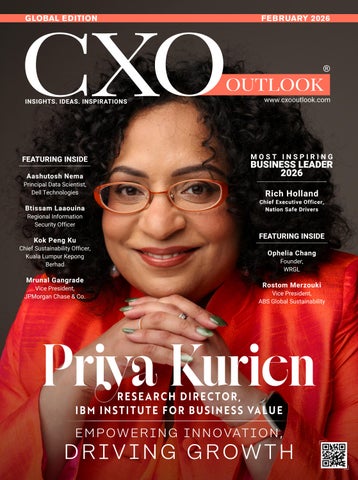
CXO Outlook – February 2026

Page 1


INSIGHTS. IDEAS. INSPIRATIONS

FEATURING INSIDE

Aashutosh Nema

Principal Data Scientist, Dell Technologies

Btissam Laaouina Regional Information Security Officer

Kok Peng Ku Chief Sustainability Officer, Kuala Lumpur Kepong Berhad

Mrunal Gangrade Vice President, JPMorgan Chase & Co.

Rich Holland Chief Executive Officer, Nation Safe Drivers

FEATURING INSIDE

Ophelia Chang Founder, WRGL

Rostom Merzouki Vice President, ABS Global Sustainability

February 2026

Creative Consultants

Charlie Jameson

Louis Bernard

Managing Editor

Sarath Shyam

Branding & Marketing Partnerships

Jennifer Anderson

Monica Davis

Jessica Edword

Consultant Editors

Dr. John Andrews

Emma James

Andrew Scott

Sabrina Samson

Editorial Enquiry admin@cxooutlook.com

Naomi Wilson

Stanly Lui

Steve Hope

Keith Alexander

Anna Elza

Stephen Donnell

Susan Miller

Partnerships Enquiry admin@cxooutlook.com

Asia-Pacific International Partnerships admin@cxooutlook.com

CXO Outlook www.cxooutlook.com is a global knowledge sharing digital platform published by Connecta Innovation Private Limited. All rights reserved. The opinions expressed in the content and pictures provided are those of the authors. They do not purport to reflect the opinions or views of Connecta Innovation Private Limited or any of its members and we do not assume any responsibility. The publisher does not assume any responsibility for the advertisements, its content, pictures, and all representation of warranties made in such advertisements are those of the advertisers and not of the publisher. CXO Outlook www.cxooutlook.com is a Free Subscription and Free-to-read digital platform strictly not for sale and has to be strictly for internal private use only. Publisher does not assume any responsibility arising out of anyone modifying content and pictures, printing a copy of this digital platform in any format and in any country and all matters related to that.

Blueprints for Intelligence

There was a time when new technology arrived like a shiny appliance. We plugged it in, trained a few people, and hoped for efficiency. That era is over. Intelligence is no longer something we install. It is something we design for.

In recent conversations with business leaders, one theme keeps surfacing: AI is everywhere, yet value is uneven. Studies show that while most organizations are experimenting with AI, only a fraction are scaling it across the enterprise. The challenge is not access to tools. It is architecture. How do we build companies where intelligence flows naturally through workflows, shapes customer journeys, and strengthens decision-making without eroding trust or values?

Designing the intelligent enterprise requires more than technical upgrades. It demands clarity in governance, discipline in data practices, investment in talent, and above all, a culture

that respects both innovation and responsibility. Institutions that endure have always understood this balance. They adapt to the future without abandoning their core.

This month’s cover story brings that philosophy to life. In our exclusive interview, Priya Kurien, Research Director at the IBM Institute for Business Value, shares how generative AI is moving from experimentation

to enterprise scale. With more than two decades of experience across telecom and hightech, she offers a grounded perspective on translating emerging technologies into measurable outcomes. Her work, including industry applications of IBM’s watsonx in areas such as customer care and network operations, reflects a practical truth: intelligence must be embedded, not bolted on.

Beyond our cover, this issue of CXO Outlook features diverse voices examining leadership, strategy, and the evolving responsibilities of today’s executives. Each piece, in its own way, explores how organizations can grow with intention in a rapidly shifting landscape.

The intelligent enterprise is not a distant vision. It is being built now, decision by decision. I invite you to explore this issue with curiosity and conviction. The blueprint for the future is in your hands.

Enjoy Reading.

Priya Kurien

Rostom Merzouki, Vice President, ABS Global Sustainability Building Sustainable Pathways for the Next Era of Energy and Infrastructure

Chief Executive Officer, Nation Safe Drivers Rich Holland

Building the Discipline That Powers What Matters in Real Moments

EXPERT OPINION

Speed vs. Strategy: The Real Battle in Cybersecurity Today

Btissam Laaouina, Regional Information Security Officer

Mentorship as Governance: Building Inclusive Boards from the Ground Up

Ophelia Chang, Founder, WRGL

28

Beyond Accuracy: Why the Future of AI Will Be Judged by Explainability

34 Mrunal Gangrade, VP, JPMorgan Chase & Co.

38

Prompt Engineering for Agentic Systems: What Works at Scale

46

Aashutosh Nema, Principal Data Scientist, Dell Technologies

Priya Kurien

RESEARCH DIRECTOR, IBM INSTITUTE FOR BUSINESS VALUE

EMPOWERING INNOVATION,

DRIVING GROWTH

Priya Kurien is a globally recognized leader in digital transformation and generative AI, with over 25 years of experience driving innovation and commercial success across the telecom and high-tech sectors. She is Research Director at the IBM Institute for Business Value, where she shapes cross-industry thought leadership and works with C-suite leaders to translate emerging technologies into measurable business outcomes. Her work has accelerated adoption of AI, including IBM’s watsonx, in industry-specific use cases such as customer care and network operations. A prolific author, speaker, and university guest lecturer, Priya has presented at major industry events including MWC Barcelona and CES.

Recently, in an exclusive interview with CXO Outlook Magazine, Priya shared insights into her passion for driving innovation and growth in technology. In the next 5 years, Priya sees generative AI transforming industries and business models, with AI poised to be a major growth engine. She also shared her personal hobbies and interests, future plans, words of wisdom, and much more. The following excerpts are taken from the interview.

Hi Priya. What sparked your passion for driving innovation and growth in technology, and how did you develop your expertise in this area?

I’ve been fortunate to work with emerging technologies from the very start of my career One thing that became very clear early on is that technology is most powerful when it is applied with purpose. I’ve always believed innovation only matters when it solves real business problems. That mindset has stayed with me throughout my career. It’s never about having the coolest technology -- it’s about how effectively you use it to create value.

My background is in electronics and telecommunications engineering, but my career has been shaped at the intersection of strategy and execution—working across global organizations to help enterprises adopt new technologies in ways that drive growth, resilience, and competitive advantage. Over time, this gave me a very practical perspective: innovation only matters when it translates into outcomes leaders can act on.

Today, as a Research Director at the IBM Institute for Business Value (IBV), I bring that same approach to thought leadership— combining rigorous research with real-world experience to help C-suite leaders turn complex technology shifts, including generative AI, into confident decisions and measurable business impact.

What do you love the most about your current role?

What I love most is the opportunity to influence important dialogue in a responsible way. At the IBM Institute for Business Value (IBV)—IBM’s

global thought leadership division—I get to shape research that informs executive decisions, and I get to do that with a team that is deeply committed to rigor, relevance, and real-world outcomes.

I also enjoy the full lifecycle of the work: spotting early signals, pressure-testing ideas with leaders, building evidence, and then turning insights into a narrative that resonates inside boardrooms across industries and into markets. Experiencing that journey “from idea to impact” is incredibly energizing.

And finally, I enjoy that IBV is a bridge: it opens the door to executive conversations that many technology teams struggle to access. That bridge-building—turning insight into relationships, and relationships into action—is where I do my best work.

How

do you see generative AI transforming industries and business models in the next 5 years?

We’re seeing a real shift in how businesses are using AI to compete, with AI poised to be a major growth engine over the next several years. Our latest IBM Institute for Business Value research shows that businesses are making significant investments in AI -- C-suite executives predict AI investments will increase by 150% between now and 2030, and, nearly 80% believe AI will significantly contribute to revenue by then. What’s changing is that AI is not just about efficiency anymore. Over the next five years, generative AI will move from “assistive” to agentic—from copilots that help individuals, to systems that can orchestrate end-to-end workflows across functions. That shift will reshape operating models, not just

productivity. We’ll see organizations compete on how intelligently they operate, not only what they sell.

Business models will evolve in three important ways. First, companies will monetize outcomes rather than effort—AIenabled services priced to results. Second, ecosystems will matter more: growth will come from partnerships that combine data, domain expertise, and trusted AI platforms. Third, trust becomes a differentiator: leaders will invest heavily in governance, security, and resilience because the cost of unmanaged AI risk will be reputational, regulatory, and financial.

My optimistic view: GenAI will reward the companies that pair ambition with discipline— those willing to reinvent workflows and build the guardrails that make innovation sustainable.

What are the key skills technology professionals need to develop to lead in a rapidly changing landscape?

These are the three skills that I see as important for technology professionals. Business fluency + big picture thinking. The ability to understand how technology choices affect the business model —and to see clearly how decisions impacts customers, day-to-day operations, risk, and company culture. AI-era craft. Go beyond just “prompting,” but understanding how AI works, the data, model behavior, workflow orchestration and how to oversee it responsibly— especially as AI becomes embedded into core processes. Know when to rely on it, and when to rely on your own experience and common sense rather than blindly following instructions. Leadership through storytelling + human-AI collaboration. Leaders who win are the ones

My optimistic view: GenAI will reward the companies that pair ambition with discipline— those willing to reinvent workflows and build the guardrails that make innovation sustainable

who can turn complexity into clarity—using strong communication and storytelling to build trust and guide others through change. And today, that includes working confidently with AI. Combining human strengths like judgment, creativity, and problem-solving with AI’s speed and insight leads to better decisions, clearer messaging, and faster outcomes. Adopt a growth mindset: IBM has always been a skillsfirst company, and that mindset matters more than ever in the AI era. In fact, our research found that 67% of executives believe mindset

will matter more than skills as work continues to change- mindset is the true differentiator.

What's a favorite way to start your day?

A couple of cups of strong coffee and a chat with my husband is my morning ritual. It’s a small but grounding moment before the day accelerates — time to think, exchange ideas, and mentally map what truly deserves attention. That pause helps me move into the day focused and intentional, rather than reactive.

What are some of your passions outside of work? What do you like to do in your time off?

Outside of work, I’m drawn to creative, handson pursuits that reward patience and precision. I practice Ikebana, the Japanese art of flower arrangement, which I love for its balance of structure and intuition. I’m also restoring my Arts & Crafts garden, reconnecting with craftsmanship, nature, and timeless design principles.

More recently, I’ve started exploring Cloisonné, which has been a fascinating exercise in discipline, creativity, and attention to detail. These practices may look far removed from technology, but for me they’re deeply connected — they reinforce the same principles I value in my work: creativity, thoughtful composition, respect for materials, and the idea that enduring impact comes from care and intentionality.

What's a favorite quote or mantra that guides you in your work?

A quote that’s stayed with me is the one by Abraham Maslow “In any given moment we have two options: to step forward into growth

or step back into safety.” It’s a reminder that progress—personally and professionally— usually lives just beyond comfort. It also captures how I approach innovation: with courage, curiosity, and accountability.

Where do you see yourself in the next 5 years?

In five years, I see myself expanding the work I’m focused on today: helping shape executive

agendas at the intersection of emerging technology and business transformation— and doing it in a way that strengthens trust, measurable outcomes, and global relevance.

I want to continue building platforms for impact: influential research, high-value C-suite engagement, and partnerships that turn thought leadership into action. And I’d like to deepen my work on responsible, industry-specific AI adoption—helping leaders move from experimentation to long-term advantage.

Most importantly, I aim to keep growing as a leader who develops others—because the strongest legacy isn’t a single report or idea, it’s the leaders you help shape along the way.

What advice would you give to professionals looking to make an impact in technology and innovation?

At the IBM Institute for Business Value (IBV)—IBM’s global thought leadership division—I get to shape research that informs executive decisions, and I get to do that with a team that is deeply committed to rigor, relevance, and real‑world outcomes

First: fall in love with the problem, not the tool. Technology changes fast; enduring careers are built on solving meaningful problems and delivering outcomes.

Second: develop range and depth. Build T- shaped expertise—deep capability in one domain, plus the ability to collaborate across disciplines (product, data, security, design, operations).

Third: learn to communicate like a leader. If you can’t explain value in plain language, you can’t scale adoption. Storytelling backed by evidence is a career accelerant.

Finally: be visible and generous. Publish, speak, mentor, and contribute to communities. Eminence comes from consistency—showing up with insight, credibility, and a point of view that helps others move forward.

Building Sustainable Pathways for the Next Era of Energy and Infrastructure

Looking back over your career, what pivotal moment or role gave you the greatest growth and how did that shape your current approach ABS?

My growth has been shaped by a progression of diverse roles rather than a single pivotal moment. Sailing on gas carriers taught me practical problem-solving and team leadership across cultures. As a class surveyor and auditor,

I gained deep understanding of regulations, construction, and management systems. Ship management roles added a commercial lens to asset operations and investments. Leading gas development at ABS positioned me to help influence the global marine gas segment. Today, my sustainability role builds on that foundation, driving efficiency and enabling new markets like hydrogen and carbon across the value chain.

Rostom Merzouki is the Vice President of Sustainability for the American Bureau of Shipping (ABS). His team is responsible for developing, implementing, and overseeing ABS’ sustainability strategy and initiatives. This critical role helps ensure that ABS operates responsibly and is positively contributing to the maritime industry while carrying out the company’s safety mission.

With over 30 years of experience in the marine industry, Merzouki has established a distinguished career that spans sailing, engineering, project management, and vessel management. He finished his sailing career with Maersk as a Chief Engineer after serving on gas carriers, FGSOs, tankers, OSVs, and PSVs.

In an exclusive conversation with CXO Outlook, Merzouki talks about the realities of leading sustainability in a world that must balance ambition with practicality. He shares candid insights on the energy transition in Asia Pacific, decarbonization affordability, energy security and why sustainability has moved from the sidelines to the heart of business strategy. Below are the excerpts of the interview.

Companies that embed sustainability into their strategy can gain a competitive edge, reduce risk, and unlock new market opportunities

Curiosity drives continuous learning and openness to new ideas, which I translate into fostering innovation within my teams

The energy-infrastructure landscape in Asia-Pacific is rapidly evolving. What are the most significant road-blocks you face today when delivering largescale services projects and how are you addressing them?

The biggest challenge is balancing energy availability and affordability with ambitious decarbonization regulations and practical realities. We address this by promoting a pragmatic transition leveraging proven solutions like LNG and carbon capture to cut emissions while helping to ensure reliable, costeffective energy and supporting development of alternative fuel technologies. At the same time, we work with stakeholders to align operational needs with regulations, enabling progress toward sustainability without compromising energy security.

Sustainability is no longer a side topic; it’s becoming a core business imperative. How do you view the relationship between sustainability, competitiveness and long-term resilience in your business?

Companies that embed sustainability into their strategy can gain a competitive edge, reduce

risk, and unlock new market opportunities. It can strengthen resilience by preparing businesses for regulatory shifts and resource constraints.

For example, in the maritime sector, integrating sustainability through energy efficiency technologies, alternative fuels like LNG or methanol, and carbon reduction strategies can help ensure compliance with IMO decarbonization targets and potentially reduce operating cost, opening doors to new business models.

Emerging technologies like AI, digital twins, advanced analytics and new-fuel systems are altering how infrastructure is built and operated. How are such technologies influencing your work and what opportunities excite you most?

AI and digital twins are game changers in the maritime sector. They help us to predict failures before they occur, optimize maintenance schedules, and reduce downtime, improving safety and efficiency. These technologies also enable testing in a safe virtual environment, helping us model the impact of new fuels and systems without

operational risk. What excites me most is moving from reactive to proactive asset management, using data-driven insights to enhance reliability and reduce costs. Looking ahead, integrating these tools with emerging solutions like hydrogen propulsion and carbon capture will support the industry’s transition to a cleaner, more resilient future.

As a leader overseeing a complex regional services business, what leadership behaviours or decisions do you believe have made the most difference in your success especially in making teams agile, responsive and future-ready?

The most impactful leadership behaviors for me have been setting a clear vision, empowering teams to make decisions, and fostering adaptability. I prioritize open communication, collaboration, and continuous learning to keep teams agile and ready for future challenges. Leveraging datadriven insights and embracing innovation enables us to respond quickly to change while staying aligned with long-term goals.

Outside the boardroom and project site, what personal values or life lessons guide you and how do those translate into your professional life or mentoring others?

The values that guide me most are integrity, curiosity, and respect for people. Integrity ensures I make decisions that are transparent and principled, even under pressure.

Curiosity drives continuous learning and openness to new ideas, which I translate into fostering innovation within my teams. Respect for people means valuing diversity and creating an environment where everyone feels empowered to contribute. These principles shape how I lead and mentor by modeling accountability, encouraging growth, and building trust.

For young professionals entering the energy or infrastructure sector today, what one or two pieces of advice would you give them to prepare for the coming decade of transition?

First, embrace continuous learning and adaptability. The energy and infrastructure sectors are evolving rapidly with emissions reduction, digitalization, and technologies like AI and digital twins. Building digital skills and staying curious will be critical to thrive in this transformation.

Second, develop a sustainability mindset. Future growth will depend on sustainable practices whether through alternative fuels, carbon reduction strategies, or efficiency improvements. Understanding the link between sustainability, competitiveness, and resilience will position you as a future professional.

Looking ahead, opportunities in hydrogen, carbon capture, advanced analytics, and virtual testing environments will redefine how we design and operate marine assets. Those who combine technical expertise with a commitment to sustainability will lead the next decade of transition.

MOST INSPIRING BUSINESS LEADER 2026

Rich Holland

CHIEF EXECUTIVE OFFICER, NATION SAFE DRIVERS

BUILDING THE DISCIPLINE THAT POWERS WHAT MATTERS IN REAL MOMENTS

Rich Holland’s leadership rhythm is set early. By 6:45 a.m., he is already in the office, and before most workdays fully begin, the tone for the organization has been set. Short, focused stand-up meetings happen by 9:00 a.m., bringing together key teams around one clear question, what must be accomplished today. For Holland, alignment is not a quarterly exercise or a slide in a board deck. It is a daily discipline. “Alignment happens daily, not quarterly,” he says.

That discipline extends beyond the morning hours. Holland is a firm believer in transparency, fact-based decisions, and the

practical wisdom of the Pareto principle. Each day closes with reflection. What was planned. What actually happened. What the team learned in the process. “At the end of the day, I take time for retrospection, what we expected to accomplish, what happened, and what we learned,” he explains. The habit is simple, but powerful. It creates a culture where execution improves through honesty, not excuses, and where progress is measured by learning as much as outcomes.

At its core, Nation Safe Drivers (NSD) exists to help motorists manage risk and find support when it matters most. The company operates through two complementary divisions.

One protects the financial investment drivers make in their vehicles through insurancerelated products. The other provides roadside assistance when mechanical failures bring uncertainty and stress. Together, they reflect the meaning behind the company’s name. National in reach. Focused on safety, both financial and physical. And deeply centered on the driver. As Holland puts it, the mission is straightforward, to be there when people need help and to make sure they can keep moving forward.

That clarity of purpose is guiding NSD into its next chapter. With more than six decades of experience, a national service network, and strong in-house technology capabilities, the company is evolving from a legacy industry leader into a platform-led organization built for the future. Recent investments in innovation, partnerships, culture, and a refreshed brand identity signal that shift. Guided by Mission 2030, Holland is focused on growing the business responsibly while ensuring no motorist is left behind. It is a long-term view, rooted in execution today and designed to keep people moving, financially, physically, and emotionally, for decades to come.

The Pause That Refined the Playbook

Every leader can point to moments that quietly change how they see the world. For Holland, three such moments stand out and continue to shape how he leads today. “The first was founding a business. The second was selling that business. And the third was what came after,” he recalls. When the company was sold, Holland stepped away from day-to-day work, effectively retired, and allowed himself something most leaders rarely get, time to think.

That pause was not about celebrating success. It was about honest reflection. Distance from the noise of operations gave him clarity. He examined what had worked, what had not, and which habits he would never repeat. That period became the foundation of a personal leadership playbook, shaped less by theory and more by lived experience. When he returned to the workforce, he carried those lessons with intention.

Guided by Mission 2030, Holland is focused on growing the business responsibly while ensuring no motorist is left behind

When he stepped into NSD, Holland did not arrive with a prewritten script or a rush to impose change. Instead, he treated the early days as a listening exercise. The first hundred days were spent in deep immersion, understanding the people, the culture, and the unwritten rules that shaped how work truly happened. “Early on, you don’t know what you don’t know. So immersion is critical,” he says. Ideas formed naturally, but they were tested carefully,

separating assumptions from bias, and instinct from evidence.

What Holland was searching for was not what to fix, but what to protect. NSD carried decades of industry experience, and that legacy mattered. Honoring it meant identifying the strengths the company had built over time and ensuring they were preserved. At the same time, he recognized that longevity can quietly harden routines that no longer serve the future.

At NSD, digital investment has been guided by a simple belief, tools should make it easier for people to do their jobs well, not distance them from the customer

Growth required discernment, knowing which practices still fueled progress and which had been outgrown.

The result has been a deliberate cultural shift. Holland’s focus has been on building a more entrepreneurial, more urgent, and more forward-looking organization, without erasing its past. “We often say we want to think of ourselves as a startup with a really big head start,” he explains. It is a simple idea with real weight. Respect what history has taught you, but never let it slow your pace. That balance, between experience and momentum, sets the stage for how NSD is being shaped for what comes next.

Technology with a Human Purpose

For Holland, technology is not a replacement for people. It is a multiplier. At NSD, digital investment has been guided by a simple belief, tools should make it easier for people to do their jobs well, not distance them from the customer. “I don’t believe technology replaces the human element. But it absolutely enables people to do their work more effectively and efficiently,” Holland says. That philosophy has guided how NSD approaches modernization, with a clear focus on outcomes that matter in real moments.

Since Holland took the helm, the company has made several large-scale technology investments that have reshaped how it serves the market. One of the most critical priorities has been reducing the time it takes to secure a roadside provider and move motorists to safety. In high-stress situations, minutes matter. At the same time, customers have been given greater autonomy through digital tools, while leaders across the organization now have real-

time visibility into execution. “Knowledge empowers better decisions,” Holland pinpoints.

Those capabilities extend beyond customers to the relationships that sustain the company’s ecosystem. Dealer relationships and service networks sit at the center of NSD’s operating model, and Holland led a fundamental shift in how those relationships are viewed. Vendors became partners. The change was more than semantic. For dealers and agents, it meant solutions designed to help them grow their businesses and serve customers more effectively, supported by strong operational, compliance, and technology infrastructure that removes friction rather than creating it.

Trust within the service network is built differently. It comes from consistency, communication, and respect. NSD recognizes performance, stays engaged, and moved early to faster, per-event payments so partners are compensated quickly and fairly. The company invests heavily in communication, recognition, loyalty programs, and cultural engagement, understanding that these partners are often the first and only human interaction a motorist has in a moment of need. Today, nearly 50,000 partners represent the face of the brand, and Holland treats that responsibility with seriousness.

Preparation is another quiet pillar of performance. NSD spends significant time planning for scenarios it hopes never occur. That discipline was tested when an international telephony provider experienced an incident. The team transitioned to a backup solution quickly, and from the customer’s perspective, the disruption was barely noticeable. Headquartered in South Florida, the company also maintains robust disaster recovery plans for hurricanes and

other events. “We rehearse situations we hope never happen. I’d rather be overprepared than surprised,” Holland says. It is a mindset that blends operational rigor with calm leadership, and it sets the foundation for resilience as the organization continues to grow.

Building Momentum That Lasts

As NSD continues its modernization journey, the impact is felt on two levels. The first is practical. Teams across the organization now have better tools, clearer processes, and modern technology designed to remove friction from daily work. The second is cultural, and it runs deeper. Accountability is no longer abstract. It is anchored in a shared belief that progress starts with ownership. “On any problem, assume it’s us,” Holland says. That simple principle has restructured how challenges are addressed, creating a culture where responsibility leads to learning and improvement rather than blame.

For years, NSD operated quietly in the background, supporting millions of motorists without much public recognition. It was one of the industry’s best-kept secrets. As the company evolved, Holland saw a disconnect between the impact of the work and how the organization was perceived. The brand no longer reflected who NSD had become or where it was headed. That realization led to a new identity, a refreshed digital presence, and a clearer expression of purpose. The rebrand was not cosmetic. It was a

At the center of that intent is movement. NSD powers what moves people, financially, physically, and emotionally, especially in moments when uncertainty sets in. Whether a driver is stranded on the side of the road or protecting one of their most significant investments, the company’s work shows up in real, human situations. As Holland explains, the shift is about direction, not appearance. It is about moving beyond the past and stepping into the future with clarity, while ensuring no motorist is

That future is already reshaping the business. Electric vehicle adoption is no longer theoretical, and it brings new operational realities. Service providers must be equipped with the right capabilities, from flatbeds to evolving solutions for modern vehicles that often lack spare tires. Customer expectations have changed as well. People now expect to manage their experience digitally, often from their phone, with transparency and ease. NSD’s response has been to stay in step with those expectations, and in many cases, ahead of them, through continued investment in connected technology and customer-focused design. What energizes Holland most is not any single initiative, but the system being built

around them. “Everything ties back to Mission 2030,” he says. The goal is ambitious, to double the size of the business while doing things the right way. That means operating smarter, removing friction, and creating environments where people and partners can perform at their best. Movement, in this sense, is internal as much as external.

When Mission 2030 shows up naturally in one-on-one conversations, quarterly reviews, and customer discussions, Holland sees it as proof that the momentum is real. It signals a company aligned around purpose and direction. At NSD, movement is not just what the organization delivers. It is how it thinks, acts, and builds for the road ahead.

Speed vs. Strategy: The Real Battle in Cybersecurity Today

Technology is moving forward fast. The big question now is not if we will have a cyberattack. When it will happen. Cyber threats are getting bigger and more complicated. This is one of the problems we have to deal with today. Governments have to worry about people attacking systems. Businesses are dealing with people breaking into their computers and losing money. People are also being targeted by criminals who want to steal their identity and trick them into doing things they should not do. Cyber threats are a concern and cyberattacks are a big problem. From people hacking into hospital computers to fake emails that steal our personal and financial information cybercrime is everywhere and it just keeps happening. This means that stopping cybercrime is not a job, for computer experts anymore it is something that we all need to think about. So people are

still trying to figure out what is the way to keep our computers and information safe. Is it better to act or to have a good plan when it comes to cybersecurity?

On one side of the debate is speed. Speed is really important when it comes to cybersecurity. The thing is, time is very important. If you can find out about a problem and fix it and stop it from getting worse that is a big deal. It can make a difference. If you respond to a problem you can stop it from spreading to other parts of your network. You can also keep from losing a lot of data and your systems will not be down for long. In some areas like healthcare or energy or transportation speed is everything. It can be the difference between things keeping going like normal and something bad happening. Speed, in cybersecurity is crucial. If someone who wants to do things gets into our system and we do not

Btissam Laaouina is a dynamic and accomplished cybersecurity expert with extensive experience across the transportation, cruise, automotive, and finance sectors. She holds a degree in Telecommunications Engineering and a Master’s in Digital Transformation from Polytechnic University, Italy. Additionally, she is certified as an Associate C|CISO, CISSP, CISM, and ITIL V4. Btissam is recognized for her deep expertise and unwavering commitment to cybersecurity. Named among the Top Cybersecurity Woman of the World Edition 2025, Global 40 Under 40 in Cybersecurity 2025, she is recognized as one of the most influential women in the field. Passionate about mentorship, she actively supports young women in Africa through Cybergirl, empowering them to build successful careers in cybersecurity. Fluent in Arabic, French, English, Italian, and more, she bridges cultural divides and advocates for inclusivity within the global cybersecurity community.

Speed, in cybersecurity is crucial. If someone who wants to do things gets into our system and we do not act fast they can do a lot of damage

act fast they can do a lot of damage. They can get deep into our system steal important information or stop things that we need from working. That is why companies spend a lot of money on tools that watch everything all the time systems that can find problems automatically and special teams that work on security and can act away when they find a threat.

Speed is not everything when it comes to getting things done. If you act fast without thinking it through you can make big mistakes that cost a lot. When you make decisions you might turn off important systems that do not need to be turned off. You might also think the problem is something when it is really something different.. You might miss other problems that are not easy to see. Sometimes acting fast can even make things worse of making them better. This is like a firefighter who runs into a building that's on fire, without checking the building first or finding out where the fire is coming from or picking a safe way to get in. Speed can be bad if you do not use it carefully. Urgency is really important. Being reckless is not a good idea. This makes me think about something. Are we just putting out fires when they start or are we making systems that can withstand fires in the place? We need to think about fires and how we deal with them and also think about how we can make systems that're resistant, to fires. This is where a good plan really matters. Cybersecurity is not about fixing problems as they happen but about thinking ahead and being ready. You cannot completely prevent things from happening in a world where everything is connected. So a good cybersecurity plan does not try to make everything completely safe. It is more about being prepared being able to

Cybersecurity is not about fixing problems as they happen but about thinking ahead and being ready

adapt and being able to recover from problems. Cybersecurity is about understanding what the threats are knowing what is really important to protect and deciding what level of risk is okay. When you look at cybersecurity this way it becomes something you have to work on all the time not something you fix once and forget about. Cybersecurity is a process that keeps going on and, on.

To stay safe companies need to take some steps. They have to keep an eye out for threats and check their systems for weaknesses. They also need to control who can access their systems and make sure they fix any problems quickly.

Employee awareness training is also crucial. This means teaching employees how to be online. Companies should also have a plan for who is in charge and what to do in case of a problem.

They need to have a plan for what to do if something goes wrong like a big attack. This plan should include backing up data and testing how to get everything back up and running.

The goal of all these security measures is to make sure that every action helps the company achieve its goals. Cyber security measures like threat intelligence and access controls are important cyber security measures are essential for a companys safety. Regular data backups and recovery testing are part of security measures they help companies get back, to normal quickly after an attack. Cyber security measures provide direction. Help companies stay safe.

You need a plan to deal with problems.. If you cannot put this plan into action quickly it is not very useful. When there is a crisis, like a cyberattack things happen fast. You do not have days to think about what to do. You have to act in minutes or hours. If you are slow your plan will not work, no matter how good it is. So the big question is not whether you should move fast or have a plan. It is about how to do both, at the time. Are companies moving quickly towards their goal. Are they just moving fast without knowing where they are going? Cyberattacks are a problem and companies need to be able to respond to them quickly. The problem is that companies need to have a plan and be able to act on it fast.

Good cybersecurity programs are the ones that do things quickly and also think about what they're doing. When you have a plan you can make decisions fast even when things are crazy. If everyone knows what to do and how to do it then they can act fast without getting confused or scared. You can use tools to help you act quickly and these tools can follow the

Cybersecurity success is not about being fast or having a good plan. It is about combining speed and strategy to get the results

rules you set so your company can respond fast but still do what is best for security in the long run. In this way doing things quickly is a part of your plan not of it. Cybersecurity programs, like this are really good because they use speed and strategy together which makes them very strong.

Cybersecurity success is not about being fast or having a good plan. It is about combining speed and strategy to get the results. When you use strategy to guide how fast you move cybersecurity is not about putting out fires as

they happen. It becomes about managing risks before they become problems. Companies are no longer just waiting for threats to appear and then dealing with them. Cybersecurity is about anticipating threats getting ready for them and bouncing back from them in a way. Cybersecurity is really, about being prepared and staying one step of the threats. In an era where cyber threats are inevitable, staying secure is less about moving faster than attackers and more about consistently staying several steps ahead.

Wa n t t o S e l l o r fi n d

I nve s t o rs f o r yo u r

B u s i n e s s ?

Beyond Accuracy: Why the Future of AI Will Be Judged by Explainability

For the past decade, artificial intelligence has often been judged by a single metric: accuracy. The higher the precision, the more impressive the system appeared. But as AI increasingly shapes financial decisions, healthcare outcomes, hiring, and public policy, accuracy alone is no longer sufficient.

Leaders must now ask deeper questions: Can we trust the AI? And can we understand why it behaves the way it does?

This is where Explainable AI (XAI) becomes essential. Explainability is not a nice-to-have feature; it is the foundation of responsible, intelligent systems.

Moving Beyond the Black Box

Many of today’s most powerful AI systems—deep neural networks, ensembles, and foundation models—operate as “black boxes.” They produce results through highly complex processes that even their creators may struggle to interpret.

This opacity creates real business challenges:

• How can executives approve decisions they cannot fully understand?

• How can customers trust outcomes they cannot interpret?

• How can organizations remain compliant in highly regulated industries?

Transparency isn’t optional; it is the cornerstone of trust. When the stakes are high, clarity is non-negotiable.

Why Explainability Matters

AI has moved from back-office automation to front-line decision-making. In finance, healthcare, and other high-impact sectors, even a model that is 99% accurate can:

• Reinforce systemic bias

• Generate false positives that disrupt services

• Complicate regulatory compliance

• Erode user confidence

Without explainability, organizations invest heavily in AI yet struggle to operationalize, govern, and trust it at scale.

Mrunal Gangrade is a Vice President at JPMorgan Chase, leading awardwinning initiatives at the intersection of artificial intelligence, cybersecurity, and data science. With over two decades of experience, she specializes in designing secure, explainable, and ethically responsible AI systems for high-impact domains including financial services and healthcare. An IEEE-published researcher and peer reviewer, she has authored and co-authored multiple papers on AI, security, and emerging technologies. Mrunal is a frequent global speaker and hackathon judge, recognized for driving innovation, governance, and real-world impact through responsible AI leadership.

Without explainability, organizations invest heavily in AI yet struggle to operationalize, govern, and trust it at scale

Explainability as a Strategic Advantage

Explainable AI delivers measurable business value:

Value Driver

Trust and adoption

Regulatory readiness

Faster problem-solving

Ethical resilience

Stronger relationships

Business Benefit

Users rely on systems they understand

Transparent models simplify audits and reviews

Errors are easier to identify and correct

Reduced risk of discrimination and unintended harm

Transparency builds credibility with customers and partners

Far from slowing innovation, explainability accelerates adoption and amplifies impact.

The Human Factor

Even the most sophisticated AI fails if people do not trust it. Employees, customers, and stakeholders need:

• Clarity on how recommendations are generated

• The ability to question or override decisions

• Confidence that outcomes are fair and consistent

Explainable AI shifts organizations from an automation-first mindset to an augmentationfirst approach, where humans and machines collaborate.

The future is not human versus machine. It is human plus machine—working together with transparency.

Designing Explainability from Day One

True explainability cannot be layered onto AI after deployment. It has to be architected into the system from the very beginning. Organizations

Explainable AI shifts organizations from an automationfirst mindset to an augmentation-first approach, where humans and machines collaborate

that embed it early build systems that scale responsibly:

• Data governance: Ensure data quality, fairness, and informed consent from the start

• Model development: Favor interpretable techniques where appropriate

• Evaluation: Measure fairness, robustness, and transparency alongside accuracy

• Deployment: Deliver explanations that are clear, contextual, and actionable

• Monitoring: Continuously detect drift, bias, and performance degradation

This “shift-left” approach ensures explainability is embedded into the AI lifecycle, not treated as an afterthought.

Regulation and Risk

Regulators worldwide are raising expectations for accountability:

• Financial institutions must justify credit, fraud, and risk decisions

• Healthcare AI must support transparent, auditable clinical reasoning

• Emerging policies across the U.S., EU, and Asia demand explainability

Explainability is no longer optional. It is expected—and enforceable. Organizations that embrace it early reduce risk while gaining a strategic advantage.

Measuring Success Differently

Accuracy remains important, but it is no longer the sole measure of success. Forward-looking leaders now track:

• Interpretability and transparency

• Bias and fairness indicators

• Model confidence and uncertainty

• User trust and adoption

• Regulatory readiness

Companies that prioritize these dimensions will stand out as responsible innovators.

From Insight to Accountability

Explainable AI is ultimately about responsibility. Leaders must ensure that:

• When a loan is denied, the reason is clear

• When medical risk is flagged, clinicians trust the recommendation

•When automation reshapes workflows, employees feel empowered—not replaced

Accountability does not constrain innovation. It makes innovation sustainable, ethical, and scalable.

The Road Ahead

As AI becomes deeply intertwined with human life, the definition of success is evolving:

• Not just Can it predict accurately?

• But Can it explain thoughtfully?

The organizations that will lead this decade are those that:

• Build AI that is understandable

• Embed fairness and ethics into design

• Empower users rather than replace them

• Consider societal impact before deployment

AI is no longer judged only by intelligence. It is judged by integrity. When decisions are explainable, they become defensible, trusted, and transformative. That is the future we must build—one where every insight has context, every decision has clarity, and every system earns the confidence of the people it serves.

Mentorship as Governance: Building Inclusive Boards from the Ground Up

“Tell me, and I forget. Teach me, and I may remember. Involve me, and I learn.”

Everyone’s heard this quote before— attributed variously to Benjamin Franklin, Confucius, or anonymous wisdom passed down through generations. But is there truth to it? In governance, the answer is a resounding yes.

The Power of Involvement

Boardrooms are complex ecosystems. They’re shaped by legacy decisions, regulatory nuance, and interpersonal dynamics. For new directors—especially those from underrepresented backgrounds—stepping into this space can feel like entering mid-chapter of a book with no index.

That’s where mentorship becomes governance.

A Buddy System in Action

At one Ontario credit union, a buddy mentorship system was introduced to support onboarding. Each new board member was paired with a seasoned director—not to shadow, but to engage. These buddies offered context, decoded acronyms, and shared the “why” behind decisions.

One mentee, a community leader new to financial services, recalled a moment during an audit committee meeting. Her buddy didn’t just explain the technical issue—they framed it: “Here’s why this matters to our members. Here’s how we’ve approached it before. And here’s what’s changed.”

That reframing turned confusion into clarity. It wasn’t just knowledge transfer—it was contextual learning. The mentee didn’t just absorb information, she began to contribute meaningfully.

Ophelia Chang is a risk and governance executive with over 15 years of experience leading enterprise-wide resilience across financial services, private equity, and technology. She currently serves as Director of Risk Management at an insurance software company, where she oversees global risk strategy, operational resilience, and regulatory oversight. She is also the Founder and Executive Director of Women in Risk & Governance Leadership (WRGL), an award-winning nonprofit advancing inclusive leadership through education and communitybuilding. Ophelia serves on multiple boards and advisory committees, bringing a cross-sector lens to governance, risk culture, and strategic oversight. Her expertise spans cybersecurity, ESG, M&A, and third-party risk, with a consistent focus on aligning risk appetite with long-term growth. She holds the CISA and CIA designations, and is ITIL-certified.

For new directors—especially those from underrepresented backgrounds—stepping into Boardrooms can feel like entering mid-chapter of a book with no index

Mentorship fosters psychological safety, encourages inquiry, and builds the trust needed to challenge assumptions and co-create solutions

Why Mentorship Works

Much of governance is still knowledge- and relationship-based. Decisions aren’t made in isolation—they’re shaped by:

Historical context

Stakeholder impact

Cultural and reputational nuance

Mentorship helps new directors connect these dots. It fosters psychological safety, encourages inquiry, and builds the trust needed to challenge assumptions and co-create solutions.

At WRGL, we’ve scaled this model nationally. Our mentor network pairs emerging leaders with seasoned professionals across risk, audit, and governance. We prioritize alignment—not just in expertise, but in values and communication style. Our programs emphasize storytelling, strategic visibility, and iterative learning—because governance isn’t static, and neither is leadership.

Conclusion

So, is there truth to the quote? Absolutely. While the author and origin may be unknown, the wisdom is timeless. Involve someone—and they learn. Involve them in governance—and they lead.

Leading Sustainability as a Strategic Growth Driver

Looking back over your professional journey, what would you say have been the most pivotal milestones and what lessons did each teach you?

I can think of three pivotal milestones. The first would be when I transitioned from managerial to leadership role as a young professional, where I was thrusted into general management which included planning, profit & loss and people management and business development. This was when I learnt to balance self-management and growth with accountability and responsibility to internal and external stakeholders. The next phase was a major shift from private sector to public sector, where what I undertook had extensive policy and fiscal implications, and it required strategic prioritisation, detailed programming, disciplined implementation, monitoring and

problem-solving, and public engagement and influencing. Finally, my current phase where I have key leadership responsibilities for sustainability, strategy and risk management is another leap that is driven by purpose, visioning and clarity of strategic focus. I would also say I hold dearly the values of integrity, empathy and curiosity throughout my professional career, which served me well through ups and downs.

Within the plantation and oleochemical industry context, what do you see as the biggest sustainability challenge today and how is your organisation positioning itself to turn that challenge into a competitive advantage?

Sustainability has been on a somewhat pendulum swing and its volatility makes planning and execution challenging. Be that as it may, the core

We have been able to move beyond the “license-to-operate” mode to one where sustainability helps to unlock value of assets and systems that form the core strengths of the organisation

Ku leads the Group's sustainability, strategy, risk, communications, investor relations, corporate responsibility, and government relations functions. He is a member of the board of governors of Roundtable for Sustainable Plam Oil (RSPO) and alternate council member of the Malaysian Palm Oil Association (MPOA). KLK is an integrated plantation company with oil palm and rubber upstream operations in Malaysia, Indonesia, and Liberia, with midstream and downstream resource-based manufacturing and property development. Prior to KLK, he held the positions of group chief strategy officer in public-listed digital enterprise - Green Packet, partner in global consultancy in public sector – PEMANDU Associates, director in the transformation unit of the Malaysian Prime Minister’s Department – PEMANDU, and regional managing director in a global communications consultancy firm - FleishmanHillard, among others. He co-authored a HBS case study on economic transformation and participated in USA’s International Visitor Leadership Programme. Ku read law and trained in post-graduate programmes in CEIBS, Shanghai and Babson College, Boston. He is a fellow of the Public Relations & Communications Association of Malaysia. In an exclusive conversation with CXO Outlook, Kok Peng Ku talks about how sustainability has evolved from a compliance requirement into a powerful engine for long-term growth, competitiveness, and resilience. The conversation explores the realities of navigating regulatory volatility, the importance of traceability and circularity across complex value chains, and how technology is enabling yield intensification and decarbonisation without expanding land use. He also shares his perspective on empathetic leadership, values-led decision-making, and why sustainability must create tangible business value to endure. Below are the excerpts of the interview.

There is growth in maturing and commercially viable technologies that are enabling us to substitute fossil energy with renewable energy, reducing costs while lowering carbon footprint at the same time

regulatory and market expectations have been steadfastly consistent and the most important consideration is how to meet these requirements while avoiding value destruction. To guide that, the vision needs to be clear and ours is sustainability as a strategic growth driver to make our organisation a trusted global partner. We do so by leveraging sustainability to create value, innovate, strengthen competitiveness and become the preferred choice for talent. In this way, we strive to live up to our purpose of enabling people, planet and business to thrive with sustainability.

In what ways is sustainability reshaping the fundamentals of longterm value creation and resilience in your company’s business model and across your value chain?

We have been able to move beyond the “license-to-operate” mode to one where sustainability helps to unlock value of assets and systems that form the core strengths of the organisation. For example, circularity which has erstwhile been an upstream best practice has morphed into, among others, energy resources that contribute to

decarbonisation and potentially for carbon sinking and credit generation. On the other hand, traceability capability acts both as a back-stop for compliance as well as a tool for competitive positioning.

Emerging technologies are reconfiguring sectors. How are you leveraging technology in your sustainability agenda, and where do you see the biggest opportunity in your field?

Our biggest opportunity is to leverage technology to aid yield intensification, delivering more from the same land resource while eliminating the need for greenfield development. This ranges from digital mapping, LIDAR and remote sensing to harvesting management system and mechanisation to improve yield systematically. At the same time, there is growth in maturing and commercially viable technologies that are enabling us to substitute fossil energy with renewable energy, reducing costs while lowering carbon footprint at the same time.

As a leader, how do you define your leadership style in driving change that often requires shifting culture, mindset and operations? Could you share one achievement that you are particularly proud of in this regard? There is no single formula. Situational leadership is required but always exercised with empathy. I encourage collaboration but ultimately, decisions have to be taken and driven through once the consultative

process is completed. I believe in business partnership; there is no better way to influence than to demonstrate value creation. One such example would be the transformation of our supply chain management that encapsulates efficient and effective supplier and customer engagements and includes EUDR readiness.

Outside the boardroom and industrial site, what personal values or interests guide you? How do you recharge, and how do these personal commitments inform your work in sustainability?

I believe that living transcends the self and service is a personal responsibility. I walk the spiritual path which guides me consciously to be mindful and present to people and situations. This brings about the realisation that sustainability is about interdependence, interconnection and inseparability; all sentient beings and environment are in fact, one.

For young professionals entering the sustainability or corporateresponsibility space today, what advice would you offer and what mindset or skillset will serve them best in the coming years?

Assuming adequate material conditions are met, which is important, I would encourage young talents to prioritise growth. It is important to appreciate that no one can know everything and there will always be room to learn and improve. This humility will anchor progress and achievement, and hopefully in a way that transcends the self.

Prompt Engineering for Agentic Systems: What Works at Scale

For the past two years, prompt engineering has often been treated like a clever craft. Developers refined phrasing, added examples, tweaked settings, and reported incremental gains in answer quality. That approach was sufficient when AI systems primarily responded to questions inside chat interfaces or LLM workflows.

It is no longer sufficient when AI systems begin to plan, reason, and act - in other words, when they become agentic.

These systems don’t just respond - they plan, clarify, retrieve information, escalate issues, and trigger workflows. In this environment, prompts are no longer simple instructions. They quietly shape how systems think, decide, and behave.

At enterprise scale, prompt engineering is not about better wording. It is about designing reliable behavior.

1. Prompts as a Strategic Function

Treating prompts as a strategic function means recognizing that they shape how AI is allowed

to think, decide, and act - and therefore how business outcomes are influenced.

In agentic environments, prompts do more than establish boundaries. They influence how tasks are decomposed, how tools are selected, how state transitions occur, and how decisions are communicated across workflows. They define what actions are permissible, when escalation is required, how confidence should be expressed, and what outputs must look like. They influence whether a system proceeds cautiously or aggressively, autonomously or with human oversight.

When AI systems influence workflows and outcomes, prompts encode authority, acceptable risk levels, coordination logic, and operational constraints. They shape how the system interacts with other components - retrieval layers, tools, APIs, and human reviewers. They function less like instructions and more like embedded operating policy.

This is the architectural shift. Prompting is no longer an experimentation tactic. It becomes

Aashutosh Nema is a Principal Data Scientist at Dell Technologies, where he leads the design and scaling of agentic AI systems, including Dell’s Next Best Action recommender engine. His work focuses on building reliable AI systems that operate within real enterprise constraints - performance, governance, and scale. He has presented his research through academic papers and applied AI forums, including Berkeley’s Agentic AI Summit. His work at Dell has earned industry recognition from TSIA and has been featured in major technology media.

Treating prompts as a strategic function means recognizing that they shape how AI is allowed to think, decide, and actand therefore how business outcomes are influenced

part of how the system works and how decisions are shaped at scale.

2. It Must Be Multi-Objective and Iterative

Most prompt engineering efforts begin with a simple question: “Is the answer correct?”

Accuracy matters - but in agentic systems, it is only one dimension of performance.

An answer can be technically correct and still:

Trigger unnecessary actions

Increase resolution time

Escalate prematurely

Sound overly confident

Inflate infrastructure cost

In our work on Multi-Objective Directional Prompting (MODP), and learnings drawn from

enterprise agentic deployments such as Dell’s Next Best Action systems, one pattern becomes clear: every AI call serves multiple goals at once.

Effective prompting must balance reasoning quality, clarity, calibrated confidence, efficiency, and cost awareness simultaneously.

Improving one dimension in isolation can quietly degrade another. Deeper reasoning may increase latency. Reduced escalation may increase risk exposure. Added context may inflate cost.

That is why prompt refinement must be iterative and balanced. Teams define what reliable behavior looks like, measure across multiple dimensions, adjust the prompt, and validate again. Over time, this creates stability - not just isolated gains.

Effective prompting must balance reasoning quality, clarity, calibrated confidence, efficiency, and cost awareness simultaneously

Prompting at scale is not about chasing accuracy. It is about sustaining balanced performance.

3. Memory Shapes Behavior Over Time

Agentic systems do not operate in a single moment. They accumulate context as they execute a workflow and across successive iterations of that workflow.

What gets remembered, what gets summarized, and what gets discarded influences future decisions. Memory is not passive storage - it actively shapes behavior.

If memory grows unchecked, systems slow down. If irrelevant details are retained, reasoning quality declines. If critical signals are lost, reliability suffers. Over time, drift becomes harder to diagnose.

Memory discipline is therefore part of prompt strategy.

These decisions require intentional ownership and deliberate design:

What information is worth remembering?

What should be summarized?

What should be removed?

How is behavioral drift detected and corrected?

Long-term reliability depends as much on disciplined memory governance as on initial prompt quality.

4. Context Shapes Decisions in the Moment

Prompts never operate alone. They operate in synergy with context.

You can think of them as interlocking puzzle pieces. The prompt defines the shape of the reasoning. The context must fit that shape. If

either piece is misaligned, the overall picture becomes distorted.

Every AI call runs within a limited window of information. What gets included in that window - and how it is organized - directly affects reasoning stability, confidence calibration, cost, and determinism.

Many times a “prompt failure” is actually a context failure.

If irrelevant information dominates, the system becomes noisy and expensive. If critical data is buried, reasoning quality declines. If sources are poorly prioritized, confidence becomes unreliable.

Effective prompting therefore requires disciplined context design. The prompt sets behavioral expectations. The context defines the informational environment in which those expectations operate. The two must be designed together.

Context must also be deliberately blended and guardrailed - not only for safety, but for relevance, efficiency, and clarity. Information should be filtered, prioritized, abstracted, or transformed before entering the model’s reasoning window so that the system focuses on signal rather than noise. What the system is allowed to see directly shapes not just what it may expose, but how effectively and efficiently it can reason and act.

At scale, predictability depends on this alignment.

5. Prompts Are Part of the Production Stack

At enterprise scale, prompts cannot live as freeform text inside notebooks or scattered across experimentation environments. They must be

What works at scale in prompt engineering goes beyond isolated refinement - it is Purposeful Design, Systems Thinking, and Measured Tradeoffs

integrated into the production stack with the same rigor as other system components.

That means prompts need to be:

Versioned

API-controlled

Tied to clearly defined inputs

Designed with structured, validated outputs

Rollback-capable

Monitored for behavioral drift

Enterprise workflows depend on predictable contracts. When inputs and outputs are structured and validated, behavior becomes testable, measurable, and governable.

Free-form prompting may work in experimentation. Structured prompting enables orchestration, reliability, and scale.

Without production discipline, small wording changes can silently alter system behavior in meaningful ways. With it, prompting becomes stable, observable, and operationally mature.

Conclusion: What Works at Scale

What works at scale in prompt engineering goes beyond isolated refinement - it is Purposeful Design, Systems Thinking, and Measured Tradeoffs.

Purposeful design treats prompts as strategic control points rather than isolated text. Systems thinking ensures memory, context, and production integration are aligned rather than optimized independently. Measured tradeoffs make behavior visible across consistency, confidence, autonomy, cost, and stability.

In the agentic era, prompt engineering becomes foundational to intelligent systems themselves. It moves beyond phrasing into a disciplined practice of designing, orchestrating, and governing AI behavior with clarity, alignment, and operational intent at scale.

Turn static files into dynamic content formats.

Create a flipbook