GLOBAL EDITION
AUGUST 2026
INSIGHTS. IDEAS. INSPIRATIONS
FEATURING INSIDE
FEATURING INSIDE
Brad Maruca
Sergey Tairyan
Managing Director, Deloitte
Dimple Thakkar
Co-Founder, PradimeAI Advisory, Former Head of Data for AI, ML -CCB, JPMorganChase
Emma Sopadjieva Head of Customer Experience Strategy, Samsara
CISO, Technology Management Center of Yerevan City
Vinicio Chaves
Alvarado CISO, Cooperativa de Productores de Leche R.L Dos Pinos 1
Zeljko Ivkovic CIO, ISS A/S
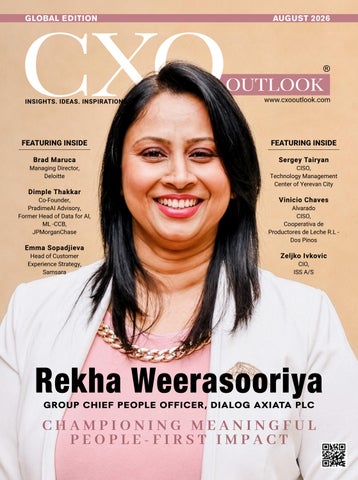
Rekha Weerasooriya GROUP CHIEF PEOPLE OFFICER, DIALOG AXIATA PLC
CHAMPIONING MEANINGFUL PEOPLE-FIRST IMPACT CXO OUTLOOK August 2026
2
CXO OUTLOOK August 2026
3
CXO OUTLOOK August 2026
August 2026
Vol - 7
Issue - 8
Managing Editor Sarath Shyam Creative Consultants Charlie Jameson Louis Bernard
Branding & Marketing Partnerships Jennifer Anderson Anna Elza Monica Davis Stephen Donnell Jessica Edword Susan Miller
Consultant Editors Dr. John Andrews Naomi Wilson Emma James Stanly Lui Andrew Scott Steve Hope Sabrina Samson Keith Alexander Editorial Enquiry admin@cxooutlook.com
Partnerships Enquiry admin@cxooutlook.com
4 For Free Subscription
International Partnerships Free Subscription www.cxooutlook.com
Americas Europe Middle East & Africa Asia-Pacific
admin@cxooutlook.com
Follow Us On
www.linkedin.com/company/ cxooutlook www.facebook.com/ CXOOutlook
CXO Outlook www.cxooutlook.com is a global knowledge sharing digital platform published by Connecta Innovation Private Limited. All rights reserved. The opinions expressed in the content and pictures provided are those of the authors. They do not purport to reflect the opinions or views of Connecta Innovation Private Limited or any of its members and we do not assume any responsibility. The publisher does not assume any responsibility for the advertisements, its content, pictures, and all representation of warranties made in such advertisements are those of the advertisers and not of the publisher. CXO Outlook www.cxooutlook.com is a Free Subscription and Free-to-read digital platform strictly not for sale and has to be strictly for internal private use only. Publisher does not assume any responsibility arising out of anyone modifying content and pictures, printingCXO a copy of this digital platform in any format and in any country and all matters related to that. OUTLOOK August 2026
LETTER FROM THE EDITOR
When Change Meets the Human Being
T
ransformation rarely fails because the technology is not good enough. More often, it falters because people are not ready to embrace what the technology demands of them. Every organization has experienced this in some form. A new system is introduced, a new strategy is announced, or a new way of working is rolled out with great enthusiasm. Then, somewhere between the boardroom presentation and everyday reality, resistance begins to surface. Employees feel uncertain. Teams fall back into familiar habits. Leaders discover that changing processes is easier than changing mindsets. That is why culture has become one of the most important determinants of transformation. Organizations can invest in the best technologies and hire exceptional talent, but without trust, adaptability, communication, and a sense of shared purpose, transformation can quickly become another corporate initiative rather than a meaningful shift. The challenge is becoming even more significant as artificial intelligence, automation, and digital technologies reshape how people
work. Leaders are no longer simply asking how quickly they can adopt new technology. They must also ask whether their people understand it, trust it, have the skills to work alongside it, and feel supported through the transition. This is where our August cover story offers an especially relevant perspective. In an exclusive conversation with CXO Outlook, Rekha Weerasooriya, Group Chief People Officer at Dialog Axiata PLC, explores the connection between employee experience and customer experience. Her belief that people who feel valued, heard, and empowered naturally extend
that care to customers offers an important lesson: transformation begins from within. Her insights into personalized wellbeing, skills-first growth, internal mobility, and humancentered AI highlight a larger truth. The future-ready organization will not be defined solely by what it implements, but by how effectively it brings its people along. This issue of CXO Outlook continues that conversation through a range of thoughtprovoking articles, interviews, and perspectives examining leadership, technology, people, innovation, and the forces reshaping business. The organizations that thrive in the years ahead will be those that understand a simple principle: transformation is ultimately a human journey. Technology may provide the momentum, but culture determines the direction. We invite you to explore this issue and discover the ideas, experiences, and leadership lessons that can help turn change from something organizations manage into something people believe in. Enjoy Reading.
Sarath Shyam CXO OUTLOOK August 2026
5
CONTENTS
10 COVER STORY
6
CXO OUTLOOK August 2026
LEADER'S INSIGHTS
Shaping the Future of Work and Technology
18
Zeljko Ivkovic, CIO, ISS A/S
Navigating the AI-Driven Future
30
Dimple Thakkar, Co-Founder, PradimeAI Advisory, Former Head of Data for AI, ML -CCB, JPMorganChase
7
EXPERT OPINION
24
The Next MedTech Growth Story May Be NeuroTech Brad Maruca, Managing Director, Deloitte
CXO OUTLOOK August 2026
CONTENTS EXPERT OPINION
Digital Transformation Is Not About Technology… It’s About Trust Vinicio Chaves Alvarado, CISO, Cooperativa de Productores de Leche R.L Dos Pinos
8
34 The Experience Architect: Redefining CX Strategy in the Age of AI Emma Sopadjieva, Head of Customer Experience Strategy, Samsara
CXO OUTLOOK August 2026
40
44 Privacy as a Payment expertplus.com Sergey Tairyan, CISO, Technology Management Center of Yerevan City
9
CXO OUTLOOK August 2026
Rekha Weerasooriya GROUP CHIEF PEOPLE OFFICER, DIALOG AXIATA PLC
CHAMPIONING MEANINGFUL PEOPLE-FIRST IMPACT
10
Rekha Weerasooriya is the Group Chief People Officer at Dialog Axiata PLC, where she leads the people strategy with a strong focus on employee experience, culture, and futureready capabilities. With deep expertise across HR, leadership development, and customercentric transformation, she partners closely with leaders to build engaged, high-performing teams. Rekha is also a certified happiness coach and is passionate about wellbeing, purposeful leadership, and creating workplaces where people can thrive. She has been recognized in the APAC region for excellence in HR leadership, reflecting her commitment to meaningful, people-first impact. Recently, in an exclusive interview with CXO Outlook Magazine, Rekha shared insights into how “Service from My Heart” drives her passion for connecting employee experience and customer experience, emphasizing that when people feel valued, heard, and empowered, that care naturally extends to customers. She highlighted three emerging trends shaping EX: personalization of aspirations and wellbeing, skills-first growth through learning and internal mobility, and human-centered AI applied ethically and with empathy, all underpinned by trust and transparency. As a certified happiness coach, she also advised treating wellbeing as a daily practice through simple rituals, protecting non-negotiables, and using the Four Burner Theory to balance Family, Friends, Health, and Work by consciously choosing which to prioritize at different life stages. The following excerpts are taken from the interview.
CXO OUTLOOK August 2026
COVER STORY
11
CXO OUTLOOK August 2026
12
Hi Rekha. As Group Chief People Officer, what drives your passion for championing EX employee experience and CX? Our number one value is “Service from My Heart” (SFH) and we are driven as a team to serve internal and external customers with the best possible experiences at all times. What truly drives me is the moment I see a person feel valued, heard, and empowered to do their best work. I’ve always believed that employee experience and customer experience are inseparable—when our people feel supported and purposeful, that care naturally reaches our customers. In my multiple roles both in CX and EX, it has been a privilege to shape environments where people can grow, bring
CXO OUTLOOK August 2026
their whole selves to work, and find meaning in what they do. That sense of connection—between people, purpose, and impact—is what keeps my passion strong every day. In my personal space I believe strongly in the quote “If your tired, take a vacation or a break NEVER quit!” When we chose a profession to serve others, it comes with passion! The world of HR EX and CX is rapidly evolving - What emerging trends do you believe will have the most significant impact on employee experience? I see three trends shaping employee experience in a very authentic way. The first is personalization—people increasingly expect
In my multiple roles both in CX and EX, it has been a privilege to shape environments where people can grow, bring their whole selves to work, and find meaning in what they do
aspirations, and wellbeing. The second is skillsfirst growth, where learning, internal mobility, and career pathways become the heart of engagement and retention. The third is humancentered technology, especially AI, which will redefine productivity and how we support people—if we apply it thoughtfully, ethically, and with empathy. Across all of this, trust and transparency will be the most important currencies. To give “work balance” is key the time you spend doing work we they get to do it optimally and efficiently that it does not take more time from them. It is however a two-way process where employees need to adopt, unlearn, self experiment and learn to the new ways of working. Enablement is successful if it’s only taken up! You’re a certified happiness coach - How do you advise individuals to prioritize their well-being in a fastpaced world? In a fast-paced world, I encourage people to treat wellbeing as a daily practice, not an occasional
CXO OUTLOOK August 2026
13
reward. It starts with listening to your own signals—energy, focus, sleep, and emotions are all data. I’m a big believer in simple rituals that are easy to sustain: protecting a few nonnegotiables in your day, taking real breaks, moving your body, and choosing moments of stillness even if it’s just a few minutes. Just as importantly, build a support system—mentors, friends, family, colleagues—because resilience grows in community. When we care for ourselves with consistency, we show up better for everyone around us. You should know what to bring in and what to keep out. Another is focus on the “Four Burner Theory life balance” It is a metaphor for a balanced life, suggesting life has four main quadrants “Family, Friends, Health, and Work.” To be truly successful, you
14
To be truly successful, you must forfeit one burner at a given time; to be highly successful, you must forfeit two, as you cannot maintain all four on high
CXO OUTLOOK August 2026
must forfeit one burner at a given time; to be highly successful, you must forfeit two, as you cannot maintain all four on high. The burners you want to light up depends on which stage you are in your life such as timing/age or phases - single, having a partner, family etc. you need to decide what to have high and low or not. It is not practical or possible to have all four burners on all the time. Many congratulations on being recognized as 2025 Member of Year in the APAC region for Excellence in HR Leadership (APAC). Our readers would love to know the secret mantra behind your success. Thank you—this recognition is deeply meaningful, and I accept it with gratitude for the teams the supported and leaders I’ve learned from along the way. If I have a mantra, it’s this: lead with purpose, and stay close to people. I’ve tried to remain curious, keep learning, and be brave enough to evolve—even when the answers aren’t clear. I also believe in doing the basics exceptionally well listening with intent something you need to work on constantly, communicating with honesty, and following through consistently. Success, for me, is never a solo journey; it’s built through collaboration, trust, and a shared commitment to make work better for people. If you could have dinner with any historical figure, who would it be and why? I chose Jane Austen because I am fascinated by her sharp wit and her uncanny ability to dissect human nature. Sitting across from her, I would get to experience the brilliant and satirical
mind. I admire how she used irony to navigate a restrictive society, turning the “small” details of provincial life into timeless art. For me, dinner would not just be about literature; it would be about witnessing her genius firsthand. I want to hear her take on modern social absurdities and learn how she found such profound depth within the quietest corners of her world. What’s something on your bucket list that you’re excited to tackle soon? One thing high on my bucket list is to take a meaningful sabbatical-style trip that combines learning and service—time to slow down, reflect, and contribute in a hands-on way. I’m especially drawn to experiences that deepen my understanding of people, cultures, and community wellbeing. It’s something I’m excited to plan intentionally, because I believe stepping out of our usual rhythm can refresh our perspective and make us better leaders and human beings.
CXO OUTLOOK August 2026
15
16
Start by becoming excellent at listening— really listening—because leadership is less about having the loudest voice and more about understanding what people need to succeed Your expertise in CX and HR is unparalleled - What advice would you give to emerging leaders looking to develop their skills? My advice is to build depth in fundamentals and breadth in perspective. Start by becoming excellent at listening—really listening— because leadership is less about having the loudest voice and more about understanding
CXO OUTLOOK August 2026
what people need to succeed. Invest in data literacy as well, because the future of HR and CX will be shaped by insights, not assumptions. Seek mentors, ask for feedback early, and take on roles that stretch you beyond your comfort zone. And finally, don’t underestimate the power of kindness and integrity; they’re not soft skills—they’re leadership strengths that create trust, belonging, and lasting impact.
Want to Sell or find Investors for your Business? 17
DigitalCXO FirstOUTLOOK Magazine August 2026 2021
LEADER’S INSIGHTS
Shaping the Future of Work and Technology Zeljko Ivkovic, CIO, ISS A/S
18
Hi Zeljko. You’re passionate about driving innovation - what’s your favorite part about leading digital transformations? What I enjoy most is not the technology, it’s the moment when an organization starts thinking differently. Technology is the easy part. The real shift happens when people move from protecting the past to building the future. In most transformations, the biggest challenge is not systems or budgets, it’s clarity. Teams often don’t fail because they lack capability, but
because they are solving the wrong problem. Once you align on what truly matters, execution becomes surprisingly straightforward. Over the years, I’ve learned that transformation is less about introducing something new and more about removing what no longer works. Complexity builds up quietly, and leaders often underestimate how much it slows everything down. The most rewarding moments are when a team realizes they can move faster than they thought. That shift in mindset is where
Teams often don’t fail because they lack capability, but because they are solving the wrong problem
CXO OUTLOOK August 2026
19 Zeljko Ivkovic is the Regional CIO for APAC at ISS A/S, where he leads large-scale digital transformation across diverse markets. With over 20 years of experience in Asia, he has held senior IT leadership roles across automotive, logistics, and facility services industries. His expertise lies in aligning technology with business outcomes, simplifying complex operating environments, and building high-performing teams. Zeljko is known for his pragmatic leadership style and focus on execution over theory. He combines deep operational knowledge with a forward-looking perspective on AI, the future of work, and the evolving role of technology in global organizations. Recently, in an exclusive interview with CXO Outlook Magazine, Zeljko shared insights into his approach to digital transformation, emphasizing that it’s about building trust and clarity rather than just technology. He highlighted the importance of emotional intelligence in leadership, citing it as a key factor in navigating uncertainty and pressure. Zeljko also discussed the evolving future of work in APAC, stressing the need for adaptability and combining technological understanding with human awareness. When asked about his proudest accomplishment, he mentioned building teams that continue to perform long after initial transformations are completed. The following excerpts are taken from the interview.
CXO OUTLOOK August 2026
transformation actually begins. Technology only amplifies it.
20
As technology continues to evolve, what emerging trends do you believe will shape the future of industries? AI is clearly the dominant force, but I think most companies are still looking at it too narrowly. They see it as a tool, when in reality it is becoming a decision layer across the entire enterprise. What’s changing is not just automation, but how decisions are made, at speed and at scale. This will fundamentally reshape operating models. The companies that win will not be those with the most advanced AI, but those that integrate it into everyday decision-making without adding complexity. At the same time, we are entering a phase where infrastructure becomes invisible. Much like cloud computing did over the past decade, AI will become embedded into everything, and eventually disappear into the background. The real risk is not adopting AI too slowly. It is adopting it without clarity. Technology moves fast, but organizations don’t. That gap is where most strategies fail. How do you see the future of work evolving in APAC, and what skills will leaders need to develop? APAC is often treated as a single market, but it’s not. You have highly advanced digital economies next to markets that are still building basic infrastructure. That creates a very unique dynamic. The future of work here will not be defined by one model. It will be shaped by how well organizations can operate across these differences
CXO OUTLOOK August 2026
without losing coherence. That requires a level of adaptability that many global companies still underestimate. Roles will not disappear overnight, but they will change faster than organizations can redesign them. That creates friction. Employees feel it first, but leaders are responsible for managing it. The leaders who succeed will be those who can combine technological understanding with human awareness. Not deep technical expertise, but enough to ask the right questions and make informed decisions. In the end, the future of work is less about technology and more about how quickly people can adjust to continuous change. What’s the importance of emotional intelligence in leadership, and how can leaders cultivate it? Emotional intelligence used to be seen as a soft skill. Today, it’s a scaling mechanism. When organizations become more complex, you cannot manage everything through structure and process alone. AI can optimize decisions, but it cannot replace judgment in human situations. Leaders still need to navigate uncertainty, conflict, and pressure. That requires awareness, not just intelligence. What I’ve observed is that many senior leaders are technically strong, but they struggle with self-awareness. They underestimate how their behavior impacts teams, especially in highpressure environments. Developing emotional intelligence is not about training sessions. It starts with honest reflection. Understanding how you react under stress, how you communicate, and how you are perceived.
The real risk is not adopting AI too slowly. It is adopting it without clarity
In a world where technology accelerates everything, emotional intelligence creates stability. Without it, even the best strategies will fail in execution. Looking back, what accomplishment are you most proud of, and what did you learn from it? What I’m most proud of is not a single project, but building teams that continue to perform long after the initial transformation is completed. In several roles, we delivered large-scale system changes and operational improvements. But the real success was when those teams kept evolving without constant intervention. That’s when you know the foundation is right.
The key lesson for me was that sustainable success does not come from control, it comes from clarity and ownership. If people understand the direction and feel accountable, they will often exceed expectations. Early in my career, I focused more on solving problems myself. Over time, I realized that the real impact comes from enabling others to solve them faster and better. Technology can deliver short-term results. Strong teams create long-term outcomes. That’s the difference. If you could have dinner with any historical figure, who would it be and why? If I could have dinner with any historical figure, I would choose Marcus Aurelius. Not because he was an emperor, but because he had to lead under constant pressure while maintaining clarity of thought. What makes him relevant today is not his power, but his discipline. He was dealing with uncertainty, conflict, and complexity on a scale that is not so different from what leaders face today, just without the noise of modern technology. We are living in a time where information is abundant, but clarity is rare. Leaders are expected to move fast, but often without the space to think. Marcus Aurelius trained himself to separate what matters from what doesn’t, and to stay grounded regardless of external circumstances. That ability to remain clear and composed while everything around you is shifting is becoming a real competitive advantage. I would be interested in understanding how he maintained that level of discipline, not in theory, but in practice.
CXO OUTLOOK August 2026
21
22
Technology can deliver short-term results. Strong teams create long-term outcomes. That’s the difference
What’s something on your bucket list that you’re excited to tackle soon? At this stage, I’m less focused on ticking off achievements and more interested in being intentional with how I spend my time. One thing that matters to me is taking a road trip with my son while he is still young. He’s at an age where he still looks to me for direction, but I’m very aware that this will change. At some point, his world will expand beyond that, and rightly so. That makes this phase more valuable than it might seem on the surface.
CXO OUTLOOK August 2026
For me, it’s not just about the trip itself, but about being fully present. No distractions, no constant urgency, just time to talk, observe, and experience things together. In parallel, I continue to work on how I operate as a leader. Clarity, consistency, and presence become more important as complexity increases. We spend a lot of time optimizing systems, but not enough time optimizing ourselves. Both matter. But in the long run, the second one makes the real difference.
23
CXO OUTLOOK August 2026
EXPERT OPINION
The Next MedTech Growth Story May Be NeuroTech Brad Maruca, Managing Director, Deloitte
24
A
s of 2026, neurotechnology is transitioning from a science experiment for the edge cases to an emerging market with real commercial potential. The sector is expected to generate approximately $18 billion to $22 billion in 2026, with a CAGR of 9%. More important than the revenue growth, the underlying technologies are becoming more practical, less invasive, and more usable in everyday clinical and consumer settings. In short, neurotechnology is no longer just advancing scientifically but commercially for those companies willing to take a more sober view of the reimbursement framework and business model innovation necessary to enable market adoption.
CXO OUTLOOK August 2026
This shift matters because markets do not become commercially viable and strategically relevant simply because the science or clinical outcomes are exciting. They become relevant when they begin solving true unmet needs. Some NeuroTech companies are starting to accomplish this goal through home-based care, lower-cost implanted devices, noninvasive neuromodulation, AI-enabled signal interpretation, etc. Two dynamics are especially important to understanding the MedTech market. First, many procedures are largely elective. Second, most U.S. insurance plans still require some degree of patient cost-sharing. As a result, MedTech companies increasingly need to engage patients directly, rather than relying
Brad Maruca is a Managing Director at Deloitte with 26 years of hands-on MedTech experience, including 19 years specializing in neuromodulation. He has played a key role in scaling MedTech businesses through leadership in marketing, sales, product management, medical education, and clinical research strategy. Brad is known for translating practical experience into results.
25
Projected to generate $1.2 billion in 2026 with an annual growth of 10%, wearable devices are doing more than extending an existing category; they have the potential to change the care model
CXO OUTLOOK August 2026
The companies most likely to win will not necessarily be those with the most interesting clinical story, but rather those who combine hardware, software, clinical validation, reimbursement strategy, and workflow integration into a coherent business model
26
solely on building brand preference among healthcare providers. Direct patient engagement can help educate patients on the benefits of an intervention and address concerns about outof-pocket costs. Together, these factors make patient acceptance at least as important as, and in some cases more important than, traditional market access efforts. Capital markets are already signaling that this transition is underway as investments across brain-computer interface, peripheral nerve stimulation, and spinal cord stimulation totaled more than $2.9 billion in transactions over the course of 2025. At the same time, M&A activity heading into 2026 remains selective but strong, with buyers focusing on programs and assets that can strengthen positions in high-potential segments where they are already heavily invested in established commercial channels. To support this orientation, new market entrants
CXO OUTLOOK August 2026
have to demonstrate clinical evidence, consistent (and sufficient) reimbursement, technologies conducive to the ASC, defendable IP, and rapidly growing market adoption. As a result, capital is becoming more disciplined around the assets likely to scale. While the author may be biased, neuromodulation stands out as the clearest commercial leader going forward. Expected to generate $6 billion to $8 billion in 2026, it is the largest revenue segment in neurotechnology today and one where manufacturers continue to identify unintended positive clinical consequences that become opportunities for indication expansion. Additionally, neuromodulation demonstrates increasingly compelling economics, as it sits at the intersection of significant clinical need for patients recalcitrant to other treatments, improvement of device performance through
technological innovation, and heightened focus on demand creation through referral development techniques in conjunction with highly trained and clinical adept commercial teams. Advances in battery life, miniaturization, wireless communication, and closed-loop functionality are making neurostimulation devices more durable, more responsive, and more appealing across a wider set of care settings. The neuromodulation companies most likely to succeed are those who recognize they are competing with indirect competitors of alternative therapies or non-treatment rather than direct competitors. This is most clearly evidenced by the fact that most therapies have only penetrated <10% of their TAM. To compete with indirect competitors like pharma, NeuroTech players must consider the patient’s journey and how to seamlessly transition them from pharmaceutical therapy to device intervention, all while offering compelling clinical outcomes, minimally invasive procedures, and minimized out of pocket expenses. This is especially meaningful in conditions where current treatment options remain limited or incomplete. In chronic pain, longterm remission is often elusive, and the burden on quality of life can be severe. In epilepsy, available drugs frequently offer only symptomatic relief, and nearly 30% of patients are pharmacoresistant. Neurostimulation is gaining ground because it offers a different therapeutic model that can increasingly be tailored in real time through better monitoring and device control. As the technology improves, the business case must improve with it, alongside fewer replacement procedures due to
therapeutic failure, less invasive placement, and better long-term therapy management. Wearable neurotechnology may prove just as important, particularly because it addresses one of healthcare’s most persistent challenges: diagnosis and access. Comprehensive neurological monitoring remains limited, under-reimbursed, and often difficult to deliver outside specialized facilities if interoperability is a consideration, as it often is. For example, there are only 245 Level III and IV epilepsy centers among approximately 6,200 hospitals in the United States. Patients needing urgent neurological assessment during after-hours periods can experience delays of up to 16 hours, while traditional EEG monitoring often requires three to seven days in the hospital. Moreover, over 50% of patients have to travel over 200 miles to reach a treatment center. In the author’s view, these are not just points of inconvenience; they are structural constraints on care delivery impeding the ubiquity needed for widespread adoption. This clearly demonstrates why wearable EEG and related neuro-monitoring tools deserve serious executive attention. Projected to generate $1.2 billion in 2026 with an annual growth of 10%, wearable devices are doing more than extending an existing category; they have the potential to change the care model. Brain monitoring that can happen in the home, with clinically relevant data and reported adherence above 90% in some studies, creates the potential for lower-cost, higher-convenience, and more continuous neurological care that facilitates the expedient intervention critical to patient outcomes. In business terms, this means a larger reachable population, a more scalable delivery
CXO OUTLOOK August 2026
27
28
model, and a more compelling value proposition for health systems and payers is possible. Brain-computer interfaces, meanwhile, remain earlier in their commercialization curve but remain strategically important as they expand the horizon of the sector with revenues expected to reach $1 billion in 2026 and a 14% CAGR. While that is modest relative to larger MedTech categories, it highlights a space where improved signal processing, AI interpretation, and novel user interfaces could open entirely new forms of neurological interaction. The point is not that every BCI concept will become a mainstream business, and I would caution companies against leading with performance enhancement instead of chasing medical applications. It is, however, capturing capital investment along with the scientific community’s imagination, which is a core enabler of growth. Still, the biggest mistake business leaders could make is to view neurotechnology purely as a technological or clinical story. It is increasingly a commercialization story, and if the right balance is not struck between business model innovation and product innovation, businesses will fail to reach their potential or simply fail outright. The companies most likely to win will not necessarily be those with the most interesting clinical story, but rather those who combine hardware, software, clinical validation, reimbursement strategy, and workflow integration into a coherent business model. In MedTech, innovation alone rarely wins the adoption race. There are signs that the broader market infrastructure is maturing as well. We are witnessing a growing neurotechnology ecosystem that includes non-profits
CXO OUTLOOK August 2026
MedTech companies increasingly need to engage patients directly, rather than relying solely on building brand preference among healthcare providers
advancing ethical dialogue and accessibility, a rising number of conferences, and research institutions such as Georgia Tech’s Institute for Neuroscience, Neurotechnology and Society. This kind of ecosystem development is integral to the creation of an enduring environment for talent, trust, standards, collaboration, policy change, and public engagement. The key takeaway is that NeuroTech should no longer be viewed as a peripheral innovation theme but rather a strategic category where the convergence of device engineering, digital intelligence, and care delivery redesign is creating genuine business opportunities. The most attractive of these opportunities are likely to emerge where the technology can reduce friction, garner fair reimbursement for effort/ risk, expand access, and fit more naturally into the way that care is delivered today.
29
CXO OUTLOOK August 2026
LEADER’S INSIGHTS
Navigating the AI-Driven Future Dimple Thakkar, Co-Founder, PradimeAI Advisory, Former Head of Data for AI, ML -CCB, JPMorganChase
30
Hi Dimple. As a leader in AI, what drives your passion for harnessing data and AI for customer experience? My passion for leveraging AI in customer experience stems from the tangible impact it can have on creating meaningful, personalized interactions and procuring maximum ROI for businesses. Having led data-driven transformations at large organizations, I’ve seen how AI, when thoughtfully applied, turns raw data into actionable insights that anticipate customer needs and deliver real value. The thrill
lies in connecting advanced technology with human-centric outcomes—where AI augments intuition, enhances empathy, and ultimately deepens trust between organizations and their customers. You’ve co-founded an AI start-up and held executive roles—what’s your favorite part about being an entrepreneur? Entrepreneurship is exhilarating because it combines vision with execution and turns
Beyond technology, it’s the opportunity to shape culture, inspire teams, and foster innovation that makes the entrepreneurial journey so energizing
CXO OUTLOOK August 2026
Dimple Thakkar is a seasoned AI and digital transformation leader with extensive experience driving innovation across financial services and technology. She has cofounded an AI start-up PradimeAI and for past 25 years, has held executive roles within Fortune 500 organizations leading enterprise-wide data strategies, analytics, and AI adoption. Dimple is passionate about harnessing data and AI to enhance customer experience, operational efficiency, and product innovation. Her expertise spans AI strategy, machine learning, and large-scale digital transformations, bridging technical excellence with business impact. She is recognized for garnering best-in-class client relationships, fostering high-performing teams, scaling AI solutions responsibly, and delivering measurable growth across complex organizations. Recently, in an exclusive interview with CXO Outlook Magazine, Dimple shared insights into her passion for harnessing data and AI for customer experience, highlighting the importance of connecting technology with human-centric outcomes. She discussed her entrepreneurial journey, emphasizing the thrill of turning strategies into tangible products and fostering innovation. She highlighted the importance of emotional intelligence in AI leadership, encouraging leaders to invest in self-awareness and inclusive culture. Dimple also advised leaders to start with clarity on business outcomes, build governance in parallel with innovation, and balance ambition with pragmatism to drive AI adoption and innovation. The following excerpts are taken from the interview.
CXO OUTLOOK August 2026
31
AI governance is not just about mitigating risk—it’s about embedding accountability and transparency into every stage of the AI lifecycle and helping products scale with faster Go-ToMarket strategies 32
strategies into tangible products! In building an AI start-up, I enjoyed the freedom to experiment, enhance my global expertise to form meaningful, professional relationships with the C-Suite, challenge conventional approaches, and rapidly iterate on solutions that address real-world problems. The most rewarding aspect is seeing abstract ideas evolve into scalable strategies and products that positively impact people’s lives. Beyond technology, it’s the opportunity to shape culture, inspire teams, and foster innovation that makes the entrepreneurial journey so energizing.
CXO OUTLOOK August 2026
As AI adoption grows, what are the biggest risks organizations should be aware of in terms of AI security and governance? Organizations must recognize that AI amplifies both opportunity and risk. Security-wise, sensitive data used for training AI models can be vulnerable to breaches or misuse. From a governance perspective, biases in data or models can propagate unintended consequences, eroding trust and compliance. Establishing strong oversight mechanisms, continuous
auditing, and ethical guardrails is critical. AI governance is not just about mitigating risk—it’s about embedding accountability and transparency into every stage of the AI lifecycle and helping products scale with faster Go-To-Market strategies. How can organizations ensure predictability in AI outcomes, and what are the biggest challenges in achieving this? Predictability in AI requires a disciplined approach to model development, validation, and monitoring. Organizations must invest in robust data quality practices, rigorous testing, and continuous performance evaluation. The biggest challenges often arise from the complexity of real-world environments— shifts in data patterns, evolving business conditions, and unforeseen edge cases can all impact outcomes. Addressing these requires a combination of technical rigor and organizational readiness, including crossfunctional collaboration and clear decisionmaking frameworks. What role do transformational platforms play in scaling AI initiatives, and how can companies choose the right ones? Transformational platforms are the backbone of scaling AI. They enable organizations to operationalize AI, integrate it with existing systems, and accelerate time-to-value. Choosing the right platform requires evaluating not just capabilities, but also flexibility, security, and alignment with long-term strategy. It’s essential to select tools that support experimentation, governance, and collaboration across data,
analytics, and AI teams, ensuring that adoption is sustainable and measurable. What role does emotional intelligence play in AI leadership, and how can it be developed? Emotional intelligence is critical in AI leadership because technology adoption is as much about people as it is about algorithms. I strongly feel that with advent of AI, the ‘Emotional Quotient (EQ) will continue to become a stronger metric for hiring at all levels. Leaders who understand and empathize with their teams, stakeholders, and customers can bridge the gap between technical possibilities and human impact. Developing emotional intelligence involves self-awareness, active listening, and fostering an inclusive culture where diverse perspectives inform AI strategy. Leaders who invest in these skills are better positioned to drive adoption and maintain trust. We are going back to basics on many things as the ‘World of AI’ scales – this one being a big one! What advice would you give to leaders looking to drive AI adoption and innovation in their organizations? My advice is to start with the need, purpose and clarity. Define the business outcomes AI should achieve, and build governance and infrastructure in parallel with innovation. Encourage crossfunctional collaboration and cultivate a culture where experimentation is safe, learning is continuous, and accountability is clear. Leaders should balance ambition with pragmatism, integrating AI in ways that augment human decision-making rather than replace it, ensuring that adoption translates into real value for both the organization and its customers.
CXO OUTLOOK August 2026
33
EXPERT OPINION
The Experience Architect: Redefining CX Strategy in the Age of AI Emma Sopadjieva, Head of Customer Experience Strategy, Samsara
34
H
istorically, Customer Experience Strategy teams have focused on deep-dive analysis of retrospective data. By synthesizing quarterly surveys, call transcripts, and NPS trends, we’ve been able to build a clear picture of the customer journey. However, as the market accelerates, we are moving beyond these lagging indicators to a proactive model, shifting our focus from explaining past churn to predicting and preventing it in real-time. A fundamental shift is underway: driven by the convergence of multimodal AI, real-time
CXO OUTLOOK August 2026
telemetry, access to customer data across the enterprise, and generative simulation, the CX Strategy team is undergoing a metamorphosis. We are moving away from “data archaeology” and toward experience architecture. In this new paradigm, the CXO doesn’t just report on the environment; we orchestrate it. By replacing static snapshots with ambient sensing and manual analysis with cognitive synthesis, leadership can now detect friction before a word is spoken and resolve issues before a human intervenes. This is the era of the self-healing customer environment.
Emma Sopadjieva leads the Customer Experience Strategy at Samsara, the leader in connected operations, improving the safety, efficiency, and sustainability of physical operations. Her team brings customer feedback to life so that the employees have the knowledge and tools to create “wow!” moments for Samsara customers. Emma has built a career with 20+ years of experience in CX strategy and was recognized as one of the top 50 San Francisco women leaders in 2025. She is a speaker at CX conferences and top-charted CX podcasts, and her work is featured in publications, including HBR and Forbes. Before Samsara, she was the head of CX Insights and Operations at ServiceNow, the Customer Insights team at Eventbrite and the 35 CX Research team at Medallia.
We are entering a world where a customer’s “digital exhaust”, their clicks, their dwell time, their API pings, and even the tone of their voice, tells a truer story than a survey ever could
CXO OUTLOOK August 2026
Pillar 1: From “Asking” to “Ambient Sensing” The traditional CX model is built on a paradox: to understand the customer, we must interrupt them. Surveys, while useful, are high-friction interventions that often capture only the “extreme” voices, the delighted or the devastated, leaving a massive “silent middle” unaccounted for. The future of CX data lies in ambient sensing. We are entering a world where a customer’s “digital exhaust”, their clicks, their dwell time, their API pings, and even the tone of their voice, tells a truer story than a survey ever could.
36
The Unified Signal Layer To achieve this, forward-thinking CX teams are building a unified signal layer. This is a realtime data fabric that weaves together disparate threads from CRM, Gong, Zendesk, and product telemetry. When a support ticket is opened in Zendesk, the AI doesn’t just see a complaint; it contextualizes that ticket against the account’s health and their recent feature adoption speed. Beyond Text: The Physical Voice We are moving beyond simple text analysis to ingest the “physical voice” of the customer. AIdriven tools now analyze the “rage-clicking” patterns in a dashboard or the micro-fluctuations in a customer’s tone during a Customer Success call. Consider a SaaS enterprise client who suddenly stops using a core reporting feature they once accessed daily, or a retail banking customer who hasn’t logged into their mobile app in thirty days despite maintaining a high balance. In the old model, these customers appear “satisfied” because they haven’t filed a
CXO OUTLOOK August 2026
By replacing static snapshots with ambient sensing and manual analysis with cognitive synthesis, leadership can now detect friction before a word is spoken and resolve issues before a human intervenes
support ticket. In the ambient sensing model, the AI registers this drop in engagement as a “silent detractor” signal. No survey was sent, and no complaint was filed, but the AI has already flagged a decay in product-market fit that predicts churn weeks before the contract renewal date. The Rise of Synthetic NPS The centerpiece of this data revolution is synthetic NPS. Instead of a quarterly snapshot, synthetic NPS provides a second-by-second sentiment ticker. By feeding AI a customer transcript or a week of usage data and asking, “Based on this interaction, what score would they give us?”, companies can maintain a live stream of customer health. This shifts the focus from “What did they say?” to “What are they experiencing right now?” Pillar 2: From “Analysis” to “Cognitive Synthesis” If the Data pillar is about gathering signals, the Insights pillar is about making those signals actionable. Traditionally, CX strategists spent 80% of their time cleaning data and 20% interpreting it. Cognitive synthesis flips this ratio, allowing the CX Strategist to evolve from a reporter into an Architect modeling outcomes. Proactive Synthesis and the Daily Brief Gone are the days of manual monthly reporting. AI agents now proactively synthesize thousands of data points into Daily Insights Snapshots. These briefs flag emerging friction points, such as a specific troubleshooting manual causing a 15% spike in setup failures, before they ever hit the executive radar. Using tools like Gong AI, leadership can see video snippets of customers
expressing a specific pain point, bringing the “Voice of the Customer” to life with visceral clarity. The Power of Digital Twins and Synthetic Panels Perhaps the most transformative shift is the move toward synthetic customer panels. By training AI models on real-world behavioral and telemetry data, organizations can create “impersonas,” digital doppelgängers of their actual customers. Instead of waiting weeks for a human panel to respond to a new pricing model or a feature concept, a CX team can “field” research to 10,000 synthetic twins in minutes. These models mimic the exact ratings, objections, and preferences of the real-world base. This allows for revenue-linked digital twins, where “WhatIf” simulations can predict the exact NPS delta and churn risk of a roadmap decision before a single line of code is written. Automated Competitive Benchmarking In a fast-moving market, knowing your own customer isn’t enough; you must know your competitor’s customer. AI now “secret shops” competitors by continuously analyzing their public documentation, pricing updates, and release notes. It synthesizes an experience delta report, telling the CX team exactly where their competitive advantage is eroding before the sales team starts losing deals in the field. Pillar 3: From “Alerting” to “Prescriptive Orchestration” The final, and perhaps most critical, evolution is moving from “alerting” (telling a human there is
CXO OUTLOOK August 2026
37
a problem) to prescriptive orchestration (fixing the problem automatically). This is the “action engine” of the modern CX Strategy team. The Micro-Loop: Self-Healing Engines The goal of a self-healing engine is Autonomous Intervention. If a high-value account is detected struggling with a new software update, the system doesn’t just send an email to the Account Executive (AE). It triggers a “Save Play”: The system pushes a firmware patch or a corrective configuration. It generates a personalized AI video from the AE apologizing for the friction. It applies a loyalty credit to the account. All of this happens in real-time, often before the customer has even reached out to support.
38
The Macro-Loop: Sentiment-Weighted Prioritization On a broader scale, AI is bridging the gap between the CX organization and every functional department, from Engineering to Sales. Historically, the roadmap for customer experience improvements, whether a software update or a change in a support protocol, was prioritized by “loudness,” gut feeling, or the most recent escalation. Today, we use sentimentweighted prioritization to bring objective financial rigor to the journey. By using LLMs to analyze the “Sentiment ROI” of various friction points across the entire lifecycle, a CXO can prove that a specific intervention, such as streamlining the onboarding documentation or resolving a recurring billing bottleneck, directly protects a specific dollar amount in Net Retention Revenue (NRR).
CXO OUTLOOK August 2026
This creates a high-definition map of where to invest capital. For instance, if the AI identifies that a 48-hour delay in initial service setup causes a 3x higher propensity to churn after the first year, that “service gap” is automatically elevated in the strategic backlog. When the improvement is rolled out, the system completes the loop by identifying every customer who previously signaled frustration with that specific touchpoint. It then triggers a personalized “We Heard You” communication, delivered via the product interface or a direct outreach from a Success lead, effectively turning a past pain point into a moment of brand loyalty. The Experience Yield The transformation of the CX Strategy organization is not merely a technical upgrade; it is a fundamental reimagining of the relationship between a company and its customers. We are moving away from a world of “best guesses” and toward a world of Causal AI. For the CXO, the success of this transformation is measured by Experience Yield. This metric goes beyond the vanity of a high NPS score; it measures how much churn was prevented, how much expansion was triggered, and how much internal effort was saved through autonomous resolution. Moving forward, the value of a CX organization will be measured not by the history it documents, but by the experiences it engineers. In an era defined by ambient sensing and autonomous resolution, the ‘Voice of the Customer’ has evolved from a feedback loop into the very operating system of the modern enterprise.
39
CXO OUTLOOK August 2026
EXPERT OPINION
Digital Transformation Is Not About Technology… It’s About Trust Vinicio Chaves Alvarado, CISO, Cooperativa de Productores de Leche R.L - Dos Pinos
40
W
e live in an era where it is increasingly difficult to find an organization that does not depend, in some way, on technology. Even those that have not yet reached a high level of digital maturity are actively exploring how to leverage it, driven by the need to remain competitive, relevant, and sustainable in an ever-evolving landscape. Over the past decade, we have witnessed a phenomenon that goes far beyond traditional technological evolution. We have experienced a hyper-acceleration of digital transformation. However, it is important to draw a clear distinction: digital transformation is not the same as digitalization. Digitalization is about moving existing processes into a digital format. Digital transformation, on the other hand, is about
CXO OUTLOOK August 2026
fundamentally rethinking how organizations operate, create value, and engage with customers, employees, and ecosystems. It is about redesigning the business through a digital lens—not simply doing the same things faster, but doing them better, smarter, and in closer alignment with strategic objectives. This transformation impacts culture, operating models, customer experience, and decisionmaking at every level. However, in the midst of this rapid evolution, there is a critical element that is often overlooked: trust—the foundation upon which the entire digital model depends. At its core, digital transformation is not a technological challenge. It is a trust challenge. Trust that platforms will perform as expected. Trust that data is protected. Trust that digital processes are secure, resilient, and reliable.
Vinicio Chaves is a senior cybersecurity executive with over 20 years of experience leading cybersecurity and digital transformation initiatives across Latin America. He currently serves as a Chief Information Security Officer (CISO), driving strategies that strengthen digital resilience and trust across complex organizational environments. Throughout his career, Vinicio has led the design and execution of cybersecurity strategies in highly regulated industries, collaborating with large organizations to enhance their digital trust, resilience, and security posture. His work has focused on aligning cybersecurity with business objectives to enable sustainable growth in increasingly digital ecosystems.
41
We have experienced a hyper-acceleration of digital transformation. However, it is important to draw a clear distinction: digital transformation is not the same as digitalization
CXO OUTLOOK August 2026
42
Trust that decisions driven by technology are sound and timely. Without trust, digital adoption simply does not happen. No organization would migrate critical processes, expose sensitive information, or rely on digital systems for strategic decisions without a sufficient level of confidence in those environments. This is where cybersecurity takes on a new meaning. Traditionally, cybersecurity has been viewed as a technical function focused on implementing controls, complying with frameworks, and responding to audits. While these elements remain necessary, they represent only part of the picture. The true purpose of cybersecurity is far more strategic: to enable and sustain digital trust. When organizations internalize this perspective, a profound shift occurs—not in technology, but in mindset. Security is no longer perceived as a control mechanism, but as a business enabler. The conversation evolves from “what cannot be done” to “how it can be done securely and responsibly.” Implementing a firewall is no longer about compliance; it becomes a decision aimed at strengthening the resilience of the digital perimeter. Deploying advanced authentication is no longer just a regulatory requirement; it becomes a tangible way to reinforce customer trust by protecting their data and assets. This shift in perspective has a direct impact on how cybersecurity is positioned within the organization. When security is managed through the lens of trust, it ceases to be perceived as an obstacle. The function evolves from reactive to strategic.
CXO OUTLOOK August 2026
The true purpose of cybersecurity is far more strategic: to enable and sustain digital trust
Cybersecurity teams begin to participate in the early stages of initiatives—not as reviewers, but as architects of secure solutions from the outset. In this context, relationships with business units also transform. Executives—Vice Presidents, Directors, and business leaders— no longer see cybersecurity as an afterthought. Instead, they actively integrate it into the design of digital initiatives. There is no longer a need to chase teams to implement controls. On the contrary, the organization seeks cybersecurity involvement from the beginning, recognizing its role in enabling trusted digital processes. This represents a critical inflection point. It is at this stage that cybersecurity reaches one of its highest levels of maturity: when it is understood not merely as a protection function, but as a value generator—as a driver of digital growth and a key component in building trusted
relationships with customers, partners, and the broader ecosystem. This transformation is not only external—it is deeply internal as well. When the mindset shifts, cybersecurity leaders are no longer required to push their way into conversations. They are invited in. They are recognized as key contributors to business success. Vice Presidents, Directors, and business leaders begin to see cybersecurity not as a control function, but as a trust enabler embedded in the value chain. They understand that cybersecurity is not simply about deploying technology—it is about enabling trust across digital processes. And that realization changes everything. At this point, cybersecurity reaches its full potential within the organization. It is no longer perceived as a cost center or a compliance requirement, but as a strategic capability that strengthens the organization’s ability to grow, innovate, and compete. Cybersecurity becomes a generator of digital trust. This transformation also takes place within the teams themselves. When cybersecurity professionals understand that their true purpose is not to deploy tools, but to enable secure and responsible digital transformation, their mindset evolves. Their work becomes more meaningful, more strategic, and more connected to business outcomes. They move from control to impact. From compliance to purpose. From isolation to collaboration. And in doing so, they elevate not only their function, but the entire organization. Within this context, a new role begins to emerge more clearly: the Chief Trust Officer.
More than just a title, the Chief Trust Officer represents a new way of understanding trust within the organization. It does not replace the CISO; rather, it expands the scope of leadership. The Chief Trust Officer brings together domains that have traditionally been managed separately: cybersecurity, privacy, risk management, operational resilience, digital ethics, and transparency. Its purpose is to ensure that trust is not accidental, but intentionally designed, managed, and measured as part of the business strategy. In more mature organizations, this role does not always exist as a separate position. In many cases, it is the CISO who evolves into this broader vision, adopting a business-oriented perspective and positioning trust as a strategic asset. What truly matters is not the title, but the organization’s ability to recognize trust as a critical enabler of digital transformation. As business models become more digital, interconnected, and data-driven, trust becomes a decisive factor for long-term sustainability and growth. Organizations that manage trust effectively will gain a significant competitive advantage. In this new reality, cybersecurity is no longer an end in itself. It becomes the foundation upon which trusted relationships are built. Ultimately, beyond frameworks, technologies, or regulations, there is a fundamental truth that defines this evolution: We do not do cybersecurity to comply. We do cybersecurity to build trust. And in a world where digital defines how we operate, compete, and grow, trust is not just important. It is everything.
CXO OUTLOOK August 2026
43
EXPERT OPINION
Privacy as a Payment Sergey Tairyan, CISO, Technology Management Center of Yerevan City
44
F
or more than a decade, consumers have purchased devices – smartphones, laptops, TVs, wearables – under the assumption that large, well-known brands handle security and privacy by default. The logic seems straightforward: If the brand is big, the protection must be strong. In reality, the opposite is often true. Many major vendors prioritise speed-to-market and feature competitiveness over robust security architecture. As a result, privacy and security controls are delegated to the end user. These controls are often complex, poorly explained, or disabled by default. Yet most users are not technically trained and do not fully understand how or why to configure them correctly. This pattern is now repeating itself with artificial intelligence. We increasingly entrust
CXO OUTLOOK August 2026
AI systems with private and confidential information. We allow them to send emails, manage calendars, analyse documents, and make decisions on our behalf. With every update, AI gains new capabilities and deeper access to our lives. We are effectively exchanging privacy for convenience. We want smart locks that recognise our faces and AI assistants that anticipate our needs. We expect frictionless digital experiences. Yet every reduction in friction requires additional data. To function seamlessly, AI systems demand highfidelity access to voice patterns, location history, behavioral signals, and biometric identifiers. Individuals who would never share personal data publicly willingly provide it to AI systems
Sergey Tairyan is a cybersecurity executive and CISO with 15+ years of leadership across public-sector and global enterprise organizations. He builds and scales security programs end-to-end – governance, risk, compliance, SOC operations, incident response, and crisis management – bridging modern engineering velocity with boardlevel accountability. He has led security innovation, including launching Armenia’s first internal bug bounty program, and advances pragmatic automation and modern defensive engineering practices. He is also a lecturer, published author, and international speaker, with a research background in post-quantum steganography and a focus on privacy-bydesign and AI-driven security.
45
To function seamlessly, AI systems demand highfidelity access to voice patterns, location history, behavioral signals, and biometric identifiers
CXO OUTLOOK August 2026
because the interaction feels private. This is the Privacy Paradox: We are trading the friction of security for the ease of automation. The question is no longer whether this tradeoff exists, but whether true harmony between privacy and convenience is still possible. To answer that, we must look at how our philosophy of control – Cybernetics – has evolved. Cybernetics 1.0: The Age of Automation (1940s – 1970s) In the early era of computing, machines executed deterministic instructions. Security was a “perimeter problem.” Trust was locationbased: if you were inside the building or the network, you were trusted. This model was simple and effective for its time, but it failed as connectivity expanded.
46
Cybernetics 2.0: The Age of Adaptation (1980s – 2010s) As software began learning from data, Identity replaced the network as the primary security perimeter. Organisations attempted to scale human attention through awareness training and compliance programs. However, attention does not scale. Training became routine; warnings blended into background noise. Human vigilance, once assumed to be a control, gradually became a liability. Cybernetics 3.0: The Age of Symbiosis (2026 – Future) We are now entering an era where AI no longer merely assists tasks; it exists alongside us. It reads calendars, interprets intent, and recognises faces. In this era, protection becomes bidirectional: a continuous Human /
CXO OUTLOOK August 2026
AI dialogue. Security shifts from protecting systems to protecting people. This balance is critical because the most dangerous capability of modern AI is believability. Attackers now weaponise scraped social data and cloning technologies to construct digital replicas of trusted individuals: A message from a colleague that perfectly matches their tone. A video call from a “manager” with a familiar voice. A request that feels routine, not suspicious. When trust collapses inside personal communication channels, enterprise security collapses with it.
As software began learning from data, Identity replaced the network as the primary security perimeter
The Solution: The AI Security Companion One of the earliest practical manifestations of Cybernetics 3.0 is the emergence of AI security agents that operate where users already are. Rather than expecting users to analyse links or recall training material, these agents function as a real-time second opinion. Take Oky.ai as a case study. Oky.ai is a personal security assistant engineered to intervene during real-time interactions with links, messages, or crypto wallets. Operating directly within platforms like Telegram, the interaction model is intentionally simple. When a user receives a link, they do not need to analyse it, they simply forward it. The AI evaluates the URL and classifies it as safe, suspicious, or malicious. This is Cybersecurity 3.0 in practice: AI supporting human decision-making at the moment of risk, rather than assigning blame after a compromise. It acts like a trusted friend in your contacts list: quiet until needed, ready to offer guidance without judgment. From Guidance to Enforcement This shift is driven less by a sudden wave of market altruism and more by a tightening regulatory landscape that mandates accountability. While technology evolves, regulation is moving to enforce a new standard. 2026 marks a decisive shift from guidance to enforcement. Frameworks such as the Cyber Resilience Act and the NIS2 Directive are pivotally transitioning cybersecurity from a “best-effort” luxury to a non-negotiable legal baseline. The European Union’s cybersecurity framework redefines accountability:
Mandatory Disclosure: Actively exploited vulnerabilities must be reported within 24 hours. Supply-Chain Responsibility: Highrisk vendors may be excluded from critical infrastructure. Secure-by-Default: Products that rely on expert users to remain safe will fail compliance. Under these mandates, products and services must be secure by design and by default, maintaining resilience throughout their entire lifecycle with robust protocols for rapid vulnerability disclosure. Consequently, safety can no longer be outsourced to expert users, buried in optional settings, or addressed through post-purchase hardening. As these regulations take hold, systemic insecurity is no longer merely a technical shortcoming; it is a compliance failure with profound financial, operational, and reputational stakes. Security is no longer an optional feature; it is an assumed baseline. The future will not be defined by fear or perpetual vigilance. It will be defined by intelligent collaboration, systems that protect people so they can live, work, and communicate freely. The dialogue surrounding security and protection is inextricably linked to the question of privacy, as a system’s architecture ultimately dictates where control over data resides. When security frameworks are designed to intervene at moments of risk, they embed assumptions about how much data must be observed, processed, and retained to function effectively.
CXO OUTLOOK August 2026
47
The future will not be defined by fear or perpetual vigilance. It will be defined by intelligent collaboration, systems that protect people so they can live, work, and communicate freely.
48
A privacy-centric architecture treats security as a functional constraint, strictly governing the lifecycle of data collection, retention, and monetisation. In the Cybernetics 3.0 era, privacy is defined by the preservation of human agency and the mitigation of automated encroachment into the decision-making loop. Privacy is too critical to be outsourced to vendors or regulators. It must be forged through constructive tension between technology builders and the “Militant Middle” - independent communities spanning Privacy,
CXO OUTLOOK August 2026
InfoSec, Compliance, Culture, Awareness, Strategy and Operations. Privacy is no longer a static checkbox; it is a continuously negotiated construct. Building a resilient, user-centric model of digital trust requires empowering the very communities it is meant to protect to define, test, and continuously refine its boundaries. Working collaboratively with AI while preserving control over our data is the central challenge we must solve to redefine what privacy truly means in the age of intelligent systems.
49
CXO OUTLOOK August 2026
50
CXO OUTLOOK August 2026