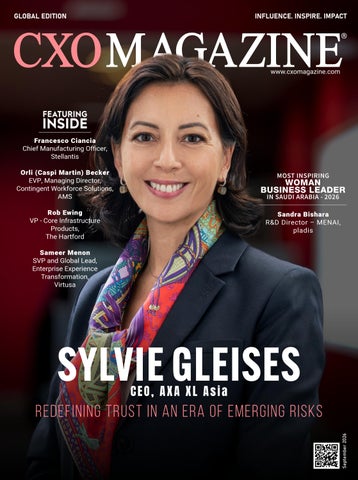
GLOBAL EDITION
INFLUENCE. INSPIRE. IMPACT
FEATURING
INSIDE Francesco Ciancia Chief Manufacturing Officer, Stellantis Orli (Caspi Martin) Becker EVP, Managing Director, Contingent Workforce Solutions, AMS Rob Ewing VP - Core Infrastructure Products, The Hartford
Sandra Bishara R&D Director – MENAI, pladis
Sameer Menon SVP and Global Lead, Enterprise Experience Transformation, Virtusa
SYLVIE GLEISES CEO, AXA XL Asia
CXO MAGAZINE, SEPTEMBER 2026
1
September 2026
REDEFINING TRUST IN AN ERA OF EMERGING RISKS
BS FR CR EE IB E
SU
September 2026
Vol - 04 Issue - 09
Managing Editor
Sarath Shyam
Consultant Editors
Dr. John Andrews Emma James Sabrina Samson Naomi Wilson Andrew Scott Kwith Alexander
Editorial Enquiry: admin@cxoomagazine.com
Art & Design
Charlie Jameson Louis Bernard Shirley David
Branding & Marketing Partnership
Jennifer Anderson Monica Davis Rachel Roy Anna Elza
Sales Enquiry: admin@cxoomagazine.com
2
Free Subscription www.cxomagazine.com
International Partnerships Americas Europe Middle East & Africa Asia-Pacific admin@cxoomagazine.com
Follow Us On www.linkedin.com/company/cxomagazinepage www.facebook.com/CXOMagazinePage
CXO Magazine www.cxomagazine.com is a global knowledge sharing digital platform published by Connecta Innovation Private Limited. All rights reserved. The opinions expressed in the content and pictures provided are those of the authors. They do not purport to reflect the opinions or views of the Connecta Innovation Private Limited or any of its members and we do not assume any responsibility. The publisher does not assume any responsibility for the advertisements, its content, pictures, and all representation of warranties made in such advertisements are those of the advertisers and not of the publisher. CXO Magazine www. cxomagazine.com is a Free Subscription and Free-to-read digital platform strictly not for sale and has to be strictly for internal private use only. Publisher does not assume any responsibility arising out of anyone modifying content and pictures, printing a copy of this digital platform in any format and in any country and all matters related to that.
CXO MAGAZINE, SEPTEMBER 2026
THE DECISIONS THAT STILL MATTER WHEN THE MAP KEEPS CHANGING
T
here was a time when a five-year business plan felt like a destination. Today, it can feel more like a hypothesis. Markets shift, technologies mature overnight, geopolitical tensions redraw assumptions, and customers change their expectations faster than many organizations can rewrite their strategies. The challenge for leaders is no longer simply knowing where they want to go. It is knowing when to stay the course, when to change direction, and when the original map is no longer useful. The numbers reflect this uncertainty. PwC’s 2026 Global CEO Survey, based on 4,454 CEOs across 95 countries and territories, found that only 30% were confident about their company’s revenue growth over the next 12 months. At the same time, CEOs continue to invest in AI and pursue reinvention despite an uncertain environment. Yet adaptability should not be confused with constantly changing direction. Good leadership in uncertain times is not about reacting to every signal. It is about developing the judgment to distinguish between temporary turbulence and genuine structural change. It means building organizations that can absorb disruption without losing sight of their purpose. That makes this month’s cover story particularly timely. In an exclusive conversation with CXO Magazine, Sylvie Gleises, CEO of AXA XL Asia, reflects on a career that moved from consulting and strategy into business and leadership, driven in part by her desire to create lasting impact and lead people. Her experience offers a valuable perspective on navigating complexity while keeping strategy, relationships, and people firmly in view. The need for adaptability extends beyond the C-suite. The World Economic Forum estimates that 39% of workers’ existing skill sets could be transformed or become outdated by 2030, reinforcing the importance of continuous learning, resilience, flexibility, and curiosity. This issue brings together other thought-provoking conversations, articles, and perspectives that explore how leaders and organizations are responding to a world in motion. The future may refuse to be predictable. But that does not mean leadership has to be uncertain. Perhaps the real advantage lies in learning how to make confident decisions without demanding certainty first. Enjoy reading.
Sarath Shyam
CXO MAGAZINE, SEPTEMBER 2026
3
SYLVIE GLEISES CEO, AXA XL Asia
08 4
REDEFINING TRUST IN AN ERA OF EMERGING RISKS
CXO MAGAZINE, SEPTEMBER 2026
MOST INSPIRING
WOMAN BUSINESS LEADER IN SAUDI ARABIA - 2026
16 Sandra Bishara, R&D Director – MENAI, pladis The Thinking Behind Every Bite
CXO MAGAZINE, SEPTEMBER 2026
5
OPINIONS
28
42
Orli (Caspi Martin) Becker, EVP, Managing Director Contingent Workforce Solutions, AMS
Beyond the Front Office: Why True Experience Transformation is an Operational Mandate
Transforming Contingent Workforce Into Holistic Talent Strategy
36 Francesco Ciancia, Chief Manufacturing Officer, Stellantis Transforming Manufacturing Through People, Process, and Technology
6
CXO MAGAZINE, SEPTEMBER 2026
INTERVIEW
Sameer Menon, SVP and Global Lead for Enterprise Experience Transformation, Virtusa
48 Rob Ewing, VP - Core Infrastructure Products, The Hartford Redefining Infrastructure as a Business Catalyst
CXO MAGAZINE, SEPTEMBER 2026
7
C O V S E T R O R Y
SYLVIE GLEISES
CEO, AXA XL Asia
REDEFINING TRUST IN AN ERA OF EMERGING RISKS Sylvie Gleises is CEO of AXA XL Insurance in Asia, where she leads the insurance business across the region. AXA XL Insurance provides property, casualty, professional, financial lines and specialty insurance to mid-sized companies through to large multinationals globally. Sylvie began her career in consulting before moving into the insurance industry, where she has built an international career spanning strategy, business and leadership roles. Her leadership combines strategic thinking with a strong focus on people, developing talent and building trusted relationships, while helping businesses navigate an increasingly complex risk environment. Recently, in an exclusive interview with CXO Magazine, Sylvie shared insights into how her professional journey began in consulting where she enjoyed shaping strategy but wanted to see long-term impact and lead people, which led her into the insurance industry and an international career across strategy, business and leadership roles, now as CEO of AXA XL Asia. On emerging risks and AI, she noted that as risks like climate, cyber and AI evolve, insurance must go beyond protection to help clients anticipate, prevent and navigate complexity, and that the future will belong to professionals who know how to use technology without surrendering their judgement to it, combining data skills with curiosity, critical thinking and empathy. Looking ahead, her biggest goal is to create meaningful impact not only through business results but by developing people, mentoring the next generation, and helping build a more resilient economy where trust is earned before, during and after a loss. The following excerpts are taken from the interview.
8
CXO MAGAZINE, SEPTEMBER 2026
CXO MAGAZINE, SEPTEMBER 2026
9
What was the moment early in your consulting days that made you realise you wanted to build a career at the intersection of strategy, people and business? There wasn’t one defining moment, but rather a growing realisation. I enjoyed advising clients on strategy, but over time I became frustrated by not having a direct hand in implementation or being able to see the longer-term impact of the decisions we were recommending. I also realised how much I enjoyed leading and developing people. I have always been empathetic by nature, and helping others grow is something I find deeply rewarding. Moving into business allowed me to bring those two things together: shaping strategy and seeing it
10 C X O M A G A Z I N E , S E P T E M B E R 2 0 2 6
through, while building teams and developing people along the way. As CEO of AXA XL Asia, what part of your role energises you the most every day? Seeing my team win important business is always rewarding, but what energises me most is the strategic challenge: working out how we navigate changing market conditions and emerging risks, and make the right decisions for our business and our clients. I also get a tremendous amount of energy from exchanging ideas with my team. Those human interactions - debating, challenging and solving problems together - remain one of the most rewarding parts of leadership.
Ultimately, our role is not only to protect businesses when things go wrong, but to help them anticipate and navigate risk, and contribute to a more resilient economy and society
What role do you see insurance playing in addressing the emerging risks in Singapore and the region? The AXA Future Risks Report shows how quickly the risk landscape is evolving, with climate change, cyber risk, and AI and big data among the leading concerns. For insurers, this means our role cannot stand still. We need to keep innovating - in the solutions we develop, how we use data and technology, and how we help clients understand, prevent and manage increasingly complex risks. The energy transition is one area where insurers can bring tangible value. Projects often require significant capital and can involve evolving technologies and complex risks across construction and operation. By
bringing risk expertise in early, insurers can help identify and mitigate potential exposures, provide the right insurance solutions and capacity, and give businesses, lenders and investors greater confidence to move viable projects forward. Cyber is another example. Businesses are increasingly dependent on technology, digital infrastructure and interconnected supply chains, while cyber attacks are becoming more frequent, sophisticated and varied. Insurers can help companies understand their vulnerabilities and strengthen their preparedness, while cyber insurance provides financial protection and access to specialist expertise to respond, contain the impact and support recovery when an incident occurs.
CXO MAGAZINE, SEPTEMBER 2026
11
These are just some examples of the broader role insurance can play as risks continue to evolve. Ultimately, our role is not only to protect businesses when things go wrong, but to help them anticipate and navigate risk, and contribute to a more resilient economy and society. Looking ahead to 2030, what will separate insurers that customers truly trust from those that don’t? Trust will increasingly be defined by what an insurer delivers before, during and after a loss. Before something happens, clients need strong risk advisory: an insurer that can help them understand and map their exposures, identify vulnerabilities and, wherever possible, prevent or mitigate losses. When a claim does occur, the quality of the claims experience is critical - being responsive, bringing the right expertise and having people on the ground who understand the local environment. But trust is ultimately built over the long term. It is not simply about being the cheapest provider. Clients want a partner who understands their business and strategic challenges, and who will stand alongside them in both good and difficult times. The insurers that earn that trust will be those that combine deep expertise with strong relationships, helping management teams and boards navigate risks to their business continuity, resilience and reputation. Talent in actuarial, underwriting and claims is evolving. What new skills will insurance professionals need to stay relevant in an AI- and data-driven industry? Analytical and data skills will undoubtedly become more important, but so will the human skills that technology cannot easily replicate.
12 C X O M A G A Z I N E , S E P T E M B E R 2 0 2 6
Adaptability, curiosity and critical thinking will be essential. Insurance professionals need to be willing to challenge the status quo, question assumptions and never take things for granted. As AI and technology take on more analytical tasks, the ability to ask the right questions, think differently and apply sound judgement will become even more valuable. The future will belong to people who know how to use technology without surrendering their judgement to it.
Many congratulations on winning “Singapore’s Outstanding CEO” at the InsuranceAsia News Country Awards for Excellence 2026. What does this prestigious recognition mean to you personally, and what does it say about the team you lead at AXA XL Singapore? I am very honoured by the recognition. When I came to Singapore five years ago, I knew almost no one on the ground. Building relationships and establishing my network here required a
significant personal investment, much of it outside office hours, so receiving this recognition is particularly meaningful to me. At the same time, I have never viewed success as an individual achievement. It takes a village. I do not come from a technical insurance background, so I have always believed in surrounding myself with the best people and drawing on their expertise. To me, sustainable success is collective success. The award may carry my name, but it also reflects the strength of the team around me and what we achieve together.
Developing people is an important part of that for me. I want to continue mentoring and coaching the next generation, and helping others grow into the leaders they can become
CXO MAGAZINE, SEPTEMBER 2026
13
Leaders need fuel outside of work. What book has influenced the way you think about leadership or life the most? The Little Prince by Antoine de Saint-Exupéry has had a lasting influence on how I understand human relationships and friendship. It is a book that has stayed with me because its lessons about connection, perspective and what we value remain deeply relevant - both in life and in leadership. We all have rituals that keep us centred. What is one daily habit or practice you never compromise on? I always read a few pages before going to sleep - a proper paper book, never digital, and mostly novels. It is my way of telling my brain that the working day is over and shifting my attention away from the day’s problems into a
14 C X O M A G A Z I N E , S E P T E M B E R 2 0 2 6
completely different story. It helps me switch off and reset. What is your biggest goal? To create meaningful impact, not only through business results, but also through the impact I have as a leader on my teams and the wider industry. Developing people is an important part of that for me. I want to continue mentoring and coaching the next generation, and helping others grow into the leaders they can become. If you could leave one message for the next generation of industry leaders, what would it be? Don’t take anything for granted. Stay curious, be proactive and keep questioning the status quo. Above all, lead with empathy.
Want to Sell or find Investors for your Business?
Digital First Magazine CXO MAGAZINE, SEPTEMBER 2026 August 2021
15
Sandra Bishara R&D Director – MENAI, pladis
16 C X O M A G A Z I N E , S E P T E M B E R 2 0 2 6
MOST INSPIRING
WOMAN BUSINESS LEADER IN SAUDI ARABIA - 2026
The Thinking Behind Every Bite
A
sk Sandra Bishara what attracted her to pladis, and the answer lies in an unusual combination: a young company with an extraordinary heritage. While pladis was newly formed, many of its brands had been part of people’s lives for more than a century. For Sandra, that created a rare opportunity to respect what had already been built while helping shape what could come next. When she joined the business, Sandra was among the first hires into the central R&D team in the United Kingdom. The organisation, its capabilities and its ambition were still taking shape, and that was precisely the appeal. There was substantial unrealised potential and an opportunity not simply to inherit an established way of working, but to help build the team, capabilities and innovation agenda the company would need for its next chapter. It was the kind of opportunity that has defined Sandra’s career: one without a
complete blueprint, but with the possibility to build something meaningful. The role brought together a fascination with food, a scientist’s curiosity, a business leader’s perspective and an appetite for challenges that do not come with easy answers. “I have never been particularly good at staying in one lane, which, in hindsight, has been useful,” she says. Sandra’s career makes more sense when viewed through the questions she kept asking rather than the titles she collected. Chemistry came first because she wanted to understand how things work. Food Science followed because she wanted to understand how science could become products people love. Later, an MBA gave her another piece of the puzzle: how those products become businesses. Her career has taken her from Egypt to Germany, the United Kingdom and Saudi Arabia, while leading and collaborating with teams drawn from many more countries around the world. These experiences have shaped her as a global
CXO MAGAZINE, SEPTEMBER 2026
17
citizen and strengthened her conviction that curiosity, cultural awareness and the ability to see through different lenses are essential to effective leadership. Her path into R&D leadership was not mapped out around a single defining moment. It emerged through a series of choices, opportunities, mentors, and perhaps most importantly, an enduring curiosity about food and the people who consume it. “Food was always at the heart of our family. It was how we gathered, how we celebrated and, very often, how we expressed love. I was curious about the science behind it, but equally fascinated by its ability to create emotion, memory and connection,” Sandra shares. Why does a particular flavour stay with someone? How does texture change the experience of a product? Why do certain foods become part of family memories? Those questions eventually took Sandra into flavour creation, product development, commercialisation, capability building, and, ultimately, R&D leadership. The journey was also influenced by a role that exists far beyond any job description: motherhood. Having two young children made Sandra more deliberate about how she spent her time and more courageous about the choices she made. It also sharpened her understanding of the kind of impact she wanted her work to have. Along the way, mentors and sponsors played their part, often recognising possibilities in her before she fully recognised them herself. Then came the decision to leave PepsiCo for pladis. It was hardly the obvious moment to make a major career move. Her daughter was three, her son was one, and the new role meant a three-hour drive from home. “Even
18 C X O M A G A Z I N E , S E P T E M B E R 2 0 2 6
now, I occasionally look back and wonder what exactly I was thinking,” she says. The question, however, was not whether the timing was convenient. Sandra could see that the opportunity would stretch her, broaden her influence, and give her the chance to build something meaningful. Waiting for the perfect moment was not an option she was willing to entertain. “Careers, much like life, rarely present their most interesting opportunities at a convenient time. I also knew that if I waited until every part of life was perfectly arranged, I might be waiting forever,” she adds. Joining pladis eventually led her to the R&D Director, MENAI, role, a position that brings together the different sides of her experience in a region where complexity is part of everyday business. The attraction was not simply the opportunity to work with well-known global brands. It was the possibility of helping brands with deep consumer affection find new avenues for growth while remaining relevant to markets with very different tastes, traditions, and expectations. That balance matters to Sandra. She is particular about food, curious about ingredients,
The MENAI region gives plenty of room to work. Across the markets Sandra oversees, consumers bring different culinary histories, preferences, habits, and expectations to the same category
and willing to spend an unexpectedly long time discussing why one choice can transform the taste or texture of a product. For Sandra, raising the standard of products made at scale is not a slogan or a one-time project. It is a long-term responsibility, encompassing ingredients, recipe, process and packaging. She explains, “I care deeply about raising the bar on the ingredients used in large-scale food manufacturing. This is a journey rather than a single intervention, but having a positive influence on it matters to me.” The MENAI region gives that ambition plenty of room to work. Across the markets Sandra oversees, consumers bring different culinary histories, preferences, habits, and expectations to the same category. The challenge, therefore, is not simply to take an existing product and make more of it. It is to understand what matters to consumers in each market and find the right balance between global brand strength and local relevance.
CXO MAGAZINE, SEPTEMBER 2026
19
Sandra studied Chemistry to understand how things work, Food Science to understand how that science can become products and later completed an MBA to understand how those products can become successful businesses
Saudi Arabia, where Sandra is based, has added another dimension to that understanding. What has stayed with her most is the warmth of its people, their hospitality, and the pride with which they carry their heritage. At the same time, the country is moving forward with remarkable confidence. Tradition and change are not necessarily competing ideas here. They can sit comfortably at the same table. For an R&D leader, that makes Saudi Arabia and the wider MENAI region particularly intriguing. There are capabilities to strengthen, consumer insights to deepen, and new ideas to explore. More importantly, there is a vast and culturally rich consumer landscape that refuses to be reduced to a single formula. Where Science Meets the Business For Sandra, R&D starts with understanding where the business can create value and then finding a practical way to turn that opportunity into reality. As R&D Director for MENAI at pladis, she oversees a broad regional agenda. Her
20 C X O M A G A Z I N E , S E P T E M B E R 2 0 2 6
team creates and commercialises new products, renovates established favourites, supports local manufacturing and sourcing, improves productivity, strengthens technical and sensory capabilities, and protects the quality and trust associated with the company’s brands. It is a role that demands both scientific depth and commercial understanding. Sandra’s background gives her a natural advantage here. She studied Chemistry to understand how things work, Food Science to understand how that science can become products and later completed an MBA to understand how those products can become successful businesses. That combination shapes how she sees R&D today. “Technical excellence matters enormously, but a brilliant product that cannot be scaled, manufactured consistently or create sustainable value remains an interesting experiment. I expect R&D to understand the commercial context, make intelligent choices and focus effort where science and technology can create the greatest advantage,” she explains.
Sandra also places strong emphasis on making better decisions at the beginning of a project. That means using evidence properly, being open about risks, challenging assumptions, and choosing a smaller number of opportunities with the potential to create value across markets. This thinking has influenced the way she has developed the regional R&D function since taking on the role. The early focus was on building the right foundations, clarifying priorities, strengthening governance, developing capabilities, and connecting teams across the region. As those foundations have become stronger, the focus has shifted. Rather than responding to a long list of individual requests, the team is increasingly looking at fewer, larger opportunities that can have a broader impact while still respecting the differences between markets. Sandra is also clear about what transformation should look like in practice. A new organisation chart or a polished presentation does not make the difference. Real change happens when R&D enters important business discussions earlier, when technical evidence influences decisions, and when team members have the confidence to challenge an idea constructively. For her, those moments are the real signs of progress. They show that R&D is no longer simply responding to business requests, but helping shape the decisions that determine growth, resilience, product quality, and the consumer experience. This approach is closely connected to her own leadership purpose. “I lead to build what does not yet exist, turn ambition into reality, and grow people who continue raising the standard long after I have moved on,” she adds. For Sandra, leadership is therefore not
only about delivering today’s priorities. It is about building the capabilities, confidence, and thinking that will help the organisation perform better tomorrow. That becomes particularly important in MENAI, a region where successful innovation requires a deep understanding of local consumers and cultures. Building for a Region That Refuses One Formula MENAI is a diverse region, and that diversity makes a standardised approach to innovation difficult. Its markets have different culinary traditions, climates, shopping habits, price expectations, and attitudes towards indulgence. Sandra believes the starting point is to understand those differences rather than assume that what works in one market will automatically work in another. “We combine consumer and sensory understanding with technical knowledge, competitive benchmarking and close observation of how people actually eat,” says Sandra. The aim is to understand the complete consumer experience and then translate that understanding into a product that delivers consistently. Every part of the product has a role. The biscuit structure, filling, flavour, sweetness, format, packaging, and manufacturing process all have to work together. A strong idea can quickly lose its appeal if the texture is wrong, the flavour does not develop as intended, or the product does not perform consistently through manufacturing and distribution. “The process is both creative and disciplined. We explore broadly, then become increasingly precise. We test assumptions, learn quickly and keep returning to the consumer experience we originally set out to create,” Sandra explains.
CXO MAGAZINE, SEPTEMBER 2026
21
McVitie’s Joy is one project that Sandra is particularly proud of because it reflects this approach. The product was developed around a clear understanding of consumers in the region. Indulgence is important to them, but so are flavour, texture, and generosity. A product designed for an indulgent occasion has to deliver a satisfying experience from the first bite. Joy was created around that idea, combining a thin, crisp biscuit with an indulgent cream centre. Rather than simply adding another flavour to an existing format, the team focused on creating a distinct sensory experience. Getting there required considerable technical work. Consumer testing helped validate both the concept and the product, while the development team worked through the practical challenges involved in bringing the product to market. Cream deposition, stack consistency, breakage, and packaging all had to be addressed without compromising the experience consumers had responded to. The project also demonstrated the importance of collaboration. R&D worked closely with marketing, commercial, manufacturing, and packaging teams to balance consumer appeal with technical feasibility, quality, cost, and manufacturing requirements. “It represents the role I want R&D to play: translating a meaningful consumer opportunity into a product that is technically thoughtful, commercially relevant and genuinely enjoyable to eat,” Sandra adds. Making Global Brands Feel Local A global brand needs a recognisable identity, but that does not mean every market should experience it in exactly the same way. For Sandra, the challenge is to understand what makes a brand special and then find the right
22 C X O M A G A Z I N E , S E P T E M B E R 2 0 2 6
way to express that strength in different markets. Local tastes, occasions, expectations, and eating habits all matter. The product has to feel familiar to the consumer while still carrying the character of the brand. “Our role is not to localise for the sake of novelty. It is to preserve what consumers trust about the brand while expressing it in ways that feel natural within each market,” Sandra says. That can mean changing the flavour, texture, format, portion, packaging, or even the occasion for which a product is designed. The change does not have to be dramatic. Sometimes a small adjustment can make the difference between a product feeling imported and one that feels like it belongs. Sandra describes this as “respectful translation rather than reinvention.” The distinction matters. She does not want teams to take a global brand and simply add a local element for the sake of appearing relevant. The better approach is to listen closely to consumers and understand what the market is telling them. “The best regional ideas do not feel imported and adjusted at the edges. They feel as though the brand has listened,” she adds. Her own experience of living and working across cultures has made her particularly conscious of this. For Sandra, curiosity is an important leadership discipline. Market reports and consumer data can reveal a great deal, but they cannot replace the experience of being close to the market. Understanding comes from listening, tasting, observing, and being willing to change an assumption when reality proves otherwise. That proximity is one of the strengths she sees in the MENAI R&D team. People work close to factories, markets, and consumers
across the region, while bringing different technical backgrounds and cultural perspectives to the table. The result is practical knowledge that connects product development with the conditions in which a product has to succeed. “We are also becoming much stronger at connecting technical detail with business impact. I want the team to be excellent scientists and technologists, but also confident commercial partners who can frame choices, explain tradeoffs, and influence decisions,” Sandra explains. Building that capability requires investment in several areas. The team is strengthening baking and ingredient science, sensory and consumer understanding, process and packaging expertise, competitive benchmarking, digital specifications, project governance, and financial knowledge. Clearer accountability and more structured development are helping make those capabilities part of the organisation rather than dependent on individual experience.
One area remains particularly close to Sandra’s heart: the quality of the complete product experience. She believes largescale manufacturing should not mean accepting lower standards
One area remains particularly close to Sandra’s heart: the quality of the complete product experience. She believes large-scale manufacturing should not mean accepting lower standards. Improving ingredient quality requires careful technical work, strong supplier relationships, commercial discipline, and patience. There are no quick fixes, especially when changes need to work across large production volumes. “Scale should not become an excuse for lowering ambition,” she adds. For Sandra, raising the standard is a continuous process. Every improvement in an ingredient, recipe, process, or technical capability can contribute to a better product. R&D has the opportunity to make those improvements practical and commercially viable. The result is a regional function that is becoming more capable of doing two things at once: understanding what makes each market different and finding ideas that can travel beyond a single market. “It is a journey, but it is one on which R&D can have a very positive influence,” Sandra explains. The People Behind the Product “Innovation is a team sport, although it becomes much easier when everyone is clear about the position they are playing,” Sandra says. Every function brings a different perspective to product development, and good innovation depends on bringing those perspectives together early. R&D brings its understanding of the consumer experience, technical possibilities, manufacturing requirements, and potential risks. Marketing brings the consumer and brand ambition. Commercial teams bring knowledge of the market. Operations understand what can work on the factory floor. Procurement
CXO MAGAZINE, SEPTEMBER 2026
23
Supporting women and girls in STEM has become an important part of Sandra’s work beyond the R&D function
and suppliers bring expertise in ingredients and technology, while finance helps the team understand the value and trade-offs behind different choices. “Global R&D allows us to reuse knowledge, connect expertise, and avoid solving the same problem several times,” Sandra says. The timing of that collaboration matters. When technical feasibility, factory capability, or economics are considered only after a product proposition has already been fixed, teams can end up negotiating over compromises. Bringing those perspectives into the discussion earlier creates more room to improve the original idea. Sandra also makes room for disagreement. “I value constructive disagreement. Alignment does not mean everyone begins with the same opinion. It means we are able to debate the evidence, understand the trade-offs, make a decision, and then move together with clarity.” The same principle applies to quality. Consumer trust is rarely built through one major gesture. It develops quietly, product by product, purchase
24 C X O M A G A Z I N E , S E P T E M B E R 2 0 2 6
by purchase. Every time a consumer opens a familiar pack, they expect the same quality, taste, texture, and overall experience. R&D has a significant role in protecting that expectation. The team influences the ingredients that go into a product, the way the product is made, how consistently it performs, and whether the final experience matches the promise made on the packaging. “Quality cannot be inspected into a product at the end. It has to be designed from the beginning through ingredient choices, recipes, processes, specifications, sensory standards, packaging and robust validation,” she
explains. Responsible product development also requires teams to consider nutrition, sourcing, waste, manufacturability, and the unintended effects of changing one part of a product. The challenge is to improve one aspect without creating a problem somewhere else. This is particularly meaningful to Sandra because of her personal interest in food and ingredients. She enjoys well-made food and pays close attention to the quality of what goes into it. At the same time, she understands the realities of manufacturing at scale. That realism, however, does not mean accepting the status quo.
“I am realistic about the complexity of manufacturing at scale, but I do not believe realism should become complacency,” Sandra states. For her, R&D can keep raising the standard by making better choices possible, building the evidence needed to support those choices, and showing that quality, responsibility, and commercial value can work together. Most consumers will never see the hundreds of decisions that sit behind a biscuit or chocolate product. They will not see the testing, specifications, factory trials, supplier discussions, or technical adjustments. They simply taste the result. They know when the flavour feels right, when the texture is consistent, and when a familiar product continues to deliver the experience they expect. For Sandra, protecting that trust is one of the most important responsibilities R&D carries. As she continues building the regional function, that responsibility provides a clear measure of what good innovation should ultimately achieve: products that perform in the factory, make sense for the business, and most importantly, earn their place in the consumer’s life. Beyond the Workday Sandra does not believe much in the idea of perfect work-life balance. To her, work and life are not two separate worlds that need to be kept perfectly level. They overlap, influence each other, and often make each other better. “My experience has been much more about integration and overlap,” she says. Her career supports her family in ways that go well beyond financial security. The experiences it brings, the people she meets, and the perspectives she gains all find their way into family life. Motherhood, in turn, has changed the
CXO MAGAZINE, SEPTEMBER 2026
25
way she leads. Her family keeps her connected to the people who eventually sit at the other end of the products her teams create. The same connection extends to the causes she cares about. Supporting women and girls in STEM has become an important part of her work beyond the R&D function. Science opened doors for Sandra into food, business, creativity, and leadership, and she wants more women to see the same possibilities. Her interests outside work also feed the way she thinks. Travel keeps her curious about different cultures. Sailing has taught her to respect conditions that cannot always be controlled. Cooking keeps her close to ingredients and the simple pleasure of making something for others. Reading and intellectually curious conversations continue to challenge her assumptions. For Sandra, none of these interests sit neatly in a separate category called “personal life.” They influence how she sees people, problems, and possibilities at work. That does not mean every day is perfectly balanced. There are difficult periods, competing priorities, and choices that require trade-offs. Sandra simply no longer measures a good life by counting how many hours go into each part. “I think more about whether the different parts of my life are supporting something meaningful. I feel very lucky that so much of the work I do sits at the intersection of things I care deeply about: science, food, people and possibility,” she explains. That sense of meaning also runs through her leadership style. She combines curiosity and high standards with a strong belief in people. She enjoys building things that did not exist before, whether that means a team, a capability,
26 C X O M A G A Z I N E , S E P T E M B E R 2 0 2 6
a system, or an idea. Just as importantly, she wants people to recognise that they can contribute more than they may initially believe. There is an interesting tension in that approach. Sandra is demanding about the quality of thinking, the evidence behind a decision, and the standard of the final product. At the same time, she does not want people simply following her answer. She wants them to challenge it. A strong team, in her view, should eventually be able to improve on the standard set by its leader. “High standards matter most when they become shared standards rather than the preference of one leader,” she states. The same thinking influences how she approaches experimentation. She gives teams a clear understanding of the outcome they need to achieve, the consumer problem they are solving, and the boundaries that cannot be crossed. Within that framework, people have room to explore. She adds, “Not every experiment will work. The expectation is not perfection; it is thoughtful learning, intellectual honesty and using what we learn to make the next decision better.” Sandra’s commitment to women and girls in STEM follows the same principle of creating room for people to grow. She says, “Science gave me a way to understand the world, but it also opened doors into creativity, business and leadership.” She wants women to see technical education as a starting point rather than a limitation. A STEM background can lead to a laboratory, a factory, a boardroom, an entrepreneurial venture, public policy, or a career that has not even been defined yet. Her own experience is evidence of that breadth. “Mentors have been enormously important in my life, but sponsors matter too. Advice helps
I lead to build what does not yet exist, turn ambition into reality, and grow people who continue raising the standard long after I have moved on
people grow; advocacy helps ensure that growth is seen,” Sandra shares. That distinction says much about how she approaches leadership. Encouragement matters, but so does opening doors. Giving people visibility, advocating for their potential, and creating opportunities can change the direction of a career. For Sandra, developing people is therefore not an additional responsibility alongside the business. It is part of doing the business well. The stronger the people become, the stronger the function becomes, and the more confidently it can take on the challenges ahead. Leaving Behind Something Stronger Sandra is at her most animated when she talks about building the future of MENAI R&D. “I am proud to say that we are transforming the function, and I love that part of the role,” she says. Her ambition is straightforward. She wants MENAI R&D to become a function the business turns to for direction, not simply delivery. That means helping identify where future growth can come from, developing products that consumers genuinely prefer, protecting the strength of established brands, and raising the quality of technical and commercial decisions across the region.
“The product legacy matters, of course. I hope we create innovations that become part of everyday lives, brands and family moments for many years,” Sandra explains. But she sees another form of legacy as even more important: capability. “I want to leave behind a team with stronger technical depth, broader business understanding and the confidence to have a point of view,” she adds. A successful leader, in Sandra’s view, should not create a team that depends on her. The real achievement is to build people who can continue making good decisions without her in the room. That idea brings her leadership philosophy full circle. Throughout her career, Sandra has followed curiosity, taken on unfamiliar challenges, and learned from people who saw potential in her. Now she is focused on creating those opportunities for others. “If, several years from now, people say that they became braver, broader, and more influential leaders because they were part of this journey, I would be immensely proud,” Sandra says. For her, that is what leadership ultimately comes down to. Build what does not yet exist. Turn ambition into something real. Give people the confidence and capability to take the work further. And then leave the organisation stronger than she found it.
CXO MAGAZINE, SEPTEMBER 2026
27
I N T E R V I E W S
Transforming Contingent Workforce Into Holistic Talent Strategy Orli (Caspi Martin) Becker leads AMS’ Contingent Workforce Solutions service line, driving growth through strategic leadership and innovation. She brings 26 years of industry experience spanning Contingent Workforce Solutions, Human Capital Management, SaaS-based Vendor Management Systems (VMS), Managed Services Provider (MSP) programs, and Go-to-Market strategies. Throughout her career, she has advised some of the world’s largest global organizations on workforce management and transformation. Prior to joining AMS, Orli held executive leadership roles, leading cross-functional teams to design bespoke global workforce solutions and optimize VMS technology. Her unique blend of talent and technology expertise enables her to translate complex client challenges into holistic, innovative talent management solutions. Recently, in an exclusive interview with CXO Magazine, Orli shared insights from a 26-year journey that began by accident in back-office staffing and grew into leading AMS’ Contingent Workforce Solutions globally. On trends, Orli sees the next 5 years defined by a shift from managing contingent labor in silos to orchestrating one interconnected talent ecosystem, enabled by AI, automation and data to deliver better visibility and experiences. Looking ahead, her goal is to help shape where the industry is headed, build great teams, and create solutions that deliver real value. Her advice for every future HR Tech leader is to have the courage to pursue ideas, stay humble and curious, and never lose sight that leadership is ultimately about people and impact. The following excerpts are taken from the interview.
28 C X O M A G A Z I N E , S E P T E M B E R 2 0 2 6
Orli (Caspi Martin) Becker EVP, Managing Director Contingent Workforce Solutions, AMS
CXO MAGAZINE, SEPTEMBER 2026
29
Hi Orli. Every leader’s path starts with a defining moment. What was the first role or experience that made you realize Contingent Workforce and HR Tech was where you wanted to build your career? I actually came into the contingent workforce industry completely by accident. When I graduated from college, I had never heard the term “contingent workforce” and knew nothing about the industry. A staffing agency placed me at a workforce solutions organization, where I started out doing back-office administrative work. What began as simply my first job quickly became a career. Over the years, I had the opportunity to learn every facet of the industry and develop a deep appreciation for its complexity, its challenges, and, most importantly, its potential. I became fascinated by the role we play in connecting organizations with the talent they need while creating meaningful opportunities for people. What ultimately made me realize this was where I wanted to build my career was the purpose behind the work. At its core, our industry is about facilitating the connection between people and work - and that is something I have always found incredibly meaningful. I feel very fortunate that what started as an unexpected first job evolved into a career I am genuinely passionate about. Your expertise spans strategy to execution. What part of your current role brings you the most energy and why? What brings me the most energy is the cross-functional nature of the work - bringing different perspectives,
30 C X O M A G A Z I N E , S E P T E M B E R 2 0 2 6
The technologies that will have staying power are those that reduce friction, anticipate needs, and make it easier for hiring managers, suppliers, candidates and workers to accomplish what they need to do
capabilities, and disciplines together to turn strategy into something real and meaningful for our clients. I love the process of taking a complex business challenge, developing a clear proposition and differentiated solution, and then connecting that strategy to proven operational execution. The most rewarding part is doing that in a truly consultative way - listening to what a global organization needs, understanding the nuances of its workforce and business, and then bringing the right people and capabilities together to create a solution that addresses those needs. Ultimately, I get energized by making a solution come to life. There is something incredibly fulfilling about seeing an idea move from strategy and possibility to something that is tangible, executable, and delivers meaningful value for a client. The workforce is evolving faster than ever. What do you see as the single biggest shift in Contingent Workforce and HR Tech that will define the next 5 years? The biggest shift I see over the next five years is the move from managing contingent labor as a distinct workforce category to managing talent more holistically. Organizations are increasingly recognizing that the question isn’t simply, “How do we hire an employee or a contingent worker?” It’s, “What is the best way to access the talent we need to achieve our business objectives?” Technology will be a major enabler of that shift. AI, automation, data, and increasingly intelligent platforms will give organizations greater visibility into their workforce and the ability to make more informed decisions about how, where, and from which talent channel to source skills. But I don’t believe technology alone is the transformation. The real opportunity is using technology to enable a more connected, talentled strategy that brings together internal and external talent, improves workforce planning, and creates a
CXO MAGAZINE, SEPTEMBER 2026
31
better experience for both the organization and the individual. Over the next five years, I think the organizations that differentiate themselves will be those that stop thinking in terms of workforce silos and start thinking in terms of one interconnected talent ecosystem - where technology, data, and human expertise come together to put the right talent in the right place at the right time. Technology promises efficiency, but adoption is the real challenge. What trend in VMS and HR Tech do you believe will have the most lasting impact? I believe the most lasting impact will come from the shift toward technology that is increasingly intelligent, intuitive, and embedded into the way people work, rather than technology that simply adds more functionality. In VMS and HR Tech, we have historically focused a lot on what the technology can do. The next evolution is much more about how seamlessly it can do it. AI and automation have enormous potential to simplify complex processes, surface insights, and help users make better decisions, but only if they are designed around the actual needs and behaviors of the people using them. For me, the real measure of innovation isn’t how sophisticated the technology is; it’s whether people actually adopt it and whether it meaningfully improves the experience and the outcome. The technologies that will have staying power are those that reduce friction, anticipate needs, and make it easier for hiring managers, suppliers, candidates and workers to accomplish what they need to do.
32 C X O M A G A Z I N E , S E P T E M B E R 2 0 2 6
Ultimately, the most successful VMS and HR Tech solutions will become less visible not because they are less powerful, but because they are so seamlessly integrated into the user experience that the technology itself almost disappears. Leaders are shaped outside the boardroom too. What book, podcast, or idea has influenced you most recently and why? One idea that has resonated with me recently is the importance of keeping a human in the loop as AI becomes increasingly embedded in the workplace. There is so much conversation today about AI and whether it will replace jobs, but I think that framing misses a much more interesting opportunity. I believe AI will fundamentally change how work gets done and will automate many tasks that today require significant human effort. But the value of human judgment, creativity, empathy, relationship-building, and the ability to understand context cannot simply be replicated by technology. For me, the future isn’t about humans versus AI—it’s about humans working with AI. The organizations that will get the most value from these technologies will be the ones that thoughtfully determine where technology can augment people and where human judgment needs to remain at the center. Particularly in our industry, where we are ultimately dealing with people, careers, and the connection between talent and opportunity, that human element is incredibly important. I think the “human in the loop” is going to be one of the defining principles of how we successfully navigate the future of work.
Everyone has a reset button. What hobby or passion outside of work energizes you and helps you come back sharper? Dancing and pickleball are probably my two favorite ways to hit the reset button. They are very different, but both get me completely out of my head and into the moment. I love dancing because it is social, energetic, and requires you to be fully present. You can’t be thinking about your inbox or your next meeting when you’re trying to keep up with the music! Pickleball gives me a different kind of reset - it’s active, competitive, and a lot of fun, especially when you’re playing with friends. Both remind me that there is value in stepping away from work and making time for things that simply bring you joy. I come back feeling recharged, more focused, and usually with a much better perspective. Sometimes the best way to solve a problem is to stop thinking about it for a while.
Work-life balance is debated constantly. What’s your perspective on building a sustainable and fulfilling career? I don’t necessarily believe in a perfect work-life balance. I think a sustainable and fulfilling career is more about being intentional about where you invest your time and energy and recognizing that the balance will shift throughout different seasons of your life. One of my favorite sayings is, “work hard, play hard,” and I think that captures my philosophy pretty well. I’ve always been someone who is highly committed to my career and genuinely enjoys what I do, so work is an important part of who I am. But I also believe strongly in making time to enjoy life, nurture relationships, pursue interests, and create experiences outside of work. Those things give you perspective, recharge you, and ultimately make you a better leader. For me, sustainability also comes from continuing to learn, staying curious, surrounding myself with great people, and doing work that has meaning. When you are passionate about what you do, it doesn’t always feel like a choice between work and life. The goal is to build a career that challenges and inspires you while still leaving room to be present for the people and experiences that matter most. I think the real measure of a successful career is not just what you accomplish professionally, but whether you can look back and feel that you built a life you are proud of along the way. What is your biggest goal? Where do you see yourself in 5 years from now? My biggest goal is to continue making a meaningful impact—both on the evolution of our industry, on the people I have the privilege of working with, and on the people who are part of my personal life.
CXO MAGAZINE, SEPTEMBER 2026
33
Five years from now, I want to be able to say that I made a difference—professionally and personally, that I helped move the industry forward, developed great people, nurtured meaningful relationships, and, of course, had a lot of fun along the way
Five years from now, I hope to look back and feel that I helped shape where the workforce solutions and HR Tech industry was headed, rather than simply reacting to where it was going. I want to continue pushing the conversation forward around how organizations think about talent, technology, and the future of work, and to help turn those ideas into solutions that create real value. Just as importantly, I want to continue developing people and building great teams. Some of the most rewarding moments in my career have come from watching people I’ve worked with grow, take on new challenges, and accomplish things they may not have thought possible. I want that same sense of impact in my personal life—to be someone who is present, supportive, and makes a positive difference in the lives of the people I care about. I certainly have professional ambitions, but I don’t measure success solely by a title or a particular position. Five years from now, I want to be able to say that I made a difference— professionally and personally, that I helped move the industry forward, developed great people, nurtured meaningful relationships, and, of course, had a lot of fun along the way. If you could leave one sentence of advice on the desk of every future HR Tech leader, what would it say? Believe in yourself and have the courage to pursue your ideas, but stay humble enough to know you don’t have all the answers. Surround yourself with smart, talented people who challenge you and make you better, stay curious and keep learning, and never lose sight of the fact that leadership is ultimately about people, relationships, and the positive impact you can make - not simply the technology or solutions you create.
34 C X O M A G A Z I N E , S E P T E M B E R 2 0 2 6
CXO MAGAZINE, SEPTEMBER 2026
35
I N T E R V I E W S
Transforming Manufacturing Through People, Process, and Technology Francesco Ciancia is Chief Manufacturing Officer at Stellantis and a member of the company’s leadership team. With extensive international experience across the automotive industry, he has held senior operational and manufacturing roles at Fiat, FCA, Maserati and Mercedes-Benz Vans. His leadership combines deep industrial expertise with a strong focus on people, operational excellence and transformation. Trained as a mechanical engineer and holding an Executive MBA, he is committed to strengthening manufacturing performance while preparing teams, plants and industrial systems for the future of mobility. Recently, in an exclusive interview with CXO Magazine, Francesco shared insights from a career rooted in a mechanical engineering background and shaped by senior operational roles at Fiat, FCA, Maserati, Mercedes-Benz Vans, and now as Chief Manufacturing Officer at Stellantis. On trends, Francesco sees the next 5 years driving toward a more connected, flexible and intelligent manufacturing ecosystem, with plants needing to be faster, more data-driven and adaptive amid electrification and supply chain volatility. His advice for the next generation of manufacturing leaders is to stay close to the shop floor, never lose curiosity, and remember that leadership starts with listening, trust, and respect for the people who build every day. The following excerpts are taken from the interview.
36 C X O M A G A Z I N E , S E P T E M B E R 2 0 2 6
Francesco Ciancia Chief Manufacturing Officer, Stellantis
CXO MAGAZINE, SEPTEMBER 2026
37
Hi Francesco. What was the first experience that made you realize manufacturing and engineering was where you wanted to build your career? My interest in manufacturing and engineering started very early, from a fascination with how things are designed, built and improved. What attracted me most was the combination of creativity and discipline: the ability to transform an idea into something tangible, reliable and useful for people. In manufacturing, you see the direct impact of engineering decisions every day. You see how a process, a technical choice or a team effort can change the quality of a product and the performance of an entire organization. That connection between technology, people and execution is what convinced me that this was the environment where I wanted to build my career.
When people are empowered, technology becomes more meaningful and processes become stronger
38 C X O M A G A Z I N E , S E P T E M B E R 2 0 2 6
Manufacturing leaders sit at the intersection of people, process, and technology. Which of these three do you feel most passionate about, and why? For me, people come first, because they are the true engine behind every process and every technology. Technology can accelerate transformation, and processes can create consistency, but it is people who make progress possible.
In manufacturing, success depends on the engagement, skills and mindset of the teams on the shop floor helped by engineering, quality, logistics and the entire value chain. What I find most powerful is creating the right conditions for people to perform at their best, to feel ownership, and to contribute to continuous improvement. When people are empowered, technology becomes more meaningful and processes become stronger.
The automotive industry is in the middle of massive transformation. What do you believe will be the biggest shift in global manufacturing in the next 5 years? The biggest shift will be the move toward a more connected, flexible and intelligent manufacturing ecosystem. The industry is facing unprecedented complexity, with electrification, new customer expectations, supply chain volatility and the need to improve
CXO MAGAZINE, SEPTEMBER 2026
39
speed, quality and efficiency at the same time. In the next five years, manufacturing will need to become even more adaptive. Plants will have to react faster, use data more effectively and integrate digital tools into daily operations in a very practical way. The winners will be those who can combine industrial excellence with agility, keeping a strong focus on people, competitiveness and execution. AI is changing how decisions are made on the factory floor. How do you see the role of a manufacturing leader evolving alongside AI? AI will not replace leadership; it will raise the expectations of leadership. Manufacturing leaders will need to become better at using data to anticipate, decide and act faster, but they will also need to ensure that AI is applied with a clear purpose. The role of the leader will be to connect technology with real operational needs, making sure that AI supports safety, quality, efficiency and the work of our teams. It is not about using AI for the sake of innovation. It is about helping people make better decisions, reducing complexity and creating more value on the shop floor. Talent is the biggest challenge in industry today. How should manufacturing leaders prepare the workforce for the skills needed in 2030? Preparing the workforce for the next years starts with recognizing that skills transformation is not a future topic; it is already happening. Manufacturing leaders must invest in continuous learning, reskilling and upskilling, but also in creating an environment where people are
40 C X O M A G A Z I N E , S E P T E M B E R 2 0 2 6
willing to learn and adapt. The skills of the future will include digital capabilities, data understanding, problem-solving, collaboration and the ability to work with increasingly advanced technologies. However, we should not forget the fundamentals: industrial know-how, discipline, quality mindset and team leadership will remain essential. The challenge is to combine traditional manufacturing expertise with new digital skills in a way that is practical and accessible for everyone. Books, podcasts, and mentors often shape how we think. What is one book or mentor that has influenced your leadership philosophy the most? I have been fortunate to learn from many people throughout my career, especially from leaders who were able to combine a strong strategic vision with a deep respect for operations and for the people who make things happen every day. The mentors who influenced me most were those who taught me that leadership is not only about setting direction, but also about being close to the field, listening carefully and taking responsibility when decisions are difficult. In manufacturing, credibility is built through consistency, presence and execution. That has shaped the way I see leadership: as a balance between ambition, humility and discipline. Many leaders draw inspiration from unexpected places. What is something non-work related that inspires your thinking about manufacturing and people? I often find inspiration in sport, because it has many similarities with manufacturing. Performance is never the result of one individual
from setbacks and keep moving forward. These are very relevant lessons for any industrial environment.
Manufacturing leaders will need to become better at using data to anticipate, decide and act faster, but they will also need to ensure that AI is applied with a clear purpose
alone. It comes from preparation, teamwork, discipline, resilience and the ability to improve every day. In sport, as in manufacturing, small details can make a big difference, and the best teams are those that combine talent with a strong collective mindset. I also like the fact that sport teaches you to manage pressure, learn
What is your biggest goal? Where do you see yourself in 5 years from now? My biggest goal is to contribute to building a manufacturing organization that is stronger, more competitive and ready for the future. For me, that means improving performance, accelerating transformation and continuing to develop our people and our industrial capabilities. In five years, I would like to look back and see that we successfully strengthened our manufacturing foundations while preparing the company for the next chapter of the automotive industry. More than a position or a title, what matters to me is the impact: creating value, developing teams and leaving behind an organization that is more agile, resilient and confident. If you could leave one piece of advice for the next generation of manufacturing leaders, what would it be? My advice would be to stay close to the reality of the shop floor and never lose curiosity. Manufacturing is a field where you learn every day, from people, from problems, from data and from the discipline of execution. Future leaders will need to embrace technology and transformation, but they should also remember that leadership starts with listening, understanding and creating trust. Be ambitious, but stay humble. Use innovation to solve real problems. And above all, respect the people who build, improve and deliver every day, because they are the foundation of any successful manufacturing organization.
CXO MAGAZINE, SEPTEMBER 2026
41
O P I N I O N S
Beyond the Front Office: Why True Experience Transformation is an Operational Mandate Sameer Menon is Sr. Vice President and Global Lead for Enterprise Experience Transformation at Virtusa, where he spends most of his time partnering with Fortune 100 leaders to solve for complex Revenue, Service, and Operations transformation, leveraging agentic AI and cloud-native solutions to modernize how enterprises engage customers, empower agents, and drive growth.
42 C X O M A G A Z I N E , S E P T E M B E R 2 0 2 6
Sameer Menon SVP and Global Lead for Enterprise Experience Transformation, Virtusa CXO MAGAZINE, SEPTEMBER 2026
43
M
ost organizations are trapped in a digital paradox: they have invested millions in sleek consumer-facing portals while their back-office operations remain shackled to legacy mainframes. On the surface, the enterprise looks modernized. But beneath that polished digital exterior, a persistent operational reality remains: a fragmented, slow-moving maze of legacy systems, disconnected data silos, and manual handoffs. The result is a fragmented experience that erodes customer trust as transactions become more complex. It is time to stop viewing ‘experience’ as a design problem and start treating it as an operational one. When an enterprise treats experience transformation as a cosmetic facelift, the illusion evaporates the moment a customer attempts a complex transaction, whether that is altering a commercial insurance policy, resolving a multi-tiered billing discrepancy, or executing a high-value supply chain adjustment. The customer encounters friction, frontline service representatives struggle with dozens of disconnected legacy applications, and operational bottlenecks stall execution. The fundamental issue is that traditional corporate structures isolate revenue generation, service delivery, and core operations into distinct, self-contained silos. To drive authentic growth and long-term customer loyalty in an era defined by autonomous technology, forwardthinking enterprise leaders are evolving past this fragmented model, recognizing that true experience transformation cannot occur at the periphery. True experience transformation cannot occur at the periphery. Instead, the next frontier of market leadership requires unifying revenue, service, and operations into a single,
44 C X O M A G A Z I N E , S E P T E M B E R 2 0 2 6
cloud-native engine - a shift increasingly powered by Agentic AI. The high cost of organizational arrhythmia We use the word arrhythmia because arrhythmia is not a blockage. Nothing is obstructed. Every individual part of the organization is functioning, and which is precisely what makes it so hard to diagnose and so easy to defend in a management meeting. Every leader in the room can show you a green dashboard. The problem is purely one of rhythm. The front of the business beats at one tempo: real-time, alwayson, personalized. The back of the business beats at another: batch, queued, sequential, manual. Both halves are healthy on their own terms, and both are hitting their own targets. The organism still fails because circulation depends on the two halves keeping time with each other. And when they don’t, the enterprise doesn’t fail loudly. It fails quietly, and it fails in three directions at once: customer experience, employee experience, and revenue. The damage differs in each, and leaders typically see only the vector they’re personally measured against. This disconnect inflicts damage across three distinct vectors: ● Customer experience (CX): Resolution cycles stretch from minutes to days or weeks, eroding trust and driving churn. ● Employee experience (EX): Employees across the front, middle, and back office waste over half their working hours navigating system complexity and performing manual data reconciliation. Instead of engaging empathetically with clients or driving operational value, human talent is reduced to acting as manual middleware.
● Revenue growth: High-intent cross-sell and up-sell opportunities vanish because the system cannot recognize or act on customer signals in real time. Optimizing the front office while leaving backend operations intact does not eliminate friction; it merely accelerates the speed at which customers hit a wall. The modernization triad: Aligning revenue, service, and operations To break this cycle, modern leaders must view experience through the lens of the modernization triad - a unified operational model in which Revenue, Service, and Operations function not as sequential handoffs but as a continuous, selfreinforcing loop. In a unified enterprise, revenue and service no longer compete for resources; they operate in deep synergy. Every service interaction is recognized as a commercial opportunity, and every operational workflow is engineered to deliver immediate customer value. 1. Service as an untapped engine for revenue When a client contacts an organization to resolve an issue, they are displaying maximum
engagement. In a legacy architecture, despite the evolution of metrics like CSAT, the underlying system often forces representatives to optimize for Handle Time, getting the user off the line as quickly as possible. In a modernized Triad architecture, real-time context allows the system to resolve the service issue instantly while equipping the interaction with hyper-personalized, contextaware growth recommendations. 2. Operations as an active participant in experience Operations is traditionally viewed as a backoffice cost center focused on compliance, underwriting, or fulfillment. In a Triad model, core operational functions are exposed as elastic cloud services. Underwriting, policy adjustments, and claim processing are transformed from opaque, multi-week background tasks into real-time, transparent digital events. 3. Continuous feedback and real-time adaptation When operational bottlenecks occur, such as delays in claims processing or supply disruptions,
The next frontier of market leadership requires unifying revenue, service, and operations into a single, cloud-native engine - a shift increasingly powered by Agentic AI
CXO MAGAZINE, SEPTEMBER 2026
45
the information is immediately updated in both the service interface and the revenue engine. Customers are proactively notified, frontline agents are provided with automated mitigation steps, and commercial offers are dynamically adjusted or intelligently suppressed during severe service failures to protect customer trust. The agentic advantage: A new metabolic rate for business Historically, this wasn’t a strategy failure; it was a systems failure. Legacy integration meant pointto-point connections between rigid systems of record - every new connection was custom-built, and every change to one system risked breaking three others downstream. So enterprises didn’t avoid unifying revenue, service, and operations because they didn’t want to. They avoided it because the cost of touching the wiring exceeded the cost of leaving the silos in place. This is where agentic AI changes the arithmetic. Traditional automation could only follow a path someone had already coded; the moment a request fell outside that path, it defaulted back to a person stitching systems together by hand. That’s why integration stayed expensive: every new scenario meant new hardcoded logic. Agentic AI removes that constraint because it doesn’t require the path to be pre-written. An agent can assess the state of multiple systems, determine what needs to happen, and act: three tasks that used to require a human doing them in sequence, now compressed into one continuous process. - Gathering: pulling relevant data from mainframes, documents, and cloud systems to assemble real-time context, rather than waiting on a batch process or a person’s manual lookup.
46 C X O M A G A Z I N E , S E P T E M B E R 2 0 2 6
- Reasoning: evaluating that context against business rules and compliance constraints to determine the correct next step, the judgment call that used to sit entirely with a person under time pressure. - Acting: executing the resulting update directly in the system of record, instead of queuing it for someone else to key in later. Deployed over a cloud-native foundation, agentic workflows compress enterprise service cycles that once took weeks, commercial loan origination, complex health plan adjustments, and enterprise software provisioning, down to days, sometimes hours. The larger shift is what it does to frontline talent. Employees stop spending their time on administrative reconciliation and start spending it on the judgment calls that were always meant to be theirs: whether this is the right moment to have a conversation, how to handle an exception, what a customer actually needs beyond what they asked for. The system handles context gathering and next-step suggestions; the person makes the decision, thereby amplifying human talent. A national healthcare organization used this approach to identify 150+ automation opportunities across its operations. The result: an estimated $20 million in value realization, split across cost reduction, revenue growth, and revenue protection. Executing transformation without disruption For Fortune 100 executives, the obstacle isn’t deciding what to build. It’s that no one can justify shutting down core transactional systems, or risking their integrity, for a multi-year ripand-replace overhaul. The modernization has to happen while the business keeps running.
Optimizing the front office while leaving backend operations intact does not eliminate friction; it merely accelerates the speed at which customers hit a wall
The practical answer is incremental modernization on a cloud-native foundation: layering new capability over existing core systems rather than tearing them out. Legacy functionality gets abstracted out gradually, in 90-day cycles, starting with the highest-friction end to end workflows, so revenue and service impact show up early rather than at the end of a multi-year build. Central to this is what we call the operational bridge: running human and AI-augmented workflows in parallel, so each capability is validated against real outcomes before it’s activated, rather than switched on all at once.
The executive blueprint for modernization As enterprise leaders look toward the future, the defining boundary between market leaders and lagging competitors will be their operational agility. Moving past front-office cosmetics to build a unified Modernization Triad requires four strategic commitments from executive leadership: 1. Dismantle functional silos at the C-suite level: Align leadership around shared metrics leaders cycle-time compression, and lifetime customer value, rather than metrics owned separately by each function. 2. Treat data as a strategic asset, not operational exhaust: Real-time, well-governed data pipelines enable agentic systems to act correctly across revenue, service, and operations; without them, agents reason on stale or partial information. 3. Architect for human-agent collaboration deliberately: This isn’t a byproduct of deploying agents, it’s a design decision: which tasks go to the system, which stay with a person, and where the handoff happens. 4. Address workforce anxiety directly through role evolution: AI adoption should be framed as an evolution towards a much-needed new organization structure rather than headcount reduction, helping leadership manage workforce concerns and foster a culture of innovation during the transition. Experience transformation is no longer a design discipline; it is an architectural and operational mandate. By unifying Revenue, Service, and Operations through cloud-native architectures and agentic AI, enterprises can eliminate operational lag, empower their frontline teams, and build a resilient foundation for long-term, sustainable growth.
CXO MAGAZINE, SEPTEMBER 2026
47
I N T E R V I E W S
Redefining Infrastructure as a Business Catalyst Rob Ewing is Vice President of Core Infrastructure Products at The Hartford, with over 25 years of experience leading infrastructure across Fortune 200 companies. He leads foundational technology platforms that advance resilience, modernization, security, and enterprise growth. Rob brings deep expertise in infrastructure operations, financial discipline, cloud and platform modernization, and forward-looking technology strategy. He is focused on simplifying complex environments, accelerating transformation, and aligning infrastructure investments to business outcomes. Rob earned a degree in Economics from Indiana University. Recently, in an exclusive interview with CXO Magazine, Rob shared insights from a 25-year journey that began as a storage manager and grew into leading Core Infrastructure Products at The Hartford. On trends, Rob sees resilience shifting from recovery to a design principle built into architecture, automation and security, and the spending conversation moving from cost reduction to value optimization. He also believes the next generation of engineers will need fluency in AI, automation, cloud, and product thinking alongside technical depth. Looking ahead, his goal is to expand as an enterprise leader who connects technology decisions directly to strategy, resilience, and growth. The following excerpts are taken from the interview.
48 C X O M A G A Z I N E , S E P T E M B E R 2 0 2 6
Rob Ewing
VP - Core Infrastructure Products, The Hartford
CXO MAGAZINE, SEPTEMBER 2026
49
Hi Rob. Every technology leader starts somewhere. What was the first role or project that made you realize infrastructure was where you could create the biggest impact? My first role that really shaped my perspective was as a storage manager. At first glance, I thought this would just be a technical discipline role, but it quickly taught me that infrastructure sits at the intersection of availability, financial management, and long-term technology strategy. I learned that the decisions we make behind the scenes directly affect the reliability of the business, the experience of our customers and employees, and the economics of the technology portfolio. That role helped me understand that infrastructure is not just about keeping systems running; it is about creating the foundation that allows the enterprise to move with confidence. As VP of Core Infrastructure Products, you own the foundation. What part of the role energizes you most and why? What energizes me most is the opportunity to connect foundational technology with business outcomes. Core infrastructure is often invisible when it is working well, but it enables almost everything an enterprise wants to accomplish from digital transformation and cloud modernization to operational resilience and innovation. I enjoy leading teams that solve complex problems, simplify the environment, and create platforms that are secure, reliable, cost-effective, and ready for the future. The most rewarding part is seeing how infrastructure at The Hartford is a catalyst for business speed and confidence is rather than simply a utility in the background.
50 C X O M A G A Z I N E , S E P T E M B E R 2 0 2 6
Availability expectations have never been higher. What do you see as the single biggest shift in how organizations design for resilience over the next 5 years? I believe the biggest shift will be moving from resilience as a recovery capability to resilience as a design principle. Organizations can no longer think about availability only in terms of disaster recovery plans or backup environments. Resilience must be engineered into architecture, operations, security, automation, observability, and even financial decisions from the beginning. Over the next five years, the organizations that lead in the marketplace will be the ones that design for graceful adoption of AI, rapid recovery, automated response, and continuous learning across hybrid and cloud environments. Cost optimization is now strategic. How do you see the conversation around infrastructure spending changing for business leaders? The conversation has changed from cost reduction to value optimization. Business leaders are asking better questions about where infrastructure spending creates differentiation, where it reduces risk, and where it may be creating unnecessary complexity. The goal is not simply to spend less; it is to make smarter choices about capacity, modernization, automation, and consumption – all with the end goal of better serving customers. Infrastructure leaders need to bring financial transparency to those decisions so the business can understand the trade-offs between cost, resilience, performance, and strategic flexibility.
Core infrastructure is often invisible when it is working well, but it enables almost everything an enterprise wants to accomplish from digital transformation and cloud modernization to operational resilience and innovation
The talent gap remains. How will organizations need to adapt hiring and training for the next generation of infrastructure engineers? My experience has shown the value of broadening how employers think about infrastructure talent. The next generation of engineers still need strong technical depth, but they also need fluency in AI, automation, cloud operating models, cybersecurity, financial management, and product thinking. Hiring cannot focus only on people who have done the exact job before; we need to look for curiosity, adaptability, and problem-solving ability. At the same time, companies must invest in training paths that help engineers continually evolve as the technology landscape changes. I am grateful to work in an organization that fosters a culture of continuous learning, anchored by an enterprise-wide learning platform and personalized AI-enabled experiences. Everyone needs a way to reset. What hobby or passion outside of tech energizes you and helps you return with clarity? Outside of work, I enjoy playing guitar and golf whenever I can find the time. Both give me a different way to reset and focus. Guitar is creative and personal, while golf requires patience, discipline, and the ability to move on quickly from a bad shot, which is not a bad leadership lesson either. Most importantly, I enjoy spending time with my family and watching my kids play sports. That time helps me keep perspective and return to work with more energy and clarity.
CXO MAGAZINE, SEPTEMBER 2026
51
Hiring cannot focus only on people who have done the exact job before; we need to look for curiosity, adaptability, and problem-solving ability
What is your biggest goal? Where do you see yourself in 5 years from now? My biggest goal is to continue growing as a broader enterprise leader while helping shape technology strategy at scale. Infrastructure will always be foundational to how I think because it teaches discipline around reliability, cost, risk, and execution. Over the next five years, I want to keep expanding that perspective across the enterprise, helping connect technology decisions more directly
52 C X O M A G A Z I N E , S E P T E M B E R 2 0 2 6
to business strategy, customer impact, operational resilience, and organizational growth. If you could leave one sentence of advice on the desk of every future VP of Infrastructure, what would it say? Never forget that infrastructure is not just technology beneath the business; it is the foundation that determines how confidently the business can operate, grow, and transform.
CXO MAGAZINE, SEPTEMBER 2026
53
54 C X O M A G A Z I N E , S E P T E M B E R 2 0 2 6