For years, growth has been the headline act in boardrooms. Bigger numbers. Faster expansion. Higher returns. But lately, the conversations I hear are changing. Leaders are asking quieter, more serious questions. How stable are we? How prepared are we? Who are we protecting when markets turn?
Not long ago, I was speaking with a senior executive who admitted that his proudest achievement last year was not a record quarter. It was building safeguards that helped his team sleep better at night. That struck me. Because in an age of volatility, security has become its own form of performance.
Consider this: Australians today are expected to spend two or even three decades in retirement. Longevity is rising. Costs are unpredictable. Confidence is fragile. In such an environment, simply accumulating wealth is not enough. The real question is whether that wealth can reliably support life when it matters most.
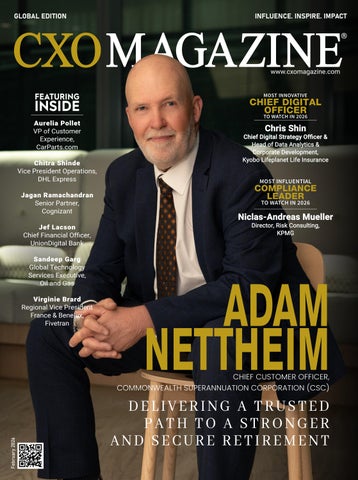
That is precisely why our cover story with Adam Nettheim, Chief Customer Officer at Commonwealth Superannuation Corporation, feels so timely. Leading customer strategy for one of Australia’s most established superannuation providers, Adam speaks candidly about the shift from accumulation to dependable retirement income and protection. In a system built on public trust and long-term commitments, his focus is clear: modernise thoughtfully, use data responsibly, enable teams, and above all, ensure members feel secure about their future. It is transformation without theatrics. Progress without compromising accountability.
This theme runs through the pages of this February 2026 issue of CXO Magazine. You will find leaders grappling with resilience, governance, technology, and wellbeing. Different sectors. Different challenges. A shared understanding that value today is not defined only by growth charts, but by durability and trust.
As you turn these pages, I invite you to reflect on your own definition of success. Growth will always matter. But perhaps true leadership now lies in building institutions that endure, protect, and stand steady when it counts.
Delivering a Trusted Path to a Stronger and Secure Retirement
Photo by Juan Forero
Australia’s superannuation system is often spoken about in terms of policy, performance, and longterm returns. Yet, at its core, it is a system built on trust, continuity, and the quiet promise of security for millions of people. That promise is not abstract for Adam Nettheim, Chief Customer Officer of Commonwealth Superannuation Corporation (CSC). It is deeply personal. Forged by a life largely spent in regional Australia, where relationships are close-knit and reputations are earned over time, his understanding of financial security was formed long before he ever entered the world of superannuation.
“I’m very much a country boy at heart. The close connections you build in smaller communities keep me grounded and energize me when I return to work,” Nettheim says. In those communities, people look out for one another. Hard work is visible. So are hardship and resilience. That early exposure to the
realities of everyday life quietly prepared him for a career that would later revolve around protecting people’s futures at scale. His path into superannuation was not pre-planned. Like many enduring careers, it unfolded through discovery rather than design. “This wasn’t my first calling. But early in my financial career, I realised the significant benefits the industry offers to people,” he recounts. What began as professional curiosity soon became a long-term commitment. For Nettheim, the superannuation system represented something rare in financial services, a structure capable of delivering nation-wide impact across generations. “There’s tremendous opportunity, even at a macro level, in what superannuation does for Australians. That is what motivates me to stay,” He emphasises. That sense of purpose has only strengthened as the industry has entered a period of reinvention. Australia’s super system, long regarded as one of the strongest globally, is now under pressure
Photo by Juan Forero
As the Australian Government’s specialist provider of superannuation services, CSC carries the weight of long-term financial security for those who serve the nation
to adapt to changing member expectations, longevity, technology, economic uncertainty and members retiring at scale. Nettheim sees this as unfinished business. He says, “The system has worked well to accumulate wealth, but in the past five years it has been trying to re-emerge into what it needs to be, a system of payment. I believe it still has further to go.” For a leader who thrives on meaningful transformation, that evolution becomes a responsibility he is eager to take on.
What gives his leadership its meaning are the people behind the numbers. Over the years, Nettheim has been exposed to countless member stories, some hopeful, some heartbreaking, many life-altering. “Another motivation comes from talking to people, sometimes in their worst moments, sometimes in their best,” he shares. Each conversation leaves him with the same question, asked with quiet urgency. “What could we do better?” At other times, the sentiment shifts to gratitude. “Aren’t I glad to be part of an
Photo by Juan Forero
industry that could help in that circumstance?”
For him, superannuation is not merely about growing wealth over decades. “It is also about wealth protection,” he says, a safeguard that stands silently in the background until it is needed most.
Away from the demands of executive leadership, Nettheim’s life is anchored by the same steady constants that shaped his early years. He speaks openly about the role of family in keeping his perspective intact. “I’m fortunate to have a healthy family and a strong relationship with my wife, whom I’ve known since we were
teenagers,” he says. That long continuity, both at home and in career, embodies a leader who values endurance over immediacy and purpose over recognition.
Where Trust Becomes Responsibility
For more than a century, CSC has stood as a quiet pillar behind the lives of Australian public servants and Defence personnel. As the Australian Government’s specialist provider of superannuation services, CSC carries the weight of long-term financial security for those who serve the nation. It manages both defined
by Juan Forero
Photo
benefit and accumulation schemes, delivers retirement solutions, and provides guidance at moments that often define the next chapter of a person’s life.
That responsibility is deeply personal for Nettheim. His role, as he sees it, begins with a simple question. “How do we help people truly understand super so they can make confident choices?” he asks. Superannuation, he knows, is often viewed as money set aside for a distant tomorrow, a sacrifice in the present that only reveals its value much later. “It can feel like a regret spend for much of your life, but one
The past few years have marked a period of transformation for CSC. The organisation has been modernising its systems, strengthening the tools that support long-term retirement outcomes
Photo by Juan Forero
people are ultimately grateful for when they see the outcome,” he says.
Underpinning his approach is the belief that clarity, not complexity, is what unlocks better decisions. His purpose lies in helping members access what already exists for them, and in strengthening the teams who guide those conversations every day. “Supporting the people who support our members is critical. If we change the way we work, we become more impactful, and we also reward the people who help members reach better positions,” Nettheim explains.
The past few years have marked a period of transformation for CSC. The organisation has been modernising its systems, strengthening the tools that support long-term retirement outcomes. New roles, clearer engagement pathways, and a stronger focus on income strategies have shifted how members interact with their fund. Nettheim’s team has played a central role in shaping how these initiatives are expressed and felt by members. “We are in a unique position. Our members already trust us, but that trust is not something we can take for granted. It has to be earned and maintained through our actions,” he observes.
The Right Conversation at the Right Time
Experience has always been central to how CSC sees its role in the lives of its members. With more than a hundred years of history serving Australian Government employees and the Australian Defence Force, the organisation has grown alongside the nation it supports. Yet for Nettheim, longevity alone is not the measure of relevance. What matters most is how well CSC shows up when it matters.
That commitment comes alive through a philosophy he often returns to; the right time, the right place, the right conversation. Superannuation, he believes, cannot be reduced to an exercise in information overload. “We cannot just throw information at people and hope it sticks,” he says. What matters is timing, context, and intent. If members are not acting, he sees that as a signal for deeper reflection. He adds, “If they are not making decisions, we need to ask ourselves why. We should treat that as our own failure and be curious enough to follow up and offer more help.”
Behind the scenes, this level of engagement depends as much on people as on technology. It requires trust within teams, clear purpose, and the confidence to change how work is done. Nettheim is candid about the human side of transformation. “Real change requires transparency and an honest appreciation of the challenges people face,” he notes. Training, clear communication, and psychological safety sit at the core of his approach. He encourages bravery and measured risk-taking, but never at the expense of wellbeing.
One belief that has guided his leadership across every role is his view on hierarchy. “I have always thought organisational charts are upside down,” he says. In his mind, leadership exists to enable, not to command. “My job is to support everyone else in the roles they do,” he clarifies. That support, he insists, must be practical. People need the right tools, the right training, safe working conditions, and recognition that feels meaningful to them. Only then can an organisation deliver consistently for its customers.
What matters most to Nettheim is not only how funds support people at the point of retirement, but how they stay present throughout the entire journey
Photo by Juan Forero
Every change at CSC is carefully framed, with a clear explanation of why it matters and who it serves. And change comes from the top, with a supportive Board and Executive Team who know the great heritage will only serve the future well with change and innovation delivered through the business. Nettheim states that the success of any part of the business is dependent on the support from all, and there has been innovation in many parts long before the start in the customer area. Its teams operate as an interconnected network, with specialists in Investments, Technology, People and Customer all reliant on each other as they strive towards their common purpose of serving those who serve. The organisation is also engaged in active partnerships with external partners, industry experts in fields such as administration and digital, who work alongside the people within CSC to help it realise its vision. Feedback is also actively invited as a tool for strengthening outcomes. Nettheim believes understanding breeds
ownership. When people understand the ‘why,’ they engage with the ‘how’ more deeply.
Designing the Future with Care
When asked what single change he would introduce across the superannuation industry to better serve members, Nettheim does not rush to a quick answer. The challenge, he believes, is too complex for a one-line fix. Yet, he is encouraged by the direction the industry is now taking. “It’s hard to pick just one change. But I think it’s already being addressed through the Quality of Advice Review,” he says. For him, this change opens the door to a more transparent
Photo by Juan Forero
and far-reaching relationship between funds and members.
What matters most to Nettheim is not only how funds support people at the point of retirement, but how they stay present throughout the entire journey. “Expanding how we communicate and nudge members is becoming increasingly important, not just for those nearing retirement, but right across the member journey,” he explains. For years, structural limitations made it harder for funds to offer timely, meaningful guidance. That environment is now changing, opening the door for more proactive and personal engagement.
At CSC, innovation moves forward alongside strong governance and risk oversight. Nettheim is clear about the balance he seeks to maintain. “Innovation and governance go hand in hand,” he opines. Teams are encouraged to think boldly and test new approaches, but always within frameworks that protect the fund and its members. It is a careful equilibrium where progress is measured, not rushed, and where integrity remains the foundation of every decision. “You also have to test the boundaries that most sectors operate within; great mechanisms established at points in time don’t always survive the test of time and you need to put the customer-benefit thinking first. Then you can work with the others to determine what changes might be possible.”
Technology and data improvements are redefining how this next phase of evolution will take shape and enable faster, more informed decisions. The aim is relevance above all else. The organisation is working towards a state where, through real time insights teams can
Photo by Juan Forero
For Nettheim, technology matters most when it works quietly in the background to improve real human outcomes
anticipate member needs, intervene earlier, and shape more responsive service pathways.
“Every day we’re learning more from our insights. It’s a long journey of getting to where we want to be, but we’re making good progress towards achieving a state where realtime insights inform our customer interactions and decision making,” he says. For Nettheim, technology matters most when it works quietly in the background to improve real human outcomes. “By harnessing timely insights, we can proactively support members and empower our people to deliver at their best,” he notes.
Trust as a Daily Discipline
Long before boardrooms and executive roles, Nettheim was given a piece of advice that continues to guide his leadership today. “Many years ago, someone shared three simple words with me: ‘Trust but verify,’” he recalls. With time, that principle moved beyond a safeguard and defined the way he thinks. “I do both and over time, you learn where you can trust more and verify less,” he adds.
In a highly regulated environment such as superannuation, where public scrutiny is constant and the consequences of failure are far-reaching, this balance is essential. Nettheim speaks with quiet realism about
the weight of that responsibility. In his view, verification exists to protect rather than to control. Protection for members, for the fund, for the board, for the executive team, and for every individual who carries decision-making responsibility.
That same discipline carries through to how CSC communicates with its members. Simplicity, he insists, is more about reducing mental burden than merely shortening messages. “We are committed to using clear, simple language and reducing cognitive overload,” he says. The objective is not to impress with detail, but to deliver just enough information at the right time, so members can act with confidence rather than confusion.
For Nettheim, improvement begins with listening. He treats feedback as a practical tool for progress rather than a measure of performance. Every comment, every concern, every suggestion becomes part of the organisation’s learning loop – indeed, the Board felt so strongly about improving the customer experience that this year it established a Customer Experience Committee to bring the voices and needs of customers further to the forefront CSC listens, adapts, and refines its processes with the clear intent of strengthening trust through consistency and care.
Empowering Growth through People and Strategy
Virginie Brard is Regional Vice-President France & Benelux at Fivetran. With over 20 years of experience in tech, she has held key leadership roles in major companies and high-growth scale-ups. A specialist in go-to-market strategies, she has helped open new markets, accelerate revenue, and lead local teams. Deeply involved in the digital transformation of French companies, she supports projects related to data, AI, and operational performance. At Fivetran, she leads the company’s growth in France and the Benelux, at a time when real-time data and automation are becoming critical drivers of business competitiveness.
Recently, in an exclusive interview with CXO Magazine, Virginie shared insights into her 20+ years of tech leadership, emphasizing building engaged teams and executing go-to-market strategies. She also shared her favorite goto destination, future plans, words of wisdom, and much more. The following excerpts are taken from the interview.
Brard
Regional Vice President France & Benelux, Fivetran
Virginie
Hi Virginie. Please tell us about your background and areas of expertise.
With over 20 years of experience, I currently serve as Regional Leader France & Benelux at Fivetran. I have built strong expertise within major technology companies and analyst firms before moving into high-growth scale-ups, including pre-IPO companies. I have played a key role in expanding into new markets, accelerating revenue and customer growth, while scaling local teams and working closely with U.S. executive leadership.
What do you love the most about your current role?
I am deeply passionate about identifying and recruiting top talent and creating the conditions in which people can fully express their potential. Building a team that is genuinely engaged, fulfilled in their work, and proud of both their collective success and the positive impact we deliver to our customers is extremely rewarding to me.
I also thrive on designing and executing a strong go-to-market strategy with my teams—
I
find great satisfaction in tackling complex challenges, solving problems of all kinds, and driving meaningful progress forward
challenging my teams, my partners, and my own leadership to continuously raise the bar and achieve the highest standards. Finally, I find great satisfaction in tackling complex challenges, solving problems of all kinds, and driving meaningful progress forward.
How's AI changing sales strategies in Europe?
AI has a dual impact on my teams. First, it is through AI-driven initiatives that our customers choose us, as we help them accelerate and scale their own AI and data projects.
Second, over the past five years, I have seen a rapid increase in the number of AI-powered tools available to sales teams, fundamentally transforming the way they work.
To name just a few examples, Gong is an extremely powerful solution that goes far beyond simple meeting note-taking. It enables advanced analysis of sales conversations, behaviors, and skills, allowing managers to significantly enhance coaching effectiveness. Similarly, prospecting teams now have access to highly efficient tools that accelerate outreach through targeted, relevant messaging and timely follow-ups. In addition, modern training and enablement platforms make it possible to continuously assess and refine sales pitches.
That said, these technologies remain tools—an important first layer that helps teams move faster and operate more effectively. I firmly believe they enhance relevance and efficiency, but they will never replace the role of leadership, human judgment, or the ability to inspire, guide, and develop people.
Do you see cloud adoption increasing in EU businesses? Why?
The adoption of cloud technologies has been accelerating steadily over the past several years. It initially began with retail and CPG companies, followed by manufacturing organizations, and is now extending to more highly regulated industries such as financial services and insurance, which are increasingly transitioning to the cloud—but not at any cost.
No cloud initiative is launched today without a thorough and rigorous ROI and TCO assessment. Data security sits at the very core of these decisions, and in light of the current geopolitical context, we are seeing a growing number of highly regulated organizations turning toward sovereign cloud solutions such as S3NS or Bleu to ensure compliance, control, and data sovereignty.
If you could travel anywhere now, where’d you go and why?
That is quite a personal question, but I’m happy to share my perspective. Over the years, I’ve had the opportunity to live and work in several countries. I spent a few years in the Netherlands and later in Great Britain, and I have worked for US companies for more than 25 years, which has given me a deep familiarity with the U.S. business culture. I have also spent significant time in Japan, where members of my family were living, which was a particularly enriching experience.
Today, I find myself especially drawn to the Nordic countries. I admire their way of life, as well as their leadership in technological innovation and environmental sustainability.
They are also strategically important regions, given their resources and geographical position. Finally, I am inspired by the prominent role women appear to play in these societies, often holding key leadership positions, which strongly resonates with my own values.
What’s a book/resource that shifted how you think about leadership?
I strongly believe that no book alone can fully teach this. Leadership is deeply shaped by what we have lived through—both the positive and the difficult experiences. Along the way, I have been inspired by leaders I admired and, just as importantly, by leaders I struggled with. In both cases, understanding why they inspired or discouraged me helped shape the leader I strive to be. At its core, leadership is about connecting around what is universal: speaking sincerely from the heart, being transparent, and practicing genuine kindness. While these concepts may sometimes sound overused, truly understanding the person in front of you—and why they react the way they do—creates stronger interactions and deeper trust. Ultimately, leadership is rooted in empathy and in recognizing the universal emotions that bind us together as human beings.
How do you prioritize self-care with a demanding regional role?
I believe this is something I have learned over time. One of the most important aspects is surrounding myself with the right people—both professionally and personally. Ensuring that the people around me are supportive and non-toxic is essential to my ability to grow and remain effective. Today, I am very clear about who brings me energy and who I can truly rely on.
Like everyone, I have experienced moments close to my own limits—the point beyond which I am no longer effective. I know where that boundary is, I recognize the signs when I am approaching it, and I am able to communicate this openly with both my loved ones and my colleagues. I have learned that vulnerability is not a weakness but a strength; acknowledging our limits and expressing them clearly allows us to step back before crossing them and to take action when needed.
On a practical level, I start each day by writing down what needs to be done and consciously prioritizing. Knowing what truly matters—and reminding myself why I took on this role in the first place—is critical. I have also maintained a lifestyle that supports my energy and focus: exercising around four hours a week in ways that I genuinely enjoy, maintaining an active social life, sharing a calendar with my husband to stay aligned, paying attention to my diet, and avoiding stimulants. All of this helps me sustain both performance and balance over time.
What is your biggest goal? Where do you see yourself in 5 years from now?
In five years, I see myself at Fivetran leading a scaled and high-impact organization in France, scaling to several hundred employees. Beyond the numbers, my ambition is to build a deeply engaged team and a strong customer ecosystem where organizations accelerate their AI and data strategies with confidence, speed, and measurable business outcomes.
My biggest goal is to have a lasting and strategic impact on the AI and data landscape in France. At this stage of my career, ambition
I have learned that vulnerability is not a weakness but a strength; acknowledging our limits and expressing them clearly allows us to step back before crossing them and to take action when needed
is less about personal achievement and more about building something that truly matters. I aim to grow a local organization that becomes a reference point for enterprises undergoing large-scale data and AI transformations— an organization known for its execution excellence, leadership, and ability to turn data into competitive advantage.
What advice would you give a sales leader starting out in tech (like data integration)?
First, truly understand how your solution accelerates your customers’ business and build your pitch around business impact—not features or technology alone.
Second, define a clear go-to-market vision over a three-year horizon. That may sound
ambitious, but having a long-term direction helps you make better decisions in the short term.
Third, invest early in building a strong internal and external ecosystem. With a compelling pitch and a clear GTM strategy, you must be able to convince partners, internal stakeholders, and leadership why they should work with you and trust you.
Fourth, build a team that reflects your values. You need a solid, reliable foundation—people you trust and who trust you—to consistently deliver and scale.
Finally, take care of yourself. Never operate in constant “apnea mode.” Make space to breathe, reflect, and stay inspired. Sustainable leadership comes from clarity and balance, not from stress alone.
Chris Shin Chief Digital Strategy Officer & Head of Data Analytics & Corporate Development, Kyobo Lifeplanet Life Insurance
CHIEF DIGITAL OFFICER
Designing the Future of Digital Life Insurance
As Chief Digital Strategy Officer and Head of Data Analytics and Corporate Development at Kyobo Lifeplanet Life Insurance, Chris Shin operates where technology, customer understanding, and long-term business growth meet. His career has been shaped by hands on experience across digital marketing, analytics, and business development in financial services, but what truly defines his leadership is how he connects strategy to purpose.
Having lived and worked across different parts of the world, Shin has been exposed to diverse markets, cultures, and leadership styles.
That global perspective, he says, sharpened one of his most important strategic instincts. “It taught me how to separate absolute principles from relative methodologies,” he explains. In his view, principles such as trust, customer centricity, and the protective role of insurance do not change. What does change is how those principles are delivered, shaped by technology, regulation, and social behavior.
This distinction sits at the heart of how Shin approaches digital transformation. In insurance, trust has always mattered, but the way it is built has shifted dramatically. “Building trust used to depend heavily on face-to-face relationships.
Today, it is increasingly about transparency, data, and digital ecosystems that make customers feel informed and in control,” he notes. For Shin, digital strategy is not about replacing values with tools, but about using new tools to express enduring values more effectively.
He is clear eyed about the industry’s past. Early digital efforts often focused on moving traditional processes online, replicating existing models rather than rethinking them. Real innovation, Shin believes, begins when technology challenges long held assumptions. Insurance has historically been about responding to uncertainty. Yet advances in healthcare, data science, genomics, and computing are steadily making risk more predictable. As the industry shifts from reacting to loss toward preventing it, the role of insurance itself is evolving.
“Effective digital strategy is not about chasing every new tool. It is about knowing which principles to preserve and which methods to reinvent,” Shin says. That philosophy explains what drew him to Kyobo Lifeplanet in the first place.
When Shin first encountered the company, he was struck by its willingness to question an industry deeply rooted in tradition. Launched in 2013 as Korea’s first digital first life insurer, Kyobo Lifeplanet challenged long standing norms at a time when few insurers were willing to rethink their foundations. It introduced multiple industry firsts and pushed digitalization forward, often without strong market validation or regulatory tailwinds. That persistence resonated deeply with him.
“Many people believed a digital life insurance model could never be sustainable. That skepticism made the mission even more
meaningful,” Shin recalls. To him, insurance remains one of the least disrupted areas of financial services, and that gap represents both responsibility and opportunity. He saw a chance to explore a different kind of sustainability, one that aligns technology with purpose and builds trust for the long term.
Today, Shin’s mandate is both strategic and expansive. He focuses on strengthening the core business through targeted investments, guiding thoughtful expansion into adjacent industries connected to life insurance, and exploring how emerging technologies and shifting social expectations can redefine what protection means in a digital world. Each priority reflects the same underlying aim, to make insurance more relevant, preventive, and human centered.
Building Insurance Around the Customer
Kyobo Lifeplanet occupies a distinct place in Korea’s insurance landscape. As the country’s first independent online based life insurer, the company continues to grow while balancing profitability with the freedom to innovate. That positioning, Shin explains, creates a fundamentally different operating mindset from traditional insurers.
In many legacy models, the primary customer is not the policyholder but the distribution channel, whether agents or banks. “Within that structure, it works. But digital insurers have no intermediary. We speak directly to customers, and that makes customer centricity a built in principle rather than an aspiration,” Shin acknowledges. The difference may appear subtle, but it shapes every decision the company makes. Adding a digital layer to a
traditional model, he argues, is not the same as building an end to end digital experience from the ground up.
In a digital first environment, marketing replaces the role once played by agents, and the entire customer journey unfolds inside a digital ecosystem. Every interaction leaves a trace. “We can observe real customer behavior and intent, and respond instantly. That ability to truly see the customer defines our differentiation,” Shin says. It also allows Lifeplanet to move with speed and precision, adjusting products, messaging, and experiences in near real time.
Launched in 2013 as Korea’s first digital first life insurer, Kyobo Lifeplanet challenged long standing norms at a time when few insurers were willing to rethink their foundations
Over the past five years, the company has invested heavily in data analytics and structured experimentation, embedding data driven thinking across teams. In a volatile and uncertain world, Shin views data as the most reliable compass. “For us, data is not just a tool. It is how we stay connected to our customers and ensure that digital transformation never loses its human core,” he notes. What began as an analytics initiative has evolved into a cultural shift, where intuition is constantly tested against evidence.
That culture now anchors Lifeplanet’s three strategic priorities. The first is deepening data capability and literacy across the organization, so decisions are grounded in insight rather
than instinct. The second is thoughtful AI adoption, starting with operational efficiency and expanding into product development, underwriting, and distribution. Shin envisions a future where many sales activities gradually evolve into AI agent-based engagement, introduced step by step rather than all at once.
The third priority looks further ahead. Shin is closely watching how blockchain, stablecoins, and tokenized assets may reshape financial services. As these technologies mature, he believes parts of the insurance value chain could become more automated and transparent, from underwriting and claims to asset management. Together, data, AI, and blockchain serve a single purpose. They help Lifeplanet deliver insurance
Over the past five years, Kyobo Lifeplanet has invested heavily in data analytics and structured experimentation, embedding data driven thinking across teams
that feels simpler, fairer, and more responsive to each customer’s life.
Leading From the Edge of the Industry
For all its progress, driving digital change in insurance has not been easy. Shin is candid about the emotional and strategic challenges of leading Korea’s only digital first life insurer. “The hardest part has been loneliness,” he admits. In an industry still shaped by traditional players, Lifeplanet often finds itself without close peers.
This sense of isolation becomes most visible in regulatory and industry discussions. Many frameworks, from accounting standards to reserve requirements and advertising rules, were designed for large, conventional insurers. Operating under those same assumptions can feel misaligned. “Our perspective does not always fit into structures created for a different era,” Shin says. Conversations with digital insurers in other markets have offered reassurance that these challenges are not unique, but shared by pioneers everywhere.
Still, Shin accepts solitude as part of the role. Being first, he believes, requires patience and resilience. Lifeplanet continues to advocate for regulatory evolution and differentiated standards, not out of self-interest but conviction. “Digital insurance is not a matter of if but when. And when that moment arrives, those who endured the hardest conditions will set the benchmark,” he says. It is a long view, shaped by belief rather than short term validation.
Another tension lies in time itself. Digital innovation moves fast, while insurance moves deliberately. In most digital businesses, results appear almost instantly. In insurance,
meaningful outcomes often take years, since product cycles are long and the customer relationship truly begins after the sale. Bridging that gap has required discipline.
Shin’s response has been to break large ambitions into smaller, measurable steps. The team tracks leading digital indicators, such as engagement and conversion signals, to maintain momentum and visibility. At the same time, leadership keeps a close eye on lagging indicators that reflect real business performance and customer outcomes. For Shin, success is not choosing between speed and patience, but learning how to manage both. That balance, between immediate feedback and long-term value, continues to shape how Lifeplanet leads from the edge of the industry and prepares for what comes next.
Designing Continuity in a Digital World
For Shin, digital transformation at Kyobo Lifeplanet has never been about forcing customers into a single channel. It is about giving them freedom without friction. The company’s omni channel strategy reflects a clear understanding of insurance reality. While many customers are comfortable purchasing policies online, key moments still require reassurance, explanation, and human judgment.
“We designed an ecosystem where customers can move seamlessly from selfservice to personalized support through chat or phone, without ever feeling like they have left the platform,” Shin explains. That sense of continuity is deliberate. Rather than offering multiple disconnected touchpoints, Lifeplanet focuses on integrating channels so the experience feels coherent from start to finish.
This integrated approach also strengthens the company’s data foundation. When web and app experiences are built as a single journey, every interaction becomes meaningful feedback. Over time, that feedback has fueled increasingly sophisticated customer insight. Lifeplanet has developed data driven targeting models that go beyond demographics to understand behavior and emotional patterns. One example is its in house psychological targeting model, which adapts communication based on how customers think and decide.
Even basic sales leads have been reimagined. What was once limited to a name and phone number has evolved into an enriched profile shaped by real signals and intent. These insights allow teams and partners to engage customers with relevance and respect rather than persistence alone. The result is a sales and service model that feels more human, not less, because it is guided by better understanding.
Building a data centered organization, however, did not happen overnight. Shin describes it as a process defined by steady experimentation and conviction. He introduced new internal controls, restructured teams, and brought in external expertise to build capabilities from within. There was no dramatic turning point. “The real driver was belief. A consistent belief over five years that data must sit at the center of every decision,” he says. As results accumulated, that belief gradually reshaped habits and expectations across the organization.
Shin is realistic about resistance. Change creates discomfort, especially for those deeply rooted in legacy systems. That is why he approaches transformation with empathy rather than force. Driving innovation, in his view,
requires patience and persuasion. Sustainable change happens when people who once defended the old ways begin to advocate for the new. It may take longer, but it is how lasting agility is built.
Reimagining Protection for a Connected Future
Looking ahead, Shin sees the integration of health data as one of the most consequential frontiers for digital life insurance. Models emerging in the United States already point to what becomes possible when insurers, healthcare providers, and pharmaceutical data systems begin to connect. In such environments, personalization moves beyond static assumptions and starts reflecting how people actually live, behave, and manage their health over time.
“When these data systems come together, insurance can adapt to the individual in far more meaningful ways,” Shin observes. Advances in AI and computing are steadily making probability modeling more dynamic. As real time health and lifestyle data flow into these systems, premiums could begin to adjust continuously, much like usage based auto insurance. Risk becomes something measured and managed in motion, rather than fixed at a single point in time.
For Shin, this shift is not just theoretical. It demands a reimagining of how customers experience insurance in everyday moments. In shaping the next generation of digital insurers, the ambition is to give customers greater agency over how they discover, design, and manage their coverage. Shin envisions an experience that feels as intuitive as a simple search interface within Lifeplanet’s app, where
Kyobo Lifeplanet has developed data driven targeting models that go beyond demographics to understand behavior and emotional patterns
customers describe their needs in plain language and receive dynamic suggestions in response.
Coverage options, policy adjustments, and product details would surface in real time, shaped by context rather than complexity.
Behind this simplicity sits a modular architecture where insurance is no longer a fixed
package but a flexible framework. AI powered recommendations would help customers assemble coverage, select riders, and adjust renewal structures based on their health profile and lifestyle. Over time, a dynamic pricing model informed by real time health data could further redefine fairness in insurance, aligning
Shin envisions an experience that feels as intuitive as a simple search interface within Lifeplanet’s app, where customers describe their needs in plain language and receive dynamic suggestions in response
premiums more closely with individual risk while strengthening transparency, trust, and long term engagement.
This vision of adaptive, customer led insurance also raises deeper questions about how protection will be delivered, governed, and trusted in an increasingly decentralized world. As life and health insurance evolve from static long term contracts into connected services, Shin is closely watching developments in blockchain based finance. The possibility of insurance moving on chain invites a fundamental rethink of roles across the value chain, from underwriting and claims to asset management and trust itself. For Shin, these shifts are not distant disruptions but signals that the industry must remain open, curious, and prepared to adapt.
In a world where change accelerates, he believes mindset matters as much as technology. Staying open to new perspectives is a discipline he practices deliberately. Shin engages directly with innovators, attends global forums, and builds networks across markets,
preferring firsthand understanding over filtered insight. “When leaders rely only on processed information, decisions become hesitant,” he says. Staying close to the source, in his view, builds confidence and clarity.
At Kyobo Lifeplanet, the ambition is clear. The company aims to prove that a digital first life insurance model can be both sustainable and scalable. Growth is driven through efficiency, not by adding layers of cost or headcount, but by using technology to increase productivity while improving customer experience.
Shin envisions Lifeplanet establishing a distinct vertical within the life insurance landscape, one that does not compete by imitating traditional players, but by redefining efficiency, accessibility, and trust through digital strength. As Chief Digital Strategy Officer, his role is to stand at the edge of that future, articulating why this direction matters. For him, leading digital evolution is not about following trends, but about building conviction in a future that is still taking shape.
Transforming Customer Journeys with AI and Automation
Aurelia Pollet is a customer experience leader with over 20 years of experience transforming end-to-end customer and employee journeys across retail, e-commerce, B2B, and DTC environments. She began her career in engineering and later moved into customer-facing and operational roles, including time at Louis Vuitton, where she learned how closely customer experience is tied to systems, processes, and execution. Today, she leads cross-functional CX initiatives spanning membership programs, returns, service design, and AI-enabled contact centers. Aurelia focuses on practical, measurable improvements that balance customer needs with business outcomes.
Recently, in an exclusive interview with CXO Magazine, Aurelia shared insights into her approach to customer experience, the role of AI in CX, and her leadership philosophy. She also shared her personal hobbies and interests, future plans, words of wisdom, and much more. The following excerpts are taken from the interview.
Hi Aurelia. What sparked your passion for customer experience?
I come from an engineering background, which wasn’t the obvious path into customer experience., so CX wasn’t exactly the obvious path. While working at Louis Vuitton, I moved from a technical role into retail and helped open a store in Nashville. That experience changed everything. I realized I loved working directly with customers, and just as importantly, I could clearly see how operational decisions behind the scenes shaped what customers experienced. Being able to connect front-of-house reality with back-of-house systems is what pulled me into CX. That bridge is where value is created.
What do you love the most about your current role?
What I enjoy most is the cross-collaboration. Customer experience sits across the organization, so I get to work with many teams on very concrete problems, from launching a membership program, to improving returns, to adding services like shipping or product protection, and working on AI in the contact center. The work is very real. You see quickly what works, what doesn’t, and how those decisions show up in the customer experience.
How do you see the role of AI and automation evolving in customer experience?
AI and automation play a key role in enhancing the customer experience. They enable faster resolution, broader availability, and more consistent support across channels and languages. They also tend to expose where processes, data, or ownership are unclear. Those
gaps were always there, AI just makes them visible. Used well, AI improves the experience for customers while helping teams identify and fix underlying issues in how the organization operates.
What role do you think empathy plays in creating great customer experiences?
Empathy is critical, but not in every situation. Sometimes the best experience is speed, clarity, and accuracy, and AI can deliver that very well. Removing friction like long phone menus already improves the experience significantly. Empathy really matters when something goes wrong and a customer needs to feel understood. The key is knowing when efficiency is enough and when a human connection is needed.
Can you share a book, podcast, or resource that has inspired you recently?
I really enjoy my friend Zack Hamilton’s podcast, Unfucking Your CX. It’s very honest and relatable for anyone working in customer experience. I listen to it during my commute, and it often makes me reflect on whether we’re dealing with similar challenges and how we’re addressing them. It’s a great reminder that many CX problems are shared and solvable.
What's the best advice you've received in your career, and how has it stuck with you?
Two pieces of advice that stayed with me: Make your work visible. Good work doesn’t automatically get noticed. Say yes to opportunities that stretch you, even if they don’t look like the obvious next step.
Used well, AI improves the experience for customers while helping teams identify and fix underlying issues in how the organization operates
What are some of your passions outside of work? What do you like to do in your time off?
I love cooking for friends and family, traveling, and hiking with my husband and our dog. She’s a German Shepherd mix with endless energy, so hiking is less a hobby and more a survival strategy.
What is your biggest goal? Where do you see yourself in 5 years from now?
Right now, my focus is on supporting my organization as much as possible and continuing to raise the bar on customer experience. Being recognized by USA Today as Best Customer Service of 2026 was meaningful, but it also sets expectations we need to keep meeting.
Longer term, I want to share what I’ve learned and continue helping shape how customer experience is practiced as a real discipline, one that delivers value to customers and to the business.
What advice would you give to someone looking to enter the field of customer experience?
Customer experience is not customer service. CX is about connecting what customers see and feel with how the business actually operates. People succeed in this field when they understand systems, data, and processes, and also have real customer-facing experience. If you only know one side, you’ll struggle to drive impact. CX lives in the tension between empathy and execution.
Empowering Teams Through AI-Driven Innovation
Sandeep Garg is a seasoned leader with extensive experience in driving complex initiatives, client engagement, and business growth in the IT services industry, with a strong focus on the AI and oil and gas sector. He blends disciplined execution with a people-first approach, mentoring diverse teams and fostering innovation. Passionate about leveraging technology and AI to deliver measurable impact, Sandeep thrives on turning bold ideas into results while creating environments for growth.
Recently, in an exclusive interview with CXO Magazine, Sandeep shared insights into the role of AI in driving business transformation and his leadership approach. He also shared his personal hobbies and interests, future plans, words of wisdom, and much more. The following excerpts are taken from the interview.
Sandeep Garg
Global Technology Services Executive, Oil and Gas
Hi Sandeep. What drives your passion for project management and leadership?
My passion for leadership began in my middle career, where leading complex initiatives gave me a strong foundation in planning, execution, and problem-solving. Over time, these experiences prepared me for transformation, where I now could influence strategy, mentor teams, and create environments where people feel supported and empowered. Today, my passion stems from seeing how technology and AI can transform complexity into clarity. What excites me most is seeing ideas transform into tangible outcomes while helping individuals and organizations reach their full potential.
What do you love the most about your current role?
I love the fact that I have chance to lead with a vision to integrate AI into business strategy, empower teams, and create environments where innovation thrives. Starting in project management and evolving through client management and business development, I now influence decisions at a broader level while staying connected to real outcomes. Working closely with clients to align priorities and guiding teams to deliver measurable impact excites me. Mentoring individuals to grow into their potential and embedding AI-driven solutions into transformation initiatives keeps
Project management is no longer just about execution—it’s becoming the engine of AIdriven transformation
me motivated. Knowing that I can drive intelligent business outcomes, accelerate innovation, and contribute to organizational and societal progress is what fuels my passion every day.
What do you think is the role of project management in shaping the future?
Project management is no longer just about execution—it’s becoming the engine of AI-driven transformation. It is going to shape the future by turning ideas into intelligent, data-powered outcomes while enabling organizations to stay competitive and innovative. Early in my career, I learned the value of disciplined planning, and today, AI amplifies those capabilities through analytics, automation, and real-time decisionmaking. Modern project management is going to ensure AI enabled frameworks for actionable strategies, frameworks for teams to innovate safely, and organizations to adapt rapidly to market shifts. When elevated as a leadership function, it becomes a catalyst for AI-enabled growth—driving operational excellence, accelerating innovation, and creating long-term value in a technology-first world.
Can you describe your leadership style and how you inspire your team?
My leadership style blends servant, coaching, and strategic leadership—enhanced by an AIfirst approach. I focus on understanding what my sales team needs to succeed and help to clear obstacles for them, enabling them to perform at their best. I empower individuals to think creatively, experiment, and build confidence through real responsibility. At the same time, I ensure they see the bigger picture—how
leveraging AI in IT services creates value for clients and drives transformation. I inspire by being transparent, listening actively, and celebrating progress. When people feel supported and equipped with intelligent solutions, they bring unmatched energy and innovation to client engagements.
What mentors or role models have had a significant impact on your career?
I’ve been fortunate to have mentors who shaped my journey at every stage—leaders within my organization, close clients, and family members. Early on, a mentor instilled discipline and attention to detail, which became the foundation for managing complex initiatives. Mid-career, I worked with leaders who encouraged me to embrace change, take risks, and trust my judgment—critical for building confidence and adaptability. These experiences opened doors to diverse roles, clients, and geographies. In my executive years, mentors offered trust before I felt ready, giving me opportunities with significant impact. That belief inspires me to do the same—empowering others and now leveraging AI-driven insights to guide, support, and accelerate their growth in a rapidly evolving digital world.
Can you share a book, podcast, or resource that has inspired you recently?
A book that has inspired me recently is Make Elephants Fly by Steven Hoffman. It focuses on how to turn bold, seemingly impossible ideas into real, scalable innovations. What resonates with me—especially in my current role— where I must drive business development by differentiating ourselves. The book’s principles
are completely relevant in today’s landscape of rapid AI and technology advancement.
Hoffman’s guidance on creating a culture where teams can experiment fearlessly, challenge established processes and innovate with intention. has helped me refine my leadership approach by combining strategic thinking with coaching and servant leadership. In many ways, the book has strengthened how I guide our teams through this AI-enabled transformation while staying anchored on delivering measurable value for clients.
What are some of your passions outside of work? What do you like to do in your time off?
Outside work, I love traveling with my family, sometimes solo—it helps me reset and see the world from new perspectives. Exploring cultures, tasting local cuisines, and walking through unfamiliar streets energize me. Fitness, especially yoga, is a key part of my routine for focus and well-being. I’m passionate about giving back through mentoring those with limited access to guidance. At home, I cherish simple moments—family dinners, conversations, and time without agendas. These connections keep me grounded and remind me why I work hard. My time off is about recharging and staying connected to what truly matters.
What is your favourite quote?
One of my recent favorite quotes by Simon Sinek says, “Leadership is not about being in charge. It is about taking care of those in your charge.”
It reminds me that leadership is a responsibility, not a privilege. True success is measured by the growth and resilience of
others, creating teams that thrive beyond my direct involvement.
What is your biggest goal? Where do you see yourself in 5 years from now?
We live in an era where AI and digital transformation are reshaping business and life. My immediate goal is to keep learning all these new advancements and lead with impact— driving outcomes while helping organizations navigate change.
In five years, I envision influencing strategy at a broader level, shaping decisions that deliver measurable value for clients and stakeholders. I aim to stay connected to teams, mentoring and developing talent to reach their potential, while embracing challenges that push me to grow. Beyond business, I aspire to give back through initiatives that create meaningful societal change. The coming years promise growth, responsibility, and lasting contribution.
What advice would you give to someone just starting out in the field?
My advice for someone starting out would be to focus on learning relentlessly and building a strong foundation in both skills and mindset. Early in your career, discipline, attention to detail, and a willingness to take on responsibilities slightly beyond your comfort zone are invaluable—they shape not only what you do but how you think. At the same time, stay curious about how business, technology, and people intersect, especially as areas like AI and digital transformation reshape industries. By combining curiosity, accountability, and a willingness to contribute, you’ll build a foundation for long-term success. Above all - be patient with your progress.
Mueller
Director, Risk Consulting, KPMG
Niclas-Andreas
The Quiet Power Behind Financial Integrity
Niclas-Andreas Mueller has built his career at a crossroads many organizations now find unavoidable, where regulation meets reputation, and compliance becomes a measure of leadership. As a Director in Risk Consulting at KPMG in Ireland, he advises organizations on how to prevent, detect, and remediate exposure to financial crime, not as a theoretical exercise, but as a business-critical responsibility. His work spans anti-money laundering, sanctions, and fraud, areas where regulatory expectations are high and the consequences of failure are very real.
Beyond client engagements, Mueller is deeply embedded in the compliance ecosystem.
He holds leadership roles with the Association of Compliance Officers in Ireland, the Association of Certified Fraud Examiners, and the Irish Funds Industry Association. He also teaches compliance at Fresenius University of Applied Sciences in Germany and contributes regularly to professional journals, reflecting a belief that compliance leadership requires constant learning and dialogue across borders and disciplines.
His entry into financial crime compliance, however, was not planned. It began early in his career, during his first assignment after joining a banking advisory team. Working within the programme management office of a global bank that had entered into a deferred prosecution
agreement for AML failures, he found himself immersed in a large-scale remediation effort.
What could have been just another consulting engagement became something more formative.
“I came upon financial crime compliance by chance. The subject matter spoke to me on several levels,” Mueller recalls.
What captured his attention was the balance the field demanded. Financial crime compliance is grounded in law, but it lives and succeeds or fails through business processes. “Established
by legal provisions but executed through business processes, financial crime compliance requires a good understanding of both the law and its application in the context of a specific business model,” he explains.
Equally compelling was the pace of change. Threat patterns evolve constantly, forcing compliance leaders to stay alert and adaptive.
“It is a highly dynamic area. This allows me to learn something new every day,” Mueller says.
Yet for him, the true significance of the work
For Mueller, the true significance of the work goes beyond technical challenge or professional growth. Financial crime compliance, he believes, serves a wider purpose
goes beyond technical challenge or professional growth. Financial crime compliance, he believes, serves a wider purpose. “It is not just another business function. It fulfils a greater purpose in helping to safeguard our financial system and economy,” he adds.
When Compliance Becomes a Leadership Responsibility
For many organizations, compliance still begins and ends with rules. At its most basic level, it is about adhering to laws and regulations, meeting defined requirements, and avoiding penalties. That narrow definition shaped the early stages of Mueller’s own professional journey. With time and experience, however, his understanding of compliance deepened, and so did his expectations of what it could achieve. “Like many compliance functions, this definition was the start of my own journey. Over time and with experience, this view has since evolved,” Mueller shares. What prompted that shift was a simple realization. Technical compliance, while necessary, does not always lead to the right outcomes. Rules can be followed in form while
their intent is missed entirely. Mueller argues that effective compliance must move beyond the letter of the law and engage with its purpose, alongside broader ethical considerations that shape trust and long-term value.
By focusing on outcomes rather than checklists, organizations begin to change how compliance is perceived internally. Acceptance grows among stakeholders. Conversations become more constructive. Compliance moves closer to the business, not further away from it.
“By focusing on good outcomes, you raise the acceptance of compliance by your stakeholders, which allows you to become more effective and develop compliance into a strategic differentiator that gets things done,” Mueller explains.
Recent corporate scandals and high-profile enforcement actions have only reinforced this point. As regulatory scrutiny intensifies, compliance functions have gained influence within organizations, often with direct access to boards and senior leadership. With that influence comes responsibility. The effectiveness of compliance now depends as much on leadership judgment as on regulatory knowledge.
The core of Mueller’s approach is dialogue with senior leadership. He helps senior leaders understand the real risks behind AML, sanctions, and fraud exposure
Mueller believes the role calls for balance. Compliance leaders must protect the organization from risk without losing sight of its core mission. That means finding practical solutions that fit the business model, respect customers, and support sustainable value creation. When done well, compliance is no longer seen as a cost centre. It becomes a source of confidence at the boardroom table.
Building Trust into the Framework
Ask Mueller what makes a financial crime compliance program effective, and he is quick to point out what it is not. Success does not hinge on a single policy, system, or control. It emerges from how different elements work together, and more importantly, how they are understood and embraced by people across the organization.
Most institutions today have completed risk assessments and implemented formal controls across areas such as customer due diligence, sanctions screening, and transaction monitoring. Yet these vertical measures often fall short if they are not reinforced by strong horizontal foundations. Awareness, training, leadership support, and a culture that encourages ethical judgment all play a decisive role.
Compliance frameworks, Mueller notes, succeed when responsibility is clearly owned. Models such as the Three Lines of Defence help clarify this structure by placing risk ownership within the business, supported by compliance and independently reviewed by internal audit. But structure alone is not enough. What matters is how that structure is lived day to day.
The core of Mueller’s approach is dialogue with senior leadership. “I help senior leaders understand the real risks behind AML, sanctions, and fraud
exposure,” he says. That understanding depends on two things. First, compliance teams must genuinely understand the business they support. Second, they must invest in relationships built on trust rather than enforcement.
When compliance provides practical, responsive advice, it earns credibility. Over time, it becomes a partner the business turns to early, not a function it informs late. “By providing responsive and practical business advisory. Compliance can position itself as a trusted partner for the business, which is therefore more likely to seek counsel and bring potential issues to the attention of the Compliance function,” Mueller explains. That shift, from gatekeeper to advisor, often determines whether risks are surfaced early or allowed to grow unnoticed.
Integrity Under Pressure
Financial crime compliance does not stand still. As criminal networks adapt and exploit new technologies, organizations are forced to rethink how they detect, prevent, and respond to risk. Systems, controls, and processes must evolve continuously to keep pace with increasingly sophisticated threats.
In this environment, Mueller is clear-eyed about the limits of assurance. Absolute certainty is not realistic, and regulators understand that errors can occur. The real distinction, he says, lies in intent and culture. Organizations that knowingly compromise their obligations, or allow weak practices to persist, face severe consequences. The same is true for firms that reward silence over transparency or prioritize technical compliance over real effectiveness.
A culture that tolerates shortcuts, or discourages open discussion of mistakes, creates
conditions where ethical failures are more likely. Compliance violations rarely appear overnight. They develop gradually, often unnoticed, until they become impossible to ignore.
This is where leadership judgment matters most. The compliance function exists to protect the organization, even when that means making uncomfortable decisions. At times, it requires saying no to business opportunities that appear profitable but carry unacceptable risk. Close collaboration with the business is essential, but independence cannot be compromised.
To reduce friction, Mueller advocates early involvement. Compliance should be part of the conversation when new products, services, or markets are being developed. “Fail early and fix
quickly” is how he frames it. When compliance is engaged upfront, it does not block progress. It redirects it. “If done right, Compliance will not block business success but rather refocus it on long-term sustainable growth over high-risk, short-term gains,” Mueller says.
The Compliance Countdown
For financial services organizations across the European Union, 2026 is a pressure point. The EU’s sweeping reform of its anti-money laundering and counter-terrorist financing framework, adopted in 2024, has reset expectations across the sector. With the Single EU Rulebook coming into force in July 2027, firms effectively have just 18 months to bring
existing compliance frameworks into line with a far more demanding regulatory regime.
Mueller sees the current moment as decisive. The actions taken now will determine whether organizations arrive at the deadline prepared or exposed. The challenge is compounded by a broader convergence of risk domains. Sanctions compliance is increasingly falling under the scrutiny of AML regulators, while cyber-enabled fraud continues to drive reporting volumes and operational strain.
Cybercrime and fraud remain top-of-mind concerns for compliance leaders worldwide. As technology advances and artificial intelligence becomes more capable of mimicking human behaviour, new forms of financial crime are emerging. Deepfake-enabled fraud is no longer theoretical. It is already testing the limits of existing controls.
While many organizations have begun to respond, most are still playing catch-up. Legacy systems, constrained budgets, and a shortage of specialized talent continue to slow progress. At the same time, compliance obligations keep expanding. The traditional solution of adding headcount is becoming harder to sustain, both financially and operationally.
To bridge the gap, firms are increasingly turning to automation and selective use of AI to reduce cost and free up resources for highervalue work, such as advisory support and risk analysis. Mueller supports this shift, with a note of caution. Technology can improve efficiency and even enhance the detection of risk patterns, but it is not a shortcut.
“Organizations should focus on getting the basics right. Clean their data and build fully system-based workflows,” he says. Jumping
straight to advanced AI tools may look attractive, but without reliable data and disciplined processes, such efforts rarely deliver results. Human oversight remains essential, particularly in areas where judgment and context matter most. As regulatory deadlines draw closer, Mueller’s message is pragmatic. Progress comes from steady execution, not silver bullets.
Leading With Integrity When It Matters Most
Much of Mueller’s advisory work unfolds when organizations are under intense regulatory pressure, during inspections, remediation programs, or enforcement actions. These moments are rarely routine. They demand technical expertise, yes, but also judgment, empathy, and political awareness.
“These situations are always exceptional for an organization. They require not only expertise but also tact and political acumen,” he notes. His approach is grounded in leadership by example. He encourages senior management to stay visible, take ownership, and focus on resolving root causes rather than getting lost in formalities.
Mueller describes his style simply. “I am tough on the issues but not on the people.” The goal is not to assign blame, but to create a collaborative environment where teams feel supported in addressing what went wrong and fixing it. Progress, in his view, comes from clarity and shared accountability.
The values guiding that approach are consistent. Integrity, excellence, and courage form the backbone of how he thinks about compliance leadership. Integrity means doing the right thing, especially when it is
Much of Mueller’s advisory work unfolds when organizations are under intense regulatory pressure, during inspections, remediation programs, or enforcement actions
inconvenient. Excellence is a commitment to continuous learning and improvement. Courage is the willingness to speak up when others hesitate.
“These values are particularly important in the compliance space,” Mueller says. Ethical conduct gives compliance its legitimacy. Without it, frameworks lose credibility and influence. Strong compliance programs evolve by learning from past failures and adapting to new threats. Just as important, people at every level must feel empowered to raise concerns and defend shared values without fear.
For those aspiring to leadership roles in compliance, Mueller’s advice goes beyond technical mastery. A deep understanding of regulations is essential, but it is not enough. Effective leaders also invest in relationships, across business functions, with regulators, and within the wider industry. Engagement through professional associations and industry forums,
he believes, sharpens perspective and builds trust.
He also encourages continuous skillbuilding, particularly in areas such as data analytics and emerging technologies, and a willingness to take on challenging assignments. Failure, when it comes, is part of the learning curve. The strongest compliance leaders, he suggests, carry a quiet confidence shaped by experience, setbacks included.
“The best leaders have learned to deal with conflict and uncertainty,” Mueller shares. They remain steady when conditions are rough, guiding their organizations through complexity with calm judgment and a clear sense of purpose, always steering toward safer ground.
It is this combination of discipline, adaptability, and integrity that defines Mueller’s leadership today, and why his influence in the compliance landscape is only set to grow in the years ahead.
Shaping Logistics for a Greener Future
Chitra Shinde is the Vice President, Operations, at DHL Express Singapore. She has been in this role since March 2024. Chitra is focused on accelerating sustainable growth and market share through next level quality to our customers by being an insanely customer centric operations team, providing innovative and sustainable solutions to improve customer experience. She has delivered team effectiveness, cost efficiency and operational excellence through collaborative and inclusive leadership.
Chitra is passionate about education and the role it plays in eradicating poverty and an economic equalizer. She leads as Champion of DHL4ALL and DHL4HER at DHL Singapore. She is recipient of 2022 DHL Group CEO Award for Diversity and Inclusion. Chitra holds a Certified Independent Director, M.B.A from KIMS (Karnatak University). A diploma in Strategic Management from Macquarie University, Sydney and is Master Gold in Continuous Improvement. With more than three decades experience in Supply Chain Operations, Chitra can provide clients with superior leadership, effectively helping many businesses compete successfully on the global stage.
Recently, in an exclusive interview with CXO Magazine, Chitra shared insights into her journey, starting as a trainee and rising to lead high-performing teams. She loves her role's dynamic nature, overseeing global strategy delivery locally. Chitra emphasized collaboration, inclusion, and customer-centricity, driving sustainable growth via innovation. She also shared her personal hobbies and interests, future plans, words of wisdom, and much more. The following excerpts are taken from the interview.
Chitra Shinde Vice President Operations, DHL Express
Hi Chitra. What inspired you to pursue a career in logistics and supply chain management, and how has your experience shaped your approach to leadership?
I joined DHL Express as a Trainee. DHL is the global leader in international express shipping, with a presence in over 220 countries and territories. Back then, the logistics and supply chain industry were nascent with great potential. I was good at problem solving so I
found a passion that aligned with my capability. DHL has a dynamic; it was fast paced and constantly evolving. This has helped me learn and grow and kept me engaged and challenged. It has also shaped my leadership approach. I stopped looking for solutions limited to myself or my team and started leveraging the strengths of other teams and group companies, customers, suppliers and partners. This level of collaborations develops superior solutions for our customers. At DHL we have followed
Head Heart and Guts Leadership which is bound together by our values of respect and results. We drive success through a focused utilisation of our strengths and a relentless pursuit of results. Creating a culture of Trust where individuals like me feel empowered and motivated to work towards a common purpose. Always maintaining a positive mindset and prioritizing clear objectives in the face of challenges, change and uncertainty. I am particularly good with change management but work harder on aligning priorities constantly to keep up with an ever-changing environment and remain aligned with our country, regional and global strategy. Recently our CEO Dr Tobias Meyer has introduced a 4th leadership attribute called BITE. It is the will to win. Bite requires all the leadership attributes to be used together.
DHL Group Strategy2030 shapes our decision making. It focuses on long term sustainability. While these can be challenged by external uncontrollable events, we are agile to adapt and know that our people and our customers can count on us to deliver.
What do you love the most about your current role?
My current role as the Vice President of Operations at DHL Express in Singapore puts me in a team environment where I oversee how DHL’s global strategy can be delivered locally. Leading the High Performing Operations team here is a true test of ‘making a great team better.’ It has stretched me out of my comfort zone.
I work with a great peer group who are high achievers themselves. Our Managing Director Christopher Ong is experienced role model leader who is intentional and strategic about what we need to do today that will create the future we want tomorrow. He encourages us to try new things, think differently, and harness technology to improve our employee and customer experience. We recently delivered a 100% Electric Last mile solution for a customer for their new product launch. We launched a domestic same day product. We developed a packaging solution “Express Pallet Box” for irregular and odd shaped items unto 250kgs. This makes the shipment easier to
Customers are increasingly wanting customisation to fit their unique needs. Customised Customer experience and efficiency will be the two main drivers of growth
handle in our network and optimises space in aircraft containers which is also better for the environment.
What trends do you see emerging in the logistics and supply chain industry in terms of technology and innovation?
The pace of technological advancement everywhere is changing faster than we can grasp. At DHL we use it as an enabler, but we can see clearly how it can change some of our roles in future.
At DHL Express Singapore, we focus on skill building to help our people move from one role to another with agility and embrace AI, digitalisation, automation, robotics and optimisation. We believe efficiency can improve through use of technology in many areas.
Customers are increasingly wanting customisation to fit their unique needs. Customised Customer experience and efficiency will be the two main drivers of growth. We see opportunity in industries like Life Science, Healthcare and Pharma. Especially where there is a shift towards residential patient care and individualised treatment.
There is also an increasing demand for sustainable supply chain solutions with clearly visible reductions in carbon emissions. We continue our journey towards Zero Carbon by 2050
Rising temperatures are causing havoc on weather patterns which affect supply chains significantly. These will continue to increase in frequency and being agile will help make changes swiftly.
B2C companies, and consumers, are looking to reduce their carbon footprint. DHL is wellpositioned to help them achieve their targets
How do you think the increasing focus on e-commerce and digitalization will impact the logistics and supply chain industry?
Online shopping is growing and will continue to be the preferred mode of shopping. This will keep the logistics and supply chain industry growing. Technology and innovation will bring in financial efficiencies.
There are two key differentiators under consideration when customers look for a logistics partner:
One: Sustainability. B2C companies, and consumers, are looking to reduce their carbon footprint. DHL is well-positioned to help them achieve their targets. We are the first company in the transport and logistics sector to set a 2050 net-zero greenhouse gas emissions target, back
in 2017. Today, we are also ahead of the curve in the airline industry in the use of Sustainable Aviation Fuel (SAF) to help our customers reduce their third-party emissions through our flagship GoGreen Plus service.
Two: Customer Experience. Continuous improvement of the customer journey through digitalization and being able to offer more than the standard delivery through value added services. We provide customers visibility on NPS rating. They can see what their own customers say about our service as it is an extension of their service offering and value proposition. It drives continuous improvement.
Congratulations on being recognized as one of the 10 COOs across Asia and the Middle East who are making an impact. Our readers would love to know the secret mantra behind your success.
I was pleasantly surprised myself. I was first appointed COO almost 15 years ago and was certainly an interesting growth period for me. I have focused on delivering tangible value in all my roles. I have been fortunate to work with leaders who create an environment and culture to do things differently.
Personally, I believe that inclusion and collaboration are key to high performance. Earning the trust of the team goes a long way especially when we make unpopular decisions or deal with challenges. I think about the worst possible outcomes and then manage the risk through adequate mitigation. If we risk nothing, we gain nothing. I try to shift from my comfort zone to my stretch zone to grow and I encourage others to do this as well.
Can you share a book, podcast, or resource that has inspired you recently?
‘Revenge of the tipping point’ by Malcolm Gladwell. I enjoy his writing. He simplifies complex topics. It is research backed inference into story telling which is not so easy to write but we are more likely to remember and recall.
If you could travel anywhere in the world, where would you go and why?
South America as I have not been there. Usually, I like to visit older civilisations and architecture. There is so much we can learn from our past.
What's one thing you're passionate about outside of work?
I am blessed with 4 kids so my world outside of work revolves around my family and activities. I like to go on bike rides with them, building Lego, painting and travelling. I also volunteer whenever there is an opportunity. I am working on my physical fitness and wellbeing too. Being Fit to lead is important. I’m not passionate about it but I think it is essential particularly as we are living longer.
As a leader, what advice would you give to someone just starting out in their career in logistics and supply chain management?
One, what worked for us may not work for you. Trust your gut, use your head and follow your heart.
Two, it’s a great time to be in Logistics. We see an increasing number of women in senior roles.
Wa n t t o S e l l o r fi n d
I nve s t o rs f o r yo u r
B u s i n e s s ?
Leading Financial Transformation in Digital Banking
Jef Lacson is a results-driven CFO with nearly 20 years of experience leading financial transformation and governance across Asia’s financial services and technology sectors. Currently the CFO of UnionDigital Bank, he is helping steer the bank’s strategic pivot through portfolio derisking and capital raising. His background includes a career foundation at KPMG and regional leadership at Pacific Cross, AIG, and QBE, where he drove IFRS 17 adoption and operational turnarounds. Recognized as one of the top CFOs in Asia, he holds a Master’s in Business Economics and multiple certifications (ASEAN CPA, CPA, CIA, CISA), bridging financial rigor with digital innovation to ensure sustainable growth.
Recently, in an exclusive interview with CXO Magazine, Jef shared insights into his approach to finance leadership, the role of technology in financial services, and his vision for the future of banking. He also shared his favorite quote, personal hobbies and interests, words of wisdom, and much more. The following excerpts are taken from the interview.
Jef Lacson Chief Financial Officer, UnionDigital Bank
What sparked your interest in finance, and how has your career path shaped your perspective on leadership in the financial sector?
I didn’t begin my career intending to lead finance teams. I started in consulting, where I learned to structure ambiguity, diagnose root causes, and make decisions with imperfect information.
Finance became an accidental home when a prominent chairperson encouraged me to take the lead of our finance organization. My journey across insurance, reinsurance, and now digital banking taught me that finance leadership isn’t about protecting spreadsheets—it’s about enabling clarity, accountability, and strategic direction.
What do you love the most about your current role?
I enjoy operating where strategy, discipline, and execution intersect. In a digital bank startup, transparency is critical—every number tells a story about our runway and growth.
That commitment to transparency allowed us to deliver a game-changing initiative this year: introducing segmented financials. This went beyond standard reporting; it was essential to demonstrating the bank's improved performance under the new management.
By breaking down the data, we quantified the value of our turnaround. While accelerating our financial close provided the discipline, the segmentation provided the insight that shifted our narrative from 'surviving' to ‘performing.’
What role do you think technology will play in the future of financial services?
I made a deliberate decision to move to a digital bank because technology is no longer just an enabler—it is the business model.
GenAI and cloud-native systems are reshaping what we deliver, meaning the modern CFO must be fluent in tech stacks as much as in balance sheets
The institutions that thrive will be the ones that treat data as a strategic asset rather than a byproduct. In our case, establishing a 'single source of truth' was the prerequisite for everything else. GenAI and cloud-native systems are reshaping what we deliver, meaning the modern CFO must be fluent in tech stacks as much as in balance sheets.
What are the most critical skills for a CFO today?
A modern CFO needs strategic clarity, operational discipline, and technological fluency.
You must simplify complexity and maintain control in a fast-moving environment. But beyond the hard skills, resilience is paramount. People look to the CFO to anchor the organization during uncertainty. My role is to provide the stability that allows the rest of the business to take calculated risks.
Congratulations on being named one of the top 10 CFOs across Asia. What is the secret behind your success?
There’s nothing glamorous behind it. Learn fast, stay grounded, build strong teams, and confront reality as it is. Consistency matters more than intensity. Leadership is about building systems that function without heroics. Being named to that list wasn't about one big moment; it was about the discipline of showing up and moving the needle every single day.
Can you share a book, podcast, or resource that has inspired you recently?
I find myself constantly revisiting Meditations by Marcus Aurelius.
It’s a constant reminder to focus only on what you can control and to lead with humility. In a high-growth environment, it’s easy to get reactive. That book grounds me. It helps me approach transformation not with anxiety, but with a calm, deliberate mindset.
What is your favorite quote? 'Whatever you do, do it with all your heart.'
Whether it’s a massive governance overhaul or a simple team meeting, the outcome is always determined by the level of intent you bring to it. Meaningful change only happens when you commit fully.
What are your passions outside of work?
I spend a lot of time learning and staying active—I try to 'future-proof' my health just as I do the business. I enjoy travel and quiet routines that bring balance to demanding work. Building a digital bank requires intense mental focus, so I value activities that allow me to unplug and recharge completely.
What is your biggest goal? Where do you see yourself five years from now?
My long-term goal is to build institutions that endure. Five years from now, I see myself continuing to lead transformation at a broader scale—developing future finance leaders and ensuring the organization operates as a strategic engine, rather than just a compliance and operational function.
I want to look back at a finance ecosystem that is so robust and automated that it drives the business forward independently.
What advice would you give someone exploring a career in finance but unsure of where they fit?
Start with curiosity. Finance isn’t a single path—it encompasses strategy, analytics, operations, governance, and systems.
Follow the problems that interest you, not the job titles. Passion often emerges when you see how your work drives decisions. That’s how you grow: by leaning into the work that stretches you.
Leading the Charge in Healthcare Innovation
Jagan Ramachandran is a Senior Partner at Cognizant Consulting, leading the healthcare payer segment and driving strategic transformation across some of the most complex and influential organizations in the industry. In his prior role, Jagan served as Managing Partner in Gartner's Healthcare Consulting practice. Over the years, Jagan has led numerous high-impact consulting engagements for Healthplans —each contributing to the evolution of payer strategy and the broader consulting discipline. The Consulting Report recently ranked him as one of the Top 25 Strategy Consultants and Leaders of 2025, placing him 2nd among an incredible group of strategists.
Jagan is widely recognized for his thought leadership in the industry. His key publications have advanced both consulting methodologies and payer strategies. His work on business-led digital transformation has helped clients successfully deliver digital transformation programs. He leads Cognizant's key research on the Voice of the Member, which allows payers to rethink their member engagement strategies. His latest publication, "How AI will revamp the healthcare customer journey," is available on Cognizant.com.
Recently, in an exclusive interview with CXO Magazine, Jagan shared his professional trajectory, insights into the future of healthcare, emphasizing the shift from "sick care" to "well care" and the importance of leveraging technology to improve patient outcomes. He also shared his personal hobbies and interests, future plans, words of wisdom, and much more. The following excerpts are taken from the interview.
Ramachandran Senior Partner, Cognizant
Jagan
Hi Jagan. Can you tell us about your career journey and how you got to where you are today?
I currently serve as Senior Partner – Consulting at Cognizant, leading the Healthcare Payer segment for Cognizant Consulting. In this role, I drive strategic transformation initiatives for some of the most complex and influential organizations in the healthcare industry. Before joining Cognizant, I was a Managing Partner at Gartner Consulting.
My path to consulting leadership has been unconventional compared to a typical consultant's journey. I began my career as a Software Engineer at TCS, later moving into an IT Project Manager role at Infosys. A mobile value-added services project I led for a telecom client in Brussels sparked my interest in consulting. Working at the intersection of business and technology in this project gave me a deeper understanding of the business side and sowed the seeds for my Consulting career.
After my MBA, when I transitioned to Healthcare business consulting, this experience helped me formulate meaningful, executable strategies for our Clients. There is no strategy without technology today, and the biggest challenge for consultants is developing executable strategies and turning strategy into execution. That's where my experience helps: I can bridge the strategy-execution chasm far better than a traditional consultant.
What do you love the most about your current role?
The U.S. Healthcare system, while innovative, is inherently fragmented, with a web of stakeholders – from payers to providers to pharmacies to regulators to technology partners
- all vying for influence while operating in siloes. This creates friction for members who increasingly expect the same seamless, personalized experience they enjoy in industries like retail or banking.
Payers are uniquely positioned to bridge this gap. Sitting at the center of the ecosystem, they're not just processors of transactions; they have the unique position to orchestrate a connected experience that improves engagement and elevates care quality.
What energizes me every day is partnering with forward-thinking payer executives to unlock their potential by designing strategies that combine technology, data, and humancentered design to transform the member experience.
It's incredibly rewarding when these efforts lead to tangible outcomes: healthier populations, improved experiences, reduced administrative burdens, and a more equitable system. In consulting, you're not just advising—you're cocreating the future of Healthcare, and that sense of purposeful innovation keeps me passionate about the work.
What do you think are the biggest challenges facing the healthcare industry today, and how do you think they can be addressed?
Healthcare has traditionally focused on managing acute episodes for the sickest 5–10% of members, who generate nearly half of all costs, while overlooking the broader, healthier population. This reactive model is unsustainable, driving up costs and making care inaccessible.
For insurance risk pools to remain viable, payers must engage healthy members or risk losing them to emerging digital health models.
What energizes me every day is partnering with forwardthinking payer executives to unlock their potential by designing strategies that combine technology, data, and human-centered design to transform the member experience
Even for those patients that Payers focus on, inefficiencies persist—Cognizant's 2025 Voice of the Member survey reveals 25% wait over two weeks for appointments, and nearly 50% face transparency and efficiency issues with prior authorizations and referrals.
Payers operate in a highly regulated environment, which often requires significant resources to ensure compliance. This can limit flexibility for other strategic initiatives.
In the meantime, a parallel digital health ecosystem is emerging, where consumers actively manage their health through wearables, at-home devices, and direct-to-consumer services (e.g., mail-order weight-loss drugs). These wellness companies are now expanding into traditional healthcare spaces, such as diagnosis and medication, through subscription models. This shift poses a significant challenge, as healthier populations could abandon traditional insurance, jeopardizing the industry's viability.
The future demands that payers evolve from claims processors to partners in health and well-being, focusing on healthspan rather than just lifespan. By integrating technology, incentivizing preventive behaviors, and engaging the healthy population, payers can disrupt the reactive cycle and reduce costs sustainably.
What do you believe are some of the most significant trends or changes in the healthcare industry, and how do you think organizations can adapt?
Healthcare stands at a pivotal crossroads, propelled by multiple forces: exponential technological leaps, stringent regulatory guardrails, and a savvy consumer base demanding personalization and equity. Artificial Intelligence is revolutionizing clinical workflows, claims processing, and
Healthcare stands at a pivotal crossroads, propelled by multiple forces: exponential technological leaps, stringent regulatory guardrails, and a savvy consumer base demanding personalization and equity
predictive analytics, enabling faster and more accurate decisions. Telehealth and virtual care have shifted from emergency solutions to mainstream delivery models, expanding access and convenience. At the same time, evolving regulations such as HIPAA evolutions and ethical AI scrutiny—demand a delicate balance between innovation, cost, and compliance. Interoperability standards like FHIR are bridging siloed data, creating unified ecosystems where patient records flow seamlessly, potentially saving billions in redundant costs.
The transition to value-based care continues to accelerate, rewarding outcomes over volume and pushing providers and payers toward shared accountability. Meanwhile, rising costs—fueled by the prevalence of chronic diseases, specialty drugs, and administrative complexity—demand new strategies to improve efficiency and prevent costs. Amid these changes, one of the most profound shifts is the move from "sick care" to "well care", extending not just lifespan but healthspan. Cognizant's Voice of the Member survey shows that 83% of members want their payers to play a part in their overall well-being, and 80% want digital wellness features.
Forward-thinking health plans will leverage AI-driven cost savings in administrative & clinical processes to strategically reinvest in comprehensive wellness ecosystems. This approach aims to attract and retain healthier populations by offering innovative benefits that focus on expanding healthspan—the period of life spent in good health—rather than merely extending lifespan.
Key strategies for these payers will include: 1) Patient-Driven Care: Extensive use of health data from wearables and athome devices to help members manage their care proactively and 2) Beyond-Traditional Benefits: Offering benefits that go beyond the typical healthcare scope, such as: Meal preparation services, Wellness clinic access, Reimbursement for weight loss drugs, Support for Supplements, Subscriptions to meditation, calorie tracking, and sleep tracking apps etc.
By redirecting savings toward preventive health and innovative benefits, payers can serve the broader population more effectively and meaningfully extend their members' quality of life.
Can you share a book, podcast, or resource that has inspired you recently?
The book that recently inspired the most is "Outlive: The Science and Art of Longevity by Dr Peter Attia. – Rethinking Medicine to Live Better Longer.
The book is about how Medicine needs to be proactive instead of reactive. He uses the falling egg metaphor to describe how modern Medicine is reactive and proposes an actionable approach to proactive preventive strategies, which he calls Medicine 3.0. In the book, he argues that Medicine 2.0 is vastly transformative, "a scientific war machine that has eradicated deadly diseases like polio and smallpox," and it demonstrated its power most recently in its fight against COVID. Yet Medicine 2.0 has proved far less successful against long-term diseases like Cancer.
Medicine 3.0, he says, first, is about a mindset shift with a far greater emphasis on prevention than treatment. Second, unlike Medicine 2.0, which treated everyone the same based on clinical trials, Medicine 3.0 tailors care to each person. He quotes the example of Continuous glucose monitors and how they can help patients modify their diets based on individual metabolism. He predicts that there will be more sensors like these that can help tailor therapies quickly and precisely. Finally, he says Medicine 3.0 is about our attitude to risk, including the risk of doing nothing.
He emphasizes targeting the "Four Horsemen" of chronic disease: heart disease, Cancer, neurodegenerative diseases, and type 2 diabetes. Attia details actionable approaches across nutrition, exercise, sleep management,
and emotional health, aiming not just to live longer, but to live better, healthier lives through intentional and informed choices.
The shift to Medicine 3.0 implies that Payers who cover treatments need to expand their benefit portfolios to include Wellness and prevention, as I mentioned in my response to significant trends in Healthcare.
What do you think are some of the most important qualities or skills for healthcare consulting professionals to have, and why?
In today's healthcare consulting landscape, Empathy is the critical skill. Understanding and respecting the perspectives and emotions of patients and healthcare workers builds trust and rapport, which are fundamental to successful collaboration and the development of patient-centered solutions. Second, having in-depth Industry expertise makes a big difference to clients: Healthcare is a unique industry, so a generalist approach or extending expertise from other consumer industries will not help. Professionals need to build a high degree of specialization within Healthcare – a specific segment (Payer, Provider, Pharmacy), a specific function (Claims, Enrollment, Care Management, etc.), or a specific line of business (commercial, Medicare, Medicaid)- to succeed in this industry. Further, Healthcare consultants need sharp analytical skills to evaluate complex data and identify root causes of problems. Consultants must evaluate large, complex datasets (clinical, financial, operational) to identify trends, inefficiencies, and root causes. Meticulous attention to detail is vital for accuracy, while structured problem-solving develops practical, actionable solutions and evidence-based recommendations.
What are some of your passions outside of work? What do you like to do in your time off?
I am a sportsman. Sports are the best things humans discovered- exciting, fun, competitive, and rules-based. One can constantly improve, excel, learn, and win. Roger Federer once said, "In the 1526 matches I played, I won almost 80% of them. But I only won 54% of the points in those matches". There is no end to learning in Sports!
I play tennis at least 4 times a week, if not more. So, if I am not working, I am at the Tennis court. I am a big Dallas and Texas fan. So if I am not playing, I am watching sports. I watch the Mavs, the Cowboys, the Longhorns, and of course the Texas super kings. This Thanksgiving weekend was fantastic –Cowboys, Longhorns, and the Mavs won! I am equally a big cricket fan, supporting the Chennai Super Kings.
What is your biggest goal? Where do you see yourself in 5 years from now?
My biggest goal is to build a successful Healthcare Consulting practice for Cognizant. A senior executive once told me, building a consulting practice inside an IT services firm is not for the faint of heart. I love this challenge and the opportunity it presents. Cognizant is uniquely positioned to execute on the strategies that we recommend. Cognizant has the right mix of strategic, technology (services & platforms), and operational capabilities to bridge the chasm between Strategy and Execution effectively. So, building a strong Consulting practice that aligns with our Technology and Operations strengths presents both a challenge and a fantastic opportunity.
Five years from now, as a lifelong learner, I am sure I will be learning something new – a new sport, improving my tennis backhand or pickleball, learning about a new industry or segment, or serving as a board advisor to startups or a combination of all of these.
What advice would you give to someone just starting out in their career in Healthcare?
If someone is starting their career in Healthcare Consulting, First, they need to build an understanding of the healthcare ecosystem – the interplay between payers, providers, regulators, and other stakeholders. The complexity of the healthcare industry stems from this fragmentation, and a good Healthcare consultant understands it intuitively. Second, they need to refine their analytical and strategic thinking capabilities. Healthcare is undergoing a massive transformation, so these strategic thinking abilities help them effectively align innovative strategies with clear, measurable business objectives. Third, prioritizing the development of exceptional communication and rigorous stakeholder management skills is crucial.
Furthermore, cultivate adaptability and a commitment to continuous learning. The healthcare sector is undergoing significant transformation through digital advancements, value-based care, and consumer-driven models. Consultants who anticipate these changes and can guide clients through transitions will distinguish themselves. Ultimately, ensure that every recommendation supports improved patient experience, operational efficiency, or financial sustainability. By combining intellectual curiosity, business acumen, and a passion for positive change, one can build a rewarding career in healthcare consulting.