CIO Magazine www.theciomagazine.com is a global knowledge sharing digital platform published by Connecta Innovation Private Limited. All rights reserved. The opinions expressed in the content and pictures provided are those of the authors. They do not purport to reflect the opinions or views of Connecta Innovation Private Limited or any of its subsidiaries, its members or associates and we do not assume any responsibility. The publisher does not assume any responsibility for the advertisements. The content, pictures, and all warranties made in such advertisements are the sole responsibility of the advertisers. CIO Magazine www.theciomagazine.com is a Free Subscription and Free-to-read digital platform strictly not for sale and must be strictly for internal private use only. Publisher does not assume any responsibility arising out of anyone modifying content and pictures, printing a copy of this digital platform in any format and in any country and all matters related to that. “CIO Magazine www.theciomagazine.com“ and “The CIO Magazine www.theciomagazine.com“ trademarks are owned by Connecta Innovation Private Limited.
THE CODE WE CHOOSE TO LIVE BY
Therewas a time when technology decisions were judged by one simple question: Does it improve performance? Today, that question feels incomplete. Now we must also ask: Who benefits? Who is left out? And what kind of future are we quietly building with every line of code?
Over the past year, I’ve found myself in conversations with CIOs who speak less about systems and more about responsibility. It is no coincidence. According to recent global surveys, customers increasingly expect companies to act responsibly, protect data with integrity, and contribute to society in visible ways. At the same time, organizations face pressure to move faster, automate more, and cut costs. Digital leaders are standing at that crossroads. Performance still matters. But purpose now matters just as much.
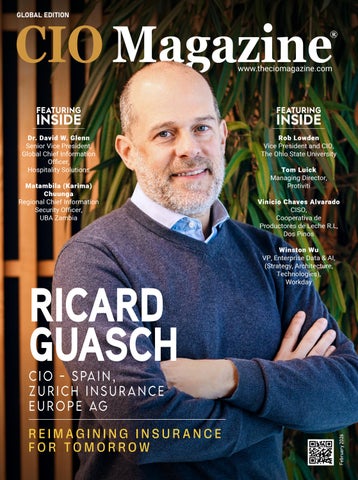
In this issue of CIO Magazine, our cover story features Ricard Guasch, CIO – Spain at Zurich Insurance Europe AG. In our exclusive conversation, Ricard speaks candidly about competitiveness and operational efficiency, but what stands out is his conviction that technology must serve people. He connects modernization with customer experience, sustainability, and inclusion. In an industry built on trust, his approach feels both practical and principled. He reminds us that digital transformation is not only about upgrading systems. It is about upgrading intent.
Beyond the cover, this edition brings together diverse voices exploring AI governance, responsible data practices, leadership in uncertain times, and the human skills that will define the next decade. You will find perspectives that challenge assumptions and invite reflection.
The mandate for digital leaders is clear. Build faster, yes. Build smarter, certainly. But above all, build wisely. The choices made in server rooms and strategy meetings today will shape societies tomorrow.
I invite you to turn these pages with that thought in mind. The future of technology is not just about what we can create. It is about what we choose to stand for.
Enjoy Reading.
Sarath Shyam
RICARD GUASCH
CIO - SPAIN, ZURICH INSURANCE EUROPE AG
REIMAGINING INSURANCE FOR TOMORROW
Rob Lowden
14 Vice President and CIO, The Ohio State University
Excellence Made Possible Through Brilliant Basics
38
Dr. David W. Glenn
Senior Vice President & Global Chief Information Officer, Hospitality Solutions
Driving Innovation through Operational Excellence
Matambila (Karima) Chuunga
Vinicio Chaves Alvarado
RICARD GUASCH
CIO - SPAIN, ZURICH INSURANCE EUROPE AG
REIMAGINING INSURANCE FOR TOMORROW
Ricard Guasch Sereno is CIO, with a career focused on driving technological innovation and digital transformation within the insurance sector. He leads initiatives aimed at enhancing competitiveness, operational efficiency, and the adoption of new technologies, always with a strong emphasis on delivering value to the business and its people and customers. He works closely with multidisciplinary teams and actively contributes to strategic projects that connect technology with customer experience. His integrative vision and ability to identify opportunities make him a key figure in the field of technological modernization and business process transformation.
Recently, in an exclusive interview with CIO Magazine, Ricard shared insights into his passion for driving technological innovation in the insurance sector. With a career focused on enhancing competitiveness, operational efficiency, and customer experience, Ricard believes that technology should serve a purpose beyond efficiency or profitability, contributing to more sustainable operations and inclusive digital experiences. He also shared his personal hobbies and interests, future plans, words of wisdom, and much more. The following excerpts are taken from the interview.
Hi Ricard. What sparked your interest in driving technological innovation in the insurance sector?
My fascination with technology began early; I dreamed of becoming an astronaut, imagining how human ingenuity could break boundaries. As an engineer, I realized that technology’s greatest power lies in improving lives in tangible, meaningful ways. Insurance, at its core, is a promise of protection, trust, and resilience. I saw an opportunity to bring innovation to a sector that fundamentally supports people in their most vulnerable moments.
My entrepreneurial journey, having launched businesses across different industries, shaped how I approach innovation. I bring that same intrapreneurial spirit to my organization: constantly challenging conventions, imagining new possibilities, and using technology as a catalyst for reimagining the future of insurance.
At the same time, I believe innovation must serve a purpose beyond efficiency or profitability. Technology should contribute to more sustainable operations, more inclusive digital experiences, and solutions that create value not only for the company but for society. That broader mission is what keeps me passionate about driving transformation in this industry.
What do you love the most about your current role?
What excites me most is the moment when business and technology merge into a single transformation narrative. When non-IT colleagues confidently explain the outcomes of a tech-enabled initiative, understanding the underlying concepts, I know we’re moving
beyond implementing systems, we’re shaping a new way of working.
Those moments show that technology has become a strategic language spoken fluently across the company. And when business and IT truly operate as one team, innovation accelerates naturally.
This synergy also allows us to push initiatives that matter on a deeper level, like improving customer experience, reducing our environmental footprint through digitalization, and fostering greater accessibility in the services we design. As technology leaders, we have the responsibility to ensure innovation uplifts all stakeholders, not just internal teams.
In your opinion, how will trends like AI, data analytics, and IoT impact insurance business models?
AI, data analytics, and IoT are not simply influencing the insurance industry, they are redefining it. AI enables hyperautomation and intelligent decision-making at a scale we could not imagine a few years ago. Data becomes the strategic currency that powers more accurate, meaningful insights. IoT and Edge technologies provide real-time understanding of risks, allowing insurers to shift from compensation to prediction and prevention.
This evolution ultimately benefits customers, who will experience more personalized protection, faster and fairer processes, and preventive services that help avoid losses altogether.
These technologies also open new possibilities for sustainability. With better data and predictive models, insurers can support safer mobility, reduce environmental risks,
and partner with customers to adopt more sustainable behaviors. The convergence of technology and sustainability is one of the most exciting frontiers for the sector.
What are the key skills insurance tech leaders need to develop?
Tomorrow’s tech leaders must be bilingual: fluent in both technology and business strategy. Understanding end-to-end processes, customer needs, and strategic priorities is essential for identifying where transformation can unlock exponential value.
Beyond technical expertise, leaders need narrative power; they must be storytellers who can communicate complex ideas simply and inspire others to embrace change. Influence,
empathy, and the ability to build diverse, highperforming teams are becoming just as critical as technical knowledge.
Diversity is not just a social imperative; it is a competitive advantage. The best ideas emerge from teams that bring multiple perspectives, backgrounds, and experiences to the table. As leaders in technology, we must cultivate inclusive environments where everyone feels empowered to contribute.
Can you share a book or resource that inspires you and why?
Rather than recommending a single resource, I prefer a broad and eclectic approach. True innovation rarely comes from a single format or discipline. I combine technology insights with
leadership content, fiction with documentaries, podcasts with industry reports.
This cross-pollination of ideas helps me approach problems from different angles, connect dots in unexpected ways, and remain open-minded. It also encourages a humancentric view of technology—reminding me that beyond the algorithms and systems, our work ultimately impacts people, communities, and society. In a way, it brings the diversity we mentioned above to the inspiration process.
What's a favorite quote or mantra that guides you?
One of my favorite stories is about JFK visiting NASA. He asked a janitor what his role was, and the janitor replied: “I’m helping send a rocket to the moon.” Whether historically accurate or not, the message is powerful: purpose transforms tasks into missions.
In insurance, we are not simply implementing technology or delivering projects. We are enabling people to sleep well at night, knowing that when uncertainty arises, we will be there. That sense of purpose is what guides me and what I try to instill in my teams. It also reinforces the importance of social responsibility in everything we do. Technology becomes far more meaningful when it serves a mission beyond itself.
How do you mentor and support emerging leaders in tech and insurance?
I mentor colleagues frequently, focusing on career development, soft skills, business acumen, and leadership. But I believe the most powerful learning comes from experience, especially from navigating complex challenges.
Technology becomes far more meaningful when it serves a mission beyond itself
I create safe environments where people can take ownership of problems, experiment, sometimes fail, and ultimately learn. It’s like teaching a child to walk: you can protect them from falling, or you can let them stumble in controlled conditions that build resilience and confidence.
I also encourage young leaders to embrace inclusive leadership early on. Understanding how to work with diverse teams, how to create psychological safety, and how to collaborate across cultures is now a fundamental skill for success.
What are some of your passions outside of work? What do you like to do in your time off?
Outside of work, I seek simplicity and authenticity. Happiness for me is spending time with people who uplift me. Watching my
children play sports, enjoying a good glass of wine on a terrace with friends, or taking a weekend trip with my wife.
I also value time alone: reading fiction, riding my bike, playing racket sports, or relaxing with a good TV series. These moments help me recharge and maintain balance, which I believe is essential for any leader.
What is your biggest goal? Where do you see yourself in 5 years from now?
My current goal is to reshape how people work by embedding AI seamlessly into daily processes. I want my department to be an example of what an AI-native, customer-centric, sustainable, and socially responsible organization can look like.
I don’t make rigid five-year plans; the world is too dynamic. I set a north star and move toward it, adjusting course as reality evolves. Ultimately, I want to continue leading transformations that enhance human potential and strengthen societal impact.
What advice would you give to professionals looking to make an impact in tech-driven insurance innovation?
First, understand your industry and your company deeply. Innovation without context creates noise, not value. Second, excel in your current responsibilities—excellence opens doors. Finally, stay curious. Look beyond your sector, explore emerging technologies, study trends in sustainability and inclusion, and keep an open mind.
The future belongs to professionals who combine technical expertise with human understanding and social awareness.
Rob Lowden
Vice President and CIO, The Ohio State University
Excellence Made Possible Through Brilliant Basics
Rob Lowden serves as Vice President and Chief Information Officer of The Ohio State University, where he leads the Office of Technology and Digital Innovation. He oversees enterprise IT, cybersecurity, data and analytics, and digital learning during a critical phase of transformation and growth. With more than 25 years of experience, he is widely regarded as a forward-looking technology leader in higher education. Before joining Ohio State, he was vice president and CIO at Indiana University, guiding IT strategy across nine campuses and medical education centers.
At Ohio State, Lowden is helping shape the university’s direction on AI fluency, digital equity, intelligent infrastructure and ethical technology practices, ensuring innovation remains student-focused and aligned to the university’s mission. His previous roles include executive associate dean and CIO of the Indiana University School of Medicine. A U.S. Navy veteran, he holds degrees in computer and technology fields from Purdue University.
In this conversation with CIO Magazine, Lowden offers a clear look at how a modern university can stay ahead in a world where technology evolves faster than most institutions can adapt. He reflects on the value of unity in large-scale IT organizations, the human side of resilience during crises, and the growing urgency of building AI fluency across an entire academic community. Below are the excerpts of the interview.
You built a long career at Indiana University before joining Ohio State. Looking back, which two projects or decisions best prepared you to lead IT at an institution the size of Ohio State, and why?
Two experiences stand out.
First, leading the alignment of a 1,500-person IT organization into a single, unified enterprise taught me the power of collaboration at scale. That work—spanning nine campuses and more than 200,000 constituents—required both precision and patience. It shaped how I listen, how I engage, and how I build shared purpose across complexity.
Second, my time as Executive Associate Dean and CIO at the largest medical school in North America gave me direct experience operating at the intersection of technology, medicine, and research. We connected clinical, academic, and administrative systems to serve physicians, researchers, and students simultaneously.
Among the projects that most prepared me for Ohio State, two rise above the rest. One was moving the entire university community to a unified digital identity—more than 200,000 people across multiple campuses, fully integrated with the state’s largest health system. That digital transformation literally touched every student, faculty member, and clinician. When this past May’s incoming class arrived, they were the first to know only a digital ID— proof that the effort had fundamentally changed the culture.
The second was IT alignment itself. I began in the medical school with an IT staff of one— me—and within six months, built and aligned nearly 200 professionals into a cohesive team.
Later, as university CIO, I carried that model forward, listening across every college and business unit, aligning another 400 staff, and maturing central IT from 900 to 1,500 FTE. That alignment created lasting gains in efficiency, trust, and capability—returns that still compound year after year.
During the pandemic you helped pivot large campuses to remote learning and research continuity. What operational lessons from that period do you still apply to everyday IT strategy and resilience planning?
The pandemic underscored that technology succeeds only when people are cared for. Moving entire campuses to remote learning and research continuity demanded technical agility, yes—but also empathy and endurance.
Well-being and communication became nonnegotiable. Teams were asked to deliver heroic outcomes on impossible timelines, and my role was to keep them connected, recognized, and grounded. Acknowledging those contributions openly and often wasn’t just morale building— it became the engine of resilience. That experience now informs every IT strategy I lead: technology follows trust.
Ohio State has highlighted AI fluency and digital equity as priorities. How do you balance rapid adoption of AI tools with concerns about ethics, bias, and equitable access on a campus with diverse stakeholders?
AI moves faster than any technology wave higher education has ever faced. The academy, however, is uniquely suited for it. Our mission—
BY EMBEDDING QUESTIONS OF ETHICS, BIAS, AND EQUITY INTO THE CURRICULUM AND OUR TECHNOLOGY GOVERNANCE, WE’RE ENSURING
THAT INNOVATION HAPPENS RESPONSIBLY
research, exploration, discovery—positions us to lead thoughtfully amid acceleration.
At Ohio State, AI Fluency isn’t a buzzword; it’s a conscious academic strategy. We’re building fluency for all—students, faculty, and staff—so that everyone can engage critically and creatively. By embedding questions of ethics, bias, and equity into the curriculum and our technology governance, we’re ensuring that innovation happens responsibly. We don’t chase tools; we cultivate understanding.
have to master the fundamentals: a resilient network, modern identity systems, and clear governance. Our network spans 88 counties and supports more than 30,000 wireless access points— connecting everything from 110,000 fans in the Horseshoe to remote research farms and clinical environments. It is our bedrock. We continue to invest heavily in its modernization.
Cybersecurity remains a top concern for higher education. How are you structuring governance, staffing, and investments to reduce risk while enabling research and teaching that require open data access? We focus on what I call the “brilliant basics.”
Before we can secure the extraordinary, we
Equally important is reimagining identity. We’re simplifying access for people who wear multiple hats—clinicians who also teach and research, parents and guests who engage through secure social logins. Security shouldn’t be a barrier; it should be an enabler. Our governance model brings voices from every part of the university to the table, ensuring decisions are informed, balanced, and forward-looking.
As a leader who has worked across enterprise IT, research computing, and clinical systems, how do you measure success when modernizing infrastructure that serves very different user communities?
Perception matters. IT is a service organization inside a mission-driven enterprise. Success isn’t measured in ticket closures or budget savings— it’s measured in whether we amplify the success of the people we serve.
When faculty can teach without friction, when researchers can collaborate securely across continents, when clinicians can trust their systems in critical moments—that’s success. Our job is to make excellence possible and invisible at the same time.
Outside of the job you enjoy golf and soccer. How do those activities influence your leadership style or your approach to team building and culture?
Golf teaches focus and discipline; soccer teaches teamwork and trust. Leading IT at a large university requires both. Some days
you’re alone with a tough decision and have to commit to the swing; other days you’re part of a coordinated play that only succeeds when every teammate contributes.
Both sports remind me that preparation and humility matter. In golf, one good shot doesn’t define the round. In soccer, one player never wins the match. IT leadership is exactly the same blend of individual accountability and collective success.
What single piece of practical advice would you give a young professional hoping to build a long-term career in higher education IT?
Do every task—no matter how small—with excellence. That quiet consistency becomes your reputation long before a title ever does. In higher education, people notice those who care deeply about their work. When you build trust that way, opportunity follows naturally.
It sounds simple, but it’s rare—and it compounds over time. That approach has guided me from my first help-desk job to the CIO’s chair.
Driving Innovation and Security in the Digital Era Matambila (Karima) Chuunga
Regional Chief Information Security Officer, UBA Zambia
Matambila is a visionary cybersecurity leader and Regional CISO whose career spans Africa and Australia. Starting in technical support, she returned to Zambia and rose from IT Helpdesk Officer to Regional Chief Information Security Officer, driven by curiosity and a passion for protecting people in the digital world. Certified in ISO 27001, ISO 27701, PCI DSS, and a CDPO, she has earned awards including the 2024 ICT Association of Zambia Cybersecurity Excellence Individual Award and Trellix 2025 Cyber Titan Top 10 Global Women Leaders. She co-hosts HoneyPot Chats and mentors emerging talent, inspiring a new generation of cybersecurity professionals.
Recently, in an exclusive interview with CIO Magazine, Matambila shared insights into her career journey, leadership philosophy, and vision for cybersecurity, highlighting the importance of diversity, inclusion, mentorship, and continuous learning in building a strong and resilient digital ecosystem. The following excerpts are taken from the interview.
Hi Matambila. Can you walk us through your career journey and how you became a cybersecurity leader?
My cybersecurity journey began in a very hands-on way. While completing my degree in Australia, I worked as a technical support analyst for a major telecommunications company. That role gave me a strong technical foundation and direct exposure to user needs — which remains a core part of how I lead today.
When I returned home to Zambia, I entered the financial services sector, where cybersecurity isn’t just important — it’s mission-critical. I started at the IT Helpdesk, solving real-world problems on the front lines. From there, I stepped into Team Lead IT Security and Risk and Management, where I learned how technology decisions connect to business strategy and regulatory accountability. That broadened perspective prepared me for my transition into formal cyber leadership. I became Country Head of Information Security, responsible for building a security culture and aligning cyber priorities with
organisational objectives. Today, as Regional Chief Information Security Officer, I lead cybersecurity strategy across multiple countries — ensuring resilience, driving continuous improvement, and shaping the governance needed to protect our customers’ trust.
What has remained constant is my passion for elevating cybersecurity to a business enabler — and my commitment to becoming the strongest version of myself while empowering others to do the same.
What do you love the most about your current role?
What I love most about my current role is the challenge and the impact. Every day pushes me to think differently — to innovate, solve complex problems, and collaborate with diverse teams across the organisation. Cybersecurity touches every part of the business, so driving that shared accountability and enabling the organisation to operate with confidence is incredibly rewarding. It’s not just about protecting systems — it’s about empowering the business to move forward safely.
CYBERSECURITY TOUCHES EVERY PART OF THE BUSINESS, SO DRIVING THAT SHARED ACCOUNTABILITY AND ENABLING THE ORGANISATION TO OPERATE WITH CONFIDENCE IS INCREDIBLY REWARDING
What do you think is the biggest misconception about cybersecurity, and how do you address it?
One of the biggest misconceptions about cybersecurity is that it’s purely an IT issue, only relevant when something goes wrong — and mainly in corporate environments. In reality, cybersecurity is a business issue, a people issue, and even a societal issue. Whether you’re a large enterprise, a small organisation, or an individual with a mobile phone, you’re a target in today’s digital world.
How I address this is by engaging the business in a language they recognise — risk, trust, continuity and growth. I work closely with non-technical functions to show how cybersecurity enables operations, protects our reputation, and supports innovation. When people understand the value and their role in it, security becomes a shared responsibility rather than a technical problem to be escalated.
Can you share your thoughts on the importance of diversity and inclusion in the tech industry?
Diversity and inclusion in tech — and especially in cybersecurity — isn’t a “nice to have,” it’s mission-critical. We are solving problems that affect people from different backgrounds, cultures, genders and abilities. To design protections that truly work for everyone, we must ensure the people building those solutions reflect the diversity of those they protect.
Representation brings different perspectives, lived experiences and ways of thinking. It helps us identify risks we might otherwise overlook and innovate in ways we
wouldn’t have imagined alone. Inclusion then ensures those voices are not just present, but empowered to influence decisions.
Ultimately, diverse teams create stronger, more resilient technology — and a safer digital world for all of us.
What inspired you to co-host HoneyPot Chats and advocate for cybersecurity awareness?
HoneyPot Chats was inspired by a simple but important observation during the COVID-19 lockdown: as the world moved online overnight, many people didn’t understand the basic cyber hygiene needed to stay safe. My co-host, Brenda, was in Spain, I was in Zambia, and we found ourselves having long conversations about the growing risks and the gap in awareness — especially in our local market.
We realised that cybersecurity education was either too technical or simply not reaching everyday users. So, we created HoneyPot Chats to bring cyber awareness to people in a relatable, accessible way — using storytelling, real-life examples, and conversations that anyone could follow. For me, it was about empowering communities with knowledge, because everyone deserves to feel safe and confident online.
What role do you think mentorship plays in shaping the next generation of cybersecurity professionals?
Mentorship plays a critical role in cybersecurity because this industry is constantly evolving, and no one succeeds alone. Mentors carry the blueprint of a road already travelled — the
challenges, the lessons, the breakthroughs. By sharing that experience, they can guide emerging professionals, help them avoid common pitfalls, and accelerate their growth.
But mentorship is more than advice. It’s about opening doors, building confidence, and helping people see possibilities they may not yet see in themselves. When we invest in mentorship, we build a stronger pipeline of skilled, diverse cybersecurity talent — which ultimately strengthens the resilience of our entire digital ecosystem.
Can you share a book or resource that inspires you and why?
A book that continues to inspire me is ‘The Professional Troublemaker’ by Luvvie Ajayi Jones. It’s a bold reminder that courage is required to drive meaningful change. In cybersecurity, we often have to challenge the status quo — speak up when something isn’t secure, push for investment, or advocate for accountability even when it’s uncomfortable.
This book reinforces the importance of fearlessly using your voice, especially in rooms where security may not yet be understood or prioritised. It reminds me that being a “troublemaker” — in the best sense — is part of protecting people, enabling trust, and leading with integrity. It encourages me to be brave, even when the easier option is to stay silent.
What are some of your passions outside of work? What do you like to do in your time off?
I’ve recently developed a love for creating content that empowers people to stay safe online — it’s a way to make an impact beyond my day-to-day role. I also enjoy reading books
IN CYBERSECURITY, WE OFTEN HAVE
TO
CHALLENGE
THE STATUS QUO — SPEAK UP WHEN SOMETHING ISN’T SECURE, PUSH FOR INVESTMENT, OR ADVOCATE FOR ACCOUNTABILITY EVEN WHEN IT’S UNCOMFORTABLE
that challenge how we think about leadership and purpose. And when I need to recharge, I love travelling and exploring new places — experiencing different cultures and perspectives always inspires me in unexpected ways.
What is your biggest goal? Where do you see yourself in 5 years from now?
My biggest goal is to continue elevating cybersecurity as a strategic business enabler. In five years, I see myself shaping cyber strategy at a global level, developing the next generation of talent, and ensuring organisations — and communities — can operate confidently in a digital-first world. Ultimately, I want to leave a lasting impact by combining leadership, innovation, and resilience.
What advice would you give to organizations looking to improve their cybersecurity posture?
The first piece of advice I would give is to treat cybersecurity as a business priority, not just an IT issue. It requires engagement from every level — from the boardroom to front-line staff.
Start by understanding your risks, aligning security investments with business objectives, and creating a culture where security is everyone’s responsibility.
Second, invest in people as much as technology. Skilled, empowered teams are your strongest defence. Provide ongoing training, mentorship, and opportunities to grow. Finally, embrace continuous improvement: threats evolve daily, so your strategy, policies, and controls need to evolve with them. Cybersecurity isn’t a destination — it’s a journey of resilience, awareness, and accountability.
Building Digital Trust through Purpose-Driven Leadership
Vinicio Chaves Alvarado
CISO, Cooperativa de Productores de Leche R.L, Dos Pinos
Vinicio Chaves Alvarado is a cybersecurity and digital transformation executive with over 20 years of experience leading strategies that protect organizations, people, and nations across Latin America. From his early days at Deloitte and BAC Credomatic to his current role as CISO of Cooperativa Dos Pinos, he has built a career driven by purpose: to enable digital trust as a catalyst for progress. Founder of the Virtual CISO platform (VRCISO), Vinicio is recognized as a thought leader, mentor, and advocate for elevating cybersecurity maturity and resilience across the region.
Recently, in an exclusive interview with CIO Magazine, Vinicio shared insights into his journey as a cybersecurity leader, emphasizing the importance of purpose-driven leadership and digital trust. He highlighted his passion for elevating cybersecurity maturity across Latin America and empowering organizations through education and collaboration. Vinicio also discussed emerging trends, the evolving role of the CISO, and common misconceptions about cybersecurity, stressing that it's a business and cultural issue rather than just an IT problem. The following excerpts are taken from the interview.
Hi Vinicio. Can you walk us through your career journey and how you became a cybersecurity leader?
The beginning of my career is a story in itself. I come from a humble family in the countryside of Costa Rica, where I had the privilege of learning from two great mentors — my father, who taught me the passion of doing things with love and commitment, and my grandfather, who showed me the power of education and lifelong learning.
I moved to the capital to pursue my professional dreams and began my career at Deloitte as a consultant. After two years filled with valuable lessons, I joined BAC Credomatic, the largest financial institution in Latin America. There, I was given the opportunity to truly develop in the field of cybersecurity. I led multidisciplinary teams and worked hand in hand with executives to build the cybersecurity strategy for a financial group that moves nearly 50% of the region’s GDP.
During that time, I earned international certifications and became one of the organization’s cybersecurity leaders. But more importantly, I discovered my purpose — to build trust in the technologies that empower companies, people, and nations. I realized that cybersecurity can have a real, positive impact on society.
Later, I was offered the opportunity to join Cooperativa Dos Pinos, one of the most iconic organizations in Central America. Shortly after joining, I was appointed CISO, leading efforts to transform the cooperative’s cybersecurity culture and resilience.
My journey has been full of challenges and opportunities, but passion and purpose — combined with the incredible professionals I’ve worked with — have shaped who I am today. I
IN
THE NEAR FUTURE, CISOS WILL SIT AT THE INTERSECTION OF TECHNOLOGY, RISK, AND CULTURE, RESPONSIBLE NOT ONLY FOR DEFENSE BUT FOR ENABLING TRUST, RESILIENCE, AND INNOVATION ACROSS THE ENTERPRISE
continue to evolve every day, driven by a clear vision: to raise the level of cyber resilience across Latin America.
What do you love the most about your current role?
What I value most is the purpose behind the work — protecting people, operations, and reputations. Every day I have the opportunity to connect cybersecurity strategy with business growth, to inspire teams, and to turn complex risks into opportunities for innovation and trust.
What are some emerging trends or technologies that you're most interested in?
I’m particularly interested in the convergence of AI-driven threat detection, identity and access governance, and operational technology (OT) security. I also see AI copilots and autonomous security agents transforming how CISOs make decisions and respond to threats. Another key trend is cyber resilience by design — embedding security, privacy, and reliability from the start of every digital initiative.
How do you see the role of the CISO evolving in the next few years?
The CISO role is rapidly evolving from a technical guardian to a strategic business leader. In the near future, CISOs will sit at the intersection of technology, risk, and culture, responsible not only for defense but for enabling trust, resilience, and innovation across the enterprise. For me, the true mission of a CISO goes beyond managing threats — it’s about empowering confidence in the digital ecosystems that connect people, organizations, and societies.
The technical expertise we’ve built will always remain a foundation, but the essence of our role is shifting toward being trust enablers — executives who help businesses move forward securely and confidently.
To succeed in this new era, CISOs must combine technical depth with strong communication, business acumen, and the ability to influence at the board level. Ultimately, the future CISO is not just a protector — but a builder of digital trust and strategic value.
What are some common misconceptions about cybersecurity that you'd like to dispel?
One of the biggest misconceptions is that cybersecurity is just an IT problem. It’s not — it’s a business and cultural issue. Another misconception is that cybersecurity is about fear or control. In reality, it’s about confidence, preparedness, and collaboration. A strong security culture empowers people rather than restricts them.
There’s also a common belief that we implement controls and policies simply because they are best practices or regulatory requirements. The truth is, we do it with a clear purpose — to enable digital trust. Every control, every policy, every process exists to allow businesses to operate securely, to foster safe commercial exchanges, and to ensure that even the woman who entrusts her life savings to a financial institution can do so with confidence.
It’s not about controls for the sake of compliance; it’s about creating the foundation for digital trust — the invisible yet powerful element that drives economies, protects people, and enables progress.
Is there a particular person you are grateful for who helped get you to where you are?
There are many people I’m deeply grateful for, but if I had to name the two most important mentors in my life, it would be my father, Norman Chaves, and my grandfather, Gerardo Alvarado. They are the people to whom I owe everything.
My father taught me the value of honest, hard work, of putting love and passion into everything I do. My grandfather taught me the power of education, continuous improvement, and humility — virtues that have guided me throughout my entire journey. Both instilled in me the belief that no matter how far we go, what truly matters is remembering that we are here to serve others and make life better for people, communities, and nations.
I also carry deep gratitude for the leaders who believed in me — first at Deloitte, and especially at BAC, where I was given the opportunity to grow, lead, and learn. And today, at Cooperativa Dos Pinos, I’m equally grateful to work alongside visionary leaders who have allowed me to rethink how we build a cybersecurity and cyberresilience culture for the future.
Their trust and guidance have shaped not just my career, but who I am as a leader — someone who leads with purpose, humility, and a deep sense of responsibility to serve.
Can you share a book or resource that inspires you and why?
This is a difficult question because I truly love reading and learning. It wasn’t something that came naturally to me — it’s a discipline I developed over time. But one book that has deeply resonated with me and shaped who I am is “Start with Why” by Simon Sinek.
Every time I revisit it — because this is not a one-time read — I’m reminded of the power of understanding why we do what we do. That “why” gives meaning to our work, shapes the culture of organizations, and even influences societies. It reminds me that when purpose is clear and authentic, the “how” and the “what” naturally follow.
This book continues to inspire me as a leader because it perfectly aligns with my philosophy: purpose is not just a personal belief — it’s the foundation for building trust, resilience, and long-term impact in everything we do.
What are some of your passions outside of work? What do you like to do in your time off?
I have several passions outside of the office, and each of them keeps me grounded and connected to who I am. One of them is running — something I don’t do as often as I used to, but it remains a personal refuge for me. Running has always been more than exercise; it’s a form of meditation and a way to confront that inner voice we all carry — the one that sometimes whispers laziness, shortcuts, or self-doubt.
When I run, I meet that voice face to face. I listen to it, I understand it — but then I ask it to take the back seat, where it belongs, and I keep moving forward. Every run becomes a dialogue between who I am and who I aspire to be — an opportunity to realign with my purpose, vision, and values.
Another passion that has become central in my life is mentorship and leadership. It’s something I never expected to love as much as I do. I find deep fulfillment in helping others grow, unlock their potential, and, most importantly, question their own “why” — why they’re here,
ONE OF THE BIGGEST MISCONCEPTIONS IS THAT CYBERSECURITY IS JUST AN IT PROBLEM. IT’S NOT — IT’S A BUSINESS AND CULTURAL ISSUE
MY BIGGEST GOAL IS TO ELEVATE CYBERSECURITY MATURITY ACROSS LATIN AMERICA, EMPOWERING ORGANIZATIONS THROUGH EDUCATION, TECHNOLOGY, AND COLLABORATION
what they have to offer, and how they can serve. Having the privilege to plant small seeds that may transform lives, even in subtle ways, fills me with an immense sense of gratitude and humility.
What is your biggest goal? Where do you see yourself in 5 years from now?
My biggest goal is to elevate cybersecurity maturity across Latin America, empowering organizations through education, technology, and collaboration. I believe that cybersecurity can and should be a force for progress — enabling trust, protecting innovation, and fostering sustainable growth across our region.
In five years, I see myself expanding the reach of our Virtual CISO platform globally, helping organizations of all sizes build resilience while influencing policy, thought leadership, and digital trust standards at a broader scale.
At the same time, I envision continuing my journey of mentorship and purpose-driven leadership — touching lives, helping others discover their potential, and inspiring future leaders to see cybersecurity not only as a profession, but as a calling to serve, protect, and transform society.
What advice would you give to organizations looking to build a strong cybersecurity culture?
Start with leadership and purpose. Cybersecurity culture doesn’t grow from policies — it grows from example. Make it part of the organization’s DNA: communicate with clarity, recognize positive behaviors, and link security to people’s everyday roles. When employees understand why cybersecurity matters, trust becomes the most powerful control.
Wa n t t o S e l l o r fi n d
I nve s t o rs f o r yo u r
B u s i n e s s ?
Leading Technology Risk and Resilience in Financial Services
Tom Luick
Managing Director, Protiviti
Tom Luick is a Managing Director at Protiviti, based in Chicago, IL, where he leads the Technology Risk & Resilience practice. With more than 25 years of experience in the financial services industry, Tom has built a reputation as a trusted advisor and innovator, helping clients solve complex technology, compliance, and risk management challenges. His expertise spans technology risk management and governance, regulatory compliance, system modernization, and business transformation, with a particular focus on the insurance and banking sectors. Tom holds a B.A. in Management Information Systems from the University of Iowa and an M.S. in Finance from DePaul University.
Recently, in an exclusive interview with CIO Magazine, Tom shared insights into his passion for technology and innovation, driven by collaborative problem-solving and teamwork. He highlighted the importance of data analytics in driving business insights and decision-making, and emphasized the need for continuous learning to stay connected with industry trends. Tom also spoke about his commitment to leadership development, aiming to empower his teams and expand his impact, while pursuing education initiatives and personal growth outside of work. The following excerpts are taken from the interview.
Hi Tom. What drives your passion for technology and innovation?
From the start of my career, I have worked on large technology implementation and merger and acquisition programs. While these projects are often difficult and require long hours, collaborating with colleagues and clients to solve the challenges they present has always been very satisfying to me. The teamwork and camaraderie that comes with those programs has fuels my passion for technology.
What do you love the most about your current role?
Working with talented and dedicated professionals is a great motivator for me and my current role allows me to do that every day. It is invigorating knowing you will learn, grow, and be challenged every day.
What role do you think data analytics plays in driving business insights and decision-making?
It would be difficult to understate the role data analytics plays in driving business insights. Most organizations are investing heavily in data analytics as the cornerstone of making informed decisions, anticipating risks, understanding their customers and improving their businesses.
How do you stay connected with industry trends and developments?
Continuous learning is a requirement of a successful career. I actively participate in professional networks, engage with
thought leaders when I can, and read daily to stay on top of the most recent trends. Most importantly, I listen to my clients to understand their perspectives on what really matters to them.
Is there a particular person you are grateful for who helped get you to where you are?
My firm values stewardship and I’ve been lucky to have several great mentors throughout my career. People who truly invested in my success who had my best interest at heart as they advised me and helped shape my career.
What are some of your passions outside of work? What do you like to do in your time off?
In the community, I focus on education initiatives including serving as a board member at Chicago Hope Academy, a Christian life preparatory high school focused on helping inner-city students achieve their full potential. In my spare time, I enjoy spending time with my family and try to stay active by hitting the gym most mornings.
Can you share a book or resource that inspires you, and why?
I find inspiration in people overcoming adversity. I truly admire the strength and resilience necessary to confront difficult situations, grow from the experience, and emerge a better person. I often look books or movies that exemplify personal strength.
MOST ORGANIZATIONS ARE INVESTING HEAVILY IN DATA ANALYTICS AS THE CORNERSTONE OF MAKING INFORMED DECISIONS, ANTICIPATING RISKS, UNDERSTANDING THEIR CUSTOMERS AND IMPROVING THEIR BUSINESSES
What is your biggest goal? Where do you see yourself in 5 years from now?
My biggest goal is to expand the impact I have on my teams by becoming a better leader. That means empowering my teams to reach their potential, being a better mentor, and providing the right growth opportunities. In 5 years, I see myself continuing to help clients solve business problems through technology,
hopefully on a little bigger scale than today.
What advice would you give to aspiring leaders looking to make a similar career journey?
My advice is to recognize that you own your career. Take ownership of your success and seek mentors and build relationships with people who are invested in helping you achieve your goals.
Dr. David W. Glenn
Senior Vice President & Global Chief Information Officer, Hospitality Solutions
Driving Innovation through Operational Excellence
David Glenn serves as Senior Vice President and Global Chief Information Officer for Hospitality Solutions, where he leads the company’s global technology strategy and operations. With more than 35 years of experience as a technology and business operations executive, David is recognized for driving large-scale transformation initiatives that deliver sustainable growth, operational efficiencies, and measurable impact across industries. He holds an MBA and Ph.D. in Global Leadership & Strategy from George Washington University and is a published author in the technology field. David has also served on the board of the Make A Wish Foundation, MDA as well as the Association of Information Technology Professionals.
Recently, in an exclusive interview with CIO Magazine, Dr. Glenn shared insights into his transformative leadership in hospitality technology, the evolving landscape of AI and data-driven innovation, and strategies for driving business growth through operational excellence. He also shared his personal hobbies and interests, future plans, words of wisdom, and much more. The following excerpts are taken from the interview.
Hi Dr. Glenn. What motivated you to pursue a career in technology and business operations?
When I was young my grandfather sent me to a computer camp as he felt that was the future. From there I feel in love with the field. Yes, I was one of those kids you would see playing on the TRS-80 outside the Radio Shack at the mall! I went on the participate in the Diversified Education Program in High School. That is where you went to school for half a day and worked the other half during your junior and senior year. I was lucky enough to land a position with a computer retailer back when you had to configure the IBM PCs with video graphics cards, memory etc.. After that I made the decision that is what I wanted to do as my choice of career. I love technology and being able to use it to help solve complex business
issues as well as an enabler for business to more forward and be competitive.
What do you love the most about your current role?
So I have the luxury of being able to work with some extremely talented people. I am not just referring to my fellow leaders. I am referring to all levels of the organization. I get to be part of taking an established brand and product and carving it out to a completely new company with new services, solutions and products to continue to be a leader in the industry. Bringing together product, data, engineering, and operations to deliver tangible business impact — and watching people grow as a result — is the daily reward. Stay tuned! Big announcement coming after the 1st of the year!
How do you think technology can be used to drive business growth and innovation?
Technology is a multiplier when it is relentlessly tied to outcomes — revenue, margin, retention, or operational cost. The most effective programs define the metric first, then apply automation, data, and AI to compress decision cycles, remove manual toil, and create new customer value that didn’t exist before. Also, Speed To Market is key in any industry. Technology can help drive that.
Can you describe your vision for the future of the industry?
The industry will move from tool-driven adoption to outcome orchestration: companies that combine human judgement, robust data governance, and composable AI services will lead. Expect more real-time verticalized platforms, rigorous operational controls around models, and a shift toward products designed for ethical, auditable automation. As it relates to technology in the Hospitality industry. The next decade will be about shifting from isolated point solutions to real-time, human-centered platforms that blend hyperpersonal guest experiences with operational rigor. Technology will stop being a cost center and become the connective tissue that turns guest intent into seamless, measurable value while protecting trust and margin. The winners will be organizations that combine disciplined operations, responsible AI, and a guest-first mindset — delivering experiences that feel effortless to guests and sustainable for the business.
What do you believe are the most important qualities of an effective leader in technology and business operations?
Clarity of purpose, operational empathy, and a bias toward learning. Leaders must set crisp priorities, remove obstacles for their teams, and create psychological safety so fast experiments can happen without fear of blame. Equally important is the ability to translate technical tradeoffs into business risk and ROI conversations. At the end of the day you must be a good listener. Avoid jumping to conclusions. A habit in a lot of IT leaders.
What mentors or role models have had a significant impact on your career?
Practical, supportive leaders who combined high standards with human warmth influenced me most — people who taught me to be both rigorous and generous. I’ve also learned a great deal from operators who prioritized runbooks, SLAs, and the boring but critical work of keeping systems healthy. Mentors that I understood that I am going to fail and coached me on how to manage that.
Can you share a book or resource that inspires you and why?
I value books that blend strategy and people— works that offer practical frameworks rather than abstract theory. They remind me that durable transformation is about habits and systems as much as technology. Specifically Lou Gerstner (Prior CEO of IBM) book “Who Says Elephants Can’t Jump” and the book “Saving Big Blue”.
MY PRIORITY IS TO SCALE AI AND DATA CAPABILITIES RESPONSIBLY, SO THEY DELIVER MEASURABLE COMPETITIVE ADVANTAGE ACROSS THE ORGANIZATION
What are some of your passions outside of work? What do you like to do in your time off?
I recharge around family. Recently became a grandfather to my amazing 15 month old granddaughter Layla. Love anything on the water, golf, good music. I also enjoy connecting with local tech leaders and trading ideas; those conversations keep my thinking fresh.
What is your biggest goal? Where do you see yourself in 5 years from now?
My priority is to scale AI and data capabilities responsibly, so they deliver measurable competitive advantage across the organization.
In five years, I expect to leading us into future offerings and continuing to find ways that technology can continue to enable to business and help us drive success.
What advice would you give to someone starting their career in technology and business operations?
Be relentlessly curious and fiercely pragmatic: run things reliably, and explain technical choices in business terms. Build operational discipline early — runbooks, KPIs, and postincident learning — and seek mentors who will push you on both craft and character. As I said in the aforementioned, be a good listener.
Empowering Innovation Through Data and AI Winston Wu
VP, Enterprise Data & AI (Strategy, Architecture, Technologies), Workday
Winston Wu is a trusted management and technology professional with over 20 years of global experience (North America, Asia and Europe) focused on helping organizations build, operate and optimize their technology infrastructure, data & analytics ecosystems, operational functions and business transformation agendas by delivering large scale business/technology programs and initiatives, and providing advisory services across various industries (financial, insurance, utilities, retail, government, health/medical and communications & high tech) in both technology and business capacities. He lives in Toronto, Canada with his wife and three children.
Recently, in an exclusive interview with CIO Magazine, Winston shared insights into his transformative journey in technology, the evolving landscape of AI and machine learning, and strategies for driving business growth through data and innovation. He also shared his personal hobbies and interests, future plans, pearls of wisdom, and much more. The following excerpts are taken from the interview.
Hi Winston. Can you tell us about your early career and what sparked your interest in technology and management?
Ever since I was a child, I was always fascinated with technology (probably stemming from video games) but upon graduating from Industrial Engineering at the University of Toronto in 2003, I joined Accenture as part of the Data Center Technologies & Operations practice. During the 7.5 years I spent at Accenture, I was immersed in the world of designing and building data centers (facilities, storage, networks, servers, HVAC, applications, security) in addition to business development, client interactions, and the management of teams and stakeholders.
Additionally, I was able to work globally (across North America, Asian and Europe) which further enriched my experience.
After leaving Accenture at the end of 2010, I joined Ernst & Young (EY) in their Advisory Services practice where I was able to apply the large program transformation experience I had gained at Accenture. But, I consciously moved towards the IT Strategy and cyber security domains as I saw the increasing interest in these two areas from organizations across all industries. Before I left EY after 5.5 years, I was hyper focused in mergers & acquisitions helping clients integrate their technology and business functions and ecosystems to realize synergies.
RESPONSIBLE AI SHOULD BE ON TOP OF MIND OF ANY ORGANIZATION LOOKING TO LEVERAGE AI – THIS DRIVES THE NEED TO ENSURE THERE ARE MECHANISMS TO TEST FOR BIAS, TOXICITY, ACCURACY, ETC. IN ADDITION TO INTENTIONAL DESIGN AND HUMAN-IN-THE-LOOP OVERSIGHT
I would say my 13 years in global consulting further reinforced my natural work ethic and discipline but definitely enabled me to expand my knowledge and skills given the exposure to various technologies and challenges across numerous clients across multiple industries (banking, insurance, wealth management and capital markets, health, public sector, utilities, retail, commercial development, fleet management).
I left the consulting world and joined one of the largest Canadian banks in late 2016 which is when my journey with data & analytics and data science began. It’s been around 10 years now that I’ve been in this space across banking, insurance, telecommunications, software/ product and healthcare, and there is no shortage of excitement with the continuous evolution of technology, the growing landscape of challenges to solve and the ever-increasing adoption and applicability of AI.
What do you love the most about your current role?
There are several dimensions I love about my current role but the top three would have to be: 1) The types of challenges we get to tackle from a technology and use case perspective; 2) The people that I get to work with due to their diverse personalities, experiences and personal backgrounds; and 3) The mission of the organization as a whole.
How do you see the role of AI and machine learning evolving in the next 5-10 years, and what opportunities and challenges do you think it will bring for organizations?
I see it as an algorithmic transformation because AI is transforming data and signals, problems, business processes and people. The primary opportunity with AI is when AI acts as augmentation tool, freeing workers for
high-value activities: critical thinking, creative problem-solving, innovation, and strategic oversight. The main challenge will be related to algorithmic bias which is why Responsible AI should be on top of mind of any organization looking to leverage AI – this drives the need to ensure there are mechanisms to test for bias, toxicity, accuracy, etc. in addition to intentional design and human-in-the-loop oversight.
What are some of the most important qualities or skills you think a technology leader should have, and how can they develop them?
I would consider five key areas:
• Strategic and Business Acumen (connecting technology investments directly to business value and long-term strategic goals) - Study market trends, understand company KPIs (Key Performance Indicators), and focus decisions on measurable business outcomes, not just technical merit.
• Communication and Stakeholder Management (translating complex technical concepts for non-technical audiences and practicing active listening) - Practice tailoring presentations to different audiences, focusing on business impact over technical detail.
• Adaptability and Change Management (guiding teams through rapid technological and organizational change) - Embrace Agile methodologies, practice scenario planning, and lead by example in adopting new technologies.
• People Management and Coaching (building diverse, high-performing teams through trust, delegation, and coaching) - Improve Emotional Intelligence (EQ), delegate meaningful work, and prioritize staff career development in oneon-ones.
I ASPIRE TO BE A CIO, CTO OR CHIEF TRANSFORMATION OFFICER WHERE I AM ABLE TO DRIVE INFLUENCE AND IMPACT ACROSS MULTIPLE LINES OF BUSINESSES AND PLAY A ROLE IN SHAPING THE FUTURE OF AN ORGANIZATION
• Technical Competence (maintaining enough depth to make informed architectural decisions, to assess risk, and to earn team respect)Participate in key architectural reviews, dedicate time to continuous learning about emerging technologies, and stay connected to the team's daily challenges. Always be curious.
Can you share a book or resource that inspires you and why?
I came across the book "Hustle and Float: Reclaim Your Creativity and Thrive in a World Obsessed with Work" by Rahaf Harfoush when I heard her speak at a data & analytics conference in London, UK in 2025. The message and book is inspiring to me because it challenges the pervasive and often destructive culture of "hustling." The key inspirational takeaways center on a more humane and sustainable approach to work and creativity -
• The realization that endless hustlingworking harder, faster, and longer - is often counterproductive to true creativity and is actively damaging to mental and physical health.
• The power of "Float" encourages embracing the concept of "floating," which represents the essential periods of rest, recovery, and deep focus needed for creative breakthroughs. The inspirational message here is that stepping away, reflecting, or even resting is not laziness; it is a vital, non-negotiable part of the creative process.
• Inspires readers to question the deep-seated cultural and historical belief that one's worth is solely tied to constant, measurable productivity. This is an emancipating message that frees people from the pressure to constantly be "on" and producing.
• Ultimately, the book points toward a path to a more humane, sustainable, and genuinely creative way of living. It offers hope that you can thrive in the modern knowledge economy without burning out or compromising your values.
It is important to emphasize that “not hustling” is not the message here - working hard will always be core to success but there needs to be a balance with the ability to give oneself the space to reflect and think.
What is your favorite quote?
“You can't do anything about the past, you can only operate in the present and plan for the future." - Jamie Dimon
I choose this quote because I genuinely believe in focusing on what one can control, and personal drive and perseverance and because of a high level of respect for Mr. Dimon and his career.
What are some of your passions outside of work? What do you like to do in your time off?
Like many of my peers who have very busy work schedules, what I do with my personal time has to be very selective – Most of my personal time is spent with my wife and children, traveling, spending time with friends, volunteering and mentoring.
What is your biggest goal? Where do you see yourself in 5 years from now?
I aspire to be a CIO, CTO or Chief Transformation Officer where I am able to drive influence and impact across multiple lines of businesses and play a role in shaping the future of an organization.
What advice would you give to young professionals looking to start their career in technology and management?
With AI’s impact on our economy and society, I would recommend that young professionals focus on Technical Fluency, Critical Thinking, Ethical Awareness and Continuous Learning. I
would also encourage them to seek mentors in their professional and personal networks - real world experience from various perspectives will always be invaluable. And lastly, developing deep specialized expertise in niche domains and building portfolios demonstrating competencies through real-world projects will also help differentiate themselves.