
In January 2025, the Trump Administration launched a coordinated effort to reduce the federal workforce, including developing a new agency to “drive efficiency.” The Department of Government Efficiency (DOGE) implemented “reductions in force” (RIF), eliminated all DEI roles , incentivized career civil servants to leave their positions, and initiated a hiring freeze on non-political appointees. These combined actions eroded institutional continuity and disrupted the everyday operations of agencies, creating profound instability for the federal workforce. Black federal workers have been disproportionately affected by the current instability within the federal workforce, including ongoing agency layoffs and, most recently, a 43-day government shutdown, the longest in United States history. As a result of the firings, relocation mandates, and deferred resignation programs (DRPs), more than 211,000 civil-service employees had either voluntarily or involuntarily separated from the federal government by late October 2025.
These shifts follow a broader pattern of government retrenchment, slashing programs that provide social support to communities already facing the greatest economic volatility and weakening the public health and education infrastructure on which millions of Americans rely. While these changes are framed as costsaving or “efficiency” measures by DOGE, the White House, and right-wing leaders intent on shrinking government, they have disrupted core functions of the federal government and created profound uncertainty for workers whose roles are tied to community well-being.
As these federal actions reshape government employment nationwide, their effects are especially concentrated in regions where Black workers make up a critical share of the public sector workforce. This brief focuses on the Washington, DC, Maryland, and Virginia region, known as the DMV, to examine how these challenges are impacting local Black communities. Public service jobs have long functioned as a pathway to stability, mobility, and retirement security for Black workers in the DMV, opportunities that private labor markets historically denied. When federal roles are eliminated or downgraded, the ripple effects are immediate: shrinking household incomes and weakening equity infrastructure across the region. Understanding who is being pushed out of government and which core functions are being dismantled is central to evaluating the long-term risks this moment poses to public institutions and the communities they serve.
The DMV metropolitan area serves as the epicenter of these workforce changes. Home to one of the highest concentrations of federal employees in the nation, the DMV region’s economic and community well-being are deeply intertwined with the federal government. This region also holds symbolic and practical importance as a hub for Black professional achievement and public service. Historically, federal employment has been a cornerstone of Black middle-class stability, offering pathways to upward mobility and homeownership during eras when private sector discrimination limited access to comparable opportunities. Today, as workforce reductions threaten those foundations, the impact extends beyond individuals, reverberating through local economies and the broader ecosystem of Black professional life in the DMV. With a high concentration of Black federal workers, particularly in agencies such as the Department of Health and Human Services, the Centers for Disease Control and Prevention, and the Department of Education, the DMV represents both a site of vulnerability and resilience. Understanding the magnitude and implications of these layoffs on the regional level is essential to shaping policy responses that sustain equitable public service and preserve the historic role of federal employment in advancing racial and economic equity.
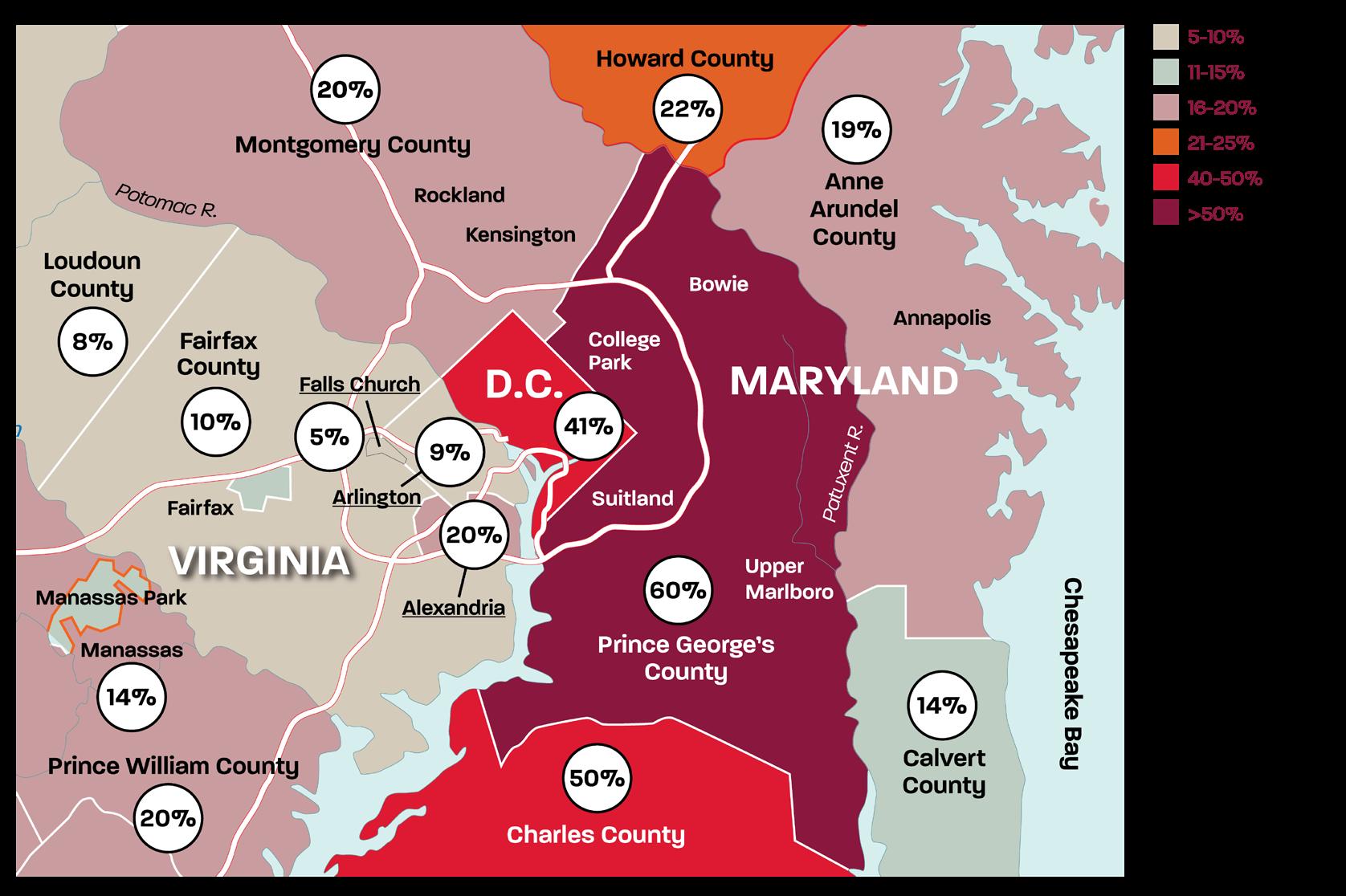
The DMV holds a uniquely consequential place in Black economic and political history in the United States. For more than a century, federal employment served as one of the few stable pathways to middle-class security for Black Americans barred from equitable opportunity in the private sector. As a result, the region became home to one of the largest and most stable concentrations of Black federal employees in the nation, and, with it, a vibrant ecosystem of Black neighborhoods, schools, businesses, and civic institutions. In Washington, DC, nearly 29 percent of the federal workforce is Black, compared with 19 percent nationally. Black employees earn on average less than $97,000 a year in federal positions. Maryland and Virginia also rank among the top states for Black federal employment, accounting for roughly 20 percent of all Black federal workers nationwide. As such, the DMV offers a critical vantage point for seeing how federal workforce instability is not abstract policy movement but a disruptive force in one of the country’s most deeply rooted Black professional hubs.
As one of the nation’s most prominent majority-Black counties—and home to one of the largest concentrations of Black federal employees—Prince George’s County, Maryland (PG County) stands as a powerful example of how federal workforce reductions may widen racial and economic disparities in historically resilient communities. In the 1700’s, PG County held more enslaved people than any other Maryland county before the Civil War. Following emancipation and the end of Jim Crow, and particularly after the civil rights gains of the mid-20th century, PG County experienced an evolution. Thanks to federal employment opportunities, it became regarded as one of the wealthiest majority-Black counties in the United States. The demographic transformation was significant. In 1960, the county’s Black population was around 8 percent. Over the next several decades, as Black professionals moved to the suburbs while working in federal agencies, that share surged. By 1990, the county had become majority Black, anchored by a growing Black middle class built on public-service employment. These patterns illustrate why recent federal workforce reductions pose such a dire threat: PG County’s economic stability, homeownership, generational wealth, and public-sector driven Black middle-class life are all deeply tied to government employment.
While Prince George’s County offers a clear microcosm of how federal workforce instability threatens Black economic mobility and community stability, the broader region demonstrates how these disruptions reverberate across the DMV’s Black communities. The District of Columbia (DC) historically served as a national center of Black professional and middle-class life, driven heavily by federal employment, Black civic institutions, Historically Black Colleges and Universities (HBCUs), and community-based organizations. Northern Virginia suburbs and Maryland counties have also drawn Black professionals working in federal agencies, national security jobs, contracting, public administration, and allied sectors, forming a regional web of Black employment, consumption, housing, and community life that depends on government functions.
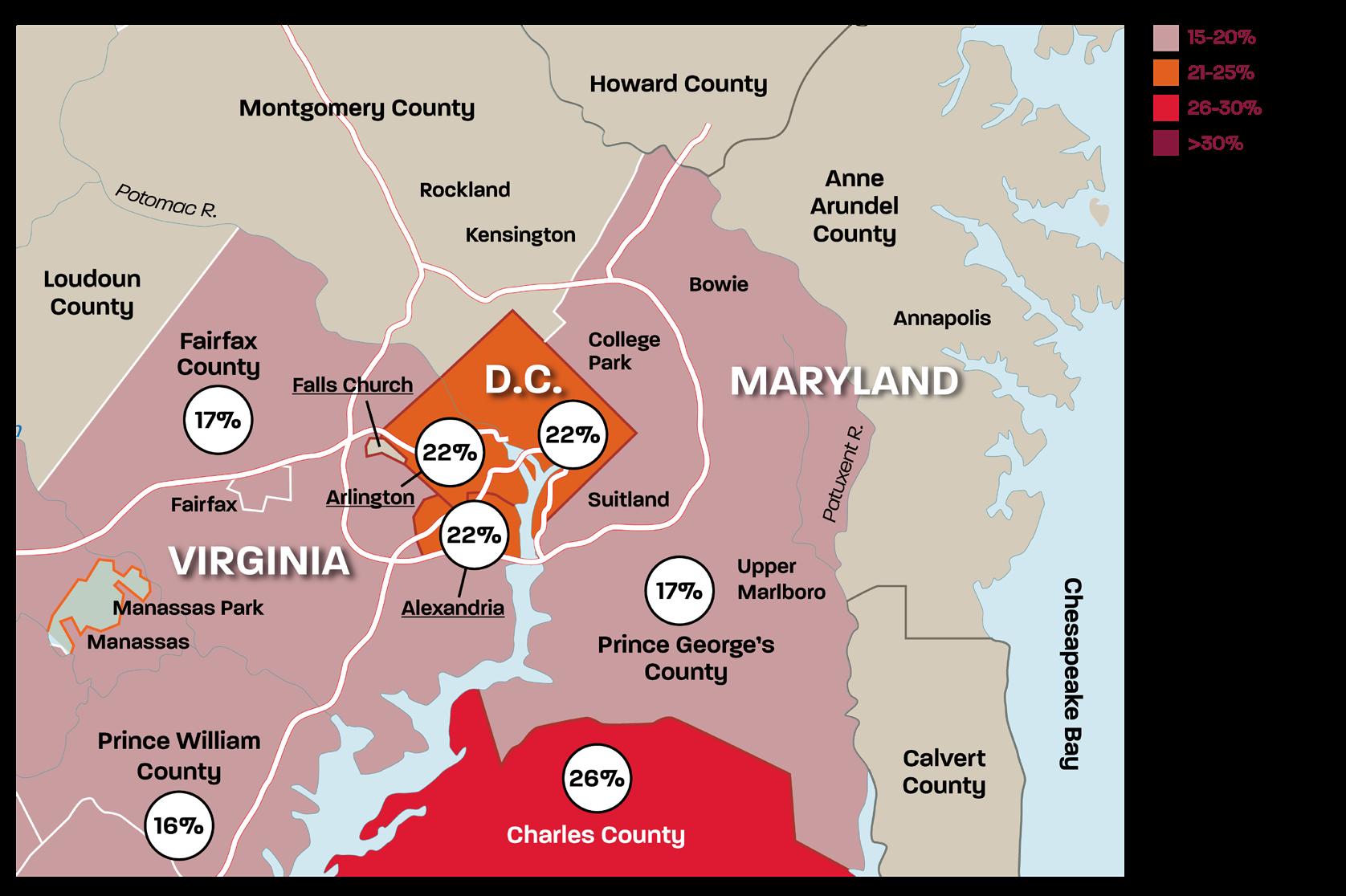
In the broader DMV region, federal jobs have declined by nearly 4.5 percent, which equals about 17,000 positions eliminated between January and June 2025. These shifts represent not simply job loss but the hollowing out of the Black public sector footprint. The consequences of this politicized dismantling of the federal workforce are deeply intertwined with the physical and mental health of Black workers and families across the region. For generations, Black professionals in federal service have relied on stable employment and robust health benefits as a buffer against broader inequities in the labor market and healthcare access.
The recent government shutdown, sparked by Congressional tensions over healthcare subsidies and Affordable Care Act (ACA) premium supports, exemplified how political gridlock directly endangers health security. As lawmakers clashed over whether to extend federal subsidies that keep premiums affordable for millions of Americans, at least 670,000 federal employees were furloughed, and approximately 730,000 worked without pay for over six weeks. For Black workers, who are more likely to be primary earners supporting extended family networks, the loss of income and certainty heightened stress and places family well-being at risk.
Although the government reopened in November 2025, the agreement that ended the shutdown did not resolve the future of marketplace subsidies under the Affordable Care Act; it simply committed Congress to a later vote. In the meantime, the enhanced premium tax credits expired on January 1, 2026. Policy analysts estimate that subsidized enrollees can expect their annual premium payments to increase by an average of 114 percent, with up to 4.8 million people becoming uninsured in 2026. For Black workers, who are disproportionately concentrated in federal employment and among lower-income ACA enrollees, health coverage is now entangled in a broader political fight that treats their well-being as collateral damage.1
1 On January 8, 2026, the House voted 230 to 196 to pass a three-year extension of Affordable Care Act premium subsidies, with 17 Republicans joining all Democrats in favor. As of January 23, 2026, the measure remains unlikely to pass in the Senate.
As layoffs and hiring freezes disproportionately impact Black-majority areas such as PG County and Southeast DC, the health and economic consequences compound quickly at both the individual and community level, producing elevated risks for food insecurity, housing instability, and community disinvestment. Families who have relied on federal jobs to maintain insurance now face gaps in care, while rising healthcare costs and stalled policy decisions over ACA subsidies intensify the strain.

Black federal workers have long been anchors of neighborhood stability in the DMV, sustaining mortgages, supporting schools, and contributing to church and civic life. When income and healthcare coverage become uncertain, health risks rise. Research links workforce volatility to anxiety, depression, cardiovascular disease, and sleep disruption. The 2025 shutdown exacerbated this instability. SNAP benefits were suspended for November 2025 in both Maryland and Washington, DC, prompting Maryland Governor, Wes Moore, to declare a state of emergency and allocate $10 million in emergency food assistance, while DC Mayor Muriel Bowser authorized the use of local funds to ensure DC residents received their November SNAP and WIC payments. For Black households in the region, these disruptions translated into immediate food insecurity as families were forced to ration supplies or seek emergency aid. Together, these pressures eroded household security and increased risks for food insecurity, housing instability, and community disinvestment, underscoring how federal retrenchment represents a profound threat to Black well-being in the DMV.
Across the Washington metropolitan region, local governments, advocacy organizations, and community institutions have mobilized, often with limited resources, to mitigate the fallout of federal workforce instability. Yet, despite notable efforts, these responses remain decentralized and underfunded relative to the scale of economic, psychological, and community harm now facing Black federal workers and their families.
In the District, city officials and local organizations have sought to cushion residents from the economic and psychological aftershocks of federal workforce disruptions. The DC Council and Mayor’s Office on African American Affairs have convened listening sessions and issued statements supporting federal workers affected by reductions and furloughs.
The ONE DC Black Workers and Wellness Center has organized legal clinics, resource fairs, and support sessions to assist displaced employees navigate unemployment, benefits interruptions, and job transitions. Local nonprofits and churches have also stepped in where formal safety nets fall short, providing short-term financial relief, career counseling, and peer support. Yet, the absence of a citywide response plan has left many Black residents reliant on ad hoc partnerships and volunteer capacity.
In Prince George’s County, the epicenter of Black federal employment, local leadership has been proactive but constrained. The Prince George’s County Council, in partnership with workforce development initiatives, has expanded job placement and retraining services for residents affected by layoffs and contract terminations. County officials have also begun collaborating with the Prince George’s County Memorial Library System to host community events on mental
health, financial planning, and navigating the federal RIF process. Despite these promising interventions, resources remain limited. Local agencies face their own budgetary pressures, and the scale of federal disinvestment has outpaced the county’s capacity to respond comprehensively. Without additional state and federal support, these efforts risk being stopgap measures in the face of a long-term structural crisis.
Congressional Black Caucus (CBC) members and Maryland Representatives Glenn Ivey (MD-04) and Kweisi Mfume (MD-07), along with Senator Angela Alsobrooks, have drawn attention to the unique vulnerability of Prince George’s County, where thousands of federal employees reside. Alsobrooks’ transition from county executive to the U.S. Senate has brought new visibility to the issue: she has called for federal support for displaced workers, job retraining programs, and renewed investments in mental health resources for public servants navigating uncertainty. During the 2025 shutdown, Maryland Governor Wes Moore activated emergency state contingency plans so that federally funded programs, including Medicaid, SNAP, and other aid programs, kept operating in Maryland during the federal shutdown. He also publicly condemned President Trump’s promise of mass layoffs during the shutdown as a “campaign of cruelty and recklessness,” criticized the federal leadership’s handling of the shutdown, and directed state agencies to support disrupted federal workers.
In Northern Virginia, municipal governments have focused primarily on workforce retraining and economic diversification. The Fairfax County and Arlington County Councils, in collaboration with state workforce development programs, have launched initiatives to help displaced federal workers transition into private-sector and nonprofit roles. However, these programs are often generalized and do not fully address the racialized dimensions of the current crisis. Black workers who face intersecting challenges, such as limited access to professional networks, caregiving responsibilities, and/or mental health strain, are less likely to benefit from one-size-fitsall retraining models. Without dedicated funding and racial equity metrics, many local efforts risk perpetuating disparities rather than closing them.

Representatives Bobby Scott (VA-03) and Jennifer McClellan (VA-04), both CBC members, have been among the most vocal advocates for worker protections and federal accountability. Scott, a ranking member of the House Committee on Education and the Workforce, has emphasized the moral and economic imperative of safeguarding publicsector jobs that sustain Black middle-class stability. Most recently, Rep. Scott spoke on potential impacts of the GOP government shutdown on healthcare for Virginians, and Americans broadly. McClellan, adding to her long record in Virginia state politics, has underscored how layoffs will disproportionately impact Virginia, home to the second highest number of federal employees.
Beyond government officials, community organizations have served as the region’s first responders. Black churches, mutual aid collectives, and chapters of the National Council of Negro Women (NCNW) and Urban League, among others, have mobilized to meet both immediate economic and emotional needs. Through food drives, rent assistance, and mental health workshops, these networks have filled critical gaps in support systems frayed by government volatility. However, as with local government efforts, these community responses are largely decentralized and underresourced. While they demonstrate the strength and solidarity of Black civic life in the DMV, their sustainability depends on long-term funding and coordination, neither of which currently match the scale of disruption caused by federal layoffs and political instability. While the DMV’s local and regional actors have responded with determination and care, the landscape of support remains uneven. Existing programs are piecemeal rather than systemic, leaving significant gaps for those most affected. As federal instability deepens, the challenge for local governments and community organizations alike will be to move from reactive assistance toward a coordinated, equity-centered regional strategy that recognizes federal employment as both an economic engine and a public health determinant for Black communities across the region.

Addressing the systemic damage in the DMV caused by the Trump administration’s deliberate disruption of government functions requires coordinated action across multiple levels of influence. The following recommendations call for a shared commitment among federal policymakers, state and local leaders, and community organizations. Together, these actors can help mitigate the disproportionate impacts of federal government retrenchment on the DMV’s Black workers, strengthen regional resilience, and promote long-term economic and mental health stability across the region.
• Invest in culturally responsive mental health and workforce resilience initiatives. Federal agencies should expand access to employee assistance programs, counseling services, and community-based partnerships that address stress and uncertainty linked to government instability.
• Protect and stabilize the federal workforce through equity-centered policies. CBC Members should continue to advocate for safeguards against disproportionate RIF impacts on Black workers, including stronger oversight in workforce restructuring and equitable funding across agencies.
• Protect Health and Social Service Continuity During Federal Disruptions. Federal policymakers should strengthen automatic safeguards that keep essential health and social services funded during political impasses and invest in culturally responsive mental health supports in Black-majority hubs like the DMV.
• Coordinate cross-jurisdictional responses to federal instability. Leaders in DC, Maryland, and Virginia should establish formal partnerships to share data, align retraining programs, and coordinate support for displaced or at-risk workers.
• Expand workforce development and mental health infrastructure. State and county programs should provide job retraining, career mobility pipelines, and accessible behavioral health services for Black workers affected by economic disruptions.
COMMUNITY
• Center Black Americans’ lived experiences in advocacy and recovery planning. Organizations such as local NAACP branches and Urban League chapters can amplify the voices of impacted workers to inform local and federal policy responses.
• Strengthen community care networks. Faith-based institutions, mutual aid collectives, and grassroots nonprofits should provide direct assistance, peer support, and culturally grounded wellness programming during periods of disruption.
The Trump Administration’s government disruptions are deeply intertwined with matters of health policy in the DMV. The recent shutdown and budget standoffs have centered on disputes over healthcare spending, public health funding, and subsidies that disproportionately affect Black workers and their families. In this way, Black Americans’ health functions both as a catalyst for political conflict and as one of its most visible casualties. For the region’s Black workforce, the impacts are cascading; instability disrupts access to care, heightens economic stress, and undermines trust in the systems meant to provide support. These ripple effects extend beyond individual well-being, influencing community health outcomes, local economies, and regional resilience.
Addressing this cycle of government destabilization requires treating health as both a driver and an outcome of government instability. Policies that safeguard healthcare funding, ensure continuity of services during federal disruptions, and expand access to culturally responsive mental health resources are critical to breaking this pattern. Through coordinated action across federal, state, and community levels, stakeholders can help build a more stable, equitable, and health-centered foundation for the DMV’s future.