South Carolina 2026 Voting Rights Scorecard Redistricting South Carolina Governor Henry McMaster (R) called a special session on May 15, 2026 to conduct congressional redistricting. The South Carolina House of Representatives passed a map that would have eliminated the only congressional district held by a Democrat, but the State Senate declined to vote on the map until the next legislative session, citing that early voting had already begun.
Vote by Mail South Carolina meets five of the seven criteria. The state has some restrictive vote by mail policies, including requiring voters to provide an excuse to vote by mail and requiring a witness to sign the completed ballot. Anyone who is aged 18 or older can witness your signature.
CBCF’s scorecard evaluates voting rights and access to the electoral process across 15 states with large Black populations. This fact sheet highlights key laws, policies, and recent developments affecting voting access in South Carolina.
In-person Early Voting South Carolina requires a two-week early voting period, but polling places are not allowed to open on Sundays, leaving 12 days of early voting. The state mandates that voting sites stay open from 8:30am to 6pm, and voters can go to any early voting center in their county.
Voter ID Laws In South Carolina, voters must provide a valid photo ID to vote inperson. Student IDs are not permitted forms of identification. If a voter cannot produce one of the five allowable documents, they may cast a provisional ballot, which will be counted only if they bring photographic identification to the county board of voter registration and elections before certification of the election. Alternatively, a voter with a reasonable impediment to obtaining a photo ID may cast a provisional ballot by presenting a non-photo voter registration card and signing a reasonable-impediment affidavit; that ballot will be counted unless the county board has reason to believe the affidavit is false.
Access to Polling Places In South Carolina, general elections must be held at voting places established by law. Any form of electioneering is prohibited within 500 feet of a polling place on public property. Legislation requires counties to provide at least one polling place known as the Countywide Barrier-Free Voting Precinct for use by physically handicapped voters, and it must be free of architectural barriers.
Disinformation Campaigns South Carolina does not have any laws to combat disinformation in elections. However, state law prohibits election fraud, voter intimidation, bribery, and other election-related misconduct.
Felon Disenfranchisement South Carolina allows people with felony convictions to vote after they have completed their entire sentence, including probation/ parole, unless they have been pardoned.
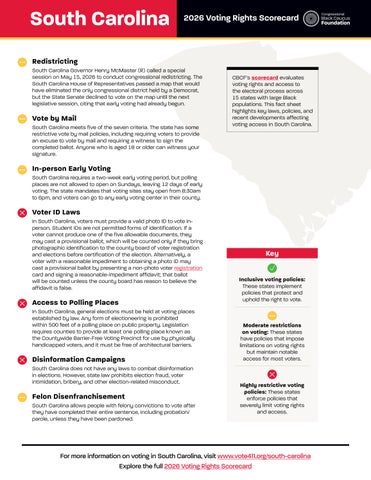
Key
Inclusive voting policies: These states implement policies that protect and uphold the right to vote.
Moderate restrictions on voting: These states have policies that impose limitations on voting rights but maintain notable access for most voters.
Highly restrictive voting policies: These states enforce policies that severely limit voting rights and access.
For more information on voting in South Carolina, visit www.vote411.org/south-carolina Explore the full 2026 Voting Rights Scorecard