North Carolina
2026 Voting Rights Scorecard
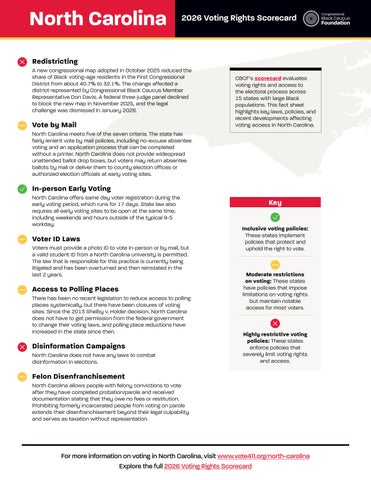
Redistricting A new congressional map adopted in October 2025 reduced the share of Black voting-age residents in the First Congressional District from about 40.7% to 32.1%. The change affected a district represented by Congressional Black Caucus Member Representative Don Davis. A federal three-judge panel declined to block the new map in November 2025, and the legal challenge was dismissed in January 2026.
Vote by Mail
CBCF’s scorecard evaluates voting rights and access to the electoral process across 15 states with large Black populations. This fact sheet highlights key laws, policies, and recent developments affecting voting access in North Carolina.
North Carolina meets five of the seven criteria. The state has fairly lenient vote by mail policies, including no-excuse absentee voting and an application process that can be completed without a printer. North Carolina does not provide widespread unattended ballot drop boxes, but voters may return absentee ballots by mail or deliver them to county election offices or authorized election officials at early voting sites.
In-person Early Voting North Carolina offers same day voter registration during the early voting period, which runs for 17 days. State law also requires all early voting sites to be open at the same time, including weekends and hours outside of the typical 9-5 workday.
Voter ID Laws Voters must provide a photo ID to vote in-person or by mail, but a valid student ID from a North Carolina university is permitted. The law that is responsible for this practice is currently being litigated and has been overturned and then reinstated in the last 2 years.
Access to Polling Places There has been no recent legislation to reduce access to polling places systemically, but there have been closures of voting sites. Since the 2013 Shelby v. Holder decision, North Carolina does not have to get permission from the federal government to change their voting laws, and polling place reductions have increased in the state since then.
Disinformation Campaigns North Carolina does not have any laws to combat disinformation in elections.
Key
Inclusive voting policies: These states implement policies that protect and uphold the right to vote.
Moderate restrictions on voting: These states have policies that impose limitations on voting rights but maintain notable access for most voters.
Highly restrictive voting policies: These states enforce policies that severely limit voting rights and access.
Felon Disenfranchisement North Carolina allows people with felony convictions to vote after they have completed probation/parole and received documentation stating that they owe no fees or restitution. Prohibiting formerly incarcerated people from voting on parole extends their disenfranchisement beyond their legal culpability and serves as taxation without representation.
For more information on voting in North Carolina, visit www.vote411.org/north-carolina Explore the full 2026 Voting Rights Scorecard