Maryland
2026 Voting Rights Scorecard
Redistricting In response to Republican redistricting efforts across the South, Maryland held a special legislative session in August 2026 to consider redrawing its congressional map ahead of the 2028 election. On August 4, the House advanced HB 2100, which would give the Legislature authority to make partisan changes to the congressional map, and the Senate gave final approval on August 5. On August 26, a circuit judge blocked the measure from appearing on the November 3 ballot. That ruling is currently stayed pending an appeal to the Maryland Supreme Court, leaving the measure’s ballot status unresolved. Maryland’s two majority-Black congressional districts, MD-7 and MD-4, remain unchanged, although the state could redraw its congressional map ahead of the 2028 election to increase Black representation.
CBCF’s scorecard evaluates voting rights and access to the electoral process across 15 states with large Black populations. This fact sheet highlights key laws, policies, and recent developments affecting voting access in Maryland.
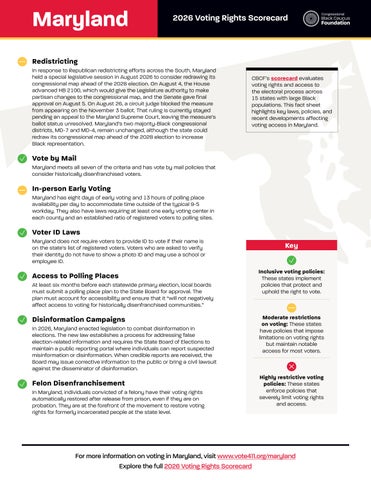
Vote by Mail Maryland meets all seven of the criteria and has vote by mail policies that consider historically disenfranchised voters.
In-person Early Voting Maryland has eight days of early voting and 13 hours of polling place availability per day to accommodate time outside of the typical 9-5 workday. They also have laws requiring at least one early voting center in each county and an established ratio of registered voters to polling sites.
Voter ID Laws Maryland does not require voters to provide ID to vote if their name is on the state’s list of registered voters. Voters who are asked to verify their identity do not have to show a photo ID and may use a school or employee ID.
Access to Polling Places At least six months before each statewide primary election, local boards must submit a polling place plan to the State Board for approval. The plan must account for accessibility and ensure that it “will not negatively affect access to voting for historically disenfranchised communities.”
Disinformation Campaigns In 2026, Maryland enacted legislation to combat disinformation in elections. The new law establishes a process for addressing false election-related information and requires the State Board of Elections to maintain a public reporting portal where individuals can report suspected misinformation or disinformation. When credible reports are received, the Board may issue corrective information to the public or bring a civil lawsuit against the disseminator of disinformation.
Felon Disenfranchisement In Maryland, individuals convicted of a felony have their voting rights automatically restored after release from prison, even if they are on probation. They are at the forefront of the movement to restore voting rights for formerly incarcerated people at the state level.
Key
Inclusive voting policies: These states implement policies that protect and uphold the right to vote.
Moderate restrictions on voting: These states have policies that impose limitations on voting rights but maintain notable access for most voters.
Highly restrictive voting policies: These states enforce policies that severely limit voting rights and access.
For more information on voting in Maryland, visit www.vote411.org/maryland Explore the full 2026 Voting Rights Scorecard