Arkansas
2026 Voting Rights Scorecard
Redistricting There have also been no changes to Arkansas’s post-2020 maps, which partisan officials drew. Although several reform proposals were introduced during the 2025 legislative session, none were enacted. As a result, the rules, authority, and procedures governing redistricting in Arkansas remain unchanged.
Vote by Mail Arkansas meets four of the seven criteria. The state has some restrictive vote by mail policies, including requiring voters to provide an excuse to vote by mail and requiring voters to include a copy of their ID in order for their application to be valid.
CBCF’s scorecard evaluates voting rights and access to the electoral process across 15 states with large Black populations. This fact sheet highlights key laws, policies, and recent developments affecting voting access in Arkansas.
In-person Early Voting Arkansas offers early in-person voting for a two-week period, but polls are closed on Sundays and state holidays, effectively reducing the early voting period to around 12 days. Arkansas offers early voting on Saturdays and outside of the typical 9-5 workday.
Voter ID Laws Arkansas voters must have a photo ID to vote in person, and they require first-time voters to provide verification of their voter registration, or a government-issued document to register to vote. While high school IDs are not accepted, a student ID or employee badge issued by an accredited postsecondary institution in Arkansas does qualify, and an otherwise acceptable ID may be used if it expired no more than four years before the election.
Access to Polling Places Arkansas does not have state-level legislation on access to polling places, as it is handled by the county Boards of Election. However, vote centers cannot be changed within 60 days of a preferential primary or general election, except in the event of an emergency.
Disinformation Campaigns Arkansas does not have any laws to combat disinformation in elections.
Felon Disenfranchisement Arkansas allows people with felony convictions to vote after they have completed probation/parole and received documentation from the county clerk that they owe no fees or restitution.
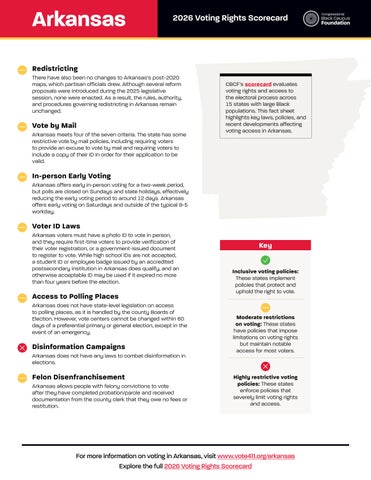
Key
Inclusive voting policies: These states implement policies that protect and uphold the right to vote.
Moderate restrictions on voting: These states have policies that impose limitations on voting rights but maintain notable access for most voters.
Highly restrictive voting policies: These states enforce policies that severely limit voting rights and access.
For more information on voting in Arkansas, visit www.vote411.org/arkansas Explore the full 2026 Voting Rights Scorecard