Congregation Agudath Israel
THE VOICE Hanukkah 5786•2025
SAVE THE DATE! CELEBRATE CANTOR JOEL
SAVE THE DATE! CAPLAN’S RETIREMENT
Saturday, June 13, 2026 Sunday, June 14, 2026
Saturday, Shabbat Morning Shabbat Morning Services Services and and Kiddush Kiddush June 13, 2026 Honoring Honoring Nancy Nancy and and Cantor Cantor Joel Joel Caplan Caplan Sunday, Sunday Brunch Brunch and and Festivities Festivities June 14, 2026 Sunday Share your Cantor Caplan story and show appreciation by contributing to Cantor Caplan’s ad journal...available soon!
The Miracle of Mere Existence Rabbi Ari Lucas In the time it will take you to read this brief essay, you will have traveled about 83 miles as the Earth rotates on its axis. In those same minutes, the Earth itself will have swung more than 5,500 miles along its orbit around the sun. Meanwhile, our solar system will have whizzed roughly 37,500 miles as it circles the center of the Milky Way. All of this motion happens constantly — so seamlessly that we never feel it and rarely notice it. I was reminded of this cosmic dance when my father recently took my family and me to the American Museum of Natural History. We tried, within the limits of our comprehension, to grasp how dark energy is driving the universe to expand faster and faster. We marveled at the claim that the universe is about 13 billion years old. “But Abba, that’s not what it says in the Torah,” one of my children remarked. “Yes,” I answered, “that’s something to think about.” (I have much more to say on the subject, but they’re not quite ready for the longer conversation. For now, I’m grateful they’re equally captivated by Torah and by the Museum of Natural History.) When I pause to consider: the sheer speed at which we are hurtling through space at every moment; the unlikely gift of Earth’s “Goldilocks zone,” when things were “just right,” allowing life to emerge and flourish; the truth that in the unfathomable sweep of cosmic history, I exist here and now, for a fleeting instant, I cannot help but conclude that mere existence is a miracle. It didn’t have to be. And yet it is. And that alone is worthy of a blessing. As we wandered through the Hall of North American Mammals — past the gray squirrels, white-tailed deer, and caribou — the Sheheheyanu blessing rose to my mind: “Baruch Ata Hashem Elokeinu Melech Ha’olam she’heheyanu, v’kiy’manu, v’hi’giyanu lazman hazeh.” The Voice | Hanukkah • 2025 Page 3
“Blessed are You, Hashem our God, Sovereign of time and space, who has enabled life to flourish, sustained our universe, and enabled us to reach this moment.” We recite it at b’nei mitzvah and baby namings, on holidays, and whenever we begin something new. But the truth is: Every moment is worthy of a Shehecheyanu. Existence itself — its steadiness, its beauty, its improbable continuity — did not have to be. And yet it is. So we give thanks to God for all the miracles, large and small. For the countless miles we have traveled together. For the journeys that still await us. For all of it, we offer our deepest gratitude. Happy Hanukkah! Rabbi Ari Lucas is CAI’s senior rabbi.
Rabbi Lucas during CAI’s 22nd Annual Israel Walkathon on November 2.
Page 4 The Voice | Hanukkah • 2025
Sound Bites? It’s Not That Simple Cantor Joel Caplan What should we do when Jew-haters are screaming at us — on campus, on the streets, in social media? The screams — the lies — are quick, stabbing, nasty. “Genocide!” “Colonialism!” “Oppressor!” I’d love to list some equally quick retorts that squash the lies and the liars. But combatting antisemitism and understanding Israeli politics don’t fit neatly into three-second sound bites. Author Sarah Hurwitz — speechwriter for both President Barack Obama and First Lady Michelle Obama — was recently here at CAI, speaking with Dara Horn about Sarah’s second book, “As a Jew: Reclaiming Our Story from Those Who Blame, Shame, and Try to Erase Us.” The book is mostly about antisemitism. Here are some quotes; these are as close as I can get to providing sound bites. (Headings in italics are mine. And this isn’t a full discussion of these complicated issues — to dig deeper, read the book.) Colonialism? [As I researched how Israel began,] I braced myself for the inevitable: European Jews conquering and colonizing the state of Palestine — massacring Palestinians, stealing their land, undertaking racist efforts to “civilize” the “natives.” Instead, I discovered that these early Zionists immigrated and bought land…. (p. 169) Genocide? [As I researched Israel’s 1948 War of Independence,] I had seen enough on social media to know what to expect, and I was prepared to encounter rampant crimes against humanity, including genocide. What I found instead was…war. And it was horrific — for both Jews and Arabs. As happens in war, atrocities were committed — by both Jews and Arabs — including brutal massacres of innocent civilians. And there were devastating numbers of casualties — of both Jews and Arabs. (p. 171) Oppressor? Even with [security] restrictions, in 2022, Palestinians attempted nearly seven hundred major violent attacks (including shootings, stabbings, bombings, and car-rammings) in Jerusalem and the West Bank, nearly five hundred of which were averted. (p. 211, footnote) Complexity? [A young woman] told me how uneasy she felt walking through The Voice | Hanukkah • 2025 Page 5
campus protests. The signs were all so strident and simplistic, she said…. We joked about how her sign would be in a tiny font, thousands of words typed onto posterboard, articulating the various arguments and ideas with which she was wrestling…. (p. 242) Shame? Israel is a country. Like my own country, America, it is both highly flawed and extraordinary. I will never stop criticizing either country when they go wrong. But I will also never apologize for their very existence — or my own. (p. 222) Pride: While Israel is a country, with plenty of the flaws and moral failings that come with power — and should be treated and held accountable as such — it is also something quite extraordinary. I can think of no other story like it: a people who, after thousands of years serving as history’s punching bag — blamed for every kind of catastrophe and human failing, living and dying at others’ whims — took their fate into their own hands, reclaimed their ancestral homeland, and built a thriving state within it, all in just a few generations. (p. 219) And what does Hurwitz say that we should do in response to Jew-hatred? One thing we can do is to learn more about being Jewish, about Jewish tradition: “There are countless ways to be a serious, engaged Jew. But all of those ways require knowing the basics of the Jewish textline — ideally, more than the basics. If you connect most deeply through social justice, wonderful. Ditto for Jewish culture. But that requires actually knowing what Jewish tradition says about social justice and what Jewish culture consists of beyond bagels and Jewish mother jokes.” (pp. 268-269) To learn more, sure, read Sarah Hurwitz’s “As a Jew.” And/or Rabbi Alan Silverstein’s “Israel’s War of Self-Defense.” And/or Noa Tishby’s “Israel: A Simple Guide to the Most Misunderstood Country on Earth.” And: How about a class, at CAI or elsewhere? We have thousands of years of tradition. Time to learn more of it!
Page 6 The Voice | Hanukkah • 2025
CAI congregants with author Sarah Hurwitz during her visit on November 19.
Finding Miracles Every Day Susan Werk What is our focus as we celebrate Hanukkah? The lights of the hanukkiah and the blessings we recite bring to mind the miracles that took place that allowed the historical events of the holiday to happen. We reflect on the Maccabees’ fight for their Jewish way of life and their military victory as a minority force defeating the large army of the Syrian Greeks. As we kindle the candles, we are reminded that a small amount of oil burned for eight days, illuminating the joyous rededication of the Holy Temple in Jerusalem. And as we spin the dreidel — whose letters ( )ש ה ג נstand for the sentence “Nes gadol haya sham” “A great miracle happened there” — we are further remind of the monumental nes (miracle) that resulted in the Hanukkah victories. But our reflection on the miracles of long ago also encourage us to recognize the miracles that have taken place throughout time, up until today. Many miraculous things occurred that have resulted in our still being here as Jews, living rich lives filled with the mitzvot and traditions of our faith and heritage when other nations that existed at the time of the Maccabees are long gone. I am constantly reminded that you are never to young to recognize and appreciate the “miracles” in our daily lives. When I asked students in the fifth grade in the Lerner religious school: “When I say ‘miracle,’ what do you think?” I got a flood of wise answers from the 10-year-olds: “when good things happen,” “God,” “blessings,” “Judaism,” “a star,” “something unexpected,” “a wish fulfilled,” “Jewish community,” “we exist,” “me!,” “Hanukkah,” “Purim,” “Sukkot,” “Fiddler on the Roof,” “friends,” “pets.” Our kids are so wise! As I reflect on these and other miracles in the context of my mantra, “an attitude of gratitude,” I recognize that the very act of recognizing a miracle is a blessing and an acknowledgement of thankfulness that can deepen our relationship with God, with ourselves, with our family, with our community. During this Hanukkah season, let’s all look to the lights we kindle — both on the hanukkiah and in our acts of lovingkindness — that brighten the darkness; let’s embrace the miracles in our lives that can elevate our gratitude and our appreciation of the world around us. Susan Werk is CAI’s Educational Director The Voice | Hanukkah • 2025 Page 7
The Lesson of the Hanukkah Lamp Lori Brown I am thrilled to be celebrating my first Hanukkah as executive director at CAI. Growing up, Jewish holidays were an instrumental part of my Jewish identity. We were not religious, but following and celebrating Jewish traditions set the foundation for who I am as a Jew. The story below — written by my father, Alvin Abram — gives a glimpse of my family history and the legacy of the joy of giving to others. Happy Hanukkah!
From Left: CAI President, Debbie Rosen; Board Member, Morris Lewis; Executive Director, Lori Brown; and CAI Financial Executive, Seth Fliegler at the Interfaith Thanksgiving Dinner on November 25.
The Lesson of the Hanukkah Lamp By Alvin Abram When I was 18, my father died and, in his death, I became troubled that I knew very little about being Jewish. Coming from a home where Hebrew was not allowed and Yiddish was the primary language, I often wondered if sending my children to Hebrew school would make them better Jews. At some point, I realized that the Hebrew school brought the culture to them much better than I ever could. Lori, my middle child, was very active and filled with curiosity. One time, on a day in December, she caused me displeasure, so I suspended her allowance for two weeks. All she had left from her previous allowance was one dollar. As the week unfolded, her behavior improved, and it became clear to me that the punishment was too severe. My dilemma was how to reinstate her allowance without losing face or weakening my authority. One Sunday, before leaving for Hebrew school, she informed me that with her last dollar Page 8 The Voice | Hanukkah • 2025
she was going to buy a Hanukkah lamp. When I picked her up, she bounced into the car with her Hanukkah lamp. “Hey Lori,” I said, “how about letting me buy the Hanukkah lamp from you, and I’ll let you light it.” “No. I want to keep it,” she answered. Taken aback by the unexpected response, I explained, “If you let me buy it from you, I’ll let you light the menorahs with mommy.” “No thanks. I want this to belong to me,” was her reply. “All right,” I said. “But if you change your mind….” On the way home from the synagogue, we stopped at the bakery, where I picked up bagels for breakfast. “Can I have some gum?” she asked. “You got your allowance last week — use it,” knowing full well she had used it to buy the menorah. “I don’t have any left,” she said. “Well, if you sell the Hanukkah lamp to me for a dollar, you will have enough money for your gum and still have money left over — and I’ll still let you light the candles.” I smiled to show her how simple the offer was. There was a pause. “Never mind. I don’t want any gum,” she answered. We drove home in silence. She leaped out of the car and hurried up the stairs to show her mother the Hanukkah lamp. No sooner did we get into the house when my wife sprung a surprise on us. “Guess who is coming from Ottawa for the weekend? Your cousin Susan!” Lori was ecstatic. “I’ll have to give her a present for Hanukkah. I know what, I’ll give her my Hanukkah lamp,” she said. Too precious to sell, but special enough to be given as a gift. Her allowance was reinstated. There is a passage written by a sage that explains what happened: “In seeking wisdom, the first step is silence, the second is listening, the third is remembering, the fourth is practicing, and the fifth — teaching others.” Does the Hebrew school teach our children anything? It must, because my daughter is teaching it to us. Lori Brown is CAI’s executive director. The Voice | Hanukkah • 2025 Page 9
THIS HANUKKAH, WE’RE CELEBRATING SMALL MIRACLES — THE EVERYDAY MOMENTS AND THE PEOPLE WHO BRING LIGHT TO THE DARKNESS. AT CAI, YOU ARE ONE OF THOSE MIRACLES. YOUR LIGHT STRENGTHENS OUR COMMUNITY AND HELPS IGNITE OUR SHARED FLAME. HELP US KEEP OUR FLAME BURNING BRIGHT WITH A GIFT TO CAI’S ANNUAL FUND IN HONOR OF HANUKKAH. YOUR GENEROUS SUPPORT HELPS OUR COMMUNITY SHINE.
CLICK HERE TO DONATE TODAY
The Miracle of the Daikon Radish Geula Zamist In the classic parenting book “The Blessing of a Skinned Knee,” author Wendy Mogel wrote: “Try to see your child as a seed that came in a packet without a label. Your job is to provide the right environment and nutrients and to pull the weeds. You can’t decide what kind of flower you’ll get or in which season it will bloom.” This quote came to mind recently when the children were outside in the garden and noticed something unusual growing. Together with their teacher, they pulled and pulled on the plant until out came a foot-long daikon radish.
Harvesting our miracle radish from the Lerner ECC garden.
We didn’t remember planting daikon radish seeds, and we certainly had never harvested one before, but when we found one, we celebrated it. Everyone was delighted as we examined it, tasted it, and wondered together where it came from. Working with young children gives us the opportunity to witness unexpected miracles every day. As Wendy Mogel teaches us, our job as parents and educators is to provide the right environment and nutrients — and then wait to see what will bloom. When our eyes are open and we take the time to celebrate the little moments, we acknowledge the miracles that occur around us every day. When we light the hanukkiah each night of Hanukkah, we recite two blessings. The first blessing acknowledges the opportunity to light the candles. The second blessing acknowledges that there were miracles long ago and that there are also miracles every day around us. Take time to pause and see those miracles every day — the miracle of the daikon radish, the miracle of the burning candles, and the great miracle of being able to watch young children learn and grow right before our eyes. Geula Zamist is director of CAI’s Lerner Early Childhood Center. The Voice | Hanukkah • 2025 Page 11
The Miracle of Resilience Rabbi Paula Mack Drill My favorite framing of the Hanukkah miracle story is not that the oil lasted for eight days; rather, it is that our ancestors knew they had only enough oil for one day and lit the lamp anyway. Perhaps miracles do not have to look like seas that part or manna that falls from the heavens. Miracles just might be taking the next step forward when things seem difficult or even impossible. Mundane daily acts of resilience might not seem like a miracle. But when we consider the alternative, we might just marvel at the wondrous nature of humanity. Consider just a few examples from recent conversations with CAI congregants (details are changed to protect confidentiality): A young woman is rejected from every nursing school to which she had applied. Instead of giving up, she studies and volunteers for a year and applies to five new schools. She is accepted at three of those schools! A man loses his job mid-career and feels hopeless. Instead of giving up, he makes an appointment with a career counselor and starts looking for a job in a brand-new field that has always beckoned to him. A woman retires from a high-pressure job. At first, she does not know what to do with herself but soon begins to volunteer at a women’s shelter. She has never before felt more needed or valued. After 53 years of marriage, a man finds himself alone after his wife died. He wants to just stay in bed, but instead, he begins helping with childcare for his grandkids and starts attending daily minyan. Every day, he has a reason to get out of bed. Some days, he even feels happy again. In my mind, human resilience is a true miracle. God planted in our souls free will. When we choose to grab hold of life, we light the lamp against all odds. We clearly choose a miraculous path forward. At Hanukkah time, let’s celebrate the miraculous mundane! Rabbi Paula Mack Drill is CAI’s rabbi-in-residence.
Page 12 The Voice | Hanukkah • 2025
• Member of Congregation Agudath Israel •
• Member of Congregation Agudath Israel •
ESS
EXECUTOR SUPPORT SOLUTIONS
Compassionate help with the details of estate settlement Ronni Frey (973) 809-9893 • ronnimarla@gmail.com executorsupportsolutions.com
• Cancel accounts and subscriptions • Organize estate documents • Track expenses and reimbursements • Oversee property maintenance • Prepare summaries for professionals (Attorneys/CPAs) • MUCH MORE
• Member of Congregation Agudath Israel •
The Voice | Hanukkah • 2025 Page 13
The Miracle of Thought: Take a Lesson From Winnie the Pooh Andrea Malmud Shalom, chaverim! We all know that this has been a difficult year on many levels, and we may feel a lack of control over this, that, and the other thing. We are seeing issues of low self-esteem, loneliness, anxiety, and depression skyrocket. And through all this, we deserve to feel better so that we are able to love and use our power (and, of course, choose the right shoes!). Feelings are not facts. So what can we control? Our thoughts and feelings about ourselves. Don’t believe everything you think. Winnie the Pooh said it best: “You’re braver than you believe, stronger than you seem, and smarter than you think.” In an article from the October 19, 2017, issue of “The Forward,” editor Seth Rogovoy talks about the “Jewishness” of that insightful bear. “Pooh himself, of course, loves honey — that quintessential Jewish food” (as in the Promised Land characterized as “the land of milk and honey”).” Rogovoy also mentions that “Saul Blinkoff, who animated the full-length Disney version, put a mezuzah on Pooh’s doorpost” and further reports that a Yiddish edition of the book — “Vini-der-Pu” — translated by Leonard Wolf, was published in 2000. I wish to offer the following daily Hanukkah miracle task to defeat your Eeyore kind of negative thinking: Conjure up in your mind concrete evidence that would hold up in court as proof of your bravery, strength, and smarts. Writing it down will help you to remember and, most importantly, review your thoughts; on darker days they’re likely to slip away. I’ll go first: Today I was feeling tired. But I went outside and filled my bird feeders. Now that doesn’t seem like a big deal, does it? But the birds seem to think so, and my brain is blessed with a hit of dopamine, that soothing hormone that helps us move forward. As always, I invite you to contact me if you would like to talk. I would very much like to meet you for the first time, or to reunite. You can reach me at amalmud@agudath.org. Wishing you a sweet and happy Hanukkah. Andrea Malmud, LCSW, CCBT, certified grief professional, is CAI’s Jewish Family Service of MetroWest social work consultant. Page 14 The Voice | Hanukkah • 2025
A List of Everyday Miracles Nurse Karen Frank Sometimes, of course, life gets us down. We are faced with challenges large and small, whether personal, familial, or global. And when we worry about one thing, we find that other worries seem to “pile on,” leading to more anxiety, fretfulness, or grief. The despair may become all we are conscious of, what occupies our thoughts and keeps us up at night. And when our worries take over, we may lose all track of the other realities, the blessings of our lives. It is common, after all, that the troubles are bigger and louder than the blessings, which may be quieter or more subtle. Perhaps we need a little discernment to discover the blessings. The intention to find these blessings becomes part of a spiritual practice. Judaism teaches us that we should find 100 things to bless each day. Then, we both acknowledge the hard things we must deal with and turn our attention to awareness of the good things. These are the things that seem to hide in the quiet, as if reluctant to shout out their existence. But as we look for them, discover and acknowledge them, experience the gratitude they elicit, we reap the benefits, spiritually and physically. We enjoy a decrease in stress hormones, blood pressure, and pessimism. We find hope. And the beauty of our awareness of these blessings is that awareness is contagious. Once we discover and acknowledge these glad tidings, it leads directly to awareness of others. That is the beauty of keeping a list or gratitude journal, a daily tracking of happy moments or sightings in a day — an experienced kindness or generosity, a bit of beauty, a sign of affection or appreciation. This list of everyday miracles, gifts, moments of joy, and inspiration that we experience serves to change the way we experience the world. And that is a miracle in itself. Karen Frank is CAI’s congregational nurse.
The Voice | Hanukkah • 2025 Page 15
The Miracle of the Human Brain (and Jewish Tradition) Miriam Leisman Rubin “We thank You and sing Your praises...for Your miracles that accompany us each day...” These words, recited in the central prayer of Jewish daily services, come from our lips multiple times each day — individually and communally. Yet we rarely ask the question they imply: What exactly are these daily miracles? Rabbi Levi Yitzchak of Berditchev, the late-18th-century Hasidic master, offers an answer by summarizing the teaching of the 13th-century commentator Ramban. He writes that “...the reason why we speak in the daily Amidah prayer about God’s performing miracles for us constantly at all times and in many locations, is that most of these miracles we never recognize as such.” A recent translator of Rabbi Levi Yitzchak sharpens the point: we tend to call it a miracle when someone survives being hit by a car going seventy miles per hour; we rarely name the miracle in the countless times a car misses us entirely. The first becomes a dramatic story; the second fades into the background with all the “near misses” we forget to notice. Our liturgy today conveys this same core ideas that it did eight centuries ago when Ramban first explained them. Jewish textual tradition is extraordinary in its continuity. Words written two hundred years ago illuminate those written eight hundred years ago, and together they help us understand texts set down more than twenty-five centuries ago. We often study these works without pausing to appreciate the sheer improbability — perhaps the miracle — of their transmission. Many historical, social, and religious forces enabled the survival of our sacred texts. Yet a quieter miracle makes this possible: the human brain. Its capacity for memory, pattern recognition, language, and interpretation allows us not only to preserve teachings but to live inside them. Nowhere is this more evident than in the Torah Service on Shabbat morning, one of the most widely practiced rituals of textual transmission in Jewish life. Around the world, communities read from the Torah scroll each week with only minor regional variations. The ritual is so familiar that we sometimes overlook what it demands of the human mind. Page 16 The Voice | Hanukkah • 2025
A Torah scroll contains no vowels, no punctuation, and letters written with unusual spacing and decorative flourishes. To glimpse this challenge, consider an English analogy: hr isrl th trnl s r gd, th trnl ln y shll lv th trnl yr gd wth ll yr hrt nd wth ll yr sl nd wth ll yr mght tk t hrt ths nstrctns wth whch chrg y ths dy
With effort, most of us could reconstruct the sample sentence. Torah readers perform this task weekly while also applying the intricate cantillation system that conveys phrasing, grammar, and melody. Some readers master Biblical Hebrew grammar and trop well enough to decode and practice any passage as needed; others memorize specific sections word-for-word and note-for-note. Jewish tradition affirms both as legitimate and valued approaches. With the right resources and support, anyone can leyn Torah. Whether decoding an unpunctuated text or flawlessly recalling a memorized one, Torah reading draws on the remarkable capacities of the human mind. These distinct sets of cognitive skills — analysis and memory — allow readers to fulfill the same sacred task, each revealing a different facet of human learning and ability. Through our tradition, we live miracles every day — the miracle that human beings, endowed with extraordinary diversity in cognitive gifts, continue to carry forward ancient words and meanings. The miracle is not only that the written words themselves survived intact, but that through countless small acts of memory, learning, and devotion, our tradition survives within us — every single day. Miriam Leisman Rubin is CAI’s rabbinic intern. • Member of Congregation Agudath Israel •
The Voice | Hanukkah • 2025 Page 17
The Miracle of Adding to Our Family We extend a warm welcome to our newest and returning families this year! Perri and Zack Abramowitz Robyn and Joseph Bier Merri and Ned Braunstein Sarah and Sean Cahill with Ben and Henry Edith Casakin Jane Taubenfeld Cohen and David Cohen Amy and Howard Cohen Yaffa Cohen and Ronit Levy with Laura and Sophie Rachel and Mark Davis with Samantha and Eric Sara Elsky with Lauren and Hannah Rebecca Feit-Klein Lisa Fels Davitt and Liam Davitt with Jack Kathryn and Brian Forman with Madeline and Miles Lisa Moskovitz and Joseph Goldberg with Tyler, Austin, and Regan Alexis and Michael Goldberger with Ava, Lily, and Caroline Debra and Mark Goldsmith Sandy and Jared Green with Avi and Zoey Shani and Jeremy Gutmajer with Jacob and Mia Sara Jarvis with Noraly and Jakob Lydia and Matthew Kertz with Annabelle and Asher Genna and Neal Koral with Ilana and Stella Victoria and Evan Kovac with William, Emilia, and Nathan Page 18 The Voice | Hanukkah • 2025
Harold Leeds Sari and Corey Leff with Maddie Miriam Leisman Rubin and Daniel Rubin Lauren Lustbader with Drew and Liv Rachel Malkin Florina Manusis with Teddy and Georgia Anna and Vadim Mats with Samuel and Margaret Honor Randall and Justin Moidel with Leonardo and Lazar Hillary and Ryan Moore with Ari, Claire, and Nora • Member of Congregation Agudath Israel •
The Miracle of Adding to Our Family We extend a warm welcome to our newest and returning families this year! Lindsey Doren and Jason Morman with Eli and Hazel Lori Freudenberger-Nelson and Richard Nelson with Hayley and Evan Natalie and Corey Neubauer with Spencer and Fletcher Rosa Colon Morales and Alex Nevins with Elijah Jill and David Olinsky with Jacob and Ari Neil Packer Shila and Idan Perez with Oren, Nitzan, and Ella Linda Perry Lauren and Lou Pietrangelo with Mia and Zoe Miriam and Marc Reimer with Audrey and Sylvia Nancy and Scott Ritch with Jake and Allison
Phyllis and Albert Russo Stephanie and Evan Schapiro with Sloane Jessica and Andrew Schenkel with Madison Tatiana Vasso and Brad Schrager with Max Rebecca Schwartz and Peter Garavuso Aviva Mandell Shabtai and Daniel Shabtai with Kobi, Amos, and Alon Nicole and Isaac Shapiro with Ryan and Evan Aliza Sherman with Zachary and Ayla Dara and Michael Soberman with Bayla and Skylar Maayan and Brian Tregerman with Lielle, Ami, Talia, and Goldie Maggie and Andrew Zebrowski with Jack, Sadie, and Zoe
BE A FRIEND AND INVITE A FRIEND!
BE A FRIEND AND INVITE A FRIEND!
Thank you for helping to spread the word about our special community at Congregation Agudath Israel and all that we have to offer. Being invested in Jewish community is more important now than ever and we thank you for your commitment. Keep telling your friends, family, and neighbors about your positive and meaningful experiences here... YOU are our MOST successful advertising! Contact Membership and Engagement Director, Debbie Lurie 973-226-3600, ext. 118 • dlurie@agudath.org The Voice | Hanukkah • 2025 Page 19
Join us for our upcoming community-wide events! Find classes, events, service times, and registration at agudath.org/calendar.
Sunday, December 14, 11:30 am Sunday, December 14, 3:30 pm Sunday, December 14, 5:15 pm Tuesday, December 16, 4:00 pm Wednesday, December 17, 4:00 pm Friday, December 19, 5:00 pm Friday, December 19, 6:00 pm Saturday, December 20, 5:30 pm Wednesday, January 7, 7:45 pm Saturday, January 10, Noon Sunday, January 11, 9:00 am Wednesday, January 21, 8:00 pm Saturday, January 24, 7:15 pm
Annual Holiday Wrap Party (K-5) Family Hanukkah Party (ECC, K-3) Roseland Hanukkah Candle Lighting W. Caldwell Hanukkah Candle Lighting Caldwell Hanukkah Candle Lighting Hanukkah Shabbat in PJs (ECC, K-2) Hanukkah Friday Night Lights Havdalah Hanukkah Candle Lighting Family Exploration of Israel Info Session 4th Annual Community Cook-Off Annual Blood Drive Letters From Anne and Martin Play 8th Annual Comedy Night
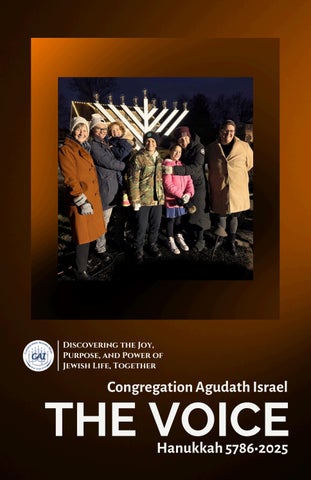
Front cover photo: CAI congregants with Rabbi Paula Mack Drill, Susan Werk, and Miriam Leisman Rubin at the North Caldwell holiday celebration on December 7.
“The Voice” is edited by Abby Meth Kanter. Congregation Agudath Israel • 20 Academy Road • Caldwell, NJ 07006 • Agudath.org