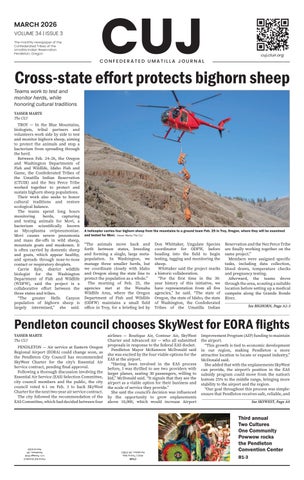
Teams work to test and monitor herds, while honoring cultural traditions
YASSER MARTE
The CUJ
TROY — In the Blue Mountains, biologists, tribal partners and volunteers work side by side to test and monitor bighorn sheep, aiming to protect the animals and stop a bacterium from spreading through the herd.
Between Feb. 24–26, the Oregon and Washington Departments of Fish and Wildlife, Idaho Fish and Game, the Confederated Tribes of the Umatilla Indian Reservation (CTUIR) and the Nez Perce Tribe worked together to protect and sustain bighorn sheep populations.
Their work also seeks to honor cultural traditions and restore ecological balance.
The teams spend long hours monitoring herds, capturing and testing animals for Movi, a bacterium scientifically known as Mycoplasma ovipneumoniae. Movi causes severe pneumonia and mass die-offs in wild sheep, mountain goats and muskoxen. It is often carried by domestic sheep and goats, which appear healthy, and spreads through nose-to-nose contact or respiratory droplets.
Carrie Kyle, district wildlife biologist for the Washington Department of Fish and Wildlife (WDFW), said the project is a collaborative effort between the three states and tribes.
“The greater Hells Canyon population of bighorn sheep is largely intermixed,” she said.
“The animals move back and forth between states, breeding and forming a single, large metapopulation. In Washington, we manage three smaller herds, but we coordinate closely with Idaho and Oregon along the state line to protect the population as a whole.”
The morning of Feb. 25, the agencies met at the Wenaha Wildlife Area, where the Oregon Department of Fish and Wildlife (ODFW) maintains a small field office in Troy, for a briefing led by
Don Whittaker, Ungulate Species coordinator for ODFW, before heading into the field to begin testing, tagging and monitoring the sheep.
Whittaker said the project marks a historic collaboration.
“For the first time in the 30year history of this initiative, we have representation from all five agencies,” he said. “The state of Oregon, the state of Idaho, the state of Washington, the Confederated Tribes of the Umatilla Indian
Reservation and the Nez Perce Tribe are finally working together on the same project.”
Members were assigned specific tasks, including data collection, blood draws, temperature checks and pregnancy testing.
Afterward, the teams drove through the area, scouting a suitable location before setting up a medical campsite along the Grande Ronde River.
Pendleton council chooses SkyWest for EORA flights
PENDLETON — Air service at Eastern Oregon Regional Airport (EORA) could change soon, as the Pendleton City Council has recommended SkyWest Charter for the city’s Essential Air Service contract, pending final approval.
Following a thorough discussion involving the Essential Air Service (EAS) Selection Committee, city council members and the public, the city council voted 6-1 on Feb. 3 to back SkyWest Charter for the next two-year air service contract. The city followed the recommendation of the EAS Committee, which had decided between four
airlines — Boutique Air, Contour Air, SkyWest Charter and Advanced Air — who all submitted proposals in response to the federal EAS docket.
Pendleton Mayor McKennon McDonald said she was excited by the four viable options for the EAS at the airport.
“Having been involved in the EAS process before, I was thrilled to see two providers with larger planes, seating 30 passengers, willing to bid,” McDonald said. “It signals that they see the airport as a viable option for their business and the scale of service they provide.”
She said the council’s decision was influenced by the opportunity to grow enplanements above 10,000, which would increase Airport
Improvement Program (AIP) funding to maintain the airport.
“This growth is tied to economic development in our region, making Pendleton a more attractive location to locate or expand industry,” McDonald said.
She added that with the enplanements SkyWest can provide, the airport’s position in the EAS subsidy program could move from the nation’s bottom 25% to the middle range, bringing more stability to the airport and the region.
“Our goal throughout this process was simple: ensure that Pendleton receives safe, reliable, and
See SKYWEST, Page A8 See BIGHORN, Page A2-3
Third annual Two Cultures One Community Powwow rocks the Pendleton Convention Center B1-3
A helicopter carries four bighorn sheep from the mountains to a ground team Feb. 25 in Troy, Oregon, where they will be examined and tested for Movi. Yasser Marte/The CUJ
YASSER MARTE
The CUJ
BIGHORN: Sheep population heavily impacted by Movi infection
Continued from Page A1
As part of the mission, a helicopter crew air-lifted one to five bighorn sheep at a time from remote mountain slopes to the ground teams.
The CTUIR officials involved were Andrew Wildbill, the tribe’s wildlife program manager, who has been part of the effort since 2022, and wildlife technician Iosefa Taula and Ira Ashley, who have participated in several projects.
“The work is challenging, but every healthy sheep counts,” Wildbill said. “Everyone shares the same goal: sustaining healthy populations of bighorn sheep.”
Taula, wildlife technician III for CTUIR, said the process is an important learning opportunity for the tribe.
“These are our lands, and as stewards of the animals and the landscape, we need to understand every part of it,” Taula said. “It’s not just about fish or elk. We have bighorns and many other species that need our attention as well.”
Wildbill said bighorn sheep were once as widely used as deer or elk. In the 1800s, their populations were robust, but over time they were wiped out from much of their historic range in Oregon, Washington and Idaho.
States later reintroduced bighorn sheep, restoring herds prized by hunters for their rams and by tribal members for seasonal sustenance, he noted. Tribal people historically relied on the meat, hides and horns — using hides for dresses and horns for bowls, spoons and bows.
“The extermination of bighorn sheep, probably in the early 1900s, cut off our access to them,” Wildbill said. “Now, with reintroductions, these populations are important to everyone.”
Wildbill said partners across state and tribal lines share one goal: maintaining healthy bighorn sheep populations.
Ashley, wildlife technician III for CTUIR, emphasized the importance of honoring tribal traditions while building knowledge for the future.
“As a sovereign nation, we should know these things and keep them on record for future generations,” he said. “This knowledge could be a vital resource. It’s possible that in the future we might not have these opportunities, so as much as we can learn now and pass it down to the next generations, that’s the most important thing.”
Saving the Herd
According to the 2024 “RangeWide Status of Bighorn and Thinhorn Sheep in North America”
CUJ
ABOUT THE CUJ
The Confederated Umatilla Journal (CUJ) was created in 1975 as the official publication of the Confederated Tribes of the Umatilla Indian Reservation (CTUIR), which includes the Cayuse, Umatilla and Walla Walla people. The CUJ is produced monthly by the CTUIR Communications Department.
“These are our lands, and as stewards of the animals and the landscape, we need to understand every part of it. It’s not just about fish or elk. We have bighorns and many other species that need our attention as well.”
— IOSEFA TAULA CTUIR wildlife technician
report, Oregon is home to an estimated 5,500 bighorn sheep. Disease continues to threaten these herds, with officials reporting 795 cases of illness statewide, including 71 confirmed Movi infections.
Of those, 22 animals developed pneumonia and eight died, highlighting the ongoing impact of the bacterium on wild sheep populations. Pneumonia caused by Movi remains one of the most significant factors limiting bighorn populations in Oregon, often outweighing habitat loss, genetic concerns, predation, climate and hunting, according to the report.
To combat the threat, wildlife officials are conducting “test-andremove” operations, in which they capture, test and remove infected
CONTRIBUTORS: Kathy Aney Dallas Dick Annie Fowler Lee Gavin Wil Phinney Travis Snell Aaron Wooden Sammantha McCloud
animals to slow the spread of Movi and protect the broader population.
In the field, a helicopter team flies into the mountains to capture bighorn sheep using a net gun, then secures them in a harness and airlifts them to waiting ground crews. The process is safe, though sheep can sustain minor cuts if tangled in the net or hurt themselves while fleeing. To ensure more safety, a veterinarian is on hand to ensure each animal is healthy before release.
Once on the ground, teams transport the sheep on stretchers to a “weigh station,” where each
CONTACT US Confederated Umatilla Journal 46411 Timíne Way Pendleton, OR 97801 email: cuj@ctuir.org phone : 541-429-7005
EMAIL ADVERTISING, LETTERS TO THE EDITOR, AND OTHER SUBMISSIONS TO: cuj@ctuir.org
ADVERTISING DEADLINE: 20th of the month prior to publication. The CUJ prints on the first Thursday of each month.
animal is processed on a large tripod and scale. Field teams are divided into specialized roles: some biologists focus on animal health and welfare, checking for injuries, illness and overall condition, while others collect data such as weight, temperature and other health metrics.
Anna Boyle, a big horn sheep biologist for the WDFW, said the work is critical to restoring bighorn sheep populations in Hells Canyon, which were once among the most numerous animals on the landscape.
The herds dwindled after humans
SUBSCRIBE: The CUJ is free to pick up at tribal entities and area businesses. However, a mailed subscription can be purchased for the price of shipping and handling by contacting the CTUIR Finance Department. Call 541-429-7150 or visit the Finance Department in person at Nixyáawii Governance Center, 46411 Timine Way, Pendleton.
One Year: $15 Two Years: $28
For more information or daily news, visit the CUJ online at: cuj.ctuir.org
Nathan Floyd, regional wildlife biologist for Idaho Fish and Game, left, and Jana Ashling, regional wildlife manager for Idaho Fish and Game, prepare to fit a tracking collar on a bighorn sheep Feb. 25 in Troy, Oregon.
A bighorn sheep lies on a stretcher while being weighed Feb. 25 in Troy, Oregon.
“Managing the landscape requires intensive, coordinated effort. If any part of the effort stops, we risk losing the animals we’ve worked so hard to protect.”
DON WHITTAKER, Ungulate Species coordinator for ODFW
Continued from Page A2
settled the area and overharvested wildlife, while pneumonia caused a significant decline in their numbers, she said.
“Chronic carriers left on the landscape can reduce lamb survival and recruitment,” Boyle said. “Lambs often don’t have the immune system to fight off the bacterium, so removing these individuals is critical for sustaining healthy herds.”
Sheep that test positive on their first capture may be released back into the mountains because Movi can sometimes clear within a year. Animals that tested positive last year are recaptured for a second test. If an animal remains positive, it may be removed from the population to prevent further transmission, particularly to newborn lambs.
Animals that remain positive may be euthanized to prevent further spread.
“It’s a hard decision because we can’t take these animals anywhere else,” Whittaker said. “But removing that source of infection allows for faster recovery in lamb survival, recruitment and the overall population.”
Local herds have felt the effects of Movi sharply, Boyle said. In the Mountain View herd, she noted, the 2024 outbreak caused an estimated 60% mortality rate, reducing the population from roughly 150 sheep to fewer than 100. In the area between Troy and the Grand Ronde River, populations once numbered 500 to 600 animals.
“It’s very important that we all keep working together, contributing, collaborating and sharing,” Whittaker said. “That’s what it’s going to take to protect these animals, which are valuable to all of us and hold even greater significance for tribal communities. Managing the landscape requires intensive, coordinated effort. If any part of the effort stops, we risk losing the animals we’ve worked so hard to protect.”
Throughout the day, the team tested and collared more than 25 bighorn sheep, moving fast and methodically, releasing ram, lamb and ewe back into the mountains when each was done. The helicopters hummed overhead,
kicking up dust and cold wind, while crews on the ground juggled stretchers, scales, nets and data sheets.
Toward the end of the day, one sheep ran too hard, too fast and tripped, suffering a severe leg injury. After a long examination, the on-site veterinarian determined it could not be saved. Silence fell over the team, their hard work interrupted by grief. The cold wind carried the quiet sounds of sniffles and hushed voices.
“We do everything to make sure these sheep are okay,” Whittaker said. “This is a terrible loss.”
As the sun dipped behind the mountains, the team packed up, tired and silent, knowing that tomorrow the rugged landscape, disease and the mission to save and repopulate the bighorn sheep would demand their return.
On the drive back, before heading up the mountains, Wildbill pulled over by the Grand Ronde River, handing herbs to Taula and Ashley and offering prayers and blessings for the lost animal. The river ran calmly between the mountains, the sun spilling golden light across its surface. Another day in the canyon had ended, but the mission to protect these sheephorn stretches on into tomorrow.
From left, Ana Boyle, a bighorn sheep biologist for the Washington Department of Fish and Wildlife, Iosefa Taula, wildlife technician III for the Confederated Tribes of the Umatilla Indian Reservation (CTUIR), and Andrew Wildbill, wildlife program manager for the CTUIR, release a bighorn sheep back into the mountains after testing.
Ira Ashley, wildlife technician III for the Confederated Tribes of the Umatilla Indian Reservation, left, and Ana Boyle, a bighorn sheep biologist for the Washington Department of Fish and Wildlife, discuss data collection.
A bighorn sheep lies down to be tested for Mycoplasma ovipneumoniae, known as Movi.
Andrew Wildbill, wildlife program manager for the Confederated Tribes of the Umatilla Indian Reservation, places his hand on a bighorn sheep to keep it calm during an examination.
In February, five Board of Trustees (BOT) members attended the Affiliated Tribes of Northwest Indians (ATNI) Winter Convention in Portland, and I attended the National Congress of American Indians (NCAI) Winter Convention in Washington, D.C.
KAT BRIGHAM Chair, CTUIR Board of Trustees
Both meetings brought together tribal leaders, youth representatives and federal officials who talked about strengthening tribal relationships and discussed policy issues needed to advance tribal sovereignty.
My biggest takeaway was seeing how unified tribal leaders are across Indian Country. Despite challenges, especially potential threats to federal funding for Native programs, we share a commitment to protect our rights and help our communities thrive.
I remembered what tribal leaders have said during tough times: “We’ve been through worse, but we’re going to survive by working together.” That spirit of determination reminds me how
crucial it is for tribes to work together internally and externally.
This is one of the reasons the BOT will continue to focus on improving coordination and communication within the Confederated Tribes of the Umatilla Indian Reservation (CTUIR). We will also continue to work with other tribal leaders, plus state and federal officials, so that we can be proactive rather than reactive in protecting treaty rights for future generations.
At NCAI, discussions focused on protecting treaty rights, investing in education and infrastructure and strengthening intertribal collaboration. The CTUIR’s 1855 Treaty, which reserved hunting, fishing and gathering rights, continues to guide our work today, especially in water rights, land protection and youth leadership.
Regional Focus: ATNI Winter Convention
The following week, CTUIR folks joined more than 500 representatives from 34 tribes at ATNI in Portland. Discussions covered education, health care, water policy, cybersecurity and economic development. Portland State University offered to host tribal cybersecurity training, and ATNI
members shared updates on Oregon legislation and federal coordination. ATNI continues to provide a space for tribes to learn from one another and build unity across the region.
Looking Ahead
Through participation in both gatherings, CTUIR advanced its leadership on key issues: water, education and long-term sustainability. I emphasized that strengthening relationships among tribes, states and the federal government is essential. Our ancestors built partnerships that sustained us and now it’s our turn to ensure those relationships endure for generations to come.
Also in February, I went to Olympia and reminded Washington state senators and representatives that CTUIR owns 11,000 acres of trust land, that about 500 CTUIR members live in that state and that we maintain tribal rights in that state. CTUIR has worked with Washington on several issues in the past and we want to continue this effort in the future.
If you have questions or want to connect, please reach out to me at katbrigham@ctuir.org or 541-975-4877. Thank you for staying engaged and supporting our shared future.
Proposed Qapqápa wildlife area acquisition has stalled
Oregon Department of Fish and Wildlife (ODFW) and the Confederated Tribes of the Umatilla Indian Reservation (CTUIR) regret to announce that the Qapqápa (pronounced cop-COP-a) Wildlife Area Acquisition has stalled.
The project secured $22 million in federal funding to complete the acquisition. Despite receiving full funding, the nonprofit foundation that owns the property and was supportive of the project has decided to withdraw for undisclosed reasons.
The effort was led by a diverse coalition of stakeholders, including the CTUIR, ODFW and the Rocky Mountain Elk Foundation. The
project attempted to bring 11,438 acres of private timber land into public ownership, creating a new wildlife area to be owned by ODFW and jointly managed with the CTUIR.
Located about 10 miles southwest of La Grande in the Blue Mountains, Qapqápa would have connected existing portions of the WallowaWhitman National Forest. The property provides vital migration routes for elk and mule deer in one of eastern Oregon’s most productive big game units, and its waters provide habitat for bull trout, Chinook salmon and steelhead.
The acquisition would have permanently conserved these important resources and
provided public access for future generations. It would also have restored CTUIR’s access to multiple sites of critical cultural and historic importance.
Our organizations remain grateful to the elected officials, community members and agency partners
LETTER FROM THE EDITOR
whose overwhelming support made this effort the top-ranked project in the nation. While it is with heartfelt regret that we share this news, we remain committed to pursuing opportunities—here or elsewhere— that benefit wildlife, habitat, and public access.
The hard roads we travel, the community that holds us
Every once in a while, a story reminds you why you started telling them in the first place. This was one of those times. I didn’t expect this edition to stay with me the way it did; there are the assignments you complete and then there are the ones that change how you see things.
I headed deep into the Blue Mountains with a crew of wildlife biologists chasing something bigger than themselves: the return of bighorn sheep to their rightful ground and stopping a deadly bacterium from spreading through the herd. From dusk to dawn, they moved with purpose, ambition and compassion. Altruistic work is rarely glamorous. It’s as rough as the rugged mountains they traverse, but the commitment runs as deep as the river cutting through the canyon below.
This journey was made possible by Confederated Tribes of the Umatilla Indian Reservation (CTUIR) Wildlife Program Manager Andrew Wildbill, whose passion and dedication spill naturally into his work. He speaks about the herd not as a project, but as a responsibility — to the
history of CTUIR and to the generations to come.
The road up the mountain was unforgiving — narrow, rocky, bumpy and, did I mention, narrow? We were climbing at high altitude, hugging the edge close enough to make me reconsider several life choices. At times, the truck drifted a little too near the drop-off for my comfort.
Journal
I’ll admit it: I’m not a praying man, but a few “forgive me, Father, for I have sinned” thoughts crossed my mind. Wildbill assured me he could probably drive that canyon blindfolded and we would be just fine, and as long as he was confident, I figured both of us should be.
I think I lost about five pounds sweating through that drive. Still, every jolt and sharp turn was worth it to witness people doing the hard, uncelebrated work of healing land and wildlife.
However, you don’t have to drive deep into the mountains – with
absolutely no cell service – to witness that kind of dedication.
You can find it in different ways every Wednesday inside the Mission Longhouse, where families, friends and elders gather to teach the importance of history, the preservation of culture and language. It’s a commitment to one another and a reminder of what it means to show up for your community and to carry responsibility beyond yourself.
Families and friends laugh, children dance and elders guide. Support flows naturally from one generation to the next, no spotlight needed. Just a community doing what it has always done: remembering who it is.
And while I may have spent long hours alone upstairs in my office weaving sentences, interviews, photos and deadlines into these pages, this edition was anything but a solo effort. As always, the CTUIR Communications team put
their hearts into it. Travis Snell contributed a wealth of stories, covering a new bereavement group, groundbreakings, Board of Trustees meetings and work sessions. At the same time, Lee Gavin captured beautiful, powerful images from the third annual Two Cultures, One Community powwow. They reminded all of us why stories in our community matter and that nothing is ever done alone. It takes a group of dedicated people to bring these stories to life for our readers.
Before I sign off, I want to say I’m no longer alone in my office. The CUJ team has a new addition: reporter Beau Glynn, who once reported for the Hermiston Herald. Glynn stepped away from the publication to finish his degree at the University of Oregon and now he’s back, ready to cover stories with the same passion that brought him to journalism in the first place. If you see him out in the field, please give him the same warm welcome you gave me.
Thank you all, gracias and qayciyáwwyaw.
YASSER MARTE Editor, Confederated Umatilla
The proposed 11,438acre acquisition for the Qapqápa Wildlife Area project near La Grande would have protected key wildlife habitat and expanded public access in eastern Oregon. (ODFW/Contributed Photo)
UTFD mourns loss of Capt. Mike Foster
THE CUJ
MISSION — Capt. Mike Foster, a 15-year veteran of the Umatilla Tribal Fire Department (UTFD), died Feb. 12 in an accident at his Pendleton home, tribal officials said. He was 54.
Foster protected the lives, health and safety of the Confederated Tribes of the Umatilla Indian Reservation (CTUIR) community and surrounding region as a paramedic, fire service leader and mentor to firefighters and emergency medical personnel.
UTFD Chief James Hall said Foster – known for his professionalism, compassion and leadership – played a vital role in strengthening emergency medical services and fire protection on the Umatilla Indian Reservation and surrounding communities.
“Captain Foster served his community with honor, integrity and unwavering dedication. He was not only an exceptional paramedic and leader but also a brother to all of us in the fire service,” Hall said. “His loss is deeply felt across our department, community and the many lives he touched throughout his lifelong career in fire/EMS. His service reflects a legacy of selflessness and commitment that will never be forgotten.”
CTUIR Board of Trustees (BOT) Treasurer Raymond Huesties, a firefighter, called Foster a friend who will be deeply missed.
“It has always been and will continue to be an honor and privilege to serve the community alongside such brave and dedicated people like Captain Mike Foster. He
will be deeply missed on the fire scene as well as in the community,” Huesties said. “I have always considered him, and every first responder, as family members. I want to thank his family for sharing him with all of us to help protect and serve the CTUIR. Captain Mike Foster was my friend and brother in fire. I will miss him. Rest in peace, Captain Foster.”
BOT Trustee Corinne Sams, speaking on behalf of the CTUIR Law & Order Committee, also offered condolences to Foster’s family and the fire department.
“We offer our deepest condolences to the family of Captain Mike Foster and extend those condolences to Chief Hall and the Umatilla Tribal Fire Department,” Sams said.
“Captain Foster was a dedicated and proud firefighter who served our community with care and honor. We are forever grateful for the work he carried out and for the support of his family.”
FRANK EDWARD BALL SR.
Aug. 30, 1935 - Jan. 16, 2026
Frank Edward Ball Sr., a member of the Klamath and Modoc tribes and U.S. military veteran born on Aug. 30, 1935, died Jan.16, age 90.
Funeral services for Ball were held Jan. 20, with the Last Dinner and Washat taking place at the Longhouse, followed by the burial at Olney Cemetery the morning of Jan. 21.
NELLIE MAE MOORE
July 16, 1941 - Jan. 14, 2026
Nellie Mae Moore, born Nellie Mae Semple on July 16, 1941 to Robert and Nona Semple of Condon, Oregon, passed away January 14, 2026 in her home in Pendleton.
A celebration of life was held January 23, 2026 in Pendleton.
The UTFD and CTUIR ask the community to keep Foster’s family and his fiancée in their prayers during this time of mourning.
Foster was a native of Vancouver, Wash.
The Umatilla Tribal Fire Department helped organize a procession on Feb. 20 to honor Foster, joined by police and fire departments from Umatilla and Morrow counties. The procession began at the fire department and continued to the Tamáskalit
OBITUARIES
Nellie is survived by her grandsons JR and Thomas Moore, and her great-grandchildren Heather Browing, Kyle Moore and Barron Moore. Contributions should be made to Walla Walla Hospice in lieu of flowers.
CURTIS LEE THOMPSON
Sept. 22, 1962 - Sept. 5, 2025
Curtis Lee Thompson Sr., age 63, was born (Sunrise) September 22, 1962, and passed away (Sunset) September 5, 2025 in Boise, ID. He was a resident of Mission, OR and a member of the Confederated Tribes of Warm Springs.
Born to parents Leland Sr. and Deanna Thompson, natural Father Kanim Smith, Sr.
He attended Inter-Mtn Indian School and Madras High School and completed Journeyman Carpentry certification in 1995.
He worked at Warm Springs Forest Products, Construction, CTWS Utilities, CTUIR TERF and
Cultural Institute, where family and friends gathered for a service.
Police and fire personnel drove their vehicles with sirens and lights activated, passing under two fire trucks that raised their ladders to the sky. A large U.S. flag, tied between the ladders, waved above the procession.
The event offered the department, who knew Foster, a chance to pay tribute and show support for Foster’s family during a time of mourning.
Wildhorse Casino.
He enjoyed spending time with his sons and grandchildren, fishing, golfing, Traditional Powwow Dancing and being with his dogs, Jesus and Jaxie.
He was preceded in death by his oldest son Josiah Thompson, his granddaughter Josephine Thompson, parents, sisters Crystal Thompson and Angela Smith, brothers Leland Thompson Jr., Tony Thompson, Corey Smith and Julius Smith Sr.
He is survived by sons Curtis Thompson Jr. of St. Helens, OR, Devon Thompson of Warm Springs and Bavis Thompson of Pendleton. Grandchildren Jevon Thompson, Arya Thompson and ChasLee Thompson of Pendleton, and Laila and Genavieve Thompson of Warm Springs. Sisters Selena Polk of Wapato, WA and Hazel Smith, brothers JoJo Smith, Kanim Smith Jr., Mario Smith and Aaron Smith of Warm Springs. Numerous aunts, uncles, cousins, nieces and nephews.
Services were held at Warm Springs Agency Longhouse, he was laid to rest at Lower Mouth Cemetery in Warm Springs.
Firefighters and police officers from Umatilla and Morrow counties sounded their sirens as they passed beneath a ladder and a U.S. flag in honor of Captain Mike Foster on Feb. 20 during his funeral procession at Tamástslikt Cultural Institute in Mission. Yasser Marte/The CUJ
Family and friends gather for the funeral of Captain Mike Foster on Feb. 20 during his funeral procession at Tamástslikt Cultural Institute. Yasser Marte/The CUJ
Capt. Mike Foster
Curtis Lee Thompson
Nellie Mae Moore
Frank Edward Ball, Sr.
Man accused of TCI, BIA thefts faces state, federal charges
YASSER MARTE
The
CUJ
WALLA WALLA, Wash. — A Kennewick, Washington, man accused of stealing property from the Tamástslikt Cultural Institute (TCI) and a fire truck from the Bureau of Indian Affairs (BIA) on the Umatilla Indian Reservation, sparking a two-state police chase, faces state and federal charges after his arrest.
After reaching a plea agreement, Israel Rivera Delgado, 34, pleaded guilty on Feb. 5 in Walla Walla County Superior Court to state charges related to the Dec. 6 pursuit. He will serve four months in state custody and faces federal charges for crimes committed on the reservation.
According to the Umatilla Tribal Police Department (UTPD), Delgado broke into the TCI, stole items and later took a BIA fire response truck, prompting a chase from Oregon into Washington.
UTPD Lead Criminal Investigator
Tony Barnett said authorities have a federal warrant for Delagdo’s arrest after he was indicted on two federal charges: theft from an Indian tribal organization and theft of government property. The first charge involves the TCI case, and the second involves the BIA vehicle he stole.
Two nights of crime
According to the UTPD, the breakin occurred in the early hours of Dec. 5, when Delgado entered the TCI. Officers arrived around 4:30 a.m. and found the main entrance’s glass door smashed, but a search of the building and nearby grounds found no one.
After reviewing multiple surveillance videos, officers identified Delgado as the suspect.
“The burglary occurred at approximately 12:30 a.m. when the suspect gained entry by breaking the glass of the front west-facing main entry door,” UTPD Chief Timothy Addleman said. “The suspect spent a considerable amount of time in TCI.”
Bobbie Conner, director of the TCI, said she reviewed video footage showing Delgado entering the vault wing through a back door. Conner, who was in Hawaii at the time, called the experience shocking but emphasized that the institute’s historical collections were untouched.
Conner said Delgado gained access to three offices where doors were unlocked or malfunctioning, taking personal and office items, including laptops, a computer backpack, thumb drives, stickers, an Oregon Community Foundation travel backpack, a Pendleton shirt, a hat, a blanket and flintnapping tools used for educational demonstrations.
According to Connor, Delgado also briefly entered a hallway leading to the regalia storage, but did not take any historical artifacts. Surveillance footage showed him wandering the building, sometimes using a blanket to carry items and attempting to take a walker belonging to an employee.
Some of the items were recovered along Mission Road near Confederated Way. Most items were recovered and returned. Connor noted that only a computer and possibly a mouse remain as evidence.
But Delgado did not stop there, police said.
The next night, Dec. 6, at about 2:30 a.m., a Bureau of Indian Affairs employee reported a white 2018 Chevrolet 2500 stolen from the station. Delgado broke into the station, took the keys and drove the truck through the gate, causing about $3,000 in damages and stealing a vehicle valued at $90,000, Barnett said.
Later that night, UTPD learned authorities had recovered the BIA
truck after officers arrested Delgado in Washington state. The College Place Police Department (CPPD) reported that the Milton-Freewater Police Department notified CPPD that Delgado was crossing the truck into Washington toward Walla Walla.
Deputies with the Walla Walla County Sheriff’s Office ended the pursuit by deploying spike strips near the roundabout at South Ninth Ave. and Washington State Route 125. The truck stopped and Delgado fled on foot, CPPD reported.
Officers found Delgado hiding in bushes near the Pepsi Bottling Group building at 1200 Dalles Military Road. Police arrested Delgado later that morning, bringing the chase to an end.
At 4:29 a.m., Delgado was booked into the Walla Walla County Corrections Department on suspicion of attempting to elude,
failure to comply with police, possession of a stolen vehicle, reckless driving and driving with a suspended or revoked license. His bail was set at $20,000.
Delgado, who has prior arrests, was identified as the TCI suspect and several stolen TCI items were recovered from the stolen BIA truck, according to the UTPD. He pleaded guilty to the BIA charges.
Barnett said the department has an active warrant for Delgado’s arrest. When authorities release him from jail, the U.S. Marshals Service will transport him to federal court in the Tri-Cities area.
To avoid extradition issues, officials plan to arraign Delgado in the Tri-Cities area on federal charges filed in the U.S. District Court for the District of Washington. The case will ultimately proceed to trial in Portland, Oregon.
Footage from the College Place Police Department shows Israel Rivera Delgado hiding in bushes after fleeing on foot from police on Dec. 6 in Walla Walla.
Tamástslikt Cultural Institute security footage shows Israel Rivera Delgado roaming the halls after breaking in on Dec. 5. Umatilla Tribal Police Department/ Contributed photos
A gated fence at the Bureau of Indian Affairs lies broken on the ground Dec. 6 in Mission, after Israel Rivera Delgado allegedly stole a fire truck and crashed through the fence.
NCFS breaks ground on Nixyáawii Neighborhood
Housing project reduces barriers faced by tribal members in becoming homeowners on the UIR
TRAVIS SNELL
The CUJ
MISSION – Nixyáawii Community Financial Services (NCFS) officials and key partners broke ground on four homes for Confederated Tribes of the Umatilla Indian Reservation (CTUIR) members on Feb. 25 at the Nixyáawii Neighborhood.
The ceremony not only broke ground but was groundbreaking as it is the first CTUIR housing project focused on homeownership, said NCFS Homeownership Service Manager Pamela Ranslam.
“Tribal members will have the opportunity to purchase the homes we’re building,” she said. “Though the funding comes from the state of Oregon through Oregon Housing and Community Services (OHCS), an allowance has been made regarding affordability. The funding for tribal communities does not include income guidelines, allowing NCFS to help all tribal members.”
The groundbreaking was held on Nixyáawii Neighborhood’s Lot 32 near the park. After a prayer by Board of Trustees (BOT) Treasurer Raymond Huesties, NCFS officials thanked key partners:
• OHCS, which earmarked funds for tribes in Oregon and eliminated income guidelines and affordability tracking that other Oregon projects must follow;
• The BOT, which provided funding for the neighborhood’s development;
• CTUIR Housing Development Team, which is responsible for developing and managing housing projects;
• Nixyáawii Financial Services Board of Directors, which oversees NCFS;
• Adair Homes, which will construct the project’s first four homes;
• 1st Tribal Lending, which approved a mortgage for a tribal member for one of the homes;
• Wenaha Group, a construction project management and consulting firm helping with the initiative;
• U.S. Bank Foundation, which provided a $100,000 grant that helped move the project forward; and
• Bryon Picard Grading & Excavation, which is providing the dirt work for the project.
Ranslam also thanked CTUIR Executive Director J.D. Tovey III and the Office of Legal
Counsel for developing the 99-year lease stipulation for the homes. Each neighborhood parcel comes with a 99-year lease because the CTUIR can’t sell its lands but can offer the lease to provide housing to tribal members.
“It’s good to see projects like this happening for the CTUIR and its tribal members,” Huesties said. “This project gives tribal members a chance at homeownership during a time when affordable housing is a big issue not only here on the reservation but the state, too. I’m glad to see NCFS and the others who helped with this project make this happen.”
Ranslam said that with the housing project, NCFS wants to reduce barriers CTUIR members face in becoming homeowners on the Umatilla Indian Reservation (UIR).
“Even if a tribal member has building land, they still face challenges of building their own home, working through a construction loan and the additional costs associated with constructing a home. These can be overwhelming for anyone but especially for those who are first-time homeowners,” she said. “By NCFS managing and providing the upfront financing of homes at the Nixyáawii Neighborhood, we’re reducing these barriers and helping to reduce the cost associated with a construction loan. By working with the NCFS housing development project, tribal members partner with NCFS rather than face construction hurdles on their own.”
Ranslam said the houses under construction are on Lots 14, 32 and 45. A fourth house is being built on Lot 8 for CTUIR members who have the
“This project gives tribal members a chance at homeownership during a time when affordable housing is a big issue not only here on the reservation but the state, too.”
— RAYMOND HUESTIES
CTUIR Board of Trustees Treasurer
99-year lease in place and a mortgage approved with 1st Tribal Lending.
The Lot 14 home will have four bedrooms and two full bathrooms and come in at 1,485 square feet. The homes on Lots 32 and 45 will have three bedrooms and two full bathrooms at 1,232 square feet.
Ranslam said each home will come standard with energy-efficient heat pumps, Hardie lap siding, quartz countertops and backsplash, Whirlpool kitchen appliances and extensive warranties on materials.
She said some of the upgrades for the homes on Lots 14, 32 and 45 include large concrete patios, soft-close cabinets, sill/apron interior window trim and a master bathroom modification to include a shower and glass door rather than tube.
Ranslam said excavation was expected to start the first week of March on the four homes.
State agency launches housing initiative for Oregon tribes
THE CUJ
SALEM — In an effort to address housing shortages in tribal communities, the state unveiled the Tribal Housing Grant Fund (THGF), the first program of its kind in Oregon.
Oregon Housing and Community Services (OHCS) announced Feb. 17 that it launched the grant fund to provide state funding to help meet the housing needs of the nine federally recognized tribes in Oregon.
“The Tribal Housing Grant Fund creates a new framework for how the state works with the nine federally recognized tribes of Oregon,” Gov. Tina Kotek said. “It represents a meaningful step forward in honoring our government-togovernment relationship and ensuring tribes have the resources and flexibility they need to address
their critical housing needs.”
OHCS and representatives from tribal nations, including housing directors, health and human services directors and council members, worked for more than a year to develop the program, according to the press release.
“The Tribal Housing Grant Fund is a landmark program that elevates tribal self-determination in a state-funded program,” Sami Jo Difuntorum, executive director of Siletz Tribal Housing Department and Housing Stability Council member, said. “The THGF will provide Oregon’s nine federally recognized tribes with critical housing resources, providing flexibility in program design.”
In the 2025 legislative session, lawmakers allocated $10 million to OHCS to establish the program. Program funds can be used for
affordable rental housing and homeownership initiatives, as well as to maintain By and For InitiativeNative American Tribes of Oregon (BAFI-NATO) investments.
Tribal nations will receive funds based on a formula that was previously used by the BAFI-NATO program, where each grantee receives a base amount along with tribal enrollment numbers.
“The values, culture and housing needs of communities are best understood locally,” OHCS Executive Director Andrea Bell said. “In consultation with Oregon’s nine federally recognized tribes, the Tribal Housing Grant Fund emphasizes self-determination and flexibility in how tribes use state resources to address local needs. Honoring tribal sovereignty, in its richest form, calls on us to operationalize this shared value.”
To receive funding, grantees must submit a housing plan each biennium outlining how they will use the money. Eligible THGF activities include homelessness response and prevention, development of affordable rental housing and homeownership support, such as down payment and mortgage assistance.
The program also allows funding for land acquisition, infrastructure, development and rehabilitation, as well as financial assistance and support services for qualifying households and capacity-building efforts.
For tribal members who are interested in applying or need to visit the THGF webpage for more program details: https://www. oregon.gov/ohcs/Pages/tribalhousing-grant-fund.aspx
Nixyáawii Community Financial Services (NCFS) officials and key partners break ground on four homes on Feb. 25 at the Nixyáawii Neighborhood. From left are Confederated Tribes of the Umatilla Indian Reservation (CTUIR) General
Council Chairman Lindsey X. Watchman, CTUIR Department of Economic and Community Development Director Bill Tovey, Wenaha Group Project Manager Shandiin Yessilth, CTUIR Board of Trustees (BOT) Secretary Monica Paradise, Adair Homes General Manager Aaron Edgemon, Adair Homes Vice President of Regional Development Lynn Tribon, NCFS Homeownership Service Manager Pamela Ranslam and BOT Treasurer Raymond Huesties. Travis Snell/CUJ
SKYWEST: Change would reduce number of weekly flights, but seating capacity would more than double
Continued from Page A1
sustainable air service that meets the needs of our community,” the EAS Committee wrote on the staff report.
EAS Committee members also evaluated each proposal using consistent criteria, including safety and regulatory compliance, reliability and on-time performance, fleet capacity, financial stability and long-term sustainability, according to the report.
The committee also weighed route connectivity to major hubs, affordability, customer service, environmental responsibility and each company’s level of community engagement.
“Boutique Air provided service for many years, but the community has outgrown the limited capacity and schedule limitations of that model,” Airport Manager Dan Bandel said. “SkyWest Charter offers larger aircraft, more seats and a service structure that better supports Pendleton’s long-term economic trajectory. This isn’t about dissatisfaction — it’s about matching the region’s growth with the right level of air service.”
The staff report noted the contract would have a positive fiscal impact for the city. The airline pays about $28,200 annually in leases and approximately $18,000 in fees. The U.S. Department of Transportation (USDOT) provides the federal subsidy, which ranges from $4.2 million to $6 million.
The council’s decision on SkyWest Charter will now go to the USDOT, which makes the final decision on the federally subsidized service.
“DOT is reviewing everything now, and while the exact timing is up to them, we expect a decision fairly soon,” Bandel said. “They tend to move efficiently once they’ve gathered community input and evaluated all the proposals.”
From small to large service
After 10 years of service, Boutique Air’s current contract is set to expire May 31. The company offered 21 weekly flights on an eight-seat aircraft between Pendleton and Portland but does not use a gate at Portland International Airport.
McDonald said changes in air service are always challenging to work through.
“The city council opted to delay a decision by a few weeks to have additional questions answered by the selection committee,” she said. “To me, this signaled that they understood the magnitude of this decision and wanted all the information before making a choice.”
McDonald said the community actively engaged in the public comment process, with many opposing a change in carrier and expressing their views to elected officials.
“There is comfort with the known provider, and the public still has many questions about what SkyWest will provide,” she said. “Once they clearly communicate flight schedules, prices, and the upgraded
Pendleton is growing — economically, technologically and regionally. Our airport needs to grow with it. This move isn’t about replacing one airline with another; it’s about positioning our community for long-term success.”
— DAN BANDEL, Eastern Oregon Regional Airport Manager
experience they will offer regional travelers, it should ease concerns.”
Bandel said any time a carrier changes, coordination behind the scenes is crucial.
“The airport team is working closely with local partners, stakeholders and the airline to make sure everything lines up smoothly,” Bandel said. “A major challenge is managing all the moving parts while keeping service consistent for travelers.”
Bandel also noted that the team has been intentional about planning to minimize disruption for the community.
If the USDOT approves the recommendation, SkyWest Charter would operate 12 weekly flights on 30-seat jets, including Transportation Security Administration screening. While the schedule would include fewer weekly departures than Boutique Air’s current 21 flights, total seat capacity would more than double, from 168 seats per week to 360.
According to the city staff report, officials divide EORA’s commercial air service into two eras: the “large air service era” from the 1930s to 2008, when aircraft seated more than 30 passengers, and the “small air service era” from 2008 to the present, when aircraft have seated fewer than 10.
From the 1930s to 1981, United Airlines served with aircraft seating more than 30 passengers. From 1978 to 1981, two additional commuter airlines also operated at the airport.
From 1982 to 2008, Horizon Air — operating as Horizon Air, United Express and Alaska Horizon — provided service with aircraft seating between 37 and 130 passengers.
From 2008 to 2026, SeaPort
Airlines and Boutique Air operated at PDT with aircraft seating fewer than 10 passengers.
Boutique Air operated during the small air service era.
However, Bandel said an airport of Pendleton’s size is expensive to maintain.
On the staff report, he noted it had accumulated $2 million in debt by 2014. He also estimated that between $150 million and $200 million in infrastructure must be maintained to Federal Aviation Administration (FAA) standards.
“Pendleton needs an air service model that can grow with the region,” Bandel said. “Our enplanement numbers have been slowly rising over the past several years, and that growth directly affects our eligibility for Airport Improvement Program dollars. The FAA ties AIP funding to passenger counts, so maintaining and increasing enplanements is essential for keeping federal investment flowing into our runways, taxiways and safety projects.”
Each FAA AIP grant requires a 5% local match. On a $5 million project, for example, the city must contribute $250,000. The airport depends on enplanements to help generate AIP funding. Passenger Facility Charges (PFC) supplement the city’s 5% match requirement. The more tickets sold, the higher the PFC revenue and the lower the city’s out-of-pocket share.
Changes are coming
Air service is one of the most powerful economic engines a rural community can have, Bandel said.
“Every additional seat that comes into Pendleton supports local businesses, boosts tourism, especially during Round Up and other major regional events and that
helps the UAS (Unmanned Aerial Systems) Range, which depends on reliable air access for visiting engineers, test teams and federal partners,” Bandel said.
He added that expanded service also attracts future employers evaluating Pendleton for expansion. Higher enplanements strengthen the airport’s eligibility for federal funding, Bandel said, which in turn supports infrastructure projects that create local construction jobs and promote long-term economic stability.
“This isn’t just about flights; it’s about keeping Pendleton competitive,” he said.
On the staff report, he wrote that no one disputes that Boutique Air has done a “very good, not great” job over the past decade, outperforming its predecessor, SeaPort Airlines.
He said staff members value Boutique’s employees, and airport management has supported selecting the airline three times during that period.
He acknowledged that many passengers appreciate Boutique’s service and that some would be affected by a change. He added that it is natural for the airline to encourage customers to lobby the council when its contract is at stake, noting the proposed contract totals $4,794,536.
“We really appreciate how engaged the community has been throughout this process,” Bandel said. “Change always brings questions and that’s healthy. But it’s important to look at the bigger picture. Pendleton is growing — economically, technologically and regionally. Our airport needs to grow with it. This move isn’t about replacing one airline with another; it’s about positioning our community for long-term success.”
He added that SkyWest Charter gives the airport the capacity to increase enplanements, secure more federal funding, support the UAS Range and strengthen the local economy.
“It helps ensure that Pendleton remains a place where businesses want to invest, families want to stay and visitors want to return,” Bandel said. “In the end, this is about protecting our airport, supporting our economy and ensuring
continues to thrive.”
Pendleton
Two of Boutique Air’s Pilatus PC-12 aircraft are parked on the runway Feb. 18 at Eastern Oregon Regional Airport. After 10 years of service, Boutique Air’s current contract is set to expire May 31, and the airport will switch to SkyWest Charter. Dan Bandel/ Contributed photo
CTUIR, Army Corps partner to improve fish passage on Walla Walla River
YASSER MARTE
The CUJ
MISSION — A new agreement between the Confederated Tribes of the Umatilla Indian Reservation (CTUIR) and the U.S. Army Corps of Engineers (Corps) could reshape flood control and fish restoration efforts on the Walla Walla River.
The CTUIR Board of Trustees (BOT) approved Resolution 26007 on Feb. 23 at the Nixyáawii Governance Center, authorizing the agreement and advancing a memorandum of understanding (MOU) for the Nursery Bridge General Investigation Study.
Before the vote, trustees met Feb. 11 in a work session with Anton Chiono, habitat conservation project leader for the CTUIR’s Department of Natural Resources (DNR), to review the proposal.
“Part of this work involves navigating a Corps-certified flood control project, which requires a lengthy process,” Chiono said. “We’re just at the beginning, exploring alternatives to improve fish passage and habitat in that reach.”
Along the Walla Walla River in Milton-Freewater, the Nursery Bridge Reach Flood Control Project dates to the 1940s, when the Corps built levees and a drop control structure. Over time, levee raises intended to prevent flooding increased water velocity and accelerated erosion, which the drop structure was meant to slow.
“When a river is straightened and constricted between levees, its velocity and erosive power increase,” Chiono said. “Installing a drop structure is how the Corps tried to address this, but it’s really just a Band-Aid. Now the river is eroding around the structure itself.”
Reconnecting the Walla Walla River habitat
While the structure stabilizes the channel, it blocks fish from migrating upstream, making it harder for summer steelhead and spring Chinook to spawn.
Under federal policy, the Corps can modify flood control projects, and CTUIR is working with the agency to add ecosystem restoration at Nursery Bridge. The study will also look at ways to improve fish passage and restore habitat.
As part of the plan, CTUIR will share costs with the Corps 50-50 for the study’s design phase, which could take up to three years and cost no more than $6 million. The tribe could be responsible for up to $3 million.
CTUIR will also lead communications and public outreach, coordinate with state and federal agencies, provide fisheries expertise, update stakeholders and plant riparian vegetation where it won’t affect levee safety.
Resolution 26-007 notes that the tribes are working with Oregon, Washington and local stakeholders to implement the Walla Walla Water 2050 Plan, which aims to
“When a river is straightened and constricted between levees, its velocity and erosive power increase. Installing a drop structure is how the Corps tried to address this, but it’s really just a BandAid. Now the river is eroding around the structure itself.”
— ANTON CHIONO, CTUIR Department of Natural Resources
restore fish passage and improve habitat. Strategy 1.09 specifically calls for protecting and enhancing fish passage in the nursery reach and implementing levee setback projects upstream and downstream of Milton-Freewater.
Chiono said next steps include finalizing the MOU, negotiating the cost-share agreement in early 2026, developing the study’s scope, schedule and budget, and holding public outreach meetings.
From 2026 to 2028, the tribe and Corps will use the study’s findings to evaluate and develop a list of alternatives.
Chiono emphasized the CTUIR’s goal of securing broader ecosystem restoration authority for the Walla Walla River through the upcoming
Water Resources Development Act. While the Corps already has aquatic restoration authority in the basin, the tribe is requesting Section 536 authority, like that for the Columbia River Estuary, which would let Oregon and Washington work closely with the Corps and affected tribes on restoration projects. He added that the authority isn’t required to advance the Nursery Bridge study but would provide long-term benefits for the river’s overall health beyond fish passage.
View of the Nursery Bridge Flood Control drop structure along the Walla Walla River in Milton-Freewater. Anton Chiono/Contributed Photo
Solar panels installed at Food Sovereignty Center
Modules will help save the CTUIR more than $16,000 annually in electricity
TRAVIS SNELL
The CUJ
MISSION – The Confederated Tribes of the Umatilla Indian Reservation (CTUIR) took another step forward with renewable energy when workers on Feb. 4 installed the last of 200 solar panels at the Tutuilla Food Sovereignty Center.
Patrick Mills, CTUIR Department of Economic and Community Development (DECD) climate coordination analyst, said four solar photovoltaic (PV) arrays – two arrays with 52 solar panels and two with 48 panels – were installed behind the 10,500-square-foot building to offset its average annual electricity bill.
“The building uses a relatively large amount of electricity due to the refrigeration and freezer units for food storage inside. We estimate the solar PV array system will save the CTUIR more than $16,000 per year on electricity bills,” Mills said. The food center is part of the CTUIR’s Food Distribution Program on Indian Reservations and is at 46678 Tokti Road. “Annual electricity bill costs for the building ranged from $10,482 to $17,880 between years 2022 and 2024. It’s important to note that electricity rates are rising so the annual cost savings could, in theory, be much greater as time goes by.”
Based on an analysis of electricity
bills spanning from July 2021 to February 2025, DECD officials estimated the building uses upwards of 149,000 kilowatt-hours (kWh) of electricity annually. Mills said the 200 panels should generate an estimated 176,125 kWh annually.
According to the U.S. Energy Information Administration, the average U.S. house uses slightly more than 10,500 kWh per year.
“Production will go down some over time due to panel degradation and other factors. To account for this and the possibility of increased building electricity demand over time, we intentionally oversized the solar PV array system by about 18%,” Mills said.
The project’s origins stem from a 2022 resolution passed by the Board of Trustees to reduce electricity costs for tribal facilities by deploying non-greenhouse gas-emitting power generation technologies that tie into the CTUIR’s Strategic Energy Plan.
DECD managed the project while Power Northwest out of Portland served as the prime solar engineering, procurement and construction contractor. Bryson Picard Grading & Excavating, a CTUIR tribal member-owned business, was hired for preconstruction site work such as service road and array pad preparation.
The CTUIR’s Tribal Employment Rights Office supported construction activities, while the Department of Natural Cultural Resources Protection Program provided cultural resource investigation and monitoring services. The CTUIR Planning Office handled the development permit and all inspections.
Mills said the pre-construction site prep work was finished within several days and the solar PV array system construction and installation took about 10 days. A perimeter fence was expected to be added to the site, he added.
“We anticipate the solar PV array system will be energized and reducing electricity costs for the tribe within two weeks, by Feb. 18,” he said. “Pacific Power still needs to install the smart power meter, and an additional placard needs installed on some electrical gear as a final inspection requirement that was flagged.”
Mills said the total project cost is estimated at around $370,000 with all of it being covered with grant funding awarded to the CTUIR through the Washington Climate Commitment Act or CCA.
“We have secured a financial incentive from the Energy Trust of Oregon that will reduce this cost by $50,000, so the final total cost with offsets will be closer to $320,000,” he said.
Power Northwest’s general manager, Lance Jackson, left, and commercial project manager Erik Beeman install the last panel of 200 that were installed behind the Tutuilla Food Sovereignty Center. The solar panels are expected to generate an estimated 176,125 kilowatt-hours annually. Travis Snell/The CUJ
Homeowner works to restore South Coyote Creek
YASSER MARTE
The
CUJ
MISSION — A homeowner cited for illegally dumping debris into upper South Coyote Creek said he is working with the Confederated Tribes of the Umatilla Indian Reservation (CTUIR) to restore the damaged site.
George Diggins, 77, who has lived on the Umatilla Indian Reservation for 52 years and lives on fee land east of the creek, said he has begun removing material and consulting with engineers to develop a restoration plan for trust land west of the stream.
Diggins said he has hired someone to help with the cleanup and will be providing updates to the CTUIR’s planning department.
CTUIR officials issued a warning notice on Oct. 21 after determining Diggins transported materials from the Wildhorse Resort & Casino (WRC) construction site across his property and deposited them onto trust land near the end of South Market Road.
The warning notice cited violations of tribal land development, environmental health and safety, water and historic preservation codes. Brian Fullen, an environmental health and safety specialist for CTUIR, said debris — including asphalt, cinder blocks, bricks, crushed PVC plastic and soil — covered roughly three-quarters of a mile of creek and floodplain.
“This unpermitted land use is in violation of CTUIR law, must stop immediately and requires immediate remedial action,” the notice stated. “If the violation is not corrected within 30 days, or steps toward correction are not being followed, citations will be issued.”
Diggins recalled that at the time he agreed to store the equipment and materials because he owns a dump truck and a pup trailer and had space available. He said that he first planned to place the items on the other side of his property, but changed course after noting that water flows in that direction and a creek had washed out much of the fence line.
“I’m the one who said I got a place for it. It was not their fault,” Diggins said. “We all thought everything was fine. I never dreamed it would develop into this situation.”
Although he did not name any contractor working on the WRC construction site, he said multiple subcontractors are working there, but they were not at fault for his decision to dump the debris on South Coyote Creek.
Patty Perry, CTUIR Planning director and author of the notice, said Diggins has taken initial steps to comply, prompting the tribe to extend its 30-day deadline.
“He is working on arrangements to get a qualified engineer involved with a restoration plan for removing the material and restoring the stream,” Perry said. “He must submit that plan to us within a certain period of time.”
Diggins said his contractor expects to take two to three days to remove the concrete, followed by clearing the remaining debris. He noted the
work will not take long because much of the material is scattered and vegetation has already grown through it.
CTUIR officials are monitoring downstream risks during high-water season. Fullen said previous flood mitigation work could be undone by the dumped debris, potentially affecting homes, septic systems and the Umatilla River.
Perry said the creek is prone to rapid flooding, especially near culverts that can become blocked and send water over roads.
However, Diggins expressed concern that removing all the debris could increase flooding along his road. He said he believed he was protecting his property and preventing flooding.
“Back in my era, people worked to control creeks so they wouldn’t flood nearby land,” he said. “Now it’s supposed to go back to natural.”
He said he did not act with the intent to harm anyone.
Although Diggins is working to clear the debris, Fullen said the dumping has created flood risks and could require a cleanup costing up to $500,000, a cost Diggins would be responsible for covering.
Diggins expressed concern about the potential expense.
“I don’t have that kind of money,” he said. “We’re going to do the best we can.”
He said he sold irrigated ground and equipment to the tribe 18 months to two years ago to pay off loans and federal taxes, leaving him reliant on Social Security and occasional work.
CTUIR officials said they will continue communicating with Diggins about the site and downstream areas during high water. Diggins is required to hire licensed contractors to carry out any removal work and engineers must design a plan to stabilize the creek and protect culverts, septic systems and nearby homes.
If Diggins does not meet the requirements, CTUIR officials said they will take further enforcement action if he fails to meet agreedupon deadlines.
Corrections
A photo on Page A1 of the February edition misidentified the location of a pile of rubble, describing it as being on trust land. The photo was taken on the wrong side of the property line, on land belonging to homeowner George Diggins. The waste material Diggins disposed of on trust land was on the opposite side of the property line from the pile shown.
On page A5 of the February edition, in a headshot of Trustee Lindsey X. Watchmen, his name was misspelled as “Lindsay.” The correct spelling is Lindsey X. Watchmen.
A pile of broken concrete lies near a stream along Upper South Coyote Creek near South End Market Road in Mission on Jan. 9, an example of an unpermitted stream-zone alteration. (Troy Baker/Contributed Photo)
BOT catches first glimpse of Wildhorse Resort’s future
YASSER MARTE
The CUJ
MISSION — Walls are rising and rooms are taking shape at the Wildhorse Resort & Casino (WRC), giving the Board of Trustees (BOT) a firsthand look at the resort’s more than $100 million expansion and a preview of the amenities it will bring to Eastern Oregon.
Trustees toured the WRC construction site on Feb. 18 as crews built rooms, installed drywall and soldered fixtures, previewing the resort’s planned upgrades and additions designed not only for tourists but also for the community.
While wearing hard hats and safety vests, they were guided by CEO Gary George of the WRC and the Lydig Construction team.
The expansion, owned and operated by the Confederated Tribes of the Umatilla Indian Reservation (CTUIR), is slated for completion in 2027. The two-year project aims to enhance the Las Vegas-style gaming experience, boost economic activity, expand lodging, increase entertainment offerings and add flexible convention and event space.
Chairman of the General Council Lindsey X. Watchman acknowledged the cost of the project but emphasized its longterm benefits.
“Although I am still experiencing sticker shock, this investment in our leading business enterprise will pay dividends in multiple areas,” he said. “The forecasted return on investment in the first few years will support growth in the government sector, providing much-needed funding for our tribal community’s health and social services.”
BOT Chair N. Kathryn Brigham said she was impressed by the expansion plans.
“Touring the project, it was really good to see what’s being planned for 2027,” she said. “The updates will help meet and expand both our community and regional needs, and the new facilities will allow us to host conventions, conferences and address local hotel demand.”
The new convention center will accommodate live shows, concerts, powwows, conferences, weddings and comedy acts, positioning Wildhorse alongside the region’s larger entertainment venues. The expansion will also include larger banquet facilities and upgraded operations, allowing the resort to host bigger events.
The trustees watched as crews hustled through the halls, transforming the gaming resort into a major regional hub. One of the project’s most significant additions is a 10-story, 214-room premier hotel tower, featuring standard rooms, luxury accommodations and executive suites, more than doubling the resort’s current room count to over 400.
Watchman said that with the addition of more than 200 hotel rooms, visitors will be able to stay on-site, keeping dollars in the community.
According to a press release, the expansion will include a 15,000-square-foot multipurpose convention center with configurable space for up to 1,500 guests, tripling the resort’s current capacity for live events
“The forecasted return on investment in the first few years will support growth in the government sector, providing much-needed funding for our tribal community’s health and social services.”
— LINDSEY X. WATCHMAN, Chairman of the CTUIR General Council
and entertainment. A resort-style, three-meal restaurant with a large banquet kitchen will support the increased convention and event traffic.
At the top floor, trustees caught a glimpse of the Blue Mountains’ scenic landscape, overlooking the resort grounds and surrounding valleys, giving them a full sense of the natural beauty in Eastern Oregon.
“It really has great views on the east, north and south sides,” Brigham said. “I think it’s going to be a place to come and a place to hold events, not only tribal but also other local gatherings.”
She added that the project represents a significant opportunity for the community and praised the planning for meeting both local and regional needs.
Once the project is complete in 2027, the expansion is expected to not only elevate WRC as a premier entertainment and convention destination in the region but also provide lasting economic and cultural benefits for the CTUIR and the surrounding community.
Board of Trustees Chair N. Kathryn Brigham takes a tour on Feb. 18 of the construction site for the new expansion at the Wildhorse Resort & Casino in Mission. Yasser Marte/ The CUJ)
Wildhorse Resort & Casino CEO Gary George discusses the future of the resort’s expansion with the Board of Trustees on Feb. 18 at the construction site in Mission. (Yasser Marte/The CUJ)
Trustee Lisa Ganuelas visits the construction site on Feb. 18 for the new expansion at the Wildhorse Resort & Casino in Mission. (Yasser Marte/The CUJ)
Wildhorse Foundation awards $353K in quarterly grant funding
MISSION — The Wildhorse Foundation awarded $353,606 to 25 organizations across Oregon and Washington in its latest grant cycle, including several serving Umatilla County communities.
The foundation, a community fund managed by the Confederated Tribes of the Umatilla Indian Reservation (CTUIR) in partnership with Wildhorse Resort & Casino (WRC), announced the grants Feb. 17 as part of its fourth quarter 2025 funding cycle.
According to a press release, grants ranged from $2,000 to $30,000 for projects focused on public health, public safety, arts, education, environmental protection, cultural activities and salmon restoration. With the latest awards, the foundation has distributed more than $1.8 million through its 2025 quarterly grant cycles.
In addition to its regular quarterly awards, the Wildhorse Foundation approved three Rapid Response Grants to help Oregon organizations address small immediate needs. The foundation awarded grants of $1,500 or less to the Blue Mountain Humane Association in La Grande, the MiltonFreewater Breadbasket in Milton-Freewater and the Oregon Coast Youth Symphony Festival in Newport.
The foundation also funded several local projects, including $5,500 to Blue Mountain Community College in Pendleton for the 2026 BMCC Spring Celebration Powwow, $15,750 to the Umatilla Tribal Police Department in Mission for its police canine program and $30,000 to the Historic Rivoli Theater Performing Arts Center Restoration Coalition.
Each year, the foundation awards grants to eligible nonprofit, government and tribal organizations within the homeland of the Cayuse, Walla Walla and Umatilla peoples, the press release said. It also funds tribal government agencies and Native American charitable organizations based in Oregon, as well as national or regional Indian organizations.
Since its establishment in 2001, the Wildhorse Foundation has awarded more than $20 million in grants. Applications are accepted quarterly, with deadlines on Jan. 1, April 1, July 1 and Oct. 1.
The CTUIR and WRC created the foundation to formalize their charitable giving, directing their review and decisionmaking process toward strengthening communities and supporting healthy families throughout the region.
2026 ArtWORKZ JUNIOR ART SHOW & COMPETITION
Submissions due March 30
Wildhorse Foundation Grants - Fourth Quarter 2025
Below is the list of organizations and the grant amount awarded to each for the fourth quarter of 2025:
Northeast Oregon recipients:
• Blue Mountain Community College (Pendleton): 2026 BMCC Spring Celebration Powwow — $5,500
• Cat Utopia (Pendleton): Spay/Neuter & Rescue Transport Van — $12,000
• Historic Rivoli Theater Performing Arts Center Restoration Coalition (Pendleton): Phase 2 Construction — $30,000
• InterMountain Education Service District (Pendleton): Playworks: The Power of Play — $11,600
• Pendleton Cultural Foundation (Pendleton): 2026 Sister City Cultural Exchange — $2,000
• St. Mary’s Outreach (Pendleton): Outreach Vehicle Replacement — $10,000
• Umatilla Tribal Police Department (Mission): Police Canine Program — $15,750
• Boardman Fire Rescue District (Boardman): Helicopter Landing Pad — $30,000
• Washington DECA (Tukwila, Wash.): Richland & Kennewick DECA Program — $5,000
• Washington Water Trust (Seattle, Wash.): Streamflow Restoration in the Walla Walla Basin — $28,940
FREE FIRST FRIDAY!
FREE admission all day at Tamástslikt Cultural Institute. March 6, 10am-5pm FREE admission all day. Dine inside at Kinship Café or order take-out. Enjoy Indian Tacos ($13) and Frybread ($6) from 11am-2pm. Shop the Museum Store for new logo items.
All young artists under the age of 19 are invited to submit their art in this popular competition. There is no fee to enter. All submissions will be displayed for six weeks in the Temporary Exhibit Gallery at Tamástslikt Cultural Institute. The deadline for submissions is March 30. Entry forms and more information are available at www.tamastslikt.org. More questions? Contact Daisy Minthorn at daisy.minthorn@tamastslikt.org or call 541.429.7749.
Museum Store
NEW LOGO MERCHANDISE!
Lots of new items with the Tamáststlikt Cultural Institute logo and designs. Great gifts! Fun to own!
DOUBLE MATIN É E
Friday, March 20 at 3pm HATIYA
Voices of the Umatilla Reservation HAND GAME
The Native North American Game of Power and Chance
Come watch these engaging films by Lawrence Johnson. Enjoy free admission! Free snacks and beverages! Latecomers welcome!
Winter is Better Together
At McKay Creek Assisted Living, we believe that winter doesn’t have to be a lonely season. Whether you’re enjoying a warm meal, participating in seasonal activities, or simply sharing a laugh with a friend, life at our community is filled with connection and care.
Visit McKayCreekAL.com or call 541-612-8213 to schedule your visit or speak with an advisor today.
OR
$10,001 $15k : 9.75% APR/OAC* (60mo)
$15,001 $20k : 10% APR/OAC* (60mo)
Are you an artist?! Show your art in a real gallery setting, win awards, and be the guest of honor at the Artists Reception!
Create your best worka drawing, a painting, a sculpture, blown glass, traditional handworkall forms are accepted. Win a $500 Gift Certificate for your school!
Open to tribal and non-tribal youth.
Age categories: 10 & Under 11-14 and15-18
No entry fee! Lots of prizes!
Submissions accepted: Through March 30, 2026
Public Showing: April 3 - May 16, 2026
Artists Reception Saturday, Saturday, April 18, 2026 at 1 pm
and entry forms
at Tamástslikt Cultural Institute or online at www.tamastslikt.org
Tovey named American Institute of Certified Planners Fellow
MISSION – On Feb. 23, Confederated Tribes of the Umatilla Indian Reservation (CTUIR)
Executive Director J.D. Tovey III was announced as a member of the 2026 Class of Fellows of the American Institute of Certified Planners (FAICP).
Tovey, who has an architecture and planning background, joins 54 others from around the nation to be honored by the American Planning Association (APA) and American Institute of Certified Planners (AICP) with the prestigious title this year.
“This is the highest honor in the planning profession. The American Planning Association has more than 40,000 members, about 15,000 of whom are AICP-certified. From that group, only 55 planners were inducted into the 2026 College of Fellows class,” Tovey said. “I’ll admit I became emotional when I received the news. It recognizes my professional contributions, but the nomination emphasized my work advancing Indigenous knowledge and practices within the broader planning field. I see this as recognition of that work as well.”
According to the APA, fellowship is granted to planners who have achieved certification through the APA’s professional institute, the AICP, and have achieved excellence in professional practice, teaching and mentoring, research, public and community service and leadership. Invitations to join the College of Fellows come after a thorough nomination and review process, ensuring the candidate has had a positive, longlasting impact on the planning profession.
“It’s comparable to the Oscars for the planning profession. As a certified planner, I use AICP after my name. As a Fellow, I will use FAICP,” Tovey said. “Within the profession, FAICP immediately signals distinction. It elevates professional and academic credibility and reflects a deep commitment to the field, ethical responsibility and long-term contribution.”
Tovey holds a bachelor’s degree from the
“I encourage tribal youth to consider careers in planning. Planning turns ideas into action.”
J.D. TOVEY III, CTUIR Executive Director
University of Idaho in landscape architecture, focused on the design of the built environment. He earned his master’s degree in urban planning from the University of Washington, along with a certificate of urban design focusing on the policy and legal side of the built environment. He is also working on his doctorate that focuses on the human educational element of the built environment through the University of Washington.
Before becoming the CTUIR’s executive director in February 2025, Tovey served as a deputy executive director for approximately 16 months. He joined the CTUIR in 2014 as the Planning Office director.
Prior to working at the CTUIR, he was a senior urban designer from 2004 to 2008 in Orlando, Florida, and from 2009 to 2014 he was at the University of Washington as a National Science Foundation Integrative Graduate Education and Research Traineeship research fellow in the Interdisciplinary Program in Urban Design & Planning.
“On behalf of the Board of Trustees, I would like to congratulate J.D. on being named a 20226 Fellow of the American Institute of Certified Planners. His role as our executive director has shown he is a planning professional whose goal is to uplifted tribal voices, honor tribal sovereignty and advanced planning practices rooted in tribal values, environmental stewardship and community wellness,” Board of Trustees Chair N. Kathryn Brigham said. “What sets him apart
is not only his professional expertise, but his personal integrity and passion for planning. He understands planning in tribal communities is not a technical exercise alone, but a generational responsibility requiring trust, accountability and commitment to cultural preservation and future generations.”
Working with the Office of Legal Counsel, Tovey helped pave the way for the CTUIR to offer 99-year leases to tribal members wanting to own homes in the CTUIR Nixyáawii Neighborhood, a residential area with parcels allotted for tribal members, elders and veterans. Because the CTUIR is not able to sell land to individuals, the leases provide a path to affordable housing for tribal members.
Tovey has also shown leadership beyond the CTUIR’s lands. In 2023, Oregon Gov. Tina Kotek appointed him as the Housing Production Advisory Council co-chair. Its goal was to develop a plan to build 36,000 homes annually in the state to provide affordable housing and keep pace with population growth. He has also educated other planners, institutions and the State of Oregon about the importance of tribal planning principles. His contributions have culturally relevant planning models that have benefited other tribal nations and the broader planning profession.
“I have always been active professionally, academically and in volunteer roles. I’ve created and hosted seminars on Indigenous knowledge in planning and have led sessions at nearly every National Planning Conference over the past 11 years, as well as at Oregon, Washington and Idaho conferences,” he said. “I encourage tribal youth to consider careers in planning. Planning turns ideas into action.”
Tovey said he plans to attend the FAICP induction ceremony on April 26 in Detroit as part of the 2026 National Planning Conference and will speak in a session titled “Solving the Housing Crisis in Indian Country.”
New CTUIR dashboard tracks drought, water, First Foods conditions
THE CUJ
MISSION — In an effort to improve drought preparedness, the Confederated Tribes of the Umatilla Indian Reservation (CTUIR) launched a new webbased dashboard that delivers early warning data to the reservation community and tribal programs.
The tribes launched the Drought Early Warning System (DEWS) dashboard in January to provide timely information that supports decision-making for the community and CTUIR programs.
This project began in 2022, when the National Integrated Drought Information System (NIDIS) awarded CTUIR a $434,000 grant to support a project focused on building Tribal Drought Resilience. While experiencing drought and flood conditions can be stressful and, at times, devastating, these events are natural parts of our ecosystem. With the right information, preparation and shared awareness, their impacts can be mitigated, helping our community adapt and move through these patterns in balance.
According to a press release, since time immemorial, CTUIR people have lived in reciprocity with the First Foods. Because of this relationship, the DEWS dashboard and the broader drought resilience effort “needed to use First Foods to understand natural conditions, so we can continue to protect, restore and enhance their livelihoods,” the release stated. “In doing so, we also protect, restore, and enhance our own.”
The DEWS dashboard includes a dedicated First Foods monitoring section that highlights CTUIR’s Department of Natural Resources’ (DNR) monitoring efforts for water, fish, big game, roots and berries. Throughout this section, users can learn about the effects of drought, the monitoring conducted by DNR and data provided by state and federal partners such as the U.S. Geological Survey, Oregon Water Resources Department, Columbia River Inter-Tribal Fish Commission, Bureau of Reclamation, Environmental Protection Agency, National Oceanic and Atmospheric Administration and others.
“A great example of what this site offers is found within the Čúuš (Water) section, where users will find information on streamflow, groundwater and spring monitoring, as well as surface water quality and chemistry and monitoring conducted at Lake Híyuumptípin,” the release stated. “Together, these data help paint a clearer picture of how drought conditions affect water resources across the Reservation.”
A special feature of the DEWS dashboard is its invitation for community participation. Hunters, fishers and gatherers are encouraged to contribute observations through a survey in the “Share Information” section.
Community members can submit details about the activities they are engaged in and the real-time conditions they observe on the land and water. Individual submissions will not be shared publicly and
personal or sensitive locations will remain protected. At the end of each year, responses will be summarized to help track ecosystem changes relevant to climate assessments.
“This collaboration creates an opportunity to work directly with our community as they exercise Treaty Rights and continue caring for the land, water and First Foods through cultural practices,” the release stated.
The DEWS dashboard also includes a robust Current Conditions, Outlooks and Forecasts section, offering visual information on drought status, water supply
and weather conditions. Additional sections — About Drought and Additional Resources — provide educational materials explaining different types of drought and conditions at the local, state, regional and national levels.
The DEWS dashboard can be accessed through CTUIR.org and is located at the bottom of the Important Links section.
Community members are encouraged to explore the dashboard, share feedback and participate in the Share Information survey when out observing conditions.
Screenshots show CTUIR’s new drought early warning system web-based dashboard. Contributed
Judge orders protective measures for Columbia River salmon
TONY SCHICK Oregon Public Broadcasting
A federal judge in Oregon has ordered dams that operate on the Columbia and Snake rivers to generate less hydropower and allow more water to pass in an effort to keep salmon populations from dying out.
The order largely restores measures that were in place under a landmark deal to protect salmon that the Trump administration canceled last year.
U.S. District Court Judge Michael Simon on Feb. 25 granted many of the changes that environmental advocates, tribes and the states of Oregon and Washington sought in their decades-long lawsuit over the federal government’s operation of dams on the Columbia and its largest tributary, the Snake.
Simon wrote that his orders weren’t exactly what they wanted, but “generally represent an effort to address the problems.”
Simon is requiring federal agencies to release more water over longer periods of time through the dams’ floodgates — up to 24 hours per day for months at a time during downstream salmon migrations in the spring, summer and fall.
He’s also requiring the dams to operate with smaller reservoirs than they have historically, meaning smaller pools of water trapped behind the dams.
The effect is a swifter, colder river flow that eases the journey for young oceanbound salmon. It also
limits the ability of those dams to generate hydroelectric power that many of Oregon’s and Washington’s smaller electric utilities rely on.
Simon’s preliminary order is the first major change to dam operations since Trump’s actions reactivated the case, which has its roots in endangered species listings for multiple salmon and steelhead populations in the Columbia River basin more than three decades ago. And the latest legal twist comes at a critical time for both salmon and energy in the Pacific Northwest.
“One of the foundational symbols
of the West, a critical recreational, cultural, and economic driver for Western states, and the beating heart and guaranteed resource protected by treaties with several Native American tribes is disappearing from the landscape,” Simon wrote of Columbia River salmon in the 101-page order. “And yet the litigation continues in much the same way as it has for 30 years.”
The lawsuit was put on hold in 2023, after the states and tribes hailed a historic deal with the Biden administration to halt lawsuits and collaborate on salmon recovery.
President Donald Trump canceled that agreement last summer.
The Feb. 25 decision puts temporary measures in place while the larger case drags on in its third decade.
Salmon survival clashes with demand for power
Columbia River salmon populations are nearing the brink of extinction.
Survival rates in recent years are as low as they have ever been on record, and are projected to drop by as much as 90% in the coming decades because of climate change.
Those salmon, which have been central to the culture and livelihoods of Native American tribes for thousands of years, were a centerpiece of treaties that granted the United States the land that became the Northwest states.
They remain a key fixture of the Northwest culture and economy.
“We’re incredibly relieved,”
Earthjustice attorney Amanda Goodin, one of the groups suing the government, told OPB Feb. 25 after the court order came out. “Overall, it’s a great decision that’s going to have an immediate impact protecting salmon this year.”
In a statement on Feb. 26 Gov. Tina Kotek said Judge Simon “made the right call” in his repudiation of the Trump administration’s reversal on salmon protections.
“This decision lets us move forward focused on what really matters – restoring fish populations, meeting energy demand, and
The salmon viewing area at the Bonneville Lock and Dam, August 2021. Kristyna WentzGraff / OPB
building a clean energy future for the Pacific Northwest,” Kotek said.
The Yakama Nation and the Nez Perce Tribe, two tribes that aligned with environmental groups and the State of Oregon in seeking salmon protections, did not immediately respond to requests for comment.
Meanwhile, Northwest energy demands have been skyrocketing, largely because of a proliferation of data centers.
New power sources aren’t keeping pace. That’s raising the likelihood of rate spikes and the threat of blackouts that could endanger lives during a prolonged heat wave or cold snap. Limiting hydropower to protect salmon can strain the electrical grid.
The Bonneville Power Administration, defendants in the case, estimated the measures sought in the lawsuit would result in a 17% rate increase for its power customers, largely because of the increase in water spilled past the dams rather than moving through its turbines.
“While we are still reviewing the judge’s order and he did appear to grant our request for more balance in a few limited areas, overall, there are concerning elements in this order that we worry will directly translate into serious reliability and affordability concerns for the region’s electricity consumers,” Scott Simms, executive director of the Public Power Council, told OPB.
The council represents nonprofit communityowned utilities, many of which rely entirely on federal dams for their power.
A spokesperson for the Bonneville Power Administration declined comment and referred to the U.S. Department of Justice, which also declined comment.
Kurt Miller, director of the Northwest Public Power Association, which represents public utilities across the West from Oregon to British Columbia, told OPB that he felt the judge was inconsistent in demanding more evidence for the harm to dam production than he did for the benefits to salmon.
Public utilities that buy electricity from
“We’re incredibly relieved. Overall, it’s a great decision that’s going to have an immediate impact protecting salmon this year.”
AMANDA GOODIN, Earthjustice attorney
federal dams have long argued that reducing hydroelectric output on behalf of salmon is counterproductive because climate change is the biggest threat to salmon and Columbia River dams are an energy source that doesn’t burn fossil fuels.
They point to studies that show ocean conditions are by far the biggest driver of salmon survival.
A compromise decades in the making Environmental advocates and a large contingent of biologists, including many within the federal government, say the dire forecast for ocean conditions is the very reason salmon survival must be prioritized in streams and rivers like the Columbia and Snake.
In the Feb. 25 order, Simon scolded federal agencies, saying they were moving in the “wrong direction” and displaying a “disappointing history of government avoidance and manipulation instead of sincere efforts at solving the problem and genuinely remediating the harm.”
It wasn’t the first time the courts had admonished federal agencies for failing to prioritize salmon survival in the operation of 14 dams on the Columbia River system. Judges have rejected federal plans for salmon recovery at least five times. In one ruling from 2016, Simon stated that the dam system “cries out for a new approach.”
For about two years, the federal government appeared to be headed toward a new approach.
In 2023, tribes, states and environmental
advocacy groups reached an agreement with the Biden administration to pause litigation for at least 10 years while they pursued a series of billion-dollar investments in salmon recovery. Central to that agreement was the momentum tribes and advocates had gained toward breaching four dams in Washington on the Snake River.
Removing those dams has long been a top priority for them, and the Biden administration agreed to study the issue, even acknowledging in a report from federal biologists that breaching the dams was “a centerpiece action” to salmon restoration.
A deal unravels
President Trump reversed course in June 2025, canceling the agreement with a memorandum titled “Stopping Radical Environmentalism to Generate Power for the Columbia River Basin.”
In its announcement, the White House called the Biden administration’s commitments to salmon “onerous” and harmful to farmers and power production.
The federal plan for salmon promptly landed back in court. This time, the states, environmental advocates and tribes sought more severe changes to dam operations than they’d accepted as part of the broader agreement.
Representatives of electric co-ops and other public utilities, who had opposed the agreement and said they were shut out of the negotiation process, were optimistic when Trump killed it. They said at the time that they didn’t want to end up back in court with injunctions dictating dam operations.
“That doesn’t help anybody in the region,” Simms, the Public Power Council director, said at the time.
Hours before Judge Simon’s ruling, Simms said he thought the agreement was worth revisiting as a starting point for the opposing parties to find a potential solution outside of court.
“There were building blocks from that agreement that were workable,” Simms said.
Two rhythms, one heart
The Weston-McEwen High School Bagpipe Program is a distinctive student music program that celebrates Scottish musical tradition while representing the pride and heritage of the Weston-McEwen community. The students, led by Jacob Gau, performed Feb. 28 at the Two Cultures One Community Powwow and shared the background of their instruments and history of the the group.
Dan Nanamkin of Nespelem, Washington, stands with his dogs outside the Two Cultures One Community Powwow at the Pendleton Convention Center on Feb. 28.
The Junior Boys Fancy competitors line up for judging after dancing Feb. 28 at the Two Cultures One Community Powwow.
Whip Woman Judy Farrow prepares for switch-out to women’s dancing after Men’s Golden Age finishes up on Feb. 28 during the Two Cultures One Community Powwow at the Pendleton Convention Center. Photos by Lee Gavin /The CUJ
Two Cultures One Community
Happy Canyon Princesses Manaia Wolf, left, and MyaLyn Mills at the Two Cultures One Community Powwow on Feb. 28.
Montee Nelson of Nespelem, Washington, took first place during the Ermineskin Headdress Special at the Two Cultures One Community Powwow on Feb. 28 at the Pendleton Convention Center.
LEFT: The Pendleton Convention Center was filled with dancers from across the Northwest for the third annual Two Cultures One Community Powwow, held Feb. 27 to March 1.
ABOVE: CTUIR Veteran, David Wolf, prepares to lead the Color Guard Veterans and the colors into the arena to open the powwow. The CTUIR Color Guard also included Ashleigh Wolf, William “Guy Guy” Herrera, Derek Quaempts and Lindsey X. Watchman on Feb. 27.
PHOTOS BY LEE GAVIN / The CUJ
Jacob Gau, pipe major of the Weston-McEwen bagpipe and drum group, leads fellow pipers in a performance at the Two Cultures One Community Powwow on Feb. 28.
Black Lodge Singers of White Swan, Washington took first place in the Two Cultures One Community drum contest. Black Lodge, led by Kenny ScabbyRobe of the Blackfeet Nation, sang some of their most famous songs during the Tiny Tot category including Sponge Bob Squarepants and Mickey Mouse.
2026 TWO CULTURES ONE COMMUNITY POWWOW CONTEST WINNERS
2nd Marshall Baker and Lara LaskyScottsdale, Ariz.
3rd Chad and Tavian St ar - Spokane, Wash.
Dancers fill the floor at the Pendleton Convention Center during grand entry at the Two Cultures One Community Powwow on Feb. 27.
Valentine’s Powwow: A night of celebration
The CUJ MISSION — A small powwow grew into a night of celebration and community as family and friends joined hands for a round dance at the Mission Longhouse.
Community members gathered Feb. 11 at the Longhouse for the Culture Night Valentine’s Day Mini Powwow. The evening let attendees celebrate Valentine’s Day, learn the round dance and connect in a space that felt more like home than an event.
The round dance is more than a step in a circle — it is the living heartbeat of the powwow. Open to all, participants moved clockwise, hands clasped, carried by the pulse of drumming and singing. The dance honors tradition while celebrating community, healing and connection. Attendees also added playful owl and rabbit steps to the circle.
Keeyana Mata, Family Engagement specialist for the Confederated Tribes of the Umatilla Indian Reservation (CTUIR), said powwows tend to be more social and celebratory, with a competitive element. At the same time, round dances are primarily ceremonial gatherings.
“Today’s round dances blend social and ceremonial elements, but we treat them with a lot of respect,” Mata said.
Round dances also accommodate visiting singers, she added.
“People come from Warm Springs, Yakama and other places,” she said. “Usually, we give each singer foursong sets. Later in the night, when more singers arrive, we split sets into two songs each, so everyone has a chance to perform.”
Most round dances, she noted,
continue late into the night, often including a midnight meal and only end once all singers have performed.
Half the Longhouse buzzed with anticipation as dancers joined the circle. The other half became a marketplace of culture and art.
CTUIR member Nizhonia Toledo displayed original artwork reflecting personal and cultural narratives, while Ken Mayfield, a citizen of the Muscogee Nation, presented his pieces with quiet pride. DeArcie Abraham, member of the CTUIR, offered clothing from her brand, Yellowbird Tribe, blending tradition with contemporary design. Ariel Howard, member of the Yakama Nation, showcased ribbon skirts, wing dresses and more.
Before the first drumbeat, musicians Charles Wood, a member of the CTUIR, and Damien Totus, a member of the Yakama Nation, burned sweetgrass, letting the smoke drift over the sticks and drums as host Fred Hill explained the significance behind the ritual. Each drum, he said, is given life and used to make songs for the people.
“I’m looking forward to getting my kids more acquainted with what our cultures offer and learning from our elders who come here to teach,” Raven Manta, member of the CTUIR, said. “Hopefully, they can show them their ways and what they’re supposed to do in the processes that we follow. These young kids come here to learn.”
The blessing opened the evening, with children standing beside parents and elders as community members watched. When the smoke cleared and the singers took their places, the opening ceremony began. After the ceremony, dancers stepped into the circle, the first
drumbeat carrying the night forward.
CTUIR member Derek Quaempts said the program gives children a safe place to play and interact. “It’s an opening song and they get to learn from the mentors we bring in — how to dance, how to sing, and sometimes even cast arts,” he said.
He added that the program is important because it builds
old Culture Night tradition. “Back then, Culture Night happened every Wednesday as a simple get-together. Now it’s a big program with vendors and everyone can be involved,” Quaempts said.
The night carried forward with music, movement and connection, a reminder that cultural traditions continue to thrive when communities come together.
YASSER MARTE
on the
Family and friends dance hand in hand on Feb. 11, during Culture Night’s Valentine’s Day Mini Powwow at the Mission Longhouse in Mission.
Sunhawk Thomas drums and sings.
From left, Johnny Goodrider, Danielle Broncheau and Jaslyn Broncheau join hands during the round dance
Artist Ken Mayfield displays his art collection for sale.
Musicians Charles Wood, left, and Damien Totus, right, burn sweetgrass to bless the drums and sticks, with Caleb Minthorn looking on.
Izzy Moses, 4, dances with her family.
PHOTOS BY YASSER MARTE
The CUJ
Nelson, Perkins win state wrestling titles
ANNIE FOWLER
The CUJ
PORTLAND — It’s been 25 years since Pendleton last had a state wrestling champion. This year, the Bucks added two more names to the champions’ wall at Warberg Court.
Seniors Vance Nelson and Aidan Perkins joined an elite group after winning titles at the 4A state championships Feb. 27 at Veterans Memorial Coliseum.
“It was amazing,” Pendleton coach Trevor Hancock said. “They have both been in that spot before and lost. This was special. Vance and Aidan had a good week. They were everything they needed to be.”
The last Pendleton champions before this year were Dylan Holcomb at 119 pounds and Roman Holcomb at 112 pounds in 2011.
The Bucks, who took 18 wrestlers to state, had 17 men earn team points and 10 place to finish second in the team standings.
Sweet Home won the 4A team title with 283 points. Pendleton was second with 202, while rival La Grande was third with 197.
“It took all 17 kids and all 10 placers,” Hancock said. “It was fun to get them (La Grande) in the end. The seniors were sent out the right way. They earned what they got.”
The Bucks have never won a state title, but have been second three times before this season — 2012, 2005 and 1982.
Nelson, who was second at 150 pounds last year, ran the table at 175 pounds this week, ending with a 16-0 technical fall over Luke Rosa of Sweet Home in the championship match.
Nelson, who won both of his matches on Feb. 26, opened action Feb. 27 with an 11-0 major decision over Griffin Copple of Cascade in the semifinals.
Over the course of four matches, Nelson had two pins, a major decision and a technical fall. He outscored his opponents 40-0. He finished the season with a 46-4 record.
At 190, Perkins finished his season with a pin of Seaside’s Carlos Silva-Villa in 1:39 in the championship match for his first state title. Perkins, who was 39-5 on the year, defeated Charlie Becker of Gladstone 5-4 in the semifinals to advance to the finals.
Kainen Zimmerman (43-11) posted an 11-5 decision over Kyle Zajic of Sweet Home in the 165-pound semifinals to reach the championship match, but a gold medal was out of reach.
Cascade’s Hans Kamm posted a 23-3 technical fall over Zimmerman in the championship match.
Cole Roy, who finished his senior season with just five losses, was second at 150. Roy advanced to the finals with a 13-8 decision over Estacada’s Logan Riga in the semifinals.
In the championship match, Roy lost a 5-0 decision to Riley Barrett of Philomath, a threetime state champion, who finished the season at 26-0.
“Cole had a great tournament,” Hancock said. “I’m super proud of Kainen and Cole.”
Aiden Cox (120 pounds), who was one of six Bucks to reach the semifinals, lost his match Feb. 27, getting pinned by Riley Vaughn of Sweet Home in 1:54. Cox rallied back in the consolation rounds to finish fifth. He won his placing match with a 7-2 decision over Kallen Blakely of La
Grande.
Kaleb Lillie, who was pinned in his semifinals match by Skylar Folau of Marshfield in 57 seconds, came back to finish fourth. He was pinned in the third-place match by Gabriel Nunn of Molalla in 1:37.
Wesley Brown finished fourth at 106 for the Bucks, winning three consolation matches before falling in the third-place match 5-2 to Rhoan Rambo of Hidden Valley.
At 113 pounds, Hank Roy reached the consolation semifinals before dropping a match to Braiden Grochowsky of Estacada. Roy won the fifth-place match with a 7-4 decision over Emmett Oliver of Madras.
Adam Urbina, who missed last season with a shoulder injury, finished his senior year with a sixth-place finish at 157. He lost the fifth-place match 15-8 to Jake Kenton of Molalla.
Tugg McQuinn was also sixth for the Bucks. After winning three consolation matches, McQuinn lost in the consolation semifinals, then was pinned by Tyler Kenton of Molalla in 1:56 in the fifth-place match.
4A/3A/2A/1A girls
Pendleton freshman Harlee James had a successful first trip to the state tournament, placing third at 190 pounds.
James earned her way to the semifinals, where she was pinned by La Grande’s Madison Armstrong in 1:46.
James won her consolation semifinal match, pinning Hannah Travis of Central Linn in 4:39. In the third-place match, James posted a 9-4 decision over Paige Baker of Willamina.
“She had a good tournament,” Pendleton coach Trevor Hancock said. “She wrestled well and came through when she needed to. It was a tough weight.”
Pendleton’s Vance Nelson, top, wrestles Luke Rosa of Sweet Home in the 175-pound championship match at the 4A state championships Feb. 27, in Portland. (Megan Hoel/Contributed Photo)
Pendleton’s Aidan Perkins tries to turn Seaside’s Carlos Silva-Villa in their 190-pound championship match Feb. 27, 2026, at the 4A state championships in Portland. Perkins pinned Silva-Villa in 1:39. ( Megan Hoel/Contributed Photo)
Pendleton finished second in the team standings at the 4A state tournament Feb. 27, 2026, in Portland. Pendleton Wrestling/Contributed Photo
Pendleton’s Harlee James wrestles La Grande’s Madison Armstrong in the 190-pound semifinals Feb. 26 in Portland. Armstrong pinned James. (Megan Hoel/Contributed Photo)
TigerScots meet familiar foe in state quarterfinals
ANNIE FOWLER
The CUJ
PENDLETON — Weston-McEwen and Stanfield are headed to the 2A state basketball tournament at the Pendleton Convention Center on March 5 for the quarterfinals.
The Blue Mountain Conference rivals will play each other — for the fourth time this season — at 8:15 p.m.
“It’s strange matching up with them,” Stanfield coach Dan Sharp said. “It’s almost comical. It will be a packed place.”
The No. 2-ranked TigerScots (232) advanced to the quarterfinals with a 64-39 win over Kennedy, while the Tigers (18-6) beat Central Linn 61-35.
“Stanfield consistently has a solid team, coach, program and supportive community,” WestonMcEwen coach Jeremy Wolf said. “It’s a great opportunity and honor to have them in our league as the standard. We look forward to the test every chance we get.”
Weston-McEwen won both of the regular-season conference games, while Stanfield knocked off the TigerScots in the district championship game.
The state pairing is the result of the state rankings. Stanfield is ranked No. 7.
“You just have to go for it,” Sharp said. “I have never been in this situation before. You are always playing someone you are trying to find film on. Here, there are no secrets. You can try and game plan, little tweaks and surprise them. You are who you are at the end of the day.”
Both teams played at the tournament last year, with WestonMcEwen placing fifth, losing the third-place game to Bandon 47-43.
Stanfield went 0-2 after placing second in 2023.
“We have kids who have played there,” Sharp said. “Kahleigha (Haney) has been there four years, and Kayla (Monkus) has been there three. That helps. I think we are willing to be aggressive and shoot. We are small and quick and we are using that to our advantage.”
five assists and five steals a game, while 5-foot-11 junior Taylor Sperr hauls down 11.5 rebounds a game.
In the other game in the bottom half of the bracket, Bandon plays Western Christian.
The Tigers lost a one-point game to Western Christian in the Crusader Classic.
Weston-McEwen has not played
either team.
The top half of the bracket features No.1 Regis, No. 4 Crosshill Christian, Knappa and Oakland.
“Regis is really good, they have some young kids and they are tough,” Sharp said. “We played Bandon last year. They are smart and aggressive. We played Western Christian early this year. I think I
Junior Charlotte Hansell is the engine that drives the TigerScots. She leads the team in scoring and rebounding.
“You have to defend Charlotte,” Sharp said. She is a good player. She can knock down every shot. She can go on spurts really fast. They are physical and play good defense.”
Addy Hall and Reagan Pickard are a great support cast, along with Brooklyn Parker, Lily Langford, Evie Hodgson and Manaia Wolf.
“Our focus is on defense which allows us to stay aggressive on offense,” Wolf said. “ With that said, we are always learning from our success and failures while still remaining creative and the girls make sure we’re always having fun.”
Monkus, a junior, leads the Tigers, averaging 19.5 points, eight rebounds and 10 steals a game. She surpassed the 1,000-point mark during the district tournament.
Haney, a senior, adds 11 points,
know our side of the bracket pretty well.”
Weston-McEwen has played Stanfield and Knappa this season. Wolf said his team is taking it one game at a time.
“We’ll worry about the team we have next,” he said. “It’s an honor to be among the programs still competing.”
Stanfield’s Kayla Monkus (3) and Charlotte Hansell (5) of Weston-McEwen get ready for tipoff at the start of the 2A Blue Mountain Conference championship game on Feb. 21 at the Pendleton Convention Center. (Kathy Aney/The CUJ)
Pendleton team wins state middle school championship
ANNIE FOWLER
The CUJ
SALEM — The Pendleton eighth grade boys basketball team won the Oregon State Middle School Championships on Feb. 21 at The PAC Community Center.
Pendleton, which was ranked No. 5 going into the tournament, played six games over the course of three days, ending with a 54-51 victory over Marshfield in the championship game.
Pendleton opened the tournament with a 66-20 win over Cascade, then beat No. 4 seed Cascade 4642. In its third game, Pendleton beat No. 1 Gladstone 57-44.
On Feb. 21, Pendleton won all three games, including wins over Henley 68-50, Mountainside 6150, and the title game.
The team has players from Pendleton, Ione and Condon. Coaches were Ryan Sams and Dennis Stefani.
Team members are Jude Banica, Quincy Sams, Murray Alexander, Dean Arthur, Cooper Stefani, Will McIntosh, Trevin Hall, and Michael Manta. Including middle school games and other tournaments, the team has a 36-7 record.
Your source for local sports CUJ FOLLOW US
The Pendleton eighth grade basketball team won the State Middle School title on Feb. 21 in Salem. The team consists of, from left, coach Ryan Sams, Jude Banica, Quincy Sams, Murray Alexander, Dean Arthur, Cooper Stefani, Will McIntosh, Trevin Hall and coach Dennis Stefani.
Ryan Sams/ Contributed photo
Oregon East Symphony brings Diné composer to Pendleton
The Long Walk Home,” honors the resilience of the Navajo people and their journey back to ancestral lands.
The CUJ
PENDLETON — Diné composer and pianist Connor Chee will bring a style that blends Navajo tradition with classical form to the Oregon East Symphony’s (OES) annual Chamber Music Festival.
The festival, which pairs chamber music with wine and hors d’oeuvres, will begin at 6:30 p.m. Saturday, April 11, at the Vert Clubroom, 345 SW Fourth St.
The music event offers audiences an intimate evening of live chamber music performed by regional musicians in a relaxed social setting. Members of the OES Board of Directors and Reception Committee will serve wine and hors d’oeuvres throughout the evening, according to the press release.
This year’s Chamber Music Festival will feature Chee as a guest artist. Chee blends Western classical music with the rich cultural heritage of the Navajo people, often drawing inspiration from traditional Navajo stories and beliefs to create works that reflect both his heritage and classical training.
Beyond performing, Chee is committed to music education and cultural preservation, inspiring the next generation of musicians.
Chee made his Carnegie Hall debut at age 12 after winning a gold medal in the World Piano Competition. He is a graduate of the Eastman School of Music and the University of Cincinnati College–Conservatory of Music. His work has earned national recognition, including performances on NPR’s “Performance Today” and a commission from YourClassical MPR for “Unbroken,” a tribute to the Navajo Code Talkers.
Chee has released five studio albums and a popular collection of music videos on YouTube. His most recent album, “Across the Desert:
In March 2025, the Oregon East Symphony presented the Oregon premiere of Chee’s Bassoon Concerto, featuring guest soloist and Yakama Nation member Jacqueline Wilson.
In addition to his Chamber Music Festival performance, Chee will present a free public lecture on Indigenous identity in classical music at 6:30 p.m. Friday, April 10, at the Vert Clubroom. During his visit, he will also give presentations to students at Nixyáawi Community School and Pendleton High School, as well as to piano students of the Oregon Music Teachers Association. Additional performances at the 2026 Chamber Music Festival will include Chelsea SpenceCrane and clarinetist Shannon Scott performing Richard Rodney Bennett’s Suite from the Victorian Kitchen Garden — often attributed to Nigel Hess’s television score and later arranged by Paul Reade — a lighthearted lyrical work drawn from the popular BBC series and inspired by 19th-century English domestic life.
The program will also feature Schubert’s “String Quintet in C Major, D. 956,” led by George Winte, arrangements of classical works for accordion duo by Eastern Oregon University Piano Professor Emeritus Matt Cooper and his colleague Christine Boris and a brief opening performance by the OES’s Youth Chamber Collective.
The Chamber Music Festival is a limited-capacity event, and seating is available by advance purchase only. For more information about the Oregon East Symphony or to buy tickets, visit www. OregonEastSymphony.org, call 541276-0320, or stop by the OES office at 345 SW Fourth St., Pendleton, Monday through Thursday from 10 a.m. to 2 p.m.
Connor Chee will perform at symphony’s annual Chamber Music Festival
Pianist and composer Connor Chee performs at Carnegie Hall in 2016.
Chee will appear on April 11 at the Vert Clubroom for the Oregon East Symphony’s annual Chamber Music Festival. Oregon East Symphony/ Contributed Photo
Chuck Sams reflects on layoffs, deep cuts
RILEY MARTINEZ
OregonPublic Broadcasting
In January 2025, after four years directing the National Park Service, Chuck Sams stepped down from his post and moved from Washington, D.C. to his home in Pendleton, Oregon. Back at the agency, where he’d just served as its first Native American director, 1,000 workers had just lost their jobs.
By that summer, then under the leadership of acting director Jessica Bowron, NPS had lost nearly a quarter of its permanent staff. The layoffs came as the Trump administration sought to reduce the federal workforce to make agencies more efficient.
On Feb. 12, 2026, Trump nominated Scott Socha, a hospitality executive, to become the next official NPS director.
The day before that nomination, Sams spoke to OPB’s “Think Out Loud.” He denounced layoffs and deep cuts by the federal government that he says have stripped the agency of valuable knowledge.
“I heard from many members of the National Park Service family all across the United States talking about how they’ve lost their supervisors, their institutional knowledge,” Sams said.
Gone from the agency are scores of scientists — from botanists to climatologists — and field supervisors who well understood NPS and the knowledge needed to carry out its work.
“That has dramatically affected the ability to do the work that the National Park Service does under its mandate: protection of natural resources and protection of cultural resources,” Sams said. “That type of long-term memory, which is crucial to the understanding of how we combat climate change, how we manage these places in situ, has a dramatic effect on each and every property of the National Park Service.”
But Sams said most park visitors likely wouldn’t have noticed the changes since NPS backfilled publicfacing roles with staff from finance and administration. Instead, he said the real damage was happening behind the scenes.
“Where maintenance is supposed to happen, where cultural resources and natural resource protection is supposed to be taking place, those things were suffering in the park,” he said. “We’re going to see the accumulative effects over the next few years of that being neglected.”
Sams also said more visible changes under the second Trump administration are underway.
“Where maintenance is supposed to happen, where cultural resources and natural resource protection is supposed to be taking place, those things were suffering in the park. We’re going to see the accumulative effects over the next few years of that being neglected.”
— CHUCK SAMS, former National Park Service Director
That includes removing signage at national parks related to climate change and mistreatment of Native Americans following an executive order by President Donald Trump.
For Sams, removing signs “has meant changing the narrative again, really just drawing on pulling back from the diverse stories that we were telling in the parks.”
He said such dramatic shifts at the agency have sapped morale from current staffers, and he’s heard from staffers that they’re concerned about the future of their work.
“They’re worried about their own ability to continue on to serve,” Sams said. “These folks took an oath of office. They are public servants and the civil servants. They do this job not because of the money, but because of their passion that they have to be of service to the American people. It’s hard to hear those calls and those discussions.”
But for those staffers who he says have had to take on new roles and responsibilities, Sams sees a silver lining in how much they’re bound to learn.
“I remind some of them who have been thrust into the supervisory or the superintendent role: When we come out of this, you will be well positioned to start building out your career and teaching others the lessons that you learned,” he said.
After leaving the park service, Sams was nominated by Gov. Tina Kotek to co-chair the Oregon Environmental Restoration Fund. He is also a member of the Northwest Power and Conservation Council.
This story was originally published by OPB.
CTUIR employees start local chapter of bereavement group
TRAVIS SNELL
The CUJ
MISSION – Creating positivity out of negativity. That’s what four Confederated Tribes of the Umatilla Indian Reservation (CTUIR) employees have done in forming a local chapter of The Compassionate Friends (TCF).
Following the loss of family members, Department of Children & Family Services Elder Activity Coordinator Sarah Frank, Department of Economic & Community Development Land Specialist Rachel Matamoros, Workforce Development Apprenticeship Training Coordinator Michelle Bratlie and Department of Natural Resources Plant Propagation Technician Marie Crawford formed the TCF of Mission.
“We just began supporting each other in person, as needed,” Frank said. “There were days that were hard to get through, including at work. We could each relate to each other. We recognized talking to other parents who lost a child was very helpful.”
According to its website, TCF provides personal comfort, hope and support to families experiencing the death of a child, sibling or grandchild, and helps others better assist a grieving family. It was founded more than 50 years ago when a chaplain at the Warwickshire Hospital in England brought together two sets of grieving parents and realized the support they gave each other was better than anything he could provide. Soon The Society of the Compassionate Friends was born. It came to the United States in 1978 as The Compassionate Friends.
“I found TCF online while seeking support after I lost my son Josiah and signed up for their emails,” Frank said. “In 2023, they called out for presenters, so I submitted a workshop proposal. I was selected but was unable to travel, so I cancelled.”
However, Frank said she and Bratlie attended the 2025 TCF Conference in Bellevue, Washington, and while there met
THE COMPASSIONATE FRIENDS
Adult Peer to Peer Support
Meetings will be held at 11 AM on the first Saturday of each month in 2026
Mission Senior Center 51 Umatilla Loop, Pendleton, Oregon 97801
TCF Regional Coordinator Ben Brinkley.
“He talked to me about starting a chapter,” she said. “I was originally interested in a Native American chapter, but TCF does not allow groups only for specific races.”
Today, TCF has more than 500 chapters serving all 50 states plus Washington, D.C., and Puerto Rico that offer friendship, understanding and hope to bereaved parents, siblings, grandparents and other family members during the natural grieving process.
The TCF of Mission meets at 11 a.m. on the third Saturday of the month in the Mission Senior Center located at 51 Umatilla Loop. Its first meeting was Jan. 17, and its next meeting is set for March 21.
“We felt it was important to form a chapter because there were no local chapters,” Frank said. “Sharing is up to each individual and is confidential. We are not bereavement counselors. We each have personal experience of loss. People can join by simply showing up.”
For more information about the TCF of Mission, call Frank at 541-630-2427 or email sarahfrank3170@gmail.com. For more information about TCF, visit www.compassionatefriends.org.
CTUIR BOARD OF TRUSTEES MINUTES
Jan. 26, 2026
BOT Present: Kat Brigham, BOT Chair; Aaron Ashley, Vice Chair; Raymond Huesties, Treasurer; Monica Paradise, Secretary; Toby Patrick, Trustee; Lisa Ganuelas, Trustee; Corinne Sams, Trustee; Sierra Quaempts, Trustee and Lindsey X. Watchman, General Council Chairman. Full Quorum Present.
Old Business: Polled Motions. Next number 001:
Polled Motion 26-001: Topic: Written Testimony on SB 6004 and HB 2103.
Motion: Corinne Sams moves to ratify Polled Motion 26-001. Raymond Huesties seconds. Discussion. Question. Motion carries 8-0-0.
Polled Motion 26-002: Subject: Talking Points for REACH (Regional History, Geology, Science And Technology) Museum Event on Jan. 23, for Toby Patrick, who is attending the 10th Anniversary of the Manhattan Project National Historical Park event.
Motion: Raymond Huesties moves to ratify Polled Motion 26-002. Corinne Sams seconds. Discussion. Question. Motion carries 8-0-0.
Polled Motion 26-003: Letter to Senators Wyden and Merkley.
Motion: Raymond Huesties moves to ratify Polled Motion 26-003. Lisa Ganuelas seconds. Discussion. Question. Motion carries 8-0-0.
New Business: Proposed Resolutions: Next resolution number is 26-004.
Resolution 26-004: Topic: Reimbursement Policy for Confederated Tribes of the Umatilla Indian Reservation (CTUIR) Tribal Members’ Passport, Passport Card or REAL ID Act Compliant State Driver’s License or State Identification Card Fees. RESOLVED, that the Board of Trustees hereby approves the Reimbursement Policy for CTUIR Tribal Members’ Passports, Passport Cards, or REAL ID Act Compliant State Driver’s Licenses or State Identification Cards Fees attached as Exhibit 1 and Request for Reimbursement Form, attached as Exhibit 2, to be effective as of Jan. 01; AND BE IT FINALLY RESOLVED, that the Board of Trustees directs the Executive Director to publish the Reimbursement Policy and Request for Reimbursement Form so
they may be available to Tribal members, and authorizes the Executive Director to approve minor edits to both as needed for clarity.
Motion: Corinne Sams moves to adopt Resolution 26-004. Raymond Huesties seconds. Discussion. Question. Motion carries 8-0-0.
Resolution 26-005: Topic: Mitigation MOA – Hood River Bridge Replacement. RESOLVED, that the Board of Trustees approves the revised Memorandum of Agreement for the Hood River-White Salmon Bridge Replacement Project Between the Hood River-White Salmon Bridge Authority, the CTUIR, and the Federal Highway Administration (MOA), attached hereto as Exhibit 1; AND BE IT FURTHER RESOLVED, that the Board of Trustees approves the mitigation measures contained in confidential Exhibit 2C; AND BE IT FURTHER RESOLVED, that the Board of Trustees authorizes its Chair or their designee to execute the attached or substantially similar MOA and any related documents; AND BE IT FINALLY RESOLVED, that Resolution 25-011 (Feb. 3, 2025) is hereby superseded to the extent that it directly conflicts with the terms of this Resolution.
Motion: Corinne Sams moves to adopt Resolution 26-005. Toby Patrick seconds. Discussion. Question. Motion Carries 8-0-0.
Resolution 26-006: Topic: Admissions & Occupancy Policies Amendments. RESOLVED, the Board of Trustees approves the adoption of the proposed amendments to the Housing Department Admissions and Occupancy Policies, attached as Exhibit 1, effective March 1, following a public notice period.
Motion: Raymond Huesties moves to adopt Resolution 26-006. Lindsey X. Watchman seconds. Discussion. Question. Motion carries 4 for - (Lisa Ganuelas, Raymond Huesties, Monica Paradise, and Sierra Quaempts) – 2 against (Corinne Sams and Toby Patrick) - 2 abstaining (Aaron Ashley and Lindsey X. Watchman).
Other BOT Action Items: Appointments to External Organizations by Monica Paradise, BOT Secretary. Appointments made: Frenchtown/ Lindsey
X. Watchman; Oregon Health Policy BoardGovernor appointment, and WSU Health Advisory Group -Sierra Quaempts—Legislative Commission on Indian Services-Alternate Lisa Ganuelas.
Motion: Lisa Ganuelas moves to approve the Board of Trustees’ appointments to Other Organizations. Lindsey X. Watchman seconds. Discussion. Question. Motion carries 8-0-0.
BOT Travel or External Meeting Reports: Chair Kat Brigham’s four trip reports: 1. Portland, Jan. 6–7, met with Reps. Sanchez and Nguyen and had breakfast with Shana McConville Radford, Director of Tribal Affairs for the Oregon Governor. 2. Salem, on Jan. 12 and 23 for the Legislative Commission on Indian Services (LCIS) meeting and a meeting with Gov. Tina Kotek. 3. Jan. 14, in Chair Brigham’s office, meeting with Rep. Bobby Levy and staff. 4. Jan. 20, Zoom interview with Public News Service.
Motion: Raymond Huesties moves to approve four travel reports from Chair Brigham. Lindsey seconds. Discussion. Question. Motion carries 8-0-0.
BOT Leave and Travel Requests:
Corinne Sams: 1. Polled personal leave Jan. 15 from 1 to 4 p.m. 2. Polled travel Jan. 21-23 to Portland, for a Columbia River InterTribal Fish Commission (CRITFC) meeting. 3. Travel changed to Feb. 4 – 6 to Portland, for a CRITFC meeting.
Lindsey X. Watchman: 1. Polled personal leave for one hour on Jan. 20 and three hours on Jan. 21.
Lisa Ganuelas: 1. Polled personal leave all day on Jan. 20 and cancelled Jan. 23. 2. Polled personal leave Jan. 16 from 2 p.m. to 4 p.m.
Monica Paradise: 1. Polled personal leave Jan. 16 from 2 to 4 p.m. 2. Polled leave from Feb. 03-27, every Tuesday and Thursday from 1 p.m. to 4 p.m. for Physical Therapy.
Sierra Quaempts: 1. Travel request for Feb. 01-05 to attend the Affiliated Tribes of Northwest Indians (ATNI) in Portland.
Toby Patrick: 1. Travel request for Feb. 0506 to Portland, to attend Willamette Falls Board of Directors meeting.
Motion: Raymond Huesties moves to approve leave requests. Toby Patrick seconds.
COLUMBIA RIVER INTER-TRIBAL FISH COMMISSION
CRITFC Main Office (based in Portland, OR)
• Principal Legal Counsel and Dept Manager
• $156-180K annual
• Fishery Scientist-Predation Coordinator
• $89-122K annual
Fisheries Enforcement (based in Hood River, OR)
• Police Officer • $32-38 per hour
• Dispatcher • $25-28 per hour
Hagerman Genetics Lab (based in Hagerman, ID)
• Genetics Lab Technician • $24-27 per hour
• Summer Salmon Genetics Research Internship
• $18 per hour + housing
OSU Internship (based in Corvallis, OR)
• Coastal Oceanography • $20 per hour + housing
Pendleton to host Interwoven, a new event celebrating Indigenous and Western fashion
The CUJ
PENDLETON — Pendleton will host a three-day celebration of Indigenous and Western fashion, food and art.
Travel Pendleton announced the debut of Interwoven: Where Cultures Meet, a multi-day fashion event set for Oct. 15-17, designed to highlight Pendleton’s storytelling roots in art and design.
Funded in part by a grant from Travel Oregon, Interwoven will blend fashion, design, food, markets and culture while showcasing Indigenous and Western artists.
Organizers describe the event as a space to share roots, forge connections, remix traditions and create together in a community known worldwide for its deep cultural heritage. Interwoven “is for the bold, for the visionary, and for what’s next,” according to the announcement.
Over the three days, Interwoven will serve as a platform for storytelling through textiles and craftsmanship. Designers and artists will present work rooted in heritage, place and lived experience, sparking a dialogue between tradition and contemporary fashion.
Central to the festival is the Interwoven Market, featuring 70 regional artists and makers, offering attendees the opportunity to engage directly with creators,
purchase one-of-a-kind works and participate in hands-on learning workshops and maker demonstrations. Interwoven will also host multiple fashion shows.
Among the highlights is a distinctive fashion show on horseback, where equine models will walk the runway showcasing craftsmanship both on and off the saddle. Interwoven will also support emerging and established designers through its Unresidency Program, selecting eight designers to develop eight-piece collections that will debut in a featured runway show during the festival.
Beyond fashion, Interwoven offers an immersive food experience, curated pop-up experiences, discussion panels, exhibits leading up to the event and highly photographable moments throughout Pendleton — encouraging attendees to explore the town as both a destination and a blank canvas.
Although applications for the Interwoven Market and Unresidency Program are not yet live, the festival offers multiple opportunities to get involved as a designer, maker, volunteer or sponsor. Event information, registration and application instructions will be posted at https://www.interwovenoregon. com. Market vendor applications opened Feb. 14, and the Unresidency Program opened March 2.
Open Mic returns to General Council agenda
The CUJ MISSION – The Confederated Tribes of the Umatilla Indian Reservation (CTUIR) General Council is set to convene on March 19, and is inviting tribal members to contribute with the return of open mic on the regular meeting agenda. During this unrestricted time, members
can bring forward concerns or comments to the council. Per the agenda, the open mic will take place after the discussion of New Business. Points of New Business listed on the council’s agenda include a quarterly report from the Board of Trustees Treasurer Raymond Huesties, an update from Karen Malcom regarding the Cancer Action Network (CAN) as well as a
request for support for the network. Last on the New Business agenda is a round of introductions for the CTUIR Youth Council, led by Department of Children and Family Services (DCFS) Director Julie Taylor.
The General Council meeting will convene at 2:00 pm in Council Chambers as well as be accessible virtually via Zoom link.
Umatilla Enrolled Members: CTUIR will exercise its Option to Purchase the land interests in the estate listed below, pursuant to the CTUIR Inheritance Code. CTUIR’s Option to Purchase is subject to Section 1.05(e) Tribal Member Right to Purchase.
In the Matter of the Estate of: Catherine Thelma Roybal
Probate No: T000183783
$ 3,140.74
CTUIR Inheritance Code Section 1.05(E) – Tribal Member Right to Purchase:
Eligibility Requirements: Any member of the Confederated Tribes owning an interest in trust land parcel where the Confederated Tribes has �iled a Notice to Purchase pursuant to Sections 1.05(D)(2), (3) and/or (5) of the Code may purchase such lands in the place of the Confederated Tribes if:
a) The member of the Confederated Tribes owns an interest in the subject trust parcel on the date of death of the decedent;
b) The eligible member of the Confederated Tribes �iles his/her notice of intent to purchase the interest in the subject trust parcel with the Secretary of the Board of Trustees within 30 days after publication of the purchase by the Confederated tribes in the Tribal newspaper; and
c) The eligible member of the Confederated Tribes’ right to purchase under this subsection shall be subject to the requirements that the fair market value of the interest in trust lands as determined by the Secretary [of the Interior] must be paid as et forth in section 1.05(C)(4) of [the] Code, and shall be subject to the rights of the surviving spouse and Indian lineal descendants set forth in section 1.05(C)(2), (3) and (7).
d) The eligible member of the Confederated tribes deposit payment in the amount equal to the fair market value of the subject trust parcel or interests therein, with the BIA Umatilla Agency Superintendent which payment shall be accompanied by the identi�ication of the decedent, the probate case number and trust parcel in questions. The eligible member must make the full payment for the subject trust parcel, or interest within 60 days of �iling its notice of intent to purchase. In such an event, the eligible member shall be authorized to acquire the interest in the subject parcel in the place of the Confederated Tribes.
Nez Perce
PUBLIC MEETINGS NOTICE
NOTICE IS HEREBY GIVEN that the Confederated Tribes of the Umatilla Indian Reservation (CTUIR) will hold the following stakeholder/public meetings to update and adopt the CTUIR Coordinated Human Services Public Transportation Plan. The Federal Transit Administration (FTA) and the Oregon Department of Transportation-Rail & Public Transit Division (ODOT-RPTD) require recipients of FTA Section 5310 program funds and the state’s Statewide Transportation Improvement Fund (STIF) to engage in a coordinated planning process. The CTUIR receives these funds to operate Kayak Public Transit.
Projects identified in this plan must be reviewed every three years and updated every five years. The CTUIR has reviewed and updated the 2020 CTUIR Coordinated Human Services –Public Transportation Plan and will be holding public meetings to engage with stakeholders to discuss the proposed updates. All public meetings and hearings will be hybrid, and individuals are invited to attend in person, virtually, or by phone.
PUBLIC MEETING #1: Thursday, February 26, 2026 at 4:00 pm in the Cayuse and Umatilla conference rooms at the Nixyáawii Governance Center. Information on joining this meeting online is available at https://ctuir.org/ events/public-meeting-1-2020-ctuircoordinated-human-services-publictransportation-plan/. Participants may also join the meeting by phone by by calling 872-242-7793 starting at 4:00 p.m. The conference ID is 808 876 194#.
PUBLIC MEETING #2: Tuesday, March 3, 2026 at 12:00 pm in the Walla
PUBLIC NOTICES
Walla and Nciwana conference rooms at the Nixyáawii Governance Center.
Information on joining this meeting online is available at https://ctuir.org/ events/public-meeting-2-2020-ctuircoordinated-human-services-publictransportation-plan/. Participants may join this meeting by phone by calling 872-242-7793 starting at 12:00 p.m. The conference ID will be 186 043 383#.
MEETING #3: PUBLIC HEARING. The public hearing before the CTUIR Land Protection Planning Commission (LPPC) will be held on Tuesday, March 10, 2026 beginning at 9:00 a.m. in the Waluula and Wanaqit conference rooms at the Nixyáawii Governance Center. The LPPC is the CTUIR STIF Committee, which reviews and makes a recommendation to the CTUIR Board of Trustees regarding the Coordinated Plan’s adoption.
Information on joining the LPPC public hearing online is available at https://ctuir.org/events/lppc-publichearing-2020-ctuir-coordinated-humanservices-public-transportation-plan/.
Participation in the hearing will also be available by phone at 872-242-7793 starting at 9:00 a.m. on the day of the hearing. The conference ID will be 637 753 409#.
Staff reports and other materials pertaining to the hearing will be available for review at the link above at least 10 days ahead of the meetings or can be requested from the Tribal Planning Office by calling 541-276-3099.
Stakeholders and the public are entitled and encouraged to participate in the public meetings and hearing, or to submit comments regarding the Plan. Written comments may be sent to tpo@ ctuir.org or to the Tribal Planning Office at the Nixyaawii Governance Center, 46411
Timíne Way Pendleton, OR 97801 for receipt by 4:00 p.m. March 9, 2026.
PUBLIC NOTICE
TRIBAL MEMBERS: This notification formally announces that applications are now being accepted from tribal members who wish to serve on the Commission(s)/ Committee(s) listed below. Members will receive a $125.00 stipend per meeting once the minutes have been approved and processed on CTUIR paydays.
CTUIR is advertising the following positions:
1 Position- Culture Resource Committee: meets 1st and 3rd Tuesday at 1 pm 1 Position- Election Commission: meets 2nd and 4th Wednesday 4-6 pm
1 Position - Enrollment Commission: meets 2nd Thursday at 2:30 pm as needed
1 Position - Fish and Wildlife Commission: meets 2nd and 4th Tuesday at 9 am 1 Position- Housing Commission: meets 1st and 3rd Tuesday at 9 am
1 Position - Water Commission: meets 1st and 3rd Tuesdays at 8:30 am
All completed applications are due by 4:00 PM on Friday. March 20, 2026. A BOT work session is scheduled for Friday. March 27, 2026, at 8:30 AM to review applications. Appointments will be made on Monday. March 30, 2026. Applicants must have access to meet in person. via Teams. or via a teleconference with a landline or smartphone.
Applications are available online, or you may pick up a paper application at the front desk in the Nixyaawii Governance Center rotunda. Please return your paper applications to the front desk or the BOT Secretary’s Office. URL Link to fill out and submit
your completed online application(s): IJ.ll.R_sJ/ctuir.org/_pur-goyernment/ co1TLmittees-cornmissions[commi!teeand-commis�ion-application/ Feel free to reach out if you need assistance with accessing a computer or filling out the application. For questions, please call BOT Secretary Monica Paradise - 541-429-7372 or email monicaparadise@ctuir.org
WORK GROUP MEETING
USDA Natural Resources Conservation Services to hold local work group meeting
Agency: USDA - Natural Resources Conservation Service
Meeting: Umatilla County Local Work Group Meeting
Date: Wednesday, May 6.
Time: 10:00 a.m. - 1:00 p.m.
Location: Pendleton Convention Center, 1601 Westgate, Pendleton, Oregon 97801
For More Information, contact: Nate James DC, 541-304-4039.
Purpose: NRCS is holding a Local Work Group Meeting to gather input from farmers, ranchers, state and federal agencies, agriculture and conservation organizations regarding natural resource conservation priorities and opportunities to invest collaboratively in Umatilla County. Lunch provided and Sponsored by the Umatilla SWCD.
The USDA is an equal opportunity provider, employer and lender.
A request for accommodation for people with disabilities should be made 48 hours before the meeting. Please contact (DC or DC designee and appropriate phone number) for arrangements. Accommodation is readily accessible.
The last light of the day fades over the Blue Mountains near Troy, Oregon on Feb. 25. Yasser Marte/The CUJ