CONCRETE 411

Page 1


You're not Romeo and Juliet, you're just in halls

@concreteuea

www.concreteuea.co.uk

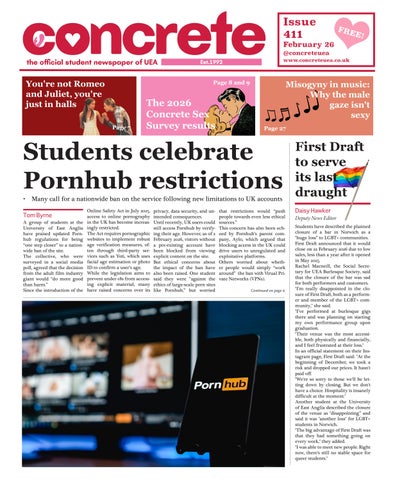
Students celebrate Pornhub restrictions

• Many call for a nationwide ban on the service following new limitations to UK accounts

A group of students at the University of East Anglia have praised updated Pornhub regulations for being “one step closer” to a nationwide ban of the site.

The collective, who were surveyed in a social media poll, agreed that the decision from the adult film industry giant would “do more good than harm.”

Since the introduction of the

Online Safety Act in July 2025, access to online pornography in the UK has become increasingly restricted.

The Act requires pornographic websites to implement robust age verification measures, often through third-party services such as Yoti, which uses facial age estimation or photo ID to confirm a user’s age. While the legislation aims to prevent under-18s from accessing explicit material, many have raised concerns over its

privacy, data security, and unintended consequences.

Until recently, UK users could still access Pornhub by verifying their age. However, as of 2 February 2026, vistors without a pre-existing account have been blocked from viewing explicit content on the site.

But ethical concerns about the impact of the ban have also been raised. One student said they were “against the ethics of large-scale porn sites like Pornhub,” but worried

that restrictions would “push people towards even less ethical sources.”

This concern has also been echoed by Pornhub’s parent company, Aylo, which argued that blocking access in the UK could drive users to unregulated and exploitative platforms.

Others worried about whether people would simply “work around” the ban with Virual Private Networks (VPNs).

Continued on page 4.

Misogyny in music: Why the male gaze isn't sexy

First Draft to serve

its

last draught

Students have described the planned closure of a bar in Norwich as a "huge loss” to LGBT+ communities. First Draft announced that it would close on 22 February 2026 due to low sales, less than a year after it opened in May 2025.

Rachel Macneill, the Social Secretary for UEA Burlesque Society, said that the closure of the bar was sad for both performers and customers.

"I’m really disappointed in the closure of First Draft, both as a performer and member of the LGBT+ community," she said.

"I’ve performed at burlesque gigs there and was planning on starting my own performance group upon graduation.

"Their venue was the most accessible, both physically and financially, and I feel frustrated at their loss."

In an official statement on their Instagram page, First Draft said: "At the beginning of December, we took a risk and dropped our prices. It hasn't paid off.

"We're so sorry to those we'll be letting down by closing. But we don't have a choice. Hospitality is insanely difficult at the moment."

Another student at the University of East Anglia described the closure of the venue as "disappointing” and said it was "another loss" for LGBT+ students in Norwich.

"The big advantage of First Draft was that they had something going on every week," they added.

"I was able to meet new people. Right now, there's still no stable space for queer students."

Concrete wins big at regional awards

Nothing celebrates sex and relation ships quite like this annual issue of Concrete. Or, more metaphorically, the brilliant group of women (pic tured above) that attended the South East Student Publication Awards at the beginning of February.

Compared by student journalists as our day at the races, the team swept up with four awards across both individual and publication categories. It’s the highest number that Concrete’s won in regionals since…ever.

The Five Ls lose grip on UEA

'resurrected' by young black singles

don't watch porn - they read it

Don't hate the player, hate the game

Hooking up with religion: Different rules, same pressure

It’s a testament to the talent and passion of the team. A group that faces every story with a smile, that brings enthusiasm in armfuls and celebrates each other at any oppor tunity.

We’re so grateful to have been highly commended under pho tography, best article and digital presence, and won outstanding commitment. But, truthfully, we find ourselves winning every day.

Each daily article published online, the monthly print issue, and the friendships formed have become the ultimate prize.

The results are in[box]: 2026

So, without further ado, we wel come you to our sex-and-rela tionships-themed February is sue, celebrating the spectrum of relationships and sexual endeav ours that occur on campus.

The good, the drag and the cabaret: Meet the people sharing pride in pageants

The chemistry of attraction

Love: In the head or the heart?

battle of the b(r)ee(ding)

Food, the ultimate love language

Date night, planned: Boursin and pancetta pasta

Let's rethink sex: Living with vaginismus

Dear, my worst relationship

finds its place in the winter chill

Are sports hot for Heated Rivalry?

Campus culture fears compliments

Almost 80 per cent of students at the University of East Anglia feel awkward when given a compliment, a poll has found.

The survey, conducted using Instagram, showed that 79 per cent of respondents were embarrassed when praised. A further 46 per cent felt unnatural giving a compliment in return for fear of it being interpreted as flirtatious.

When given the option of complimenting people online rather than in person, over half said that they felt more comfortable offering the niceties over social media.

The response aligns with national statistics that show 56 per cent of people from England and Wales feel em-

barrassed when receiving a compliment, with one in four not agreeing with the compliment given and 52 per cent rejecting them to avoid attention.

It found that women prefer compliments from family and friends, while men prefer them from strangers and work colleagues.

Behavioural Science Professor, Nicholas Epley, conducted an experiment where participants gave five compliments to someone they know throughout the duration of a week.

Rather than this person doubting their authenticity or feeling bored, as participants feared, they found that the compliment-receiver continued to have a good response each time a compliment was given.

New year, no libido

Daisy Hawker

Students are less sexually active than ever, according to Concrete's 2026 Sex Survey.

Almost a fifth of students cited never having sex or having not lost their virginity. In 2022, only 5.2 per cent of students had not had sex before.

This year's survey asked students to reflect upon what barriers students felt they faced when it came to sex and relationships.

In the same questionairre, 60 per cent of students listed their sexuality as LGBT+ or questioning. Several LGBT+ students explained how their sexual orientation was a barrier to finding relationships or sexual partners at university.

One participant reported their biggest difficulty as "being able to tell if someone is into you in the first place - especially if they are of the same gender."

Others highlighted the “decline” of clubbing culture and the limitations of dating apps.

One respondent described dating apps as "dead,” adding that ”no one goes out anymore, so it's impossible to meet other queer people."

Many students agreed that dating apps and online hook-up culture made fostering meaningful connections difficult.

"We've lost the skill of just approaching people to chat," said one participant. "It's very hard to meet people naturally, and dating apps aren't always successful."

Some barriers, however, remain timeless. Multiple students referred to thin accommodation walls as a deterrent to casual sex.

"My best friend is in the room next door," reported one participant. "She sometimes listens, and it's a bit awkward."

The Five Ls lose grip on UEA students

Nearly one in five UEA students have never heard of the university’s most “infamous” urban myth.

The “Five Ls” is a long-standing student challenge in which participants are dared to have sex in five locations across campus, including the LCR, the laundrette, the library, a lecture theatre, and the lake.

While the exact origins of the Five Ls remain unclear, its popularity appears to have peaked in the early 2010s.

The challenge was first mentioned in Concrete on 5 March 2013, when 36.2 per cent of students admitted to completing at least one of the Five Ls in the 2013 Sex and Relationships Survey. Fast forward to 2026, and participation has noticeably declined. Just over a quarter of students, or 26 per cent, say they’ve completed at least one of the Five Ls - and 17 per cent of students have never heard of it at all.

Despite the drop, those who have taken part still describe the Five Ls as a “quintessential” UEA tradition. “It’s part of what makes being at uni so fun,” one student told Concrete.

Another student, who has asked to remain anonymous, recalled completing one of the more infamous locations during an LCR traffic light night.

“I was with my girlfriend on an LCR Traffic Light night. We were both orange because we were looking for a threesome, and we got approached by a guy.

“We all went to the lake afterwards and the rest is history. I've not done the other four yet, though!”

However, not everyone is convinced of the challenge’s practicality.

One contributer asked on Concrete Confessions how students were “even managing to have sex in all of these places,” after hearing about the challenge for the first time - suggesting that the Five Ls may now be more myth than reality.

Daters are breaking up with hookup culture

Most students aren’t looking for hookups, Concrete’s annual sex and relationships survey has found.

Less than 10 per cent of students who responded to the questionnaire said that they use dating apps to look for one-night stands, while almost half of those who use dating apps reported seeking long-term relationships.

But the decline of hookup culture ex tends beyond the students at the Uni versity of East Anglia. According to dating industry research, meaningful connections and long-term relation ships are increasingly a priority for dating app users. An expert at Forbes found that within 3 years, the number of users looking for serious relation ships had risen by 9 per cent.

Despite this, many students said that the biggest challenge they face in terms of sex and relationships at uni versity is finding others who want to commit to a romantic relationship. One student said that for them, the issue was that “people aren’t

dating with intention and [the] majority aren’t willing to wait until marriage.”

For some, the rise in popularity of longterm relationships is the issue itself. Another contributor said that the biggest challenge they experienced was “the rise of purity culture.”

The purity culture movement originated from American evangelical Christian communities in the 1990s, which

UEA students would feel comfortable discussing sexual health with their partner.

While no information is available for the motive of those abstaining, 19 per cent of students said they had never had sex, and 18 per cent reported that they had never had a sexual partner. Researchers have suggested that the decline in young people having sex likely stems from a combination of societal changes, as well as psycho-

Contributing factors range from changing societal attitudes, including a greater emphasis on consent and emotional connection, to behavioural shifts, such as the decline of nightclub and pub presence, leading to a decrease in impulsive, one-night sexual encounters.

Students don't watch porn - they read it

The 2026 Concrete Sex Survey has found that almost a quarter of UEA students prefer reading porn to watching it.

It comes after only 2 per cent of students at the University of East Anglia said that they viewed porn as a positive force following research last year. One student, who wished to remain anonymous, said that they turned to reading erotic fiction after traditional video porn became “too fake.”

“When everything is fictional, it’s easier to build up an idea of what works for you, and you can have more fun with it since there’s no visual stimuli.”

“I find it difficult to find stuff I find attractive in visual porn, like people who look more alternative or have more real bodies, whereas written porn tends to be more alternative.”

They explained how written porn, known as smut, offered a “safer and more ethical” alternative to the adult film industry.

“We’re becoming a lot more attuned to the dangers of traditional porn - traf-

ficking, poor work standards, sexual assault and rape, underage/non-con videos are rife even on the biggest sites. It’s hard to feel aroused when you’re aware of how terrible standards and treatments are for sex workers.”

In the UK, erotic and romantic fiction book sales increased by 110 per cent be tween 2020 and 2023.

Over half of UEA students who report ed reading smut were women, many of whom identified as queer.

“As a woman, I don’t think many of us talk about our porn habits in any form,” said one study participant.

“I used to be quite embarrassed of [read ing smut], as my friends didn’t under stand how reading could make you feel anything compared to actual porn. But, when we got to our twenties, they real ised smut is, actually sexy.”

After the popularity of the Canadian show Heated Rivalry, the on-screen adap tation of the second book in the Game. Changers series, New York City Mayor Zohran Mamdani encouraged readers to borrow the book from libraries.

The e-book saw a 500 per cent increase in downloads in the days following Mam dani’s statement.

The survey also showed that 17 per cent

of students at the University of East Anglia preferred listening to audio porn over watching it.

The rise in audio erotica extends from Reddit, featuring subreddits

Students celebrate Pornhub restrictions

Tom Byrne

One student told Concrete they believe VPN use has become a widespread loophole to bypass age verification.

Ofcom previously reported that VPN usage more than doubled in July and August 2025, though it is not yet reflected in UK traffic data for pornographic sites. Despite these concerns, one participant has called for Pornhub to be “banned completely”. They commented: “I can’t think of a single good thing that has ever come from large-scale porn sites, whether we add age verifications or not.”

Another respondent echoed this sentiment, and said the ban was a “well needed change” to tackle porn culture itself, arguing that young people, especially young boys, should be able to “view sex realistically” without developing distorted expectations.

Celibacy 'resurrected' by young Black singles

More than 40 per cent of Black Gen Z singles are choosing not to have sex, a survey has found.

The study, by BLK Dating App, showed that young people were avoiding physical intimacy to instead “focus on personal growth.”

One student, who follows the same lifestyle choice, said that they decided to abstain after experiencing racial comments during sex.

“I decided to become celibate because I wanted to improve my self-worth. The current dating environment can feel very toxic, and I needed to protect my

emotional well-being.

“Choosing to abstain from physical inti macy has given me the mental clarity to understand my own worth.”

Jonathan Kirkland, Head of Brand and Marketing at BLK, said that the trend was an important step for young people in their independent journeys.

“What we are seeing with Black Gen Z singles is more than just a dating trend. It is a movement towards personal em powerment and emotional well-being. This generation values authenticity and is reclaiming their narratives.”

Jonathan explained how young people were prioritising self-discovery over so cietal expectations.

He said that he believed the rise in celi

bacy showed a desire for healthier relationships with themselves and others. Celibacy defines the act of abstaining from physical intimacy for a period of time.

But the choice is not limited to those born between 1997 and 2012.

One 35-year-old woman, who asked to remain anonymous, explained how a teenage promise to God led to a life of intentional celibacy.

al than rushed and fragmented.”

The woman said she did not want to experiment emotionally or physically with partners, and explained that her ADHD “did not allow her to dabble in relationships.”

The same survey found that women appeared to lead the cultural change, with 64 per cent of Black Gen Z women choosing to live a celibate life.

Among this group, 63 per cent have been celibate for less than six months, with growth or covery being the son for the

However, many said that they

While one in three Black Gen Z daters believed that ing more accepted, 43 per cent said there was a stigma around the choice within the Black

Scholars left heart broken in higher education

A study has shown that over half of stu dents experience at least one break up during their time in higher education. The research, by Zhong, showed that between 50 and 70 per cent of people at university will separate from at least one partner during their course. It sug gested that increased awareness and support surrounding break ups was needed by universities.

One anonymous source, who ended their “longest relationship” at the be ginning of the Spring summative sea son, said that “what people seem to for get about a break-up is that it’s a form of grief.”

“I found myself completely unable to function as normal, and the growing anxiety of approaching deadlines im mobilized me further. It didn't help that he'd done the same course as me and had frequently helped me with my work in the past.”

Another student explained how going through a breakup during exam season

writing essays and revising for exams. I felt like I didn’t have the time to deal

The data, collected from 500 university students, suggested that college social dynamics and relationship patterns were mostly to blame for the break-

But students praised single use therapy sessions at the University of East Anglia for supporting them through such experiences. One said “They [UEA Student Services] told me, rightfully, that I was grieving, and I needed to allow myself to do so instead of desperately trying to therapise the feelings

“From there, I worked on acknowledging my sadness instead of forcing it away, and I started

to feel better. I also found the support of a friend who was going through the same grief very helpful... so helpful, in fact, we ended up in a relationship!”

In 2024, universities across the UK reported a 450 per cent increase in students formally disclosing mental health problems. The same study showed that high social support from peers helped mitigate the effects of poor mental health.

A UEA student told Concrete that talking to friends that they trusted helped them process separating from their partner.

“Talking about what I was dealing with, staying busy with the clubs and societies I was involved in, and building stronger connections with those on my course was a huge help.”

If you’re struggling with a breakup, there is lots of support on offer. Contact the University of East Anglia’s support service or the Students’ Union if you need help, as well as anonymous helplines such as Samaritans (116 123) and CALM’s relationship breakdown guide.

COMMENT

Don’t hate the player, hate the game

At first glance, dating apps appear to be a cheat code for the dating game. By immediately being presented with potential dates’ looks, interests, and intentions, you bypass initial questions of attraction and compatibility, which should, theoretically, bring you to your perfect match.

However, all of Hinge’s features, with its polls, voice notes, videos, and other prompts, have created another game out of dating entirely, one that seems impossible to win.

Your dating app profile has never been about showing the real you, but rather about presenting the best, most interesting or exciting version of yourself, to attract likes or swipes. Recently, though, Hinge profiles have become a stage for bits and performances, as if competing for who can come up with the most creative punchline, rather than truly showing who you are.

This may be (at least partly) due to Gen Z’s apparent inability to be earnest or sincere. Having come of age in the heyday of ‘cringe culture,’ with every move at risk of being mocked or criticized, it is no surprise that many young adults fear putting themselves out there when social media has created a virtual panopticon.

Entire TikTok accounts are dedicated to rating Hinge profiles, leaking weird or uninspired replies, or judging people based on the photos they choose, with many of their videos reaching tens (if not hundreds) of thousands of likes.

Though internet humiliation might be a worse-case scenario, users, par ticularly those in university, have a major risk being seen by a classmate or a friend, which feels just as em barrassing. Thus, instead of throw ing their ‘best selves’ to the wolves and risking being seen at their most vulnerable (i.e. admitting that they might be a person desiring sex or ro mance), they hide behind wittyjokes, pop culture references, and memes in lieu of profile images.

Sure, many complain about how repetitive prompt answers have be

come, as if there is a designated number of interests deemed ‘socially acceptable,’ but is yet another “My typical Sunday: F1” not more hon est than “Together we could: do the ganzfeld experiment” and “my simple pleasures: bleep bloop” (both of which being real replies that I have come across.) At least, in the former’s case, you learn one thing about them. To take it one step further, videos of people projecting Hinge profiles on their TV at parties or talking about their friends “taking over” their accounts for the night contribute to the blatant dehumanisation of those on the other side of the screen. This dehumanisation gives people the confidence to talk about their likes or matches as if they were simply video game NPCs, with many taking to social media to complain that they keep getting likes from ‘ugly’ people, going so far as to act insulted by Hinge’s algorithm.

Every dating app has its own audience and reputation. Grindr is the app for gay sex, Feeld is for kink and nonmonogamy, Tinder is for straight hookups, but where does that leave Hinge?

With Fortune stating that over three-quarters of Gen Z feel burnt out using dating apps and Novuna finding that two-thirds of them use apps merely out of boredom, it is safe to say that most Hinge users of this demographic are not there to find the One. Instead, they are there for the thrill of the chase, a noncommittal way of achieving validation, not only for their looks, but for as much of a personality as they are willing to display.

You see someone you like, you swipe,

Third spaces at university are vital for connection

I write this curled up on a sofa in what Norwich has self-proclaimed its new “living room,” surrounded by people who, a few months ago, were complete strangers.

The lights are low, the atmosphere warm with relaxed chatter and soft jazz. I sip a mango and habanero soda while we all type furiously on our laptops, challenging ourselves to write freely for half an hour. This isn’t so different from what we do as creative writers each week, yet it feels special in a way a cold library desk or my bedroom never does.

That’s because this space is shared, and more importantly, it’s shared with friends I would not have met without the third spaces I found while at UEA.

A third space is defined as any place outside of home and work (the first and second spaces, respectively) where people can gather and consistently, forming connections without pressure or obliga-

These spaces are where friendships grow naturally, where conversation

flows easily, and where community forms almost without you noticing. Since COVID-19, the third space is often described as being in decline. As students, we can certainly feel that pinch

With long working hours most of us face on top of meeting academic standards, spending time outside the home can feel like a luxury. As a result, many people argue that the internet has replaced the third space, with social media platforms acting as our new communal hubs.

But anyone who has ever scrolled through Instagram while feeling inexplicably lonely knows this isn’t quite true. No matter how many people I talk to online, nothing compares to the warmth of catching up face to face at ballet, or the fizz of excitement after a rehearsal realising I’ve made a new friend. This is where UEA’s third spaces become not just helpful, but vital. When we imagine third spaces, we often picture local pubs, independent cafés, or expensive gyms. But these places don't always facilitate making friends organically and are sometimes inaccessible on a student budget.

But being a student at UEA means we have the luxury of having some of the most meaningful third spaces already built into campus life through clubs and societies. UEA’s clubs and societies are

perfect examples of third spaces. Regular, low-pressure, in-person interaction centred around shared interests.

Whether it’s a writing group, a sports team, a volunteering society, or a place outside of your campus bedroom that simply exists to give people somewhere to be, these spaces allow relationships to develop slowly and authentically. They remove the awkwardness of having to “make friends” outright. You’re there to write, to play, to talk, to create, and friendship follows naturally. Third spaces matter especially in a time when many of us are living away from home for the first time. Without them, it’s easy to slip into isolation, spending days moving only between lectures and your bedroom. With them, campus becomes more than somewhere you study, a place where you meet UEA is rich with third spaces, but they only work if we use them. So as the new semester picks up, keep your eyes open; for the club you keep walking past in the Sportspark, the weekly meet-up you’ve not quite got around to trying out yet, or the society that seems a bit of you.

Flatcest: You’re not Romeo and Juliet, you’re in halls

Have you ever heard to not ‘shit where you eat’? Well, maybe you shouldn't have sex there either.

As a first year myself, all I have heard about from local and afar is the troubles of deciding whether to snog your flatmate or not. The resounding ‘no’s’ from older students appears to only compel people to believe they are a modern-day Romeo and Juliet. Whilst not a personal problem of mine, it is one I have had front row seats too - a lot. So, the question is - what is the aftermath? If you end up together, you effectively end up living with your partner full time. It could be great. Maybe not so great that you might end up agreeing to live with each other next year and then breaking up dramatically over the summer because of the inability to live in each other's pockets. Sure, the

cooped-up bubble of love seems like a great idea - until suddenly you look around to realise you have barely left the flat. Plus, the only person you can count on is some stranger you met at a fresher fair whilst deciding not to join the hummus society.

I'm all for love, and for unconventional beginnings. The whole friends to lovers thing seems totally romantic in theory. However, after the end of first year, you may come to an inconvenient realization that you might have just stayed together because it was the easiest way of living with someone who has seen you naked. These relationships tend to end before that second year lease has started, which can make things awkward to say the least. On the other, more dramatic, end of this spectrum, you might find yourself moving out before March if it all goes up in flames. There's little worse

than when you cannot bear to look at each other at breakfast. Best advice: try to snog anyone that you do not have to have dinner with every night. Ask yourself - are they really the love of your life or were they just next door? Do not take my word as gospel, though. Perhaps it does work out for some people. That 2

per cent are smugly going around acting like the 98 per cent of failed flatcest relationships are propaganda. I hate to be the one to say it, but I think successful close quarters lovers are a mythical fairytale.

Hooking up with religion: Different rules, same pressure

On the surface, purity and hookup culture seem worlds apart. Purity culture, which advocates for strict sexual abstinence until marriage, is seen as conservative, restricted and dated. Hookup culture is seen as progressive, liberating and modern. However, despite these differences, both rely on the same mechanisms: pressure, shame and double standards.

Purity culture was popularised by the United States evangelical Christian movement peaking in the 1990s. But this was not the first of its kind. Precursors existed in the wake of the 1980s AIDS crisis, with many people at the time citing sexual promiscuity as one of the main causes of the epidemic. Those endorsing this movement were opposed to the values of the ‘Free Love' movement of the 1960s which advocated that love and relationships should be free from legal and societal restrictions. Purity culture is often rooted in reli-

gious and moral framework. Yet its decline in popularity since the 1990s does not account for its influence that persists both in the US and glob ally. The culture’s double standards - much like those also present in hookup cul ture - mean that women are often the ones held re sponsible for beliefs, such as waiting until marriage. Men are also expected to follow these standards, but the blame and focus tends to be placed on women as the gatekeepers of sex.

Critiques of the culture ar gue the damaging impact on individuals who were brought up to believe that sexual ‘pu rity’ equated to moral worth. Although framed as righteous, the effects of this movement in clude feelings of shame, confu sion and fear. It's especially true for members of the LGBTQ+ community who face both these feelings and vulnerabil

ity to feeling forced into secrecy and, as a result, harm.

The 1987 song “It’s a sin” by the Pet Shop Boys captures the emotional reality of purity culture, where desire is not managed or understood, but punished. But despite it's presence in pop-culture and entertainment, the lifestyle has often remained secluded to the religions that practice such. No matter how hard it tries, few have managed to convince a wider audience to follow the movement. That is to say, perhaps, it may benefit from the social lessons of hookup culture; sweeping nations, inspiring apps and often the focus of raunchy

At first glance, hookup culture is the juxtaposition of purity culture, it encourages practices such as sex with

no commitment. Its origins can be traced back to the 1920s when social trends shifted as dating under parental supervision (courting) began to fade in western society.

The 1960s ‘Free Love movement’ attempted to make themes of hookup culture socially acceptable. In hookup culture, sex becomes detached from commitment, clarity or emotional continuity. Similarly to situationships (a relationship without clear rules or promises) the joke “are you the one with the commitment issues or the one with no self-respect?” is a critique of the false sense of freedom both phenomenon's give us. Hookup culture is sold as a product of the sexual liberation of the 1960s, however it is just as controlling as purity culture. Participants in this culture are pressured to emotionally detach themselves during sex and repress vulnerability. Instead of shame attached to sexual desire, hookup culture

produces shame around attachment.The double standards of hookup culture towards women mean those who partake in casual sex are still seen as whores, whereas men doing the same thing have no negative labels placed on them.

A healthier sexual culture would remove the pressure, shame and double standards of both purity and hookup culture. Both cultures lack communication.

In purity culture, sex is considered taboo to discuss, whereas in hookup culture the dreaded question of “what are we?” is discouraged. Communication is vital in any relationship, sexual or not. In a healthier culture, the definition of sexual ‘freedom’ would be focused on someone's ability to replace the feeling of shame around either wanting or not wanting sex with the feeling of autonomy, not social pressure.

Image Credit: Pixnio

Evie Smith
Comment Editor
Violette Douglas
Image Credit: Violette Douglas

ERROR: File The_2026_Concrete_Sex_and_ Relationships_Survey could not be formatted in text. View image files here.

Did you know that UEA student's favourite sex position is missionary?

A.T

I'm in love with you but don't want to ruin our friendship...

Roses are red, violets are blue, P.O I really fancy you

DearReader,Rosesarered.Concreteisblue. Toshowyoujusthowmuch wecare,we'vedelivered theselettersfrommystery admirerstoyou.

Love, ConcreteCupidx

P.SWillyoubemyValentineL.R? hopingyoureadConcrete

Thankyouforthebestthree yearsofmylifeRyou'rethebest thingthateverhappenedtome

YouMarIthinkyouaresoneatMarmakemylifecomplete IthinkyouaresogreatWeWeshouldgoona(friend)date cancelebrateValentine’sDayIIwillevenletyoupay donothaveajob

Tomyfavouriteco-worker, Whoknewthatapizzakitchencouldbe sucharomanticplace? Ineverknewthatthesmellofsmokeyhair, tomatosauce,andburntgarlicbutter couldbesoattractive. I'llalwaysthinkofyouwhenIseeapaper cocktailumbrella! Let'sgetdessertsometimesoon,darling. Love/you/friend/best, yourfavouriteco-workerxx

Happy Galentine's M.L and H.F, love you

The good, the drag and the cabaret: Meet the people sharing pride in pageants

For some, performance is unnatural. For others, it's a way of life. And for few, it's a life-saving experience. Concrete's senior editors sat down with drag and cabaret artists to learn more about the practice.

"Trans bodies deserve to be celebrated"

“I’d heard a lot of other trans girls refer to themselves as ‘joystick mode’ girls,” Thea explains. “That name, for me, was trying to take a source of dysphoria and own it. And then also trying to take joy in my body, I felt like that made sense. And then Aphrodite was because I want to also feel beautiful in myself.

“Joystick Aphrodite is a more theatrical, over-the-top version of some bits of me—a way to express a lot of ideas and energy that I find difficult to necessarily express without being a bit more sort of extravagant.

For all performers it is agreed the best way to express your gender and entertain is drag.

Ekko Pixie, a psychology student and UEA’s current burlesque president lives a double life, as they are also a non-binary draglesque performer.

“I've been doing burlesque for over 3 years now, and I have never regretted my decision.

“When I started, I was so incredibly nervous, but I kept seeing burlesque in media and I knew I wanted to do it but taking that step to join a class was so scary.

“I was too nervous for my first warm up and had to literally take myself out of the class to calm down, then hid at the back for the rest of routine.

“This first routine was terrifying, but I was so determined to do it, so I kept going.

“From helping me find a new way of expressing what I want to through a different movement, to teaching me about a type of costuming or normalised that genderqueer doesn't have a specific look.

“Burlesque especially has helped me to love and appreciate a variety of bodies and styles, helping me to confront the beauty standards I held with too much weight for too long.

For Thea, a UEA graduate and member of Snapdragon Cabaret, the world of burlesque was a way to reclaim the “narrative of [her] body.”

“Trans bodies are often stigmatised, and then fetishized in kind of equal measure. Burlesque can drive the ways in which I can take control of that narrative. I felt like, if I did [burlesque], I'd be in an environment of people who are very good at understanding bodily autonomy and consent, and that I'd be in a good place to sort of start building a better relationship between me and my body, which has definitely been the case.

“There's a lot of spaces I've been a bit iffy about joining, wondering oh, will I be the only trans person in the room? Will I have to be my own advocate? I think knowing that there were [other trans people] around has made it feel a lot safer. People sell burlesque as spaces for people of all genders and where all bodies can be celebrated. And I think trans bodies deserve to be celebrated, but there aren't always very many spaces outside of very explicitly queer places where you can kind of get that.

“I think it's a great place, in my opinion, to sort of practise and share trans joy, which I think is really lovely.”

Her stage name, Joystick Aphrodite, was the first step in taking ownership of her transness through performance.

“She comes from real gender euphoria and trans joy, but doesn't have to have all of my baggage is maybe the best way of putting it.”

Embodying that persona has also allowed

Thea to reimagine and reinforce her own femininity as a trans woman:

“[Drag and burlesque] have made me a lot more comfortable to take up space. I think I feel a lot more confident being out and about, just being myself as a woman. I feel like the dysphoric things on my head can be so loud, but also like going on stage and having like 100 people cheer when you take your clothes off is also very loud. Trying to take that confidence from the stage has made me feel like I can be a bit braver in being more out there with myself in real life.

“My partner has said that they've loved seeing how much I've sort of come into myself, and a lot of my friends from like pre-transition have been like, oh, this is who you're supposed to be. You seem alive!”

When asked what burlesque means to her, Thea emphasizes the importance of community and expression, and the safe and supportive space created by cabaret.

“[Starting burlesque] is going to be intimidating, but it's worth it. Like every time you step on that stage, you'll feel a bit more confident, and if you want to perform, everyone in a crowd is absolutely on your side and wants to see you do your best and to see you have a wonderful time.”

“Six weeks in I was on stage, still terrified, but proud of myself, it felt like a massive hurdle, and I managed to make it.”

For Ekko, it isn’t just the fun of performing but a chance to get to know who they are.

“The moment the lights hit my face I knew this was what I wanted to do and I had no doubts about it; I remember coming off stage and thinking that I really wanted to do a solo.

“I enjoyed pushing myself, since then I've been able to learn even more about myself; how I like to move, what makes me feel confident, my own boundaries and how much is too much to push myself.”

Drag itself involves elaborate costumes and makeup and more importantly creating a new identity.

“I go by Mx AnnaKey, because soon after my first show I started feeling comfortable enough with my community over at Snapdragon Cabaret to be much more playful and mischievous.

“From this I really wanted to pay homage to my chaotic stage presence, when considering synonyms, I was inspired by anarchy.”

As well as an act there is a huge community around drag which is vital to Ekko.

“Near every drag artist I have met has inspired me in one way or another.

“The moment the lights hit my face I knew this was what I wanted to do"
Anna Johnson Deputy Editor

“Not only has it stopped me being so judgemental to others, but it has encouraged me to give grace to my body, no matter what it is doing or looking like that day.

“I think this has been fundamental for me in learning to love my body, which as a trans person has been a complex journey.”

If you are thinking of giving it a try, here is Ekko’s advice: “Go for it. It's always going to be scary but that ends up being the fun bit.

“Not everyone is going to like it, some people will be judgemental but, in my mind, they aren't the people you want to have around you anyway.”

BOOKS - CREATIVE - FASHION - FILM + TV - MUSIC - EVENTS

An interview with an erotic art photographer - Why do we read smut? - Threesomes in film - What’s on in Norwich - Why are goths so... sexy? - Misogyny in music - And more!

Letters from the editors

Dear reader,

Happy New Year!

I hope that 2026 brings you all the luck in the world. In my case, this new year, and this new term, means that graduation is just a couple of months away, but thinking about it too hard fills me with deep dread. So instead, I have been focusing all my attention on something far more thrilling: sex!

A fun fact about me is that I find the topic of sex absolutely fascinating. When I was 14, I was enthralled by the erotic paintings left on the ruins of a brothel in Pompeii, a few years later I became obsessed with the history of sex toys, and later still (i.e. last term) I spent three months researching the sexual revolution for a summative. So, it is no surprise that this issue is the one I have been looking forward to all year.

Plainly put, I am so happy to have seen this issue come to life. From planning the Sex Survey questions, to shooting the cover photos, to regaining contact with the other editors as we all returned from our (well-deserved) holidays, I feel like the Venue team has truly become a well-oiled machine. Every single member has given their all this month, pitching and picking up amazing and exciting articles, and truly bringing their own to the meaning of “Sex and Relationships.”

If you have any interest in love and lust or pain and pleasure (or if you just want to see a bare butt), I hope you enjoy. And if you haven’t already, please add “writing for Concrete” to your list of resolutions!

Sincerely,

Dear Reader,

Happy 2026!

I know it’s been an entire month and a half since this year began but I am nonetheless very excited about it. New beginnings are wonderful; they get me so excited for what’s to come. I used to be somewhat against New Year’s resolutions as I thought they were a bit pointless, but I’ve had a change of heart recently, and now January 1st is one of my favourite days of the year. One of my aims in 2026 is to be more confident by doing things that will scare me. I’m not talking about bungee jumping or exploring haunted houses. I’m talking about riding a bike and going on a rollercoaster. These things probably sound trivial and perhaps even quite fun to most, but I never learned how to cycle and have a morbid phobia of funfair rides, so it’s going to be quite the uphill battle.

Now let’s talk about another scary thing: sex and relationships! That’s right, you currently have your hands on Concrete’s signature saucy February paper. When I think back to last year, when I was fashion editor, February was without a doubt my favourite of all the print issues. As both a queer person and burlesque dancer, love and sex are topics that I always find myself coming back to, whether that be during late-night chats with my housemates or in an 8000word English Literature dissertation. I think this issue of Concrete has some of the most fun and fascinating articles I’ve seen: you’re going to love it.

Books...................................................................p16

Is there a right way to write about abuse?

Fanfiction: A platform for queer love

Why do we read smut?

Reviews of Machines like Me by Ian McEwan, Annie on my Mind by Nancy Garden, Mothering Sunday by Graham Swift

Creative..............................................................p18

Lovey-Dovey

Analepsis as coping mechanism

Keats, by his beloved's bedside

The word 'Love'

Photo spread by Jessica Knight

Regards, Robyn

Fashion...............................................................p22

Underwear and the trans experience

Styling your body and embodying your style

Why are goths so... sexy?

Venue En Vogue: What’s in for February?

Film + TV............................................................p24

Portraying male victims without a punchline

Three's a crowd: Threesomes in film

Reviews of Pretty Woman, Sex and the City, Bridgerton

Music..................................................................p26

Why the male gaze isn't sexy: Misogyny in music

Sex and relationship songs: Fact or fiction?

Reviews of "All Flowers in Time Bend Towards the Sun" by Jeff Buckley, "It's All About You" by McFly

Events.................................................................p28

Preparing for The Event

Date night on a budget

Cover by Micah Petyt

Sex work in the age of the internet: An interview with Shot by Oli

Micah Petyt and Robyn Srikandan

After graduating from NUA with a BA in film back in 2017, Oli Hosier tried to go the traditional route, looking for any entry-level runner job, but struggled to find any leads. That’s when he turned to photography, a skill he had developed during his time in university, and began “shooting portraits, weddings, music, things like that… Anything that [he] found interesting.”

But then COVID happened, and “no one could afford a photographer. That was probably the last thing on people’s minds.” So, much like the many other freelancers who found themselves out of a job, Oli had to pivot, crediting the pandemic for the sudden rise of OnlyFans “and adult content in general.”

“I had a friend who did OnlyFans,” he recounts, “and I said do you mind if I pick your brain on the business side of it? I was very curious as to how I could implement the skills that I had and get a piece of that pie. I came to it from a monetary standpoint, but I wasn’t ready to do adult content, so I found this thing called boudoir.”

Boudoir is a style of photography that focuses on “empowerment of the body,” photographing subjects in intimate and sensual settings. As boudoir photography appeals to a primarily female demographic, Oli acknowledges his need to create a safe space for the women who came into his studio. “[These women] are going to be nervous when contacting you because they've never done anything like this before. There was a lot of pressure to come across very genuine, more relatable than you would [need to] if you were a female. During 2023 I managed to get my own studio space, did that for about a year…”

A hard financial year and a creative rut is what first pushed Oli to give up his studio and enter the world of pornography, realizing that there was “a lot more money in porn than there [was] in boudoir.” However, as of right now, OnlyFans is just a means to an end for him, as he remains first and foremost a filmmaker.

“My goal at the moment is to create

erotic art,” he tells us. “I want to make films more than pornos. Although straight-up porn does sell really well financially, it’s not something I have a huge passion in making. What I do have a passion for is storytelling.

“I think all I want is financial freedom and creative freedom. At the same time, and I want to do that in the best way that I enjoy.

“I’m trying to build a portfolio that tells stories on the intimate side of things. Imagine you're watching, like, of Grey, but more of a shortened down version of that. It's got more of a cine matic tone to it, as if you're watching a short film as opposed to watching a porno when you when you click on my work. That's what I'm trying to do.”

We ask him to describe his typical shooting day, and he emphasizes the administrative side of the job.

“When you approach someone for a collaboration, you would want to build that rapport like you would any other business opportunity. Networking is very big like it is in any other business.

“I always relax at the beginning of the shoot, just chat to them. Cof fee, tea, and then we go through the legal stuff. We go through a lot of consent forms and con tracts… There's a performer checklist that I have, which basi cally goes through the yeses and nos of what you're comfortable doing on camera, what you're not comfortable doing.

“Due to the Online Safety Act— which had a massive hindrance on the industry recently—you have to do you have to take a photo of the ID, front and back, you have to have a photo of them holding the ID, and a photo of them holding the con sent form that they've signed. Once all that legal stuff's done, you're good to shoot. I'm also looking at introducing anoth er final consent form, basically saying everything we've done today has been fine.”

Throughout the interview, the conversation repeatedly returns the ‘traditional’ aspects of the job. From

networking at conferences, to paperwork, to the gender pay gap, Oli makes it clear that OnlyFans is a job like any other. However, when asked about his favourite aspect of his work, he laughs.

“I'll be honest, sex is fun,” he says, reminding us that his work is less conventional than a traditional job in entertainment.

“That is a good thing to look forward to, especially if you have a really good connection with someone, [because] it comes across on camera better.

“But the most enjoyable part is making it, and seeing this idea come together. I just get so nervous, and I'm such a perfectionist as well. I want it to be the best I can make it. I just want it to be the best I can make it.

“[I love] the storytelling part of it, but that's coming from my filmmaking interests. A lot of people go into the industry for money, but it’s also quite empowering, you know. Having that sexual freedom.”

echoing one of the main warnings that comes with the porn industry. “It doesn't matter if you remove it, it stays in some capacity.”

Beyond the obvious, however, he also talks about having to work the social media age, complaining about having to make “stupid TikToks and Instagram Reels just to stay relevant,” reminding us that, albeit working in the sex industry, OnlyFans is still a form of content creation, and comes with many of the same responsibilities as those of a social media influencer.

However, old stigmas remain regarding the industry, especially in Norfolk, where the population is older and more conservative than certain areas in London, where sex culture flourishes.

““Norwich could do more, when it comes to sex. […] I heard Norwich wants to get rid of all sex or adult themed venues by, like, 2030 or something,” he laments. “I don't know if they're going to do it, but it shows that some higher powers still

These stigmas are further pushed when it comes to his personal relationships. Oli namely recalls a recent date he’d been on, where the woman had expressed a clear dislike in his profession, something that caught him by surprise given their

Where it is less surprising, however, is

“I'm very close to my mum so I told everything,” he explains. “She’s not overly keen that I do it but she goes ‘as long as you're being ’ My dad [on the other hand] is a little more conservative, an old school man. He's doesn’t want to hear it, but ultimately what I'm doing is I want to

“I think it's important to not care too much about what people think when it comes to this stuff, because at the end of the day, what you're doing is completely normal. Sex is normal, and filming sex is normal.”

Machines Like Me by Ian McEwan

review by Polly Dye

Set in an alternate 1980s where the Beatles have reformed and Alan Turing is still alive, Machines Like Me is ripe with questions about humanity, desire and consciousness. It follows a burnt-out Charlie, who uses his newfound wealth to buy Adam, a synthetic human. With the help of his lover, Miranda, Charlie designs Adam’s personality. A love triangle soon emerges, confronting all three beings with a profound moral dilemma.

This is a subversive, introspective read that gestures towards compelling questions about the future of intimacy in our digital age. Although McEwan’s prose is exquisite, the narrative itself feels strangely dull. The characters are so flat that it is tempting to imagine a plot twist revealing they were robots all along. Still, the novel remains a thoughtful meditation on whether intimacy can survive once it becomes programmable, and a cautionary tale in which robots are not only dangerous, but also incredibly annoying.

Annie on My Mind by Nancy Garden

review by Avery Hewitt

Annie on My Mind was the first young adult novel published to have lesbian main characters. Its 1982 release garnered shock from readers, as society was still coming to terms with lesbianism and its representation in media. There were many protests against this book – which follows Annie and Liza, two teenage girls who fall in love, as so many teenagers do – because it was viewed as corrupting to young girls. It’s a complicated and raw love story that consistently emphasises the importance of queer representation, as Annie and Liza look up to two of their teachers, who are in a sapphic relationship of their own. Unlike so many tragic queer stories we see on our shelves, Annie on My Mind has a happy ending, and it is beautiful to have hopeful LGBTQ+ love stories to show how queer love can thrive and bloom.

Mothering Sunday by Graham Swift

review by Natalie O'Dell

Graham Swift's Mothering Sunday desires to be devoured in one sitting. A domestic tragedy, set within the confines of the manor house (literally) and of society (figuratively), the novel follows our boundary-pushing protagonist across twenty-four hours of her passionate love affair. It's an epic defeat of both romantic norms and class divides. Swift compresses this love affair over the span of a single chapter, neatly extending their short interaction into what feels like a lifetime of excruciating tension, showcasing his expert manipulation of time. This novel's visceral quality teases its audience into drifting away with the lovers through a timeless expression of their illicit love affair that plunges us into the realm of forbidden lust in the height of 1920s society. This is a tantalizing read that promises to entagle you zithin its web from the outset.

Finding safety in smut

I mean, what even is smut? That might be the first question you’re asking. At its core, it’s books about sex, or “book porn” as a Substack article so delicately put it. The internet says that smut is not just scenes that are ‘spicy’; smut scenes must be explicit, detailed and precise. But smut is not the same as porn. While some may read it to fantasize and relax, much of my research found that for most people, arousal wasn’t the main goal. A friend told me they read it because of their “lack of boyfriend”, perhaps wishing for the intimacy and love of a partner rather than one-off arousal. Another told me the best smut has “substance”, that it adds to the story and teaches you something new about the characters. You might be thinking: Grace, do all your friends read smut? Actually, I have some friends who had no idea what smut was. It was interesting to find out that my friends who had never heard

of it were men. Smut is more commonly read by women, perhaps because it seems to be geared towards them and often focuses on female pleasure. But, as is often the case on social media, something women enjoy must also be shamed, as I came across articles such as, ‘Why Are Women Reading and Listening to Porn in Public?’

But I think this is reductive. Lucy Eaton, in her article ‘Why We Hate Smut But Tolerate Porn’, says that Pornhub has been fined for filming videos of sex-trafficking victims, and that around half the women on the site have been coerced into

being choked, slapped or spat on. This is a possible outcome of the normalisation of BDSM kinks on porn websites. Porn can only be about desire and arousal; the websites are specifically geared towards that. Smut is enclosed within the pages of plotline, within character development and fantasy worlds. It gives women a community, both on and offline. For many, smut is a way to relax, enjoy a book and feel loved and seen.

Image Credit : Grace Barnett

Fanfiction: A platform for queer

Here’s a fun and slightly embarrassing fact about me: discovering Warrior Cats fanfiction at the tender age of eleven helped me realise I was a lesbian.

I was already intuiting my ‘difference’. Compared to all the models of womanhood around me, I seemed to lack something. I grew up rurally, didn’t engage much with pop culture and didn’t know any queer people in my village. I never encountered anything but heterosexual femininity. Wattpad (yes, Wattpad) was my first social media. I joined with the intention of publishing my original stories to great international acclaim, hardly interested in what other people my age might be writing. Then I got really into Warrior Cats fanfiction — essentially a feline soap for tweens — and forgot about my lofty fiction goals altogether. Wow, a bunch of people loved these absurd cat books as much as I did! And they

were inventing all these characters and story arcs for me to follow while I waited for the next series to drop! The community aspect of fanfiction is comforting, the reworking of stories already familiar to us uniquely appealing. It’s easy to get invested.

It was upon this familiar canvas that queer characters, romances and stories were introduced and demystified to me. Obviously, I was getting a simplified, age-appropriate version of queerness — we were all under thirteen, and these were cats — but encountering new kinds of relationships opened my mind. I didn’t have to feel the same attraction as everyone around me. There were many other ways to be. Embarrassing? Maybe. But I’m grateful fanfiction gave me the tools to understand myself early on. Since its rise in the 1960s (thanks, Star Trek!) fanfiction has been an outlet for writers and readers to explore their sexual and romantic fantasies in non-judgemental spaces. As an accessible form that can gain traction quick-

love

ly among existing fanbases, fanfiction spotlights stories that are deemed commercially unviable by mainstream media, particularly queer stories that venture beyond what’s broadly palatable. Fanfiction isn’t perfect. Content may be misguided, disinforming, or downright problematic. Certain kinds of queerness remain marginalised — while 65% of Archive of Our Own’s top pairings are male/male, just 5% are female/ female. At the same time, it’s revolutionary. Nowhere else can queer writers connect with such vast readership, or can queer readers so easily find content which reflects who they are… or stumble across something, as I did, that puts words to the way they’re feeling for the first time.

Is there a right way to write about abuse?

With society's rising preoccupation with violence, literature has undeniably seen more stories tackling abuse. But as content warnings become increasingly standard, a question arises- is there a right way to write about abuse? Should we be writing explicitly about distressing experiences? Should we question the intention behind these stories, and should we give voices to abusers? To determine whether there's a right way to write about abuse, I'm going to delve into the works of Fernanda Melchor, Kate Elizabeth Russell and Ivy Pochoda. Melchor's Hurricane Season is undeniably the hardest book I've ever read. From the start, she assaults readers with crude language and graphic depictions of female abuse. Paired with the book's unrelenting pace, dominated by page-long

sentences, the reader never feels relief. The horror peaks in Brando's chapter, where blase depictions of abuse are so nauseating that I seriously considered never finishing the book. Eventually, I did and discussed it in a seminar, but many of my peers did not. By turning readers away, is Melchor wrongly writing about abuse? I'd argue no. This book takes things to the limit, but Melchor doesn't use explicit depictions unnecessarily. They have a clear purpose: barrage the reader until they cannot deny the horrors a failing society produces. Reject apathy, incite action.

Russell does something different in My Dark Vanessa. Following Vanessa through adolescence and adulthood, she details her experience of sexual abuse at the hands of her teacher, Mr Strane. My Dark Vanessa is less explicit than Hurricane Season, despite its sickly descriptions of

Strane's grooming. Arguably, however, the novel's real horror is how little we hear from Vanessa, despite it being her POV. Strane's manipulation dominates Vanessa's speech and thoughts so heavily that it feels like we are reading his thoughts. Unlike Melchor's extreme bombardment, Russell straddles the line between impact and awareness. Yes, the graphic depictions of Vanessa's abuse disgust readers, but not to Melchor's extreme. Russell instead draws our attention to the systems that continually let Vanessa down, raising awareness of institutional problems surrounding abuse. In this way, she blends impact and awareness to simultaneously disgust and enlighten us. It would be an injustice to say that Pochoda's These Women is an easy read, but compared to the previous two, it's cer-

Unhappily ever after:

Why contemporary fiction hates

Ollie Wheaton

happy relationships

From Hamlet (ca.1599) to Wuthering Heights (1847), unhappy relationships have always been part of literature, regardless of time or genre. Due to many stories being driven by conflict, there’s a case to be made that happy fictional relationships are a difficult place from which to source dramatic material. Tempestuous relationships are an easy place for conflict and drama to unfold. Is the discussion of a lack of happy relationships in contemporary fiction the same conversation happening again, or a sign of something else?

I have not read Normal People (2018), but I have read the short story first featuring Marianne and Connell, "At The Clinic" (2016), which I hear sets up the novel perfectly. At its heart is their inconsistent relationship, as they care for each other yet seem unable to express it. Rooney is one of the largest names in contemporary

fiction, her works exploring the pressures and expectations of relationships, and the messiness of romance. Other contemporary novels such as Fundamentally (2025) by Nussaibah Younis and You Exist Too Much (2020) by Zaina Arafat feature protagonists caught in messy situationships or fracturing relationships, ultimately choosing themselves, although Arafat’s protagonist ends up in a healthy relationship built on understanding and communication. Whilst not as recent, One Day (2009) by David Nicholls shows people right for each other separated by life until it’s too late.

A clue to this question is in the genre’s name: contemporary. These novels reflect current times, and in contemporary culture many people would rather be single than deal with the stress of dating. A friend recently told me that they wouldn’t wish the London dating scene on anyone, as though it is the worst fate

imaginable. This view seems to be widely held regardless of location. It is easy to notice that healthy relationships are hard to find in the era of the manosphere, dating apps and situationships.

Despite this, happy relation ships do have a place in liter ature. The enduring success of the romance genre and the rise of subgenres such as Roman tasy (despite the problematic elements of many of its most successful entries) signal this demand.

Unlike contemporary litera ture, Romantasy is divorced from reality, making it unable to reflect modern life as accu rately. And right now, modern life is not a happy place for re lationships.

tainly lighter. Mostly, we are spared explicit details, instead focusing on these women's day-to-day lives. Pochoda gives us their voice, and not the killers, when women in crime fiction are traditionally silent, mutilated plot devices, inverting media narratives of overlooked victims and sensationalised abusers. Pochoda's focus on presenting women as more than their abuse means that the novel is lighter, although still undeniably horrendous, favouring educating a wider audience over visceral graphic detail.

All three authors write about abuse in distinct ways, and to say that one is right and another wrong would be to misunderstand them. There's validity in stripping back explicitness to make the material easier to engage with, but there's also effectiveness in thoroughly

disgusting readers to the point of physical revolt. Authors face the risk of turning readers away, but they refuse to let them leave unscathed. Of course, it's also entirely possible to combine these two methods, proving that there's no right way to write about abuse. I would argue, however, that there are wrong ways, namely glorifying abuse and coining it "love". Therefore, rather than asking if there's a right way to write about abuse, we should be questioning these stories' purposes. Is it educational? If it's graphic, is it purposeful? If we are hearing from an abuser, is it glorifying? I think it's important that books don't continue to silence women and empower abusers. Instead, they should be survivors' stories, raising awareness of abuse and imploring change.

Upcoming releases

Image Credit: Pixabay

Polly Dye

CREATIVE CREATIVE CREATIVE CREATIVE

Analepsis as coping mechanism After Ocean

Vuong

Can’t write

so I’m shuffling through the old, old stuff – soggy sonnets bunched like wet petals, penned to your Roman nose, your pixie cut – & I’m dripping yellow, warm & lonely as a yolk, in a slurry of white North Carolina sun. I want to phone you up now & come clean, all laughy. Hey, girl! I cut my teeth on you. Shy & solemn at 14. Cut my love-sucking teeth in the suet classroom air, around your arm raised lazy as though dangling, to answer something elegant & right. Writing wry little notes on papers graded A, extracurricular Latin, tins of petroleum jelly. We were plaid-pleated girls with a secret handshake. Who kissed, just once, at the kissing gate. Odd at its hinges but warm to the touch. The kiss & the gate. At sleepovers, friends breathing gentle as hills, you tucked your chin over my shoulder & we’d sleep, sweet as thorns in each other’s sides. Two smart-curt girls conjugating pluperfectly, linking little fingers under heavy sleeves of uniform, thinking marriage, for a laugh, on a farm where we’d grow redcurrants. I cut my teeth on redcurrants. On neat & gleaming you, sharper than the slyest moon. We studied & glimmered & dreamed & I swear. That future gleamed, I swear it.

At 19 we burst obviously, like hand grenades. A burnout, a breakdown. I waxed, spit like a candle, blazed right out the country. You waned, a closing door: waned out of school to tend a quiet bar, with dark carpets, low rafters, at the arse-end of the village. This man takes you driving weekly, makes cruel jokes & you love him. I’m out here, cruel & hot between the pines. Once you whispered across the aisle between our desks: Hey, here’s a palindrome that only works in Latin. Roma tibi subito motibus ibit amor. Rome, love will come to you suddenly, with violence. I want to phone you up & tell you: Hey, remember we cored apples, split lunch money? It never seemed so sudden or violent, not then. Not to me. & Hey, by the way, I cut my teeth on that love, one that had me surrounded – subject-object-verb, your sweet thorn through its centre – back then it started & ended more than sentences, honey. & Hey. I’d peel back the Norman Conquest, the history of the Germanic, whittle syntax down into a firm fresh seed out the saline earth of Naples to put things back in order. Subject-object-verb, it’s the loving that lingers. How’d it get to be so fleeting, the way we tell it now? The world keeps moving past it. Or it keeps moving, back, back.

Seeing God

in messy sheets and tousled hair, a tongue against my spine, in batted lashes and reddened cheeks, and fingers on your thigh

in paint-stained thumbs and widened eyes, a head against a chest, in spearmint gum and lemonade, and murmurs in the night.

a word a smell a melody, unbuttoning your jeans, in shutter clicks and keychain clinks, an early summer breeze.

Playing house

Playing dress up, pretend grown-ups, With full-time jobs, a dog, two cats, In a place we'd both call home.

White wine is on the kitchen counter, Whiter sheets are on the floor, Bare feet dancing on the hardwood, Long-stemmed glasses we didn't pay for.

The fridge is filled with summer fruits, The pantry's stocked with snacks, Black coffee, ticket stubs, Sore losers, scattered cards, Rusted rings and lipstick stains, Bills in someone else's name.

We're running late for evening plans, Down cobbled streets, we're holding hands. Suitcases packed, a flight to catch, There’s no time to spare, When the clock is ticking and lives are waiting, In cities we don’t share.

The word 'Love'

Terrell Bryan

The word love doesn’t always have to be recited aloud. It’s the familiarity that lasts the kind where explanations aren’t needed, where very little changes even when everything and everyone does. Love lives in friendships, showing up without rhyme or reasons Going strong through different seasons Knowing when to catch up.

The quiet recognition that you don’t need to check in every day to know they’re there when you need them. It’s a different kind of love. One you don’t announce or compare. A shared history that only sits between us.

Feathers flutter white, Perched on a fragile, high branch, Bearing the weight of the strix bird above, Laden on the dove’s shoulders, Until they buckle.

The dove has a clever mind, It flies up to a branch above Letting the strix plummet to its self- designed demise.

Blood boiling with resentment, the strix crashes to the floor. Blames the dove for its own creation, yet Begs to hold the dove once more.

Lovey-Dovey
Violette Douglas
Micah Petyt
Micah Petyt

Keats, by his beloved's bedside

'I will be as obstinate as a Robin, I will not sing in a cage.'

- John Keats in a letter to Fanny Brawne

I am told you suffer from bad dreams; Let me, like a treasured bird, perch Beside you, crane and listen.

It is fantasy, the beetles, death moths That transform your lovelorn psyche To a cage for creatures, melancholic.

Without hesitation, I would gird Myself as swallows do for flight, Exchange pasture for desert

If such movement brought you to me –Close, close as a kiss, unfaded; That is my meaning to my melody.

Bird song, so typical, will close, lying; I'll be winged, then – against air; falling.

Doting

Please Come to my Place

Douglas

A permanence amongst the ghosts I have made, The pining paid off, I ended up with a beautiful thing.

Head in the nook of your neck, Rewarded for my leaps of faith into trusting what could have been bruising.

Moved a mountain away, Chasing separate dreams in our midday, Long day of learning - of self leading, Wish that when I get in I could kiss you in the kitchen with the lights low, Having to hug pillows to sleep whilst picturing your shadow, This city is mine, I am beginning to hate it because it is not ours though.

Plenty of arms open - no one comes close. Comfort cannot keep me until your face breathes life back into mine. For the meantime I will keep your shadows. Trace your face into my pillows.

I didn’t ask where, or why, or when or if you would love me. I didn’t need it all or some, or half, or even a crumb. I could swim on my own. butterfly, breast, back. But now I am drowning. now floating means sinking, and diving is falling. Lungs half empty with oxygen, half full from a liquid love that is still unfamiliar. But I will sail these floods. board my boat to drift between heartbeats and float through rapid breaths as he guides me past waterfalls and over streams. This is the way. I feel. I know. I am as sure as the day that I dived, deep into your heart. I am as sure as the sea.

Lucid conversations at night

Amongst the midnight heat, Our foreheads share sweat despite having already pushed off the sheets. Grand planning out a house by a river,

To raise some rugrats.

Your new place is beside one, We walked along it once When we were headed home drunk. My skirt got soaked, Sunk myself into the soil of the bank, You carried my heels all the way back,

As my wet soles dodged pavement bluetack. Made it to our tower with no major disaster, Only one cut that needed a small plaster. You made me peppermint tea, Whilst I dried my feet, Felt fit by nightfall, Warmed mostly by the way you look at me.

Earn

discounts by donating at New-U store in Castle Quarter

Shopping sustainably has never been so easy, and a store in Norwich has made it even easier. Based in Castle Quarter in the city centre and online, New-U allows customers to donate their old clothes and buy second hand ones. When you donate an item, you gain loyalty points which can be used for a discount at the till. The better quality the item they donate, the more points the customer can collect, thus the more money off their purchase. New-U promotes recycling and sustainability as their main goals for the store, priding themselves on being affordable and reducing textile waste. Their 50 per cent off Winter Sale begins on the 19th of February.

Claire’s enters administration –but will its two central Norwich locations close?

Tabitha Woolcott

Jewellery retailer Claire’s has entered administration after declaring bankruptcy in the US last year after failing to compete with online retailers. The fate of its two Norwich outlets, however – with one in Castle Mall and another in Chantry Place – may not be sealed, as the brand has just announced former Athleta CEO Michelle Goad, an alum of Gap and Nike, will be taking up its helm. A new strategy is in place to expand target audiences and refocus on piercing services in order to compete with e-commerce. The store’s iconic pastel branding, a nostalgiac mall fixture for the previous two decades, is also liable to be reimagined. While the decline of Claire’s is currently threatening over 1,000 jobs in the UK, new leadership may well keep the affordable accessories brand’s place in Norwich, despite the clearance sales in its front windows.

Why are goths so...sexy?

I’ll never forget coming downstairs at 15 in a studded collar, eyeliner drawn to the edge of my scalp, to my mum’s total horror: ‘Absolutely not!’. Dressing promiscuously wasn’t even my intention. I was just really into post-punk and The Craft! But in retrospect, I can sort of see why my parents drew the line at my wearing wide-mesh fishnets to family dinner, or PVC corset-laced flares to big Tesco.

While there’s nothing inherently sexual about being goth, it’s undeniable that gothic fashion borrows stylistic staples from the iconography of sex. It’s a throughline linking almost every substyle under the wide umbrella of ‘goth’: corsets, chains, chokers, hosiery and harnesses, textiles and accessories that look a whole lot like fetish gear. But where, how and why did this association begin? It dates right back to the 1940s and ‘50s, the post-war flourish-

ing of fetish subculture in cities like New York, London and San Francisco, where (underground) bars catering to the ‘leathermen’ and other sex lifestyles were established. Then came the 1960s’ ‘permissive society’ and reassessment of attitudes to sex, heralding a fashion revolution: styles became far more expressive and individual, and subcultural fashion grew in popularity. Already these subcultures crossed over into sex fashion’s territory in order to shock, to spell out one’s rejection of the mainstream.

With the ‘70s came punk, within which goth has its strongest stylistic roots. Vivienne Westwood, perhaps the most iconic influence on punk fashion, refurbished her King’s Road boutique into the infamous SEX in 1974 — decorated with whips and chains, it stocked fetish gear brands and clothing designed to flout sexual taboos. Later in the decade, around punk off-shoot icons like singer Siouxsie Sioux, a gothic scene began to develop in earnest. Adopters fused Victorian mourning aesthetics with punk’s subversal of societal norms, including its fetish

motifs. Interaction and overlap between the goth and fetish scenes (as both often gather in clubs and are associated with nightlife) has kept their respective fashions linked ever since, even as kinky accessories like corsets and thigh-highs slowly perforate the mainstream!

Fashion is a complex and fascinating web of signifiers, a language in itself. A harness or garter might spell out a kinkster’s sexual interests in hope of flagging a specific partner; they might signify a goth’s rejection of traditional aesthetics and values. While donning gear as a goth may have zero intended sexual undertones, it may also serve as a reclamation of one’s sexuality — especially for women and LGBTQ+ people, who have historically been shamed for expressing sex on their own terms. Whatever the case, fetish clothing has an interwoven history of subculture and boundary-breaking, pioneered by nonconformists who weren’t afraid to dress for their inner ‘freak’.

Underwear and the trans experience

Shopping for underwear is a simple and menial task for most people, but for many transgender individuals, it can be an uncomfortable, confusing and overwhelming experience. When you come out as transgender, the first move is often to transition socially; changing your name, pronouns, the way you dress. How you dress is not only about how others perceive you but making sure that you feel comfortable in yourself. Underwear is unique in that it is not often worn with the intent of being seen, so picking out your first pair of gender-affirming underwear is a personal and intimate decision.

‘Gaff and Go’ is an underwear company for transgender people assigned male at birth. It sells underwear to help you feel comfortable, sexy, cute; the list goes on. They believe that trans women shouldn’t have to miss out on the opportunities of

womanhood such as the thrill of buying lingerie, or the confidence of wearing a bikini for the first time.

‘Toni Marlow’ market themselves for “people who defy gender norms”, showing that there is no one specific way to be trans, and we can’t let our trans identity put us in a box when it comes to buying underwear like we allowed our former cis identity to. They sell a limited but effective range of compressing sports bars, packing pants and boxers. They also sell boxers that are possible to wear whilst on your period, which can be a time which triggers large amounts of gender dysphoria for many people, so being able to feel comfortable and gender euphoric in what you are wearing can help make that time of the month just a little less awful.

‘Shapeshifters’ is one of many great places to buy a binder that compresses your chest safely and looks stylish as well. Whilst of course you want a binder that looks cool, please make sure you

are buying from reputable companies that have your safety in mind, and never wear it for over the recommended time – usually 6 to 8 hours a day.

‘Wilde Mode’ is a British, trans underwear company that specifically caters to neurodivergent and disabled people. Whilst its wide range of funky patterned bras, boxers, period pants and more are available to anyone, they are designed with sensory issues in mind. For example, they do not sell full compression binders, instead they sell “comfort tops” which still lower the volume of your chest, without the intense pressure that people with sensory and pain needs can struggle to deal with. Buying underwear to fit your trans body should be no scarier than a cis person doing it for themselves. Make sure to find something that helps you feel like yourself. Remember, you will always look best in what you feel comfortable in.

Styling your body and embodying your style

It's

When our clothes come off, it can be questioned whether our personal style is removed with them. We associate personal

style most strongly with the clothing and accessories that we choose for ourselves, yet personal style can also be seen as something that is not so easily removed. Our bodies have always reflected our personalities, genetics, and habits within their appearances, whether intentional or not. But there seems to be a greater focus in our current society on the intentional ways we do or do not modify our bodies and the messages we aim to convey by doing so.

Ways of customising our bodies can vary greatly depending on the person. It could be by having visible muscles in order to reflect a person's fitness-centred lifestyle, or being simply due to their genetics.

Both interpretations of someone's body tell you something about them. If it is due to a fitness lifestyle, someone's body is telling you they regularly work out, potentially for pleasure. Potentially, fitness and exercise is something this person is deeply passionate about. Or maybe it is because they are a victim of poor body image and work out to regain control. Just like how someone's personal style of clothing reflects the person's intentionality and what they want to tell others about themselves in a visual way. Even having visible body hair as a woman has become a sort of political statement, as it can be seen as a method of defying societal expectations of femininity. Others may simply en-

joy the look of their armpit or leg hair, and feel no need to remove it. Or, others do remove it in order to fit their own identity, or to fit a societal expectation of femininity that feels familiar and comfortable to them. Each choice that someone makes about their body – whether it be piercings, dyeing hair, or 'freeing the bush' -- leaves others with an assumption about you, or a question about you. It reflects a freedom to express ourselves in non-materialistic ways. Even if the act is unintentional, these small features that are often found beneath our clothing reflects upon us just as much as our wardrobe choices.

date night - what are you wearing?

Once you have said yes to a date – or a date has said yes to you –it is then that the real stress begins. Picking what to do, what to eat, and most crucially, what to wear. I asked some first year UEA students about a recent date that they went on, and what they wore. Hopefully this article will give you outfit inspiration!

Seth says: “I’m not the most fashionable guy out there but last week I went on a date to Wagamama's, and

I wore my blue quarter zip jumper, jeans and a pretty standard t-shirt underneath. On more fancy dates I wore a beige overcoat, a black t-shirt, jeans.”

You don’t have to be a fashionista to know that a quarter zip is always a great fashion choice when you want to find that balance between casual and formal whilst still wanting to look great for your date. Don’t doubt your fashion knowledge, pick something you enjoy wearing.

Helen says: “I wore a long blue skirt, my flower cardigan with a

pink tank-top underneath and my flower Doc Martens. We got corn dogs and saw Wicked! And then I broke up with the guy a week later....”

Whilst unfortunately it was an unsuccessful date for Helen, it was a cute outfit! Pink to go with Glinda in Wicked, and matching shoes and cardigan!

Freddie says: “It was a coffee date then a walk after. I was wearing jeans, a hoodie and a jacket on top, with trainers. I wanted to look casual but not like I’d just rolled out of bed, you know?”

Venue en Vogue: February

Tabitha Woolcott

Hats on! 2016 is back, supposedly, and baker boy caps being everywhere again may well be solid evidence. Hats seem to be an ‘it’ accessory right now: unusual but elegant 1950s pillboxes are making a grand entrance, while the furry trapper hats we’ve seen every winter since 2021 have made yet another return. Berets are practically synonymous with ‘chic’ — if you want to broaden your headwear horizons but aren’t sure where to start, this classic might be the place.

A worry when choosing an outfit is that you will be too casual or formal. Jeans are a good way to combat this, looking both smart and relaxed. Try and dress for what you are doing, for example, if you are going on a walk, wear comfy shoes!

Grace says: “I wore a red midi-length dress with puffed sleeves and a sweetheart neckline. There was a bow at the top, and a slit which went halfway up my leg. I wore it with open-toe silver chunky heels and a matching silver clutch bag.”

A beautiful outfit! A modest and sophisticated outfit is great for a more formal dinner date. Once you learn if you are a silver or gold person, it’s smart to own a go-to pair of shoes and bag that go with any outfit!

Brooches: Did you spot them at the 2026 Golden Globes?

Flashy and deli cate, gold-plated, bejewelled, vintage modern, brooches stud- ded the lapels of celebrities from Snoop Dogg to Orlando Bloom. With a more masculine look, they’re the perfect pop of expressive detail — and there are so many different styles to choose from! Perhaps this is the first step towards decorative buttons, which fashion forecasters have been predicting for this year’s trends… Hunt down your perfect brooch at any vintage boutique or charity shop!

Layered lingerie: We’ve seen bulky jumpers layered over long lace camis all winter — and with Valentine’s lingerie hitting stores, take the chance to do some more creative layering with sexy pieces. Add a pop of intrigue to a plainer outfit by putting something sheer, flowy or lacy over it, or beat the cold by pop- ping a more revealing top over some mesh. Swap a belt for a more orna- ment- ed cor - set, or tights (if you wear them) for something strappier and more garter-ish.

Image credit [L-R]: Pexels and Tabitha Woolcott

Three's a crowd: Threesomes in film

The ménage-à-trois has long been a feature of art house cinema, particularly to represent the strange or the taboo. For example, in Araki’s Doom Generation (1995), the threesome comes after an hour of sex and murder, while Belucci’s

The Dreamers (2003) uses the threesome to represent a turning point in the relationship between Matthew and the twins he has fallen in love with, who had already been in an incestuous relationship of their own. In both instances, the characters engaging in the threesome are on the fringes of society: criminals and runaways on one hand, cinephile

counterculturists on the other, and the threesome is just another way for them to rebel against the institution. In more recent years, however, threesomes have been presented as a topic of interest for even the most “mainstream” members of society. In Guadagnino’s Challengers (2024), the three principal characters engaging in a steamy makeout session are up-and-comers in the tennis world, and while it does not go any further than kissing, it sets the sexual tension for the rest of the film. More apparently, in the 2025 romantic drama The Threesome, the threesome is not a representation of youth-

ful free-spiritedness but rather pitched as a devastating mistake for three middle-American professionals, having life-changing consequences for everyone involved. The appeal of the threesome is fairly straightforward: not only do these films present three attractive parties engaging in sex (or at the very least flirtation) with each other, but they also allow the viewer to entertain a fantasy in which two equally appealing suitors battle for their affection, before realizing that they do not have to only limit themselves to one or the other.

And yet, a common theme in most depictions of a three-

some is the damage it causes to pre-existing relationships: in Cuaron’s Y Tu Mama También (2001), Luisa’s sexual encounter with Julio and Tenoch separately causes a rift in their friendship, one that does not mend after they all sleep together— as opposed to the way Tashi leaves the room in Challengers, not wanting to come between Art and Patrick (a triangle that further complicates after she enters a relationship with Patrick, then with Art)—while the Doom Generation’s threesome ends in brutal assault. Though these films present a fantasy of sexual non-monogamy, these less-than-conventional relationships remain just that: a fantasy.

Portraying male victims without a punchline

Intimacy between characters has always been a natural and integral part of film and TV. Stories and relationships are read by the audience through tone and emotion. Joy is often communicated through a collection of happy instances; a montage of heartfelt scenes, that has always been conveyed well.

There is a template, and that template works. Over time, we can recognise these and understand what is being conveyed. Sometimes, writers choose to invert that portrayal. Intimacy becomes poisoned – reframed not as a connection but as a violation, often by a trusted partner.

This is not a new concept in media, but it always requires care. When handled thoughtfully, these scenes become visceral, causing a lasting ache in the heart.

When poorly handled, they blur into ‘a bit’ of a comedic, unserious instance. The absence of narrative weight, emotional follow-through, or acknowledgement within the story allows these moments to pass without much thought. In The Boys, two moments are at the centre of this fault. The Tek Knight dungeon sequence:

Hughie is restrained, coerced and humiliated; the scene is staged with punchlines, comedic timing and reaction shots that are meant to elicit humour from the audience, as though it is merely discomfort.

Second, the shapeshifter storyline functions as a narrative twist – a big shock moment – rather than as rape by deception, an experience that should be deeply traumatic and alter Hughie’s interior life.

The backlash for the narrative mistakes intensified after interviews and commentary circulated in which showrunner Eric Kripke described the Hughie dungeon material as “hilarious,” forcing the question of why such material is not taken more seriously.

Media criticism noted the show’s failure to name what was happening rightfully as assault.

The show wants credit for being edgy and progressive – speaking on current affairs through a brutal, unapologetic lens, but fails to create a window for powerful storytelling.

The same issue shows up in Sex Education, which is especially jarring given that the series is usually careful with consent and sex positivity. In season 4, episode 4, the scene involving Michael Groff is widely read by viewers as invasive and violating, yet it is staged in a comedic tone that invites awkward

laughter rather than clarity or care. His discomfort is treated as an obstacle to Gloria’s satisfaction, rather than as a signal that he may not be consenting in a fully present manner.

In a show like Sex Education, where the audience has previously been shown that sexual discomfort is something worth naming, boundaries are set even in relatively small moments.

That history makes the Groff scene feel like a step sideways.

The viewer is given a setup that could be written to ed ucate, but it lacks clarity. In discussions online, comments flat-out asked, “Wasn’t that as sault?” yet the scene is shown as cheeky or merely slightly uncomfortable.

This aligns with an is sue not recognised by the media or society. “He’s a man, of course, he wants

framing of the scene encourages a specific reading: Michael is not someone being pushed into an unwanted situation; he’s someone failing at a situation he supposedly wants.

The narrative is pushed away from consent into masculinity or lack thereof: his violation is softened into embarrassment. And importantly, it’s not that stories can’t depict male survivors. Some shows do it with gravity, giving the victim inte-

way, and we as viewers have further to go. However, I don’t think it’s complicated: powerful, realistic issues should be told without a punchline. Let the victim’s perspective lead the scene. Because if an audience is taught to view male assault as a gag, they are taught not to recognise it in real life.

Image Credit: Stockpix

Pillion and the underbelly of BDSM

Harry Lighton’s debut Pillion (2025), an adaptation of Adam Mars-Jones’ novel Box Hill, shines a light on the gay biker community within the UK. Lighton’s portrayal acts as both an empathetic celebration of the subculture as well as a critique of the issues raised within the practice of BDSM.

The nuanced approach to representing these sexual and romantic practices helps de-stigmatise them but doesn’t blindly glorify them, instead opting to recognise the psychological damage that can be caused when these relationships fall into unhealthy territory.

When Colin (Harry Melling), a socially awkward gay man, meets the elusive biker, Ray (Alexander Skarsgard), he gets wrapped up in the underbelly of BDSM. The two men enter a strict, dominant and submissive relationship wherein

Colin discovers new aspects of himself through his unwavering submission to Ray.

Between the two men, there is an unspoken agreement. Colin cooks, Ray Eats. Colin sleeps on the floor, and Ray sleeps in the bed. Colin stands, Ray sits and so on. On paper, this dynamic is alarming to anyone not immersed in the lifestyle; however, Pillion shows how these relationships can be consensual for both parties, fulfilling, and more common than we realise.

Prior to shooting, Lighton spent a weekend with members of the Gay Bikers Motorcycle Club, who then went on to act as advisors on the film and act as themselves within Ray’s biker gang. Their involvement brings a much-needed lightness to the film and represents BDSM as a way for these men to unite. They move almost like a wolf pack through various spaces. Via this safety-in-numbers, they unashamedly exist in the public eye despite taboos.

The majority of the pushback against Colin and Ray’s relation-

Sex and the City (1998)

review by Tabitha Woolcott

It’s been 27 years since Carrie Bradshaw first graced our screens: thirty-something and single, a sex columnist in a sultry, scene-y version of New York City, a cloud of curls, chaos and Galliano-era Dior. We follow Carrie and her three very different best friends as they twirl between brunches, dinner dates, and the lowest lows of dating post-twenties. In response to each ‘monster-of-the-week’ (typically a monstrous lover), Carrie takes to her column to muse about the big issues — ones that are still totally relevant today. Can there be sex without politics? Can exes actually ‘stay friends’? Is it better to fake orgasms than to be alone? Sometimes episodes are so confrontational, the characters so messy and embarrassing, that they’re hard to watch. But you’ll keep watching: the writing is sharp and witty, the shenanigans are addictively fun to follow, and the girls are fantastically complex, deeply lovable. (BTW: I’m a Charlotte). After my seventh re-binge, I couldn’t help but wonder… is this the greatest show of all time?

Bridgerton (2026)

review by Esme Holkham

ship comes from Colin’s mother, Peggy (Lesley Sharp). Naturally, she is protective of her son and, from a place of care, cannot understand the consensual element of Ray’s apparent “disrespect” towards Colin. This dynamic unveils the external danger that lies within Ray and Colin’s dynamic, whilst also recognising that it’s a relationship type often shamed by the mainstream.

Pillion opens up an important conversation around kink culture in the gay community, the importance of consent and the judgment that can come from a lack of education on these topics. It does so with humour, but doesn’t shy away from the heaviness that these characters carry.

Love comes in all forms in Netflix’s Bridgerton. With each season focusing on a different Bridgerton sibling finding love for themself, the show centres on romance tropes that keep modern audiences gripped to every word, every touch, and every ounce of tension. Set in a time when love was virtually non-existent, and marriage was for duty, the series depicts an act of defiance—something we can root for—as characters fight for freedom through love. This love also explores the theme of vulnerability, particularly in a society where sex was private and never spoken about publicly. This raises the tension completely, leading to journeys of exploration through the characters’— especially women’s—sexual vulnerability. The sex scenes in Bridgerton then become moments of self-discovery for those involved; the connection is earned, longed for, and intimate in a way the characters have never experienced before. Experience it again as Bridgerton season four returns with part two on February 26th, following the release of part one on January 29th.

Pretty Woman (1990)

Pretty Woman is a romantic comedy starring Julia Roberts and Richard Gere. It follows Vivian, a prostitute in Los Angeles, who is hired by a rich businessman, Edward, to be his girlfriend for a week. Although this is meant to be a purely professional relationship, they realise that they are slowly falling in love with someone they shouldn’t. Edward is clumsy and confused by his emotions and messes up repeatedly in how he allows Vivian to be treated by his colleagues. But when he witnesses a friend taking advantage of her, he steps in to protect her, realising his mistakes and apologising profusely for his obliviousness. It is important to recognise that because this movie was made in 1990, some aspects have not aged well, but the core themes of love, protection and an unlikely romance mean that Pretty Woman remains a comforting and nostalgic romcom loved by many.

Image Credit: Pexels

Why playing an instrument is so attractive

Two of the best things about being a teenager are discovering your taste in music and falling in love. Often these come hand in hand, and we only want to mash the two together. If you’ve ever landed yourself a lover that is talented enough to play an instrument, perhaps this made them an even more attractive partner. This begs the question: what is really the most attractive instrument a person can play? We may witness our favourite artist nailing a life-altering guitar solo and think “me next!”, their hands carelessly ripping through that guitar… but this pertains for pianists, no? The dedication, concentration and sheer accuracy that shoots through a great pianist’s fingers and creates the kind of music that makes you want to kiss them all over, how can one resist? So, my conclusion becomes: it is all in the hands. Watch carefully and always use protection.

All Flowers in Time Bend Towards the Sun by Cocteau Twins

“All Flowers in Time Bend Towards the Sun” is an unreleased song written and sung by Elizabeth Fraser, of the Cocteau twins, and Jeff Buckley. This raw song demonstrates their intense, whirlwind of a romance in the mid 1990s before Buckley’s tragic passing in 1997. The song was never meant to be released which maybe makes it even more romantic. Just an intimate ode to each other and their love for one another. The guitar is dreamy, almost shoegaze like, which is more Fraser’s style but demonstrating Buckley’s admiration he had for her. Although, maybe an unlikely duo, musically their voices compliment and contrast each other perfectly, giving the most raw and emotional sound. The song tells a tale of soulmates, and although their relationship didn’t last, I think this song is the most beautiful demonstration of love.

It's All About You by McFly

“It’s All About You” was released in 2005 by the band McFly. Its meaningful lyrics, alongside its romantic history, leads me to believe that it is the most beautiful love song ever written. This song was never meant to happen. In 2005, lead singer Tom Fletcher was dating his childhood sweetheart Giovanna Falcone and made the error of completely forgetting Valentine’s Day. As only a musician could, he decided the way to make it up to her was to write her the song “It’s All About You.” The lyrics “I would answer all your wishes” and “... you make my life worthwhile”, show the power of love, how it consumes us, how it ignites feelings within us we never knew existed.

Ultimately, Giovanna forgave Tom and they married seven years later. At their wedding, Tom gave his speech over his band’s song “Obviously,” proving music really is the food of love.

Finding love in Norwich's music scene

In a society that’s overrun with social media and technology, dating apps can seem like the only option when trying to find a meaning full connection. With the endless opportunities to meet people on the UEA campus or the wider city, forget hookup culture and look no further than these music filled spaces to find the organic connection you’ve been searching for! Whether you enjoy a night filled with dancing or a casual chat with a drink, there are many spaces in Norwich you can find yourself at! During the week, Dead Wax Social is the perfect place to go to start up a conversation with someone new or the perfect spot for a date night if you’re already coupled up. It’s a newly opened bar in the city playing a mix of vinyl, digital and live music of all genres so there’s something there for everyone. If you’re looking for a more alter-

native space, Voodoo Daddys is your go-to! Located in the Norwich Lanes it has everything you could want from a night out: live music, pizza, drinks and even guitar hero! Upstairs in the dimly lit bar is the perfect place to stop for a drink on a weekend night out and meet some friendly, welcoming people. Downstairs, if you’re more music focused, is perfect to discover an up-and-coming local band from a range of genres spanning across punk to soul. If you fancy a night in the club, Gonzos is your best bet! Located next door to Voodoo Daddys makes for an easy commute between both venues allowing you to meet even more people! Gonzos hosts a range of free and ticketed events with guest DJ’s staying open until 3:30am most weekends to allow you to dance the night away!

If you’re a student at UEA, your search can end here as there are many spots you can find yourself at on the university campus! The LCR is a very popular choice hold-

ing club nights and gigs almost every day of the week: sports nights for those in a club, y2k themed events and Damn Good with the classic club anthems everyone knows and loves. After having some well-known artists like The 1975 and Manic Street Preachers grace the stage, I’m sure you can expect a gig from an artist you love to crop up sometime soon and find someone who loves an artist as much as you do. If you’re looking for something more lowkey, the all-inclusive, LGBT lounge bar, Dorothy’s, in the Student Union building is perfect! Hosting club nights, society gatherings or a place to have a drink and be yourself – you’re bound to meet alike people to bond over identity and music! For non-drinkers societies are a great place to look. UEA has many music orientated clubs and societies so I’m sure there’s one for you out there that will act as the ideal place to make a new connection with fellow students, platonic or romantic!

Declaring love through music

Way before text messages, Shakespeare was hand-writing sonnets and people created music as a confession of emotion.

Now, websites like Pinterest push love in art forms: painting, poetry, hand-written notes and even playing music together. The “Rockstars Girlfriend” trend romanticises the lives of icons Courtney Love and Alexa Chung, not only for their effortless beauty, but for the way they were visibly admired by their

partners. Many women fantasise about watching their partner own a stage, surrounded by screaming fans, yet still having eyes for only them. However, films like Barbie encourage women to talk about their experiences of guys playing guitar at them rather than for them. The film shows a scene familiar to many women: a man playing his guitar, singing at his date but only trying to find some sort of deeper connection within his own performance. It encouraged women to share their first-date experiences, debating how dull it is to have to

keep up the appearance that you’re interested. It’s like smiling so forcefully your cheeks start to hurt. For introverted people like me, saying how you feel out loud may feel like too much. My favourite way to express my feelings is writing poetry. This doesn’t have to be exclusively romantic love either, I’ve written poetry about friends, family, even my favourite music and after realising the dedication it takes to write, I would quite enjoy for someone to do the same for me. Love comes in all forms, romantic or not and there are so many ways to show it, music is definitely a popular choice!

Misogyny in music: Why the male gaze isn't sexy

The following article contains strong language.

Sex is a beautiful act. Whether you do it or not, like it or not, sex is the most raw and sacred thing that a person can consent to. Intimacy is an emotional dance that music consecrates. We have sex and the fascinating temple called the uterus to thank for our existence. It must be cherished and not abused.

Unfortunately, I do believe a harmful rhetoric is unconsciously being fed through music in the 21st century, one where women and girls, particularly, are being exploited and objectified. This is not to say that the same does not happen to men, but the vast majority of this is steeped in misogyny and unsolicited agency over women's bodies.

Music is one of the most successful communicators of the human condition. Lyrics and instrumentals hold the power to connect us through joint experiences and emotions. Songs about sex are no different. However, within the rise of sexual expression, lines

have blurred between sexual imitation and female objectification.

What do I mean by this? Well, many artists have become accustomed to using derogatory phrases like, “pussy,” “bitch,” and “whore” to refer to wom en and their body parts. It’s the unfiltered, desensitised lan guage which trickles down to listeners and negatively im pacts their views on what sex is and how you should act.

I’m sure most Gen Z music appreciators know who The Week nd is and might love his music. Objectively, I think he has some catchy songs. However, there is no denying that a large sum of his music centralises around wom en’s bodies and the act of se ducing them. Most noticeably, songs like “Or Nah” and “One of your Girls,” either degrade woman as submissive beings that like to be punished, and/ or use insensitive language to suggests how disposable women are. The same goes for artists like Drake, Kanye and Chris Brown, as well as female

artists such as, Niki Minaj and Megan Thee Stallion.

This is the ‘Male Gaze.’ Laura Mulvey’s theory investigates the voyeuristic lenses of

this detrimental language. Whether it’s a complete disregard of the fact, or a subconscious ideology that women should be reflected in this way,

Male Gaze. It may sound like an impossible task for artists to remain respectful as sex can be so ferocious and intense – although there should be no disrespect shown to that side of intimacy, it is just as meaningful as the slower, more reverent types of sex. However, there are plenty of examples where this has been upheld, and the songs are still as

Sex songsfact or fiction?

Starting university can be a nerve-wracking thing. There are the obstacles of making friends, living on your own and learning at an elevated level but, perhaps the scariest factor of coming to university is sex and relationships. Hormonal teenagers are left unsupervised to chat up (or skip the chatting) with the people they’re attracted to. However, this image isn’t always realistic. Sex and relationships aren’t always as magical as they seem to

be portrayed in the movies and ballads. In fact, some songs depict a negative portrayal on what healthy relationships call for and how accessible sex should be for young people. Music does a brilliant job of romanticising adulthood, whether that’s hookups, drugs, smoking or adventure. Take “Sex, Drugs, Etc” by Beach Weather for example, the song creates a blissed out, psychedelic atmosphere with its echoing vocals and boozy bass line. Lyrics such as: “Socialize, romanticise the life,” “Bulletproof passengers/ On the road to sex, drugs,

etc,” and “I’m floating on my low-key vibe,” create a narrative of hypnotic connections and dream like scenarios. This is not to say that this picture cannot and is not achieved at university, however, it fails to mention that instant connections aren’t guaranteed, and getting stoned is highly likely. So, should we take lyrics like these as gospel, no matter how good the song is?

As with any art, music also draws from suffering - but we can dig past the surface to find music that reflects the struggle, loneliness and heartbreak that many experience at university. Alex Turner (Arctic Monkeys) asks, “And do you still think love is a Laser Quest?” on the tenth track of the album “Suck It and See”. This question explores the disposability of relationships during youth, and

how sex and love can become superficial and an expression of loneliness and detachment. Here, we see music detailing the flip side of romance - the cold empty nights, the hurt, and the vulnerability that can be experienced among students.

Music can also be a catalyst for peer-pressure. The places in which these types of songs are played, cause a hyper-idealistic idea of sex and romance. This ideal image is propelled by the settings in which the music exists - the club, at bars, at parties. It can inhabit insecurity and sell sex as some sacred plain that you’ve either never visited, you’ve walked out of or have been hurt by. But in that place of hurt, music can also exist as a distilled truth that reflects the loneliness, the wound, and the questioning of

identity.

freaky ever! I will again; not of make show

Therefore, music can both pressurise and help you heal. It’s something that can both hurt you and then plaster your scars, the same way love & sex possess an equal ability of hurt and healing. Music reflects all shades of intimacy. It stings, and it comforts; it masks the emptiness when it’s just you in your room, for no song can ever be as loud as being alone.

Image Credit [L-R]: Izzy Hollyhead and

Preparing for The Event

When someone asks, “When was your first time?”, nobody assumes they mean your first attempt at badminton or your first snakebite. You know they mean sex. That alone shows how societal and peer pressures have shaped virginity into a characteristic, when in reality, virginity neither detracts nor adds to your character in any way. I first heard the term safe sex in my Year 7 PSHE class and assumed it meant ‘use protec-

tion’. Safe sex is about so much more than that, and understanding this is crucial when preparing for your first, second, or hundredth time having sex. At uni, one of the first flat-kitchen questions is “Have you done it?” and “How many times?”. This creates pressure and expectation, but sex is not something you should just ‘get out of the way’.

The first step to safe sex is being with someone you are comfortable with, and who respects your consent - or lack of it. A deeper connection and

Date nights without breaking the bank

Emily

Pitt-Shaw

Looking for the best place to take your beau on a budget this Valentine’s? Concrete’s got you covered with our ultimate list of intimate, classy, and equally cheap date-night-hot-spots.

Turkuaz, Tombland

This newly opened restaurant offers traditional Mediterranean food at a budget-friendly price. Visit for lunch, and you’ll be greeted by a two-course menu for only £10 per head. The atmosphere is bright, the décor beautiful, and staff extremely friendly.

Now, this one could swing either way for budget-friendly. If you’re dating a burly rugby player who eats twice their weight, it might be best to avoid. But if you’re looking for a lovely cocktail with a couple of tapas to share, you’re in for a treat. Asian-fusion food with live music to match, it’s always a hit.

Gozo, St Gregory’s Alley

For an alternative take on a traditional burger, head to Gozo. The prices won’t break the bank and, for the quality of food, are much lower than a chain. Bonus points go to the incredible cock-

tails menu – or even ask for a custom made beverage to make the date extra special.

Bun X at Micawbers, or The Coach and Horses

Who doesn’t love a burger and a pint? With two locations, you’re spoilt for choice with where to eat one of Bun X’s fantastic burgers – with a side of fries. A lively atmosphere at either place, and darts for afters at The Coach and Horses – just make sure to leave room for another Jubel after your meal.

Harry’s Soul Station, Adelaide Street

Loaded fries, brunch plates, and succulent chicken – the menu makes this place a memorable date night. The beautiful thing about it? Whether you fancy a ‘morning after breakfast’ (wink wink) or a romantic evening meal, Harry’s is serving.

Yalm, The Arcade

You can’t fault this one – especially for the selection of food. Reasonably priced and endless options ranging from pizza to ramen, you and your date will love it – even if you have opposite tastes. The fancy food hall also hosts events such as Jazz evenings and Drag Bingo.

feeling secure when talking to someone makes the topic of sex less intimidating. It also improves the experience, as you’ll feel more confident saying what you do and don’t like, leading to an overall more pleasurable experience.

Secondly, it is essential to talk to your sexual partner about protection, such as birth control, and sexual disease history. You do not want an STI because you found someone to your liking at the LCR. Sex is not worth that, which is why knowing and trusting the other person matters.

To relax nerves, practice selflove and build confidence before the bedroom. Explore your preferences, clean your body, and buy new boxers or perfume to feel good. Learn independently what gives you pleasure even before having sex with someone else. Fear of pain is common, but sex should not hurt. Use lubricant, communicate boundaries, pace, and positions, and… EN JOY IT. Safe sex isn’t scary. It should feel empowering!

Valentine's Day in Norfolk

Alyssa Gava

With Valentine’s Day just around the corner, treat a partner, friends, or yourself on a smaller budget!

Culture lovers will enjoy The South Asia Collection (Monday – Saturday), a hidden gem on Bethel Street with pieces from India, Pakistan, Burma, and Thailand showcasing intricate woodwork, ceramics, and more with a stunning ceiling above you.

Dine at The Last Wine Bar & Brasserie (Wednesday – Sunday). It’s not only a buzzing fine dining destination, but also a former shoe factory and a legacy of Norwich’s industrial past.

Norwich Cathedral is hosting Romantic Movies by Candlelight on Saturday 14th February, from 7:30-9:30pm. The programme spans music from the soundtracks of E.T, Titanic, The Notebook, Beauty and the Beast and more. Tickets can be purchased at londonconcertante.com and range from £27, £39 and £52.

For food lovers, two of Norfolk’s restaurants have been named the UK’s most romantic by OpenTable, a reservation service for restaurants and bars around the world! The Colches-

ter Inns and The White Horse in Brancaster Staithe hold the prestigious title, located between Hunstanton and Wellsnext-the-Sea.

Take a stroll through Fairhaven Woodland and Water Garden - open daily from 9am with prices from from £11.36, just a 25 minutes’ drive from Norwich. Or, walk along the beaches of Holkham that feature in the film Shakespeare in Love, an hour's drive from Norwich.

You could also have fun at Cromer Pier’s Valentine’s Disco (14 February, 7.30pm, £10).

Blue Joanna, Unthank Road
Poppy Ithell

Fig is one of those people who speaks and you’re instantly brought into their world.

like political progress.”

Starting their drag journey just under two years ago, they began with a residency running karaoke at the (now deceased) Propaganda.

“We lied in the emails… And then we showed up being like, we just have to pretend like we're really good at everything.”

They reflected on those early days, a bastion of humility when they in reality worked very hard.

“You look busted for a really long timeyou have to go out and look crazy and that’s the only way you’re going to get better…we got really lucky; that was a stroke of luck that could have gone to somebody else very easily.”

“It's the exaggeration of gender norms"

Their stories of drag beginnings and gender expression intertwine. After a “a very heterosexual upbringing”, spending their “entire childhood as a boy”, they went through what they describe with a wry smile as their “cross-dressing era” in their mid-teenaged years. Beginning with wearing makeup and women’s clothes within the confines of home, once they reached university, they brought it into the world – “going to the shops in like a full wig”.

“I do it much less now, I think because I practice drag… I sort of expunge my femineity when I do that”. Nowadays, Fig identifies as gender queer.

“Normally when people envision a non-binary person, they will envision like there's male here and there's female here. And then if you're non-binary, you're like nowhere to be seen… I like gender fluid and genderqueer as descriptors because it's very just like, I don't know.”

They further reflected on the overlap between drag and gender.

“It's the exaggeration of gender norms… I think when a drag queen gets critiqued for something they do, it's really just like a macrocosm of what the culture then wants to do to like women… it all ends up being about policing women's bodies.“

Acknowledging humorously that this is a common description, they went further into their own personal motivations. They talk about how they love the attention, hope it “emulates the concept of celebrity”. Joking in an (only slightly) exaggerated self-obsession, their humility still shines through.

“I would say I do drag because it feels good, but I don't think I could sustain doing drag for a long period of time without trying to put some of the good energy I get from doing drag back into

INTERVIEW

“…One of my goals in drag… I want to start making short form media in drag talking about human rights issues in the UK that's one of my goals. I want to fuse drag in journalism because … everything is short form video media now. …I think the right wing are really good at media… everybody still thinks we're in like peak Obama and we're just not. It's not true… Even in modern events like the Norwich Drag Pageant, which is supposed to be so celebratory of diverse racial identities, gender identities, sexual identities. like anti-immigrant and racist rhetoric still crops up here. Like it's not just in like the pub, right?”

It's easy to become disheartened thinking about the current political climate, but Fig never shows grief when talking about it – only determination and a jovial grit.

“I do think that people have the potential to wake up and apologise and take accountability. But I don't think it will just happen… I think [we need] col lective action. I think I can't sustain having career without getinvolved in politics, because otherwise it's just like, well, you can't spend all your time just like trying to look pretty, go do some thing.”

“As a drag artist. You don't make it very far just launching a vani ty project… you have to at some point become a community builder and a role model. Other wise people aren't really going to take you seriously”

It’s not all talk, either, they have plans they relate with ad mirable resolve.

“I want to become more ac quainted with legal documents and legal proceedings because I think that's how we lose a lot of rights… if you don't under stand what's happening and everyone else does, you're going to lose.”

They talk with infectious enthusiasm and authentic ity. Despite the interview taking place over Teams, it’s easy to feel like a cheering audience member while talking to Fig. With such charisma, strength of character, and belief in themself and their ideals, I cannot wait to see more as they take centre stage.

In the most recent census, it was discovered that Norwich is the city with the highest percentage of bisexual people in the UK. This is one of my favourite facts and I mention it to almost everyone I know. It’s not really a surprise, then, that the queer scene is so vibrant. Recently, I had the privilege of interviewing one of the talented individuals that helps to keep this scene alive: drag artist Ina Pickle, whose everyday name is Lei.

Having grown up in a relatively conservative small town, he very much felt some of this openness when moving to Norwich for university. “Coming to Norwich, the main thing you see is all the students, how different everyone is to each other, how everyone just wants to be themselves and is very open about being themselves. And I was gobsmacked by that.”

It was a huge change from a small Essex town. Something that many can relate to is how judgy your peers at school are, and Lei was no stranger to this. “It was around the time where the word gay was being used like a slur. And I remember figuring out that, when I was about thirteen years old, I fell into that category.”

“You’re sat there hearing the word gay being used in such an insulting way, and thinking that you fall into that de-

stacked drag events. Cabaret, burlesque, multi-arts, everywhere.”

“The queer and arts scene meld so, so intensely, and are very much heavily involved in each other.”

It was through art that they first began to create the ‘Ina Pickle’ persona. Whilst studying fine art at university, he created a performance art piece about his relationship with his father, who he had cut off contact with. “The first few times I was recording it, it just wasn’t hitting right.”

“I was looking through old sketchbooks of mine, even from when I was really young, and there’s this little clown character that I used to draw all the time.”

“I thought this is my inner child that I’m obviously drawing there. What if I became that childhood drawing? How would that impact the piece?”

"Becoming him has really grown my confidence, in and out of drag.”

This was the beginning of ‘Ina Pickle’. He began going to burlesque classes, and experimenting with artistic makeup, before a friend ambushed them with the prospect of a live performance. “I was like, when’s the show? And they were like, well, it’s a month away.”

“So I had a month to create this drag persona, which immediately was the little

Ina Pickle was an immediate hit. “I was just met with so much love.”

“I apparently made a bit of an impact at my debut that I got recommended to apply for the drag pageant. So I applied and got in and I’d only done one show. And then I got booked for four others.”

Ina Pickle became something aspirational for Lei. He started off as just a little guy, but became so much more.

“He’s silly, light-hearted, passionate about what he does and full of energy. I wanted to create this embodiment basically of what I truly was aspiring to be. And honestly, becoming him has really grown my confidence, in and out of drag.”

Image Credit: Ina Pickle

Chemistry in class? Here's why you've got the hots

Picture this: you’re walking down Chancellor’s drive to your seminar in the New Science building. You’re listening to your favourite album and thinking about what you’re going to have for dinner later, when all of a sudden, you see… them. Your hands start to sweat, your face feels hot, and you’ve lost any train of thought you once had. They’re just so darn hot. People have often turned to things like art and poetry to help understand

feelings of love or lust, but there is a much more objective, and slightly less romantic explanation – chemistry.

You may have heard of serotonin and dopamine: these are known as ‘happy chemicals’. Despite both being linked to good moods, they are quite different. Serotonin helps regulate a lot of general aspects of your health, such as sleep and digestion, as well as helping to regulate your emotions. It is an ‘inhibitor’, which means it stops things going out of control. When it comes to love and attraction, this often relates to feelings of security and emotional

stability. Interestingly, serotonin also is linked with sex drive: less serotonin equals higher libido. This probably also explains why emotions – good and bad – often feel totally out of control when you’re feeling horny.

Dopamine, on the other hand, is more about motivation. It’s like a reward that gives you a boost when you’ve achieved something. When you see someone hot, dopamine gets you excited about it. That rush of pleasure might make you want to talk to them, or try to see them again. What’s tricky about dopamine, however, is that a chemical based on rewards has the potential to lead you in the wrong direction. Dopamine is a contributary factor in many types of addiction, as it gives you that short-term pleasure boost regardless of the long-term consequences. That one awful ex you kept seeing even though you knew they were terrible? You can probably blame dopamine for that.

Another major ‘happy chemical’ is oxytocin. Unlike dopamine, oxytocin is in it for the long game. It makes you feel emotionally attached to people and allows you to form bonds with them. Oxytocin is responsible for all kinds of relationships, including your parents, your friends, and even your cat. It releases mostly as a result of physical affection, which is why hugs are so great. And if you are dating someone – or maybe just sleeping with them –

you are probably going to do a fair bit of, uh, hugging. You may be wondering if there are any universal traits or features that people are biologically predisposed to find attractive, and scientists have been working hard to try and find an answer to this question. Scent may be one thing, in the form of pheromones. These are often bodily smells that promote sexual interest in potential partners. There is actually a lot of evidence to say that pheromones play a major role in sexual attraction… in animals! For humans, however, research on the topic hasn’t proved anything.

The golden ratio is another well-known example of what, apparently, is a universally attractive feature. The golden ratio is essentially a mathematical way to measure a face’s attractiveness, invented in ancient Greece. Like pheromones, evidence that the golden ratio is an objective way to measure attractiveness is very difficult to prove – and this is also true for other methods of calculating beauty. What does this mean? Probably that attractiveness is entirely subjective.

Conclusion: attraction is complicated and confusing. Nobody is shocked! But now, at least, the next time you see that hottie on Chancellor’s Drive, you might have some idea of why you’re feeling so excited.

Image Credit: Wikimedia Commons

The biology of friendship

From early hunter gatherers to online friends, humanity has always relied on bonds with others. From holding the door open for a stranger to holding a pint for a mate, humanities success has been built upon our reliance on others. We are social, tribal creatures by nature, and although the ways friendships are formed have changed over time, the core fundamentals and importance of having a connection with another human remain. Friendships exist in the animal kingdom too, suggesting it is not a unique human quality, but an evolved trait which is necessary for survival.

to communicate in the complex ways in which we can today. Forming friendships then would have arguably been easier than today – you can bond over what you have in common, a desire to survive.

So why is friendship still so important all these years later? Physically, a lack of social interaction can cause stress, leading to heart attacks, strokes and a high blood pressure. Studies also suggest that having friends can make you live longer! Isolation can also put you at risk of developing dementia. The immune system also weakens – it sees the state of loneliness as a threat, triggering the fight or flight response. The body therefore increases inflammation in preparation for injury as well as lowering antiviral response. Our brains are wired for human connection, so without it, depression and anxiety can develop. This can cause a cycle of withdrawal, as peo -

ple could be reluctant to put themselves out into the world because they don’t have the support network to help uplift them from a depressive state. But these are the people who would prevent them being there in the first place. We often undermine friendship in comparison to romantic love, despite platonic love being just as vital. Why do humans search their entire lives for their ‘person’, their soulmate, ‘the one’? Why is it our significant other holding our hands in the hospital bed, rather than one of our many close friends? Perhaps it is evolutionary – survival and reproduction are key components of the human experience, so the desire for a romantic partner may be purely biological. Your spouse should also be your best friend, and often married couples are companions and partners. There is also greater stability in marriage – once legally bonded, they will be your person forever. But friendships are incredibly fleeting and unpredictable. I have been on nights out and met my closest friends, and met strangers who I have never seen again. The art of friendship is that it can create beautiful fleeting moments with people you may not cross paths with again. Or, show you the people who will be your bridesmaids at your wedding and be the aunties and uncles for your

children.

The modern day has arguably shifted the ways in which friendships are formed, valued and needed for survival. Take social media: having a ‘friend’ on Facebook changes the entire meaning of the word. This can be someone you’ve never – and will never – meet,but nonetheless, they are a ‘friend’. You have to send friend requests to even be associated with these strangers. Friendship has become fleeting and almost meaningless due to the rise in technological advances. This extends to seeing friends IRL – if I’m meeting them somewhere, I’ll text them to ask if they’ve arrived, despite knowing they will be in the same place. When we meet, we are both often distracted by messaging someone else, scrolling on social media or aimlessly tapping. Phones are a help and a hinderance. Without them, I would not have friendships as strong as I have today, and in such variety. But they do take away being in the moment, and our ability toswitch off from the outside world and just be with someone. There is always a buzz, a call, something seemingly more important than being with the person in front of you. So is technology more important than human connection? Are we becoming more mechanical, just like the machines we rely so heavily on? Do we depend on the internet as the cave men relied on each other? Next time you are catching up with an old pal, I ask you to reflect on these.

Love on the brain... or in the heart?

They say love is a mystery, but for scientists it’s a blend of chemicals – the “Love Cocktail.”

Dopamine - the “feel-good” chemicalprovides a euphoric feeling akin to the addictive effects of cocaine. Oxytocin forges and deepens feelings of attachment, such as with MDMA. Serotonin fluctuates heavily in the early stages of love, with low amounts leading to obsessive thinking. Research found the levels of serotonin in new couples mimicked individuals with obsessive-compulsive disorder.

The common saying that ‘love is a drug,’ is not without merit.

It’s logical, then, that research has shown the body’s reaction is similar to drug addiction withdrawals. ‘Heartbreak’ can also be literal. When the body senses a deep grief, it can experience physical pain due to the rush of stress hormones to the heart. It can be lethal – particularly in men.

Studies exploring the emotional-physical pain connection found, when talking to heartbroken individuals, the area of the brain that registers physical pain was activated when recounting their lost partner. So, when we explain love from a biological standpoint, do we gain clarity or lose meaning? Does a magic trick lose its value if we know how the trick is performed?

Well, yes. Psychological studies have discovered that the enjoyment of magic tricks is likely due to experiencing the unexpected in a safe environment. When we know how the trick is done, the performance stays within our expectations of reality, and we don’t feel the same exhilaration or wonder as before. Instead, we appreciate the mastery of the illusion, and the efforts behind it. The enjoyment comes from a more grounded recognition as to the skills of the performer and the shared experience.

Further ~magic research~ also shows that trick enjoyment is not relative to the perceived impossibility, so there is good news whether you’re a hopeless romantic or a ruthless cynic.

But how impacted are our feelings when we acknowledge the cold, scientific truth behind them? And why do we fall for any one specific person?

These are questions science cannot yet answer.

To me, love is stupid, annoying, obscene and nonsensical. Wonderful, ineffable, magical and simply indescribable. No amount of science could explain it or rationalise it. In its very nature; love is irrational. While we’re able to explain the feelings produced by chemicals in our brain, how can we explain who it is produced for? Do we gain clarity or lose meaning: I think neither. We understand the procedure, yet the magic still lingers. Despite knowing the trick, it still amazes us.

Battle of the b(r)ee(ding)

I imagine a lot of you have walked around campus in Spring and Summer and enjoyed the beautiful wildlife and floral scenes. Perhaps you enjoy honey in your, tea, yogurt or smoothies, but have you ever thought about the amount of hard-working bees it takes to have these pleasantries?

Also referred to as Apiculture, bee keeping and breeding involves the nurturing of honey bees to collect honey as well as other hive produce (Beeswax, Propolis, Pollen and Royal Jelly), for the purpose of manufacturing consumer products and aiding in the pollination of crops.

The importance of bees is made obvious by the fact that according to the U.S. Departments of Agriculture, about 35% of the World's food production is dependent on plants pollinated by animals - most of that work being up to the honey bees. So, it seems reasonable for there to be infrastructure

tant to consider the negative impacts commercial bee breeding can have. Such as the declined reproductive success of wild bees. Although this may not seem like a large problem - afterall, wild bees are not inclined to breed out of romance and love; instead breeding out of instinct and biological neccessity - this does not take away from the concept that there is a growing dependence on unnatural or commercial means for their survival. The increased number of bees due to commercial breeding can also lead to overcrowding, which results in the transmission of diseases and parasites, especially for the wild bees that haven't been especially bred to withstand such diseases. This overcrowding can also mean the native ecosystems that the wild bees call their home, become disrupted by the overcrowding of commercially bred honey bees. When it comes to getting their little legs on pretty flowers, these fuzzy workers are highly competitive. Yet, as it seems currently, native bumble bees are endangered due to competitive displacement, as a result of over-achieving, commercially reared

In defense of tree hugging

Regardless of whether you're team 'Wild' or team 'Commerce', next time

Tree hugging didn’t originate in the 2000s. The phrase has roots in environmental activism, most notably the Chipko movement in 1970s India, where women physically hugged trees to prevent deforestation as an early example of ecofeminist protest. Yet at some point in the 2000s, “tree hugger” became a cultural punchline and cutting remark. It conjured an image of someone eco-conscious, if perhaps a little overbearing. Akin to the kind of Y2K yoga instructor with chakra jewellery and smoothies you might see trending on TikTok. Tree hugging was mocked as performative, overly sentimental, or vaguely spiritual in a way that made people uncomfortable. At the time, the benefits were described in New Age language co-opted from Asian cultures which nobody quite understood: absorbing energy, calming the mind, rooting the chakras. Despite this, modern research into nature

exposure shows how physical contact with natural environments can reduce stress, regulate the nervous system, and lower cortisol levels. In other words, touch, even the non-human kind, matters. We often think of intimacy as something that only exists between human beings, but intimacy is really about regulation, safety, and being grounded in your body. Even when dating feels exhausting, relationships feel unstable, or university loneliness sets in, the body still craves grounding.

Hugging a tree won’t replace human connection, but it can offer a moment of calm: bark under your palms, weight against your chest, noticing the beauty of nature around you. In a culture increasingly starved of safe, uncomplicated touch, a moment of grounding can offer more than we might like to admit.

So if you’re on campus, your deadlines are overwhelming you, and there’s nobody around to help you destress, why not run down to the lake and give a tree a hug instead? You might find it calms you down.

minder of how many little creatures went

New data from University of East Anglia and the Met Office confirmed that 2025 has ranked as one of the three hottest years on record. Scientists warn that this consistent heat increases the frequency of extreme weather events and pushes the planet closer to critical climate thresholds. Met Office Chief Scientist Professor Stephen Belcher CBE said that the globe has seen a surge in annual temperatures since 2023. Climate scientist Colin Morice of the Met Office said: “The long-term increase in global annual average temperature is driven by the human-induced rise in the concentration of greenhouse gases in the atmosphere.”

STUDY BREAK

Which loo for two?

Through a secret door into a back passage staircase on one of the many floors of the library you will find these odd loos.

The matching pair sit next to each other perfect for you and a friend or a 'special' friend to releave yourself together and only together.

The best part about these loos is no-one knows where they are and hardly anyone walks past them as most sane people would take the main staircase, unless a fire alarm of course.

I found these loos one day exploring the library and thought I had transported to an alternate dimernsion because on the outside these doors look tiny but on the

inside it is still small but not as small as you would think. Another great thing about these WC's is that they both have a huge mirror. This is perfect to do your hair or get changed - whatever you fancy.

The one big downside is that they house the type of hand towel that is on a continuous loop which never feels fully hygenic. Plus, the doors have the most annoyingly circular handle that is difficult to open for even someone who can grip. Overall, if you are looking for the full, clean experience these are great and sucluded. However, they can only be visited if you are in the library so best get studying.

BATHROOM SCORE: 4/5

February: Pet of the Month

For February we have the loveliest kitty of all, Vasilisa, nominated by her owner, third year literature student, Isabella.

“Vasilisa is an endlessly entertaining companion. We adopted her elderly highness from a cat shelter two years ago. She is 16 years old and rather arthritic. She came from Canada, and we suspect she may be half Maine Coon, because she has massive paws and tufty ears. Vasilisa’s name used to be Rogue (for good reason), but we renamed her after a Russian folklore princess. It is fascinating to watch her moods change during the day, for she is immensely

proud and easily annoyed. Vasilisa is not one for cuddles or sitting on laps; she prefers to lie near my head at night and slowly push it off the pillow. She will happily accept a belly rub, so long as she gets a treat afterwards. Despite her age, she loves to have plenty of meals, to sniff the breeze by the open front door, and she even has the occasional surge of cat zoomies.”

If you want your pet to feature in next month’s issue send us some photos and a description to concrete.editor@uea. ac.uk.

Food, the ultimate love language

Food is arguably the sixth love language. There must be a reason why love and food are always associated together. Candlelit dinners and chocolate covered fruits are now staples when it comes to romance. Food is interpreted into love when you take the time to know someone’s favourite cuisine, what they hate, and of course if they have any allergies. Irish playwright George Benard Shaw believed “there is no love sincerer than the love of food” but without love poured into it, food is just food. It’s essential for our survival, and eating can sometimes feel like a chore.

A survey by Retail Gazette discovered that over 36 per cent of adults believe that homemade meals are the best expression of love, and 35 per cent think a candlelit dinner beats any other form of date.

When you think about it, cooking in corporates quality time, acts of service and gift giving, three of the core love languages. I think cooking a meal for someone to welcome them home af ter a busy day is the ultimate form of love. It could just be spaghetti bolognese but knowing that love has gone into the dish, heals most wounds.

Making food for people is an act of vulnerability and trust. The person might not like the food, and they could get food poisoning the next day. Howev er, it’s the ef

fort and attention to detail that matters. My sister recently got married, and in her speech, she mentioned my brother in laws love of porridge. He learns how everyone in the house likes it, adding any ingredient under the sun to make it ‘perfect’, he will even start over and make it again if his children aren’t content. Cooking for people requires you to learn tiny details about them. It’s the art of knowing, remembering and putting other people’s enjoyment above your own.

The food I pour the most love into is banana bread. Last year, I wanted my friend to have a substantial breakfast on our first day back at university, so I decided to make a banana bread the night before despite feeling very tired. Unfortunately, the result was two second degree burns, but my friend loved her breakfast, so it was worth it. Recently, my ridiculous dog ate my dad’s birthday banana bread at 3am, and I was the only one who woke up ing very drunk, I made a new banana bread as he deserves a birthday cake more than anyone, and I felt very kind

My best friend, breakfast

Making food for people is rewarding in so many ways. This is wild, but parts of the food you consume become part of your body’s energy for your lifetime. You really are what you eat, so it’s nice

Breakfast and I have never been friends, more like acquaintances. For a long time, I struggled to eat anything in the morning as I always felt ill, probably due to nerves. But don’t ask me what I was nervous about, sometimes fear can just pop up for no reason at all.

Over the years, I started to hate food and even the idea of eating.

I remember distinctly one day, going to school on my first day of sixth form and arriving late because I had tried to eat breakfast and my stomach disagreed so up it came. When I sat down in form that morning at twenty past eight and my new form tutor asked why I was late on my first day, I lied. I said I had forgotten my pass to get in the building.

“That doesn’t matter. Just get here on time.” She said.

I spent the rest of those twenty minutes of form looking at my desk. I felt so angry, it was only my first day and my form tutor already hated me.

Day after day I struggled more and more, getting later and later. I realised sometimes battles are too difficult to fight

alone so I told one of my teachers. She sympathised and encouraged me to tell the head of sixth form so that I never felt rushed to get to form and instead focused on taking my time and feeling better in the morning.

It only took one caring comment for me to start to relax and in turn it seemed my oesophagus agreed and breakfast became easier. Not fun but doable.

Relationships are not easy; they take time and effort, especially if you have had a disagreement. So, if you do struggle with your relationship with food give it time and love that you would give a friend.

I am happy to report that it has been over four years since that story I told you and I believe I can say breakfast and I are now friends. There are times when I struggle but looking back, I am doing so much better than I was then. Now I can easily eat something filling and do not even consider worrying.

I once heard someone say they eat to live and don’t live to eat. Even though I have had my struggles, I disagree. Food is there to be loved, and I am working my way there to love it again. All you need is time, patience and room in your heart to love the incredible foods there are on offer all around the world.

Bittersweet memories of food in grief

I remember a warm bowl of Hong Kong macaroni soup waiting for me in the early hours of a school day. I remember the red bean Tong Sui she’d make for us on a Sunday morning. I remember when she’d make Tangyuan and my sister would decline. I remember when she’d sacrifice sleep so that she could make massive batches of Zongzi for us to savour. I remember all the time she dedicated, so that me and my sister would never go without good food. Yet, most of all I will never forget

the love she engulfed me and my sister with. The love that wrapped around us like silk sheets and cashmere sweaters. People always talk about grief and loss, but no one talks about anticipatory grief. Marie Curie defines it as ‘feelings of grief while the person is still alive,’ and gosh it’s such a strange feeling to mourn the living. Slowly seeing someone grow weaker by the month and the picture of the past becoming a warped memory. For over a year, I have been stuck in eternal limbo waiting for a when or an if. Nothing has felt right since. Even the small things like having dinner with my friend’s parents or watching grandparents take their grandchildren on toy

Romantic Boursin garlic & herb pasta with pancetta

Looking to not splurge your student loan on a dinner that says I love you? Well, why not try it yourself and show your love by cooking this easy 25 minute recipe.

If you buy the ingredients from

shopping sprees in the centre, would leave me feeling envious of what the future could and should be. One thing people don’t talk about is that when someone becomes ill; they face strict food restrictions. They’re strongly advised not to consume processed, sugary or fatty foods; and as someone who generally has a balanced diet: I’m no stranger to occasional snacking and there’s nothing wrong with that. But now there’s an added layer of guilt; it feels selfish to be enjoying these foods in front of her. Before diagnosis, she enjoyed French Les Roules or sushi; but now she can’t. Whenever my dad buys me a new treat, I pretend that it has the flavour profile of

dirt and that it’s the worst thing to ever encounter my palates so that she doesn’t feel jealous. It’s extremely difficult to not pick up a snack once in a while and it saddens me that she can’t satiate the cravings unlike the rest of us, and for that not only do I commend her self-restraint in this but also her determination and strength through a life of landmines.

Method:

1. To measure servings, make a circle with your thumb and index. This is about 1 serving a person but if you don’t have much of an appetite; I’d recommend just doing this once, if not then measure the pasta this way twice. Boil a pot of hot water and add a pinch of salt, then add the pasta till it’s al dente for 8-10 minutes and then strain.

2. Optional step – finely chop half of a small onion, then oil the pan and caramelise it on medium high heat. Put to the side and add in later during step 5.

3. Whilst it’s boiling, add a small amount of oil to a separate pan and cook the pancetta on medium heat. Add a pinch of salt and a small amount of pepper. Don’t fully cook it since it will cook later in the sauce. You can keep the rendered fat from the pancetta for elevated flavours.

4. I typically use Elmlea double cream and I use half of it which is about 135ml. Add that to the pan and cook on low heat. Hover your hand over the cream and if it’s warm add half of the Boursin.

5. Once the mixture has melted, add the pancetta and the al dente pasta to the pan and mix. Also add the optional onion.

6. For a balanced meal, add about 1/3 of a bag of baby spinach into the mix.

7. Once the spinach has cooked, serve. For a drink to pair, I recommend white wine or rosé; for a non-alcoholic alternative, try white grape Shloer

Ingredients:

Salt and pepper (I use onion salt, but it can be regular)

1tsp olive oil (or vegetable)

Any flavour of Boursin

135ml double cream

200g of any type of pasta

Smoked/non-smoked pancetta

100g spinach

Onion (optional)

Let's rethink sex: Living with vaginismus

I suppose I was naïve to think being anxious about everything wouldn’t affect my

one else in the world, and in my house, are shagging.

But if everyone’s shagging, they aren’t all enjoying it, that’s for sure. According to BJOG (that’s the International Journal of Obstetrics & Gynaecology) between 1 in

penetration is not everything, but how would I even know? The only sex I’ve ever had was cowgirl and mediocre. So mediocre. But I supposed the guy I was seeing at the time had a ball. It complicates a lot. I feel at times like a “bad girlfriend”. Like I’m some frigid tease. And my boyfriend doesn’t mind. But I do.

The main solution for vaginismus is psycho-sexual counselling, combined with physio and at-home dilator therapy. Dilator therapy is what Lily uses on Sex Education for her journey with the condition (the only information I and most of my friends ever had on this). They’re like boring vibrators that don’t move. Body safe and in varying colours and sizes though! And you train your body to get better and not panic.

Practising penetration is time consuming and frustrating: it’s like wanking without half the fun. You end up sticky with lube and with absolutely no satisfaction, and sometimes I just stare at the really big one which looks like one of those German Herta sausages. Like the very large one. Not the frankfurters.

It's hard not to feel totally isolated and alone in times like that. It feels like every-

Making - and maintaining - adult friendships

I have always struggled with understanding friendships, understanding when someone qualifies as a ‘friend’ and how to actually spend time with people. As a child, I could rely on my parents to do these things for me, organising meet ups and answering my endless list of questions about whether or not my best friend liked me. But now, it’s up to me. Which is scary. Despite that, I have become better and making and maintaining friends, following three main principles:

The internet is your friend I will be the first to admit that I have a love-hate relationship with the internet. However, it is absolutely a great way to talk to people. Organise a facetime call, play some Jackbox, text someone when you think of them! Something I practice is that if I see something that reminds me of a friend, I will text them a photo of it, regardless of the time that has passed since my last message.

Be the first to ask

way that risks conception, excludes so many kinds of people from the conversation.

I watched a video the other day by a creator (@horriblemeanbadwoman) on Instagram, where she spoke about when we define non-penetrative sex as foreplay we then downplay everything else. It seems completely silly that there’s such importance placed on penetrative sex, considering it’s caused such a thing as ‘the orgasm gap’. People with clitorises and uteruses orgasm so much less than people with penises that there’s actually a term for it. There are thousands of articles about how to bridge the orgasm gap, what techniques work best for achieving climax during penetration, but nowhere does anyone seem to be talking about going down on people.

And sure. I want to be in a position (ha, ha) where I can understand the hype about penetration, and then I suppose I will fully understand what’s on offer. But until then, I think it would benefit everyone to re-centre the conversation around sex to pleasure.

If a good bang works, then go for it. But that doesn’t always need to mean penetration.

No one wants to be the first to ask. Not now, not ever. This is something I realised, and now I make sure I send a message. I am a very anxious person,

but after starting this practice I have become a lot better at texting. More times than not, someone will happily respond and say that they’d love to do something! I even managed to reach out to an old primary school friend doing this. When I saw her, she said ‘I’d been thinking about texting you’So trust me, just ask.

Treat social activities as necessary

Any introverted person like myself will tell you that they’d rather stay home than go out. I have had periods of accidental isolation because of this. But you need to treat social activities as something that you need, because you do. We need to see our friends, we need to spend time with people, especially in leisure. Every time you have an essay due and you’re thinking of cancelling on your friend, remind yourself, it is not unproductive, it’s needed.

Adult friendships are very different to being a kid, but that’s part of what makes them so great! It’s amazing to have the ability to see my friends who live halfway across the country, or even travel with them to different ones - something almost impossible to do as a kid.

So, go and make new friends, and reconnect with old ones!

Dear, my worst relationship

To my phone, I have tried everything to quit you: to reduce screen time, I used apps blocking me from social media but would click “15 more minutes” or go to the settings to disable it.

I removed TikTok, until Instagram replaced that short-form-content sized hole in my heart. Then I removed Instagram, only to scroll on the web browser version, despite how slow, glitchy, and annoying to use it is. I tried putting you in monochrome. I ordered an alarm clock, and you went to charge in another room. I made our home screen look minimalist, designed to look like a “dumb phone.”

I can kid myself that the time we spend together serves good - but you are overwhelming.

I’m too reliant on you. You are a little block of comfort, you supply maps even when I know the route I am going. I constantly ask and triple check bus times,

we count the stops on the route home just to make sure I don’t miss mine. If we go out we constantly listen to music together.

You are my anchor in stressful or unfamiliar situations, You are always with me. You are an infinite space for limitless knowledge, but you’ve started to feel like a black hole.

I am fatigued. Spending time mindlessly with you, constantly checking in with you. I just need some time alone and some peace and quiet. It’s not me, it’s you. You’re addictive, and I’ve had enough.

It’s time we broke up.

It might not be magical and fix everything, but it's time I tried something new.

Regards, Hannah

(P.S I really did break up with my phone. You can read the article over on our website.)

Swipe or pass - dating apps aren't done

Swiping, matching, and cheesy pickup lines have become the defining features of modern dating (and they say romance is dead!)

With just a few selfies and sentences, people search for everything from true love to a one-night fling. The UK now ranks as the third largest online dating market globally, and usage continues to climb year after year. But does UEA follow the national trend, or are students stepping away from the digital dating scene?

University life is stereotyped as a whirlwind of messy situationships and Love Island-style drama.

Yet, after speaking to students around UEA’s campus, I was surprised to find that UEA does not match the statistics when it comes to downloading dating apps. Many people feel nervousness or even embarrassment at the thought of posting themselves so publicly. Seeing people you matched with the night before passing you in the Square may feel a little too close to home. The proximity of UEA’s campus seems to heighten the fear of rejection.

A lot of students have moral issues with dating apps too. Several students described the swiping experience as “shallow,” judging people by a handful of images and a sentence or two. That perception feeds into a wider stereotype: that dating apps are not about deep connections at all.

“Hookup culture” and “casual” were the key words used for apps like Hinge or Tinder. Despite the platforms’ advertisement of longterm love, most students felt the reality was far more surface-level. Matching based on instant attraction and stereotypes rarely leaves room for deeper compatibility. For some, the whole thing has become a bit of a joke - Tinder is as much a game of “swipe or pass” as it is a search for romance.

It is rare to hear a couple announce they met on Bumble, so why do students download these apps at all? One student offered a different take: “People, especially boys, do not care about finding someone. They just enjoy the dopamine hit from a match.” The excitement of matching, or being found attractive, even briefly, seems to be a major pull factor.

Clubs and bars are still popular scouting grounds for potential love interests, but rarely do these encounters lead to anything longterm.

UEA is still swiping. With lectures online, a takeaway over a dinner out, and a general dip in social confidence post-COVID - students feel less comfortable dating face-to-face.

LIFESTYLE

Love behind the screens

In a world consumed by social media and technology, it is not surprising that our relationships can be damaged by its downfalls. From carefully edited videos to phubbing - unintentionally snubbing someone whilst using your phone - the digital sphere represents an ingenuine version of friendships and dating today.

Well-documented relationships of influencers and celebrities can portray love and friendship in an unrealistic light. They might meticulously edit their digital footprint to show their ‘ideal’ lifestyle.

Sometimes it can be difficult to determine just how different appearances on social media are to reality. Normal, everyday conflict that comes with relationships rarely makes the cut, which can perpetuate the idea of having the ‘perfect’ relationship. As a viewer, it is important that we do not compare our own relationships to those presented to us by the algorithm, and to acknowledge that no relationship is ‘perfect.’ FOMO, or the fear of missing out, is also exacerbated by social media, as people post every exciting event in their life in order to influence, attract and entertain their viewers. In reality, it illustrates an unrealistic expectation of a busy and exciting social life, which can make the viewer feel inadequate about their own

life.

A benefit of social media is that it allows us to stay connected to long distance friends and romantic partners, however there is often no alternative. This can apply an extra pressure to download social media, even if you don’t want to.

According to a USwitch poll, 70% of people aged eighteen to thirty-four said they prefer to text rather than call on the phone, and 48% like to use social media apps to communicate. With a rise in social media usage among young people, we are less likely to call one another, which can cause communication and relationship problems for university students who live far from their friends and partners. So social media is usually needed in order to communicate, and it is assumed that everyone has it. Even if you do not want to use social media, it is almost impossible to avoid.

Due to the huge presence of social media in our lives, it can be hard to switch off. Our personal, professional and social lives are intertwined with social media, so it can be difficult to distance yourself from it.

Many people engage in what is known as ‘phubbing’, which describes a situation of a social setting where everyone is sat on their phones, messaging others or scrolling on social media rather than engaging with in-person communication. This can damage trust,

respect and emotional connection with loved ones, who feel they are not being listened to. It can help to make a habit of turning your phone on ‘do not disturb’ or airplane mode when you are socialising in person, in order to limit the distraction of social media.

Although social media remains a useful tool for long distance communication, it also comes with many challenges that can be hard to manage. Being conscious of your screen time can be useful in understanding the extent of its influence on your wellbeing and relationships. Prioritising face to face communication with your friends or romantic partners is a great way to increase emotional connection and understanding between each other. Sometimes it might be important to make the conscious decision to take yourself away from social media temporarily to protect and nurture your relationship.

Ultimately, it is essential to take everything you see on social media with a pinch of salt, that is to say that reality is not portrayed on social media, only the version they want to be seen.

Have you met your match?

Chemistry has often proved a vital component of sporting success. Like any two-way relationship, one partner often isn’t complete without the other.

Would seven-time Formula 1 Champion Lewis Hamilton have won as much as he did at Mercedes without the calm, reassuring presence of his friend and Race Engineer Peter Bonnington? Would tennis aces Serena and Venus Williams have achieved 14 unbeaten doubles Grand Slams without the other? Would Cambridge United have retained their League One status in the 2022/23 season without Harrison Dunk

popping up in the box following a Conor McGrandles corner? Maybe that’s not such a good example… sorry Cambridge fans.

To find out a little bit more about the need for these connections, I caught up with three UEA six-a-side players from ‘Gravel FC’. Aside from “putting it into the mixer”, Owen, Ben and Fred outlined meeting new people and playing with friends as the reasons for their passion for playing football. Ben and Fred have played together for two years, but living together as housemates has also been a big part of building their understanding on and off the pitch.

“Now we have a back two of me and Ben. We know each other pretty well

and I’d like to think we’ve got each other’s back,” said Fred.

However, living together does bring some drawbacks. Ben said he has spent a lot of his time recently watching West Ham, which he feels is “unfortunate”. Even Hammers fan, Fred, said: “watching his side play teaches him what not to do”.

“When we’ve been to the bar and the LCR, it’s definitely helped with team bonding”, noted Owen. “I feel I play better at 6-a-side because I feel more confident.”

Gravel FC currently sit fifth in the ‘UEA Wednesday Championship’, with hopes of building on the team spirit built up over last semester.

But it isn’t just team sports that require collaboration for success. Bradley Pawson has been training with UEA Boxing 2 or 3 times a week, since September.

“I feel a lot fitter, and a lot more confident in myself,” the second year said.

“Feedback from coaches really helps me work on my own technique and myself. Being at a hall with like-minded people, there’s a unity there.

“You’re in a room full of people learning the same things as you and they all want

the same outcome. It’s very social. At the end of the day, you’re still a team and part of a big group.”

Bradley stands out amongst other members of the club, being the second tallest at 6’5”. He notes how coming up against different types of opposition helps to enhance his ability.

“Having to move to someone else’s rhythm helps with the mental game.

“Everyone says that boxing is a mental game and that’s definitely true.

“Especially if you’re competing against people of different heights and builds, you think more methodically about how you’re able to beat your opponent.”

So, there we have it – in sport both your team and competitors can push you forward, improve your skillset and ultimately lead to triumph.

Of course, though, it is the taking part that counts.

“Exercise makes me quite happy,” said Bradley. “Having that outlook to train with a big group of people has made me a lot more positive.”

Sport's getting hot for Heated Rivalry

At the start of the year, whilst every one else was watching the gripping final series of Stranger Things. Sport fans were indulging in something a bit different – a TV drama focusing on the relationship between two of the best young ice hockey players in the (fiction al) world.

This is Heated Rivalry – a Canadi an sports drama based on the Game Changer book series from author Ra chel Ried.

It stars two breakout stars in Hud son Williams and Connor Storrie. Williams’ character Shane Hol

sodes- we see the trials and tribulations of this relationship and also focus on other characters too. No spoilers of course but this is a much watch of any sport fans – or anyone who like a romantic drama for that matter – the sport is secondary on Heated Rivalry.

One thing the show has done – is bring in an abundance of new fans to the sport of ice hockey, and is important for sports like this – which do not have the same following as football for example.

“The show and its novel break down people's assumptions of the sport, bringing people who would perhaps never think twice about the sport to show attention to it”: said Moe Jennings, President of UEA Ice Hockey. “It's especially great in the UK where hockey culture is very

With Heated Rivalry confirmed for a second season – there is no better time to get your skates on and start enjoying this exhilarating and enjoyable sport.

Team GB skates towards victory at Olympic Games

This year’s Winter Olympics began on the 6th and are taking place in the city of Milan and Cortina d’Ampezzo, a town in the Italian Alps. The Olympics will be continuing until the 22nd, with the Paralympics taking place two weeks after, between the 6th and 15th of March. In the history of the Winter Olympics, Team GB’s highest number of wins is five. Last year they won only two medals, however this year it is expected that they may win as many as eight medals, which would mark the most successful year ever for Great Britain in the Winter Olympics.

Matt Weston is a two-time world champion of skeleton sledding, and three-time World Cup title winner. Across the recent season before the Olympics began, he has already won nine medals, seven of which were golds. In the other two, he came second to Marcus Wyatt, another Brit worth looking out for.

Zoe Atkin is another world champion taking part in the games this year. She is a halfpipe

freestyle skiing athlete, and this season so far she has had three podium finishes. She will be competing on the 19th and 21st. Another big player in freestyle skiing is Kirsty Muir. She has won two golds at the World Cup in slopestyle. Along with slopestyle she is also competing in big air skiing. Snowboarding also looks promising for Team GB, with both Charlotte Bankes and Mia Brookes competing. Bankes was a 2021 world champion in snowboard cross, alongside many other successes. Brookes was the slopestyle world champion in 2023, and at sixteen was the youngest snowboarding world champion ever.

Figure skating dancers Lilah Fear and Lewis Gibson also aspire to success following their recent World Championship medal wins, which was the first time Britain has achieved this since 1984.

Others to look out for include the Mouat men’s curling team, skeleton athlete Tabby Stoecker, and Brad Hall who will be part of the two- and four-person bobsleigh teams.

Image Credit: Wikimedia Commons

Love finds its pace in the winter chill

To some people, nothing seems more displeasing than waking up early in the morning and going for a run in the mid-February chill. But 53 per cent of in dividuals in the UK say their new year’s resolution will involve prioritising exercise in their lives. I feel like we all know how long it takes for this determi nation to wear off, not very long.

However, it’s becoming increas ingly popular for couples to en courage each other to stick with their resolutions on a Valentines Day run. Across the UK, multiple cities are hold ing a range of 5k and 10k runs on Satur-

day 14th February, including Norwich with their weekly parkrun at Eaton

This year, the event that has sparked the most interest is the Time Outdoors Valentines Challenge – hosted in Bury St Edmunds. Participants are challenged to run as far as they can over a six-hour event and it is perfect for new runners looking to try a 5k or a 10k, supported by their partners as well as friends

If you and your partner are looking for a way to keep fit together, why not encourage each other to keep at the New Year’s resolutions by taking part in a fun and light-hearted race. Why not start off the day of love right and make it a Valentine’s Day to remember.

PUZZLES

The Birds and the Bees

ACROSS

1 Christian Prayer starter (1,4)

6 "... sitting in ____, K-I-S-S-I-N-G" (1,4)

11 Military branches: Abbr. (3)

14 Home of that damn pistachio chocolate (5)

15 Writings from an admirer, odes or sonnets (5)

16 Between rising and falling action (9)

18 As __ resort (1,4)

19 What you grab wuth your hands to unsheathe (5)

20 You might slather your burrito with this (4)

22 Best place to get oiled up (3)

23 Long stretches of time (4)

24 Watergate whistle blowers (10)

27 What someones dating profile might say if they are up for a smoke: Abbr. (3)

28 Ctrl-Alt-__ (3)

29 How might you sext the spirits? (6)

30 Pokes fun at (6)

33 Tops that are casual (4)

34 This is erect on the Paris skyline (6,5)

37 Video genre consisting of whispering sweet nothings (4)

39 Mormons got down and dirty? (6)

40 Descendants (6)

43 Degree of Accuracy: Abbr (3)

44 When your partner moans the wrong name, perhaps (3)

47 How sleepover secrets are shared (6,4)

50 Eins + zwei (4)

51 Fu-__ (legendary Chinese sage) (3)

52 Dan and Phil, to a Phan (4)

53 What you might be looking for at Gonzo's Pillow Princess? (5)

54 You need __ word if you have a sexual partner (1,4)

56 Muddy conversation (5,4)

59 One who might prefer solo play (5)

60 One for the birds (5)

61 __ boy beta cuck (3)

62 "Bet on it" and "Get your head in the game" are mainly __ songs. (5)

63 To crave something... or someone? (5)

Want to know the answers or read your full horoscope? Visit www.concreteuea.co.uk for the solutions and monthly zodiac fortunes. Or, contact ueaconcretepuzzles@gmail.com to suggest puzzles and themes.

DOWN

1 Saying "ly2," sending love emails, or some cute emoticons: Abbr. (4)

2 Unit of illuminance (3)

3 ____-Wan Kenobi (3)

4 Curvacous landscape (5)

5 Unearth, like an old ex (3,2)

6 Attack chopper (6)

7 Dan and Phil, to a shorter Phan (3)

8 Logician (8)

9 Typography measure (2, 5)

10 They're left behind (7)

11 How your muscles may have felt after intense cardio (5)

12 ____ with death or a date (5)

13 George Eliot's "_____ Marner" (5)

17 High pts. (3)

21 @@@ (3)

22 Someone who might be good at noticing sign (4)

25 Someone's preference ain't nobody ____ business! (5)

26 It's ____ "X" for sex (5)

28 Dict. offering (3)

30 Alpine region (5)

31 Band of Evil Women? (3)

32 Many of these find their homes in a market (5)

34 Mexican revolutionary Zapata (8)

35 "I don't need any more convincing!' (2, 2)

36 Hump day: Abbr. (3)

37 Hard top on the road (7)

38 One of a pair, that often snips (7)

41 Brown-____ (sycophants) (6)

42 Abbr. for a guy who isn't dating anyone at the moment, and isn't gay (3)

44 Soul singer Thomas et al. (5)

45 Who might see you driving 'round town with the girl he loves? (5)

46 How you might describe type 4 hair (5)

48 The last time I had sex with your mum? (5)

49 A necrophiliac wouldn't prefer his partners this way (5)

50 When tripled, would be at the end of a longing-for, risky text (3)

53 Victorious-sounding surname (4)

55 Mystical, effeminate, elven, otherworldly (3)

57 Narrow inlet (3)

58 Sticky stuff (3)

Horoscopes

Jan 20 - Feb 18

Romance is on the mind this period as Venus is on its way in; if you have been thinking about making a move now is the time to do it! Financial help or opportunity also awaits you this month so don’t keep those bargains waiting. You might want to use some of that cashflow to invest in something that makes you feel attractive; some silk sheets, a new dress shirt or anything that sparks some creative sensuality.

Feb 19 - Mar 20

We may be nearing the end of winter but the sun is in your sign. It’s time for you to glow and be the best version of yourself, which may bring some attraction from others. Whilst the upcoming lunar eclipse does mean relationships may end, do not fret; it’s for the best and if it really was meant to be, they will find you again. You are about to become the most zinging zodiac for the next three weeks; people won't be able to get enough of you and to the couples reading this, get ready for some fun.

Mar 21 - Apr 19

It's best to start off the end of winter quietly. Mercury's retrograde does suggest a need for caution, so work on some in the background activities; the main performance is still getting ready so work on perfecting any little things backstage. All this work leads to March being your glow-up month so get ready for a new style. You should become more conscious of your desires; take off those rose-tinted glasses that may have blinded you to any red flags and track down what really gets you going.

Turn static files into dynamic content formats.

Create a flipbook