![]()


Chorus Inspira & Cosmopolitan Chorus Society
Laura Mackay, soprano
Josiah Maxfield, baritone
Danielle Lisboa, conductor
Tragic Overture, Op. 81

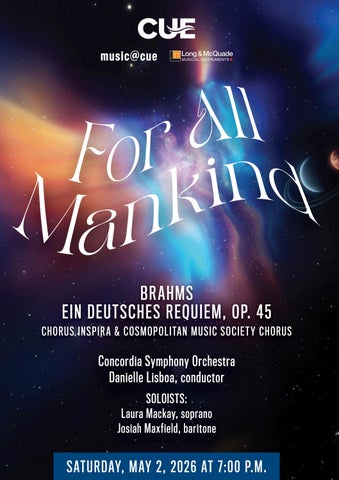
Ein deutsches Requiem (A German Requiem), Op. 45
I. Selig sind, die da Leid tragen
II. Denn alles Fleisch es ist wie Gras
III. Herr, lehre doch mich
IV. Wie lieblich sind deine Wohnungen
V. Ihr habt nun Traurigkeit
VI. Denn wir haben hie keine bleibende Statt
VII. Selig sind die Toten
Johannes Brahms
Johannes Brahms
THE CONCORDIA SYMPHONY ORCHESTRA
Danielle Lisboa, Music Director and Conductor

VIOLIN I
Frank Ho, concertmaster
Raymond Leung
Mehdi Hedayati
Fiona Vance
Amy Kao
Nautica-Pearl Lehocky
VIOLIN II
Svitlana Remniakova
Lydia Yu
Jay Hansen
Lucas Chiu
Harold Steinbrenner
VIOLA
Darrell Soetaert
Anna Schultz
Joe Dupuis
Alan Dunn
CELLO
John Fedor
Ryan Hoffman
Julia Dolman
Sharon Toronchuk
Katarina Kuhn
Robi Szabo
BASS
Dante Wright
Caitlin Laslop
FLUTE
Alison Grant-Préville
Rock Larochelle
OBOE
Stephanie Wong
Courtney Borstad
CLARINET
Amber Campbell
Cindy Richardson
BASSOON
Douglas Ridgway
Jacqueline Miller
FRENCH HORN
Martin Grasdal
Catherine Labbe
Jasper Whitby
Calla Ehrkamp
TRUMPET
Nancy Stepney
Angelo Panahon
TROMBONE
Fenton Corey
Joanna Macdonald
Ken Burns
TUBA
Will Gervais
PERCUSSION
Nicholas Jacques
HARP
Jane Fagnan
ORGAN
Tammy-Jo Mortensen

SOPRANO I
Anne Brereton - Anne Campbell - Bev Chappell - Barbara Duncan Carolyn Eggert - Brenda Enns** - Louise Fairley - Tammy Farkes Carissa Fedoruk - Beverlie Gensler - Kaitlynd
Goertz - Dami Herbert Cathryn Landreth* - Christina Magnusson - Ianua RobertsonCarole Rody-Wu - Mary Lynn Schmidt - Catherine Taylor
SOPRANO 2
June Chao - Kim Haag - Andrea Hamilton - Nancy Kim - Pat Korthuis Manjula KuruvillaKathryn Roberts - Lorene Ryhard - Rebecca Scholtens - Judith Slomp - Jorgianne Talbot -
Margaret Ward-Jack* - Katy Warke - Alana Whitson
ALTO 1
Joan Baker - Evelyn Blanchette - Fay Bredeson - Monica Dear - Christina Debusschere -
Pam Gowing-Ellenberger - Janet Graham - Trudy Grienauer - Thalia Hartson - Kathleen
Harvey* - Jennifer Hinnell - June Hwang - Lindsay Johnston - Dorothea Korthuis - Olga Kostenko - Anna Kraemer - Mini Kurian - Guylaine Lefebvre-Maunder - Carol MarshallSusan Spiess - Heather Starke - Mackenzie Steer - Maryan Threndyle - Colleen Vogel
ALTO 2
Marcia Bercov - Elizabeth Green - Barbara Halladay* - Renee Hardy -nBarbara Kallay - Ann Lukey - Sheila Macdonald - Johann Mann - Izraelle Nabu - Sandra Newman - Renee O'DellKathy Robinson - Barbara Sadler Wells - Elisabeth Scholtz - Kathryn Steed - Mary Stephens
TENOR 1
Marlow Christensen - Michael Clark - Grant Harrison* - Manoj Mathew - Philip NabuNaomi Rankin - Steven Sayers - Bernie Semenjuk - Benedict Spiess - Ken Sutley - Andrew
Whiteside**
TENOR 2
Len Gierach* - Jeremy Keenan - Troy Lewis - Charlie Mballa - Jude Nwankwo** - John Soong - William Strydhorst - Sten Thomson - Mark Vogel - Wayne Wright
BASS 1
Bill Baynes - Paul Cachia - Len Christiansen - Graham Fast** - Leroy Hiller - Dan HodgesWalter Hsu* - Troy Janzen - John Maxfield - Jim McDonald - Michael Otto - Darryl Rolfson
Bernie Schaloske - David Sommerfeldt - James Strohschein - Markus Wilhelm
BASS 2
Stan Backs - Reint Boelman - Jochen Eggert - Mark Freeman - Ian Kellogg - Tom LoveJosiah Maxfield** - Adam Ollenberger - Dr. Leonard Ratzlaff - Arnold Voth* - Mike WaymanAustin Zamorsky
** Section Leader
* Section Captain

SOPRANO
Rose Marie Basaraba - Marderé Birkill - Candice Chen - Melissa Chisholm - Jennifer Fedor
Jane Fedorak - Deborah Fenton - Melanie Humphrey - Susan Jong - Victoria Matejka
Karen McLeod - Natalie Merster - Janice Petrich - Mary-Ann Provencal - Christine Russo
Linda Staal - Shelley Warden - Cynthia Yamach
ALTO
Nora Abercrombie - Pat Cettiga - Paula Coliton - Sarah Dafoe - Helene Darcel Rita Fester
Joyce Harrison - Hermina Joldersma - Colleen Lawrence - Sally MacLellan - Cara McCargar
Debra Mooney - Sandra Opdenkamp - Angela Saccomani - Tanis Stamatelakis - Emma
Villeneuve - Hilary Wynters
TENOR
Jamie Burns - John Coutinho - Greg Melnychuk - Colin Melnyk - Lea Nicoll Kramer - Ian Prescott - Mary-Ellen Turnbull - Ron Weir
BASS
Graeme Burns - Andrew Chichak - Dave Ealey - Tim Huebert - Gerard MacLellan - Dave Milton - John Vogrinetz - Dave Waldbillig - Paul Willsher

Artistic Director: Timothy Shantz
Interim Director: Andrew Bortz
As the premier symphonic choir in Edmonton, Chorus Inspira believes in the vital importance of great choral music and its power to transform. Engaging new audiences not only in masterworks, but also in newly commissioned works that nurture hope, imagination and understanding for our world.
As an astute and resilient organization, our pursuit of excellence embraces a spirt of collaboration, discovery and growth to promote the advancement of choral music.
Artistic Director Dr. Timothy Shantz, creates a rigorous and rewarding ensemble experience that values each member of our dynamic and diverse group of 100+ singers who share a commitment to mastery of skills and performance
Always exploring new ways to contribute in the modern context and adapting through strategic partnerships that open opportunities for greater artistic and community impact, we are building on a vibrant legacy of almost 75 years, including 57 years as Richard Eaton Singers
Performances have included Edmonton premieres of many choral masterpieces such as Haydn’s Creation, Mendelssohn’s Elijah, Schubert’s Mass No 5 in A-Flat, Vaughan Williams’s The Sea Symphony, as well as many shorter works for accompanied and unaccompanied choir.
The choir has commissioned and produced premiere performances by Canadian composers, including Allan Bevan’s No Mortal Business and Last Light Above the World, as well as works by John Estacio, Stephanie Martin, Imant Raminsh and Mark Sirett.
The choir has traveled extensively across Canada, to the Netherlands, Britain, and Germany, and has participated in choir exchanges, including with the Calgary Philharmonic Choir and Vancouver Bach Choir Often partnering with the Edmonton Symphony Orchestra, Chorus Inspira has created many memorable choral events in our city, including the performance of Mahler’s Symphony of a Thousand to celebrate the opening of the Francis Winspear Centre for Music.
The choir has a history of making wonderful music and looks forward to continuing the exploration of the richness of the human voice, supported by outstanding ensembles As they continue to build connections, they hope that you will follow the journey and come along for the sonic experience


Jamie Burns, conductor
The Cosmopolitan Chorus is a non-auditioned adult mixed choir, originally formed in 1985 to complement the Cosmopolitan Music Society's concert in the performance of large-scale collaborative works. Over the past forty years, the Chorus has evolved as its own performing ensemble and has given its members the opportunity to sing music across a wide variety of genres, from Renaissance to folk music to world music to classical masterworks to popular music and songs of the screen and stage. Past conductors include: Armand Baril, David Garber, Liana Bob, and Sally Hunt, and for the past twentyone seasons the Chorus has been conducted by Jamie Burns Intake occurs in September and January each year, and requires only a short voice placement. Rehearsals are held on Monday nights at the Old Strathcona Performing Arts Centre.
The Chorus's mandate is to take in singers at their own level of skill and experience, and to elevate that through a diverse (and sometimes eclectic) range of repertoire and performance opportunities. We also prioritize collaborative community performances, be they with other CMS ensembles (concert and jazz bands, handbell ensembles) or outside organizations In recent years, the Chorus has performed alongside many fine Edmonton ensembles and musicians, including Chorale Saint-Jean, Korora Choirs, the Braille Tones, TIME, and Maria Dunn.
As part of our 40th anniversary celebrations, the Chorus is presenting two spring concerts that represent completely different styles of repertoire. On March 21, the Chorus presents The Great Cosmo Sing-a-Long, a concert also featuring the folk/comedy band The Bump Dogs (and the audience!), that evokes memories of boisterous karaoke parties full of friends old and new. And then, on May 2, the Chorus tackles one of the grandest masterworks in Western choral literature: The German Requiem by Johannes Brahms. This is the Chorus's largest-scale work to date, and they are delighted to be joining Chorus Inspira and hosts, the Concordia Symphony Orchestra, for this epic concert.


soundscapes, from the Middle Eastern Oud, the Chinese guzheng, the Indian sitar, to the South American cavaquinho, into the classical canon, creating a fresh, inclusive concept of music-making.
Beyond the podium, Lisboa’s current research explores immersive and multisensory technologies to deliver multidimensional audio and visual experiences. These programs represent a revolution in how we consume, appreciate, and engage with the public in live music performances.
Her rapid ascent in the Canadian music scene began with Orchestra Toronto, where she rose from apprentice to Music Director in a single season, later leading the inaugural tour of Bellus Barbari, the Toronto Women’s Symphony Orchestra. Lisboa’s 2024–2025 season reflects her international reach, with recent engagements including the Moravian Philharmonic (Czech Republic), the National Philharmonic of Trinidad and Tobago, and the UNIRIO Symphony Orchestra (Brazil). Lisboa holds a doctorate in orchestral conducting from the Eastman School of Music in New York. A committed educator and clinician, she continues to lead international workshops, recently serving as a visiting scholar at Southwest University in Chongqing, China, and the Université catholique de l'Ouest in Angers, France. Lisboa is a passionate speaker and advocate for pluralism in classical music, with appearances at the International Conductors Guild Conference in Valencia, Spain, and, more recently, at the Orchestras Canada National Conference in Edmonton this February.


Coloratura-soprano Laura Mackay earned her Bachelor of Music at the University of Western Ontario, and received her Master of Music in Voice Performance at James Madison University in Harrisonburg, Virginia. She has appeared in operatic productions and concerts throughout Canada, the United States, and Europe. Some past performances include Giannetta in Elisir d’Amore, The Sandman/Dew Fairy in Hansel and Gretel, and Merab in Saul, all with Grande Prairie Opera, Queen of the Night in Die Zauberflöte and Zenobia in Radamisto, both with Accademia Europea dell’Opera in Lucca, Italy, Rosalinda in Die Fledermaus and Susanna in Le Nozze di Figaro, both with. MUOpera Theater, as well as ella in Gianni Schicchi with Luray Opera Theater. Laura is also a proponent of new music, having premiered several works, including the soprano solo in Simon Fink’s song cycle “Unquiet Dreams” at the Staunton Music Festival, and the role of Mona Parsons in Steven Webb’s chamber opera The Patterns of War at the Opera From Scratch Festival in Halifax. She currently teaches at Windermere Music Academy, and operates a private voice studio in Edmonton.

Originally from the United States, where he started his musical journey as a choirboy in Minnesota, Bass-baritone (and Concordia alumnus) Josiah Maxfield has called Edmonton home for over 15 years. While he attended Concordia, he studied voice with Jolaine Kerley and sang with the Concordia Concert Choir, graduating in 2023 (B.A. in Music) and 2025 (Vocal Pedagogy and Performance Certificate). He now performs regularly as professional choral singer, section leader and soloist with Pro Coro Canada, the Schola Cantorum of St. Joseph’s Basilica, Chronos Vocal Ensemble, Dawn Chorus, A Joyful Noise, Chorus Inspira and various other choirs.


Josiah also teaches voice privately and enjoys spending his Monday evenings conducting the St. David’s Welsh Male Voice Choir. A few musical highlights from recent years include representing Alberta as a Bass in the 2024 National Youth Choir of Canada, performing solos with Pro Coro Canada in the Brahms Requiem (as Emerging Artist) and Paul Mealor’s Light of Paradise. He also enjoyed travelling with the King’s Community Choir as a section leader and soloist on their tour to Spain, and singing as the characters of Simeon and Herod in the Chilcott Christmas Oratorio with A Joyful Noise Last year, Josiah was a recipient of the Johann Strauss Award, which funded his studies with Swiss-baritone Christian Immler and German-baritone Andreas Schmidt at the Mozarteum International Summer Academy in Salzburg, Austria Josiah hopes you enjoy tonight's performance of the Brahms Requiem as much as he does, and that it may bring comfort, reassurance and a deeper appreciation of Brahm’s masterpiece.
Interim Director, Chorus Inspira

lis Vocal Ensemble. Andrew has sung with professional choirs including musica intima, Vancouver Chamber Choir, Calgary's Luminous Voices, and Edmonton’s Pro Coro Canada


Jamie Burns
Conductor, Cosmopolitan Chorus


Selig sind, die da Leid tragen, denn sie sollen getröstet werden.
Die mit Tränen säen, werden mit Freuden ernten.
Sie gehen hin und weinen und tragen edlen Samen, und kommen mit Freuden und bringen ihre Garben.
Denn alles Fleisch ist wie Gras und alle Herrlichkeit des Menschen wie des Grases Blumen
Das Gras ist verdorret und die Blume abgefallen.
So seid nun geduldig, lieben Brüder, bis auf die Zukunft des Herrn Siehe, ein Ackermann wartet auf die köstliche Frucht der Erde und is geduldig darüber, bis er empfahe den Morgenregen und Abendregen.
Aber des Herrn Wort bleibet in Ewigkeit.
Die Erlöseten des Herrn werden wieder kommen, und gen Zion kommen mit Jauchzen; ewige Freude wird über ihrem Haupte sein; Freude und Wonne werden sie ergreifen und Schmerz und Seufzen wird weg müssen.
Blessed are they that mourn; for they shall be comforted.
They that sow in tears shall reap in joy
He that goeth forth and weepeth, bearing precious seed, shall doubtless come again with rejoicing, bringing his sheaves with him
For all flesh is as grass, and all the glory of man as the flower of grass.
The grass withereth, and the flower thereof falleth away.
Be patient therefore, brethren, unto the coming of the Lord Behold, the husbandmen waiteth for the precious fruit of the earth, and hath long patience for it, until he receive the early and latter rain.
But the word of the Lord endureth for ever.
And the ransomed of the Lord shall return, and come to Zion with songs and everlasting joy upon their heads: they shall obtain joy and gladness, and sorrow and sighing shall flee away.


Herr, lehre doch mich, daß ein Ende mit mir haben muß, und mein Leben ein Ziel hat, und ich davon muß.
Siehe, meine Tage sind einer Hand breit vor dir, und mein Leben ist wie nichts vor dir. Ach, wie gar nichts sind alle Menschen, die doch so sicher leben. Sie gehen daher wie ein Schemen, und machen ihnen viel vergebliche Unruhe; sie sammeln und wissen nicht wer es kriegen vird.
Nun Herr, wess soll ich mich trösten? Ich hoffe auf dich.
Der Gerechten Seelen sind in Gottes Hand und keine Qual rühret sie an.
Wie lieblich sind deine Wohnungen, Herr Zebaoth!
Meine seele verlanget und sehnet sich nach den Vorhöfen des Herrn; mein Leib und Seele freuen sich in dem lebendigen Gott. Wohl denen, die in deinem Hause wohnen, die loben dich immerdar
Lord, make me to know mine end, and the measure of my days, what it is: that I may know how frail I am.
Behold, thou hast made my days as an handbreadth; and mine age is as nothing before thee. Surely every man walketh in a vain shew: surely they are disquieted in vain: he heapeth up riches, and knoweth not who shall gather them
And now, Lord, what wait I for? my hope is in thee.
But the souls of the righteous are in the hand of God, and there shall no torment touch them.
How amiable are thy tabernacles, O Lord of hosts!
My soul longeth, yea, even fainteth for the courts of the Lord: my heart and my flesh crieth out for the living God.
Blessed are they that dwell in thy house: they will be still praising thee V
Ihr habt nun Traurigkeit; aber ich will euch wiedersehen und euer Herz soll sich freuen und eure Freude soll niemand von euch nehmen.
Sehet mich an: Ich habe eine kleine Zeit Mühe und Arbeit gehabt und habe großen Trost funden
Ich will euch trösten, wie Einen seine Mutter tröstet.
And ye now therefore have sorrow; but I will see you again, and your heart shall rejoice, and your joy no man taketh from you.
Ye see how for a little while I labor and toil, yet have I found much rest.
As one whom his mother comforteth, so will I comfort you


Denn wir haben hie keine bleibende Statt, sondern die zukünftige suchen wir.
Siehe, ich sage euch ein Geheimnis: Wir werden nicht alle entschlafen, wir werden aber alle verwandelt werden; und dasselbige plötzlich, in einem Augenblick, zu der Zeit der letzten Posaune. Denn es wird die Posaune schallen, und die Toten vervandelt werden. Dann wird erfüllet werden das Wort, das geschrieben steht: Der Tod is verschlungen in den Sieg. Tod, wo ist dein Stachel? Hölle, wo ist dein Sieg?
Herr, du bist Würdig zu nehmen Preis und Ehre und Kraft, denn du hast alle Dinge geschaffen, und durch deinen Willen haben sie das Wesen und sind geschaffen.
Selig sind die Toten, die in dem Herrn sterben, von nun an. Ja, der Geist spricht, daß sie ruhen von ihrer Arbeit; denn ihre Werke folgen ihnen nach.
For here have we no continuing city, but we seek one to come.
Behold, I shew you a mystery; We shall not all sleep, but we shall all be changed. In a moment, in the twinkling of an eye, at the last trump: for the trumpet shall sound, and the dead shall be raised incorruptible, and we shall be changed then shall be brought to pass the saying that is written, Death is swallowed up in victory. O death, where is thy sting? O grave, where is thy victory?
Thou art worthy, O Lord, to receive glory and honour and power: for thou hast created all things, and for thy pleasure they are and were created.
Blessed are the dead which die in the Lord from henceforth: Yea, saith the Spirit, that they may rest from their labours; and their works do follow them.


deutsches Requiem is a work of profound humanism. Brahms was not interested in the "Dies Irae" (Day of Wrath) or the terrors of the afterlife. Instead, he curated his own libretto from the German Luther Bible, selecting passages that focus on consolation, hope, and the resilience of the human spirit. Hence, our title invitation “For All Mankind”: the composer’s gift to Humanity. As Brahms himself famously remarked to Carl Reinthaler: "As far as the text is concerned, I will confess that I would very gladly omit the 'German' as well and simply put 'Human'."
While the Requiem was conceived over many years, perhaps as early as 1857 following the death of his mentor Robert Schumann, Brahms felt it was unfinished. The work was officially sparked by the death of his mother, Johanna Christiane Brahms, in February 1865. The composer later inserted movement five, which stands as the true heart, the emotional pulse of the piece.


In this movement, and through Brahms’ hand-picked selections from the Lutheran Bible, the soprano soloist acts as the voice of his mother, offering a celestial message of comfort to those left behind, at a moment when the composer himself yearned for an embrace. Brahms explicitly tied the work's meaning to her memory, stating: "I have now completed my German Requiem... I had my mother in mind when I wrote it."
The soprano sings the tender promise: "I will comfort you, as one whom his mother comforteth." It is the nurturing core around which the grand architecture of the surrounding movements revolves.
The Requiem is organized in a symmetrical seven-movement arch, anchored by the maternal comfort at its center and massive choral pillars on either side.
I. Blessed are they that mourn: Brahms immediately signals a departure from standard orchestral brilliance by omitting the violins entirely. By removing the brightest timbres of the string section, he creates a grounded and intensely intimate sonority. The divided violas and cellos carry the weight of earthly sorrow, providing a somber foundation for the chorus’s opening promise of comfort.
II. For all flesh is as grass: The second movement is the Requiem’s most visceral confrontation with the vanity of life. Opening with a funeral march in triple meter, the chorus sings in a hollow unison to depict the frailty of 'all flesh,' which withers like grass. This grim reflection on the shadowy nature of existence eventually shatters, giving way to an energetic celebration of ‘eternal joy.' It is the work’s first major victory of the spirit over the grave.
III. Lord, teach me that there must be an end: This is the work’s intellectual anchor. Here, the baritone soloist emerges as the direct surrogate for Brahms’ voice: a searching soul trying to find meaning in life, who sees the artifice of worldly ambitions, the "shadow" of human existence walking through a fleeting world. We hear an embatled soul, grappling to accept the brevity of life. We hear the musical cries in the solo line “und ich davon muß!” - “and I must accept that!”, to which the choir emphatically echoes “I must accept that!”. The movement reaches a staggering climax with a fugue built over a pedal point, the organ and basses hold a single low D for 36 bars, representing an unshakeable spiritual foundation amidst the shifting nature of human life.
IV. How lovely are thy dwellings: This central movement serves as a lyrical sanctuary. Set in a warm E-flat major, it provides a pastoral vision of peace, contrasting the existential conflicts of the previous movements. Through flowing melodies and a buoyant closing fugue, Brahms captures a sense of longing and homecoming, offering the listener a safe haven, a still point of beauty at the heart of the work’s grand architecture.
V. You now have sorrow: The voice of the mother enters via the soprano soloist, providing the emotional resolution to the grief established in the earlier movements. Added last as a tribute to his mother, Johanna Christiane, this movement is the emotional heart of the Requiem.
VI. For here we have no continuing city: This is the dramatic summit. It contains the Requiem’s only real moment of “judgment" music (the sounding of the trumpet). It is the movement of transformation where the chorus hurls a double challenge at the grave: "Death, where is thy sting? Hell, where is thy victory?" This is not a plea for mercy; it is a shout of triumph. It concludes with a massive, complex fugue of praise (Herr, du bist würdig). It is the most technically demanding section for the choir, requiring immense power to symbolize the final, irrevocable victory of the human spirit over the grave.
VII. Blessed are the dead: The work comes full circle. By mirroring the musical themes and the beatitude ("Blessed") of the opening movement, Brahms completes the symmetrical arch of the Requiem. The somber earthiness of the beginning is replaced by a shimmering peace. As the harp gently ascends in the final bars, the struggle with the vanity of life is finally resolved in eternal rest.

Artistic Director Danielle Lisboa
CSO Orchestra Librarian/ Rock Larochelle Communications
CSO Marketing Assistant Angelica Barbosa Program Booklet Graphic Design
CSO Marketing Support Stephanie Wong
Stage Manager (CSO) Anna Schultz
THANK YOU TO ALL OUR SUPPORTERS AND VOLUNTEERS!