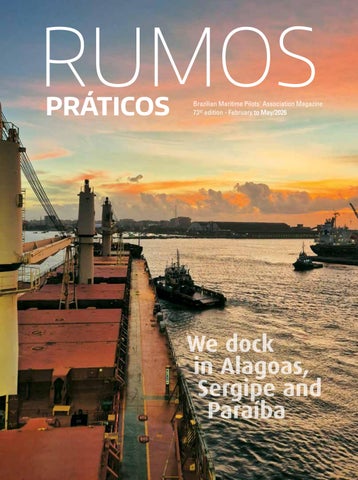
Brazilian Maritime Pilots' Association Magazine 73st edition - February to May/2026
We dock in Alagoas, Sergipe and Paraíba
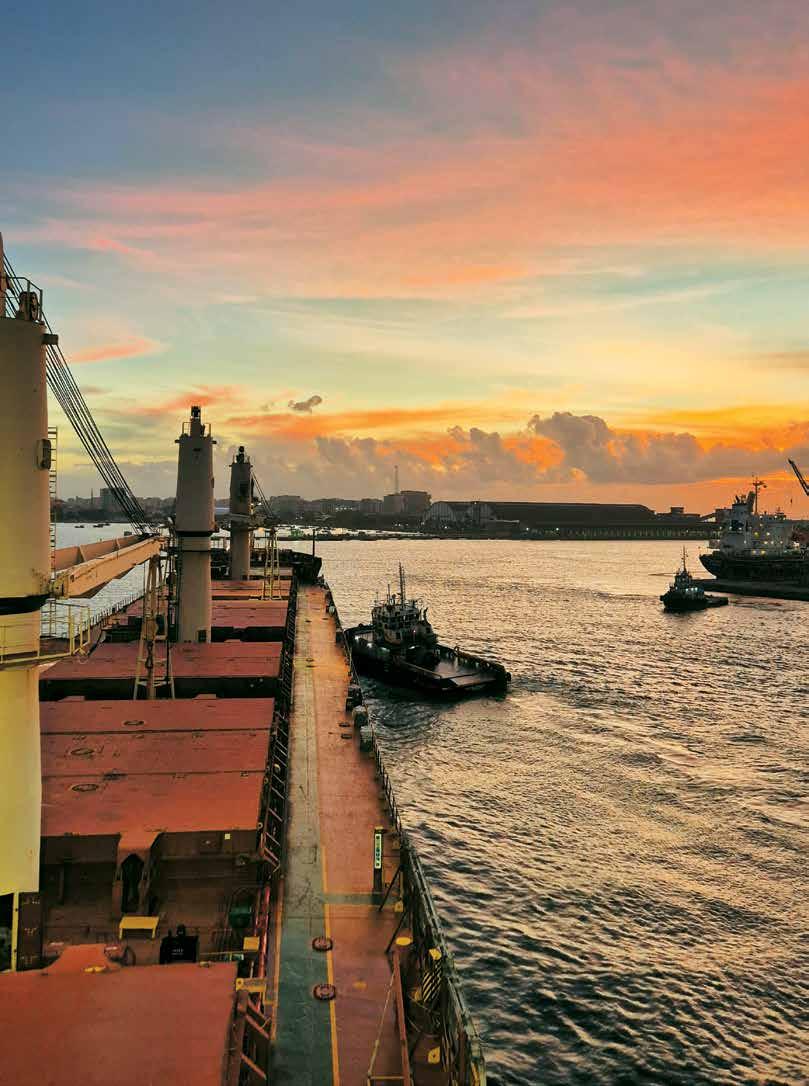
In this edition, we continue sailing our waters and conclude our journey through the Northeast, following the work of pilots in Alagoas and Sergipe (ZP-10), as well as Paraíba (ZP-8). It is the second-to-last report in the series on Brazilian pilotage zones. In the ports of Maceió (Alagoas), Barra dos Coqueiros (Sergipe) and Cabedelo (Paraíba), the experience of the local pilotage overcomes structural limitations, narrow channels and the force of wind and tide, ensuring the flow of goods and passenger transport, without harming the environment.
Next, we present an overview of the use of pilot boats in search and rescue operations. The article shows that the operational readiness of pilotage goes far beyond port maneuvers, contributing with the Maritime Authority for the protection of human life at sea.
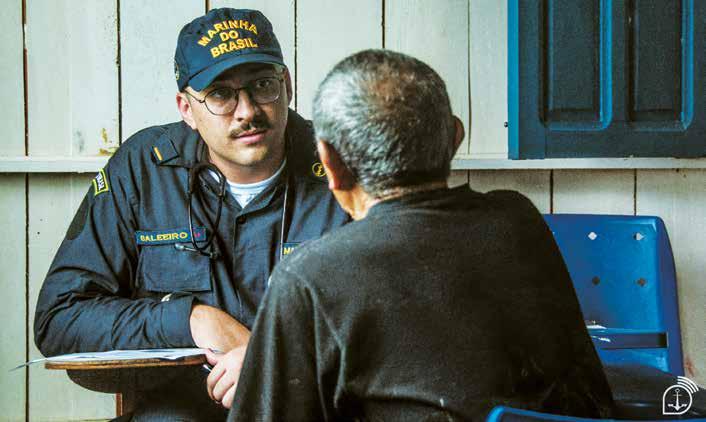
Along the same lines, we bring a report about the “Ships of Hope” of the Brazilian Navy, which provide medical and hospital care to isolated communities in the Amazon and Pantanal.
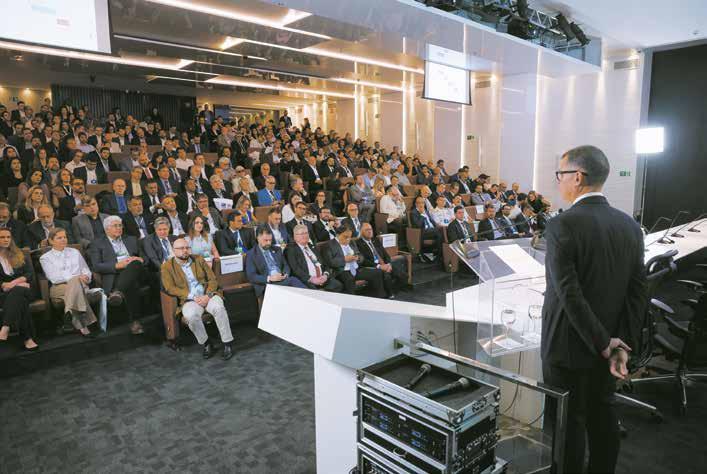
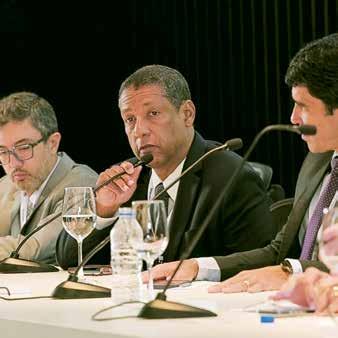
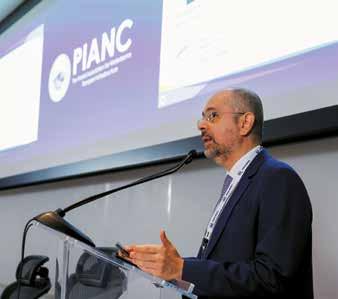
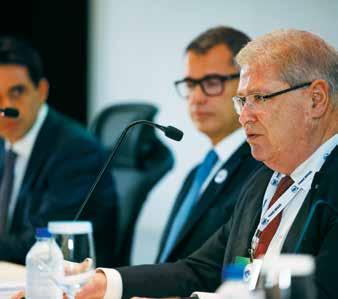
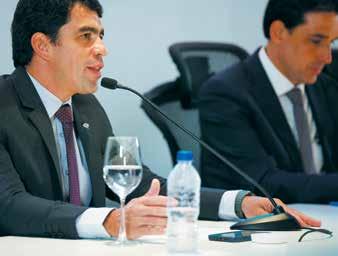
In Brasília, we followed the first seminar of PIANC Brazil. The event brought together authorities, specialists, and sector representatives to discuss the application of port planning guidelines in our ports and access channels. This technical rigor combines navigation safety and efficiency.
This topic, by the way, was the focus of the first course at the Brazilian Maritime Pilotage Institute aimed at basic concepts related to the nautical aspects of port planning. We participated in the inaugural class with students from the sector.
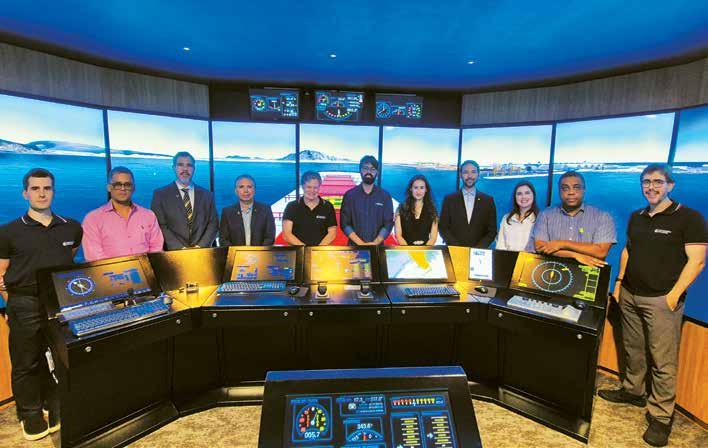
This pursuit of excellence is also reflected in the cutting-edge technology adopted by pilotage. The reader will find that in Maranhão the pilotage has transformed its maneuver simulation center into a real laboratory, incorporating the use of Artificial Intelligence (AI).
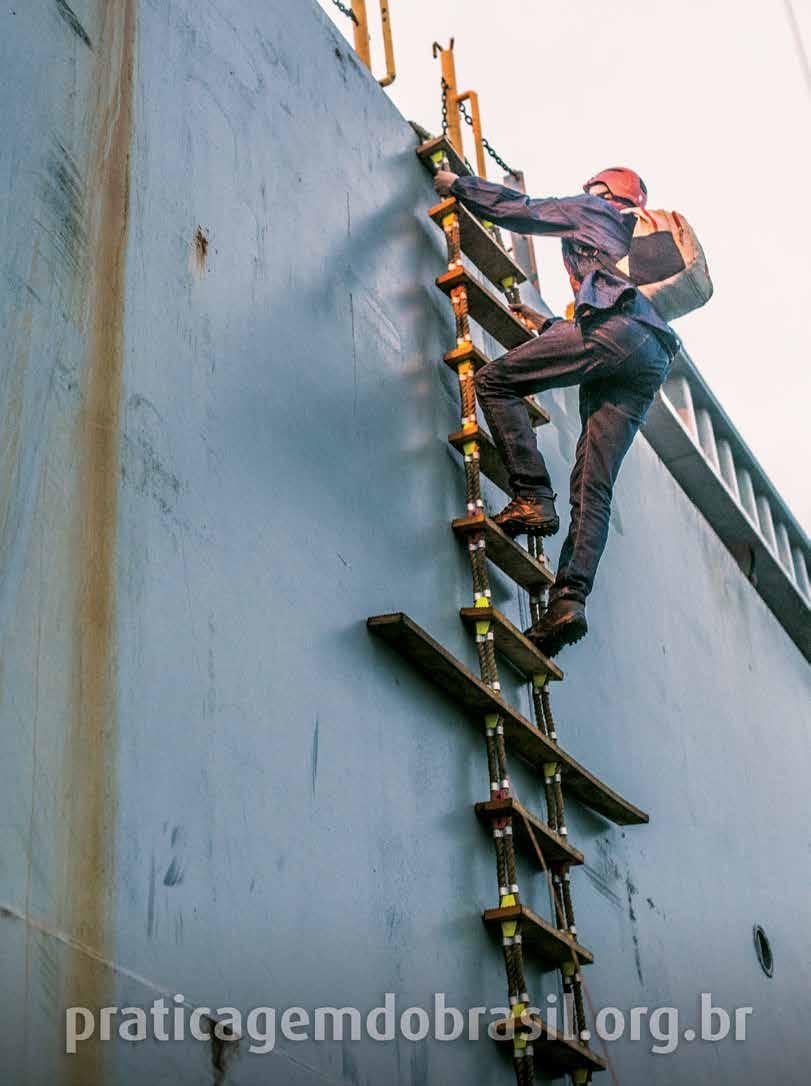
Still in the technical area, we publish a special supplement with the new pilot ladder regulations and reproduce the article “Shiphandling: The beautiful game", an original text from The Nautical Institute.
Finally, we celebrate the ten years of activities of the Brazilian Maritime Pilots’ Federation, an entity that I had the honor to preside over for two terms.
Enjoy your reading!
Otavio Fragoso is the editor in charge
Brazilian Maritime Pilots’ Association
Av. Rio Branco, 89/1502 – Centro – Rio de Janeiro – RJ – CEP 20040-004
director president of Brazilian Maritime Pilots' Association
Bruno Fonseca
director vice-president
Marcio Fausto
directors
Evandro Saab
Marcello Camarinha
Pedro Parente
director / vice-president of IMPA
Ricardo Falcão
Rumos Práticos
planning
Otavio Fragoso/Flávia Pires/Katia Piranda
editor
Otavio Fragoso
writer
Rodrigo March (journalist in charge)
MTb/RJ 23.386
translation
Julia Grillo
revision
Raquel Furtado
layout and design
Katia Piranda
pre-print
DVZ Impressões Gráficas
cover photo: Rodrigo March
The information and opinions expressed in this publication are the sole responsibility of the authors and do not necessarily express the
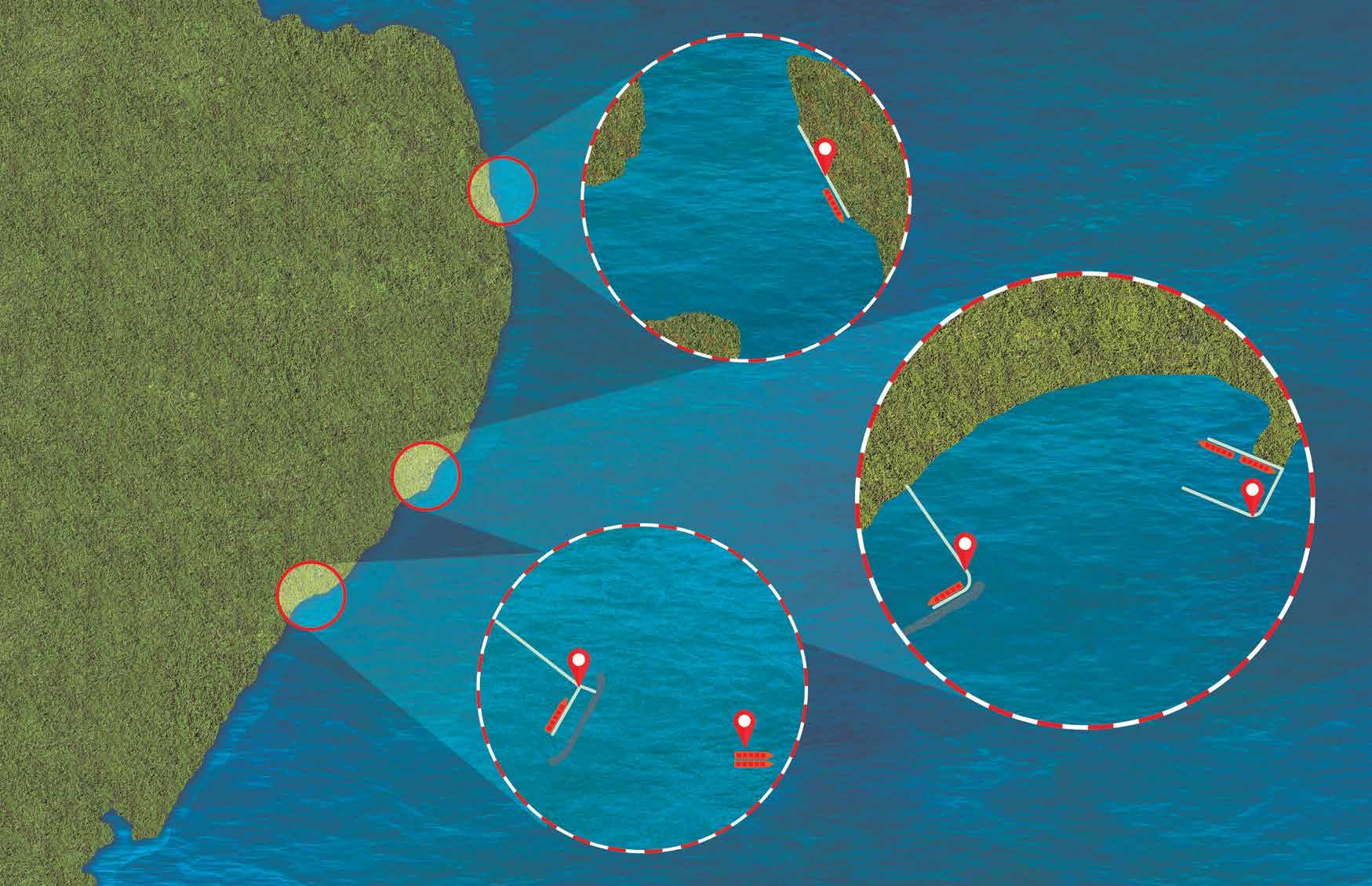
MACEIÓ CABEDELO
BARRA DOS COQUEIROS
Our last stop in the Northeast
We visited the pilotage services that overcome obstacles in the ports of Maceió, Barra dos Coqueiros (ZP-10) and Cabedelo (ZP-8)
Port of Maceió
Port of Cabedelo
Paraíba River
In the penultimate report of the series on Brazilian pilotage zones, we followed closely the challenges faced by maritime pilots in Alagoas/Sergipe (ZP-10) and Cabedelo - Paraíba (ZP-8). Navigating these waters is a constant exercise of skill amidst the force of wind and tide. The routine is marked by narrow channels, structural limitations, and little space to act in the event of vessel failure. Both ZPs are in sensible areas for tourism, the economy, and the environment. On the other hand, cargo movements differ considerably.
We started our journey in ZP-10 and headed north along the northeastern coast to ZP-8. In Maceió (Alagoas), there is a public port, managed by the Company Docas do Rio Grande do Norte (CODERN) and the Private Use Terminal (PUT) of Braskem. In Barra dos Coqueiros (Sergipe) the maritime pilots maneuver at the VLI PUT (TMIB) and at the Eneva Floating Storage and Regasification Unit (FSRU).
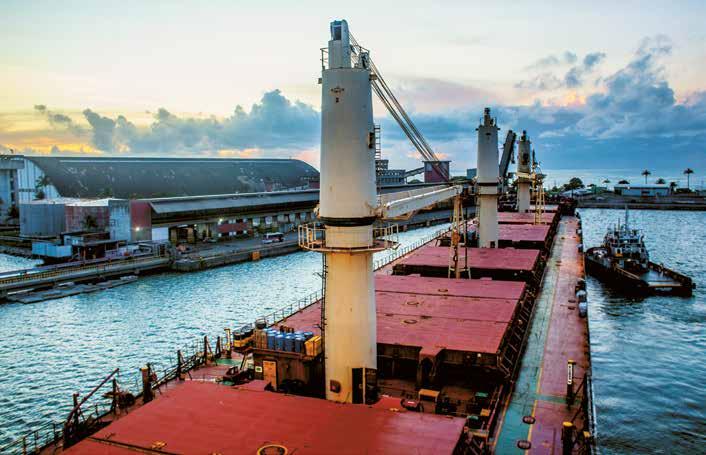
Most of the activity in ZP-10 occurs at the Port of Maceió. It handled 2.5 million tons in 2025, primarily consisting of sugar, petroleum/derivatives and fertilizers. Located between the beaches of Pajuçara and Jaraguá, the port also receives cruise ships up to 330 meters in length, the largest of the ZP, while most cargo ships are up to 180 meters. There are five berths for vessels with a draft up to 11 meters at the two largest.
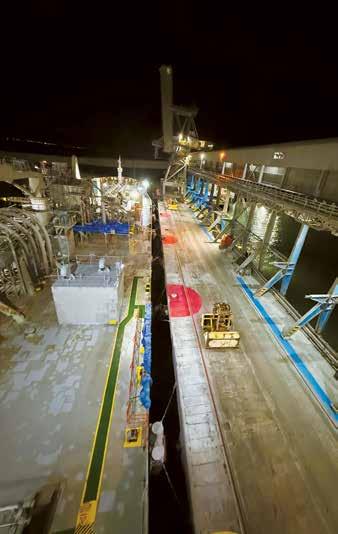
Access is through a narrow one-way channel, approximately one nautical mile long and 120 meters wide. Speed is limited to six knots. The turning basin is 400 meters long and 360 meters wide, according to the Harbour Master Rules and Procedures (NPCP). Rumos Práticos followed the departure of a ship loaded with sugar, including its turn, and the arrival of another vessel in ballast, which berthed at the same berth. Most turns occur upon departure, except for oil tankers, which turn upon entry and berth starboard side.
The current runs parallel to the coast. Wind strongly influences the maneuvers with the dominant wind blowing from the southeast. In the summer, quadrants from the northeast and east emerge. At the port entrance, attention is doubled as the ship tends to drift to starboard toward the pier end. Senior pilot Marcone Acioli recalls that the worst situation he faced was there:
“I needed a full rudder to port and the ship did not answer because it was already at low speed. I then requested ship's engine ahead. The captain called the chief engineer, and he said he was performing maintenance during the maneuver! I called the tugboat which pushed the stern just in time to avoid the collision. It was a real scare.”
BERTHING AT THE SUGAR TERMINAL, IN MACEIÓ
Pilot Jean Figueiredo dealt with a similar case in the same stretch, plus an astern engine failure inside the turning basin:
“I had to drop both anchors to stop the vessel loaded with fertilizers.”
One of the structural challenges is that the Port Authority does not provide sensors to monitor environmental conditions. The pilotage has an anemometer at the top of the building where the pilots' station (operations center) is located, although it is not the ideal spot. The wind limit for operations is 25 knots.
Once, pilot Jean crossed an area of strong wind aboard a large cruise ship (with a high windage area):
“I saw a cloud approaching and by the time I arrived at the bridge, the wind reached 28 knots. There was no way to enter. I informed the captain that the force would decrease in 20 minutes. He managed to keep position using only the thrusters, and we waited it out. When we approached the breakwater, the intensity had dropped to 13 knots.”
To avoid structural damage to the quay, passenger vessels must use their thrusters minimally, although tugboats’ power is insufficient
to overcome the local wind. During berthing, propellers reduce the approach speed, since the wind pushes the ship towards the quay during most of the season. During unberthing, the propellers also act with lower intensity, to help the ship overcome inertia and counteract the opposing wind. About two years ago, the port didn’t even have fenders – tires fulfilled the role of cushioning the impact on the mooring structure.
Twenty minutes from the public port, between Trapiche and Ouricuri beaches, is the Braskem Private Use Terminal (PUT). Movement there has decreased considerably since the company was banned from mining rock salt in the city in 2019 – residents of five neighborhoods had to leave their houses due to ground subsidence. Without mining, the terminal now only receives chemical products. This year, there were two ships until early May.
Located in the open ocean about 850 meters from shore, the pier allows the docking of vessels up to 176 meters long. For vessels over 150 meters, the maneuver can only happen in daylight. A platform connects the pier to the industrial complex. The ship usually turns at the entrance and berths to port side. The maximum draft is 8.40 meters.
ph oto: Gustavo Stephan
Even with the breakwater protection, there was an episode where pilot Marconte aborted an entry:
“We saw that the ship would not remain berthed. The Captain even joked: better safe than sorry. I answered: exactly. Otherwise, when things got worse, he would be calling me.”
Unlike the Port of Maceió, which is sheltered by a 1,700-meter jetty and protected by a reef system, the VLI PUT in Barra dos Coqueiros resembles the Braskem terminal. However, its pier is more exposed and farther from the breakwater, so that maritime support vessels have space to berth on the other side. According to Marcone, this design makes it difficult to keep the ship moored during southerly seas.
The quay was built 2,400 meters from the coastline and the breakwater is 550 meters long. The terminal is designed for ships with a maximum deadweight tonnage (DWT) of 60,000 tons and a
draft of 9.80 meters. In 2025, it handled 886,000 tons, mainly cement (loaded for Manaus), petroleum coke, fertilizer, copper ore and wheat flour.
Maneuvering at TMIB requires extra care, Jean emphasizes:
“The current is much stronger and throws you against the breakwater during the approach. Also, even the slightest wind complicates our boarding and disembarking.”
Even more delicate are the operations at the Eneva ocean terminal, which is farther away. The ship Energos Nanook, which characterizes the terminal, is anchored about two miles from TMIB. It is a regasification unit for liquified natural gas received from LNG tankers that berth alongside in a ship-to-ship operation. Once returned to its original state, the gas is transported via a seabed pipeline to an onshore thermal power plant.
photo: Publicity
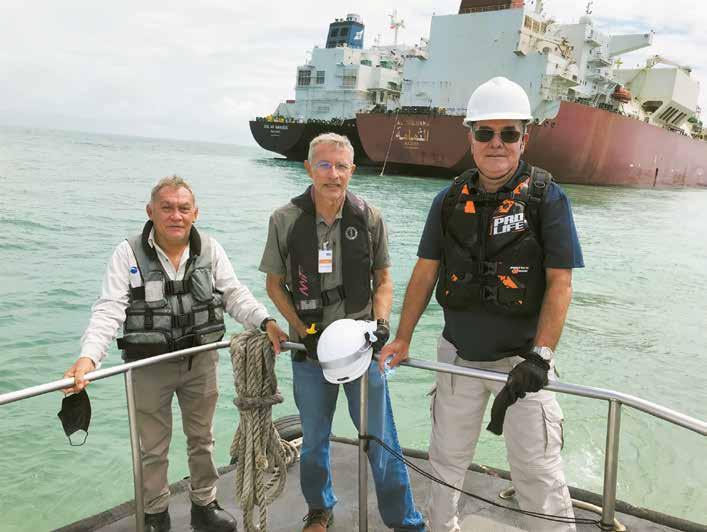
PILOTS BRABO, JEAN AND MARCONE AT THE ENEVA TERMINAL
The Energos Nanook is 305 meters long. Supply ships up to 315 meters berth alongside it. The operation involves four tugboats: one with a tow line on the stern of the floating unit and the others acting on the LNG tankers (on the bow, amidships and stern). The terminal has a buoy for measuring the favorable environmental conditions.
Until early May, two vessels had berthed. Movement depends on the demand for energy. In 2021, due to little rain, the dams not filling up, there was one ship per month.
PORT OF CABEDELO
The five pilots of ZP-10 – the same number of qualified professionals from ZP-8 – perform about 700 maneuvers annually.
In Cabedelo, the number of operations is lower: averaging eight ships per month, which represents a challenge for maintaining proficiency.
Rumos Práticos accompanied the berthing of the first 11-meter draft ship in Cabedelo, conducted by two pilots (Sergio Faria and Juarez Koury), as it was an experimental maneuver. The official draft is still 9.14 meters, despite the channel being dredged to a depth of 11 meters. Therefore, the ship had to take advantage of a short one-hour tidal window.
The access channel is 3.5 miles long and well-marked. Speed must not exceed 7 knots. The narrowest section is 120 meters wide, which is considered tight for vessels up to 40 meters beam.
Another challenge is the curve near buoys 10 and 12, because in this stretch the current changes direction, explains pilot Luiz Fernando Seixas:
“On entry maneuvers, with the wind added, the ship tends toward port side, and we apply 10 or 15 degrees of starboard rudder, to hold the vessel. On departure, we turn starboard, giving port rudder.”
As the port is located on the Paraíba River, one mile from its mouth, the ebb current is strong. The operational limit is two knots, and 25 knots for wind (mainly south and southeast).
Due to the current and the low power of tugboats, loaded ships berth port side-to and turn upon departure, being lighter and less subject to current.
“During strong ebb tide, to depart, the ship must be berthed to starboard side, meaning it has already made the turn. Even with two tugs, there is no way to row against the tide", notes pilot Juarez, the senior maritime pilot.
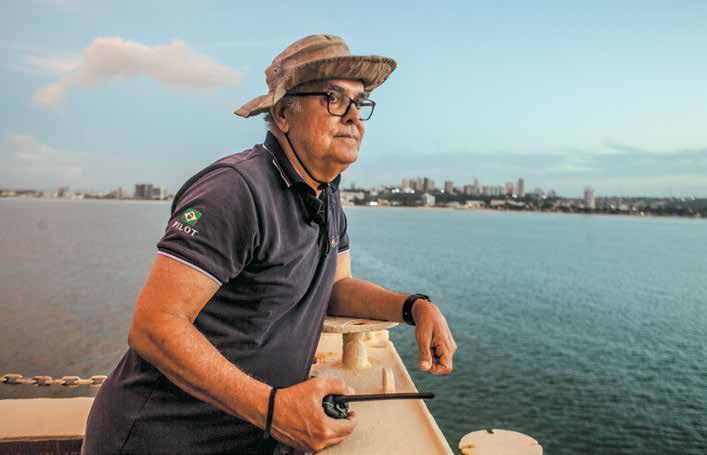
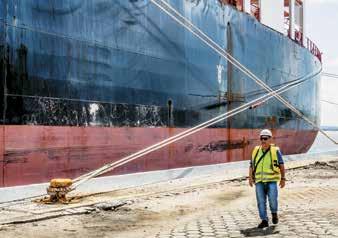
MARITIME PILOT SEIXAS AT THE QUAY EDGE, CHECKING THE DRAFT BEFORE THE MANEUVER
ph oto:
Gustavo Stephan
Maneuvering in the turning basin, which suffers from silting by river mud, requires precision from maritime pilots, as its width is 300 meters.
“It’s difficult because we turn 20 meters from the berthed ship and 20 meters from a sandbank", says Juarez.
In the area surrounding the maneuver basin and access channel, special attention is necessary for recreational and fishing boats
traffic, as well as the ferryboat that makes the CabedeloCostinha crossing. During a departure operation, pilot Sergio was very concerned:
“When we were almost heading straight, I spotted two fishing boats and immediately sounded the whistle. The first one left and the other stayed. We sounded again, slowed down, and it still didn't move. As we got close, we stopped the engine. Just before we reached it, the boat finally deviated a little. There was no collision, but the boat capsized. Our motorboat provided assistance, and fortunately the man was unharmed.”
Cabedelo also used to operate with tires instead of fenders. Current traffic is not the same as in the past, when Paraíba exported pineapples, cotton and sisal hemp. The port, however, has been renovated and is well-structured for growth. There are three mooring berths along 600 meters of quay. It is managed by the company Docas da Paraíba. In 2025, 1.2 million tons were handled, mainly petroleum and its derivatives, petroleum coke, wheat, malt and fuel ethanol.
Following the draft increase, the next ramp-up will be the execution of experimental night maneuvers. The Maritime Authority's plan aims to assess navigation safety throughout the entire process until final certification, always consulting the experienced local pilotage.
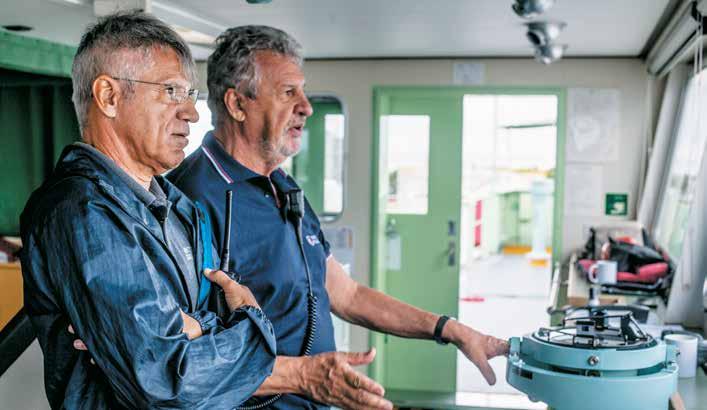
MARITIME PILOTS SERGIO AND JUAREZ AT THE BRIDGE
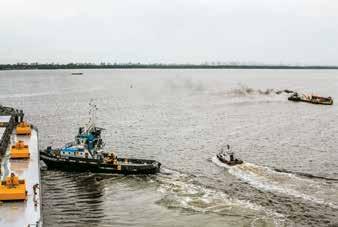
IN THE TOP RIGHT, FERRYBOAT NAVIGATING IN THE TURNING BASIN
ph otos: Gustavo Stephan
MEETING OF THE SEA WITH THE PARAIBA RIVER, NEAR THE ENTRANCE CURVE AT CABEDELO
SERGIO AND JUAREZ ABOARD ONE OF THE PILOTAGE BOATS
OIL TANKER MAKING A PORT SIDE TURN TO LEAVE CABEDELO
photo: Gustavo Stephan
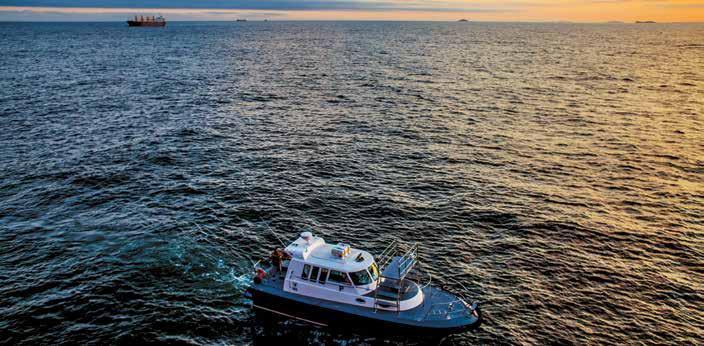
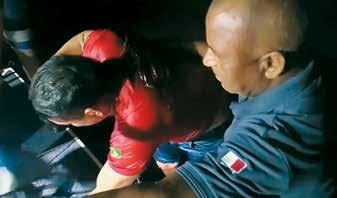
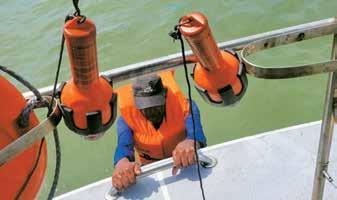
Pilot boats support over thirty rescue operations
Cooperation with the Navy is a normative duty. The average of two (2) cases per month refers to the year of 2025 and the first two months of 2026.
On September 6 at around 5:15 am, pilot Rafael Dracxler heard a radio distress call about a sinking boat near Cagarras Islands, off the coast of Rio de Janeiro. He immediately asked the Pilotage operations center to send a pilot boat and a warning sign to the Military Firefighters Corps. The boat Pilot 10 rescued twelve of the thirteen people on board, supported by the military firefighters, which arrived shortly after with a speedboat and a personal watercraft. The 13th person on board was taken by the firefighters. No injured people found, thanks to the quick rescue and readiness of the pilotage, functioning 24 hours.
Cooperating in the search & rescue (SAR) activities is an obligation for all seafarers, but also a duty stipulated by the Maritime Authority for the Pilotage Service (Normam-311/DPC), including the usage of pilot boats and support boats, which must be permanently ready for pilot services and also for SAR operations. Throughout 2025 and during the first two months of 2026,
Rumos Práticos found over thirty (30) SAR procedures already conducted – an average of two per month.
The action can occur at the request of the Brazilian Navy and of the Military Firefighters Corps, as well as situations detected by merchant-vessel crews and other vessels, such as pilot boats.
On the afternoon of April 29, for example, Barra do Pará Pilotage was summoned by the Navy to provide support to a fishing vessel that had gone adrift near the Quiriri Channel. There were 14 people onboard. The pilot base at Vista Alegre sent to the incident location two (2) pilot boats which traveled approximately 50 nautical miles through the mouth of the Pará River. The boat had lost its rudder, leaving the fishermen without control, yet since they weren't facing any immediate peril, they chose to wait for a tugboat to transport them to the nearest port.
photo:
Gustavo Stephan
On September 30, it was the pilotage's turn to support firefighters in a fire on a small vessel in Arrozal River, near the pilot base in Barcarena. The P8 boat crew provided initial assistance and transported two burn victims to the ambulance onshore.
Being summoned via communication from ships is also a frequent occurrence. On August 15, the vessel Shandong Victory reported rescuing survivors from a boat that had sunk. The Maranhão Pilotage speedboat moved to the vessel, and, despite the rough seas, the sailors managed to transfer the five rescued crew members and transport them to their base, where they received assistance and food.
Similar conditions were overcome by the Rio Grande Pilotage (Rio Grande do Sul) in the rescue of other five crewmembers, on July 22. They fell into the sea during a lifeboat training exercise. It was a dark night, with low temperature and strong current. On board Pilot Boat 12, the fast support boat crew reached the location in less than 20 minutes, and everyone was saved, some of them showing initial signs of hypothermia.
Towing operations by pilotage are only carried out when necessary to safeguard human life or if authorized or requested by the Ports Captaincies. As the case handled on December 27 by a boat of Bahia Pilotage, whose crew sighted a recreational vessel under engine failure at the bar entrance and informed the Port Captaincy, that requested the pilot boat's support for towing the boat under technical failure to the pier.
There are times when the Navy may also need help. In April, a small boat from the Navy suffered a breakdown and ended up running aground on Itajaí beach, being towed by the pilot boat Pilot IV
Pilotage vessels are also used in medical evacuation operations. On February 13, a pilot boat from Imbituba Pilots (Santa Catarina) was required for transferring an elderly person, who was ill onboard a cruise ship about three kilometers from the coast. Rescuers boarded the cruise ship, provided the first aid and took her to the next port station, from where she proceeded to a hospital.
On October 22, the Navy contacted the Pilotage service to rescue a military officer from the Oceanographic Vessel Antares. The vessel had departed from Macapá (Amapá) on October 20 and was located near the north bar of the Amazon River, unable to reach the necessary speed to assist the crew member in time. Promptly, the Eastern Amazon Basin Pilotage sent the pilot boat BAP Santarém, the fastest in the fleet and the only one with an operational range for eighty (80) nautical miles. The military officer was taken to the city hospital, where he continued receiving treatment.
The Search and Rescue (SAR) service is under the jurisdiction of the Navy and operated by Salvamar Brasil. Upon learning of a SAR incident, Salvamar Brasil activates the Regional Salvamar, which may then summon other means of support, including the pilotage boats. In 2025 there were 264 incidents, with 692 people rescued by the Naval Force. The majority were shipwrecks (81) and cases of people who accidentally fell overboard during navigation (74).
The head of the Navy's Rescue and Saving Section, reserve captain José Nelson Nonato de Oliveira Coutinho, emphasized the significance of this information to the Agência Marinha de Notícias (Maritime News Agency):
“Each life represents a face, a name, a story that could have been cut short.”
For maritime and fluvial emergencies, the recommended notification channel is the toll-free telephone 185, which is available nationwide, 24 hours a day. The Navy also advises vessel operators to use the NAVISEG application, which allows registering the navigation plan, with information such as route, destination, departure notice, return time and number of people on board. This enables monitoring by marinas, yacht clubs and the Navy, accelerating SAR operations.
photos: Divulgação
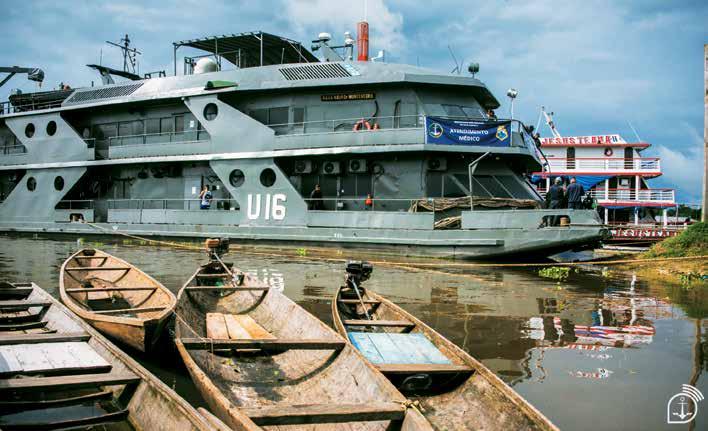
Meet the Brazilian Navy's “Ships of Hope”
Six vessels bring hospital and dental assistance to the most remote areas of the Amazon and Pantanal
For decades, the Brazilian Navy has played a significant role in promoting population health. By means of the “Ships of Hope”, the affectionate name given to its hospital care ships, the institution provides medical, dental and hospital care, as well as sanitary actions, to riverside and indigenous communities in the Center-West and North of the country, in addition to providing support in situations of calamity.
In the midst of the vast Amazon Region, the Doutor Montenegro ship, for example, visits the Juruá Valley every year to carry out an operation that covers the states of Acre and Amazonas, in partnership with the Ministry of Health.
The numbers reveal the importance of this aid. In the first month, 1,313 riverside residents were assisted; along with 1,347 medical procedures; 6,593 dental procedures; 6,347 nursing procedures; 96 surgical interventions; 216 mammograms; Additionally, 56,132 medications and 2,412 dental items were distributed.
The ship set sail from the Rio Negro Naval Station, in Manaus (Amazonas), on 12 th January and until February 12 she visited ten locations, a mission that would continue until May 19, serving isolated communities in eleven municipalities along the Juruá River.
On another front, the Sargento Lima ship docked at the quilombola community of Santana do Arari, in the municipality of Ponta de Pedras (Pará), where it offered services in dentistry, medical clinic and of vaccines. On February 3 and 4, there were 132 attendances and 1,303 medications donated to residents of the local community and neighboring areas.
It was the first time that a vessel from the 4 th Naval District Command, dedicated to hospital care, docked at Marajó Island. Subsequently, Sargento Lima would sail to municipalities in the Lower Tocantins. The vessel was incorporated into the naval means in October 2025.
The Navy has four other hospital care ships. Large vessels of the Naval Force, originally designed for war operations, such as the multipurpose aircraft carrier Atlântico and the multipurpose dock ship Bahia , can also function as floating hospitals, with the capacity to provide assistance to almost any coastal region.
In February 2023, the Atlântico docked at São Sebastião (São Paulo) to assist the population affected by heavy rains that blocked roads in the northern coast of São Paulo. In the action, 28 health professionals from various specialties were made available, as well as 200 beds and one complete Intensive Care Unit (ICU).
The Navy has been working to bring hope to the farthest corners since the end of the 1940's. In 2026, the incorporation of another vessel is planned to strengthen its actions, the ship Anna Nery. The ship's name is in honor of Brazil's first nurse, who was a volunteer in the War of the Triple Alliance. In the monarchy period, the Navy used to name ships after women from the Imperial family, such as the corvette Dona Isabel, in honor of Princess Isabel.
The Maritime Authority's humanitarian effort is connected to the institution's motto: “protecting our wealth, caring for our people".
It was onboard Doutor Montenegro that a seven-month pregnant riverside woman had her first prenatal checkup. The crew also provided the young woman with an improvised gender reveal tea party. In return, she chose the name “Marinho” for the boy.
With information from the Agência Marinha de Notícias (Maritime News Agency).
photo:
PIANC Brazil holds its first seminar in Brasília
Integration to advance port infrastructure was the watchword at the event, which brought together more than 300 people
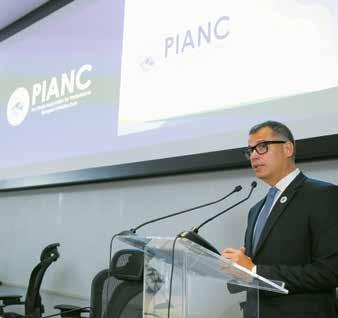
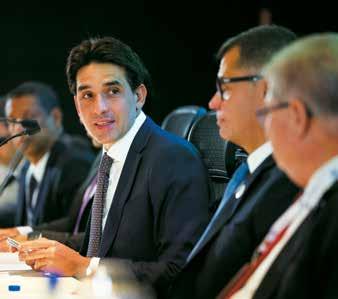
Last March, The Brazilian Maritime Pilots’ Association participated in the first seminar of PIANC Brazil – the national section of the World Association for Waterborne Transport Infrastructure, chaired by maritime pilot Ricardo Falcão. The entity is responsible for producing the technical reports that guide port planning, whose guidelines are applied in the regulations of both the Navy and Port Authorities. More than just publishing manuals, the institution represents port engineering focused on performance and risk management. Its activities directly impact port projects, navigation channels, and public policies.
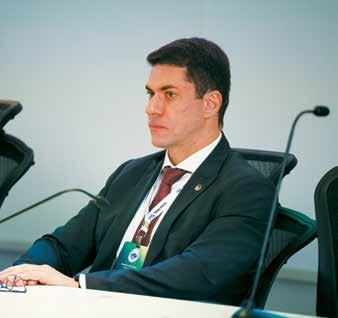
The president of the Brazilian Maritime Pilots’ Association, pilot Bruno Fonseca, and the vice-president, pilot Marcio Fausto, attended the event with the directors Evandro Saab, Marcello Camarinha and Pedro Parente. In addition, pilots and managers from different Pilotage Zones were among more than 300 people gathered in Brasília.
The seminar featured the participation of the president of PIANC International, Francisco Esteban; the general director of ANTAQ, Frederico Dias; the minister of Ports and Airports, Silvio Costa
photo: Pedro Ladeira
Filho; and the rear admiral Sergio Guida, representing the director of Ports and Coasts, vice admiral Carlos André Coronha Macedo. The technical-scientific coordination was led by Edson Mesquita and Maria Eduarda Chame, PhDs.
President Ricardo Falcão delivered the opening lecture, in which he made a retrospective of the association's 140 years of activity and addressed the challenges of implementing its guidelines in Brazil. Since 2007, the country has been a qualified member of PIANC International, officially represented by ANTAQ. In 2022, it formalized its national section, expanding the participation of Brazilian engineers and experts in international working groups, in order to bring global experiences to the domestic context.
According to Falcão, the main institutional obstacle is the asymmetry between the guidelines of various government bodies and the PIANC recommendations. The challenge is to promote technical convergence so that reports by ANTAQ and the Port and Maritime Authorities have international scientific backing.
As a good example, he cited the work of the Navy, from the moment the Brazilian Maritime Authority - Directorate of Ports and Coasts (DPC) conditioned the approval and validation of port expansion projects to alignment with PIANC Report 121.
“Imetame Port, in Espirito Santo, is a success case, already designed and built applying Report 121, which advocates for the use of simulations and risk analysis", highlighted Falcão.
Rear admiral Sergio Guida noted that the partnership is essential for the proper application of the recommendations:
“The Maritime Authority has been working together with other government actors and stakeholders, such as maritime pilotage, to develop the business environment in the best possible way. Geographically, the country has its challenges, and we seek to overcome them by drafting new regulations and monitoring risk analysis. In this sense, PIANC’s guidelines are fundamental to our work. We are increasingly seeking the maximum operating capacity of national ports and waterways, with safety.”
photos: Pedro Ladeira
PRESIDENT OF PIANC BRAZIL, RICARDO FALCÃO
PRESIDENT OF BRAZILIAN MARITIME PILOTS’ ASSOCIATION, BRUNO FONSECA
REAR ADMIRAL SÉRGIO GUIDA, FROM DPC
Professor Eduardo Tannuri, from the Numerical Offshore Tank Laboratory of the University of São Paulo (USP), a benchmark laboratory in simulations, observes that Brazilian projects have become very aligned with PIANC since the Navy internalized the international guidelines into its regulations. Normam-303/DPC, focused on waterway construction works, explicitly mentions criteria from PIANC reports and its recommendation in the book Planejamento Portuário – recomendações para acessos náuticos (Port Planning – Nautical Access Recommendations), edited by the Brazilian Maritime Pilots’ Association and authored by 25 specialists.
“In addition to the Navy regulations, the launch of this book in 2022 was especially important. So, everything converges towards the complete adoption of the rules in nautical port projects and projects of mooring and berthing structures. The Navy requires a new study, based on PIANC, for any modifications intended to be made in old terminals. In this way, ports are required to comply with the regulation. Anyone who operates below the recommended level and requests changes will certainly have to provide adjustments at the terminal or road infrastructure in order to operate. There is a driving force to follow 100% PIANC", states the professor.
The seminar also discussed the navigation of large convoys in inland waters. PIANC Report 141 is based on European and North American examples. In Brazil, however, the rivers with the greatest transport potential, especially in the Amazon, have hydrological, sedimentological, and dimensional characteristics that differ from the channeled rivers of Europe, which are smaller and have high traffic density. This is, therefore, a subject that PIANC Brazil will have to address, since barge convoys often exceed the typical dimensions covered by international standards. Today, there are
convoys with 35 barges, with plans to expand them to 50 in order to increase the efficiency of agribusiness cargo handling. One concern when lengthening the convoy is safety, due to loss of visibility in the pusher's bridge.
Environmental and sustainability issues were discussed in the final panel. From the 2000's onwards, PIANC began to defend the concept of “working with nature”, which proposes infrastructure project design in symbiosis with the ecosystem, with emphasis on coastal preservation. This requires environmental licensing to evolve from a reactive impact analysis, focused on mitigation, to an integrated project approval, based on hydrodynamic and environmental modeling. With this integration, the aim is to promote projects that benefit the environment.
The entity requires the incorporation of climate resilience into the life cycle of port assets. However, there is a lack of long-term metoceanographic monitoring networks for the application of vulnerability models, increasing the risk of undersizing or overcost in coastal protection works. This is another challenge for the collaboration of the national section.
There is also a shortage of bathymetric (depth) and morphological data for national ports, essential to define safety margins that do not economically hinder maintenance dredging, another topic related to the environmental area.
The sustainability director of the Executive Secretariat of the Ministry of Ports and Airports, Larissa Amorim, moderated the environmental panel. She perceives a cultural and mindset shift in the implementation of large infrastructure projects:
“Previously, environmental and social components were seen as a problem, a stage to be overcome, and something that was not taken into consideration in project planning or implementation. With the scenarios of extreme climate events and the advancements in legislation (General Environmental Licensing Law), the need to internalize these components in projects becomes increasingly clearer and vigorous.”
SECTIONS THAT HOST EVENTS EXPERIENCE GREATER PARTICIPATION WORLDWIDE
O President Francisco Esteban of World PIANC emphasized the importance of seminars held by national sections:
“These events are fundamental because they place the discussion at a national level, give cohesion to the sector and unify criteria. There are many national sections that hold many events, and
PROFESSOR EDUARDO TANNURI, FROM USP
photos: Pedro Ladeira
then they are the ones that participate most internationally. This happens through national representatives in our technical committees, who decide which topics will be the subject of reports. The ideal construction, I believe, is like this, from bottom to top.”
For Frederico Dias, ANTAQ general director, the event's full attendance demonstrated the interest of authorities and stakeholders in PIANC affairs, and the trend of growth aligned with the expansion of waterborne transport:
“We have a huge space for development. There are 2,400 kilometers of navigable waterways within a potential of 42 thousand kilometers. In 2025, our inland navigation grew 20%, while coastal shipping grows 3.5% per year. The Tapajos River used to move 200 thousand tons 15 years ago and reached 18 million last year. That
is, waterborne transport tends to increase, and we will need an increasingly efficient and sustainable matrix. Therefore, I have no doubt that solutions for the country can arise from this forum. For ANTAQ, it is an opportunity for the exchange of experiences, organizational learning and innovation.
The Minister of Ports and Airports Silvio Costa Filho considered that the presence of PIANC in Brazil ensures more safety and efficiency to projects, in addition to expanding the dialogue with institutions:
“It is very good to have PIANC and its contribution to the development agenda of the port sector. When President Ricardo Falcão invited me to the event, I thought it would be a regular work meeting, but here we see more than 300 people present, representatives from all regions of the Brazilian productive sector. In 2025, Brazil broke records in its port sector, a growth of almost 5%. More than 30 billion in investments. Therefore, we need to strengthen the role of PIANC, adding more safety and sustainability to Brazilian navigation.
The president of PIANC Brazil, Ricardo Falcão, stressed that standardization in the segment is a foundation for Brazilian logistics competitiveness:
“Technical excellency reduces the ‘Brazil Cost’ and attracts investment. The integration between academia, government and private sector, based on examples, the adoption of international best practices and customization to our own reality, with due technical-scientific rigor, is the way to consolidate the country as a reference in waterborne infrastructure. Planning with science is fundamental. Navigating is essential.”
photos: Pedro Ladeira
FRANCISCO ESTEBAN, PRESIDENT OF PIANC INTERNATIONAL
GENERAL DIRECTOR FREDERICO DIAS, FROM ANTAQ
EX-MINISTER SILVIO COSTA FILHO
First class of the basic port planning course
Brazilian Maritime Pilotage Institute offers training to contribute to the adoption of PIANC guidelines in the country
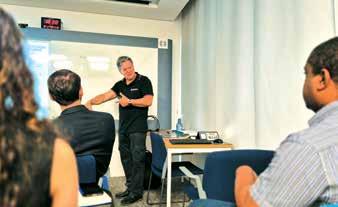
The Brazilian Maritime Pilotage Institute, in Brasília, held in May the first Port Planning Course, aiming to update professionals from regulatory agencies, inspectors and legal operators. The course provided knowledge of the basic principles related to nautical aspects in port planning, necessary for developing a conceptual design of access channels and port facilities, according to the guidelines of the World Association for Waterborne Transport Infrastructure (PIANC). The conceptual design gives the investor an initial idea of the costs involved in bringing a project to reality.
The class content was based on PIANC report 121, which deals with access channel projects, and the book Planejamento Portuário (Port Planning), edited by the Brazilian Maritime Pilots’ Association, which includes, in addition to PIANC, the United States Army Corps of Engineers manual and Spain's maritime construction recommendations.
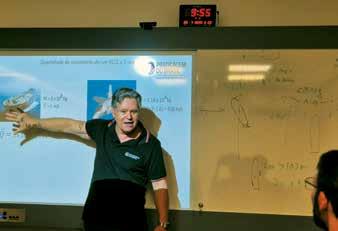
In the morning session, Professor Edson Mesquita, consultant for the Institute, addressed types of access channels, factors influencing depth, width, and curves, as well as concepts such as under keel clearance and ship's maneuverability margin. In the afternoon, he presented topics such as stopping distance of the vessel with and without tug(s); pilot boarding/disembarking area; approach channel to a port facility; maneuvering and turning basins; anchorage areas and their safety margins; and distances between ships at mooring berths.
Using the Institute's two simulators, partnerships with the University of São Paulo (USP) and Technomar Engenharia, students were able to learn theory in practice, verifying, for example, how long-period waves influence navigation in exposed channels.
“Not every simulator can be employed in port assessment. And all involved actors must be present in the simulation: Pilot, ship captains, and tug masters. The final focus is the project risk analysis,” the professor stressed.
According to him, since the Brazilian Navy assumed, by law, the coordination of studies related to the nautical aspects of port planning, with the extinction of Petrobras, the Maritime Authority has been adopting the PIANC standard in its regulations. An example is NORMAM-303/DPC, which, in the case of port works, requires the description of calculation and sizing criteria for access channels, internal channels, turning basins, mooring berths and anchorages, as established in report 121 and in the book Port Planning
The Harbour Master Rules and Procedures (NPCP) have also been aligned with PIANC doctrine, thanks to the updating of officers during a one-week advanced course at USP, taught by professors Mesquita and Eduardo Tannuri.
photos: Rodrigo March
PROFESSOR EDSON MESQUITA, IN CHARGE OF THE COURSE
“We presented international fundamentals that are not yet common and often diverge from the standards found in naval architecture books. We have created a distinct Brazilian culture of seamanship and port management that can cause delays in the development of our port infrastructure. That's why it is very important to level knowledge", emphasized the Institute's consultant.
Leandro Bernardino, the Permit Issuance Manager of the National Waterborne Transport Agency (ANTAQ), was one of the eight participants in the first class. He manages the team analyzing grants for private port terminals and considered the program very profitable for his daily work:
“Many of the concepts I had were acquired from naval architecture. And here, we saw the more scientific part, recognized internationally. I can visualize its application in my work. We can deepen several current processes based on what was taught. Obviously, it will demand study of PIANC reports and the book Port Planning, but that is why we came.”
Wellington Camacho, advisor to ANTAQ director Wilson Lima Filho, also participated in the first class:
“For us at the agency, keeping up with the global parameters of port planning is essential for our area of activity, as well as for everyone involved with ports, such as advisors to port authorities and maritime lawyers.”
As the professor rightly reminded at the beginning of the class, “nautical science without practice is sterile; naval art without theory is fatality". The sentence is by Aleksey Krylov (1863-1945), considered by Russians the father of modern naval architecture.
LUIS HAAG, THE INSTITUTE'S TECHNICAL COORDINATOR
photos:
Rodrigo March
Simulation center incorporates Artificial Intelligence (AI)
Check out the advances added to the Maranhão Pilotage laboratory, which develops a virtual maneuver assistant
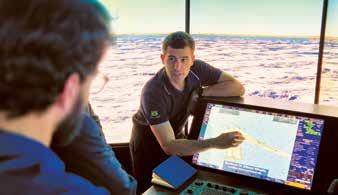
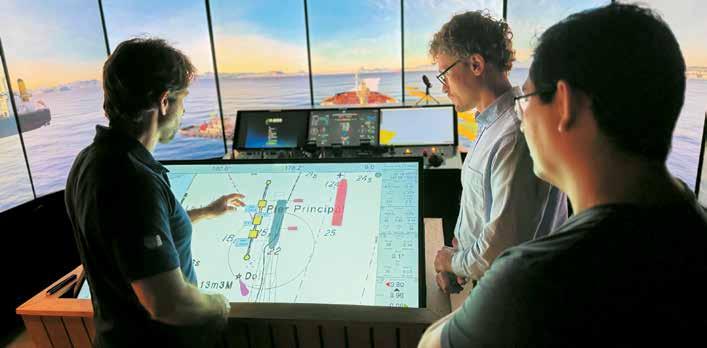
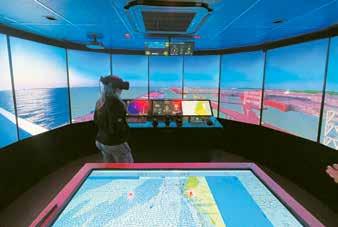
Almost five years after its inauguration, the simulator at Maranhão Pilotage has become a real laboratory with the use of Artificial Intelligence (AI). In addition to an interactive touch navigation table with virtual reality glasses, a maneuver assistant integrates another pair of Ray-Ban Meta glasses with camera and microphone, which allows the pilot to interact with the environment by voice orders and TTS (Text to Speech), a technology that converts text into audio.
On their workstations, staff also use AI to analyze environmental parameters and maneuver interactions efficiently, as well as set up simulation scenarios automatically.
AI shows great results in cross-analysis of maneuver information with wind, current and tide data, collected from environmental sensors located along the stretch from Ponta da Madeira, where Vale's terminal is located, to the Alumar terminal. Claudio Coreixas, responsible for the laboratory, gives an example:
“Recently, a pilot and captain noticed abnormal behavior of the ship being thrown towards the berth during unberthing at Vale. In the laboratory, we conducted in-depth analysis of the environmental factors in the vicinity (in particular, the current) and, with AI support, processed a vast range of data from the sensors and produced an interactive plot over time. The result showed a current reversal with force transverse to the berth, as noted by the pilot. We asked AI to adjust the predicted current field, ran the simulation, and accurately reproduced this behavior, allowing us to share the experience with other pilots and provide reliable training, highlighting the lesson learned.”
Another important application of AI use in the laboratory occurs in the study of interaction between ships in the already narrow tidal windows for maneuvering, mentions Coreixas:
“With the expansion of berths at Itaqui Port and terminals planned for construction in the coming years, we adopt AI to
COREIXAS, ON THE LEFT, OPERATES THE INTERACTIVE SCREEN
simulate different scenarios for scheduling concurrent maneuvers and identify the optimal time for the pilot to be onboard, in order to avoid the crossing of vessels and make operations safer.
The pilotage service also employs AI for the development of the integration code of the Ray-Ban Meta glasses with data from the Portable Pilot Unit (PPU), the navigation support device used by the pilot on board. The goal is to create an interactive maneuver assistant. The pilot will be able to ask for relevant information during navigation and when approaching the berth. For example, if the pilot asks about the drift, AI interprets the voice order and answers through the glasses’ earpiece.
Various information is available for AI processing, such as surrounding traffic captured by AIS; data from the ship itself received by the PPU; geographical points input by the pilot (for example: How far is pier three?); and data from integrated environmental sensors (for example: what is the current at berth sensor No. 108, or what is the tide at Alumar’s buoy two?).
“The processing of this data by AI generates massive time savings that an experienced programmer would spend to make the integration seamless with the cognitive process of the maneuver pilot. AI, on the other hand, immediately becomes an expert of its business model in a port maneuver", notes Coreixas.
In the future, the pilotage service plans to adopt computer vision processing from the image captured by the camera in the Ray-Ban Meta glasses. In this case, the intention is to feed a database associated with dangerous situations or nearaccidents that can be introduced into a learning machine to support the pilot's decision-making, alerting them to potential risks in certain situations.
Regarding scenario generation in the simulator, AI increases the productivity of the operator who previously used to take hours to set up an environment by positioning ships in the exercise area, establishing navigation routes, configuring environmental data, time of day and other complex adjustment parameters.
“We have built a collection of pre-defined situations and, with the appropriate prompt in natural language, we create the simulation file quickly. This speeds up the execution of tests in multiple experimentation environments, such as traffic interaction and maneuver tests under various current and wind conditions.
AI also favors the assembly of programming codes used to automatically reconstruct maneuvers that occurred on-site, in order to calibrate hydrodynamic models and current fields.
“This means bringing a full recording of a maneuver (position, heading, linear and angular speeds, helm, engine and tug orders) and automatically generating a temporal sequence of these
commands superimposed on the ship's track, loading an initial situation identical to that observed in the maneuver. The AI-generated tool applies the necessary commands throughout time and simulates the same pilot orders. This process greatly facilitates the exact replication of the maneuver after any coefficients adjustment or environmental parameters, until reaching a satisfactory degree of reliability for the original track result.”
With the DNV Class A product certificate, the space will be able to carry out studies and harbour analyses recognized by the Brazilian Navy, as well as offer training validated by the International Maritime Organization (IMO).
“We present a renewed, expanded and conceptually repositioned infrastructure. The name is not just a board update, but a declaration of intent. A laboratory, by definition, is a place for research, rigorous testing, and knowledge production. And this is exactly what we want to represent for the pilotage service and the entire state maritime community", says the president of Maranhão State Pilots’ Association ( APEM ), pilot Marcelo Delgado.
He highlights the partnership with Technomar Engenharia, which goes far beyond the simulator development, and adds that the laboratory will continue to be an important regional branch of the Brazilian Maritime Pilotage Institute, in Brasília:
“With the infrastructure now more robust, we will be in even better conditions to share experiences, host training and provide the environment for analysis of maneuvers characteristic of our pilotage zone (ZP-4), contributing to a knowledge database that benefits national pilotage.”
According to the president, a research institute will soon be created, which will have the laboratory as its main means of work, opening possibilities of agreements with universities, centers of excellence and the port sector.
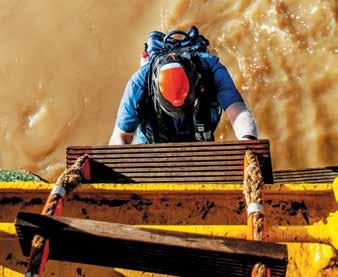
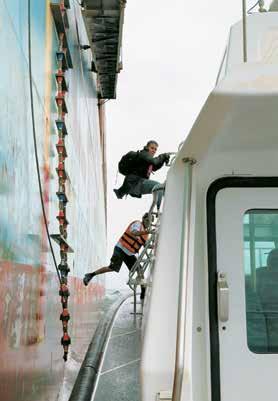
The period for adopting pilot ladder regulations has begun
IMO encourages voluntary anticipation of the new measures, aiming at pilot safety
Although the new regulations for manufacturing, installing and maintaining pilot ladders won’t officially take effect until January 2028, they can already be voluntarily adopted. The International Maritime Organization (IMO), that is responsible for approving the measures, has been encouraging early implementation from 2026. In order to facilitate the dissemination of information to shipping companies, seafarers, manufacturers, inspectors and maritime pilotage, Rumos Práticos has published in this edition a supplement with the updated poster from the International Maritime Pilots’ Association, which was approved by IMO to be displayed on the ships’ bridge.
The illustrated material presents the rules and a QR Code for further information on the IMPA website. To support the transition phase and facilitate consultation, the United Kingdom Maritime Pilots’ Association (UKMPA) has transformed the poster into an interactive art, from which it is possible to clarify questions about each specific point of the boarding arrangements. Simply access the entity's page (ukmpa.org) in the section dedicated to the public.
The IMO Maritime Safety Committee (MSC) approved the
their combination with accommodation ladders are the most common means of transfer between boats and ships. During the IMPA's last annual survey, 14% of the 5,285 reports submitted by maritime pilots presented non-compliant arrangements.
The amendments to the international convention incorporated changes considered essential by the IMPA, such as the 36-month replacement interval for pilot ladders from the date of manufacture, implementing manufacturer self-certification for products, and the alignment of standards with the International Organization for Standardization (ISO) requirements.
According to Chapter V, Regulation 23 of the new SOLAS, if an irregularity is found in the transfer means, the pilot must inform the ship's captain and refuse to use it before due repair. The regulation shares responsibility with the ladder user, who must ensure their own safety.
foto:
Divulgação
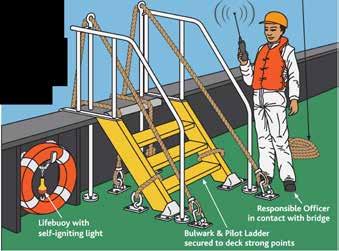
Handhold stanchions rigidly secured to deck. Man-ropes, if rigged, shall pass through the eye of the stanchion and be secured to strong points on the deck
Manropes and secure to pad eyes on the deck in the same manner as the "Gate Panel"
A heaving line shall be available
PILOT BOARDING IN ITAJAÍ
ILLUSTRATION FROM THE IMPA POSTER: BULWARK LADDER
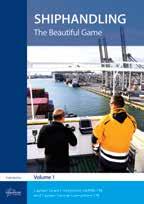
Shiphandling: The beautiful game
Introducing The Nautical Institute’s latest publication
Captain Grant H Livingstone FNI
Captain George H Livingstone FNI
The beautiful game is a term inspired by the outstanding Brazilian footballer Pelé (Edson Arantes do Nascimento). It arose because of his artistic execution. On the pitch, Pelé loved the game with the same fervour as those in the stadium who were cheering him on. But Pelé did not begin his career with artistic execution.
After he joined his first professional team, Pelé recalled: There was no moment when things started to turn around for me. There was no epiphany or great triumph. Instead, I just kept training, kept doing my drills, kept focusing on football (Pelé and Winters, 2015). Mastering fundamentals, combined with passion and dedication, is how Pelé achieved artistic execution. The same holds true in shiphandling.
KNOWLEDGE AND ‘FEEL’
As in football, shiphandling is revealed in its execution; not just technical knowledge, but also skill. The best shiphandlers understand and endorse the science, but nearly always talk about the ‘feel’. That’s the remarkable way in which the human brain assimilates experience and develops motor skills and cognitive deduction into artistic execution, fuelled by passion. The good news is that someone who has less innate aptitude can, with passion, determination and training, become a competent shiphandler.
The shiphandler executing at the highest level senses what is happening and anticipates what will happen next, balancing forces seamlessly and executing manoeuvres almost perfectly. When that happens, shiphandling becomes the beautiful game
Advanced and artistic execution cannot be achieved without fundamental knowledge. Fifty years ago, when there were far greater numbers of smaller ocean and coastwise trade vessels, it was common for Masters to handle their own vessels. A Master’s shiphandling skill was not only essential; it was the professional standard.
Fundamental change in three areas of the maritime industry – ship size, technology and liability – has all but eliminated that standard.
Today, most Masters are not afforded the same opportunity to handle their own vessels, with the notable exception of passenger ships and coasters. The consequence has been a significant loss of professional shiphandling knowledge and skill among most mariners. Considering the astronomical liability for all parties involved in the movement of ships in the 21st century, this matters a great deal.
Shiphandling is a long-established subject of conversation among mariners. We hope to shed greater insight into areas of shiphandling that have changed or become outdated, or which would benefit from new study. This is not a comprehensive A–Z shiphandling book. The reader will discover a primer on managing fundamentals, strategic thinking, effective commands and managing emotions and pressure, in addition to inertia and momentum, assist tugs, zero visibility, turns, anchoring and distractions. Student shiphandlers may be surprised to learn that successful shiphandling depends on much more than shiphandling skill.
WHERE NEXT?
There is no single source of shiphandling knowledge. It is our hope that this volume may add value to broader study. Each chapter and section can be reviewed independently and used as a reference when needed. The intent is to fortify mariners with easy-tounderstand explanations focused on fundamental aspects of manoeuvring vessels.
Mariners have always had professional discussions on a wide variety of maritime subjects, including human factors studies of bridge resource management (BRM). However, from the authors’ combined experience of 20,000 ship piloting manoeuvres, far less attention is paid to the debilitating effects that anger, fear, anxiety and panic can have on decision making on the ship’s bridge. Nevertheless, mariners have long borne witness to the oftennegative outcomes arising from those emotions. Under the weight of ever-increasing professional liability, and with bridge VDR technology recording everything a mariner says and does, it is not
surprising that professional discussions about mariners’ fear, anxiety, anger and panic are not taking place on the bridge. The study of shiphandling must include understanding the emotionalpsychological state required to manoeuvre successfully the largest (and smallest) floating objects on the planet. This book addresses that directly.
In the past, professional mariners tended to overlook emotions and pressure in shiphandling studies, as if they were not an integral part of decisions. ‘Suck it up kid, it’s a contact sport,’ was the traditional advice for dealing with fear, panic, anxiety and pressure. These negative emotions and pressure can block access to the critical-thinking skills that shiphandling demands, often when they are needed most. Understanding emotions and pressure is as foundational to shiphandling as understanding wind and current.
The shiphandling content of this book was determined by mariners at sea, for mariners at sea. A shiphandling survey conducted by The Nautical Institute in March 2023 asked mariners to consider their experience in shiphandling. It asked them two questions:
• What were the most challenging elements to learn theoretically?
• What were the most challenging elements to execute practically?
The collective answers to those questions revealed common challenges for professional mariners studying and executing shiphandling. The shiphandling content of this book is a response to those questions and challenges.
Chapters cover:
• Emotions
• Shiphandling
• Managing pressure
• Managing zero or reduced visibility
• Managing inertia and momentum
• Anchoring
• Narrow rivers, channels and bridges
• Managing assist tugs
• Managing docking and undocking
• Managing dead ship movement
• Managing technology and distractions
• Managing professional conduct
Two extracts from the book overleaf give some flavour of the range of topics and the way in which they are covered.
MANAGING EMOTIONS
The authors discovered early on – long before we imagined handling ships or tugs – that we had a strong aversion to hitting anything with a boat. That aversion revealed itself when learning to handle small sailing boats and crashing into docks, rocks and other sailboats. It was one part embarrassment, two parts panic: embarrassment, because everyone was watching; panic, because we did not know how not to crash (and everyone was watching). Decades later, we can still tap into that awful feeling conning small boats banging into objects, but now it’s three parts embarrassment because we have learned a lot about emotions and the game.
Considerable study of the human element has taken place and study of human factors is evolving. Harvard Business Review (HBR) executed a large-scale study of what selfawareness is, why we need it and how to improve it (Eurich, 2018). That HBR study identified two categories: internal and external self-awareness –seeing ourselves objectively and getting objective feedback to understand how others see us, respectively. Increased self-awareness improves our understanding of why people behave the way they do and of the relationship between behaviour and consequences.
This book aims to focus on how our own emotions affect our own decision making, particularly under stress, which is key to executing good shiphandling decisions.
Clinical studies show human beings are subjective, not objective, by nature. This requires education and training to mitigate. It is unlikely that the average person can process information with complete objectivity without education and training.
FACTCHECKING EMOTIONS
Emotions are natural and serve as signals: happy, sad, angry, depressed, frightened. These signals have helped humans to survive for thousands of years. To oversimplify, the brain interprets/ processes sight, sound and senses and sends out information to the rest of the body, resulting in feeling, emotion, perception and action. This is known as stimulus perception followed by a behavioural response.
The signals flow through innumerable biological and neurological pathways to and from our brain before manifesting as a physical or emotional response.
Much of this occurs at a subconscious level, in mere hundredths of a second. Before we have a chance to consider, we’re already experiencing the emotion (Schreuder et al, 2016). Without objective self-awareness and self-differentiation, negative emotions can hijack responses. Objective decision making is foundational to effective shiphandling: all emotions should be fact-checked.
ANGER
Take anger, for example:
Living and working on tugboats and ships for extended periods of time naturally creates stress. It is a challenge to maintain emotional composure over long periods of time in a small space, away from home, family and friends.
Anger is a motivational emotion. In certain situations, a temporary burst of anger may give the individual an emotional and physical boost, determination and adrenaline. It focuses our attention on the obstacle in front of us by diminishing our peripheral senses and increasing our risk threshold, and triggers blood flow to our extremities. All of these may be exactly what one needs to succeed in a fight or extreme situations.
What if getting out of extreme situations depends on unemotional objectivity and unbiased facts? In shiphandling, anger increases our risk threshold. The blood flow to our extremities competes with the blood supply to our brain. Angry people find angry messages convincing. Anger commonly carries over from a past event and is likely to affect our judgement and decision making in the current situation, whether it’s applicable or not.
When we get angry, we may blame others for the problem and get even angrier. Anger interrupts cognitive processes and hijacks our attention, skewing judgement. By hijacking our cognitive process, our decisionmaking for the task at hand is distracted and slowed down. Anger and chronic stress also negatively affect our memory.
Others often view angry people as hostile, domineering, rude and uncooperative. Respect, cooperation and teamwork can disintegrate, causing communication and information exchange to cease.
If I am hijacked by anger and lose selfcontrol and start yelling, I stop hearing anyone else and become further critically distracted from the task at hand. Yelling seldom improves communications or solves problems: it creates more stress and hinders problemsolving just when the opposite response is needed.
If I am angry on a ship:
• I may get tunnel vision;
• I may blame others for the problem;
• I may feel overconfident and take greater risks;
• my decision-making process may become distracted;
• anger and decisions in past situations may inappropriately carry over to;
• influence current situations; I will alienate the team or individuals around me; and
• communication and informationmay cease.
Nothing in shiphandling is improved by becoming angry: quite the opposite. Anger usually begins with irritation, which can be just as distracting as anger. We are human, however, so at times we become irritated and angry. The good news is we can learn to manage those and other emotions that affect shiphandling decisions. Learning how to manage emotions and pressure are covered in depth throughout this book.
SHIPHANDLING RULES AND EXCEPTIONS
The first rule of shiphandling is there is an exception to nearly every rule. There are so many elements encompassed by the subject of shiphandling that if you were to devote all your time to mastering the academic science of it, there would be no time left for practical application. It is impossible to begin a career with the knowledge and expertise that can only be acquired throughout a long career of shiphandling. The shiphandler can advance their knowledge and expertise at an accelerated rate with a thorough understanding of the principles of shiphandling.
Experience is a wonderful teacher, though often a very slow one. In the course of time, it will instil into a seaman’s mind a considerable knowledge of the capabilities and behaviour of his vessel under varying circumstances – her strength, her carrying capacity, her stability, or, in other words, her sea qualities.
This mode of obtaining knowledge is, however, far too costly for the intelligent seaman of today. He knows that many a good ship, and what is worse, many precious lives have been lost before it has been acquired, and all through pure – though it would be unjust to say, wilful – ignorance. (Walton, 1901)
Begin the journey by learning how to manage the varied elements, such as:
• momentum and inertia;
• speed, wind and current;
• anchors and rudders;
• restricted waterways and turns;
• tug types and placement;
• tug commands;
• tug and ship crew safety;
• berthing and unberthing; and
• traffic management.
Mistakes will be made often; dedication, patience and passion will be required to follow through. But don’t be discouraged: shiphandling is a numbers game. The more ships you can move in ports, bays and rivers with varied manoeuvres, the more ability you will acquire, if your knowledge is fundamentally sound. The journey is
rewarding and begins with a solid understanding of the fundamentals. Maintain a journal of that journey to learn and improve.
MANAGING FUNDAMENTALS
OThe old-fashioned method of ‘beginning at beginning’ of the subject has been adopted as the only trustworthy way; and while endeavoring to cover as much as possible, the aim has been to condense the matter as far as compatible with clearness, to present it in a language easy enough to understand by every seaman. (Walton, 1901)
When a subject is complex, you must understand the fundamentals if you are to advance to higher levels. It is folly to attempt advanced execution without excellent fundamental knowledge and practice, particularly in shiphandling. Don’t get sidetracked trying to execute complex manoeuvres that demand advanced levels of training and experience. Being impatient during training at the beginning of a career and bypassing the fundamentals will only erode and undermine your skill and execution when it matters most, later in your career.
STRATEGY
In the world of business, strategic thinking is foundational for success. Strategic thinking is also foundational for successful shiphandling; the two are interchangeable. Successful strategic thinking identifies threats and vulnerabilities and produces clear goals, adapting to the ever-changing marine environment.
Strategic-thinking skills enable you to use critical thinking to solve complex problems and develop a plan balancing actions and ideas against consequences and results. An ability to envisage new solutions and to continually reinvent are requisites for successful shiphandling.
MANAGING SPEED
One fundamental key to every aspect of shiphandling is speed. The last generation of mariners warned that in shiphandling there are three things to watch carefully:
• Speed;
• Speed;
• Speed.
Speed is like salt: easy to pour on, difficult to take off.
Speed can become problematic and not only on full ahead: 1 knot can be excessive if there isn’t enough room to stop. Appropriate speed (not to be confused with International Rule no. 6, or Colregs) is the speed at which the shiphandler can reasonably expect to stop the ship with anchors or engines or tugs, prior to allision or collision (in an emergency, that may require all three options). If inbound at sea buoy, multiple miles outside a port, sea speed may be appropriate as there are miles available in which to stop. In a narrow harbour with berths close on either side, speed should ideally be such that the ship’s course and direction can be properly controlled with the use of engine rudder and tugs. Exceptions are usually related to weather, current or mechanical failure.
Shiphandlers traditionally relied on their eyes to judge speed when manoeuvring ships. Today, ECDIS, radar, PPU and handheld electronics all provide the shiphandler with accurate speed readings. The unintended consequence is that the important habit and skill of visually monitoring speed is being lost. Do not underestimate the validity of visual estimation!
A 2021 research report in the European Journal of Neuroscience on subliminal perception (the ability to discriminate visual stimuli not consciously seen) suggests that, rather than being a separate unconscious capacity, subliminal perception is based on similar processes as conscious vision (Railo et al, 2021). The shiphandler should pay close attention to relative movement directly on the beam, and practise and develop the skill of visually observing and estimating speed and other ship motion.
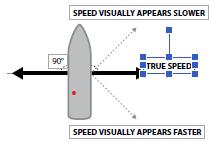
To estimate speed visually, the observer must be looking abeam exactly 90 degrees to the ship’s keel. With headway, if the shiphandler looks slightly forward of the beam to objects on the near horizon, the relative speed will appear to be less than it is. If the gaze is slightly aft of the beam, the relative speed will appear greater than it is. When close enough to any berth or land, the old advice to imagine someone walking alongside the ship as an estimation of speed is still helpful. Walking speed for the average person is about 3 knots. esBmaBon of speed is sBll helpful. Walking speed
With practice, the shiphandler can become accurate at visually estimating speed. The greatest benefit of that habit is that the shiphandler’s peripheral vision begins to pick up changes in ship speed naturally (subliminal perception), even when not looking. This skill provides the shiphandler with speed information as instantaneously as the bridge instruments.
Ships do not control speed – shiphandlers do.
Originally published in the Nautical Institute Magazine
Seaways in association with the Royal Institute of Navigation in March 2025, and reproduced with the authors' permission.
www.nautinst.org
ABOUT THE AUTHORS
Twin brothers Grant and George Livingstone graduated from the California Maritime Academy in 1980 and both embarked on a decades-long career at sea, becoming expert on pilotage, shiphandling, offshore tug operations and ocean towing.
Over the course of 40 years at sea, George has sailed on a wide variety of vessels, ranging from US-flagged ships to harbour and ocean tugboats. As a pilot, he was active in various leadership roles, from the Harbor Safety Committee to State Pilot Commissioner, roles in which he made important contributions to the training of pilots and the development of safety management. His career includes 13 years of service with the San Francisco Bar Pilots, as well as a period in the role of Vice President of the Nautical Institute. Despite retiring from the San Francisco Bar Pilots in 2021, George has remained active within the maritime sector since through his writing and as a consultant involved in the training of tug captains and pilots.
Grant has worked as a pilot for Jacobsen Pilot Service in the Port of Long Beach, California, since 1991, and he assists in the training of all new-hire pilots in addition to his own duties. Within that time, he has undertaken more than 16,000 documented ship moves. Additionally, Grant has provided extensive training to Mexican pilots and Azimuth Stern Drive (ASD) tug captains on behalf of simulator training provider Marine Safety International. He has helped the Maritime Research Institute Netherlands (MARIN), a leading European hydrodynamic and nautical research facility, to develop an emergency manoeuvring simulation package for ASD tugs, including the production of a training DVD. He has provided similar training assessments to Pacific Maritime Institute, Boluda Towing and the ports of Progreso and Veracruz, Mexico. He has also worked for South Coast Tugboats.
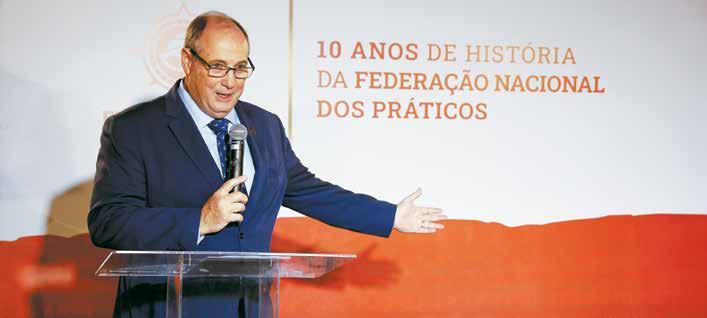
Ten years of activity of the Brazilian Maritime Pilots’ Federation
Celebration in Brasília marks achievements since the entity's registration. The president highlights future challenges.
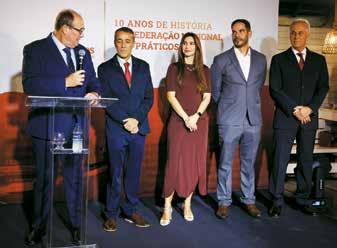
On March 17, 2016, the Brazilian Maritime Pilots’ Federation (Fenapraticos) obtained its official registration at the Ministry of Labor and Employment, after bringing together the minimum required of five unions. Ten years later, 12 unions were formed, reaching 90% of professionals from the 20 pilotage zones. The decade of operation was celebrated on May 20, at an event held at the Naval Club in Brasília.
Currently, the associated unions represent pilots from the following pilotage zones: Amapá-Amazonas-Pará (ZP-1), Bahia (ZP-12), Ceará (ZP-5), Espírito Santo (ZP-14), Maranhão (ZP-4), Pará (ZP-3), Paraná (ZP-17), Pernambuco (ZP-9), Rio de Janeiro (ZP-15), Rio Grande (ZP-19), Santa Catarina (ZPs 18, 21 e 22) and São Paulo (ZP-16).
The creation of the federation, in 2013, was a natural process. At that time, the activity began to see increasing union-related demands and there was no entity to defend the interests of maritime pilots with the legitimacy to act as a representative category in key forums.
Pilot Otavio Fragoso (ZP-15) participated in the federation’s founding and was its first president, serving in the 2013/2016 and 2016/2019 terms. In his view, the main achievement over these years was “establishing a space for national representation at a professional level and making ourselves heard".
One of the first actions of his administration was the signing, in 2014, of a memorandum of understanding with the National Federation of Maritime Navigation Agencies (Fenamar), through which both parties recognize regional price negotiation as the best way to meet the needs of service users, given the diverse characteristics of Brazilian ZP's. From the agreement, the issue was pacified.
During the two years it took for the approval of the new pilotage law, the federation played an important role, joining efforts by participating in meetings and public hearings on the matter at the National Congress. At this period, it was also heard at an audience in the Federal Court of Accounts (TCU), during the audit process of the service’s regulation (filed).
photo: Pedro Ladeira
PRESIDENT OF FENAPRATICOS, PILOT GUSTAVO MARTINS
Fenapraticos is affiliated to the National Confederation of Workers in Waterway, Aerial, Fishing, and Port Transport (CONTTMAF), which integrates the Fórum Sindical dos Trabalhadores (FST) (Workers Union Forum) and the International Transport Workers' Federation (ITF). Pilots Otavio Fragoso and Ricardo Falcão (ZP-1) are the delegates in CONTTMAF.
Otavio's successor, maritime pilot Gustavo Martins (ZP-17) was re-elected for the 2026-2029 three-year term. The current administration also includes the vice-president, maritime pilot Carlos Alberto Barcellos (ZP-14), the administrative director, maritime pilot Vanessa Zamprogno (ZP-9), the financial director, maritime pilot Adonis dos Santos (ZP-1), and the technical director, maritime pilot Pedro Parente (ZP-5).
Gustavo highlights that, today, the federation is institutionally recognized by the Maritime Authority, the Congress, and regulatory bodies, “a result of years of consistent presence where decisions affecting maritime pilots are made”. He mentions four further achievements:
“The first is legal representation. The unions now have support to face administrative and judicial challenges that previously each ZP handled alone. The second is legislative action. We closely monitor the proposals to modify the pilotage regulatory framework, contributing with technical arguments so that the debate in Congress is qualified and not driven solely by commercial interests. The third is strengthening the category's identity. We work so that the maritime pilot can be recognized as a professional essential to navigation safety and the economy, rather than a cost variable to be optimized. There is also a symbolic achievement that makes me proud. In 2017, we were present at the Pantheon of the Fatherland, where the name of pilot Francisco José do Nascimento (the Sea Dragon, leader of the abolitionist movement in Ceará) was inscribed in the Book
of Heroes and Heroines of the Fatherland. Pilotage community contributed to this tribute which reminds us of the historical and moral weight carried by our profession.”
The work of union organization in the not yet represented ZPs continues. According to Gustavo, each process has its particularities: some zones are in a more advanced stage of organization, with pilots mobilized and documentation underway with the Ministry of Labor, while others are at the initial process. Fenapraticos provides direct assistance to these groups, providing guidance on legal requirements, supporting the drafting of statutes, and monitoring registration procedures.
For the future, the president lists two more challenges, with the regulatory environment being the most immediate and complex, in his view, despite the consolidation of the new pilotage law:
“Proposals to modify the legal framework of pilotage continue to be processed in Congress, some of them with the potential for profound impact on the model that ensures navigation safety in our waters. Fenapraticos also needs to be present in this debate with solid technical arguments and qualified dialogue. The second challenge is communication. There is an expression which summarizes the paradox of our profession: Silence is the sound of safety. The maritime pilot is successful when nothing happens, and this makes our relevance invisible to most people. The society that depends on this service deserves to know it, not to celebrate the category, but to understand what is at risk if this model is weakened.”
To mark the ten-year anniversary, the maritime pilots who served on the institution's board were honored: Marcelo Cajaty, Moacyr Bezerra, José Estevão Dell’aringa, Ernesto Conti Neto, Marcos Martini and Alexander Kreuger. Otavio Fragoso had already been honored at the Fenapraticos headquarters in 2023.
GUSTAVO, THE DIRECTORS ADONIS, VANESSA, PEDRO AND VICE-PRESIDENT CARLOS ALBERTO
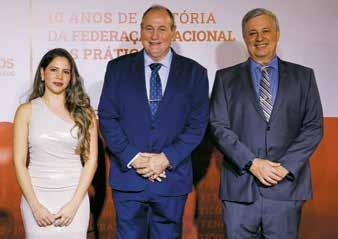
MICAELE, GUSTAVO AND ANDRÉ COSTA
photos: Pedro Ladeira
fast & focused
LAGOA DOS PATOS
NIGHT NAVIGATION RETURNS IN ACCESS CHANNELS AFTER 42 YEARS
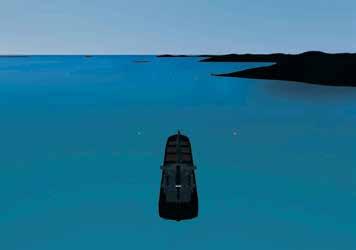
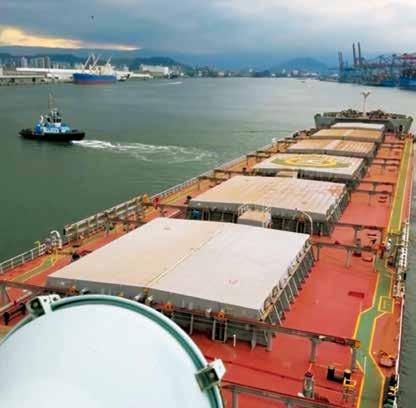
The image of the ship with the buoys in the background shows a part of the night navigation in the access channels to Lagoa dos Patos, which had not occurred for 42 years. Proposed by the local pilotage and studied at the Brazilian Maritime Pilotage Institute, this measure saves up to two days on round trips. There were 18 simulations before approval by the Navy, following dredging and recovery of nautical signaling. The ship PGC Tarmina departed from Rio Grande and berthed at a terminal in Triunfo (Rio Grande do Sul), crossing the lagoon and Porto Alegre. The maneuver was conducted by pilot Eduardo Barboza and accompanied onboard by the Port Captain of Rio Grande do Sul, Captain Gutemberg Ferreira.
NORTHERN BAR
STUDIES WILL SUPPORT THE NAVY IN INCREASING THE DRAFT
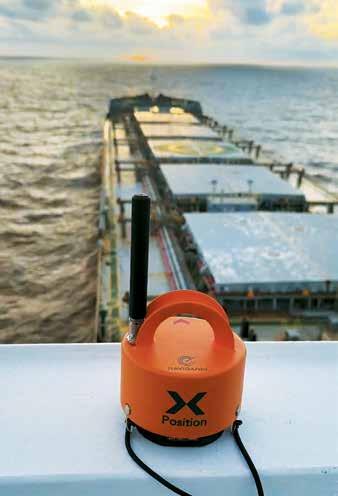
How is a Panamax-class ship with a 11.7 meter draft maneuvered in the Northern Bar of the Amazonas River? Through the Navigandi Portable Pilot Unit (PPU), the Eastern Amazon Basin Pilotage collected transit data to assist the Navy in increasing the draft limits. The ship traveled zigzag sessions with half a meter of under keel clearance, without touching the mud. The performance will be analyzed by a group formed by the University of São Paulo (USP), the Brazilian Maritime Pilotage Institute, PIANC Brasil and Technomar. The “muddy arc” limits the loading of vessels that transport a great deal of the agribusiness cargo. “We will deliver evaluations with promising results for the future of navigation", says the Institute consultant Edson Mesquita, who accompanied pilot Ricardo Falcão onboard.
BRASIL EXPORT
PRESIDENT OF BRAZILIAN MARITIME PILOTS’ ASSOCIATION JOINS THE COUNCILS
The president of the Brazilian Maritime Pilots’ Association, pilot Bruno Fonseca, joined the National Council of the Forum for Logistics, Infrastructure and Transports (Brasil Export). The announcement was made during the regional edition of Santos Export, held in May, in Guarujá (SP). Brasil Export promotes events with top leaders from the public and private sectors to eliminate bottlenecks and discuss measures to promote infrastructure development, including port infrastructure, which is essential for navigation efficiency and safety.
APPRENTICE
SELECTION PROCESS INCLUDES BOOKS PUBLISHED BY THE BRAZILIAN MARITIME PILOTS’ ASSOCIATION
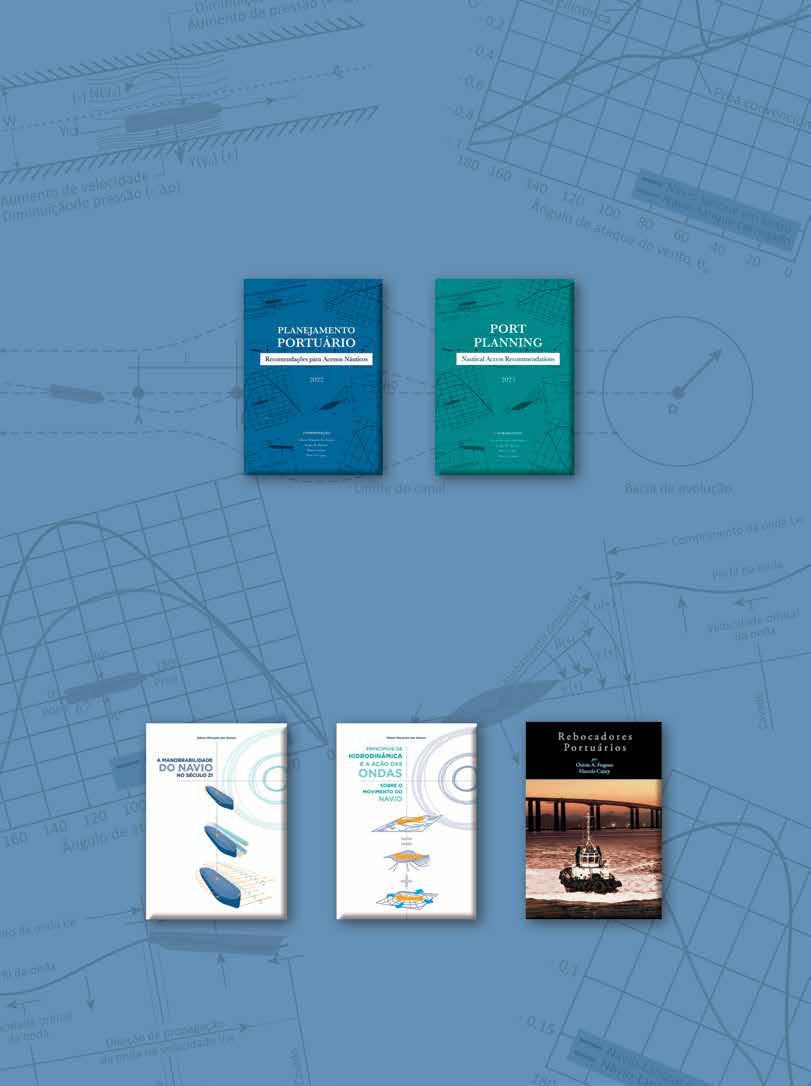
The Brazilian Maritime Authority - Directorate of Ports and Coasts (DPC) concluded the review of the program content and suggested bibliography for the pilot apprentice category (PSCPP) selection process. The literature includes four books published by the Brazilian Maritime Pilots’ Association: Rebocadores Portuários (Harbour Tugs), by Otavio Fragoso and Marcelo Cajaty; A manobrabilidade do navio no século 21 (Ship Maneuverability in the 21st Century) and Princípios de hidrodinâmica e a ação das ondas sobre o movimento do navio (Principles of Hydrodynamics and the Action of Waves on Ship Movement), by Edson Mesquita; and Planejamento Portuário – Recomendações para acessos náuticos (Port Planning – Nautical Access Recommendations), by 25 authors. The call for applications is scheduled for July 2027, with the written exam taking place in November. Further information is available on the website: marinha.mil.br/dpc.
CANOEING
ISAQUIAS QUEIROZ GETS OFF TO A GOOD START TOWARDS LOS ANGELES 2028 OLYMPICS
One gold and one silver medal in the Canoe Sprint World Cup stages in Germany and Hungary. Isaquias Queiroz began his season on the road to the Los Angeles 2028 Olympic Games. In Szeged (Hungary), he completed the C1 500 meters in 1min 44sec 73, finishing behind Ji Bowen. In Brandenburg (Germany), the Olympic champion left the Chinese behind and conquered the gold medal, with a time of 1min 52sec 55. With changes in the Olympic classification system, the accumulated score throughout the circuit has gained greater importance. “I still have a long way to go to recover my level. Let's say I have performed 30% of my capacity. I’m thankful to the Brazilian Maritime Pilots’ Association and all my sponsors", he said.
photo:
Bruno
Haddad
photo:
Publicity
photo:
media success
RAIN OF VIEWS
A ship-to-ship mooring operation during heavy rain reached more than five million views on our social media. The maneuver, conducted by maritime pilot Diogo Weber, was filmed onboard at the Tebig terminal in Angra dos Reis, Rio de Janeiro (ZP-15).
MORE FOLLOWERS
Almost three million views and attracting twenty-five thousand followers to our channels, mainly on Instagram. This was the result of a turning and departure maneuver from Porto de Santos (ZP-16). The video shows tugboats pulling at maximum force a loaded bulk carrier. Pilot Adriano Dias ran the engine in reverse at full speed to “brake” the vessel against the ebb current on the port side.
RISK IN EVIDENCE
Our third most viewed post reveals the risky routine in pilot boarding and disembarking, it’s not always in calm seas. The video of pilot Jean Oliveira disembarking in rough seas in Bahia (ZP-12) had nearly 500 thousand views.
REQUIRED PILOT TRANSFER ARRANGEMENTS FOR PILOTS AND OTHER PERSONNEL
1 The Maritime Safety Committee, at its 110th session (18 to 27 June 2025), adopted amendments to SOLAS regulation V/23 on Pilot transfer arrangements (resolution MSC.572(110)) and the Performance standards for pilot transfer arrangements (resolution MSC.576(110)) developed at the eleventh session of the Sub-Committee on Navigation, Communications and Search and Rescue (NCSR) (4 to 13 June 2024).
2 The aforementioned amendments are expected to enter into force on 1 January 2028.
3 The Committee concurred with the recommendation of NCSR 11 regarding the revised required transfer arrangements for pilots and approved a revision to MSC.1/Circ.1428 and the poster previously circulated thereby, as set out in the annex. The illustrations are also available for download from www.impahq.org.
4 Member States are invited to bring the revised illustrations to the attention of their pilots, seafarers, shipowners, ship operators and others concerned with pilot boarding arrangements.
5 This circular should be implemented alongside the amendments to SOLAS regulation V/23 adopted by resolution MSC.572(110) and the Performance standards for pilot transfer arrangements adopted by resolution MSC.576(110).
6 MSC.1/Circ.1428 is revoked as of 1 April 2030.
NON-COMPLIANT PRACTICES
In accordance with SOLAS Chapter V Regulation 23 INTERNATIONAL MARITIME PILOTS’ ASSOCIATION
Email: office@impahq.org
This document and all IMO Pilot-related documents are available for download at: www.impahq.org
NO!
No shackles, knots or splices NO!
The steps shall be equally spaced NO!
The steps shall be horizontal and chocks above and below the steps shall be tightly secured NO!
Spreaders shall not be lashed between steps NO!
Side ropes shall be equally spaced NO!
The steps shall not be painted, varnished, dirty or slippery NO!
No Loops. These present a tripping hazard and foul the pilot launch NO!
Retrieval lines shall not be secured below bottom spreader. Retrieval lines if required, shall be secured at or above the bottom spreader and shall lead forward.
STERN BOW
REQUIRED PILOT TRANSFER
In accordance with SOLAS INTERNATIONAL MARITIME
Email: office@impahq.org
This document and all IMO Pilot-related documents
RIGGING WHEN POINT OF ACCESS IS 9 METRES OR LESS ABOVE THE WATER
HANDHOLD STANCHIONS
Stanchions shall extend a Min. 120cm above bulwark. Diameter of stanchions
Min. 32mm Max. 36mm.
Stanchion ring diameter shall not be less than 60mm.
Distance between stanchions
Min. 70cm Max 80cm.
MAN-ROPES
SHALL BE RIGGED IF REQUIRED BY THE PILOT
(Man-ropes shall be made of manila rope or other material of equivalent strength without knots or splices)
Min. Diam. 28mm
Max. Diam. 32mm
SIDE ROPES
Min. Diam. 20mm
Max Diam. 22mm
ALL STEPS
Shall rest firmly against ship’s side shall be horizontal
Min. 40cm
31-35cm equally spaced
RIGGING WHEN POINT OF ACCESS IS MORE THAN 9 METRES ABOVE WATER
PILOT LADDER AND MAN-ROPES shall be secured to strong points on deck
SPREADER Min. 180cm Long
6 METRES unobstructed ship’s side
MAXIMUM 8 STEPS Between spreaders
PILOT LADDER
Shall extend at Least 2 metres above the lower platform. The Pilot ladder and Man-ropes, if rigged, shall be secured to the ship’s side 1.5m above the platform using sunken eyes, magnetic or pneumatic system. ACCOMMODATION LADDER Shall lead aft
45˚ slope
The lower platform shall be rigged as requested by the pilot service, with a minimum height of 5m above the water up to a maximum height of 9m above the water. Lower platform horizontal. Lower platform shall be rigged with both an inboard and outboard stanchion.
Retrieval line shall lead forward
5th STEP From bottom shall be a spreader
Height above water required by Pilot
Accommodation ladder shall be secured to ship’s side (Using sunken-eyes or approved mechanical system)
Pilot ladders shall be secured at intermediate lengths by a device type approved for the purpose, which prevents any slippage of the side ropes and has a breaking strain of not less than 48kN.
TRANSFER ARRANGEMENTS
SOLAS Chapter V Regulation 23
MARITIME PILOTS’ ASSOCIATION office@impahq.org documents are available for download
PILOT LADDER WINCH REEL
Lifebuoy with self-igniting light
Handhold stanchions rigidly secured to deck
Scan for more information
1 2 3 4 5 6
Duties of the Responsible Officer
Have knowledge of the correct use of Pilot Transfer Arrangements
Establish direct communication with bridge
Communicate with bridge during boarding process
Oversee / Check compliant rigging of the ladder
Test safety equipment in place and ready for use
Arrange for the pilot to be safely guided to/from the bridge via a clear illuminated route
All Companies shall have an approved safety management system which includes ship-specific procedures for the safe conduct of pilot transfers. The ISM Code requires that these procedures comply with SOLAS Chapter V regulation 23 and conform to IMO recommendations, international standards and guidance from marine industry organizations.
PILOT TRANSFER ARRANGEMENTS FOR TRAP DOOR AND SIDE DOOR DIAGRAMS CAN BE VIEWED BY SCANNING THE ABOVE QR CODE.
In accordance with SOLAS INTERNATIONAL MARITIME
Email: office@impahq.org This document and all IMO Pilot-related
ACCOMMODATION LADDER (TRAP DOOR ARRANGEMENT)
The platform shall be secured to the ship’s side when in use
In the case of a combination arrangement using an accommodation ladder with a trapdoor (ie. embarkation platform), the pilot ladder and man-ropes shall be rigged through the trapdoor extending above the platform to the height of 2m.
The Pilot ladder shall rest firmly against the ship’s side
Maximum 45˚ slope
Lower platform horizontal
The lower platform shall be a minimum of 5 metres above the
SOLAS Chapter V Regulation 23
MARITIME PILOTS’ ASSOCIATION
Pilot-related documents are available for download at: www.impahq.org
Platform shall be secured to ship’s side (Using sunkeneyes or approved mechanical system)
Distance between Stanchions
Min. 70cm Max. 80cm
Pilot ladders shall be secured on the lowest deck within the ship’s side opening. Rigging from the deckhead or freeboard deck is not permitted.
6 METRES unobstructed ship’s side
When rigged from a ship’s side opening manropes may be rigged from the deck head, provided that the manropes pass through the ring or the eye at the top of the stanchions at the point of access.
Distance from top of step to entry to be no more than 320 mm
Height above water required by Pilot
Port Planning – Nautical Access Recommendations, authored by 25 specialists, is available for free in the publication session at praticagemdobrasil.org.br.
A manobrabilidade do navio no século 21 (Ship Maneuverability in the 21st Century) and Princípios de hidrodinâmica e a ação das ondas sobre o movimento do navio (Principles of Hydrodynamics and the Action of Waves on Ship Movement), by Edson Mesquita, can be acquired by emailing manobrabilidade.ondas@gmail.com
To obtain Rebocadores Portuários (Harbour Tugs) , by Otavio Fragoso and Marcelo Cajaty, send an email to praticagemdobrasil@praticagemdobrasil.org.br.