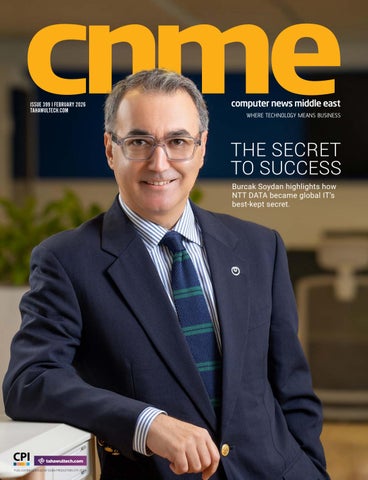
THE SECRET TO SUCCESS
Burcak Soydan highlights how NTT DATA became global IT’s best-kept secret.


E-mail: mark.forker@ cpimediagroup.com
TIME IS OF THE ESSENCE
February is the shortest month of the year, and once again it has gone by in a flash.
However, despite the condensed calendar month of February, it was a busy one for us at CPI Media Group, as we hosted our annual CIO Leadership Awards and Reseller Awards.
In the current technology climate, it has become quite evident how much of a commodity time is.
The demand to deploy AI at scale from enterprises globally continues to gather astonishing pace, but parallel to that aspiration is the reality that there is increasing pressure from a boardroom level who want to see measurable business outcomes and a return on investment.
In these circumstances time is an enemy.
In many respects there is no time, and there is no patience.
Investors want results and they want them now.
Many businesses fear that the AI train will depart without them, and they’ve seen how this movie has played out in the past.
They don’t have time to wait and see if a specific AI product or project will be a success in the long-term, it’s all about the short-term.
However, when it comes to the company on the front cover of February’s edition of CNME, they can be described as ‘timeless’.
NTT DATA are an iconic Japanese institution that have been in business for over 150 years, which is quite staggering.
Longevity, resilience, trust and tradition have served NTT DATA well over the years, but its ability to think in the ‘long-term’ is one of the key reasons for their phenomenal success over such a sustained period of ‘time’.
Burcak Soydan is the Managing Director, for the Middle East, at NTT DATA, and he highlighted how the company’s ability to not be sucked into short-term thinking is one of the reasons the company is the only full stack integrator in the entire world.
Soydan is a charismatic figure, who has enjoyed a great career to date, but appears to be a man relishing the opportunity to grow NTT DATA across the Middle East.
He believes that NTT DATA are the best kept secret in global IT.
I know I’m bias, but it really is a terrific interview, and the NTT DATA story is beyond compelling.
In February’s edition of CNME, we also have some other brilliant interviews.
I spoke to one of the most revered and respected IT leaders globally in the form of Ali Siddiqui, Global CEO of BMC Helix.
BMC Helix were named by Forrester as the No.1 undisputed leader in the Enterprise Service Management Space.
Siddiqui explained how the company has now established itself as the market incumbent in what was a fascinating exchange with one of the industry’s brightest minds.
Speaking of bright minds, there are few more impressive characters in the world of cybersecurity than Ahmad Halabi, Managing Director of Resecurity.
He has an incredible understanding of the complexities that exist within the global cybersecurity ecosystem.
His message was clear during our interview.
Enterprises need to move away from the thought process of detection and instead focus on prediction and prevention.
He outlines what they need to do in a way that only he can.
Again, I’d highly recommend our exchange.
In addition to this, I had brilliant interviews with companies such as DataTorque, RedHat, Education University of Hong Kong and e& enterprise.
In addition to the interviews, we have strong thought leadership features from Epicor and DXC Technology respectively.
We also have coverage from our CIO Leadership Awards and an excellent exclusive roundtable session that I had the pleasure of moderating on behalf of OPSWAT.
I hope you take the ‘time’ to enjoy February’s edition of CNME.
Mark Forker Editor


26 NTT DATA

CNME rounds up the biggest regional and global developments in enterprise technology, which includes the news that NTT DATA and AWS sign long-term Agentic AI agreement, Singapore announces it is setting up a space agency - and semiconductor sales are expected to reach $1 trillion in 2026.
kausar.syed@cpimediagroup.com
10
16
22
Ali Siddiqui, Global CEO of BMC Helix, explains how the company has become the undisputed leader in the Enterprise Service Management Space.
Ahmad Halabi, Managing Director at Resecurity, on the need for enterprises to move away from detection, and instead focus on prediction and prevention in the cybersecurity industry.
Mary O'Leary, Tax Policy and Technology Expert at DataTorque, highlights the important role of the new UN Tax Subcommittee in giving smaller countries a voice at the top table.
32 Anirban Mukherjee, Director of Solution Architecture, MENA at RedHat, stresses the need for digital sovereignty.
48
Global cybersecurity leader OPSWAT hosted an exclusive roundtable with a whole host of prominent IT leaders, where they presented their vision for securing critical infrastructure in an evolving threat landscape.


NTT DATA and AWS sign multi-year agentic AI agreement
NTT DATA and Amazon Web Services (AWS) recently signed a multi-year agreement to support enterprises modernising their systems. The pair are set to focus on increasing cloud adoption and the responsible use of agentic AI.
Unveiling the strategic collaboration agreement, NTT DATA explained the pair would provide tailored enterprise products intended to modernise critical workloads for customers.

The pact targets helping transformation across a number of areas including: accelerating migration of on-premises workloads to AWS to open the way to more intelligent operations; providing NTT DATA industry-specific products on AWS infrastructure; and provision of systems on AWS European Sovereign Cloud where required.
Along with product-based collaborations, the pair intend to run co-innovation projects, certification programmes and events intended to “help enterprises adopt AI driven cloud solutions faster and with greater confidence”.
NTT DATA president and CEO Abhijit Dubey said the company is “helping clients move beyond experimentation to scale AI impactfully and responsibly”.
Tesla cuts select car models ahead of robotics push

Tesla, the electric vehicle (EV) maker, is shifting its focus to artificial intelligence (AI) and robotics, amidst mention of first time ever fall in annual revenue. The company, which is run by multi-billionaire Elon Musk, reported a 3% decline in total revenues in 2025, while profits fell 61% in the last three months of the year.
It will now use the manufacturing plant in California that made those cars to produce its line of humanoid robotsknown as Optimus.
The move comes despite a recent vote taken by Tesla shareholders on a proposal to invest in xAI. Abstentions and votes against the idea outnumbered those who approved. Last year,
investors overwhelmingly voted to grant Musk - the world's richest person - a record-breaking pay package that could be worth nearly $1tn. To collect that payout he must drastically raise the firm's market value over the next 10 years.
It comes after Musk's entry into politics, including a high-profile costcutting role in the administration of US President Donald Trump. His political activities alienated parts of Tesla's customer base, with some protesting at its dealerships around the world. The shift away from its EV roots also coincides with Trump rescinding some US government subsidies for non-fossil fuel cars.
Singapore to set up a national space agency
The Singaporean government recently outlined plans to set up a national space agency on the 1st of April 2026. They intend to use this agency to lead national ambitions and push its credentials across the wider global market.
The Ministry of Trade and Industry explained the National Space Agency of Singapore (NSAS) would spearhead efforts around the global space economy, which it stated is projected to reach a value of $1.8 trillion by 2035.
It explained the NSAS would build upon current functions in the country to strengthen its R&D ecosystem, develop the space industry and advance international partnerships. Its work will include taking on new functions to
develop national space capabilities, and devising legislation and regulations which are pro-innovation and pro-business “while achieving space safety and sustainability”.
It emphasised space technologies are critical to Singapore’s open and highly connected economy, underpinning digital connectivity, navigation, maritime monitoring and climate resilience.

Spain moves to enact a youth social media ban
Spain looks to move forward with a ban that will prevent children under-16 from accessing social media as governments across Europe toughen their stance on online safety. A move that will likely step up the pressure on platforms to introduce robust age verification and hold executives accountable for illegal content.
Spanish Prime Minister Pedro Sanchez warned social media had become a “digital wild west” run by companies “wealthier and more powerful than many nations, including

mine”. He added: “Today, our children are exposed to a space they were never meant to navigate alone. A space of addiction, abuse, violence, pornography, manipulation, and more violence.”
Sanchez said Spain would require platforms to deploy stronger age verification systems, insisting the checks must be “not just check boxes, but real barriers that work”. He also declared that “the CEOs of tech platforms will face criminal charges for failing to remove illegal or hate-inciting content”.
In addition, the government plans to introduce legislation to criminalise the manipulation of algorithms that amplify illegal material.
Sanchez added prosecutors would work with the government to investigate potential violations by X’s Grok, TikTok and Instagram, framing the effort as part of a broader push to defend Spain’s digital sovereignty.
Semiconductor sales to hit $1 trillion in 2026
According to the U.S. Semiconductor Industry Association (SIA), global chip sales are projected to reach the $1 trillion mark globally in 2026, with AI, IoT, 6G and autonomous fuelling this demand.
The trade body represents most U.S. chip companies and found the global semiconductor industry recorded its highest ever annual sales in 2025, growing 25.6 per cent year-on-year to $791.7 billion.
With the figure expected to reach $1 trillion this year, SIA president and CEO John Neuffer said semiconductors are “propelling the game-changing technologies of today and tomorrow”, but added it is essential U.S. politicians prioritise policies to strengthen the domestic chip ecosystem for years to come.
“A globally competitive U.S. semiconductor industry will allow us to boost our economy, enhance
national security and lead the global race for technological leadership in the 21st century.”
The SIA noted several semiconductor product segments stood out in 2025. Sales of logic products emerged as the largest product category, increasing 39.9 per cent to $301.9 billion. Memory products were second, up 34.8 per cent to $223.1 billion.

The value of the 5G sector is on the rise
The value of the global 5G equipment sector could hit $265 billion by 2035, driven by the evolution of technology like AI and private networks. according to market research company SNS Insider.
The company estimated the value in 2025 at $32 billion and predicted a CAGR of 23.6 per cent between 2026 and 2035.
Other drivers of the anticipated growth include deployments of smart infrastructure and autonomous technologies.
SNS Insider also identified growing demand for high-

speed, low-latency connectivity spurred by a growing IoT sector, AR, autonomous vehicles and smart city initiatives.
The research company also gave operators a nod as likely drivers of growth, noting they are moving swiftly to upgrade equipment to meet these demands.
Technology is not the only element SNS Insider believes is driving the growth: it stated “supportive government initiatives including spectrum auctions”, financing for R&D projects and digital transformation programmes are also factors “driving the expansion of 5G”.
Inception signs strategic MoU with multiple entities

Inception, a G42 company and the region’s leading innovator of AIpowered, domain-specific products and enterprise solutions, recently announced the signing of a strategic partnership with Tajikistan’s Ministry of Industry and New Technologies and pioneering synthetic data company zypl.ai (zypl).
Under the terms of the agreement, Inception, the Ministry and zypl will jointly advance the piloting, deployment, and scaling of artificial intelligence solutions across public administration under Tajikistan’s ongoing transformative national initiative called AI-GOV. The MoU also establishes a structured
framework for cooperation aimed at accelerating responsible AI adoption in the public sector, strengthening institutional AI capacity and supporting the implementation of Tajikistan’s National AI Strategy – 2040.
Ashish Koshy, CEO, Inception, said: “This partnership reflects Inception’s focus on deploying applied AI where it can deliver meaningful, national-scale impact. Working alongside the Government of Tajikistan and zypl. ai under the AI-GOV initiative, we aim to support the responsible adoption of production-ready AI across public administration by strengthening institutional capabilities while respecting sovereignty, governance, and local context. We see this collaboration as another great example of how governments can integrate advanced AI into core public services and scale these models responsibly”.
BeyondTrust expands pathfinder platform to the UAE
BeyondTrust, the global leader in privilege-centric identity security protecting Paths to Privilege™, recently announced the strategic geographical expansion of the BeyondTrust Pathfinder Platform to the United Arab Emirates, India, Singapore, and South Africa.
This expansion addresses the urgent cybersecurity demand in these regions, driven by the explosion of machine identities, the rise of agentic AI, and increasingly rigorous compliance mandates.
As organisations across these high-growth markets accelerate digital transformation, the ratio of non-human to human identities has shifted dramatically. The proliferation of agentic AI—autonomous systems capable of reasoning and executing
actions without human intervention— has introduced unprecedented "shadow" risks. The Pathfinder Platform provides a unified,

"privilege-centric" identity security experience, specifically engineered to secure this new threat vector across hybrid, cloud, SaaS, and OT environments.
"The explosion of machine identities in the modern enterprise ecosystem is amplifying the need to evolve identity security models", said Janine Seebeck, CEO at BeyondTrust. "In regions like the UAE, India, Singapore and South Africa, where rapid technological adoption meets stringent regulatory frameworks, the inability to see and control machine identities is no longer just a risk; it is a critical compliance failure. Pathfinder unites the visibility, intelligence, and control necessary to close these gaps".
NetSuite announces NetSuite Next to assist businesses in the UAE
Oracle NetSuite, the #1 AI Cloud ERP, recently announced NetSuite Next – the future of NetSuite – for the UAE market.
By building in powerful and practical AI capabilities, including embedded conversational intelligence, agentic workflows, and natural language search capabilities, NetSuite Next

handles repetitive and complex tasks so businesses can achieve outcomes faster, more intuitively, and with greater confidence.
“NetSuite Next is designed to transform how AI works for business and will provide a collaborative, insightful, adaptive, and AI-centric user experience for customers in the UAE”, said Nicky Tozer, Senior Vice President, Europe, Middle East and Africa (EMEA), Oracle NetSuite. “With the latest AI innovations built in, NetSuite Next delivers powerful insights and the ability to autonomously handle both repetitive and complex tasks. By grounding each insight and action in data, which in turn are governed by a user’s existing roles, permissions, and policies, NetSuite Next will enable customers in the UAE to intuitively
engage with AI and achieve immediate value”.
Core to the NetSuite Next user experience is Ask Oracle, a natural language assistant that enables users to search, navigate, analyse, and act across the entire NetSuite dataset using their own words. It delivers context-aware answers, visualisations, interactive content, and reasoning that explains the “how” and “why” behind every response and enables users to more easily collaborate with NetSuite. In addition, Ask Oracle acts across customisations and extensions built on the SuiteCloud Platform, including partner applications available in the SuiteCloud Developer Network, to provide a seamless experience and contextual insight across the suite.
Cisco announces new Silicon One G300 to power AI data centers
Cisco has recently unveiled the Silicon One G300, a 102.4 Tbps switching silicon designed for massive AI cluster buildouts.
The Cisco Silicon One G300 will power new Cisco N9000 and Cisco 8000 systems that push the frontier of AI networking in the data center.
The systems feature innovative liquid cooling and support highdensity optics to achieve new efficiency benchmarks and ensure customers get the most out of their GPU investments. In addition, the company enhanced Nexus One to make it easier for enterprises to operate their AI networks — onpremises or in the cloud — removing the complexity that can hold organizations back from scaling AI data centers.
"We are spearheading performance, manageability, and security in AI networking by innovating across the full stack - from silicon to systems and software", said Jeetu Patel,
President and Chief Product Officer, Cisco. "We’re building the foundation for the future of infrastructure,
supporting every type of customer— from hyperscalers to enterprises—as they shift to AI-powered workloads”.

(L-R) James Chisham, VP, Product Management, Oracle NetSuite & Nicky Tozer, Senior Vice President, Europe, Middle East and Africa (EMEA), Oracle NetSuite.
DELIVERING REAL ‘VALUE’
CNME Editor Mark Forker sat down with Ali Siddiqui , Global CEO of BMC Helix, to find out how the value dashboards on their Agentic AI platfor m are enabling their customers across the enterprise space to transform their day-to-day business operations.
The term visionary is often bandied about quite loosely when describing IT executives from the global technology industry.
However, when it comes to Ali Siddiqui, the word visionary is an appropriate adjective to describe his stellar career to date.
Siddiqui was appointed as the Global CEO of BMC Helix in April 2025.
During his career he has held senior leadership positions at various technology giants such as VMware, Oracle, and Cisco to name a few.
Those who have worked closely with Siddiqui over the years have all highlighted his uncanny ability to articulate and envisage what the ‘big picture’ looked like, and crucially, he possesses the tools to execute his vision. When it comes to AI deployment across the enterprises space, it’s fair to say that there’s been more than just a few teething issues.
Failure rates are high,

which has caused unrest in boardrooms among executives who are desperate to not only deploy AI, but see an ROI on their AI investments.
We began the conversation by examining what role BMC Helix was playing in terms of helping their customers yield the benefits of AI technologies across the enterprise sector. Siddiqui was unequivocal in his view that the biggest problem facing enterprises when it comes to AI deployments was their inability to define the business outcomes they wanted to achieve by using AI technologies.
“Look we always work very closely with our customers, we are customer-centric and hands-on. I think it’s important to make a distinction between AI and Agentic, and what we do is Agentic. There has been failure in terms of successful AI usecases for many enterprises, there’s no doubt about that. What we have found is that many customers are struggling to find a clearly defined business value when it comes to AI, and ROI on AI use-cases, and that’s an area where we are stepping in to help them overcome,” said Siddiqui.
BMC Helix
Siddiqui believes that the true value of Agentic AI lies in its ability to orchestrate complex tasks.
“IT transformation requires both complex and simple tasks, but the ability to orchestrate these tasks is a key capability within the realm of Agentic AI. It allows users to run automations to focus on the actual work and enables them to be action orientated,” said Siddiqui.
Siddiqui highlighted how their BMC Helix platform provided ‘out-of-the-box’ value dashboards, and stated that was a key differentiator for the company in what is a crowded marketplace.
“I believe what makes us stand out from the crowd is our agentic capabilities. If you look at our platform today, then you’ll see out-of-thebox value dashboards. We deliver on value dashboards for customers, and they can see tangible results and outcomes as a result. We’ve been on this AI journey for about 6 years. We started on Gen AI about 3 and a half years ago, and then we pivoted towards Agentic AI. However, we always believed in action orientated AI from the onset, which is now Agentic AI, and we’re delivering that to our customers. Almost all our customers use Agentic AI and are getting real value, and what we’ve been able to do is deliver business outcomes and demonstrate that to the management of our customer base,” said Siddiqui.
One of the biggest talking points in the world of Agentic
AI has been related to how AI Agents complement the human workforce.
In the field of cybersecurity, AI Agents are seen as a great way to help cybersecurity practitioners to combat alert fatigue, but on the other side of the coin, concerns have been raised as to how much ‘access’ you give an AI Agent. Siddiqui was quick to stress that from his perspective Agentic AI was not about job reductions.
We deliver on value dashboards for customers, and they can see tangible results and outcomes as a result.”
“I think there are doomsayers that say Agentic AI is going to result in multiple job losses, but Agentic AI is not about reducing overhead from a human capital perspective. It is designed to allow you to do more innovation. I don’t know a single CIO in the world who thinks that the budget they have is enough to cover all their innovation, not one. Trying to enhance your customer experience and engaging in predictive insights are not easy and straightforward to do, they require a lot of time and investment, so no CIO will have a big enough budget to do everything they want. So, essentially, we really want our customers to understand that Agentic AI is not about reducing jobs, it’s about letting people do more with the same budget. Our agentic capabilities are laser-
focused on predictive insight, enhancing that customer experience and ensuring that the employee experience is outstanding. I believe that is what every CIO ultimately wants to achieve, so again, it’s not about replacing jobs, it’s all about doing more innovation,” said Siddiqui.
Quite naturally, with failure rates in relation to AI deployments relatively high, there can be not quite a resistance to change, but perhaps a slower pace of adoption.
However, as Siddiqui pointed out it all comes down to ‘change management’.
“We’ve got hundreds of customers and large customers like Ericsson and DNV using our Agentic AI capabilities in production, and that is all down to change management, and ultimately that is what change management is all about. We have invested heavily in a modern goto market strategy. We empower our customer success teams to drive that change management, because we want to deliver on their expectations and our customers’ success teams work together with our customers to ensure they get all the benefits of our Agentic AI platform. The value dashboards also tell us how compliant the customers are, and ensure they are following compliance rules, not experiencing hallucinations, and ultimately how we are adding value to what they do on a day-to-day basis,” said Siddiqui.

In the IT world, recognition from independent industry analysts such as Gartner, IDC and Forrester gives enterprises a significant amount of clout.
It validates their business model - and firmly positions them as a key market player globally, and in a marketplace that is both saturated and ultra-competitive gaining that recognition can tip the scales in their favour.
Forrester recently recognized BMC Helix as a market leader in ESM, and Siddiqui explained the impact of that.
“It’s a testament to the
hard work of the team that Forrester has placed us as not only the No.1 leader, but they went one step further and described us as the ‘undisputed’ leader in the Enterprise Service Management space. I think both Gartner and Forrester believe that to effectively deliver IT transformation in ESM, you need service ops.
They have stated that it is no longer a nice to-have, but a necessity. It is a major validation of our strategy, as we were the ones that coined the term ‘service ops’ around 6 years ago. We bet big on it, and that gamble has paid off,” said Siddiqui.
Siddiqui added that the fact BMC Helix invested early in service ops early has given
It’s a testament to the hard work of the team that Forrester has placed us as not only the No.1 leader, but they went one step further and described us as the ‘undisputed’ leader in the Enterprise Service Management space.”

them a big advantage in the market.
“The fact that we focused on service ops has undoubtedly given us a headstart on our competition. We are AI-native, and the AI-native platform we have built is a big differentiator for us. I think the key differentiator for us is that we can do AIOps, ESM and service ops all together, which is critical for us and our customers. We don’t just have customers doing demo service ops and agentic, we have customers using our platform in production and they are getting incredible
business value out of that. Our customers are then telling other companies that they are using BMC Helix in production and generating huge ROI on that,” said Siddiqui.
The conversation then pivoted to another key strength in their armour, and that was in relation to their ‘open platform’.
“There is no datacentre on earth that works with only one vendor. Regardless of what datacentre you visit, every CIO that you talk to will give you a list of the tools they use, and you could have 50 different vendors. So, given
the state of play we decided to also bet on the concept of the open platform. We are almost anti-platform; we didn’t want to lock customers in and say you have to use everything from us if you want to get value. Customers want autonomy, flexibility and choice, and that’s why the open platform is resonating with the market. The open platform provides the capabilities to work seamlessly with other vendors and deliver value to CIOs, and this approach is another market differentiator for us,” said Siddiqui.
Siddiqui concluded a brilliant conversation by reiterating that the fundamental mission and overall goal of BMC Helix as a company is to deliver outstanding value to their customers.
“I believe that the next phase in our journey with customers is providing them with the ability to be predictive. They get huge business value from being predictive, and that also ties into their overall approach to innovation. We are already helping hundreds of customers to harness predictivity that they need to deliver the innovation. Agentic AI will become the baseline. What we are really trying to do now is provide customers with that ability to be predictive, and if we can continue to do that, and demonstrate real tangible value to them, then we will remain as the incumbent market leader,” said Siddiqui.
ARE YOU READY FOR THE LAUNCH?
Sandhya D’Mello,
Editor of Security Advisor Middle East, spoke to Mouteih Chaghlil, Chief Cloud Officer at e& enterprise, to find out more about the UAE Sovereign Launchpad, and how that is going to accelerate cloud and AI adoption across regulated industries. e& enterprise
The UAE Sovereign Launchpad—powered by AWS and managed by e& enterprise—is positioned to accelerate cloud and AI adoption across regulated industries. From your perspective, how does this initiative support the UAE’s long-term digital sovereignty and national cloud ambitions?
The UAE Sovereign Launchpad directly supports the nation’s digital sovereignty ambitions by establishing cloud as the foundation of large-scale digital transformation.
Cloud underpins every modern use case—from AI to advanced analytics—and the UAE has consistently positioned itself as a global digital pioneer.
For more than a decade, we have worked closely with customers, regulators, and technology providers to enable secure cloud adoption in the UAE.
The Sovereign Launchpad formalises this effort by providing a trusted, oncountry cloud platform
The
that aligns innovation with national priorities, while enabling organisations to scale faster, adopt advanced technologies, and remain fully compliant.
Given that the Launchpad is aligned with the UAE National Cloud Security Policy and endorsed by the UAE Cybersecurity Council, what specific security, dataresidency, and governance controls have been built into the architecture to give regulated customers confidence?
The architecture is designed around a clear sovereign-bydesign principle. First and foremost, all data remains within the UAE’s borders. Both the data plane and the control plane are hosted and operated locally, under the oversight of UAE-based compliance and security professionals.
The platform is fully aligned
with the requirements of the UAE Cybersecurity Council, with pre-built security hardening embedded into the environment.
This includes advanced zero-trust security, continuous monitoring, deep observability, and the ability to intervene in real time when required.
In addition, the AWS infrastructure supporting the Launchpad is hosted in UAE regions, supported by local teams. From infrastructure to operations, governance, and support, every layer is designed to ensure confidence, control, and compliance for regulated customers.
Cloud and AI innovation often conflict with strict regulatory regimes. How do you balance agility and innovation while enforcing
UAE Sovereign Launchpad directly supports the nation’s digital sovereignty ambitions by establishing cloud as the foundation of large-scale digital transformation.”

rigorous compliance for highly regulated workloads?
Innovation and regulation must coexist. While organisations want to move quickly, experience shows that when controls are missing, the consequences can be significant.
The balance lies in separating agility from governance without compromising either.
With the Sovereign Launchpad, customers benefit from the full innovation velocity of the AWS ecosystem—modern hardware, platforms, AI capabilities, and partner solutions—while security, compliance, and control are tightly governed.
By clearly separating the platform’s innovation layer from its security and control layer, we enable organisations to adopt new capabilities rapidly, while ensuring regulations are enforced consistently.
Close collaboration between regulators, partners, and customers allows us to evolve controls in step with new technologies, ensuring speed without sacrificing safety. Which regulated sectors stand
to benefit most from the Sovereign Launchpad, and how do you plan to accelerate adoption across these industries?
Several sectors have historically been cautious with cloud adoption due to regulatory constraints.
The Sovereign Launchpad unlocks cloud adoption for these industries—particularly government, financial services (BFSI), energy and utilities, and healthcare.
Our approach begins with a foundational, industryagnostic version of the platform that organisations can adopt immediately.
From there, we work closely with customers to understand sector-specific requirements, such as cross-border data processing, controlled data sharing, or specialised access controls.
Equally important is collaboration with sector regulators—whether central banks, health authorities, or education ministries—to
co-develop tailored sovereign cloud environments.
This ensures the platform evolves alongside regulatory frameworks, enabling innovation while maintaining full compliance.
Now that the UAE Sovereign Launchpad is commercially live, what’s next for e& enterprise in terms of scaling the platform? Do you foresee further sovereign cloud offerings?
The focus now shifts from product development to scale and ecosystem expansion. Following the soft launch, we are actively working with key customers and extending the platform across industries where sovereign cloud can deliver value.
Beyond hosting customer workloads, we are also engaging international technology providers that want to serve the UAE market but face challenges navigating sovereign and regulatory requirements.
As a sovereign telco and digital services provider, we help these organisations enter the market in a compliant and efficient way.
Looking ahead, our roadmap includes expanding partnerships with technology vendors, consulting firms, and industry-specific service providers, as well as developing additional sovereign cloud offerings.
The goal is to grow a robust ecosystem—bringing innovation, compliance, and scale together—to support the UAE’s evolving digital economy through 2026 and beyond.
THE SOURCE OF THE PROBLEM
Ahmad Halabi, Managing Director at Resecurity, sat down with CNME Editor Mark Forker, where he highlighted how AI is making things harder for cybersecurity professionals, whilst at the same time making the landscape easier for hackers to exploit. He went on to discuss how his company differentiates themselves by predicting where attackers could target next, which allows them to stop it at source.

From a cybersecurity perspective, what the sort of emerging threats you see impacting the current cycle of AI adoption and momentum?
We are adopting AI in the security field whilst hackers are also adopting AI in their techniques and attack tools.
In some ways, AI is making their work easier and it’s making the work of the security analyst harder. Imagine having, an AI engine where you just ask it ‘hey find me a vulnerability in website X’ or ‘escalator privileges in this access’.
Hackers can develop custom agents and models which allow them to predict specific vulnerabilities, automate exploitations and acquire further intelligence data about the target. This is without even mentioning phishing or scamming campaigns as well as the rampant use of deepfakes.
In a way, there are two main types of issues at work here. The basic threats that target the consumer industry, such as fake accounts and domains.
The goal here is to be as similar as possible to the legitimate organisation from a brand impersonation perspective.
The second issue are advanced attacks in which

hackers utilise AI to attack targeted environments, gain access and exfiltrate information.
How do you determine how much access you give an AI security agent while also retaining human oversight? This comes down to a governance and compliance perspective, to ensure that nothing is leaked by using utilising AI. I believe that it’s all about feeding it with the right content and data.
One way is to let the AI handle everything, but this method requires a huge amount of specifically structured data and it may be sensitive based on your industry. The other way is just create a baseline for the AI to handle secondary tasks. This way you ensure that nothing critical is going out and it’s just doing the baseline work.
AI is not going to replace analysts. it will increase efficiency, speed up the process, and deliver more work from a lower load. So that’s why analysts can oversee and direct tasks instead of needing to do everything hands on.
What’s your overview on brand impersonation attacks from the consumer’s end and what do consumers need to do? In addition, what do business entities need to do better to protect their customers?
You always need to strike a balance between you, your employees, the business brand and the consumers, which is not easy to control or manage.
You can educate your employees and whole departments, but you cannot educate the consumer. You cannot force the consumer to learn these things and if an incident happens the consumer will lay the blame on you.
Brand awareness is important but making things easier for a consumer, yet complicated for a hacker, is better.
For example, in the past for online payments you usually received a code via an SMS. Today banks rely on push notifications in their own banking apps which has closed an avenue of exploitation for hackers.
This doesn’t eliminate the concept of having strong brand protection and awareness, but it reduces the total risk.
It is still critical to have a brand monitoring tool telling you what your posture on the internet looks like on the dark web, social media, deep web, employee posture, retailer awareness and so on.
By nature, people tend to follow what is easiest for them. If you can find a
We’re here to identify whether your brand is being targeted and whether you have a material breach before it reaches the point of ransomware attacks. They occur because there was an access to your network or endpoint, so if you can map this you can identify it before the ransomware happens.”
solution where you make the service easy for the end user, while at the same time making sure it is protected that’s great.
Can you help our readers understand the definition of a zero day attack, its life cycle and the sort impact it can have on those affected?
Zero day means there is an exploit for a specific consumer technology which only the person who discovered it knows about. They may then go on to sell
this vulnerability or utilise it to exfiltrate data, depending on what the zero day exploit does. This can go on until the owners or end users recognise this vulnerability and bring in an analyst to understand where it is.
What would you say differentiates Resecurity from other market competitors and why does the market resonate with your portfolio of technologies?
We like to focus on the present of the cyber

industry as opposed to dwelling on incidents that have already occurred and are too late to fix.
We’ve deployed artificial intelligence within our technologies that doesn’t just state the incident details but also predicts where this group may target later based on behaviour pattern profiling. We try to look at the root cause of the issues and identify any precursor or breach incident before it hits.
We also look for actionable intelligence, we’re here to identify whether your brand is being targeted and whether you have a material breach before it reaches the point of ransomware attacks.
They occur because there was an access to your network or endpoint, so if you can map this you can identify it before ransomware.
We’ve already done this in the UAE marketplace by helping customers identify potential incidents before they got public and escalated into ransomware attacks or data exfiltration. Through our monitoring and analysis, we can identify potential loopholes before they spread to threat actors.
AI is not going to replace analysts. it will increase efficiency, speed up the process, and deliver more work from a lower load. So that’s why analysts can oversee and direct tasks instead of needing to do everything hands on.”


THE HUMAN FACTOR
Thys Bruwer, Consulting, Data & Analytics Leader for Middle East & Africa, at DXC Technology, has reinforced the viewpoint that the success of AI will remain deeply dependent on people.
AI is reshaping industries at unprecedented speed, yet results remain uneven. While global investment in AI continues to climb into the hundreds of billions, a recent MIT study warns that a mere 5% of AI pilot programs achieve rapid revenue acceleration. What separates these few winners from those that stall is not access to better algorithms, but how deliberately they prepare, support and elevate the people working alongside increasingly autonomous systems.
This perspective comes at a pivotal moment. Agentic AI is growing more sophisticated, making decisions and taking actions with minimal human input — and the workforce feels it. A global ADP survey of 35,000 workers shows a clear divide: 43 percent see AI as helpful, while 42 percent fear job loss. The youngest workers, aged 18 to 24, understand AI best but are also the most anxious about its impact on their careers.
Despite these concerns, organisations that cut

through the noise will pull ahead. They're transforming their workforce alongside the technology, building the processes, skills, and culture that turn early wins into scalable results.
Reshaping the workforce for an agentic AI future Organisations that succeed know when to automate and when to elevate human capabilities. They embrace what could be described as
"good friction” — moments where human insight, judgment, and collaboration create value that AI cannot deliver alone.
To understand what's possible when AI becomes a true collaborator, leaders should start with these questions:
How do we redesign work when AI handles the routine processes?
AI transformation begins with automating repetitive tasks, but the work doesn't stop there. The real impact comes when organisations enhance what humans can do. Take security analysts in modern security operations centers, for example. Agentic AI increasingly handles entrylevel work — classifying alerts and documenting findings — while analysts dedicate their expertise to complex investigations and fine-tuning systems to catch emerging cyberattacks. In many organisations, this shift also enables experienced professionals to share their expertise more widely,
supporting teams and partners that are earlier in their AI adoption journey. In this way, automation creates the space for genuine career elevation and professional progression.
This pattern of transformation is accelerating across industries. The question is no longer whether AI will reshape work, but whether organisations can move fast enough to capture the advantage that comes from preparing their people for it.
The scale of change may sound daunting, but it's not unprecedented. When electricity and the internal combustion engine reshaped work in the early 20th century, roughly 40% of agricultural jobs transformed — and society adapted, creating new industries and job opportunities that previous generations couldn't have imagined.
Today's AI transformation shows a similar pattern. A recent global survey of nearly 2,500 business leaders found that among those with high visibility into workforce planning, the vast majority are taking action: 86% will use AI to shift job responsibilities, 89% will create new roles to manage and optimise AI systems, and 87% are actively retraining staff to work alongside AI.
What skills will separate high performers in this new environment?
High performers will excel where AI can't, such as in judgment calls, relationship building, and intricate work that calls for human oversight. This matters
especially in industries like insurance, where certain situations require empathy and nuanced understanding only humans can provide.
When regulators ask, How did you make that decision?, insurance organisations relying on agentic AI will need humans who can explain the reasoning, understand the underlying algorithms, and take accountability.
This need for human judgment extends beyond
High performers will excel where AI can't, such as in judgment calls, relationship building, and intricate work that calls for human oversight.”
compliance. While agentic AI can speed up claims and sharpen risk assessment, insurance agents and brokers remain essential. They help customers navigate complex products, personalise coverage, and feel supported during life's big moments.
Managers need new skills, too. In the previously mentioned global survey, business leaders ranked lack of AI leadership and strategy alignment as the second-biggest challenge to implementing AI solutions — just behind integration difficulties with legacy systems. Managers are not just leading people anymore — they're orchestrating collaboration between humans and agentic AI. As these systems take on more responsibility, effective leaders must guide both to ensure AI delivers value without losing the human touch.
How do we invest today's efficiency gains into tomorrow's competitive advantages?
Anyone who has led a team through change knows resistance is inevitable. What differentiates effective leaders is their ability to show a clear path to results. With agentic AI, that path starts small. For example, many insurance organisations are finding success through targeted implementations that focus on specific business processes and deliver quick, measurable wins. When teams see AI making their day-to-day work easier, scepticism fades and momentum builds. This shift unlocks bigger opportunities. With AI handling routine work, organisations can redirect human talent toward highervalue activities that create competitive advantage, such as designing new products and providing ethical oversight of AI systems to ensure fairness and compliance with evolving regulations. Organisations with a clear path forward don't just automate faster. They innovate differently.
The bottom line AI will automate countless tasks in the years ahead, but lasting advantage will belong to organisations that invest just as deliberately in their people. The technology may be ready, but the real differentiator will be the workforce that knows how to apply it with judgement, accountability and purpose.
A VOICE FOR CHANGE
CNME Editor Mark Forker spoke with Mary O’Leary, Tax Policy and Technology Expert at DataTorque, to find out how a newly formed UN Tax Subcommittee has been designed to ensure that developing nations have their voices heard and are not left lagging behind in the AI arms race.
The last time I sat down for a conversation with Mary O’Leary, it was November 2020.
At the time, O’Leary was working for Vizor Software and was based in Paris.
2020 was a year of seismic change, triggered by the global COVID-19 pandemic that engulfed our world in March of that year.
In the time that has passed since we last spoke, quite naturally, a lot has changed.
The global pandemic ended. Vizor Software was acquired by BearingPoint Reg-Tech in 2021.
In February 2022, O’Leary moved to one of the biggest professional services companies in the world in the form of EY.
She was appointed as a director and subsequently relocated to Dubai.
In August 2025, she was appointed as the Tax Policy and Technology Expert at DataTorque.
Despite all the change, one thing has remained constant, and that is the fact that Mary
O’Leary is a tour-de-force in the world of tax, technology, and digital transformation.
This was further evidenced following her appointment onto a newly formed UN Tax Subcommittee, that is primarily focused on how AI can be used more effectively by tax authorities in developing countries.
And that’s where we kickstarted our conversation.
The primary aim of the new UN Tax Subcommittee is to give smaller nations a stronger voice at the top table.
“The mandate for this subcommittee was driven by the G7 and G20, and they are at the forefront of seeing how big an impact AI is having on industries and economies globally. However, ultimately, they want to ensure that the gains and the spoils of AI are equally shared,
regardless of the size of your GDP. So, predominantly this subcommittee is focusing on developing countries in the emerging south. The UN Tax Committee was formed in 2023, and it was designed to give developing countries a greater voice at the table on international tax policy,” said O’Leary.
O’Leary disclosed that earlier in her career she had worked for the OECD for 6 years - and highlighted how they are often criticized for prioritizing the interests of larger economies, which are predominantly the 38 countries that form the membership of the OECD.
“Developing countries are invited to the OECD meetings, but their voice may not necessarily be fully reflected when new policies are published. I think given the prevalence and power of AI
AI can do pattern recognition and anomaly detection so much faster than a human, and so much more accurately with the quantum of data we’re now seeing around tax.”
DataTorque

and the rapid speed of change, it is crucial that developing countries are not left behind in all the great things that AI can bring for tax administration,” said O’Leary.
O’Leary said that the demand for change is palpable across the developing nations and stressed that AI can empower tax administrators to do more with less.
“In developing countries there is a massive appetite to promote domestic resource mobilization, as opposed to giving aid to upskill, to give these countries a chance to be self-serving in guaranteeing
their own revenues, be it through tax collection or trade. It is so important to arm these tax administrators with the tools to increase their efficiency, because so many of them are badly resourced, so if AI can be deployed to do the work of 10 tax officials, then that’s a win-win for everybody,” said O’Leary.
However, as O’Leary pointed out, the tax industry hasn’t been immune to technological change.
“I think there has been a wave of digitalization changing the tax function for the last while, we have
been embracing this sort of new era of optimization for a few years. When I began my career we had paper returns, and then we pivoted towards having 20 Excel tabs open on your laptop, and then we moved to software, and now we are in this new world of AI, where essentially, AI agents are going to do a lot of that grunt work for you,” said O’Leary.
The conversation then pivoted towards the impact the implementation of AI is going to have in terms of the way tax administrators tackle things like compliance and reporting, compared to a few years ago.
Again, O’Leary said new technologies are reshaping traditional norms, but with a lot of human oversight.
“Quite often tax doesn’t have a massive voice because they are a downstream consumer of data. Generally, they are in operations as opposed to other industry verticals when it comes to the topic of technological change. However, what we’ve seen from companies, and particularly those based in the Gulf, because they are real leaders when it comes to emerging tech, is the fact that there is an AI-driven policy cross-firm, so everyone is encouraged to get onboard and training is provided. Some of that training includes what sort of prompts you should use on Claude, or Co-Pilot to get accurate tax advice. Do you blindly rely on the output? Absolutely not, but it’s AI-driven, but it’s human reviewed, enforced,
and ultimately signed off on at a human level, and that’s what we’re seeing on the tax function for big companies,” said O’Leary.
In terms of how AI is transforming traditional processes for tax authorities, O’Leary conceded that things are typically a bit slower due to institutional reforms, and the fact that there’s obviously the geopolitical element that they need to contend with.
However, she stressed that there has been massive forward movement, and this was further evidenced by a report commissioned by the OECD.
“The OECD conducted a comprehensive report on digitalization, and they estimated that around 80% of tax authorities are using some form of AI in their operation. When you talk about AI there are some misconceptions that it is just a chatbot, but that’s not what we’re talking about here. We are talking about being able to train algorithms with enough data, so they can start to predict future behaviors. Now that’s very interesting from a tax perspective because if we start thinking about tax avoidance, tax evasion, or fraud, we obviously want to be able to predict this from happening before it does, and that’s where the value really is. When fraud has been committed and there’s an audit open, then it can be quite cumbersome in terms of time, money and resources on both sides, but if you can try and preempt that, then it’s powerful. For example, if a

large multinational files their tax returns, AI technology can give them a prompt to ask did you make that deduction, have you properly filled that in? Essentially, it is all about putting the taxpayer at the heart of compliance, and getting the compliance right at the first attempt, and that is where the real value lies,” said O’Leary.
O’Leary said that the questions she is asked around the implications of AI are universal.
There are two main
challenges, and I get the same questions asked by tax authorities in some shape or form everywhere I go. The first one is the declaration that they don’t want to host anything in the cloud because of cybersecurity concerns and data sovereignty for tax, and then the other one is the question of is AI going to take my job? Is AI going to take your job if you don’t embrace it, then quite possibly it will. However, if you upskill and harness the power of AI to leverage your position then
It is crucial that developing countries are not left behind in all the great things that AI can bring for tax administration.”

that’s ultimately the place that you want to be in,” said O’Leary.
One of the biggest issues with AI, regardless of what industry vertical you operate in has been the high failure rate.
1 in 4 projects don’t leave the pilot phase.
The same issues apply to the tax sector, but O’Leary did say that quantifiable results are emerging with AI deployments when it comes to risk.
“At the end of the day, AI can do pattern recognition and anomaly detection so much faster than a human, and so much more accurately with the quantum of data
we’re now seeing around tax. If you’re sitting at the head of a large multinational corporation in this region, then one of your main objectives is to be compliant. The era of tax evasion is gone. The BEPS project spearheaded by the OECD has stopped that. I feel that in this region especially we are very privileged and lucky with all the things that we have access to, be it education, healthcare, or the workforce, it’s a very safe environment and people want to conduct business here, and regulators want to make it business friendly. I think AI can facilitate that in terms of transparency and in terms of easing compliance. It’s making everybody’s job smoother and easier, and from my conversations with regulators and tax authorities they are always talking about AI as a journey. They also see the benefit of securing what they would describe as a few ‘quick wins’ to validate AI, and risk and compliance is an area where you can get those
out, O’Leary conceded new skills are required, but the fundamental principles of the job have not changed.
“I believe that the principles are the same, and the concepts of tax have been evolving for quite some time now considering the international dynamic. I think there has been a shift in terms of the operationalization and putting all these new tax laws into practice, be it compliance or advisory. To be honest, I’d be so happy if I was starting my career now and not having to do the amount of legwork that was required when I started out over 20 years ago. I think the skill mix is certainly a little different, I mean if you’re a tax advisor then clients are going to expect you to be a strategic business advisor, and that probably wasn’t the case a couple of decades ago. They fully expect you to understand their business. If AI can remove a large chunk of the due diligence you have
The OECD conducted a comprehensive report on digitalization, and they estimated that around 80% of tax authorities surveyed are using some form of AI in their operation.”
quick wins if you deploy AI in the right way,” said O’Leary.
O’Leary first entered the tax domain over 20 years ago, and understandably the landscape has changed considerably within that time.
There is a lot of talk around how AI will end entry-level jobs, but when asked how AI will change things for tax professionals starting
to do and all the back and forth with tax authorities can be outsourced to AI, then that’s fantastic as that gives you time, and enables you to be more valuable for your client. At the end of the day your network is key, and people want to work with people they get on with, and that’s not going to be an AI agent,” said O’Leary.

THE SECRET TO SUCCESS
CNME Editor Mark Forker sat down for an exclusive interview with Burcak Soydan, Managing Director for the Middle East at NTT DATA, to learn how the company is one of the best kept secrets in the global IT industry, and how its acquisition strategy has enabled it to become one of the world’s largest global system integrators.
In the 10 years I have spent covering the ICT landscape across the Middle East region, I have been fortunate to speak to some of the most prominent voices and brightest minds from within the industry.
There is a common theme amongst many of them, they are highly intelligent, possess strong leadership skills, and can expertly articulate and present the future vision of their respective companies.
However, every now and then you meet a tech executive whose passion for their job is tangible, and that energy, excitement and enthusiasm that they have for the job is almost infectious, and that was certainly the case when I sat down with Burcak Soydan, Managing Director for the Middle East at NTT DATA.
Soydan has enjoyed a distinguished career to date and is perhaps best known amongst his peers for this 19year spell at US multinational technology giant IBM.
He helped grow IBM’s presence across multiple markets across the Middle East, Turkey and Europe.
Now, it’s his job to do the same for one of Japan’s most iconic institutions in the form of NTT DATA.
He began the conversation by laying out the rich history of NTT DATA.
“I joined the company in 2023, and I’m still learning about it. I honestly believe that NTT DATA is one of the best kept secrets in the entire ICT industry. I think it’s important to provide a bit of background on the company to lay the foundations for its story. NTT stands for Nippon Telegraph and Telephone, and there are some members of my team who don’t even know what a telegraph is, so that shows you the legacy and heritage of the company. It is over 150 years-old, and NTT Docomo is the biggest telecommunications operator in Japan – and 30% of the company is owned by the
Japanese government, so in many respects, it is a national treasure,” said Soydan.
According to Soydan, a huge factor in its continued success over the years has been a combination of never standing still, and strategic long-term planning.
As he explained, at the beginning of the new millennium, the company opted to go in a new direction.
Over the past two decades, NTT has expanded globally to become one of the world’s largest system integrators, originating from Asia when most major system integrators emerged from the US, Europe, or India.
One of the most significant things that I have learned about working for a Japanese company, is that they always think in the long-term.
A short-term plan in the Japanese business world is 3-5
Over the past two decades, we have expanded globally to become one of the world’s largest global system integrators, originating from Asia when most major system integrators emerged from the US, Europe, or India.”

years, and having previously worked for a US company, a short-term plan to them was next week, so culturally it’s very different. They build a 20-year plan, and they execute that meticulously. So, they set out 20 years ago to break into the top 5 Global System Integrators in the world, and they did that through a strategy of acquisitions,” said Soydan.
Soydan highlighted how over the years NTT DATA has acquired over 90 companies, including entities such as Dimension Data and Dell Services.
That acquisition model has yielded great benefits and has positioned the company as one of the largest full- stack global system integrators in the world.
But what is the definition of a full-stack integrator?
“The NTT leadership team had one vision from the outset and that was to become a full-stack system integrator. What that means is we have a submarine cable business, which carries a significant amount of the world’s internet traffic, and we have a datacenter business that is the 3rd largest in the world. We also have a very large technology solutions business that has on-prem infrastructure build-up capabilities, and we work with partners such as Cisco, Dell and Palo Alto Networks to name a few. We have a cloud and application business where we work with companies such as Salesforce and ServiceNow, and we also have a data and AI entity,
and a satellite business. So, effectively, our journey starts from under the sea and ends up in space. We are a dirt to AI integrator, and that is what we mean when we say full-stack integrator,” said Soydan.
As aforementioned above it was the company’s acquisition strategy that has put them on such solid footing.
However, even Soydan expressed his surprise at how skilled NTT DATA are at absorbing companies that they have acquired.
“I was taken aback by this incredible integrated capability we had to acquire companies and absorb them into our overall organization. There is no other example of what NTT DATA has done. Around and transforming it into a global company. We changed the leadership team and appointed people who could speak the global language of the company, but also intrinsically understood the local market here across the Gulf. Again, as I have already stated, I was genuinely amazed at how much internal capability there was in terms of integrating companies, and the whole M&A process is so seamless. There is an entire team that is dedicated to identifying companies that we feel are the right fit for us and are aligned with our strategy,” said Soydan.
We are currently one of the largest fullstack system integrators in the world.”
3-4 years ago we started that journey to becoming one company, and in 2024 we announced our new brand that is today known as NTT DATA.” said Soydan.
Further evidence of the infancy of the NTT DATA brand is the fact that when Soydan joined the company, it was still operating as Dimension Data, despite its acquisition by NTT in 2016.
“When I first joined the company here in the Middle East, I joined Dimension Data. The responsibility I was tasked with was to rebrand the company here in the Middle East to NTT DATA, which doesn’t just mean changing the sign. It means expanding the portfolio
Soydan highlighted the fact that they are a global full stack integrator, doesn’t mean that translates into every individual market where they have a presence.
“Full stack doesn’t exist in every country and region, so a key responsibility in my remit was to build up all our capabilities in the Middle East. When I first joined, we probably had around 20-25% of our global portfolio in the region, which is primarily focused on system integration and that business is doing very, very well, particularly in Saudi Arabia. However, we didn’t have the other 80%, so we had to sit down and devise a strategy to try and build up that 80% here in the Middle East region,” said Soydan.
Soydan said that the other 80% essentially consisted of a mixture of cloud, applications and data, and outlined the approach they adopted to close that percentage gap.
“We quickly figured out
that to get that other 80% then we needed to adopt a two-fold approach. We can build a lot of these capabilities organically, because we have the tools to expand, and we can shift resources, and we are already doing that in some projects in Saudi Arabia. However, we knew that there were some areas where we should look at an acquisition in a bid to help us accelerate, and for us that area was the cloud,” said Soydan.
Soydan expressed their fears of missing out on the next wave of cloud innovation and opportunity emerging across the region, but specifically in Saudi Arabia.
“I think it has become quite evident that there is a second phase of cloud expansion coming to the region right now. I think the first phase was more UAE-orientated, but I think the second phase is going to be more Saudiorientated, and that has been further heightened by the fact that Microsoft and AWS will have their datacenters operational in the KSA by the end of 2026. We believe that will trigger a second boom, and we don’t want to miss out on that,” said Soydan.
The Managing Director at NTT DATA also highlighted the invalidity of references from the US and Europe, saying customers across the Middle East want to know what NTT DATA has done in this region.
According to Soydan, another key component in its success is the decisionmaking processes in place at NTT DATA, which he described as unique.

“We are a very localized global company, and what I mean when I say that is we have a lot of local decisionmaking, which came as a surprise to me when I first joined the company. I worked for a large global company prior to joining NTT DATA, and the decision-making within that entity was very centralized. I’m not saying one approach is necessarily better than the other, but choice is important and I do love the fact that we have that localization,” said Soydan.
Soydan has made no secret of the fact that they needed to build their cloud capability across the region, and their decision to acquire Zero&One is going to help them do that.
When pressed on the science behind the selection process of what company to acquire, Soydan stressed the importance of ‘culture.
“When our M&A team carry out their due diligence on a company that we want to acquire, they also look at the cultural fit of that company. A lot of acquisitions fail if the cultural fit is not there, because it can create infighting and you can lose a lot of resources. Zero&One is the premier AWS partner for the Middle East and North Africa, and they describe themselves as builders. The owners are real techies, which we love, and they see AWS as their Lego set. They don’t say that they are a cloud company,
We are a very localized global company, and what I mean when I say that is we have a lot of local presence and decision-making.”
they say they are a solutions company that can build what you want, and they use cloud as an enabler, and that’s exactly the way we would define ourselves. We have never described ourselves as a consulting company. We always say that we give just enough consulting because we want to build and execute things, and we don’t want to over-consult companies. In summary, they were the right cultural fit for us,” said Soydan.
Soydan added that Zero&One had reached a very good size but had reached a point where they needed some support to get to the next level.
“We are going to be doing a full integration with them, and they will act as our cloud practice in the Middle East that is linked in tandem with our global team. They will be able to leverage our global capabilities, and their goto-market team will be fully integrated with our global team,” said Soydan.
Soydan said that the acquisition of Zero&One was also serving as an enabler for the other things that they want to do.
“What we discovered during our due diligence of Zero&One was the fact that they had AI applications in production. So, naturally the conversation pivoted from cloud computing to data and AI and cloudnative applications, because we know that a large amount of AI will live on the cloud. It now gives us a lot of capability in terms of references in the region and doing agentic AI on the cloud, and that allows us to really ramp up
the full stack that we want to deliver across the Middle East region,” said Soydan.
The conversation then shifted to the most talked about subject in technology, yes, you guessed it, AI.
Despite the hype, AI failure rates remain high, with only 1 out of 4 pilots globally getting to the production phase.
Soydan acknowledged that many CIOs are under pressure to yield results from AI deployments, but he believes the real challenge is the demand to scale AI.
“I was at the Future Investment Initiative in Riyadh with our Global CEO, and we had several conversations with a series
I honestly believe that NTT DATA is one of the best kept secrets in the entire ICT industry.”
of ministries from across the KSA, and when we asked them what their priorities were they said: No.1 was AI, No.2 was AI and No.3 was AI. So, it is evidently clear AI is the priority and there is a rush to deliver outcomes with AI. However, what we see is the challenge to scale AI, and in the enterprise world that is what you need. But it is not easy as there are a lot of challenges in relation to both infrastructure and security,” said Soydan.
Soydan also added that when it comes to AI, NTT DATA is placing a huge emphasis on the enterprise sovereign AI space.
“We are very focused on
enterprise sovereign AI, and we are partnering with companies that are also investing their time and resources into enterprise AI. We see ourselves as a real enabler of enterprise AI. We also think that enterprise AI is going to be different, and there will be different players operating in that space. In that domain you need more responsible, secure, integrated and cost-efficient AI, you don’t need a full LLM for a lot of business tasks, instead you need specialized models. The models need to be customized to your business needs, and that takes time because the models need to be retrained,” said Soydan.
Soydan described their partnership with Mistral AI as fantastic - and said they are both on the same page when it comes to enterprise AI and referenced a sovereign AI project that they are both working on together in Luxembourg.
Soydan concluded a brilliantly engaging and informative exchange by lamenting the issue of skills when it comes to AI.
“The talent and skills shortage are major issues. Quite simply, there are not enough people that can retrain the models to give businesses the customization they need, and it’s a global challenge, it’s not at a local or regional level. The AI skills gap is a global concern. If you want to scale across the enterprise you need different skill sets, so it is a problem and one that isn’t going to be resolved overnight,” said Soydan.
RedHat
LIVING ON THE EDGE
CNME Editor Mark Forker spoke to Anirban Mukherjee, Director, Solution Architecture, MENA for RedHat, to learn more about its open hybrid cloud portfolio, the need for digital sovereignty, and what intelligent automation looks like at the edge.
The MENA region is experiencing rapid digital transformation, with significant investments in cloud and AI. How does Red Hat position its open hybrid cloud portfolio to cater to the diverse cloud strategies of MENA organizations?
Most organizations in the region aren’t running a single-cloud strategy: they’re blending private infrastructure, sovereign clouds, and hyper-scalers depending on data gravity, cost, and compliance.
IDC shows hybrid cloud adoption in MEA crossing 60% as enterprises modernize regulated workloads. What Red Hat brings to the table is this: any model, any accelerator, any cloud.
That means a consistent cloud operating model so teams can build once, deploy anywhere, and move workloads without lockin. For example, one of the largest banks in the United Arab Emirates, Emirates NBD, partnered with Red Hat to

standardize on one platform layer across multiple clouds, which allowed them to scale new digital services faster
while keeping regulated data in-country.
A Dubai-based airservices group used the same architecture to modernize cargo applications on-prem while selectively bursting non-regulated services to the public cloud, improving resilience and cutting deployment cycles from weeks to days. The outcome customers care about is speed, portability, cost efficiency, and risk reduction.
MENA also faces unique challenges, including a diverse regulatory landscape, varying levels of digital maturity, and a strong emphasis on digital sovereignty. How does Red Hat address these nuances? The region’s regulatory diversity and sovereignty focus means technology decisions are increasingly policy driven.
Governments and large enterprises want to know exactly where data lives and how AI models are governed, and whether platforms can be audited and isolated to prevent hallucination or pursue a misaligned goal.
We lean heavily into open architecture so organizations can inspect, validate, and govern the full stack.
A good example is a banking customer that built their digital banking and payment
Edge is mission-critical tied to revenue and safety outcomes in sectors like energy, ports, logistics, and 5G networks because the data is generated far from central clouds.”

system on a shared hybrid infrastructure, allowing them to innovate faster while aligning to local regulatory oversight and keeping data residency fully controlled.
On digital maturity, we see customers in very different phases, so our strategy is to adapt to customers’ maturity levels and help them move from experimentation to production, modernise what exists, automate it, then embed AI where it improves productivity and drives measurable outcomes.
For instance, a telecom operator automated network fault remediation, modernized their application platform to deploy digital 5G services and are leveraging AI to boost productivity for their call centre operations.
With edge computing becoming more critical for sectors like energy, logistics, and telco, how is Red Hat enabling real-time decisionmaking and intelligent automation at the edge? Edge is mission-critical tied to revenue and safety outcomes in sectors like energy, ports, logistics, and 5G networks because the data is generated far from central clouds.
We enable industrial automation by providing a durable, consistent platform that runs disconnected, automates locally, and syncs centrally. I have a few examples for you. An energy company in the region deployed automated inspection workloads across remote rigs, processing
sensors and vision data locally for anomaly detection.
This resulted in improved equipment uptime, and shortened incident response from minutes to seconds which is critical in hazardous environments.
In logistics, a major airport cargo provider used edge automation for conveyor orchestration and predictive load balancing, cutting package processing delays by 30%.
A regional mobile operator is running intelligent network automation at tower edges, enabling self-healing configurations, which directly improved uptime and lowered costs.
What initiatives, partnerships, or educational programs is Red Hat implementing to foster local talent development, upskill the workforce, and build a strong open-source community with the MENA countries?
The talent opportunity in the region is massive, but the gap is real. In UAE only, according to a recent Red Hat survey, 76% of businesses agree there is an urgent AI skills gap, with agentic AI skills most in demand (57%).
In GCC, governments are pushing national skilling programs at scale: PwC predicts AI-related GDP impact in the Middle East to reach 2.6% by 2030, but only if workforce readiness keeps pace. At Red Hat investment has been to build structured enablement paths so students, developers, and IT professionals can move from consumers to contributors.
Into New Worlds
You’re One LEAP Away

From 13-16 April 2026
Riyadh Exhibition and Convention Center - Malham, Saudi Arabia
Secure your pass now

We align directly with the human capability goals of regional national visions through programs that integrate open-source curricula directly into universities across the UAE, KSA, and Egypt.
We’ve been working with partner ecosystems to incentivise them to develop local talent on cloud native technologies and AI so that they can develop new revenue streams and help our customers in their journey.
The strategy isn’t just workforce upskilling: it’s ecosystem building, job creation, and long-term digital competitiveness.
What are Red Hat’s strategic priorities and investment areas in the MENA region for the next 3-5 years, and how do you foresee the opensource landscape evolving in this dynamic market?
Over the next 3-5 years, the priorities are clear: sovereign hybrid infrastructure, largescale automation, and AI that can be governed, optimized, and run cost-efficiently.
The open-source landscape here is shifting to strategic imperative, especially as governments mandate data sovereignty, transparency, model provenance. I see AI becoming embedded inside broader digital platforms rather than standing alone.
We anticipate the landscape
will evolve toward "Agentic AI," where autonomous agents interact across enterprise applications to complete end-to-end workflows.
A UAE bank we are working with is already combining hybrid cloud consistency, automated DevSecOps governance, and internal AI inference for fraud detection and customer support.
The future winners in MENA will be the ones that standardize the core, automate relentlessly, and treat AI as an accelerator.
Open source will win here, because organizations want innovation they can scale, inspect, govern, and localize on their own terms.
University of Hong Kong
FINDING THE RIGHT BALANCE
CNME Editor Mark Forker sat down with Professor John Lee Chi-Kin, President of The Education University of Hong Kong, to learn more about how he thinks AI is going to impact the global education system, the challenges facing both teachers and students in terms of how they can harness the technology – and why the Middle East needs to strike the right balance when it comes to aspirations over improvement and employability.
Professor John Lee ChiKin is the President of The Education University of Hong Kong (EdUHK) – and he is a widely revered and respected global leader in teacher education, educational policy and research.
Professor Lee attended the World Government Summit 2026 in Dubai as part of a whistlestop tour of the UAE and Oman earlier this month. He is proactively engaging with academic institutions and universities across the UAE and Oman as part of his efforts to support what he described as ‘future-ready’ education systems.
CNME managed to secure an exclusive interview with Professor Lee during his time in Dubai.
The main topic down for discussion was rather inevitably that of AI, and its impact on how education is going to be dispensed in the future.
The education industry isn’t immune to fear when it comes
to the advent of AI technology in their processes, policies and systems.
So, naturally the conversation began by examining how AI can really change the core principles that have always existed in the education space.
Professor Lee said that conversations around the impact of technology in classrooms was not something new.
“I have attended many educational conferences over the last few years, and typically there are questions over what the future role of teachers will be in a world that is driven and dominated by technology. For example,
will one-to-one tutoring now become a thing of the past considering we have Open AI models like ChatGPT that can provide students with access to information within seconds, where they can interact with ChatGPT like it’s a teacher or assistant. These are all legitimate questions to ask. Another area is related to the impact AI will have on future research in education. Research-led teaching is one of the most important areas where AI will have not only short-term impact, but probably medium-term impact too,” said Professor Lee.
Yet Lee highlighted the limitations that also come with a lot of the Open AI
Balance is so important, but it’s not easy to achieve. Firstly, you need to balance innovation with tradition, and every system has their own strengths, and you need to respect, treasure and conserve those traditions. Countries have different cultures, traditions and perspectives and that is valuable.”

public models and these need to be recognized.
“The human-AI interaction now is extremely interesting, because AI has been democratised and very few people are not using AI in some capacity. However, it’s important to remain cognisant of the fact that we are talking about different human talents with different values and perspectives interacting with large AI databases.
Yet we are hyperaware of the fact that the database generated by algorithms is drawing on information and making predictions that in many cases will have certain limitations. At the end of the day, it goes back to the quality of the data that is driving AI output,” said Professor Lee. Professor Lee then moved the dial of the conversation towards defining the actual role of a teacher.
He reiterated that AI can’t deliver real human interaction that is at the core of what teaching is all about.
“I think some of the key questions that as educators we need to ask are around literacy and the role of teachers in a society that is increasingly becoming underpinned by technology. I’ve been working in the field of education for a long time, and there’s no doubt that the power of AI is real. Yet it’s important to also acknowledge and highlight that the role of teachers is fundamentally different: it is based on human interaction. It is all about cultivating and nurturing talent, inspiring and motivating future leaders. Teachers don’t just transmit knowledge; they create an environment that allows creativity and learning to flourish,” said Professor Lee.
With the role of a teacher clearly defined, Professor Lee pivoted the discussion to examine how teachers need to effectively use AI to enhance their ability to inspire and motivate their students.
But what should they teach?
What are the most important fundamentals?
“I think teachers need to embrace AI and not view it as a threat. They need to leverage the capabilities of the technology to effectively incorporate it in the way they teach. That must be done in an ethical way, and the same applies to students using AI to learn. There has been a lot of focus on self-
regulated learning that also applies to a teacher’s point of view about what to teach. AI is a powerful tool, but what are the most important things to teach? That can be a philosophical question for many educators, who will inevitably have differing views. What knowledge is the most important to transmit to the next generation? Personally, I think you must start with the classics, the most valuable parts of different civilisations and societies that we must preserve and conserve, and I think the classics are a good yardstick to start with,” said Professor Lee.
Professor Lee added that local relevance must also play a key part in determining the contextualisation of knowledge and comparing that with the contextualisation of applying AI into education systems. There have been increasing calls globally to reform curriculum in many countries, with those advocating for change saying current education systems are no longer fit for purpose. For example, many countries reward rote learning and memorisation. Yet many people believe there are plenty of different educational models that academic institutions can adopt to implement change and reform.
Can AI help countries transform their curriculum?
Professor Lee believes it can.
“Look I think there is a universal consensus from many educational researchers
that a significant number of countries do need to review their curriculum and ask an uncomfortable question: does the current curriculum unleash the potential of every student, or just the ones that can learn something off by heart? I think we need to make a very important decision: what should we memorise, and what should we not memorise? Educators need to make that distinction, but it goes back to our conversation around what sort of AI do educators use, are the datasets reliable? AI can help us, but there needs to be governance and structures built around it. First, we need a foundational layer. How do we use AI for inquiry and challenging questions, sometimes in the field we call these ‘grand questions’. AI needs to be used to help human beings and improve humanity. We all know how powerful education is, and if AI can be implemented in a way that improves the overall system, then we need to encourage its adoption,” said Professor Lee.
The UAE and other nations across the Gulf have made no secret of their desire to be a global leader in AI.
But we know that when it comes to becoming an AI powerhouse globally, you need talent.
How can government across the Middle East carefully balance innovation with regulation when implementing AI into schools and universities.
Professor Lee said that ‘balance’ was the key word.
“Balance is so important, but it’s not easy to achieve. First, you need to balance innovation with tradition, and every system has their own strengths, and you need to respect, treasure and conserve those traditions. Countries have different cultures, traditions and perspectives and that is valuable. However, what I think is critically important is the balance between employability and the aspiration for improvement. You can be brave and have the courage to dream and cross boundaries through innovation, but we must start looking for talented people who are risktakers on one hand but also possess the ability to reimagine the future. I think these are the talents that are needed across society,” said Professor Lee.
Professor Lee said education systems across the Middle East must start creating those types of talents and again reiterated the importance of increasing ‘employability’.
“The workplaces of the future have new demands and
The workplaces of the future have new demands and expectations, so we need to start creating the talent that industry needs, so education systems need to increase the employability of every student under their watch.”

expectations, so we need to start creating the talent that industry needs. Education systems need to increase the employability of every student under their watch. The curriculum does have to change to do that, but again, like we said earlier that’s not a straightforward process. The curriculum is all about the combination of time and space. With the advancements in technology, we can learn in different time zones, so you don’t necessarily need a fixed timetable, and we can all study and learn outside of classrooms and beyond
schools, so that’s how we configure it and that’s how we can go about reshaping curriculums. At the end of the day, when you talk about curriculum, instruction and learning, you must remember that we need to focus on three aspects. The content, what do we learn, then the aspect of cultivating teachers, how do we train teachers for the future, and lastly is all about context,” said Professor Lee. Professor Lee concluded a brilliant interview by calling for all governments globally to work together and share one unified vision.
“We need less competition and more collaboration. We need greater harmony, and a shared understanding of what is required for our futures. How can we all work together to create a better future for all? I think AI can help us close the gaps in terms of training and enhancing economic development. There are huge opportunities with AI, but there is lots to be figured out in order for us to really harness its capabilities, and for us to do that, then we need to work together,” said Professor Lee.


Alaa Elayyan Relaam Real Estate Company LLC
Abdulwahab Al-Khateeb Deyaar Development
Kevin Neogy
The Kanoo Group
Abdulla Ibrahim Abdulla Zayed University
Ebrahim Kamalzadeh
Al Nabooda Automobiles LLC
Ali Al Jumaily Saeed & Mohammed Al Naboodah Group


Rashed Al Hammadi
The Presidential Court - Abu Dhabi
Sageer N K Burjeel Holdings
Dr. Majeda Mohamed Al Marzooqi
EDGE Group PJSC
Wael Omar Taaleem Group
Suresh Bathrachalam GEMS Education
Arunachalam Palaniappan Choithrams

Jacob Mathew
UAE Government Entity

Anas Elsadig Eltahir
The Government of Dubai Legal Affairs Department

Feroz Patel
IMG Worlds of Adventure

Dr. Fayid Kadambodan
Dubai Integrated Economic Zones Authority (DIEZ)

Suragouni
Sukoon Insurance

Sharjah Maritime Academy (SMA)
Muhammad Affan
Sreedhar


Padam Sundar Kafle Aster Hospitals UAE
Rameshkumar Ponram NEOPAY
Mustansir Aziz Automech Group
Mohammed Rizwan Razeek Al Matroushi Group
Manish Agarwal M. H. Enterprises LLC
Rohit Anand Bajpai Gulf Islamic Investments (GII)

AI AI Vendor of the Year

LIST OF WINNERS
Faisal Khaliq Al Ghurair Investment
Will Douglas Premier Inn HotelsMiddle East
Jawad Abu Farha Juma Al Majid Holding Group
Farukh Ali IHG Hotels & Resorts
Uttam C. Yadav Innoventures Education
Prashant Nair Airtel Africa
Muhammad Tariq Siddiqui
Abu Dhabi National Takaful Co. PSC
Yanal Qasim Alkhasoneh The General Administration of Customs – Abu Dhabi
Dr. Mohammad Abdulla Alawadhi
Ministry of Health and Prevention (MoHAP)
Basem Easa Dubai Sports Council

Hari Nair Minor Hotel Group MEA
Somaya Al Hemeiri Environment Agency –Abu Dhabi (EAD)
Kenneth D'Costa OMNIYAT
Her Excellency
Dr. Mubaraka
Ibrahim
Emirates Health Services
Abdalla Al Ali Dubai Multi Commodities Centre Authority (DMCC)
Epicor
LET’S GET REAL
Vibhu Kapoor, Regional Vice President – Middle East, Africa & India at Epicor, has stressed the importance of what he described as ‘controlled agility’ if businesses really want to close the gap between AI ambition and reality.
Through 2025, many organisations realised that while AI delivered on its promise, often this fell short of the level of transformation expected. Much of the progress has been in pilots and isolated wins that scale poorly. The gap between intent and impact remains wide. As 2026 begins, the expectations have therefore changed. Boards want results, not experiments. Technology leaders are being asked to prove value in ways that are measurable, operational and safe. Most importantly, they need to do it fast.
Across industries, there’s still a huge amount of AI value left on the table. This year, the focus of AI endeavours will therefore be on closing this gap, which will require a well thought through strategy.
Breaking Bureaucratic Barriers
One of the biggest hurdles of 2025 wasn’t AI capability but organisational inertia. Many companies treated AI like any major IT upgrade, plaguing it with slow governance cycles, multi-layer sign-offs and lengthy approval processes. That approach may work for large infrastructure projects,

but it suffocates AI’s ability to iterate and improve.
In 2026, organisations that will make progress will be those that break from that pattern. The first six to twelve
months of an AI programme are about gaining traction, learning what works and getting early wins that build confidence. That demands agility, not bureaucracy. It
means creating space for teams to experiment, fail safely and adjust quickly. Without this, even the most promising AI initiative is likely to stall before it shows meaningful value.
From what we see in practice, while organisations may break the pattern, they can still find value in familiar metrics for the measurement of success. Cycle times, processing accuracy and clear productivity improvements give leaders something tangible to point to. When a reporting process becomes 25% faster or an orderto-cash cycle shortens materially, scepticism fades. AI stops being an abstract concept and becomes something that genuinely improves operational performance.
The organisations that progress fastest in 2026 will be the ones that deliberately loosen old structures while keeping governance proportionate.
Recalibrating Roles
Amid this shift, the nature of IT and operational roles is changing. Despite dramatic headlines, AI isn’t replacing IT teams. Rather, it’s reshaping what they do. While routine work becomes automated, the need for skilled people who understand how to apply AI only grows.
The most valuable IT professionals in 2026 will be those who can operationalise AI, understanding how models behave, how to troubleshoot outputs, and how to redesign workflows
to take advantage of automation. These skills don’t require a PhD in machine learning. They require curiosity, hands-on practice and the confidence to use AI as a tool rather than something to fear.
This is where organisational leadership becomes critical. Teams need access to AI tools, guidance on responsible use and clear examples of how AI can improve daily work. The ERP analyst who automates data checks, the finance manager who uses AI to handle monthend reconciliation or the warehouse supervisor who optimises scheduling through predictions will be the real markers of progress. They build internal momentum far more effectively than grand gestures.
2026 promises to be a year where AI is defined by performance.”
A Deepening Threat Surface
Of course, as AI becomes woven into everyday work, the threat landscape inevitably expands. One of the most urgent challenges of 2026 will be defending against AI-generated fraud as this will be more advanced, more convincing and harder to detect than traditional attacks. Deepfake voices, fake video and AIgenerated messages can mirror legitimate behaviour so closely that classic security tools struggle to distinguish them. By the time something
feels suspicious, the window for response may already have closed.
This is why ambition must be balanced with strong governance. Controls that protect systems and data remain non-negotiable. Identity management, access control and data protection still form the backbone of safe AI adoption. Yet as regulations evolve and models become more agentic, the scope of those controls must expand. Organisations will need transparency around model training, data lineage and how AI-driven decisions are reviewed.
Visibility is equally critical. AI increasingly operates behind the scenes, automating tasks or orchestrating workflows without users noticing. That invisibility can be a strength, but only when IT teams fully understand how AI integrates with core systems, especially enterprise platforms like ERP. If teams can’t explain where data is flowing, who has access or what actions an AI system is authorised to take, then the organisation simply cannot secure it.
Controlled Agility
2026 promises to be a year where AI is defined by performance. This year, the difference between experimentation and impact will come down to execution. The organisations that pull ahead will be those that create the right conditions for speed, empower their people to work smarter and reinforce security in line with new risks.

TIME TO THINK CRITICAL
Global cybersecurity leaders OPSWAT, in conjunction with CPI Media Group, hosted an exclusive roundtable discussion entitled: Securing Critical Environments Against Advanced Threats. The session was moderated by CNME Editor Mark Forker and was attended by some of the region’s most prominent CIOs.
OPSWAT were founded in 2002, and in the 24 years that have passed since its inception as a company, the future has never looked better or brighter.
The company has a market presence in over 80+ countries worldwide, boasts 2000+ global customers, and protects 98% of nuclear facilities in the United States. It has enjoyed significant growth across the Middle East
over the last number of years, and that growth cycle shows no signs of slowing down.
The roundtable was specifically designed to bring together cybersecurity leaders and practitioners, along with some of the brightest CIOs and CISOs from the region to examine in detail the evolving threat landscape facing critical infrastructure.
Rami Hazime, Regional Sales Director, at OPSWAT,
kicked off the roundtable presentation with a clear message.
“At the end of the day, the approach of a traditional detection-based security model is no longer sufficient for today’s highly sophisticated adversaries. Organisations simply must adopt a proactive, multi-layered security model that is specifically designed for IT/IOT convergence environment,” said Hazime.
OPSWAT

Hazime added some weight behind his viewpoints that disclosed some sobering numbers when it comes to the sophistication of malware.
“98% of malware samples employ at least one evasive technique and 32% of malware is hyper-evasive, using six or more evasion tactics. In addition to this, 27% of malware evades detection from a single sandbox – and traditional anti-malware and sandbox solutions are becoming less effective. What this demonstrates is that the threat ecosystem has evolved significantly. Nation-state actors, and AI-enabled adversaries are increasing the volume and complexity of attacks, and malware is often sandbox-aware, polymorphic, and designed to bypass signature-based detection,” said Hazime.
The central message and recurring theme of the
entire session was all about prevention—not detection.
Hazime said that prevention and detection simply had to become the core cybersecurity strategy for critical infrastructure.
“Our approach is built around three pillars, and that is purpose-built IT/OT technologies, a comprehensive integrated platform, and finally practical cybersecurity training and certification. Traditional security stacks often rely on a single antivirus engine.
OPSWAT demonstrated that this model is inadequate. Different antivirus vendors detect threats at different times; some may take weeks, months, or even years to
recognize new malware,” said Hazime.
Hazime then handed the baton to his colleague Saif Alrefai, Solution Engineering Manager at OPSWAT, who was quick to highlight the incredible multi-scanning capabilities of its MetaScan product.
“MetaScan leverages over 30 antivirus engines simultaneously to achieve near 100% malware detection rates. By combining diverse heuristic algorithms, organisations gain proactive defense against both known and emerging threats. The detection efficacy increases as more engines are layered together, significantly
OPSWAT provides a comprehensive framework for protecting the world’s critical infrastructure against both current and emerging cyberthreats.”
reducing the probability of missed threats,” said Alrefai.
Another key cornerstone of the OPSWAT platform is Deep Content Disarm and Reconstruction (CDR).
Alrefai pointed out that unlike traditional detection tools, CDR does not attempt to determine whether a file is malicious.
“CDR assumes files may be unsafe and reconstructs them using only verified, safe components. Deep CDR supports over 200+ file types and offers more than 200+ sanitization and conversion options. It identifies and scans embedded active content, removes malicious macros, scripts, hyperlinks, and hidden threats and processes multi-level nested archives. It can also sanitise QR codes and regenerates fully functional threat-free files,” said Alrefai.
Alrefai added that the technology had the power to address zero-day attacks and be proactive against suspicious threats.
“The technology addresses zero-day exploits and filebased vulnerabilities before installation. By regenerating safe files rather than attempting to clean malicious ones, Deep CDR provides proactive protection against unknown threats,” said Alrefai.
To complement prevention technologies, Alrefai highlighted how OPSWAT provides an ‘Adaptive Sandbox solution capable of performing real-time, emulation-based malware analysis.
The sandbox we have is
10x faster than traditional sandboxes and 100x more resource-efficient – and can process 25,000+ files per day on a single server. It focuses on detecting evasive threats and extracting actionable Indicators of Compromise (IOCs), including hashes, IP addresses, domains, registry paths, and embedded artifacts. The platform integrates AI-powered executive summaries to simplify threat reports,” said Alrefai.
The direction of the roundtable then pivoted towards that of compliance, supply chain and country of origin.
“Let’s make no bones about it, there is increasing regulatory scrutiny and supply chain risks. However, OPSWAT addresses these through: File-based vulnerability assessment, SBOM validation, countryof-origin detection for devices and software – and real-time threat intelligence. These capabilities support compliance mandates and reduce exposure to nationstate risks and compromised third-party components,” said Alrefai.
A universal issue in cybersecurity is skills and talent.
Hazime used the presentation to briefly touch on the role their OPSWAT Academy is playing in terms of addressing the skills shortage.
“OPSWAT Academy provides award-winning associate and professional certifications focused
on practical, hands-on cybersecurity expertise. With over 268,000+ professionals certified and regional CIP labs, the Academy strengthens workforce readiness for IT/ OT environments. We must be cognisant of the fact that technology alone cannot solve the cybersecurity challenge; trained professionals are essential for effective deployment, configuration, and incident response,” said Hazime.
Hazime concluded a terrific roundtable session by reiterating the company’s mantra and outlining their strategic goals for the future.
“OPSWAT’s longterm vision is clear: “We secure our way of life.” As organisations accelerate digital transformation, cybersecurity must shift toward proactive, preventionfirst models designed specifically for critical infrastructure environments. To summarise, some of the key points we want you to take from this session is that prevention technologies such as multi-scanning and Deep CDR significantly reduce risk. Integrated platforms spanning IT and OT are essential, and by combining multi-engine malware detection, content disarm and reconstruction, adaptive sandboxing, supply chain validation, and secure crossdomain solutions, OPSWAT provides a comprehensive framework for protecting the world’s critical infrastructure against both current and emerging cyberthreats,” said Hazime.


25 hour battery life on one charge*
Meet the EM45
Serious about work and simple to use
The Zebra EM45 Mobile Computer brings all the features your workers need in a consumer style they’ll love to use. It’s quick to deploy and built for retail, hospitality, transport, healthcare, and mobile workforces.
• The power of Zebra with sleek consumer ergonomics
• Unmatched productivity and flexibility for your frontline
• Personalised user experience and an intuitive interface
• Latest and fastest wireless connectivity: 5G and Wi-Fi 6E
• Processing power unlocks AI potential
• Simple to set up and manage with Zebra DNA enterprise software