Garry Roehr – AMT Robotics: Say Hello to AMT Robotics
Carl Villella – Acceptance Leasing: Sales Tools: How Equipment Financing Drives Growth in Wood Component Manufacturing
Thomas McAnally – TheJobLine: 2026 Hiring Outlook: Warning Signs or Just Delayed?
Geordie Secord – Design Connections: When Going Beyond Scope Makes Sense (and Adds Value)
MSR Lumber Producers Council: Dive into the 2026 MSR Workshop Learning Lineup
Craig Webb – Webb Analytics: Turbulence at BFS Facilities?
MiTek Staff: Deflection Across the Chase in a Floor Truss
Larry Messamer, P.E. –Simpson Strong-Tie: Using the Plate Monitor “Inspect” Tool
Christine Wagner – SBCA: Fueling Innovation in Structural Building Components
Joe Kannapell – The Last Word: Celebrating and Remembering Jerry Koskovich
A dverti $ er Component manufaCturing
Serving the Structural Building componentS induStry
New & Used Equipment
Saws
Truss Equipment
Panel Equipment
Trucks & Trailers
Misc. Equipment
Door | Stair | Window Equipment
Calendar of Events
Safety First
TheJobLine - Jobs & Candidates
Industry News
Directory
Hiring-Zone - Jobs & Subcontractors
4Ward Solutions Group
Acceptance Leasing & Financing
Acer, Inc
Advanced Component Solutions
All Points Technical
Alpine
AMT Robotics
BuyMetrics
Clark Industries, Inc.
CT Darnell Construction
Eagle Metal Products
Eide Machinery Sales, Inc.
Fitzgerald Group
Hiring-Z one
HOLTEC USA
Hundegger, Inc.
JAX, The Wood Retriever
LimTek Solutions
MiTek
Panels Plus
Paragon
Precision Equipment Truss Trailers
ROGworx Automation
Simpson Strong-Tie
Spida USA
TechWood
The Hain Company
TheJobLine
Timber Products Inspection
Todd Drummond Consulting,
Triad | RUVO | Merrick Machine
Vekta Automation
Wasserman & Associates
West Fraser
Wolf X Machina
Wood Tech Systems
Publisher Thomas McAnally twm@componentadvertiser.org
Editor Anna L. Stamm 800-289-5627 x 3 anna@componentadvertiser.org
Distributed FREE
Via e-mail subscription Download PDF or Read on line at www.componentadvertiser.com
News of Interest and Advertising inquiries can be submitted to: anna@componentadvertiser.org An Open Forum for many sources.
Deadline 20th of each month. Articles, Trade Names, and Logos are the property of their respective owner or creator unless otherwise noted
Disclaimer: We reserve the right to refuse any advertisement or material that we deem not in the interest of the industry or the Advertiser. Permission to use content is the responsibility of the contributor including permissions to use any likeness of persons.
The Advertiser is provided “As Is” including typographical errors, omissions, and mistakes both intentional and unintentional.
The Advertiser 7586 Becks Grove Road Freetown, Indiana 47235 no reproduction in whole or in part without permission from the component manufacturing advertiser
Archive Copies Available On Line www.componentadvertiser.com
Anna L. Stamm Director of Communications and Marketing Component Manufacturing Advertiser.
Advertiser Forum
The Impact of Budget Cuts
When I’m frustrated by something, I’ll tend to keep thinking about it, like a problem to be solved. If I can figure out why I’m so irritated, then maybe I can learn from it (rather than only complain about it).
Fictional Stories and Real-Life Budgets
In the past, I’ve mentioned I got hooked on reruns of Chicago Fire with my sister during her chemo treatments. It was so entertaining that it became a bright spot during a very challenging time. Importantly, it had two key elements — a charming ensemble cast and lots of exciting scenes with fire. Sadly though, the episodes since her death have been such disappointments that I almost dread watching them. We’ve been told the show was too expensive so they had to cut production costs, especially the paychecks of the actors. But, this short-term focus on profits will hasten the inevitable demise of the show.
The lesson for management — when you stop spending money where it matters, you devalue what remains. The question for management — are you guilty of doing that too?
Imagine your business is a TV show. Keeping it running is expensive. If you have a mature work force (cast), their salaries take a big chunk of your budget. So, are your tempted to trim them back, so you can save money? That’s what they’ve done to this cast, by firing some and doing revolving layoffs on everyone else, so that each episode has only a limited number of actors. The charming ensemble dynamic barely exists now. As for the action scenes? They must have been judged as poor ROI so they too could be minimized. But, what metric has been used for ROI?
In your business, do you do “optional” things that demonstrate your commitment to your team? Do you have a nice holiday party each year, or a summer team-building event? Do the people at your company feel valued, or are they simply cogs in a machine?
In the case of the TV show, we may keep watching it, but we’re not happy about it. Now, it’s only a matter of time before the show is cancelled. When it’s so apparent that management does not value its cast, it’s also implicit that they don’t value their consumer. As the customer, we can tell the business is focused narrowly on profits, and it will to sacrifice quality for short-term gain.
When you’re pressured to trim your budget to increase profits, what are you willing to sacrifice? How much do you value your cast? Will you take the path toward cancellation because it looks better on the ledger sheet?
NEW INNOVATION
FOR TRADE STORES & FABRICATION PLANTS
Slowly gathering and organizing loose lumber manually is now a thing of the past. Stand-alone automated picking is here!
With a compact footprint and newly developed software, Vekta’s fully customizable PickFeeder system is built to fit your needs.
It intelligently scans, selects, and delivers lumber to the stack at lightning speed – eliminating downtime, fatigue, and costly errors.
You can even combine multiple PackFeeders into your PickFeeder system to increase volume or range of product.
PROTECT PROFITS & SAFEGUARD SCHEDULES
New! MiTek® Guardian™ is a preventative maintenance program that helps you protect your operations from disruption caused by out-of-service machines.
Includes:
ü Scheduled service calls by trained technicians
ü Routine mechanical inspections
ü Operation and maintenance training
ü Minor repairs and more
Keep your MiTek equipment green-lit for the work ahead!
Monet DeSauw FWA 500 Floor Web Cutter
• Push Button Powered Blade Angulations
• Single Push Button Setting for 2 Blades per Side
• Servo Positioning on Infeed, Angle & Outfeed Pusher
• Over Travel Protection
• Ink Jet Printer
• Lumber Optimization Program
• Belt Waste Conveyor
• 480 Volt / 3 Phase / 60 Amp
• Includes 5 Day Onsite Installation & Training
• Optional Monet DeSauw Live Deck, Bunk Feeder & Incline Belt Waste Conveyor FOB MO Call For Pricing
• Touch Screen User Interface with Backup Mechanical Controls
• 3 Operating Modes: Auto, SemiAuto & Manual
• All 20 Axes of Movements are Computer & PLC Controlled
• Comprehensive Setup Screens Display Each Piece with Setup Data
• Anti-Collision & Optimizing Programming
• Auto Calibration Productivity & Time Tracking
• Maintenance Diagnostics
• Variable Speed Conveyor (0-50 Flights per Minute)with Powered Hold Downs
• (1) 30” x 80 Tooth Blade (27 3/4” Scarf on PAE)
• (4) 16” x 40 Tooth Blades (13 1/2” Scarf on Centerline)
• Pneumatic Blade Brakes on all 5 Blades
• 16 1/2” to 20’ Length Capacity (11” Minimum on Square End Blocks)
• Vibrating Waste Conveyor Under Saw
• 480 Volt / 3 Phase
• Includes 4 Day Onsite Installation & Training
• Add $2,900 for Extra Set of Blades
• Optional Live Deck, Label Printer, Ink Jet Printer, Catcher Display & Incline Belt Waste Conveyor.
Monet DeSauw DeRobo Linear Saw
Monet DeSauw DeSawyer 2000 Automated Saw
By Joe Kannapell
The New American Home at IBS 2026
Will trusses will be part of new American homes in the future? That question has been the reason I keep a close eye on the home built for NAHB’s International Builders Show. Since 1984, this off-site exhibit, “The New American Home” (TNAH), has presented the latest innovations in home building. For the first 20 years of TNAH, which rotated among Houston, Dallas, Las Vegas, and Atlanta, the home’s architecture reflected that of the local area, and most of America. In 10 Texas showings, for example, since D.R. Horton was one of the providers, TNAH was likely stick-framed. In five Atlanta and three Las Vegas showings, TNAH would have been trussed. Beginning in 2003, the IBS show had grown so big that only Orlando and Las Vegas could accommodate it, and starting next year, the show will be held only in Las Vegas. We should expect to see a future of flat roofs, and thus a challenge for wood truss construction.
On the way to TNAH, riding through a neighborhood of traditional homes, I spotted an ultra-modern façade through a clearing in the lush foliage. Like the Orlando show I wrote about in March 2023, “Is the Future Flat?”, this 7600 sq ft palace was shoehorned on a relatively narrow lot between two more traditional homes. Despite the long, shallow cantilevers projecting outward, I suspected this flat-roofed edition was wood framed, like the last several, but since none of the framing would be exposed, I would have to look for other clues.
Glancing up at the roof, I wondered what roof covering was being used that could beat the heat on this large, nearly commercial-sized flat roof. Will its 1/4” per ft slope be adequate to shed the torrential Florida downpours that accompany 24” of summer rainfall? I was relieved to learn that the last six TNAHs used an engineer’s dream product: closed-cell high density polyurethane (HDPE) with an acrylic coating, like what is used to insulate interior spaces. Use of HDPE can decrease dead loads by 50%, and deflection by an equal percentage, which minimizes ponding on these long-spanning, shallow flat roofs. And, what will be even more important as TNAH moves to Las Vegas is that this HDPE has a solar reflectance index (SRI) of 73, compared with a maximum of 20 for traditional built-up tar and gravel roofs. Of course, HDPE can be of equal benefit on trusses spanning podium apartments and flat-roofed town houses.
Inside TNAH’s modernist exterior, I found the apparent need for three 30’ long, shallow beams that either support a glass wall or span above one. The stringent deflection requirement led me to question whether wood LVL members would work. But, I learned more when I saw the floor system.
As I descended a staircase to the lower level, I found an array of sports cars, but I saw no driveway out of the space. Then, I spotted a turntable built into the concrete slab, and a car elevator to raise cars to street level. The guide explained that the owner entertains large groups here and needs space for 18 vehicles. So, clearly the fire risk exceeded that of a normal residential occupancy, requiring a steel structure above this garage, perhaps necessitating steel in the rest of the structure.
Thus, construction photos revealed that light-gauge steel frames the rest of the house, plus three wide flange steel beams spanning those 30’ distances. Nevertheless, much was revealed by examining the steel construction details. Note the long steel X-bracing in the walls, which was repeated throughout the structure. I counted 75 spot welds that attach each end of each X-brace to the steel studs and tracks, which dictated offsite fabrication, which had to be excruciatingly difficult.
Due to the incredible complexity and cost of 2026 TNAH’s framing, I suspect 2027’s will be wood framed, as it was in 2025. This upcoming TNAH is being built in the same Ascaya community, perched on a shelf cut into a mountainside, overlooking the Las Vegas Strip. Compliance with Ascaya’s very strict architectural standards requires modernist designs with flat roofs, but any of the many local component manufacturers will surely be able to truss it with confidence. Stay tuned!
Design. Cut.
Connect. Build. Boost your productivity from end to end.
Transform your truss operation with an integrated solution from Simpson Strong-Tie. The industry leader in truss plates now brings you a full suite of software, equipment, hardware and services to drive truss component manufacturing from idea to installation. Start with CS Director,™ CS Truss Studio,™ CS EWP Studio™ and CS Producer™ for design, layout, production and project management. Use our powerful Monet DeSauw industrial saws to cut webs, chords, stair stringers, rafters and wedges with speed and precision. Specify the optimal connectors, anchors and Strong-Drive ® structural fasteners for every project. You can also complement your team with our professional truss design services at any time. Altogether, you have a smart solution made to increase productivity, ensure high quality and take your business to the next level.
To learn more, contact your representative at (800)
The IntelliVIEW Suite is a fully integrated software solution for the layout and design of a building’s rough framing elements—including roof and floor trusses, wall panels, solid sawn, EWP, sheathing and various ancillaries.
The IntelliVIEW Suite provides the industry’s most complete analysis of the design, cost information and bill of materials—promoting increased profits by reducing plate and lumber use.
Ask those who know. They’ll tell you about the people at Alpine who make a difference.
• Facilities tailored to your operation and equipment
• Smarter layouts for safer load-ins and faster turns
• Integrated storage and optimized SKU management
With nearly 40 years of LBM experience and more than 4,500 completed projects, we build turnkey truss facilities designed to perform from day one.
The truss industry relies on 3rd party quality assurance services to provide random visits to review the plants Quality Assurance program along with their operations. If your plant needs to comply with the IRC, IBC and to those who depend on solid, experienced QA expertise, we ask you to consider selecting Timber Products Inspection, Inc. (TP) as your choice for 3rd party inspections.
Proudly serving the forest products industry for over 50 years, TP brings the expertise you need to ensure your business is successful. As a responsible partner, TP delivers to clients, employees, and the industries we serve the confidence to drive value through the effective use of our diverse professional team.
TP would like to welcome the following authorized agents to our inspection team, each of whom have many years of experience in the truss industry!
• Al Coffman
• Jean Hart • Curt Holler • Chuck Ray
Glenn Traylor • Elliot Wilson
If you have questions about how you can make this selection, please contact your authorized agent above or Glenn Traylor at 919-280-5905 or trusguy@gmail.com. https://www.tpinspection.com/ https://www.tpinspection.com/auditing-services/truss
By Glenn Traylor
When Can an Engineered Connection Look Like a Member to Member Gap?
Sometimes, a designed and engineered connection will appear to look like a member to member gap. Because of that, we need to ask the question: should the truss designer always try to eliminate a member to member gap in a truss? Generally speaking, yes, it’s always worthwhile, but there are occasions when a gap occurs and it’s not a design error or fabrication error.
The photo shows a circumstance where a significant gap was created between members which appears to be a fabrication error. In this case, the joint was not fabricated wrong — the builders followed the design.
The significant gap was created because the lines the web was cut against were not defined and the software attempted to pick the best possible situation.
Web 2 was cut against the angle cut of Chord 2. Also, Web 1 was single cut against the Chord 1 piece. This configuration creates a gap, as shown with the orange arrows.
Because it was done per design, the fabrication was not an error.
With this being the case, should the design have been designed differently?
My contention is yes.
The design creates a very small area contact of Web 2 against Web 1. That means additional design considerations need to be addressed to ensure proper performance and safety.
Because of the small area of contact between the webs, the plate needs to be designed stiff enough to prevent collapsing this joint under design load and, more importantly, under installation loading. Loading over time will eventually collapse this gap until a sufficient amount of material is crushed into Web 1.
How much this joint will collapse is a matter of discussion. Many designers argue that it is very minimal. Others feel any effort to prevent this circumstance is worthwhile. I agree it should be prevented, but there are several other reasons besides long-term loading.
With most major plate manufacturers providing easy-to-use tools to recut joints that don’t automatically heal this condition, it’s just a click or two to make the necessary adjustments. There are some software manufacturers that don’t provide a quick adjustment, but with a few more clicks it’s easy to resolve.
You may be asking if there are reasons other than joint collapse to avoid this situation — the answer is yes. In this joint, double cutting both Web 1 and Web 2 would make the joint easier to assemble. A very specific location would be defined by using this method. Thus, the preferred approach would be that both webs are double cut.
When considering cutting, also keep this in mind. On a component saw, a double cut web length is more accurate than a single cut. This is due to crooks or bows that naturally exist in lumber. Cutting with a linear saw helps eliminate this problem, because most linear saws clamp or hold the lumber closer to the cut end, thereby limiting the variable that bows or twist cause. Another reason to eliminate this circumstance is because it looks better and does not look like a mistake. I would argue that there is a value for this too.
The Bottom Line
Even when a truss is sealable by an engineer, it may not be a design you should build. The software may let you design it a certain way, but you should still consider questions about its longterm performance. Some designs have inherent flaws that will manifest themselves into problems years later.
An ANSI/TPI 1 3rd Party Quality Assurance Authorized Agent covering the Southeastern United States, Glenn Traylor is an independent consultant with over four decades of experience in the structural building components industry. Glenn serves as a trainer-evaluator-auditor covering sales, design, PM, QA, customer service, and production elements of the truss industry. He also provides project management specifically pertaining to structural building components, including on-site inspections, expert witness and ANSI/TPI 1 compliance assessments. Glenn provides new plant and retrofit designs, equipment evaluations, ROI, capacity analysis, and CPM analysis.
Elevate Your Wall Panel, Floor Truss or Roof Truss Manufacturing with 4Ward Design Solutions’ Precision Component Design Services!
Extend your existing capabilities with 4Ward’s design expertise. Without the hassle and expense of training your own designers, partnering with us guarantees that each wall panel, floor truss or roof truss will be designed for structural integrity and production and field efficiency.
Achieve cost efficiency without compromising on excellence.
Our cost sensitive approach ensures maximum value for your investment.
Build Smarter
Leverage our expertise, ensuring every component is attentively designed for optimal performance and durability.
Price Reduction!
2002 Monet B500 five-blade component saw – Single Sided Setup includes digital readouts, push-button movement controls for angles, manual movement for length, mechanical backup counters, (1) 30″ diameter blade, (2) 18″ diameter blades, (2) 16″ diameter blades, powered chain infeed with upper hold-downs and shaker pan waste conveyor. Cuts angles from 8 to 115 degree angles. Minimum 90/90 cut is 10 inches and shortest angle cut is 18 inches. Cuts 2×4 through 2×12 lumber up to 20 feet in length. Includes horizontal shaker-pan waste conveyor, spare set of blades, any available spare parts. 480 V, 3 Ph, 100 Amp electrical.
Not producing the results you need or want – getting conflicting info about what to do and the equipment and the systems you may need?
Before you Buy - Ask yourself –do I need a salesman or a guide?
If you want an Independent Guide that has your bottom-line results as the #1 priority, Call Me. If the salesman will do - we'll talk later...
Also, don't let Financing Deals influence your best solution. FitzGroup can arrange – Zero down & No payments for 90 Days!
Please be assured that your investment with any of our selected partners will not cost one penny more with the Fitzgerald Group as your purchasing contact. In addition, you will receive the full advantage of our Partner Relationships and Services NOT offered elsewhere.
Maximize Your Production With ProCut™ UC Series
The ProCut™ UC Linear Saw Series is configurable to any assembly line; providing a safe, accurate way to cut your lumber, while keeping your materials moving on your line. Make your lumber processing fast, clean, and safe in as little as 4 steps:
1
Feed a steady supply of bulk lumber to the UC Linear Saw for processing.
2
Cut your lumber up to 4-boards high with 6-Position clamping for spot-on accuracy.
3
Scrap Conveyors & Dust Collectors
Optional conveyors and dust collector remove debris & scrap lumber.
4
Transfer Conveyor Systems
Send cut & organized lumber directly to the assembly station to build your trusses.
The ProCut™ UC Linear Saw Series offers many variations to suit your plant & assembly line. Let us design a system for you.
2005 Alpine ALS 276C Linear Saw
2005 Alpine ALS 276C Linear Saw: Cuts wall and truss parts from lumber depths 2×4 through 2×12, 60”+ scarf cuts, internally optimizes material (up to 11 7/8″ x 1.5″ EWP) Includes 20 foot idler roller infeed conveyor and 15 foot idler roller outfeed conveyor, and under-saw scrap conveyor with belt-type incline. All servo controlled functions, Microsoft Windows 10 Pro o/s (can be upgraded to Windows 10 LTSC for additional cost), 7.5 HP motor with 20” carbide tipped blade. Includes digital manual and Zebra brand label maker, model 105SL. No ink printer is included. 220 volt, 3 phase, 100 Amp electrical required. 125 PSI air required.
EZ-SET AUTO JIGGING EXCLUSIVE & PATENTED DESIGN
Automatic Truss Jigging System to drastically reduce setup times. Allows for 100% embedment on the table, with top & bottom chord pucks in the same slot. TopSider or standard configurations available for conventional kick-leg, walk-thru, or our new trackless 8' and 10' continuous table systems. Systems for other roller & hydraulic gantries are coming soon. Available in new machine installations or for retro-fitting your existing table. The TopSider is exclusively applicable for “kick or flip leg” style truss presses such as the Tri-Axis & Lumbermater®
FEATURES / APPLICATIONS
• Capable of 100% On-Table Nail Plate Embedment
• Two Pucks Per Slot
• 24", 26", and/or 30" Spacing
• Compatible with all current major design software
• Multiple Simultaneous Layouts
13 1/2” Capacity
• Foot Pedal Operation
• Dust Outlet
• TigerStop 16’ Programmable Stop
• Automatic Positioning of Stop via Simple and Intuitive Controls
• Infeed/Outfeed Plastic Top Tables with stands
• Excludes: Dust Collector and Adjacent Computer in Orange Cabinet $13,500 NOW $12,000 FOB NE Wasserman & Associates 800-382-0329 www.wasserman-associates.com
Experience High Output Roof Truss Production with our Roller Plant
The robust Roller Plant streamlines the assembly of roof trusses – combining technology, precision and efficiency to produce high quality trusses!
INCREASED PRODUCTION
EASE OF OPERATION REMOVES MANUAL HANDLING +
With the Roller Plant you’ll gain more than a press, you’ll get a whole truss manufacturing system that will make a world of difference to your production numbers!
Wendy Boyd Chief Customer Officer Machinery Group Spida Machinery
The Material Yield Opportunity
Structural building component manufacturers across North America often track metrics like walls, floors, and trusses shipped each day, labor hours per unit, machine uptime, and on-time delivery. These numbers are important, but they don’t tell the whole story. There’s a quieter metric that often receives far less attention: material yield.
The actual percentage of each board or sheet that becomes finished product, versus what ends up as waste or underutilized offcuts, is rarely understood in detail. That means a portion of your production cost may be hiding in plain sight.
Why Understanding Yield is Important
Yield pays you every shift:
• A few percentage points of yield on high throughput truss or wall lines can compound into annual savings.
• Gains can be achieved from process changes and better planning, not just capital investments.
• Yield improvements enhance consistency and predictability, not just impact cost.
You can’t control market material prices, but you can control how much of each piece you convert into sellable components instead of invisible loss.
Where Your Material is Disappearing
Material loss doesn’t always show up as obvious waste. Scrap bins are easy to notice – but the bigger leak is usually the material you intended to use but never did.
Consider the following common “invisible” loss points.
The Offcut Trap
• Offcuts “saved for later” but never reused.
• Short lumber pieces and sheet remnants stored with good intentions, but difficult to locate and match to live jobs in real time.
• Material that moves around the plant until it’s damaged or disconnected from jobs, then quietly scrapped.
Throughput vs. Yield Trade-off
• Manual cutting patterns that prioritize speed over optimization.
• Operators focused on throughput KPIs (because they’re visible), while yield goes unmeasured.
• Cutting decisions made in isolation rather than across jobs.
Handling and Storage Damage
• Panel corners damaged during repeated forklift moves, stacking, or loading.
• Lumber end splits from tight banding, rough handling, or outdoor exposure.
• Damage at saw infeed/outfeed or on panel lines, turning usable material into scrap or rework.
Each of these “small” losses feels minor in the moment, but together, they quietly erode profitability.
The True Scale of the Problem (or Opportunity)
Consider just your sheet material. If your plant processes hundreds of sheets of sheathing each month, improving usable yield by only a few percentage points can translate into noticeable annual savings. The same is true for long-length lumber going through truss or wall lines.
Most plants lack clear visibility into actual material utilization:
• Offcuts move between stations, are stored “temporarily,” or are discarded without formal documentation.
• Operators focus, understandably, on keeping lines running not tracking every piece.
• Management can quote labor cost per panel but only estimate material efficiency.
You need reliable data. What you don’t measure, you can’t improve and you certainly can’t manage effectively.
Why Yield Often Goes Unmeasured
Yield often gets ignored because no one truly owns it:
• Operations track throughput, uptime, and labor.
• Purchasing focuses on price, supply, and lead times.
• Engineering optimizes design for structural performance and constructability.
Yield sits at the intersection of all three but often belongs to none. It requires data that many traditional workflows weren’t built to capture.
In fast-paced production environments, manually tracking every offcut or damaged sheet simply isn’t realistic. So yield becomes a “we know we could do better” conversation, rather than a measurable, managed, driver of performance.
Focusing on Optimization
As margins tighten and material costs remain volatile, more manufacturers are addressing this gap. Key enablers include:
• Cutting optimization tools that generate more efficient patterns across jobs and product lines.
• Offcut tracking systems so your software maintains an inventory of usable offcuts.
• Improved data flow between design, purchasing, and production that allows plants to align what they buy, how they design, and how they cut around yield-aware rules.
Importantly, these approaches don’t have to slow production. In many cases, they improve both yield and workflow efficiency.
Practical Ways to Improve Yield Now
The highest return opportunities often come from tightening fundamentals and making yield visible.
1. Make Yield Measurable and Visible (Start Here)
• Track yield per shift and per saw, not just at the monthly P&L level.
• Use simple visual dashboards that connect yield performance to dollars, not just board feet.
2. Put Structure Around Offcuts (Quick Win)
• Define what counts as a “usable” offcut by size and type.
• Store usable offcuts in clearly labeled, organized locations by size, not in one miscellaneous pile.
• Integrate offcut use into scheduling and optimization logic so they are intentionally consumed in upcoming work, instead of leaving it to chance.
3. Upgrade Cutting Logic (Higher Impact)
• Use optimization software that’s designed to minimize waste.
• Optimize across jobs where feasible, not just within single components.
• Standardize rules so operators consistently make yield-aware decisions when trade-offs with speed arise.
4. Protect Material from Avoidable Damage (Often Overlooked)
• Improve forklift routes and handling practices.
• Optimize stacking, strapping, and storage conditions.
• Re-utilize or quickly dispose of damaged inventory to avoid repeated handling.
Turning Yield into a Competitive Advantage
Most component manufacturers know their lumber and panel prices to the cent but only know their true material yield to the nearest guess. That gap is an opportunity. The next wave of margin improvement, especially for those building roof and floor trusses and wall panels, may come less from “buying better materials” and more from “smarter material use.” These opportunities are not new – but for some, they might be hiding in the offcut pile!
Reach out to me when you’d like to learn how Spida Machinery leverages design, software, machinery, and factory layout expertise to help customers maximize plant efficiency, including material yield, Wendy
HUNDEGGER
lnnovationen fur den Holzbau
HUNDEGGER
Hundegger leads the way in automation innovation for the truss component industry. Our advanced CAMBIUM software offers cutting-edge automation and digitalization solutions, revolutionizing operations, boosting productivity, and driving sustainable growth for manufacturers like you.
We go beyond standard mechanization; we champion true Automation. The Hundegger TD-II isn't just a saw-it's a transformative, comprehensive solution designed to streamline your production process. From retrieving lumber to optimizing, nesting, stacking, destacking, sorting, buffering, and precise delivery, our system ensures peak efficiency and productivity, tailored specifically to truss component manufacturing.
REVOLUTIONIZE YOUR TRUSS MANUFACTURING WITH THE HUNDEGGER TD-II
Harness the power of data with Hundegger's advanced CAMBIUM TACTICAL software. It meticulously tracks and optimizes your production, ensuring more automated operations and significant productivity gains.
We provide state-of-the-art automation and control solutions that set the industry standard. Our focus on industrial automation and robotics positions Hundegger as the leader in enhancing performance and efficiency in truss component manufacturing and beyond.
Hundegger products are essential for future-proofing your business. Elevate your productivity and secure your competitive edge with our advanced technologies and automation solutions, meticulously designed to meet the unique demands of component manufacturers today and tomorrow.
Don't get left behind. Invest in the future with true automation from Hundegger and see your business thrive.
• Control Cabinet Enclosure with Touch Screen Computer
• DeWalt Model DWS780 Miter Saw
• Support Table for DeWalt Saw
• 10' Infeed Roller Conveyor
• Excludes Dust Collector & Spida Annual Support Fee
$19,900 NOW $18,900 FOB ND Wasserman & Associates 800-382-0329 www.wasserman-associates.com
2024 ASI Chop Saw Automation
Wall panel cutting station with conveyors. Cuts and marks wall panel pieces up to (2) 2x-boards high. Includes a DeWalt 12″ dia. blade mitre saw, 20-ft long length measure, 16-ft long outfeed conveyor, ASI “Basic” wall panel cutting software with Lenovo PC, plate marker on two 1.5″ edges/1 edge per board and manual. Software reads EHX, TRS, Sapphire XML, EZY, CYB, WCD, ASI, BTL & BTLx files. HMI display available in English, Spanish & French. 120 volt, 1 phase electrical required.
$39,997 FOB NY Wood Tech Systems 765-751-9990 www.woodtechsystems.com
1994 Timbermill Model MH5G-20 Component Saw
Five blades cut lumber from 2″ x 4″ through 2″ x 12″, 4″ x 2″ lengths from 12 inches to 20 feet, including four-angle floor webs from 18 inches. All powered movements. Saw includes (1) 30″, (2) 20″ and (2) 14″ blades, analog scales, chain-drag scrap conveyor with chain-drag scrap incline, and an extra set of blades. Additionally this saw includes an extensive spare parts inventory including: Contacts/Starters, fuses, push buttons, limit switches, crank handles, scales/rulers/dials, angulation, conveyor, and saw motors, universal joints, and arms for outfeeds. 480 volt, 3 phase electrical required. $17-924 FOB NC Wood Tech Systems 765-751-9990 www.woodtechsystems.com
Idaco Webmatic Saw
• Roof & Floor Web Saw
• Four 5 HP Saw Motors
• Cuts 2x4, 4x2 and 2x6
• Manual Angulation & Carriage
• Belt Waste Conveyor (under saw)
• Incline Belt Waste Conveyor (adjacent to saw)
• Skatewheel Receivers
• Add $10,500 for Used PCS 5 Chain Live Deck
• Buyer to dismantle/load the saw. The seller will provide a forklift.
$10,000 FOB WI Wasserman & Associates 800-382-0329 www.wasserman-associates.com
• Automated Truss Length and Angle Cutting as directed by Truss Design Software Output
• Di rect Drive 7.5 HP Motor with Automated 160 Degree Angulation & 18" Blade
• Minumum Angle of 10 Degrees with 36" Stroke for Long Scarf Cuts
• Braked Saw Motor , Safe Grip, Variable Stroke Limiter & Plexiglass Shield for Operator Safety
• 20' of Steel Framed/MDF Table with Automated 20' Length Stop & 10'
• Workstation, Control
Enclosure & 21"
Integration
• Kufo Dust Collector
• Spare Parts
• Truss Cutting Operating Software
• 480 Volt / 3 Phase
• Lighty Used
• Excludes: Installation/Training & Annual Technical Support Fee
Alpine ALS 276C Linear Saw $39,990 FOB OH
Cuts wall and truss parts from lumber depths 2×4 through 2×12, 60”+ scarf cuts, internally optimizes material (up to 11 7/8″ x 1.5″ EWP) Includes 20 foot OEM auto-infeed conveyor and 15 foot OEM outfeed conveyor, and under-saw scrap conveyor with belt-type incline. All servo controlled functions, Microsoft Windows XP OS, 7.5 hp motor with 20” carbide tipped blade. Includes spare infeed/outfeed belt and any available spare parts. No printer is included. The door latch needs to be repaired. 220v / 3 ph power, 125 PSI air required.
The Auto-Feeding RetroC
The Amazing RetroC by Enventek
A complete wood processing system proven to profitably feed cut lumber to truss plants of all sizes.
Easy to use, simple robust automation that is scalable with less labor. A RetroC holds calibration.
Out Produces Any Saw in Batch Cut or Cut by Truss Mode
Auto-Feeding, no upper hold-downs (just 15 automation axes) with electronic braking. Efficient material handling that will significantly increase cut piece production with reduced operating costs and improve truss build times with consistently accurate cut pieces.
The Magic of SpeedCatch - No Catching Labor
Catching labor is eliminated with our optional SpeedCatch cart system. Sophisticated SpeedCatch software enhances the efficiency of truss production by effectively collating and organizing the lumber at the truss tables. SpeedCatch upgrades the RetroC to a comprehensive one-person (sawyer) wood processing system.
Hain Systems Framer
The Hain Systems Framer (HSF) will help you build square and accurate wall panels for residential or commercial construction applications. It will help you cut building costs by saving time and improving your quality. It’s a reliable, efficient and proven system that features a ruggedly simple design. The HSF is based on a proven design with over 20 years of actual production use and maintenance experience. It comes fully assembled and is designed for portable job site framing or in-plant permanent installation. The table has many optional attachments and will support Mylar Tape wall layout or any other type of layout. The optional gun rails can also be retro-fit to any table.
Details:
Table Construction: Thick-wall Structural Steel Tubing, Jig Welded for Accuracy
Height: 12 inches
feet (720”)
Air Supply: 90 psi (10 CFM Air Flow Recommended)
Depth: 12 inches
Electrical Supply: 120 VAC
Powder Coat: Industrial Gray
Dimensions: Height: 43”
Length: 16’ or 20’
Width: Adjustable 8’ to 10’ or 8’ to 12’
Shipping Weight: 3000 lbs
If you are looking for the fastest, most consistent way to measure and cut your product, then the Hain Measuring System (MEA) is your answer. The MEA changes from one length t any length instantly, up to 60’, without changing the operator’s position on the line. It is also highly accurate (+/- .010) and quickly moves from one length to the next in seconds. The MEA is designed for quick and easy setup and is simple to use. Even a first time user will be productive with little or no training required. It can adapt to any saw and can be mounted to any surface so that you can integrate the MEA with your existing setup. The MEA is versatile allowing “left” or “right” handed operation and measurement in “feet and inches” or “inches” depending on your preference. The MEA is also available in a “Skid Mounted” version.
Edmond Lim, P.Eng. LimTek Solutions Inc.
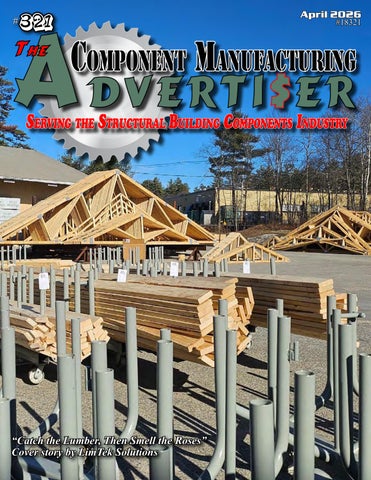
ICatch the Lumber, Then Smell the Roses
’ve been to Boston a few times, but like most business and installation trips, it usually goes the same way: fly into the airport, drive a few hours, get the work done, and head straight back home. There’s never any time to actually pause and “stop to smell the roses.”
My trip a few weeks ago was different and didn’t go according to plan. Some unexpected utility delays meant we had to finish training the following week, since I already had commitments waiting for me back home. What I didn’t realize at the time was that the real disruption was still ahead. When I arrived at the airport late Friday night, ready to fly home, I learned my flight had been canceled thanks to a March snowstorm and mounting airport slowdowns. I was rebooked for late Sunday night.
I still had to be home on Monday — only to fly back on Tuesday — and now I had an extra 48 hours in Boston!
What began as an annoying, drawn-out layover quickly transformed into an opportunity: a chance to hit pause, catch my breath, and finally get to see Boston. And it just happened to be the weekend of the St. Patrick’s Day Parade!
Do you recognize the gold dome of the Massachusetts State House? (Hint: it’s in one of my favorite movies, “The Departed.”)
These floats by the Carpenters Union Local 327 and the National Association of Women in Construction (NAWIC) caught my eye. I also got to see the impressive 40 foot high curved Glulam arches and beams that span the entire concourse of the Back Bay Transit station between the Dartmouth and Clarendon Street entrances.
Back to business, literally and figuratively, I was ready to complete the project and make sure everyone was trained on their impressive new system.
This installation features a forklift-fed RetroC using a raised bunk deck, spilling and flattening lumber onto an auto-feeding SmartConveyor equipped with an inkjet printer and Sawyer’s display. To top it off, SpeedCatch auto-fill carts eliminate manual catching labor, efficiently organizing lumber for the left, middle, and right sides of the truss build tables.
SpeedCatch is a labor-free lumber catching and sorting system that will efficiently organize lumber for any side of the truss assembly area.
This is efficiency in motion. It doesn’t take long for the RetroC and SpeedCatch system to fill carts, completely eliminating the need for manual catching and sorting.
Regardless of the type of trusses you’re building, this system will keep your business humming, and then you’ll have time to stop and smell the roses too!
Even though my two-day vacation in Boston was unplanned, it gave me an opportunity to put life into perspective. We all work hard at our jobs, so we should make improvements where we can to increase our efficiency, and then we can celebrate once in a while too — especially if it’s a holiday weekend.
When you’re ready to see how LimTek Process Organization Technology can help maximize your truss production, please let us know! https://limteksolutions.com/#solutions
GOING FORWARD, COSTLY SERVICE AGREEMENTS ARE A
THING OF THE PAST.
To see meaningful labor savings, quality improvement and production gains, SL Lasers with their easyto-see green light are nothing short of illuminating. They enhance worker accuracy and productivity, regardless of experience or primary language. They can reduce tedious setup time by up to 70%. No complex training or costly service agreements are required. And SL Lasers integrate seamlessly with any component design software and are quickly installed over existing equipment. We’ve been trailblazers in wood component laser projection since its very beginning, and we’re still delivering more rapid ROI for roof truss, wall and floor panel producers every day. Contact our enlightening team at Wood Tech Systems to see how SL Laser can deliver for you.
A dverti $ er
Striebig Optisaw, model Optisaw Automatic (Type # 5164) vertical panel saw station, with angled frame supporting material being cut: Max. cutting height (vertical) 5′-4″, max. cutting length (horizontal) 15′-1″, max. cutting thickness 2.36″. Both vertical and horizontal analog measuring scales on frame. Cutting head manually rotates from vertically to horizontally for rip vs. cross-cutting, adjustable spacers for repetitive cuts, 5.25 HP saw motor, 9.84″ diameter blade, guide bearings for travel , push button controls, e-stop button and dust extraction hose (no vacuum included). Overall footprint of station 19′-1″ wide x 4′7″ deep x 7′-10″ height. Sold for $36,000 new. 208 volt, 3 phase electrical required.
$14,490 FOB AZ Wood Tech Systems 765-751-9990
www.woodtechsystems.com
2000 Alpine AutoMill Component Saw 2000 Alpine AutoMill model 343H, (5) blade component saw, cuts lumber from 2×3 through 2×12, from 18″ to 20′, 4-angle floor webs from 18″. Includes powered length and angulation, digital readouts, (1) 32″, (3) 18″ & (1) 20″ blade, shaker under-saw scrap conveyor, incline, PC with Windows 98 o/s, and outfeed conveyor. Decommissioned in 2018. Stored indoors. 480 volt ,3 phase electrical required.
$10,497 NOW $5,997 FOB ON Wood Tech Systems 765-751-9990
www.woodtechsystems.com
Alpine AutoMill RS Parts
Alpine AutoMill RS Parts per Uploaded PDF
$23,500 NOW $19,500 FOB GA Wasserman & Associates 800-382-0329 www.wasserman-associates.com
NEW Hain 20' Powered Measuring System
Adapts to Any Saw. Left or Right Hand Operation. Feet & Inches System (Stops at 12” Centers) or Inches System (Stops at 10” Centers). Motor: 1/4 HP Linear Actuator (110 Volt). Stop Rail: 2 x 4 x 1/4” Aluminum Extrusion. Stops: Jig Bored Steel. Stop Blocks: Machine Billet Aluminum. Optional Lengths from 5’ to 60’. Optional Gang Stop. Add $890 per 10’ Section of Heavy Duty Roller Conveyor with Stands
$8,990
Wasserman & Associates
800-382-0329
www.wasserman-associates.com
2024 Hundegger Turbo Drive II Linear Saw
Configured for I-joist cutting of material 2×3 through 2×12, and EWP up to 17″ in width in lengths from 6′ to 32′. Saw includes Cadmium software and PC, outfeed monitor, UPS, frame for future install of tool carrier & motor in the future, central lube, bronze gilding, 5-arm infeed with additional 3 arms for loading EWP, extendable infeed supports, outfeed conveyor with storage arms, OEM waste system with controller, rear Ink-Jet printing, stacked timber processing, remote monitor, etc. Sold for over $410.000 new + freight and duty. Ready for immediate shipment. OEM Installation required.
Truss & Wall Panel Design Staff
EWP Layouts and much more!
Sub Component Nailer
Block Sizes: 2x4 & 2x6 framing lumber, any length
Nail Cycle Time: 1 nail 1 sec; 2 nail 2 sec; 3 nail 3 sec
Machine Set Up Time: 1 sec from any prior set up
Air Supply: 125 psi at 30 CFM, nothing less
Electrical Supply: 120 VAC
Frame: 1/4” steel plates mounted to heavy duty roll top tables and 2x2 skids mounted no install
$118,997 FOB GA
2014 Monet DeSawyer 2000
(Non-servo) five-blade, automated component saw using a touch screen interface and Windows 10 OS for direct input. Operates in automated or manual input mode. (1) 10 h.p., 30″ diameter blade with PAE setup & (4) 5 h.p. 16″ diameter blades with center line setup. 16″ blades cut angles from 3º to 115º, 30″ blade from 3º to 100º . Minimum 90/90 cut is 10 inches and shortest 4-angle cut is 18 inches. Cuts 2×4 through 2×12 lumber up to 20 feet in length.
Refurbished 2000 MangoTech saw with Automation, featuring direct drive 5.5 HP, cuts 4×2, 2×3 through 2×12 material, max angle 11 degrees, up to 37″ scarf cuts with 18″ carbide-tip blade. Includes stroke limiter, Plexiglass shield, 20-ft Mango Automation with 15″ touch screen input. PC has Windows 11 operating system with truss software. System includes 20-ft infeed conveyor and 5-ft outfeed conveyor. Saw has 3-month wear parts warranty after installation. 230 volt-30 Amp / 440 volt15 Amp, 3 phase electrical required for saw, 110 volt-20 Amp, 1 phase electrical required for PC.
• Automated Component & Linear Saws (2010 & Newer)
• Monet DeSauw or TimberMill Manual Component Saws
• Floor Web Saws
• Spida (Apollo) Saws with Truss Automation
• Bunk Cutters Truss Equipment
• Roller Gantry & Hydraulic Press Systems
• Finish Rollers
• Truss Stackers
• Floor Truss Machines
• Lumber Splicers
• Jack Tables
• C-Clamp Presses
• Stretch Roll-Off Trailers
• Go oseneck Roll-Off Trailers Modular Equipment
• Pacific Automation or MiTek Mobile Home Press
Wasserman & Associates for a Fair Market
your
• Automated Wall Panel Component Cutting & Marking as directed by your Wall Panel Design Software
• S600 Up-Cut Saw (Square Cut Only)
• 7.5 HP / 3 Phase Braked Saw Motor with 24" Blade
• Enclosed Hood & 2 Hand Control for Operator Safety
• 20' of Steel Framed/Plastic Top Table with Automated Length Stop/Plate Positioner
• 10' Infeed Steel Framed/Plastic Top Table
• 24" Industrial Touch Screen Computer
• Ink Jet Printer marks Wall Member Locations, Wall ID & Job Name
• Dust Collector
• Current use is a low volume shop
• Excludes: Installation/Training & Annual Technical Support Fee
$79,000 FOB MO
be considered!
Enhanced servo-controlled (ESC) component saw with touchscreen user interface and backup mechanical controls. Includes three operating modes: Auto (download setups from LAN or USB), Semi-auto (touch screen setup entry), and Manual (backup push-button switches for powering all movements). Includes Windows 11 operating system, over-travel protection, setup screens, auto sequencing, auto-calibration, and pneumatic brakes on all five (5) blades; one (1) 30” blade and four (4) 16” blades. Manual cut limits are 18” min. angled roof web, 11” min. square edge blocks, 20’ max cut length. Belt under-saw waste conveyor. $79,997 FOB CO
It’s Not a People Problem, It’s a Clarity Problem
Good people show up. They work hard. They care. Yet output still stalls, quality still slips, due dates still move, and managers still spend too much of their day answering questions, expediting work, and solving the same problems again and again. Because when work is unclear, effort gets wasted.
That truth gets missed every day in organizations full of sincere effort and constant activity, yet still struggling with follow-through. When frustration starts to show, the usual response is to push harder. More meetings. Repeated instructions. Tighter supervision. Another improvement effort. Yet the gains often do not hold, because the real issue is not effort. The real issue is that the work itself is too unclear, too dependent on memory, and too fragile under normal daily pressure.
After nearly 40 years in the workplace across multiple roles, and almost 25 years as a full-time consultant helping companies improve operations, I have seen that pattern repeat itself over and over. It is not a pattern that strengthens the operation, improves flow, or makes gains easier to sustain. Serious leaders need to recognize that the organization will keep paying for the same problems again and again with this approach.
One of the best formal tools for breaking those negative patterns is Lean Manufacturing. But the problem with Lean is that it is often easier to talk about than to implement and sustain. That is why so many Lean efforts start with energy and end with drift. If the work never becomes clear enough to teach, repeat, and sustain, the effort slowly fades, no matter how strong the kickoff looked.
That is one reason improvement work becomes so frustrating. People are trying to do the right thing, but they keep tripping over Lean jargon, overcomplicated explanations, and habits so common they start to look normal. Meanwhile, leaders often assume the problem is the workforce. In most cases, it is not. Good people are usually trying to work inside a system that asks them to remember too much, search too often, and work around problems that should have been designed out long ago.
That is why, when I perform a consultation, I do not want people focused on blaming others. I also do not want them buried in a Lean initiative that slowly withers over time. I want them focused on making the work easier to understand, easier to teach, easier to repeat, and easier to sustain. That need led me to create what I call the Granny Rules.
Todd Drummond
The Granny Rules capture core Lean principles in a practical, teachable, and usable way. They strip away unnecessary jargon and get down to what people can apply in real work. Make the work obvious. Give things one clear home. Design for real human limits. Fix the biggest part of the problem first, then refine what remains. Those ideas are simple, and that is exactly the point. Ideas only make a difference if people can actually use them every day.
Out of that came Lean Manufacturing Made Obvious for Leaders.
Now Available on Amazon
This book is written for leaders who want to build systems that real employees can follow and real managers can maintain. Many books tell you what a good system should look like. This one helps you make the work obvious enough that the system can actually hold.
Wayne Townsend received an advanced copy of the book’s manuscript. Here is his testimonial.
“I have been teaching and implementing Lean for decades, and Granny’s Rules are the simplest explanation I have ever run across. I intend to run my entire team through this book, and I cannot wait for Granny’s Rules of Six Sigma to come out. Thank you.”
Wayne Townsend, COO Ridgway Roof
Truss Company,
Inc.
That matters to employees because much of the waste they deal with every day gets accepted as normal. Searching. Waiting. Repeated questions. Confusing instructions. Avoidable mistakes. Workarounds. A new employee cannot find what they need. A supervisor answers the same question ten times a day. Work sits still because no one is fully sure what comes next. Over time, that kind of environment wears down good people. It slows learning, weakens confidence, and creates frustration that management often mistakes for attitude.
This book shows that work can be designed to teach the worker. It can be visual, organized, and simple enough that people do not need tribal knowledge or a great memory just to do routine work well. When that kind of clarity exists, training improves, questions go down, stress drops, and confidence goes up.
Managers suffer from the same problem in a different way. Too many spend their day holding broken systems together through personal effort. They answer questions that the process should answer. They chase work that should have flowed. They keep standards alive through reminders and constant intervention. From a distance, that can look like leadership. In reality, it is often process weakness wearing a management badge. Managers should be leading improvement, not rescuing fragile systems all day.
That is where this book becomes especially useful. It creates a straightforward common language across the organization. Employees can understand it. Supervisors can apply it. Managers can teach it. Executives can support it. Improvement stops being a specialist conversation and starts becoming a practical way of operating.
The value does not stop there. The bonus Theory of Constraints guide adds practical help. Many companies waste time and money trying to improve everything at once, only to discover they improved the wrong area. The TOC guide helps leaders identify the real bottleneck, protect it, and improve the one step that actually controls output. That helps prevent wasted capital, false urgency, and expensive decisions that miss the true constraint.
So this book is more than a book. It is a practical guide for leaders who want better work without more confusion and better results without depending on heroics. It helps organizations move away from blame, jargon, and fragile systems that only work when the right person is standing by to hold them together.
When work becomes obvious, organized, and built for real people, training improves, quality improves, flow improves, leadership improves, and profit improves. Most importantly, the work gets better for the people doing it every day.
That is the real promise here. Not Lean as a slogan. Not improvement as a program. But a clearer, more teachable, more sustainable way to run the work.
If you are tired of watching good people struggle inside unclear systems, Lean Manufacturing Made Obvious for Leaders was written for you. Buy the book, put it in the hands of your leaders, and start building work that people can understand, teach, and sustain.
If your operation feels harder than it should, there is usually a reason. The answer is not more effort, more pressure, or more activity. The answer is clarity. Todd Drummond Consulting helps manufacturers uncover what is truly slowing performance, whether it begins in workflow, labor visibility, training, handoffs, or leadership decisions. With practical guidance grounded in real operational experience, TDC helps leaders simplify the work, improve flow, reduce waste, and make better decisions that support stronger margins. The goal is simple: help you see the real issue, focus on what matters most, and move forward with confidence.
Alpine AutoMill HP, model 349C component saw. Servo controlled computerized saw sets up in 2 to 19 seconds and downloads from a network, or by using a touch screen for ease of operation. Five-head automated component saw works in both automated (downloading files), semi-automated control (via touch-screen input) or manual mode. It has (23) axes of automated movement, enhanced diagnostics, and auto management reporting.
The HP cuts from 2′-6″ to 20′-0″ long material in size range from 2×3″ through 2×12″, and 4-angle floor webs from 2′-0″. Includes [3] 18″, [1] 20″ and [1] 30″ blades with air brakes, Windows 7 o/s and under-saw scrap conveyor. The Windows 7 o/s can be upgraded to a version of Windows 10 that will be supported until 2032, at an additional expense.
Also includes over $8,000 in spare parts. 480 volt, 3 phase, 100 Amp electrical required. 90 PSI @ 69 SCFM air required.
$129,997 NOW $119,990 - FOB OR
NEW!
Terminailer
Price: $237,900
FOB: ND
The Terminailer all but shatters the stereotypical myth that sub-component equipment is essentially peripheral – unimportant. And it does so by quickly and accurately driving far more framing nails in your wall panel jobs than ever before. Whether in your shop or in the field, one operator sets the pace for production and quality, which reduces labor costs and other aspects of overhead.
The new Terminailer V.8 improves on the previous generation Terminailer in several key ways:
All new HMI/Software
• Siemens Pivoting HMI Touchscreen display to operate from either side
• On-screen tutorial for all menu items
• Operator now controls functions such as process speed, nail spacing, nail patterns, etc.
• Simplified input commands
Nail Feed Complete Redesign
• All new frame to allow for redesigned nail coil placement with direct feed path
• EverWin PN90-PAL industrial tools now standard equipment
• New nail guides with spring-loaded tensioners
• Nail coils move with vertical travel of the nail guns
Reengineered air system
• SMC “Soft–Start” Pneumatics
• Simplified air for control to all components: lift–cylinders, triggers, stop–gate, etc.
• Direct air supply to each nail gun for improved nailing performance
• All pneumatic elements are clearly labeled for EZ service and adjustment
• “Block–wheel” redesign for 3X increased applied force
• Approximately 1,200# of applied clamping force resulting in straighter finished
• Subcomponents from even the poorest lumber
• Larger doors for easier access to interior elements including coil–nail spools
Terminailer is an event-driven, sub-component assembler that will quickly and accurately drive 30% to 70% of the framing nails in any wall panel job. In your shop or in the field, one operator sets the pace for production and quality. The Terminailer functions independent of design software, requires zero set-up time when switching between any configuration, and requires no special operator training.
The Terminailer is easy to move around the shop so its location can evolve as your shop evolves. With all of the nailing occurring in the closed main chamber, nail injuries and nail location misfires are eliminated, making your plant that much safer.
With nearly ten years of development from people that know machinery, it is assembled to exacting standards, well supported, and it is easily maintained with shelf-item parts. Terminailer: vetted, tested, and ready to drive maximum productivity for you. Be sure to check out our videos below for a quick review of this revolutionary machine!
208 volt, 3-phase, 21 (full load) Amps, 60 Hz electrical required. 50 SCFM @ 100 PSI air required. Net weight 7,000 lbs..
New! SQUOTE LAYOUT
Get your engineered design-based floor and roof truss quote in minutes, not hours. Save designer time and save money!
Based on the major plate suppliers' engineering
& Plane Input Updating Quotes Squote PDF Export
1999 Alpine SpeedCut
Centerline Pull-Arm Saw
1999 Alpine Metra Cut, model SSA-17, pull arm, centerline saw. 16″ blade, maximum cutting depth of 6″, maximum scarf length of 31″, 164 deg. cutting range and 5 HP motor. Includes push-button on/off controls and analog angle measure on turntable. Need re-assembly. 220/440 volt, 3 phase electrical required.
Call For Pricing, FOB OR Wood Tech Systems
765-751-9990
www.woodtechsystems.com
2023 Northfield Model 410 Upcut Saw NEW 2023 Northfield model 410 upcut saw available for immediate shipment. 90/90 degree cuts to 4″ x 10″ capacity (fence forward position) to 2″ x 14″ (fence rearward position). Saw is configured for material from left to right, with 3″ x 6″ air operated cylinder, filter, regulator, lubricator, 10 HP motor, enclosed steel base with cast iron table, magnetic starter and adjustable operating speed from 20 to 60 CPM. Includes optional two-palm controls, additional 4″ dust outlet, NEMA 12 electrics with fused disconnect and two 18″ diameter 60 tooth blades with 1″ diameter bore. 460 volt, 3 phase electrical required.
$18,630 FOB MN Wood Tech Systems
765-751-9990 www.woodtechsystems.com
2005 Alpine ALS 276C Linear Saw 2005 Alpine ALS 276C linear-feed saw (Refurbished in 2015). Cuts wall and truss parts from lumber depths 2×4 through 2×12, 60”+ scarf cuts, internally optimizes material (up to 11 7/8″ x 1.5″ EWP). Includes 15-foot idler roller infeed conveyor, 15-foot idler roller outfeed conveyor, and under-saw scrap conveyor with belt-type incline. All servo-controlled functions, Microsoft Windows 10 OS, 7.5 hp motor with 20” carbide tipped blade. Includes any available spare parts. No printer is included. 230v, 3 ph power, 70A electrical required. Includes step-down transformer. 125 PSI air required.
$39,991 NOW $35,997 FOB OR Wood Tech Systems
765-751-9990
www.woodtechsystems.com
1982 SpeedCut MetraCut Centerline Saw
GOOSENECK ROLL OFF TRUSS TRAILERS
1982 Speed Cut Metra Cut, model SSA-11, centerline saw, 16″ blade, maximum cutting depth of 6″, maximum cut length of 31″, 164 deg. cutting range and 5 HP motor. Includes push-button on/off controls and analog angle measure on turntable with air stop, 20′ long infeed conveyor with OEM SpeedMeasure, 20′ long outfeed conveyor and one (1) spare blade. 208 volt, 3 phase electrical required (can be converted to 240v/440v).
$6,990 FOB WY Wood Tech Systems 765-751-9990
www.woodtechsystems.com
New Monet DeRobo Linear Saw
New, DeRobo linear saw by Monet organizes "fill" boards to increase optimization of each board, can produce unlimited scarf cuts, cuts 1 or 2 boards at a time and cuts webs, chords, wedges, rafters and open-stair stringers. Works with all major connector plate manufacturer's software. Features include 22 inch blade, left-to-right feed direction standard, lumber push and pull grippers for more accuracy, ink marking on the 1 1/2" face of the incoming boards and small piece capture and delivery to the front of the saw for easy access. Infeed deck and bunk feed are shown as options only. 480 volt, 3phase.
$257,000 FOB MO.
Streamline your truss operation with a total solution.
Transform your truss operation with an integrated solution from Simpson Strong-Tie. The industry leader in truss plates now brings you a full suite of software, equipment, hardware and services to drive truss component manufacturing from idea to installation. Start with CS Director™, CS Truss Studio™ , CS EWP Studio™ and CS Producer™ for design, layout, production and project management. Use our powerful Monet DeSauw industrial saws to cut webs, chords, stair stringers, rafters and wedges with speed and precision. Specify the optimal connectors, anchors and Strong-Drive ® structural fasteners for every project. You can also complement your team with our professional truss design services at any time. Altogether, you have a smart solution made to increase productivity, ensure high quality and take your business to the next level.
To learn more, contact your representative at (800) 999-5099 or visit us online.
$18,880 NOW $17,000 FOB MB Wasserman & Associates 800-382-0329 www.wasserman-associates.com
2004 Manual Apollo Saw
• 5.5 HP Motor (3 Phase) with 18" Blade
• 6" Maximum Cut Depth with 36" Stroke for Long Scarf Cuts
• Minimum Angle of 10 Degress (160 Degree Angular Movement)
• Turntable Air Brake
• Variable Stroke Limiter & Saw Barrier Guard for Safety
• 15' of Roller Conveyor with Stands
• New Blade Guard (in box) $11,500 FOB NE Wasserman & Associates 800-382-0329 www.wasserman-associates.com
Safety Speed Cut Model 7000 Panel Saw
Safety Speed Manufacturing model 7000, vertical panel saw, 3 HP induction motor, 64 inch crosscut, 2-inch maximum thickness, accuracy within 1/64th of an inch, 96" tall x 10-foot-wide welded steel frame with integrated stand and linear V-guides, enclosed counterweight system, adjustable vertical and horizontal rules. Quick changes from vertical to horizontal cutting. Includes machined aluminum material rollers, hold down bar, wheels, quick stop gauges and material hold downs. Dust collection ready. Options available include lower frame width extension to 13-ft, digital readouts, laser guide, stop bar, vacuum, and midway fence.
2007 Alpine ALS 276 Linear Saw
Cuts wall and truss parts from lumber depths 2×4 through 2×12, cuts bevels from 90 to 25 degrees, 60”+ scarf cuts, optimizes material, production rates +2000 pieces per 8 hr. shift. Includes 16- foot ICC-brand infeed deck, 20-foot-long infeed roller and 16-foot powered outfeed conveyor, Matthews “Mperia V” series 8000 printer (one 3
½” face) added in 2022, and undersaw belt scrap conveyor. All servo controlled functions. Windows 10 o/s. Includes Servotronix upgrade, recent saw head bushing, bevel motor and gearbox installed in 2024, spare blade, all available spare parts and digital operator’s manual.
FL
• New saw design with double slide minimizing footprint
• Roller slide reducing risks of injury by lowering the effort pulling the saw
• Hybrid aluminum-steel construction combining the robustness of steel for the frame with the lightness of aluminum for the moving head
• High resistance powder coat paint surface finish
• Blade travel adjusts automatically depending on the saw angle
• Saw arbor type 5 HP motor with integrated mechanical brake
• (575 Volts – 3 phases)
• Angles from 10° to 110°
• Head overall travel length of 26in
• 18in saw blade
• 5.5in cutting height
• Complete « wrap-around » blade guard
• 4in dust collector connection
By Kathryn Pedde
Moving Lumber Keeps Getting Easier
When we launched JAX over 2½ years ago, we knew we were building something special even though JAX breaks no new ground in technology. JAX uses a proven industrial-grade material handling system combined with vacuum-operated lumber pickup heads, which can be configured in multiple ways to suit practically any plant. The process is deceptively simple. The JAX gantry head moves to the location of SKU X, picks up Y boards, and delivers them to Z locations, where X ≤ 35, Y ≤ 13, and Z ≤ 6.
We’ve configured our JAX with 33 SKUs and 3 saws – an Alpine ALS, a MiTek Blade, and a Monet DeSauw Automated Component Saw. Each of these saws was ordered with a stock configuration and required no alteration to work with JAX. Likewise, JAX works with any design software without alteration to its functioning. It simply reads the file that is normally sent to the saw and sends it to JAX in the order received.
Since we installed JAX, it became convenient to keep track of inventory, so we hired Q4US to write a perpetual inventory program too.
Every day, one of us in the plant office keeps a close eye on JAX’s operation. From the time JAX was installed until the present, we’ve been able to respond immediately to any stoppage or anomaly. Initially, that required one of us to hustle out to JAX to discover the cause. As owners, we didn’t hesitate to shut down all or part of JAX to discover the problem, since we could always feed the saws manually, like we used to do. This way, we avoided workarounds or band-aid type solutions that may have just kept JAX producing and may have masked the root cause. But over time, we’ve added cameras so that we can watch JAX’s continuous movement on monitors in our offices or on large screens in the plant that depict up to 8 distinct views.
Announcing JAX-XL for Lumberyards
In reflecting upon the solid performance of JAX, The Wood Retriever in a truss-oriented application, we are proud to announce that we are extending JAX technology to lumberyards. In this new implementation, JAX-XL, all partial bunks of generally rectangular SKUs are tightly arranged in a centralized, covered storage area, serviced from overhead by a Sage Automation gantry and underneath by Toyota Autonomous Guided Vehicles (AGVs). Bunks of materials of various lengths are set endto-end in columns 5’-0” on center, numbered 1 to 34 in this example. These bunks may contain sticks of lumber, lengths of LVL, units of OSB, and all kinds of sheet goods. JAX-XL is dedicated to retrieving partial bunk orders, while full bunk orders are stored, accessed, and loaded onto trucks in another location.
JAX-UC software, developed by Q4US, synchronizes the gantry and AGV movements, for example:
• Retrieval: 2x12x14 SYP from 10B is set in the Order 1 cradle, then 2x8x10 PT from 12D is set on top.
• Replenishment: JAX-XL gantry retrieves an empty cradle from 11B and moves it to 16G; AGV moves beneath 11G, 11F, 11E, and engages 11D, moving it into 11B; AGV moves 11E, 11F, and 11G in succession to fill empty locations; AGV moves cradle with full unit into 11G.
• Outgoing orders: AGV moves Order 1 cradle outside JAX-XL space and advances Orders 2 and 3.
While this novel configuration of bunks of material may be new to the lumber business, it is not new for Sage Automation, the Beaumont, Texas provider of JAX. In other industries, the Sage gantry already spans up to 70’ and can pick from densely packed stacks of different SKUs of tires, for example. While the JAX-XL gantry moves pieces efficiently within the structure, the Toyota AGVs have the capacity to move full bunks into, around, and out of the JAX-XL enclosure, to keep orders flowing.
When you’d like to learn more about what JAX can do for your operation, please call me or Richard Pedde at 980-404-0209.
“Over the years Alpine ensured our quality and production kept improving. Working with Alpine has been a 22 year friendship as well as a partnership!”
— Roy Bedient
Manager/ Production Manager, Warman
Truss
Alpine has it all—the right equipment, user-friendly software and dependable hardware to improve your teams efficiency. Alpine delivers the complete package for success—including comprehensive support and service that sets us apart within our industry.
Ask those who know. They’ll tell you about the people at Alpine who make a difference.
Used Hain Quick Rafter Cutter
• Reconditioned in December 2020
• Board Sizes: 2x4 and 2x6
• Motors: Two 1 HP / 220 Volt or 440 Volt / 3 Phase
$29,900 NOW $14,900 FOB AZ Wasserman & Associates 800-382-0329 www.wasserman-associates.com
In answer to the demands of high-volume customers comes the Monet DeSauw FWA 500 CA (Automated Controls) floor web saw. The 500 CA is perfect for component manufacturers who routinely run floor trusses in high volumes with variable web geometry. Another primary feature is enhanced safety through automation which eliminates the need to open the saw motor cabinets other than for periodic service. The 500 CA includes automation for all blades, including the fixed cut-off blade for minimal waste. Lumber infeed speed is variable up to sixty (60) boards per minute, while the powered carriage utilizes rack and pinion drive with airlock for set accuracy throughout the production run. Your operator will easily download batches to the 500 CA saw from your design software via an ethernet connection to a MS Windows 10 industrial PC with a 17″ monitor housed in a stand-alone console. If you frequently batch floor web cutting, and if enhanced safety with increased productivity are a concern, then an automated Monet FWA 500 CA may be the right selection for you. More information click Here
Together the PieceGiver and PieceMaker streamline production, boost efficiency and reduce manual labor – all with just ONE operator.
Is truss cutting your bottleneck? Get in touch to learn how the power duo can transform your workflow!
The PieceMaker
An automated linear saw that cuts, prints and optimizes.
The PieceGiver
A high speed, fully automatic lumber loading system.
• 4.0
• 230 Volt / 3 Phase
• Cutting Length: 14’ / Cutting Height:
• Automatic Mode: Plunge, Saw & Return with Variable Speed Control
• Top & Bottom Sawing Beams with Pneumatic Arrest
• Digital Horizontal Cutting with Motor-Driven Precision Adjustment
• Digital Longitudinal Stop with Fine Adjustment
• Pneumatic Support Grid
• Dust Extraction Port
• Like New Condition
• A 2016 COIMA FI6000 Dust Collector is available at additonal expense Panel Saw - $21,900 Dust Collector - $7,900 FOB CA Wasserman & Associates 800-382-0329 www.wasserman-associates.com
$15,399 Base FOB MN
Safety Speed Manufacturing Model 7400 XL Panel Saw Ready for long hours of accurately cutting OSB, fiberglass reinforced sheathing, and virtually any other sheathing material specified. The 7400 XL features a quiet 3 HP induction motor, 64 inch crosscut, 2 1/8″ maximum thickness, accuracy within 0.005 inches, 96" tall x 13-foot-wide welded steel frame with integrated stand and linear V-guides, enclosed counterweight system, adjustable vertical and horizontal rules. Quick changes from vertical to horizontal cutting. Includes machined aluminum material rollers, hold down bar, wheels, quick stop gauges and material hold downs. The 7400 XL is dust-collection-ready for easy connection. Options available include digital readouts for vertical cuts, laser guide, stop bar, dust vacuum and midway fence.
$355,000 Location: MO
New, Monet DeSawyer 2000, computerized, five-bladed component saw, sets up in 15 to 17 seconds, can run in manual mode, downloads projects from a network or manually using display screen controls. Features all powered movements, cuts from 15" 90/90 cuts to 20 foot length, 2 x 3" to 2 x 12" lumber depths and internal brakes are standard. Options include enhanced servo controls featuring autocalibration, catcher's display and either shaker or belt scrap conveyor and incline. 440 volt, 3 phase electrical.
By Gerhard (Garry) Roehr, P.Eng.
LSay Hello to AMT Robotics
ast fall, I had the chance to catch up with many of my peers at BCMC Omaha, and now I’m pleased to say Hello to an even wider audience. As an Industrial Engineer with 3 decades’ experience in PreFab, I am eager to share our innovative solutions to continue to help move our industry forward.
AMT Robotics was founded in 2020 Winnipeg, Manitoba, Canada. Our journey began with the development and manufacturing of a custom automated wall sheathing station. Since then, we’ve developed and installed a line of equipment for the manufacturing of prefabricated wood wall panels and have undertaken a variety of custom automation projects for industrial customers.
At BCMC, we showcased our Datum Squaring Table, which is the building block of our wall panel production line. It can be configured for Framing, Insulating, Tacking, and Sheathing Stations, and integrates with other AMT Robotics equipment including the HyperLeap Sheathing Bridge, Gluing Bridge, and Panel Flipping Material Handling Station.
Two features that set the AMT Datum Table apart from other squaring tables are our patent pending multi-panel staging and auto-squaring which work together to eliminate lost production time between panels and reduce the required space and investment cost of the overall line. Lifters maintain a panel’s location by raising it slightly above the wide slatted power conveyor. Upstream panels can continue to move down the line on powered conveyors and occupy unused areas as buffer zones. The result is faster cycle times due to less waiting for other stations on the line and less time spent moving panels from station to station. Eliminating extra stations for buffer zones also shortens the line, improves operator efficiency, saves floor space, and reduces the initial cost of the line. Combining an AMT Squaring Table equipped with auto-squaring and the AMT HyperLeap Bridge creates a fully autonomous Sheathing Station with unmatched cycle times.
We love engaging with our customers to deliver the right level of automation for each unique situation. Reach out when you are ready to talk more, and in the meantime check us out on LinkedIn, YouTube, and amtrobotics.com.
• High Performance Linear Feed Saw (Non-Beveling)
• H igh Performance L1 & L2 Motors and Gear Boxes
• Servo Blade Motor with 20.5" Blade
• Blade Motor was replaced in Late 2024
• Touchscreen Monitor
• Mattthews Ink Jet Printer
• 8' Automated Live Deck
• Outfeed Queue System
• Waste Conveyor
• 230 Volt / 3 Phase
• Excludes Dust Collector
• V ideo available upon request
• Price in in US Dollars
interface and Windows 10 O/S for direct input. The DeSawyer 2K Can operate in automated or manual input mode. (1) 10 h.p., 30″ diameter blade with PAE setup & (4) 5 h.p. 16″ diameter blades with center line setup. Mechanical backup counters and scales, powered chain infeed with upper hold-downs, and shaker pan waste conveyor (no scrape incline). 16″ blades cut angles from 3º to
to 20 feet in length. 480 volt, 3 phase, 60 Amp electrical 90 psi air required. (Seller reserves the right to decline sale based on buyer’s regional trade area).
New
Monet FWA 500 Floor Web Saw
New Monet 5-head, floor truss web saw, cuts 4-angle, 4×2 floor truss webs from 13 inches and 90-90 blocks from 7 inches, to 4 foot long maximum length. Features 10-board magazine feed, powered, fixedquadrant angulation, manual carriage standard, scrap conveyor and cut-off blade. Options available for longer carriage length, incline scrap conveyor, and choice of shaker or belt scrap conveyor. 440 volt, 3 phase, 60 Amp electrical. 50 PSI air at 5 CFM required. $83,000 FOB MO
www.woodtechsystems.com
• 10 Each - Standard 20 Ton Track Mounted Heads with 10" x 10" Platens (refurbished in 2011)
• 6 Each - 2011 Double 40 Ton Track Mounted Heads with 10" x 15" Platens
• 2 Each - 2021 Double 40 Ton Track Mounted Heads with 10" x 15" Platens
• 2 Each - 10 HP Two Stage Hydraulic Systems with Controls (230 Volt / 3 Phase)
• Track System for 55' Scissor & Flat Bottom Trusses
• 1 Each - Peak Head Track (perpendicular to base line)
• 2 Each - Movable Bottom Chord Tracks (to adjust for pitch)
• 8 Each - Floating Tracks for Top Chord Head
• Clamping Package: Peak, End Stop, Camber Stops & Air Clamps
• Air & Hydraulic Manifolds with Quick Connectors for Heads
• 26 Each - 14' Powered & Idle Exiting Rollers with Stands $89,900 NOW $59,900 FOB AR 765-751-9990
OPTIMIZE WITH THE INNOVATORS
REAL-TIME OPTIMIZATION IS HERE
Vekta’s innovative Real-Time Optimization software leverages decades of technology advancements and intelligent algorithm development to provide unparalleled flexibility and control of your cutting and production planning.
RTO is designed specifically to make considerable improvements to operational and material efficiencies in plants with a direct delivery system, but can also benefit smaller setups as well.
KEY FEATURES:
• SIMULTANEOUS OPTIMIZATION – instantly optimize multiple jobs across assembly stations, minimizing waste.
• REAL-TIME ADJUSTMENTS – adapt cutting volumes and flow to meet dynamic point-of-use demand.
• DECENTRALIZED INTERFACE – empower your operators with the ability to schedule zero-disruption recuts directly from the point-of-use. Load, adjust, reorder and reroute in real-time from any network device.
• MULTI-SAW MANAGEMENT – efficient single operator control of multiple saws, reducing labor requirements and costs.
• CONTINUOUS CUTTING LISTS – eliminate end-of-file waste through seamless job transitions, optimizing material usage.
Simply put, RTO is a comprehensive solution to provide significant improvements in productivity and waste reduction.
2006 Alpine Speed Rafter Cutter
• Simplified compound cutting for hip, valley and jack rafters (double & single compound cuts)
• Two Worm-Drive Circular Saws (110 Volt / 30 Amps)
• Saw Turntable (for angle cutting)
• Saw Carriage (for up to 45 degree bevel cutting)
• Infeed & Outfeed Roller Conveyor with Stands
$4,900 NOW $4,250 FOB CA Wasserman & Associates 800-382-0329 www.wasserman-associates.com
Used - Metra Cut Radial Arm Saw (2x) Parts Machine
$500 – Make Offer
Eide Machinery Sales, Inc. 612-521-9193 www.eidemachinery.com
Used - 2005 Model 305 Infeed Conveyor Designed for use with all component saws. To include: Soft Start ~ Soft Stop Inverter System. Programmable load sensing; Overload / Jamb sensing shut down feature. Gear motor providing conveyor speed of 36' per minute. Forward and reversing controls for location at both ends of conveyor unit. Material capacity range - 4' through 24' lumber. Chain deck pedestals 20' long with cross bracing. Staging area at the saw independent of the live deck system. 30,000lb. Deck capacity. Call for pricing
Eide Machinery Sales, Inc. 612-521-9193
www.eidemachinery.com
Safety Speed Manufacturing Gypsum Cutter
Lose the dust and noise for processing material such as DensGlass®, or other gypsum products with the Safety Speed model VGC 515 cartridge cutting system. Easily process full sheets of gypsum wall panel sheathing of material in widths up to 64". Fully portable, and with NO power or air required, the VGC 515 is dust and noise free to easily score gypsum material that rolls effortlessly to an integral edge used for breaking scored material. Features blade cartridges for quick exchange in less than a minute and uses off-the-shelf utility knife blades. Includes two cutting/scoring cartridges, removable clamping bar, integral counterweight, both left & right measuring tapes, wheels for portability, free-standing 90" tall x 10-ft wide frame and 5-foot Quick Stop system for accurate, repetitive cutting.$6,399 FOB MN Wood Tech Systems 765-751-9990 www.woodtechsystems.com
• 5 Blade Automated Component Saw
• Cuts 2x3 through 2x12 from 11" to 20'-0"
• Computer, Enclosure & Stand
• Waste Conveyor (under saw)
• E xcludes Incline Waste Conveyor (adjacent to saw)
• Video available upon request
• Add $12,500 for 6 Chain Live Deck $16,500 NOW $14,900 FOB ND Wasserman & Associates 800-382-0329 www.wasserman-associates.com
New SpeedWorx Automated Sheathing Station
Reduce labor and operator fatigue by taking advantage of the SpeedWorx automated vertical panel saw. This one-person station cuts wood sheathing sheets up to 50 inches x 10 feet, and up to 2-inch thickness, using a fast 1-button cutting setup with CNC accuracy to 1/32 of an inch (0.03125″). The usage of each sheet is optimized through automated sequencing. The photos of raw materials illustrate the drastic reduction of scrap material thanks to implementing the Rogworx saw station.
Visual user interface with standard ‘Auto Fill’ feature makes choosing the job and sheet-cutting order easy to determine. Files are downloadable allowing for minimum waste. Saw station reads WBX file format (Alpine) or EHX file format (MiTek) or CSV files with manipulation. System offers full optimization and sequence panel parts, looking ahead through the job based on your specification. The cutting chamber automatically switches from rip to cross-cutting. All this in a 100-square-foot footprint, approximately 25′ long x 4′ deep, so it can fit within existing facilities. Includes advanced dust collection. Integrated printing for labeling parts is available as an option (additional $14,000).
$143,500 (Base)
New Monet DeSawyer ESC (Servo Controlled) Component Saw
Monet DeSauw model Desawyer ESC enhanced servo-controlled ( ESC) component saw with touch screen user interface with backup mechanical controls. Includes three operating modes: Auto (download setups from LAN or USB), Semi-auto (touch screen setup entry), and Manual (backup push-button switches for powering all movements). Includes over-travel protection, comprehensive setup screens, auto sequencing, auto-calibration and pneumatic brakes on all five () blades. One (1) 30” blade and four (4) 16” blades. Manual cut limits are 18” min., 11” min. square edge blocks, 20’ max cut. Belt under-saw waste conveyor. Voltage: 480 volt/3 phase/60 Amp. Air: 50 PSI at 5 CFM. One-year warranty included. Can be paired with a model PD-6 lumber feed system at an additional cost. Heavy duty 80 RIV chain feed system. 16’ wide x 20’ long x 36” deck height. Transfers 3’ to 20’ lumber. Includes auto-feed control, foot pedal override, forward & reverse, variable speed control with HD double-bearing construction. Other additional-cost options include, inkjet marking, label printing, backside screen display, spare blades and incline scrap conveyor.
$386,000 FOB MO
Trusses! A Better Retrofit Solution!
Jacks &
Small
Retrofit your tables for Jack and small truss production, a growing percentage of what you do! The ‘Double
Jack Retrofit ’ allows you to double your production by operating on both sides of the table, allowing assemblers to quickly build four or more trusses in half the space. Unlike conventional setups that demand longer lines, this retrofit optimizes floor space by consolidating jack production on a shorter, standalone workstation or retrofit the end of your existing line.
• 14’ x 24” Diameter Gantry Roller (Model 14RT)
• 7 1/2 HP Motor (208 Volt / 3 Phase)
• 14’ x 64’ Steel Slotted Top Table with End Eject Rollers (Raised Track)
Carl Villella, CLFP President, Acceptance Leasing & Financing Service
Sales Tools: How Equipment Financing Drives Growth in Wood Component Manufacturing
In an industry defined by efficiency, you aren’t just selling a piece of iron; you are providing a self-funding production tool. If a new linear saw reduces waste and labor costs by $15,000 a month and the finance/lease payment is only $4,000, the sale is no longer an expense — it’s an immediate $11,000 monthly gain.
In the high-speed world of roof and floor truss and wall panel manufacturing, the hurdle to a sale isn’t the quality of the saw or the efficiency of the gantry — it’s the complexity of the capital. While general business loans often require a tangled web of collateral, Commercial Equipment Financing and Leasing simplifies the equation by using the machinery itself as the sole security for the debt.
For sellers of specialized wood processing technology, this shift from general lending to assetspecific financing is a tactical masterstroke. It allows sales teams to adapt to industry-specific buyer hesitation, succeed in closing complex capital projects, and execute aggressive growth goals with surgical precision.
Adapting to Modern Financial Constraints
Truss and component manufacturers often operate with tight margins and heavy reliance on their primary bank lines for lumber inventory and payroll. A traditional bank loan typically requires a “blanket lien” on the buyer’s entire business. This “all-in” requirement scares away savvy manufacturers who want to keep their operating capital liquid.
By offering financing where the saw or press is the only collateral, sellers adapt to these concerns. This structure creates “siloed” debt: the equipment pays for itself through the labor savings and increased board-footage it generates, while the rest of the manufacturer’s business remains unencumbered. When the collateral is restricted to the specific asset being sold, the barrier to upgrading a production line drops significantly.
Succeeding Through Speed and Simplicity
In the wood building component industry, timing is everything. A manufacturer may need to scale up quickly to meet a surge in housing starts or a massive multi-family contract. Equipmentonly financing allows for an **“Application Only”** process that can often be approved in 24 to 48 hours.
Because the lender understands the high resale value and long-term utility of specialized equipment like component saws or floor truss machines, they don’t always need a weeks-long forensic audit of the buyer’s global financials. This speed allows sellers to do the following.
• Capture Momentum: Close the deal while the manufacturer’s backlog is at its peak.
• Mitigate Competition: Secure the order before the customer has time to second-guess the investment.
• Simplify the Pitch: Move the conversation from “How will you afford this?” to “How much faster can you ship trusses?”
Executing Bold Sales Goals
To hit ambitious targets, sales teams must be able to sell to more than just the industry giants. Equipment financing expands the reachable market by allowing for **100% financing**.
Since the machinery serves as the security, lenders can wrap “soft costs” — such as specialized software integration, freight, and onsite technician training — into a single monthly payment. For a sales rep, this means a customer can install a state-of-the-art automated production line for $0 down.
We are Acceptance Leasing and Financing Service, Inc. We were established in 1992, which puts us in our 34th year of business. We pride ourselves on our Certified Leasing and Financing Professional designation. We are a member of SBCA and a frequent attendee of the BCMC tradeshows. We can provide financing for any new and, regardless of age, used equipment. We invite you to contact us at 412 262-3225 to discuss your particular situation.
Increase Your Market Share by Adding Floor Truss Manufacturing
We have a range of products suitable for floor truss manufacturing and we offer floor truss solutions customized to your requirements too! Choose from side or end eject options to suit your operation and space.
Get in touch to learn more about adding floor trusses to your production line and how it could benefit your factory!
Price Reduction!
Baumeister Lumber Splicer
• Vertical Hydraulic Press with 3"x 12" Platen Size
• 2x3 and 2x4 Lumber Material (3" x 10" maximum plate size)
• Magnetic Platens to hold plates in the correct position
• Working Pressure: 1600 PSI
• Dual press cycle activation for safety
• 208, 240 or 480 Volt / 3 Phase (10 HP)
• Video available upon request
• Excludes: Infeed/Outfeed Roller Conveyor
• Optional 2x6 Capacity (up to 16" long plate) Splicer is available
Call for pricing FOB PA Wasserman & Associates 800-382-0329 www.wasserman-associates.com
Commercial
Machinery
Fabricators
12' Finish Roller
• 12’ Long x 18” Diameter Rollers
• Front and Rear Safety Bars
• Adjustable Roller Height (1 1/2” and 3 1/2”)
$14,900 NOW $13,900 FOB IA Wasserman & Associates 800-382-0329 www.wasserman-associates.com
EMSI Field Repair Press
EMSI 10 Ton Field Repair Truss Press
System. Complete with: 1/2 HP, 115 Volt, 50/60 Cycle Universal Motor – Operates at voltage as low as 60 volts. 10,000 PSI
Portable Power Pack with Two Speed Operation – 200 cu in/min @ 0–200 psi, 20 cu in/min @ 200–10,000 psi and Externally Adjustable Relief Valve (unit weight 55 lbs.). C-Clamp Assembly with 8" Maximum Reach, 4" x 5" Pressing Platen (optional platen available for 4” x 2”). Independent 10 Ton Hydraulic Cylinder. 10’ Hydraulic Hose Assembly with Quick Disconnect Coupling. Handle with 24 Volt Remote Electrical Pendant.
Call for Price Eide Machinery Sales, Inc. 612-521-9193 www.eidemachinery.com Four Eagle Production Presses with Jig Table
• (4) Eagle Production Presses (1 new in 2023, 2 with new pumps within the last 3 years, 1 with older Simplex motor)
End-eject floor machine with floor finish roller press, 40-ft working length, builds 12″ to 24″ deep 4×2 floor trusses. Clamping is ontable air cylinders with toggle controls. Includes idler roll leading to floor finish press. Gantry press head has a 7 HP drive motor. Includes electrical panel and inverter installed in 2024. Needs safety bar repairs. Model RF2300. Made in the Czech Republic. Floor finish press, 12″ diameter rolls, 5 HP motor. $51,997 FOB
Klaisler Finish Roller Press
Klaisler finish roller press, model #: TR21424, 14-ft final roller with 24″ diameter rolls, heavy-duty steel frame, continuous shaft supported by (4) baffles. Twin 5 HP drive systems (10 HP total), with single-safety bar, and chain / sprocket guards. 460v, 3 phase electrical required. Please review this video: $39,997 FOB KY Wood Tech Systems 765-751-9990 www.woodtechsystems.com
TRUSS EQUIPMENT
The TruStance Pedestal Jig System was developed to solve the problems associated with pedestal jig systems, while retaining and enhancing all the advantages. The system features track mounted pedestals with a track and lockdown design, movable pedestals, and a roller lift assembly. The pedestal tops are 30″ above the floor, creating a comfortable working height. The ability to configure the system in a very small footprint makes it ideal for any size truss plant. It is designed to use with a ‘C-clamp’ type press.
With the ability to install the interchangeable crossmembers and angle iron stops on both track mounted and movable pedestals, the system can be configured to meet the needs of even the most complicated truss designs.
Movable pedestals can be moved and locked down efficiently; the 4″ thick steel base provides the weight needed to keep them in position.
Bottom chord pedestals are installed on the steel track mounted to the floor. Pedestals are easy to move and rigidly lock into place with threaded rod locks.
The optional air activated roller lift assembly raises the truss above the jig to be easily ejected. Its versatile design allows it to be configured for any set-up.
TruStance recommends a (16) pedestal system for roof trusses to 60-ft in span. 120 volt, 1 phase, 20 Amp electrical required. 50 PSI air required.
C-clamp system with strut table, 48-ft maximum span, 14-ft maximum height trusses. Includes 48-ft of stand-alone strut frames, (3) complete boom sub-assemblies with hydraulic fluid reservoirs, (1) boom sub-assembly for parts, (1) ’07 MiTek TK8 clamp with 8″ throat, (1) ’12 MiTek TK6 clamp with 6″ throat, (2) ’23 Eagle TP-300 clamps, and one Eagle clamp for parts. Includes any available spare motors, strut / strut extenders and hardware. Decommissioned January 2025. The MiTek presses are 110 volt, 1-phase. The Eagle presses are 220 volt, 1-phase.
$37,997 FOB TN Wood Tech Systems
765-751-9990 www.woodtechsystems.com
1998 Pacific Automation Auto 8 Press
1998 Pacific Automation model Auto 8 beam press table: 8’ x 40’ system specifically designed for smaller trusses. The Auto 8 is a fully integrated hydraulic press capable of handling 2” x 4” and 4” x 2” trusses with no adjustment. System includes plastic building surface with wood underlayment, riding operator platform with joystick control, heavy duty 15 HP hydraulic drive system and 2′ x 9′-10″ x 1¼” thick steel platen. 480 volt, 3 phase electrical required. Please view video below.
New Baumeister
DuraPress
Finish Roller
• 24” Diameter x 14’ Long Rollers (custom lengths available)
• Removable Shaft Replacement in Rolls
• Simplified Roll Height Adjustment
• 14' Long x 4" or 5" (Inside Diameter) Schedule 40 Pipe
• Tube Steel Stands (7" Height Adjustment - Height to be Specified)
• 4 Bolt Flange Bearings
• Idle and Motorized Rollers
• 1/4 HP Motors (240/480 Volt-3 Phase) with Controls
• 1" and 1 1/4" Cold Rolled 24" Shafts Baffled
• 6 to 8 Week Delivery
2026 Hiring Outlook: Warning Signs or Just Delayed?
Candidates and employers keep asking me the same question — what am I seeing in hiring trends for 2026? The honest answer is “it’s complicated.” The more honest answer is that I don’t think the market has made up its mind yet.
It’s April and, under normal conditions, hiring activity should be ramping up. School will be out in a few months, and relocation is easier in the summer. But this year, hiring hasn’t moved much. Interest rates remain high. Many homeowners are locked into low-rate mortgages and won’t make a move that sets them back. Affordability is stretched, especially for younger families. Add tariffs, global instability, regulatory pressure, and material costs, and you get a market that feels stuck in neutral. Everyone is waiting for a sign.
Many companies have a solid backlog. On the surface, that sounds encouraging. But when you look closer, a lot of that backlog is tied to weather delays and projects that were already in motion, not new bidding activity that will be converted to jobs. The pipeline behind it is not as full as it needs to be to create real confidence.
That distinction matters. Based on more than three decades of watching this industry, I believe we are approaching a go or no-go point. The next 30 days will likely determine whether 2026 trends toward growth, stagnation, or something closer to a pullback. And right now, the deciding factor, builder confidence, is absent.
If builders do not commit, component manufacturers will not staff up. When manufacturers hesitate, hiring slows. When hiring slows, capacity tightens. Then, if demand returns suddenly, companies are caught flat-footed. That is when potential candidates take charge, and compensation becomes the lever.
We have seen this before. Delayed hiring followed by sudden demand does not create a smooth recovery. It creates a surge. A 15% to 20% spike in designer pay is not unrealistic in that kind of environment. Let’s not forget 2011! The problem is that most companies cannot absorb that without giving up a meaningful portion of their margin.
At the same time, candidates are not behaving like they would in a strong market. They are cautious. They hear mixed signals. They are not convinced that a move will improve their position. Knowing where they stand feels safer than betting on what might happen next. They are waiting for a sign too.
This creates a disconnect. Employers will need people, but candidates won’t be fully engaged. When movement like this happens, it is often driven by compensation, not by long-term fit or opportunity. That is where problems start.
When hiring becomes reactive, decisions are compressed. A candidate who was not planning to change jobs takes the interview on an impulse. An offer is made quickly, on a gut feel, but it’s short on details, lacks clear responsibilities, and consists of promises without documentation. Assumptions replace clarity, so a few months later, both sides realize it is not what they thought it would be.
On the other end of the spectrum, you just found out that one of your best designers got a better offer and gave notice. You make a counteroffer, because you think you can’t lose that person right now, you meet or beat the offer to keep them. After all, what’s a few months of increase to keep things flowing, after which time you can reassess and replace them later. Unethical? Yes. Does it happen? More times than I can count. So, one employee gets a bump to stay. But then, you repeat the pattern with another employee. Before you realize it, the internal pay structure no longer reflects experience or tenure. It reflects urgency — and your budget pays the price!
That is how instability starts to spread through an organization, and it gets even more complicated when you factor in your remote designers. Remote work has expanded your options, but it has also expanded competition. You are no longer competing with the plant down the road. You are competing with companies across the country that are willing to pay market rate for the same talent.
We are seeing a clear split. Multifamily design has largely embraced remote work, which is often centralized under one division that spreads work across multiple plants, routing it to wherever capacity exists. Single-family design is still primarily in-office jobs plus a few remote designers, with each location managing its own needs and a little cross-plant cooperation. That divide is reshaping how teams are built and how compensation is set.
So the real question is — are we early in a recovery that’s been slow to find its footing or are we looking at early warning signs that are being rationalized because the backlog looks acceptable on paper? I am not convinced the answer is obvious.
This does not feel like 2007. The structural issues are different. But some of the early signals, especially hesitation, mixed messaging, and delayed decision-making, feel familiar enough that they should not be ignored. The next 30 days will matter more than most people think.
When builder confidence returns, hiring will accelerate quickly, and those who hesitate will be left behind. If it does not, the market could stay in this holding pattern longer than expected, and reactive decisions will start to compound. Either way, timing will decide who wins. Make sure you are not reading yesterday’s backlog as tomorrow’s demand. Make sure your compensation structure reflects where the market is going, not where it has been. And most importantly, make sure you are ready to act when the market finally shows its hand, because it will. The only question is whether you will recognize the sign when you see it.
THE MOST TRUSSED NAME IN LUMBER
Why do so many manufacturers rely on West Fraser for mechanically graded lumber? With over 30 North American mills, 14 of which produce MSR, we run a highly dependable supply chain in both SYP and SPF.
Our ability to identify higher grade lumber imparts predictable strength and consistency to high-performing trusses and other products. Why not let our high production standards support yours?
Truss us – we won’t let you down.
• (2) 2024 Mitek RoofTracker III Gantry Rollers with Ride Platform
• 126' of 2000 Mitek Trackless Table with New High Slope Ejectors in 2024
• (77) Wizard Automated Jigging Channels (purchased in 2021 and 2024) with Computer and Stand
• (6) Virtek Laser Projection Heads (5 Heads are 2021, 1 Head is 2024)
• Interior Powered Transfer Roll and Exiting Truss Conveyor
• Non-Powered Outside Truss Conveyor
• Excludes Mitek Finish Roller
• Buyer to dismantle/load the equipment. Seller to supply forklifts. $999,000 FOB
1987 Alpine RAM Roof Gantry Line with 1995 2nd Head
1987 Alpine tracked roof truss gantry with 1995 second gantry press head: 14′ x 151-ft working length system includes (1) 1987 14-ft x 18-inch diameter gantry head with 5 HP motor, (1) 1995 Alpine model 700 RAM Roll-AMaster gantry head, 14-ft x 18-inch diameter roll and 5 HP motor, (21) 14-ft x 67-inch wide tables with slotted steel tops and skatewheel ejectors, (21) receiving arms, (313) feet of crane rail, all available aisle pads & hardware, and electrical bus bar supply. 208 volt, 3 phase, 21.5 Amps electrical required for each press head. Center conveyor and finish press shown in some of the photos are not included.
$211,993
NY
SBCA Knowledge Center
2023 Wescana 14' x 84' Roller Gantry System
• Trackless Gantry Roller Press Head
• 14’ x 84’ Steel Slotted Top Tables with Skatewheel Ejectors
Hundegger leads the way in automation innovation for the truss component industry. Our advanced CAMBIUM software offers cutting-edge automation and digitalization solutions, revolutionizing operations, boosting productivity, and driving sustainable growth for manufacturers like you.
We go beyond standard mechanization; we champion true Automation. The Hundegger TD-II isn't just a saw-it's a transformative, comprehensive solution designed to streamline your production process. From retrieving lumber to optimizing, nesting, stacking, destacking, sorting, buffering, and precise delivery, our system ensures peak efficiency and productivity, tailored specifically to truss component manufacturing.
REVOLUTIONIZE YOUR TRUSS MANUFACTURING WITH THE HUNDEGGER TD-II
Harness the power of data with Hundegger's advanced CAMBIUM TACTICAL software. It meticulously tracks and optimizes your production, ensuring more automated operations and significant productivity gains.
We provide state-of-the-art automation and control solutions that set the industry standard. Our focus on industrial automation and robotics positions Hundegger as the leader in enhancing performance and efficiency in truss component manufacturing and beyond.
Hundegger products are essential for future-proofing your business. Elevate your productivity and secure your competitive edge with our advanced technologies and automation solutions, meticulously designed to meet the unique demands of component manufacturers today and tomorrow.
Don't get left behind. Invest in the future with true automation from Hundegger and see your business thrive.
Teelok 115-ft Side-eject Roof Gantry Line
Teelok Roof Gantry -115-ft working length, side-eject system with (18) Tee-Slot tables 6×14′ each, (2) Tee-Lok 14’x18″ dia. roller gantries, (2) 6×8-ft slotted steel parking stations that can be used to build heel conditions, (2) end masts, festoon electrical supply cable and any available jigging hardware. Tables are slotted steel with skate wheel ejectors. Four of the tables are missing ejectors. The center conveyor system and transfer roll shown in some of the photos are not included. 230 / 460 volt 3 phase electrical required.
Design Connections
When Going Beyond Scope Makes Sense (and Adds Value)
My March article, “Prevent Scope Creep Becoming ‘Just the Way We Do Things’,” talks about drawing clearer boundaries so extra work doesn’t quietly erode margins, burn out designers, and reset customer expectations. While all of that matters, it would be unrealistic (and honestly unhelpful) to suggest that truss companies should never go beyond scope.
In the real world, jobs are messy. Drawings are incomplete. Trades overlap. Schedules get tight. And sometimes sticking rigidly to scope creates bigger problems than it solves. The issue isn’t whether you ever go beyond scope. The issue is whether you do it intentionally, strategically, and with value in mind.
When Going Beyond Scope Actually Makes Sense
There are situations where expanding your scope is the smart move, for example, when a small amount of additional effort on your part prevents a much larger problem later — missed framing dates, field fixes, or unsafe improvisation by installers. It can also make sense when you’re dealing with a key customer or a long-term relationship where flexibility is part of the value you offer, or even when the plans are ambiguous and no one else is stepping up to solve it. In those moments, insisting on “not our problem” may technically be correct but practically damaging. The key is this: going beyond scope should be a decision, not a reflex.
Low-Cost Add-Ons That Make Installers’ Lives Easier
Some of the most effective scope expansions are small, low-cost add-ons that dramatically improve installation efficiency. Extra tags, color coding, or obvious orientation marks on tricky trusses can eliminate phone calls, delays, and field errors. These are simple touches, but they often make the difference between a smooth install and a frustrating one. From the installer’s perspective, these details feel like real value. From your perspective, they reduce callbacks, questions, and risk — often at little additional cost.
Mitigating Risk by Expanding Scope
Sometimes going beyond scope isn’t about being helpful — it’s about protecting yourself. When installers are forced to guess, improvise, or solve problems in the field, risk increases. That risk doesn’t always stay in the field. It will often find its way back to the truss supplier when something goes wrong. Strategically expanding scope to clarify intent, resolve known conflicts, or address obvious coordination gaps can reduce liability exposure and downstream disputes. In many cases, doing a bit more work upfront prevents much larger problems later. The goal isn’t to take responsibility for everything. It’s to recognize when additional clarity reduces overall project risk.
Communicating the Value to Your Client
One of the biggest mistakes truss companies make is doing extra work quietly. When you absorb expanded scope without saying anything, the client doesn’t see value — they see normal service. If you’re going beyond scope, say so. Frame it clearly and professionally, for example, “This goes beyond our normal scope, but we’re recommending it because it will reduce install time and avoid issues in the field.” This does two things. First, it reinforces the value of what you’re providing. Second, it makes it clear that this is an exception, not a baseline expectation. Clients understand value when it’s explained in terms of reduced risk, smoother installs, or fewer downstream problems. What they don’t understand is silent generosity.
Getting Value in Return (Not Always Cash)
Value doesn’t always have to be a line item on an invoice — though sometimes it should be. Other forms of value include faster approvals, fewer tolerated revisions later, or preferred supplier status on future work. The important thing is that there is a return. If you can’t clearly identify what you’re getting in exchange for expanded scope, that’s a warning sign. Good intentions are not a business strategy.
Guardrails That Prevent “Helpful” From Becoming Habitual
Even when you decide to go beyond scope, guardrails matter. Document the exception. Make sure sales, design, and production are aligned. Avoid letting one-off decisions quietly turn into standard practice. Most importantly, give your team permission to escalate these decisions instead of absorbing them automatically. Flexibility should come from leadership — not from quiet heroics.
The Bottom Line
Going beyond scope isn’t a failure of discipline. Doing it accidentally, repeatedly, and for free is.
The most successful truss companies are not the most rigid — they’re the most intentional. They know when to say no. They know when to say yes. And they make sure both answers serve the business, the customer, and the people doing the work. That’s not scope creep, it’s strategy.
If you want help finding that next perfect component designer or design job in Canada, please contact me. If your work is in the mass timber world anywhere in North America, I’d love to talk to you about connecting you to that next great job or candidate. You can reach me at secord@ thejobline.com, or 800-289-5627 ext. 2. I’m also happy to engage at: LinkedIn.com/in/geordiesecord www.thejobline.com
800-289-5627
$280,000 FOB AB
• 14' x 24" Diameter Gantry Roller (Model 14RT)
• 7 1/2 HP Motor (208 Volt / 3 Phase)
• 14' x 72' Steel Slotted Top Table with Side Eject Skatewheel Ejectors (Raised Track)
• (2) 5'-6" Park Sections
• Wizard (GEN 1 and GEN 2) Automated Jigging (36 Rails) with Computer/Cabinet
• Excludes: Exiting Truss Conveyor/Receivers and Finish Roller
• Add $40,000 for Used Pacific Automation Finish Roller
• Prices are in US Dollars
80′ Side Eject Klaisler Tracked
gantry System
80′ Side Eject Klaisler Tracked gantry System – 80′ working length side eject gantry system includes (19) 56″ x 14′ plastic top tables, (2) 24″ diameter gantry rollers, Klaisler model #: TR214-24, 14-ft final roller with 24″ diameter rolls, and rail track.
$83,893
FOB KY
Klaisler 40′ Floor Truss Gantry
Klaisler Floor Truss Machine with riding platform and 24″ dia. roller. Builds trusses up to 40′ in length. Side-eject, push-button controls with riding operator’s platform. Twin 5 h.p. gear-drive systems, raised crane rail, 230v, 3 phase, with dual-safety bars.
$44,997
FOB KY
2022 Spida Final Roller
15′, Model 69B0000-15. Dual 24” Diameter Rollers, 1” Wall Minimum Rollers, 4” Diameter Stub Shafts Supported By 4 Baffles, Spherical Roller Bearings, Twin 10 Hp Sumitomo Gear Motors, 20 HP Total, 1” X 4” Steel Support Frame, 32″ Working Height, 114’ Per Minute Fixed Working Speed, Front & Rear Emergency Shut Off Bar, Emergency Stop Button, Emergency Stop Interlock, Chain & Sprocket Guards, Integral Mechanical Brakes, Variable Frequency Drive, low hours, 480v 3ph.
$44,995 FOB KY
Roof Truss, Floor Truss & Wall Panel Plant
• 300' x 80' Building & Adjacent Land (for sale or lease)
• Used CMF 14' x 60' Roller Gantry System
• Powered Transfer Roller & Powered Exiting Conveyor
• Reconditioned Klaisler Finish Roller
• Outside Non-Powered Conveyor
• 2025 3 Head SL Laser Truss Projection System
• 2025 ASI Automated Truss Saw
• 2022 Spida Automated Apollo Saw
• Used CMF Trackless Floor Truss Machine
• 2022 Complete Wall Panel Line (Component Table, Framing Table with Panel Bridge, Conveyor)
• 2022 Craneveyor Crane System with Electric Hoist & Wall Panel Lift
• 2022 Spida Ink Jet Plate Marker
• 2024 Lakeside 40' Gooseneck Roll-Off Trailer
• Material Carts & Wall/Truss Dollies
• Located in Edmond, OK (north side of Oklahoma City)
New TruStance Portable Plate Press
This is the first, self-contained, truly portable repair unit used to press metal truss plates into dimensional lumber at virtually any location. Wood component (roof and floor truss) manufacturers, as well as builders, frequently require a tool to repair metal plate connected, wood truss components. The complete unit is mounted to a wagon built from square tubular steel. Extremely compact at only 28” wide and about 32” long the wagon features four wheels on soft-rubber solid tires, and a steering axle on the front with a handle that makes the unit easily maneuverable. The wagon contains the hydraulic power unit and an area for a portable gas generator. A rack in the back securely stores the C clamp, a standard 25′ hydraulic hose, and an electric power-supply cable.
The clamp is manufactured from T1 steel, cut into a C-shape with a steel tube welded to the front that securely holds the hydraulic cylinder. Pressing is easily performed with a 4×4 magnetized steel platen that holds and presses the truss connecter plates. The C-clamp that weighs less than 30 pounds, features a throat that opens to 4-1/2” inches to accept either 4 x 2 or 2 x 4 lumber. It has a push on and release off switch to cycle the unit. A 10,000-psi electric-overhydraulic power unit pumps hydraulic fluid through a 10,000-psi hose to activate a 10-ton hydraulic cylinder with a 3.9 inch stroke. The unit can be powered by 120v electric power or an optional 120v, 2200-amp (output), gasoline powered Honda generator, which can also act as a portable power supply out in the field for other singlephase equipment.
• Pressing Capability: 4.5” throat opening presses 2×4 through 4×2, includes a standard 25-foot, HD 10,000 PSI hose, with a 10 TON, 4”x4” magnetized pressing platen.
• Electric/Hydraulic: SPX Hydraulic Technologies – Rockford, IL USA 10,000 PSI / 700 BAR. 10 ton pressing capability
• Power Source: The unit is powered by a standard 120v/15 amp electric power or an optional 120v, gasoline powered Honda generator with 2200-watt output capability, which can also act as a portable power supply for other single-phase equipment.
• Warranty: One year from date of purchase on manufactured unit, OEM warranties on hydraulic and optional gas motor
Saws
• Automated Component & Linear Saws (2010 & Newer)
• Monet DeSauw or TimberMill Manual Component Saws
• Floor Web Saws
• Spida (Apollo) Saws with Truss Automation
• Bunk Cutters
Truss Equipment
• Roller Gantry & Hydraulic Press Systems
• Finish Rollers
• Truss Stackers
• Floor Truss Machines
• Lumber Splicers
• Jack Tables
• C-Clamp Presses
Trucks & Trailers
• Stretch Roll-Off Trailers
• Go oseneck Roll-Off Trailers
Modular Equipment
• Pacific Automation or MiTek Mobile Home Press Contact Wasserman & Associates for a Fair Market Value Assessment of your Used Equipment
Operational, Needs Work, and Parts Only equipment will be considered!
Condition: As-Is, Where-Is Set of (2) 30 mW green Cad-Pro LAP Lasers. Includes mounting brackets, distribution box, projector cables, remote control, and all available system hardware and instructions. 30 mW lasers are better suited to Canadian facilities, but could work in a US location with some additional steps due to regulations.
$39,890 FOB BC Wood Tech Systems 765-751-9990 www.woodtechsystems.com
The Clark floor truss jig allows for on-table building of floor trusses for hydraulic press tables. The jig has pneumatic clamping and allows you to build floor trusses from 10″ to 24″ in depth up to 40 ft. long.
$5,990 FOB OH Wood Tech Systems 765-751-9990 www.woodtechsystems.com
• 6’ x 38’ Table with Air Cylinder Clamping & Built-In Camber
• Floor Truss Depths from 12” to 24”
• 230/460 Volt - 3 Phase
$34,900 FOB OK Wasserman & Associates 800-382-0329
www.wasserman-associates.com
• 24” Diameter x 14’ Long
• Removable Shaft Replacement in Rolls
• Simplified Roll Height Adjustment
• (2) 2024 Mitek RoofTracker III Gantry Rollers with Ride Platform
• 126' of 2000 Mitek Trackless Table with New High Slope Ejectors in 2024
• (77) Wizard Automated Jigging Channels (purchased in 2021 and 2024) with Computer and Stand
• (6) Virtek Laser Projection Heads (5 Heads are 2021, 1 Head is 2024)
• Interior Powered Transfer Roll and Exiting Truss Conveyor
• Non-Powered Outside Truss Conveyor
• Excludes Mitek Finish Roller
• Buyer to dismantle/load the equipment. Seller to supply forklifts.
$999,000 FOB WI
By the MSR Lumber Producers Council
TDive into the 2026 MSR Workshop Learning Lineup
he MSR Workshop has a solid reputation for providing practical, real world learning, and this spring’s program in Orange Beach, Alabama is shaping up to be one of the strongest yet. The 2026 agenda features two concentrated blocks of educational sessions — Thursday morning (8 am to 11 am) and Friday morning (8 am to 10:15 am) — designed to give you a sharper, more complete understanding of the current MSR landscape.
Woven into a schedule that also includes plenty of networking opportunities, a tour of Canfor’s newest mill, and time for a little R&R, this year’s lineup includes some standout sessions:
Benefits of Using MSR in Component Design
It’s no secret that MSR lumber plays a critical role in delivering efficient, reliable, and highperformance building components. But what does that look like from a truss designer’s perspective? In this session, Joshua Harris, Design Manager at Hiwassee Truss, breaks down the real-world advantages MSR brings to truss design, from achieving longer spans to managing deflection and supporting heavy loading conditions. A storyteller at heart, he will draw on more than a decade of experience to connect engineering principles with relatable jobsite and production realities, showing how MSR can strengthen both truss designs and business outcomes.
Building the Future South: What’s Driving Tomorrow’s Construction Landscape?
The U.S. South continues to reshape the nation’s housing and construction landscape. Canfor’s Chris Leftis will take a focused look at regional supply trends, demographic shifts, and evolving cost structures that are redefining building activity across the Southeast. He will explore how affordability dynamics differ from other regions, how recent intrastate migration patterns may redirect future demand, and what an aging population could mean for construction labor and design needs. The discussion will also examine shifting fiber availability — including lower Canadian SPF volumes — and how new capital investment is reshaping mill operations and future capacity.
Southern Yellow Pine in Global Markets: Trends, Trade & Opportunities
Take a data-driven look at how Southern Yellow Pine (SYP) is evolving to meet shifting demand and how the Southern Forest Products Association (SFPA) is helping expand its footprint through market development and trade initiatives. Presented by SFPA’s Executive Director Eric Gee, this session will examine U.S. production trends, mill investments in automation and grading, and how these advancements support export growth. You will gain insights into leading export regions, along with product mixes and buyer expectations for quality, moisture control, and sustainability. Whether you focus on truss manufacturing, engineered systems, or market strategy, you will leave with a clear understanding of how SYP is growing its presence in a competitive marketplace.
Analyzing Trends in the 2025 MSR Production Survey
Since the MSR Lumber Producers Council (MSRLPC) began tracking data in 1994, the annual MSR Production Survey has become a valuable tool for both monitoring the progress of the industry in North America and promoting the use of MSR lumber worldwide. Join FEA’s Crystal Gauvin for a deep dive into the results of the Council’s most recent survey.
North American Macro, Housing & Lumber Markets: Where Do We Go From Here?
FEA’s Crystal Gauvin will help you gain a clear understanding of the U.S. economic outlook and its impact on the wood products industry. She will provide answers to questions about where the U.S. economy is headed and how residential construction markers will fare, so that you can better anticipate the effects of inflation, interest rate fluctuations, and housing market trends. In addition, Crystal will explore the future of lumber production in Canada and how timber supply constraints across North America could impact lumber markets in the year ahead.
Understanding the Role of ALSC in the Forest Products Industry
Join American Lumber Standard Committee (ALSC) President, David Kretschmann, for a brief history of the ALSC and its role in the forest products industry. He will explain the organization’s governance structure and the programs it accredits, tell you about other activities in which ALSC is involved, and answer any questions you might have along the way.
Workshop Roundtable: The Final Countdown
Join another lively discussion on the Workshop’s most important topics! Led by industry veteran Dan Uskoski of Metriguard Technologies, this roundtable is a great way to revisit the valuable content from other sessions or ask the questions you didn’t get a chance to ask. (Feeling shy? Get your question to Dan to ask anonymously — he’ll ask anything!) Then depart the Workshop with a plan to integrate everything you learned into your business plans.
It goes without saying, these aren’t generic presentations. They’re practical, technical, and led by experts who shape the MSR industry. Whether you’re responsible for design decisions, purchasing strategies, estimating, or plant operations, these sessions deliver the kind of information that helps you work smarter.
“If you are new to the industry, the Workshop is a great place to learn,” says Hunter LeCaire from Wildwood Trading Group. “I learned something from every session and got a good foundation in a number of areas, especially about how MSR lumber is being used by component manufacturers.”
Join us April 29–May 1 in Orange Beach — your MSR strategy will be stronger for it! Learn more and register at msrlumber.org/workshop.
DO SOMETHING BRILLIANT WITHOUT HAVING TO BANG YOUR HEAD AGAINST THE WALL.
Stacking wall panels at the end of your production line can be a real labor-intensive and safety-challenging task. But it doesn’t have to be now, thanks to ProStack . This innovative wall panel stacker literally stacks from the bottom up, reducing awkward overhead lifting & placement, and the risk of head injury. Plus, ProStack frees up at least one worker to return more productively to your core task—building wall panels. Enhanced worker safety and productivity is what ProStack is all about.
ProStack
By: DAK Automation
Setup and installation is easy too, without the need for complex training or disruption to workflow. So, free up your team to do what they do best, and you need to do most, and let ProStack stack your wall panels instead. Contact us to learn more today. For a ProStack demonstration video, scan the QR code below.
• 10 Each - Reconditioned 76" Slotted Top Tables with New Skatwheel Ejectors
• New Roof Truss Jig Hardware
• 2 Each - New Park Sections
• Excludes: Powered Transfer Roller, Powered Exiting Conveyor & Outside Conveyor/Stacker (available at additonal cost)
• Add $47,500 for Reconditioned 14' x 24" Diameter Finish Roller
Inspired by ten years of intensive field experience and the ample and detailed feedback of numerous customers, we’re pleased to introduce the most advanced, most enhanced and high-performance Terminailer yet - Terminailer V.8. Drawing on invaluable time in the trenches closely evaluating Terminailer’s performance under varying conditions, our engineers have incorporated critical learning and insight to enhance simplicity, performance and operator control. Just part of what V.8 offers includes:
•Vastly enhanced operator control for even greater productivity
•A redesigned nail-feed supplying EverWin PN90-PAL industrial nail guns
•Simplified pneumatics featuring direct air-supply to all six nail guns
•Even more sub-component profiles for wall design flexibility
•Rugged durability with pharmaceutical grade assembly
Developed by people who know well the mechanics, safety considerations and business aspects of wall panel production, Terminailer V.8 combines more enhancements & operator-friendly features than ever to take your productivity to the next level and beyond. Contact us to learn even more and to put the V.8 performance in motion at your facility.
Gang Nail Mark V Press & Table
• Gang Nail Mark V 50 Ton Press with 2' x 14' Platen
• 15 HP / 480 Volt / 3 Phase
• Floor Track & Kicklegs
• 13'-10" x 104'-10" Table (Steel Plate with Plastic Top & Unistrut Jig Rails)
• The buyer to help in dismantle/load the equipment
$35,000 FOB OH
Wasserman & Associates
800-382-0329
www.wasserman-associates.com
2022 Spida 14' Finish Roller 24" Diameter x 1" Wall x 14' Long Rollers
Dual 10 HP Sumitomo Gear Motors (480 Volt / 3 Phase)
Front & Rear Emergency Shut Off Bar
Variable Frequency Drive for Soft Start and Stop Operation
$55,000 NOW $44,995 FOB KY
Wasserman & Associates 800-382-0329
www.wasserman-associates.com
A dverti$er
Klaisler Roller Gantry System
• 2 Each - Klaisler 14' Gantry Roller with Safety Bars
• Klaisler 14' x 24" Diameter Finish Roller
• 25 19 Each - 4' x 14' Plastic Top Tables with Skatewheel Ejectors
• 178 LF of Floor Rail
• Excludes: Inside Powered Exit Conveyor, and Outside Conveyor
$89,895 FOB KY
Pointer
Auto Return
(3) Circa 2000 Triad Gen 1 Framing Stations
Circa 2000 Triad Generation 1 wall panel framing stations. Three (3) available at this location. Each includes power telescoping height adjustment and air lift-outs (no tools or tool dollies). Builds 2×4 or 2×6 walls to 20′-1″, from 6′-4″ to 12′-3″ height. 120vac, 1 phase electrical required. 100 psi air required.
$12,997 FOB NY Wood Tech Systems 765-751-9990 www.woodtechsystems.com
New Panels Plus Wall Panel Framing Equipment
Consider Panels Plus wall panel assembly equipment for manufacturers of wood or steel wall panels, floor-panels, and related framing components. Panels Plus is an employee owned, ISO certified, manufacturing company that builds state-of-the-art equipment featuring durable construction, with fit and finish second to none in the structural building component industry. The referenced base framing table allows you to assemble from 7-12 foot wall heights, at industry standard 16 foot lengths, at a working height of 29 to 32 inches. This framer design includes controls at each end of table, squaring stops and pneumatic clamping for consistent wall panel quality. Frames 2x4 or 2 x 6 walls, with color-coded, steel stud locators at 16 and 24 inches O.C. spacing. Includes pop-up skate wheels for easy transfer of completed wall frame. Framing table can be configured to receive wall framing light bars, other options include custom buildable wall heights, lengths and auto-indexing of optional 2 or 3 tool carriages.
Additionally from Panels Plus are sheathing tables with features that include foot pedal control at squaring end of table, with squaring stops, roller conveyors at both sides, single pendant controls for bridge, tool spacing at 6 inch centers with 3 inch bridge shift for offset nailing. Tool bridges can accommodate from 2 x 4 to 2 x 8 walls, with seam tilt being standard equipment Panels Plus Tool Bridges are available with single beam or dual beam design for two different tool mounts on one bridge. Squaring stations, sub-component tables, conveyors and panel lifts are also available to complete the configuration of the wall panel assembly line. Price includes factory installation and training. 50 CFM at 120 psi air. 120 or 230 volt, 1 phase electrical.
ProStack Wall Panel Tilt In-Feed Conveyor
Solving the problem of missed fasteners on exterior sheathing remains one of the primary reasons for call back charges and exceptions noted during jobsite building inspections. Clearly finding and resolving missed fasteners or “shiners” becomes mission critical before a sheathed wall panel leaves the production line. Our shop-proven, tilting conveyor makes the process safe, fast, and labor efficient. The ProStack tilt in-feed safely lifts wall segments to 45º in 5 seconds for inspection and on to 75º for easy to reach repairs. This tilt system is also excellent for installing blocking , windows, and other details in your wall panel segments. More information click here. 72,665 FOB ND
$37,525 FOB ND
ProStack Wall Panel In-Feed Conveyor
ProStack powered in-feed conveyor was engineered to deliver wall panel segments at a matched speed and height into the ProStack automated wall panel stacker. Built for smooth operation and assembled with laser cut, powder-coated finish steel. Base model conveys wall panel segments up to 12’ in height and up to 16’ in length for wall segments up to 1,600 lbs. Extended length systems come in standard 20′ and 24’ length capacity. All models come with adjustable working heights and variable conveyor speeds.
Powered in-feed conveyor section, synchronized chain drive under top and bottom plate for open access, 5-HP, 208v, 3Ph power. Adjustable working height from 28” to 34”. 16′ length capacity.
Our brand-new Sub-Component Nailer precisely, quickly and effectively nails lumber together for subcomponents that are up to 7-ply and ranging in size from 2” x 4” to 2” x 12”.
The machine is equipped with a camera sensor that determines what subcomponent is being nailed.
The nailer’s user-friendly, intuitive design allows quick and effortless reloading across six nail tools, each equipped with “mega coils” that hold up to 2,500 nails each.
An optional outfeed pusher ejects the completed subcomponent from the outfeed conveyor, making room for the next component to be assembled.
• Model SRDE6.5 Stock Reel
• Model RS35-4-12" Roller Straightener
• Model FR5-12 Feed Roll
• Hydraulic Press System with Three Feature Dies (36" Feeds)
• 22' Powered Entry Conveyor
• M odel 420 STR Rollformer (10 Forming Stations)
• Roll Tooling
• Beck Automation Controller
• Citronix CIJ Ink Jet Printer
• 3 5/8" and 6" R-Stud
• Coil Inventory
• Refer ence Uploaded PDF for Additonal Details & Layout
By Craig Webb
Turbulence at BFS Facilities?
Like many stories, this one started with a rumor: Builders FirstSource was closing two stores in Iowa, a dealer told me. Digging into that story revealed a much bigger tale involving how actively America’s biggest full-service lumberyard has been shedding some underperforming locations (some it might never have wanted) while upgrading and consolidating other yards and revamping itself to get through sluggish times.
While BFS has touted its 19 locations acquired these past 15 months, it won’t comment on what crowdsourcing indicates have been at least 34 closures of facilities that have occurred since January 2025 or that will take place soon. At least 14 of those closures are truss or millwork operations, a minimum of 10 of the 34 were acquired when BFS merged with BMC in 2020. At least a couple dozen surviving locations are taking in workers and customers from closed branches, and/or are being “repurposed.”
This turbulence actually has been going on all this decade. According to BFS reports for Webb Analytics’ Construction Supply 150, the company’s dealer count has grown by just 15 locations between the end of 2021 and the end of 2025. But over that same period, Webb Analytics has recorded 110 locations that BFS purchased and another 10 that it opened as greenfields. To produce a net gain of just 15 locations after those 120 additions, it would have had to close 105 others.
What’s going on? A BFS spokesperson would only point Webb Analytics to a statement in the company’s latest earnings call: “We’re moving aggressively on the evaluation of our facilities and consolidations, consistent with what we’ve been doing over the last two years. These actions are driven by our ongoing focus on optimizing capacity utilization across the network. We continue to evaluate our footprint to ensure capacity is aligned with starts and projected growth. In addition, our plants are increasingly more efficient due to sustained investments in technology, automation, and process improvements. Those investments allow us to consolidate activity into fewer, more productive facilities while maintaining our on time and in-full service levels.”
That is the case in some places, such as when two window-millwork facilities were closed and folded into a bigger new location, and when a new yard in Woodland, WA, replaced a closed one in Longview, WA. But according to some informed outsiders, there may be other reasons, too.
The first involves leases, particularly stemming from its merger with BMC. Many of the more than 150 locations that BFS got in the merger were yards that BMC had been leasing from companies it acquired over the years. (Stock Building Supply, which BMC took over in 2015, also was an active lessor.) Similar leasing activities were common when ProBuild was created largely from Lanoga and The Strober Organization in 2005. BFS took over ProBuild in 2015.
Leases often can run 5, 10, or even 20 years. Veteran industry observers—some of whom negotiated these leases—noted that the closure of some old BMC yards might be happening now because five years have passed and thus the leases might have expired. It’s possible BFS never wanted some of these yards, the veterans added, but when you’re offered the chance to buy over scores of locations in one fell swoop, you’ll accept some dud yards for a chance to get star locations.
A second reason for the closures could be that some aren’t being permanently shuttered, but rather are being mothballed until busier times return. A prominent figure in the sale of used truss equipment said he hasn’t noticed any increase in equipment for sale in areas where BFS is closing. If BFS was shutting some of those plants forward, it would make sense to strip the truss tables and sell the saws.
Consolidating overlapping facilities is another possibility. This was particularly likely in Colorado as soon as BFS bought Alpine Lumber in late 2024. Since then, two truss plants and a lumberyard in the Centennial State have closed.
Then there’s strategy to consider. BFS’ acquisition earlier this year of truss plants in Ballston Spa and Queensbury, NY, gave it a new territory to sell a value-added product. Likewise, buying Truckee-Tahoe Lumber put it in fast-growing Reno, NV, and the adjacent Lake Tahoe area, while acquiring O.C. Cluss Lumber puts it into Western Pennsylvania. At the same time, rural locations are going away including in Fergus Falls, MN (pop. 14,329), and Hawarden, IA (pop. 2,700).
Finally, there’s the housing economy. BFS predicts zero growth in single- and multi-family starts and only 1% repair and remodeling growth in the areas its serves. This comes after a 2025 in which net sales declined 7.4%, net income plummeted 60%, and adjusted EBITDA shrank 32%. Its stated game plan in a weaker economy includes moves to right-size its network, optimize capacity, tightly control discretionary spending and overhead, and trim capital expenditures.
In other words, opening and closing properties is something big dealers do regardless of the economy if they hope to be efficient. But when times are tight, it’s particularly important to cut what you can, when you can. That may be the case now.
About Webb Analytics
Webb Analytics is a data and research consultancy that helps executives in construction supply spot the trends, threats, and opportunities that matter most. It’s led by Craig Webb, one of the nation’s best-known industry figures and the former editor-in-chief of ProSales, the construction supply industry’s most honored publication.
We create transformative website and app experiences
Since 2006, we've been helping businesses of all kinds build their online presence. We make websites and software for the construction industry to empower companies to reach a wider customer base and engage their audiences. Companies all around the world work with us to make websites and apps that people actually want to use. Reach out to Wolf X Machina if you're a business and you want a website that actually drives results.
WOLF X MACHINA www.wolfxmachina.com info@wolfxmachina.com
Not producing the results you need or want – getting conflicting info about what to do and the equipment and the systems you may need?
Before you Buy - Ask yourself –do I need a salesman or a guide?
If you want an Independent Guide that has your bottom-line results as the #1 priority, Call Me. If the salesman will do - we'll talk later...
Also, don't let Financing Deals influence your best solution. FitzGroup can arrange – Zero down & No payments for 90 Days!
Please be assured that your investment with any of our selected partners will not cost one penny more with the Fitzgerald Group as your purchasing contact. In addition, you will receive the full advantage of our Partner Relationships and Services NOT offered elsewhere.
Be in the KNOW
Consider the Benefits of MSRLPC Membership
All who produce, supply, and use machine stress rated lumber are invited to join the MSR Lumber Producers Council. Membership supports the annual MSR Workshop, which brings together members of the entire lumber supply chain and offers a unique opportunity for participants to network and gain a broader perspective on the MSR market and opportunities for growth.
As a component manufacturer, understanding what you’re buying and how it’s produced is critical. If you are bidding and designing jobs months in advance and don’t have a pulse on the MSR supply in North America, you can find yourself in a pickle. Material availability is not optional—it’s foundational to profitability.”
—Porter Clark, Hiwassee Builders Supply Inc.
Inspired by ten years of intensive field experience and the ample and detailed feedback of numerous customers, we’re pleased to introduce the most advanced, most enhanced and high-performance Terminailer yet - Terminailer V.8. Drawing on invaluable time in the trenches closely evaluating Terminailer’s performance under varying conditions, our engineers have incorporated critical learning and insight to enhance simplicity, performance and operator control. Just part of what V.8 offers includes:
•Vastly enhanced operator control for even greater productivity
•A redesigned nail-feed supplying EverWin PN90-PAL industrial nail guns
•Simplified pneumatics featuring direct air-supply to all six nail guns
•Even more sub-component profiles for wall design flexibility
•Rugged durability with pharmaceutical grade assembly
Developed by people who know well the mechanics, safety considerations and business aspects of wall panel production, Terminailer V.8 combines more enhancements & operator-friendly features than ever to take your productivity to the next level and beyond. Contact us to learn even more and to put the V.8 performance in motion at your facility.
CT Darnell Construction’s design-build approach
With nearly 40 years of LBM experience and more than 4,500 completed projects, we build turnkey truss facilities designed to perform from day one.
Deflection Across the Chase in a Floor Truss
By MiTek Staff
Achase is an intentional opening in a floor truss created by omitting specific diagonal webs to provide space for HVAC ducts, plumbing lines, or electrical runs. For structural efficiency, chases should be located within the middle third of the truss span, where shear forces are lowest. Removing webs in high shear zones near the supports interrupts the intended load path, reduces truss stiffness, and significantly increases the potential for differential deflection.
When mechanical chases are incorporated into a truss layout, their placement becomes critical to overall structural behavior. Because a chase naturally creates a more flexible region in the truss, evaluating vertical deflection across the opening is essential. Chases placed outside the middle third require explicit engineering review. Without supporting diagonal webs, these areas become more prone to vertical movement, which can result in noticeable sagging, increased floor vibration, and other serviceability issues.
In the example below, the chase located between joints 10–11 falls outside the middle third zone of the truss span. Its placement substantially increases the risk of excessive differential deflection and related field performance concerns.
To evaluate differential deflection, begin by analyzing the truss. In Search and View, locate the Vertical Deflection values for the joints of interest — in this case, joints 10 and 11. The differential deflection between these joints is: 0.50” – 0.05” = 0.45”.
A differential deflection of 0.45 inches across a span of only 2 feet is significant. Such movement is typically visible during inspection and may indicate potential structural or serviceability concerns.
If relocating the chase toward the center third of the truss is not feasible, the following measures may be considered to reduce differential deflection:
• Reducing the size of the chase,
• Upgrading the top and/or bottom chord lumber, or
• Doubling the top and/or bottom chords.
In the example below, doubling the top chord reduces the differential deflection to: 0.30” – 0.11” = 0.19”.
For additional information, or if you have questions, please contact the MiTek Engineering department.
• Pop-up Skatewheel Conveyor
• Powered Height Adjustment (6'-11" to 12'-5" wall heights)
• Fixed Squaring Stops
• Excludes Tool Dollies
• 110 Volt / 20 Amps
• Add $6,600 for Stud Locators at 16" & 24" O.C.
• Add $3,500 for 1 Pair of 15' Skatewheel Conveyor with Stands
• Ad d $13,900 for Sub-Component Layup Tables with Pop-up Skatewheel Conveyors
• E QUIPMENT FINANCING available from SLS Financial Services
$39,500 FOB NE
ProStack Wall Panel Stacker
Reduced labor, increased safety, the benefits just keep stacking up. Stacking wall panels at the end of your production line can be a real labor-intensive and safety-challenging task. But it doesn’t have to be now, thanks to ProStack. This innovative wall panel stacker literally stacks from the bottom up, reducing awkward overhead lifting & placement, and the risk of head injury. Plus, ProStack frees up at least one worker to return more productively to your core task—building wall panels. Enhanced worker safety and productivity is what ProStack is all about.
Developed for commercial wall panel production facilities this is the remarkable ProStack, fully automated wall panel stacker. The ProStackrelieves your build team from creating a stack of wall panels and keeps them building walls instead. Stacks 2×4 through 2×8 walls up to 20′ in length and up to 12′ in height (taller by special order). The ProStack will automatically center or left or right justify each layer including multiple wall segments on the same layer. For ease of loading in your yard or on the build site, fork pockets are created in two ways: The operator can attach blocking up to 5″ tall to the last wall of the stack prior to entering the stacker, or two shorter walls can be spread apart prior to the second to last row of the stacker. Designed without any overhead frame or apparatus, so no crane inspections are required. The ProStack is “event driven”, so there is no need to read a file. Setup and installation is easy too, without the need for complex training or disruption to workflow. So free up your team to do what they do best, and you need to do most, and let ProStack stack your wall panels instead. ProStack can even operate with your existing powered conveyors or select our optional matching conveyors (see the video shown below). 208 volt, 3 phase, 43 Amp base model electrical required. No air required. Footprint is 26′-5″L x 19′-3″W. For additional information Click Here
GOING FORWARD, COSTLY SERVICE AGREEMENTS ARE A
THING OF THE PAST.
To see meaningful labor savings, quality improvement and production gains, SL Lasers with their easyto-see green light are nothing short of illuminating. They enhance worker accuracy and productivity, regardless of experience or primary language. They can reduce tedious setup time by up to 70%. No complex training or costly service agreements are required. And SL Lasers integrate seamlessly with any component design software and are quickly installed over existing equipment. We’ve been trailblazers in wood component laser projection since its very beginning, and we’re still delivering more rapid ROI for roof truss, wall and floor panel producers every day. Contact our enlightening team at Wood Tech Systems to see how SL Laser can deliver for you.
Processes 16-ft long max. material via a 16-ft long infeed and 16-ft long outfeed conveyor, material pusher, PC and enclosure. The PF90 has the potential to mark each component with critical information that speeds the layout and assembly process. System automatically pushes the lumber from the load position to each cut position and signals the saw to make the cut. Primary saw has had new drive belts, ram valves, touchscreen monitor and print heads installed. Includes second PF-90, located inside of the modified 40-ft high-cube container, can be used for parts.
$25,997 FOB AZ
Wood Tech Systems
765-751-9990 www.woodtechsystems.com
$13,900 FOB NE Wasserman & Associates 800-382-0329 www.wasserman-associates.com
Wall Panel Lift
• 8' to 12' Wall Heights
• 1,000 Lb Capacity
• Weight: 120 Lbs
• Excludes: Electric Hoist & Freestanding Bridge Crane
$1,950 FOB NE
Wasserman & Associates
800-382-0329
www.wasserman-associates.com
2024 Panels Plus Squaring Station – B
This station (model PP55015) is designed to hold a framed wall panel square while sheathing is applied and manually tacked in place. Standard table has a capacity for clamping walls from 16′ L to 12’4″ wall height and materials from 2×4 through 2×12. Telescoping function is operated by foot-pedal or push-button controls. This Squaring Station was never installed.
$42,750 FOB FL
2024 Panels Plus Squaring Station – A
This station (model PP55015) is designed to hold a framed wall panel square while sheathing is applied and manually tacked in place. Standard table has a capacity for clamping walls from 16′ L to 12’4″ wall height and materials from 2×4 through 2×12. Telescoping function is operated by foot-pedal or push-button controls.
1997 Lakeside JDH Trussmaster 36′51′ – Lakeside trailer features 5th-wheel connection, sliding tandem axle, locking rollers and hydraulic lift neck. Current DOT inspection September 2023. 50% brakes and 50% tire tread remains. 26,000 GVWR
$28,997 NOW $21,997 FOB MO Wood Tech Systems
765-751-9990
www.woodtechsystems.com
2021 Big John Extendable Pole Truss Trailer
Extendable pole trailer
Used for 60' span roof trusses, peak down
Retracted length - 35'. O.A.
Extended length - 45' O.A.
Adjustable 2' Increments
Outer tube frame - 8" square tube
Inner tube frame - 6" square tube
Axles - (2) 25,000 LB Capacity Each Axle width -102"
Anti-lock brake system
Parking brakes on both axles
Wheels - 10 stud outboard drums
Tires - 11 R 22.5 radials
Rims - 22.5 steel unimount (8) alum wheels
Suspension - Watson air ride with dump valve
Landing gear - 2 speed
Bumper - standard
Lights - DOT Specs, LED Package (2) truss stands (4) winches with straps
$29,900 NOW $14,900 FOB SC
Wasserman & Associates
800-382-0329
www.wasserman-associates.com
2005 Rayfab 32′ Roll Off Trailer
32′ Rayfab trailer features 5th wheel connection, locking rollers, straps, a 10,000 lb axle, electric brakes, spring suspension, and 2 speed landing gear. Manufacturer states the lightweight trailer is ideal for oneton trucks. Trailer weighs approximately 5,420 lbs. DOT expired February 2025. $7,990 FOB OH Wood Tech Systems 765-751-9990 www.woodtechsystems.com Scan the QR Code to take you directly to our website. For more information or to request a quote Call or Email: 1-800-237-5161 sales@precisionequipmfg.com
(Shown with Optional Headache Rack)
By Larry Messamer, P.E.
Using the Plate Monitor “Inspect” Tool
The “Inspect” tool in Plate Monitor (Joint Properties) is a little known and certainly underutilized tool in the Truss Studio design software that can help you quickly deal with joint plating changes and issues. We developed this tool for investigation and testing, but made it available to designers for at least these reasons:
A. You want to change the plate size or the position to something else that works.
B. You want to see why a particular plate size or orientation doesn’t work.
C. You want to attempt a plate with a positioning that the program didn’t try.
This article will explain how to use this tool, and how it can help you be more efficient when manipulating joint plates becomes necessary or desired.
When you select a joint after running a truss, the Properties for that joint are given as shown below. If you then click inside the “Plate” size property drop-down list and scroll all the way up to the top, you will see “Inspect” as an option. For example:
Selecting that option will open a new dialog that looks like this:
This is the “Inspect” tool. This tool has the following options to choose from:
• Select the Minimum Plate Width that is acceptable for this joint, or that you want to attempt. If you leave it as is, it will start with the minimum from plate handling.
• 18-ga. only – this option specifies to skip all 20-gauge plates. Useful particularly for BC splicing when you already know that 20-ga. will be insufficient.
• Passed only – this option will step through your plate inventory showing only attempted solutions that pass analysis for the selected joint.
• Skip Boundary Failures – certain joints where boundaries (attic rooms, for example) limit the success of a plate attempt can be skipped with this option.
Using this tool is accomplished by pressing the buttons that you see at the bottom of the Inspect tool dialog above. Clicking “Start” will show you the first attempted plate, and then that button will change to “Next Plate” and the leftmost button will be activated for “Previous Plate” – this allows you to navigate through your plate inventory in both directions. The “OK” button serves to save the current plate and position in view, and you will get the usual “PM” after the plate label due to this being a Plate Monitor change. The “Cancel” button exits the dialog without changing or saving anything.
Note that as you navigate through the different plate attempts with the Next Plate option, the program is sorting the order based on plate cost, not size. For example, a 4x10 plate may be attempted after a 5x7 plate, because the 5x7 has less square inches, and therefore typically less cost (35 sq. in. for the 5x7 vs. 40 sq. in. for the 4x10), making the 5x7 more desirable. (This is intentionally different than in the regular Properties plate drop-down list where the order is sequential based on plate depth.)
A. You want to change the plate size or the position to something else that works.
o After opening the dialog, select the “Passed only” checkbox, then click on Start.
o The first plate that shows is the same plate that is already there. Click “Next Plate” to work through your inventory to find other passing plate options. It will progress something like this (depending on your inventory and the joint selected):
o Note that all of these options pass analysis because you checked “Passed only.” Also note that the 5x7 was attempted in two different orientations that worked.
B. You want to see why a particular plate size or orientation doesn’t work.
o After opening the dialog, select the “Minimum Plate Width” that you are interested in (you cannot select the length) but do NOT select the “Passed only” option, then click on Start. Click on “Next Plate” until you reach the plate length that you wish to try (note that other widths may be intermixed – the “Minimum Plate Width” creates a starting point in the inventory only, then it progresses based on cost).
o The info in Properties shows why that plate doesn’t work. For example, let’s try a 4x8 on the above hip joint. Set the “Minimum Plate Width” to “4x*” then Start and Next until the 4x8 appears, then note in Properties why it doesn’t pass analysis (area!):
C. You want to attempt a plate with a positioning that the program didn’t try.
o Select the joint using the Move Plate toolbar option, or right-click on the joint and select the Move Plate option from the list. (For this option, you cannot just select the joint!)
o After selecting the joint with Move Plate, THEN go to Properties and select the Inspect Tool at the top of the drop-down plate list.
o Select the options you want, similar to “B” above. For example, I want to try the 4x8 plate, but slide it left to get more area on the sloping top chord where the area is lacking with the auto-placement. So, select “4x*” and Start and Next until you get to the same result as in “B” above.
o Because you invoked the Move Plate option, you can now click-and-drag on the 4x8 plate on the joint to move it around, or click-anddrag near a plate corner to rotate, trying different positions to see if you can find a location where the plate passes (it will turn black as you are adjusting the location and the Properties info will indicate a passing CSI Max value):
o Click on “OK” if you want to save this plate at this location. If you can’t find a location that passes the plate, you can continue clicking on Next Plate and trying other sizes, moving each in a similar manner.
Additional notes on this feature:
• Clicking through your inventory with Next and Previous without checking any boxes will show you all the different attempts to plate the joint that the program has automatically considered. The program accepts the first successful size and orientation.
• There are some EnvData plating settings not covered in this article that can influence the plating attempts made, whether using this tool or not.
• This tool works best on joints with single plates. It may not work well if multiple plates are applied, for example heel joints with longer scarf cuts. This is because the tool is intended for one-at-a-time usage, but a joint like that needs to combine the two (or more) plates in order to get the acceptable solution.
The “Inspect” tool is a powerful Plate Monitor option and can save you time compared to selecting plates manually one at a time in the Properties dropdown list. Give it a try!
Compare MSR lumber reference design values with visually graded dimensional lumber by species.
• History of the MSR Lumber Industry
Spanning eight decades, the industry’s robust history has been captured for the first time in one place.
• Sources for MSR Lumber
Filter by species, grade and dimension to locate products from MSRLPC members.
• Educational Resources
Find helpful information for current and potential MSR lumber users.
Valuable WEBSITE Resources
“Lumber buyers don’t often have access to truss design software to easily determine the allowable substitutions that may inform their purchasing decisions in a meaningful way. This tool helps with that and provides valuable information about species substitution, which is becoming more common in today’s market. It’s a one-stop shop.”
—George Hamilton, MSRLPC Board & Website Committee Member
Lakeside
1997 Lakeside JDH Trussmaster 48-ft rolloff trailer features 5th-wheel connection, sliding tandem axle, locking split rollers, and hydraulic lift neck. Current DOT inspection valid through 1 October 2025. 60% brakes remaining. Six tires at 50% tread remaining and two tires at 40% tread remaining. 68,000 GVWR. $11,997 NOW $6,997 FOB IA As-is, Where-is Wood Tech Systems 765-751-9990 www.woodtechsystems.com
• Dual Axle, Dual Wheel
• Hydrauli c Tilt (New battery and hydraulic pump in 2025)
• 12,000 Lb Heavy Duty Winch
• Lighty used over the last 2 years $23,900 FOB UT Wasserman & Associates 800-382-0329 www.wasserman-associates.com
2014 Precision 48′ Roll Off Trailer (R157)
2014 Precision 48′ roll off trailer features tandem axle, fifth wheel connection, locking rollers, ABS brakes, and hydraulic lift neck. Estimated 50% tire tread remaining. $17,990 FOB WI Wood Tech Systems 765-751-9990
www.woodtechsystems.com
1990 Wabash 48' - 77' Roll off trailer
• Certified for highway
• 70% rubber
• New 5th wheel
• Newer undercarriage
• New rear bumper
• New wiring
• Annual inspection report completed on 9/19/24 - good for 1 year. Asking $19,500 NOW $14,500 M.P.B. Builders 920-748-2601 www.mpbbuilders.com
2021 Big John Extendable Truss Pole Trailer
2021 Big John peak down extendable pole trailer. Transports up to 60′ peak down trusses with a retracted length of 35 ft. O.A., and an extended length of 45 ft. O.A. Adjustable in up to 2 ft. increments. Outer tube frame is 8″ sq. tub and inner frame is 6″ sq. tub. Features 2 axles with anti-lock brake system and parking brakes on both axles. Trailer features air ride suspension with dump valve and 2 speed landing gear. $23,890 NOW $14,990 FOB NC Wood Tech Systems 765-751-9990
www.woodtechsystems.com
Used - 2014, R157 48” Roll -Off Precision Trailer
Tandem Axles | Air Ride Suspension : Air Operated Load Control, Air Operated Pin Locks | Mesh Between Rollers | Beaver Tail | Strap Locks and Winches | LED Lighting | 11.4 Ton Self Contained Power | (1) Heachache Rack
$17,500 NOW $10,500 Eide Machinery Sales, Inc. 612-521-9193
www.eidemachinery.com/equipment/
Used - 2014, R156 48” Roll -Off Precision Trailer Tandem Axles | Air Ride Suspension : Air Operated Load Control, Air Operated Pin Locks | Mesh Between Rollers | Beaver Tail | Strap Locks and Winches | LED Lighting | 11.4 Ton Self Contained Power | (1) Heachache Rack
$17,500 NOW $10,500 Eide Machinery Sales, Inc. 612-521-9193
www.eidemachinery.com/equipment/ trailers
TRUCKS & TRAILERS
and need to be replaced
$12,500 Each or $24,000 for Both Trailers
Wasserman & Associates 800-382-0329
www.wasserman-associates.com
Used Precision 50’-70’ Stretch Trailer Tandem Axles | Air Ride Suspension, Air Operated
2000 Haulin 36' Truss/Panel Roll-Off Trailer
• Bed Length: 36'
• GVWR: 26,000 Lbs
• Battery Operated Hydraulic Tilt
• Electric Brakes
• Locking Rollers
• Trailer Inspection is current
• One location needs steel plate/weld repair (reference photo) $19,900 NOW $10,900
2014 Precision 48′ Roll Off Trailer (R156) 2014 Precision 48′ roll off trailer features tandem axle, fifth wheel connection, locking rollers, ABS brakes, and hydraulic lift neck. Estimated 50% tire tread remaining. $17,990 FOB WI Wood Tech Systems 765-751-9990 www.woodtechsystems.com
• Foam Filled Tires
• Cummins QSB 4.5 Turbo Diesel
• 4,350 Hours
$59,900 FOB CA Wasserman & Associates 800-382-0329
www.wasserman-associates.com
2006 Rogers 15 HP Compressor
2006 Rogers 15 HP rotary screw compressor model RMC-KIV-15-100, reconditioned in 2021. 125 PSI, 8,100 hours. 460 volt, 3 phase electrical required.
$16,997 NOW $13,995 FOB OR Wood Tech Systems 765-751-9990 www.woodtechsystems.com
New Monet Power Deck Infeed Decks
Heavy-duty, 5-chain feed system to bring material to the infeed of the component saw. 16′ wide x 20′ long x 36″ high. Transfers 6′ to 20′ lumber lengths. Option for 6-arm Power Deck available at an additional cost. Features auto-feed advance, foot pedal override forward and reverse, variable speed control, double bearing construction, softstart and soft-stop and e-stop cable. Base price shown. 480 volt, 3 phase, 15 Amp electrical required. (Prices start at $31,000.) Wood Tech Systems 765-751-9990 www.woodtechsystems.com
• 60" x 72" Base
• 10" Fixed & Swivel Casters
• 2 Vertical Standards and Cart Blocking for Fork Lift Loading
• EZ-Set Pneumatic Height Setting
• 6 Each
•
• Repurposed Koskovich
• Excludes:
• Auto Indexing (as material is removed)
• 6,000 Lb Capacity
• W hite Powder Coat Finish (Optional Custom Colors)
• Made in the USA with USA Steel $9,520 FOB SD
New! SQUOTE LAYOUT
Get your engineered design-based floor and roof truss quote in minutes, not hours. Save designer time and save money!
Based on the major plate suppliers' engineering
& Plane Input Updating Quotes Squote PDF Export
2020 (Reconditioned) Clark Column Laminator
(OEM Reconditioned in 2020) Features the capacity of producing 3-ply to 5-ply columns up to 40 feet in length from 2”x 6”, 2”x 8”, or 2”x 10” boards. The hydraulic pressing clamps secure the entire length of the post on all four sides during the assembly and computerized nailing process to ensure that the plies are kept tightly together producing a straight & true laminated column. Options included hydraulic ejection and handling systems, planing of finished columns for smooth, uniform surface, industrial nailers, and in-line hydraulic plate press for material splicing.
A PRIL 29 — MAY 1
Orange Beach, Alabama
Island House
Hotel – a DoubleTree by Hilton
26650 Perdido Beach Blvd
Orange Beach, AL 36561
2026 WORKSHOP
Wednesday, 4/29
Golf Outing or
Fishing Charter
Social Hour
Independent Dinner
Thursday, 4/30
Educational Sessions
Tour: Canfor (Axis, AL)
Hosted Dinner
Friday, 5/1
Educational Sessions
Roundtable
“As a component manufacturer, understanding what you’re buying and how it’s produced is critical…. Material availability is not optional— it’s foundational to profitability.”
—Porter Clark, Hiwassee Builders Supply Inc.
“If you have never seen the sugar white beaches of the northern Gulf Coast, you NEED to come. If you HAVE seen them, you know you need to come back!”
—Linda Brown, Southern Pine Inspection Bureau (SPIB)
“There’s a singular focus with the MSRLPC. At big shows you get pulled in different directions. At the Workshop, you’re meeting the people who are pertinent to your industry. It’s very efficient.”
—Brandon Contradow, Canadian Engineered Wood Products
• Steel
Bar Frame with Makita Switches
• 3 1/4 HP / 120 Volt / 1 Phase / 15 Amp
• Includes 2 Router Bits
$3,000 FOB NE. Wasserman & Associates 800-382-0329 www.wasserman-associates.com
Custom Slotted Steel
Low-profile Tables, Qty: (13)
Quantity of thirteen (13) custom-built, slotted steel tables, each 6′-8″ wide x 14′0″ deep x 1′-4″ tall. Table top building surface is 6″ x 1/2″ thick bar stock over 3″ channel, and 3/4″ diameter threaded rod adjustable feet. Slots are 3/4″ wide. No truss hardware included. Can be purchased in various quantities.
$1,875 ea. FOB Ontario Wood Tech Systems 765-751-9990
www.woodtechsystems.com
20' Live Deck (5 Chain)
• 20' Live Deck (5 Chain)
• Foot Pedal Control
• 3 HP / 3 Phase Motor
• Buyer to dismantle/load the equipment
• Se ller will provide forklift for equipment dismantle/load
$12,500 NOW $11,000 FOB OH Wasserman & Associates 800-382-0329
www.wasserman-associates.com
SL-Laser Model ProDirector 7 Projection System
Improved model ProDirector 7, green-color laser projection system from SL-Laser. Projects roof truss, floor truss and wall panel design images accurately onto building surface for faster setup and fabrication times. New employees are productive more quickly, with less training required. Each laser head provides 21′ projection length (at 15-foot ceiling heights). New model PD7 projector heads are smaller in size than previous models, have diodes that are easier than ever to swap out and maintain, and project an even clearer line onto the building surface.FOB NC Wood Tech Systems 765-751-9990 www.woodtechsystems.com
2005 NAPA 15 HP Compressor
2005 NAPA rotary screw compressor, 15 HP, reconditioned in 2021, 25,887 hours, model H80158. 460 volt, 3 phase, 20 Amp electrical required.
$8,991 NOW $4,991 FOB OR Wood Tech Systems 765-751-9990
www.woodtechsystems.com
Highly Accurate: +/- .010 Inches
Stop Rail: 2 x 4 x 1/4 Aluminum Extrusion
Stops: Jig Bored Steel
Stop Blocks: Machine Billet Aluminum
Internal Components: Hardened, Ground and Polished Steel and Billet Aluminum
Dimensions:
Length: 5 feet (60”) to 60 feet (720”)
Height: 12 inches
Depth: 12 inches
If you are looking for the fastest, mist consistent way to measure and cut your product, then the Hain Measuring System (MEA) is your answer. The MEA changes from one length t any length instantly, up to 60’, without changing the operator’s position on the line. It is also highly accurate (+- .010) and quickly moves from one length to the next in seconds. The MEA is designed for quick and easy setup and is simple to use. Even a first time user will be productive with little or no training required. It can adapt to any saw and can be mounted to any surface so that you can integrate the MEA with your existing setup. The MEA is versatile allowing “left” or “right” handed operation and measurement in “feet and inches” or “inches” depending on your preference. The MEA is also available in a “Skid Mounted” version.
The truss industry relies on 3rd party quality assurance services to provide random visits to review the plants Quality Assurance program along with their operations. If your plant needs to comply with the IRC, IBC and to those who depend on solid, experienced QA expertise, we ask you to consider selecting Timber Products Inspection, Inc. (TP) as your choice for 3rd party inspections.
Proudly serving the forest products industry for over 50 years, TP brings the expertise you need to ensure your business is successful. As a responsible partner, TP delivers to clients, employees, and the industries we serve the confidence to drive value through the effective use of our diverse professional team.
TP would like to welcome the following authorized agents to our inspection team, each of whom have many years of experience in the truss industry!
• Al Coffman
• Jean Hart • Curt Holler • Chuck Ray
Glenn Traylor • Elliot Wilson
If you have questions about how you can make this selection, please contact your authorized agent above or Glenn Traylor at 919-280-5905 or trusguy@gmail.com. https://www.tpinspection.com/ https://www.tpinspection.com/auditing-services/truss
2023 MiTek Component Delivery System (CDS)
Quantity of two, priced per each. Automated conveyor system for moving cut boards from a linear saw towards assembly tables. Cut boards move from the linear saw to a staging conveyor with the ability to divert boards for use later. Board capacities from 2×3″ minimum to 2×12″ maximum, to 20-ft maximum length. Shortest lengths governed by the linear saw. Each CDS includes operator bridge platform, HMI control stands with touchscreen tablet, one 5-ft transfer conveyor, one 22-ft push conveyor, one 30-ft staging conveyor assembly, one 10-ft staging conveyor, one power and control module, one 24″ wide bridge, pushbutton emergency stop and any available spare parts
$178,995
FOB GA
New ASI Ink Jet Plate Marker
• Automated Wall Panel Parts Cutting & Marking as directed by Wall Panel Design Software Output
• 20' Roller Conveyor with Servo Motor Controlled Length Stop/Plate Pusher
• 10' Infeed Roller Conveyor
• 24" Lenovo Touch Screen Computer (Windows 11 Pro OS)
• ASI Basic L Plate Cutting/Marking Operating Software
• 4 Head Ink Jet Plate Marker (marks 2 plates on edge)
• 110 Volt / 1 Phase
• Includes Onsite Installation & Training
• Excludes Saw & Dust Collector
• Add $2,250 for Dewalt Sliding Miter Saw with Saw Support Table
• Other Saw Options Include: Existing Saws, ASI Radial Arm Saw, Lauderdale Hamilton Up Cut Saw & Vista Angle Boss Saws
• Video available upon request
BAM Stair Wedge Saw
Builders Automation Machinery (BAM) model 2220, stair wedge saw station automatically produces wood wedges used to lock stair treads and risers into slots cut into the stair stringers…
Price
SL-Laser Truss Projection System
• (6) 2017 SL-Laser ProDirector 6 Heads
• Currently used with Desktop PC & Monitor
• Original SL Laser Touch Screen/Cabinet is included
• Excludes SL-Laser Software License
• Price in US Dollars $52,500 FOB
BAM Pre-Hung
Door Machine
Titan Series
Builders Automation
Machinery (BAM) Titan series pre-hung door machine. Designed to produce between 150 and 250 doors per day. Multi-function door machine capable of doors 1'-6″ to 4′-0″ in width, and both 6′-8″ or 8′-0″ door heights. Processes both 1 3/8″ and 1 3/4″ thick door slabs. Machines the door, hinge jamb and strike jamb all at the same time. Capable hinge sizes include 3 1/2″ x 3 1/2″, 4″ x 4″, 4 1/2″ x 4 1/2″ with 5/8″ radius. Cycle time with flush hinge routing is 45 seconds. 10′ long x 7′-6″ wide footprint. Shipping weight 4,000 lbs.
More information Click Here
Price based on configuration
765-751-9990 www.woodtechsystems.com
NAPA 25 HP Compressor with Dryer (BU-1)
and 5 HP drive motor. Sold for $4,200 new. 480 volt, 3 phase electrical required.
$2,495 FOB AZ Wood Tech Systems 765-751-9990 www.woodtechsystems.com
OR Wood Tech Systems 765-751-9990 www.woodtechsystems.com
2022 Sullair Rotary Screw Air Compressor
• Model 1112E
• 43.7 CFM at 175 PSI
• 460 Volt / 3 Phase
$4,900 FOB WA
Wasserman & Associates
800-382-0329
www.wasserman-associates.com
Hain Vent Block Drill
Hain Company Vent Block Drill. From the OEM’s website, “The Vent Block Drill is designed to make lumber, truss and wall panel manufacturing yards more efficient by easily converting scrap wood into useable vent (frieze) blocks. By simply inserting a block, the VBD has one button to press and the rest is automatic. It can drill 1, 2, 3, or 4 holes and you can adjust the block size in 15 seconds or less. The VBD processes each job quickly and tests have shown that it will produce in excess of 360 vent blocks per hour. Operation is simple and even a first time user can begin drilling blocks in a matter of minutes. The machine is enclosed for safety and the back cover can easily be removed for maintenance.”
5 HP motor, block sizes 2×4 through 2×12 on center drill holes, or 2×14 off-center drill holes. Carbide tipped drill bits. 10 ga. aluminum construction. 60″ x 60″ x 33″ height. 100 PSI air required. 440 volt, 3 phase electrical required. Net weight 750 lbs.
$9,995 NOW $8,499 FOB OR Wood Tech Systems
765-751-9990
www.woodtechsystems.com
2020 Ranger RS Lumber Retrieval System
• Fully Automatic Laser Guided Lumber Retrieval System
• 5 Lumber Carts (6' to 20' Lumber)
• Vertical Dividers for Magazine Carts
• Vacuum Pick Head System
• Perimeter Safety System (Light Curtains, Fencing & Gate)
• 50' x 28' Footprint
• 5 Extra Custom Built Lumber Carts
• De signed to fit Monet Deasuw DeRobo Saw
• Available July 2024
• Video available upon request
$94,900 NOW $79,900 FOB NE
Wasserman & Associates
800-382-0329
www.wasserman-associates.com
Hain 210" Powered Measuring System
• Powered (1 Phase) Measuring System
• Inches System (21 Stops at 10" Centers)
• 15' Roller Conveyor with Stands
$6,225 NOW $2,500 FOB CA
Wasserman & Associates 800-382-0329
www.wasserman-associates.com
Enventek Smart Conveyor
• 12' Live Deck (10 Chain)
• Adjustable Height
• Foot Pedal Control
• 220 Volt / 3 Phase Motor
• Buyer to dismantle/load the equipment
• S eller will provide forklift for equipment dismantle/load.
$12,000 FOB WI
Wasserman & Associates 800-382-0329
www.wasserman-associates.com
BAM Staircase Assembly Clamp Builders Automation Machinery (BAM) staircase assembly clamp, model 2210, accommodates up to 20 foot long stringers with a maximum width of 54″…
SL-Laser (7) Head Projection System
2015 SL-Lasers PD-6 Projector system. Fixed-head laser projection system allows for quick and accurate laser-guided setups, consisting of (7) GREEN laser heads for 140-feet of projection at 15’ table-to-ceiling height. Includes one SL touchscreen PC control, any available cables & universal mounting brackets. OEM installation and one-time software license required. 120 volt, 1 phase electrical, OEM Software license and installation required.
$59,497 FOB OR
FOB PA
& Associates
Scrap (Band) Chopper with Stand 1/2 HP Motor (115/208-230 Volt)
$1,900 NOW $1,750 FOB NE.
2018 Spida Ink Jet Plate Marker
• Aut omated Wall Panel Component Cutting & Marking as directed by your Wall Panel Design Software
• DeWalt Miter Saw with Saw Table
• 20' of Steel Framed/Plastic Top Table with Automated Length Stop/Plate Positioner
• 10' Infeed Steel Framed/MDF Top Table
• Workstation, Control Cabinet Enclosure & 17" Touch Screen Integration
• Ink Jet Printer marks Wall Member Locations, Wall ID & Job Name
• Current use is a low volume shop
• Excludes: Dust Collector, Installation/ Training & Annual Technical Support Fee
$45,000 FOB MO Wasserman & Associates 800-382-0329 www.wasserman-associates.com
BAM “Ovation”
Door Machining Center (DMC)
New Builders Automation Machinery “Ovation” series, door machining center (DMC). Fully programmable, two-stage door machine featuring (27) axes of operation. Can be specified with either two or four front machining heads. Machine is side-eject, direct-drive with helical gear racks and gear protection from dust. The door loader is driven by an absolute encoder; no stepping motors, belts or exposed ball screws are used.
More information Click Here
Price based on configuration Wood Tech Systems
765-751-9990
www.woodtechsystems.com
Capacity
White Powder Coat Finish (Optional Custom Colors) • Made in the USA with USA Steel
BAM Door Loader, Model 2001
Builders Automation Machinery (BAM) door loader, model 2001. Allows you to stack door slabs horizontally and feeds them into a horizontal door machine like the BAM model 996E-TS. Mechanically adjusts door stack height vertically as slabs are fed into machine. Clamp automatically adjusts to type and size of door slab: steel, solid-core or hollowcore, from 6-ft to 8-ft heights. Electronic, programmed controller manages the loading process. Loader positions the door stacks adjacent to the door machine
heavy-duty drive train
approximately (30) seconds per
By Christine Wagner SBCA Director of Communications
Fueling Innovation in Structural Building Components
Innovation in the structural building components industry does not always come from sweeping, disruptive change. Often, it begins with practical ideas, incremental improvements, and solutions born directly from jobsite challenges. The SBCA Innovation Grant is designed to bring those ideas forward, giving companies of all sizes a platform to share, refine, and elevate their innovations within the industry.
Now open for applications, the SBCA Innovation Grant provides an opportunity for emerging and established companies alike to showcase new technologies, processes, and products that can move the industry forward. More than just funding, the program offers visibility, connection, and real-world feedback from industry peers.
At its core, the SBCA Innovation Grant is about participation and engagement. As Cheryl Lewis of FairBuild AI, a 2025 Grant Recipient, explains, the value goes beyond simply presenting an idea: “This is a great opportunity for any company that is up and coming to get out there and be seen and get some feedback. That’s the great part. People are coming here and giving us feedback, telling us what they want, what they want more of, and how they’d like us to address some of these issues.”
That feedback loop is a defining feature of the program. Participants are not operating in isolation. Instead, they are engaging directly with component manufacturers, framers, and other industry professionals, stakeholders, and decision-makers who can help shape and strengthen their ideas.
The SBCA Innovation Grant also reinforces an important message: innovation does not have to be largescale to be meaningful. Denis Zulfic of Randek, a 2025 Grant Recipient, highlights this perspective: “Every small innovation is an innovation. I think it’s important to get that out there. To apply and try, and see what people think of it.”
This mindset lowers the barrier to entry and encourages broader participation. Whether it is a new piece of equipment, a software solution, or a process improvement, the program welcomes ideas that address real challenges in residential and multifamily construction.
For companies developing new technologies, the grant offers a pathway to industry recognition and integration. Scott Nyborg of Dusty Robotics, a 2025 Grant Recipient, emphasizes the importance of visibility and community connection: “If you’re innovating in the space of residential homebuilding or multifamily construction, and you have an exciting innovation to bring to the industry, this is a really great way to daylight that innovation, bring attention to it, and also become part of the community that you’re innovating for.”
That sense of community is further reinforced through the program’s connection to BCMC, SBCA’s annual trade show, where selected participants have the opportunity to present their innovations on the show floor. This exposure places new ideas directly in front of decision-makers and end users, creating a unique environment for collaboration and discovery.
As Diego Polanco of Alpine, an ITW Company, a 2025 Grant Recipient and the 2025 People’s Choice Innovator, notes, the setting itself plays a key role in sparking new thinking: “Being here at BCMC on the floor is a great opportunity for everybody to think about innovation in the future. Customer pain points bring a good opportunity for innovation.”
By grounding innovation in real-world challenges, the SBCA Innovation Grant ensures that ideas are not only creative but also practical and applicable. The program encourages participants to identify pain points and develop solutions that can be implemented in the field, driving measurable improvements across the industry.
Ultimately, the SBCA Innovation Grant is about more than individual ideas. It is about fostering a culture of innovation within the structural building components industry. By providing a platform for collaboration, feedback, and visibility, the program helps ensure that new ideas are not only generated but also refined, shared, and adopted.
For those ready to take the next step, the message is clear: apply, participate, and contribute to shaping the future of the structural building components, and the greater construction, industry.
2026 SBCA Innovation Grant Recipients will receive:
• One 10x10 booth (100 square feet) at BCMC 2026
• Up to three exhibit passes for the full BCMC event
• Press release announcements recognizing 2026 SBCA Innovation Grant Recipients
• The opportunity to be named the 2026 People’s Choice Innovator, including publicity in SBCA Magazine’s January/February 2027 issue and a feature in SBCA’s Industry News
The deadline to enter is May 15, 2026 @ 11:59pm Pacific Time. Learn more and apply at: www.sbcacomponents.com/innovationgrant
April 12–14
April 13–24
April 14–15
April 15–16
CalENdar of EvENts
APRIL 2026
Western Wood Products Assoc (WWPA) Annual Meeting Vancouver, WA
2026 SBCA European Industry Tour 5 countries
American Bldg Mat Alliance (ABMA) Advocacy Day Washington, D.C.
Annual Triad–Ruvo National Trade Show Alda, NE
April 16–19 Assoc Bldg Mat Distrib of America (ABMDA) 43rd Convention Bonita Springs, FL
April 20–23
April 22–24
April 26–29
Modular Bldg Inst (MBI) World of Modular Conference & Tradeshow Las Vegas, NV
April 27 SBCA of the Capital Area 13th Annual Golf Tournament Haymarket, VA
April 27–May 1 Southern Pine Inspection Bureau (SPIB) Week of Quality Pensacola Beach, FL
April 28–29 VA Tech Course: Wood Design, Loads, Disaster Mitigation, and Ethics Blacksburg, VA
April 29 – May 1 Structural Engineering Inst (SEI) Structures Congress 2026 Boston, MA
MAY 2026
May 4–6 Builder 100 Leadership Summit Dana Point, CA
May 4–6 Engineering News-Record (ENR) FutureTech 2026 San Francisco, CA
May 4–7
North Am Wholesale Lumber Assoc (NAWLA) Wood Basics Raleigh, NC
May 18–19 Frame & Truss Mfrs Assoc of Australia (FTMA) National Conference Twin Waters, QLD, Australia
May 18–19 National Framers Council (NFC) Meeting & Golf Ellicott City, MD
May 18–20 Cold-Formed Steel Engineers Inst (CFSEI) Expo Long Beach, CA
May 26–29 University of Texas Building Professional Institute (BPI)—North Irving, TX
JUNE 2026
June 9–13 Natl Assoc of Home Bldrs (NAHB) Leadership Meeting & Legislative ConfWashington, D.C.
June 9–11 Structural Bldg Components Assoc (SBCA) Open Quarterly Meeting Bellevue, WA
June 10–11 2026 Post-Frame Builders Show York, PA
June 10–13 AIA Conference on Architecture & Design San Diego, CA
June 14–16 Groundbreaking Women in Construction (GWIC) Conference San Diego, CA
June 23 Offsite Construction Summit Los Angeles, CA
June 23–24 Metal Construction Assoc (MCA) Summer Meeting Rosemont, IL
CalENdar of EvENts
JULY 2026
July 17 Truss Mfrs Assoc of Texas (TMAT) Astros Baseball Outing Houston, TX
July 22 Mountain States Lbr & Bldg Mat Dealers (MSLBMDA) Golf Golden, CO
July 22–26 Southeastern Lumber Mfrs Assoc (SLMA) Annual Conference Point Clear, AL
July 23–26 Bldg Mat Suppliers Assoc (BMSA) Summer Conference Virginia Beach, VA
July 28–30 Pacific Coast Builders Conference (PCBC) San Diego, CA
July 29 – Aug 1 American Inst of Bldg Design (AIBD) Annual Conference Cleveland, OH
AUGUST
2026
August 6 Midwest Bldg Suppliers Assoc (MBSA) Sycamore Scramble Anderson, IN
August 11–12 Mid-States 2026 Fall Rendezvous Phoenix, AZ
August 17–19 University of Texas Bldg Professional Inst (BPI) of Texas—West Lubbock, TX
SEPTEMBER
2026
September 14–18 Building Component Manufacturers Conference (BCMC) Columbus, OH
Is your event on this list? Email us the
FROM CHAOS TO CONTROL Replace spreadsheets and disconnected tools with a single platform built for offsite manufacturing.
See Moducore in action! Schedule a
Safety First!
Safety Meeting Topics
From State Fund CA.
Workplace Fires
The potential for fire is present in any workplace. But, if you’re aware of the causes and conditions, if you’re prepared, and if you think before you act, the risk of a workplace fire and its damaging effects – on you, your co-workers or your company – can be minimized.
Following good housekeeping practices is crucial to fire prevention. That means keep heating and electrical equipment clean, clear, and in good repair; regularly clean ducts and fume hood filters; keep ovens and ranges clean and free of spilled fats, sugar, sauces, etc.; keep paper products, aerosols, and other flammable materials away from heating elements; and store flammable liquids away from heat sources, exits or escape routes. To avoid electrically-caused fires, check, replace or have professionally fixed any appliance with frayed or loose cords and wires or cords that get hot during use. Avoid running cords or wires under rugs and carpets or near a heat source; and keep them out of doorways where they can become worn.
Ensure that fire protection equipment (i.e., sprinklers, smoke/heat detectors, alarms, fire hoses, fire extinguishers, and fire blankets) are maintained, available for use, and not impaired or concealed. Make sure fire extinguishers correspond to the potential risk. Know where they’re located and how to use them.
Incendios en el sitio de trabajo
El peligro de un incendio está presente en cualquier sitio de trabajo. Pero si usted está consciente de las posibles causas y condiciones y está preparado, y si piensa antes de actuar, se pueden minimizar los riesgos de incendios en su sitio de trabajo, así como sus efectos dañinos a usted, a sus compañeros de trabajo y a su empresa.
Cumplir con las prácticas de buen orden y aseo es crucial para prevenir incendios. Eso significa mantener los equipos eléctricos y de calefacción limpios, en buen estado de funcionamiento y libres de obstrucciones; limpiar los ductos y los filtros de las campanas de extracción de gases; mantener las estufas y los hornos limpios y libres de derrames de grasa, azúcar, salsas, etc.; mantener los papeles, aerosoles y otros materiales inflamables alejados de los elementos de calefacción; y almacenar los líquidos inflamables alejados de fuentes de calor, y de las vías de salida y rutas de escape.
Besides training in fire prevention and protection, make sure you understand company emergency communication and evacuation procedures. Know the location of fire alarms and the telephone numbers for emergency response personnel. Report a fire, even if it seems minor. Fire fighters would rather arrive and find nothing to do than be called after it’s too late to save individuals or property. Keep in mind that all workers are responsible for preventing fires, but not everyone is expected to fight major fires. Fire fighting is best handled by trained professionals.
Mylon Stark
605.838.4240 fax 888.519.4130 toll-free 605.220.2342 mobile info@bigpicturesafety.com http://www.bigpicturesafety.com
Para evitar los incendios causados por la electricidad, revise, reemplace o haga que un profesional repare cualquier aparato con cordones o cables deshilachados o sueltos, así como cualquier cordón o cable que se caliente estando en uso. Evite colocar los cordones o cables debajo de las alfombras o cerca de fuentes de calor; y manténgalos alejados de las puertas donde pueden estar sujetos a desgaste.
Asegúrese de que los equipos de protección contra incendios (por ejemplo, rociadores, detectores de humo o calor, alarmas, mangueras para incendios, extintores de incendio y mantas para incendio) reciban buen mantenimiento y estén disponibles para su uso, y no dañados o inaccesibles. Asegúrese de que los tipos de extintores para incendio correspondan a los riesgos potenciales. Sepa dónde están ubicados y cómo usarlos.
Además de la capacitación en la prevención y protección contra incendios, asegúrese de entender los procedimientos de evacuación y de comunicaciones de emergencia de su empresa. Conozca la ubicación de las alarmas contra incendio y los números de teléfono del personal de respuesta a emergencias. Reporte los incendios, aunque parezcan ser menores. Los bomberos prefieren acudir y encontrar que no tienen nada que hacer y no ser llamados después que es demasiado tarde para salvar a alguna persona o propiedad. Tenga presente que todos los trabajadores son responsables de prevenir los incendios, pero no todos tienen la responsabilidad de combatir los incendios mayores. Es mejor dejar el combate contra los incendios a los profesionales capacitados para hacerlo.
The above evaluations and/or recommendations are for general guidance only and should not be relied upon for legal
They are based solely on the information provided to us and relate only to those conditions specifically discussed. We do not make
expressed or implied, that your workplace is safe or healthful or that it complies with all laws, regulations or standards.
Remote EWP Designer New England ID: J15380
MiTek Multifamily Truss Designer Texas ID: J15378
Plant Manager - Wall Panels - J15375 Central Florida
Truss & EWP Design Manager - J15376 Central Ontario
Relocation: USA - ALL States for management positions.
Remote for design Overview:
Senior truss design professional with over 25 years of experience in roof and floor truss systems, department leadership, and cross-functional coordination. Proven track record of advancing from designer to senior leadership, overseeing design, estimating, scheduling, and sales alignment within high-volume manufacturing environments.
Recognized for building structured processes, improving communication between sales and production, and strengthening design team performance. Deep working knowledge of Alpine software, IRC and IBC code requirements, and workflow optimization within component manufacturing operations.
Seeking either a Design Manager opportunity where leadership and process development are key priorities, or a remote Senior Truss Designer role where advanced technical expertise and efficiency can add immediate value.
ID: C19039
Wall Panel Designer
Relocation: Texas, REMOTE, Michigan
This candidate brings a rare blend of handson construction experience and wall panel design expertise. Beginning his career as a carpenter, he spent years mastering framing, finish work, layouts, and overall building methodology before running his own construction business. When the market shifted, he transitioned into wall panel design, quickly excelling in software-driven production for residential, multi-family, and commercial projects, including large custom homes and multi-story hotels. His field background gives him practical insight into how panels are assembled, installed, and coordinated on-site, making his designs both accurate and builder-friendly.
Known for reliability, adaptability, and a strong work ethic, he has also demonstrated the resilience to navigate major career transitions while remaining committed to craftsmanship and quality. After spending several years in transportation to support his family, he is returning to the construction industry with a renewed focus on balance, pride in his work, and long-term career growth. He is open to relocation for the right opportunity.
another 6 years in Design (one of our very few ACE designers): Facilitated the truss sale, design, & delivery for lumber salesmen lacking truss experience. Developed own customer base by selling trusses. Design layouts of floor and roof truss systems for multifamily/commercial projects. Proficient use of MiTek Engineering, eFrame, AutoCAD, TJBeam, and Excel programs. He has some Sapphire experience but not as a Truss Designer. He expects to need 30 days to get back up to speed and re-learn Sapphire.
14+ years' experience as Plant Manager including staff development, workforce management and training, meeting production goals, asset management, maintenance and capital improvements, budget development and reporting, and assuring company policies were implemented across all departments.
Compensation: Upper $40's per hour as a Remote Truss Designer to start with review and adjustment to actual value based on his abilities in 30-60 days.
Thom's Notes: One of our top 1% Truss Design ACE's. Open to other remote opportunities that he is qualified to fill including Sales or Estimating. Will travel.
ID: C18378
Remote Truss Designer Relocation: REMOTE, USA - Western
Experienced Roof Truss Designer with a strong foundation in the building industry, seeking a role where my skills can contribute to company growth and long-term success. I thrive in fast-paced, high-pressure environments and excel at understanding customer needs, communicating clearly, and motivating teams through effective delegation. I recognize the importance of company-wide financial performance and strive to support overall success through efficient operations.
My industry background is diverse, including truss design, hardware, lumber, equipment operation (small and heavy), construction, and home inspections. I began my career in the plant and advanced into design, gaining hands-on knowledge at every level.
I designed trusses using EdgeCad and Computrus to generate customer estimates and batch cutting reports for sawyers and builders. I prepared engineering packages for submission to Building and Safety Departments and use EdgeTrack for scheduling, delivery coordination, and billing. I’m now transitioning to MiTek SAPPHIRE Structure for advanced design and project management and have completed many training programs for MiTek SAPPHIRE and am ready for the next challenge.
ID: C18549
Remote Wall Panel Designer Relocation: USA - ALL States Wall panel designer with 10 years' experience including production builders, single family custom and small to MegaMultifamily projects. MiTek Sapphire software experience.
ID: C18426
Remote Truss Designer Relocation: Colorado, Illinois, Indiana, North Carolina, South Carolina, Texas, Utah, Maryland, Florida, Georgia, Nebraska, REMOTE, Costa Rica, Pennsylvania, Tennessee, Virginia, Wisconsin, Wyoming, Washington DC, Rhode Island, Saskatchewan, Oregon, Ontario, North Dakota, New York, New Mexico, New Jersey, New Hampshire, Nevada, Montana, Mississippi, Minnesota, Massachusetts, Kentucky, Delaware, Conneticut, California, Arizona, Alaska
Offshore Truss Designer with MiTek experience. The candidate is a civil engineer with 6 years' truss design experience for companies in Texas and Florida. Prior work for BFS and smaller manufacturers. Bilingual Spanish/English with a company set up to make paying easy. Scored 89 on our truss design skills evaluation, which is near the senior designer level. He is also SBCA I & II certified. He is willing to go to work immediately.
Compensation: $65-75k as a subcontractor, no benefits or taxes.
We haven't represented offshore candidates in the past but feel this candidate is worth a shot. Please contact Thom for additional details.
ID: C10122
Designer/Design Manager - Truss Relocation: Iowa
Senior Designer. - Advanced. Candidate has 24 years Truss Ddesigner experience and 5 years Truss Design Manager experience. Products include floor trusses, roof trusses, I-Joists, and hardware. Markets include single family, custom, high end, multi-family, light commercial, and agriculture. Primary duties include design, layout, optimization, cutting/production documents, and takeoff. Secondary duties include checking others work, repairs, customer service, inside sales, software maintenance, training, and filling in for the Design Manager as needed. Software experience includes MiTek and Keymark. Training received includes WTCA Level 2. Education: High School Graduate and Batchelors degree.
Motivating factors: advancement, compensation, benefits, work location, job security, and relocation.
ID: C18604
Truss Designer - Remote (MiTek)
Relocation: Alberta
I currently design & layout roof trusses, floor trusses, I-Joists and EWP from PDF plans and specifications for pricing. Also does engineering using MiTek, then uploads to Management or MBA in the past. Once sold, and field measurements are provided, I update the project and clean up the layouts, trusses and release them to the shop. I also answer questions from sales and the shop as needed as well as training newer designers. Most of my projects are single family, but I have also done several apartments, hotels, assisted living centers, and other commercial projects. I want to grow, learn, and become a better designer to be a valued team member.
Top level Engineering/Design Management candidate, 14+- years experience Truss, 4+- Panel experience. Has experience building and integrating offshore design resources with internal design departments and training design managers to better utilize offshore capabilities. Large volume manufacturer experience. MiTek Sapphire design/layout proficient. Too confidential to go into more detail.
Compensation: $120k+
ID: C11370
General | Plant Manager/Operations - Truss/ Panel/Framing Package
Relocation: Texas, Arizona
20 years' experience. Started in production, advanced to Saw Supervisor, Production Manager, Plant Manager, now General Manager. As General Manager operated a $125M truss plant. Tripled output and reduced errors and labor cost. Developed and implemented standards and procedures to manage quality and costs. As Plant Manager (4 years), manage all the operation of the manufacturing plant, such as
TheJobLine.com, inc.
Productivity, logistics, efficiencies, costs. As Production Manager (12 years), manage all the areas of the manufacturing across the plant. Safety, quality control, efficiencies, HR, etc... Software: MiTek, Word, Excel, OptiFrame. Products: R & F Truss, Panel, Framing package. Markets: Single Family, Multifamily, Custom Homes. Bilingual English/Spanish spoken and written. Degree in Industrial Engineering.
30 year industry veteran, started as a Truss Designer, earned his way to Design Manager over 20+ designers. MiTek - Advanced, AutoCAD proficient. BSCE - PE.
Compensation: Open??
Thom's Notes: PE with Mid Atlantic seals ID: C18565
Designer: Truss/Panel, Wood/Steel, BIM Relocation: North Carolina
Material take-offs, proposals, job-site meetings, Submittal Tracking, Excellent Problem-solving Skills, Material Ordering, Field Measuring, 3-D Modeling Program (3-D and 4-D BIM in-house), Generated material take-offs from the BIM model, Coordinated RFI's thru the BIM model, Clash detection between wood trusses, structural steel and LVL's. 3-D Scan's of job-sites. Scheduled / Distributed work to 6 designers Cross-trained all designers in roof floor and wall panels for whole-house design.
ID: C10507
Senior Management - Truss/Panel/Lumber/ Installed Services Relocation: USA - Western
I am a Diverse driven individual seeking a position in the fast paced construction component industry where my professionalism in sales, business and leadership skills along with a strong proven background in, General Management, Operations, Sales Management, strategic alliances, business development, team building, P&L experience and Customer Satisfaction will play an integral part in growing new business, nurturing existing business or developing company operations to meet the highest level of efficiencies, standards and safety while having fun doing it!
ID: C18387
Division Manager, VP Operations, President - Truss | Panel | Building Materials | Pro Dealer
Executive level manager, VP, President with $1+B P&L responsibility. Lumber, building materials, trusses, wall panels, and CFS background. Inquire to discuss this candidate.
Engineered panel and truss design, developed material take off for turnkey build up, worked in coordination with multiple plants and design teams, worked closely with material suppliers on take offs and estimating.
I've worked for decades in the construction industry. Not only in new construction, but additions and remodels as well using innovative designs for added value and to drive down cost. In addition to experience with MiTek, Wallbuilder and other design software packages, I have extensive manual trig/math skills. I use these to back check questionable loads as well to design from scratch in the field when needed. I have also written tutorials for the training of others and checked other designer's work as a Design Manager at a Panel Plant. All things being equal, I love working in components whether designing, cutting, building or setting components at the site.
ID: C18430
Truss Designer | Remote Truss Designer Relocation: USA - South, USA - Southwest, USA - ALL States
Extensive experience in truss estimating and design. Proficient in designing roof and floor trusses for a variety of projects including: custom homes, track homes, multi-family, mega-multifamily, and light commercial projects. I always get everyone involved with the project like architect, engineers, homeowners, and sales personnel Many times I go to the job site for the convenience of the framer and see what kind of condition or changes they might have; this way we will be working on the same page. Also included in my experience is purchasing material, negotiating contracts, setting up deliveries, steel and cmu detailing for steel columns and beams, with almost 25 years of experience in the construction business. MiTek Sapphire.
ID: C18412
Plant | Production | Operations ManagerTruss/Panel
Relocation: Georgia, South Carolina, Florida
Oversaw all aspects of the manufacturing and shipping of wood truss component systems for the building industry: roofs, floors and wall panels; 2 shift operation; 8 million in sales.
Managed the master schedule based on
sales orders, plant volume, and lead time through the Mitek Management Business Application System.
Followed all orders through the process to insure OTD (on time delivery).
Handled all phone communications from the customer as it related to changes in the delivery schedule.
Batched jobs through the engineering software to the component saws and truss building tables
Quality Assurance – WTCA/TPI
ID: C18365
Intermediate Canadian Remote Truss Designer - Sapphire Relocation: Ontario
Remote Truss Designer available.. Currently provides technical support and designs to lumber distributors for roof systems for residential and commercial applications. Provides technical assistance and support to the distribution staff to meet client demands for engineered wood structural applications. Ensures that wood truss fabricators, lumber distributors and specifiers have adhered to established building standards, codes and practices. Maintains extensive knowledge of structural analysis programs such as MiTek SAPPHIRE Structure design software. Analyze/prepare engineered wood designs and details for Design Engineer review and approval. Generate manufacturing information and quotations for sales team and management. Prepares the job for production. Canadian codes and standards experienced.
30 years' experience starting in production and advancing to multi-plant operations manager. Door experience includes managing three Production Managers and five Production Supervisors, consisting of 300 hourly employees producing 11,000 doors and 10,000 face frames per day. Responsible for the manufacturing functions of all mill operations, five frame component machining cells, three frame assembly operations, four door component machining cells, three door assembly clamps, three door profiling lines, two wide belt sanding lines and specialty machining and assembly cells.
Flooring experience: Responsible for all plant functions including budgeting and P&L. Managed six Department Managers: two Production Departments, Quality Assurance, Materials, Human Resources including SHE, and Plant Engineer/Maintenance Manager including the CI program. Their staffs consist of eleven
Supervisors and 330 hourly employees. The door plant operation dries lumber, cuts dimension stock, assembles and sands the doors. The panel plant produces the veneered flat and raised center panels, by cutting engineered wood and veneer from flitch and pressing the veneer to the substrate. Both plants are equipped with finishing lines.
ID: C15995
Truss Designer - MiTek
Relocation: Florida
Truss Designer. Primary duties: design, layout, optimization, and cutting/production documents. Secondary duties: checking others work. Software used: MiTek and AutoCAD. Component experience includes floor trusses and roof trusses. Market experience includes single family, multifamily, light commercial, and agriculture. My volume was varied depending on projects. 2 years experience, MiTek software.
Relocation: Maryland, Minnesota, North Carolina, Pennsylvania, South Carolina, USA - Eastern, Virginia, Washington DC
Experienced and successful professional engineering manager with over 25 years experience in improving productivity and resolving structural problems for engineered wood product and truss manufacturers and developing innovative design software programs. Also skilled in building outstanding teams and relationships among sales, manufacturing, and engineering stakeholders. Highly educated with exceptional employment history & experience.
Top level Light Gage Steel Senior Remote Designer with Truss and Panel and well as metal frame commercial project experience. Alpine, Truswal and Keymark experience.
ID: C17230
Remote Wall Panel Designer - Sapphire
Relocation: Newfoundland
My objective is to be part of a team/company and prove I am reliable, show my ability and my willingness to learn! In addition to being a newer wall panel designer, I have learned software such as Mitek Sapphire, Revit 2017, Bluebeam Revu 2016. I have recently done jobs such as designing garages and adding on additions to homes. Jobs I have worked in wall paneling include a massive
wall panel job for the US (500,000+ SFT) and designed units for a senior complex. In addition to wall panels...I also add in blocking, windows, doors, etc. I also do bundling and paperwork as well.
ID: C16152
Mega-Multifamily General Manager
Relocation: Florida
Mega-Multifamily General Manager. Apply to discuss this candidate. Highly confidential.
ID: C11781
Truss Design Manager
Relocation: New York
Worked on the most complicated custom projects, commercial buildings, and apartment complexes. Quickly became a team leader and was considered company wide as an expert in truss framing and computer applications. Provided training for a group of 30 experienced component designers in topics including load tracking, truss and layout optimization, and hardware specification. Optimization training helped to reduced material costs by 5%. Developed departmental procedures to increase consistency and accuracy of all designs and estimates. Reduced errors on repetitive projects by 25% by creating the master project file database, which organized and provided fast and easy access to project information. Streamlined estimating process for commercial construction projects. Analyzed the final cost of completed projects and applied results to new estimates. Reduced estimating time by 75% Managed up to 10 designers/sales reps. Software: MiTek, AutoCAD.
Truss Designer. Primary duties: design, layout, optimization, cutting/production documents, and takeoff. Secondary duties: checking others work, scheduling, repairs, customer service, inside sales, and field measurements. Software used: MiTek and AutoCAD. Component experience includes floor trusses, roof trusses, I-Joists, EWP, and hardware. Market experience includes tract, single family, single family custom, multifamily, and light commercial. My volume was varied depending on projects. Has used MiTek, Alpine, AutoCAD, and Microsoft Office programs.
The candidate has been out of the industry, working in parallel jobs, and wants to return to a design position. Scored Senior Designer using an HP calculator, 8 years after his last truss design job. Speed was faster than average too. It may take a little time for him to get up to speed on the latest software. Ranked 5 out of 5 in our system.
Available Candidates
ID: C10810
Designer/Inside Sales - Truss
Relocation: Virginia
6 years design experience, 1 inside sales. Primary duties: design, layout, optimization, cutting/production documents, and takeoff. Secondary duties: scheduling, repairs, customer service, inside sales, and field measurements. Software used: MiTek, AutoCAD, and CAD - Other. Component experience includes floor trusses and roof trusses. Market experience includes tract, single family, single family custom, multifamily, light commercial, and agriculture. My volume was varied depending on projects. Past carpenter and framer. Has an engineering related associates degree/ drafting
Compensation: $45k+
ID: C15679
LGS Truss & Panel PE
Relocation: USA - Eastern, USA - South
As Engineering Manager I was responsible for oversight of all technical and engineering engagements. Design of light gauge metal trusses, wall panels, shear walls, for hotels, retirement homes and other commercial and residential structures. Making jobs viable by replacing red-iron with light gauge metal was key to solidifying more projects. I was actively engaged in computer software development of truss design and coordinating overseas programming efforts into truss layout.
As Senior Technical Services Engineer, I held the nation-wide responsibility for all light gauge cold-formed steel truss engineering including field applied repair design. I provided technical advice and counsel to our staff and functioned as a subject matter expert (SME) for all three product divisions. As a result, I augmented my professional registrations to include 38 States, 1 District, and 1 Canadian Province. ID: C14490
General Manager | Operations Manager | Turn Around
Relocation: Colorado, Delaware, Illinois, Indiana, Iowa, Kentucky, Maryland, Michigan, New Jersey, New York, North Carolina, Ohio, Pennsylvania, Tennessee, Virginia, Washington DC, West Virginia, Arkansas, Massachusetts, Minnesota, Missouri, Montana, North Dakota, Rhode Island, South Carolina, South Dakota, Texas, Wisconsin, Florida, Georgia, Idaho, Kansas
Full P&L turnaround of a family owned light gage steel panel manufacturing company. Turned it form a mom and pop, into a large, functioning manufacturing company that had systems, KPI programs, personnel development, and a growing customer base. Ready to help take your company to the next level.
ID: C11895
Designer - Truss/I-Joists, EWP
Relocation: California, USA - ALL States, Texas, Alaska
Designer. Primary duties: design and cutting/production documents. Secondary duties: checking others work and field measurements. Software used: Alpine and MiTek. Component experience includes floor trusses, roof trusses, I-Joists, EWP, and hardware. Market experience includes single family, single family custom, multifamily, and light commercial. BS Civil Engineering. Software: Alpine, MiTek, AutoCAD, Word, Excel.
As Location Manager, managed one estimator, four designers, a secretary/ data entry person, and a shop of 40 truss production employees. As Senior Designer, primary duties: design, layout, optimization, and takeoff. Secondary duties: checking others work, scheduling, repairs, customer service, and training. Software used: Alpine and AutoCAD. Component experience includes floor trusses, roof trusses, wall
panels, framed openings, I-Joists, EWP, hardware, lumber, and complete framing package. Market experience includes tract, single family, single family custom, multifamily, and light commercial.
Thom's Notes: Very experienced, willing to wear many hats.
NEWs
Fed Holding Pattern Continues
Posted March 19, 2026 on NAHB Now | The News Blog of the National Association of Home Builders Reprinted with permission.
The Federal Reserve continued its current pause for rate reductions at the conclusion of the March meeting of the Federal Open Market Committee, the central bank’s monetary policy body. The Fed held the short-term federal funds rate at a top rate of 3.75%, the level set in December of last year. This marked the second policy pause since the Fed resumed easing in September 2025.
Characterizing current economic conditions, the Fed stated that “uncertainty about the economic outlook remains elevated.” The central bank also noted that “the implications of developments in the Middle East for the U.S. economy are uncertain.” The March statement noted: “Available indicators suggest that economic activity has been expanding at a solid pace. Job gains have remained low, and the unemployment rate has been little changed in recent months. Inflation remains somewhat elevated.”
Chair Powell noted during his press conference that activity in the housing sector remains “weak.” Despite elevated uncertainty, Chair Powell noted there is expectation of ongoing progress for inflation, describing policy as mildly restrictive.
The Fed’s statement noted the central bank will continue to consider risks associated with both sides of its dual mandate: to maintain maximum employment and stable prices.
NAHB had forecasted two additional rate cuts for 2026, based on the expectation of modest easing of inflation and a cool labor market. However, consistent with market expectations, our forecast will reduce this to just one rate cut for 2026 due to higher inflation pressure related to headline issues, including increased oil prices due to the Iran war. A longer conflict will have a relatively greater impact on the delay for future Fed rate cuts.
While reductions for the federal funds rate do not have a direct effect on mortgage interest rates, which remain slightly above 6%, federal funds rate reductions do lower interest rates on builder and developer loans, helping the supply-side of the housing market. Supplying more housing and at lower cost is key to solving the ongoing housing affordability challenge. Lower financing costs are part of the overall solution.
NAHB Chief Economist Dr. Robert Dietz provides additional insights in this Eye on Housing post
New Home Sales Down in January on Weather Disruptions
Posted March 19, 2026 on NAHB Now | The News Blog of the National Association of Home Builders Reprinted with permission.
Economic uncertainty, severe winter weather and housing affordability concerns acted as headwinds on the market in January.
Sales of newly built single-family homes fell 17.6% in January, to a seasonally adjusted annual rate of 587,000 from a downwardly revised December reading, according to newly released data from the U.S. Department of Housing and Urban Development and the U.S. Census Bureau. The pace of new home sales is down 11.3% from a year earlier.
“January’s dip in new home sales reflects typical monthly volatility, as well as weatherrelated disruptions, most notably in the Northeast and Midwest,” said NAHB Chairman Bill Owens, a home builder and remodeler from Worthington, Ohio. “On a three-month moving average basis, sales were 688,000, remaining broadly in line with the 685,000 pace seen a year ago. Builders are increasingly using incentives, including price reductions and upgraded features, to attract buyers and sustain market momentum amid ongoing affordability challenges.”
“New home sales fell in January largely because of weather-related disruptions, even as mortgage rates eased modestly,” said Jing Fu, NAHB senior director of forecasting and analysis. “According to the Freddie Mac Primary Mortgage Market Survey, the 30-year fixed mortgage rate averaged roughly around 6.1% during January, providing some relief for buyers. However affordability pressures, including economic uncertainty, elevated construction costs and tariff risks, continue to constrain activity.”
A new home sale occurs when a sales contract is signed, or a deposit is accepted. The home can be in any stage of construction: not yet started, under construction or completed. In addition to adjusting for seasonal effects, the January reading of 587,000 units is the number of homes that would sell if this pace continued for the next 12 months.
New single-family home inventory in January rose to 476,000 units, 0.4% higher than the previous month, but 4.0% lower than a year earlier. This represents a 9.7 months’ supply at the current building pace. Completed forsale new homes remained unchanged at 126,000, the highest level since 2009.
The median new home sale price was $400,500, down 6.8% from a year ago. On a year-to-date basis, nationally new home sales rose 1.4%.
Regionally, on a year-to-date basis, new home sales are up 1.4% in the Midwest and 4.1% in the South. New home sales are down 8.3% in the Northeast and 3.5% in the West.
NEWs
Builder Sentiment Inches Higher but Affordability Concerns Persist
Posted March 16, 2026 on NAHB Now | The News Blog of the National Association of Home Builders Reprinted with permission.
Builder sentiment inched up in March even as builders continue to express affordability concerns stemming from elevated construction costs and shortages of buildable lots and labor.
Builder confidence in the market for newly built single-family homes rose one point to 38 in March, following a revised upward one-point revision in February, according to the National Association of Home Builders (NAHB)/Wells Fargo Housing Market Index (HMI) released today. All responses to the March survey were received after the conflict with Iran started.
“Affordability for buyers and builders remains a top concern,” said NAHB Chairman Bill Owens, a home builder and remodeler from Worthington, Ohio. “Many buyers remain on the fence waiting for lower interest rates and due to economic uncertainty. Builders are facing elevated land, labor and construction costs and nearly two-thirds continue to offer sales incentives in a bid to firm up the market.”
“While the Freddie Mac 30-year fixed rate mortgage averaged 6.05% in February, the lowest since August 2022, downpayment hurdles and uncertainty from the conflict with Iran and the price of oil will be headwinds going forward,” said NAHB Chief Economist Robert Dietz. “The administration’s executive orders issued last week to reduce regulatory burdens associated with home building are a positive step toward increasing attainable housing supply.”
The latest HMI survey also revealed that 37% of builders cut prices in March, up slightly from 36% in February. The average price reduction remained stable at 6%. The use of sales incentives was 64% in March, down one percentage point from February, and marking the 12th consecutive month this share has exceeded 60%.
Derived from a monthly survey that NAHB has been conducting for more than 40 years, the NAHB/Wells Fargo HMI gauges builder perceptions of current single-family home sales and sales expectations for the next six months as “good,” “fair” or “poor.” The survey also asks builders to rate traffic of prospective buyers as “high to very high,” “average” or “low to very low.” Scores for each component are then used to calculate a seasonally adjusted index where any number over 50 indicates that more builders view conditions as good than poor.
All three of the major HMI indices posted gains in March. The HMI index gauging current sales conditions increased one point to 42 from February to March, the index measuring future sales gained two points to 49 and the index charting traffic of prospective buyers posted a three-point increase to 25.
Looking at the three-month moving averages for regional HMI scores, the Northeast held steady at 44, the Midwest was unchanged at 43, the South held constant at 35 and the West fell two points to 31.
HMI tables can be found at nahb.org/hmi. More information on housing statistics is also available at Housing Economics PLUS.
Single-Family Starts Remain Soft in January on Affordability Concerns
Posted March 12, 2026 on NAHB Now | The News Blog of the National Association of Home Builders Reprinted with permission.
Elevated construction costs and constrained affordability conditions led to a reduction in single-family housing starts in January.
However, led by solid multifamily production, overall housing starts increased 7.2% in January to a seasonally adjusted annual rate of 1.49 million units, according to a report from the U.S. Department of Housing and Urban Development and the U.S. Census Bureau.
The January reading of 1.49 million starts is the number of housing units builders would begin if development kept this pace for the next 12 months. Within this overall number, single-family starts decreased 2.8% to a 935,000 seasonally adjusted annual rate. The multifamily sector, which includes apartment buildings and condos, increased 30% to an annualized 552,000 pace.
“The single-family market has slowed as builders continue to deal with elevated construction costs while affordability conditions are a cause of concern for many potential home buyers,” said Bill Owens, chairman of the National Association of Home Builders (NAHB) and a home builder and developer from Worthington, Ohio. “Weather effects also likely depressed single-family construction in the Northeast, where single-family starts were down 33% from December 2025 and down more than 6% compared to January 2025 readings.”
“Permit data indicates ongoing weakness for single-family construction given the affordability crisis,” said NAHB Chief Economist Robert Dietz. “Meanwhile, volatile multifamily construction surged to what appears to be an unsustainable high annualized pace of 552,000 units. However, this data may be revised lower in future revisions. Furthermore, prior NAHB analysis of the geography of permit data has shown gains for apartment construction occurring in lower density areas, such as exurbs, secondary cities and small towns.”
On a regional basis compared to the previous month, combined single-family and multifamily starts were 47.4% higher in the Northeast, 10.8% lower in the Midwest, 11.4% higher in the South and 7.5% lower in the West. Overall permits decreased 5.4% to a 1.38 million unit annualized rate in January. Single-family permits decreased 0.9% to an 873,000unit rate, which is the weakest reading since August of last year. Multifamily permits decreased 12% to an annualized 503,000 pace.
Looking at regional permit data compared to the previous month, permits were 9.6% lower in the Northeast, 9% higher in the Midwest, 3.5% lower in the South and 15.7% in the West.
The number of single-family homes under construction fell back to 582,000 in January, down 8.8% year over year as the single-family home building market has slowed. Despite recent gains for apartment construction, the number of apartments under construction has fallen back to 686,000 units, a 10% decline from January 2025.
Builders Identify Key Long-Term Forces Shaping Housing Demand and Industry Health
Posted March 15, 2026 on NAHB Now | The News Blog of the National Association of Home Builders Reprinted with permission.
Results from special questions included in the recent National Association of Home Builders (NAHB)/Wells Fargo Housing Market Index (HMI) reveal that home builders expect a mix of demographic, economic and technological forces to significantly influence the long-term health of the home building industry and housing demand over the next decade.
Builders were asked to assess the long-term impact of 14 major trends and forces. Among the factors expected to have a strong or somewhat negative impact on housing demand and industry conditions over the next 10 years, respondents cited:
• Government debt levels: 82%
• Declining fertility rate: 78%
• Long-term inflation outlook: 70%
• Declining marriage rate: 67%
• Energy costs: 61%
At the same time, builders identified several forces they expect to have a positive impact on the health of the home building industry and housing demand, led by structural and technological shifts:
• Aging housing stock: 73%
• Work-from-home trends: 65%
• Artificial intelligence: 52%
• Modular and panelized construction: 45%
• Aging population: 39%
“Builders are clearly thinking beyond the short-term outlook and are focusing on the forces that will shape housing demand for years to come,” said NAHB Chief Economist Robert Dietz. “While long-term demographic trends and fiscal pressures are viewed as headwinds, builders also see meaningful opportunities tied to an aging housing stock, evolving work patterns and emerging technologies that can offer growth opportunities and improve productivity and affordability.”
“These findings underscore the complex outlook facing the housing market, as builders weigh the long-term risks alongside opportunities for innovation and adaptation in response to shifting consumer needs,” said Jason Orvosh, chair of NAHB’s Young Professionals Committee. “Especially for those builders at the early stages of their careers, these factors will shape the market for years to come and offer insights into the future of the housing market.”
March 25, 2026, Boynton Beach, FL—As portions of Florida’s residential construction market moderate amid higher interest rates and tighter lending conditions, CSCI, one of the state’s pre-eminent structural shell contractors, is continuing to gain market share—expanding its active project pipeline and hiring additional jobsite leadership to meet builder demand.
Despite a year-over-year moderation in new residential permitting— approximately 6% statewide and roughly 10% across Southeast Florida in 2025 compared with 2024—CSCI expanded its market share with a 9.7% increase year over year, highlighting its ability to outperform broader market trends. Early reports suggest CSCI is poised to make an even more significant market share leap in 2026.
“In every construction cycle, performance separates operators from order-takers,” said Daniel Goldburg, President of CSCI. “When markets tighten, developers consolidate around contractors they trust—teams that bring disciplined systems, predictable execution, and the operational scale to deliver without disruption. That’s where we’ve focused for more than three decades.”
Strategic Growth in a Shifting Market
CSCI is currently delivering structural shell construction at over 100 units per week statewide, including concentrated growth throughout Southeast Florida, where housing demand fundamentals remain strong. To support continued expansion, the company is actively recruiting four to six superintendents, primarily in Central East and Southeast Florida, to oversee jobsite operations and coordinate subcontractor crews across its growing portfolio. Unlike contractors scaling back operations amid market caution, CSCI reports increased project volume across both national production builders and regional developers seeking stability and experienced execution partners.
Scale, Systems, and Staying Power
CSCI currently employs 155 full-time professionals and coordinates a daily workforce of more than 1,500 subcontractors across active projects statewide. The company completes over 4,000 residential shell structures annually, serving many of the nation’s leading homebuilders, including Lennar, Pulte, D.R. Horton, GL Homes, Kolter, and Stock Development. CSCI attributes its continued market share growth to disciplined scheduling systems, deep trade partner relationships, and the operational infrastructure required to execute efficiently across multiple counties simultaneously. In a tightening housing environment, that consistency has become a measurable competitive advantage.
“Builders aren’t just looking for capacity, they’re looking for predictability,” added Goldburg. “We’ve invested heavily in systems, leadership, and culture so our partners can move forward with confidence, regardless of market conditions.”
Read the complete press release online
Builders FirstSource to Partner with Blitzy for AI Software Development
February 26, 2026 – Builders FirstSource announced the company is partnering with Blitzy, an autonomous software development platform purpose built for enterprise codebases, to accelerate product development for its next generation of digital solutions. Blitzy will enable BFS to transform their software development cadence and modernize their technology stack by embracing an agentic approach to building applications.
“This collaboration underscores our commitment at BFS to leveraging AI-enabled solutions that accelerate innovation and deliver measurable results for our customers and team members. By integrating Blitzy’s advanced capabilities, BFS is not only transforming its internal workflows but also setting a new benchmark for speed, efficiency, and digital excellence in the industry,” said Gayatri Narayan, president of technology at BFS.
The Challenge of Adopting AI in the Enterprise
Enterprises are making significant investments in AI coding tools, with co-pilots representing 55% of all departmental AI spend. However, the results are not matching the investment. Only 26% of AI-generated code merges without significant rework. The gap between expectations and reality is driven primarily because co-pilots struggle with context across large, complex enterprise codebases. Builders FirstSource recognizes these limitations and is leveraging AI tools like Blitzy to close the gaps.
Blitzy’s autonomous software development platform is purpose-built for enterprise-scale codebases with infinite code context. The platform ingests existing codebases and builds a deep contextual understanding down to the line-level dependency, across millions of lines of code.
Blitzy orchestrates thousands of specialized agents that collaborate for hours to days, planning, building, and validating premium quality code, that leverages the enterprise’s existing services, components and standards. This is spec and test-driven development at the speed of compute. Blitzy autonomously delivers more than 80% of the project, leaving the remaining work for human engineers and their co-pilots.
“Builders FirstSource understands that accelerating development at enterprise scale requires more than co-pilots, it requires a fundamentally new approach,” said Brian Elliott, co-founder and CEO of Blitzy. “Their results prove what’s possible with an agentic SDLC: measurable productivity gains, faster time to market, and engineers freed to focus on innovation.”
In the first 3 months, BFS has already observed a 3-5x increase in development velocity in initial use cases. They now have 120 engineers trained on AI-native workflows, who will continue to unlock potential value through Blitzy. This acceleration is increasing the speed at which BFS is building digital solutions, which will allow them to better serve their customers and generate incremental revenue.
Builders FirstSource also debuted at the NAHB International Builders Show plans for its next generation of digital solutions for homebuilders, expected to launch in the second half of 2026.
INdustry NEWs
Introducing Frame Forward Systems: UFP Site Built Tackles Construction Industry’s Time, Cost and Labor Crisis
February 27, 2026 – UFP Site Built, a leader in single family, multifamily and commercial structural components, announced at the 2026 NAHB International Builders Show a vertically integrated structural system that will revolutionize onsite construction.
“Construction really hasn’t changed in over 100 years. It takes too many people and too much time and waste to meet the nationwide need for affordable options,” said Executive Vice President of UFP Site Built Mike Ellerbrook. “Frame Forward Systems™ cuts past those pain points, while leveraging our scale and decades of experience in the construction industry, to deliver high-quality, precision-manufactured structural components to the marketplace.”
Frame Forward Systems™ turns offsite expertise into an extension of the job site by delivering a complete system of wood panels, floors, trusses, stairs, and more—designed in-house and precision-assembled in UFP Site Built’s 24 strategically located facilities across the country.
More than components, Frame Forward Systems™ offers builders, general contractors, architects and framers collaborative design and engineering support, resulting in high-quality products and services delivered to the job site. Frame Forward Systems™ is backed by TrussTrax®– our proprietary mobile, interactive platform— for access to product resources and project management tools. These services align to create an integrated off-site system that delivers speed, safety and savings across the board.
“Hundreds of thousands of trade jobs are unfilled, leading to longer construction timelines across the country,” Ellerbrook said. “With new technology and a new generation of tech-driven builders emerging, offsite manufacturing is the future of construction.”
UFP Site Built is a business unit within the UFP Industries family of companies whose brand portfolio also includes Endurable Building Products and PIVOT Systems.
About UFP Industries, Inc.
UFP Industries, Inc. is a holding company whose operating subsidiaries – UFP Packaging, UFP Construction and UFP Retail – manufacture, distribute and sell a wide variety of value-added products used in residential and commercial construction, packaging and other industrial applications worldwide. Founded in 1955, the company is headquartered in Grand Rapids, Mich., with affiliates in North America, Europe, Asia and Australia. For more about UFP Industries, go to www.ufpi.com
Mead Lumber To Complete Renaming Efforts With Cañon City Event
March 12, 2026—Mead Lumber will complete the renaming of its former Knecht Home Center stores on Friday, March 13, when its Cañon City, Colorado location officially changes its name to Mead Lumber. The move marks the final step in a brand transition that began in October 2025 with the company’s locations in Rapid City and Spearfish, South Dakota, and Gillette and Sheridan, Wyoming.
The change brings all five former Knecht Home Center locations under the Mead Lumber name, creating a more consistent identity across the company while continuing the service and relationships customers have trusted for decades.
“Bringing our Cañon City location under the Mead Lumber name completes an important step in unifying our brand across these markets,” said Dave Anderson, President and CEO of Mead Lumber. “While the name is changing, customers will continue to see the same team, the same service, and the same commitment to quality they have come to expect.”
To mark the occasion, Mead Lumber will host a ribbon cutting ceremony at its Cañon City location on Friday, March 13, at 11 a.m. A customer lunch will follow at noon.
“We have been part of the Cañon City community for decades, and Mead Lumber has owned this location since 2011,” said DJ Fahey, manager of Mead Lumber in Cañon City. “Other than the name, nothing else is changing. The same people will continue to serve the community, and we hope the name change helps more people realize we are a lumber yard too.”
The Knecht name has a long history dating back to 1928, and Mead Lumber is proud to continue that legacy under one unified brand. Mead Lumber acquired the Rapid City, Spearfish, and Gillette locations in 2000, added Sheridan in 2006, and Cañon City in 2011.
The renaming effort is part of Mead Lumber’s broader initiative to create greater consistency across its operations while preserving the local service, experienced teams, and trusted relationships that have defined these locations for years.
About Mead Lumber
Mead Lumber is a 100% Employee Owned company that has become one of the leaders in the building materials industry, ranking in the top 10 nationally for companies serving Professional Builders. Mead Lumber now has 54 locations in Colorado, Kansas, Iowa, Missouri, Montana, Nebraska, Oklahoma, South Dakota, and Wyoming, including six truss and wall panel manufacturing plants and a countertop manufacturing facility. Mead Lumber specializes in providing a complete line of materials to builders and homeowners including lumber, building materials, trusses & wall panels, millwork, kitchen cabinets and countertops, siding, decking, windows, doors and hardware.
EIGHTY FOUR, Pa. (February 25, 2026) – As the country prepares to celebrate the 250th anniversary of the signing of the Declaration of Independence this July, 84 Lumber is launching its Building America250 campaign, a company-wide tribute honoring the past, present, and future of the industry that built America.
A play on the company’s longtime mission of Delivering the American Dream, Building America250 will engage customers, vendor partners, and associates through a series of stories and initiatives throughout the year, commemorating America’s 250th anniversary.
“For 70 years, 84 Lumber has supplied the materials and expertise that have helped America build homes, businesses, and communities across this country,” said Maggie Hardy, owner and CEO of 84 Lumber. “Building America250 is our way to highlight that legacy and say thank you to those whose hard work and commitment have helped shape the American dream.”
As part of the campaign, 84 Lumber has created a commemorative Building America250 logo that will serve as a unifying symbol throughout 2026. The logo debuted at the company’s booth at the International Builders’ Show in Orlando and will be featured at its annual awards banquet in March, as well as prominently throughout May during the company’s Operation Appreciation campaign, reinforcing the campaign’s focus on recognizing the people and partnerships that continue to build America.
The Building America250 campaign will include a series of initiatives highlighting the depth and impact of the construction industry across the country. Throughout the year, 84 Lumber will showcase the commemorative logo on associate uniforms and through social media and video content, bringing the campaign to life across multiple touchpoints.
“We are proud to be an American company, built on the values represented by our red, white, and blue,” said Hardy. “As part of our 70-year history leading into America’s 250th birthday, we are excited to tell the stories of the people who continue to build this country year after year.”
To learn more, visit www.84Lumber.com or follow 84 Lumber on Facebook, Instagram or LinkedIn. For career opportunities, visit www.84Lumber.com/careers.
About 84 Lumber
Founded in 1956 and headquartered in Eighty Four, Pennsylvania, 84 Lumber Co. is the nation’s largest privately held supplier of building materials, manufactured components, and industry-leading services for single-family and multifamily home construction, as well as commercial buildings. The company operates 320 facilities in 34 states, including stores, component manufacturing plants, custom door shops, and engineered wood product centers. 84 Lumber also provides turnkey installation services for a wide range of products, including framing, insulation, siding, windows, roofing, decking, and drywall.
INdustry NEWs
AWC Applauds Executive Order to Unlock America’s Housing Supply
March 12, 2026, WASHINGTON, D.C. — The American Wood Council (AWC) today commended President Trump for signing executive orders to streamline federal permitting under the National Environmental Policy Act (NEPA) and to unlock the affordable housing provisions advanced in the One Big Beautiful Bill Act, including the landmark permanent extension of the Low-Income Housing Tax Credit (LIHTC). These actions reflect the bold, supply-side leadership that America’s housing market urgently needs.
“The forest products industry is hurting. More than 60 wood product facilities have closed since 2022, and domestic manufacturers are operating below breakeven — not because of a lack of capacity or skill, but because housing starts have collapsed. Today’s executive orders help change that. By unlocking the permanent extension of LIHTC in the One Big Beautiful Bill Act and cutting the permitting delays that add months to every project, President Trump is giving builders the runway they need to get shovels in the ground.” said Jackson Morrill, CEO, American Wood Council.
Despite these encouraging steps, housing starts remain deeply depressed, and much more must be done. The United States faces a structural housing deficit of 4 to 5 million units. The median first-time homebuyer is now 38 years old, up from 31 just a decade ago, as millions of Americans are priced out of the market entirely. Executive action alone cannot close a gap this large.
Housing is the wood products industry’s most important market — 94% of single-family homes are built using wood products. Without a meaningful increase in housing starts, additional facility closures are inevitable, devastating the rural communities that depend on these jobs. Forest Economic Advisors estimates that the permanent extension LIHTC alone will generate approximately 1.9 billion board feet of additional lumber demand — a significant boost, but not nearly enough on its own.
AWC calls on the White House to champion the Neighborhood Homes Investment Act (NHIA) as the next critical step to supercharge the domestic housing supply. By bridging the “value gap” between construction costs and market home prices in low-income communities through a targeted federal tax credit, the NHIA would support the construction or rehabilitation of approximately 500,000 affordable, owner-occupied homes over the next decade, catalyze $125 billion in total development, create 861,000 construction-related jobs, and generate $28 billion in federal, state, and local tax revenue. AWC also supports the 21st Century ROAD to Housing Act, which includes important provisions to accelerate housing starts, streamline permitting further, and expand support for manufactured housing. AWC urges the administration to encourage conferencing of these bills into a robust final package that includes the NHIA.
About the American Wood Council
The American Wood Council (AWC) represents 87.5 percent of the structural wood products industry and the almost 465,000 men and women working family-wage jobs in mills across the country. From dimension lumber to engineered wood products, we champion the development of data, technology, and standards to ensure the best use of wood products and recognition of their unique sustainability and carbon-reduction benefits. We are leaders in providing education to the design, code and fire official communities who view AWC as a trusted and credible resource.
INdustry NEWs
The AWC Accelerates U.S. Mass Timber Construction Through Code Education
March 26, 2026—At the end of 2025, 44 states (30 statewide and 14 with adopting jurisdictions) had adopted the mass timber provisions in the 2021 or 2024 International Building Code (IBC). Mass timber’s inclusion in the IBC is still fairly new, and the American Wood Council continues to play a leading role in supporting states and jurisdictions as they consider, adopt, and implement the provisions.
A major focus of the AWC’s effort is ensuring that building code officials and fire service leaders have the technical confidence and familiarity needed to fully assess mass timber construction. The AWC’s recent work in New York City demonstrates the program’s expertise and ability to meet the specific needs of each regulating area.
New York City has a unique approval process for code adoption, and as a result, a coordinated effort between the AWC’s codes team and fire service engagement teams has been critical. The codes team had established relationships in New York City, and after hearing concerns about a potential limited adoption of the IBC’s mass timber provisions, led education presentations for the city’s code committee to address misconceptions and clarify relevant testing and performance standards. This further solidified the AWC’s role as a technical expert and resource for the committee as they continue to deliberate on the mass timber provisions.
At the same time the city’s code committees deliberated, the AWC’s fire service engagement team was actively meeting with and supporting the fire department because the mass timber proposals are unlikely to pass without the department’s support. In January, the AWC joined the New York State Fire Chiefs’ Association at the Long Island Fire and EMS Expo, leading a training seminar and meeting with a key former member of the New York City Fire Department to discuss strategies for communicating the safety of mass timber with the department.
Supporting the adoption of mass timber provisions across the U.S. helps expand where wood construction can be used, opens new markets, and provides standardized pathways for mass timber projects. Educating building code officials and fire departments is a critical part of this, and the AWC’s work in New York City is just one example of the places that the AWC is listening and responding to the educational needs of jurisdictions around the country.
Statistics Canada: Investment in Building Construction, January 2026
March 20, 2026—The total value of investment in building construction decreased $448.3 million (-1.9%) to $23.4 billion in January. Declines in the residential sector (-3.0%) were moderated by a slight increase in the non-residential sector (+0.8%). Year over year, investment in building construction grew 7.8% in January.
On a constant dollar basis (2023=100), the total value of investment in building construction in January declined 2.0% from the previous month to $21.4 billion but was up 4.3% year over year.
Widespread decline within residential investment
In January, investment in residential building construction decreased $504.3 million to $16.4 billion. Declines were recorded in both the single-family (-3.4%) and the multi-unit (-2.7%) components.
Investment in single-family home construction decreased $255.2 million to $7.3 billion in January. This decrease partly stems from the $119.7 million decline in the value of single-family building permits in December. The decline in January was largely attributable to Ontario (-$164.4 million) and British Columbia (-$91.0 million). Gains in four provinces (+$47.4 million) moderated the overall decline.
Meanwhile, investment in multi-unit construction was down $249.1 million to $9.1 billion in January. Quebec (-$220.6 million) led the decrease, supported by broad declines across seven other provinces and one territory.
Non-residential building investment edges up
In January, the value of non-residential investment in building construction edged up $56.0 million to $7.0 billion. Investments in the commercial and institutional components each increased by 1.1%, while the industrial component was down slightly (-0.4%).
Investment in the commercial component grew $38.2 million to $3.5 billion in January, marking the sixth consecutive monthly increase. Gains in Ontario (+$18.3 million), Alberta (+$16.7 million) and British Columbia (+$6.6 million) were mitigated by a decrease in Quebec (-$2.6 million). In total, seven provinces and one territory contributed to the overall increase.
Meanwhile, investment in institutional construction rose $23.5 million to $2.1 billion in January. Overall, six provinces and one territory contributed to the increase, led by British Columbia (+$17.6 million).
Investment in the industrial component edged down $5.7 million to $1.3 billion in January, mainly driven by Quebec (-$5.8 million). By contrast, Alberta (+$1.8 million) along with three other provinces and three territories recorded a growth.
For more information on construction, please visit the Construction statistics portal. For more information on housing, please visit the Housing statistics portal
Truss Designer - MiTek HZ00030
British Columbia Canada
Founded in 1971, AcuTruss Industries (1996) Limited is comprised of five sales offices and three manufacturing plants, all located in beautiful British Columbia. AcuTruss is Western Canada's premier supplier of roof trusses, floor joists, ICF, wall panels, wood and steel beams and full engineering services.
Designer- Truss Multifamily
HZ00029 | Texas, USA
We are assisting a well established construction and building materials company that is launching a new truss manufacturing division. This is a ground...
Production Manager
HZ00026 | Alabama, USA
We’re seeking an energetic and knowledgeable leader to manage truss production—or to step up into management if you have strong experience supervising...
Today
Estimator
HZ00019 | Texas, USA
We are seeking a seasoned Lumber Estimator with hands-on expertise in structural framing take-offs for both residential and light commercial proje... Today
Outside Sales Representative
HZ00021 | Wisconsin, USA
We are looking for an experienced Truss Designer with at least three years of experience to design roof and floor trusses for agricultural projects an...
Inventory Control Specialist
HZ00028 | Texas, USA
This Inventory Control Specialist with Synergos Lumber + Truss in Gonzales, TX, is responsible for accurately maintaining inventory levels and associa...
Designer-Wall Panel
HZ00027 | Florida, USA
A leading provider of building materials is seeking an experienced Wall Panel Designer to join its expanding design team. This is a full-time in-offic...
Designer-Truss
HZ00024 | Colorado, USA
Truss design using MiTek software responsible for designing accurate and structurally sound roof and floor truss systems for singlefamily and multifa...
Designer-Multifamily
HZ00017 | Texas, USA
A growing building components manufacturer in Texas is hiring an experienced Truss Designer for an in-office role, with potential flexibility for remo...
Outside Sales Representative/ Designer/Estimator
HZ00025 | Alabama, USA
This position offers an exceptional opportunity to join a wellestablished building materials supplier launching a new truss manufacturing division. T...
Outside Sales Rep. Designer/ Estimator
HZ00023 | Wisconsin, USA
#About the Company: Our client is a small but growing truss and engineered wood product (EWP) manufacturer specializing in agricultural, single-f...
Designer-Truss
HZ00022 | Wisconsin, USA
Company Overview Our client is a leading provider of high quality truss systems, specializing in innovative solutions for agricultural and residen...
Outside Sales Representative
HZ00012 | New York, USA
Engineered Wood Products OSR/ Specialist : We’re looking for a results-oriented Outside Sales Representative to drive sales of engineered wood prod...
Designer-Multifamily
HZ00008 | Texas, USA
We have a client in Texas who needs Remote Multifamily Truss Designer(s) familiar with the Houston, San Antonio, Austin, and DFW areas. In addition to... 2 months ago
New Application Notices and Internal Candidate Messaging Keeps your search confidential Manage on Your Phone or Computer For Additional Information twm@Hiring-Zone.com
Visit our website: www.Hiring-Zone.com
PROTECT PROFITS & SAFEGUARD SCHEDULES
New! MiTek® Guardian™ is a preventative maintenance program that helps you protect your operations from disruption caused by out-of-service machines.
Includes:
ü Scheduled service calls by trained technicians
ü Routine mechanical inspections
ü Operation and maintenance training
ü Minor repairs and more
Keep your MiTek equipment green-lit for the work ahead!
Joe Kannapell, P.E.
JThe Last Word
Celebrating and Remembering Jerry Koskovich
erry Koskovich, inventor of the first robotically controlled truss equipment, passed away March 17, 2026. Jerry was a singularly gifted entrepreneur who started from scratch in the truss industry as a TPI QC inspector in Minnesota in 1973. While doing his inspections on the shop floor in many different plants, he noticed that cutting and assembly equipment was sitting idle much of the time. He also noticed the increasing complexity of the product being built, which dramatically reduced the repetition and further increased the idle time of equipment. When plant managers encouraged him to automate the component saw, he took on the challenge, one for which he was well prepared.
Jerry also exercised his engineering skills by doing forensic work for his customers, especially when record snow falls caused truss collapses. This gave him a detailed understanding of how the various truss engineering programs interfaced with the shop, which would prove to be invaluable in his future endeavors in automating cutting. And, it cemented relationships he had with his customers.
In the late 1970s, Jerry began working on a redesigned component saw, which he believed was the greatest source of bottlenecks in the plant. He had the distinct advantage of having observed nearly the entire range of competitive offerings through many years to guide his approach. Over the following five years, he built and delivered two saws to component plants. Unfortunately, after careful evaluation, Jerry realized that his saws delivered only incremental improvements, not markedly different from what the large machinery companies had delivered over the last two decades. At the same time, he saw that the use of computers was fundamentally transforming industries, and he began thinking “outside of the box.”
Jerry then did what great engineers do, by following the foundational steps in structured problem solving: understanding the given and doing a thorough analysis to find the optimal solution. He already had learned through keen observation, and by building saws himself, the limitations of conventional mechanisms in angulating blades and adjusting their centerlines. He had also recognized that automating setup would nearly eliminate the quality issues he had seen during his inspections that resulted from both operator errors and lack of regular recalibration. Then, he exercised his
masterful ability to engage sophisticated electronics suppliers and a high-tech contract manufacturer to partner with him in developing his saw. Together, they took on the risk that replacing complicated mechanisms with robotically controlled cutting heads would prove to be successful.
Before he went to market, Jerry leveraged the strong relationship he had developed with a local truss plant to secure a beta site to work out the bugs. When he knew his Auto-Omni saw was ready, he had the confidence to place one in Lenny Sylk’s Shelter Systems plant, one of the most demanding operations in the country. Even then, Jerry completely changed the industry’s standard one-week on-site installation practice. Instead, he had the saw operator and a maintenance person come to his operation to learn how to care for the saw, after which they disassembled the major components and loaded them for delivery.
As I wrote in “Sixty Years of Machines, Part XVII: Automation Takes Hold,” much more impressive than only the saw were the brains of the operation – Jerry’s and the Auto-Omni’s. Imagine that a sole entrepreneur put together his own PLC – Programmable Logic Controller – before General Electric’s was even marketed. Jerry Koskovich made this happen without the backing of any large entity. He assembled a remarkable group of suppliers that designed the control electronics and created custom circuit cards to drive the saw. I doubt that Lenny Sylk or the other AutoOmni takers appreciated the technological genius inside this first automated saw – if they knew the level of complexity, they may have doubted Jerry’s ability to provide support. Perhaps that’s why I never found mention of PLCs in old Auto-Omni ads.
As Jerry ramped up sales, he used his persuasive genius to bring highly professional people into all aspects of his fledgling organization. This enabled him to invent the first auto-fed linear saw and a drop-in auto-puck system, which have lived on in MiTek products after Jerry sold his business to them in 2005.
Jerry Koskovich set a high bar for other equipment suppliers, which greatly stimulated their innovation, and the benefits continue to accrue for all component manufacturers. The Shelter Systems Limited plant in Maryland has successfully operated Omni saws for 28 years, with minimal downtown, as have many others. As a further testimony to his effectiveness, Jerry determined how to selectively harness the advantages of robotics 40 years ago, which today’s much larger and more sophisticated suppliers still struggle to address. Few other individuals have had a more positive impact on so many people and on the entire industry than Jerry Koskovich. He will be sorely missed but always remembered.
Our brand-new Sub-Component Nailer precisely, quickly and effectively nails lumber together for subcomponents that are up to 7-ply and ranging in size from 2” x 4” to 2” x 12”.
The machine is equipped with a camera sensor that determines what subcomponent is being nailed.
The nailer’s user-friendly, intuitive design allows quick and effortless reloading across six nail tools, each equipped with “mega coils” that hold up to 2,500 nails each.
An optional outfeed pusher ejects the completed subcomponent from the outfeed conveyor, making room for the next component to be assembled.