PUBLISHER & CREATIVE - Kip Johnson MANAGING EDITOR - Dawn Duncan LAYOUT & DESIGN - Aaron Burgener
SUBSCRIPTIONS
In the U.S., one year $24.95; two years $43.50; three years $55.00. Elsewhere add $5.00 per issue. Back issues are available for $5.00 per issue, plus shipping and handling. Subscriptions can be purchased online at lakeandhomemagazine.com/products
From the Office
Hello Spring!
As I write this, we are not quite there…yet. But almost. We all know about spring cleaning, but beyond getting those baseboards glistening and our closets decluttered, this is a time to start focusing on change. This is a season of shifts in nature, pace, and projects, so what better time than now to begin planning.
Whether it’s a small refresh to your kitchen, a remodeling project for part of your home or property, or even a custom build, the energy of spring can fuel the process. With more time outdoors soon, this is the chance to update your home to be more efficient and lifestyle centric. For lake homeowners, this may mean adding or upgrading a mud room, adding an outdoor shower, or focusing on the lakefront projects.
Or perhaps you’re looking at a tired kitchen or bath. Color is the easiest update, quickly changing the ambiance of a room and giving ample opportunity to align with design trends. New cabinets, hardware, or countertops may come into play, or even just changing appliances. Whatever you choose, making alterations can go a long way with limited effort or expense.
If you’re ready to invest more time and budget, this is a wonderful time to update windows and bring in natural light, change out flooring that’s outdated or worn, or maybe even knock down walls to allow more traffic flow and open concept to your home. In these pages, you’ll find plenty of inspiration!
And be sure to peruse at our stunning feature homes. Each brings new perspective in exterior and interior design, expert-level craftsmanship, and unique finishes. One is nestled among tall trees and set next to an award-winning golf course in the Nisswa area, while the other is a West Fargo standout full of gorgeous décor and architecture. Here’s to a season of planning and getting to work on refreshing our spaces after another winter in the North! L&H
Best,
Dawn Duncan Managing Editor
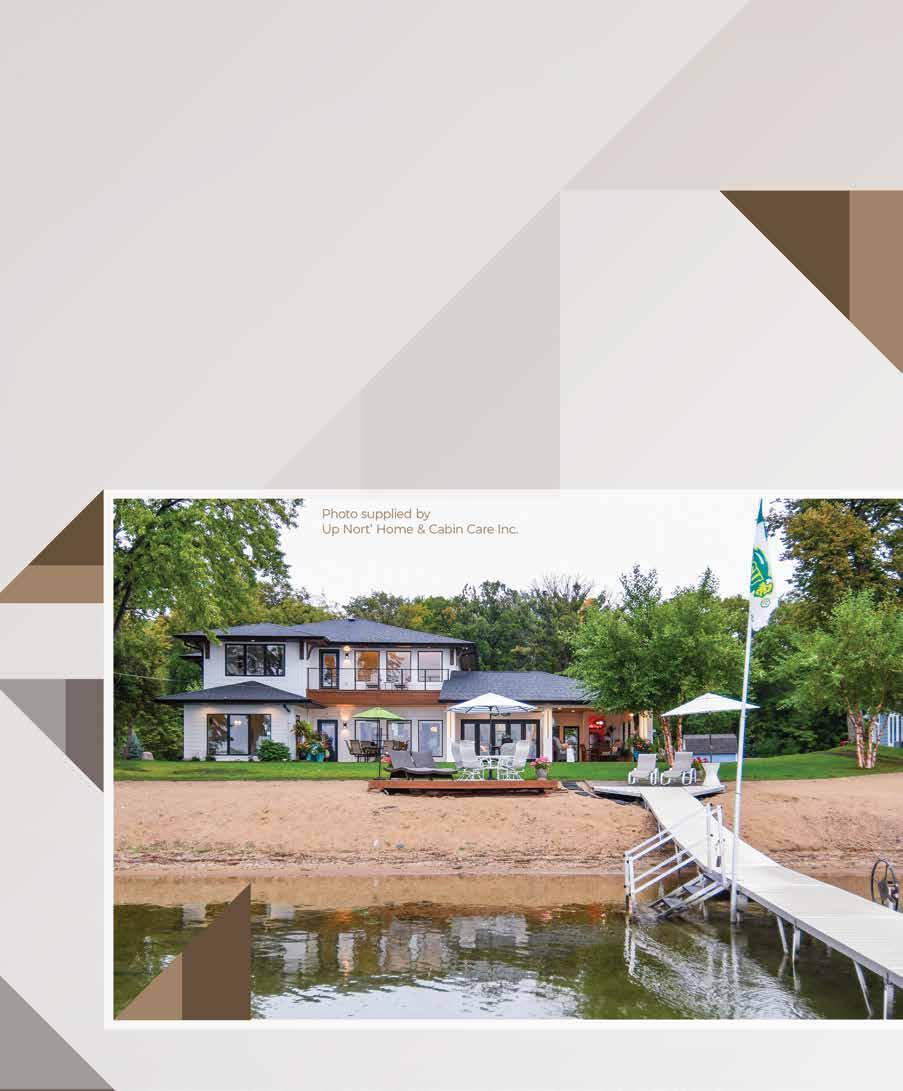
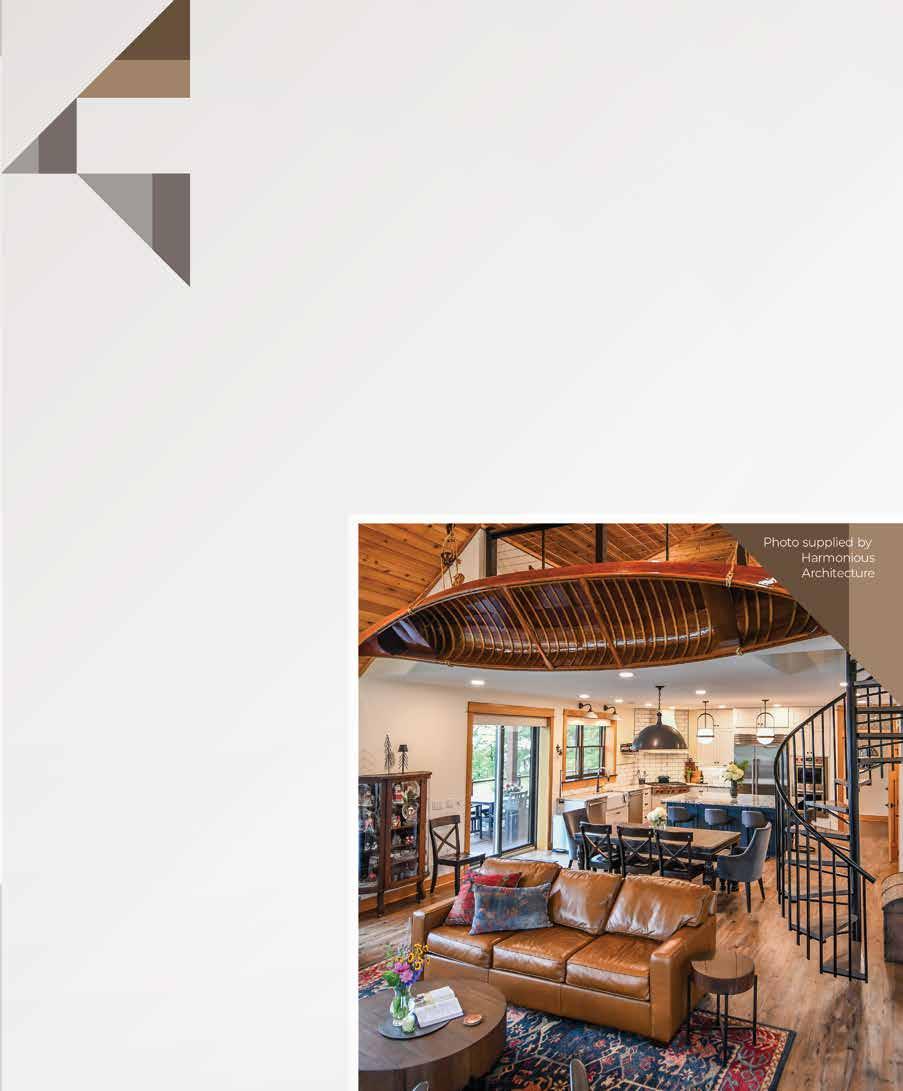
The star of the north, the land of 10,000 lakes, the Gopher state. Being together and being outdoors is how Minnesotans preserve their own special brand of Midwest heritage. In a state where the weather is the judge, jury, and executioner, a home must be versatile. Multidimensional. Especially when it is on the lakeshore, Minnesota homes seem to have these hidden talents that make them more of an adventure than just a means of shelter.
What is it that imbues lake homes with that subtle dream-like quality? The water and the boats, sure, and the fresh air certainly helps, but it’s the people inside the homes that really make the magic—high ceilings and open concepts don’t account for much without the warmth of loved ones moving about.
Strategic architecture allows these structures to be built around the unique shape of a family like a road that contours through the hills, allowing for characteristic bumps and turns. Mark Dobbelman, owner of Up Nort’ Cabin and Home Care in Battle Lake, MN, has been building and remodeling lake homes for over several years and the only foolproof architectural rule he’s found for clients who wish to be good hosts is that there isn’t one.
“We entertain a lot,” is something Mark hears from many of his clients. “Well,” he says, “that’s a really general statement.”
“I really try and drill down and say, ‘okay, what does that mean? Walk me through what that looks like over a year.’ Do you just have the neighbors over for a barbeque? Do you host themed parties? Are there areas you want to make sure that people have access to or don’t have access to?’”
Although there is no rule, there are guiding principles; accessibility, movement, and purpose are the golden tickets to make a lake home perfect for company.
As Mark said, accessibility determines which spaces people will be funneled to and which spaces the homeowners wish to keep discreet or separate. With lake homes specifically, access is huge word. There needs to be water access and patio access, road access and access to food and drink from outside.
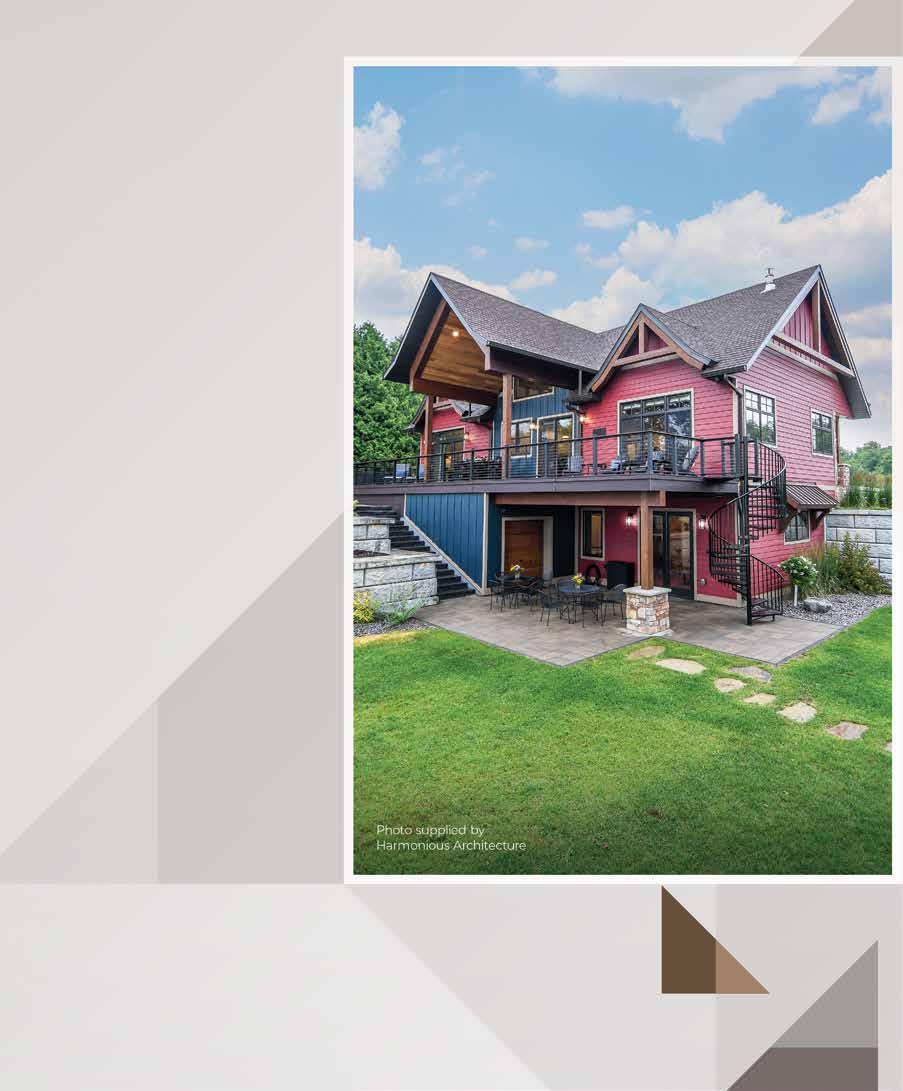
Kelli Wegscheid is an experienced architect whose focus is lake home design. She owns Harmonious Architecture in downtown Perham, MN and states that there are several things she knows to highlight when considering the accessibility of a client’s home.
Accessibility determines which spaces people will be funneled to and which spaces the homeowners wish to keep discreet or separate.
- Mark Dobbelmann
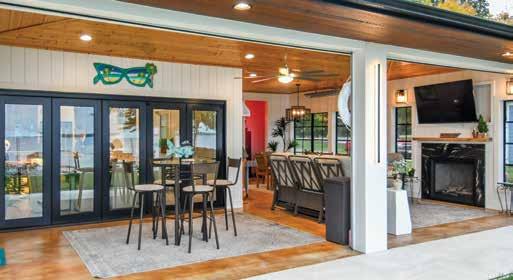
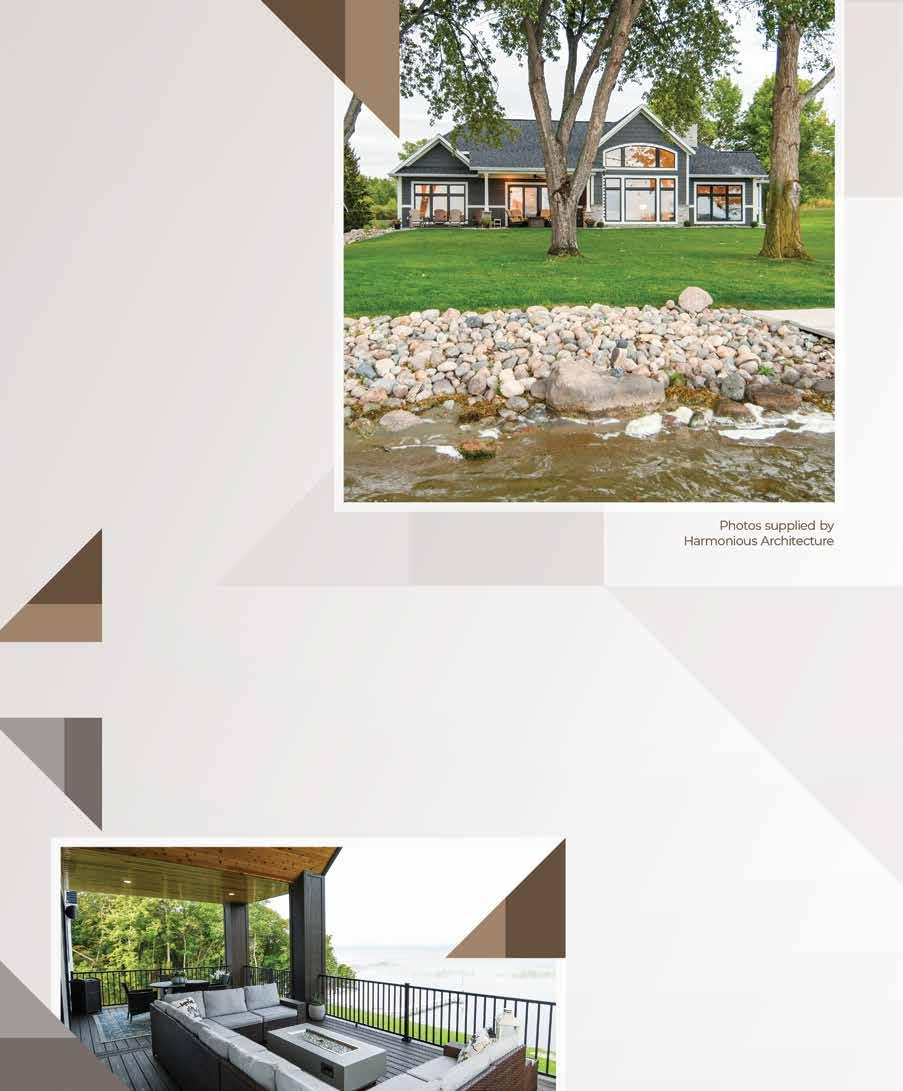
“Entertaining wants to happen outside,” she says, “so people are paying attention to these outside decks and patios and outside kitchens. We are here in this location to enjoy the outside.” How comfortable and easy is it to go from inside the home to the patio or the lawn? Modern advancements make it possible to bring the “outside in” more than ever before.
For example, Kelli says, “Even concrete patios now can have stamped concrete and stained concrete pavers. You can get a very elevated look and feel with the materials you use. Those just weren’t even options in the 80’s.”
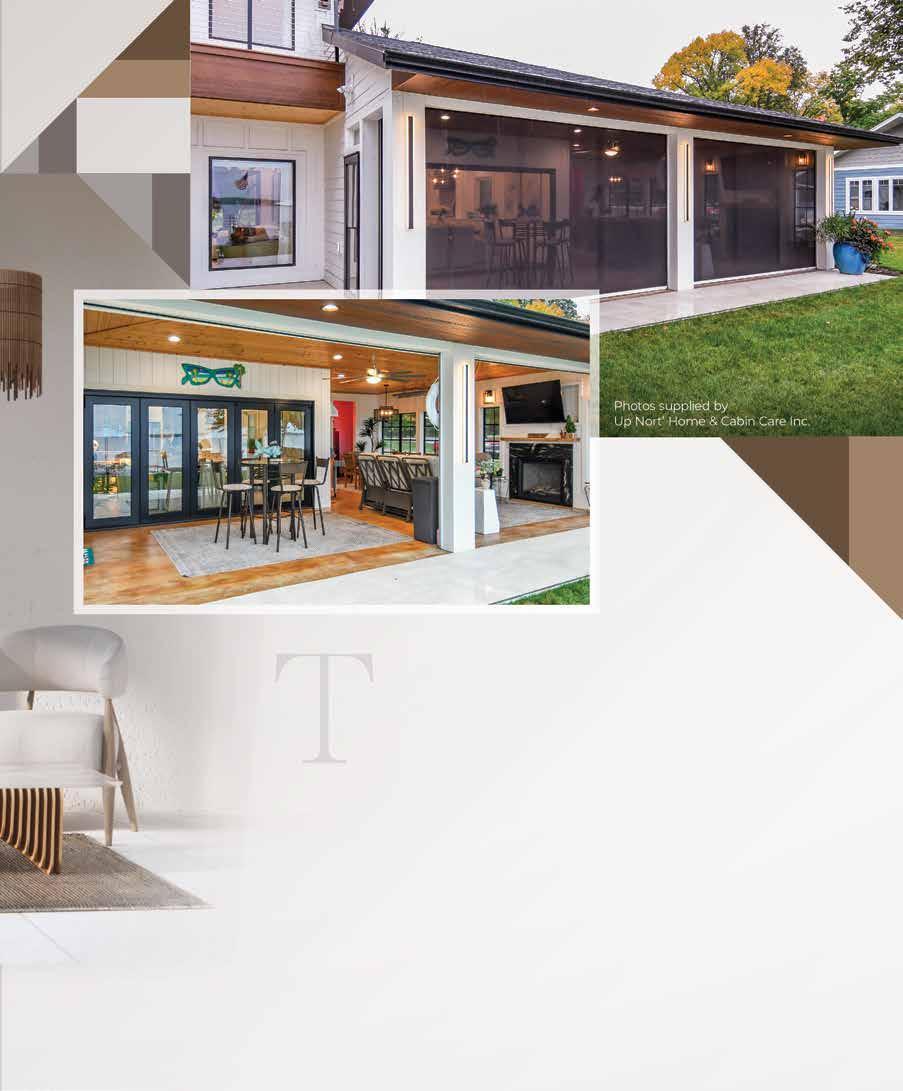
Builders, like Mark, can install these beautiful patios and porches and make them accessible for nearly all four Minnesota seasons. He’s used screens, multi-glide patio door systems, specialty window panels, floor heat and fireplaces, and even grills with connected vent hoods so no one has to stand in the rain or snow to flip the burgers.
Even concrete patios now can have stamped concrete and stained concrete pavers. You can get a very elevated look and feel with the materials you use.
- Kelli Wegscheid
We really try and understand what the client needs are and incorporate that into the design itself.
- Mark Dobbelmann
That’s a lot of bonus square footage that can be tapped when the cars park outside in the summer. Thoughtfully upgrading these typically utilitarian spaces allows the feeling of the home to continue beyond its walls. If someone plans to use their garage as their primary hosting area then that’s where emphasis will be placed via a kitchenette, a bathroom, or even an extra bedroom that is annexed from the main living space.
“We really try and understand what the client needs are and incorporate that into the design itself,” Mark says.
Now, we arrive at another key point in a home that makes it good for hosting: the flow of movement—starting with the most obvious transitions like kitchen to dining room to living room. The elimination of physical doors and narrow hallways in these spaces has been the norm for several decades, especially as people remodel old cabins that were only meant for summer use.
“While it’s not insulated, it can absolutely extend your usability period by several months,” he says. “You’re not going to want to be out there in -30 degrees in January, but my clients have used those spaces well into December.”
On the other side of the home is another space with tremendous potential: the garage.
“All a garage needs is a sink,” Kelli says. “You can have dining out there. Most people have parties, like graduations, in their garage. As far as hosting, that’s one of our biggest open spaces of our home.”
Things like roll-up screens and temperature control can extend the home’s accessibility even further when the garage is considered.
“We almost always finish them as though it’s your living space,” says Mark. “They’re fully insulated, fully drywalled—many of them have heat and air conditioning, baseboards, trim, and epoxied floors.”
“People want to see and interact with people in their family room or living room so that those conversations can happen back and forth without peeking your head around a wall or a corner,” Mark says, referencing this popular shift to open concept builds.
There is more nuance here than meets the eye, however.
People need movement and transitions to make sense of a space… there is an intention, a depth of purpose that is lost if each room feels just the same as the last one. Although it’s no longer popular to have physical barriers dividing the heart of the home, there must be other means of differentiation.
Fortunately, there are architects like Kelli who know exactly how to accomplish this.
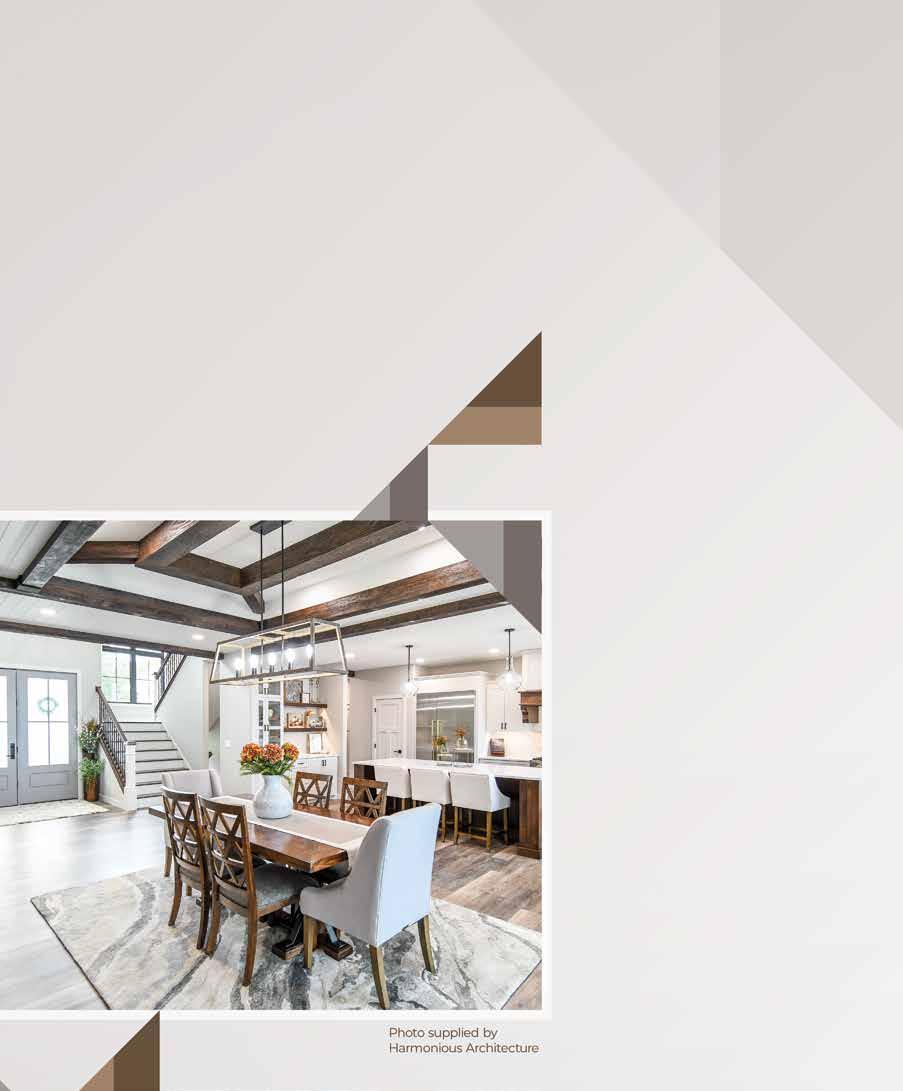
“A lot of times, the designs we do will be open concept visually in a floor plan, but if you look up,” she says, “the ceilings are different.”
“A lot of times, the designs we do will be open concept visually in a floor plan, but if you look up, the ceilings are different.” - Kelli Wegscheid
“A great room might have a vaulted ceiling, a dining room might have a wood-faced ceiling, and a kitchen might have a plain ceiling with pendant lights. So, even though you can physically walk between the open concept rooms, they still have a distinct feel of being different.”
Ceilings are a critical, sometimes subconscious indicator of how a room feels and what type of activity is intended to take place there. Subtle logic like this makes people feel at ease and makes transitions between activities simpler, like moving from the kitchen after a meal to the dining room table for a card game and then to the family room for a movie.
Lighting works in tandem with ceiling height to this effect.
“Although the kitchen wants to be included in this open concept,” Kelli explains, “it also needs a lot of task lighting. That then brings the ceiling back down to a flat ceiling where we can get a lot of lighting.”
On the other hand: “Dining rooms don’t have to be as well lit so those ceilings can be accents of wood or shiplap, sometimes in conjunction with a pretty light fixture. I think that ceiling surface is important in differentiating those open concept rooms.”
That covers transitions within the home, but transitions to and from outside are critical as well in entertaining large groups of people. Consistent access to food and drink will always be a people-pleaser and one way to accomplish this is the inclusion of a wet bar down by the walk-out or wherever the shore access is.
“Then,” Kelli says, “As people are coming inside and outside from the lake access, they have an opportunity to have some snacks down there—a sink and refrigerator go a long way in creating a little mini kitchen in that space.”
As with the screened porches and vented grills, some homeowners even opt for small outdoor kitchens and luxury firepits to help ease that inside/outside transition. Extending the class and comfort of the home to the outside by matching the color scheme, wood grain, or rock texture can make a patio feel more cohesive and harmonious with the outdoors.
As people are coming inside and outside from the lake access, they have an opportunity to have some snacks down there—a sink and refrigerator go a long way in creating a little mini kitchen in that space. - Kelli Wegscheid
Large windows and specialty railings also contribute to this seamless transition. Cable and glass railings have been gaining in popularity, cutting down on anything that blocks the view of the water.
In essence, integration and gentle transition appear to be paramount in designing a home fit for entertaining. Expand the home environment to all corners of the property and make transitions so subtle that they are nearly subconscious. Change is necessary to create flow and a sense of space—each area has its designated purpose and charm, just without harsh boundaries.
Before any of that, however, consider your family’s blueprints and what’s important to you as a host. Nearly anything is possible with architects and builders like Kelli and Mark on your team so take the time to articulate your specific goals and needs. L&H
Flooring sets the tone for the home. Homeowners should consider a flooring material’s durability, maintenance requirements, cost — even how it feels underfoot. Some flooring types work best in certain spaces, so homeowners need to tailor their choices to the rooms where they work best.
Thankfully, homeowners don’t have to make these decisions alone. Flooring specialists provide a range of options that suit their needs, style, and budget.
HARDWOOD FLOORS
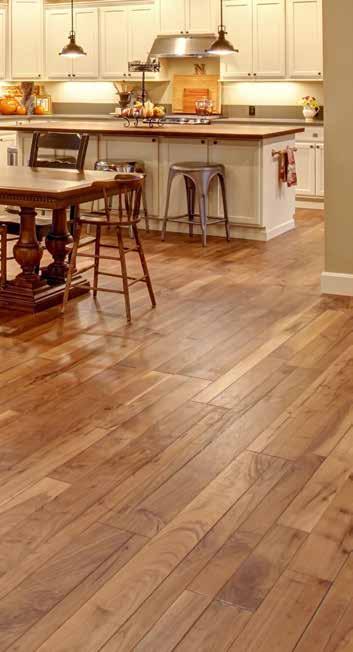
Hardwood floors are made from long, solid planks of natural wood. With proper maintenance, their beauty can (and will) last for generations.
PROS:
• “You’re looking at a floor that’s going to last the lifetime of your home,” adds Andy Sorben, sales professional at Seland’s in Fergus Falls. “20 years down the road, can get it sanded and refinished, and you basically have a fresh new floor.”
• Hardwood floors are timeless. Since it’s always in style, a hardwood floor enhances a home’s resale value.
• A hardwood floor is a design statement, right down to the last board. “The warmth, the color — you get that character and uniqueness of every board,” Joe Paine, account manager at Brainerd Hardwoods.
• There are a wide variety of wood species and colors to choose from. “If they want a more consistent color, white oak is a good choice,” says Paine. “If they like color variation and lots of character, I tell them to go with hickory. If they want a floor that’s a little more budget friendly and they like the red hues, I tell them to go with red oak. If they want to see very little grain in the wood, I push them towards maple.
CONS:
• Wood floors don’t work well in wet environments, so “they don’t make sense in bathrooms,” says Paine. “I would steer away from using wood in lake or beach entries or mud rooms, depending on how much they’re used. I would shy away from putting a wood floor in a basement that is known to be damp.”
• Wood is more expensive than other flooring materials to purchase and install.
• Indoor humidity changes can cause wood to move. “So from season to season, summer to winter, you can expect to get gaps in your floor in your floor, unless your indoor humidity fairly consistent all year round,” Paine explains. “A wider plank floor is going to move more than a narrow plank floor.”
• This material is also vulnerable to scratches and requires protection from pets, high heeled shoes, and sharp-edged furniture.
• Wood floors require regular maintenance. Homeowners should avoid excess water and harsh chemicals, dust and clean floors regularly, and wipe up spills immediately to avoid damage.
TEXTURED HARDWOOD
Textured hardwood is just wood planks that have been distressed. It retains the benefits of hardwood and minimizes a drawback.
PROS:
• “Distressing (or any texture) is nice because it does hide scratches from pets or dings from kids — or life in general,” says Paine. “It hides more of the wear and tear.”
• A variety of finishes are available. “We’re doing a lot of texture on woods — wire brushing, circle sawing, band sawing, distressing,” explains Paine.
CONS:
• Textured floors distract from sleek interiors. “In a real modern, clean home, I don’t see a lot of distressed flooring,” says Paine. “In a cabin or a transitional kind of home, I see more.”
• Dirt and dust can get trapped in the distressed grooves, making this type of flooring more challenging to clean.
• Because the distressing pattern is distinctive, it can be harder to find a professional to sand and refinish the floors and maintain their original appearance.
ENGINEERED HARDWOOD
Engineered hardwood includes real wood — it’s just not a solid plank. This flooring type places a thin layer of wood veneer over more stable materials.
PROS:
• Since the top layer of this product is genuine wood, engineered hardwood looks virtually identical to solid wood planks.
• It’s cost-effective. Engineered hardwood looks like solid wood for less.
• This flooring type is less vulnerable to humidity changes – and the warping caused by dampness and the freeze/ thaw cycle – than solid wood.
• Different types of installation (glue, staples, or a click-lock floating method) mean this floor can be installed over various subfloors, including concrete and underfloor heating systems.
• Engineered hardwood flooring is study and durable.
• “Putting down a pre-finished engineered floor is less invasive; you don’t have to finish it in place,” explains Paine. “A lot of engineered floors are pre-finished, so that saves a step —and the cost of the installation and the sanding and finishing in place.”
CONS:
• The hardwood layer can scratch or dent, just like solid hardwood.
• The wood veneer is thin, so it doesn’t last as long as solid wood. Homeowners may only be able to sand and refinish an engineered wood floor once or twice — or not at all.
• Lower quality products are often thin and may not feel as sturdy underfoot.
• Regular maintenance is required. Since this flooring type includes a wood layer, gentle cleaning and quick clean-up of spills and standing water are a must to avoid damage.
LUXURY VINYL PLANK
Luxury vinyl plank (LVP) is a product that mimics the look of hardwood or tile flooring in its most visible layer. It can be installed in several different ways, but floating planks that use an interlocking tongue and groove system and a glue-down option are most common in the region.
PROS:
• “Floating planks are very water resistant,” says Sorben. “A glue-down vinyl plank is 100% waterproof. We at Seland’s highly recommend going with a glue down option if you want vinyl plank”
• Luxury vinyl plank is comfortable underfoot and feels sturdy.
• “Having a durable wear layer on it makes it scratch-resistant, pet-resistant, and kid-resistant,” Sorben says.
• LVP products are very low-maintenance and easy to clean.
• This flooring type is available at a variety of price points to suit many budgets.
• Installation is easy and may not require a skilled professional, which saves homeowners money.
CONS:
• Repairs can be a challenge. “If you were to damage a plank in the center of a room with one of those floating floors, it’s a difficult process to pick up one plank and then replace it,” Sorben says. “Now with the glue down plank, it’s actually a lot easier.”
• Cheaper LVP flooring can fade over time.
• Luxury vinyl plank flooring can show wear from furniture that’s moved often such as dining room or desk chairs. Sorben recommends adding felt pads to chair legs to prevent damage.
• Thin versions of the product can move as the weather shifts. “We recommend getting a thicker product so you have a better locking mechanism, especially in the Minnesota climate where homes expand and contract throughout the seasons,” Sorben says.
CARPET
Thick, luxurious carpet isn’t quite as popular as it once was. But customers still love it.
PROS:
• Customers choose carpet for “the warmth underfoot and the comfort that you get with your carpet cushion underneath,” says Sorben. “You just don’t get that with any other floor covering.”
• Carpet’s softness and texture provides slip resistance and cushions falls, making it a go-to in households with very young or very old members.
• It’s affordable and available at numerous price points.
• Customers can choose from a huge range of colors, textures, and patterns.
• Carpet absorbs sound and makes a room quieter.
CONS:
• “You can’t clean it as easily,” Sorben says. “It can hold onto pet dander or dirt.”
• Carpets need to be cleaned often. “We always recommend vacuuming as much as you can and then doing a professional cleaning once every 12 to 18 months.”
• It can be difficult (or impossible) to navigate on carpet using mobility aids like walkers and wheelchairs.
• “Big, plush carpet in major walkways in a home is going to show wear over time,” says Sorben.
TILE
Ceramic, porcelain, natural stone, and other materials are cut into shapes, installed in eye-catching patterns, and set in place with grout. Since it’s often seen on walls and backsplashes in this part of the country, it’s an unexpected (and intriguing) flooring choice.
PROS:
• “Customization is probably the biggest benefit of tile. You can go any which way color wise — pretty much anything you can imagine,” Sorben says. The variety of patterns, shapes, and textures on the market is equally expansive.
• Tile is durable and resists scratching and stains.
• Like hardwood, tile can last for generations if properly cleaned, sealed, and cared for.
• It’s also waterproof, so it’s a great choice for bathrooms, steam rooms, and spaces prone to moisture.
• Tile works well with heated floors because it conducts and transfers warmth.
CONS:
• This flooring type isn’t cheap. “Tile can be more expensive than a lot of the rest of the popular flooring choices,” Sorben admits.
• Tile is hard, so it’s not comfortable to stand on for long periods of time.
• It can also be brittle and chip if something heavy falls on it.
• Installation is difficult and finding skilled contractors can be a difficult and expensive.
• Since grout is porous, grout lines must be cleaned and sealed often.
There are so many exceptional flooring choices on the market today. The best option for your home will be shaped by your budget, your style, and the unique pros and cons of each flooring type. L&H
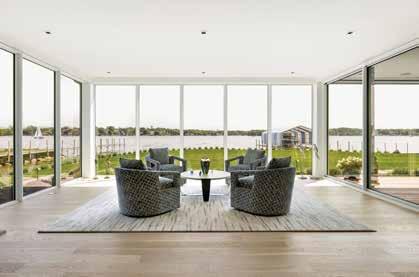
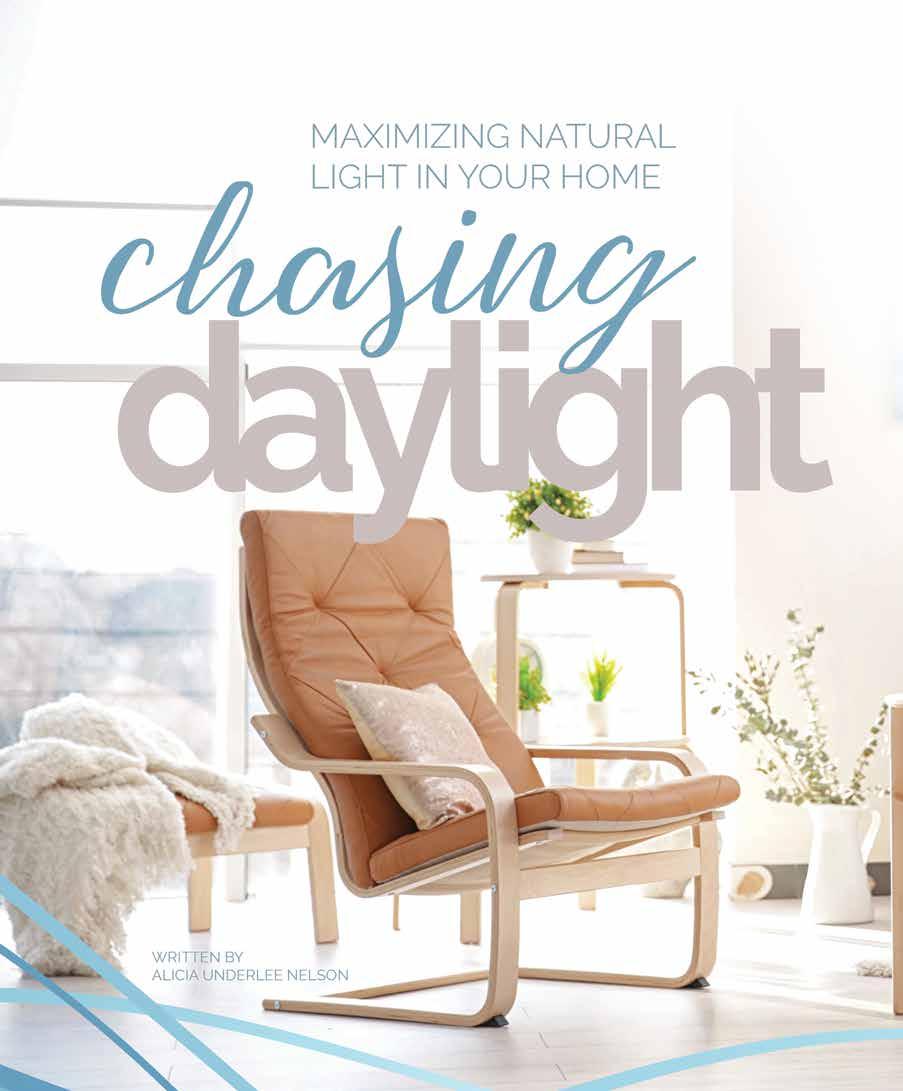
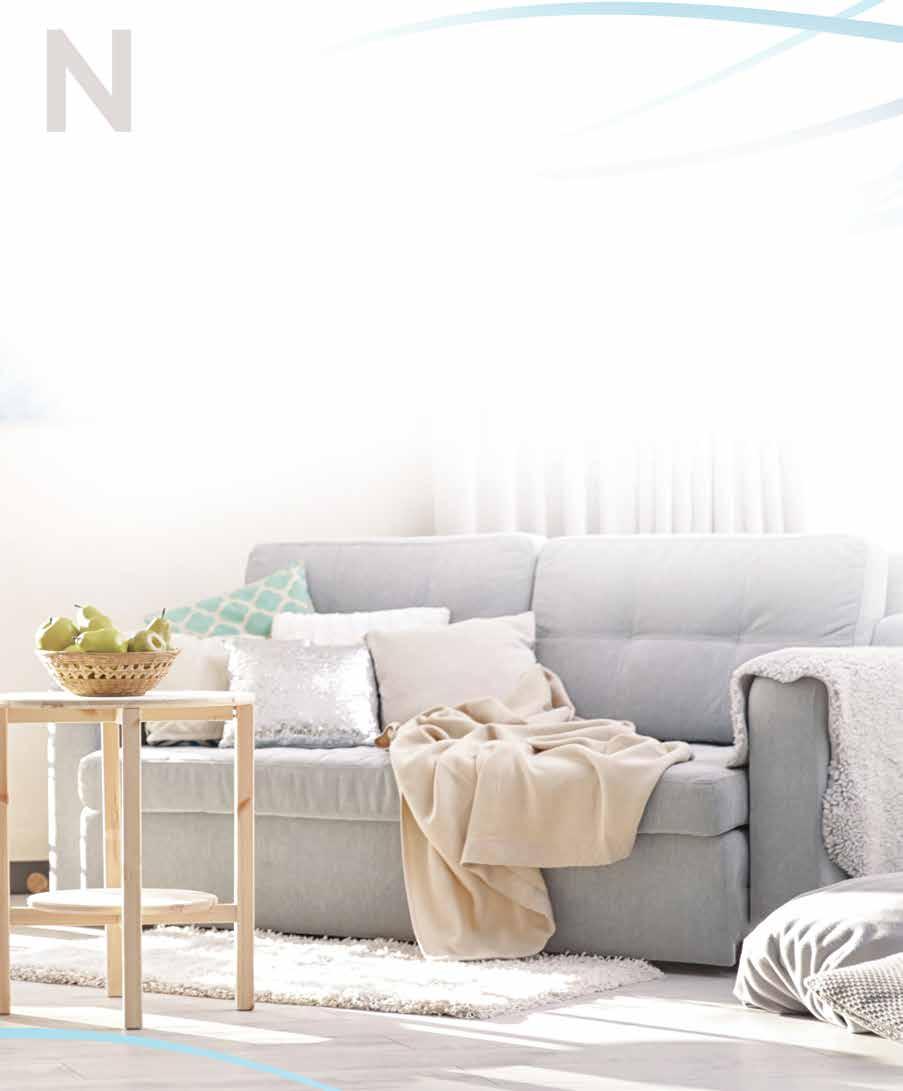
Natural light is a powerful force, as daylight makes our interior spaces feel larger and more welcoming. It can even lower our energy costs by helping us cut down on our use of artificial lighting and reducing our heating bills by capturing the sun’s warmth.
Sunlight is also a natural mood booster. Daylight can improve our mental outlook, amp up our productivity, and increase our feelings of happiness and well-being. It draws us into a room and makes us feel simultaneously warm and cozy and focused and energized. And in a climate where we’re forced to stay indoors for much of the year, it just makes sense to bring as much natural light into our homes as possible.
It’s easiest to maximize natural light during the process of building a new home. But there are plenty of ways to increase the amount of interior daylight in a room by implementing strategic remodeling projects and using targeted redecorating tips. pace
CONSULT THE EXPERTS DURING A NEW BUILD
“Adding light on the new construction side is much easier than remodeling, so we’ll start with the easy one,” says Lance Premeau, general manager of Kolbe Gallery Twin Cities. ”For any home — whether it’s on the lake or otherwise — I recommend working with an architect to ask those questions about how to get the most natural daylight.”
Then bring on the rest of the team, including your builder and a window specialist like himself. This can help determine exactly what you want and refine the budget.
”For any home — whether it’s on the lake or otherwise — I recommend working with an architect to ask those questions about how to get the most natural daylight.”
- Lance Premeau
CONSIDER HOME ORIENTATION
An architect and experienced home builder will work with you to ensure that your home gets the amount and quality of light that you need. A key factor to consider is orientation, or the direction your home faces.
Positioning a home so that the largest windows face south will allow the interiors to receive the most (and most consistent) light all day long. North facing windows let in more muted light with almost no shadows, so they’re better for spaces like art studios, music rooms, and bedrooms for late sleepers.
Early birds like to wake up bathed in bright eastern light. (Morning spaces like breakfast nooks also often face east). West-facing windows welcome afternoon and evening light, but they can get quite warm and may require special window coverings and finishes to reduce glare and prevent the fading of floors and furniture.
FEATURED IN LAKE & HOME MAGAZINE JAN/FEB 2026
WINDOW POSITION MATTERS
A smart architect will position windows in the home (and within each room) to maximize natural light and to customize that light to the homeowner’s needs. For example, a bank of windows on multiple walls maximizes daylight and reduces shadows.
Placing windows near the roofline or adding skylights can help light reach deeper into the room while preserving privacy. These types of windows can be added to new builds and remodeling projects alike, as long as they experts determine that the wall will remain structurally sound once the new windows are added.
“Adding transoms, if the wall position makes sense, is an easy one,” says Premeau. “If you have tall enough ceilings, adding a clerestory window — or a bank of them is fairly economical because they are small, but they’re pretty dramatic. And they really increase the amount of daylight that can come into a room.”
PHOTO
GO BIG
“In today’s world, architects, builders, and homeowners want more and more glass. And manufacturers certainly have responded to that,” says Premeau. “Depending on the manufacturer and the glass limitations, a window could be 10 feet by 12 feet.”
And that’s just for one singular window, Premeau adds. He says when you work with experienced professionals, the possibilities expand even more.
“You can put two of them together — or more — and start to create a bank of glass in a wall,” he explains. “And that’s where an architect really is invaluable, because you’re starting to talk about structural engineering — what’s load bearing, how a wall handles that amount of glass.”
CHOOSE LARGER DOORS
Windows aren’t the only pieces of glass that are manufactured in larger sizes. Glass patio doors are getting bigger too.
“It’s incredible how large they can get,” Premeau says. “So 25 or 30 years ago, you needed a couple of two-wide patio doors next to each other to achieve a really large view. Today, you only need one large twowide patio door to get the same effect.”
DIRECT SET WINDOWS OFFER MORE LIGHT
It’s important to consider function when choosing windows as well. If a window doesn’t need to open, consider a fixed (or direct set) window to really maximize the window size.
“If you want to do a non-operating window, a direct set will give you more daylight in the same sized window opening,” he says. That’s because the windows are constructed differently.
“If you don’t need a venting window (an operating widow) you can do much, much larger sizes because it doesn’t need to open. You don’t have any moving parts,” Premeau continues. “And that gives you more daylight, because you don’t have a sash. The glass on a direct set window goes directly into the frame, versus in an operable window, the glass would go into a sash, and then the sash goes into a frame.”
Premeau adds many customers opt for direct set windows in their remodeling projects and in new builds. Just make sure you’re not bound by building codes to include an operable window, like in egress windows, for instance.
“In today’s world, architects, builders, and homeowners want more and more glass. And manufacturers certainly have responded to that.”
Casement windows are a happy medium between form and function. They swing outwards like a door, so homeowners can enjoy a fresh breeze. But they also offer a largely unobstructed view to maximize natural light.
Premeau says casement windows are a smart choice for new builds. He adds that replacing a traditional double hung window with casement windows in a remodeling project is a simple way to increase daylight without expanding the window opening in your wall. It can also make a more traditional home feel fresh with minimal effort.
“If you have a double hung window and you go to a casement, you will automatically gain daylight because you don’t have the check rail (where the two sashes come together) to block your view,” he explains. “Where a home was a little more traditional in design, they’ll have double hung windows. And then they’ll flip the script and go to a casement. It’s dramatic, the amount of daylight you gain and the different aesthetic of the home.”
PHOTO FEATURED IN LAKE & HOME MAGAZINE NOV/DEC 2025
Speaking of aesthetics, the style of windows and patio doors you choose matters too. Contemporary lines and minimalist styles make even operable windows and patio doors fade away so the natural light (and the scenery visible through the glass) really shine.
“There are product lines out there that offer a modern window design, where the frame and sash members are narrower than a traditional window,” says Premeau. “We offer them to give a more modern, contemporary look. That can drastically change the look of a home, but also bring in more daylight because you have less wood and aluminum and fiberglass and more glass.”
PHOTO FEATURED IN LAKE & HOME MAGAZINE
NOV/DEC 2025
“There are product lines out there that offer a modern window design, where the frame and sash members are narrower than a traditional window.” - Lance Premeau
One of the key benefits of more glass and more natural light is lower energy costs. Homeowners spend less on electricity because they don’t need to constantly turn on the lights. The sunlight pouring into west and south facing rooms can keep the space warmer in cold weather.
“But there are times where you want to be careful about that, depending on your climate and your elevation, because you may not want all of the solar energy that comes with that daylight,” Premeau says. “There are Low-E coatings that you can tailor to the elevation, if you choose, to bring in the daylight but limit the amount of heat gain.”
Window experts like Premeau can recommend the best Low-E (low-emissivity) window coatings to reflect light and keep things cool in the summer and maximize heat retention in the winter. These products also reduce UV exposure within the home, which protects flooring and furniture.
In a new build, Premeau recommends asking the builder to bring in the HVAC specialist early in the process. This can help homeowners decide which windows are best, maximize energy cost savings, and make sure the entire home ecosystem functions effectively.
DECORATE WISELY
If a new build or remodeling project isn’t in the budget, don’t fret. Smart decorating choices can amplify the effects of natural light in your home.
Using light, bright paint colors (whites, neutrals, and pale pastels) on walls and ceilings can increase a feeling of airy expansiveness. Choosing semi-gloss or satin paint finishes help reflect light.
Mirrors make the space appear larger and also throw light around the room. Adding mirrored or lacquered furniture, shiny sculptures, or glossy wall art can increase the reflective effect and metallic finishes and gleaming accents have a similar result.
Replace heavy drapes or thick shades with sheer alternatives to let the light in. Make sure they can be tied back or pulled all the way up to maximize natural light. White or pale furniture, rugs, and textiles also help a space feel lighter and brighter.
Natural light is energizing and invigorating. It makes our interior spaces (and our minds) feel fresh and open. Thankfully, there are many ways to maximize natural light in our homes so we all can enjoy the benefits of daylight. L&H
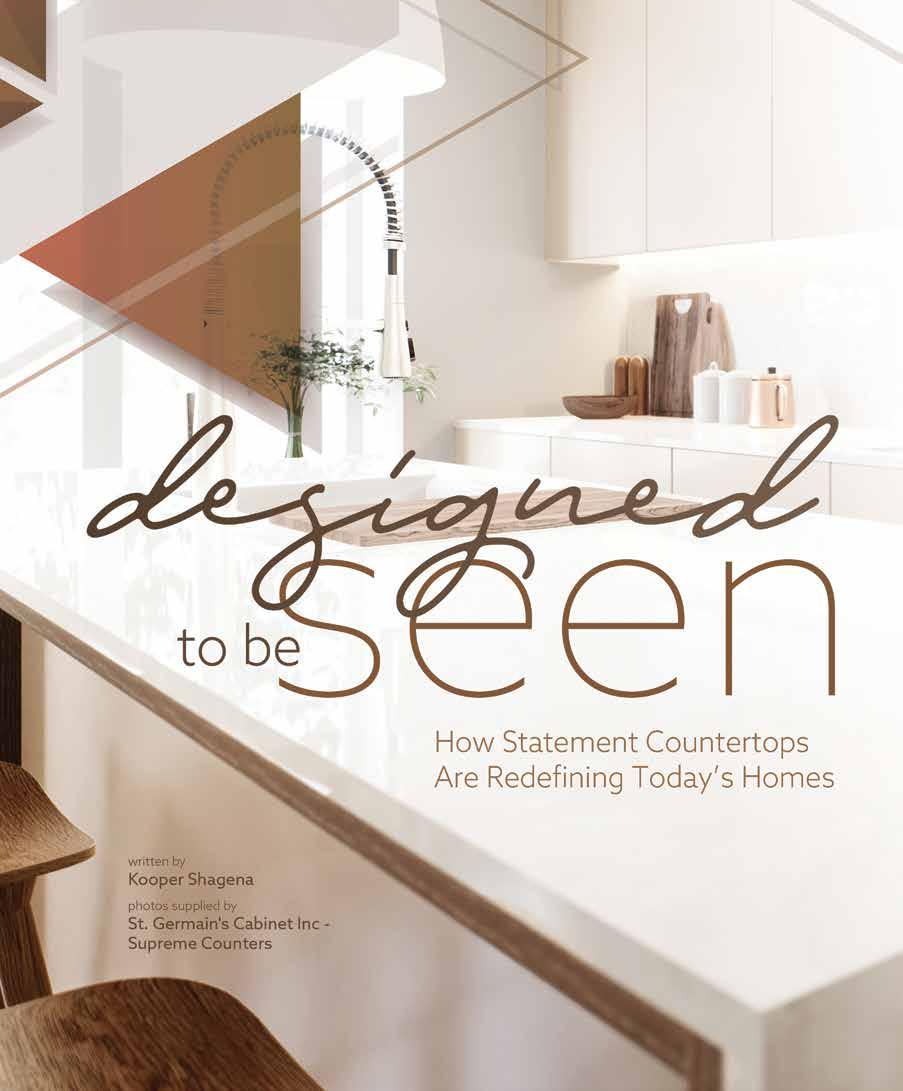
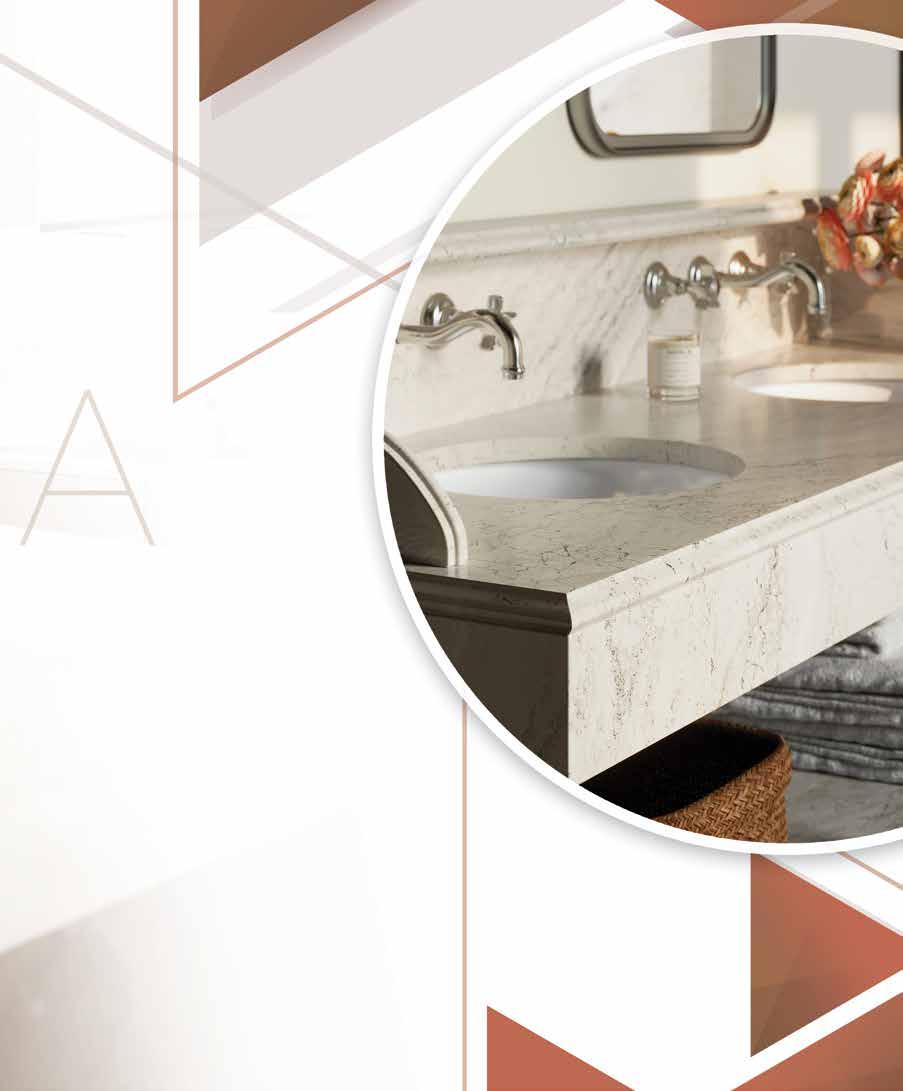
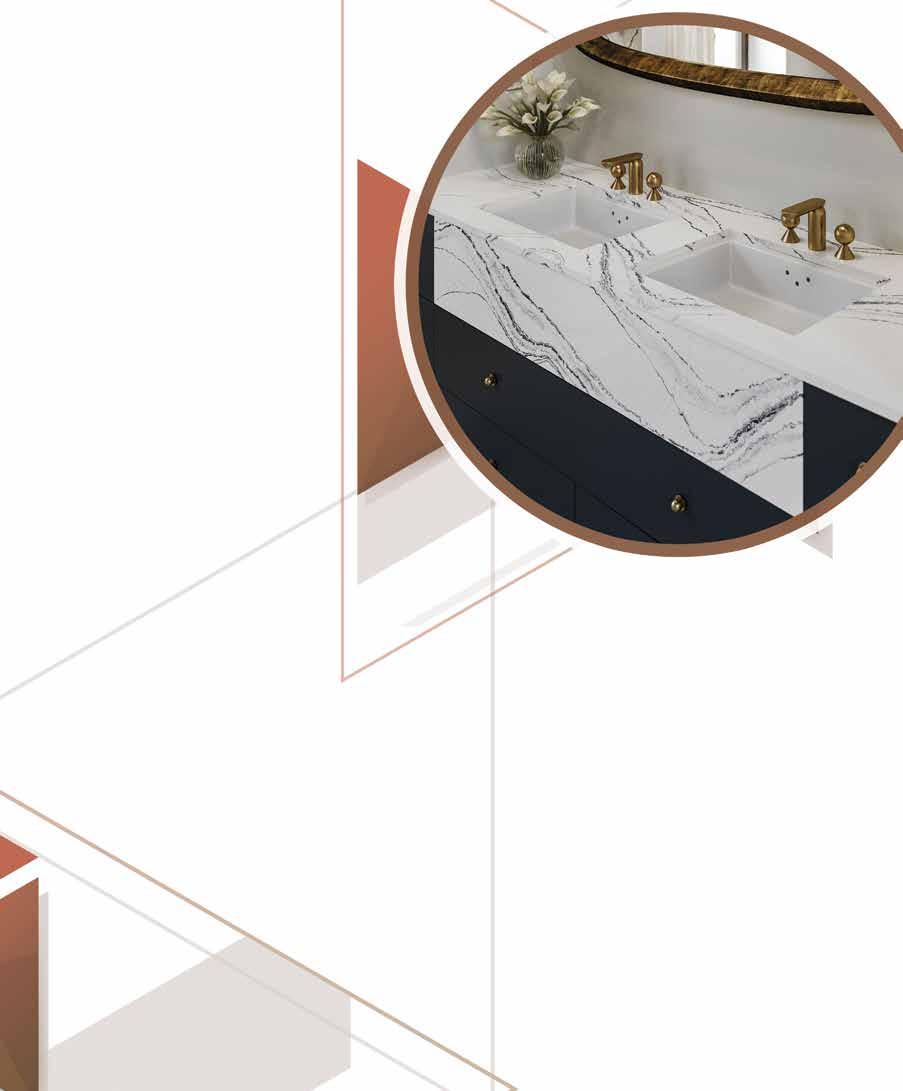
A statement piece is an intentionally chosen piece of jewelry, furniture, art or clothing that serves as the focal point of the larger image. Our eyes love to be entertained and surprised and we—when given the luxury—are always endeavoring to find that next thing for our homes, bodies, cars, etc. that entertain the eyes of our peers while communicating something about ourselves to them. The customizability of countertops makes them an excellent candidate for statement pieces; they’re an integral part of the home and a worthwhile investment.
“A statement is going to be something that really reflects the homeowner and their design style that they’ve chosen for the entire home. You walk into a space and you can tell it’s something that the homeowner fell in love with and it’s a part of them and their personality,” says Nichole Albright, an interior designer for Fergus Home and Hardware in Fergus Falls, Minnesota.
“You definitely get a little bit more of an emotional response when something is different than what you’re typically seeing,” she says. Being emotionally impacted by a countertop might sound a little unexpected, but wherever expectations are challenged, people take pause to notice and intuit a response to the surprise.
And it’s the subtlety of surprises like these that add intrigue to a room.
“A statement countertop doesn’t need to shout to make an impact,” says Berit Rosenberg of St. Germain's Cabinet Inc-Supreme Counters. “The most successful ones are pieces that quietly tie the whole room together.” Finding that fine balance of including something unexpected that simultaneously contributes to the overall cohesion of the home sounds tricky, but the experts have some practice.
First and foremost, there are materials to pick from.
“No matter the budget or the type of space,” Berit says, “the materials you choose set the tone. They influence how a room flows and how people feel when they’re in it.” We’re pretty simple as it turns out; natural stone or wood and organic colors curate a sense of calm and warm stillness, while bolder-toned surfaces can communicate a more lively or even playful presence. Laminam, for example, is a rather new innovation that could be ordered to fit either aesthetic.
“A statement countertop doesn’t need to shout to make an impact.”
- Berit Rosenberg
A form of manufactured porcelain, Laminam is extremely durable and heat/scratch resistant—enough to be used outdoors. It’s also the material that would be used for integrated stoves or invisible warmers in modern countertops.
“It has a different feel that quartz does,” Nichole says, “and they have some really awesome patterns that are a little bit bolder.”
With modern technology and the high customizability of nearly every home fixture, Berit advocates that “every category, whether it’s wood, laminate, solid surface, quartz or natural stone has the potential to feel warm and inviting or elevated and luxurious, depending on how it’s used.”
“Lighter tones, soft veining or natural textures can create a calm, approachable vibe,” she explains, “while deeper colors with pronounced movement or textured surfaces can feel more casual or rustic.”
Texture or finish open up another playground for creating a statement countertop. A popular intrigue-adding method is to have different finishes present in the same home: “gloss and matte is a big one,” Nichole says. Even a disruption of expectation as small as this is enough to spark some attention.
“What’s popular right now is the leathered look,” Nichole adds, “It’s still kind of smooth; it’s not shiny but it has that texture when you feel it.” Quartz and most other natural stone and laminate surfaces all have their own ranges of finish choices, from high gloss to soft satin or solid matte. Trying a new combination of material and finish could lead you to discover that elusive aesthetic you’ve been searching for.
“Texture can add depth and interest without relying on color or pattern,” Berit suggests. The shinier finishes lend themselves to feeling refined and high-powered, brightening a space and energizing it, while matte and satin finish can feel a bit more relaxed. Having both energies present could create a bespoke environment that matches a unique kitchen perfectly.
“It’s also important to consider how these finishes interact with everyday use,” Berit says, “as some may show fingerprints and marks more easily than others.”
Countertops, first and foremost, must work for living. Instead of seeing this as a hurdle, adopting a creative perspective could reveal whole new world of possibilities when designing countertops for a large space.
Even though something like an integrated stove and warmer must involve solid surface or Laminam, a section of butcher block could be installed in the same kitchen; stone and wood are a striking and effective combination.
“The warmth and texture of wood contrast beautifully with the clean, smooth feel of stone while also providing a different type of work surface,” Berit says. Heat and scratch resistance are important to think about when choosing materials for specific areas of a kitchen, or any space that may see tools or heat of some kind.
“Texture can add depth and interest without relying on color or pattern.” - Berit Rosenberg
“Consider what you need the surface to do for you,” she says. “Does it need to withstand stains, high heat, stay hygienic, resist scratches or require no maintenance?”
Quartz, one of the most popular surfaces, is a non-porous material that requires no sealing, resists scratches and stains, and comes in a large variety of colors.
Sintered stone (a mixture of natural materials that have been melted down and compacted to form slabs) is highly heat resistant so hot pans can go directly on these countertops without warping or discoloring them. It also resists stains and scratches but can be susceptible to chipping around the edges.
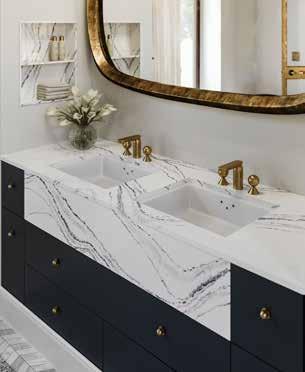
Marble is a little less common to see in modern homes, but still an available option. As marble ages, exposed to everyday touch and friction, it develops a light surface texturing known as patina, which can contribute to the classic feel of a space and show a bit of character. Like granite, marble is porous, so it is heat resistant but sealing is a requirement to prevent staining and moisture damage.
A granite countertop is always unique as each slab is mined whole and cut down to size—this can make it difficult to smoothly replace, however, granite is susceptible to staining if it isn’t sealed properly. Butcher block needs regular sealant, too to prevent staining and warping. Every house functions a little bit differently to accommodate its inhabitants’ idiosyncrasies and the countertops can be a beautiful reflection of how a family functions.
“When clients work closely with designers and installers,” Berit says, “these choices become more meaningful.”
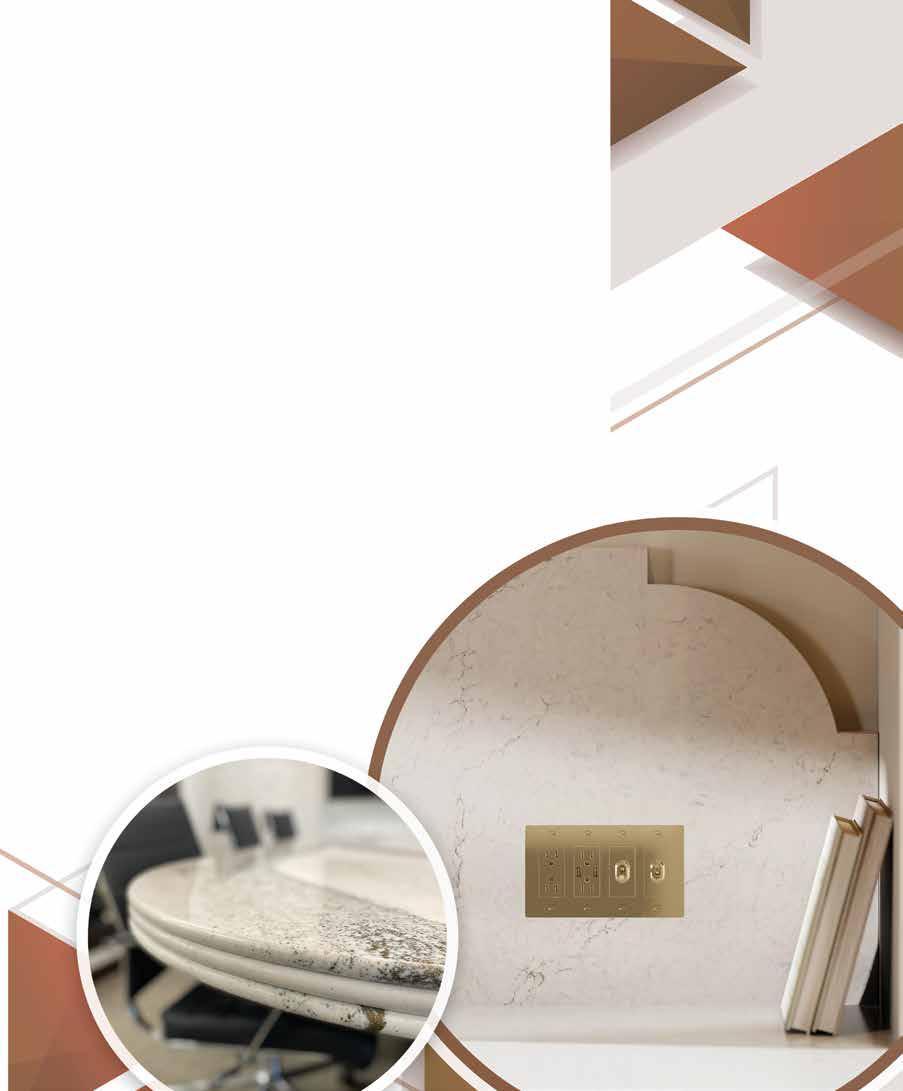
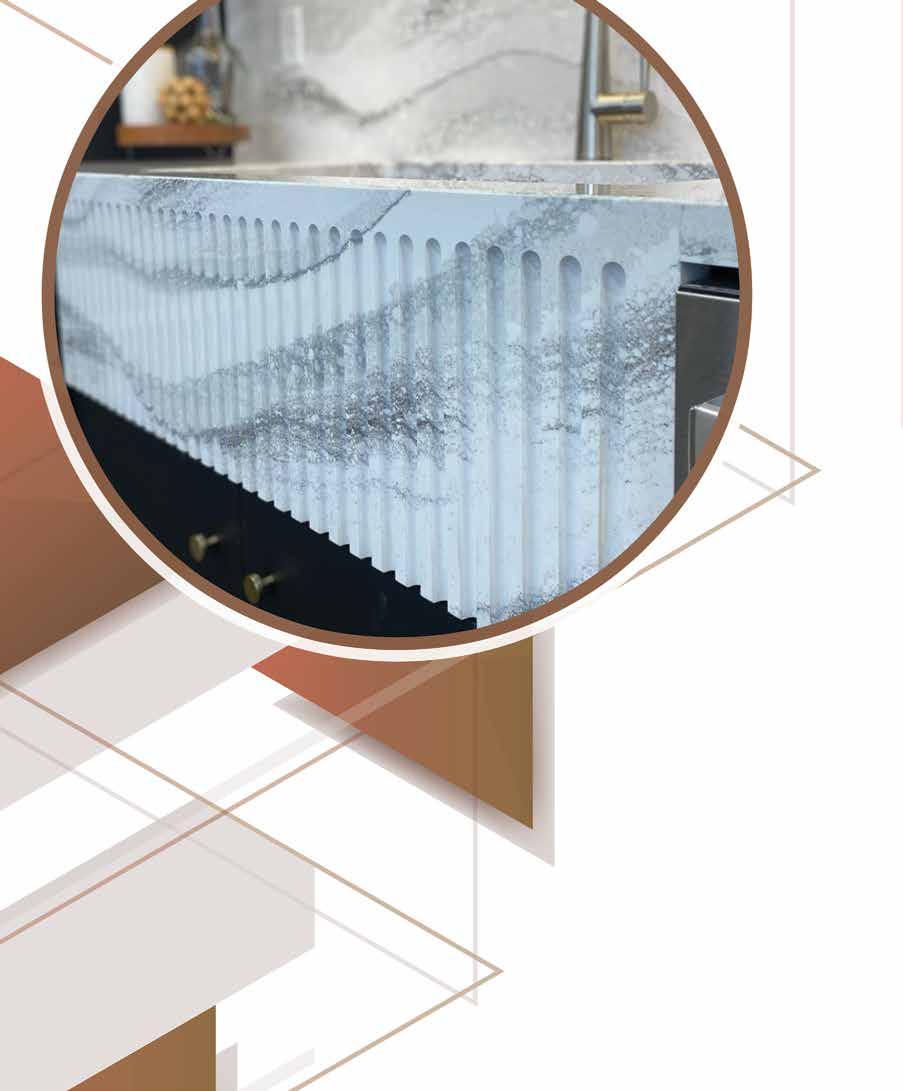
The edge profile also has potential to make a countertop into a statement. With natural stone, the edges can be left raw creating a geode-type roughness just around the perimeter of the slab. Thickness can have a large aesthetic impact, too. Mitered edges, for example, make the entire countertop appear much thicker by joining two thin slabs at a 45-degree angle to create a squared edge—which can also extend partly or fully down the side of an island. Again, anywhere expectations are challenged will add visual interest.
“Even subtle choices like how the inside and outside corners are eased, how a material transitions into a window or backsplash or how the movement is oriented can really elevate the design,” Berit says. Rounded edges, carved edges, or even just an unexpected angle here and there make for a more authentic feeling.
Considering all the craftsmanship and often beautiful patterning that goes into a custom countertop installation, there is potential around the rest of the home to incorporate the same material into unexpected places. Around a fireplace, for example, or up into a backsplash.
“If there’s a color that’s somewhere else in the house,” Nichole says, “that’s where we get to bring that into the countertops. I like to call it an accessory just because it’s kind of fun and it makes everything finished in a space.”
“Thoughtfully chosen surfaces allow a home or business to reflect the people who spend their time there.”
- Berit Rosenberg
Because countertop material is highly specialized, it’s instantly recognizable even in small quantities if it makes appearances throughout the house. The repetition factor would also lend it to being a statement piece; it shows a focused intention. Nichole also described the idea of a statement piece for a homeowner as “what they enjoy when they walk into their own space,” which visitors will always be pleased to pick up on; if you love your space, those who love you will love it, too.
“Thoughtfully chosen surfaces allow a home or business to reflect the people who spend their time there,” Berit says. All the little choices, even if they seem small, work together to create the one-of-a-kind spirit of a home. “The result is a surface that feels tailored to the space, not just installed in it.” L&H
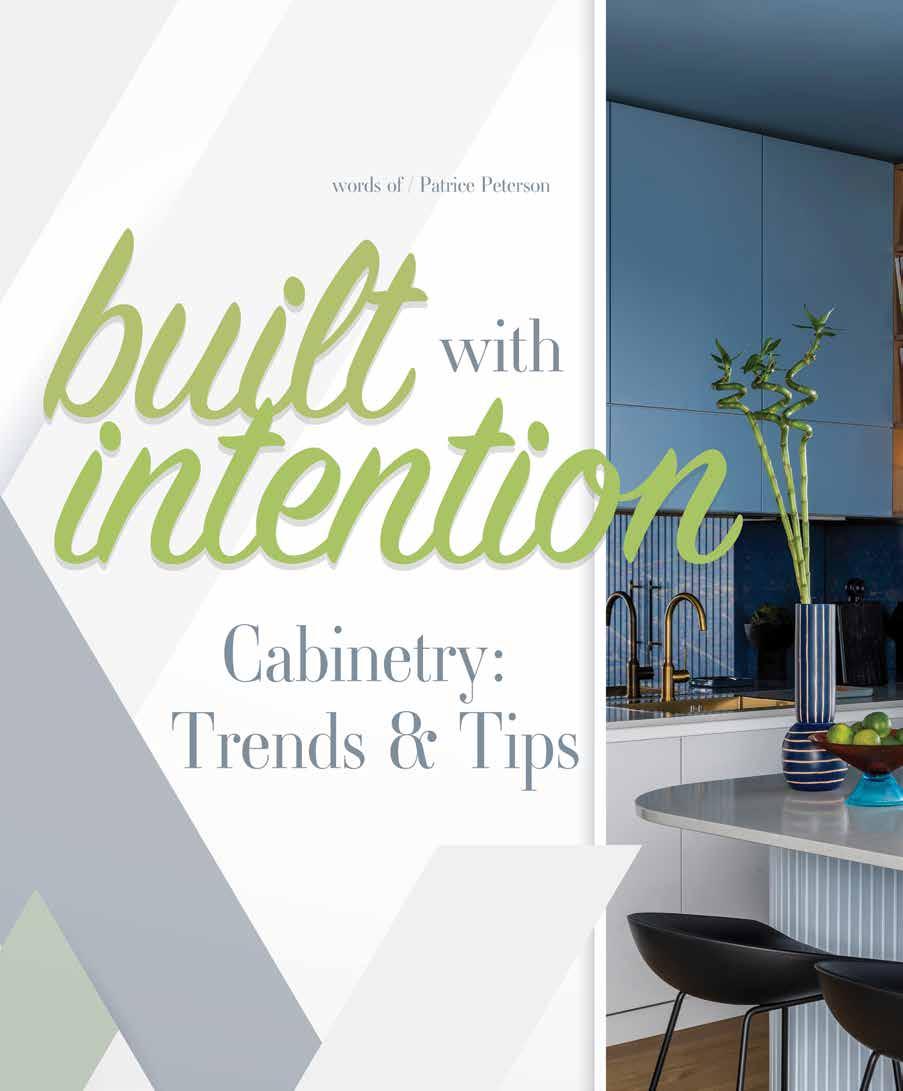
Although cabinets are a necessary and functional element of a home, they can also become a considerable dynamic in a home’s overall design. Whether in the kitchen, bathroom, or built into any other storage space area, the cabinets we choose can shine a spotlight on a home through the materials, size, color, and shape. Those cabinets also take up a large portion of the budget for any kitchen design project.
“When building or remodeling, the function of the kitchen is always going to be the most important factor to consider, and cabinets play the most sizable role in that,” says Christa Swedberg, one of four owners at Swedberg Wood Products Inc., a custom cabinet shop in Alexandria, MN that’s been in business for 42 years. “Everyone likes something different, and that’s what’s so great about being in custom cabinetry. For each individual, it’s about being intentional with your choices, adding personal details, and making it look like your own space.”
Different styles for different people has always been a consideration, even back when the choices were more limited. Somewhere in the 1930s to 1950s, freestanding wood furniture in the kitchen gave way to more streamlined steel cabinets, sometimes with bright, bold colors. As kitchens became a place where growing families gathered following WWII, a cleaner, more modern look became popular, with straight lines, lots of white, and minimal contrast.
Earth tones were all the rage during the 70s and 80s, with dark wood finishes and raised panels on the cabinets. Gold, green, and burnt orange were popular accent colors. Even today, when watching an old movie or TV show, that time period becomes evident as soon as the “harvest gold” or “avocado green” appliances appear onscreen.
Once again, all white kitchens – including the cabinets – followed that trend, as more open floor plans widened the kitchen’s space, vitality, and prominence.
From the pioneer kitchens that simply had large pieces of furniture around the kitchen, to the modern, high-tech and smart-home features of more recent cabinetry, there will always be trends to follow along the way to choosing the right look for each individual or family.
Nichole Albright, of Fergus Home & Hardware in Fergus Falls, sees the trends that are popular all across the country, as well as in the lakes area.
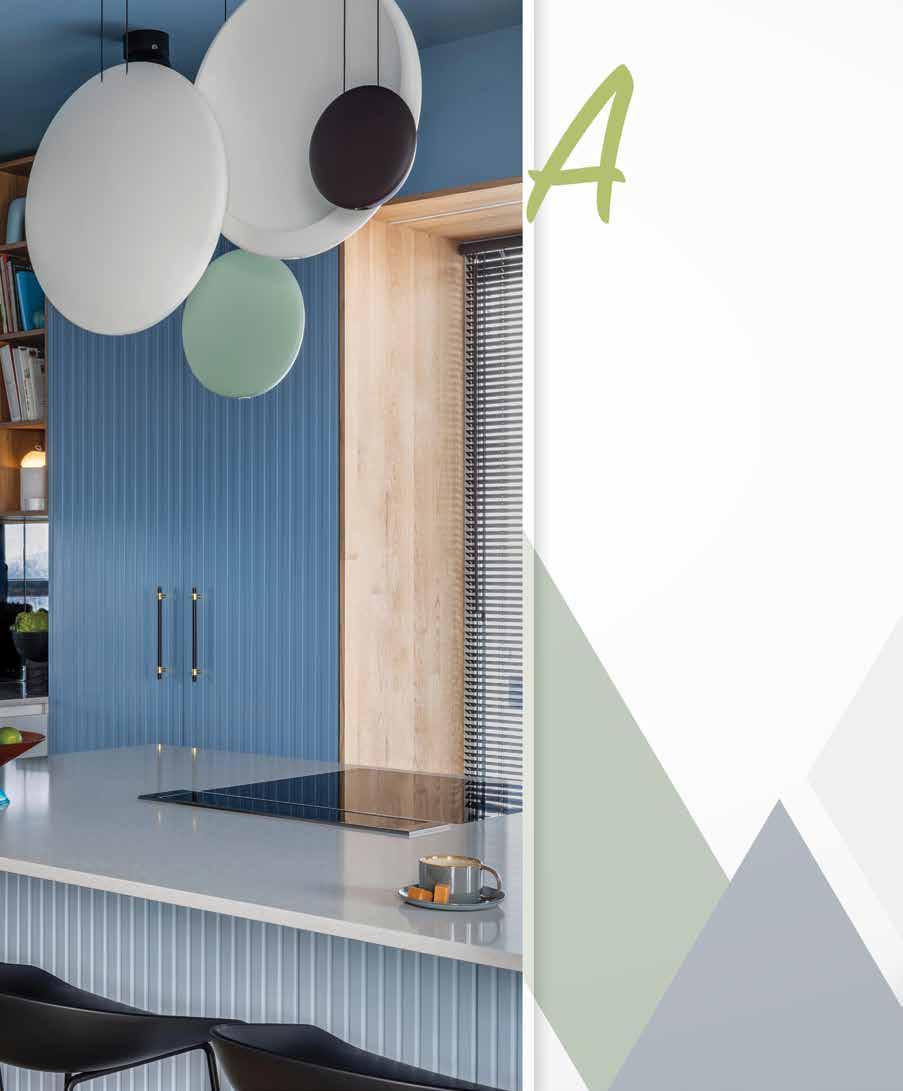
“We’ve been away from color for so long, but it’s coming back,” she says. “Right now, it’s definitely going from all the pure white to whites that are softer, creamier tones, and most of the time they’re mixed with wood or another paint color. To me, it’s a more creative blend of applying color into certain places – thinking about what color you want and where it will be located.”
IN LAKE & HOME MAGAZINE JUL/AUG 2025
Some questions to consider:
• Where are you going to place those color cabinets?
• Will all the upper cabinets be painted in a color?
• Will the color just be accents on those cabinets around your range?
• Ultimately, what color would you want in your kitchen?
PHOTO BY BROOKE AABERG PHOTOGRAPHY
PHOTO FEATURED
Warmer, Richer Colors
When using paint on cabinets, current trends are focusing on warmer, richer colors, like deep greens, dark/navy blues, and browns, with different types of textures mixed in. A satiny finish is the most common, but it can also be appealing to mix those finishes, with some matte and some gloss.
Christa says that while using trending colors in cabinets is still widespread, natural wood finishes have a current style and popularity all their own.
“We’re seeing a lot of two, sometimes even three tones in a space,” Christa adds. “You can start with stained base and tall cabinetry, then add pops of color with some upper painted cabinetry, maybe a soft mossy green for a perfect combination. Natural wood as the bulk, and the painted color is the accent or vice versa. We’re even accenting an open painted cabinet with a stained interior. Options are endless!”
PHOTO FEATURED IN LAKE
Woods & Grains
A wood finish will never totally go out of style; its look is classic.
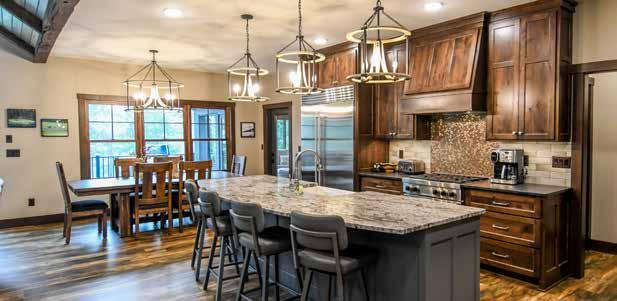
“Walnut and white oak are still what we do the most of here,” Christa continues. “People are drawn to the graining of the walnut, especially after putting a stain on it, which gives it a rich look. White oak has more of a white undertone than the red oak, so it doesn’t turn as orange, and you can get a true brown look when applying a stain.”
Nichole agrees that white oak is a big trend right now – especially quarter sawn white oak, but she says they’re also seeing more variety in wood stains in general, not necessarily a specific wood species.
“With some of our cabinet lines, the new launches that come out include a lot more new wood stain options that are updated,” Nichole says. “You can see the trends hitting everywhere. From basic to custom, it’s kind of a mix of light and dark.”
One additional way to add depth to a kitchen is to mix upper cabinets, stained light, with darker stained lower cabinets. Another way of “mixing” wood species that’s becoming more common is between the cabinets and the flooring. Selecting one type of wood for the cabinets doesn’t mean that same type of wood has to be used on the floor or other decorative wood accents.
PHOTOS FEATURED IN LAKE & HOME MAGAZINE NOV/DEC 2025
Innovation, Organization & Accessibility
Every year there are new and innovative cabinet systems designed and introduced, with advanced features for maximizing kitchen efficiency.
“Options are almost endless on how you can design your kitchen to organize it the way you want it,” says Nichole. “Of all the organizational tools that can go into cabinets, the ones we see as the most popular are the trash pullouts and silverware organizers. Also, utensil holders that typically get put next to the range, pull-out drawers for sheets pans, baking sheets & muffin tins, plus spice racks in a pullout drawer or in upper wall cabinets on the doors.”
Christa adds that the pull-out organizers for storing cutting boards, or even Tupperware lids, are a focus for many customers who want to keep their counters “virtually clean.”
“We’re even doing a lot of pockets doors,” says Christa. “One new and improved version of an ‘appliance garage’ is a space where the cabinet comes all the way down to the countertop, but can slide back. It’s kind of like a command center for the kitchen. When entertaining, it can be closed, getting rid of the clutter.”
Other popular specialty cabinet items include:
• Charging station outlets in a drawerin the mudroom or kitchen
• Toe-kick drawers for storing pet bowls out of sight
• Touch or motion-activated soft close doors
• Automated lighting with LED lights underneath or inside cabinets
Lighting
A kitchen doesn’t have to be considered part of a “Smart Home” to incorporate some of the many modern cabinet lighting options now available. Whether it’s for functionality or aesthetics, innovations like motionactivated lighting, color-changing strips, or voice-activated controls can be customized to the homeowner’s needs.
SEP/OCT 2025
PHOTO FEATURED IN LAKE & HOME MAGAZINE
Hardware
For a while, it seemed to Christa that it felt like the hardware on every cabinet was very large and oversized.
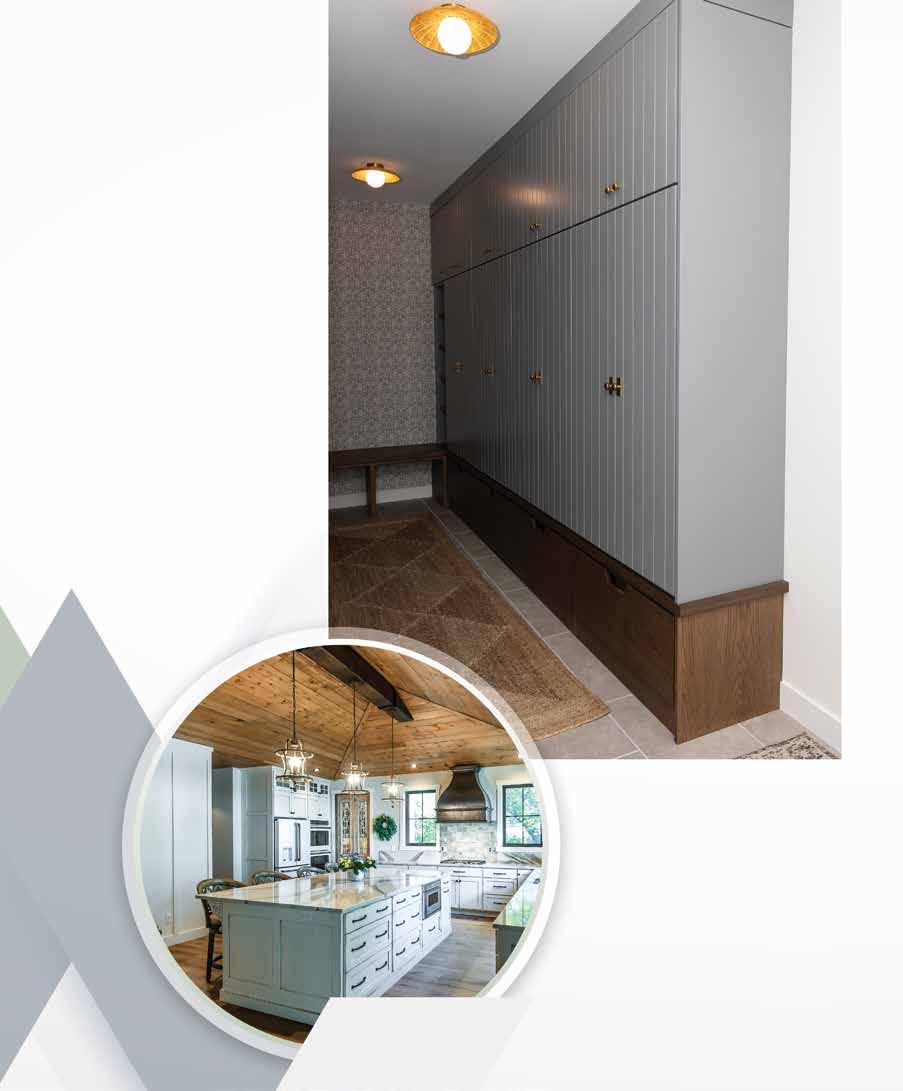
“We’re starting to see a lot more smaller knobs now,” she says, “with a little bit of character to them, like an aged brass look instead of chrome, with almost a weathered kind of look. Hardware can be swapped out, too, so we’re seeing people add interest in that area. It doesn’t always have to match the faucet or the light fixture, but can have an eclectic type of feel. It can become very personalized when homeowners choose hardware that is more of an individual choice to them, but doesn’t necessarily have to match.”
PHOTO BY BROOKE AABERG PHOTOGRAPHY
With hardware, the simpler the better.
Nichole adds, “Trends are going more toward the simple, but with small details on it. Instead of super plain, it’s about going a little back to character without overdoing it. Something like a small backplate on the back of a simple pull can make a huge difference. Subtle details seem to be coming back into hardware, leaving the color to the cabinets.”
Similar to mixing wood stains with paints, Nichole suggests even mixing the metals used on the hardware.
“People are definitely getting away from the super ‘matchy-matchy,’ especially when it’s a vacation home. More fun can happen when you can get out of your comfort zone and create something with cabinets that you love.” L&H
SEP/OCT 2023
PHOTO BY BROOKE AABERG PHOTOGRAPHY
PHOTO FEATURED IN LAKE & HOME MAGAZINE
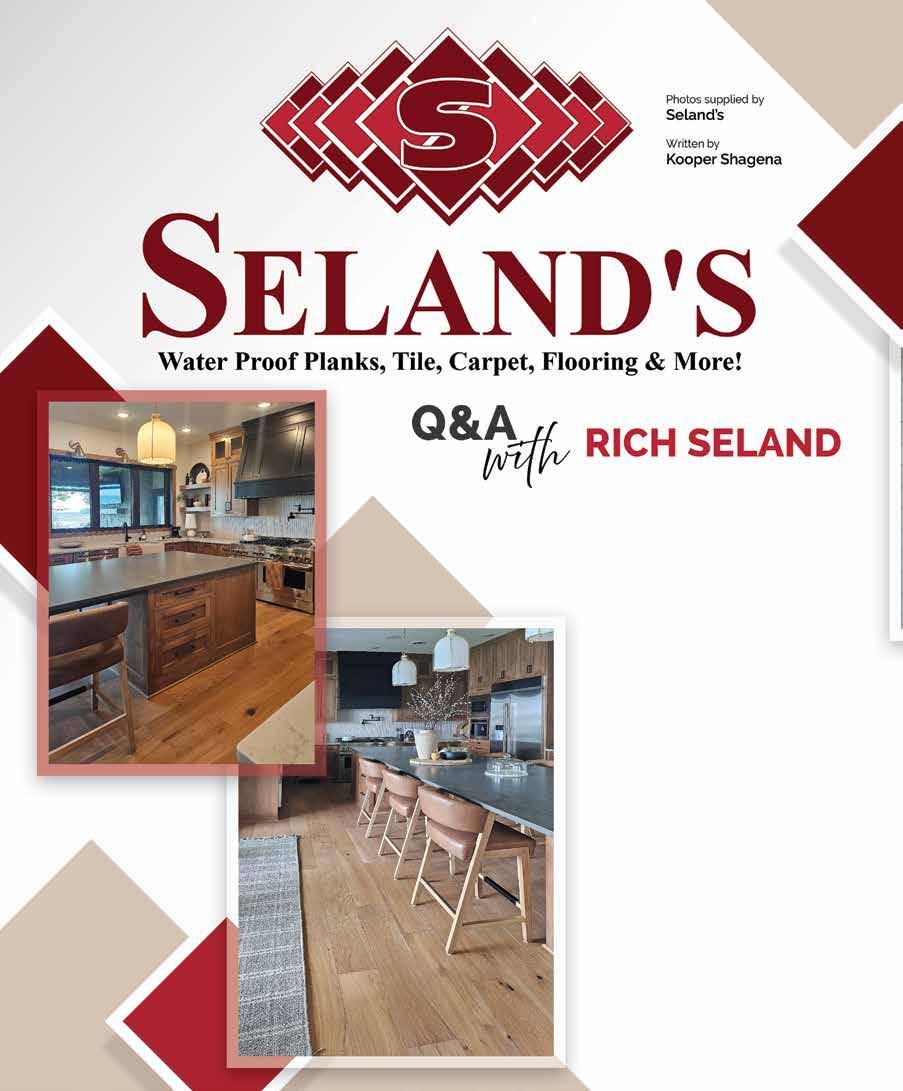
Lake & Home Magazine: When was the company founded, and by whom?
Who are the current owners?
RS: My wife Tobi and I are co-owners. I moved to Fergus Falls in 1989 where I started a flooring installation business, working for area stores. In 1992 my wife and I purchased a mobile franchise, Floor Coverings International, which got us into the retail side of the business. We thought it would be a good fit, given I was an installer by trade. My desire was and is to help our customers with the details of renovations or building. We started out of our garage, then mobile service from our vans. Because of the physical demand of installation, I knew at some point I needed a location where we could operate a showroom and warehouse, so it naturally evolved to our current location, south of Fergus Falls at I-94, exit #61.
LH: How many people work for Seland’s?
RS: We have five employees. My position is president and manager of the store. Andy Sorben is one of our sales professionals, Tim Tostenson is Installation Coordinator & Warehouse Associate, Janna Rarick is Sales and Office Support, and Jerry Swendsrud is our Bookkeeper.
LH: Explain each type of flooring you install and how they differ.
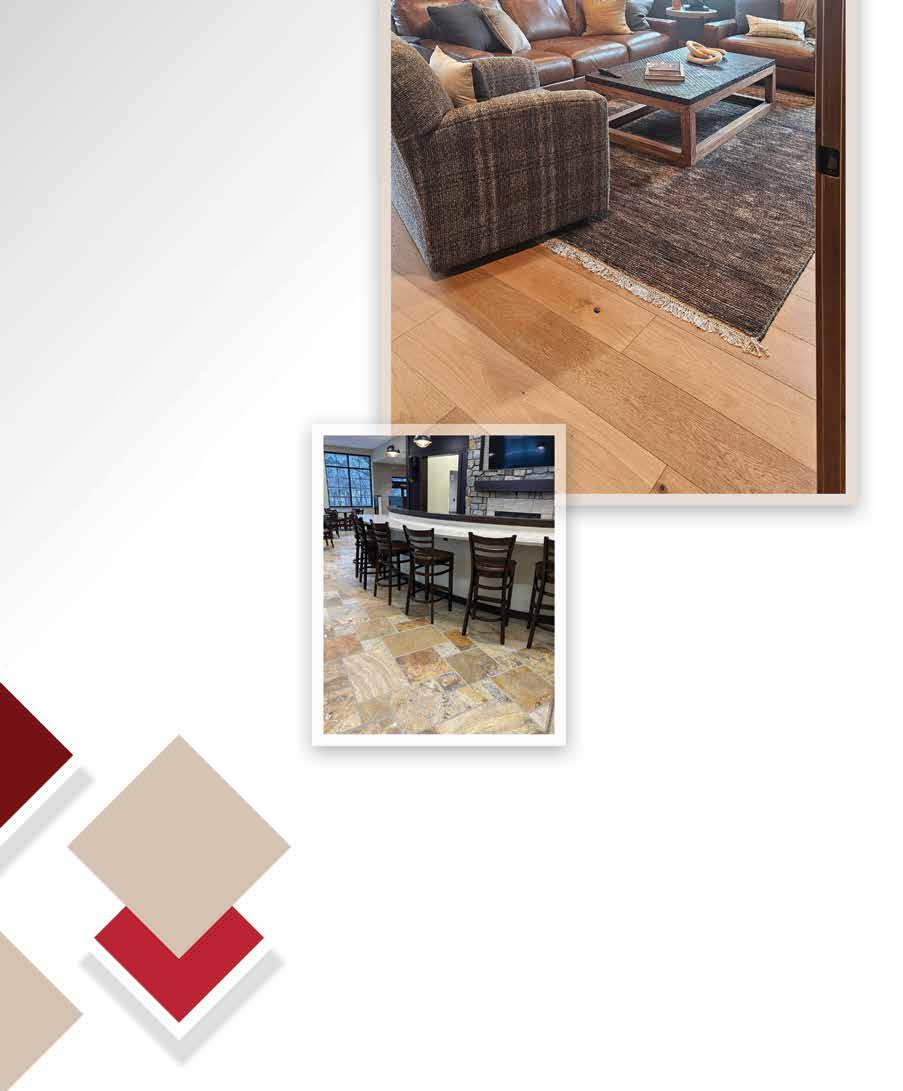
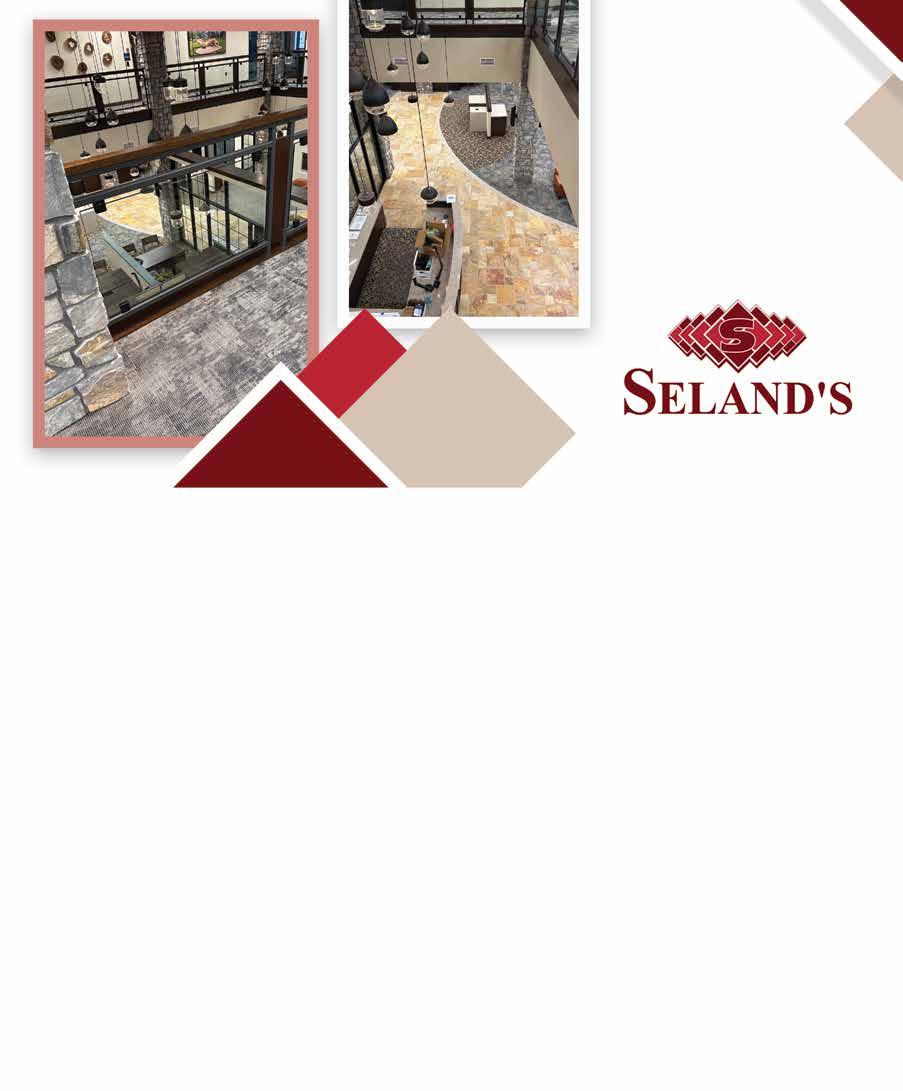
RS: We offer carpet, all types of tile, hardwood, laminate, sheet vinyl, custom window blinds and waterproof vinyl plank flooring. Whether it be a bank, church, nursing home, builders, or apartment managers, we do what it takes to adapt to the style and design trends. Some customers have their own installer, or some general contractors have staff to do their work—we are happy to just provide materials in these scenarios.
Others prefer full service with professional installation, this is our wheelhouse; we thrive on taking stress out of home remodeling or building. We work with the lakes area’s top installers, coordinating schedules and providing detailed work orders and drawings, ensuring the customers’ wishes come true.
LH: How do you source your materials?
RS: We are part of the Abbey Carpet and Floor group. Abbey’s the largest retail flooring chain in the US with more than 600 members and each Abbey Store is individually owned and operated. Abbey negotiates our pricing as a group, which allows us to compete with home centers and online stores. We then pass the savings on to our customers, offering a low-price guarantee ensuring the best pricing. We allocate resources to provide a large selection of in-stock products. Customers love this as they can “grab and go” rather than extended delays waiting for special orders. We only stock top quality, running line, trending merchandise.
LH: What is unique about the company and how you work through projects from start to finish?
RS: Our success is based on a simple philosophy: provide quality products at a fair price and treat every customer like a friend. We strive for excellence rather than spread ourselves thin with unrelated products that bog down the competition. We are a flooring and window blind specialty store, working closely with our local, highly skilled craftsmen. If it is not installed right, it can leave a bad taste in someone’s mouth.
But we’ve noticed times have changed; customer service is at an all-time low. Too often the customer is getting “ghosted” or receives sub-standard workmanship. It’s frustrating for the customer and we take offense to this trend. Our team is like-minded, with a team approach. We are guests in the customer’s home and we answer our phones.
Customer satisfaction is the foundation of our business! Without satisfied customer referrals we would not be in business today. We follow up after the project is done to ensure satisfaction and if there is a problem, we take care of it in-house. Too often the customer must file an online claim and the merchant then washes their hands of any responsibility. This is not our approach. When problems arise, we look at them as opportunities rather than problems.
LH: What new trends are appearing?
RS: Aside from color and design trends, vinyl planks are still the hottest flooring category. In addition to product trends, technology including AI are the biggest trends in the flooring industry. We’re implementing measure capabilities that are making tape measures and scale rulers are a thing of the past. We are transitioning from desktop computers to notepads with browser-based operating platforms. Measuring is now done with an app, a smartphone and a laser. We think that in the next few years, many customers will select products from their home, and all the business transactions will take place online.
LH: What is it like to operate a company that is a family affair, such as yours?
RS: It was my dream to own my own business. My father, Paul Seland, owned and operated a funeral home in Wisconsin. I got my start in the flooring industry working for my brother Dave at our uncle DeVerne Seland’s store in Coon Valley, Wisconsin. In the 1980’s, we worked in the Twin Cities for several years as independent installers. I enjoy helping the customer from start to finish and seeing the project through completion. In a community this size, whether a small remnant for bathroom, or a large-scale commercial project, it’s rewarding to see the finished project done well and to help people.
LH: What does flooring communicate for a space? How can it change the space’s feel and function?
RS: With the home becoming more of a refuge, having a comfortable space reflecting the customer’s values is more important than ever. For example, some customers prefer soft, natural, simple textures and colors to reflect their taste of outdoors. Others might lean toward technology or minimal décor with clean lines, sleek styling a sense of order in their space. As design trends evolve, customer demand changes. We push to meet those needs.
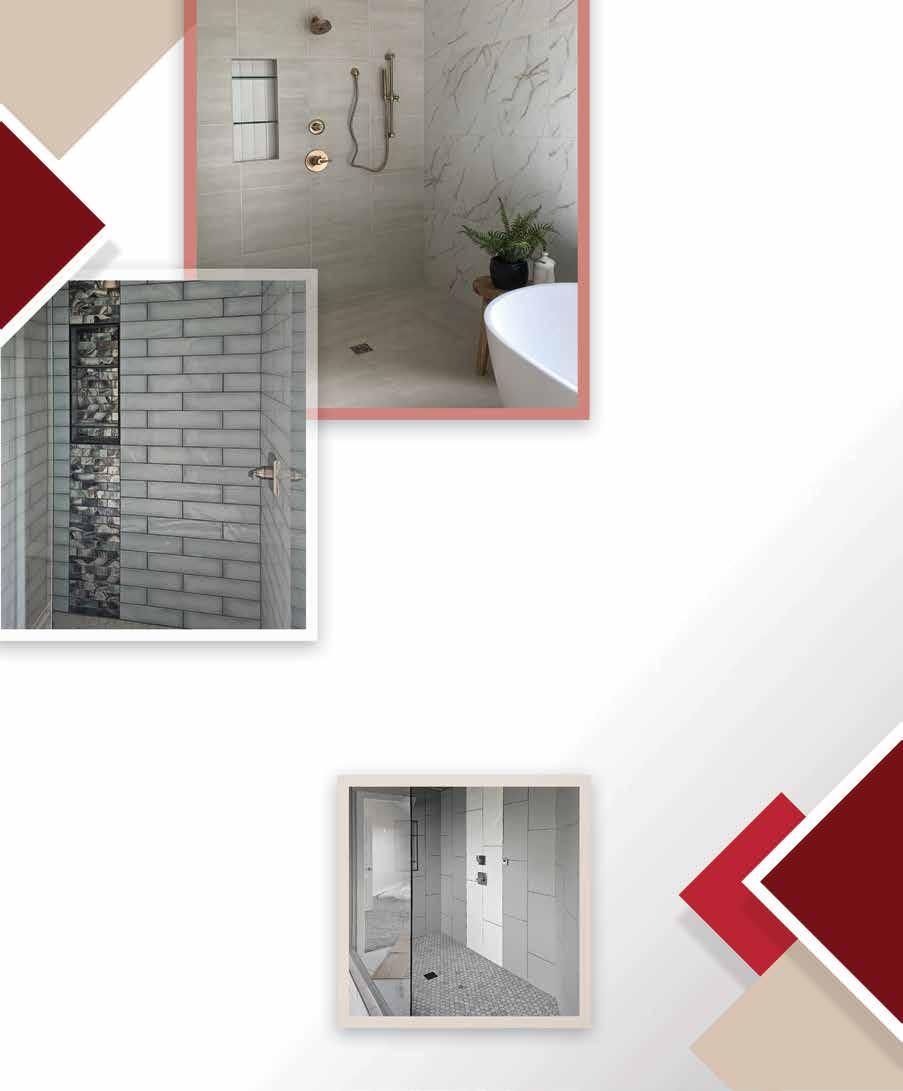
LH: You’re branching into tiled showers, backsplashes, and wall features. Why did you decide to expand and how have these new services benefited you and your customers?
RS: We have provided tile since our beginning, but customer demand and trends have evolved. In recent years, online shopping has exploded. Our customers can go to our selands.com website and shop for tile – or any other flooring or carpet - from their home or office. They can upload a photo, and view any of our products via room visualizer. Due to the latest technology, we often sell jobs without the customer stepping foot in our showroom. It’s hard to imagine this 25 years ago, but here we are!
In addition to flooring, tile and carpet, we do custom walk-in showers, backsplashes, wall features, kitchen backsplashes, stacked stone with glass and stone mixtures. Faux stone/wood technology has become so realistic that it’s nearly impossible to tell it’s not natural; these products are also more maintenance friendly, which is a big hit with today’s customers. For these reasons, we see customers transitioning away from natural stone and hardwood. L&H
During these last days of winter, we crave the greenery of spring. So we turn our attention to indoor gardening as our frozen gardens slumber under a blanket of ice and snow. Succulents are some of the easiest plants to grow indoors, no matter your skill level.
Succulents are desert plants. They’ve evolved in hot, arid conditions, so they need to be cared for in a way that’s the direct opposite of what Midwestern gardeners normally do. We spoke with the region’s foremost expert in succulent care to learn how to care for these unique plants and dropped by local garden centers to learn which succulents are readily available.
The Definition of a Succulent
These tough desert plants store water in their leaves or stems, which makes them resilient and drought tolerant. (It also makes succulents a smart choice for gardeners who forget to water plants or travel often.)
Many plant families that contain succulents, including the medicinal aloe vera plant, whose fat, spear-like leaves contain a substance that heals minor cuts and burns. The jade plant (a.k.a. lucky plant, money plant, or money tree) is a succulent. So are spiny Yucca plants, versatile Agave (the source of agave syrup, tequila, and mezcal), spiky cacti, and delicate air plants.
Popular Succulents Boast Visual Variety
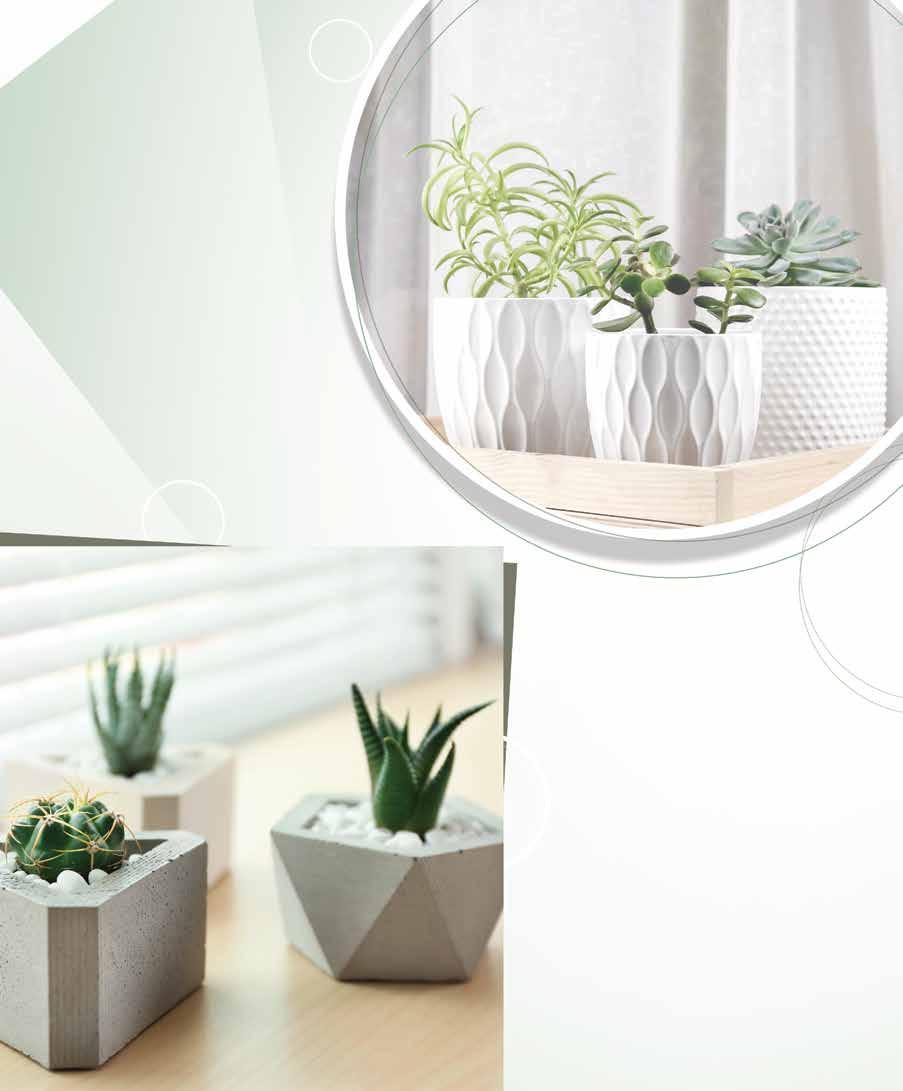
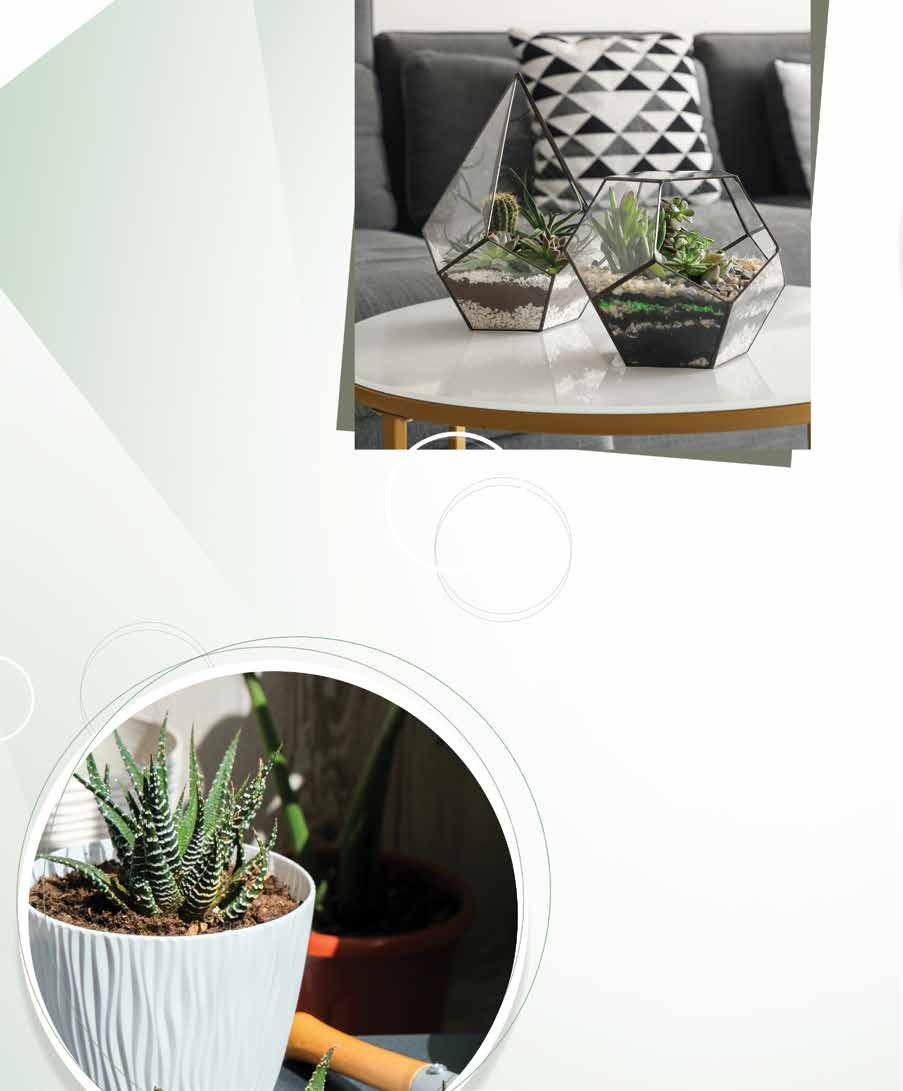
Succulents are interesting to look at, both when they’re displayed alone and when they’re arranged in groups. That’s because a succulent’s leaves come in a variety of shapes, sizes, textures, and configurations. They might be sharp and geometric or dainty and ruffled. Some leaves are round as peas, while others are long and thin.
Standouts include the dainty rosettes and frilly, flowery forms of echeveria to the trailing clusters of pea-green balls that make up the string of pearls plant. Sedums resemble jellybeans, Haworthia are striped and spikey, and the fat, teardrop-shaped leaves of a Burro’s Tail grow in ropes as long and thick as a girl’s braid.
The shape of the plants vary, too. Some grow straight up in the air, while others send out vine-like shoots. Still others stay tightly compact.
The names of succulents are often quite evocative. Blue Chalksticks and paddle plants look exactly as you’d imagine. Succulents with cuddly names — Silver Panda, Bear Paws, Kitten Ears — are every bit as velvety, fuzzy, and touchable as their names suggest.
Popular indoor cacti varieties include the Barrel cactus (which looks like a spiny pincushion), the Bunny Ears cactus with its long, paddle-like stems, and Thanksgiving, Christmas, and Easter cactus plants. These longlived succulents produce colorful blooms during the holiday seasons that give them their names.
A Rainbow of Colors
Succulents are available in a wide range of colors. Green is the most common, of course, but the variety of shades is refreshing — from mellow mint to a bright, sunny lime.
Gardeners who dig moody shades select succulents in silvery gray green, a greentinged blue, and a rich, blackish purple. There are pale succulents like ghost echeveria and pink moonstone for those who prefer just a hint of color.
Pink and red turn up often in succulents, often as an accent along the edges or tips of leaves or in the bright blooms of a cactus. But there are also warm-colored succulents available. Look for coppery versions and a variety of succulents (often sedums) in vibrant shades of orange or glowing red.
Choose the Right Container
Succulents need very little water. If they get too much, they’re prone to root rot. So choosing a pot with good drainage is essential. Look for containers with drainage holes for optimal results.
Special Succulent Soil
Soil formulated for succulents and cacti is specifically designed to be fast-draining and extra porous to whisk water away from the plants’ roots. Find it at most garden centers and home improvement stores
Resist the temptation to use nutrient-rich potting soil with fertilizer, compost-heavy garden soil, or even Midwestern clay-infused dirt reused from other spring lawn projects. They’re all much too dense for succulents (which prefer thin, dry soil with a little grit) and will trap water at the roots.
Planting Succulents
Once you find a succulent that you like at a garden center, just tip the pot over to remove the plant. Leave soil on the roots and don’t cut or break them.
If you’re planting more than one succulent in a pot, arrange them in your hand to get an idea of the arrangement you like. Then place them in the pot and lightly press the soil around the roots, leaving room between the roots of each plant. Tap gently to settle the soil and fill any gaps.
Trim any damaged or drying leaves so the plant doesn’t divert its energy to withering leaves. You can even save a leaf cutting to grow new succulents!
Growing Your Own Succulents From Cuttings
“They’re so easy to propagate and share with a friend,” says Johannes Olwage, the Curator of Living Collections at the International
Peace Garden in Dunseith, North Dakota — one of the most comprehensive succulent gardens in the Midwest. “That’s why a lot of people love them. Eventually the planter is going to become over-grown. Just take your cuttings and you’ll have extra plants. Sometimes even just one leaf will give you a new plant. You can refresh them forever.”
The process is simple, since many popular succulents — like jade, sedum and echeverias — regrow from leaves. Gently twist off a leaf at the stem. Let it dry for a few days, then place it in a well-draining pot with appropriate potting soil.
Don’t push the leaf under the soil — just put it on top and place the container in full sun. Mist it with water only when the soil dries out.
In a few weeks, impossibly thin roots will grow. A small plant will follow. You can replant it when the original leaf starts to shrivel up and the new plant is half an inch high.
Maximize Sunlight
Always select the sunniest spots for your succulents. They need at least six hours of sun daily. Choose a window facing south, west or east. If you move your containers outside in the summer, your succulents will thrive in full sun.
If natural light is at a premium indoors, plant succulents in a hanging basket or try moving plants around the house as the slant of sunlight shifts season by season. You can also buy plants that require a little less light. Air plants and sedums are just the beginning.
“A very common one is one called Snake Plant or Mother-in-law’s Tongue,” say Olwage. “They’re some of the hardiest houseplants you can get. There are also some plants that are related to aloes that are called pinwheel plants. Or Haworthia — they’re like miniature aloes, so they’re nice and compact, but they don’t need that full sun.”
You can transfer those containers outside in the summer. Just take them indoors when rainstorms or frost are in the forecast, says Olwage.
Barely Water Your Succulents
This is the part that trips most Midwestern gardeners up, because not watering our plants is deeply counterintuitive to most of us. But giving our succulents very, very little water is actually one of the most important things we can do to help these desert plants thrive.
“The most common mistake is overwatering them or killing them with too much love,” says Olwage. “They are made to deal with short and longer periods of famine. Water about once a week to every 10 days. Put your finger in the soil and see how fast the water dries out. Water when the soil is about to turn dry.”
Olwage says that a hands-off approach is best, especially at first. He says over time we’ll learn what our plants need through careful observation.
“Just ignore them once in a while and see what they do,” he suggests. “Usually succulents will show you when they would like some water. They’ll get a raisin-y, wrinkly skin. If you’re going on vacation for two weeks, I wouldn’t worry about anybody coming to water your succulents.”
Schedule a Winter Drought
If you buy a succulent plant in the winter, congratulations. You have to do even less watering than you would during the rest of the year, because winter is the dormant season for succulents.
“It’s usually the end of October to the beginning of March, the darkest periods of winter up here,” Olwage explains. “Don’t stop watering them but tone it down. Go to once month instead of once a week. And never water it if the soil is still wet.”
This is good news for gardeners with jampacked winter schedules or spring break getaways on the calendar. You can actually remind the house sitter not to water your succulents while you’re away!
This is just another reason why succulents are a great choice for busy people and brand-new gardeners alike. Succulents are a hardy, low-maintenance option that add a pop of color and texture to your home with only basic gardening skills required. L&H
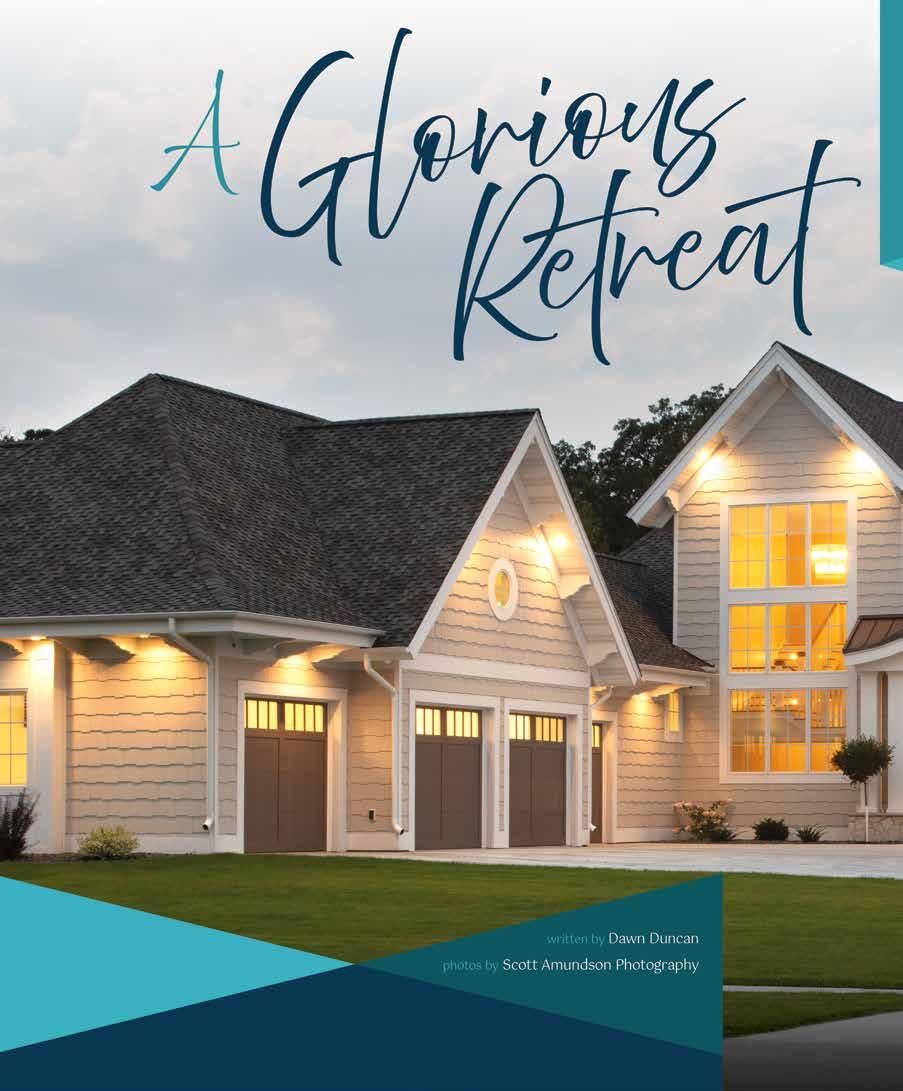
What makes a luxury home a showpiece? Is it simply the size or is it more than this? In the realm of large-scale residences, there are homes that are grand yet lacking personality or warmth and those that showcase conscientious planning to elicit a feeling of retreat, despite extensive square footage. One of Strom Architecture’s completed projects in West Fargo falls into the latter category, with 8,490 square feet and every inch of this space thoughtfully considered and meticulously designed.
It was constructed by Dietrich Construction, a general contractor in Fargo, ND that has been in business for more than 40 years and that works in both commercial and residential design/build. Dietrich is a family-owned and operated company with a focus on building high-quality, functional spaces. These include commercial new builds and remodels, fit-ups for various sectors and custom homes, in addition to earthwork and a focus on turn-key solutions. The business
delivers what they term “the Dietrich Way,” illustrating their concentration on specific methods and standards.
Strom Architecture has risen to the top of the architecture sector in this region and currently has two offices: West Fargo and Detroit Lakes, MN. Their projects span the region and the company also works with clients out of state.. Founded and led by architect Jackson Strom, the cutting-edge company is known for innovation and the ability to uniquely solve problems, working through complex projects. One challenge that can arise is timing; concept through completion of large homes and properties can end up under tight deadlines and sometimes seemingly insurmountable odds. However, this West Fargo mansion project had many things on its side, including ample time for it to be carefully designed, built, and receive its finishing touches. In 2021, Strom Architecture began working with the homeowners, design was completed the following year, and the home was move-in ready in 2023.
“We
met and worked through the details and tailored the design to his lot. In the end, very little changed. He wanted to keep what made the design strong in the first place.”
Jackson Strom STROM ARCHITECTURE
This project began in a rather unconventional way. Jackson Strom was acquainted with the homeowner and knew that he owned this particular lot. After reaching out with a cold email, simply telling the homeowner he thought that the design for a model/ spec home Strom Architecture had drawn would look good on the lot, the renderings were included for review and the homeowner responded immediately, ready to move forward.
Strom comments that this entrepreneurial angle is one that is a hallmark of his company. "We design homes specifically around clients, land, and budget; this was a proactive opportunity rather than a pre-existing commission."
"From this initial exchange, we embarked on the process together, working through the details. We tailored the design to his lot and in the end, very little changed. He wanted to keep what made the design strong in the first place. From there,” Strom says, “we met and worked through the details and tailored
the design to his lot. In the end, very little changed. He wanted to keep what made the design strong in the first place.”
Strom continues, “Having ample time to work on this project allowed the architecture and details to develop thoughtfully rather than feeling rushed, which is especially important on a home of this scale.” He states that throughout the process, the homeowner was intentional about protecting the details that often get trimmed back when budgets are reviewed. Instead of simplifying things, he chose to hold onto the proportions, material transitions, and refinements that give the home its character.
From the beginning, the goal was to make this house feel like a true retreat, a place to play as well as relax. The homeowners also stressed having all the amenities needed to make it the ideal place for their family and entertaining. “They were very intentional about how the home would be used,” Strom remarks, “day to day, during holidays,
“Having ample time to work on this project allowed the architecture and details to develop thoughtfully rather than feeling rushed, which is especially important on a home of this scale.”
Jackson Strom STROM ARCHITECTURE
and when hosting friends and extended family.” There was extensive care in considering how the house would function. “The middle bay of the garage has a vaulted ceiling,” Strom says, “and the space includes a basketball hoop, allowing the family to play together indoors. It’s not flashy, it’s just thoughtful; a space designed for real life.”
He continues by stating that their top priorities were creating a highly functional layout throughout the property, designing spaces that naturally support gathering and entertaining, and maintaining a strong connection between the indoors and outdoors. “At the same time,” he continues, “they wanted the architecture and materials to feel timeless and enduring, rather than driven by trends. Those priorities shaped every major design decision.”
One story that still makes Strom laugh is that the homeowners followed the design intent so closely that when he began working with Dietrich Homes and their designer Heather Sagvold on the interiors, they were using Strom Architecture’s interior renderings as their guide. “They were set on finding the exact chandelier in the rendering to keep the vision intact. When we show light fixtures in renderings, especially when we’re not handling final selections, they’re there to communicate scale and overall design direction. They are not always literal,” Strom adds.
“One afternoon, I received a text from the husband saying he didn’t think he’d be going with the six-figure chandelier we had shown in the rendering. It was a good reminder of how seriously he and his wife took the vision--and how convincing a rendering can be.”
Their goals were achieved. The home is one that is masterfully equipped to be versatile and prepared for a large family, frequent gatherings, and different types of functions.
“The tall ceilings and generous scale of the main spaces create an immediate sense of openness, allowing those rooms to feel comfortable and inviting even when full,” Strom explains.
Although there are numerous showstopper elements in this home, Strom offers that one
of his favorites is the hall adjacent to the main living spaces. “It quietly does a lot of work in the plan by separating the living room and kitchen from the entry, stair, and office, while also connecting the primary bedroom wing to the garage wing. That circulation space helps the home feel organized and calm.”
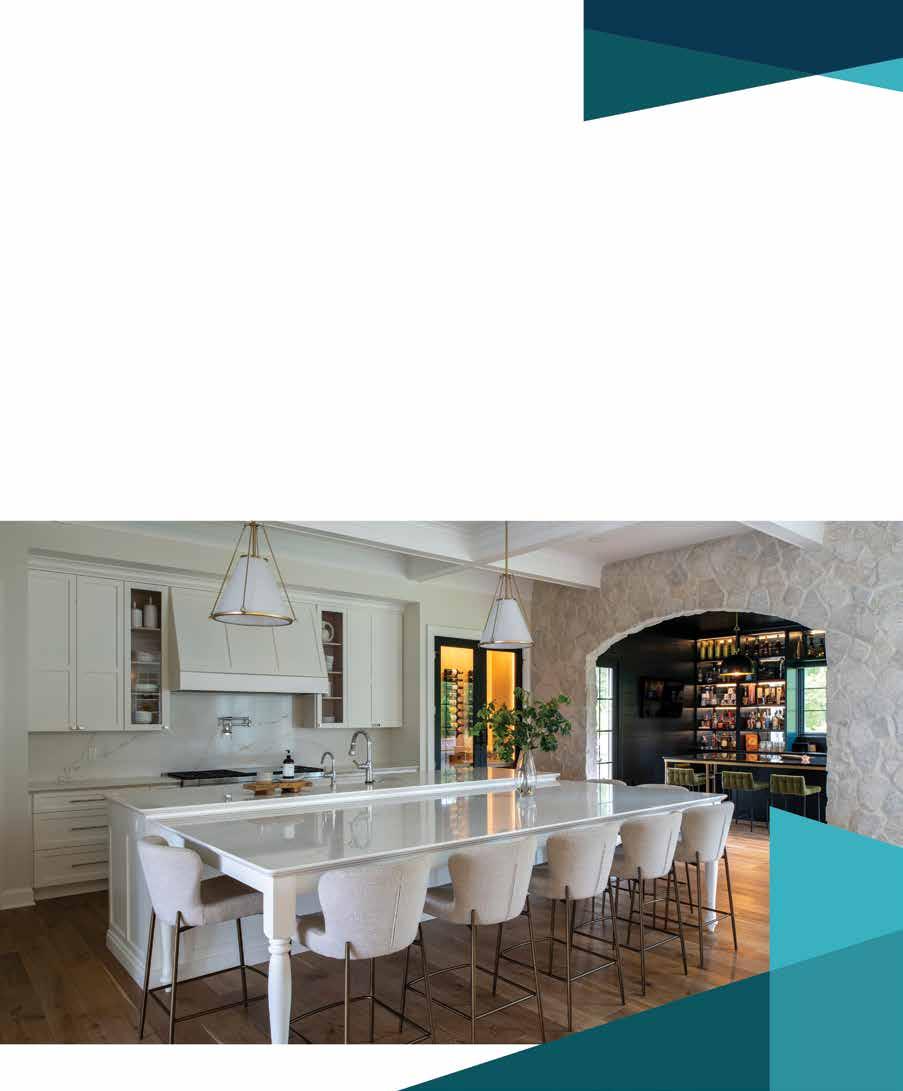
The kitchen, predominantly done in white with a mixture of sleek and rustic finishes, includes an expanded island that has a bar attached, sized to include seven seats.
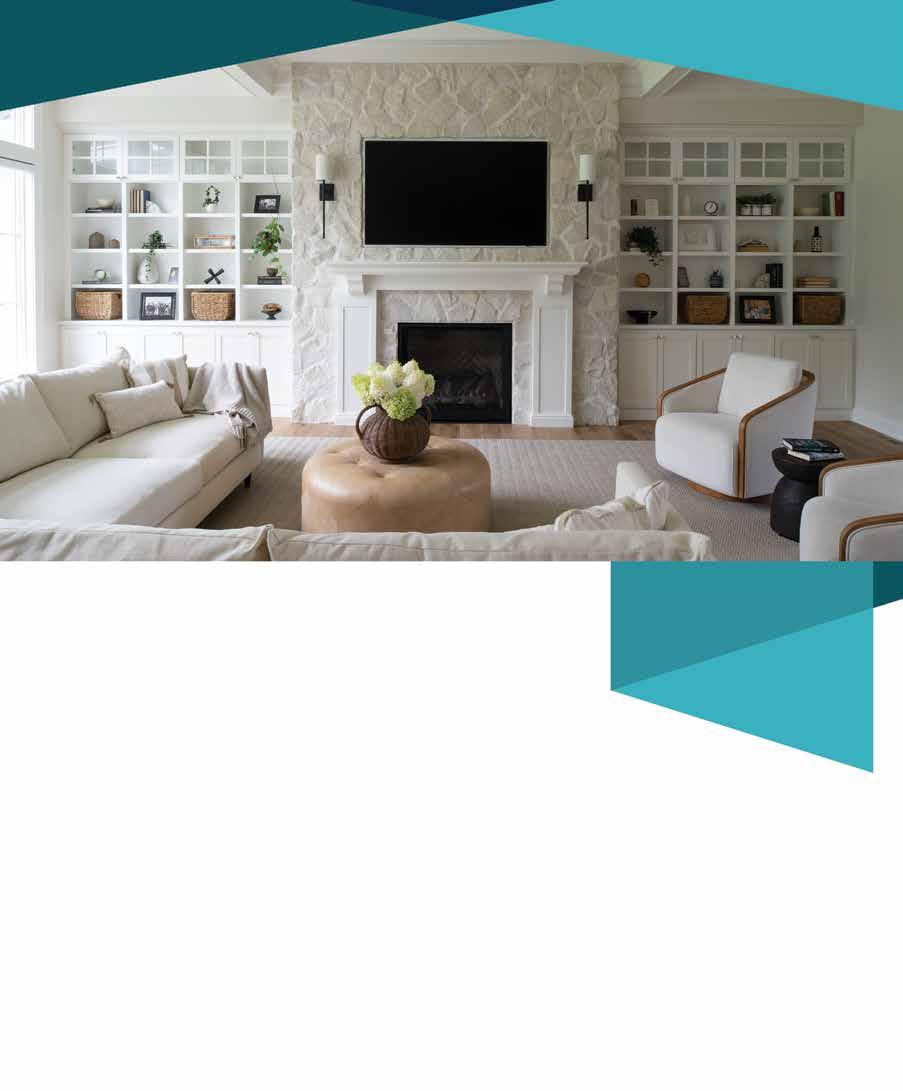
Adjacent is the living room, a continuation of the white them and offering a stone fireplace, white mantel and frame, and extensive built ins on either side with paned cubes across the top, with open square shelving, 12 per side, positioned above storage cabinets
below. The neutral sectional, soft tan leather ottoman, and white accent chairs pull the room together, with subtle pops of color including greenery and various décor items displayed in the shelving.
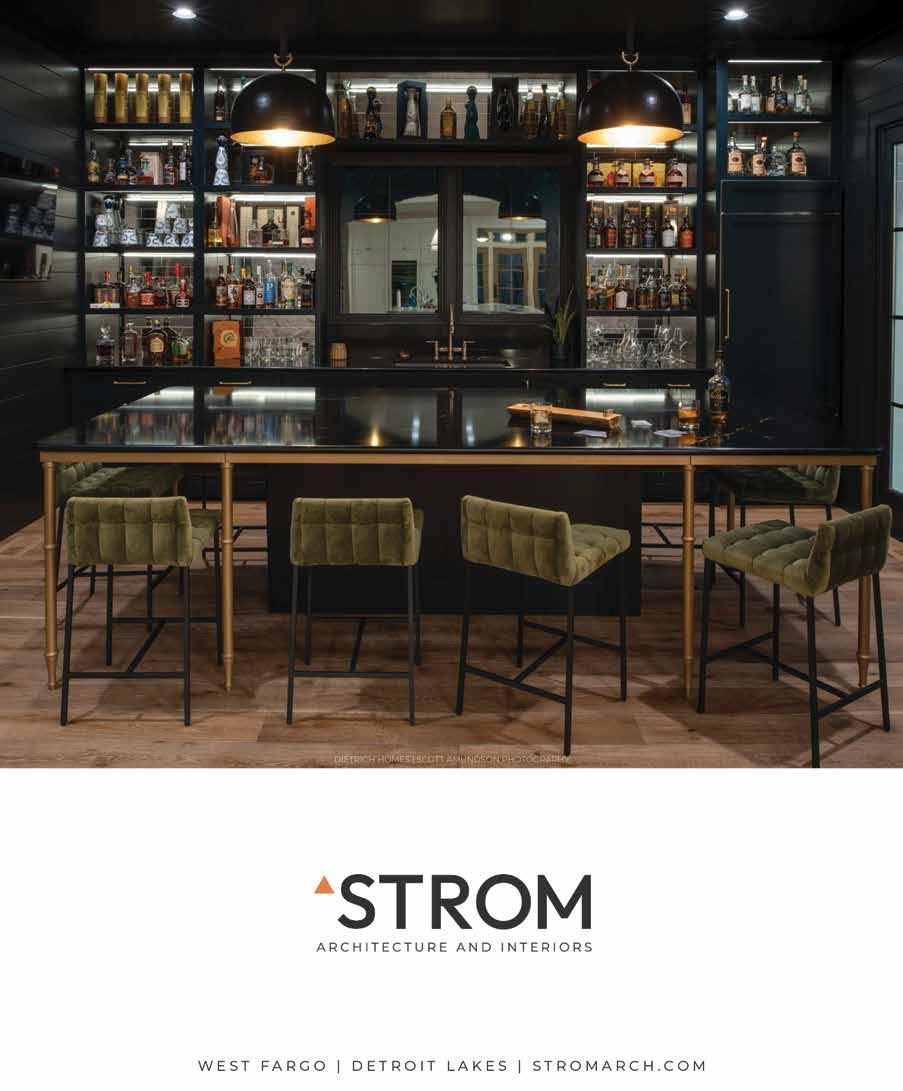
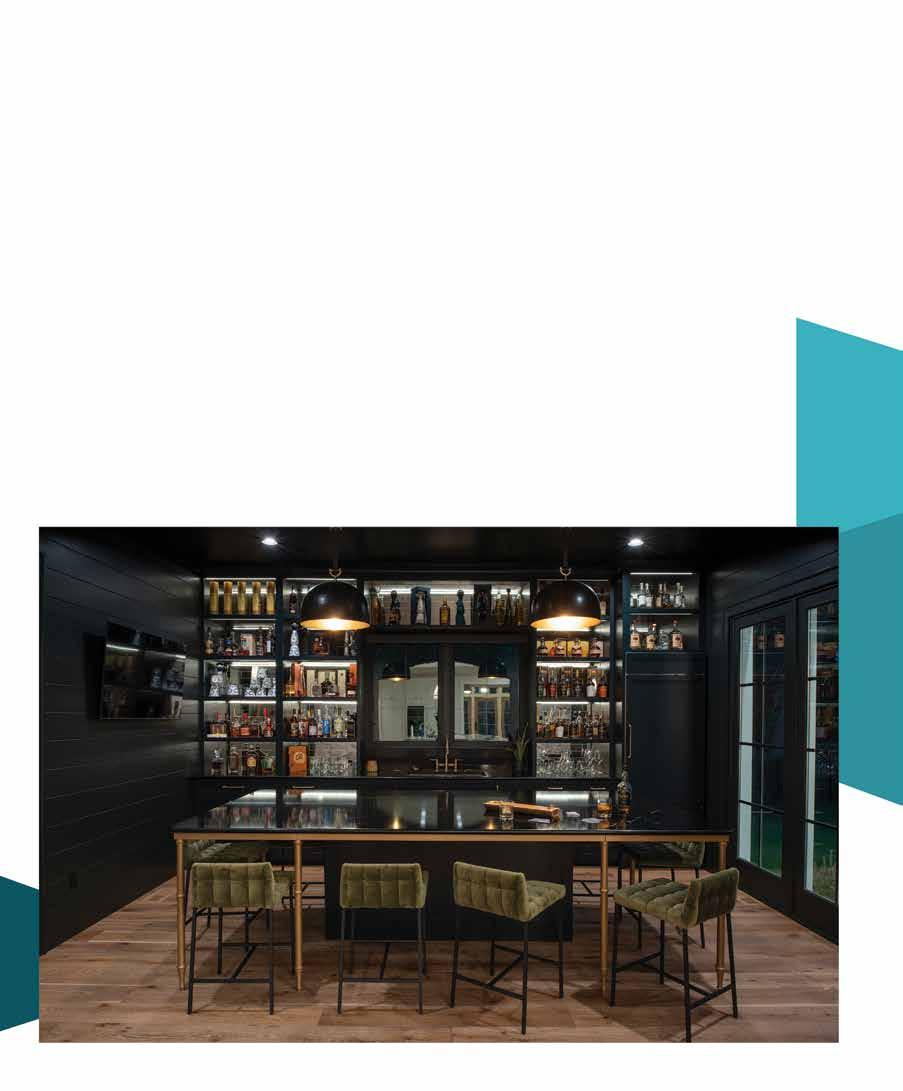
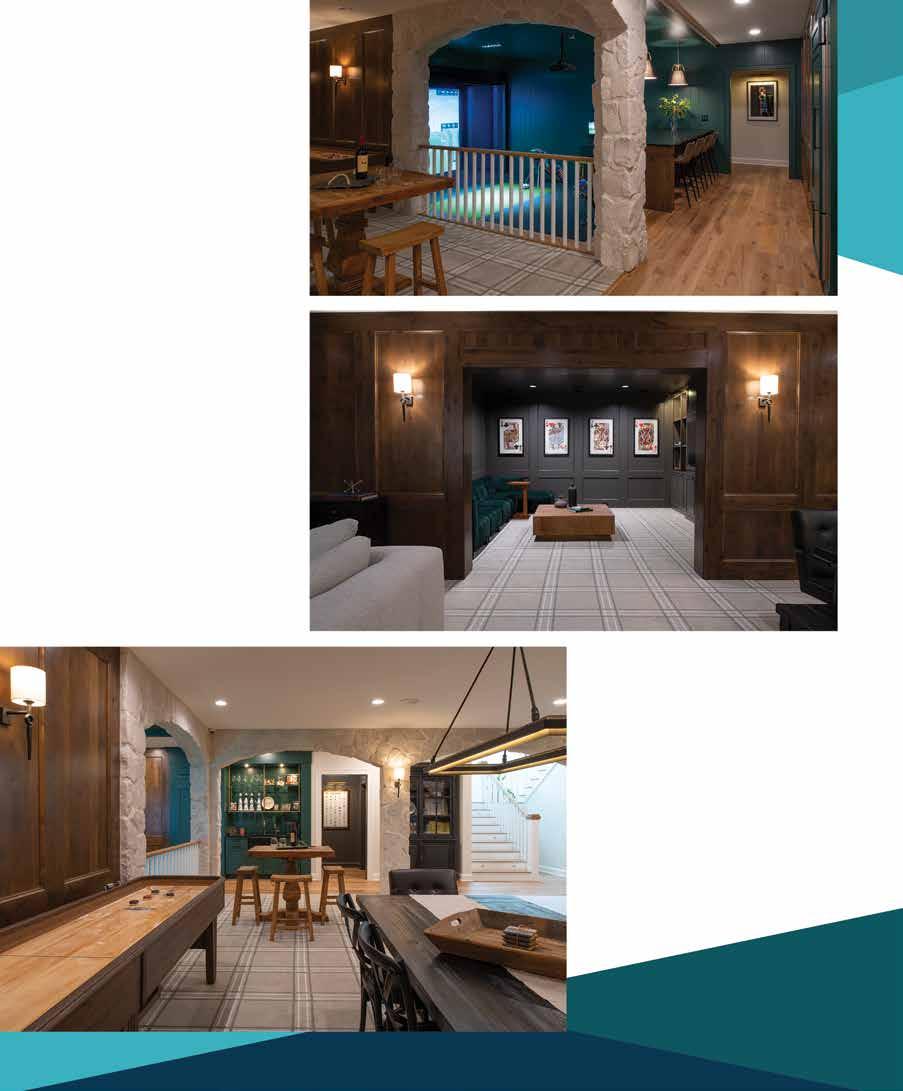
The lower level of the home also turned out well and met expectations. “It’s become a true entertaining destination,” Strom says, “with a golf simulator, game room, and multiple TVs that work together seamlessly. It has the energy of a pub—lively, comfortable, and designed for people to settle in and stay awhile, while still feeling like they’re in a natural extension of the home.” Another unique area of the home is its bar---dark, moody, and filled with rich finishes, including olive velvet quilted stools, burnished brass hardware, and lighted display shelves flanking a full wet bar set up offer a high-end hotel vibe mixed with coziness that creates a relaxed atmosphere for conversation.
Remaining focused on details was important and the Strom team, along with the homeowners, remained diligent in their pursuit of excellence; it was critical to work through details up front to ensure the project’s success. Along with the builder and designer, plus all of the subcontractors who worked to pull this home project together, it was critical to remain conscientious about each piece of the build to ensure that the vision would be realized.
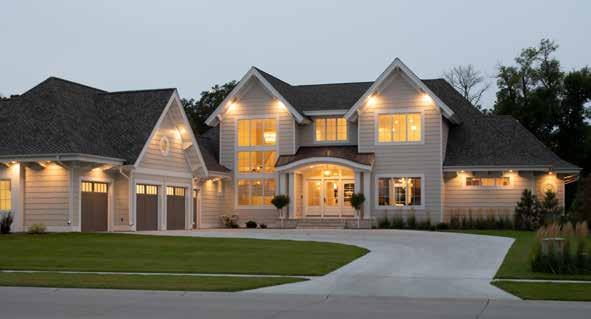
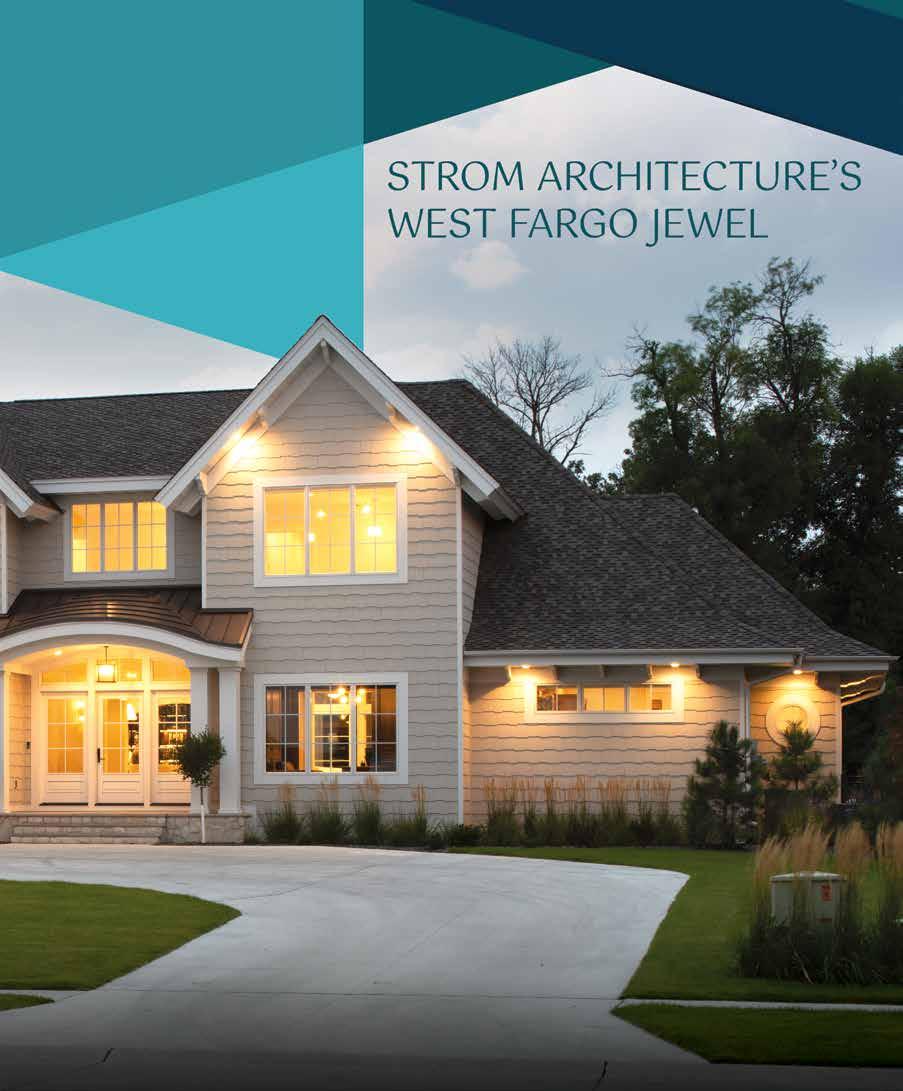
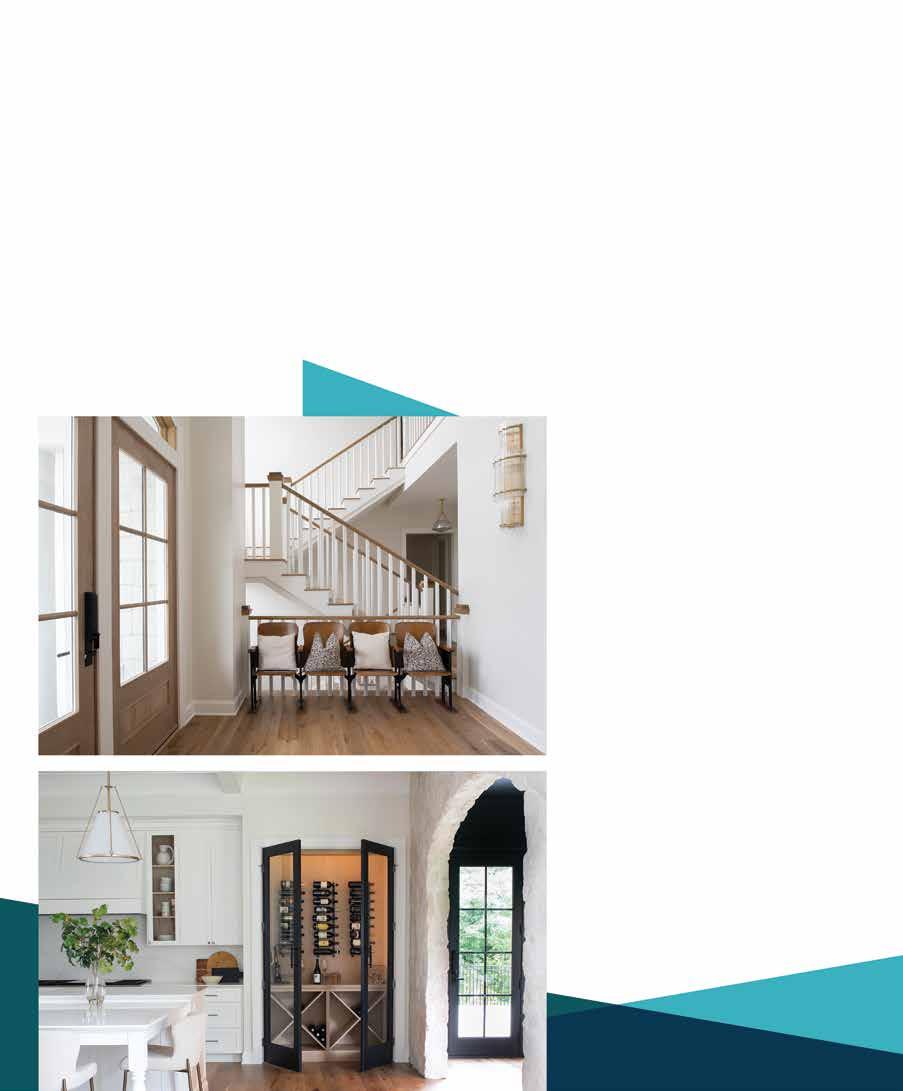
The home features six bedrooms, six full bathrooms, and two powder rooms. With 10,700 square feet of finished space, there is room for the homeowners and their family, as well as guests. Four garage stalls, a grand entry filled with natural light, white walls, contemporary sconces, and other sophisticated design choices are attributes of the home that blend beautifully, offering a stately retreat from the outside world. A relaxed, curved driveway leads to the twostory structure that boasts multiple, large,
paned windows across its front side, adding intrigue and brightness. It is the type of home that can flex between cozy and cosmopolitan, easily evolving from one activity to the next, always remaining functional while also aesthetically striking.
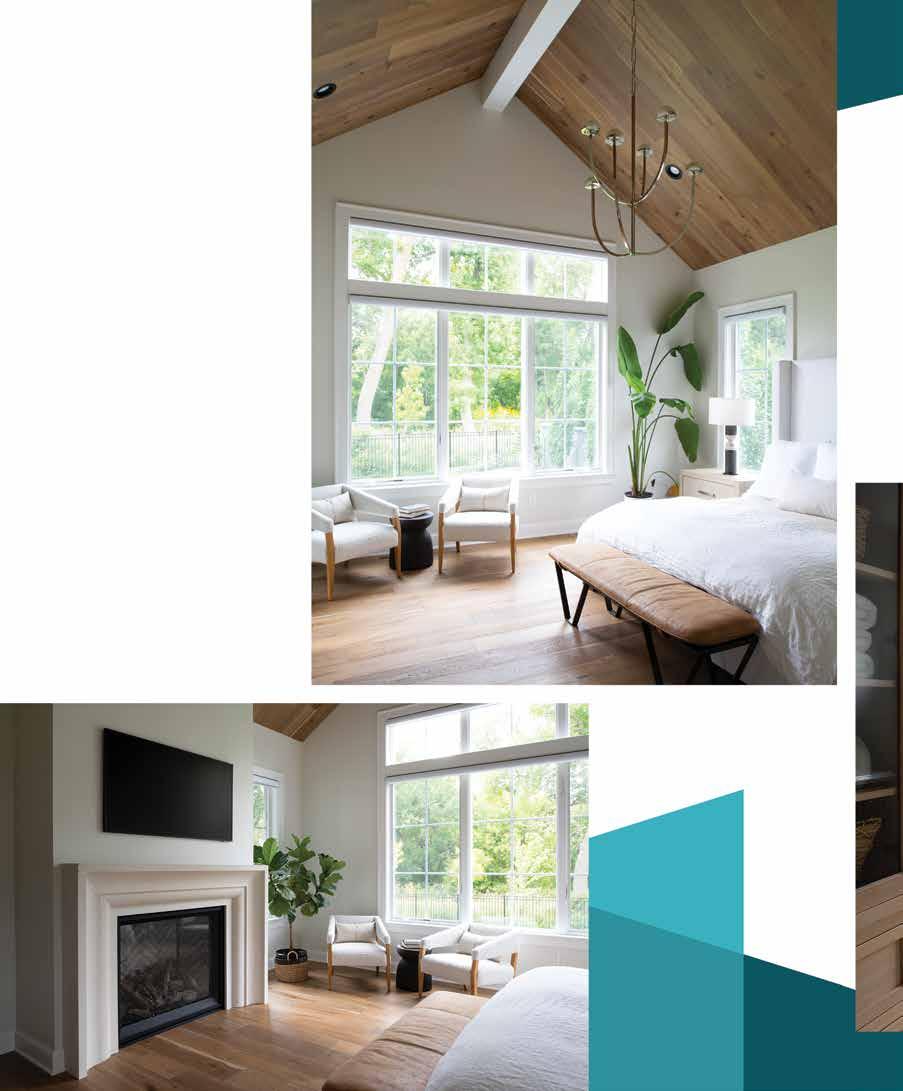
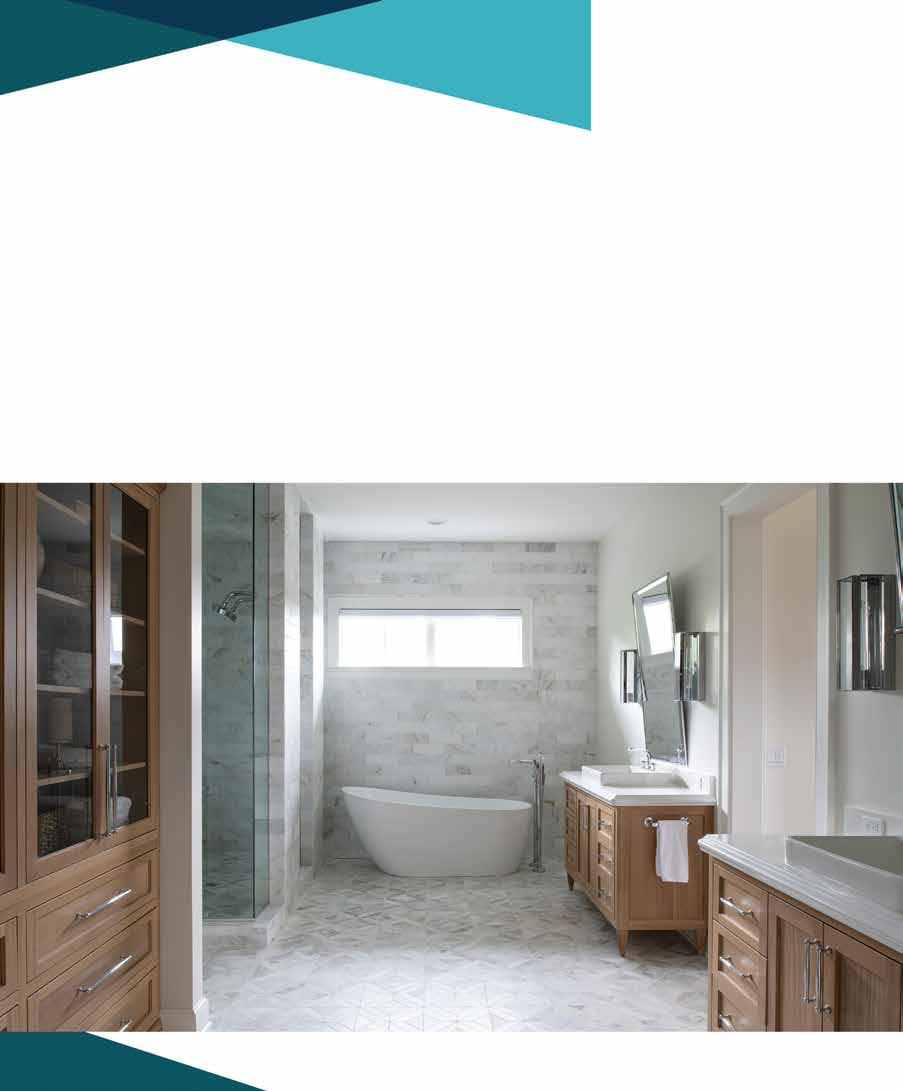
Bedrooms are a perfect combination of rustic touches such as hardwood floors, vaulted ceilings, stark white beams, and minimalist-yet-striking chandelier lighting. The mixture of clean whites and neutral browns, blacks, and greens give a spa-like feel to the primary suite, with the bed-facing fireplace and mounted television bringing in extra touches for relaxation. The en suite bath offers a sizable space which includes a modern white, freestanding tub, a white and pale gray aesthetic, and two large wooden vanities with white contemporary sinks, LED-lit rectangular wall mirrors, and sleek sconces on either side. The vanities are on either side of the doorway into the bedroom and the same wood finishes are used in the built-in
“Shingle-Style homes rely heavily on rooflines, massing, and transitions, and at this size, those elements need to be carefully refined so the home feels layered and welcoming rather than oversized.”
Jackson Strom STROM ARCHITECTURE
storage cabinets that feature drawers as well as glass doors. These serve as the linens area. Lastly, a custom glass shower completes the bath.
Strom notes that, architecturally speaking, the home’s Shingle-Style design requires keen focus on proportion, massing, and detail rather than ornament. “What makes this home truly unique,” he comments, “is not just the style itself, but the collective effort behind it. This was very much a group effort, with significant contributions from our team, especially Shea Selly, along with Heather Sagvold and the entire Dietrich Homes team.” He notes that from start to finish, the group worked together and the home is a testament to what a team can achieve when everyone is aligned and working with one another from the earliest design conversations through construction.
The homeowners were involved, willing to take the extra step to ensure the architecture was executed as intended. “Details like the properly scaled fascia profiles, flared eves, trim details (and craftsmanship), we all carefully considered and carried through,” says Strom.
“That level of collaboration from start to finish is what allowed the home to come together in a way that feels cohesive, intentional, and lasting—without ever feeling overdone.”
Jackson Strom STROM ARCHITECTURE
This home was built exactly the way it was designed. Every proportion and detail carried through from drawings to the actual construction. “There wasn’t a single element that was not thoughtfully considered,” adds Strom. “Yet when you walk through the home, it feels natural and effortless—almost like ‘of course that’s the way it should be’. That sense of ease is only possible because of the amount of thought, coordination, and care behind every decision.
He stresses that the project reflects the strength of the entire team and the trust that the homeowners placed upon them. “It isn’t often that everything aligns—the right people, a shared vision, and a client who respects the team and process enough to let everyone do their best work,” Strom remarks. “That level of collaboration from start to finish is what allowed the home to come together in a way that feels cohesive, intentional, and lasting—without ever feeling overdone.”
Strom adds that the project was especially meaningful because it became about more than just the house itself. “The homeowners were thoughtful, engaged, and trusted the process, which allowed the work to unfold in a deliberate and targeted way. That trust made it possible to focus on the fundamentals---proportion, flow, and how the home would be experienced over time.” He adds that what has been most meaningful is that the relationship has continued well beyond this project. “We have since worked together on additional efforts and even had the opportunity to welcome their son into our office as a student intern. Those moments reinforce that the most lasting outcome of this work isn’t just the home, but the relationship that form during the process.”
This home is currently for sale and inquiries may be directed to Jackson Strom. Although this home sits along a river, it carries many of the qualities valued in lake homes: a strong connection to the outdoors, spaces that encourage people to naturally come together, and an overall sense of comfort and longevity. Strom adds, “It’s a home meant to be lived in fully, and one that reflects the collaboration and care that went into creating it.” L&H
Couldn't have done it without:
Strom Architecture | ARCHITECT
View our ad on page 85
Dietrich Homes | BUILDER, INTERIOR DESIGN, TILE View our ad on page 87
Cullen Insulation | INSULATION
Mortenson Masonry | MASONRY
Spaulding Stone | COUNTERTOPS
Precision Heating & A/C | HVAC
A&R Drywall | PAINTING, DRYWALL
Carpet World | FLOORING
View our ad on page 93
Precision Plumbing | PLUMBING
Current Electric | ELECTRIC
Precision Dirtworks | EXCAVATING
Crane Johnson Lumber | BUILDING MATERIALS, WINDOWS
View our ad on page 93
Red River Tile | TILE
Rigels | APPLIANCES
View our ad on page 91
Braaten Cabinets | CABINETS
Wire Wise | SECURITY
EZ Open Garage Doors | GARAGE DOORS
Turf Tamers | LANDSCAPING
Lemke Home Improvements | SIDING, GUTTERS
Hebron Brick | FIREPLACE
Ottertail Glass | SHOWER GLASS
View our ad on page 95
Jim and Connie Volling are LeSueur, MN natives and high school sweethearts who, during their marriage and raising three grown sons together, two of whom reside in Minnesota and one who lives in Connecticut, have built multiple homes. For many years, the Vollings enjoyed a vacation home at Voyageurs Retreat, up north in Minnesota and nearly five hours from their primary residence in the Twin Cities. Many fond memories were built there, but the couple felt it was time for something new, a place that their now expanded family that includes seven grandchildren could usher in the next chapter of life.
The Vollings researched the areas of Minnesota that would work well distance-wise for them and through Evolution Real Estate, found a lot at North Pines at Grand View Lodge in Nisswa, nestled up to the resort’s award-winning, world-renowned golf course. The lot was owned by builder W Gohman and after contacting the company, Jim and Connie proceeded with purchasing the lot and getting to work on creating their new vacation oasis in the pines.
When starting from scratch with just an empty lot, at times the design/build process can be overwhelming for homeowners, but not for the Vollings. They had a clear vision of what this next phase of vacation home
living should look like and did the groundwork to list details of what they wanted included in their new house. “We love a warm, welcoming feel,” says Jim. “We had a plan, architect Travis Miller, and ideas; the team at W Gohman were phenomenal, along with the designer Sara Raimann of The Hearth Room and the list of subcontractors. Connie and I have extensive experience in this type of process and we have similar tastes, so when one of us doesn’t necessarily like a particular potential design choice, they have veto power. We work very well together.”
The home’s dark gray exterior is accented by a burnt red trim, wrought iron railings across the deck and down the L-shaped stairs that lead to the covered patio and the yard. It’s stone chimney and columns feature stone and create a perfect balance of color and texture, which is a signature attribute. No detail has been overlooked, and the dormer windows plus those that are large-scale add a quaint and traditional feel, honing the mission to keep the property one that is inviting. Its charm is evident and the home exudes character that harkens to historic houses.
When entering from the asphalt driveway, the front of the house features a total of three garage spaces, peaked entry with columns, and a classic aesthetic. This house is one that achieves what many of today’s luxury homeowners strive for: having lots of square footage, but keeping the overall feel of the home cozy. It’s not always easy to do, but this is where experts are of great service, as their skills in space planning and creative solutions map to the desired look but also the feel that homeowners are going for.
“Some of the furnishings are from our previous property, and others are new. We blended these together and we love the true Minnesota feel of the home.”
Jim Volling / homeowner
Beyond the stunning home itself, the lot the Vollings built upon has large trees and a spacious yard, complete with a sizable fire pit for gatherings. The view from the home’s deck is the third hole of the golf course, and offers a peaceful, serene ambiance. Although this home is large at 5,547 square feet, with five bedrooms and five-and-a-half bathrooms, its design is cozy and the décor pays homage to the Northwoods of Minnesota. “Some of the furnishings are from our previous property,” Jim adds, “and others are new. We blended these together and we love the true Minnesota feel of the home.” Hand-carved furniture and décor accents, including a large black bear statue as well as a carved eagle, bring
in a rustic feel. Knotty Alder woodwork, including on the vaulted, peaked ceiling of the great room, which also includes dark beams, adds to the home’s warmth. The stone fireplace with reclaimed wood and metal mantel pull the room together.
This two-story home is ideal for large gatherings and is designed with guests in mind. En suite baths are included in four of the guest rooms and there is also a powder room as well as a large bathroom located in the hallway near the bunk room, which includes a double vanity, shower, sauna, and deep, white porcelain free-standing tub. Concentration on large windows, lots of light, ample
“The views are incredible. The layout takes full advantage of the lot.”
Dave Thomes | W Gohman
storage space, and comfortable furnishings have all been included in bringing the Volling home together. Equipped to accommodate a large family, the home is designed to offer room to move about, to retreat, and to enjoy the natural surroundings.
Dave Thomes, Residential Construction Manager at W Gohman, served as the project manager in this build, which broke ground in mid-October of 2024 and that was completed in June of 2025. The Vollings shared their vision with Dave as well as architect Travis Miller. For the Vollings, beyond the home having desirable design features, quality was paramount to anything. Jim states that his personal style when it comes to building is to spend time laying out the project and getting things right at the onset as much as possible, thus avoiding excessive change orders. “It makes the process easier for everyone,” he comments.
For Dave, the standout features of the home are the open great room and kitchen. “The views are incredible,” he states. “The layout takes full advantage of the lot. I also like that every bedroom and bathroom has its own feel. It does not feel repetitive as you move through the house.” The kitchen Knotty Alder cabinetry pairs well with the dark gray island with bowed granite countertop that also features bar seating for four. The larger dining space is part of the room and metal pendant lights over the bar are the smaller version of that which hangs above the dining table for six. The bar holds a deep farmhouse sink and houses multiple cabinets, drawers, and a dishwasher. Brushed nickel hardware accents the room.
In addition, Dave comments that the bunk room, which features lower-level queensized beds and upper-level expanded twin beds, plus a stair in between the sets of bunks in lieu of a traditional ladder, was a fun space to build and see come together. “The lower-level bathroom is also a favorite, with the sauna and wet room. It’s a great example of how thoughtful design and good execution can really elevate a space. Overall, it was a very collaborative project between Jim and Connie, the design team, and W Gohman, which always leads to the best results.”
The Vollings’ lot had slightly larger setback requirements, posing a bit of an initial challenge in terms of design, but the team were intentional with how the house was laid out. Dave remarks, “A lot of time went into maximizing square footage while still positioning the home to capture the best views. In the end, everything fits the lot well and feels like it belongs there.”
Connie comments that everyone in the family loves the porch for coffee in the morning. “The windows on three sides of the porch and the fireplace make the porch very cozy and appealing.” The wood planks on the peaked ceiling and the walls are a continuation of the living room’s look, and the gray/ brown/beige color palette is subtle, yet it
makes an impact. Jim states that his favorite spot is in the primary suite. “There is a patio door off the suite and there is tremendous natural light streaming into the area. I also have a desk in the suite, which is a bonus.” The primary bath has a large double vanity, LED mirrors, and a window between. The all-glass shower helps the room to appear larger and more open, resulting in a bright space.
Downstairs, the entertaining area is open and flows to the outdoor areas of a patio and then into the yard. “The flow is terrific,” Jim states, with Connie adding that the entire property is designed so that there are many things to do, both inside and outside.
Overall, it was a very collaborative project between Jim and Connie, the design team, and W Gohman, which always leads to the best results.”
Dave Thomes | W Gohman
The family room includes a sizable wet bar, wine fridge, and cabinetry that extends to the ceiling, providing abundant storage.
And, sometimes favorites aren’t just spaces. They are items carefully curated and chosen for the home, as is the case with the round centerpiece artwork that has been crafted from by Brainerd, MN-based company I Saw It In MN. The Crow Wing County business is known for custom wood carving, especially chainsaw carvings. Along with other décor from the company, the Vollings added this unique piece to the area over their stairway. The piece includes metal as well as wood and makes a distinct statement.
Additionally, the Vollings comment on the landscaping done by RockWater Irrigation & Landscape . “It has great design and execution,” Jim comments, “and W Gohman found excellent resources for the project.” From carefully designed rock walls to various sizes of rocks brought together for gardens and walkways, the yard seamlessly blends into the natural setting.
In the end, Jim and Connie state they could not be happier with this home. “We wanted site lines and Dave was sensitive to this. We asked for privacy and that was honored, which can be tricky when you live on a resort golf course.” And, Dave has rave reviews about the project as well. “Jim and Connie were a pleasure to work with from start to finish,” he relays. “They were engaged in the process, trusted the team, and were great
partners throughout the build. We had a strong group of people involved, and every decision felt like a team effort. That level of collaboration is a big reason the final home turned out the way it did.”
After moving in during the first part of June 2025, when the home was just nearing completion, Jim and Connie started planning a big Fourth of July celebration where their family could come together to enjoy the new home. “It was wonderful,” Jim says, “and everyone from Minnesota was there. Our son from Connecticut couldn’t be with us, but this summer, we’ll all be together at the house.”
Although still in its first year of existence, it is evident that the Volling home is one that has been built with quality, innovation, and the long game in mind. For this family of golfers, it is on par with making memories and a legacy. L&H
Visit Dot & Minnie’s in Perham for a true boutique experience. Explore a wide range of classic yet unique styles and a stunning collection of jewelry. Our designers include names such as Joseph Ribkoff, Sympli, Luukaa, Kozan, Bodil, Chalet, Fenini, Tulip, Cut Loose, Liverpool, Dear John, and many others. Need some shopping guidance? We love to help!
Shop our extensive website and follow us on Facebook for the latest in-stock styles.