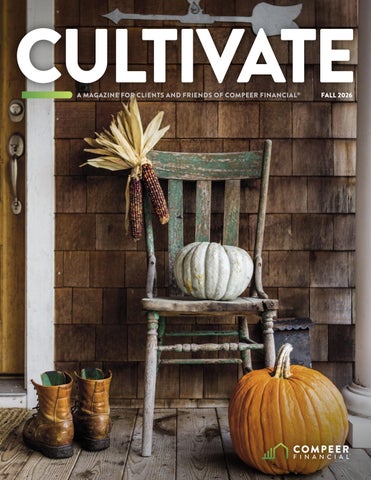
CULTIVATE A MAGAZINE FOR CLIENTS AND FRIENDS OF COMPEER FINANCIAL®
FALL 2026
Thank for Moving the Pork Industry Forward Your swine business depends on your dedication around the clock. We share your passion and are honored to partner with pork producers, processors and others who help move the industry forward. As the swine sector evolves, we’re here with specialized financial solutions, industry expertise and trusted guidance to help your business thrive.
CELEBRATING OCTOBER PORK MONTH
Ag & Rural Community Financing & Support Compeer Financial can provide assistance with finances based on historical data and industry expertise. Compeer does not provide legal, tax or investment advice. Compeer Financial, ACA is an Equal Credit Opportunity Lender and Equal Opportunity Provider and Employer. NMLS #619731. © 2026 All rights reserved.
CULTIVATE 6
Volume 10, Issue 3 Fall 2026
EDITORIAL STAFF Anna Vangsness, Editor Annie Lauber, Contributing Writer Nora Nolden, Contributing Writer Valerie Brekke, Contributing Writer Terri Poburka, Designer
12
9
DIRECTORS Ashley Ahl Merrillan, Wis. Rod Bosma Rushmore, Minn. Ann Broome Austin, Texas Allyn Buhrow Ashton, Ill. Mark Cade Westby, Wis. Dan Erickson Alden, Minn. Larry Fischer Sleepy Eye, Minn. Dale Holmgren N. Mankato, Minn. Sarah Jansen Menasha, Wis. Dave Peters Manteno, Ill. Greg Pollesch Oshkosh, Wis. Dan Scheider Freeport, Ill. Tracy Travis Cambridge, Wis. Kimberly Wedig Darlington, Wis. Stephanie Wise Joliet, Ill. Cultivate is a publication of Compeer Financial®, ACA. Compeer Financial exists to champion the hopes and dreams of rural America. This publication is copyrighted in its entirety. Cultivate is published by Compeer Financial, 2600 Jenny Wren Trail, PO Box 810, Sun Prairie, WI 53590. Please send address changes to Compeer Financial, Attn: Cultivate Magazine, 2600 Jenny Wren Trail, PO Box 810, Sun Prairie, WI 53590 or call (844) 426-6733. Compeer Financial, ACA is an Equal Opportunity Employer, Lender and Provider. Equal Credit Opportunity Lender. Compeer Financial is a registered trademark of Compeer Financial, ACA. ©2026 All rights reserved.
16
18
20
CONTENTS 6
Caring for the Land, Building a Legacy
How one Wisconsin farm is protecting natural resources while strengthening the operation for future generations.
9
From the Farm to the Family Table
Connecting consumers to agriculture through locally raised beef.
12 Adding Value to Wool, Right at the Source
Creating new value from wool while supporting local shepherds.
16 Farmland Values Remain Resilient What today’s farmland market means for buyers, sellers and long-term value.
18 Turning Generational Differences into Strengths
Practical strategies for navigating farm transitions with confidence.
20 Rooted in Purpose
Board member Stephanie Wise on leadership, risk and the future of rural communities.
4 CEO Message 22 What’s New at Compeer?
Cultivate is brought to you by Compeer Financial. This publication’s name represents our cooperative’s commitment to growing long-term relationships with our member-owners and championing the hopes and dreams of rural America. Comments or suggestions for future editions can be sent to Compeer-CommunicationsTeam@compeer.com. Fall 2026 • CULTIVATE 3
CEO MESSAGE
WINNING IN THE PIT LANE When talking with the team at Compeer recently, I compared some of the work we’re doing to improve our internal processes to NASCAR and Formula 1. In these highly competitive races, the margin of victory is often razor-thin. It’s decided in the pit lane, where structure, precision and process make all the difference. What took more than 10 seconds a few decades ago now takes less than three because technology, equipment and processes have evolved. It’s incredible to watch these world-class crews replace four tires, clear air intakes, adjust the front wing and make other critical changes in a matter of seconds. They make it look easy, but it isn’t luck. Success comes from relentless practice, clear processes, strong communication and extraordinary teamwork. You see it in the synchronization as tire changers, jack operators, fuelers and the rest of the crew work together under intense pressure to get the driver back on the track. They also anticipate problems before they happen and respond quickly when they do. In many ways, the weeks leading up to harvest are agriculture’s own version of the pit lane. It’s the time to inspect equipment, service machinery, evaluate conditions, fine-tune your strategy and make sure everyone knows their role. A Formula 1 race car traveling more than 225 mph isn’t much like a combine moving through a field at 3 mph, but both require preparation and a dependable crew. Harvest is just one example. In farming, pit stops happen all year long — both planned and unplanned. Agriculture is unpredictable, and being prepared helps your operation adapt when conditions change. Equipment failures, market swings, severe weather and global events can all change your plans. Having clear processes and contingency plans in place help reduce risk while keeping you ready for whatever comes next. Your on-farm pit crew is essential, and a trusted off-farm crew matters just as much. These are the advisers you count on, like your agronomist, veterinarian, accountant, financial partner and others. As your cooperative, Compeer Financial is proud to be part of that trusted team. We have the financial strength, expertise and products to help support your operation with the resources you need when the pace picks up. One example of that partnership is our patronage program, which returns a significant portion of our earnings to our member-owners. This year, that means $152 million in patronage payments, including our August distribution. It’s cash back that can help strengthen your operation, build resilience and prepare you for whatever comes next.
4 CULTIVATE • Fall 2026
“Success comes from relentless practice, clear processes, strong communication and extraordinary teamwork.”
In this edition of Cultivate, you’ll meet several clients whose stories reflect the resilience and innovation found across agriculture. On page 6, you’ll read about Mike Berg, recipient of the 2025 Wisconsin Leopold Conservation Award, whose commitment to conservation shows how good land stewardship and strong farm management go hand in hand. On page 16, we explore what’s driving farmland values across our territory. Then, on page 20, Compeer client and Board member Stephanie Wise shares her perspective on managing risk, maintaining financial discipline and investing in rural communities. As you head into harvest, we’re proud to stand in the pit lane with you, helping you fine-tune your plans, supporting your team and working alongside you to turn today’s challenges into tomorrow’s successes. Thank you for your continued partnership. We wish you and your family a safe, smooth and successful harvest season.
Jase Wagner, President and CEO
Manage Your Accounts Anytime, Anywhere with MyCompeer and Online Banking Whether you’re in the field, at the office or on the go, MyCompeer and Online Banking make it easy to manage your finances on your schedule. Securely access your accounts, make payments, transfer funds and more — all from your computer or mobile device.
Manage your finances — your way. Discover how our digital solutions can simplify your day. Scan the QR code or visit compeer.com/OnlineServices.
GET STAR
TED
Equal Credit Opportunity Lender. Equal Opportunity Provider and Employer. NMLS #619731. © 2026 All rights reserved.
Fall 2026 • CULTIVATE 5
CARING FOR THE LAND, BUILDING A LEGACY BLANCHARDVILLE, Wis. — On the rolling hills above the Pecatonica River, conservation has shaped Berg Family Farm for generations. For Mike Berg, the act of caring for the land has never been separate from running a successful farm. In 2025, Berg received the Wisconsin Leopold Conservation Award for his commitment to soil health, water quality and wildlife habitat.
CONSERVATION ACROSS GENERATIONS At Berg Family Farm near Blanchardville, conservation is more than a practice – it’s part of the family’s legacy. The 540-acre farm includes cropland, pasture and woodland, where steep terrain makes protecting soil especially important. That commitment began with Berg’s father, who installed contour strips in 1952 to reduce erosion. More than 70 years later, the family continues that work, believing each generation should leave the land better than they found it.
6 CULTIVATE • Fall 2026
“Mike has shown that conservation isn’t separate from strong farm management.” —Erin Mullett CONSERVATION THAT WORKS Berg has spent decades adapting his operation with the future in mind. The family adopted no-till farming in the 1970s and later hosted field days to demonstrate how conservation practices can support productive farmland. Berg and his wife, Diane, also planted more than 25,000 pine and walnut trees across about 75 acres of marginal farmland, creating wildlife habitat while adding long-term value to the farm. “Mike has shown that conservation isn’t separate from strong farm management,” said Erin Mullett, financial officer at Compeer Financial. “It’s part of building a resilient operation for the land, the business and the next generation.”
IMPROVING WATER QUALITY Water quality has long been a priority on the farm. Before retiring from dairy farming in 2002, the family built manure storage facilities to help protect nearby waterways. After transitioning to Red Angus beef cattle, Berg and his son, Taylor, incorporated rotational grazing and established birdsfoot trefoil, a clover-like plant that supports healthy pastures while helping reduce erosion. In 2020, Berg partnered with the Natural Resources Conservation Service, the Pecatonica Pride Watershed Association and the village of Argyle to restore nearly a mile of the Pecatonica River shoreline. Using riprap to stabilize the riverbank, the project reduced erosion and sediment entering the river. Nearby, grass buffers provide habitat for pollinators and aquatic life.
LEADERSHIP BEYOND THE FARM Berg’s stewardship extends beyond his own operation. As a member of the Pecatonica Pride Watershed Association, he’s helped bring together farmers, landowners, businesses and community members to improve water quality across the watershed.
“Compeer is proud to sponsor the Leopold Conservation Award across our territory and recognize clients who are exceptional stewards of the land,” said Mullett. “Producers like Mike remind us that thoughtful conservation today helps strengthen farms, improve water quality and support rural communities for generations to come.”
A LASTING LEGACY For Compeer, Berg’s recognition reflects the connection between stewardship and long-term success. His farm shows how conservation investments can protect natural resources while supporting a productive, profitable operation. “Mike’s approach is rooted in care, and it’s practical,” said Mullett. “He understands that healthy soil, clean water and strong farm management all work together. That’s a powerful example for producers planning for the future.” Today, the contour strips Berg’s father installed still help protect the hillsides above the Pecatonica River, while newer conservation projects continue to strengthen the land. Together, they reflect a simple belief that has guided the family for generations: Caring for the land today helps sustain farms and communities tomorrow.
Left: The Pecatonica River winds through the rolling hills surrounding Berg Family Farm near Blanchardville, Wis. Center: Conservation practices along the Pecatonica River help reduce erosion, improve water quality and support wildlife habitat. Right: Mike and Diane Berg are joined by their grandchildren, reflecting the family’s commitment to conservation across generations. Bottom left: Rotational grazing helps support healthy pastures while protecting soil and nearby waterways. Bottom right: Berg Family Farm has blended conservation and production for generations, earning Mike Berg the 2025 Wisconsin Leopold Conservation Award.
Fall 2026 • CULTIVATE 7
8 CULTIVATE • Fall 2026
FROM THE FARM TO THE FAMILY TABLE HILLSDALE, Ill. — When Wesley DeClercq talks about farming, he doesn’t start with acres or cattle. He starts with people. “We always hear about how farmers feed the world,” he said. “That’s why we really love the beef side, where we can go from raising the animal on our farm all the way to when we can put it on the consumer’s plate.” For DeClercq, that connection is one of the most rewarding parts of farming. It’s also what inspired him to expand beyond the family’s third-generation row crop operation and become a firstgeneration rancher. Today, DeClercq owns and operates DeClercq Farms and LW Cattle Company, where he raises crops and cattle with a focus on quality and stewardship. “We really see a demand for the community wanting to know where their food comes from,” he said. “That’s why we enjoy doing what we do so much.”
“We really see a demand for the community wanting to know where their food comes from.” —Wesley DeClercq
BUILDING A CONNECTION That demand led to the family’s next venture: an on-farm store where customers can buy beef raised on the farm. The store is open several days each week, and customers can also order online for convenient pickup. For DeClercq, it’s about more than another income stream. It’s a chance to build relationships with the people who buy their products. He wants customers to know how their food is raised and the care that goes into producing it. Continued on page 10
Main photo: Wesley DeClercq raises Red Angus cattle as part of his family’s diversified farm near Hillsdale, Ill. Bottom left: Red Angus cattle graze on pasture at DeClercq Farms, where livestock has become an important part of the family’s operation. Bottom center left: DeClercq Farms combines row crops and cattle to meet growing demand for locally raised beef. Bottom center right: Visitors can stop by the DeClercq Farms store to purchase locally raised beef and connect with the people who produce it. Bottom right: Vintage tractors reflect the family’s farming heritage and the generations that shaped DeClercq Farms.
Fall 2026 • CULTIVATE 9
Continued from page 9
THE OPERATION ITSELF HAS DEEP ROOTS. DeClercq’s grandfather started farming in the late 1960s. His father continued building the row crop operation, and today Wesley and his brother are focused on growing the business while preparing it for the next generation. “I’m hoping someday my brother and I can keep building on their legacy,” he said. While the family farm has evolved over the years, DeClercq has always had a clear vision for where he wanted to take it. Along with corn, soybeans and wheat, the operation now includes cattle and hay, creating opportunities to serve customers in new ways while building a more diversified business.
GROWING WITH CONFIDENCE Growth doesn’t happen overnight, though. Every decision comes with risk, whether it’s diversifying, investing in equipment or adapting to whatever the growing season brings. DeClercq said having trusted advisers who understand agriculture helps him make those decisions with confidence. That includes his longtime relationships with Compeer Financial and Crop Insurance Officer Jesse Edlefson. “We always make the joke working with Jesse that he knows our fields better than we do,” DeClercq said. “We rely heavily on Jesse’s advice because we believe in him a lot, and we know he has our operation’s best interest at heart, like we do.”
“When you’re building a legacy, the number one attribute you have to have is resilience.” —Wesley DeClercq
10 CULTIVATE • Fall 2026
The DeClercq family has worked with Compeer for more than 20 years. DeClercq remembers sitting in meetings with his dad and grandpa as a kid before eventually taking out his first operating loan at 19. Today, he works with trusted advisers who help support the farm’s long-term success. “Compeer has played a significant role in helping us grow our operation,” he said. “They can help us make good business decisions that’s healthy for our farm.”
BUILDING A CONNECTION Even with careful planning, farming comes with challenges that can’t be controlled. Markets shift. Crops fail. Plans change. “When you’re building a legacy, the number one attribute you have to have is resilience,” he said. “You’ve just got to roll up your sleeves up and go to work every single day.” As DeClercq Farms continues to grow, Wesley hopes every customer who stops by the farm store leaves with more than locally raised beef. He hopes they leave with a better understanding of the people behind their food and why that connection matters.
PUT YOUR NUMBERS TO WORK UNDERSTAND COSTS, CASH FLOW AND KEY RATIOS TO BUILD A STRONGER, MORE PROFITABLE OPERATION.
Successful farming requires skill both in the field and in the office. Just as you check the progress of your crops and perform routine maintenance on your equipment, regularly reviewing your financials keeps you appraised of how your operation is performing. Knowing your numbers goes beyond tracking inputs and outflows. These are key measurements that show you various insights like what each crop costs to produce, where you break even and what may be holding your operation back from greater profitability.
Do You Need a Numbers Coach?
What You’ll Learn From Numbers Coach
Numbers Coach was created for farmers who want to better understand the financial side of their operation and use that knowledge while making key business decisions.
Inside the workbook, you’ll find:
This workbook is designed for farmers who: • Are starting out or taking over a farm operation • Need a clearer picture of production costs and breakeven points • Are looking for ways to improve profitability and make better informed decisions
Access the Workbook
J
• A clear introduction to essential financial concepts, including balance sheets, income statements, cash flow, cost of production, breakeven points and key financial ratios • Formulas and step-by-step guidance for calculating these figures for your operation • Examples and worksheets to help you organize information, track performance and put financial tools into practice • Guidance for evaluating family living expenses and understanding how they fit into the farm’s overall financial picture Numbers Coach won’t take the place of your accountant. But it will give you a deeper understanding of essential farm financials every producer needs to know — and help you ask better questions.
Fall 2026 • CULTIVATE 11
ADDING VALUE TO WOOL,
Right at the Source NORTHFIELD, Minn. — Inside a small fiber mill tucked among the rolling hills outside Northfield, raw fleece moves through a series of machines before becoming soft skeins of yarn ready for knitters across the country. For Theresa and Jacob Bentz, that transformation represents much more than finished yarn. It reflects years of learning, persistence and a belief that even a byproduct can become something valuable. Continued on page 12
Theresa Bentz prepares wool for processing at the fiber mill on Get Bentz Farm near Northfield, Minn.
12 CULTIVATE • Fall 2026
When the couple purchased their 40-acre farm in 2014, they weren’t planning to build a fiber mill. “Our goal was to be homesteaders and live off the land,” Theresa Bentz said. They started with two Icelandic sheep. Soon, three more followed. Before long, the flock had grown, helping restore overgrown pasture while producing meat and wool. But the wool presented a challenge.
BUILDING A MARKET WHERE NONE EXISTED Finding a mill willing to process Icelandic wool wasn’t easy. The breed’s dual-coated fleece requires specialized equipment, and as local mills closed or stopped accepting it, Theresa was running out of options. Rather than giving up or shipping the wool farther away, she decided to learn the craft herself.
Theresa Bentz sorts raw wool before it moves through the mill’s washing, carding and spinning process.
“For a lot of producers, wool used to be something they burned or threw away,” said Theresa. “Now I can buy it from them, process it and turn it into yarn.”
She taught herself to wash, card and spin wool before investing in commercial equipment to build a fiber mill on the farm.
Instead of receiving pennies per pound, or disposing of it altogether, local shepherds now have another market for their fiber, creating additional income from animals they were already raising.
“I decided to get the big machines and make a go of it,” said Theresa.
CONNECTING PEOPLE TO AGRICULTURE
The decision transformed what had been a difficult-to-market byproduct into the farm’s primary business. Today, Get Bentz Farm processes wool from its own flock and from shepherds across Minnesota and neighboring states. The mill washes, cards, spins and plies raw fleece into yarn sold at farmers markets, specialty yarn shops, fiber festivals and online to customers across the United States, Canada and Europe.
On summer tour days, the fiber mill becomes more than a manufacturing space. Visitors meet the sheep, watch wool move through the processing equipment and purchase yarn directly from the farm. Theresa said helping people understand where clothing comes from is just as important as helping them understand where food comes from. Continued on page 14
Bottom left: The Bentzes’ flock of Icelandic sheep provides the wool that started the farm’s fiber mill business. Bottom right: Raw fleece is transformed into soft fiber through washing, carding and other processing steps.
Fall 2026 • CULTIVATE 13
Continued from page 13
“For a lot of producers, wool used to be something they burned or threw away, Now I can buy it from them, process it and turn it into yarn.” — Theresa Bentz
After another financial institution struggled to understand the business, the Bentzes turned to Compeer Financial.
“When people come here, they can actually see where their yarn comes from,” she said. “It connects them to agriculture in a whole different way.”
Today, solar panels dramatically reduce electricity costs for the energy-intensive mill while supporting the farm’s commitment to stewardship.
That direct connection has helped build a loyal customer base while supporting the local economy.
“We’re a sustainable farm,” Theresa said. “Everything we do is about improving the land.”
Rather than sending raw wool elsewhere for processing, the Bentzes keep more of its value close to home. Revenue from the yarn is reinvested into the farm, equipment and purchases from local shepherds, creating a cycle that benefits multiple agricultural businesses.
That philosophy extends beyond renewable energy. The Bentzes continue restoring prairie and pasture, reducing invasive species through rotational grazing and exploring new ways to reuse wool byproducts.
Value-added enterprises like Get Bentz Farm also help diversify income for smaller farms, Theresa said, making it easier for rural businesses to remain viable and connect consumers with local agriculture.
Financing from Compeer helped the couple purchase the commercial processing equipment that made the mill possible. As the business grew, Compeer also financed improvements, including concrete work and a solar energy system that powers the operation.
Looking across the farm today, Theresa sees more than buildings and equipment. She sees restored land, stronger markets for neighboring shepherds and a business built one step at a time.
INVESTING IN THE FUTURE
“Seeing people knitting with our yarn across the country is pretty amazing,” she said.
Turning the idea into a business required more than determination. It also required a lender willing to see agriculture differently.
What started with two sheep has grown into a business that creates value for the farm, neighboring producers and customers who know exactly where their yarn begins.
Bottom ledt: Specialized equipment spins and twists wool into yarn ready for knitters and fiber artists. Bottom center: Spools of yarn take shape inside the fiber mill, where wool from local shepherds is processed into finished products. Bottom right: Finished skeins of yarn are sold directly to customers, specialty yarn shops and fiber festivals across the country.
14 CULTIVATE • Fall 2026
Celebrating the Heart of Harvest:
Harvest is the result of a year of planning, hard work and perseverance. Enter for a chance to win a gift that shows how much you’re appreciated! Entries are accepted Oct. 1 through Nov. 15, 2026.
You could win one of these prizes *There will be multiple winners for each prize shown.*
iLive Cinema Pop-Up Movie Theater Kit
GoPro HERO12 Waterproof Camera
Visit compeer.com/harvest-giveaways or scan the QR code to register. Entries are accepted Oct. 1 through Nov. 15, 2026
Toasteez 3-In-1 Handwarmers, Power Bank & Light
As a cooperative, Compeer Financial is committed to agriculture and rural communities. When you partner with us, you’re more than a client. You’re a member-owner with access to exclusive tools and support to help you and your farm thrive. Discover more at: compeer.com/member-benefits
Eligibility: Open to legal residents of Illinois, Minnesota and Wisconsin, age 18 or older at time of entry. One entry per person. Business entities are not eligible. Giveaway entries are accepted Oct. 1 through Nov. 15, 2026. See full giveaway terms and conditions at: compeer.com/harvest-giveaways Compeer Financial, ACA is an Equal Credit Opportunity Lender and Equal Opportunity Provider and Employer. NMLS # 619731. ©2026 All rights Fallreserved. 2026 • CULTIVATE 15
FARMLAND VALUES REMAIN RESILIENT Farmland values across Illinois, Minnesota and Wisconsin have held up more strongly than expected over the past year. Even as producers navigate tighter margins, lower commodity prices and higher borrowing costs, the market remains steady across most areas. That stability doesn’t mean the market is unchanged. Buyers are becoming more selective, focusing on quality, productivity and long-term fit within their operations.
A MORE DISCIPLINED MARKET Higher interest rates and tighter profitability have made buyers more cautious, but farmland remains a limited and highly sought-after asset. When productive ground becomes available, especially near an existing operation, it continues to draw strong interest. Rather than reacting to short-term price swings, today’s buyers are making decisions based on long-term performance. Purchases are increasingly evaluated on whether they improve efficiency, strengthen the overall operation or support generational goals. That long-term perspective continues to provide underlying support for farmland values, even in a more challenging economic environment.
QUALITY IS DRIVING THE MARKET One of the clearest trends is the growing separation between high-quality farmland and more marginal tracts. Farms with productive soils, effective drainage, efficient field layouts and high tillable percentages continue to command the most attention. Buyers see these characteristics as key drivers of long-term productivity and financial return. At the same time, buyers have become more discerning. Smaller parcels, irregular fields or farms requiring additional improvements may see more price sensitivity than in recent years. The gap between premium and average-quality farmland is becoming more pronounced. Buyers are also taking a more conservative underwriting approach, often testing potential purchases against current interest rates and conservative commodity price assumptions before moving forward.
16 CULTIVATE • Fall 2026
WHAT SELLERS SHOULD CONSIDER For landowners thinking about selling, today’s market still offers opportunities, but preparation matters more than ever. Understanding a property’s strengths – including productivity, drainage, access, lease structure and comparable sales – can help establish realistic expectations before bringing a farm to market. High-quality tracts in desireable areas continue to generate strong interest. Farms with limitations can still attract buyers, but pricing strategy and timing become increasingly important. Ultimately, every decision to buy, sell or hold farmland is tied to individual goals. Succession plans, financial needs and comfort with market volatility all help shape the right path forward.
LOOKING AHEAD Several factors will continue to influence farmland values in the months ahead, including commodity prices, input costs, interest rates, cash rents and overall farm profitability. The volume of land offered for sale will also shape market dynamics. While no one can predict exactly where the market will go, one theme remains consistent: Buyers continue to prioritize high-quality farmland that strengthens their operations over the long term. For both buyers and sellers, success in today’s market depends on a disciplined approach and a clear understanding of long-term value.
Dave Dinderman Director Appraisal
Scan to sign up for Appraisal Insights.
State-by-State Land Values Snapshot* ILLINOIS Median value: Approximately $13,321 per tillable acre Market trend: Generally stable to slightly softer during the analysis period What’s supporting values: Productive cropland, strong soils, high tillable percentages and consistent earning potential
MINNESOTA Median value: Approximately $10,545 per tillable acre Market trend: Modest upward trend during the analysis period What’s supporting values: Local buyer demand, limited supply and long-term operator interest
WISCONSIN Median value: Approximately $10,277 per tillable acre Market trend: Strongest upward trend in both dollars per productivity index and dollars per tillable acre What’s supporting values: Competitive demand for productive acres and limited available farmland * Compeer Financial’s recent cropland sales analysis reviewed 1,336 cropland sales from May 2025 to May 2026 across Illinois, Minnesota and Wisconsin.
Fall Fall 2026 2026 • CULTIVATE 17
TURNING GENERATIONAL DIFFERENCES INTO STRENGTHS Farm transitions rarely fail because of a lack of technical knowledge. More often, challenges arise because family members bring different perspectives shaped by their experiences.
For larger investments or operational changes, compare options using the same criteria, such as expected financial impact, labor savings, potential risks and long-term value. Using the same information helps families focus on facts instead of assumptions.
Today, many farm operations include as many as four generations working together — Baby Boomers, Generation X, Millennials and Generation Z. Each has been shaped by different markets, technology and work environments, which naturally influences how they view risk, change and long-term success.
DEFINE ROLES BEFORE THEY BECOME PROBLEMS
Recognizing those differences is an important first step. The next step is creating a process that keeps everyone focused on the same goal: preserving a successful operation for future generations.
UNDERSTAND WHAT’S DRIVING THE CONFLICT Disagreements often aren’t about the decision itself — they’re about what each person is trying to protect. Older generations may prioritize stability, financial security and proven practices. Younger generations may be more focused on efficiency, innovation or long-term growth. Neither perspective is wrong, but problems arise when families assume others share the same priorities. Instead of debating individual ideas, begin by asking, “What are we trying to accomplish together?” When everyone agrees on the farm’s long-term goals, conversations become less personal and more productive.
CREATE A PROCESS FOR DECISIONS Successful transitions aren’t built on one conversation. They require consistent communication. Regular family or management meetings provide an opportunity to review finances, operations, staffing and future plans before issues become conflicts. Clear decisionmaking guidelines also help remove emotion from difficult discussions.
18 CULTIVATE • Fall 2026
Many transition challenges stem from unclear expectations. Clearly documenting responsibilities, decision-making authority and compensation can prevent misunderstandings before they happen. Families should also distinguish between ownership, management and day-to-day labor, recognizing that those roles often change over time. Annual family meetings can help review progress, discuss future responsibilities and address concerns before they grow into larger issues.
INTRODUCE CHANGE IN MANAGEABLE STEPS Technology and new equipment often highlight generational differences. Successful farm families don’t see those differences as competing approaches. They intentionally combine them. If new technology significantly reduces labor, improves safety or reduces downtime, discuss how those benefits support the operation’s long-term goals. When uncertainty exists, consider starting with a small pilot project. Testing a new process or technology on a limited scale allows families to evaluate results before making a larger investment. Measuring outcomes together builds confidence and helps decisions feel less risky.
BALANCE EXPERIENCE WITH NEW IDEAS Every generation brings valuable strengths to the operation. Experienced family members often bring perspective, risk awareness and historical knowledge. Younger generations may contribute interest in new technology, fresh ideas and different ways to solve problems.
Rather than seeing those differences as competing approaches, successful farm families intentionally combine them. Experience can help evaluate new ideas, while innovation can strengthen long-term competitiveness. When discussions become difficult, returning to shared goals — protecting the business, supporting the family and preparing the next generation — often helps move conversations forward. Farm transitions are rarely about finding perfect agreement. They’re about building a process that helps families make thoughtful decisions together, even when perspectives differ. Trusted advisors, including lenders, accountants, attorneys and financial professionals, can also provide objective guidance when conversations stall and help families keep both relationships and business goals on track. Compeer Financial offers transition and succession planning resources to help farm families navigate both the financial and personal side of preparing the next generation.
Dr. Megan Roberts Principal Quantitative and Economic Analyst
Ready to start? Scan to connect with a transition planning specialist.
Fall Fall 2026 2026 • CULTIVATE 19
ROOTED IN PURPOSE
Board member Stephanie Wise on leadership, risk and the future of rural communities
Stephanie Wise brings agricultural roots, financial expertise and a passion for rural communities to her role on Compeer Financial’s Board of Directors. A fifth-generation farmer, Wise has owned and operated corn, soybean and popcorn farms, worked in crop protection and fertilizer sales, and managed a small grain and milling operation. Drawing on experience in agriculture and banking, she has spent her career helping businesses navigate risk, identify opportunities and plan for the future. Wise lives in Joliet, Ill., with her husband, Christopher.
Q
How did your connection to agriculture begin, and what has farming taught you over the years?
A
I’m farm-raised and banking-careered. I grew up on a fifth-generation family farm, where you were expected to learn by doing. My dad encouraged us to tackle challenges head-on, while my mom led by example through her faith and her own successful businesses outside the home. Those early experiences taught me to be resourceful, adaptable and willing to take on new challenges. The confidence I gained on the farm shaped how I approached opportunities throughout my life. I followed my husband to California and back to Illinois, built a career in banking and eventually moved into executive leadership. While remaining grounded in agriculture and rural communities, I also took the leap to purchase my own farms. In 2013, I shifted my focus back to farming and soon had the opportunity to serve on Compeer’s legacy Illinois Board.
20 CULTIVATE • Fall 2026
Q
What lessons from the farm have most influenced your approach to leadership and financial decision making?
A
The lessons from farming and banking are remarkably similar. Both teach the importance of investing time and resources in what matters, building value over the long term and working with people who share a common purpose. They also teach humility. Farmers understand that markets, weather and circumstances beyond our control can quickly change outcomes. That’s why managing risk is so important. Whether it’s crop insurance, marketing plans, irrigation or drainage improvements, successful operations invest in tools that reduce risk while creating opportunities for growth. Most importantly, both farming and banking have taught me to take a long-term view guided by purpose. No matter your role, you need to regularly ask yourself, “Why am I doing this?” ..................................................................................................................
Q
What are some of the biggest challenges farmers and agribusinesses face today?
A
One challenge that doesn’t get enough attention is the limited access many farms have to specialized expertise and resources.
Q
A
How has serving on Compeer’s Board shaped your perspective on the role financial institutions play in supporting rural communities? Serving on the Board has reinforced my belief that strong agriculture depends on strong rural communities.
One issue that deserves greater attention is the significant funding gap facing rural hospitals, senior living facilities, childcare centers and other community services. These resources are essential to attracting and retaining families in rural areas. Compeer has been a leader in addressing these challenges through programs like Mission Financing, which brings together financial institutions and community partners to fund important rural projects. The organization has also helped raise awareness among policymakers about the need for additional tools and resources to support rural investment. Agriculture and rural communities are deeply connected, and investing in one strengthens the other. ..................................................................................................................
Q
What advice would you give to the next generation of agricultural leaders?
A
In large corporations, teams of professionals focus on areas such as finance, technology, human resources, marketing and risk management. On many farms, a small group of people wears all those hats while keeping the operation running day to day.
Make cash management your top financial discipline. Build a strong network of trusted advisers who can help you analyze opportunities and develop strategies. Then put yourself in a position to act quickly when opportunities arise.
At the same time, farming is capital-intensive, seasonal and cyclical. Producers must make important decisions quickly while managing significant cash-flow demands throughout the year. It can be difficult to balance day-to-day operations with long-term strategic planning.
Beyond the financial side of the business, take time to understand your purpose. Agriculture will always involve uncertainty, and there will be challenges you can’t predict or control. Having a clear sense of why you’re doing the work can help guide difficult decisions and keep you focused on the long term.
That’s why building a network of trusted advisers is so important. Having people who can help analyze opportunities, challenge assumptions and support decisionmaking can make a meaningful difference.
Preparation, strong relationships and a long-term perspective are critical. When those are grounded in purpose, you’ll be better equipped to navigate challenges and build a successful future.
Fall Fall 2026 2026 • CULTIVATE 21
WHAT’S NEW AT COMPEER?
THRIVE WITH A COLLEGE INTERNSHIP
HOLIDAY HOURS Compeer Financial offices will be closed in observance of the following holidays: Thanksgiving: Christmas Eve: Christmas Day: New Year’s Day:
Nov. 26-27* Dec. 24 (half day beginning at noon) Dec. 25 Jan. 1
* The Contact Center will be open from 8 a.m. to 3 p.m. on Friday, Nov. 27. Call (844) 426-6733 for assistance.
VOTE ONLINE IN COMPEER’S ELECTIONS Eligible member-owners will receive ballots in early September for Compeer Financial’s Board of Directors and Nominating Committee elections. Members may vote electronically or return a paper ballot. Voting is an opportunity to help shape the direction of the cooperative. Compeer’s Board helps guide business strategy, evaluate operations and represent the needs of clients and the agriculture industry. Key details for the 2026 election include: • Three director positions — one in each region — and 24 Nominating Committee positions and six alternate positions are open this year. • Ballots must be submitted by Oct. 2.
22 CULTIVATE • Fall 2026
An internship at Compeer Financial offers hands-on experience and opportunities to grow. You’ll build connections and lifelong relationships while gaining professional experience and developing skills that support your growth. Our interns enjoy a flexible, collaborative environment and are empowered to make meaningful contributions during their time with Compeer. See yourself thrive in an internship in areas like: • • • • •
Lending Appraisal Information Technology Corporate Finance Credit Underwriting
• • • • •
Crop Insurance Human Resources Marketing and Events Tax and Accounting Legal
Are you a college student or know someone who is? Visit compeer.com/ collegerelations for more details on internship opportunities.
COMPEER FINANCIAL RECOGNIZED AS A TOP WORKPLACE IN ILLINOIS, MINNESOTA AND WISCONSIN We’re pleased to share that Compeer Financial has been recognized as the No. 1 Best Place to Work in Illinois in the large employer category for 2026 by the Daily Herald Suburban Business. Compeer was also named as a Minnesota Top 200 Workplace in 2026 by the Star Tribune and a 2026 Top Workplace by the Wisconsin State Journal. We owe these honors to our 1,500 team members, who are committed to serving our clients every day.
SCHOLARSHIPS AVAILABLE FOR HIGH SCHOOL SENIORS The Fund for Rural America, Compeer Financial’s corporate giving program, will offer 105 scholarships to students in 2027 — 35 in each state Compeer serves. Graduating high school seniors with an agriculture or rural background, or those planning to major in an agriculture-related field at a community college, university or technical school, are encouraged to apply. Applications will be accepted from Dec. 15, 2026 through Feb. 15, 2027. Each scholarship recipient will receive $2,000 for education expenses. All applicants will be notified of their status six weeks after the Feb. 15 deadline. Students can find more information at compeer.com/scholarships.
You’re more than a client when you partner with Compeer Financial. You’re a member-owner who shares in our cooperative’s success. Patronage puts real cash back in your hands.
$152 million returned in 2026 to our member-owners.
More than $1 billion returned and counting.
Learn how patronage adds up for you A
compeer.com/patronage
Patronage remains at the discretion of the Compeer Board of Directors based on a combination of factors. No guaranty of annual allocations. Equal Opportunity Provider and Employer. Equal Credit Opportunity Lender. NMLS #619731. © 2026 All rights reserved.
Fall 2026 • CULTIVATE 23
2600 Jenny Wren Trail PO Box 810 Sun Prairie, WI 53590
Here for Planting to Harvest. Year After Year. 24 CULTIVATE • Fall 2026
Harvest is the culmination of months of planning, hard work, and resilience. We’re grateful for the opportunity to stand alongside you — this season and every season ahead.
WISHING YOU A SAFE HARVEST SEASON
Equal Credit Opportunity Lender. Equal Opportunity Provider and Employer. NMLS #619731. © 2026 All rights reserved.