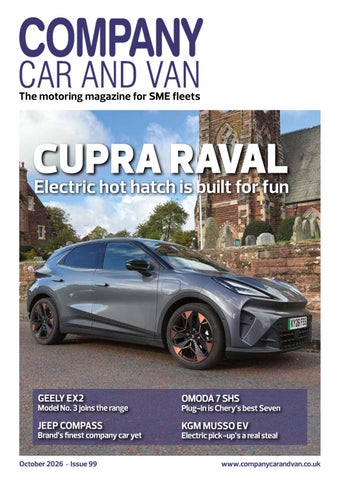
The motoring magazine for SME fleets
CUPRA RAVAL Electric hot hatch is built for fun
GEELY EX2
OMODA 7 SHS
JEEP COMPASS
KGM MUSSO EV
Model No. 3 joins the range Brand’s finest company car yet October 2026 • Issue 99
Plug-in is Chery’s best Seven Electric pick-up’s a real steal www.companycarandvan.co.uk
CONTENTS
www.companycarandvan.co.uk
INSIDE 34 04
08
New names, new cars, and some old favourites Autumn has arrived and so too has the October issue of CC&V. This issue’s cover star is the CUPRA Raval, the Spanish manufacturer’s all-new electric hatchback which comes liberally sprinkled with CUPRA DNA. Read our thoughts inside. The JEEP Compass may not spring to mind when you think of an electric SUV, but a trip to Germany saw us drive one and we came away mightily impressed. KGM launched an electric Musso pick-up early this year and while not as practical as its diesel sibling, it’s a cost-effective solution to those who need a workhorse for lighter loads. And Geely’s product offensive continues with the launch of its third model, the C-sector EX2. We review it inside, and fire some questions at Geely’s fleet manager, Alan Barrett. Other models tested include MG’s superimpressive IM6, a performance SUV that’s leading the brand’s charge, and Mini’s JCW Aceman, which offers four-door practicality with plenty of fun. Mitsubishi is back and we take a close look at the new plug-in hybrid Outlander, the car that arguably began the company car electric revolution. AION is a relatively new name to the UK. A trip to Stokenchurch saw us try out its latest car, the UT. It’s a Volkswagen ID 3-sized rival with plenty in its favour, and we asked Head of Sales Lee Giddings how having an experienced team of automotive professionals is giving this newcomer a strong foundation. It says a lot about how fast things are changing in the car world that OMODA is now an established name; its plug-in hybrid 7 is arguably the Chery brand’s best No 7 yet. Our reigning Executive Car of the Year, the XPENG G6, is on test, as the brand going forward will now be sold in the UK by XPENG themselves.
We also take a look at the Alpine A390 Sport Fastback, as the performance arm of Renault gets serious about fleet, and Mazda reveals details of its upcoming electric SUV, the CX-6e. It’s due to land in late 2026, as the company looks to double its electric company car offering. Northgate Vehicle Rental has launched Northgate Mobility making them a full service partner. MD Neil McCrossan explains why having everything in-house is great news for customers and fleets. Regular contributors Rolec discusses developing your fleet electrification road-map, Vanaways explains why now is the right time for SMEs to go electric with vans, and Rivervale tells us why Chinese cars are so popular with its leasing customers. On the commercial front, we review the Volkswagen eTransporter, which alongside the ID Buzz has given VW impressive sales this year. Maxus has a diesel pick-up, the T60, and as we found out in the home of the Beatles, it’s an attractive alternative to the usual suspects. INEOS has a Grenadier Commercial, a tax-breaking CV that will go anywhere, anytime while saving you money. See how we got on when we drove one in this issue. And, finally, we take a closer look at Farizon’s second model, the V7e. Andrew Walker, Editor and Publisher
NEWS Rolec 6 In conversation with Lee Giddings, AION 10 Rivervale 12 Northgate 16 In conversation with Alan Barrett, Geely 18 Vanaways 19 CARS Jeep Compass KGM Musso EV AION UT Cupra Raval MG IM6 MINI JCW Aceman Mazda CX-6e Alpine A390 OMODA 7 SHS Mitsubishi Outlander XPENG G6 Geely EX2 Drift Bridge Group in profile Geely Poole in profile
4 8 11 20 22 26 28 30 34 36 39 42 44 45
COMMERCIALS Ineos Grenadier Commercial Volkswagen e Transporter Farizon V7e Maxus T60
46 50 52 53
36 42
Company Car & Van is wholly owned and published by: Walker Advertising & Marketing Ltd 12 Oakwood Lane, Bowdon, Cheshire WA14 3DL t: 07734 264735 e: andrewmaxwalker@icloud.com w: www.companycarandvan.co.uk Follow us at twitter.com/andrewmaxwalker and www.linkedin.com/in/companycarandvan Although every effort is made to ensure the accuracy of material contained within this magazine, the publisher can accept no responsibility for omissions or inaccuracies in its editorial or advertising content. The views expressed in this publication are not necessarily those of the publisher. The carriage of adverts in this publication should not necessarily be viewed as an endorsement of the products or services advertised. All articles within this publication are copyright of Walker Advertising & Marketing Ltd. Editorial consent must be obtained before any are reproduced, either in printed form or electronically.
www.companycarandvan.co.uk www.companycarandvan.co.uk
Company CarCar & Van | October 03 Company & Van | August2026 2023 | 05
JEEP COMPASS
Compass goes electric but keeps plenty of that JEEP DNA To compete with the influx of new cars from China, Stellantis is fighting fire with fire as it brings updated battery electric vehicles to market. CC&V spent a highly enjoyable couple of days in Wiesbaden driving EV and PHEV versions of the latest contender, the Jeep Compass. Here’s how we got on...
IF MAX CHOOSES DIFFERENT CAR FOR COVER, REPLACE THIS PIC WITH WHITE ONE OPPOSITE
04 | October 2026 | Company Car & Van
www.companycarandvan.co.uk
www.companycarandvan.co.uk
The Jeep Compass is all new, using the latest STLA Stellantis Medium platform, and has been delivered with a completely new design. It’s offered with an e-Hybrid 1.2-litre petrol engine, but for company car drivers and fleet managers it’s the electric and plug-ins that will tick the BIK box. At present three power options exist: a Standard Range EV with a 74kWh battery offering 201bhp; a Long Range EV with the larger 97kWh battery and 228bhp; and a plug-in hybrid fitted with a 1.6 litre turbo and a 17.9kWh battery offering 223bhp. An AWD electric 4xe is expected later this year. Electric performance and driving range
The FWD short range Compass Electric comes with an 0-62mph time of 8.5 seconds, a top speed of 112 mph and a claimed WLTP range of 311 miles. The long-range version with the bigger battery will travel up to 419 miles. 4xe
The flagship 4xe was the vehicle we drove off-road and it’s fitted with larger battery and an additional motor on the rear axle for a total output of 380bhp, with 425lb ft of torque. It’s quicker, going from 0-62mph time in 4.9 seconds, but the range is trimmed to 377 miles. Charging
The batteries can be charged at up to 160kW via a DC charger, with all versions fitted with an 11kW AC onboard charger as standard. It can be upgraded to 2kW as required. Charge on a public fast charger and a 20-80% top-up takes 31 minutes for the smaller battery and 27 minutes with the larger one. Trims and prices
There are three specs that will be familiar to Jeep fans: Altitude (priced from £36,999); First Edition (£39,800) and Summit (£41,500). Altitude has plenty of goodies and comes with 19” alloys, auto LED headlights, power mirrors, heated seats, a heated steering wheel, two-zone climate control, Jeep’s Selec -Terrain traction control system, adaptive cruise control, lane positioning, keyless entry and start plus all-round parking sensors. First Edition has 20” alloys, matrix LED headlights, a backlit grille, wireless charger, powered tailgate, wireless mobile phone charger with some additional exterior protective cladding. The Summit tops things off with front fog lights, a black roof, electrically adjustable seats with a vinyl covering and ambient lighting. The 4xe comes with two trims, Upland or Overland. Both versions look chunkier than the standard Compass and come with 10mm more ground clearance, a rear tow bar, roof rails and 19” wheels with off-road tyres. Overland’s 19” alloys are diamond cut and it also comes with an illuminated grille, an anti-reflective bonnet strip, more durable cleanable seats and a Jeep Shield front bumper. Inside, the 4xe also offers anti-scratch seat backs and a unique www.companycarandvan.co.uk
Jeep storage system which allows you to hook on kit such as ropes, cables and backpacks. Off-road capability
Even though the electric Compass is most likely to see nothing more adventurous than the local school field, it has be designed to perform. So you get 200mm ground clearance, a 480mm wading depth and approach and departure angles of 20 and 27 degrees. The 4xe offers 10mm more clearance with approach and departure angles of 28 and 31 degrees. Infotainment
The infotainment system will be familiar to anyone who’s driven the latest Vauxhall or Peugeot models. It comes with crisp, clear 16” display with programmable buttons beneath it for shortcuts to your most-used screens. Apple Car Play and Android Auto can be accessed via your Smartphone and there’s a wireless charger that will take even the largest iPhone. The voice connect function means that you can utilise voice control as a short-cut to functions simply by saying ‘Hey JEEP’ followed by your command. Cabin practicality
The centre console comes with twin drinks holders, twin USBs, a 12v socket, a cylindrical drive selector and on our test car, a wireless phone charger. There’s also under armrest storage, a decent sized glove box and door pockets with 34-litre of space in total. In the rear seats, head and headroom is generous and a 550 litre boot comes with a split floor so cables can go beneath. Driving
The electric Compass is definitely the most enjoyable to drive of the all-new models. On tarmac it’s smooth and quiet with the automatic gearbox working well. Acceleration is good, as we found out on some decent dual carriageways, and with composed steering, it handles country roads with aplomb. In town the Compass has a few tricks up its sleeve, too. Regenerative braking and even one-pedal mode feature, so tootling in town – I headed into the centre of Wiesbaden – was
quiet and easy. The steering in urban areas feels heavier – after all, this is a large, heavy electric SUV – so you’ll need to turn the wheel to full lock when reversing or parallel parking. If you want to go further, all versions come with Jeep’s Selec-Terrain drive mode system which is now operated by a large, red, centrally located lever. Here you can select different driving modes including Snow, Sand and Mud which quietly adjust the feel, so the weight of steering, throttle response and level of grip alter to suit the terrain you’re on. The 4xe adds 4WD lock and as we discovered on a series of gravel tracks, muddy inclines, dry fields and a ‘Playground’ of rutted tracks, water obstacles and jagged rocks, will do stuff a-plenty if you want, all aided by the Michelin e-Primacy tyres. Pros
The electric Compass will do more than other EVs. The new interior looks great and it’s usefully practical too. The Compass looks like a proper Jeep and there’s nothing wrong with that. Driving range is exceptional, especially on the Long Range version. Cons
The electric Compass is significantly more expensive than the hybrid version. Other Stellantis electric models with the same platform drive just as well on tarmac.
CC&V VERDICT Like many, CC&V wondered where a brand like Jeep can sit in the new electric world. After all it’s steeped in heritage and toughness. A couple of days on and offroad in the latest Compass put those fears to bed. While the hybrid is a tad dull and underpowered and the plug-in, while better, doesn’t handle as brilliantly, the electric Compass is a revelation. It’s an electric SUV that you can green-lane in, comes with a 400-mile range, is practical but looks and feels like a Jeep. Jeep’s best company car yet.
CC&V RATING: N N N N
Company Car & Van | October 2026 | 05
ROLEC
www.companycarandvan.co.uk
Planning your fleet’s electric future The transition to zero-emission vehicles is already well underway, and for many fleet operators the approach will continue to develop as more electric vehicles enter the fleet. Decisions around vehicle replacement and charging will change too, so reviewing your electrification roadmap along the way can help keep the transition practical and manageable. Moving to a fully electric fleet shouldn’t feel like a chore. Lower running and maintenance costs remain important, as does lower Benefit in Kind tax for company car drivers, but the business case now goes beyond the vehicle itself. How and where vehicles are charged, how much time they spend off the road and how easily charging costs can be managed all have an impact on the day-to-day operation of a fleet. So, where do you go next?
A good place to begin is by reassessing your fleet as it stands today. What types of vehicles do you have? What are their typical journey patterns, where are they based and how long are they usually stationary? Understanding vehicle usage, journey demands and charging requirements can help identify where electrification makes sense. Vehicle data, including location and battery status, can also provide a clearer picture of when vehicles need to charge. You can then relate this information to the wider range of electric cars, vans and HGVs available on the market. Match up vehicle size, typical daily journey lengths and other relevant information to find a comparable EV that fits your needs. Once you have identified the vehicles that could work for your fleet, you can start planning a gradual transition. Line this up with your replacement schedule, starting with a handful of vehicles and giving employees time to get used to the different driving experience before phasing in other models. There isn’t a one-size-fits-all approach to fleet electrification, but EVs and charging infrastructure are increasingly straightforward to use. Rolec provides dedicated training and hands-on support to help drivers and fleet teams get up to speed quickly and confidently. Make charging work for your fleet
As the fleet grows, the charging network will need to evolve with it. Look at how the vehicles actually operate. Where will they be charging and when? How long are they parked for? What power is available at the site? Will drivers need to charge at home or 06 | October 2026 | Company Car & Van
use the public charging network? For some fleets, vehicles returning to a depot or workplace overnight may be well suited to AC charging. Others may cover larger distances or have shorter turnaround times and need DC rapid charging during the day. You may even need a combination of the two. AC charging can support company cars and light commercial vehicles through to larger workplace and depot installations, while DC charging can provide higher-powered charging where vehicle turnaround is more important. Rolec’s DC range extends from 40kW through to high-powered distributed systems delivering 1.6MW+ for larger fleet requirements. The charging network doesn’t necessarily stop at the depot either. Charging could take place across the workplace, depot, drivers’ homes and public network. Sponsored home charging and automated reimbursement can help businesses manage the cost of employees charging company vehicles at home.
“A good place to begin is by reassessing your fleet as it stands today. What types of vehicles do you have? What are their typical journey patterns? Understanding vehicle usage, journey demands and charging requirements can help identify the right approach to electrification for your fleet.”
The right chargepoint management system can help monitor usage and manage access, with features such as charger reservation and prioritisation helping fleets manage charging around operational needs. Rolec connects with more than 45 CPMS partners, giving fleet operators flexibility over how their network is managed. And don’t forget what might happen next. A charging network that works for ten electric vehicles may need to support 20, 50 or more as the fleet changes. Available power, electrical distribution and solutions such as dynamic load balancing are all worth considering as the network expands. A roadmap that evolves with your fleet
There is no single route to fleet electrification. What matters is understanding how your vehicles are used, where and when they can charge, and what the business will need as more of the fleet becomes electric. Rolec supports fleets with an end-to-end approach to EV charging, providing the expertise and guidance needed to plan, deliver and scale a charging network around each fleet. Extensive UK stockholdings also mean AC chargepoints are available for next-day delivery, with short lead times across Rolec’s DC rapid charging range. Want to know more? Visit our website: www.rolecserv.com to explore our full product range, or speak to one of our experts at 01205 724754 or fleetcharging@rolecserv.co.uk www.companycarandvan.co.uk
KGM MUSSO EV
KGM’s electric pick-up comes with a touch of class KGM has added an electric pick-up to its Musso range. First shown at the 2026 CV Show, we got to drive one in early August, and here’s how we got on...
Model choice
Out and about, if plugged into a 100kW fast charger, a 10-80% charge will take 46 minutes. At home with 11kWh on-board charging built-in, a 0-100% charge would take 10 hours and 20 minutes.
Specs
Exterior
While it shares the Musso moniker, it is in fact based on the Torres EVX SUV. So factor in an SUV ride and handling, a distinctly non pick-up monocoque body, and multi-link rear suspension.
Generous, with front and rear parking sensors, LED headlights, leather seats, heated front and rear seats, a heated steering wheel, automatic dual zone air-con, twin 12.3” screens, Apple CarPlay and Android Auto connectivity via a cable, a 360 degree monitor system and intelligent adaptive cruise control.
What does this mean?
Safety
Tell me more?
In effect it may look like a pick-up but with payload of under one tonne (it comes in at 690kg) it can’t be classed as a commercial vehicle. However, with a starting price of £39,995 including VAT it’s incredibly good value for money when put up against rivals from Toyota, Isuzu and Maxus. And since doublecab pick-ups are now subject to emissionsbased Benefit-in-Kind, with zero emissions the Musso EV even qualifies for a £5,000 plug-in van grant (PiVG) because it weighs less than 2,500kg. 08 | October 2026 | Company Car & Van
Charging
Simple, one, with five optional colour options above standard white. These are Space black, Marble grey, Ultra marine blue, Amazon green or Blazing gold, though the latter adds £750 to the cost.
Musso EV comes with eight airbags, Autonomous Emergency Braking, Lane Departure Warning, Safety Exit Warning, Rear Blind Spot-detection and Rear Cross Traffic Warning. A suite of driver attention warnings also feature and you’ll need to get used to entering the screen to turn the most annoying of these off . Battery and range
The Musso EV comes with an 80.6 kWh battery and a WLTP range of 236 miles.
The electric Musso looks great with its 17” diamond cut alloys, black roof rails, slim led front lights, flat front grille and deep low down side lights. Plastic cladding adorns the wheel arches with a subtle KGM in the rear tailgate and vertical rear corner lights. Inside
The interior looks and feels ‘SUV’, which for passengers is plainly a good thing. The twin 12.3” screens are neatly joined and curve towards the driver. Almost everything is controlled via these screens, save for the steering wheel controls where you can access the cruise control, the telephone, select your media options, heat the steering wheel and adjust the volume. The centre binnacle features a floating piece which contains the gear lever, twin cup holders and a wireless phone charger. Window switches open and close the windows and there’s an electric mirror adjustment set-up, too. www.companycarandvan.co.uk
www.companycarandvan.co.uk
Everything is finished nicely in black and silver with a copper-coloured bottom to the dash front and matching stitching on the dash top. Quality is good, with the cheaper, scratchier stuff hidden lower down. Cabin space and practicality
Twin front USBs, a medium-sized glove box, large front and rear door pockets, under armrest space, another underneath the floating centre console and rear USB inputs offer decent usefulness. V2L also features. Front leg and headroom is excellent and in the rear two adults will sit comfortably behind taller front passengers. The centre rear seat though is small and legroom compromised by the rear climate set-up. Drivetrain and performance
There’s 237 PS of power from two electric motors, with torque of 339Nm equating to a 0-62mph time of 8 seconds. There is also a full-time all-wheel drive system and self-levelling rear suspension. Off road and usefulness
Ground clearance is 181mm with approach and departure angles of 20.2 and 24.3 degrees. Braked trailer capacity sits at 2300kg and maximum payload comes in at 690kg. The load bed of the Musso EV measures 1,515mm wide x 1345mm long x 510mm high so is large enough to take a Euro pallet. The tyres on our test truck were also more ‘on-road’ than ‘off-road’, and there’s no 4×4 controls on-board; rather the Musso EV is always in AWD. It will handle some tough stuff but as we discovered whendriving on sand, there isn’t the pick-up to go anywhere. Driving in town
Climb aboard and you’ll immediately feel at home in the car-like interior. All controls fall easily to hand and the forward, side and rear views are good even with the narrow rear window and longish load-bed. While KGM is Korean the infotainment and safety system feel very Chinese. So expect great graphics, fast responses but also a myriad of menus and incredibly oversensitive driver safety warnings, which, trust
us, you’ll want to learn how to disable quickly. Once you’ve done that you’ll settle in to find a pick-up that drives and handles much like the Torres SUV the Musso EV is based on. So factor in a quiet cabin, a smooth ride, comfortable and adjustable seats, plus some decent acceleration. The vehicle size means it doesn’t feel long nor wide and is simple to manoeuvre and park in town, and is supereasy to drive in an urban environment. Regeneration
You can utilise three levels of regenerative braking via the steering wheel paddles and all work well. It’s not quite one-pedal driving but if you select Level 3, the Musso will slow down impressively while adding a touch of extra range to the battery. Out and about
Hit some open and undulating A and B roads and the suspension is excellent, and the light steering feels just right. Even unladen, the usual pick-up bounce was mostly absent thanks to the more sophisticated chassis fitted to the electric Musso. On the motorway you can select adaptive cruise control, point and go, and while the
cabin noise increases, it’s really not intrusive. At a constant 70mph the truck feels happy. Driving range
After a week and several trips locally and along the motorway we were able to give a view on the battery range. We were driving alone, in a warm August with no payload, and fully charged the Musso indicated 221 miles of range. After an 84-mile round trip to the beach on mostly motorways that range had fallen to 123 miles, so a touch below a 1:1 ratio of miles driven to range used. We’d surmise that if you add passengers, a payload and colder weather then a 150-175 mile range is the likely outcome. Pros
Cheaper than the competition. Drives and handles like an SUV. Nicely appointed. Looks sharp too. Low BIK and useful payload for those who need it. Cons
Under one-tonne payload. Lower towing capacity, load bed size, approach and departure angles than most pick-ups. Doesn’t feel built for the tough stuff.
CC&V VERDICT Simply put, the Musso EV is an absolute bargain and is well worth your consideration if you don’t require your electric pick-up to match a diesel one for usefulness. A deep sigh? Not really. Many will find that what the Musso EV offers is plenty enough for them and we can see it being utilised by local councils and health authorities for park and site activity, ticking the zero emissions box as it goes. A bit of a steal.
CC&V RATING: N N N N
www.companycarandvan.co.uk
Company Car & Van | October 2026 | 09
IN CONVERSATION WITH... LEE GIDDINGS, AION
www.companycarandvan.co.uk
Great8 underlines AION’s confidence in its UK offer Company Car &Van had the chance to sit down with Lee Giddings (right), Head of Sales at AION Auto UK, to find out more about this latest Chinese manufacturer to launch in the UK Company Car & Van: Can you tell us a bit more about AION, both the brand and where it comes from? Lee Giddings: Though pretty new to the UK, AION is part of GAC, one of China’s biggest carmakers with almost 30 years of experience, including building vehicles for both Honda and Toyota. AION was devised as GAC’s upper-mainstream electrified brand, focused on excellent quality, equipment, space and range, along with a great ownership experience. The best example of that is the Great8 promise, which is available to fleet customers as much as it is retail. We’re offering eight years of warranty, servicing, roadside assistance and MoT test fee, which we would say is the most comprehensive package on offer in the UK new car market. Especially as it’s attached to the VIN, so future AION used car customers will feel the benefit all the way through to the eighth year of ownership. CC&V: AION has put together a team of experienced UK car industry professionals, including yourself with fleet experience at Suzuki and Toyota, Alex Key in marketing and Paul Barker in PR. How important has it been to make sure that the team at AION has the experience to launch a new car brand in the UK? LG: The UK has such a complex car landscape that it’s vital to have people that understand how it all comes together. From
our Managing Director Jon Wakefield, who has great experience at both manufacturer and dealer group level, through the senior team, we have well over 130 years of UK market knowledge - people that know the UK landscape inside out and understand how to grow an exciting new brand within it. CC&V: AION V has been with us for a few months now. How is it performing so far in the corporate sector? LG: We’ve seen really strong success in various fleet channels. We’ve been doing the right things in building the foundations, which is reflected in really strong residual values versus key competition. That’s a great endorsement of what we’re doing, and feedback from customers has been equally positive, particularly around the quality of the cars. As people experience the car, they’re seeing for themselves the premium aspects that make us stand out, and that combines with the residual values to build confidence in what we’re doing. CC&V: AION UT is your latest new electric model. Where do you see its appeal with company car drivers? LG: This is a fantastic product for us, taking AION into a new segment, and electric hatchbacks are an important sector right now. We’ll see it help us grow in salary sacrifice and public sectors in particular, due to the size of the car, although it’s extremely practical for a B-segment hatch. It also offers great space, range and equipment levels, which are factors that help us stand out across all corporate channels. CC&V: Can you tell us if AION will only be Aion UT
10 | October 2026 | Company Car & Van
launching EVs in the UK or if you will be bringing any hybrid or PHEV models to market? Though the first two models have been full electric, we have a plug-in hybrid SUV coming to the UK during 2027, one of at least five new models in the coming years. We’re making sure we have the right selection of products to succeed in the UK market, both corporate and retail, and that means electrified options to suit as many drivers as possible. CC&V: One of our reader is interested in leasing an AION. Do you have a working relationship with leasing companies and brokers? LG: We have what we see as a unique leasing proposition, where we don’t work exclusively with one funder, but ensure the end user attracts the most affordable monthly payment in the market at any given time via our retailers. It’s another building block designed to try and do the right things for customers, and as we grow we’re trying to be agile and as easy to deal with as possible. CC&V: How big is the AION retailer network and are you actively recruiting new dealers? LG: When we launched the V in April, we said the target was 15 dealers by September, and we’ve hit that number. The goal is 25 by the year end, and 100 by 2030, but we’re building slowly and sustainably, prioritising the key areas where we see opportunities and with long-term partners that buy into the vision and strategy. CC&V: Finally, does AION have an aftersales strategy so that if a fleet customer requires a service or repair, your dealers are set-up to look after them? LG: We do! As I said before, we’re focused across the AION UK business on doing the right things and having great foundations in place. So if a fleet isn’t within range of one of our growing network of centres, we are working with the AA to provide mobile servicing at a driver’s home or work. It’s another example of delivering a premium customer experience, along with things like partnering with DHL for next-day parts deliveries, ensuring cars are back on the road as quickly as possible, and that Great8 promise designed to give customers ultimate peace of mind. www.companycarandvan.co.uk
AION UT
www.companycarandvan.co.uk
AION UT offers fun-size family joy The UT is AION’s second vehicle, following the AION V. We drove to the Chiltern Hills to put one through its paces and here’s what company car drivers and fleet managers need to know ... Tell me more
The UT is a five-door electric hatchback that will be competing against the likes of the MG4, Geely EX2 and BYD Dolphin. Looks wise it’s far more rounded than these, combining elements of a Mini and a Suzuki Swift, and it feels larger too, thanks to its wheelbase, which is only 25mm shorter than the larger AION V. Model choice is refreshingly simple: One powertrain, powered by a 204PS motor and a 60kWh battery and one trim level with the option to specify a £1,200 Premium Pack. Prices start from £28,950 OTR.
Range, performance and charging
AION claims a 268-mile of range from the standard 60kWh LFP battery. With 204PS and 210Nm it is far quicker than most competitors, especially Geely’s new EX2, reaching 62 mph in 7.3 seconds. DC rapid charging is a touch slow at 87kW, but a 60kWh battery can be charged relatively quickly, so when out and about on public chargers a 30-80% charge would take 24 minutes. At home in our five-hour discount window from midnight to 5am we could add 38kWh of charge for under £3.50 on our Rolec EVO charger.
Specifications
Standard features include 17-inch alloy wheels, climate control, heated front seats, a heated steering wheel, all-around LED lighting, a heat pump, a 14.6” touchscreen, 8.88-inch LCD instrument display, DAB, 6-speakers and an in car WiFi hotspot. The quality and finishes are better than many, with soft touch areas on the dash front, inside of the doors and armrest top. Harder stuff can be found lower down on the dash and around the seats and centre binnacle, but we are being picky. On our test car the colour options were www.companycarandvan.co.uk
safe with grey, black and chrome finishes; we came away thinking that a splash of colour would have been nice. Practicality
Scores highly. The cabin features 24 storage compartments with large door pockets, twin cup holders, a glove box and split opening under armrest space. In the back are separate air vents, a single USB, rear front seat sleeves and the rear doors open to almost 90 degrees aiding access. The space is impressive with a flat rear floor enabling three to sit in the back. Headroom is great even with the additional panoramic sunroof. The boot holds 440 litres, rising to 1,660 litres with the rear seats folded. Great 8 Warranty
The UT has an eight-year warranty, with eight years’ servicing and roadside assistance courtesy of the AA, and MOT testing. Infotainment and controls
The screen menus and idiosyncrasies are by now all too familiar on most new cars and not just those coming from China. Having driven plenty it’s fairly straightforward, with short-cut icons located across the bottom of the screen, including those for climate, the heated seats, the car menu, infotainment and a home one as well. Turning off over-zealous safety warnings is relatively simple. Our only complaint was that in Apple CarPlay you need to go back into the system every time you come out of it, so press more buttons than you’d ideally want to. Driving
A test route on the motorway, winding B roads plus A roads gave us a good idea of how the UT handles and in all fairness it proved to be highly enjoyable. Power on tap immediately gives you confidence, enabling you to nip in and out of both slow and fast-moving traffic, be it in town or on the motorway. The cabin feels well insulated and road noise, even when it’s raining, doesn’t feel intrusive. Praise too for the suspension set-up which did
a very good job of masking the battery weight and hiding road imperfections as we drove around. Only the deepest ruts were felt. On a stretch of the M40, the cruise control is easy to use as its located on the right side stalk as part of the gear lever. Simply push to engage and the UT will cruise at 70mph. AION told us that the car had been set up specifically for UK roads and they’ve done a good job. Handling on narrow, winding roads is good, with little body roll. We should also mention the regenerative braking. On the UT you can select from off, low or medium and even medium is quite subtle; it’s not one-pedal. Finally, range. While our route wasn’t long enough for a proper comparison we were seeing figures of 4.1 miles/kWh on our drive, so around a 246-mile range, which isn’t far below the claimed figure. Pros
Cute looks combined with decent performance and handling make for a fun-sized electric family car. Driving range is competitive. Great 8 warranty is excellent. It’s larger inside than most of the competition. Cons
Charging speeds aren’t as fast as others. No fore and aft steering wheel adjustment which seemed strange. Interior colourways aren’t very exciting. Dealer network is still growing.
CC&V VERDICT So many Chinese EVs have arrived that even motoring writers can’t tell them apart. Good news is the UT has enough different DNA to be worthy of your time. Looks and drives much more like a European car than most Chinese competition, it’s spacious, fun to drive and quick. It’s a positive arrival and for salary sacrificers and company car drivers, it’s well worth a look. A fun, small family EV.
CC&V RATING: N N N N Company Car & Van | October 2026 | 11
RIVERVALE
www.companycarandvan.co.uk
Will your next company car be Chinese? The rise of Chinese car makers is showing no sign of slowing down. Ben Freakley, Marketing Manager, Rivervale takes a look at the story behind the growing sales... From BYD and Jaecoo to Geely, Chinese manufacturers are moving rapidly from unfamiliar newcomers to serious fleet contenders. Rivervale’s latest leasing data shows just how quickly attitudes are changing. Not long ago, names such as BYD, Jaecoo, Omoda and Geely were unfamiliar to many UK drivers. In 2026, that is changing remarkably quickly. Recent UK registration figures show just how far some of these manufacturers have come, while Rivervale’s own leasing data tells a similar story. Combined orders for Chinese-owned and Chinese-founded brands increased by 153.1% during the first half of 2026 compared with the same period last year. BYD led that growth, with orders up 355.6%, followed by Jaecoo at 187.5%, while MG sales doubled. Several manufacturers that had little or no meaningful presence in Rivervale’s order book a year ago are now generating genuine customer demand. Why are drivers taking notice?
Part of the answer becomes obvious when you spend time with the cars themselves. Recently, Andrew Walker from Company
Ben Freakley
Car & Van and I attended the UK press launch of the new Geely EX2. Starting from £20,990, it is a small electric hatchback with five seats, a 375-litre boot, another 70 litres of storage under the bonnet, plenty of standard technology and an eight-year warranty. Larger-battery versions offer up to 214 miles of range. It isn’t perfect. Performance is leisurely and its 80kW maximum charging speed trails some rivals, but what impressed me was how complete the EX2 felt for the money. It was comfortable, practical and well equipped, without constantly reminding you that it sits towards the affordable end of the new-car market. For businesses operating fleets, cars like this become particularly interesting. List price is only one part of the equation, of course. But if that level of value translates into competitive monthly rentals and whole-life costs, even relatively small savings can become significant when multiplied across 20, 50 or 100 vehicles. It could also give businesses an opportunity to offer drivers more equipment,
newer technology or an electric vehicle while remaining within existing budgets. Look beyond the badge
That doesn’t mean fleets should choose a newer manufacturer simply because the purchase price looks attractive. Leasing rates, residual values, servicing coverage, parts availability, insurance, downtime and driver acceptance all need to be considered. These are areas where established manufacturers have built confidence over decades, while many newer entrants are still developing their UK dealer and aftersales networks. Electrification is helping drive the change too. Rivervale’s hybrid orders grew 80.4% year on year during H1 2026, while electric orders increased 16.9%. Combined, electric and hybrid orders grew 33.8%, ahead of Rivervale’s overall order growth. Importantly, though, the rise of Chinese manufacturers isn’t simply an EV story. Brands including Jaecoo, Omoda and Chery are also using hybrid and plug-in hybrid models to appeal to drivers who aren’t yet ready, or able, to go fully electric. The question is becoming less about whether UK drivers will consider a Chinese car. Increasingly, they already are. For fleet decision-makers, the challenge is to look beyond the badge and assess each vehicle on what really matters: cost, suitability, support and how well it works for the people driving it every day. Where to go for advice Whether you’re choosing your next company car, looking for a competitive personal or business lease, or reviewing the way your organisation manages its fleet, Rivervale can help. Explore the latest vehicles, leasing offers and fleet solutions at rivervale.co.uk
12 | October 2026 | Company Car & Van
www.companycarandvan.co.uk
IN CONVERSATION WITH ... ALAN BARRETT, GEELY
www.companycarandvan.co.uk
The UK’s buying in to the Geely story After 27 years at Toyota, Alan Barrett has joined Geely as Head of Fleet. During his tenure at Toyota, he spent time in logistics, finance, product, customer relations and latterly fleet, where he spent 10 years. He brings a wealth of experience to his new role at Geely, and we caught up with Alan recently to talk about its aims in fleet as the Chinese manufacturer launches its third car, the EX2. CC&V: The Geely EX2 has just launched and fits in nicely below your larger Geely EX5 in the compact EV sector. Size-wise it will appeal to the public sector, but do you think it has legs elsewhere in fleet? Alan Barrett: Yes, definitely. We’re already getting demand from other fleet sales channels. Some have surprised us, we’ve had some unexpected interest, including from daily and flexible rental operators. I expect there’ll be others too as we expect EX2 to work very well for SMEs and sole traders. We’ve also had interest from driving schools. So, I think it will sit very nicely in many sales channels in fleet. We’ve been asked for exclusive supply from a multitude of areas, which is very encouraging, including leasing and salary sacrifice. So, we think the Geely EX2 will be very successful across a broad spectrum of fleet customers. CC&V: The Geely EX5 has been with us now for 12 months. How is it performing in the corporate sector? AB: We aren’t specifically targeting the corporate sector with this model, but having said that, very pleasingly, fleet managers have been open to listing Geely EX5 on their fleets. This is down to its safety features as well as other attributes, particularly spaciousness, specification and build quality, which have made the package attractive. They have also bought into the brand story, which is very positive. We’ve had some early success with the NHS. While it’s not corporate, they ordered over 200 Geely EX5s in the first half of the year which are now on the road. They have recently ordered a batch more for Q4. We’re quotable with nearly all the main FN50 funders, so corporate continues to grow. CC&V: Your Starray EM-i is a plug-in hybrid with low BIK and a 600-mile range. Will Geely be adding any more PHEVs? AB: Yes, there are three new models coming in the next 12 months, but in terms of PHEV specifically our next model will launch 18 | October 2026 | Company Car & Van
Geely EX2
in Q1 of 2027. It is a long-range D-SUV called the Geely Monjaro EM-i. It’s already on sale in other markets and will position Geely Auto UK in the third largest passenger car segment. We’re positive and excited about that vehicle coming. We expect sales to be strong, and it to be our second best-selling model in the Geely Auto UK range. CC&V: What kind of relationship do you have with leasing companies and brokers to make Geely successful in the corporate sector? AB: We have a very good relationship with the leasing industry. We’ve worked very well in partnership with a small number of brokers who have done an outstanding job putting Geely Auto UK on the map, and really helped us bring new customers to the brand. The product value and specification make a lot of sense to buyers, whether that’s business or personal contract hire, whether that’s corporate or across all channels. It works very well for brokers as a value proposition. Regarding the leasing companies, they obviously work very closely with brokers and we’re in daily dialogue with both, often at the same time as they work hand-in-glove. Initially, we only had one leasing company quoting Geely Auto UK products, but we’re now live with pretty much all of the FN50, which will give us access to lots of new opportunities, particularly new corporate customers. CC&V: SMEs like dealership back up, so does Geely have any corporate specialists and to help when small businesses need it? AB: We know that minimising downtime is essential to maintaining productivity and business continuity and that’s why we’ve invested heavily in a well-established partner network. Our network is made up of experienced operators who understand the needs of fleet customers and recognise the
importance of keeping vehicles on the road. By the end of the year, we will have appointed 50 partners across 115 locations, providing strong nationwide coverage for multi-site fleets. This support extends beyond vehicle delivery to service, maintenance and repair. We have trained technicians across the UK, supported by a dedicated UK-based parts logistics operation. Together, these capabilities help minimise vehicle downtime, with next-day parts delivery available for vehicles that are off the road. Combined with our eight-year/125,000mile vehicle and battery warranty, four years of roadside assistance, and we believe we offer customers a comprehensive aftersales package. For SME customers in particular, this delivers real peace of mind, providing the support, expertise and coverage needed to keep their businesses moving. CC&V: Geely is one of a number of Chinese brands who have launched in the UK in the past two years. Why should company car drivers choose a Geely over the competition? AB: The good news is they already are. We are selling pretty much every vehicle we can get, and that’s down to a package of high levels of specification, good quality, competitive pricing and peace of mind. When you put it all together, it’s very compelling. The brokers, leasing companies, rental companies, corporate customers and our dealers are all very confident in Geely Auto globally and in the UK, and that gives customers a lot of confidence. We have a strong network, and that helps the overall package of confidence and peace of mind. Customers can talk to our dealers and drive the cars and once people see the product, it speaks for itself. Overall, we offer excellent value, excellent TCO and peace of mind for businesses. www.companycarandvan.co.uk
VANAWAYS
www.companycarandvan.co.uk
Why now is the right time for SME fleets to go electric As the ZEV Mandate accelerates and grant funding remains available, Vanaways explains why SME fleets weighing up electric vans should make the switch now rather than wait. Van manufacturers must now hit 24% electric sales under the ZEV Mandate by the end of 2026, rising again next year. For SME fleets weighing up their next van, the question isn’t really whether to go electric anymore. It’s when, not if. Increasingly, the honest answer is why not now? The economics that used to hold fleets back have shifted faster than most managers realise. Managing Director Chris Jakeways, who has spent more than 30 years in the van trade, puts it plainly: “I’ve watched electric vans go from a curiosity to a genuine alternative on cost alone. “The fleets getting this right aren’t waiting for the last possible moment. They’re
www.companycarandvan.co.uk
switching while the grants, the choice and the pricing are all still in their favour.” A new electric van through contract hire often costs less to run than diesel from day one: lower running costs, no van benefit charge and residual value risk sitting with the leasing company, not the fleet. Vans up to 4.25 tonnes also qualify for a Plug-in Van Grant worth up to £5,000, built into the price. Leasing removes the guesswork on resale value entirely, letting a fleet try electric without betting the balance sheet on it. Electric vans have moved on fast, too. Ranges that struggled past 100 miles a few years ago are routinely over 200 miles today, with some now topping 285 miles, with rapid charging from 10 to 80% in under half an hour. Real-world performance still eases off a little in the cold, but today’s vans comfortably cover a full day’s work in any weather. For most fleets, range is no longer the reason to wait. For vans running into city centres regularly, ULEZ and Clean Air Zone charges are daily,
not occasional. A non-compliant diesel van in London can rack up £7,000+ a year against roughly £2,000 for a compliant electric van. Run that gap across a fleet and the savings add up fast. Switching to electric doesn’t have to mean flying blind. Telematics gives fleet managers real visibility over how new vans are charged, driven and used day to day, turning an unfamiliar technology into a known quantity rather than a leap of faith. Vanaways offers contract hire, finance lease and outright purchase on electric vans, with free UK mainland delivery and the market knowledge to match the right van to the right fleet. “Whatever you need, however many, we’ll get it to you fast, without the headache,” says Jakeways. “That’s what you learn after 30+ years in this trade.” Want to know more? Call us at 0117 428 7721, email info@ vanaways.co.uk or visit vanaways.co.uk.
Company Car & Van | October 2026 | 19
CUPRA RAVAL
www.companycarandvan.co.uk
Raval brings hot hatch to life The Volkswagen Group is launching a number of baby EVs in 2026, and the first to arrive is the Cupra Raval. Pitched firmly against the likes of the Renault 5, Nisan Micra and the soon to arrive VW ID Polo, the Spanish brand has added Cupra DNA to its smallest car, creating a model that took us back to the heady days of the hot-hatch. As a previous owner of a 205 GTi and Golf GTi we may have found the closest electric car to these yet... Model choice, power and driving range Extensive. The Raval is front-wheel drive and is offered with two batteries: 37kWh or 52kWh. An entry level Origin model is on the way but for now the options are, with the smaller battery, a V1 and V2 which come with 135 PS and a driving range of up to 202 miles. Then you have the larger battery, a V1,V2 and V2 Launch Edition which we tested with 210 PS and up to a 277-mile driving range. For those who want something a bit tastier, you can have a VZ or VZ Extreme, which offer a 239-mile driving range and come with 225 PS. Prices range from V1 37kWh at £25,495 to VZ Extreme 52kWh at £34,810. Our test model the V2 Edition coil set yo back £31,080 Performance
The 37kWh battery on V1 and V2 hit 62mph in 9.5 seconds. The larger battery V1 and V2, do this in 7.1 seconds, while the VZs are faster, taking just 6.8 seconds to go from 0-62mph. Top speed on V2 Edition is 99 mph. Outside
Looks great. Features are crisp, making it stand out. The large front grille sits very low while high corner headlights wrap around the 20 | October 2026 | Company Car & Van
edges. At the sides, sharp lines make the doors look decidedly different, copper-edged alloys stand out too, and the pop-out door handles finish things off nicely. Inside
There’s nothing dull. Bucket seats, a mottled plastic dash-front, copper trim and lighting on the dash and doors. Layout is minimalist with the 12.9” touchscreen dominating in the centre dash. Quality is very good and the overall ambience is sporty and aggressive. Cabin space is surprisingly generous for Cupra’s smallest car, with good storage in the front and two adults in the rear enjoy good head and legroom. Boot space at 441 litres is good, rising to 1,300 litres. Specifications
V1 comes with tinted glass, 18” wheels, two-zone climate control, a rear view camera, heated seats, Apple CarPlay and Android Auto connectivity. Step up to V2 and find electrically adjustable bucket seats, a very, very good Sennheiser sound system and 19” alloys. VZ models take handling further with dynamic chassis control, electronic slip differential and add matrix LED lights. Charging
While the driving range on our V2 Edition showed 231 miles when fully charged, a peak charging speed of just 50kW is disappointing. The larger battery versions are quicker at 135kW. So, on our test car with 11kW AC charging available a 0-100% charge would take 5 hours and 30 minutes. DC charging on a public charger sees a 10-80% charge take just 24 minutes.
On the road
Almost perfect. Instant torque, rapid acceleration, brilliant brakes, exceptional handling. Offers go-kart feel with accurate, well weighted steering. In town its small dimensions and nippy-ness make it fun to be in. On faster country roads it hugs the tarmac like glue and sits happily at motorway speeds without compromising range, while still offering a supple, comfortable ride. Pros
Looks good both inside and out. Great model choice for customers. All versions come very well equipped. Offers amazing handling with plenty of fun. Practical boot and cabin. Cons
Charging speed of entry level versions is slow.
CC&V VERDICT Volkswagen Group’s other new small electric offerings will struggle to match the Cupra Raval. It’s a car that made us smile every time we went out in it. We’d avoid the smaller battery versions as charging and range are compromised but a V2 52kWh model hits just the right note. But this isn’t just a hot-hatch: it’s practical too, with a large boot and plenty of cabin room for four adults. The Raval’s aggressive styling and clever dashboard and controls set-up are better than almost all. A contender for our Car of the Year.
CC&V RATING: N N N N N
www.companycarandvan.co.uk
MG IM6
www.companycarandvan.co.uk
MG powers ahead with IM6 MG’s new IM range is targeting the premium fleet sector that’s headed by Tesla. The IM5 is a Model 3 competitor and performs well, but what about the larger Model Y look-a-like, the IM6? Here’s how Andrew Walker got on There are two models on offer: the Long Range with a 100kW battery, a 402bhp motor and a driving range of 388 miles; and the dual-motor Performance, which has the same battery but a 741bhp and a 313-mile driving range. Expect to pay £47,995 for the former, £50,995 for the latter. Outside
The IM6 takes inspiration from Tesla’s Model Y and has an almost identical silhouette. On the boot IM and MG badges feature with pop-out door handles, blacked out rear windows, a small rear window, high boot spoiler, flat front with no grille and boomerang shaped headlights finish things off. Inside
First thing you notice is the carpets, yes, the carpets: it’s a thick, grey number that’s good enough to lounge on. Elsewhere, soft touch grey dominates the dash and doors, with a black steering wheel, faux leather upholstery in grey and some chrome on the fixtures and fittings. The large 26.3” screen stretches two-thirds across the dash with a smaller 10.5” touchscreen to the driver’s left in the middle section, which controls most of the settings.
Cabin
Light and airy thanks to the large panoramic glass roof. The seats are comfortable. Good storage space but no glove box. Rear passengers get heated seats, but only a single USB-C port, a flip-down central armrest with cup-holders and a small pocket on the back of the front seats. Battery and charging
Infotainment
The smaller centre screen adjusts climate, car settings, wing mirrors and set-up. The single ADAS button allows quick customisation, which we liked. The screen response and loading times are quick, the menus are simple to understand and wireless CarPlay connected easily.
We spent a week in the Long Range single motor fitted with the 100kWh battery. Driving in cold weather when fully charged, the indicated range in Eco driving mode was 317 miles. Most of our driving was local with a few short motorway hops and we were getting around 2.6 miles per kWh. Public charging is fast. With 800V architecture on the Long Range model, a maximum recharge rate of 396W is on offer so a 10% to 80% top-up takes just 16 minutes. At home on our Rolec Eve smart charger we added 37 kW to the range for just £3.30. https://www.rolecserv.com/ev-products/ evo
Performance
Driving
Long Range will go from 0-62mph in 5.4 seconds with a top speed of 146mph, and the bonkers Performance version will hit 62mph in just 3.5 seconds and go on to reach 148mph. Boot space
A massive 665 litres is offered, with a 32-litre frunk under the bonnet. The hatch opens wide to reveal a usefully shaped load area and accessible floor.Seats can be folded 60:40. All in all a very practical load space. 22 | October 2026 | Company Car & Van
On the motorway you select cruise control on the gear lever and away you go. It will happily sit in the busy lanes at 70mph but you can tell it wants to go faster. We selected Eco mode for motorway trips and tried out Sport for a bit of fun on some local country roads, and acceleration is impressive. Motorway overtaking is a doddle and on plush tarmac the ride is nice and refined. Sound deadening on the front wings, double-layer sound proof glass and the double-glazed panoramic roof all contribute to the calm in the cabin. And the
speakers are very good so you can make and receive hands free calls and hear what’s being said without having to shout. At higher speeds and on winding roads the steering is a bit vague, as on many Chinese cars. However, when we selected Sport mode things improved so we’d suggest choosing this and sticking with it. You can customise the suspension settings as well, but it didn’t really add anything to the ride. Brake regeneration can be utilised but none of the settings are strong and certainly not one-pedal, which is a shame. The brakes themselves worked well, especially when slowing down from a hard kick-down. In full Sport mode and in a straight line the IM6 flies, but be warned, the power on tap is almost too much. We’d assume the Performance model would be even crazier. Pros
Very well equipped, excellent charging speeds, decent driving range, amazing turning circle. Competitively priced. Cons
The interior is not as premium as some competitors. The infotainment is a touch annoying with your eyes drawn to the lower down screen and not the road ahead. The car struggles to cope with the power on tap.
CC&V VERDICT IM6 is set-up to tempt existing Tesla and BYD Seal customers. It’s larger than the Tesla but manages to feel smaller thanks to a turning circle of just 10.18m. Interior quality is comparable, although the Tesla has a longer range. Highest marks come on the motorway where it’s very impressive, thanks to its well-insulated cabin, stunning acceleration and super-fast charging. Closer to the top.
CC&V RATING: N N N N www.companycarandvan.co.uk
MINI JCW ELECTRIC ACEMAN
MINI Aceman Electric offers loads of practical fun Following the rollout of the latest generation Mini family, the brand has introduced a John Cooper Works MINI Electric, Countryman Electric and Aceman. We spent a week in the Aceman and here’s how we got on. John Cooper Works specifics
Costing from £42,220, the electric Aceman JCW is fitted with a 54.2kWh battery which offers 258hp and 340Nm of torque. Top speed is 124mph and 0-62mph takes just 6.4 seconds. Mini’s engineers have developed an all-new electric boost function to further 26 | October 2026 | Company Car & Van
enhance power delivery, giving the driver an additional 20kW of electric motor power once John Cooper Works mode has been activated by using a rocker switch on the steering wheel. The JCW suspension maximises handling, while high-performance grip tyres come as standard on all electric John Cooper Works models. Outside
The exterior design of the new John Cooper Works Aceman comes with a more aggressive appearance. There’s a red, white and black John Cooper Works logo and gloss black trim is standard, so black side skirts and aeroblades at C-pillar level. Plus there’s a rear spoiler with red vertical reflectors and diffusers that contrast with the rear black apron. An aerodynamically optimised 19” wheel design in black with red accents is available exclusively on electric Aceman, with
Chili Red brake callipers sporting a white JCW logo and a Chili Red roof are standard, with a multi-tone black to red roof available optionally. Inside
The black and red JCW colour scheme continues inside the vehicle, where a black and red pattern decorates the knitted surface of the dashboard. The driver and front passenger seats are upholstered in black synthetic leather with multi-coloured knitted fabric at the shoulders and red accent stitching, while the ambient interior lighting illuminates the headlining as a JCW model exclusive feature. Infotainment
The system fitted to the Aceman is called the MINI ‘Interaction Unit’ and it runs an Android-based System 9 operating software. This has been specifically designed to look www.companycarandvan.co.uk
www.companycarandvan.co.uk
and feel similar to a modern smartphone, so you can stream video and play games on it too. It also offers the MINI Experience Modes whereby you can configure different settings: Core, Green, Go-Kart, Vibrant, Timeless, Balance and Personal. However, only three – Go-Kart, Core and Green – actually change the way the Aceman drives, by either altering the levels of regenerative braking allowing for an increased range, lightening or tightening the steering, most noticeably in town, or increasing/ decreasing the accelerator response, something you’ll get hooked on in Go Kart mode. Specification
Among other features our test Aceman came as standard with a heated steering wheel, John Cooper Works steering wheel, anthracite roof lining, John Cooper Works sports seats, charging cable, AC Fast Charge preparation, Sport Trim, DAB, Mini Experience Modes and a Harman/Kardon Surround Sound Audio System. If you want to add extras with Mini’s packs expect to pay £2,500 + for Level 2 goodies and £3,000 + for Level 3. Charging
The Aceman John Cooper Works Electric can be charged via 11 kW AC and up to 95 kW DC, meaning at a fast-charging station, the battery can be charged from 10 to 80 per cent in under 30 minutes. Plug-in at home overnight on an EV tariff and enjoy 9p a kWh for five hours and add 37kWh for £3.30. Our new Rolec Evo is well worth considering as your home charger – find out more at https://www.rolecserv.com/ev-products/ evo. If you’re on a longer journey, by using MINI Nav the Aceman will ensure the battery reaches the ideal temperature for efficient charging in advance, thus reducing charging time. Customers can also optimise charging for their schedule, setting charging start times, active charging windows and battery capacity by departure time via the MINI app. Practicality
There’s more room in the rear than the original Mini five-door – a good start. Upfront you sit a little higher to accommodate the battery. Front seat passengers get loads of seat adjustment, while in the back the headroom is good and legroom impressive. Boot space is 300 litres increasing if you fold the 60/40 split rear seats down to 1,005 litres. Driving
Just as good as we expected. Mini’s engineers succeeded in creating a proper Mini driving experience which the Aceman and the JCW version extends. At 1,720kg it’s heavy which should in theory ruin the fun. But it most definitely doesn’t. Whether you play it safe in the Green driving mode, select the middle ground with Core or go mad for www.companycarandvan.co.uk
Go-Kart, all three modes offer the driver plenty of fun. On some very drivable roads, we’re pleased to report that the steering is light and very well balanced and the brakes are amazing. So you can, as we did, break out in a broad smile as the Aceman powers in and out of corners, hugging the road like glue. We think it’s a marginally better performer than the Cooper and Countryman, probably because its dimensions equate to, in our opinion, the perfect size for a small battery electric vehicle. The extra power just means a broad Cheshire Cat grin
Looks fantastic, high quality interior, decent range, fast charging and as brilliant to drive as Minis of old. Low BIK too.
Urban and motorway
Cons
We’ve praised it on a country road, but what about in town? Locally it is, excuse the pun, ace, nimble and a proper driver’s car. The Aceman is quiet to drive in traffic and with the B regeneration mode set, you get some decent brake power, almost, but not quite, one-pedal. Release this and the Aceman emits a lovely high pitched whine in Core mode as the brakes are turned off. A couple of sojourns to the seaside along the M56 and M53, with adaptive cruise control selected plus that instant torque, was highly enjoyable too. At 70mph the Aceman remains quiet and although the JCW seats are a little hard, cabin comfort is impressive, with plenty of room in the front. Even in the rear two six-footers will have head and legroom to spare, quite an achievement for this compact car. Any negatives? The infotainment screen looks fantastic, but it contains all of the driver info. The constant need to glance left to read these could be a touch distracting, and as for the climate controls, annoyingly you adjust the temperature using two tiny sliders which are located at 5 and 7 o’clock on the touchscreen. In its defence we’ve spent more
time in the new Minis now and it does get more familiar. The Head-Up display fitted to our test car is well worth considering and this comes within the Level 3 pack. And if you’re wondering, then yes, like all electric cars, you can feel the battery weight primarily when you drive over poor road surfaces, and it’s just as fidgety as all similar-sized electric cars in that respect. Pros
Adding extra packs can get expensive. Perhaps separate climate controls would have been a good idea. More expensive than a standard Aceman Electric which is a great car anyway.
CC&V VERDICT The John Cooper Works Electric Aceman delivers plenty of Mini magic. We had a blast driving it and you’ll never get bored of its smile-inducing road manners. On-board fast charging is a bonus and range is about par for the sector, so don’t let 250 miles put you off. More good news is that it’s roomy enough to fit four adults and features a useful sized boot. Throw in the Mini DNA best illustrated by the circular infotainment screen and toggle switches plus the JCW badge and accoutrements, and it’s another winner.
CC&V RATING: N N N N
Company Car & Van | October 2026 | 27
MAZDA CX-6e
www.companycarandvan.co.uk
All-new CX-6e puts Mazda firmly in contention UK price and specification of the all-new Mazda CX-6e has been revealed, with the all-electric SUV offered in two highly specified model grades: the £42,990 Takumi and £45,350 Takumi Plus. Unveiled at the Brussels Motor Show in January, the all-new Mazda CX-6e redefines electric driving with a bold blend of style, performance and advanced technology. Powered by a 78kWh battery, this mid-sized SUV delivers 258PS and 290Nm of torque to the rear wheels. With a WLTP range of up to 300 miles2 and rapid DC charging, the CX-6e offers both long-distance confidence and everyday convenience. Inside, a 26.45” touchscreen, voice recognition and a suite of intelligent safety features ensure a seamless, secure and engaging driving experience, making the CX-6e a bold step into Mazda’s electric future. Developed through global collaboration, the all-new CX-6e delivers Mazda’s signature Jinba Ittai driving experience with pure electric confidence. Its 78kWh Lithium-Ion Phosphate (LFP) battery powers a rear-mounted motor that develops 258PS and 290Nm of instantly accessible torque, delivering responsive control and linear acceleration. Driving the rear axle through a singlespeed transmission, it accelerates from standstill to 62mph in 7.9 seconds and onto a top speed of 115mph, while posting a WLTP range of up to 300 miles. A maximum DC charging rate of 200kW results in a 10-80% charge time of just 24 minutes. The onboard charger supports 11kW three-phase AC charging via Type 2 connectors for convenient home charging. The interior is available in three distinctive colour variations: Stone or Black Maztex3 in Takumi models, or a two-tone Amethyst and White Maztex in the Takumi Plus. Maztex is Mazda’s vegan alternative to leather that’s designed to be durable, easy to clean and designed for comfort. Takumi models feature 19-inch wheels as standard and can be upgraded to 21-inch wheels for £1,000, while the flagship £45,350 Takumi Plus gets 21-inch wheels as standard, as well as digital rear-view and side cameras, translucent interior styling bar with ambient lighting, heated outer rear seats and ventilated outer rear seat bases, plus additional controls on the rear function touchscreen to control these. Across both model grades, the all-new Mazda CX-6e features a cohesive suite of technology and convenience features as 28 | October 2026 | Company Car & Van
standard. The smart cockpit centres on a sweeping 26.45-inch touchscreen with a customisable dual-split layout that provides passengers with access to a wide range of information, without distracting the driver from the road. This screen is complemented by a large head-up display that overlays navigation guidance onto the road ahead, while gesture control lets you quickly select pre-saved routes or play your favourite music without touching a button. Voice recognition responds naturally to everyday requests – whether that’s adjusting the temperature, opening the windows, or finding your next destination. Next to Wireless CarPlay® and Android Auto™, the all-new CX-6e has its own dedicated app, with many remote-control functions including Bluetooth® key sharing and battery charge management. Combining advanced technology and family-focused innovation, every model features nine airbags and a network of high-definition cameras, millimetre-wave radar and ultrasonic sensors to enhance visibility and awareness. A full suite of driver assistance systems, including Smart Brake Support, Lane Keeping Assist and Blind Spot Monitoring, ensures confidence on every journey. With these features, the Mazda CX-6e delivers uncompromising protection and reassurance for drivers and passengers alike. However, it’s the styling that will likely be the first thing to attract customers to the Mazda CX-6e. Elevating Mazda’s Kodo - Soul of Motion design philosophy into the future of electric mobility. Its bold ‘Soulful Futuristic Modern’ theme reflects the intersection of
cutting-edge technology and sculptural elegance. Mixing form with function, the CX-6’s 2,902 mm wheelbase and short overhangs disguise its versatile load-carrying capabilities, with the 468-litre luggage bay expanding to 1,434 litres with the second row of seats folded flat. A palette of seven exterior colours is available to bring the sculpted and flowing surfaces of the Mazda CX-6e to life, headlined by the Nightfall Violet hero colour - a deep and glossy tone that shifts between a lustrous purple glow and near-black shadows depending on the light. The CX-6e’s sleek profile disguises a spacious and intelligently configured cabin. Inspired by the Japanese concept of Ma, the beauty of empty space, it offers generous head, leg and shoulder room for all occupants. Commenting on the all-new Mazda CX-6e, Mazda Motors UK, Managing Director, Jeremy Thomson, said: “Hot on the heels of the Mazda6e, the CX-6e combines great design, driving enjoyment, and advanced technology and I know how excited our UK dealers are about this cars arrival.” He added: “With the announcement of such competitive pricing, I’m confident UK customers will be equally excited about this stylish, well-equipped and high technology addition to Mazda’s SUV line-up in the UK. “In the competitive electric SUV segment, our new CX-6e will be a compelling proposition. The all-new CX-6e offers the efficiency and performance our customers expect, while supporting Mazda’s broader ambition to reduce CO₂ and expand our electric portfolio. Together with the Mazda6e, it accelerates our electrification strategy and strengthens our Multi-Solution approach.” www.companycarandvan.co.uk
ALPINE A390
Alpine A390 GT and Premiere Edition, with the flagship GTS arriving later this year Agility and practicality, with up to 470PS and 0-62mph in as little as 3.9 seconds Up to 345 miles WLTP range from a highperformance 89kWh battery, with 190kW DC rapid charging capability Six body colours available, including Gris Tonnerre Matte Atelier finish, with optional contrasting black roof Price from £61,390 onthe-road for the GT
Alpine takes next step with the A390 The all-new Alpine A390 is the brand’s next step in its fully electric Dream Garage line-up and its first five-seat sport fastback. Prices start from £61,390 on-the-road for this premium model, which follows on from the success of the manufacturer’s Car of the Year-winning A290. The A390 brings Alpine’s unmistakable performance DNA into a new segment, combining the agility and emotion of a sports car with everyday practicality, seating for five and sporting a 532-litre boot. The A390 range is available in three versions: n A390 GT – from £61,390 on-the-road n A390 Premiere Edition – from £65,390 on-the-road (limited to 390 examples) n A390 GTS – from £69,390 on-the-road Built around Alpine’s new optimised electric
30 | October 2026 | Company Car & Van
architecture, the A390 GT & Premiere Edition deliver 400PS and accelerate from 0-62mph in 4.8 seconds, while the flagship GTS delivers up to 470PS and 824Nm, achieving 0-62mph in just 3.9 seconds. All A390 models feature Alpine’s unique Active Torque Vectoring system, enabled by two independent motors on the rear axle, allowing precise control of torque at each wheel. The result is exceptional agility, balance and responsiveness, with the development team benchmarking its behaviour directly against the renowned Alpine A110 to ensure a driving experience defined by feel and driver engagement. A390 is powered by a high-performance 89kWh battery, offering up to 345 miles WLTP range (dependent on wheel size). With DC rapid charging of up to 190kW, A390 can charge from 15-80 percent in as little as 25 minutes. An 11kW AC bidirectional charger is fitted as standard across www.companycarandvan.co.uk
www.companycarandvan.co.uk
SPECIFICATION GUIDE
the range, with a 22kW unit available as an option and included as standard on the Premiere Edition. Inside, the A390 introduces Alpine’s refined and immersive feel@one cockpit, centred around two high-definition screens: a 12.3-inch driver display and a 12-inch central multimedia display. These integrate Alpinespecific graphics, Google built-in services, an EV route planner, and over-the-air software updates. Six body colours are available from launch, made up of Blanc Topaze, Noir Profond, Argent Mercure, Bleu Abysse, Bleu Alpine Vision, and Gris Tonnerre Matte – a special Atelier finish available on GT and GTS. A contrasting black roof can be added for £1,000 on both the GT and GTS. Nicola Burnside, Brand Director, Alpine, said: “With its blend of expressive design, bespoke electric performance and the dynamic spirit that defines every Alpine, the A390 marks an important step in the brand’s transition to a fully electric future – one that remains firmly centred on driving pleasure.” For more information and to configure your own Alpine A390, visit: https://www. alpine-cars.co.uk/electric-models/a390 www.companycarandvan.co.uk
A390 GT 20” CRISTAL diamond-cut alloy wheels with Michelin Sport EV tyres Alpine branded 6-piston monobloc front brake calipers Alpine Active Torque Vectoring with three e-motors and all-wheel drive 11kW three-phase AC charger with bidirectional charging Adaptive headlights with LED MATRIX Vision technology Rear privacy glass Shark fin antenna Body-coloured roof Powered tailgate Two-tone interior harmony combination of Alcantara® and Nappa leather in deep blue and grey with double stitching Two-tone centre console with grey stitching and Nappa leather armrest Interior headliner in black fabric Heated Alpine Sport seats finished with perforated Alcantara®, driver & passenger 6-way powered memory function Dual-zone automatic climate control with air purification function Alpine i-Key for keyless entry and welcome sequence Powered, heated, auto-folding side mirrors with puddle lamps and projected Alpine logo Heated steering wheel in Deep Blue Nappa leather with mid-point marking Front and rear one-touch powered windows Frameless auto-dimming interior mirror Centre console with transmission buttons inspired by A110 Interior ambient lighting with Alpine monogram (customisable up to 48 colours) Driver recognition camera integrated into the windshield pillar with user profile management 12.3” digital driver display 12” multimedia display with Alpine Portal and Google services built-in Alpine Telemetrics Devialet® high-fidelity audio system with 13 speakers Wireless smartphone replication Android Auto™ / Apple CarPlay® Electric parking brake with auto-hold function Automatic lights and wipers with rain sensor Automatic switching of high/low beams Alpine Drive Modes selector on the steering wheel Intelligent adaptive cruise control and speed limiter Safe distance alert Emergency brake assist
Company Car & Van | October 2026 | 31
OMODA 7 SHS
www.companycarandvan.co.uk
OMODA 7 gets the price point right as it delivers quality and affordability The Omoda 7 is C-sized SUV offering five-seat practicality but with a lower coupé profile. It shares its platform with the Tiggo 7 and Jaecoo 7 and sits between these in the Chery model range. We take a closer look... Model choice and price
Two versions: petrol or plug-in hybrid. The latter is more tax friendly with 9% BIK. The Omoda 7 SHS Knight costs from £32,000, while the Super Hybrid in Noble trim is available from £35,000. Trims
Interior doesn’t disappoint. Both Knight or Noble are very well kitted out. Knight includes 19” alloys, LED headlights, silent glass, a leather heated steering wheel, six-way driver seat power adjustment, six speaker stereo, wireless 50w cooled phone charging, wireless AppleCar Play and Android Auto, 2-zone air con, keyless start, a 540 degree panoramic camera, an 8.88” LCD display and a 15.6” central touchscreen. Noble ups the ante with gaming inspired front seats, 20” alloys, a power panoramic sunroof, multi coloured ambient lighting, a Sony 12 speaker audio system, six-way powered front passenger seat, a power boot lid, heated and ventilated front seats. Outside
With two C-sized SUVs already offered across the Chery brand, what could Omoda do to make the 7 look different? Simple: make it longer and a touch lower to create a sleeker and nicer looking vehicle. At the front you get slim, high LED headlights, a honeycomb textured grille with flush door handles to the side. Darkened A, B and C pillars create a lower profile whilst the rear offers a small roof spoiler and a zig zag lightning rear light pattern. In side profile it looks not to dissimilar to a Jaguar F Pace. Interior
Driving premium cars nowadays it is difficult to see where the extra cost comes from, certainly inside the cabin.The Chery products we’ve tried do a decent job of using good plastics and to include some soft touch areas, and the 7 is no different. We’d argue it’s nicer than the Jaecoo 7 and of higher quality than the Tiggo 7, so make of that what you will. Excellent all-around view. The driver’s seats are excellent, and rear occupants get very good head and legroom. You get a whopping 590 litres of boot space in the plug-in version, but there’s no movable boot floor. Total with seats down is 1,417 litres. 34 | October 2026 | Company Car & Van
Driving modes and on the road
If you want to select this as an option, the Omoda 7 central touchscreen’s USP is that when stationary it will slide across to the passenger side. As far as usability goes it responds quickly to inputs, and connecting hands-free to Apple CarPlay was simple. On-screen menus are intuitive but it’s the usual cocktail of beeps and bongs until you work out how to silence the driver safety. Similar to the Geely Starray PHEV, there are actually two screens. A 15.6” touchscreen and a separate driver info-display illustrate speed, driving range, EV/battery range and revs.
Three driving modes - Eco, Normal and Sport – and I tried them all, but there isn’t a lot of difference. The electric motor is a touch noisy as it strains to accelerate from 50-70mph. It isn’t a fast car per se, but is plenty quick enough for most driving scenarios. The Omoda 7 handles poor road surfaces well thanks to soft suspension as it’s clearly set up for comfort and not thrills. The steering is light and doesn’t offer much feel, and over a series of rolling road, the car floats rather than hugs the tarmac, because it’s an SUV. We didn’t travel far on the motorway, about 10 miles along the M40, but it was fine.The cruise control is easy enough to engage and overall it was quiet and relaxing.
Performance
Pros
Infotainment
The Omoda 7 Super Hybrid gets a 1.5-litre four-cylinder petrol engine with a 201bhp electric motor, fed by a useable 18.4kWh battery with a three-speed automatic gearbox. The Super Hybrid’s claimed electric only range is 56 miles. You set off in EV mode and if the battery range is low it’s a simple toggle switch to switch to HEV mode. As far as charging goes it’s equipped with a 40kW charging speed so a 10-80% top-up on fast charger will take no more than 30 minutes. Plug in at home on a 7.4kWh charger like our own Rolec Evo and a full charge is under 3 hours. The claimed mpg is 211 miles or 23g/ km. Warranty
You get CHERY’s comprehensive 7-year/100,000-mile warranty, whichever comes first, with the Super Hybrid also coming with an 8-year/100,000-mile warranty on the battery.
Space for five adults and bigger boot than Tiggo 7 and Jaecoo 7 PHEVs. BIK of 9% and competitive pricing. Cons
Not that different to the Tiggo 7 or Jaecoo 7. Too much is controlled through the touchscreen. Predictably dull driving dynamics.
CC&V VERDICT
If we could choose between the 7s – Chery, Omoda and Jaecoo – we’d put the Omoda first. Why? We think it looks better and we love that massive boot. Furthermore, the quality is at least as good as the Jaecoo. Is it exciting ? No. Interesting to look at? No. Will it suit the average British SUV customer? A definite yes, as it will company car drivers who need a large five-seat SUV. Well equipped and well priced. CC&V RATING: N N N N www.companycarandvan.co.uk
MITSUBISHI OUTLANDER
Outlander’s premium touches boost its ‘go-anywhere’ appeal Mitsubishi Motors in the UK presents the new Mitsubishi Outlander PHEV (Plug-in Hybrid Electric Vehicle), a versatile next-generation SUV designed for every aspect of life. The plug-in hybrid powertrain delivers fully electric, economical everyday driving, with power, performance and capable full- me four-wheel drive for adventures farther afield. It combines a revised 2.4-litre four-cylinder petrol Internal Combustion Engine (ICE) with a Lithium-ion traction battery and two electric motors. With a combined power output of 299 PS, the Outlander’s fully electric range of 53 miles and tailpipe emission-free driving are ideal for daily commutes and in-town driving, while a combined power output of 299 PS provides an overall range of over 500 miles. Electric motors mounted on front and rear axles deliver all-wheel drive with superior tracking and balanced handling. The new Outlander PHEV is equipped with the brand’s renowned Super All- Wheel Control (S-AWC) system, handling in all environments, including low-traction conditions.The new Outlander PHEV combines distinctive Mitsubishi exterior styling, a spacious and luxurious interior, and
36 | October 2026 | Company Car & Van
a high level of features including dynamic safety aids and connectivity as standard. For the first time in the UK, a seven-seat Outlander PHEV Nativa is offerred, as well as the premium five-seat Diamond model, Powertrain and performance
The plug-in hybrid powertrain of the new Outlander PHEV combines a 2.4-litre front-mounted combustion engine and a mid-mounted 22.7 kWh Lithium-ion traction battery, with electric motors located on front and rear axles outputting 85 kW and 100 kW respectively. The new Outlander delivers a maximum 299 PS/220 kW of power and 195 Nm of torque at 4,300 rpm. With a pure electric range of 53 miles and a combined range of over 500 miles, acceleration from 0-62 mph is achieved in 7.9 seconds. The new Outlander PHEV’s S-AWC system delivers permanent all-wheel drive. The S-AWC system incorporates Ac ve Yaw Control (AYC) with torque vectoring, An -lock Braking System (ABS) and Active Stability Control (ASC), with all systems working in unison for high- performance cornering,
traction and stability. Placement of e-motors on each axle allows for optimal front and rear torque distribution, which cannot be achieved by conventional 4WD systems with a propeller shaft . Longitudinal torque distribution is continuously adjusted depending on traction demands, such as during acceleration braking, cornering and in low traction conditions. Premium features as standard
The new Mitsubishi Outlander PHEV combines clever styling with a refined and spacious interior. Slightly longer, higher and 6.2 cm wider than the previous Outlander, the new models generous dimensions and sculpted profile reinforce its bold character. Both the Nativa seven-seat and Diamond five-seat configurations come with a high level of technology and convenience as standard.. From the electric, heated driver’s seat with lumbar support (with electric memory, ventilated and massage functions, plus heated rear seats on the Diamond models, cabin occupants have access to intuitively placed controls and storage
www.companycarandvan.co.uk
www.companycarandvan.co.uk
options. The drive mode selector is located on the centre console, with indicator controls on the heated steering wheel together with adaptive cruise control, audio and brake regeneration selectors. Keyless entry is provided, with the engine ‘start’ button located conveniently on the centre console. The Outlander PHEV’s ‘go-anywhere’ character is enhanced by a choice of seven additional drive modes, selected via a dial on the centre console. Working seamlessly alongside EV, Series Hybrid and Parallel Hybrid opera on, each selectable mode is designed to optimise efficiency, performance
www.companycarandvan.co.uk
and traction across a wide range of driving conditions. ECO prioritises energy efficiency and reduced fuel consumption, making it ideal for urban and everyday driving. NORMAL delivers a balanced blend of efficiency and performance for typical road conditions. For a more engaging experience, TARMAC sharpens responses for dynamic driving on open roads, while POWER provides faster acceleration and more responsive handling. In more challenging environments, GRAVEL enhances stability and control on loose surfaces, while SNOW optimises power
delivery and four-wheel drive traction to improve grip and confidence in slippery conditions. Finally, MUD is designed for low-speed driving in deep mud or snow, providing controlled torque delivery for maximum traction in demanding terrain. With a maximum payload of 517 kg on the Diamond and 711 kg on the Nativa, the new Outlander HEV has a maximum loading of 1,385 kg on the front axle, 1,545 kg at the rear. An ample loadspace is offerred in both the specifications. Rear seats split 40:20:40 with the third row in Na va folding flat, providing up to 1,602 litre capacity when the second-row seat (and third in Nativa) is folded. A maximum loadspace length of 1,710 mm is available when all rear seats are folded down. A height-adjustable power tailgate makes easy work of packing the Outlander PHEV’s low, almost lip-free loadspace, which includes eight cargo hooks. Audio is delivered through the Dynamic Sound Yamaha Ul mate system.Yamaha’s proprietary Digital Signal Processor incorporates acoustic technologies developed for concert halls, with Yamaha’s ‘sound meisters’ tuning the system for optimal output of each audio type and to each seat in the Outlander. Eight speakers (12 plus subwoofer in Diamond) surround the cabin occupants, with five selectable ‘listening positions’ depending on cabin occupants’ preferences.
Continued on page 38
Company Car & Van | October 2026 | 37
MITSUBISHI OUTLANDER
Continued from page 37
A 12.3” full-colour digital ‘floating’ touchscreen display provides comprehensive connectivity, in-car entertainment information and satnav, with Bluetooth connectivity, wireless smartphone charger and three USB ports. The new Outlander PHEV fully supports Apple CarPlay® and Android Auto™, with smartphone control of entertainment, naviga on and communication features, including messaging via voice command. A Heads-Up Display projects essen al naviga on, safety, traffic and infotainment information to the driver, and ambient lighting is included on the Diamond specification Physical buttons for heating and climate control (two-zone in Nativa, threezone in Diamond) are in a panel just below the touchscreen. Electric window and heated wing mirror controls are located on the doors. LED auto-levelling headlights and Day me
38 | October 2026 | Company Car & Van
www.companycarandvan.co.uk
Presence Detection (CPD) and Rear Seat Alert (RSA) are included, and a crash detection system automatically unlocks doors in case of impacts. The rear seats incorporate two Isofix fi ngs. The Mitsubishi Outlander PHEV Diamond adds, aluminium pedal covers and footrest plus soundproofed privacy glass and a digital chromatic rear-view mirror is added. The triple zone climate control includes rear air- conditioning controls, and the Diamond features a one-touch panoramic sunroof and hands-free tailgate. Running Lights (DRLs) are standard, as are parking sensors front and rear, with a 360-degree camera transmi ng images to the driver display. Privacy glass is standard. On the road
The Outlander PHEV includes comprehensive passive and active safety and driver assist features as standard. Lane Departure Prevention and automatic Brake Control Safety incorporate Forward Collision Mitigation (FCM); Rear Automatic Emergency Braking (Rear AEB); and an Electronic Parking Brake (EPB). Traffic Jam Assist and Traffic Sign Recognition aid driving in heavy traffic situations. Driver Attention Alerts, Blind Spot Intervention, Emergency Lane Keeping and Forward Collision Mitigation support the driver. Driver and passenger seat airbags are located front, side and at knee level. Child
Colours and interiors
Both Nativa and Diamond Outlander PHEV models are offered in white as standard, with optional White Diamond, Black Diamond and Moonstone Grey, plus Red Diamond on the Nativa. The Diamond specification comes with brown perforated soft-touch leather, with contrasting black gloss and metal-effect trim on dashboard, doors and around driver controls and info screen. Roof linings are in black suede-effect fabric, and the interior is finished with black carpet in both models. Prices
The Nativa seven-seat is priced from £46,995.00 OTR and the Diamond fiveseater from £49,995.00. A comprehensive eight-year or 100,000-mile vehicle (whichever comes sooner) and battery technology warranty is provided as standard.
www.companycarandvan.co.uk
XPENG G6
XPENG not ready to sit still as it adds fresh touches to the G6 Chinese manufacturer XPENG launched its G6 model in 2025, with a G9 luxury MPV set to follow. It’s a Tesla competitor and we liked it enough to award it our Executive Car of the Year for 2026. As Chinese brands are apt to do, the G6 has already been updated and this new version arrived at Company Car Towers for us to test. Andrew Walker got behind the wheel...
Three versions are offered: a G6 RWD Standard Range which comes with 280bhp and will accelerate from 0-62mph in 6.6 seconds.The G6 RWD Long Range which has 296bhp, is quicker to 0-62mph in 6.2 seconds and a range topping G6 Dual Motor AWD, which hits 62mph in just 4.1 seconds thanks to its crazy 470bhp. Top speed across all there is 124mph.
What is it?
Prices
A five-door electric RWD SUV hatchback with smooth lines that features a slim bonnet front light strip with an X in the centre, a Porsche-esque narrow rear light strip, steep rear window and slim side windows with pop out door handles. Exterior and other updates
Subtle, with a new full width LED light bar, less exterior black cladding and a high efficiency heat pump is now standard across all trims.
www.companycarandvan.co.uk
Model choice and Performance
Pricing starts at £39,990 for the RWD Standard Range with the Long Range at £44,990 and the AWD Performance available for £49,990. Interior upgrades
Updates from the Mk 1 include a new steering wheel that has just two button controls, a suede effect headliner, upgraded door panels and pillar finishes and a new ambient lighting system. Redesigned speaker covers, softer wireless charging panels now
at 50w each and, on RWD Long Range and AWD Performance versions, an upgraded 9” digital inner rear view mirror now feature. Displays and build quality
Almost all is controlled via the 15” central touchscreen. You also get a 10.2” information display in front of the driver which illustrates range, speed, tyre pressure, vehicles around you and driving mode. The fonts used are quite small and as they’re plain black on a white background, can be a touch difficult to pick up in bright sunlight. Quality throughout is very good with a mix of soft plastics and tactile fabrics and synthetic leather for the seats. The steering wheel is an odd squared/ circular shape with just two spin wheels on the centre section that control the media, volume, cruise control when in use, the climate when not. The right side stalk is for the gears and pushing it all the way down engages cruise control. The left-hand stalk controls the wipers and lights. Continued on page 40
Company Car & Van | October 2026 | 39
XPENG G6
www.companycarandvan.co.uk
power on tap it’s an easy car to drive, quiet, refined and comfortable. Around town it was a relaxing car to be in and on a 200-mile motorway trip, one of the best cars I’ve driven so far this year for striking the comfort-relaxed-fun balance. As far as range goes the Performance gave us a 316-mile range.A 200-mile return trip saw us use up 208 miles of our range, with most of this at a constant 70mph. We’d surmise that 300 miles is doable.
Continued from page 39 Cabin practicality
Good news is the spacious cabin, which offers excellent front head and legroom. The rear seats offer plenty of this as well and it is large enough to fit three adults in side by side. The large windscreen offers a great forward view, but both the narrow rear window and shallow side windows make parking a tad difficult, and you’ll need to utilise the side mirrors using the screen sub-menus and reversing camera on occasions. The steering wheel adjusts fore and aft and the electric seats offer a memory function and are heated, too. The boot comes with a light movable parcel shelf and 571 litres of space, so plenty of room for the heavy charging cable which can be stored in a bag. Fold down the rear seats and the space goes up to a whopping 1,374 litres.
The battery size has been updated so it’s now slightly smaller. You can choose a 68.5 kWh battery with a 292-mile WLTP driving range or an 80.8 kWh battery with a 326-mile range in RWD Long Range or 316 miles in AWD Performance versions. At home on a 7.4kWh charger a full replenish of the larger battery will take approximately 11 hours.
Infotainment
Specifications
Any Tesla customer will be familiar with the clutter-free set up with almost all functions going through the screen. SatNav, DAB, Apple CarPlay and Android Auto are all included. The Snapdragon processor makes the screen quick and responsive, although you’ll need a bit of time to get used to the menus. The XOS cockpit system has been upgraded too, so customers benefit from faster app responses, a smarter voice control with Hey XPENG now offering intelligent recommendations across four zones in the cabin. Charging and batteries
The updated G6 will peak charge at a whopping 451 kW; that’s up from the previous 280 kW. Charging the battery on a public fast charger from 10 to 80% now takes just 12 minutes. 40 | October 2026 | Company Car & Van
Just one specification so the goodies list is high and includes a panoramic roof, 15-inch infotainment system, 18-speakers, 20-inch wheels wrapped in Michelin Pilot Sport EV tyres, electrically adjusted memory and heated seats are all standard. Driving
You can select from four driving modes. Eco, Standard, Sport or Individual and within each can adjust the power steering and braking between Comfort, Standard and Sport. Regeneration levels can also be altered with Low, Medium High and XPedal the options, the latter offering almost one pedal driving. For the thrill of it when you’re in Sport mode there’s a Launch option which was great fun, unleashing the G6’s full potential. Despite the
Pros
Striking exterior, quality interior with plenty of space for five. Drives and handles exceptionally well. Competitively priced. Just 3% BIK. Cons
The lack of physical buttons in the cabin to adjust simple things is a touch annoying but you do get used to it.
CC&V VERDICT Excellent. More European friendly than most of its Chinese rivals. BYD, Omoda, Jaecoo, Geely and Changan are leading the Chinese charge but we reckon the XPENG is the best of the bunch so far, with the updates, especially to charging speed, making it an even stronger company car prospect. Would we choose one over a Tesla? We would and we’d be happy driving a G6 every day as well, especially as the new Performance model offers such exhilarating acceleration. CC&V RATING: N N N N N www.companycarandvan.co.uk
GEELY EX 2
Geely gets the balance right as EX2 delivers on price Geely launched the EX3 in the UK just 12 months ago, and added the Starray to the line-up in February. Now a third model, the EX2, a small electric hatchback, has arrived. Currently it’s the best selling car in China and Geely hopes to attract user-chooser fleet customers with it. We stepped out in deepest Wiltshire to put it through its paces, and here’s how we got on. Model choice, battery and driving range
Geely is keeping it simple with three well-equipped versions offered. Entry level Pro, priced from £20,990, kicks things off. This is fitted with a 35kWh battery giving the car 82hp and a 156-mile driving range. Next up is Max, which costs £23,490. This model comes with the larger 47kWh battery and a longer 214-mile driving range with more power at 115hp. The range topper is Ultra, which also features the 47kWh battery, the same 42 | October 2026 | Company Car & Van
214-mile driving range and costs £25,490. Charging
The 35kWh battery has charging speed of 60kWh while the larger 47kWh battery will charge faster at 80kWh. Both will take 30 minutes to charge from 30-80%. Performance
Adequate but a touch slow compared to rivals. Pro will take 14.2 second to hit 62mph, the Max and Ultra 11.5 seconds. Specs
Pro and Max feature a 14.6” touchscreen, an 8.8” digital driver’s display, Apple CarPlay and Android Auto connectivity, electrically adjusted front seats finished in vegan leather, 16” alloys, LED daytime running lights, privacy glass, two front and one rear USB input, keyless entry and exit, V2L plus a raft of safety features including Adaptive Cruise Control, a reversing camera, a driver monitoring system and Lane Keeping Assist. Select an Ultra model and this adds two-tone paint, metal side skirts, a 360
degree camera, wireless charging, a power tailgate, heated front seats and a heated steering wheel. A palette of colours includes standard Matt White, or select from Blush Pink, Pistachio Green, Moonstone Silver, Magnetic Grey or Sandstone Beige. There’s also a two-tone paint scheme and a selection of three bonnet stripes as options. Warranty
You get eight years/125,000 miles, whichever comes sooner. Outside
The EX2 features cute front and rear lights that blend seamlessly into the bonnet and rear hatch. A closed front grille, black wheel padding, a floating roof design and a contrasting black roof nicely finished off our Pistachio-coloured test car. Also in its favour, the exterior isn’t too busy. Cabin and infotainment
Two cabin colours are offered, grey or white. The finishes and equipment in general are www.companycarandvan.co.uk
www.companycarandvan.co.uk
plasticky but they look smart, modern and solidly finished. Some piano black areas will highlight fingerprints and dust, but the constellation dash and door finishes look good and overall quality is acceptable, especially at this price point. The touchscreen is good. It’s easy to reach, responsive, and the Geely software update now means that drivers can turn off safety features more easily than in the original EX5 and Starray. The steering wheel is clean but does house the driver assist cruise control switches and media and volume buttons. Window and electric mirror switches are located in the doors and thankfully aren’t on the screen. A line of climate, camera, EV and Home icons sit beneath the screen so short-cuts are made easier. We connected quickly and wirelessly to CarPlay. Our only gripe is that the driver’s display features a very small font so is difficult to read. Cabin practicality
Here is where the EX2 shines brightest. Small it may be but it’s Tardis-like interior means there’s loads of room up front for two adults, and two six-footers will easily sit in the rear. Furthermore, Geely says there’s a total of 36 storage spaces dotted throughout this car, including a very cool drawer glovebox which is just large enough to fit the charging cable in. And you can add an extra 25-litre storage box underneath the rear seats if desired. Negatives? As with many Chinese cars the passenger seat felt too high and you can’t lower it, unfortunately. Boot
At 375 litres it’s 50 litres up on our Small Car of the Year, the Renault 5. Folded down you get 1,320 litres plus a useful 70 litres under the bonnet.
On the road
A circular test route saw us take in a variety of roads, and the EX2 handled them all comfortably. At the beginning we travelled along some undulating Cotswold B roads and the EX2 felt comfortable, successfully masking the battery weight underneath. The steering is a touch light and weightless so there’s not much feel as you go around a corner, but it doesn’t suffer too much body roll. The EX2 actually offers a harder ride over tarmac than many Chinese EVs which makes it a touch more engaging to drive, and more European than some. All-around vision is decent with plenty of glass. The gear selector is located on the right hand side of the steering wheel and is simple to use. Twin centre cup holders and the wireless charger sit between the front seats so we utilised these with bottles of water and my iPhone. A couple of hours in the cabin passed quickly and the seats were comfortable and supportive. Motorway and dual-carriageway
If you’re looking for speed then the EX2 will disappoint. Our Ultra test car with two
passengers took at least 12 seconds to hit 60mph and also felt slow pulling out of junctions. Once up to speed it does at least stay there and the Adaptive Cruise Control is set-up nicely. Indeed, having turned off most of the annoying driver safety in the screen before we set off, the EX2 was surprisingly compliant as we drove around making a refreshing change from many new cars. No complaints here. Range
A test route of only 60 miles isn’t a great indicator but we were seeing a return of 4.4 miles/kWh on a warm August day. We’d surmise that with the large battery, 180 miles is doable even in colder weather. Pros
Cavernous cabin space for the sector. Very well equipped and generously priced. Clever interior touches such as the drawer glove-box lift the EX2 above other cabins in the sector. Cons
A bit dull to drive and a touch bland inside. Acceleration is not a selling point. Driving range is only average for the sector.
CC&V VERDICT The EX2 feels decidedly plain when compared to the likes of the Renault 4 and Fiat Grande Panda Electric. Will potential customers mind? We don’t think so. The EX2 gives many people exactly what they’re looking for, namely a spacious, well equipped, practical five-door hatchback at a seriously competitive price. From a fleet perspective, we’d expect the EX2 to be a popular user-chooser leasing choice as it’s a super-practical electric car that ticks plenty of boxes.
CC&V RATING: N N N N
www.companycarandvan.co.uk
Company Car & Van | October 2026 | 43
DRIFT BRIDGE
www.companycarandvan.co.uk
Drift Bridge Group: Celebrating 90 years of operations “From a single Epsom showroom founded by the Frost family in 1936 to a multi-franchise automotive group in 2026, the journey has been defined by change, but also by continuity.”
In 2026, Drift Bridge Group proudly celebrates its 90th anniversary, marking nine decades of family ownership and building relationships with customers, colleagues and local communities. Founded in 1936 by the Frost family, Drift Bridge began life as a single showroom in Epsom. From those beginnings, the business has grown into an established, multifranchise, family-run dealer group, while remaining true to the principles on which it was founded. Now in its third generation of family ownership, Drift Bridge remains a privately owned business. Over its 90 years, the automotive industry has changed dramatically, from the cars on our roads to the technology behind them, but the importance of trust, expertise and personal service has remained at the heart of the business. More than just selling cars
Today, Drift Bridge Group works in close partnership with some of the world’s most prestigious automotive manufacturers, representing Audi, Volkswagen, Honda, Skoda and Geely. The Group’s portfolio has continued to evolve, with Skoda and Geely joining the business in 2026, the same year Drift Bridge celebrates its 90th anniversary. But Drift Bridge Group is about much more than helping customers choose their next car. A key part of the business is supporting motorists throughout their entire ownership journey. Alongside new and used vehicle sales, Drift Bridge provides comprehensive aftersales and servicing support, helping customers keep their vehicles safe, reliable and performing at their best. From routine servicing and MOTs to maintenance, repairs and manufacturer-approved care, experienced teams provide the knowledge and expertise customers can rely on long after they have driven away from the showroom. Whether someone is buying a new vehicle, looking for a quality used car, booking their annual service or simply needs advice about maintaining their vehicle, the aim is the same: to provide a straightforward, professional and welcoming experience. The Group also operates TPS branches in Chessington, Croydon, Brighton and Guildford, further extending its presence within the automotive industry and supporting the motor trade with parts and services. A family business at its heart
While Drift Bridge has grown considerably since 1936, its family-run identity remains 44 | October 2026 | Company Car & Van
central to the way it operates. For Drift Bridge, being a family business is about more than ownership. It shapes the way people are treated, both customers and colleagues. The Group aims to create a welcoming environment where customers receive a consistent level of service across its sites, while colleagues are treated with equal respect and encouraged to feel part of the wider team. Family-focused values mean building relationships for the long term rather than simply focusing on the next deal. It is a philosophy that has helped Drift Bridge serve generations of motorists and build lasting connections within the communities where it operates.
The same principles apply to its people. Drift Bridge strives to offer stability, clear expectations and opportunities to develop and grow. Looking towards the next 90 years
Reaching 90 years is an extraordinary milestone, but for Drift Bridge Group it is also an opportunity to look ahead. The automotive industry is experiencing another period of significant change. Electric and hybrid vehicles, new technologies and evolving customer expectations are reshaping the way people buy, drive and maintain their vehicles. Drift Bridge is embracing these changes while remaining grounded in the values that have guided the business since 1936. The arrival of Skoda and Geely in the Group’s 90th year demonstrates that evolution in action, with further expansions to be announced soon. New brands, technologies and opportunities are being welcomed while the family-run ethos remains firmly in place. From a single Epsom showroom founded by the Frost family in 1936 to a multi-franchise automotive group in 2026, the journey has been defined by change, but also by continuity. As Drift Bridge Group begins its next chapter, its commitment remains unchanged: to provide customers with the vehicles, servicing, expertise and support they need throughout their motoring journey. www.companycarandvan.co.uk
GEELY POOLE
www.companycarandvan.co.uk
Geely Poole: Driving the future of fleet mobility in Dorset As the automotive industry continues its shift towards electrification, businesses are increasingly looking for vehicle partners that can deliver innovation, value, and dependable support. Geely Poole is proud to bring a fresh approach to fleet and business mobility, offering Dorset organisations access to one of the world’s most forward-thinking automotive brands. Part of the trusted Van Mossel Automotive Group, Geely Poole combines global automotive innovation with a local, customerfocused approach. Conveniently located in Poole, the dealership is ideally positioned to support businesses across Dorset, Hampshire, and the wider South Coast region with their evolving fleet requirements. Geely is recognised for its investment in advanced vehicle technology, safety, connectivity, and sustainable mobility solutions. With a growing global presence and a reputation for delivering exceptional value, the brand is rapidly gaining attention from forward-thinking businesses looking for practical electric vehicle solutions. At Geely Poole, the focus is on making the transition to electric mobility simple and straightforward. The team works closely with local businesses, company car drivers, and
www.companycarandvan.co.uk
fleet decision-makers to understand their operational needs and recommend the right vehicles and support packages. From initial enquiries and vehicle demonstrations through to funding options and aftersales support, customers benefit from a personalised approach backed by expert knowledge. The arrival of the all-new Geely EX2 marks an exciting step for businesses exploring electrification. Combining contemporary design, advanced technology, impressive efficiency, and everyday practicality, the Geely EX2 offers a compelling option for fleet
operators and company car users seeking a modern electric vehicle solution. Beyond the vehicle itself, Geely Poole is committed to delivering a complete experience. Fleet customers can access dedicated support, flexible finance solutions, and ongoing guidance to help maximise efficiency. The dealership’s experienced team understands that every business operates differently and takes pride in tailoring solutions to individual requirements. As more organisations seek to reduce emissions and future-proof their transport strategies, Geely Poole is ready to help them navigate the journey with confidence. Whether you’re considering your first electric company car, reviewing your fleet strategy, or simply looking to learn more about the latest developments in electric mobility, the team at Geely Poole is ready to help. Discover a new generation of fleet-focused driving and experience how Geely Poole is helping businesses embrace the future of mobility. To find out more and to view our model range, visit breeze.co.uk/geely/new/geely To speak with our Geely Fleet team, scan the QR code below or call 01202 713111.
Company Car & Van | October 2026 | 45
INEOS
www.companycarandvan.co.uk
Tough-as-teak Grenadier will keep your business marching on The rural community has been mourning the loss of its beloved Land Rovers since the Defender turned into a Chelsea Tractor, but into the gap has stepped the Ineos Grenadier. It’s a tough 4×4 that will go anywhere. While the five-door version makes for a practical working SUV, its petrol and diesel engines don’t make it tax or fleet friendly. So Ineos has built a commercial version to scratch that itch, ostensibly a two-seated Grenadier with a flat cargo space in the rear. Andrew Walker took one for a ride and discovered a hard as nails vehicle which could be a ‘halo’ product for some in the SME fleet sector. Tell me more
Assembled at the Ineos plant in Hambach, France, it is then converted into a van in South Wales by EDC, a light commercial vehicle engineering specialist. Engines
Two: a 3-0 litre BMW diesel, a 249hp unit with 550Nm; or a 286hp 3.0 litre BMW petrol engine. We tested the former. Both have an eight-speed automatic gearbox. Practicality
The rear seats have been replaced by a flat cargo bed which offers a useful 2,088 litres of space and a maximum payload of up to 871kg (796kg for the diesel.) While almost square the door frames and wheel arches do intrude and there’s room on either side for small objects to disappear, otherwise it’s a usefully shaped area. A steel mesh bulkhead keeps driver and passengers safe, and there are six-tie down points in the floor with two above each wheel arch and two in the roof and a 12v socket. The rear hinged asymmetric doors split 30/70 and close with a wondrous thud, while the rear side windows have been replaced by aluminium panels and the rear glass is opaque. A Euro pallet will fit inside. It is fitted with a box-section ladder frame, with solid beam axles and five link coil springs front and rear. A 3.5-tonne towing capacity is impressive, as is 5.5 tonnes of winching power. Outside
The Grenadier is a cross between an old Defender and a Mecedes-Benz G Wagon. It has a bucket-full of presence from the huge protruding front bumper to the bump strips along the sides, tailgate privacy glass and oval rear light clusters. Inside
It’s a proper 4X4 with the now famous labelled roof switches for most off road 46 | October 2026 | Company Car & Van
features reminding us of an aeroplane cockpit. It’s very well made with plenty of decent quality plastics. Infotainment
Ineos has fitted a touchscreen and a number of short cut switches between the front seats with a BMW-style click-wheel, ostensibly so that if you have wet or muddy hands you can access the functions more easily. As far as the functionality goes it’s easy to use and to reach, offers simple menus and connects to Apple Car Play and Android Auto and offers DAB. Not so good is that it also doubles as the instrument cluster so the speedo is in the centre of the car not in front of the driver. Performance
Top speed is 99mph and 0-62mph takes 9.8 seconds. Fuel economy isn’t great: we topped out at 28.7mpg in our week but a huge 90-litre fuel tank means visits to the petrol station aren’t as regular as you’d expect. Comfort
Kind-of okay. Seats are comfortable and the cabin is spacious, while the coil spring suspension is soft enough on smooth tarmac and brilliant over speed bumps and pot holes. But make no mistake, this is not a Land Rover Defender or even a Toyota Landcruiser, this is an all-terrain vehicle and should be treated as so. And of course with no rear seats it’s just a two-seater so is practical as a commercial but not so much as a people carrier. Driving
Cross the Serengeti, tick, traverse the Atlas Mountains, tick, experience the green lanes of North Yorkshire, tick, or tow a trailer across rough, wet or uneven ground, and the
Grenadier has got you covered. In town and at under 30mph it’s a heavy beast with whiplash light steering, so easy to oversteer. It accelerates briskly and the engine roar is palpable but it takes a second or two to get going before the full torque is released, so best to pick a decent gap in traffic before you pull out. On the motorway it’s a decent performer with not a lot of road or wind noise spoiling the ambience inside. Off-road is brilliant. Green lanes, muddy tracks, gravel, rocks, water, are all dealt with easily and if your business requires a go anywhere, durable 4X4 then the Grenadier is the solution. Towing is effortless. Pros
Bomb proof. Looks the part. Hugely capable and goes where nothing else does. Low-ish BIK and VAT reclaimable. Way, way better than the old Defender. Cons
Thirsty. Imprecise steering. Heavy to handle and to park. Expensive when you add things on.
CC&V VERDICT We see the Grenadier Commercial as a halo product, something to be bought to promote your business while doing the stuff nothing else can do. We imagine it as the de-facto CV at a wet music festival, winching everything else out of the muck while delivering the tents and tables. Its usability has to be tempered by its old-fashioned driving feel; heavy and a little cumbersome even with power steering. Many older customers will take it in their stride but young ‘uns may find it challenging.
CC&V RATING: N N N N www.companycarandvan.co.uk
VOLKSWAGEN TRANSPORTER
Electric Transporter goes straight to the top Volkswagen launched its seventh generation Transporter van in 2025. It’s based on the class-leading Ford Transit Custom, and the Ford/ VW strategic partnership has also delivered the Connect/Caddy and Ranger/Amarok, so this joint venture is hardly a surprise. We got to grips with the electric Transporter and here’s what you need to know. Tell me more ?
Ford sells more Customs than Volkswagen does Transporters, but Volkswagen has come out fighting to change this dynamic. The all-new Transporter Electric comes with a longer warranty and fitted with higher specs than the Ford van. What is it?
This is the seventh generation of Transporter and it comes with an enlarged load or passenger compartment, a higher payload and increased efficiency. There’s a Panel Van, with Kombi, Shuttle and DoubleCab variants .All models are available with turbodiesel, plug-in hybrid and electric drives with the design and platform shared with Ford’s Transit Custom. Exterior
Looks-wise the front and nose are the main visuals changes that VW have made to 50 | October 2026 | Company Car & Van
Ford’s van. The front grille takes influence from the T5. The upper edge of the headlights extends as a line into the side section above which sits a pronounced line that divides the upper and lower body, a feature that pays homage to the first generation Transporter. Customers can as with previous Transporter, choose from a tailgate or wing rear doors. Otherwise it’s almost identical. Cabin
Climb aboard and the interior immediately smacks of quality. Yes, it’s almost identical to the inside of a Ford Transit Custom Electric although VW has a different steering wheel and digital driver’s display. The electric handbrake is located between the centre air-vents and the gear selector is on the right steering wheel stalk, freeing up floor space meaning drivers can move across the cab for pavement exit and entry. And if there are three in the cab, there’s decent legroom for the centre passenger as well and certainly more than in a number of competitors offerings. Electric choice
The electric Transporter is offered with two outputs: 136 PS and 218 PS with speak torque figure of 430Nm. Both come fitted with a usable 65kWh battery and both are rear wheel driven. In effect the range consists of six models: The T32 Commerce 136PS SWB and LWB. The T32 Commerce Plus SWB with 136PS or 218PS or the T34 LWB 136PS or 218PS .
Charging
The e-Transporter can be charged on an AC connection at speeds up to 11kW and on DC chargers at speeds up to 125kW. And with Rolec now offering 30kW workplace charging speeds this is even easier. See https://www.rolecserv.com/ev-products/ ultracharge-30 Charging times are linked to the maximum 125kW DC rapid charging, so if you’re out and about you’ll be able to charge from 10-80% charge in around 40 minutes. The 11kW maximum charge speed for home chargers means a charge time of 8.5 hours from 0-100% on a 7.4kWh home charger like our own Rolec. Depending on the model, the Transporter has between 192 and 201 mile range and also comes with one regeneration mode accessed by a ‘B’ button on the gear selector stalk. Trims and specs
There are two, the Commerce Plus and Commerce Pro, with both offered in standard or long wheelbase. Commerce Plus is fitted with 16” steel wheels, LED headlights, rear wing doors, a near side door, 12” driver’s display, 13” touchscreen, cruise control, keyless start, Wireless App Connect, a heat pump, heated front seats, all season tyres, body coloured bumpers, a leatherette steering wheel, front and rear parking sensors, a rear-view camera, keyless start with Safelock and an anti-theft alarm. Range topper Commerce Pro ups the ante with 16” alloys, a heated windscreen, a www.companycarandvan.co.uk
www.companycarandvan.co.uk
heated leatherette steering wheel, wireless phone charging, auto air-con, Adaptive Cruise Control, Blind Spot Assist, extra USB ports and super-bright LED lights in the load area. Electric Transporter practicality
Unsurprisingly, the total payload is less than diesel models, sitting between 1,013kg and 1,088kg depending on the spec. The towing capacity at 2,300kg is also smaller than the diesel’s, but is class leading for an electric van. There’s more good news with load space, which is the same as the diesel. So the SWB L1 offers 5.8 cubic metres of cargo space, with the LWB L2 coming with 6.8 cubic metres. There’s a 1,400mm aperture for the back door with 1,932mm of space between the arches. The load compartment length on the Standard wheelbase model is 2,602mm, while the extended wheelbase version offers 3,002mm. There’s also a hatch in the bulkhead which allows you to load long loads into the space under the front seat, adding another 448mm to the total. Three Euro pallets fit inside the Transporter long wheelbase and a useful addition for tradespeople is that electrical devices with a total power of 400 W up to 2,300 W (depending on model) can be operated via optional 230 V interfaces. All versions also come in under 2m high making the T7 electric car park-friendly and you can also fit up to 175kg on the roof rack. Safety
Standard equipment includes Autonomous Emergency Braking, Lane Assist, front and side curtain airbags, cruise control, rear parking sensors, Dynamic Road Sign Display and Front Collision Warning. Infotainment
Touchscreen inputs and menus are straightforward. There are some physical buttons for functions such as the heated windscreen, located on a single section under the screen. Apple CarPlay and Android Auto are included as standard. We connected an iPhone via a USB cable and it connected to CarPlay promptly. The reversing camera is super clear. Cabin practicality
Up front there are two USB inputs and a 12v socket in the centre dash and a clever pull down cup holder. The doors feature three different storage spaces, with a dash top open area in front of the driver as well. There’s a good sized glove box and even a dash top mounted closing box in front of the passenger. Our test cabin also had two more USB’s within the dash top open area. And the passenger side seat lifts up to access storage area perfect to hide the charging cables. Driving modes
The Transporter BEV is available with five
www.companycarandvan.co.uk
Drive Modes; Normal, Eco, Sport, Slippery and Tow/Haul. In a BEV, Eco is the favoured choice, and Sport is useful for moving a heavier load or climbing steeper roads. On the road
From the driver’s seat everything is easy to reach, including the touchscreen. Visibility is also good, although you will need to lean forward to look left on some occasions. The seats, as per all VW’s, are firm, which we like giving the driver plenty of lower back support. Driving locally, dare we say, it feels electric car-like. From the off you’ll immediately notice the torque. It literally flies away from junctions and as we live at bottom of a hill, there’s enough power to make it up steep inclines easily. The electric motor can be heard at start up and when you slow down, but with anything playing on the speakers it’s barely noticeable. Like the diesel version, the electric Transporter is a pleasure to drive. The only difference is the fitting of all-season tyres as standard, clever since it makes the electric model less likely to slip from the off a problem with many battery electric vehicles especially those that are rear wheel driven. Rear wheel drive makes it a lot of fun. On a series of narrow winding North Cheshire roads, with two on board and an empty load space, we headed cross country to Crewe and it feels quick, with a much faster 0-62mph time of 8.6 seconds compared to 13.4 seconds in the diesel, it’s easy to see why. It’s also fabulously quiet with just a hint of road and wind noise entering the cabin. A combination of the tyres, battery weight and overall weight though do make it a little more cumbersome on those winding roads then the diesel version, typical of electric vans and certainly no deal breaker. The ride quality isn’t bad either, with only poor tarmac causing any cabin judders. Familiarity with VW’s set-up meant that engaging the cruise control and turning off a couple of driver safety features was simple. When we got on to the M56 and M53 we wanted to see how the e-Transporter’s range was when driving faster, as well as how comfortable it is on a longer journey. Range
wise, when full charged our test van’s range indicated 159 miles, so an 84-mile round trip to Wallasey and back at a constant 70 mph in Normal mode saw us return home with 55 miles remaining so we used 104 miles of range. Weather wise it was cold, but it was just me driving with no payload so our advice is to stick to 60mph on your motorway trips. Range
As far as range goes across our week we averaged an okay 2.5kW a mile on our test. Eco mode will help conserve the battery as will utilising the B-regeneration function. We tried it and in all settings the regeneration is really that noticeable and certainly isn’t one-pedal. It will, of course, help you eke out that extra range, especially useful in the colder months. Pros
Excellent to drive, very well equipped and hugely practical – a total payload of between 1,013kg and 1,088kg is much higher than the Buzz Cargo’s 592kg for example. It’s also cheaper than the Electric Transit Custom and comes with a better warranty. Cons
Payload is less than the diesel version. It’s also more expensive. Real world range likely to be 130 motorway miles -150 urban miles. Very similar to the Ford Transit E-Custom.
CC&V VERDICT Utilising the engine’s platform from the Transit Custom, Volkswagen has got itself a much better, more practical electric panel van than it had before, and one that is class leading in almost every area. The Transporter features some Volkswagen traits, namely a different front end, grille, interior set-up, infotainment and digital driver’s cluster. The seat finishes and plastics on the dashboard front and door panels feel nicer than those in the Ford, so another tick. More important, though, is that it’s superior to most electric panel van competitors.
CC&V RATING: N N N N N Company Car & Van | October 2026 | 51
FARIZON V7E
www.companycarandvan.co.uk
Farizon V7E is built for business – as Shire Link is happy to confirm CPD Farizon North East, based in Stocktonon-Tees, has handed over the very first born-electric Farizon V7E medium van in the UK. Vehicle hire specialist Shire Link took delivery of their new 67 kWh van in July. Shire Link is a family-run business that has been providing commercial and private vehicle hire services for over 45 years. Having tested similar-sized electric vans, including the Ford E-Transit and Maxus eDeliver 7, the company selected the Farizon V7E for its class-leading range, payload and value. The latest addition to the hire fleet will be available to rent immediately, and is forecasted to cover between 15,000 and 20,000 miles a year. Matt Magee, Managing Director at Shire Link, said, “This is our first fully electric van, and we see it as the starting point for expanding our EV offering. Over time, we aim to introduce more fully electric vehicles to gradually replace our existing diesel fleet. We’re really looking forward to seeing our own customers experience the benefits of driving an electric van. I don’t doubt the word will quickly spread.” Calum James, General Manager at Farizon Auto UK commented: “The V7E has been built
52 | October 2026 | Company Car & Van
Handover: Matt Magee and Calum James
for business, so it’s great to know that the first model to hit the streets is going to be put hard to work carrying out a wide range of duties. This is the first step in what I’m sure will be a successful rollout of vans across the country.” Launched at the Commercial Vehicle Show in April, the city-focused V7E delivers a class-leading cargo space of 6.95 m3, a payload of up to 1,338 kg, and an ultra-low
loading height of just 500 mm. With a range of 204 miles (WLTP combined), the V7E can charge from 20 to 80 per cent in as little as 18 minutes. Available with 50 kWh and 67 kWh battery options, the V7E is available from just £28,000 (excl. delivery charge, VAT, ZEVG, VED and first registration fee). To find out more about the V7E, visit: www.bridgendford.co.uk/site/farizon/
www.companycarandvan.co.uk
MAXUS T60
www.companycarandvan.co.uk
You’re gonna love, love, love Maxus’s diesel T60 pick-up If you can’t beat them join them. Maxus unveiled the eTERRON 9 electric pick-up in 2024 and it was joined in 2025 by a new diesel Maxus pick-up, the T60. We took a trip to the home of the Beatles to put it through its paces. Tell me more
There’s just one version, the MAX, priced at £34,995. It’s powered by a 213hp 2-litre diesel engine and produces peak torque of 500Nm. It features eight-speed automatic transmission mated to a four-wheel-drive system. Size and practicality
It measures 5,395mm long by 1,960mm wide by 1,870mm high. The cargo load bed measures 1,485mm × 1,510mm, with a height of 530mm. It also has a 3.5-tonne towing capacity, a GVW of 3,250kg and a payload of 1,050kg Outside
At the front the T60 comes with a dark front grille, high LED headlights, black side corner cut-outs and a large MAXUS logo on the bonnet front. The rear has a centre bumper step, vertical rear lights and a T60 MAX logo emblazoned on the tailgate. There’s roll bars and a side step as well. Inside
The infotainment and driver display is the
www.companycarandvan.co.uk
same as in the ET9, a massive dual screen consisting of a 12.3” cluster and 12.3” central touch screen that stretches across the dashboard top. There’s no gear lever, instead, you’re presented with a right side steering wheel stalk with a simple Reverse, Neutral, Park or Drive option. The steering wheel also features switches for cruise control on the left and on the right those to utilise the infotainment, hands-free phone, voice control and heated steering wheel. Located between the front seats is a large armrest with the wireless phone charger, electric handbrake and off-road function dial floating above. Here you can connect your Smartphone via Apple CarPlay, utilising the
wireless charging pad. Or plug in via the two front and one rear USB input. Separate climate controls are located underneath the screen with air vents above. Equipment
Standard is a six-way adjustable leather driver’s seat, a heated steering wheel, LED automatic headlights, automatic wipers, the wireless charging pad, DAB radio, Bluetooth, connected Apps for Apple CarPlay and Android Auto, six speakers and Maxus connected services. Cabin practicality
There are numerous cabin storage spaces including large door pockets, a glove box, a covered centre are with cup holders and tray and space beneath the centre armrest. In the rear there’s a fold down armrest with twin cupholders inside. Safety
These include a 360 degree camera, front/ rear parking sensors, Adaptive Cruise Control, Forward Collision Warning, Automatic Emergency Braking, Lane Keep Assist, Lane Departure Warning and driver and front passenger airbags, side airbags and front to rear curtain airbags. Rear Differential Lock is also standard with three driving modes offered, Eco, Normal and Power. Continued on page 54 Company Car & Van | October 2026 | 53
MAXUS T60
Continued from page 53 Infotainment
The screen itself is clear and bright. Our only complaint is that the screen menus – for Vehicle, Energy, Driving, Connection, Sound System – are located on the left-hand side so a bit of a reach for the driver. The infotainment connections for Apple CarPlay worked promptly, using the DAB radio was fine and the inclusion of six speakers on our pick-up gave the system some heft. Load practicality
T60 comes with a painted load bed liner, a tailgate lock, tailgate lift assistance, rear bumper step, a side step and roof rails. On the road
www.companycarandvan.co.uk
quotes an approach angle of up to 29-degrees and a departure angle of up to 26-degrees, which are class competitive. Pros
As it’s only available in ‘MAX’ form, it’s incredibly well equipped compared to the same priced Ford or VW truck. The interior is well presented and it all feels built to last. Good safety and plenty of infotainment features come as standard too. Cons
CC&V VERDICT While not as refined as the Ranger or Amarok, the Maxus T60 is priced competitively to compete with the lower specced Isuzu D-Max and Toyota Hilux models, while offering the same level of ride and practicality. It will be interesting to see how the T60 performs in a sector that has slowed thanks to Government taxation.
CC&V RATING: N N N N
In the entry end of the pick-up sector, there’s plenty of competition from the likes of the GWM POER300, the imminent return of the Mitsubishi L200 and the updated KGM Musso.
We drove the T60 on the motorway and around Liverpool city centre and it rides like a typical diesel pick-up truck and is certainly no better or worse than the Hilux and D-Max. Up front, the ride feels firm and with leaf-spring rear suspension it’s the same in the rear. Front and rear seat space is good with decent head and legroom in the rear as well. The cabin is comfortable and user-friendly, the dashboard and switches are easy to use and understand and the off-road dial easy to reach and adjust as required. On the motorway adaptive cruise control is a blessing and one up to 70mph in eighth gear the T60 cruises comfortably. Road noise does enter the cabin thanks to the large tyres and wing mirrors, but again it’s par for the course in a pick-up. You can alter performance via a range of drive modes – ‘Eco’, ‘Power’ or ‘Normal’. Eco in town is sensible, Power when fully laden makes sense too. Top speed is 105mph. Venture off road and clearance is 230mm on the back axle, 217mm on the front axle and 230mm between the axles. Maxus 54 | October 2026 | Company Car & Van
www.companycarandvan.co.uk