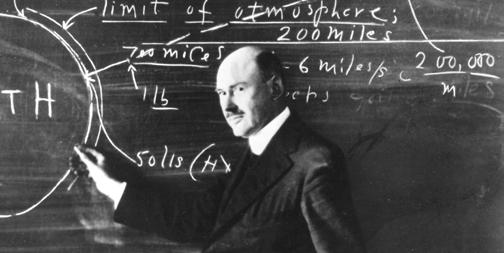
A century ago, the modern rocket age began thanks to Worcester native Robert H. Goddard

A century ago, the modern rocket age began thanks to Worcester native Robert H. Goddard


Become an AARP Massachusetts volunteer and make a difference in your community by supporting causes that matter to you, participating in local in-person and virtual events, reaching out to community members, and advocating for change.

REQUIREMENTS FOR UPLOADING YOUR OWN
By Jennifer Benson, AArP MAssAchusetts stAte Director
Giving back. Making friends. Changing lives. Volunteer opportunities are open to people of all ages. Find your place at aarp.org/volunteerhere

PHOTO: You may upload a photo to the template if (1) it was downloaded from the Digital Asset Hub, or (2) you can document that AARP has all necessary legal rights to use the photo, including identifiable individuals, artwork and trademarks in text and logo, in this template.
For many Massachusetts residents, the years around retirement are full of big financial decisions. High living costs can make those choices feel even heavier. So can a complicated system that isn’t always easy to navigate. Long term security isn’t just about higher returns. It’s about having clear, timely information.
That’s where AARP Massachusetts comes in. Our work focuses on helping people understand the systems that shape financial security later in life. We aim to make the process feel less intimidating and more manageable.
The minimum suggested size for the photos is 4500 x 2700 pixels.
Image resolution is best reviewed in “Preview” mode.
One of the most significant challenges facing older adults is managing the transition from employment to retirement. Decisions about Social Security, health coverage, and retirement income are often made years before people fully understand their long‑term impact. AARP offers easy to use educational tools that help people feel more prepared and confident as they approach retirement, especially during the pre-retirement years, when there’s still time to make choices that can really matter.
For more information about photography and usage rights, please review the Local Photography Guidance & Rules One-Sheet on InfoNet.
By translating complicated topics like when to claim benefits, how to plan for health care costs, and whether you’re on track for retirement into clear, practical guidance, AARP helps people move forward with greater peace of mind and fewer unwelcome surprises. You can check out the AARP Retirement Calculator and find out when — and how — to retire the way you want. 54% of pre retirees say they have no idea how much they’ll need to retire. Use this calculator to learn, double check and make sure you’re on the path to your “someday,” each month. Find it at aarp. org/retirementcalculator
Caregiving is another area where financial strain often goes unrecognized until it becomes overwhelming. In Massachusetts, 1.4 million people provide unpaid care to older loved ones, frequently absorbing out‑of‑pocket costs while juggling work and family responsibilities. AARP Massachusetts has been a leading advocate for a refundable family caregiver tax credit, arguing that caregivers play a central role in keeping people at home and out of more costly institutional care. The proposed credit would help offset caregiving expenses and acknowledge caregiving as a public good, not just a private burden.
Housing costs also loom large for older adults, particularly for those trying to remain in their homes on fixed incomes. AARP has long worked to raise awareness of the Senior Circuit Breaker tax credit, a state program that can return thousands of dollars to eligible homeowners and renters aged 65 and older. Many eligible residents never claim the credit simply because they are unaware of it or unsure how to apply. Through education and volunteer tax‑assistance programs, AARP helps ensure this policy functions as it was intended—as a tool to support aging in place rather than a benefit that goes unused.
From everyday money decisions to major policy fights, AARP works to make aging easier to navigate. Think of AARP as a wise friend and a fierce defender, helping to transform the experience of aging. We have a number of online and in person events to help you navigate the choices that come up as you approach retirement. You can find information at aarp.org/ma.
Jennifer Benson is the State Director for AARP Massachusetts. For more articles visit www.fiftyplusadvocate.com.

The QR code seen on this template must be deleted or changed. QR codes must be created in the Uniqode platform using your AARP account. Download either .jpg or .png format for use in the template.
For information about licenses, training and support, review the QR Code Guidance on InfoNet or contact BrandHelp@aarp.org.
By evAn WAlsh contriButing Writer
GRAFTON – One day, Andy Kjellberg’s chief came into North Truro Air Force Station in an especially chipper mood. He’d been given orders: He was heading to a different command, and he’d be leaving soon. Kjellberg wanted to get out of Massachusetts. “Can I go with you?” he quickly asked.
“Never asked him where he was going,” Kjellberg remembered.
At 3 a.m. the next morning, an envelope was thrown on Kjellberg’s desk. As the sun rose, he went to the chow hall, made a cup of coffee, and took a big swig. Then he read the envelope. Immediately, he spit his brew into the just-pressed uniform of a nearby staff sergeant.
“That’s when I found out that I’m going to Vietnam,” Kjellberg said.
Soon enough, he was on a plane to fight in a war halfway across the world. It was the start of a journey filled with near death experiences, but along the way, he found his life’s purpose. For the last three decades, Kjellberg has spent almost every spare moment researching Grafton’s veterans, ensuring that no Grafton resident that served the U.S. goes unrecognized.
“I took this job for one reason: It needs to get done,” he said.
Joining the service
A Worcester native and Saint John’s graduate, Kjellberg found himself doing nighttime maintenance at Assumption College. Far more lucrative for Kjellberg: the local pool table, where he’d made over $1,000 per week, sometimes more.
It was while playing a game of pool when he learned he’d been drafted. He joined the U.S. Air Force and did basic training at Lackland Air Force Base (Texas). Soon after, he was sent to Keesler Air Force Base (Mississippi) for radar training.
Then it was time for his deployment. He was about to be sent to the faraway land of Green Hill Park, Worcester – about a 5 minute walk from his father’s house, and an easy commute to get home cooking from his mother. Immediately, he thought about how he would spend his per diem.
“I joined the Air Force to travel the world. I can’t even get out of my own city,” he joked.
The U.S. Air Force offered him a spot on Alaska’s Aleutian Islands — “No thanks,” said Kjellberg — and eventually sent him to North Truro, Massachusetts. There, he developed scope radar, sometimes managing dozens of aircraft at once. One night, he tracked all of LaGuardia’s airspace independently.
Arriving in Vietnam a week after

the Tet Offensive, Kjellberg’s one year deployment was rocky from the start. He arrived in a C 130 that faced mortar fire as it touched down on the runway. Within his first few days, he dealt with close quarters combat as the enemy closed in.
“It would’ve been a short stay,” said Kjellberg. “Would’ve gone home in a box.”
Remembering those who served
After his military service, Kjellberg didn’t receive a hero’s welcome home. Quite the opposite, actually. After a 16 hour flight from Vietnam to Seattle Tacoma International Airport, he was sworn at, spit on, and shoved by anti war activists who called him a “baby killer.”
It didn’t stop Kjellberg from honoring those who served.
Kjellberg moved to Grafton in the 1970s and was immediately welcomed by the community of veterans. But his colleagues started “dropping off, left and right,” and family members would complain that veterans weren’t being properly honored. It didn’t sit right with Kjellberg, so he decided to act.
“I started to talk to these guys while they were still alive to get their information, so people would know — if they did die — that they served,” said Kjellberg. “I have pages and pages of documents, all with information — about the families, about the veterans, and about their lives.”
For 28 years Andy Kjellberg of Grafton has pored over every death certificate in the town from the last 40 years, read almost every obituary, and mapped (and honored) the graves of all U.S. veterans from Grafton.
A new marble grave was installed for Josiah (Joseph) Warren Houghton, a Civil War veteran and former Grafton resident who was buried in an unmarked plot in 1908. Kjellberg located Houghton and realized he’d never been formally honored.
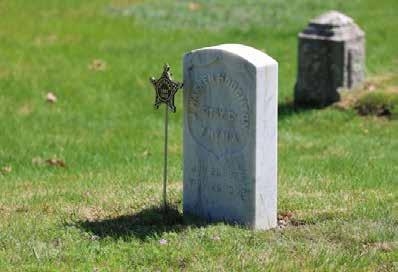
In 1998, Kjellberg started to track ancestry, attempting to find all of Grafton’s veterans. He’s pored over every Grafton death certificate in the last 40 years, he reads almost every obituary and newspaper clipping, and maps (and honors) the graves of all U.S. veterans.
Thirty years ago, he started with a list of 900 names. He’s up to 1,939.
He said: “Why do I do it? It has to be done. These guys can’t be forgotten.”
A new marble grave was installed for Josiah (Joseph) Warren Houghton, a Civil War veteran and former Grafton resident who was buried in an unmarked plot in 1908. Kjellberg located Houghton and realized he’d never been formally honored.
In his years of research, he’s remembered the long forgotten. In 2025, Kjellberg helped honor a Civil War veteran who wasn’t properly honored when he passed away 117 years ago. The veteran, buried in an unmarked plot in 1908, got a new
Then there’s his work with the town’s Vietnam War plaque. Approximately 196 veterans are honored on the town’s original plaque. Kjellberg tracked down 208 additional names, putting up a second bronze plaque. He advertised across the nation as part of the effort.
Today, Kjellberg’s database is vast: Thousands of names, their burial locations, their rank, their hometown, their company, and accolades. It’s become a living database of dead people – and something that Kjellberg hopes to pass to the next generation, if a fellow Grafton resident picks up the mantle.
“All of this information, it’s available in town in 62 different places. Now, it’s available in one. It has to be done. I was adopted here — Grafton adopted me from Day One, no questions asked. They’re dying left and right, now I’m paying them back.”
“When I die, what do I ask? Put a flag on my grave. I served.”
By Brett Peruzzi MAnAging eDitor
SWAMPSCOTT – Piper Kerman had a privileged upbringing in this affluent North Shore town. But it didn’t stop her from ending up as an inmate in 2004 in the federal prison system after pleading guilty to charges of money laundering and conspiracy to commit drug trafficking.
What that experience did do for her was inspire her to write a best-selling memoir about her 13 month stint in prison, “Orange Is the New Black: My Year in a Women’s Prison,” which later became an award-winning television series on Netflix.
Recognizing the humanity of inmates
“Part of my goal in writing the book … and allowing it to be adapted, was for more people to recognize the humanity of people in prison, or in the criminal justice system,” Kerman told The Dickinsonian, the Dickinson College student newspaper, in a 2018 interview. “We want to have a criminal justice system, wherein if someone we love ends up in that po-
sition, we wouldn’t fear for their lives, we wouldn’t fear for their safety, we wouldn’t fear for their sanity,” she explained. “We wouldn’t ever want
Smith College find herself incarcerated? In 1993, while she was in her early 20s, she participated in a drug smuggling operation. She transported a
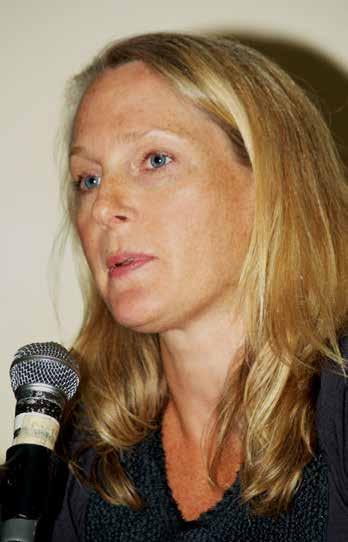
Swampscott native Piper Kerman’s memoir about her year in a women’s federal prison became the basis for the hit Netflix series “Orange Is the New Black,” which ran for seven seasons. Photo/Courtesy of Netflix

someone we love to go into prison or jail and come out in worse shape than when they went in, but that’s exactly what happens far too often.”
So how did the 56‑year‑old graduate of Swampscott High School and
suitcase of cash from Chicago to Brussels, a crime she was later implicated in by an ex girlfriend. Although she ended her criminal involvement in the mid‑1990s, the FBI investigated and paid her a visit in 1998. Charges were
brought and she eventually entered a guilty plea to laundering money for a drug ring.
Kerman was sentenced to 15 months, and served 13 months in the Federal Correctional Institution in Danbury, Connecticut, between 2004 and 2005. Five years later in 2010, her book about her prison experience was published to widespread acclaim. One point Kerman makes clear is that the United States is an outlier in the number of people who are incarcerated.
A prison nation
“We are a prison nation in comparison with all other nations in the world, by far, and historically you can’t find another society that has ever chosen to do what we’ve done to ourselves,” she observed in The Dickinsonian interview. “The United States incarcerates more of its own people than any society in human history has ever done. We can’t really claim to be the land of free where in fact we’re the land of the incarcerated. And of course, women have been the fastest growing part of the prison system for decades now.”
Kerman’s approach in her book was more analytical than sensation-

Swampscott
native Piper
Kerman wrote the memoir “Orange Is the New Black: My Year in a Women’s Prison” after spending a year in federal prison after being convicted of money laundering.
Commons

al, despite the drama that is portrayed in the Netflix series. She uses her editorial lens to examine systems — incarceration, policy, inequity — rather than just recounting interactions between individuals.
In the book, she is very aware that she entered the federal prison system with many advantages, including an elite higher education, support from her family, as well as the financial and cultural capital that comes with her background. Indeed, one of her memoir’s central themes is how privilege operates inside and outside the justice system.
“When we think about crime and punishment and safety, one of the most interesting concepts is the idea of desistence,” Kerman noted. “We get a lot of focus on external factors controlling crime or determining safety, but if someone is involved in a harmful behavior, we want them to be able to desist from doing what harms them or what harms other people,” she said. “Story and narrative plays a really strong role in a person’s ability to desist. The story of their past and the story of who they are in that moment, has to change for them and they have to be able to develop a new story going forward, an authentic story and something that they want for themselves.”
Kerman talks in her book about how prisons fail both inmates and society at large. “The public expects sentences to be punitive but also rehabilitative; however, what we expect



and what we get from our prisons are very different things,” she added. “The lesson that our prison system teaches its residents is how to survive as a prisoner, not as a citizen — not a very constructive body of knowledge for us or the communities to which we return.”
Following her release from prison, Kerman married writer Larry Smith and began writing her book. Kerman and her husband and son lived for several years in Columbus, Ohio where she taught writing classes at the Marion Correctional Institution and the Ohio Reformatory for Women in nearby Marysville, Ohio. After the success of her book and the creation of the Netflix series, she served as a consultant on the show for its seven season run, reading scripts and providing feedback to ensure the prison portrayed on the show was realistic. She and her husband had a cameo appearance in the show’s final episode, portraying visitors in the prison’s visiting room. Kerman and her family now live in Berkeley, California, She is a writer and speaker focusing on women in the criminal justice system, re-entry, and the importance of arts in prisons. Kerman serves on the board of directors for the Women’s Prison Association. She has been working on a second book, regarding her experiences teaching in the prison system. She was awarded the “Humanist Heroine of the Year Award” from the “Humanist Hub” group at Harvard University.



By JAnet stoicA contriButing Writer
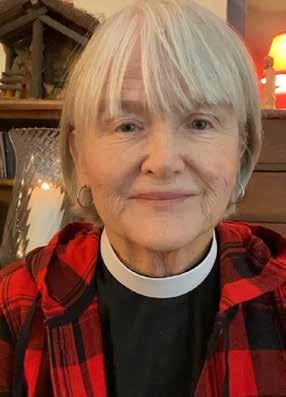
DOUGLAS – Rev. Julia Dunbar was ordained an Episcopalian priest at the age of 50, at an age when most people are not looking to start a new career.. Now in her late 70s, she recently retired from her last congregation, the Good Shepherd Episcopal Church in Oxford.
Catholic upbringing
Dunbar was raised in a Roman Catholic family but found that she wanted to learn more about the Episcopalian denomination. Unlike Catholicism, woman priests have been common in the Episcopalian church since the 1970s. She had no intention of becoming a priest but once she joined an AIDS Action Committee and was asked to meet with a prisoner in a long-term jail facility, she realized what her calling truly was. “Just visiting him in prison, I could see his suffering and it was this that was instrumental in my becoming a priest,” she said. “Not that he was a choir boy. This part of my training in clinical pastoral care, which involved 2500 hours of working with patients, really opened my eyes to the need for counseling.”
She then worked with inpatients at
Beth Israel Deaconess Medical Center in Boston and trained at Brigham and Women’s Hospital to become a chaplain. “It was such a fascinating experience introducing myself to and talking with patients to learn where they were in life,” she recalled. “Just listening and sensing them through the stage of life they were in, observing their body language.” Soon she became director of pastoral care and education at Beth Israel. She worked closely with graduate students in the program which she found gave her the greatest satisfaction as she guided and educated them.
At the age of 50, Dunbar was ordained an Episcopalian priest. She had also begun working for a philanthropy during her ordination process, and ran the charitable office while handling a large donation portfolio. She ultimately left the organization as she found she could not continue to devote the number of hours the job required while also being a priest.
Hospital work
She soon found herself handling the volunteer services department at Beth Israel. “Their pastoral care department was very small,” said Dunbar, “and soon hospital social workers began phoning me for patient assistance. Suddenly the director departed and I
learned that there were many national and international applicants applying for his job. The department and patient needs were a large part of my pastoral care.” After all interviews had been held for the open position,. Dunbar learned that she had been chosen as the new director.


Choose us for exceptional results.
“I met many, many people from all walks of life and that’s when I realized that we are all carrying a heavy load in life,” she recalled. “I am so grateful to have had that opportunity to meet these people and will always feel honored that they felt trustful enough to share their thoughts and words with me. I remember a call once when I’d gotten home late at night after having been with a dying patient with her son at her bedside when she passed away.”
“The floor nurses phoned me to ask if I’d return to the now deceased patient’s room because the son did not want to leave his mom,” she continued. “It was now a few hours after the woman had passed. Her son was so broken at every level. I stayed another two hours with him and he was able to


leave afterwards. I walked him to his car and saw him drive away. I then returned to the patient’s floor to check on the nurses who had compassion fatigue.” Dunbar said the challenges and life connections that she experienced in this role were “true blessings” for her. She mentioned how privileged she felt from her patient interactions.
Transition to parish churches
After working for several years in the pastoral care department at Metrowest Medical Center in the Framingham/ Natick area, she was asked to fill in for other priests at their churches when they were away on sabbaticals. St. Thomas Episcopal Church in Auburn was her next assignment when parishioners asked her to join them. Then the COVID 19 pandemic happened, which shut down everything. The rectory was sold and the church was closed quickly. Some of the St. Thomas parishioners chose to attend Grace Episcopal Church in Oxford and that’s when Dunbar learned that Grace Episcopal needed a priest and she was hired. As COVID was still rampant, most services were held outdoors and people showed up in their heavy winter coats, mittens, gloves, scarves, and woolen caps. The merged congregation members voted for a new church name and thus Good Shepherd was born. The parish grew to approximately 65 members.
As most Sunday Mass attendees are aware, there is an acute shortage of priests and most are more attracted to full time positions. After a recent shoulder injury, Dunbar said she knew it was time to retire. She still keeps busy with her family and active with many friends she’s made along the way during her pastoral career and life’s calling.



care services?
508-579-1890 www.trustedlikefamilyhomecare.com and disabled adults in Worcester County
• Locally owned and managed – fully insured and bonded
• Client satisfaction and service are our top priorities!
Contact us today to see how we can help! info@trustedlikefamilyhomecare.com
By MichAel PernA Jr contriButing Writer
WORCESTER – One hundred years ago, on March 16, 1926, the world entered the modern rocket age thanks to Worcester native Robert H. Goddard. He had been experimenting with rockets for over a decade, but it was on that night on a farm in Auburn that the first liquid‑fueled rocket shot into the night sky.
Childhood curiosity
He was born in Worcester, Massachusetts on October 5, 1882. As a little boy, Robert Hutchings Goddard was considered what was known in those days as “sickly” and ended up missing a great deal of time from school. This did not stop him from having a great deal of interest in the ways of science. For instance, at the age of five, his father explained how he could generate static electricity on the family’s carpet.
for many years:
“On this day I climbed a tall cherry tree at the back of the barn…and as I looked toward the fields at the east, I imagined how wonderful it would be to make some device which had even the possibility of ascending to Mars.…I was a different boy when I descended the tree from when I ascended. Existence at last seemed very purposive.”
Academic career
He went on to obtain his bachelor of science degree from Worcester Polytechnic Institute, then earned his master of arts degree in 1910, then his doctorate degree in physics from Clark University in 1911. He then became a part-time instructor and research fellow at Clark, where he also pursued his interest in rocketry research.
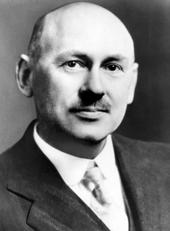
He was described by his colleagues as shy and reserved, which they considered to be detrimental to being a good professor.
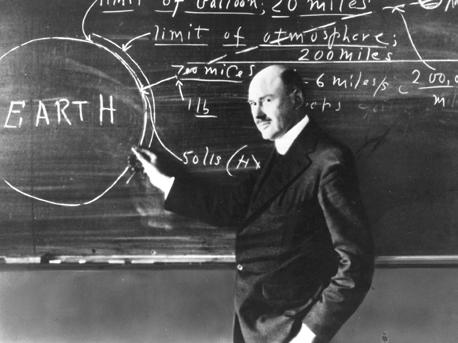
His experiments continued, with him eventually receiving a research grant of $5000 from the Smithsonian. Clark University also provided some funds for his work.
Robert H. Goddard’s launch of a liquidfueled rocket on an Auburn farm on March 16, 1926, inaugurated the modern rocket age.
Young Robert then had the idea to try to charge a battery by scuffing his feet on a gravel walk, in hopes the battery would help him jump higher. He abandoned his experiment after his mother warned him that if he was successful, he might “go sailing away and might not be able to come back.” In another experiment, he mixed chemicals in the house, causing a smoky explosion.
When he read a newly published book, H. G. Wells’ “The War of the Worlds,” which described a Martian invasion of the earth, his fascination with space flight was born. When he was 17, he had an experience that he later would describe as his “greatest inspiration,” which he described in his very detailed diary that he kept
His first experiment involved the launch of a powder rocket, which he launched during an evening in the fall of 1915. The launch was noisy and bright enough that it alarmed the college’s janitor — Goddard had to reassure him that nothing was wrong. After that time, he moved his experiments to an inside laboratory.
He eventually came up with plans to produce a liquid fueled rocket. By this time, he had been noticed by organizations such as the Smithsonian Institution, the National Geographic Society, and the Aero Club of America.
He performed tests on a military rocket launcher, later to become known as the “bazooka” during World War I, however the war ended before the weapon was put into use.
By 1926, he was ready to test the world’s first liquid fueled rocket. The launch took place on March 16 in Auburn at what he described as “Aunt Effie’s farm” — today the site is a National Historic Landmark known as the Goddard Rocket Launching Site. The launch was only partially successful; however, Goddard went on to make improvements to his design.
From that time on several nations went on to utilize the same type of propulsion system in both military and space flight rockets, continuing right up into the present day.
Robert Goddard became known as “The Father of Modern Rocketry.” He continued his work with rockets right up to and through World War II. Sadly, he contracted tuberculosis, then was diagnosed with throat cancer. He died in August 1945 and was buried at Hope Cemetery in Worcester.
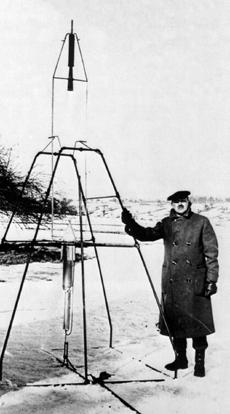
As the world remembers Robert Goddard’s first rocket launch, there will be several events to note the centennial of the achievement, including some at Robert Goddard Park in Auburn.
More information about the celebratory events can be found at goddard100th.org.
By sheAlAgh sullivAn contriButing Writer
HUDSON – In 1992, Hudson resident Rob Butts was newly married, an accomplished electrical engineer, and someone who always embraced an adventure. But that same year, a tragic accident would upend his life as he knew it.
During a skiing trip to Killington, Vermont, Butts was gliding down the slope on his final trip down the mountain for the day. He and his wife were meeting friends in the lodge that evening, and the only way back to their car was a beginner slope he jokingly called the “The Ugh.”
Butts had been a lifelong avid skier. Picking up speed, he performed a maneuver called a “back scratch.” But his skis didn’t come down in time. He described his fall as a “sledgehammer” hitting the earth.
“It was the weirdest thing, because it felt like all my life, I knew I was going to do it. And not only that, I knew it was going to happen, but it was supposed to happen,” Butts said.
Acutely aware he couldn’t feel much of anything, he called for his wife, who had skied ahead of him. Though the two were the only ones on the slope, help managed to arrive, carrying Butts down the mountain on a snowmobile. He was rushed to the hospital.
He never lost consciousness.
Butts had a burst fracture in his fifth vertebrae, rendering him paralyzed from the shoulders down. Doctors used a piece of his hip to fuse his fourth, fifth, and sixth vertebrae together. As he recovered in the hospital, Butts knew his life would never be the same.
In the years that followed, Butts suffered from chronic pain and was limited to bed rest for three years. In that time, he read the Bible — a book he said he’d always had in his house but had never taken the time to delve into. He had been connected to his
faith prior to his accident, but when he had “nothing but time,” he gave the Good Book a closer look.
“One of my ‘Rob isms’ is that sometimes God will put you on your back to get you to look up. I looked up,” he said.
Butts will have been paralyzed for 34 years this spring. In that time, he’s gone back to school twice for graduate school. He went to Boston University shortly after his accident to pursue a master’s in computer science, an endeavor that took about a decade to complete. Unable to work with his hands anymore, he thought coding could help him professionally. He’s used those skills to design a kayak with a joystick controlled motor, and a track system above his bed to help him get him into his chair in the mornings.
In December, he finished his master’s in theology from Dallas Theological Seminary, and plans to travel to Texas in May to cross the stage. To complete his papers, he used a mouthpiece that connects to his keyboard to tap the keys, letter by letter. The process was painstaking, even slightly impacting his jaw function. He once wrote a 22-page, single-spaced paper, only using the mouthpiece.
Though his reality is drastically different from what he imagined as a young man, Butts still has a zest for life – and his love of adventure never went away. He’s taken to parasailing and hopes to fly solo as soon as this year; he trains using an electromagnetic hand bicycle to stay in shape.
He’s met and connected with people he never thought he would. He has two children, now in their 20s, who he has stayed close with.
“He’s the kind of person that if you are down, if you are sad, he always has a word to encourage you, to raise up your spirit,” said Marcia Cardoso, a close friend of Butts. “Even when I am at my worst, he can say something that I’m gonna just laugh at.”
Each week, his friend Jim Ash
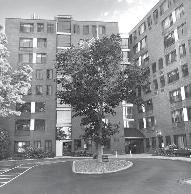




comes over to play cribbage. Butts designed a special card holder for himself, and uses his mouthpiece to signal to Ash which cards he wants to play: “He just maintains a level of faith and perseverance that is extraordinary considering what he’s been through,” Ash said.
Over the decades he’s been con-
Hudson resident
Rob Butts said he’s come to see his life since he was paralyzed in a skiing accident 34 years ago as a blessing instead of a curse.
fined to his chair, Butts said he’s come to see his life as a blessing instead of a curse. He’s deepened his relationship with God and leads prayer groups at his church in Marlborough — all with the goal of showing others the comfort that faith can give.
“I have one friend who used to always want to pray for me to get healed. And I used to say to her, ‘I’m not so sure that’s my plan,’” he said.
Now, he’s working on turning his story into a book. The process started about six years ago, Butts said.
“It’s been cathartic,” he said. “I didn’t know if I’d remember a lot of this stuff anymore, but as I was writing about it, the more I was remembering. I can just see where I was, when I sat, and where I am now, especially going to school and all of that.”
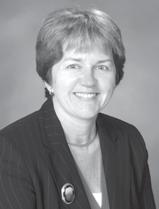

Walter Dyer was leather, and a very unconventional businessman

REGION – Massachusetts has seen its fair share of colorful and most memorable characters over time, and leather craftsman Walter Dyer was certainly one of them. But Dyer drew national attention in 1980 when he decided to drop down $1,500 in $1 bills over the heads of Lynn residents like manna from heaven.
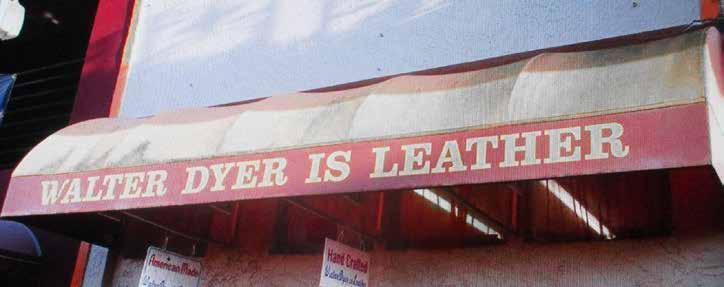
The leather manufacturer and owner of Walter Dyer Is Leather stores hired a plane to fly over Lynn’s Central Square during Christmas time because he knew many people needed the money. He said he liked helping people, it was his way of saying thank you to the community where his business was born, and he wanted to provide a little fun and excitement for them.
Unfortunately, the stunt did not go so well for the nearly 4,000 people who showed up for the event. They unavoidably watched in shock as the wind seemingly blew most of the money away, which likely fluttered out to sea. Many could recall on Facebook that unusual day and the man who tried to bring a little joy to local residents.
Maureen Hurley Phaneuf wrote:
“He certainly was a character! So recognizable with that suede coat and cowboy hat!”
Susan Bowes recalled:
“I was there. I remember that. Most of it went into the ocean.”
Laine Averback added:
“Certainly remember this! Shopped in his leather stores a lot! As he said, Walter Dyer IS leather!”

of, “Walter Dyer. Walter Liar.” Un beknownst to most was the fact that Dyer, whose leather workshop em ployed 40 people at the time, was going through financial difficulties.
Dyer was adamant about the gimmick not being a publicity stunt since he went 10 years without advertising his store. He and the store were already well known. Dyer had retail outlets in Harvard Square, Rockport, Charles Street in Boston and a leather shop in Framingham. At one point, his factory was making up to 2,000 leather vests per year.
Unconventional businessman
His business came about after serving in the Army during World War II and then working in the shoe industry in Lynn. He opened a leather shop in the 1950s making shoes and moccasins before expanding into leather clothing. Eccentric to the core and a believer in his product, Dyer was his own salesman and model, and was nicknamed “The Liberace of Leathers.” He often wore a Native American headdress while working in the window of his shop to draw attention to his line of Indian
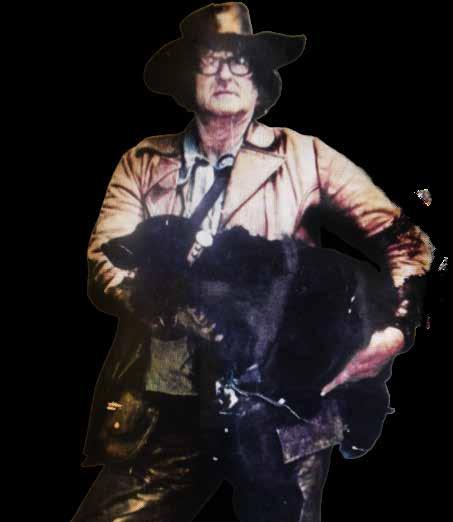

strate his designs, drove around in a pink Cadillac and claimed to be Lynn’s first streaker. At six feet tall and 250 pounds, he was an imposing figure made all the more distinctive by often being clad head to toe in his leather creations.
Family members have said Dyer was an unconventional businessman who was more interested in introducing people to something new rather than making money. They have speculated he could have been a multimillionaire if he had gotten a handle on how much it cost to make his goods. Before the days of credit cards, he would sometimes send customers home with a coat without them having paid for it. He promised them it would change their lives and asked them to send the money once they got home. They usually did.
A recovering alcoholic who stopped drinking in 1955, Dyer became a member of Alcoholics Anon
known by many for his work with AA as he was for his leather and outrageous costumes.
Retirement and passing Dyer retired one year after his well intentioned stunt in 1980 after his workshop was destroyed in the Great Lynn Fire of 1981. Looking back, he said it was probably best the cash went into the ocean instead of into the hands of the crowd, opining in The Boston Globe, “If it (money) had landed in the square, there might have been a stampede and people might have gotten hurt. So, I can’t say I’m sorry it happened.”
Walter Dyer passed away at 84 in 2003. The last Walter Dyer Is Leather store, the Framingham location on Route 9 with its distinctive orange exterior, run by his son Bruce Dyer, closed in 2018 after 49 years in business.


By shAron oliver contriButing Writer
LYNN – Boston area residents know or at least know of the notorious nursery rhyme/song “Lynn, Lynn City of Sin.” It’s humorous to many, pesky to some, especially people from Lynn, a city of 103,000 residents less than four miles north of Boston that was founded in 1629.
“Trot, trot to Boston. Trot, trot to Lynn! Be careful when ya get there, Ya don’t fall in!
Lynn, Lynn the city of sin. You never come out, the way you came in, You ask for water, but they give you gin. The girls say no, yet they always give in. If you’re not bad, they won’t let you in It’s the damndest city I’ve ever lived in.
Lynn, Lynn the city of sin. You never come out, the way you came in.”
Reputation from Prohibition era The rhyme originated many decades
ago at a time when Lynn was also known for its bootleg gin during Prohibition. Surprisingly, the song and the seaport city’s reputation made its way across the country as noted by people like John Nollet, who wrote on Facebook, “I heard the ‘Lynn, Lynn, City of Sin ...’ poetry back in 1984 in San Francisco ... my cab driver from the airport was from Massachusetts originally and said he was surprised that people here knew the lines ... I thought ‘WOW’ we are famous ... I love Lynn ... been here since I was 5 and love the “Melting Pot” that it is ... people say bad things about the city. It’s usually people who avoid it ... I’d just say I’m glad that my mind is not that closed ... Yea Lynn, Lynn City of sin...”
With a “rum row” having existed off the coast, speakeasies and bootlegging were common. Nevertheless, times do change and Lynn, like any other city in the United States has gone through transformations since its settlement in Massachusetts. Being a “City of Firsts,” Lynn boasts having the first streetcar to operate in the state, constructed the first fire engine and was a massive manufacturer of shoes.
It was also the home to notable people such as Academy Award winning actress Estelle Parsons, actor Neil
Hamilton (“Batman’s Commissioner Gordon), “Wheel of Fortune’s” original hostess Susan Stafford and “60 Minutes” journalist Lesley Stahl. Singer songwriter Don White also paid homage to his native city with his 1995 song “I’m from Lynn, What Can I Say.” White good naturedly lampoons various aspects of Lynn, rhapsodizing about its plethora of sub shops and juvenile delinquents running amok. But
Now accepting Applications for 62 years of age and older and those that are under 62 years of age and are permanently disabled.

•
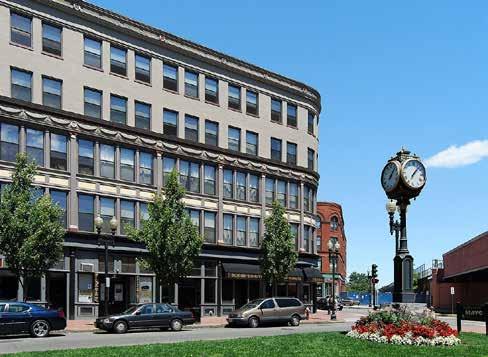
Central Square is one of the many historic areas of Lynn, which was first settled in 1629.
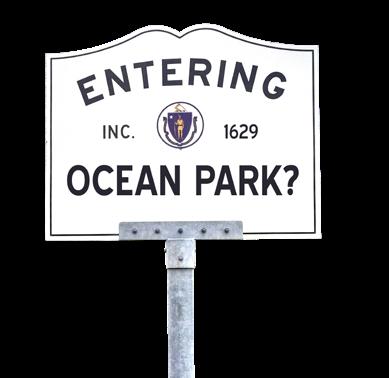
the more upscale North Shore towns of Nahant, Swampscott, and Marblehead don’t escape his razor wit either. In 1997, city solicitor Michael Barry proposed renaming the city to Ocean Park in an effort to rebrand Lynn’s reputation of negative connotations. Voters objected and there was even another little ditty written to memorialize the new name.
Peter McCarty remembers well on


Facebook, “Howie Carr blasted it in the Herald. ‘Ocean Park, Ocean Park. Don’t go there after dark. If Noah lived here he’d build another Ark.’ He also went on to ask how come all the houses in Lynn real estate seem to be on the Swampscott line, etc...”
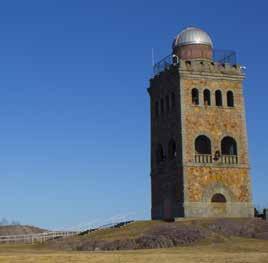
Vibrant culture and cuisine Lynn does have a vibrant culture. In 1850, the first hiking club in New England — the Lynn Exploring Circle — was estab lished and Lynn was among the first in the na tion to set aside a large por tion of land for parks and green space. The Lynn Woods Reserva tion is the sec ond largest mu nicipal park in the United States and the High Rock Tower Observa tory is an iconic Lynn landmark. The city is also known for its beautiful beaches and wide range of cuisine. Lynn Beach is a pop ular spot for sunbathing, swim ming, and leisurely walks along
High Rock Tower Observatory, with sweeping views of the surrounding area, as well as the nearby Atlantic Ocean, is an iconic Lynn landmark.
Photo/Wikimedia Commons/ Pilgrimsong
the shoreline.
Kings Beach is known for its tide pools and rock formations. Foodies can experience everything from Italian to Dominican to Thai, with a few waterfront restaurants worth
“Lynn, Lynn the city of sin. You never come out, the way you came in” may have a different meaning these days with so much to see and explore.

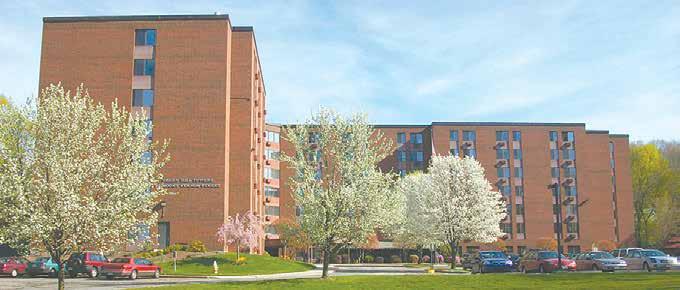
Within the building amenities include:
• A Theater-like media center
• Handicap-accessible lounges on every floor
• Library equipped with two computers and free internet access
• Physical fitness center
• Game room with billiard table
• Community room with bingo board and large screen TV
27 Mount Vernon Street, Worcester, MA • O ffice O pen D aily 8:00 am - 4:30 pm
To receive an application please call 508-755-6062 TDD# 508-755-0228
Now accepting applications for 62 years of age and older and those who are under 62 years of age and are permanently disabled.
Applicants must meet HUD annual low income guidelines. Preference is given to individuals 62 and older.
• Contemporary styled 1 & 2 bedroom apartments
• New kitchens with built-in microwaves and granite-like countertops
• Small pets welcome
• Heat and Hot water included
• Bus route / ample parking
• Beautiful landscaped grounds with gazebo



By shAron oliver contriButing Writer
LOWELL – Imagine entering a department store and being greeted by a sign which read in large bold letters: “NO BROWSING.” It is perfectly normal for the average shopper, especially if undecided, to want to browse for that perfect personal item or gift. Store owner Nathan Birke did not see it that way.
Holocaust survivors
Nathan and Sally Birke fled their homeland of Poland for Russia when Germany invaded in 1939. They opened Birke’s Department Store on Market Street in Lowell less than a decade later in 1948, after arriving in the United States two years earlier. After the war, Sally returned to Poland only to learn that her family had all died. Her sister Leia died of starvation, her mother Szifra and 8 year old brother Avram, were gassed at Auschwitz. Nathan’s family were also killed by the Nazis.
Birke’s was described as the Marshalls or T.J. Maxx of its day. The husband-and-wife team offered their cus-

tomers a chance to score bargains such as designer jeans for $10. Sally, the welcoming half of the duo, often provided tea and cookies and calmed customers’ nerves after being riled by her husband. However, potential buyers always entered at their own risk after being given fair warning with that impossible to miss the sign bearing Nathan’s famous rule, “NO BROWSING.”
Holding court in the center of the store, Nathan Birke was particularly cantankerous and often interrogated those who entered with, “What do you want?” If the reply was, “I’m just looking,” he would retort, according to JewishBoston.com, “No lookers. Ve vant buyers! You vant to browse, go to a library! At least there you vill loyn someting!” What followed next was usually a shout to get out of his store. Much of the time, Nathan was away from the store meeting with vendors and wholesalers, allowing for a sigh of relief for customers.
Daughter and customers remember According to a 2010 interview in the Lowell Sun, the Birke’s oldest daughter, Szifra said, “It was a crime if you knew exactly what you wanted. It was
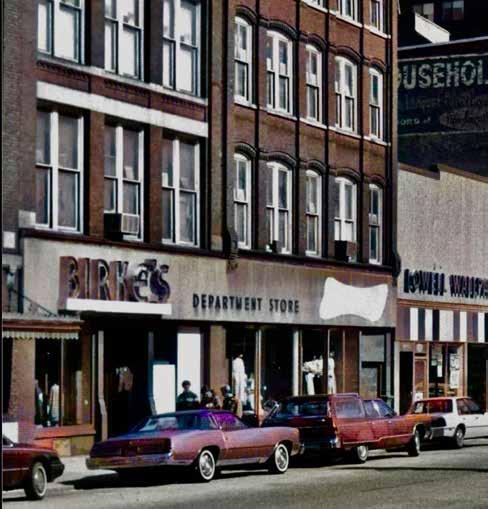
Birke’s Department Store in Lowell was a popular retail destination for 44 years despite its sometimes cranky attitude towards its customers.
Retirement Home III is congregate housing for seniors. Enjoy nutritious “Home Cooked Meals,” served in our attractive dining room with your neighbors and friends.

All apartments at Colony Retirement Homes receive rental assistance through the HUD section 8 program. Rent is 30% of your adjusted monthly income. Rent includes all utilities except phone and cable TV. Call Monday thru Friday, 9am to 5 pm for more information.


Sally and Nathan Birke, the owners of Birke’s Department Store in Lowell, were Holocaust survivors


By MAriAnne lyons Delorey, Ph.D.
“You have to go through the falling down in order to learn to walk. It helps to know that you can survive it. That’s an education in itself.”
a crime if you didn’t know what you wanted. Everything was a reason to be thrown out of Birke’s. It is a miracle anyone ever got in.”
She went on to describe her relationship with her father as just as complicated as it was with his customers. “I loved him, but I had a disdain for his level of intolerance and the way he treated people. He was verbally abusive. He treated us the way he did the customers: Sometimes really well, and sometimes poorly.”
Nevertheless, Nathan Birke was generous at times, often reducing prices for the poor, donating clothes, and helping deliver food to families struck by typhoid fever when no one else would. He would also hold conversations and share Fig Newtons with you if he liked your looks. Some former customers took to Facebook to post personal memories.
J. Ed O’Keefe wrote:
“I had the honor to be chased out of the store by Sally. They didn’t care
if they sold anything a whole week. If they weren’t in the mood for business, it wasn’t happening.”
Judy Neiland Lemire added:
“I was allowed to shop there because my manager at the Social Security office was friendly with the Birkes. Always felt I had to purchase something, or I might not be allowed to shop again.”
Some shoppers ran out at first bark; others stayed and paid no attention to Nathan’s surliness. In 1994, Szifra collected stories and memorabilia to be displayed at the Morgan Culture Center in Lowell, as she recounts in a YouTube video. The exhibit called, “Browsing Through Birke’s” is also the title of a documentary detailing Nathan and Sally’s journey of survival and perseverance.
After Nathan passed away in 1992 at age 84, Sally continued operating the store, which closed in 2004 after 44 years in business. Sally Birke passed away in 2012.


– Carol Burnett
I was speaking to a physician the other day and she noted that a lot of people in her practice had some generalized anxiety because of the state of politics today. She said people are anxious and worried.
It appears this anecdotal evidence is backed up by data. According to a new Gallup poll Americans are exceptionally anxious about their democracy, behind only Taiwan. Additionally, the younger generation in the U.S. is significantly more likely to be anxious about their country’s economic future.
I wonder if the older generation is less anxious about their economic future because they feel like they’ve seen worse and have a broader basis for comparing our current situation to harder times.
Given the prognosticating going on (and the anxiety of expecting the worst to happen) I am growing more curious about how people perceive the current day through the lens of how they thought the future would be.
I sat down with some elders recently and asked them what they thought about the events around World War II back while they were living it compared to how those events are remembered today.
Certainly, there is variability in how much and what is remembered. My oldest resident is 99. She was only two years old when the stock market crashed, but 15 by the time the U.S. entered World War II. Her memories were those of a teenage girl – she remembers her brother’s military service and the person coming to the house with a telegram that he had been hurt. She remembers him taking off his prosthetic to rest his leg. She remembers before the war that they couldn’t feed themselves well so her grandmother sold antique after precious antique to put food on the table.
Another resident had clearer memories of the events that led up to the war. She watched the reels in the cinemas and stayed on top of the news. She read a lot but did not worry her parents with her concerns. She learned about the atrocities of World War II in bits and pieces and in school afterwards.
Yet another resident simply remembers her brother’s life being lost and the telegram arriving by bicycle.
My godfather remembers throwing bread over the fence to the prisoners in the camp in Boston. (Yes, there was a prisoner camp for Italians in Boston.)
While all these elders had memories of the historical events, their recollections seemed to be personal connections and personal impacts rather than a focus on the larger society. I wonder if it is too difficult to recall the larger political discussion later on or if the ruminations are spoiled by those who write the history books.
It also strikes me that, much like today, there were bigger problems for the everyday person to worry about than what was happening so many miles away. Hunger was real, hardship was real. Death came to the door.
And so, I wonder out loud, how will today be perceived in 50 years? What will our grandchildren’s children be learning in school about the events of today and how they shaped their lives? Tomorrow will hold the key. Perhaps the Gallup poll and this article will serve as a record. People are anxious. We don’t want our democracy to crumble, but maybe there is a better, brighter future ahead and we just can’t see it yet.
Perhaps Carol Burnett said it best. “You have to have faith that there is a reason you go through certain things.”
While I do not share her faith, I do have hope in us.
Marianne Delorey, Ph.D., is the executive director of Colony Retirement Homes. She can be reached at 508-755-0444 or mdelorey@colonyretirement.com and www.colonyretirementhomes.com. Archives of articles from previous issues can be read at www.fiftyplusadvocate.com.
By JAnice linDsAy contriButing Writer
Speaking of immigrants — as we often are these days — here’s a story of one immigrant who gave us a most American piece of Americana.
The little guy was four when he arrived in New York in 1893. He was the youngest of eight in a poor Jewish family who escaped pogroms in Russia and came to America looking for a better life. When his father died three years later, little Israel (Izzy) Baline helped the family by earning pennies selling newspapers and delivering telegrams.
He clearly had musical ability. At fourteen, he quit school and got a job as a singing waiter in saloons, bars, and a cafe.
He also worked as a “song plugger” for a publisher of sheet music. Before records and radio, most families had a piano and someone who could play. They needed sheet music of popular songs. As a plugger, Izzy would attend a live performance, applaud loudly when the singer sang a song from his publisher, or jump up and “spontaneously” lead the audience in singing the chorus while the performer acted surprised. Result: the audience learned the song and bought the music. At his café job, he wrote and sang parodies of
popular songs. A waiter in a rival café had written a song for the café that was published and got some publicity for the place. Israel’s boss asked him to compose a song for his cafe. Working with the café’s pianist, he wrote his first song, “Marie from Sunny Italy.” The song was published in 1907, earning him 37 cents in royalties and a new name. The printer un intentionally changed his name from Israel Baline to Israel Berlin. He later chose Irving.

Irving Berlin was on his way, not that his way was well traveled or easy. He had other jobs while he wrote. He eventually got a job writing songs for a publisher of sheet music and wrote all types of popular songs, building his skills, making friends in the music industry, earning a reputation.
Then, in 1911, came his tune “Alexander’s Ragtime Band” (“Come on and hear, come on and hear, Alexander’s Ragtime Band…”) Some of the popular singers of the day liked it and performed it. It was a huge hit, selling 1.5 million copies of sheet music in 18 months, earning enough money for Berlin to start his own publishing company.
World War I provided the opportunity for Berlin, drafted into the Army, to write his first musical show. Stationed at Camp Upton in New York, he wrote “Yip Yip Yaphank” that was performed at the camp, then on Broadway, raising money for a service center at the camp.
Fast-forward two decades during which Berlin wrote many songs and shows. Traveling in Europe in 1938, he witnessed the growing threat of fascism and Nazism, which made him grateful to be American.
When he returned home, the popular singer Kate Smith asked him to write a song for her radio show where she would celebrate patriotism and what was then called Armistice Day.
Berlin remembered the song he had rejected twenty years earlier. He gave Smith the rights to the song for free, stipulating that any profits from it should go the Girl Scouts and Boy Scouts.
That song was “God Bless America.”
Is there any song more thoroughly American than that? We all know it. Some consider it our second national anthem. And an immigrant wrote it. That seems a bit ironic, but so American.
Contact jlindsay@tidewater.net.



By leighAh BeAusoleil contriButing Writer
WESTBOROUGH – When Peter Daniel Cook, 64, was a ninth grader at Westborough High School, he had no clue what he was going to do with the rest of his life.
On his way to meet with a guidance counselor, a poster for the U.S. Marine Corps captured his attention: “We are looking for a few good men,” the advertisement read. Suddenly, Cook’s mind was made up. He skipped the meeting, and hung the poster on his wall, where it would stay for the next four years until he officially enlisted.
Though he joined with tremendous enthusiasm, he remembers the bus ride through South Carolina that had him second guessing his choice. There were more men than seats available, so Cook found himself crouched down in the aisle. When the bus finally stopped, a drill instructor boarded: “You’ve got five seconds to get off this
work than wielding weapons. “It was a peacekeeping organization, and I see it as such — and a noble one. Men led with their conscience. And that’s so important, I think.”
Though the book largely takes place in Ecuador in the 1980s, readers can catch a glimpse of Westborough and the surrounding area. The main character, Curtis, is a graduate of Westborough High School and returns to the town once he’s placed on leave.
“I love the Marine Corps … I really believe in it and I believe that the Marine Corps is there to provide services to the citizens of the country.”

bus, and four of them are already gone,” he said.
Midway through training, Cook’s perspective changed: “This is pretty good,” he thought.
From 1979 to 1984, Cook served with the U.S. Marines, holding posts at a number of American embassies, including in Ecuador, Spain, and Haiti. In 2024, he published his first novel, “Bootleg Heroes,” a military comedy that draws from his service experiences and presents what he says is an accurate representation of the Marines during that time.
“It was really about trying to capture authentic human behavior,” he said.
“I love the Marine Corps. … I really believe in it and I believe that the Marine Corps is there to provide services to the citizens of the country,” he said, noting that there’s more humanitarian
You’ve Worked Hard All Your Life, Now Let Your Home Work For You
• Need more money each month to cover the higher cost of living?
• Still have a mortgage payment or high credit card balances?
• Need money for house repairs or improvements?
• Feel anxious about NOT having enough money today or in the future?
Looking for a Solution? Maybe You Fit:
Are you 60 years old or older? Do you own a home?
A REVERSE MORTGAGE MAY BE THE ANSWER
I Will Guide You & Create a Plan
After a short conversation, I will be able to determine if you qualify and then share the exact action steps to successfully implement a plan.
Please call or text me at (781) 724-6221 or email me at av@powhse.com
I am passionate about educating people about reverse mortgage and will explain the pros & cons so that you will be fully informed if a reverse mortgage is the best choice for you.
of Not Overcoming Your Challenges
Cook remembers his time in Westborough fondly, recalling the winter afternoons when the town would be covered in a blanket of snow that muffled all sounds; he and his buddies would walk back to his parents’ house to load up on snacks before gymnastics practice.
“Westborough gets in your heart and stays there,” Cook said while reminiscing.
Though he wasn’t a “good student” at the time, given his sole interest in joining the Marines, a mentor would eventually help him get a provisional acceptance to American University, where he developed a love for literacy. Now living in Los Angeles, Cook earned his Ph.D. and teaches at Camino Nuevo Charter Academy, where helping students with literacy is his top priority.
“I’m not selling books. I’m selling literacy,” Cook says, adding he hopes his novel can help others find the love and magic that he discovered while reading for the first time.
Cook will be visiting Tatnuck Bookseller for an author event on March 28. His book, which may be adapted into a movie in the near future, said Cook, is available for purchase now on Amazon: https://a.co/d/hDMuz5C
There is no cost to learn about reverse mortgages. But the cost is immense to realize later that a reverse mortgage may have overcome your financial concerns, needs, and challenges. Over my 30 plus year career, the one word that hurts the most is – regret, regret of not taking action. Please feel comfortable contacting me.
When used properly, a reverse mortgage allows a qualified borrower the option to receive tax free cash up front, or a monthly check, or a line of credit to access cash when desired with NO minimum or required monthly mortgage payment. A reverse mortgage has no impact on Medicare or Social Security benefits. You still own your home and can prepay without penalty. Top uses include paying off a current mortgage and credit cards, augmenting retirement cash flow, medical needs, home improvements, and peace of mind knowing cash is available. I look forward to learning what success looks like for you. (Note – you are required to pay ongoing real estate taxes and property insurance and meet other loan guidelines.)
Alain Valles
Reverse Mortgage Specialist 781-724-6221
A great place to start is get your free “How to Use Your Home to Stay at Home” 36-page book. This is the official reverse mortgage consumer booklet approved by the U.S. Department of Housing & Urban Development and published by the National Council on Aging.
To receive your free copy, please call me at (781) 724-6221 or email me at av@powhse.com
I am also available to evaluate your specific situation, answer your questions, and calculate how much money is available to you.
Alain Valles was the first designated Certified Reverse Mortgage Professional in New England. He obtained a Master of Science from the M.I.T. Center for Real Estate, an MBA from the Wharton School, and graduated summa cum laude from UMass Amherst. He is the senior reverse mortgage loan officer MLO#7946 at Powerhouse Funding Corp. NMLS #1740551. He can arrange but does not make loans. Alain can be reached directly at (781) 724-6221 or by email at av@powhse.com
By MichAel PernA Jr contriButing Writer
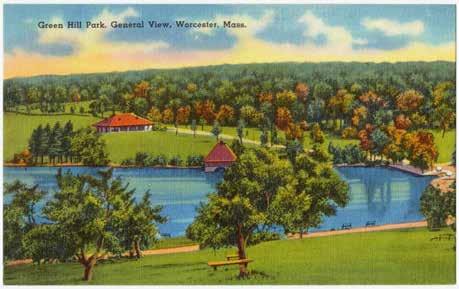
WORCESTER – Aaron Adams of the Massachusetts Bay Colony obtained thirteen acres of land in 1713 located in what is now Worcester, Massachusetts. He probably never would have believed that his property would now be known as the “crown jewel” of Worcester – Green Hill Park.
Family property
Adams built a house on the property the following year and then started adding to his land holdings. Adams’ brother Thomas later took over ownership of the property. In 1754, Dr. Thomas Green purchased the property, which then became known as “Stormont” and sometimes “Green Hill.” Green’s son, Dr. John Green, inherited the property, building the Green family homestead in 1757. By the late 1700s, the family had more than doubled the size of their land holdings. In 1848, Andrew Green took over ownership of the family’s land. Andrew moved to New York City, where he became the commissioner of Central Park. His interest in landscaping led him to beautify the Green Hill property with many varieties of ornamental trees. He also enlarged an existing house to a forty two room mansion.
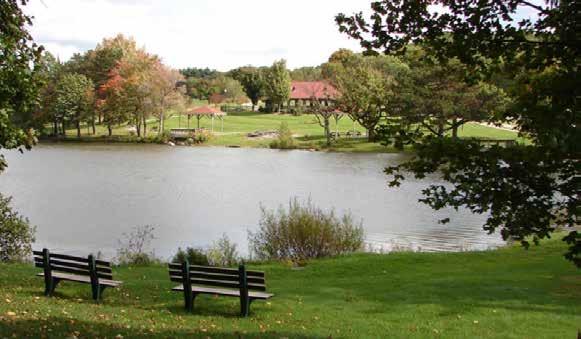
In 1872, Andrew’s brother Martin became the manager of the estate. His background as a civil engineer led to him making several changes, including the creation of what is now known as Green Hill Pond.
City takes ownership
Andrew Green died in 1903. He had willed his property to his nieces and nephews. They, in turn, sold the property to the City of Worcester in 1905. The family mansion was then turned into a resource for a variety of uses — a sort of shelter for women and children, a laboratory to study native birds, a meeting room for the
Worcester Natural History Society, and a children’s hospital.
In 1911, a pavilion, known at the time as “The Refectory” was built, followed in 1919 by a nine-hole golf course. During the 1920s, more improvements were made. A bathhouse, golf clubhouse, and a memorial grove dedicated to Worcester’s residents that perished in World War I were added. More additions to the park followed. In 1929, a “bowling green” was built on land adjacent to Lincoln Street. This was later transformed by the addition of a pool, basketball courts, and an archery range. In 1942, a field house, called the Thomas Holland House, was built by the Works Progress Administration on the site, along with a wading pond, called the Holland Rink. This later became a neighborhood park when Interstate 290 was built through part of the park property.
In 1957, a portion of the park, located on what was called Millstone Hill, was turned over to the state of Massachusetts so that an Air National Guard armory could be constructed. When completed a radar installation was added to the site. This sometimes caused issues — in the 1970s, a resident that lived on the other side of the park would frequently call and complain that the radar beams interfered with his television reception! The Air National Guard used the facility until 2000, when it was turned over to the Army National Guard.
An area close by the armory had been used by the city as a dump for many years. After issues with ille
gal dumping, the dump was closed, only to be reopened as a landfill in 1971. This, in turn, was closed in 1973, with the area being turned into sports fields.
In 2002, the Massachusetts’ State Vietnam War Memorial was dedicated in the park. That same year, work began on the Worcester Technical High School, which is located on what had been part of the park.
The park has continued to change over the years — the mansion building was demolished, a zoo that once housed buffalo in addition to many other animals has been downsized, and other improvements made. Today, Worcester’s largest park at 470 acres, Green Hill Park, continues to be an extremely popular destination for all types of outdoor activities, not only for city residents, but for people throughout the local area.


By shAron oliver contriButing Writer
ARLINGTON – Ever since 1955, the Guiness Book of World Records has kept up with an ever growing list of achievements and oddities. There is the oldest this and longest that and everything in between. Falling into the category of World’s Greatest Grape Catcher was a man from Arlington by the name of Paul Tavilla.
Perhaps he had plenty of practice. Tavilla and his brothers owned and operated the P. Tavilla Company, wholesale produce distributors, at the New England Produce Center in Chelsea. The produce merchant not only had a talent for catching grapes with his mouth but also from a jaw- dropping distance. The grapes were thrown by hand and caught in mouth on level ground, often from high rise buildings.
Due to his ability to open wide and catch grapes in his mouth from long distances, Tavilla found himself in the Guinness Book of World Records in 1978 when he posted a mark of 251 feet and then again in 1979 when marksmen hurled them towards him from 327 feet and six inches. The following year, however, Tavilla was knocked from the throne after Ardman Chapman of Monroe, Louisiana won. Not to be outdone a second time, Tavilla came back with a 270 foot, four inch posting, making him a winner yet again in the book’s 1981 edition.
Tavilla took their rivalry public when Chapman won for a second time in 1982. Tavilla protested his competitor’s claim of catching the grape thrown 319 feet, eight inches by softball pitcher Pete Mercer. The disbelieving Tavilla even offered Mercer an all expense paid round trip from Louisiana to Boston, plus a $1,000 bonus if he would come and hurl a grape 319 feet, eight inches on level ground. Mercer declined the offers. Tavilla had said that if Mercer did not accept his offer,
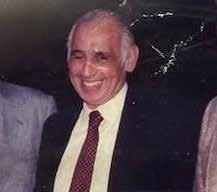
Paul Tavilla, a produce dealer from Arlington, was in the Guinness Book of World Records for grape catching in his mouth, including one that had been dropped 788 feet from the John Hancock building in Boston.


After Tavilla’s death in 2014, this autograph was posted to his obituary page by one of his fans.
he was going to demand the Guinness Book of World Records reinstate him as the legitimate record holder. In 1988, he caught a grape from 788 feet at the John Hancock skyscraper in Boston.
After catching a grape which plummeted 52 stories down from Tokyo’s Shinjuku district and at the speed of 80 mph, Tavilla admitted the forceful landing hurt his mouth. Nevertheless, he set a record of 660 feet and 2.6 inches in 1986, breaking his own record from the previous year. Tavilla had been invited to Tokyo as a guest of a Japanese television company for a taping of a show on world record holders set before an audience of around 200. However, Tavilla



had said he was surprised to learn that he and the other guests were expected to try and break their own records.
TV appearances and charity events
He gained national recognition for this unusual feat, landing guest appearances on “The Dinah Shore Show,” “The Tonight Show Starring Johnny Carson,” “Maury Povich” and “Live with Regis and Kathie Lee.” Tavilla was also a hit at charity events and hospitals where he visited sick children. Others who have cemented their place in Guinness for grape catching skills include: Paul E. Lyday III of Fort Motte,
South Carolina, in 2009 for the Longest Distance Caught with a record for the greatest distance at which a grape thrown from ground level has been caught in the mouth is 108 meters (354 feet 4 inches).
The record for the most grapes caught in the mouth in one minute is 68 grapes and set by Ashrita Furman in Kuala Lumpur on December 22, 2005. The record for the greatest distance catching a grape in the mouth (self thrown) is 23.79 meters (78 feet), achieved by Connor Castleberry in Tucker, Georgia, in 2022. Paul Tavilla died in 2014.




By shAron oliver contriButing Writer
BOSTON – The recent passing of reggae pioneer Jimmy Cliff cannot pass without saying how much of an impact he and reggae music had in the Boston Cambridge area during the 1970s. The musical peer to another legend, Bob Marley, died on November 24, 2025, following a bout with pneumonia. He was 81.
Jamaican films sparked interest No one could have possibly guessed how reggae would infiltrate into the lives of white middle-class Boston and Cambridge college students following the release of two Jamaican movies that featured reggae music. One flick in particular, “The Harder They Come,” which was released in 1972 and starred Jimmy Cliff, remained a strong cult favorite with locals for years.
Oftentimes patrons stretched out the door and down the block. According to the projectionist, Hal Wagner, the film’s attraction was largely due to word of mouth. In an old Boston Globe article, he said, “People just keep coming. And they keep coming back.” One teenager admitted to having seen the film 35 times. Another teen named Martin Restovich even claimed the movie was “his gospel” and wondered what he would do next.
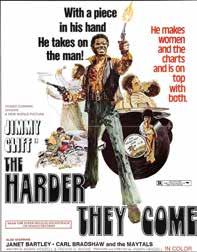
So much so that it was the longest running film in the history of the Boston area at the time with an estimated 250,000 moviegoers having seen it since its release at the now-closed Orson Welles Cinema in Cambridge.
Loosely based on real life Jamaican criminal Ivanhoe Rhyging, Cliff portrayed the spree killer, tracing his arrival in Kingston, Jamaica as a country boy, drawn to the Jamaican music business but who ends up in the ganja trade. Filmed on a shoestring budget, the movie features Cliff delivering the title tune and is famously credited for a reggae soundtrack that is said to have “brought reggae to the world.” Moreover, Cambridge with its student counterculture became one of the first U.S. cities associated with reggae. The association between reggae and marijuana smoking probably endeared it with local students as well.
The soundtrack album played a
ASSISTED LIVING FACILITIES
major role in popular izing reggae in the Unit ed States and globally. In 2003, the album was ranked number 119 on Rolling Stone magazine’s list of the 500 greatest albums of all time.
Early Bob Marley concerts and radio shows
The film’s success prompted Island Records honcho Chris Blackwell into signing Bob Marley and the Wailers and the first place they headlined was Cambridge’s Paul’s Mall for a five night residency in the summer of 1973. Adding to the excitement, fans of this Caribbean blend of rhythm and blues, calypso and jazz were able to listen to live broadcasts of the shows on WBCN radio. Wailers bass player Aston “Family Man” Barrett would later recall the Paul’s Mall shows as among the best the band ever played, and the Boston crowd as the most hospitable. The Wailers would return to the same venue two years later, playing to two packed shows each night for a seven night residency.
Bigelow Village – Rutland
Congregational Retirement –Melrose
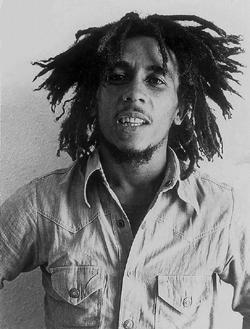

case hosted by Doug Herzog, future president of MTV Networks. It was the station’s highest rated program. That same year, Bob Marley and the Wailers entertained a crowd of nearly 20,000 at Soldiers Field stadium for a benefit concert.
At the time, “Reggae Bloodline” on WGBH was the most popular local radio outlet for reggae. It was hosted by Carly Simon’s brother Peter Simon after a trip to Jamaica made him want to spread the word of Jah to Boston. It was the first reggae show in the Northeast.
In 1978, WERS 88.9 premiered “Strictly Rockers” (later “Rockers”), a weekly two hour long reggae show-
Brookhaven Assisted Care – West Brookfield
Heywood Wakefield Commons – Gardner
SUBSIDIZED HOUSING
Colony Retirement – Worcester
Green Hill Towers – Worcester
Sherwood Village – Natick
Boston was ripe with racial tensions, but folks of all stripes came together, if only for a moment in time, at a club called Western Front where reggae nights were always crowded. According to Boston music journalist Noah Schaffer he told radio station WBUR, “Boston’s reggae scene was somewhat famous for being one of the only integrated scenes in a time [in] which integrated cultural activities simply didn’t happen.”
The world may have lost legendary reggae artists like Bob Marley, Bunny Wailer, Peter Tosh and Jimmy Cliff but their creative influence still remains.
By sAnDi BArrett contriButing Writer
REGION – Monday, April 20, is the official celebration of Patriots’ Day for 2026. This historic day is a linchpin in Massachusetts’ 250th anniversary of our nation’s birth. Originally a Massachusetts holiday, it is now celebrated in Maine, Connecticut, Wisconsin, North Carolina, Florida, and North Dakota.
The day commemorates the opening salvo in the conflict of the American Revolutionary War. The renowned “shot heard ‘round the world” was fired on April 19, 1775. Lexington and Concord are the central players in this iconic battle between the Colonial minutemen and the British soldiers, but fun holiday festivities can be found across the Commonwealth in addition to those at Minute Man National Park. All would be great for a family celebration of the holiday with grown children or grandchildren.
Holiday origins
In 1894, Governor Frederic T. Greenhalge set the first Patriots’ Day, bringing Lexington Day and Concord Day into one unified celebration. The purpose of this celebration is to commemorate the early battles and the midnight ride of Paul Revere.
Patriots’ Day was celebrated on April 19 until 1969 when the state legislature voted to make the holiday a floating day falling on the third Monday in April, creating a three-day weekend.
The Boston Marathon
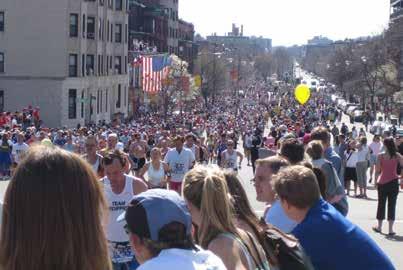
Traditionally falling on Patriots’ Day is the Boston Marathon, a world renowned marathon attracting elite world-class runners from many countries. The race begins on Main Street in Hopkinton and traverses several cities and towns along the 26.2 mile route, ending at the Boston Public Library in Copley Square.
On a beautiful spring day up-
wards of 500,000 people line the race route beginning in Hopkinton, then on to Ashland, Framingham, Natick, Wellesley, Newton, Brookline, finishing in Boston. Some of the most popular viewing spots, besides the start and finish, are Wellesley’s “Scream Tunnel” and Heartbreak Hill in Newton. You can find easier access and parking if you choose a viewing spot away from these popular locations.
Concord, Lexington, and Arlington celebrations
The largest battle at the beginning of the war was in the colonial town of Menotomy, current day Arlington. Militia from Middlesex and Essex Counties took up covered fighting positions along Concord Road between Lexington and Concord and Boston. Hiding behind trees, stone walls, and buildings, these men ambushed the British troops as they retreated to Boston. One infamous battle took place at the Jason Russell House in Arlington. You can tour the home where this bloody skirmish took place outside and inside the home. The Battle of Menotomy reenactment will take place on April 20 around the Jason Russel House between 2:00 and 5:00 pm.
On April 19, from 12:00 p.m. to 5:30 p.m., Menotomy Beer Hall in Arlington is the spot to celebrate the ride of Paul Revere and William Dawes with live music, local craft beverages and hearty grub. On April 21, a reenactment of the ride of Revere and Dawes will take place at Arlington Town Hall.
In Lexington an exclusive VIP experience to Paul Revere’s ride will be hosted at the Hancock Clark House on April 17. Limited to 40 participants, the $250 per person event includes a pre show reception, and a ticket to Buckman Tavern, Munroe Tavern, and the Depot Museum. Additionally, guests will have a photo opportunity with Paul Revere, Sam Adams, and other period actors.
In Concord, the April 20 Patriots’ Day parade and celebration details are

Boston Marathon on Patriots’ Day attracts elite runners from around the world and up to half a million spectators.
The reenactment of the first battles of the Revolutionary War, in Lexington, Concord, and Arlington, are living history events that draw thousands of people.
Photo/Wikimedia Commons


still taking shape, but check the Concordma.gov webpage for up to the minute details.
May the God of Hope fill you with all joy and peace as you trust in Him so that you may overflow with hope by the Power of the Holy Spirit
~ Romans 15:13 Grace for Today

On Sunday, April 19, at 5:45 a.m. in Concord, the muster at Buttrick Hillside, near the North Bridge, sets the ominous tone for the weekend. The muster is followed by the dawn salute at 6:00 a.m. The star of the dawn salute is “Dr. Prescott” who rides across the fields warning the British are coming, followed by a muster salute.
Pro tips to remember
Boston Red Sox game
On Monday, April 20, the Red Sox take on the Detroit Tigers, with the first pitch at 11:10 a.m. The team will give away Red Sox windbreakers to the first 7,500 game day tickets scanned. Since 1959, the Sox have taken to the diamond, with the exception of a few rain outs, for an early game, giving fans the opportunity to take in a great ball game and have a peek at the Boston Marathon.
• There will be road closures and parking bans due to events
• Arrive to reenactments and parades early for best viewing
• Buy tickets early, ticketed events can sell out