What Matters Now
7 Healing Letters to a Friend with Cancer
Michael Lerner
Michael Lerner
by Michael Lerner
Common Knowledge Press
Bolinas, California First Edition, Revised June 2026
Published by Common Knowledge Press
A publication arm of Commonweal, Bolinas, California. commonweal.org/press
Book design by Sienna Dawn · First Edition, Revised · ISBN: 979-8-9920275-1-8
This book is for informational and educational purposes only. It does not constitute medical, legal, psychological, or other professional advice. All treatment decisions should be made in consultation with a qualified physician familiar with your specific circumstances.
References to psychedelic substances, specific programs, or organizations are for informational purposes only and do not constitute endorsements. Readers are solely responsible for compliance with all applicable laws. No medication, supplement, or therapy should be self-administered without guidance from a qualified physician.
To the fullest extent permitted by law, neither the author, Common Knowledge Press, nor Commonweal shall be liable for any damages, loss, injury, or harm arising from the use of information in this book. The views expressed are the author’s alone and do not represent medical or scientific consensus.
This work is licensed under Creative Commons AttributionNonCommercial-NoDerivatives 4.0 International (CC BY-NC-ND 4.0). You’re free to share this book widely. Print copies, share the digital file, pass along a physical book. If you distribute this significantly (to groups, hospitals, organizations), let us know at ckpress@commonweal.org. Three requirements: (1) Don’t change it—share the full book as written. (2) Give credit—acknowledge Michael Lerner and Commonweal. (3) Don’t sell it— this is offered freely. Translations: Contact us at ckpress@commonweal.org to collaborate. Full license: creativecommons.org/licenses/by-nc-nd/4.0/
These letters are dedicated to all those whose lives have been touched by our work of intentional healing. We are a small part of a great and ancient tradition. May that tradition—in whatever form it takes—continue to sustain all those who are prepared to receive it. May they in turn pass it on to those whose lives they touch.
The Founder’s Series brings together core writings from Michael Lerner, founder of Commonweal, exploring themes that have shaped five decades of work at the intersection of personal healing and planetary health.
Michael often writes in the form of letters. He believes letters are the most powerful form of written communication. He wrote these letters as a direct response to the people he met in each Commonweal Cancer Help Program retreat. He has always shared these freely, rough and unpolished, over many iterations. A true public intellectual, Michael has always shared his work in progress and never felt the need to polish his work. Immediacy and usefulness have always been more important. And, likewise, these publications, while bound in paper and ink, are still meant to be what Michael calls “working papers” and will doubtless be revised and revisited many more times. More shall be revealed.
These working papers reflect Michael’s distinctive approach to understanding complex problems, intellectually, emotionally, and practically. From navigating a cancer diagnosis to creating an organization, from holding death with grace to understanding the cascade of crises facing our world, his writings offer tools for living with depth and purpose in challenging times.
This first working paper in the series is, rightfully, focused on cancer. Michael has devoted over forty years to transforming how people navigate cancer. In 1985, he co-founded the Commonweal Cancer Help Program, a week-long retreat that has become an internationally recognized model for integrative cancer care, serving thousands of people with cancer from around the world.
His groundbreaking book Choices in Healing: Integrating the Best of Conventional and Complementary Approaches to Cancer, published by MIT Press, remains a foundational text in the field. Building on decades of experience, Michael co-founded CancerChoices, an online resource that guides people through creating personalized integrative cancer care plans. He also co-founded Healing Circles and the Collaborative for Health and Environment, both of which have a strong cancer focus. Through these four initiatives and his ongoing work, Michael has helped shape a vision of cancer care that honors the whole person—body, heart, mind, and spirit—and empowers individuals to become active participants in their own healing.
Preface — What forty years of sitting with people facing cancer has taught me, and the central precepts that shape these letters.
1. Integrative Cancer Care — Why conventional care alone is not optimal care, and what integrative cancer care can add to your healing.
2. Intentional Healing — What healing really means, how a diagnosis can become a turning point, and the four energetic centers of healing: body, heart, mind, and soul.
3. Skillful Decisions — How to approach treatment choices without rushing, how to research wisely, and when to trust your own knowing.
4. Caution in Conventional Care — An honest look at the limits of conventional medicine and the forces that can shape your treatment.
5. Self-Care and Healing — The 7 Lifestyle Healing Practices and why caring for yourself is one of the most powerful things you can do.
6. Complementary Therapies — Herbs, supplements, repurposed drugs, and the emerging role of psychedelics—how to evaluate your options and build them into your care.
7. Choices in Dying — On preparing for a good death, what end-of-life care offers, and the great mystery of what may follow.
Closing Thoughts — How to make the journey your own.
A Message to Caregivers — On the profound and underestimated skill of caregiving, its burdens and unexpected gifts, and the grace it can ask us to find in ourselves.
Appendix: The 7 Lifestyle Healing Practices — Evidence-based self-care approaches developed by CancerChoices.
Dear Friend,
Cancer touches us all. Over 40% of us will face a personal cancer diagnosis. We will all walk with friends and family facing some form of cancer.
Before you read these letters, I want to share where I find myself at 82 years of age, having devoted over 40 years to exploring intentional healing with cancer. I’ve sat in intimate counsel with over two thousand souls with a cancer diagnosis. I’ve doubtless sat in intimate counsel with another two thousand souls who are living with many other illnesses. I’ve been near the edge of life several times myself, including an abdominal aortic aneurysm and coronary bypass surgery.
My brother Adam has spent his career as a senior oncologist. My book Choices in Healing received positive reviews in The New England Journal of Medicine and JAMA. The website I co-founded, CancerChoices, was named the best balanced source on complementary therapies by leading skeptics. I served as Chief Consultant to the Office of Technology Assessment of the US Congress for its pioneering report Unconventional Cancer Treatments, and on the President’s Advisory Panel of the American Cancer Society.
I share this because I want you to know: I’m a profound believer in mainstream and experimental cancer therapies. I’m not a doctor or therapist. I strongly embrace skillful use of conventional treatments and take a very judicious
approach to complementary therapies. Whatever treatment path you explore—conventional, experimental, or complementary—please consult your physician or other credentialed health professional.
These 7 letters were never designed to be published. This is a working paper. These letters were written for friends and participants in the Commonweal Cancer Help Program. This book is not intended as medical advice. Please treat these as letters from a friend.
With that precautionary introduction, let me turn to what I truly believe. I have come to four central precepts that guide everything in the letters that follow.
First, love is the greatest healing force. No matter what we have to endure, love is what makes it bearable. “Those who have a why to live can bear almost any how,” Viktor Frankl wrote, quoting Nietzsche. People seek many other things—money, power, reputation, or whatever else. They often lose awareness of the healing power of love. For those who truly know love, there is no greater source of healing.
Second, as the great mystic poet William Blake said, “He who would do good to another must do it in Minute Particulars.” I have found this true. It’s not counsel on medical treatments or self-care or complementary therapies. It’s not teaching yoga or qigong, nor suggesting exercise or diet. All those things can help, no doubt. But what I have found to be most healing is understanding the unique particulars of someone’s life. It is walking with them through their personal pilgrimage to whatever matters to them right now.
Third, humans have an awesome variety of worldviews. As I sit in counsel with people, I am continually reminded that they hold the most astonishing range of experiences of who they are, why they are here, where they come from, where they are going, and what this mysterious life is all about. You can’t begin to truly help another person in depth without understanding what they think their lives are all about.
Fourth, what we call death is a great mystery. For some there is no question: We die and that’s it. For others there are certain beliefs about life after death, or endless mysteries concerning what happens to the soul. I started as an agnostic. Now I am frequently in dialogue with my dead who come to me in dreams and in conscious visions as well. I don’t ask you to agree. You have your own view of the mystery.
Most people develop some idea of what life is about. It may be religious, spiritual, philosophical, pragmatic, scientific, aesthetic, nature-based, or something else. But it is their sense of the ultimate meaning of life that grounds them in their sense of what is possible.
I am a religious man. I would not have said that when I was younger. I would have said, as many do, that I was “spiritual but not religious.” Now when people ask, I sometimes say that I am a Jewish Christian Buddhist Yogic Sufi with Taoist influences. Those are the five traditions that have opened to me over sixty years of study. (Taoism has, so far, been a lesser influence.)
Every tradition has an exoteric (public) face and an esoteric (private) practice that leads the inner seekers toward the light. What has opened to me in these five traditions is not the exoteric public forms, to which I am somewhat indifferent. It is the esoteric mystical heart of these traditions.
I like to believe that the mystical heart of all great traditions is a refraction from a single source of light that expresses itself differently in each tradition. This is known as a “non-dual” understanding about the nature of ultimate reality. I have no way to prove it and don’t exalt my view over others. It’s simply my choice to see life this way.
I believe in the power of prayer. I believe in the reality of grace. I believe there are many beings who watch over us and wish us well. I believe we can access the wisdom of the forces beyond our consensual world in many ways.
I believe that unmerited suffering can bring us closer to the Real, however we experience the deepest truth. I have witnessed that in the Cancer Help Program countless times.
Being a religious man does not mean I am an especially good man. I am not. I often say I am a radically imperfect human being with a few useful skills. But with all my faults, I have chosen to devote my life to the commonweal, which means the common good. We weren’t designed to be perfect. We can try our best to do as little harm and as much good as possible.
What I remember best from my work with people facing cancer are the stories. The stories of so many of those I
have sat with in intimate counsel. Even more, the stories of the people I have loved in this life—and those who have loved me.
This brings me back to love as the greatest healing force. And the need to help each other in unique particulars. The greatest question in that regard is: “How can I help?” I am astonished by the infinite variety of ways we understand the world. And I hold the great mystery of death near me.
These 7 letters are my attempt to share what I have learned about integrative cancer care, intentional healing, and the choices that can make the greatest difference in your journey. They are written with the understanding that whoever you are, whatever your beliefs, I hope you will be able to find at least something of value in what I offer here.
Love & prayers,
Dear Friend,
You are reading these letters because you or someone you care about has cancer.
My father and mother both had cancer. So did my wife. So did a half-sister. My brother is a senior oncologist at Boston Medical Center.
I’ve spent 50 years exploring integrative approaches for many other health conditions at Commonweal, the nonprofit center in Bolinas, California, that I co-founded in 1976. I’ve spent over 40 years, half my life, helping people explore integrative cancer care. I wrote a seminal book, Choices in Healing: Integrating the Best of Conventional and Complementary Cancer Care, published by MIT Press.
I’ve led over 230 week-long Commonweal Cancer Help Program retreats for people with cancer. I helped start a global network of healing circles for people with cancer. I’ve worked personally with several thousand people with cancer. This work helping people with cancer has shaped my life.
These 7 letters are an effort to summarize some of the things I’ve learned from these experiences. (I include an eighth letter written for caregivers, especially family and other close caregivers.)
Above all, I have come to believe in the value of intentional healing guiding your integrative cancer care, rather than conventional care alone.
To put it bluntly, I do not believe that conventional care alone is optimal cancer care. Optimal care involves the skillful integration of the best of conventional therapies with personally appropriate self-care, lifestyle therapies, and other carefully selected therapies, including complementary therapies, repurposed drugs, and other agents.
The sad truth is that optimal cancer care is exceedingly difficult to access. The best most of us can do is approximate it with gifted teams of practitioners from different disciplines. I take no pleasure in saying this to you. But when I have to choose between telling you the truth as I understand it and comforting you, I will tell you the truth.
Let us take one example, chronomodulated chemotherapy—chemotherapy timed to what Keith Block, MD, likens to “happy hour” for each chemotherapy. It can be far more effective and less toxic than the same agent given as a bolus or a continuous feed. Integrative oncology practices may offer conventional medicine with a few “add-ons” like yoga, meditation, diet, exercise, and the like. While these add-ons can be tremendously valuable, and part of the effort to “approximate” optimal care, they are not the same thing.
One size does not fit all. Many people are not willing or able to do what it would take to optimize their cancer care. The reasons may be time, money, or circumstance. They trust their doctor and do what she recommends. Those willing to both include and go beyond conventional care
can be well rewarded for their efforts. It doesn’t have to be a Herculean task. It can be gentle, evolving, self-forgiving, but continuously attentive.
But you do have to want to do it.
I strongly believe in conventional treatments—and also mainstream experimental treatments—when they are evidence-based and are rooted in informed patient choice.
I strongly believe in taking a cautious approach to these often rigorous conventional and experimental therapies— so that you do yourself no unnecessary harm.
I strongly believe that lifestyle choices and evidence-based complementary therapies can often improve quality of life and sometimes reduce risk of recurrence or extend life.
Ultimately, everything depends on who you are—what you believe, what you want, what your circumstances are, what your resources are, and above all, who is truly there to walk through this with you. As Hippocratic wisdom has long held, it is more important to know what sort of person has a disease than to know what sort of disease a person has. That is especially true when it comes to integrative cancer care.
My best counsel is that you—the person with the diagnosis—should call the shots based on your own beliefs, abilities, circumstances, and resources—unless you deliberately want to turn the decisions over to someone you trust: a physician, family member, or friend.
It’s easy to lose your center at a time like this. You can get swept away by urgency, the opinions of others, or the momentum of the medical system. Coming back to your own inner knowing—what matters now—is the anchor point for everything else.
What is the difference between conventional cancer treatment and integrative cancer care? And why should you care?
It’s simple. You should care because you may do better with conventional care plus integrative cancer care than with conventional cancer treatment alone.
Why? Conventional cancer treatments—such as surgery, chemotherapy, radiation, or immunotherapies—can be arduous. The stronger, healthier, and more resilient you are, the more likely you are to do well with the conventional treatments. Commonsense self-care and complementary cancer therapies can build strength and resilience. They may also have direct anticancer effects.
Conventional care focuses on your physical body. It rarely does as good a job with your mind, your emotional life, your soul, or your spirit. Even with your body, conventional care does not typically focus on optimizing your strength, energy, and resilience.
However, if you get good exercise, eat well, sleep well, reduce your stress levels, and find the support you need, you are likely to do better with your conventional treatments.
Integrative care = conventional treatments + self-care + complementary care + a purpose-driven life. It’s as simple as that.
CancerChoices, a program of Commonweal, is an independent voice, dedicated solely to providing information to support people with cancer to live as well as possible for as long as possible. On their website, CancerChoices.org, they map the terrain of integrative cancer care across conventional and experimental treatments, lifestyle healing practices, complementary therapies, and—when the time comes—choices in end-of-life care.
Why is end-of-life care included? While the hope is to live as well as you can for as long as you can, some cancers won’t be cured. Many people find it helps to have honest conversations about what you would want at the end of life.
You may not want to think about end-of-life questions. I understand completely. But I have seen how sharing thoughts, hopes, and fears about end-of-life questions can put you and those you love at greater peace. And—having given some thought to how they want to die—I have seen many people go on to live for long periods of time.
You won’t necessarily follow this order, but a simple approach to integrative care is:
• Decide what matters at this point in your life. Guide your treatment accordingly.
• Decide on conventional therapies and mainstream experimental therapies.
• Add powerful self-care strategies—such as the 7 Lifestyle Healing Practices developed by CancerChoices (see Appendix).
• Add science-based supplements and other complementary approaches.
Before you choose your conventional therapies, it is especially important to ask yourself what your goals are.
• Do you want to live at all costs, no matter how difficult the treatments?
• Are you more concerned with quality of life?
• What matters now in your life?
• Have you told your family and your doctor what matters to you now?
I offer you what I wish all those I have loved had known while going through cancer. I believe it would have made a difference for them. I hope it does for you.
Prayers for your healing,
PS: My endorsement of integrative cancer care reflects my belief that it is more effective than conventional care alone. My view is quite controversial. It necessarily shapes these letters toward conclusions many would not agree with. Ignore any of my beliefs that do not serve you. Because your life and well-being are at stake, please consult the health professional you trust most before accepting my perspective.
Dear Friend,
What is the true meaning of healing? As we understand it in the Commonweal Cancer Help Program, healing is movement toward wholeness.
Healing is different from curing. This is the most fundamental point of all.
A cure is a medical treatment that ends a disease process. Healing, as a movement toward wholeness, can take place at any point in our lives. It can take place physically, emotionally, mentally, and/or spiritually. It can take place whether our health is improving or whether we are losing ground.
Intentional healing means that you have a sustained interest in doing whatever you can to heal. Intentional healing can powerfully promote living longer and better. But powerful experiences of healing often take place even as cancer may be progressing—and especially as life may be nearing the end.
People with a new diagnosis of any kind of serious illness can go into shock. Shock is often a less-than-ideal state in which to make life-changing decisions, so it is best to let the shock settle. One of the saddest things patients say is, “I wish I had known this before I made my choice.”
This is one fundamental reason to ask how much time you have before you have to make big care choices—aside from using that time well to make good choices.
On the other hand, shock can also offer you a rare and precious place from which to review and evaluate your entire life—and to take a careful look at the most vital question in your medical and life choices: What matters now? In fact, severe shock—trauma—can “flip” you into a completely altered state of consciousness. This altered state can be confusing, frightening, yet also rich with deep healing potential.
This is more common in cancer than is usually recognized. Many cancer survivors can relate to the experience of cancer as a “wake-up call.” Some actually come to treasure the experience. “I wish I didn’t have to have a cancer diagnosis to wake up this way, but I wouldn’t choose to give up where it has taken me.”
When the shock is not beneficially channeled, people can end up with what is widely called “post-traumatic stress disorder” or PTSD. When the shock is rightly understood, it can help lead to an entirely new phase of personal growth. Of course, it is not either/or. There are many gradients between complete numbness and some kind of transformation.
“What matters now?” is the most profound question we can ask ourselves in a healing crisis. Some people try to get out of shock and back to “normal” as soon as possible. This new world is too disorienting, too threatening, to the lives they are living and the promises they have made. But if
you are willing to have the courage to learn what the shock state offers, it may be life-changing.
You may find out who really shows up among friends and family—and who doesn’t. You may reevaluate whether you are doing work that supports your healing. You may ask whether your close relationships support your healing.
It’s a time to ask how much you matter to yourself. Are you willing to stay in work or relationships that don’t really support your healing? What would life look like if healing was your true priority? Is it even possible, given your realities, to make a change? If not, is there any way to change your inner orientation to work on relationships that don’t support your healing? And are there ways you live or spend your time that could shift in a healing direction—even if changes in work or relationships seem out of reach?
These questions don’t just take place while you are in shock. But shock is often when they most vividly come to you. These questions can be among the most difficult and painful of our lives. Have we been climbing the wrong ladder placed against the wrong wall? Are we on the right path? Do we want to double down on the people and work and places we love?
In depth psychology and spiritual traditions, experiences of loss and trauma are frequently seen as opportunities for psychological and spiritual growth. This is my experience in my own life, the lives of those I care about, and well over two hundred week-long Cancer Help Programs. This growth is seen as the hidden “gift” in the hardest life experiences.
Here are four great energetic centers of healing work:
Heal the body — Notice what your body is asking for. Your body may feel better with different food, more movement, relaxation, or other healing practices. How can you bring balance to your body to help create a healing environment? Listen to your body.
Heal the heart — Great loss can bring immense waves of feelings. We may go into shock. It may take time before we allow ourselves to feel. That’s where friends, counselors, support groups, therapists, and other places to share feelings can help. We may find better ways to face grief, anxiety, or depression. We may heal old relationships. We may allow relationships that no longer serve us to end. We may find new friends and loves. We may even learn to love ourselves. Love is the greatest healer. Love transforms us. It is never too late to love. Listen to your heart.
Heal the mind — Our beliefs shape us. We can change them. We can heal our stories about ourselves and the world. We can let go of old ways of thinking that hinder healing. You might believe your cancer is a punishment. You might believe you are not worthy of love. You might believe you have no power to change what is happening. Are these beliefs true? We can heal our minds and find better ways to see ourselves and the world. Don’t believe everything you think.
Explore soul and spirit — Soul and spirit seek us. Spirit takes us up into the solar clarity of transcendence. Soul takes us down into the rich, dark depths of the heart. Whatever your beliefs—religious, spiritual, or
secular—both soul and spirit are our birthright. We need only to remember them. Soul and spirit speak to us in different ways. No need to believe in God to discover spirit. Call it a sense of meaning or purpose. Call it what you love most. No need to believe in anything to explore the soul. It sticks close to your body, close to your lived experience. A wisdom echoed in many traditions: When the ego laughs, the soul cries—and when the ego cries the soul laughs. Soul and spirit are the nodal points of the mythic unconscious.
From these four centers of body, heart, mind, soul and spirit, we can descend to the more granular dimension of the daily practices that support healing—such as those described in the 7 Lifestyle Healing Practices (see Appendix).
More granular still, and at least as important, are the healing paths unique to you. I cannot emphasize this enough. The 7 Lifestyle Healing Practices can be immensely powerful, but healing your life in the ways that matter most to you is more powerful still.
There are so many examples of powerful, unexpected healing as people follow their own unique paths. It could be changing jobs, changing relationships, or changing your attitude toward the things you cannot change.
Most of the participants in the Cancer Help Program are women. An astonishing number of these women have experienced verbal, physical, or sexual abuse as children which has shaped their lives. Women also often carry profound trauma from family, work, or cultural
experiences. They are often anguished by their relationships with parents, partners, and children. Often, their deepest work in the Cancer Help Program is on healing these life wounds.
There is nothing more central to intentional healing than an awareness of who you are and what matters now in your life. I have known people who welcomed a cancer diagnosis—even a metastatic cancer diagnosis—because it brought them a great sense of clarity they had not had before. And I have known many who were frightened, sometimes even terrified, by the diagnosis. Many who were frightened at first later found their way to love, courage, and inner peace.
An introspective person will have a very different path to healing than an extrovert. Someone who leads from their feelings will have a different experience from someone who leads from their mind. Meditation can be transformative for some, while time with loved ones or in nature is transformative for others. A cancer diagnosis sometimes opens the gates to inner powers of healing we never imagined.
And it’s not just a cancer diagnosis that can open these gates—it’s direct engagement with life itself.
Prayers for your healing,
PS: The 7 Healing Practices are strongly evidence-based. The evidence is summarized at CancerChoices.org. My belief in the reality of soul and spirit, and in the
importance of meaning or purpose to healing, would not be accepted by most mainstream cancer and scientific authorities. These beliefs shape my perspective. For these reasons, consult your trusted health professional.
Dear Friend,
The shock of a cancer diagnosis can feel overwhelming. Yet the decisions you must make about your cancer treatments can be the most consequential.
The biggest regrets people often have, as I said earlier, are when they look back after treatment and say, “I wish I’d known that before.”
Here are some rules of thumb for getting through these often difficult treatment decisions.
Above all, don’t necessarily rush into treatment. Find out if you can take some time—unless it is an acute emergency. Ask your doctor how much time you can safely take to consider your options. You may well need time to emerge from the shock of a diagnosis before you can think clearly about treatment choices.
Ask yourself what matters now in your life. Do you want life at all costs? Is quality of life more important? What else matters? Time with family? Time to complete something? Your answers can provide the compass for the direction you take in treatment. If you set your own course, you will likely do better and have fewer regrets.
Consider getting several opinions. Physicians may get at least two opinions before undertaking a major cancer treatment. And they might talk to two or more surgeons before choosing a surgeon for themselves. Follow the example of these people who know the landscape from the inside out. Ideally you should talk with physicians from different care networks, though your insurance may make this impossible. Different physicians often have different advice. You may trust one more than another. If you simply want to trust your medical team and skip second opinions, that’s okay too. In other words, second and even third or fourth opinions can be immensely valuable—but only seek them if they are intuitively the direction you choose to take.
Research your choices. People can take more care researching a new car or a new home than researching cancer treatment options. Yet these choices in therapies may have far more impact on your life than the car you drive or even the home you purchase. This is, of course, closely connected to the benefit of seeking additional medical opinions.
Many people don’t realize that there is often real variety in how different oncologists, surgeons, and radiation oncologists would treat your cancer. Your primary practitioner, or an internist, or an oncology nurse practitioner, or a professional cancer navigator can help you with research since they know the territory. So can a friend or family member who is good at this kind of research. Perhaps you are good at it yourself. Someone should take notes, look up treatments, study physician qualifications, and all the rest. Cancer.org from the American Cancer Society is an
excellent resource for understanding how your oncologist sees your situation. The National Cancer Institute’s Cancer.gov is another excellent resource.
Find someone you trust to help research your options if you don’t want to do this all yourself. Who to trust with this vital responsibility is among the most consequential decisions you will make. Since we began CancerChoices, we have seen the rise of AI and what a powerful tool it can be for synthesizing available health data. And, as of this writing, we are also aware of the risks of using AI, which can give inaccurate information or provide limited perspectives, based on the level of sophistication of queries. As with all guidance you receive, stay abreast of its risks and limits.
Research side effects. You may live with side effects of treatment for a long time. Knowing about them, including whether or not complementary therapies can be utilized to minimize them, may affect your decisions about which cancer treatments to choose. A palliative care physician can be an excellent resource, as can an oncology nurse who, on a daily basis, sees what patients go through.
Beware of complementary treatments alone. I’ve known many people who did not want conventional therapies because they feared their side effects. Often their cancers were early-stage and curable, and they opted for complementary therapies alone. Then their cancers progressed and became incurable. This is truly tragic. If conventional therapies offer a cure or a high likelihood of life extension, take this seriously—unless you have truly decided that the cost in terms of quality of life and what matters now to you is too high.
If you just want to skip all the second opinions and simply trust your oncologist or your primary practitioner, please do just that. Many people do well with that simple strategy. Your own intuition is your strongest ally in making these critical life choices.
Consider statistics, but don’t be limited by them. When making decisions, it’s worth noting that the “median survival” statistics doctors often quote can underestimate a real possibility—people living far beyond median survival expectations. The median is pulled toward shorter survival by people who don’t get good medical care, live in difficult circumstances, and may not particularly want to live longer. This means median survival for people with good care and decent circumstances, who truly want to live, can be higher. You may also be told that a new therapy could help you live longer when in reality that could mean a very modest increase.
Another key question is whether a treatment extends disease-free survival or overall survival. These are not the same thing. Disease-free survival means the cancer is controlled or in remission, but this doesn’t always translate into living longer. A treatment can show impressive disease-free survival results while having little impact on how long you actually live. That said, time without active cancer often means better quality of life—fewer symptoms and more functional time. The question is whether the benefits outweigh the treatment side effects. Yet most studies only report disease-free survival, which can make treatments appear more beneficial than they are.
If you have a deep intention to heal and make good choices in medical care, self-care, complementary therapies, and commitment to what matters most in your life, you may move toward a better and longer life. My friend Kelly Turner has studied radical remissions in depth. (You can discover her work at RadicalRemission.com.) These complete reversals of serious disease are not common, but what is far more common are the many people who dramatically outlive expectations—or do far better than expected with a serious prognosis.
Build self-care and complementary care around conventional treatments. Conventional treatments are often rigorous. Strong health can be a powerful foundation. Use self-care strategies—such as those described in the 7 Lifestyle Healing Practices—to strengthen yourself before, during, and after treatment. There is strong research behind their benefits, and they are proactive ways to engage with your own healing.
Practices like meditation, qigong, tai chi, yoga, and prayer can serve as portals to connect with deeper sources of healing. By practicing entry into the mystery of life through whatever portals work for you, you can access healing resources that extend beyond conventional understanding.
Explore which complementary therapies show evidence of effectiveness with your cancer or may minimize the side effects of treatment. The reviews of complementary therapies at CancerChoices.org can serve as a resource for you. And complementary therapies are the subject of the sixth letter in this series.
You may want a qualified integrative cancer specialist to work with you. The Society for Integrative Oncology is a credible starting place. The Oncology Association of Naturopathic Physicians is also an excellent resource. It is better to build your complementary therapy program with qualified help than to go it alone. CancerChoices.org offers a useful overview on the “Finding Integrative Oncologists and Other Professionals” page.
The main thing really is to explore how to live as fully as possible with the inner and outer resources available to you. That’s what matters most.
Prayers for your healing,
PS: Many points in this chapter may be controversial for some cancer specialists. My suggestion not to rush into treatment may get pushback, even though I stipulate that you should ask your oncologist how much time you can safely take. Many mainstream oncologists are not comfortable with recommendations from the Society for Integrative Oncology (SIO), even though SIO is filled with mainstream oncologists. The suggestion to consider counsel from the Oncology Association of Naturopathic Physicians is highly controversial in conventional oncology circles. For these reasons, especially when you go beyond mainstream oncology, please be sure to consult your trusted health professional.
Dear Friend,
For good reason, conventional cancer care—such as chemotherapy, radiation, surgery, and the new targeted therapies—is where most people start. Conventional therapies offer the only proven reliable and repeatable cures for cancer. They may also extend and improve life when cures are not possible. I regard conventional therapies as the starting place in creating your integrative cancer care.
I am concerned when someone with a cancer that is curable with conventional therapies decides to try complementary therapies alone. Their cancer may progress and become incurable. I’ve seen that happen too many times.
Yet conventional therapies can have limits. They can’t cure every cancer. They can be difficult to undergo. The demands of delivering good conventional care in the brief time physicians have for each patient can leave little space for advising you on integrative care.
Access to integrative care is growing but remains quite rare. Many oncologists know little about integrative care. Some are dismissive of it. Some distrust it. Some hospitals have integrative care centers. They may provide a starting place for what integrative care can be. They typically offer
light, non-intrusive approaches like support groups, yoga, qigong, meditation, or visualization. They rarely go deep, with a few exceptions.
Skip this section if you want to simply trust your oncologist and your treatment plan.
This is the hard part of writing you this letter. Please don’t read this section unless you want to raise your awareness of the downside of conventional cancer care. I write it because I must. If you want to sustain a simple trust in your physicians and your treatments, I advise you not to read it.
The American for-profit medical system is organized around the for-profit interests of the pharmaceutical industry, the insurance industry, the hospital industry, and the interests of medical practitioners—although the practitioners usually come last on this list.
The sad truth is that the pharmaceutical industry has significant influence over which cancer treatments are recommended and approved. To take a single example, some newer cancer medicines receive FDA approval even when they are no better than existing treatments. This has been documented in many academic, journalistic, and independent reports.
Likewise, academic researchers and journalists have documented financial relationships between pharmaceutical companies and prescribing physicians that can create structural conflicts of interest. These dynamics are important for us to understand. The system can incentivize
the use of certain medicines, surgeries, radiation, and other treatment paths. It’s not that anyone in the system wants patient care to be less than optimal. It is that healthcare is a massive for-profit industry and can behave accordingly.
This reality—well understood by many oncologists themselves—has been described many times, especially well in Clifton Leaf’s The Truth in Small Doses, Vinayak K. Prasad’s controversial Malignant, and Azra Raza’s The First Cell. Each of these three books is a heavily-referenced guide to this unfortunate reality. Leaf is a leading journalist. Prasad, an oncologist at University of California, San Francisco. Raza is a tenured professor of oncology at Columbia University whose husband died of the cancer she treats. She speaks the same truths that Leaf and Prasad speak, but in terms more accessible to the oncology community because she is less confrontational.
What does this mean for the discerning person with cancer? The simple truth is you will encounter many kind and caring people in medicine who wish you the best. But they are working in a context that may incentivize some forms of treatment and penalizes other forms—such as integrative cancer care. It means you may be offered medical treatments that actually aren’t the most skillful way to treat your cancer.
The best remedy for this, unfortunately, is deep research. The best approach is to find practitioners you can trust to work against the structural biases of the medical care system. If you push, you can sometimes uncover some of the biases with questions like: “What would you do if I were your mother/sister/spouse?”
Or you can do the research yourself into what the optimal treatments for you are. The three books I mentioned above will give you a taste for the reality oncologists and other practitioners face. If you were to read any or all of these books, you would have a very good base for meaningful conversations with your practitioners.
A dear friend who has spent her career at the top of the cancer field gave me this response when I asked her how she reconciled helping patients keep their faith in their treatment with her understanding of the reality I have described above. She said, “That was the greatest challenge of my career. What I did was not to criticize the system, but simply to steer them to practitioners I trusted.” If you are the kind of person who reads books like this, the chances are that you are aware of the complexity of real-world choices.
Still, modern medicine is an endlessly evolving medical miracle machine. Advances in almost every field of cancer care emerge over time. The goal is to make this medical miracle machine work for you.
You should do what doctors do when they or a loved one has cancer. They almost always talk to more than one oncologist or surgeon. They do additional research and take a very careful look at their choices.
No treatment decisions you make will be more fateful than your choices in conventional cancer therapies. Make them with care.
Prayers for your healing,
PS: This chapter addresses topics many find controversial. What I report is based on literature in oncology journals and books written by oncologists. But talking about the American for-profit medical system and its relationship to the for-profit interests of the pharmaceutical, insurance, and hospital industries is controversial. You must decide for yourself. For this reason, I encouraged patients who simply want to trust their oncologist to skip this chapter. And I always encourage you to seek several medical opinions to optimize these most essential treatments. That’s not controversial. Consult several trusted cancer doctors. Remember Hippocrates: Above all, do no harm.
Dear Friend,
Self-care refers to self-directed therapies or practices you can undertake alone or with people in your community. Self-care is usually inexpensive. It often doesn’t require a health professional. But it can also include in-person or online classes that may be led by a health professional.
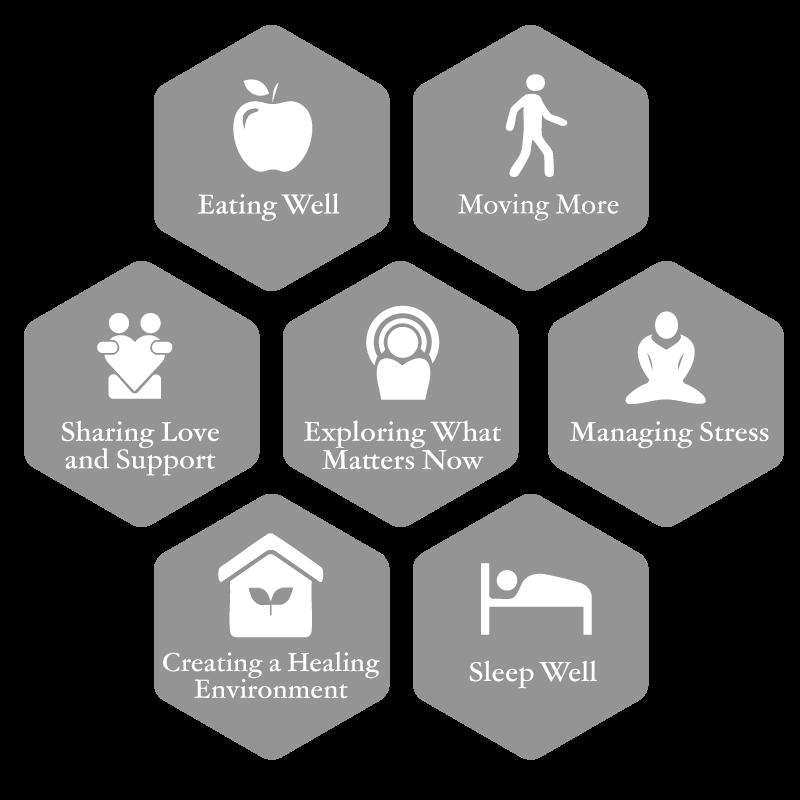
The 7 Lifestyle Practices (see Appendix) bring a range of self-care practices into one framework. I can’t overemphasize how powerful these 7 practices can be. They can enhance your quality of life and strengthen resilience to achieve better outcomes with conventional therapies. They often also have anticancer and pro-healing effects of their own. Best of all, most are free or inexpensive—and have the additional immense benefit of giving you a sense of agency.
For those who want to explore beyond conventional therapies, self-care can be a very promising avenue. These healing practices can build your physical, emotional, mental, and spiritual resilience in the face of cancer’s
challenges and the rigors of conventional treatments. They may reduce symptoms and side effects that are common during cancer and its treatment. They may improve your body terrain, making your whole body less hospitable to cancer and other diseases. They may improve quality of life, extend your life, and reduce your risk of recurrence. Most of these practices are supported by substantial evidence. You don’t need to do all 7 of the Healing Practices. How much you want to do depends on your goals for this part of your life.
I’ve known many people who were not interested in trying these healing practices. They found it impossible to
do these kinds of things for themselves. If this describes you, you need not despair. Many people live well doing whatever conventional and complementary therapies make sense to them—or just conventional therapies alone.
The real secret to self-care is simply caring about yourself. Let it be real. Do what makes you feel better. Do what you believe is worth doing. If you slack off, just pick yourself up and start again. But only if you’re drawn to continuing.
Sometimes it’s helpful to find a community for self-care. An exercise class or qigong class or the like. Or you can find healing community wherever you feel most comfortable—with neighbors, your faith community, or any other trusted place.
Having someone to share your deepest experiences with you matters. It probably isn’t your partner or a family member because there’s almost always so much you cannot say to them. It can be a therapist or a coach. It can be a faith leader. Most often, it’s a wise friend who naturally understands the power of listening, not fixing, and asking only discernment questions designed to help deepen your understanding of your own path.
Listening circles are a powerful form of love and support for anyone with cancer or any other serious life challenge. Commonweal has developed a listening circle community through its program Healing Circles Global. (You can learn more and join no-cost online circles at HealingCirclesGlobal.org.) But there is no need to use that particular approach, as there are many programs online and maybe even in person in your local community.
Here are the basics that Healing Circles participants agree to:
• Treat each other with kindness and respect
• Listen with compassion and curiosity
• Honor each other’s unique ways to healing and don’t presume to advise or fix or try to save each other
• Hold all stories shared in the circle in confidence
• Trust that each of us has the guidance we need within us
• Rely on the power of silence to access that guidance
In summary, self-care therapies are among the most powerful, safe, and least costly approaches to self-healing. Behind them all lies one essential quality of healing—love.
Love is the greatest healing power. Self-care is love. It’s not always easy to let ourselves love ourselves. But it is at the heart of healing.
Prayers for your healing,
PS: You might not think that self-care with a cancer diagnosis would be particularly controversial. Nonetheless, the specifics of the 7 Healing Practices do require care. For example, eating well raises the question of what eating well actually means. That is widely debated. And moving more is tremendously beneficial, but you can hurt yourself. So, before you engage in any self-care practice that goes beyond common sense, please consult your trusted health professional.
Dear Friend,
Choices in complementary cancer care go beyond conventional care and self-care. Complementary care offers therapies and practices that “complement” conventional therapies. Complementary therapies include herbs and supplements, repurposed drugs, mind-body approaches, and many other kinds of therapies from Eastern and Western traditions.
Most people don’t include repurposed drugs under complementary care. CancerChoices does. These are drugs that are being discovered to have uses beyond their typical application. They represent a critical science-based resource that neither your oncologist nor your complementary practitioners are likely to mention.
I suggest you consider these three guidelines as you explore complementary therapies:
First, you may want to review the science on therapies that interest you. CancerChoices.org has a database of complementary therapy reviews that can help. If you are drawn to a therapy, I recommend working with a healthcare practitioner trained in its use to guide you. Sadly, it may not be possible to find or afford the guidance.
Second, listen to your intuition. If you feel drawn to a therapy, if there is science behind it, if it appears safe, available, and affordable, you may want to consider it. If the potential for harm is small, and if it will not be a financial burden for you, you may risk very little by exploring it. As long as you’ve got your conventional therapies covered. I appreciate a concept I learned from Donald Abrams, MD: The lower the likelihood of harm, the lower the burden of proof.
Third, if a therapy is costly and you have to travel to get it, or if a center claims to cure your cancer, be far more careful. The biggest danger is practitioners or centers that claim to cure cancer using complementary therapies alone and who charge a lot and require travel. Some are easily discovered to be fraudulent. Others are sincere but may not deliver on their claims. Navigating the claims of these centers is a complex undertaking.
Now, it is true that there are many ethical alternative or complementary cancer centers in the US and internationally that benefit some people. They are also typically expensive and unreimbursed by insurance. I can’t begin to cover all those clinics here. The same is true of online integrative cancer programs. I’m focused primarily here on what is doable for committed people of limited to moderate means. The international search is for another time.
For those who want to explore the more readily available complementary therapies or unorthodox use of conventional therapies, the choices are confusing and endless. There is a “Supplements and Therapies Database” at CancerChoices.org that summarizes the research on over 60 therapies. You may find this to be a useful starting place.
This brings us to the question of agency in healing. Agency is what social scientists call an “internal locus of control.” Many people have a sense of agency in some areas of their lives but not in others. You may feel agency at work but not at home. You may feel agency in your financial life but not in your ability to influence your healing.
The key question is not whether you have a generalized sense of agency but a specific one. It’s about whether you have a sense that you can engage in intentional healing or not—and to what degree, and in what ways.
Do you feel agency to integrate the best conventional, experimental, lifestyle, and complementary therapies for you? You may feel agency in some of these areas but not in others. I, for example, have a strong ability to change my diet and stick with it. I have much more difficulty sticking with a rigorous yoga, qigong, meditation, or exercise regime. Make progress where you can.
In addition to herbs, supplements, and repurposed drugs, there is another class of complementary therapies that is re-emerging with both growing research and deep historical roots: the skillful use of psychedelics or entheogens (entheogen means a substance that helps you see the presence of the numinous or divine). Some people feel drawn to them. You can call them a form of self-care or a complementary therapy; the operant word here is skillful. They represent a major new and also ancient avenue for healing and self-exploration.
The laws governing psychedelics are changing at local, state, and national levels. There is a large and growing network of practitioners and users who have different views of both the
laws and the right of the government to control what we do with our consciousness.
Psychedelic experiences are immensely dependent on set and setting, your mindset and the environment in which the experience takes place. Some say you need a formally trained facilitator. Others say a deeply experienced friend or guide can be as good or better. I am a strong believer in their benefit—but again, only for those so inclined. I wouldn’t push them any more than I would push second opinions, self-care, or complementary therapies. As a wise friend once said to me, “How could I possibly know what is best for another human being?”
There is a great difference between different classes of psychedelics. Ketamine is the most accessible, shortest acting, and legal in most states. MDMA (aka Ecstasy) takes you a big step further, but it can have complications. Psilocybin and Ayahuasca are far more transformative, and they can be terrifying as well as enlightening. Psychedelics are not for everyone. Their effect depends strongly on mindset, setting, the intention, level of psychic integration of the voyager, and the skills of the guide. Microdosing may be a safer way to explore. If you feel called to this, seek trusted medical guidance from someone who knows what they are doing and make certain you have a safe healing place for the experience.
Psychedelic medicine—including but not limited to plant medicine—can serve as a portal to sacred experience for those who use it wisely. Psychological and spiritual transformation can profoundly affect biological processes—easing transitions either back toward more time to live, or into the mystery of the great transition.
When seeking any type of complementary, repurposed, or emerging therapy, it is wise to talk to patients and practitioners before you sign up for an expensive treatment protocol. Look for online reviews. Visiting the center and seeing it yourself before you sign up is best of all.
PS: Complementary therapies are where people are most likely to need careful guidance. CancerChoices is extremely careful about summarizing the evidence for and against leading complementary cancer therapies. I began by recommending you work with a healthcare practitioner. But what kind of health professional is the critical question. I also suggest listening to your intuition. That is controversial. I speak of ethical alternative or complementary cancer centers, which is also controversial. Psychedelics are especially controversial in some circles but not in others. They do warrant great care and experienced medical guidance. Complementary therapies are where thoughtful discernment matters most—and who you trust as your guiding health professional.
Dear Friend,
This letter is about death, dying, and the mystery of what comes after death. We die. We all do. Sooner or later.
One real question for us is not if we will die, which is certain, or even when we will die, which we rarely know. It is how we die. Do we die in fear, in anguish, in anxiety—or in some other and perhaps more skillful way?
A second real question is what, if anything, happens after death.
A third real question is what we, our families and friends, and our communities make of our passage. What is the immediate or lasting impact of our passing? What do we leave for others?
I’m 82 as I write you. Death has visited many friends and family members, and the many people I have met with advanced cancers. It has become a familiar.
What I can tell you is that many of these deaths have been beautiful. They have often been easeful, filled with dignity, permeated by grace, and surrounded with love.
But to make death easeful, dignified, and surrounded with love usually requires preparation. Many people spend hundreds of hours researching treatments—which may or may not help—but fail to put any energy at all into preparing to die the way they would choose to. That’s a mistake, in my humble opinion. Preparation matters. Fortune favors the prepared.
So you can ask yourself some basic questions, starting with these:
• What are my beliefs about death? Is it the end, does something come after, or is it a mystery?
• What are my feelings about dying? Am I afraid, regretful, curious, at peace? And, if afraid, is the fear of death or the dying process?
• How do I want to die? With whom, where, and in what way?
• What do I hope to leave behind? What will my legacy be?
If the primary fear is fear of discomfort in dying, there is a lot you can do to minimize the discomfort. A palliative care consultation is one great way to begin. Or you can research which hospices offer the best local care. Hospice providers can really differ, so research is warranted.
The benefit of palliative care is that you don’t give up the right to access medical treatments that might extend life or reduce suffering the way you do with hospice. Some people cycle in and out of hospice depending on whether they need medical interventions or not. This choice—to stay with palliative care or move into hospice—is consequential.
If there are treatment options available that might extend or improve your life, is it better for you to stay with palliative care?
More and more states have Compassion in Dying or Death with Dignity laws that give you some choice in when and how to leave. I have seen these deaths be beautiful. Even if your state does not offer one of these laws, there are often compassionate physicians devoted to ensuring that their patients do not suffer. There are many patients who don’t believe our right to die as we choose should be left up to the state. I happen to be among those who hold this belief.
There are deep philosophical, religious, and spiritual questions about self-deliverance. Some traditions frown on it, others accept it. The deepest question is whether the soul pays a price if you choose self-deliverance. To my knowledge, we don’t have a clear answer. I personally hope the soul does not pay a price because self-deliverance is a way I’d like to go if the path ahead looks too unpromising to me.
You should be allowed to choose who you want around you as you die and equally who you don’t want around you. This is your final time in this body. It should be as easeful and as respected as it can be.
A Commonweal Cancer Help Program alumnus arranged a New Orleans Jazz Band at his memorial. With the band playing, he rode through Santa Cruz, California, in a convertible in his open coffin, while fully alive. Another alumnus said that when his friends learned about how he had died, he wanted them to say, “Far freakin’ out.” A woman in my mother’s Quaker retirement community
wanted to enjoy her memorial while alive, and she did. She had such a good time that she scheduled it again for the following year.
You can compose an ethical will that talks about your values and what you hope to leave behind. You can plan your funeral or memorial service so that your friends and family know they are enacting what you chose.
Estranged family members and friends sometimes forgive each other as death grows near. The process can be deeply healing.
BJ Miller, MD, has thought a lot about death. He ran the San Francisco Zen Hospice for years. He became a triple amputee in a college accident. That experience led him to palliative care medicine and to become one of the most thoughtful voices on what it means to live and die well. When he comes out to Commonweal he rides a specially designed racing motorcycle with one hand. He wrote a helpful book called A Beginner’s Guide to the End, with Shoshana Berger. I especially like the title of the first chapter: “Don’t Leave a Mess.” There’s a lot of wisdom in those four words.
Many people say they want to be celebrated, not grieved, after they die. Francis Weller, a psychotherapist, grief advocate, and Commonweal Cancer Help Program facilitator, suggests you plan for both. Give people a chance to grieve you before they celebrate your life. Perhaps an intimate funeral is more for grief and a memorial more for celebration. Our preferences differ so greatly. For the ease and comfort of your loved ones, it can be an extraordinary gift to give direction on your wishes.
The big mystery is what happens after death. Is it the end, is there something else, or is it a mystery? Mystery is the safest guess. I’ve been studying this question for years. Here’s a report from the frontlines of current understanding:
• Some children reliably report having experienced past lives. The meticulous research of Ian Stevenson and Jim B. Tucker at the University of Virginia has documented these accurate memories in rigorous methodological detail.
• This of course fits with all the traditions that teach the immortality, or at least extended continuity, of the soul after death. It also fits with descriptions of Near Death Experiences, Near Death Awareness, Out of Body Experiences, and more.
• The reality of soul survival opens the gateway to the study of a range of paranormal experiences that a materialist worldview cannot account for, including telepathy, clairvoyance, clairaudience, remote viewing, and much more.
• Soul survival also fits well with philosophies of mind like panpsychism, which holds that the whole cosmos is conscious—an ancient view coming back into credence in the 21st century as the materialist paradigm fades.
• This also fits well with the anthropic principle, which holds that the cosmos looks designed to support life, and therefore life may be everywhere.
• If this is true, soul survival and other paranormal experiences may fit quite readily into a 21st-century vision of the nature of life and death.
In other words, as mystics and original peoples have long believed, the cosmos may be alive and shot through with spirits and intelligences of myriad kinds.
Thus our own journeys may be far more complex and variegated than the materialist paradigm of the past century or so suggests.
Do we know this? No. Do the panpsychic vision, the anthropic principle, the crisis in physics, and a host of paranormal phenomena suggest it may be so? As philosopher and psychologist William James once said, there is always enough evidence for believers and not enough for skeptics.
I offer this philosophical perspective to give you the fullest possible picture I have of the death and dying process. Please take what is useful for you and leave the rest. I urge you to listen to the deepest voice in your being that is guiding you. Sitting with the bigger mystery could be the most essential part of your healing. One final suggestion. If you realize you are still conscious after death, you may see a light. Follow that light.
Love & prayers for your journey,
PS: Medical aid in dying legislation (physician assisted suicide) is spreading nationwide. It is controversial, especially for people who believe self-deliverance should not be permitted. I have a strong view that self-deliverance is a human right. After all, suicide is not a crime and
so-called “rational suicide” means you have thought carefully about your decision and are of sound mind. What is illegal is helping someone beyond the changing laws. Trusted friends deeply disagree with my belief in self-deliverance. I respect their views as equally valid. The best medications for self-deliverance are largely unobtainable beyond medically sanctioned use. Vets can give them to animals but human use is restricted or banned. “Palliative sedation” is legal in all 50 states, which I find comforting. Families face difficulty where they differ about whether the person should be allowed to die at a time of their choosing, or be kept alive by all possible means. It’s a great service to everyone to get clear on this. Death and dying issues are an essential time to consult your trusted health professional. Dying well is a great gift to you and all who love you.
Are you beginning to have a vision of your integrated care path? Let me give you an example of what a woman in her 40s with metastatic breast cancer might be doing.
First, she would have settled on her conventional and experimental therapies, balancing risk and reward and being very careful not to elect therapies that excessively wear her down when the evidence of benefit is not that strong.
She might have found a therapist or a healing circle or some other kind of support group.
She might have found some sustaining spiritual practice, possibly including meditation and some psychophysiological practice like qigong, tai chi, or yoga.
She might well have a Traditional Chinese Medical practitioner she trusts.
She might have settled on her diet, her herbs, and her supplements, preferring those with a strong evidence base.
She knows what makes her feel passionately alive and she creates space for those experiences.
She knows which people and experiences are not helpful to her, and she has developed skills in distancing herself from those people and experiences.
Finally, she intuitively understands the power of the healing arts—and all genuinely creative acts—for healing. So she engages regularly in creative acts that feel healing to her.
Throughout it all she is finding authentic ways to center love for her Self. She understands that what matters, truly, is that love heals.
There are some principle ideas woven through these 7 letters. And it feels beneficial to highlight those here.
The intention to heal as best we can is a real thing. It can make a difference in all kinds of healing—physical, emotional, mental, and spiritual—with all kinds of wounds, illnesses, and conditions.
Some people are blessed with a sense of agency—some inner locus of control—which leads them to believe they can make a difference in their own lives through their efforts and intentions—the intention to heal, in our case.
Harm
Conventional and experimental medical treatments are potent medicines that can profoundly support healing. Like all powerful interventions, they work best when used with skill, discernment, and careful attention to your unique circumstances. Use them skillfully.
These are the powerful, gentle angels of the healing process. These angels—eating well, moving more, sleeping well, managing stress, creating a healing environment, finding love and support, and exploring what truly matters now— can have powerful effects on your underlying health. This has been true since the beginning of human history. We should not ignore such fundamental principles of care.
While the 7 Lifestyle Healing Practices are powerful indeed, often the unique conditions of healing are even more powerful. Finding someone who you love and who truly loves you. Having a dog or cat companion that you love. Spending time in nature. Having a community of friends you love. Having some great passion like reading or art or music. The people and passions we love the most are often the most healing of all.
When it comes to healing, it matters more what kind of person you are than what kind of illness you have. That’s because true healing—the movement toward wholeness— is as unique as the iris of our eye or our fingerprint. It’s about who we are at the deepest level. When you become truly aware of this, your whole life may change. Or you may be aware of it already. The great human questions arise:
Who am I? Why am I here? Where do I come from? Where am I going? And to whom—or what—am I ultimately accountable?
When it comes to facing our mortality, we ask the big questions. What is death? As Stephen Levine wrote and titled his beautiful book: Who Dies? What is the true nature of this life I have been living?
Do I know, even now, at 82, as I bring this writing for you to a close?
The only answer I can give you is the one Socrates gave when told the Oracle at Delphi had said he was the wisest man in Athens. If that was so, he said, it was only because he knew that he did not know.
I don’t know, either. But I’ve devoted my life to the quest for this knowing. I know a few things. I know that love matters. I know that kindness matters. I know that seeking to do as little harm as possible matters. I know that helping others where we can matters.
It’s in this spirit that I offer you these letters. I hope they may be of some service to you and your loved ones. I hope even more that whatever ease they bring to your mind and heart, soul and spirit, you take some care to pass it on.
Love & prayers for your journey,
Dear Friend,
I write this letter to you, the caregiver. It’s not an easy letter to write. Family members and close friends often come to the Cancer Help Program to accompany the person with cancer. We always tell them that their journey—their suffering, their trials, their joys, and their well-being—is every bit as important to us as the journey of their family member or friend with cancer.
We tell them that during the week of the retreat they should let go of their caregiver role and take the week for themselves as much as possible. We say we know that this illness experience can be at least as difficult for the caregiver as it is for the person with cancer. We say that if they burn out it will benefit no one. It’s easy to get sick, possibly seriously ill, from the burdens of caregiving.
Now, it is equally true that some caregivers move deeply into beautiful relationships with their person. They don’t always experience caregiving as a burden—or, if they do, it is a welcome one. Some caregivers are able to heal old wounds in the relationship. I can’t tell you how often women who have been abused by their fathers have told me they forgave them and reconciled with them as their fathers moved into dying.
I believe that it is profoundly underestimated what a deep skill caregiving is. We can distinguish four kinds of caregivers. First, there are the professionals, the nurses and the nurses’ assistants and the like. Second, there are close family members who often carry most of the burden of caregiving. Third, there are close friends who can make a profound difference. And fourth, there are all the people who make a living helping those with significant needs to navigate their daily lives with adequate care.
What often goes unsaid is that a cancer diagnosis, or cancer progression, has the potential to transform not only the person with cancer, but also the circle of family and friends. This is especially true of the caregiver-patient relationship. But it is very far from an easy process since caregiving is so often a deeply arduous task. It’s as if the whole life history of the relationship is suddenly (or gradually) overturned—joys, wounds, the rhythms of life, and everything else. It is, for most people, a very mixed bag. The challenge is usually to make it as good as possible.
This isn’t just up to the caregiver to make it as good as possible—it’s equally the responsibility of the person with cancer. Also, by the way, this is not only about caring for someone with cancer. I have watched people tend to patients with a wide range of diseases and conditions. Caring for someone with dementia, or chronic pain, or a debilitating neurological disease can be far more difficult than caring for someone with cancer.
Caregiving at a high level is a very intimate connection between two people who move almost as one. A really gifted caregiver anticipates what their person seeks to do
next. They also see all the undone things that are needing attention. They move effortlessly among them. But it’s not just the quality of the caregiver—the person who needs care also plays a critical role. It takes skill on both sides. And it helps immensely if there is a deep trust and sharing so that the energy flows as well as possible.
Some people are by nature designed to be good caregivers, which is easier to do when they are acknowledged and supported by the person they are caring for. For others, caregiving may be among the last things that they are good at or have any desire to be good at. And yet they may end up facing that task involuntarily. It can be tremendously difficult for them—and for the person they are supposed to care for.
I could offer you many testimonials about how wonderful and beautiful caregiving is. This can be true, and when it is true there is something holy about it. I also know people who were not natural caregivers but were surprised to find these abilities in themselves when they cared for someone they loved. It is truly possible to make caregiving a spiritual path. And yet there’s nothing easy or simple about it.
If you can, find within yourself the gifts and grace to be a good caregiver for someone you care about. I hope the person you care for fully acknowledges you, supports you, and takes care of you in ways you need so that you can take care of them.
If you aren’t a natural caregiver, I wish you well on the often hard journey to find it within yourself to do the best you can. All the issues between couples and within families come up when caregiving is required.
Often it seems to me that it is easier to find the spiritual dimension of the cancer experience than it is to find and sustain the spiritual dimension of the caregiver experience.
I pray for all of us in our efforts to love and care for each other.
No one promised this would be easy. But sometimes we can find within ourselves reserves of kindness and mercy we did not know we possessed. Sometimes caregiving is just as powerful a path to inner awareness as cancer.
We have to allow ourselves to be human. To acknowledge how hard this can be. And then to move forward as best we can.
Love & prayers,
PS: Caregiving at its best is an act of grace. And it is very difficult to get there. It is usually just a real struggle to do the best we can. Letting you as the caregiver get worn down serves no one. It can be highly dangerous to your health. Caring for you, the caregiver, is essential. A major challenge here is when the patient and caregiver differ on any aspect of conventional, complementary, or self-care therapies. If you need help caring for yourself, please consult your trusted health professional. Even more important, decide that you matter, too. And act on it.
Use the 7 Healing Practices. And find the unique paths to healing that are the most powerful of all.
The 7 Lifestyle Healing Practices are evidence-based selfcare approaches that can build physical, emotional, mental, and spiritual resilience. They reduce symptoms and side effects, improve the body’s terrain, and may extend life and reduce risk of recurrence. Most are free or inexpensive, and they can return a sense of agency to the person with cancer.
A nourishing, health-promoting diet, like the Mediterranean Diet, can support immune function, reduce inflammation, and may create conditions less hospitable to cancer.
Regular physical movement can reduce fatigue, improve mood, support immune function, and can have direct anticancer effects. The goal is consistent movement paced to your energy and ability.
Chronic stress depletes healing resources. Meditation, breathwork, time in nature, prayer, and practices like qigong and yoga can be powerful ways to create inner conditions for healing.
Deep, restorative sleep is when the body repairs itself. Consistent rhythms, a restful environment, and minimizing stimulation are foundational.
Reducing exposure to toxins, spending time in nature, and creating a home environment that supports rest and restoration can all contribute to healing.
6. Sharing Love and Support
Love is the greatest healing force. A healing circle, a trusted counselor, a wise friend, a faith community—the form matters less than the quality of genuine presence and shared care.
This is the most important practice of all. A cancer diagnosis brings the deepest questions into focus: Who am I? What truly matters? What do I want the rest of this life to look like? Making space for these questions is itself a profound act of healing. This framework was developed by CancerChoices, a program of Commonweal. To learn more, go to CancerChoices.org.
I am profoundly grateful to Rachel Naomi Remen, MD, who co-imagined the Commonweal Cancer Help Program with me, and to Lenore Lefer, Virginia Veach, Francis Weller, Stuart Horance, Natalie Compagni Portis, Waz Thomas, Arlene Allsman, Jenepher Stowell, Marion Weber, Irene Gallwey, Katrina Mayo-Smith, Claire Heart, Rebecca Katz, MS, Jnani Chapman, Elizabeth Evans, Sabriga Turgon, Penny Hamilton, Maya Ravani, Erlene Chiang, LAC, DAOM, PhD, Anna O’Malley, MD, Kate Holcombe, Angela Madonia, Ladybird Morgan, RN, MSW, and all the rest of the Commonweal Cancer Help Program staff over the past 40 years.
I am forever thankful to over two thousand alumni who have built and sustained the Cancer Help Program with us. Jenifer Altman and Barbara Smith Coleman created foundations that sustain us to this day. Hundreds of other alumni have made the work possible with their contributions.
Janie Brown at Callanish in Vancouver, BC, has carried the Cancer Help Program torch at the highest level. Toby Symington and the Lloyd Symington Foundation co-created the Symington Foundation Conferences on New Directions in Cancer Care where many beloved partners gathered over 40 years.
I treasure the memory of the late Barbara Smith Coleman, with whom I co-imagined Smith Center for Healing and the Arts. I am so grateful to our co-founder, Shanti Norris, and to Jennifer Bires, Lisa Simms Booth, Julia Rowland, and Laura Pole of Smith Center for Healing and the Arts and the Smith Center Cancer Help Program.
I am deeply grateful for my partners in CancerChoices including Miki Scheidel, Lucy Waletzky, Roger and Vicki Sant, Nancy Hepp, Laura Pole, RN, MSN, OCSN, and Christine Mineart.
I am equally grateful for my partners in founding Healing Circles, Diana and Kelly Lindsay, and all who carry Healing Circles on.
I treasure my partnerships with Oren Slozberg, Katherine Fulton and all who for 50 years have built Commonweal. I cannot name all those who should be mentioned.
Dean Ornish, MD, Keith Block, MD, Donald Abrams, MD, Mark Renneker, MD, Anna O’Malley, MD, Cynthia Li, MD, Ted Schettler, MD, Steve Helig, MPH, Susan Braun, and Lynnaea Lumbard are among my most cherished thought partners.
My wife Sharyle Patton has been my partner in life and work for over 40 years. We still walk together in love and gratitude.
This book was made possible by the dedication of Susan Grelock Yusem, Erin O’Reilly, David Bailey, Erin McAuley, and Sienna Dawn. To anyone who I have overlooked, I hope to correct that in the next edition. I know that at 82 with imperfect memory I have failed to acknowledge some of you who should be here.
Commonweal was founded over 50 years ago in dedication to healing ourselves and healing the Earth. We are a source for learning, drawing on decades of work in personal and social transformation. We are a refuge for building the resilience necessary to adapt to a new era. And we are an incubator for visionaries imagining and planting seeds for a more just future. We are home to over 30 programs working around the world—together, a determined and creative response to a complex time. Rooted in Bolinas, California, we operate a retreat center and host ongoing field-building gatherings. At heart, we are a flexible instrument of human service, now evolving into our next 50 years.
Commonweal is home to a range of cancer-related programs, including the Cancer Help Program, CancerChoices, Healing Circles, the Collaborative for Health and Environment, and Zero Breast Cancer. Commonweal’s New School program has a rich library of podcasts and videos exploring the many facets of healing and cancer. To access these resources, go to Commonweal.org.
Common Knowledge Press is Commonweal’s publication project, originally founded in our early years and relaunched for our 50th anniversary. We publish work that embodies the wisdom, consciousness, and service at the heart of Commonweal’s mission. Like Commonweal
itself, the publications are wide-ranging but grounded in a dedication to healing, resilience, community, and how we navigate change.
Our publications are designed to be accessible, affordable, and beautiful. We believe ideas matter, books matter, and making knowledge available in forms people can hold, share, and return to is part of the work of building a more resilient world.
Michael Lerner is the founder of Commonweal, a nonprofit organization in Bolinas, California. For over 50 years, he has worked at the intersection of personal healing and planetary health, supporting innovative programs in healing and integrative cancer care, environmental health and justice, collaborative learning and community resilience.
Michael is the co-founder of the Commonweal Cancer Help Program, which has served as a model for integrative cancer care programs worldwide. He has served on the boards of foundations and non-profit organizations, and he has been recognized for his contributions to public health, environmental advocacy, and social innovation. He holds a PhD in political science from Yale University and taught at Yale.
Michael received a MacArthur Prize Fellowship for contributions to public health in 1984. His writing explores healing, social change, and consciousness, and how communities navigate crisis and transformation.
Michael lives in Bolinas, California, and on Whidbey Island, Washington.
Iota is the smallest letter in the Greek alphabet. Its form reflects its meaning. Its Hebrew equivalent yod, also the smallest, is said to contain the entire Torah. In Matthew 5:18 Jesus says “not one iota ... shall pass from the Law.” Iota becomes the sacred minimum that contains the whole—for Jung, the soul’s inviolate insistence on wholeness; in mystical traditions, the via negativa, what cannot be said or stripped away.