
Richmond Transport Strategy – Analysis of Public Feedback on Disability and Accessibility
1. Introduction
Richmond Council is looking to build its Transport Strategy 2040 and consulted the residents for their input. The strategy will guide the development of long-term, sustainable, and inclusive transport improvements throughout the borough.
Building on current policies and the Local Plan, the Richmond Transport Strategy will focus on identifying transformational projects, innovative service models, and strategic partnerships to unlock significant improvements in connectivity, sustainability, and accessibility, it will address the emerging needs of the borough’s residents, businesses, visitors over the next 15 years.
This report looks specifically at disability and accessibility aspects of the feedback received through our engagement.
2. Methodology
For the purpose of gathering community input in shaping the Richmond Transport Strategy, a survey was conducted using the online engagement platform Commonplace. To ensure broad awareness and participation, the Council undertook a multifaceted outreach campaign. This included:
• Social media campaigns
• Newsletters
• New updates
• In-person events like the Hampton Wick and Teddington Community Conversation, Community Forums, Voluntary Sector Forums, Ruils’ Richmond Transport and Mobility Forum, and the Richmond Cargo Bike Fair
The engagement process was open to all residents, who were invited to share their concerns about the existing transport conditions in the borough and suggestions for their improvement, guiding the focus for the transport strategy.
This report focuses specifically on the comments related to facilities for people with disabilities and the suggestions provided to improve transport accessibility within the borough.
Respondents were asked to provide their ward details and the capacity in which they are responding, to help the Council understand any impact the strategy might have on people in the local area. The responses were then analysed and reported by the Council’s Consultation Team on an anonymous basis under the guidelines of the Data Protection Act. The Consultation Team are qualified researchers and bound by the MRS Code of Conduct when conducting research.
3. Results
Our engagement took place through two main channels: an interactive map and a survey. Below is an analysis of the feedback submitted by people with disabilities and accessibility issues collected from both sources:
3.1. Interactive Map
Please note that we did not receive any disability-related comments from six wards, as shown in the table above, through our interactive map engagement. Below is a detailed analysis of feedback from the wards where residents did share their views. This includes concerns about accessibility and the respondents’ suggestions for improvement.
(i) Barnes
Concern:
• Residents have raised multiple concerns about Hammersmith Bridge. They have mentioned that mobility-impaired users struggle with lack of bus/cab access to get through due to the bridge closure.
Improvements Suggested:
• One of the improvements suggested includes serving Hammersmith Bridge with small accessible vehicles (self-drive or staffed) for elderly/people with disabilities.
• Alternatively, respondents have also suggested keeping bridge open for active travel only but implement electric pods for those unable to walk/wheel.
(ii) Mortlake & Barnes Common
Concern:
• Respondents raised concerns over the lack of wheelchair accessibility (no lift, no inclusive access) at Barnes Bridge station.
Improvement Suggested:
• Respondents suggested adding a footbridge and river link for better transport connectivity and ensuring accessibility at Chalker’s Corner.
(iii) Kew
Concerns:
• Kew Gardens Underground is reported to have no wheelchair access.
• Respondents also mentioned that Kew Gardens Station has no lifts for step-free access; exclusion of mobility-impaired users.
Improvement Suggested:
• Accessibility upgrades at Kew Gardens Underground station are suggested by respondents.
(iv) South Richmond
Concerns:
• Respondents highlighted that the pavements in the ‘Vineyard’ area are obstructed by illegally parked cars and overgrown hedges; forcing wheelchair users and multiple pedestrians to walk on the road which is a safety concern.
• The responses also mentioned concerns regarding the pavement parking at Friars Stile (by shops) as it endangers pedestrians, obstructs mobility access, and damages paving.
Improvements Suggested:
• More Blue Badge parking bays and all-electric buses with easy wheelchair access were suggested by respondents.
Please note: Sheen Road was appreciated by the respondents for having electric buses with excellent disabled access.
(v) Ham, Petersham & Richmond Riverside
Concerns:
• Respondents were concerned about the lack of pathway for wheelchair or buggy access near Riverside Drive Playground
• Another concern highlighted is about gate barriers at the entrance to Petersham Meadows that excludes cycles, wheelchairs, and prams.
• Diagonal path (Ham House to Thames Path) was also expressed to be muddy and inaccessible for prams or wheelchairs.
Improvements Suggested:
• One of the respondents has suggested application of Highway Code hierarchy in road design: prioritise pedestrians (including disabled), then active travel, then public transport, deliveries, and lastly private vehicles.
• Respondents also seem interested in having the provision of equitable access gate at Petersham Meadows.
• The responses also propose maintaining car access to Richmond Park for people with disabilities, elderly, and families. Along the same lines, other respondents suggest keeping all the parks open for vehicle access, especially for people with temporary disabilities.
• Another suggestion includes installation of dropped kerbs at all crossing points for accessibility.
(vi) Twickenham Riverside
Concerns:
• Respondents expressed concern over the lack of 24-hour Blue Badge spaces outside Denton Road for two disabled residents.
• There was an emphasis on future riverside development and its potential to displace parking, worsening accessibility for residents with disabilities and carers.
Improvements suggested:
• Introduction of double Blue Badge spaces was suggested by respondents, and the council was asked by the respondents to consider mitigation strategies for displaced parking during development.
(vii) South Twickenham
• Respondents have mentioned that the Strawberry Hill Station has no toilets at the station; train carriages inconsistently have toilets, causing hardship for elderly, people with disabilities, pregnant, or ill passengers.
• Lack of direct bus route from Cross Deep/Strawberry Vale to Kingston was also stated as a concern as people currently need to change at Teddington which is difficult for those with mobility issues.
(viii) Heathfield
Respondents suggested that the car park at Percy Road / Whitton Community Centre / Whitton Corner Health Centre needs to be restricted to disabled parking only.
(ix) Hampton North
Lack of easy access to rail or tube on Graham Road was considered as an issue by the respondents as this issue makes residents with disabilities effectively housebound unless they drive.
(x) Hampton
Respondents mentioned that the bus diversions in Hampton create significant challenges for people with mobility issues.
(xi) Teddington
Concern:
• Respondents expressed that the infrequent service of the 481 bus on Sandy Lane is problematic as the alternative (281, 285) are unsuitable for those with limited mobility; 481 provides quicker link to Kingston.
Improvements Suggested:
• Following the concern, there was a suggestion made to increase frequency of 481 bus service.
(xii) Hampton Wick & South Teddington
Concern:
• Respondents highlighted the lack of lift service at Hampton Wick station, creating poor accessibility for wheelchair users, elderly, and those with buggies.
Improvement suggested:
• Following the concern above, installation of lifts to platforms was suggested.
3.2. Survey
There were several questions asked in our survey to gain a broader understanding of transport conditions across the borough. While only a few of these questions specifically relate to disability issues, we have received comments from residents on those topics. Please find the disability and accessibility concerns highlighted through these comments below: the survey portion of the consultation asked questions on various topics. Many of these topics garnered disability-based responses. Below, please find the disability concerns expressed in relation to each question in the survey.
(i) This Transport Strategy focuses on meeting the future needs of the borough. However, if there are any local improvements you want to see in your area now (e.g. potholes, broken street light, etc.), please let us know below.
1. Disabled Access and Mobility
Respondents have mentioned that there is a need for more provisions for people with disabilities and wheelchair users across transport and public spaces. They have also expressed that replacing of disabled bays with electric charging bays needs to be stopped, as this reduces essential parking for those with mobility needs. Additionally, concerns regarding bus accessibility were stated, particularly the lack of proper disabled access at the Richmond Bus Station; current setup seems to force people with walking difficulties to cross unsafe roads.
2. Pavement Quality and Safety
Respondents have mentioned that people with disability are facing trouble due poor pavement conditions outside town centres and in areas like Kew and Ham - missing dropped kerbs making wheelchair navigation extremely difficult. It is highlighted through responses that the wheelchair users, visually impaired individuals, parents with prams, and children on scooters face significant challenges due to the pavement quality.
3. Street Design and Infrastructure
There have been a few suggestions made by respondents to improve accessibility for people with disabilities - adding ‘sit stops’ to encourage walking and accessibility, tightening of kerb radii to prevent corner parking and reduce vehicle speeds, and joining up of disconnected areas (e.g., Kew village separated by railways) to improve access.
4. Obstructions on Pavements
Respondents highlighted certain concerns that cause mobility issues for people with disabilities - abandoned Lime bikes blocking pathways, shop signs placed on pavements, and oversized SUVs encroaching onto pavements even when partially parked in driveways.
• Actions suggested by respondents for the above issues:
o Ban pavement signs
o Lobby Lime bike operators for better management
o Public awareness campaigns or fines for SUV obstruction
5. Safety and Awareness
Respondents have suggested public awareness campaigns including educating people about pavement obstruction and promote respect for accessibility needs. Alongside, there was also a mention of support for bans and fines where voluntary compliance fails.
(ii) What major transport changes do you want to see in your community in the next 15 years?
1. Accessible Public Transport
The following changes are highlighted by respondents in regard to making public transport accessible for all:
• More provisions for passengers with disabilities
• Larger wheelchair spaces on buses to avoid conflicts with buggies
• Level bus stops for easier boarding
• Reliable lifts in stations and step-free access (e.g., installation of lifts in Kew Gardens station)
• Well-informed staff to assist travellers with disabilities
2. Bus Service Improvements
Respondents mentioned that people with disabilities seem to be facing difficulties due to lack of efficient bus services. There was a proposal made for a bus park at A316 car park so only those with real accessibility needs are brought into the Richmond town centre. Additionally, it was also mentioned in the responses that a proper bus service to and around Richmond Park would be ideal to help older and mobility-impaired residents avoid driving.
3. Parking and Disabled Spaces
Respondents have asked for more disabled bays for shopping and town centre access and mentioned that the replacing of disabled bays with electric charging bays must be avoided as it reduces accessibility for those who need them most.
4. Traffic and Infrastructure Challenges
This is majorly concerning the closure of Hammersmith Bridge as highlighted in the feedback. Respondents are seeking alternative accessibility solutions for people with mobility issues
5. Environmental and Mobility Goals
The responses suggested a more Low Traffic Neighbourhoods (LTNs) must be enforced to reduce car dominance while ensuring disability access.
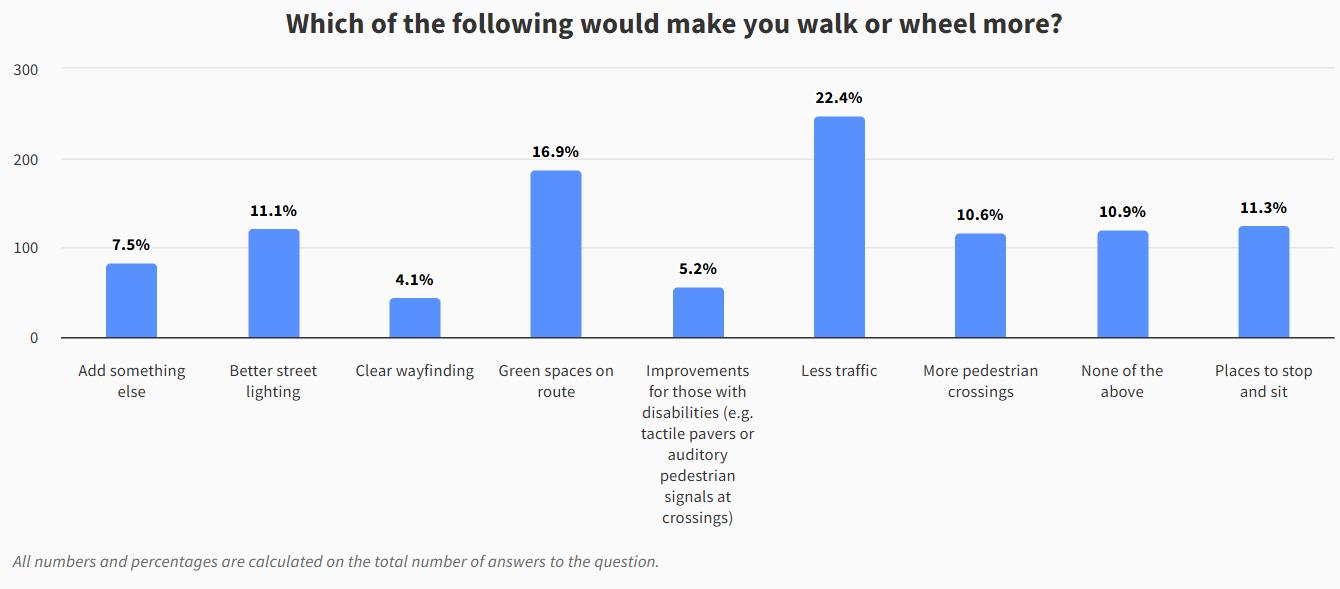
(iii) Which of the following would make you walk or wheel more?
Out of the total of 567 responses received for this question, 57 (around 10%) respondents expressed that “Improvements for those with disabilities (e.g. tactile pavers or auditory pedestrian signals at crossing)” would make them walk or wheel more in the borough.
(iv) In thinking about transport in the next 15 years, which factors do you feel are most important in your borough?
For this question, respondents were given several options to choose from, including convenience, reliability, affordability, safety, environment, and sustainability. They also had the opportunity to provide additional comments in a free-text box. Below are the accessibility concerns for people with disabilities that were highlighted through these free-text responses.
• Respondents strongly emphasised the need for inclusive transport options that cater to people with disabilities and mobility challenges. They expressed concerns about practical barriers and called for better design and service provision:
o Access for passengers with mobility issues
o Enabling people with disabilities to board the buses that start at Richmond bus station (e.g., 190) – South Richmond
o Accessibility to those with disabilities – North Richmond
o Disabled access – South Richmond
• Respondents highlighted the importance of fairness in how public spaces are shared among different users. They stressed that planning should consider everyone including pedestrians, wheelchair users, cyclists, public transport users, and drivers. The location identified through this comment is Mortlake & Barnes Common.
• There was also a concern around inclusive transport planning that has been highlighted by the respondents – asking the council to think of transport suited to
those who cannot cycle (e.g. the disabled, elderly, etc) and provide them with convenient and safe travel alternatives. The location identified through this comment is Twickenham Riverside.
• Some respondents stressed that cars remain essential for disabled people as they find using public transport difficult and there should be less blockages for such people.
• Respondents called for better bus services, particularly to accommodate wheelchair users and families. The location highlighted for this concern is West Twickenham.
(v) Please let us know if you feel there are other areas of transport that need attention.
• Respondents highlighted several challenges and suggestions regarding accessibility. They mentioned that broken lifts and unpredictable train stops make journeys difficult for wheelchair users and parents with buggies.
• Some reported issues with bus access, noting that wheelchair users are sometimes turned away when spaces are occupied by buggies.
• Specific stations were identified as problematic, including North Sheen, which respondents felt needs a complete rebuild for step-free access, and Kew Gardens, where proper disabled access without long detours was requested.
• Concerns were also raised about the need for support crossing Hammersmith Bridge for those with mobility difficulties.
• Several respondents stated that people with disabilities often prefer driving due to difficulties with public transport and suggested introducing shuttle or assisted transport for mobility-impaired individuals.
• Other comments included calls for better consideration of pedestrians from cyclists, prioritising elderly and disabled needs in station and street design and improving access to and from Barnes and Barnes Bridge stations, including attention to lighting and bus connectivity.
4. Demographic Data
Following is the demographic data of the respondents with disabilities, collected through this engagement:
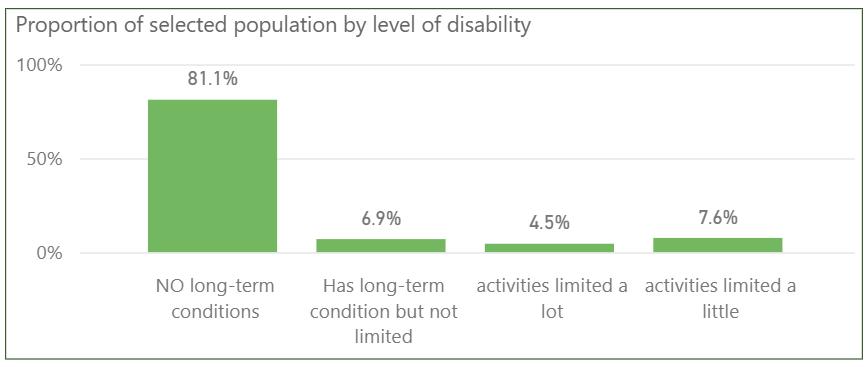
Below is the demographic data of people with disabilities in the whole borough (source: DataRich):
Drawing comparisons:
According to borough-wide data from DataRich, 88% of residents self-reported as not disabled or without long-term conditions, while 12% identified as having disabilities. In comparison, survey responses show that 75.4% of respondents reported being not disabled, and 16.3% identified as disabled.
This indicates that the proportion of individuals with disabilities in the survey sample is slightly higher than the borough-wide figure (16.3% vs. 12%), and the proportion of non-
disabled respondents is correspondingly lower (75.4% vs. 88%). However, it is important to note that the sample size for this engagement (1409 responses) is smaller in comparison to the borough wide data set.