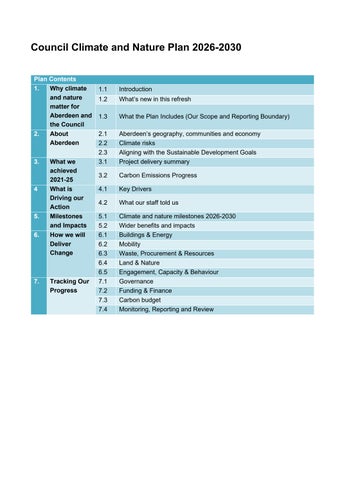
Council Climate and Nature Plan 2026-2030 Plan Contents 1. Why climate and nature matter for Aberdeen and the Council 2. About Aberdeen 3.
4
5.
What we achieved 2021-25 What is Driving our Action Milestones and Impacts
6.
How we will Deliver Change
7.
Tracking Our Progress
1.1
Introduction
1.2
What’s new in this refresh
1.3
What the Plan Includes (Our Scope and Reporting Boundary)
2.1 2.2 2.3 3.1
Aberdeen’s geography, communities and economy Climate risks Aligning with the Sustainable Development Goals Project delivery summary
3.2
Carbon Emissions Progress
4.1
Key Drivers
4.2
What our staff told us
5.1 5.2 6.1 6.2 6.3 6.4 6.5 7.1 7.2 7.3 7.4
Climate and nature milestones 2026-2030 Wider benefits and impacts Buildings & Energy Mobility Waste, Procurement & Resources Land & Nature Engagement, Capacity & Behaviour Governance Funding & Finance Carbon budget Monitoring, Reporting and Review
Executive Foreword Climate change and nature loss are among the most important challenges facing Aberdeen today. We are already seeing more frequent severe weather, pressure on our natural environment and growing impacts on communities across the city. How we respond matters, not just for today, but for future generations. Aberdeen City Council has a clear responsibility to act. As a Council, we manage buildings, services and land that affect people’s daily lives. We also have an opportunity to lead by example, showing how climate action, resilience and care for nature can go hand in hand with improving wellbeing and supporting local places. This Climate & Nature Plan sets out how we will continue to take practical action between 2026 and 2030. It brings together our work to reduce carbon emissions, prepare for the impacts of a changing climate and support nature recovery across our managed land and assets. The Plan focuses on what we can directly deliver or influence, while aligning with national climate and biodiversity ambitions. Over recent years, we have made progress, by reducing emissions, improving the energy efficiency of buildings and housing, expanding green infrastructure and strengthening how climate risks are considered in decision making. These actions are already delivering benefits, from warmer buildings and lower energy use to greener spaces that support health, wellbeing and biodiversity. The next phase of this work is about building on that progress. Some of the changes needed, particularly around heating buildings and transitioning vehicles, are complex and will take time, investment and partnership working. This Plan sets a clear direction of travel, while recognising that delivery must be realistic, proportionate and based on available resources. Preparing for climate impacts is just as important as cutting emissions. Flooding, storms and rising temperatures are already affecting our services and assets. That is why adaptation and resilience are woven throughout this Plan, ensuring we plan ahead and make decisions that help protect people, places and public services as the climate continues to change. Nature has a vital role to play in Aberdeen’s future. By caring for and enhancing parks, green spaces, trees and waterways, we can help tackle climate risks while creating more attractive, healthier neighbourhoods. Nature-based solutions are a key part of this Plan, delivering benefits for both people and wildlife. This Council Climate & Nature Plan reflects our commitment to openness and accountability. Progress will be monitored and reported regularly, and we will continue to learn, adapt and improve over time. By taking steady, practical action and working with staff, partners and communities, we are committed to supporting a lower carbon, climate resilient and nature positive future for our city.
Draft for Committee (June 2026) – Subject to Public Consultation
1.
Why does climate and nature matter for Aberdeen and the Council?
1.1
Introduction
Climate change and nature loss present significant risks to Aberdeen’s communities, economy and environment. As a coastal city, Aberdeen is increasingly exposed to flooding, storms, extreme weather and environmental degradation, all of which can disrupt services, damage assets and impact wellbeing. As a public body, a large employer (7,155 FTE staff on 31 March 2025), a landowner and a service provider, we have responsibilities to; reduce our emissions, plan for climate risks, strengthen resilience across our operations, protect and enhance biodiversity and support nature recovery. We must also report publicly on our progress. We also have an important leadership role as a major organisation within the city — embedding climate and nature considerations into decision‑making, investment, policies and service delivery, and working in partnership with others to support shared outcomes. The actions we take helps set standards, build confidence and support wider progress across the city. In 2023, we declared a Climate and Nature Emergency. Our refreshed Climate and Nature Plan responds by strengthening our work on adaptation and nature recovery, alongside continued action to reduce emissions to reach net zero by 2045. The new plan aims to: Mitigation: Cut emissions Reduce emissions from our buildings, fleet and day-to-day operations. 1.2
🛡️ Adaptation & Resilience Reduce the impact of flooding, storms and heat on Council services and assets.
🌿 Expand nature Support nature recovery and invest in nature-based solutions that improve resilience.
📊 Improve data Strengthen the evidence through enhanced data and clearer reporting.
What’s new in this refresh
Our Climate and Nature Plan builds on the progress made in the 2021–2025 Climate Change Plan, which delivered a 48% reduction in corporate carbon emissions compared to the 2015/16 baseline. The Plan takes a whole‑Council approach, embedding climate and nature considerations into services, decisions and investments. 2021–2025
What’s changing
2026–2030
Focus on planning and preparation
→
Focus on delivery, finance and impact
Testing ideas and pilot projects
→
Rolling out what works more widely
Building skills and systems
→
Making climate and nature action part of everyday Council work
Council Climate Change Plan
→
Council Climate & Nature Plan
Climate, nature and resilience considered separately
→
Climate, nature and resilience brought together
Many individual actions
→
Fewer, higher‑impact priorities
Tracking emissions
→
Using a carbon budget to guide decisions and investment
Draft for Committee (June 2026) – Subject to Public Consultation
1.3
What the Plan includes
Our scope and reporting boundary This plan covers our Council assets and operations. While we will work to influence wider impacts through procurement, infrastructure and land use, this plan is not intended to cover area wide climate action which is addressed through city wide partnerships and strategies. Our role within North East Scotland is important in this context. Many climate and nature challenges, such as managing river and flood risk areas, supporting wildlife networks and maintaining infrastructure, extend beyond Council boundaries. We will continue to work closely with neighbouring authorities and partners to support coordinated action, helping to deliver climate and nature outcomes, strengthen resilience and maximise shared benefits. Carbon Emissions Included in this Plan Emissions from Council: buildings (energy & water), fleet, street lighting, staff business travel (e.g. grey fleet, air, rail), internal waste, staff home working.
Land & Nature Included in this Plan Council‑managed land and green infrastructure, including parks, green spaces including at housing estates, woodlands, countryside areas, school grounds, street environments and food‑growing/ allotments on Council land.
How scope is defined & reported Reported using Scope 1, Scope 2 and selected Scope 3 emissions, in line with statutory climate change reporting duties and greenhouse gas accounting principles.
Addressed elsewhere (Not in this plan) Procurement & staff commuting not fully included at present; actions in place to improve data and reporting over time. (e.g. emissions associated with purchased goods and staff travel to work). Council housing and household waste.
How scope is defined & reported Reported where the Council has direct responsibility for delivery, including routine land management and targeted biodiversity–led improvements (nature‑based solutions).
Addressed elsewhere (Not in this plan) Private land, agricultural land (e.g. private gardens and agricultural land). Regional habitat networks and wider city‑wide biodiversity recovery, delivered through partnership working, community involvement, and other dedicated strategies.
Climate Adaptation & Resilience Included in this Plan How scope is defined & reported Focused on identifying and Council‑owned or managing climate risks, Council‑managed buildings, strengthening resilience and land, infrastructure, services embedding climate‑informed and operations affected by risk management into climate risks. Draft for Committee (June 2026) – Subject to Public Consultation
Addressed elsewhere (Not in this plan) City‑wide climate risks and adaptation actions led by communities, partners or other organisations.
governance and decision‑making. Purchased heat used in Council‑owned or Council‑operated buildings, including district heating and heat supplied from the Energy‑from‑Waste facility, is included within the Council’s carbon reporting boundary. Our emissions reporting boundary Figure 1 below shows how carbon emissions included in this Plan are grouped and reported for statutory purposes, and how different emission sources fall within Scope 1, Scope 2 and Scope 3 of the Council’s carbon reporting boundary. Figure 1: Carbon Emission Scopes
Draft for Committee (June 2026) – Subject to Public Consultation
Carbon offsetting and insetting This Plan prioritises reducing emissions at source and does not rely on carbon offsetting to meet its targets. This approach is consistent with statutory guidance, which places emissions reduction as the first priority for public bodies. The Council is not currently using carbon offsetting. If, in future, there are residual emissions that cannot be avoided due to the absence of low‑carbon alternatives, any use of offsetting would be applied cautiously, transparently and in line with Scottish Government guidance. Carbon insetting is reflected through nature‑based projects delivered on land the Council owns or manages, including tree planting, woodland expansion, habitat restoration and green infrastructure. These actions are undertaken primarily to deliver biodiversity, climate adaptation and wider environmental benefits, while supporting long‑term resilience.
Carbon Offsetting: Balancing emissions we cannot fully avoid by supporting activities that reduce or remove carbon elsewhere – for example planting trees or funding projects that cut emissions, where any remaining emissions are cancelled out. Carbon Insetting: Using nature to absorb carbon. We are expanding green spaces, planting trees, and creating wildflower meadows on Council land. These natural areas act as “carbon sinks” – they absorb carbon from the air while also making Aberdeen greener and more biodiverse. We’ve already planted over 40,000 trees since 2022 and aim to continue tree planting at scale.
In line with statutory guidance (including Annex F requirements), carbon sequestration from insetting activities is not relied upon to offset operational emissions or to meet carbon reduction targets, unless it meets recognised standards for measurement, permanence and verification. The Council will maintain a clear distinction between: • Emissions reduction, which remains the primary focus of this Plan; and • Carbon removal, which is supplementary and subject to appropriate controls. Any future inclusion of sequestration within reporting will be applied transparently and in accordance with Scottish Government guidance, ensuring consistency with statutory reporting requirements and avoiding double counting or over estimation of carbon benefits. Nature-based projects are therefore included within this Plan primarily for their contribution to climate adaptation, biodiversity recovery and wider co-benefits, rather than as a mechanism to meet emissions targets directly.
Draft for Committee (June 2026) – Subject to Public Consultation
2.
About Aberdeen
2.1
Aberdeen’s geography, communities and economy
While this Plan focuses on our assets and operations, understanding Aberdeen’s geography, communities and economy is essential to ensuring that our action is proportionate, resilient and aligned with wider city outcomes. Aberdeen is a coastal city shaped by the North Sea and the rivers Dee and Don. The city’s strong energy heritage and ongoing transition to low‑carbon systems influence our decisions on buildings, fleet, transport and procurement. The city has diverse communities supported by a wide range of Council services and facilities. Climate change and nature loss do not affect everyone equally, and their impacts can disproportionately affect vulnerable groups. This reinforces our role in protecting wellbeing and ensuring that our response to climate and nature challenges is fair and inclusive. Aberdeen has significant opportunities through renewables, skilled workforces, Council land and assets. Investment in retrofit, clean transport and resilient infrastructure also supports local skills and supply chains. Expanding blue‑green infrastructure, nature‑based solutions and sustainable land management can reduce risk, enhance biodiversity and deliver wider social and environmental benefits. Just Transition Our Climate and Nature Plan is guided by Scotland’s statutory just transition principles, which underpin national climate policy. These principles emphasise that action to address climate change should be delivered in a way that is fair and inclusive, supports good quality jobs, reduces inequalities, and enables communities to participate in and benefit from the transition. In line with these principles, we will take steps to ensure that the benefits of climate and nature action are shared, and that any costs or impacts are not borne disproportionately by those least able to afford them. This includes supporting access to affordable, reliable energy, improving building performance, and considering how decisions and investments affect different communities across the city. We will support jobs, skills and inclusive economic opportunities linked to the transition to a low carbon and nature positive economy. This includes strengthening local supply chains, supporting access to green jobs, and working with partners to develop the workforce and skills needed for retrofit, low carbon heat, transport and nature-based solutions. We will also support participation and engagement, ensuring that staff, communities and partners are able to contribute to and benefit from climate and nature action. This includes embedding just transition considerations into decision making, governance and delivery, and ensuring alignment with wider Council priorities on fairness, wellbeing and inclusive growth. Progress will be monitored through indicators within this Plan, alongside the Council’s Monitoring Framework and statutory reporting, ensuring transparency and accountability over time.
Draft for Committee (June 2026) – Subject to Public Consultation
Through this approach, we will support a transition to a net zero, climate resilient and nature positive Council that promotes wellbeing, supports local employment and inclusive growth, and contributes to national and local just transition objectives. Community Energy We recognise the role that community energy can play in supporting local resilience, affordability and participation in the transition to low carbon energy systems. Emerging national initiatives, including Great British Energy, provide opportunities to strengthen community involvement in energy generation and delivery. Within the Council’s role and responsibilities, we will continue to engage with partners and communities, share learning, and explore opportunities where community energy can support wider climate, economic and social outcomes. 2.2
Climate risks affecting the Council
Climate change increases risks from flooding, coastal erosion, storms and overheating, affecting our buildings, Climate Adaptation refers to infrastructure, land and service delivery over the long-term. adjustments needed in response Our third Local Climate Impact Profile (LCLIP) covers the to current climate and weather; as period 2019-2024. It identifies the severe weather events, well as to future climate change. such as Storm Arwen (2021) that created impacts such as financial and operational for key Council services, looks at how the Council responded and compares with previous reporting. 64% of key teams interviewed perceived an increase in frequency of severe weather events. Tracking change and the control measures we have in place helps to inform our future adaptation measures and preparedness. A climate risk assessment has been completed, and climate change is included in the Council Corporate Risk Register, with additional risks identified in Cluster and Operational risk registers. Climate change projections for Aberdeen indicate increasing frequency and severity of extreme weather events. Figure 2 shows how the types and frequencies of severe weather events have changed over time, while Table 1 sets out the associated hazards, current impacts, and future risks for Council services. The Council monitors and strengthens its response through annual Adaptation Benchmarking against the Public Sector Adaptation Capability Framework and participation in the Public Sector Climate Adaptation Network. This supports continuous improvement in managing climate risks and tracking progress in strengthening the resilience of Council assets and services.
Draft for Committee (June 2026) – Subject to Public Consultation
Figure 2: Changes in severe weather events over time Number of severe weather reports 25 20 15 10 5 0 Frost / ice / snow
Excessive rainfall / flooding
Storm / Wind
LCLIP 2008-2013
Lightning
High temp / heatwave
LCLIP 2014-2019
Drought
Other
LCLIP 2019-2024
Note: ’Other’ includes wildfires and record-breaking temperatures.
Table 1: Current weather impacts experienced by the Council and future climate risks. Climate Hazards Increased Winter Rainfall & Flooding
What we are seeing today
Future climate risks
• Winter rainfall increasing, heavier downpours. • Flooding causing damage to building interiors, mechanical, electrical and water services.
• More frequent and severe river, surface-water and coastal flooding. • Increased structural damage, subsidence and asset deterioration.
• Surface-water and river flooding affecting roads, transport and operations Hotter, Drier Summers & Heat
• Overheating risk in schools, offices and care facilities. • Drought stress on trees, green spaces and soils. • Increased demand for water and cooling
Low Temperatures & Freeze Thaw
• Warmer winters with fewer snow, ice and frost days. • Burst pipes from freezing conditions.
Draft for Committee (June 2026) – Subject to Public Consultation
• Higher maintenance and repair costs.
• More extreme heat events. • Higher cooling demand in public buildings. • Increased wildfire risk and reduced ecological resilience. • Rapid freeze–thaw increasing infrastructure wear. • Reduced winter hazards overall, but higher repair costs where damage occurs.
More Frequent & Severe Storms
Risks affecting the Council Roads, Transport & Infrastructure
Waste, Parks & Grounds
• Damage to road surfaces from freeze–thaw cycles.
• Possible changes in pests and diseases.
• High winds causing significant tree loss (15,000+ trees in recent storms). • Structural damage to buildings and infrastructure.
• Stronger and more frequent storms. • Increased damage to assets and infrastructure. • Greater service disruption and recovery demands.
• Operational disruption to waste, transport, parks and emergency services. Services Impacts
What does this mean for us?
• Damage to road surfaces, potholes and travel disruption. • High staff demand for flood response, snow clearance and gritting.
• Reduced lifespan of roads, pavements and paths. • Increased repair costs and service disruption. • Increased energy and vehicle costs.
• Waste and recycling disruptions due to storms, flooding and snow. • Fallen and damaged trees. • Flood- and storm-related
• Increased disruption from flooding and storms. • Damage to waste infrastructure. • Longer growing season, increased pests, disease and wildfire risk.
damage to path networks. Parks, Nature, Trees & Biodiversity
• Loss of canopy cover from storms. • Riverbank erosion along Don and Dee corridors. • Drought stress and new pests and diseases.
• Reduced ecological resilience. • Increased erosion and wildfire risk.
Flooding & Coastal Change
• Flooding from rivers, drains and sea during heavy rain and high tides. • Coastal erosion making areas unsafe as identified in the Northeast Flood Risk Management Plan.
• Sea-level rise and stronger storms.
• Costs for damage, repair and emergency response. • Service disruption during extreme events.
• Increased pressure on budgets and insurance costs. • Impacts on service delivery and procurement. • Increased statutory duties.
Leadership, Finance & Governance
Draft for Committee (June 2026) – Subject to Public Consultation
• More frequent and severe flooding and erosion. • Increased exposure of communities and assets.
Linking climate risks to delivery priorities The climate risks set out above help us decide where action is most needed and how best to plan for the future. Understanding how flooding, heat, storms and cold affect our buildings, infrastructure, land and services allows us to focus effort where impacts are greatest and where action can reduce disruption and long term costs. These risks directly shape the actions in this Plan. Across all themes, we are taking steps that both reduce carbon emissions and make our assets and services more resilient to climate change. In some cases, the same action delivers both benefits; for example, improving building insulation can lower emissions while also protecting people from heat and cold. Where needed, we also take targeted adaptation measures to address specific risks, such as flooding, overheating or storm damage. This approach helps ensure our buildings and infrastructure remain safe, services continue during extreme weather, and public assets are fit for purpose as climate conditions continue to change. These risks are used to prioritise action across the Plan, helping to protect buildings, infrastructure and services from the impacts of climate change. This approach focuses on reducing disruption, managing costs and maintaining service delivery over time. 2.3
Aligning with the Sustainable Development Goals
Our Climate and Nature Plan supports a wide range of the United Nations Sustainable Development Goals (SDGs). In particular, the actions in this plan contribute to tackling climate change, protecting and restoring nature, improving health and wellbeing, reducing inequalities, supporting a just transition, and strengthening sustainable places and communities. This reflects our role as a major employer, landowner and service provider, and the links between climate, nature, wellbeing and wider social outcomes. A detailed summary showing how this plan aligns with individual SDGs is set out in Appendix 1.
Draft for Committee (June 2026) – Subject to Public Consultation
3.
What we achieved in 2021-2025
3.1
Project Delivery at a glance
The 2021–2025 Climate Change Plan set out an ambitious programme of 103 projects to reduce emissions, improve resilience and embed climate action across the Council. It focused on planning, testing and developing the foundations for long‑term transformation. Project Delivery Breakdown Overall, the results show that much of the work was delivered and is now part of routine Council activity, while a smaller set of projects forms a pipeline of ongoing and next‑phase work.
Figure 3: This chart provides an overview of how the programme progressed by the end of the plan period.
Where projects took longer, this was typically linked to practical challenges such as complexity, capacity and reliance on external factors. A small minority of projects were assessed and not taken forward because they were no longer viable or not the best use of resources compared with other actions. Much of this work positions us to accelerate delivery under the 2026–2030 Plan, showing where early action worked and where change was needed. It confirmed the value of embedding climate action into business‑as‑usual, governance and standards, while also highlighting that some projects were slowed by capacity, complexity and external dependencies. 3.2
Carbon Emissions – our progress
By 2025 we had nearly halved our corporate carbon emissions, which were down 48% since 2015/16. Our annual emissions dropped from approximately 46,371 tCO₂e in 2015/16 to 25,971 tCO₂e in 2024/25, even with a growth in our reporting scope, Figure 4.
Draft for Committee (June 2026) – Subject to Public Consultation
Figure 4: Overall reported corporate carbon (tCO₂e) emissions since baseline.
Overall emission by source:% Change Since First Year Council Buildings Council Water Council Street Lighting Council Staff Travel Council Internal Waste Council Fleet Council Home Working District Heating
50000 45000 40000 35000
▼-47% ▼-76% ▼-79% ▼-22% ▼-52% ▼-2% ▼-34% ▲ 20%
tCO2e
30000 25000 20000 15000 10000
5000 0 2015/16 2016/17 2017/18 2018/19 2019/20 2020/21 2021/22 2022/23 2023/24 24/25 *Emissions calculated using UK emission factors, updated annually by Department for Energy Security and Net Zero
Figure 5: Reported emissions by scope
Draft for Committee (June 2026) – Subject to Public Consultation
The reduction in our emissions since 2015/16 baseline, by scope, is summarised in Table 2: Table 2: Summary of total emissions by scope 15/16 (tCO2e)
24/25 (tCO2e)
% Reduction
Scope 1
22,020
15,664
29%
Scope 2
21,664
8,568
60%
Scope 3
2,687
1,736
36%
In 2024/25: •
Scope 1 accounted for 60% of our total emissions. This represents a 29% reduction from our 2015/16 baseline. Scope 2 made up 33% of our emissions. We’ve achieved a 60% reduction since 2015/16, largely due to energy efficiency upgrades and a cleaner UK electricity grid. Scope 3 made up 7% of our emissions in 2024/25. These emissions have reduced by 36% since the baseline year.
• •
Together, these reductions reflect our ongoing efforts to cut emissions across all areas of its operations.
4.
What is Driving our Action
Our response to the climate and nature emergency is shaped by a combination of national legislation and duties, local priorities and strategies and the views of staff. Together, these drivers set the direction, pace and ambition of this Plan. 4.1
Key Drivers
Legislative Context: Legislation and policy frameworks can have a direct and material impact on our strategic direction, priorities and delivery of climate and nature action. Climate Change (Scotland) Act 2009
Nature Conservation (Scotland) Act 2004
Sets the statutory duties for public bodies. Under Under the Act, we have a duty to further the these we are required to: conservation of biodiversity when carrying out our responsibilities. • reduce emissions We are required to produce a publicly available • adapt to a changing climate report on compliance with this duty every three • act sustainably years. • report annually on progress. The table below highlights overarching, sector specific and governance related national legislation and strategies that most directly influence our climate and nature response.
Draft for Committee (June 2026) – Subject to Public Consultation
We will continue to monitor legislative developments throughout the lifetime of the Council Climate & Nature Plan and will update actions and delivery approaches as required to ensure ongoing compliance and alignment with statutory obligations. Theme
Key Driver / Legislation / Strategy
Climate Mitigation (Emissions Reduction)
• • • •
Climate Change (Emissions Reduction Targets) (Scotland) Act 2019
•
Climate Change Plan Update 2018–2032 (Securing a Green Recovery on a Path to Net Zero)
• •
Climate Change (Emissions Reduction Targets) (Scotland) Act 2024 Five‑Year Scottish Carbon Budgets (from 2026)
•
Mandatory Scope 3 Reporting (from 2027)
Buildings, Heat • and Energy • •
Nature & Land
Climate Change (Scotland) Act 2009 Climate Change (Duties of Public Bodies: Reporting Requirements) (Scotland) Order 2015 Climate Change (Duties of Public Bodies: Reporting Requirements) (Scotland) Amendment Order 2020
Heat Networks (Scotland) Act 2021 Heat in Buildings Strategy (2021) Local Heat and Energy Efficiency Strategies (Scotland) Order 2022
• •
New Build Heat Standard (NBHS) Net Zero Public Sector Building Standard REAS Regional Energy Strategic Planning
•
Scotland’s Biodiversity Strategy and Delivery Plan (2024–2030)
•
National targets under the Scottish Biodiversity Strategy (Scottish Biodiversity Strategy to 2045) Natural Environment (Scotland) Act 2026 (including statutory nature restoration targets) Nature Conservation (Scotland) Act 2004 Wildlife and Natural Environment (Scotland) Act 2011
• • • Waste, • Procurement & • Resources • •
Scottish Government Procurement Strategy 2024-28 Circular Economy (Scotland) Act 2024 Circular Economy & Waste Routemap to 2030 The Circular Economy (Scotland) Act 2024 (Commencement No. 2) Regulations 2025
• •
UK Vehicle Emissions Trading Schemes (VETS) Zero‑emission trucks: measures required to end sale of fossil‑fuel powered trucks by 2035 HGV zero‑emission aspiration (MoU): minimum 30% of new sales > 3.5t zero‑emission by 2030; all new sales zero‑emission by 2040
Mobility (Fleet & Travel)
• • •
Targets to phase out fossil fuel vehicles Car Emissions Reduction Target (2026–2030): at least 16% reduction (compared to 2023)
Draft for Committee (June 2026) – Subject to Public Consultation
Engagement, capacity & behaviour Climate Adaptation Resilience
• •
UN Convention on the Rights of the Child (Incorporation) (Scotland) Act 2024 Net Zero Nation: public engagement strategy
•
National Just Transition Planning Framework
• & • •
UK Climate Change Risk Assessment Scottish Adaptation Programme 2024–2029 Scottish National Adaptation Programme (SNAP3)
This plan aligns with the outcomes of Scotland’s Climate Change Plan: 2026–2040 by setting out actions to cut operational emissions (supporting the transition to net zero), build resilience to climate risk, and support nature restoration by prioritising nature-based solutions and biodiversity improvements on Council-managed land, whilst delivering wider benefits for health, fairness and a just transition. Alongside statutory duties and national policy drivers, we recognise the importance of community priorities and lived experience in shaping its climate and nature response. Evidence from community led engagement highlights strong public concern about fairness, warm and affordable homes, access to green space, reliable transport and ensuring the transition delivers local benefits. This evidence provides important context for our action within direct areas we are responsible for. Wider context and community priorities Community Planning Aberdeen’s engagement for the Local Outcome Improvement Plan 2026-2036 highlighted strong public interest in issues such as green space, housing, wellbeing and fair economic opportunity. These priorities reflect wider city engagement on climate and nature, including through Net Zero Aberdeen, where themes of environment, wellbeing and inclusive economic transition are central. It also reflects wider priorities around poverty reduction and financial security, indicating that affordability is a key concern for communities. While this Plan focuses on the Council’s own assets and operations, this wider context is important. It highlights the need to deliver climate and nature action in a way that is practical, proportionate and supports affordability, including through actions that reduce energy costs and improve wellbeing.
4.2
What our staff told us
We have listened to what staff have told us by engaging through staff surveys. 441 staff sharing their views through our first Climate & Nature Staff Survey. 45% of respondents saw climate action as part of their role, indicating that climate and nature considerations are increasingly embedded in day‑to‑day work. Where staff are aware of available support, it is clearly valued. 84% of respondents who were aware of the Green Workplace section of our staff intranet rated it as useful, highlighting the importance of accessible, practical resources. Staff feedback also showed that strong everyday action is already happening, particularly where actions are simple and well supported. Draft for Committee (June 2026) – Subject to Public Consultation
At the same time, the findings highlight clear opportunities to grow awareness and further embed action, ensuring more staff can access existing initiatives and that climate and nature considerations are consistently built into roles, processes and decision‑making. Our Staff Travel Survey 2024, which received 671 responses, provided detailed insight into how staff travel to, from and during work. The Council has already put key sustainable travel infrastructure in place at its headquarters, Marischal College, including pool bikes and indoor cycle parking. Awareness of these options is currently mixed, with fewer than half of respondents aware of the pool bike fleet and 36% not aware of indoor cycle parking, highlighting that existing provision is not yet fully visible to all staff working at the headquarters site. Overall, the survey highlights clear opportunities to reduce emissions through better information, targeted communications, improved infrastructure and alternatives to car use. These insights directly informed the development of the Staff Travel Plan and helped prioritise actions that support realistic, achievable behaviour change.
Draft for Committee (June 2026) – Subject to Public Consultation
5.
Milestones and Impacts
5.1
Climate and nature milestones 2026-30
Our target(s) We are committed to achieving net zero* emissions by 2045 We will work to contribute to Scotland’s target of restoring and regenerating biodiversity by 2045 We will work to decarbonise our fleet and plant to zero‑emission vehicles where feasible by 2035, subject to market and infrastructure availability We will increase the use of clean energy across Council operations, including renewable electricity and low carbon heat solutions such as district heating and other clean heat technologies. Expanding on‑site generation where feasible We will improve the resilience of Council assets, services and natural systems to climate change, aligned with the outcomes of Scotland’s National Adaptation Plan Annual carbon budgets will continue to guide emissions reduction, investment decisions and progress towards our long‑term targets *net zero - the Committee on Climate Change scenario for net-zero has all sectors at zero, or virtually zero, emissions except for agriculture, some parts of industry, and international aviation. Remaining emissions from these sectors will need to be balanced, or outweighed, by negative emissions solutions such as tree planting.
Indicator streamlining To keep our Plan clear and focused, we have streamlined the indicators included at Plan level, retaining a smaller set of headline measures while moving more detailed and delivery specific indicators to our Monitoring Framework, where they continue to be tracked. Across all themes, we have removed indicators that are better suited to programme management, including detailed operational, infrastructure and activity based measures, as well as those that are highly dependent on funding, delivery sequencing or evolving methodologies. We focus on a small number of outcome based indicators that clearly link to emissions reduction to emissions reduction, climate resilience and nature recovery, with supporting data and detailed metrics managed separately through the Monitoring Framework and delivery programme.
Draft for Committee (June 2026) – Subject to Public Consultation
We are committed to contributing to national milestones, including: National Milestones End on landfill of biodegradable municipal waste (enforcement delayed from 2025) Phase out the need for new petrol and diesel vehicles (public sector fleet) Phase out the need for new petrol and diesel cars and vans (Scotland)
Timescale
Car Mileage Reduction Target: at least 4%
By 2030
30 by 30 – Protecting 30% of Scotland’s land and sea for nature
By 2030
Target number more than 5% of Scottish households being in fuel poverty
By 2040
Increase woodland cover to 24%
By 2040
Net Zero Scotland
By 2045
Restoring and regenerating biodiversity
By 2045
By 2028 By 2030 By 2030
Scottish National Adaptation Programme (2024-2028) Deliver priority actions in Local Flood Risk Management Plans Ongoing National Adaptation Outcomes Climate‑ready Council assets and Nature‑based adaptation Resilient Public Services & Infrastructure investment on Council land Strengthen the resilience of Embed climate risk and adaptation into Use green and blue Council assets, buildings asset management, capital infrastructure on Council and services to flooding, programmes and service planning. land to manage flood risk, storms and overheating. heat and water. The Scottish National Adaptation Plan (SNAP3) tracks progress through national outcomes and indicators, rather than a set fixed numerical adaptation targets. The targets in this Plan therefore focus on delivery milestones and actions within the Council’s control that contribute to national adaptation outcomes.
Where quantified targets are not yet available, these will be developed through the Delivery Programme and Monitoring Framework as data quality improves. 5.2
Wider benefits and impacts
Our climate and nature actions deliver a host of positive outcomes for our staff, services, and the communities we serve. By decarbonising our operations, we not only help fight climate change but also create warmer buildings and homes, cleaner air, new jobs, thriving green spaces, and a more resilient Council. For example, when we insulate a school or office, we make it warmer and healthier for occupants (and reduce energy bills, helping to tackle fuel poverty). Draft for Committee (June 2026) – Subject to Public Consultation
When we switch a diesel waste truck to an electric model, we eliminate tailpipe pollution, leading to cleaner air and healthier lungs for everyone around. Investing in low carbon technology and naturebased projects also boosts the local economy, creating green jobs and skills opportunities in areas like construction, energy, and landscaping. At the same time, planting trees and restoring habitats on Council land enhances biodiversity and beautifies our city, while actions to prepare for floods and heatwaves protect our services and make our communities safer. In short, the climate and nature projects in this Plan are a “win-win”, cutting emissions while also improving quality of life, reducing costs, and building a better Aberdeen. Co-benefits of climate and nature projects for our communities Health impacts • Supports health and wellbeing by reducing emissions and exposure to climate risks • Improves building comfort and indoor air quality. • Encourages active and sustainable travel.
Children, families and lifelong learning • Warmer, healthier schools and homes support child development • Greener school estates enable outdoor learning and activity • Builds climate literacy and skills for a net zero transition.
Economic stability • Energy efficiency and low-carbon heat reduce running costs over time • Helps tackle fuel poverty. • Supports local skills, jobs and supply chains in retrofit and green services.
Community and housing • Better quality, more energy-efficient homes reduce cold and damp impacts • Climate-resilient design improves safety during extreme weather • Green infrastructure and food growing strengthen social connections
Neighbourhood and environment
In summary • Cuts emissions while improving everyday wellbeing • Builds resilience to flooding, storms and heat. • Supports inclusive growth through jobs, skills and better places.
• More and better green/blue infrastructure
improves local places. • Supports cleaner air, cooler streets and
reduced noise. • Nature-based solutions help manage flood
risk and heat. Impact assessments
An Integrated Impact Assessment (IIA) has been completed, identifying overall positive impacts and no significant adverse impacts requiring changes to the Plan at this stage. Strategic Environmental Assessment (SEA) pre-screening has been completed for the Council Climate and Nature Plan 2026-2030 and, given the Plan’s high-level, enabling nature and the absence of site allocations or a framework for development consent, it is concluded that significant environmental effects are not likely to arise at plan level. Habitats Regulations Appraisal (HRA) screening exercise will be undertaken for this Plan. Interventions under this Plan, where required, will complete a detailed project-level HRA through relevant programmes and workstreams. Draft for Committee (June 2026) – Subject to Public Consultation
6. How we will deliver change Our Climate & Nature Plan covers five workstreams to 2030. The cross-cutting enablers strengthen climate resilience and value for money across all activity, delivering a range of outcomes. Themed Workstreams to 2030
Buildings and energy
Mobility
Internal waste, procurement & resources
Land and nature
Engagement capacity behaviour
Cross cutting enablers to 2030
Climate adaptation & resilience
Best value
Our Outcomes Reduced energy demand
Low carbon infrastructure
Increased communication & understanding
Low carbon/ renewable energy
Reduction in internal waste generated
Enhanced skills/ capacity
Reduced emissions
Reduced carbon footprint (Council catering)
Sustained behaviour change
Increased resilience
Sustainable procurement
Maximised external funding
Improved standards
Increase in nature-based solutions
Zero emission fleet
Increased land for nature
Draft for Committee (June 2026) – Subject to Public Consultation
Our Delivery Programme sets out measurable actions to support the plan, and these are set out against the themed workstreams and encompass:
Direct interventions
Indirect interventions
Enabling interventions
Climate Adaptation & resilience – a cross-cutting approach Climate adaptation is cross cutting across all themes and is delivered through a risk-led and embedded approach, rather than as a standalone workstream. This ensures that adaptation activity is clearly planned, prioritised, monitored and governed as part of core Council business. •
Climate risks are identified and prioritised through Local Climate Impact Profiles and the Corporate, Cluster and Operational Risk Registers.
•
Adaptation outcomes are focused on the areas of greatest risk to the Council, including resilient buildings and infrastructure, flood and drainage management, nature-based solutions on Council land, and service continuity.
•
Actions to address these risks are embedded across themes and programmes within the Plan, including capital investment, asset management, land management and flood risk activity.
•
Monitoring is undertaken through the Monitoring Framework, adaptation benchmarking and regular review of climate risks via the Corporate Risk Register.
•
Governance and review are provided through existing climate and corporate governance arrangements, with progress reviewed through annual Climate & Nature Reporting.
This approach ensures that adaptation is planned, prioritised, monitored and reviewed as part of core Council business.
Draft for Committee (June 2026) – Subject to Public Consultation
The challenge Delivering climate and nature action at scale brings a distinct set of pressures, reflecting the size, complexity and responsibilities of the Council. Taken together, these pressures reinforce the need for prioritisation, partnership working and sustained investment to deliver climate and nature action at pace, while remaining resilient to a changing climate. Delivery will be supported by a programme of projects, which will be kept under review and updated as needed to reflect progress, emerging risks and available resources. Scale & Complexity - The Council operates a large and diverse estate, fleet and land, generating significant direct and indirect emissions. - Public buildings and Council housing vary widely in age, construction type and energy source, increasing the challenge of standardised solutions.
Governance, data & carbon pressures - New and emerging legislative duties on climate, adaptation, biodiversity, procurement and reporting continue to raise expectations on public bodies. - Data quality and consistency are improving but remain incomplete, particularly for Scope 3 emissions, where national reporting requirements are still evolving. - Ongoing carbon pressures (including estate growth, increased use of assets, longer operating hours and expanded EV charging) affect the rate of emissions reduction.
Draft for Committee (June 2026) – Subject to Public Consultation
Resources, Pace and investment - Financial pressures, capacity constraints and competing priorities limit the pace of change, making targeted investment essential. - Retrofit, heat decarbonisation and transport infrastructure represent major cost pressures requiring long‑term capital commitment. - Delivering at scale depends on having sufficient skills, time and expertise, both internally and across partners. Nature & climate change - The Council faces the dual challenge of reversing biodiversity loss while improving how nature action is communicated, embedded and monitored. - Resource use and internal waste minimisation remain key pressures, reinforcing the need to shift towards circular economy models. - Climate impacts are already being felt, with flooding, storms and heat affecting assets, services and communities, making ongoing adaptation essential.
A long-term approach While this plan covers key Council actions over the next 5 years, it forms part of a longer-term pathway to 2045. Our Pathway to 2045 NOW What we are doing
2030 Direction of travel
• Progressing decarbonising of • Significant reductions in buildings and heat, operational emissions from improving energy efficiency buildings, fleet and business and transitioning to travel. low‑carbon and renewable • Low‑carbon heat and energy energy. efficiency measures embedded across priority • Progressing the transition of assets. Council fleet to zero‑emission vehicles and • Predominantly low‑emission supporting infrastructure. or zero‑emission fleet, supported by appropriate • Reducing waste, improving infrastructure. sustainable procurement and catering, and embedding • Circular economy practices circular economy principles. increasingly embedded in • Increasing land managed for procurement, catering and nature, tree planting, internal waste management. expanding nature‑based • More Council land managed solutions and supporting for nature, delivering climate resilience. biodiversity, flood management and wellbeing • Reducing emissions from benefits. staff travel and encouraging active and sustainable travel. • Climate risks more systematically managed, with • Further embedding climate adaptation increasingly and nature into governance, embedded in asset planning. decision‑making, business cases and risk management. • Improved data quality, baselines and monitoring, • Building awareness, skills including readiness for and behaviour change Scope 3 reporting. across the organisation. • Strengthening data, monitoring and reporting to meet statutory requirements and improve accountability.
• A more climate & nature‑aware and engaged workforce, supported by training and governance structures.
Draft for Committee (June 2026) – Subject to Public Consultation
2045 Beyond 2030 • Net zero operational emissions from Council assets and operations • Climate‑resilient buildings, infrastructure and land, designed for future climate conditions. • A nature‑positive Council estate, contributing to biodiversity recovery and ecosystem resilience. • Minimal waste and resource‑efficient operations, with sustainable procurement standard practice. • Climate and nature fully embedded into how the Council plans, invests and delivers services. • Robust governance, data and reporting systems sustaining long‑term climate and nature outcomes.
6.1
Buildings and energy
About This workstream focuses on our own operational estate and Council owned housing. The estate includes a wide range of public buildings, such as schools, offices and depots, which vary significantly in age, size, construction, use, energy efficiency and fuel sources. Our Council buildings account for around 73% of our Scope 1 & 2 emissions. In addition, we are responsible for 23,146 Council homes (2025), of which around 16,580 are directly gas‑heated, with a further 4,856 connected to gas heat networks. Smaller numbers of homes are heated by electricity and energy from waste. Renewable and low‑carbon solutions already in use include district heating supplied by energy from waste, solar PV, and air‑source heat pumps, but these currently serve a minority of the stock. While the condition and energy performance of these homes are our responsibility, household energy consumption is determined by residents. What we delivered between 2021-2025 – highlights Between 2021 and 2025, we delivered a wide programme of activity across buildings, housing and lighting. The examples below highlight some of the most significant areas of progress. • Council home connections to district heating increased by 1,021, from 3,631 to 4,652 and expanded links to the Energy-from-Waste plant. • 93% of Council housing stock now rated EPC C or above. • Constructed four energy-efficient new schools. • Reduced emissions from electricity by 62.7%, oil by 54.6%, gas by 32.7% and water by 76% in Council public buildings. • Completed major LED lighting upgrades, including at Marischal College, saving approximately 106 tCO2e annually. • Connected 3 public buildings to the energy from waste, heat network. • Improved fabric, insulation, heating controls, water efficiency and water leak detection through the Condition & Suitability Programme. • Reduced emissions from street lighting by 79% through actions including completion of our LED lighting replacement programme. Case study: Our ‘Gold Standard’ New Build Housing Programme By 2025, our Gold Standard New Build Housing Programme had delivered almost 1,600 highly energy efficient council homes across nine sites. As well as reducing emissions, the programme supports climate adaptation by improving thermal comfort, resilience to extreme weather, and long-term habitability as the climate changes. The Gold Standard applies a fabric first approach, combining enhanced insulation and airtightness with low carbon heat solutions such as communal district heating and on-site renewables. This approach delivers homes that are significantly warmer and cheaper to run, helping to reduce
Draft for Committee (June 2026) – Subject to Public Consultation
operational carbon emissions while also strengthening household resilience to future climate and energy price risks. By improving comfort and lowering energy costs, the programme supports efforts to tackle fuel poverty and reduces vulnerability to cold weather and rising living costs. The Gold Standard New Build Housing Programme sets out how this approach achieves at least a 27% reduction in emissions compared to traditional new build standards and describes the collaborative delivery model with contractors and government partners, including details of sites delivered, numbers of homes, and the technologies used. Adaptation outcomes: Improved thermal comfort, reduced exposure to extreme temperatures, lower household vulnerability to fuel poverty, and homes designed to perform reliably under future climate conditions. Our approach to 2030 Our climate and nature actions are underway, reflected in our city strategy for Local Heat and Energy Efficiency and our Council Property and Estates Strategy, School Estates Plan and Condition and Suitability Programme. • The Council’s Condition & Suitability Programme prioritises projects which will improve the energy efficiency of buildings through repairs and improvements to building fabric and through replacing obsolete mechanical & electrical systems with more efficient alternatives. • The Council’s Capital Programme provides opportunities to improve the energy efficiency of buildings which are being refurbished or replaced. All business cases for capital include sections on environmental management and on operational carbon impact, which must be completed prior to projects being approved. • Council Property and Estates Strategy identifies as a key strategic outcome, that assets will be environmentally and economically sustainable, contribute to the buildings outcomes identified in the Council Climate Change Plan, and support wider policy objectives including 20-minute neighbourhoods. • The School Estates Plan identifies the need to improve the sufficiency and efficiency of the school estate, through responding to demographic changes in the city to reduce any unused excess capacity and reducing the energy consumption and whole life costs of our school buildings. Alongside technical delivery, we recognise that how residents experience and understand changes to how their homes are heated is critical. As a social landlord, we will continue to engage with tenants, provide clear information, and respond to concerns about comfort, affordability and reliability as heating systems transition away from fossil fuels and towards lower carbon solutions. Emerging drivers include: • Buildings (Heating and Energy Performance) and Heat Networks (Scotland) Bill: to set a target for decarbonising heat in buildings. Provisions for further regulation on minimum energy performance standards and heat network zones. • 2026 - Heat Decarbonisation Strategy • 2026 - Heat in Buildings Strategy & Delivery Plan (end of 2026) Draft for Committee (June 2026) – Subject to Public Consultation
• Social Housing Net Zero Standard: to replace EESSH. Proposes a fabric efficiency rating. Requires social housing to use clean heating systems for heat/ hot water, replacing fossil fuel systems by 2045. Minimum fabric efficiency standard for social housing lets. • 2026 - Energy Performance Certificate (EPC) Reform: is due to come into force in 2026, amending the rating system to include fabric energy efficiency & heating system efficiency. • 2045 - Clean Heat Target all buildings (Scotland): decarbonise heating systems. Our Net Zero pathway We will: •
Continue work to optimise our estate, to reduce energy demand.
• •
Improve energy efficiency, expand district heating and deploy renewable energy. Build on street lighting successes, through incremental future activity, focused on maintaining performance, replacing ageing assets and installing new lighting to serve expanding communities and transport networks. Council Buildings - reduction pathway 40,000.00 35,000.00 30,000.00
tCO2e
25,000.00 20,000.00 15,000.00 10,000.00
2044/45
2043/44
2042/43
2041/42
2040/41
2039/40
2038/39
2037/38
2036/37
2035/36
2034/35
2033/34
2032/33
2031/32
2030/31
2029/30
2028/29
2027/28
2026/27
2025/26
2024/25
2023/24
2022/23
2021/22
2020/21
2019/20
2018/19
2017/18
2016/17
0.00
2015/16
5,000.00
Our Adaptation pathway Climate change is increasing risks to our buildings, housing and energy systems, including overheating during heatwaves, increased rainfall and flooding, wind driven rain and storms, and disruption to heating, lighting and other critical systems. These risks can affect service continuity, asset condition, occupant comfort and safety, and long-term operational costs. In line with the Scottish National Adaptation Plan, our approach focuses on ensuring that buildings and energy infrastructure are climate ready and continue to perform reliably under current and future climate conditions. Adaptation is embedded within asset planning, design, maintenance and investment decisions, informed by climate risk evidence and condition data to prioritise action where vulnerability is greatest. Draft for Committee (June 2026) – Subject to Public Consultation
This approach builds on delivery already embedded across our estate. The Gold Standard New Build Housing Programme and large scale retrofit of Council housing have improved thermal comfort, reduced exposure to extreme temperatures, and strengthened resilience to both cold and overheating. Through the Condition and Suitability Programme, upgrades to building fabric, roofs, drainage, ventilation and mechanical and electrical systems across schools and operational buildings have reduced vulnerability to flooding, water ingress and system failure during extreme weather. Together, these actions demonstrate how emissions reduction programmes also deliver adaptation benefits. By improving building performance, water management and system reliability, we are protecting our assets, supporting continuity of essential services, improving comfort for building users, and reducing long term climate related risks across the Council estate. Priorities up to 2030 - Buildings and energy Outcomes
Priorities for 2026-30 • Reduce energy consumption, demand management.
Reduced energy demand
• Energy efficiency improvements, improved controls, optimisation of existing assets.
Low carbon/ renewable energy
• Extending heat networks and connections to district heating (Council buildings & homes). • Increase installation of renewable energy. • Continue decarbonising gas-powered district heating (wider programme).
Increased resilience
• Improving the resilience of new Council buildings and homes through design. • Improving building fabric resilience: Roof, window, door upgrades and external fabric works, to reduce vulnerability to heavy rainfall, storms, wind driven rain and water ingress. • Linked to 6.4 use of nature in building grounds to reduce run off.
Improved standards
• Meet new and revised legislation, regulation and standards, going beyond minimum requirements, where practical.
Efficient water management
• Supporting more efficient use of water across the estate.
Greater awareness
• Increase staff and tenant awareness of heat and energy efficiency and measures.
Maximise external funding
• Retrofit and decarbonising heat is significant cost pressure. Need to spread works, attract funding and focus investment.
Our 2030 Milestones •
Our milestones focus on tracking progress in reducing emissions from our buildings, housing and street lighting, while supporting the transition to clean heat and improved energy performance across our estate.
Draft for Committee (June 2026) – Subject to Public Consultation
•
The indicators presented below provide a high-level summary of progress against key outcomes. They are intended to show the direction of travel and support transparency in reporting.
•
Detailed datasets, including fuel specific emissions, heating technologies and heat network connections, are maintained within our Monitoring Framework. This ensures that operational performance can be tracked robustly, while keeping the Plan focused on a smaller number of clear, headline indicators.
•
Achievement of these milestones will depend on funding availability, technical feasibility, asset condition and wider infrastructure constraints. Targets and trajectories will be kept under review through the Delivery Programme and annual reporting processes. These milestones represent an interim checkpoint, and we will strengthen and refine the post 2030 pathway to ensure it remains aligned with our 2045 net zero target and avoids deferring a disproportionate share of delivery to later decades. Indicators
By 2025
By 2030
% change in our building energy emissions (overall) from 2015/16 baseline
47.38% reduction
60%* reduction
Number of Council buildings connected to heat networks (not EfW network)
14
19
% of our Council homes rated EPC C and above
93%
To be kept under review**
Progress in transitioning Council housing to clean / low‑emission heat (headline measure)
Progress reported annually
Trajectory to 2030 confirmed***
78.5%
Maintain/improve
Council buildings
Council housing
Street lighting % change in emissions street lighting from 2015/16 baseline
* The 2030 milestone reflects our current ambition based on delivery of pipeline projects, including retrofit and low‑carbon heat transition. Achievement will depend on successful implementation, alongside funding, technical and asset constraints. These milestones are an interim checkpoint, and the pathway will be reviewed and refined through the Delivery Programme and carbon budget cycle to ensure alignment with our 2045 target and overall consistency of indicators and assumptions. ** EPC projections are subject to change due to planned EPC methodology reform. We will review this indicator once the updated methodology is implemented. *** Clean energy for heat, includes low and zero‑emission heat (for example, district heating and other clean heat solutions). Detailed breakdowns are tracked in the Monitoring Framework.
Co-Benefits: What this means for people and places •
Warmer, more comfortable buildings for staff, pupils and service users
• •
Helping to tackle fuel poverty Healthier indoor environments with better air quality
•
Improving energy efficiency
•
Supporting local green jobs in retrofit and renewables
Draft for Committee (June 2026) – Subject to Public Consultation
6.2
Mobility
About Our Fleet is the Council’s second-largest source of emissions, so decarbonising our Council owned fleet vehicles and plant is a major focus for 2026–2030. Our approach aligns with national commitments to phase out fossil-fuel vehicles for example, UK and Scottish policies target most new cars and vans to be zero-emission by 2030 and an end to new petrol/ diesel HGV sales by 2035–2040. A forthcoming Public Sector Fleet Decarbonisation Plan (expected 2026) will also guide councils in transitioning fleets from fossil fuels to alternatives. Alongside, we are working to reduce emissions from staff business travel including pool cars, grey fleet and travel by air, rail, coach, ferry. The scope of this theme will expand to incorporate staff commuting, with the detail of how this will be addressed emerging over the course of the Plan period. What we delivered between 2021-2025 Between 2021 and 2025, we made tangible progress in reducing emissions from fleet operations and staff travel, while improving the data, infrastructure and policies needed to support longer‑term change. The examples below highlight some of the most significant areas of progress: • Progress in decarbonising the fleet – transition from fossil fuels. • 16 electric vehicle chargers installed, exclusive to Fleet. • Funding secured to further expand electric vehicle charging infrastructure for fleet vehicles, supporting future fleet transition. • Car Club membership up by 18%, supporting lower-emission business travel. • Staff travel emissions reduced, backed by an approved Staff Travel Plan. • Grey fleet data improved, boosting understanding of travel patterns and emissions. • Active travel facilities in place: cycle infrastructure, pool bikes, and storage available. • 64% of external passenger transport providers signed the Aberdeen Climate & Nature Pledge. • Staff Travel survey (December 2024) received 671 responses Case study: Our Car Club - Enabling Low-Carbon and Flexible Staff Travel Following re-tendering of our car club contract in 2022, Enterprise Car Club was appointed and now provide 10 dedicated low-emission vehicles for staff business use. The scheme enables staff to travel to work by walking, cycling or public transport while retaining
access to a vehicle during the working day. This reduces reliance on grey fleet (personal car use for work) and embeds shared, low emission vehicles as the default for work travel. It demonstrates how changes to fleet provision can reduce emissions and support lower-carbon travel without affecting service delivery. Adaptation outcomes: Increased flexibility and resilience in staff travel options, reduced dependence on private car use, improved access to low emission vehicles, and a more adaptable transport system that supports service continuity during disruption.
Draft for Committee (June 2026) – Subject to Public Consultation
Our approach to 2030 This progress has laid the foundations for the next phase of delivery, giving us a clearer picture of solutions that work in practice and where targeted action will have the greatest impact. Through our Fleet Replacement Programme and operational service delivery we will optimise our fleet use and accelerate the shift to zero emission vehicles. With a new Staff Travel Plan in place and updates to our Staff Travel Policy in development, we will promote sustainable and alternative staff travel choices to, from and during work. This theme has a strong synergy with some of our city-wide actions to install electric vehicle charging and active travel infrastructure, supporting the Local Transport Strategy, Net Zero Aberdeen Mobility Strategy, Active Travel Action Plan and Electric Vehicle Framework. Emerging drivers include: • 2026 - Transport Scotland, draft Public Sector Fleet Decarbonisation Action Plan. • Zero Emission Skills College Programme (via the Energy Skills Partnership) to develop capability in zero emission vehicle technology. • 2027 - Scope 3 additions: staff commuting/ overnight stays. • Emissions associated with home-to-school transport (contracted bus services). • Supply-chain emissions from education transport providers (as procurement). • Active travel facilities & incentives. • By 2027 - Place‑Based Behaviour Change Planning, includes school‑related travel behaviour change programmes and “modal shift” for regular journeys such as school runs. • Best Value Following the Public Pound • Work-from-Home Considerations • Health Benefits and Impacts • By 2030 – national EV infrastructure funding aims to enable 24,000 additional public charge points. Our Net zero pathway We will: • Shift from fossil fuel to zero emission fleet vehicles by 2035. This requires constant overview of fleet and infrastructure requirements. • Expand and promote the Car Club for staff business travel. • Expand Council electric vehicle charging for fleet and staff travel. • Increase active travel infrastructure and opportunities for sustainable staff travel. Alongside actions to deliver School Travel Plans.
Draft for Committee (June 2026) – Subject to Public Consultation
Fleet - reduction pathway 4,500.00 4,000.00 3,500.00
tCO2e
3,000.00 2,500.00
2,000.00 1,500.00 1,000.00 500.00 0.00
Our adaptation pathway Climate change is increasing risks to our mobility and transport services, including disruption from flooding, storms, snow and heatwaves. These risks can affect fleet availability, staff safety, access to services and the reliability of transport operations needed for day‑to‑day service delivery. Our focus is on maintaining a transport system that can continue to operate safely and flexibly during periods of severe weather. Adaptation considerations are embedded within fleet management, infrastructure planning and operational decision making, drawing on operational experience to minimise disruption when conditions are challenging. This builds on delivery already embedded across our transport operations. The fleet replacement programme, investment in Council owned electric vehicle charging infrastructure, and implementation of the Staff Travel Plan have improved reliability and operational flexibility. Pool vehicles and car club arrangements further support continuity when vehicles or routes are disrupted. Together, these actions strengthen the resilience of our transport operations, help protect staff safety, and support the continued delivery of essential services during extreme weather. Priorities up to 2030 – Mobility Outcomes
Priorities for 2026-30 •
Accelerate/continue the transition to low and zero carbon fleet and plant (subject to finance, infrastructure and market availability).
•
Put in place the enabling fleet and staff travel charging infrastructure to support the Net Zero transition.
Zero emission fleet
Low carbon infrastructure
Draft for Committee (June 2026) – Subject to Public Consultation
•
Reduced emissions
Encourage fuel efficiency, efficient vehicle utilisation and route optimisation. • Deliver the staff travel plan, reduce unnecessary staff travel, encourage, facilitate increased uptake of active & sustainable travel.
Enhanced skills/ capacity
•
Build (fleet) staff skills and capacity, in new technology.
Maximised external funding
•
Seek and utilise funding opportunities and mechanisms to enable fleet transition and staff travel infrastructure.
•
Integrate climate adaptation in the design, management and maintenance of the transport infrastructure we maintain/ manage.
Increased resilience
Our 2030 Milestones Indicative targets for 2030 track progress in reducing operational emissions from our fleet and staff travel. Achieving these will depend on funding availability, infrastructure installation, and capacity. Indicators
By 2025
By 2030
1.4% reduction
25.9%* reduction
% change in Staff travel emissions from 15/16 baseline
21.6% reduction
30% reduction
% change in staff mileage emissions from 15/16 baseline
43.35% reduction
60% reduction
Number of EV chargers installed (car club)
17 total as of 2025
50 total
Number of staff car club registered staff users (business travel)
368
750
Number of Car Club vehicles (dedicated/nondedicated) (staff)
10
30
% Council external passenger transport (low emission) Pledge signatories
90%
100%
Fleet % change in our fleet emissions (overall) from 2015/16 baseline Staff Travel
* Fleet emissions beyond 2025 will be influenced by technology development, national policy (including Euro VI standards) and delivery of the Fleet Replacement Programme. Detailed trajectories will be managed through the Delivery Programme and carbon budget cycle
Co-Benefits: What this means for people and places • •
Cleaner air and better health, especially for children and vulnerable people Quieter streets and neighbourhoods
• •
Lower fuel and maintenance costs over time Healthier, more active staff
Draft for Committee (June 2026) – Subject to Public Consultation
• •
6.3
Supporting new low carbon transport jobs and skills Independence from fossil fuel to create resilience
Internal Waste, Procurement & Resources
About The internal Waste, Procurement & Resources theme plays a critical enabling role in delivering the Council’s climate and nature ambitions for 2026–2030 by using procurement power, partnership working, and operational change to support carbon reduction, responsible resource stewardship and strengthened climate resilience to reduce risk. Activity under this theme includes reducing waste generated through Council operations and lowering the carbon footprint of catering through sustainable practices. This workstream focuses on reducing the environmental impact of the Council’s operations by embedding circular economy principles, improving resource efficiency, lowering carbon emissions associated with purchased goods and services with an emphasis on sustainable procurement, and strengthening sustainable internal waste management across all service areas.
What we delivered between 2021-2025 Between 2021 and 2025, we embedded many sustainable waste and procurement practices as business‑as‑usual, while building the systems and standards needed to address indirect emissions more effectively over time. Key highlights include: • Internal waste minimisation, sustainable catering measures, and green waste management are now business-as-usual. • Contributed to Aberdeen achieving the Gold Sustainable Food Places Award (first in Scotland, 2025). • Catering services consistently retain Bronze Food for Life Accreditation. • Digitisation projects cut paper usage across Council services. • Circular economy principles embedded in procurement and internal waste processes. • Managed print contract introduced to reduce waste. • 31% of Council spend went to local suppliers in 2024/25 — supporting the regional economy and exceeding the 30% internal target. • 100% of regulated contracts included Community Benefit requirements, ensuring procurement delivers added social value for communities. Exceeding a 95% internal target. • 100% of all measured contracts met the Council’s carbon‑efficiency standards. Exceeding an internal target of 75% • 94% of contracts met Fair Work criteria - promoting fair employment practices across our supply chain. Internal target: 95%.
Draft for Committee (June 2026) – Subject to Public Consultation
Case Study: Give peas a chance Give Peas a Chance is a pilot programme introducing locally grown organic peas into school meals across 58 city schools. As well as reducing emissions, the initiative supports climate adaptation by strengthening local food supply chains and promoting healthier, more resilient diets. By sourcing food locally, the programme reduces food miles and reliance on longer, more climate vulnerable supply chains, while engaging pupils through sustainable catering options from soups and salads to plant-based burgers. Climate friendly procurement helps cut supply chain emissions and waste, while delivering wider health and wellbeing co-benefits. Adaptation outcomes: Improved resilience of local food systems, reduced reliance on climate-vulnerable supply chains, and healthier diets that support long term wellbeing as climate risks increase. Our approach to 2030 Progress to date provides a strong foundation for the next phase of delivery, as we expand our focus from operational waste reduction towards tackling the wider carbon impacts associated with procurement, supply chains and resource use. The Joint Procurement Strategy 2023-26 includes a theme of climate change, net zero and circular economy, alongside others including for Community Wealth building. The schedule refresh of the strategy will take place during this plan period, offering opportunity for review and updates to reflect evolving priorities and requirements Emerging drivers include: • • •
2026 - Scottish Government to develop a Product Stewardship Plan, approach to managing products with high environmental impact across their whole life cycle. 2026 - Aggregates Tax: Encourage reduced use of virgin (primary) materials. 2026 - Digital Waste Tracking: UK‑wide digital waste tracking service from 2026
• •
2027 - Scottish Government to develop new statutory Circular Economy Targets by 2027. 2027 - Scope 3 - Embodied carbon and low‑carbon materials procurement requirements.
Our Net zero pathway On actions within the Council’s direct control or influence, we will: • Support a shift towards a more circular, resource‑efficient approach while contributing to emissions reduction, cost savings and wider health and wellbeing benefits.
Draft for Committee (June 2026) – Subject to Public Consultation
Build knowledge, capacity and where required systems to monitor and report additional categories of Scope 3 emissions, including those associated with procured goods and services, construction materials, waste treatment and staff commuting. • Strengthen procurement and contract data, aligning policies and evaluation criteria with emerging national guidance, and piloting Scope 3 data capture where robust methodologies exist. Our adaptation pathway Climate change presents increasing risks to waste services, resource management and supply chains, including disruption from flooding, storms and extreme temperatures. These pressures can affect operational continuity, increase costs and place additional strain on infrastructure and contractors during extreme events. Our approach focuses on reducing vulnerability by improving flexibility, reducing reliance on resource intensive systems and embedding climate considerations into procurement and service planning.
Scottish Government has signalled a forthcoming expanded reporting of Scope 3 emissions by public bodies, with further guidance and methodologies expected during the lifetime of this Plan. A significant proportion of the Council’s wider carbon impact will relate to Scope 3 emissions, including those associated with procured goods and services, construction materials, waste treatment and staff commuting. While full Scope 3 reporting is not yet consistently defined or required, the Council will take a phased and proportionate approach during 2026–2030, focused on improving data quality, procurement alignment and organisational readiness. Adaptation is supported through operational processes and contract management that anticipate disruption and enable services to adapt. This work builds on changes already embedded across Council operations. Internal waste minimisation, digitisation and sustainable catering practices are now business‑as‑usual, reducing exposure to disruption during severe weather. Sustainable procurement standards, including carbon efficiency requirements in regulated contracts, help strengthen supply‑chain resilience. Priorities up to 2030 Outcomes
Priorities for 2026-30
Reduction in internal waste generated
•
Implementing internal waste minimisation and circular economy measures.
Reduced carbon footprint (Council catering)
•
Continue actions to reduce emissions from Council catering and equipment. Reduce food waste & surplus.
Sustainable procurement
•
Apply mandatory climate and circular‑economy evaluation criteria to 100% of regulated procurements, proportionate to contract risk and value. Ensure all priority spend categories (including construction, catering, fleet, and facilities management) include requirements to reduce lifecycle carbon and resource use.
•
Draft for Committee (June 2026) – Subject to Public Consultation
Improved data and monitoring
•
Maintain or exceed existing targets for local supplier spend, Fair Work, community benefit and carbon efficiency, reviewing thresholds as national guidance evolves.
•
Data, monitoring improvements in line with legislative requirements, this will include establishment of a documented Scope 3 emissions baseline for priority categories, using nationally recognised methodologies once these are known.
Milestones – Internal Waste, Procurement and Resources Indicative targets for 2030 track progress in reducing operational emissions from internal waste and tracking our sustainable procurement targets. Indicators
By 2025
By 2030
Food For life Soil Association - ACC Catering
Bronze
Silver
Sustainable Food Places Award Aberdeen
Gold (2025)
Maintain Gold
51.66% reduction
Further reduction to be confirmed*
% Community Benefit (CB): Current Internal Target 95%
100% regulated contracts included CB requirements.
100% regulated contracts included CB requirements.
% Carbon efficiency: Current Internal Target 75%
100%
Maintain 100%
Fair Work compliance – internal target 95%
94%
100%
% Local supplier spend: Current Internal Target 30%
30%
35%
Internal waste - % change in emissions tCO2e
* Internal waste emissions are influenced by operational activity levels, waste composition and reporting scope. 2030 targets will be refined through the Delivery Programme and Monitoring Framework as data quality and circular economy measures develop.
Co-Benefits: What this means for people and places • •
Less waste sent to landfill and lower disposal costs Cleaner, tidier workplaces and public buildings
•
Reuse of surplus items to support schools and charities
•
Supporting circular economy jobs such as repair and recycling Leading by example on waste reduction
•
Draft for Committee (June 2026) – Subject to Public Consultation
6.4
Land and Nature
About This theme focuses on the Council’s role in protecting and enhancing nature across the land it manages, including parks, green spaces, school grounds, streets, and land around Council assets. It recognises the vital role that green and blue spaces play in tackling the climate and nature emergencies – supporting climate mitigation, improving resilience to climate change, restoring biodiversity, and promoting health and wellbeing. Well‑designed and well‑managed nature helps us respond to a changing climate. By using nature‑based solutions on Council land, we can help manage flood risk, reduce surface water impacts, cool urban areas during hotter weather, and respond to changing seasonal patterns such as drier summers, wetter winters and longer growing seasons. This theme also focuses on strengthening the resilience of trees, parks, and green spaces to drought, storms, and emerging pests and diseases, ensuring these spaces continue to deliver benefits over the long term. Healthy, resilient ecosystems help protect public health, support wellbeing, and reduce pressure on Council services. What we delivered between 2021-2025 Between 2021 and 2025, we took practical action to restore and enhance nature across Council‑managed land, while building long‑term capacity to manage green and blue spaces more sustainably. Key highlights include: • • • •
41,879 trees planted since winter 2022. Increased areas of naturalised grassland and wildflower meadows, improving biodiversity. Successful Parks for Pollinators, Aberdeen B-lines & Nectar Networks partnership projects. 12.24ha of habitat enhanced or better managed for invertebrates through the Aberdeen Blines project. • Managing green waste and Control and Management of Invasive Non-Native Species now business as usual. • Installed 91 green-roof bus shelters since 2022, enhancing urban biodiversity and reducing surface water run-off. • Trials and testing of low carbon small machinery for landscaping progressing. • Concept design completed and funding secured for Den Burn Restoration Project to restore and re-naturalise 2.3km of the Den Burn. • Successful food growing activities continued with over 150 Meadow‑in‑a‑Box packs distributed to Aberdeen schools, nurseries and community groups. • Erroll Street Allotments introduced, delivering 47 new plots and a large community greenspace. • Monitoring and management of tree cover and tree health continues. • Consistently maintained between seven and nine Green Flag Award‑winning parks and green spaces each year since 2021, demonstrating sustained national‑level standards in the management of green infrastructure. Draft for Committee (June 2026) – Subject to Public Consultation
• Junior Aberdeen City Countryside Ranger programme launched, with 12 pupils from Hazlehead School taking part. Case Study: Green Roof Bus Shelters As part of our bus shelter replacement programme, 91 sedum roofed bus shelters have been installed across the city since 2022 to deliver climate adaptation and biodiversity benefits through everyday transport infrastructure. The project integrates green roofs and solar technology into our owned assets, demonstrating how small-scale interventions can deliver multiple climate and nature outcomes. The living roofs help manage surface water by absorbing rainfall, reducing runoff during heavy rain events and supporting local flood resilience. Sedum planting also creates habitat for pollinators, acting as stepping stone habitats that link green spaces across the urban environment. Solar panels fitted to the shelters enable self-powered lighting and information displays, reducing operational energy demand. Delivered through a combination of Council capital funding and Nestrans support, the project embeds climate and nature considerations as standard practice in transport infrastructure upgrades. The shelters have been well received by the public and are now established features of the street environment. Adaptation outcomes: Improved surface‑water management and reduced runoff, enhanced urban biodiversity and pollinator habitat, increased resilience of our transport infrastructure, and greener, more attractive public spaces that perform better under future climate conditions. Our approach to 2030 Work to date has strengthened the resilience and quality of Council‑managed green spaces, increased nature connections and land for nature. Between 2026 and 2030, we will move from individual projects to a more connected programme for land and nature, scaling up what works, linking sites into stronger nature networks, and targeting actions where they deliver the biggest benefits for biodiversity, flood risk, health and wellbeing. The focus is on actions within the Council’s direct control or influence, helping to restore nature, strengthen ecosystem resilience and support adaptation to climate change in the places people use every day. Delivery will be supported through partnership working, working with the North East Scotland Biodiversity Partnership, the North East Scotland Biological Records Centre and the Dee Catchment Partnership, so that local action is evidence-led, coordinated and aligned with wider catchment and regional priorities. In taking forward this work, the Council recognises that access to nature and green space is not experienced equally across the city. Action on Council managed land will therefore continue to focus on improving the quality, resilience and accessibility of green and blue spaces where they deliver the greatest benefits for wellbeing, climate resilience and local communities, within the Council’s role as landowner and asset manager. Draft for Committee (June 2026) – Subject to Public Consultation
Emerging drivers include: • Proposed Carbon Land Tax – evidence development with Scottish Land Commission. • Refresh of the Net Zero Aberdeen - Natural Environment Strategy. Our Land for Nature pathway We will: •
• • •
Deliver practical, place-based improvements on Council land—planting and caring for trees in streets and council managed parks, restoring habitats, creating and connecting nature-rich spaces. Expand food-growing opportunities where appropriate. Investigate and seek Nature Towns & Cities Accreditation Continue to secure external funding to help scale up nature-based action and deliver value for money.
Our adaptation pathway Climate change is increasing risks to Council managed land and natural assets, including flooding, erosion, storm damage, overheating and drought stress. These impacts can reduce the effectiveness of green and blue spaces and increase pressure on built assets and services. Our focus is on using land and nature-based measures to reduce climate risks and strengthen resilience across our estate. Adaptation is embedded within land management, design and maintenance decisions, informed by local climate evidence and service knowledge. This approach builds on delivery already underway on Council managed land. Large scale tree planting, naturalised grassland and wildflower areas, green roof bus shelters and Council led river and wetland restoration projects have improved surface water management, reduced overheating, stabilised soils and strengthened resilience to flood and storm impacts. Together, these actions show how land management supports climate adaptation while also delivering benefits for biodiversity, wellbeing and the long‑term resilience of Council assets.
Milestones - Land and nature Indicative targets for 2030 will track progress in actions to increase land for nature and nature-based climate resilience. Indicators
By 2025
By 2030
Number of trees planted in ACC open space
41,879 since Winter 2022
Continued increase through delivery programmes
No. of street trees planted
628 since Winter 2022
Targets to emerge
Draft for Committee (June 2026) – Subject to Public Consultation
Woodland managed
400ha
Maintained, managed and enhanced
Number of Allotment Plots
634
Targets to emerge
Area of land managed for nature and biodiversity on Council land
Baseline established
Increased area and improved condition
Number of green-roofed (sedum) Bus Shelters
91 since 2023
Targets to emerge
Green Flag Awards (Parks & Green Spaces)
9
Maintain 9
Note: Targets for land and nature indicators are still being developed, as we need to improve data, establish baselines and align with forthcoming statutory nature targets under the Natural Environment Act. As this work progresses and national targets are confirmed, Council targets will be introduced over time and reported through annual updates as part of the Plan’s monitoring.
Priorities up to 2030 – Land use and nature Outcomes
Priorities for 2026-30
Increase in nature-based solutions
Develop blue, green infrastructure on Council land for water management and biodiversity.
Increased land for nature
Contribute to national “30 by 30” targets, aiming to protect and enhance at least 30% of land for nature by 2030.
Greater awareness
Increase transparency and engagement on climate & nature actions.
Increased climate resilience
Take proactive action to address climate change impacts to land and nature.
Maximised external funding
Secure and coordinate external funding to accelerate delivery of climate adaptation, biodiversity, and nature‑based projects,
Co-Benefits: What this means for people and places •
More wildlife and greener neighbourhoods
• •
Better places for relaxation, wellbeing and outdoor activity Shade in hot weather and reduced flood risk
• •
Trees and soils absorbing carbon Community involvement through planting and care activities
Draft for Committee (June 2026) – Subject to Public Consultation
6.5
Engagement, capacity & behaviour
About This theme focuses on building the skills, confidence and organisational culture needed to deliver sustained climate and nature action across Aberdeen City Council including within education settings. It recognises that achieving net zero and climate resilience depends not only on policies, infrastructure and investment, but on informed, engaged people and consistent behaviours across all services. The focus for 2026–2030 is on deepening impact and normalising climate positive behaviours as part of everyday decision making. We will build on activity delivered between 2021–2025, including climate training for employees and elected members, staff engagement and the embedding of climate capability within our job family frameworks, and learning activity within our schools. This includes increasing participation in training and engagement, strengthening leadership sponsorship of climate and nature action, making effective use of internal communications and supporting employee led action through networks such as the Green Champions, alongside continued support for education based activity. Evidence and feedback will be used to drive continuous improvement. The theme also recognises the important role of schools and young people in shaping long term culture change. Through climate learning, school based action and engagement with the Climate Youth Group, the Council is supporting young people to understand climate and nature challenges, contribute ideas, as well as help shape future priorities. Where appropriate, the Council will support wider community empowerment by sharing learning, evidence and experience from Council led climate and nature action, and by aligning with, rather than duplicating, city wide partnership activity delivered through Net Zero Aberdeen and other regional programmes. What we delivered between 2021 and 2025 – highlights Between 2021 and 2025, we focused on building organisational capacity, strengthening engagement and laying the groundwork for lasting behaviour change across the Council. Key highlights include: • •
All planned Awareness, Capacity & Behaviour change projects delivered. 188 staff completed the ‘Meeting our Climate Duties’ e-learning module.
• • •
35 staff attended specialist ‘Taking Action on Climate Change’ training. Green Champions Network was created, involving 89 staff by 2025. A staff travel survey was undertaken in late 2024 with 671 responses, in addition to a previous survey completed in August 2022 with 974 responses. 441 staff responded to the first Council Climate & Nature Survey in 2024.
• • • •
A Green Workplace staff intranet hub was launched for staff engagement. Children and young people leadership established and embedded through the Youth Climate Change Group, supporting sustained, student led engagement, leadership and governance. School led climate action enabled through targeted Youth Climate Change funding and partnership working, delivering tangible outcomes including Eco Schools accreditation, biodiversity initiatives, waste reduction, active travel projects and outdoor learning across schools and Associated School Groups.
Draft for Committee (June 2026) – Subject to Public Consultation
•
Learning for Sustainability embedded more consistently across schools, aligned with national expectations such as Target 2030 and supported through external partners (including Keep Scotland Beautiful, Aberdeen for a Fairer World and NESCAN) to increase scale and consistency.
Case Study: Wildflower Planting at the Treasure Hub The Wildflower Planting at the Treasure Hub is a Council led biodiversity project delivered by staff and volunteers as part of the Green Champions Network. The project has created a new wildflower meadow on Council managed land, focusing on threatened native plant species from the North East of Scotland. As well as supporting biodiversity, the initiative contributes to climate adaptation by improving the resilience of Council land to flooding, overheating and land degradation. Wildflower meadows are among Scotland’s most threatened habitats, with significant losses recorded over recent decades. By restoring this habitat at the Treasure Hub, the Council is helping to retain and protect native species while improving soil structure, water retention and ecosystem health. Species such as Yellow Rattle were planted to reduce dominant grasses over time, allowing a wider range of wildflowers to establish and increasing ecological diversity. The meadow has been delivered through staff volunteering and specialist support, with planting work completed and ongoing management in place to support long term establishment over the next several years. Once established, the site will help absorb water during heavy rainfall, reduce surface runoff, support pollinators, and improve resilience of the surrounding area to changing climate conditions. Adaptation outcomes: Improved resilience of Council managed land to flooding and extreme weather, enhanced biodiversity and pollinator habitat, improved soil and water management, and stronger ecosystem resilience under future climate conditions. Our approach to 2030 Our actions to date have helped build climate and nature considerations across the organisation and provide a strong foundation for scaling up engagement, capability and behaviour‑change activity. During the 2026–2030 plan period we will: • • •
Strengthen capability, through training and skills development. Sustain engagement and embed behaviour change, to support long-term cultural transformation. Ensure climate and nature considerations are integral to how the Council operates and delivers services.
Draft for Committee (June 2026) – Subject to Public Consultation
Priorities up to 2030 - Engagement, capacity, behaviour Outcomes
Priorities for 2026-30
Increased communication & understanding
• Staff, including those working in our schools, and children and young people in those schools are aware of the Council’s climate commitments and how they contribute.
Enhanced skills/ capacity
• Staff and children and young people in our schools feel supported in taking action to limit climate change and boost nature recovery.
Sustained behaviour change
• Climate-positive behaviours are embedded as part of everyday working culture and across educations settings, influencing decision making
Improved collaboration and participation
• Use feedback and survey evidence to identify barriers, motivators and opportunities for action, ensuring that behaviour change interventions are targeted, proportionate and responsive to staff and pupil needs.
Strategic Leadership
• Clear ownership and accountability at senior level, and visibly championing climate and nature priorities reinforcing expectations across services alongside financial, workforce and performance priorities.
Schools help deliver these outcomes, but the Council does not set targets for them. Instead, school activity follows national education guidance and is led by schools themselves.
Our Adaptation pathway Climate change increases the need for the Council to respond effectively to service disruption, operational pressures and evolving statutory duties linked to extreme weather and long-term climate risks. Without sufficient awareness, skills and capacity, organisational vulnerability to these impacts can increase. Our approach focuses on ensuring staff, services and decision makers are prepared to anticipate and respond to climate related disruption. Adaptation is supported by embedding climate awareness into everyday roles, decision making processes and governance. This builds on actions already delivered across the organisation. Staff training and engagement activity, surveys and the Green Champions Network have increased awareness of climate risks and strengthened capacity within services. Embedding climate risk considerations into governance, business cases and decision making supports clearer accountability and more timely responses.
Draft for Committee (June 2026) – Subject to Public Consultation
Milestones Indicative targets for 2030 will track progress in actions to engage, involve and train staff. Indicators
By 2025
By 2030
No. employees completed climate & nature training
78
400
No. employees completed climate training (eLearn)
216
2,500
Employee Green Champions
89
150
Employee climate & nature survey – no. of staff responses
441
2,400
* These indicators reflect organisational engagement and capacity building. Progress will depend on ongoing staff participation, communications and resourcing, and will be monitored through annual reporting and the Monitoring Framework.
Co-Benefits: What this means for people and places • • •
A more informed and confident workforce, able to take climate and nature action as part of everyday roles More consistent, joined-up decisions that consider climate, nature, cost and wellbeing together Long-term behaviour change that reduces emissions and waste across Council operations
• • •
Stronger leadership and shared ownership of climate and nature goals Empowered staff, young people and communities who can contribute ideas and action Better value for money, as climate action becomes part of “how we do things”, not an add on
Draft for Committee (June 2026) – Subject to Public Consultation
7.
Tracking our progress
We have clear arrangements in place to manage and deliver our Climate and Nature Plan for 2026– 2030. 7.1
Governance
Governance arrangements, outlined in Figure 6, make sure there is leadership, responsibility, and oversight across all our services. Day‑to‑day coordination is supported by our Council Climate and Nature Group. This group brings together staff from key service areas such as buildings, transport, waste, and land use. The group helps services work together; tracks progress, keeps an up‑to‑date list of our climate and nature projects; and provides updates and advice. Oversight is provided by the Energy Board. This senior officer board oversees our climate, energy, and carbon reduction work, including our carbon budget and makes sure climate and energy activity supports our wider priorities and investment decisions. Elected members provide democratic oversight through the Net Zero, Environment and Transport Committee. The committee receives annual updates on climate and nature progress, including the statutory Climate Change Report. Figure 6: Council Climate and Nature Governance Structure
Energy Board
Oversight: carbon budget
Chair – Director/Chief Officer attendance Liaise: place-based climate work - relevant officers and sit on the Council Climate and Nature Governance
Council Climate and Nature Group Chair – Chief Officer
Theme Leads for workstreams: Buildings; Mobility; Internal Waste, Procurement & Resources; Land & Nature; Engagement, Capacity & Behaviour
Education and other Advisory/Support
Alongside themed delivery, we have strengthened the governance, systems and processes that enable consistent climate and nature action across the organisation. Key foundations are now in place to build climate and nature into our everyday decision‑making, including:
Draft for Committee (June 2026) – Subject to Public Consultation
Forecasting
Risk management
Embedding Climate/ Environment
Carbon budget
Funding & Finance
Risk management Climate risk is included in the Corporate Risk Register, with oversight and scrutiny arrangements in place through the Risk Board. Further climate and nature risks are integrated at Cluster and Operational risk level, including a climate and nature compliance risk. Relevant risk ownership is in place. A programme risk log is in place for the Council Climate and Nature Plan and will be monitored through plan delivery. Reducing organisational risk, environmental considerations are integrated into policy, strategy, committee, capital business case and Integrated Impact Assessment templates. Regular review processes such as Public Sector Adaptation Benchmarking are completed to understand and improve climate adaptation capabilities. Our consultation and legislation trackers help to ensure that the Council is aware of, prepared for and ready to respond to the scale and pace of emerging legislation and national policy change. 7.2
Funding and finance
Council funding commitment and infrastructure investment supports a range of priorities for net zero, climate adaptation and nature including for fleet replacement, school and estates improvements, building energy efficiency and efficient lighting, renewable energy, extended heat networks and blue green infrastructure. Between 2021 and 2025, the Council invested approximately £21 million of capital funding in projects within the direct organisational scope of climate change mitigation, climate adaptation and nature recovery. This includes investment in Council owned assets and infrastructure where emissions reduction, resilience and biodiversity outcomes are a core component of project delivery. Draft for Committee (June 2026) – Subject to Public Consultation
The Council’s Housing Capital Programme represents significant contribution to climate mitigation and adaptation. Sustained multi‑year investment in energy efficiency, heating systems and building fabric improvements across the Council housing stock supports emissions reduction, climate resilience and reduced fuel poverty, while protecting long‑term asset value. The Council’s Capital Programme includes over £12 million of planned investment specifically targeted at reducing emissions from the Council’s operational estate. This includes energy efficiency measures, efficient lighting upgrades and on‑site renewable energy generation across Council‑owned buildings, supporting emissions reduction, improved asset performance and long‑term value for money. •
Net Zero Buildings – Efficient Lighting: £4.5 million
• •
Net Zero Buildings – Energy Efficiency: £5.25 million Net Zero Buildings – Energy Generation: £2.1 million
•
Photovoltaic Systems: £0.3 million
Decarbonising the Council’s fleet forms a core part of this Plan. The Capital Programme includes almost £24 million for fleet replacement, alongside investment in Council‑led electric vehicle charging infrastructure. This programme is supported by enabling infrastructure such as secure cycle storage and active‑travel facilities, helping to reduce emissions from Council operations while supporting wider modal shift. •
Fleet Replacement Programme: £23.9 million
•
Electric Vehicle Charging Network (Council led): £0.86 million
The Capital Programme also includes targeted investment in Council‑managed land and nature‑based projects. This includes approximately £1.8 million invested in river restoration and nature recovery initiatives, such as the Den Burn Restoration and the Nature Restoration Fund. In addition, wider infrastructure investments, including green‑roofed bus shelters, contribute to biodiversity enhancement and climate adaptation alongside transport and placemaking benefits. • •
Den Burn Restoration: £1.56 million Nature Restoration Fund: £0.23 million
We continue to work collaboratively to maximise available resources and unlock economies of scale. Examples include cross‑Council collaboration to enable large‑scale electric vehicle charging infrastructure across the north of Scotland, as well as the development of demonstrator projects and feasibility studies to identify cost‑effective solutions. However, meeting our climate and nature commitments, alongside statutory and legislative duties, will require a significant scale of action and sustained investment. External funding and additional investment will be essential to deliver this Plan. A range of external funding streams supported delivery of the first Council Climate Change Plan and maximising external funding opportunities and appropriate financing mechanisms is a priority within this Council Climate & Nature Plan.
Draft for Committee (June 2026) – Subject to Public Consultation
7.3
Carbon budget
Scotland now uses five-year carbon budgets to guide the country towards its climate targets. The Council’s Climate and Nature Plan (2026–2030) also uses a carbon budget to help us stay on track with our climate goals. The Carbon Budget is set annually alongside the General Fund Revenue Budget and 5-year Capital Programme, aligning with the financial planning cycle to guide investment, prioritisation and accountability. It covers emissions from the Council’s own buildings, vehicles, streetlights, and daily operations. Our Carbon Budget translates long‑term targets into annual emissions limits and a five year forecast. In setting the annual carbon budget a review of relevant capital projects and programmes is undertaken. A carbon budget monitoring cycle is in place, and we monitor actual and forecast emissions against the budget. This provides a clear picture of progress and helps inform decision-making, prioritisation of projects and forward planning. Oversight of progress and budget variance is through the Energy Board. Forecasting and our Delivery Programme Our Delivery Programme plans out the direct, indirect and enabling interventions that will be delivered under our Climate and Nature Plan. It is intended to be a “live” dashboard, setting out measurable actions to meet our carbon budget and climate and nature outcomes. The Delivery Programme will be reviewed and refreshed on a regular basis to take into account available resources and additional opportunities that may emerge through new technology, partnerships and external funding routes. Use of the ClimateView data and modelling platform informs the scale and pace of actions, policies and programmes required. This aligns with use of the ClimateView platform to inform city wide climate planning, work which is supported by the Scottish Climate intelligence Service. 7.4
Monitoring, Reporting & Review
Monitoring Progress in delivering the Climate & Nature Refresh Plan is monitored by the Council Climate & Nature Group, which collates qualitative and quantitative information from across themes and programmes. Approach to indicators and tracking progress The indicators and milestones set out within this Plan have been developed to provide a clear and proportionate framework for tracking progress towards net zero, climate resilience and nature recovery. In line with statutory guidance and best practice, we have adopted a “less is more” approach, focusing on a smaller number of headline indicators that directly align with our carbon budget, delivery programme and strategic outcomes. These headline indicators are supported by a wider set of measures within the Monitoring Framework, which provides the definitive and auditable source of Draft for Committee (June 2026) – Subject to Public Consultation
performance data. Tables within theme sections and milestone tables are therefore intended as illustrative summaries, showing how actions contribute to delivery, rather than a comprehensive dataset. The 2030 milestones presented in this Plan represent an interim checkpoint within our longer-term pathway to 2045. Progress beyond 2030 will be refined through the Delivery Programme and annual carbon budget cycle to ensure continued alignment with long-term targets and to avoid disproportionate change being deferred to later decades This approach ensures that indicators are: • • •
Clearly linked to the Council’s pathway to net zero; Consistent across themes and reporting cycles; and Proportionate, avoiding duplication and over complexity.
Indicators will continue to be refined over time as data quality improves, ensuring that reporting remains robust, transparent and aligned with evolving statutory requirements. Where quantified targets are not yet defined or remain “targets to emerge”, these will be developed through the Delivery Programme and Monitoring Framework as methodologies, baselines and delivery programmes mature. The Monitoring Framework is the definitive source of indicators for the Climate & Nature Refresh Plan. Relevant measures and indicators are recorded separately to this Plan, providing a consistent, auditable record of performance. Further indicators may be added as projects develop or where new statutory or reporting requirements emerge. Reporting •
A Council Climate & Nature Report (CCNR) is reported annually to the Net Zero, Environment and Transport Committee.
•
The CCNR includes, as an appendix, the Council’s statutory Climate Change Report (CCR) on progress with duties under Part 4 of the Climate Change (Scotland) Act 2009, submitted annually to Scottish Government.
•
Annual reporting includes a Statutory Performance Indicator (SPI) on corporate emissions.
•
A Biodiversity Duty Report is produced every three years. Nature indicators in this Plan will be aligned with biodiversity duty reporting to ensure consistency over time.
•
Updates on climate change risks are provided through the Corporate Risk Register and reported to the Council’s Risk Board.
•
From 2026, the CCNR will include the Adaptation Benchmarking Tool as an appendix, supporting monitoring of climate resilience, identification of gaps, tracking improvement over time and comparison with other councils.
•
Climate education activity is monitored annually.
Draft for Committee (June 2026) – Subject to Public Consultation
Review The Plan will be reviewed in 2030, or earlier where required to reflect any changes to legislation and guidance relating to climate change. Following this the plan will be reviewed every 5 years. Our approach to climate and nature at Council and city level has had scrutiny through internal audit process, which has strengthened control actions. This has included internal audits on climate compliance (2021), biodiversity and the natural environment (2024) and carbon budgeting (2025). Information on the Council’s climate change progress and our commitments is included on the Council website.
Draft for Committee (June 2026) – Subject to Public Consultation
Appendix 1 - Alignment with the UN Sustainable Development Goals (SDGs) SDG 1 No Poverty SDG 2 Zero Hunger SDG 3 Good Health and Wellbeing SDG 4 Quality Education
SDG 5 Gender Equality SDG 6 Clean Water and Sanitation SDG 7 Affordable and Clean Energy SDG 8 Decent Work and Economic Growth SDG 9 Industry, Innovation and Infrastructure
We are expanding clean energy systems, including district heating and improving the energy efficiency of Council housing, helping to reduce fuel poverty and support a just transition. Our work contributes to food security by expanding food growing spaces through our newbuild Council housing developments and creating food growing initiatives on Council land. Expansion of blue-green infrastructure, active travel networks, and low emission transport—helps to improve air quality, encourages physical activity and creates healthier environments for residents and staff. Schools continue to embrace the Learning for Sustainability (LfS), biodiversity, climate change, outdoor learning, and global citizenship into learning. Improvements to our schools are enhancing education environments. Our Integrated Impact Assessment process ensures gender equality considerations are embedded across climate and nature policies. We protect water environments through adaptation actions such as flood-risk management and expanded blue-green infrastructure. These measures help secure water resources, protect ecosystems, and strengthen resilience to climate impacts. We continue to expand clean energy generation and efficiency measures, including district heating, on-site renewables and upgraded electric vehicle charging infrastructure across Council assets and housing. Sustainable regeneration projects stimulate green economic activity, enable fair employment opportunities, and support the shift to a low-carbon regional economy. We continue to innovate through low-carbon infrastructure, modernised
energy systems and nature-based solutions, sharing learning through wider networks. SDG 10 Reduced Improving the energy efficiency of Council housing and expanding access Inequalities to learning opportunities helps reduce inequalities and support those facing socio-economic challenges. SDG 11 Through resilient planning and adaptation actions, improving our Council Sustainable Cities housing stock, schools and Council greenspaces we are contributed we and are contributing to placemaking. Enhancing open spaces, strengthening Communities infrastructure, helping to reduce exposure to climate hazards and improve air quality. SDG 12 We are advancing circular economy principles through minimising internal Responsible waste and making effective use of resources through sustainable Consumption and procurement. Production Draft for Committee (June 2026) – Subject to Public Consultation
SDG 13 Climate Action
SDG 14 Life below Water
SDG 15 Life on Land
SDG 16 Peace Justice and Strong Institutions SDG 17 Partnerships for the Goals
By 2025, we achieved our target of a 48% reduction in emissions, strengthened governance, and declared a Climate & Nature Emergency in 2023. Our plan shows a pathway for continued emission reductions, and ongoing climate risk management and continued work to embed climate change into decision making to reduce impacts to our Council assets and services. Improving water use efficiency, through effective use of resources and expanding blue green infrastructure will contribute to protecting and restoring water related ecosystems, rivers and aquifers. Increased tree cover on Council land will also support the water environment. These actions will in turn contribute to water quality at the coast. Nature-based solutions, including increased tree cover, biodiversity enhancements, and habitat protection form a core part of our climate and nature planning. These actions strengthen ecosystem health and enhance land-based resilience. We continue to strengthen governance of climate and nature action, impact assessment and benchmarking processes, show accountability through ongoing statutory climate and nature reporting. Aiming to embed climate considerations into other programmes, plans and strategies will lead to improved policy coherence and present opportunities to engage further with partners though this plan and share learning with wider multi-stakeholder partnerships.
Appendix 2 Glossary of Key Terms Sustainable development: Meeting today’s needs without harming future generations. Climate change: Long-term changes in the Earth’s climate system (temperature and weather patterns), primarily caused today by increased greenhouse gas emissions from human activities like burning fossil fuels. Greenhouse gases (GHGs): Gases (e.g. CO₂, methane) that trap heat in the atmosphere. Global warming: The gradual rise in the Earth’s average temperature due to the increase in greenhouse gas emissions. Climate risks: The potential impacts of climate change on land, nature, buildings, processes, and people, such as flooding, overheating, diseases and storm damage. Climate mitigation: Action to reduce or remove greenhouse gas emissions to slow or prevent climate change, such as by improving energy efficiency, tree planting or using low carbon energy. Climate adaptation: Action to adjust land, nature, buildings and processes to cope with the impacts of climate change.
Draft for Committee (June 2026) – Subject to Public Consultation
Resilience: The ability of land, nature, buildings, processes and people to withstand and recover after climate impacts. Just transition: An approach to climate action that is fair and inclusive, ensuring that benefits are shared and that people are supported through change. Carbon budget: A limit on the total amount of greenhouse gas emissions over a set period, used to guide decisions and track progress. Decarbonisation: Reducing carbon emissions across sectors like energy, transport, and buildings. Carbon sequestration: Storing carbon naturally (e.g. in forests, soils, peatlands) or using technology. Carbon insetting: Reducing or absorbing emissions within your own land, supply chain, or area rather than buying offsets elsewhere. Carbon offsetting: Paying for emissions reductions somewhere else to compensate for your own emissions. Net zero: Balancing the amount of greenhouse gases released with the amount removed from the atmosphere. Scope 1, 2 and 3 emissions Categories used to report emissions: •
Scope 1 – direct emissions from Council operations
•
Scope 2 – emissions from purchased energy
•
Scope 3 – indirect emissions, such as supply chains and staff travel
Biodiversity: The variety of living things, plants, animals, and ecosystems in a given area. Nature: The combination of living (plants & animals) and non-living things (air, water, soils, etc.) and systems (forests, oceans, cycles). Ecosystem: Community of living things interacting with their environment (e.g. a forest, river). Ecosystem services: Benefits from nature that underpin human health, wealth & wellbeing, such as clean air and water, food, flood protection, and climate regulation. Nature loss: Decline in biodiversity due to pressures like habitat destruction, pollution, and climate change. Nature recovery: Actions to restore habitats and increase wildlife populations. Nature-based solutions: Actions that use natural systems, such as trees, green spaces and waterways, to reduce climate risks, support biodiversity, improve human health and more. Green Flag Award: A nationally recognised award for parks and green spaces, assessing quality, management and accessibility.
Draft for Committee (June 2026) – Subject to Public Consultation