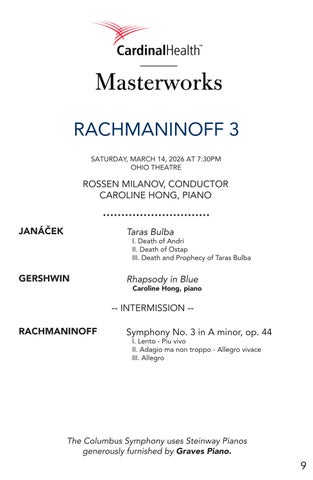
The Columbus Symphony uses Steinway Pianos generously furnished by Graves Piano.
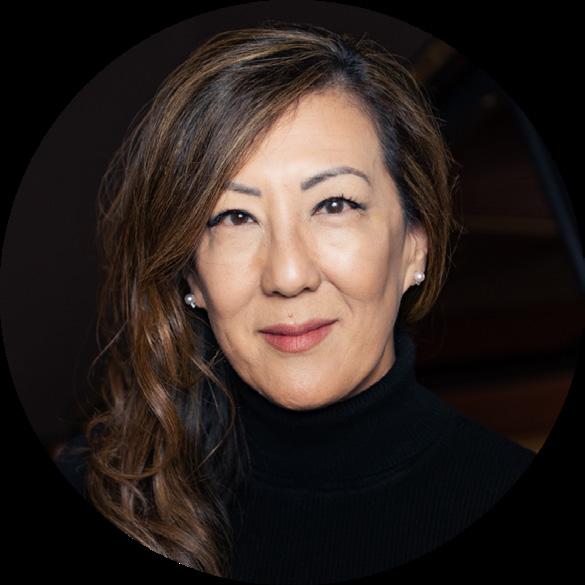
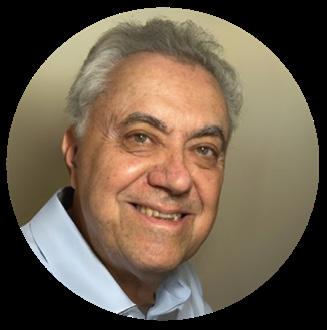
CAROLINE HONG, piano
Caroline Hong, internationally acclaimed pianist, Steinway Artist, and professor of piano, has been praised for her “expressive and powerful playing,” “formidable technique,” and “keen sense of lyricism and the classical style” (Richmond Times, Columbus Dispatch). Widely admired for her interpretive insight and versatility, she has established herself as a soloist, recitalist, chamber musician, recording artist, master teacher, and international competition director. Pulitzer Prize-winning composer John Corigliano hailed her as “one of the greatest pianists I have ever heard” after her performance of his Etude Fantasy—a rendition critics described as “breathtaking” and “hard to imagine a better performance.”
Her career spans international concert appearances, competitions, and critical acclaim. She made her New York debut at Carnegie Weill Recital Hall as winner of the Frinna Awerbuch International Piano Competition and has appeared as concerto soloist with orchestras including the Utah Symphony, Columbus Symphony, Richmond Symphony, Indiana University Philharmonic, and West Texas Symphony, among others. She has been selected for many of the world’s most prestigious competitions—among them the Van Cliburn International Audition, Concours Musical International de Montréal, Robert Casadesus, William Kapell, and UNISA International Competitions—and holds top awards from the Chicago Civic Orchestra Soloist Competition, Palm Beach International Piano Competition, and the Society of American Musicians. Most recently, critics praised her 2024 performance in Fulda, Germany, as reaffirming her stature as an international artist of distinction. Her performances have been featured on broadcasts worldwide and commended in American Record Guide.
As a chamber musician, Hong has collaborated with the Vermeer String Quartet, the Dorian Wind Quintet, and toured extensively with Duo Viardot. She frequently serves as juror and teacher at major competitions, with invitations that include the Aarhus International Piano Competition (Denmark), Pianale International Piano Academy and Competition (Germany), Los Angeles International Liszt Piano Competition, Bartók-Kabalevsky International Competition, and the Princeton Symphony Orchestra International Piano Competition.
A devoted advocate for Franz Liszt, Hong is president and founding member of the American Liszt Society Ohio Chapter, executive and artistic director of the Franz Liszt International Festival and Piano Competition, and a member of the American Liszt Society Board of Directors. She also serves as professor and chair of the keyboard area at The Ohio State University.
Her distinguished teaching career reflects artistry and mentorship of the highest level. Her students have won international competitions and secured faculty positions worldwide. She studied with renowned artists including Martin Canin, Jerome Lowenthal, Sergei Babayan, Dmitrii Paperno, Ann Schein, Karen Shaw, and Fernando Laires, with further mentorship from Claude Frank, John Browning, Leon Fleisher, György Sebők, Menahem Pressler, and Charles Rosen. She began piano at age two under the guidance of her first teacher, her mother, Mrs. Koon Ja Hong.
Hong earned degrees from the Peabody Institute of Johns Hopkins University (BM), The Juilliard School (MM), and the Jacobs School of Music at Indiana University (DM). She has served on the faculties of leading festivals and conservatories across North America and Europe, most recently the Adamant Music Festival in Vermont. Her multifaceted career—encompassing performance, chamber music, pedagogy, leadership, and advocacy—continues to inspire audiences and students alike.
Highlights of her 2026 season include collaborations with BalletMet and the Columbus Symphony Orchestra, chamber performances with CSO Concertmaster Joanna Frankel, and guest appearances at the Indiana University Piano Academy, Kunstuniversität Graz in Austria, and the Liszt Academy in Budapest.
PROGRAM NOTES
Taras Bulba (1915-18)
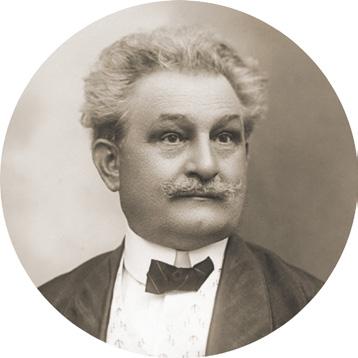
By Leoš Janáček (Hukvaldy, Moravia, 1854 –Moravská Ostrava, 1928)
Most recent Columbus Symphony performance: Sept. 26-27, 2003; Michael Stern conducting. Duration: 24’
The provinces of Bohemia and Moravia, where Leoš Janáček spent his entire life, were long part of the Austrian Empire, until the founding of Czechoslovakia in 1918. Seeking to liberate themselves from their German-speaking oppressors, Czechs in the 19th century looked to the East for political and cultural support—that is, to Austria’s long-standing enemy, the Russian Empire. At the time, Russia was the only independent country speaking a Slavic language, and it became a beacon of hope for many Czechs who believed in the idea of pan-Slavism, or the brotherhood of all Slavic peoples. Janáček was an enthusiastic adherent of this idea. He studied the Russian language, belonged to a Russian circle in his hometown of Brno, and drew inspiration from Russian literature for several of his greatest works: including the orchestral rhapsody Taras Bulba, after a celebrated novella by Nikolai Gogol, one of the great figures of Russian literature who was, actually, of Ukrainian origin. The story is set in the 16th century, when the Cossack warriors, who for the most part were allied with Russia, represented a major political and military force in the region.
The character of Taras Bulba is probably a composite of several different historical figures. Gogol portrayed him as an intrepid and ruthless Cossack leader, engaged in deadly combat against the Poles. The writer managed the tour de force of making us feel for this hardened and bloodthirsty soldier; but then, Taras’s life was tragic indeed. One of his sons, Andriy, fell in love with a Polish woman and became a traitor to his peo-
ple. He was killed by his own father on the battlefield. After his other son, Ostap, was captured, publicly tortured and executed by the Poles, Taras assembled an army larger than any ever seen before to avenge Ostap’s death, only to be captured and burned at the stake. With his last words, he pledged allegiance to the Czar and spurred on the Cossacks for the final victory.
What attracted Janáček to this grim story was, no doubt, the combination of nationalism and personal drama. Gogol did not try to conceal the flaws of his protagonist, such as his cruelty and his fanaticism, yet he also showed Taras’s undying devotion to the cause he believed in, as well as his pain and his sincere grief. Janáček, great opera composer as he was, saw the inner contradictions of his hero vividly in his mind’s eye, and brought them alive even without a stage.
The three-movement “Slavonic rhapsody” was written at a time when extreme nationalism had erupted in the cataclysm of World War I. Janáček’s sympathies lay clearly on the side of the Russians and their Western allies.
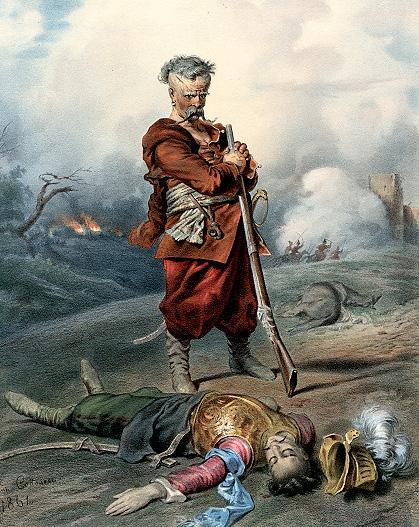
Illustration for Gogol’s novel Taras Bulba by the painter Pyotr Sokolov (1861).
PROGRAM NOTES
He finished an early version of Taras Bulba in 1915 and revised the work thoroughly three years later, in March 1918, when the war was nearing its end and the negotiations that would lead to the independence of Czechoslovakia were already underway.
Janáček’s unique “mosaic” technique, consisting of the juxtapositions of short motifs that are never subjected to extensive development, is amply evident throughout this work. The first movement (“The Death of Andriy”) opens with a plaintive theme consisting of only a few notes, shared by oboe, English horn, and solo violin, portraying the doomed love between Andriy and the daughter of the Polish commander. Thanks to constant changes in the orchestration and the accompaniment, this motif always sounds fresh. The second part of the movement brings some fast military music, with resounding brass fanfares and excited subsidiary themes; the ending, with its sudden alternations between slow and fast tempos, expresses both the violence and the profound sadness of the moment when Andriy dies at the hands of his own father.
The second movement features a characteristic six-note motif that hovers strangely between tonalities. Eventually, this motif becomes the accompaniment to a lyrical theme, itself interrupted by what seem to be strains of dance music heard from afar. The ending is unexpected in its brutal abruptness.
The final movement moves from a meditative opening (“The Prophecy”) to a fast section depicting the final attack of the Cossacks, followed by the lengthy coda, which takes up almost half of the movement and represents the dying Taras’s spiritual victory over his enemies. Yet Janáček makes it clear that the victory isn’t complete: this music is majestic, but rather less than exultant. The pain that Taras has both inflicted and suffered does not go away even at the moment of the final apotheosis.
Rhapsody in Blue (1924)
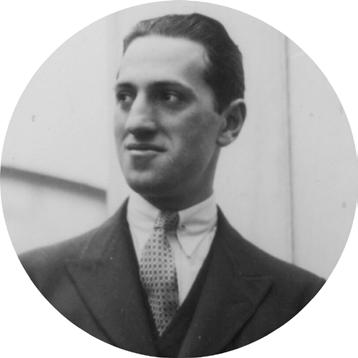
by George Gershwin (Brooklyn, 1898
– Hollywood, 1937)
Most recent Columbus Symphony performance: June 29, 2024; Stuart Chafetz conducting; Michael Chertock, soloist. Duration: 15’
“When the Rhapsody ended, there were several seconds of silence and then all hell broke loose,” writes Charles Schwartz in his Gershwin biography, describing the
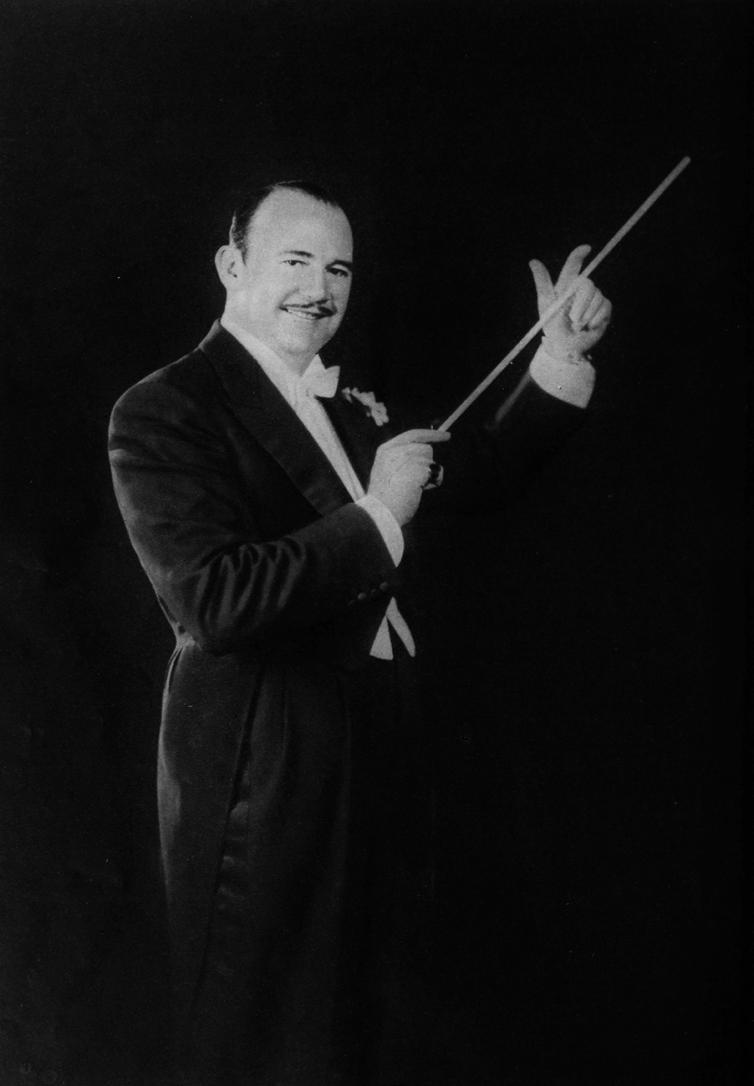
first performance of Rhapsody in Blue. The work was heard at the end of a long concert given by the famous bandleader Paul Whiteman and labelled, somewhat ambitiously, an “Experiment in Modern Music.” In reality, all Whiteman wanted was to have popular tunes arranged for a classical orchestra to enhance the respectability of jazz among a high-brow audience.
The bandleader Paul Whiteman in Radio Stars magazine, February 1934.
PROGRAM NOTES
It was for this concert that Whiteman had commissioned the Rhapsody from Gershwin. He invited musicians like Jascha Heifetz, Fritz Kreisler, Sergei Rachmaninoff, and Leopold Stokowski to witness the great “experiment,” which, however, rapidly began to degenerate into quite a boring affair—until the 27-year-old George Gershwin came on stage.
“Whiteman gave a downbeat,” Schwartz writes, “and [Ross] Gorman began his clarinet solo. At the sound of the clarinet, with its opening ‘wail,’ the audience became as if transfixed. Jolted by the exuberant, unexpected beginning, they were rooted in their seats, their ennui and restlessness disappearing as if by magic … It was unmistakably clear as the Rhapsody continued that it was generating a vitality and cohesiveness that are only too infrequently encountered in creative works. The Rhapsody seemed to have something pertinent to say and was saying it forcefully and directly, with personality and conviction.”
The work had originally been entitled simply “American Rhapsody.” According to another Gershwin biographer, Edward Jablonski, the title Rhapsody in Blue came from Gershwin’s brother and collaborator, Ira. After visiting a gallery and seeing some paintings by James McNeill Whistler—with titles such
as “Nocturne in Black and Gold” and “Arrangement in Gray and Black”—Ira thought, “why not a musical Rhapsody in Blue?”
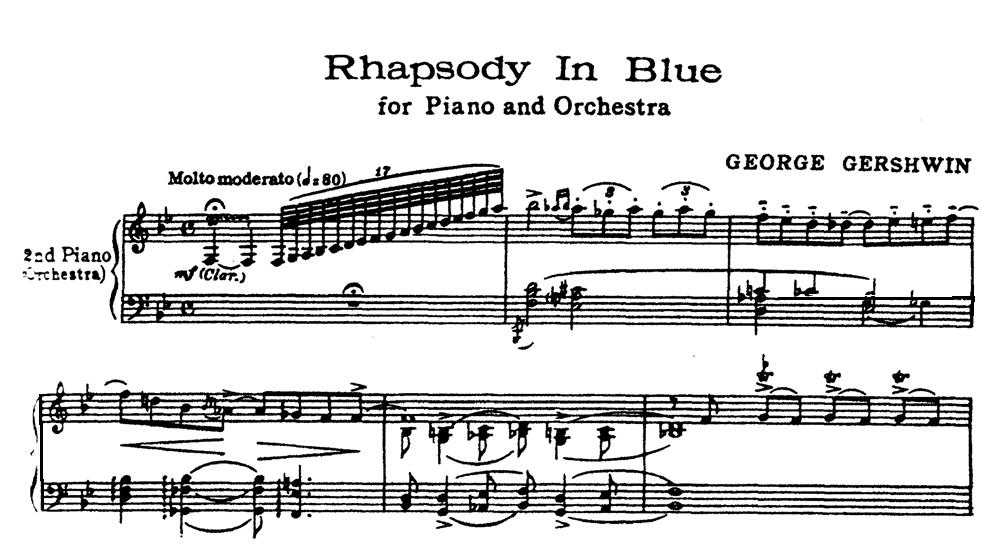
Although notated precisely in score, the Rhapsody exhibits a quasi-improvisatory quality in the loose and unpredictable way its various sections follow one another; a sense of order is restored at the end when two of the main themes return. Elements of jazz and Western classical music are combined in a way that many composers, both American and European, have sought to emulate, though few can be said to have succeeded as well as Gershwin. The extraordinary success of this work catapulted Gershwin, already a noted presence on Tin Pan Alley and Broadway, into fame as a composer of serious music. The Rhapsody is a landmark composition, one of the first American concert pieces to become truly popular both at home and abroad.
Gershwin himself stressed the distinctive American quality of his work: “In the Rhapsody I tried to express our manner of living, the tempo of our modern life with its speed and chaos and vitality. I didn’t try to paint definitive descriptive pictures in sound … I consider the Rhapsody as embodying an assimilation of feeling rather than presenting specific scenes of American life in music.”
PROGRAM NOTES
Symphony No. 3 in A minor, Op.
44 (1935-36)
by Sergei Rachmaninoff (Oneg, Russia, 1873 - Beverly Hills, California, 1943)
This is the first Columbus Symphony performance.
Duration: 38’
ed considerably. However, his basic view of what a symphony should be had remained essentially the same.
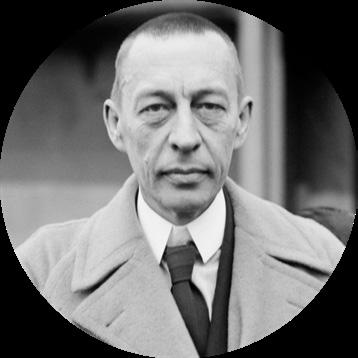
After his emigration in 1918, Rachmaninoff virtually stopped composing for many years. With most of his possessions left behind in Russia, and faced with the need to support his family, he decided to change the course of his life at the age of 45 and embark on the career as a piano virtuoso. Although he had been famous as a prodigious pianist since his youth, he had rarely performed anything but his own music. He now built up a repertoire of Classical works, quickly establishing his international reputation as one of the greatest pianists of his time. For years he had a busy concert schedule in Europe and the United States, and it is natural that little time was left for composing.
It was not until the 1930s that Rachmaninoff had at last the time and peace of mind to engage in some large-scale creative projects after acquiring a villa in Switzerland. It was there that he wrote the Rhapsody on a Theme of Paganini, followed by the Third Symphony and the Symphonic Dances, which remained his last finished composition. The Third Symphony was premiered by Leopold Stokowski and the Philadelphia Orchestra on November 6, 1936.
Almost 30 years separate the Third Symphony from the Second, which was finished in 1907. Picking up from where he had left off a generation earlier, Rachmaninoff stayed remarkably true to himself and was largely untouched by recent musical developments. This is not to say that his style had not changed. It had become richer and the range of colors on his palette had expand-
A symphony, to Rachmaninoff, was still more or less what it had been to Tchaikovsky, the idol of his youth: an invariably majestic and dignified work for orchestra whose movements were fairly standardized in character and whose formal structure was largely preordained by tradition. The composer’s task was to re-create that structure by filling out the basically unchanged symphonic concept with his best melodies and his best efforts at developing and orchestrating them. Rachmaninoff fulfilled this task admirably, introducing many subtle innovations without breaking up the traditional framework. The formal rules inherited from the past served to impose a Classical discipline on his unbridled Romantic imagination.
Like the first two Rachmaninoff symphonies, the Third opens with a motto that returns in all the movements. This motto is made up of only three different notes, but despite its simplicity, it bears the stamp of Rachmaninoff’s personality. Its scoring for three solo instruments—clarinet, muted horn, and muted cello—immediately draws our attention to the virtuosic orchestration that characterizes the entire piece. Patrick Piggott, writing about Rachmaninoff for the BBC Music Guide series, explained this motto as a “fatalistic” reminder “that our destiny is inescapable and that however persuasive human eloquence may be, fate will have the last, inevitable word.” The motto is also capable of undergoing transformations in rhythm and orchestration to adopt a more resolute dramatic tone, yet it is most memorable when it appears at the end of both the first and the second movements in a veiled pianissimo and with an unmistakable tinge of resignation.
The second theme includes a conspicuous quotation from Rachmaninoff’s song “Zdes khorosho” (“How fair this spot,” Op. 21, No. 7), written in 1902. As one commentator has suggested, this quotation may express the composer’s happiness in his Swiss villa by
PROGRAM NOTES
way of a reference to a work written when he was enjoying another beautiful family estate, Ivanovka. Perhaps the entire Symphony could be viewed as representing the contrast between past happiness and struggles in the present.
The “Zdes khorosho” theme is played by the cellos to the soft accompaniment of clarinets, bassoons, and harp (which makes its first entrance at this point). The development section begins with a duo of bassoons accompanied by the violas only. Rachmaninoff builds a highly effective climax by adding more and more instruments, including brass and percussion; then he suddenly takes them all away and introduces the motto in a novel scoring for piccolo, bassoon, and xylophone that almost reminds us of Prokofiev in its eccentricity. The full orchestra—including bass drum and cymbals, which were silent so far—subsequently intones the motto, repeated later in a more austere setting on the brass playing in unison. It is difficult to believe that these two sections are based on the same melody. In fact, they both use the same three notes that make up the motto; it is the orchestration that makes all the difference. Throughout the movement, the succession of timbre combinations is as carefully planned as the sequence of melodies.
The second-movement Adagio has an “Allegro vivace” (quasi-Scherzo) middle section, effectively telescoping the two middle movements into one. There are many exquisite solos for horn (accompanied by harp), violin, flute (accompanied by harp, celesta, and four solo violas), and bass clarinet. The fast middle section is remarkable for its rhythmic poignancy and many sudden contrasts in volume and instrumentation. The transitions from the slow section to the Scherzo and back to the first tempo are signaled by a trill figure played alternately by the first and second violins. The recapitulation is much shorter than the first Adagio; it is limited to a recall of the principal theme (in turn in the violins, oboes, English horn, flute, and clarinet), and leads
into the motto, played by plucked strings in pianissimo, closing the movement with a whisper.
The themes that make up the third movement are rather diverse in tempo, tonality, and orchestration. The buoyant first theme, played by the full orchestra with a strong rhythmic drive, is contrasted with a more lyrical second subject, to which the forceful chords of the harp make a significant contribution. A small melodic fragment, introduced by an unaccompanied solo bassoon, turns out to be the cell out of which a whole central fugato (fugue-like imitative section) grows. There is a re-transition in which the percussion instruments (especially the snare drum) are prominent, leading to an almost literal recapitulation.
The coda, which combines the first few notes of the chant with the Symphony’s motto, is one of the most brilliant moments in the piece: remote keys are directly juxtaposed, and the final A-major chord is approached from an interesting angle that, while hardly a novelty in 1936, nevertheless shows that Rachmaninoff was not always the arch-conservative he is reputed to have been. Patrick Piggott related that Rachmaninoff’s old friend, the Russian émigré composer Nikolai Medtner, who heard the first London performance, was distressed by what seemed to him concessions to “modernism” on his friend’s part.
Rachmaninoff’s Third Symphony is perhaps the last blossom on the tree of the Russian symphonic tradition symbolized by the name of Tchaikovsky. Rachmaninoff carried on this tradition, in which he believed deeply, in a most interesting and innovative way. As Piggott wrote at the end of his essay, “Rachmaninoff perfectly succeeded in what he set out to do.”