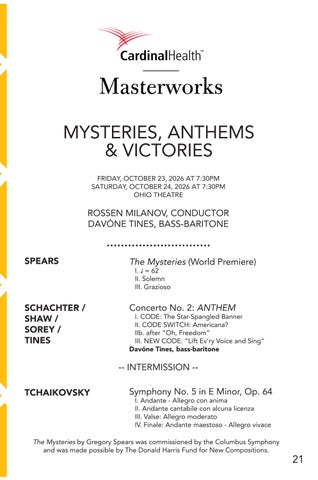
MYSTERIES, ANTHEMS & VICTORIES FRIDAY, OCTOBER 23, 2026 AT 7:30PM SATURDAY, OCTOBER 24, 2026 AT 7:30PM OHIO THEATRE
ROSSEN MILANOV, CONDUCTOR DAVÓNE TINES, BASS-BARITONE
............................. SPEARS
The Mysteries (World Premiere)
SCHACHTER / SHAW / SOREY / TINES
Concerto No. 2: ANTHEM
I. ♩ = 62 II. Solemn III. Grazioso
I. CODE: The Star-Spangled Banner II. CODE SWITCH: Americana? IIb. after “Oh, Freedom” III. NEW CODE: “Lift Ev’ry Voice and Sing” Davóne Tines, bass-baritone
-- INTERMISSION -TCHAIKOVSKY
Symphony No. 5 in E Minor, Op. 64 I. Andante - Allegro con anima II. Andante cantabile con alcuna licenza III. Valse: Allegro moderato IV. Finale: Andante maestoso - Allegro vivace
The Mysteries by Gregory Spears was commissioned by the Columbus Symphony and was made possible by The Donald Harris Fund for New Compositions.
21
D AV Ó N E T I N E S , b a s s - b a r i t o n e Davóne Tines, heralded as an artist “changing what it means to be a classical singer (The New Yorker) and “[one] of the most powerful voices of our time” (Los Angeles Times), is a pathbreaking artist whose work encompasses a diverse repertoire, ranging from early music to new commissions by leading composers, while exploring the social issues of today. A Grammy-nominated creator, curator, and performer at the intersection of many histories, cultures, and aesthetics, he is engaged in work that blends opera, art song, spirituals, contemporary classical, gospel, and protest songs as a means to tell a deeply personal story of perseverance connecting to all of humanity. As a musician who maintains complete creative control over his work, Tines develops new repertoire and programming from initial idea to its final stage. This artistic approach is central to works such as Recital No. 1: MASS and its orchestral counterpart, Concerto No. 3: MASS, which explore liturgical traditions across 21st-century, African American, and Western European contexts. Further orchestral works include Concerto No. 1: SERMON, which he debuted alongside the BBC Symphony and Philadelphia Orchestras, and Concerto No. 2: ANTHEM, which received its world premiere with the Los Angeles Philharmonic. Tines has also premiered operas by today’s leading composers, including Terence Blanchard, Matthew Aucoin, and most recently, John Adams’s El Niño at the Met Opera. His concert appearances include performances of works ranging from Beethoven’s Ninth Symphony to Kaija Saariaho’s True Fire. Tines’s first studio album, ROBESON, was released on Nonesuch Records in September 2024. Through a diverse set of repertoire ranging from classical and gospel to Broadway and Black folk music, Tines explores his connection to legendary American baritone Paul Robeson, reimagining some of the music Robeson famously sang. He recently served as Artist-in-Residence at Detroit Opera — an appointment that culminated in his performance in the title role of Anthony Davis’ X: The Life and Times of Malcolm X in the spring of 2022. Tines is featured on the Grammy-nominated world premiere recording of the opera released on BMOP/sound in 2022. Tines is a member of AMOC and co-creator of The Black Clown, a music theater experience commissioned and premiered by American Repertory Theater and coming to Opera Philadelphia in May 2026. He is Musical America’s 2022 Vocalist of the Year, a winner of the 2020 Sphinx Medal of Excellence, a recipient of the 2018 Emerging Artists Award from Lincoln Center, and a recipient of the 2024 Chanel Next Prize. He is a graduate of The Juilliard School and Harvard University, and is the recipient of the prestigious 2025 Harvard Arts Medal.
22
G R E G O RY S P E A R S , c o m p o s e r Praised for “astonishingly beautiful” (The New York Times) music and a “singular compositional voice, unlike any that has been heard in opera before” (The New Yorker), composer Gregory Spears is acclaimed for his distinctive blend of romanticism, minimalism, and early music influences, which seeks to collapse layers of history into one moment, our own. His works – spanning opera, orchestral, chamber, and vocal music – are celebrated for their melodic richness, emotional clarity, and sensitivity to text. Spears’ latest opera, Sleepers Awake, premiered at Opera Philadelphia in Spring 2026 and was praised as “haunting” and “evocative” (The Wall Street Journal). Spears was profiled by The New York Times in 2026, described as a “composer who loops musical time and history.” The commercial recording of Sleepers Awake will be released on Temple University’s BCM&D Records, in collaboration with Opera Philadelphia. Highlights of Spears’ 2026-2027 season include the world premiere of his new orchestral piece The Mysteries with the Columbus Symphony, followed by a performance at Carnegie Hall; the world premiere of Bartleby, a song cycle for mezzo-soprano Jennifer Johnson Cano and pianist Christopher Cano, at the Tucson Desert Song Festival; and Jason and the Argonauts, an opera for young people, presented by the Welsh National Opera. Spears’ best-known opera, Fellow Travelers (libretto by Greg Pierce), premiered at Cincinnati Opera in 2016 and was praised by The New York Times as “an opera that seems assured of lasting appeal.” It has since been produced by Lyric Opera of Chicago, Boston Lyric Opera, Minnesota Opera, Arizona Opera, and London’s University College Opera, among others. 2026 marked its tenth anniversary with the launch of a national tour, continuing in the 2026-27 season with performances at Austin Opera. Spears’ opera The Righteous, with a libretto by former U.S. Poet Laureate Tracy K. Smith, premiered at Santa Fe Opera in 2024, earning a “Critic’s Pick” in The New York Times and was shortlisted for an International Opera Award. Earlier collaborations with Smith include Castor and Patience (2022, Cincinnati Opera) and Love Story (New York Philharmonic). His first opera, Paul’s Case (with librettist Kathryn Walat), was called “a masterpiece” by The New York Observer and has been staged by Urban Arias, Prototype Festival, and Pittsburgh Opera. His recorded catalog includes Requiem (New Amsterdam Records), Seven Days (Bright Shiny Things), The Tower and the Garden (Parma), Paul’s Case (National Sawdust/American Modern Recordings), and Fellow Travelers (Fanfare Cincinnati). He also composed the soundtrack for Kit Monkman’s feature film Macbeth. Spears has been commissioned by the New York Philharmonic, Lyric Opera of Chicago, Santa Fe Opera, Cincinnati Opera, Houston Grand Opera, Opera Philadelphia, Seraphic Fire, The Crossing, Bang on a Can, Volti, BMI/Concert Artists Guild, Vocal Arts DC, New York Polyphony, The New York International Piano Competition, JACK Quartet, and the New York Youth Symphony, among many others. He is the recipient of numerous honors, including residencies from Yaddo, MacDowell, and the Copland House, and awards from BMI and ASCAP. He is a former Fulbright Scholar, a graduate of the Eastman School of Music and Yale School of Music, and earned a PhD in composition from Princeton University. Spears teaches at New York University and Purchase College, and his music is published by Schott Music and Schott PSNY. Learn more at www.gregoryspears.com.
23
PROGRAM NOTES The Mysteries (2026)
by Gregory Spears (b. 1977, Virginia Beach, Virginia) This is the world premiere performance. Duration: 27’ Gregory Spears has achieved great success with his operas, two of which – Fellow Travelers and Castor and Patience – have been premiered by the Cincinnati Opera. Fellow Travelers was seen most recently in a new production at the Glimmerglass Festival this past summer. Last season, the Columbus Symphony presented Mozart’s Requiem with the missing movements written by Spears – a version of the iconic classic that, first performed in 2013, has already received numerous performances throughout the country. The Mysteries – a demanding, 27-minute piece in three movements – is Spears’s largest purely orchestral work to date. During a recent conversation over Zoom, the composer shared some thoughts about the composition as he was putting the finishing touches on it. Asked about what the “mysteries” of the title were referring to, Spears noted that oftentimes, things we take for granted (such as the blue sky) can begin to seem mysterious when we contemplate them as if we saw them for the first time. We may think we know things just because we are used to them, but this perception may be misleading. Spears translated this philosophical insight into music by subjecting musical elements familiar from earlier eras (medieval, Baroque or Romantic) to transformations that make the familiar unfamiliar. To Spears, this process has something ritualistic to it as he feels that those borrowed elements, through repetition, can somehow become objects of veneration and become mystified or “re-mystified” in the process. Each of the three movements takes a different approach to enacting this. Spears has described the first movement as the most active of the three, somewhat “collage-like, toggling between different musical ideas.” The second movement does the opposite: it concentrates on a single idea that is transformed and
24
repeated, evoking the litanies of the Catholic Church and American minimalism at the same time. The last movement, in a slow tempo, presents an idea that is periodically interrupted by silence, inserting gaps into the musical trajectory that are bridged over by the continuation of the music’s progress. Spears has insisted that mysteries often cannot, and should not, be explained, but rather experienced. Thus, he has not revealed (and I didn’t ask) how the piece is going to end.
Concerto No. 2: ANTHEM (2022) Created by Davóne Tines (b. 1986, Portsmouth, Virginia) with music by Michael Schachter, Caroline Shaw, Tyshawn Sorey, and Davóne Tines, and text by Mahogany L. Browne This is the first Columbus Symphony performance. Duration: 24’ The composer provided the following note on the occasion of the work’s world premiere with the Los Angeles Philharmonic at the Hollywood Bowl in 2022: Before I centered my musical life on singing, I played the violin for 14 years. As a kid, I was fascinated and physically transfixed by the waves of sound symphony orchestra string sections made. I wanted to be a part of it. I was concertmaster of my high school’s chamber orchestra and went on to be general manager, then president of the Harvard-Radcliffe Orchestra, living out my obsession with orchestral sound from the back of the secondviolin section. The concerto, particularly the violin concerto, revealed itself as a paragon of orchestral expression, and mastering the concerto repertoire was a journey I stared at as if it were the base of Mount Everest. When I decided I would take on other mountains to climb, I left the violin behind, but kept the desire to engage in this soloist v. orchestra form. The creation of devised concertos for voice and orchestra has been my way of reconnecting to that young-born desire. I wanted to, as a vocalist, hold that hallowed instrumental space. The inherent advantage or challenge with singing is that there are words
PROGRAM NOTES to contend with. But, there is also the beguiling opportunity to say something. With Concerto No. 2: ANTHEM I wanted to meet the scale of the opportunity to present something at the Hollywood Bowl. The historic and storied venue, nestled in the heart of the land that bore contemporary commercial storytelling, is literally shaped like a megaphone; and offering this possibility of critiquing American ideals with the hope of offering a positive alternative, is what I choose to say with that megaphone. Concerto No. 2: ANTHEM presents the hope of possibility — hopefully on a national scale. It seeks to interrogate American ideals as summed up by the “Star-Spangled Banner” and present the Black national anthem “Lift Every Voice and Sing” as an alternative to which we, as a nation, could newly aspire. The lyrics of “The Star-Spangled Banner” were penned by the 35-year-old lawyer and amateur poet Francis Scott Key on September 14, 1814, as part of the larger document, the “Defense of Fort McHenry.” Key was famously inspired by seeing the American Flag triumphantly remain flying over the Outer Baltimore Harbor after a night of bombardment by the British Royal Navy, signifying American victory in the Battle of Baltimore in the War of 1812. The lyrics were then excerpted and set to a popular, preexisting British tune written by John Stafford Smith called “To Anacreon in Heaven,” the
official drinking song of the Anacreontic Society, an 18th-century British gentleman’s club for amateur musicians. “The Star-Spangled Banner” is a complicated song. This complication shows and underlines itself in its lesser-known verses of which many are not aware. It talks about blood washing away evidence of one’s foes, and brash revelry in the inability of the British to protect “the hireling and slave from the terror of flight or the gloom of the grave.” There has been much debate over centuries, at this point, about the implications of the use of the terms “hireling and slave.” Some argue that this was in direct reference to AfricanAmerican slavery. In a 2016 New York Times interview, University of Michigan musicologist and Anthem expert Mark Clague outlines that “The reference to slaves is about the use, and in some sense the manipulation, of Black Americans to fight for the British, with the promise of freedom,” and also notes Key’s documented racist ideologies referring to Black people as “a distinct and inferior race.” Others attempt to deflect this argument by presenting that the terms were meant to refer to indentured servants, many of whom were white. This debate is a critical factor in the social analysis of the text, but the problematic nature of the song is not solely wrested upon the appearance of those terms. The song
Detail from the first sheet music publication of The StarSpangled Banner (Thomas Carr, 1814)
25
PROGRAM NOTES that has come to represent America is about celebration at the victory of one nation over another. It extols an idea that sovereignty is gained through the conquering of an “other.” These essentially violent, colonialist ideals can be seen as a foundation — or unacknowledged foundation — of critical aspects of our country that are deeply problematic, harmful, if not altogether counter to the ideals of life, liberty, and the pursuit of happiness. The song “Lift Every Voice and Sing,” known as the Black national anthem, might be an apt alternative, offering ideals of nationhood by means more conducive to the successful functioning of a society; namely, the valuing of collective unity as the foundation of sovereignty. To help realize and articulate a proposition of this scale, I’ve invited a close group of beautifully diverse colleagues to fill in a concerto structure I created; like a very precise mad-lib. They’ve deftly realized their parts of this storytelling arc to help me and the piece ultimately say: “Here’s where we are. What if we went a different way?” Michael Schachter’s setting of “The StarSpangled Banner” (“Movement 1. CODE: The Star-Spangled Banner”) presents the first three verses of the song. The first verse, marked “Maniacally Majestic,” is an over-thetop presentation of the anthem as we know it. I asked Mike to think “Whitney Houston at the Super Bowl, MBM Musical, Disney World” to really show the bedazzled reverence with which the song is commonly held. That ecstatic presentation then melts, even decomposes, into a creepier second verse, whose words describe the mysterious tension and anticipation of the battlefield. The third verse is a garish recapitulation of the first. The playful and triumphant tropes of a marching band are now made to fray and splinter as the song tries to reclaim its former glory, but is unable to unsee or undo the gloom of the bloodied battlefield through which it has trudged. The primally violent, destructive chords from the famous 11/4 bar of Stravinsky’s The Rite of Spring momentarily reveal a dark underlining machinery.
26
In this context, the final “land of the free and the home of the brave” intrinsically feels like more of a question than a proclamation. Mahogany L. Browne, Lincoln Center’s firstever poet in residence, picks up this question, asking: Who said the free? Can’t be me Not, in country that deems me more womb than human More shadow than Black gold… I asked her to make a piece of writing in line with Langston Hughes’ “Let America be America Again.” She answered the call and brings the proposition in the present, stating “Let America be America, finally.” The relationship and parody between this syntax and the slogan of a recent former president should not be lost on the listener. Mahogany’s words manifest a liminal space created by Caroline Shaw’s “Movement 2a. CODE SWITCH: Americana?” in which pieces of musical Americana, like objects, are picked up, considered, questioned, then set aside. Aaron Copland’s late-1800s American hallmark “Simple Gifts” from his first set of Old American Songs is quoted, “tis a gift to be simple, tis a gift to be free,” repeated and fragmented to point to the notion that this simple gift of freedom is perhaps not bestowed upon all. Next, the Civil-War anthem “Dixie” is quoted and combines lyrics from both the original Confederate version that longs for “the land of cotton” and the satirical Union version that points out that that land is ironically a place where “cotton’s king and men are chattels.” The next object is comprised of Irving Berlin’s ubiquitous 1918 song “God Bless America,” which was championed by contralto Kate Smith, popularly known as “The First Lady of Radio.” The song became a signature of Smith’s, alongside definitively racist minstrel songs, particularly “Pickaninny Heaven.” “Pickaninny,” derived from a term used neutrally in the West Indies, became a NorthAmerican racial slur caricaturing small children of African descent as simple-minded pests. The song gleefully employs stereotypes of
w o c i e p p i q t h t m h
T i S N f t b t D
T c s t c t s s h t
T i S J R W
PROGRAM NOTES watermelons and fried pork chops abundantly occupying an afterlife for these death-fated children. The juxtaposition of these two songs is intended to demonstrate that a figure extolling American ideals, can also be the purveyor of deeply problematic, and perhaps profoundly un-American ideals. This is not intended to dismiss Smith’s importance as a quintessential American figure, but to point out the complication of a person simultaneously holding opposing truths; a nuance of identity that may be true for many of us. This is also meant to call to the difficult opposing truths held within “The Star-Spangled Banner” itself. The last stop on this journey through Americana is the spiritual “Oh freedom” as set by Tyshawn Sorey (“Movement 2b: after Oh Freedom”). Negro Spirituals are seen as America’s foundational musical literature. They exist in the tension of the irony that beautiful art can be born from the ugliest of circumstances. In the Narrative of the Life of Frederick Douglass, Douglass writes: they were tones loud, long, and deep; they breathed the prayer and complaint of souls boiling over with the bitterest anguish. Every tone was a testimony against slavery, and a prayer to God for deliverance from chains. The song “Oh Freedom” is prayer, an indelible call for change. I asked Tyshawn to set the song as a march that rises from under the tectonic plates; an intriguing proposition for a composer I know to rarely write in symmetrical time signatures. I also asked him to have the song build toward a definitely bold dominant seventh chord. This is meant to symbolically hold and bear the tension of all of humanity that has ever yearned for something better. The cathartic resolution of this tension comes in the form of the song “Lift Every Voice and Sing.” The lyrics were written by James Weldon Johnson and set to music by his brother, J. Rosamond Johnson. About the song, James Weldon Johnson writes: A group of young men in Jacksonville, Florida, arranged to celebrate Lincoln’s birthday in 1900. My brother, J. Rosamond
Johnson, and I decided to write a song to be sung at the exercises. I wrote the words, and he wrote the music. Our New York publisher, Edward B. Marks, made mimeographed copies for us, and the song was taught to and sung by a chorus of five hundred colored school children. Shortly afterwards my brother and I moved away from Jacksonville to New York, and the song passed out of our minds. But the school children of Jacksonville kept singing it; they went off to other schools and sang it; they became teachers and taught it to other children. Within twenty years it was being sung over the South and in some other parts of the country. Today the song, popularly known as the Negro National Hymn, is quite generally used. The lines of this song repay me in an elation, almost of exquisite anguish, whenever I hear them sung by Negro children. The song, born of a need to honor progress through collective resilience, offers a different path to sovereignty or nationalism by way of truer unity. This is presented without the existence of a straw-man “other,” or victim, or enemy to be conquered. The words extoll the honoring of the individual’s voice as part of the collective “Lift every voice and sing… with the harmonies of liberty” in order to acknowledge a past “stony the road we trod … we have come over a way that with tears has been watered … out from a gloomy past,” while standing united in the present in order to hope for a future that builds on that past, or builds beyond it: “Thou who hast brought us thus far on the way, keep us forever in the path we pray.” Concerto No. 2: ANTHEM could be construed as a socio-political statement, or an open invitation for Americans to reconsider our foundations and core ideals. It could also simply be seen as a soloist with an orchestra producing a kaleidoscope of virtuosic sound. Please take from it what you will. Enjoy. –– Davóne Tines
27
C O N C E RT O N O . 2 : A N T H E M | T E X T 1. CODE: The Star-Spangled Banner
Text by F. S. Key Music by J. S. Smith arr. Michael Schachter O say can you see, by the dawn’s early light, What so proudly we hail’d at the twilight’s last gleaming, Whose broad stripes and bright stars through the perilous fight O’er the ramparts we watch’d were so gallantly streaming? And the rocket’s red glare, the bomb bursting in air, Gave proof through the night that our flag was still there, O say does that star-spangled banner yet wave O’er the land of the free and the home of the brave! On the shore dimly seem through the mists of the deep Where the foe’s haughty host in dread silence reposes, What is that which the breeze, o’er the towering steep, As it fitfully blows, half conceals, half discloses? Now it catches the gleam of the morning’s first beam, In full glory reflected now shines in the stream, ‘Tis the star-spangled banner, O long may it wave O’er the land of the free and the home of the brave! And where is that band who so vauntingly swore, That the havoc of war and the battle’s confusion A home and a Country should leave us no more? Their blood has wash’d out their foul footstep’s pollution. No refuge could save the hireling and slave From the terror of flight or the gloom of the grave, And the star-spangled banner in triumph doth wave O’er the land of the free and the home of the brave.
28
Recorded Interlude: “Let America” Text by Mahogany L. Browne
But who said the free? Can’t be me Not in a country that deems me more womb than human More shadow than Black gold More box-ready Still shot Kill shot Boom-bap Fingers click capitalistic locks Like pandemic stocks America has yet to rise to its ancestral potential All the marches and protests and songs and flags Are harvest waiting for the promise of revolution O, let America be America finally A land full-fisted of reparations and accountability Equality and anti-property Abolition and universal healthcare Blooming from its good hands Yes, let this be the land of the brave Looking directly into the bright light of failure Instead of the almost dream too afraid to admit We all can see The noose is still hanging from democracy’s tree
C O N C E RT O N O . 2 : A N T H E M | T E X T 2. CODE SWITCH: Americana? Music by Caroline Shaw
Tis a gift Tis a gift to be Tis a gift to be Tis a gift to be simple, tis a gift to be Tis a gift to be simple, tis a gift to be free Tis a gift to be simple, tis a gift to be free Tis a gift to be simple, O I wish I was in the land of cotton Old times there are not forgotten Look away, look away, look away. Where cotton’s king and men are chattels God bless America, land that I Haven’t you been told of the place where the good little pickaninnies go? From the mountains, to the prairies, to the oceans, white … Great big watermelons roll around and get in your way in the pickaninnies’ heaven My home, sweet home God bless America, my home sweet Some day
2b. after “Oh, Freedom”
Traditional; original music by Tyshawn Sorey Oh, freedom Oh, freedom Oh, freedom over me And before I’d be a slave Before I’d be a slave I’d be buried in my grave And go home to my Lord And be free!
3. NEW CODE: “Lift Ev’ry Voice and Sing” Text by James Weldon Johnson Music by John Rosamund Johnson arr. Davóne Tines and Michael Schachter
Lift ev’ry voice and sing, Till earth and heaven ring, Ring with the harmonies of Liberty; Let our rejoicing rise High as the list’ning skies, Let it resound loud as the rolling sea. Sing a song full of the faith that the dark past has taught us; Sing a song full of the hope that the present has brought us; Facing the rising sun of our new day begin, Let us march on till victory is won. Stony the road we trod, Bitter the chast’ning rod, Felt in the days when hope unborn had died; Yet with a steady beat, Have not our weary feet Come to the place for which our parents sighed? We have come over a way that with tears has been watered; We have come, treading our path thro’ the blood of the slaughtered, Out from the gloomy past. Till now we stand at last Where the white gleam of our bright star is cast. God of our weary years, God of our silent tears, Thou who has brought us thus far on the way; Thou who has by Thy might, Led us into the light, Keep us forever in the path, we pray. Lest our feet stray from the places, our God, where we meet Thee, Lest our hearts, drunk with the wine of the world, we forget Thee; Shadowed! beneath Thy hand, May we forever stand, True to our God, True to our native land.
29
PROGRAM NOTES Symphony No. 5 in E minor, Op. 64 (1888)
by Pyotr Ilyich Tchaikovsky (Kamsko-Votkinsk, Russia, 1840 – St. Petersburg, 1893) Most recent Columbus Symphony performance: May 5-6, 2023; Rossen Milanov conducting. Duration: 47’ Despite his growing international fame, Tchaikovsky was constantly plagued by selfdoubt. Early in 1888, he went on a three-month European tour, conducting his own works with some of the world’s finest orchestras. He was lionized in Leipzig, Paris, London, and Prague, and met Dvořák, Grieg, and Mahler. Yet his private life was not free from turmoil. He had recently lost one of his closest friends, Nikolai Kondratyev, and his sister Alexandra and his niece Vera were both seriously ill. It must have been hard to escape the thought that life was a constant struggle against Fate, a hostile force attempting to thwart all human endeavors. After his return from abroad, Tchaikovsky decided to write a new symphony, his first in 10 years. Characteristically, the first sketches of the new work, made on April 15, 1888, include a verbal program portraying the individual’s reactions in the face of this immutable destiny, involving stages of resignation, challenge, and triumph: Introduction. Complete resignation before Fate, or which is the same, before the inscrutable predestination of Providence. Allegro. (1) Murmurs of doubt, complaints, reproaches against XXX. (2) Shall I throw myself in the embraces of faith??? A wonderful program, if only it can be carried out. Tchaikovsky never made this program public, however, and in one of his letters even went out of his way to stress that the Symphony had no program. Clearly, the program was an intensely personal matter to him, in part because he was reluctant to openly acknowledge his homosexuality, which seemed to him one of the hardest manifestations of the Fate he was grappling with. Many people believe this is what the mysterious “XXX” in the sketch stands for. It is certain that the “program” had a deep influence on Tchaikovsky’s thinking during the gestation period of the Fifth; without it, the
30
Symphony would not be what it is (in particular, the opening theme wouldn’t return so ominously in all four movements). This theme returns over and over again, usually played by the brass instruments and apparently symbolizing the threatening power of Fate. The theme is first heard in the “Andante” introduction of the first movement, where it is followed by a more lyrical, lilting idea as we move into the faster “Allegro con anima” tempo. The accompaniment of the “fate” motif, however, remains present as a stern reminder. The entire movement swings back and forth between lyrical and dramatic moments. We would expect it to end with the final fortissimo climax. Instead, the volume gradually decreases to a whisper. The mysterious last measures are scored for the lowest-pitched instruments in the orchestra: bassoons, cellos, basses, and timpani. The second movement is lyrical and dream-like, suggesting a brief respite from the struggle. The first horn plays a singing melody eventually joined by the full orchestra. A second idea, in a slightly faster tempo, is introduced by the clarinet. Soon, however, an intense crescendo begins that culminates in the fortissimo entrance of the Fate theme. The first theme returns, once more interrupted by Fate; only after this second outburst does the music finally find its long-desired rest. The third movement is a graceful waltz with a slightly more agitated middle section. As before, we expect a respite from the fate theme and its emotional drama. Yet before the movement is over, there is a short reminder, subdued yet impossible to ignore, on the clarinets and bassoons. In the finale, Tchaikovsky seems to have taken the bull by the horns: the fate theme dominates the entire movement, despite the presence of a number of contrasting themes. At the end of a grandiose development, the music comes to a halt on the dominant (the fifth degree of the scale that serves as the opposite pole to the tonic, i.e. the keynote). There have been performances where some people mistakenly thought that the piece was over and started applauding. The final resolution, however, is yet to come, in the form of a majestic reappearance of the Fate theme and a short “Presto” where all “doubts, complaints and reproaches” are cast aside and, against all odds, the Symphony receives the triumphant ending it needed. Spears and Tchaikovsky notes by Peter Laki.