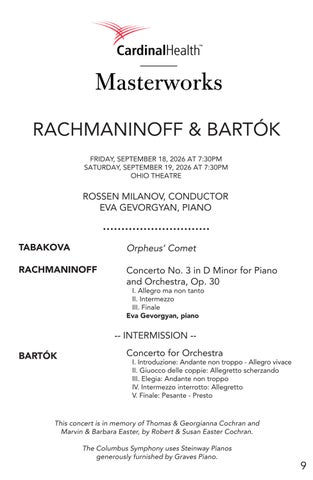
RACHMANINOFF & BARTÓK FRIDAY, SEPTEMBER 18, 2026 AT 7:30PM SATURDAY, SEPTEMBER 19, 2026 AT 7:30PM OHIO THEATRE
ROSSEN MILANOV, CONDUCTOR EVA GEVORGYAN, PIANO
............................. TABAKOVA
Orpheus’ Comet
RACHMANINOFF
Concerto No. 3 in D Minor for Piano and Orchestra, Op. 30 I. Allegro ma non tanto II. Intermezzo III. Finale Eva Gevorgyan, piano
-- INTERMISSION -BARTÓK
Concerto for Orchestra
I. Introduzione: Andante non troppo - Allegro vivace II. Giuocco delle coppie: Allegretto scherzando III. Elegia: Andante non troppo IV. Intermezzo interrotto: Allegretto V. Finale: Pesante - Presto
This concert is in memory of Thomas & Georgianna Cochran and Marvin & Barbara Easter, by Robert & Susan Easter Cochran. The Columbus Symphony uses Steinway Pianos generously furnished by Graves Piano.
9
E VA G E V O R G YA N , p i a n o Yamaha Young Artist Eva Gevorgyan is a laureate in more than forty piano competitions, including top prizes at the 2018 Cleveland International Piano Competition for Young Artists and the 2019 Van Cliburn Young Artist Competition. More recently she has won the Prix du Bern in Switzerland in 2023, Discovery Award at the 2019 International Classical Music Awards, the Grand-Prix Prize at the Russia National Orchestra Competition in 2021, in addition to being finalist and winner of the Special Prize at the Chopin International Piano Competition in Warsaw, Poland. She has performed as soloist with the Dallas Symphony, Lucerne Symphony, Warsaw Philharmonic, Mariinsky Orchestra, Russia National Philharmonic, Ontario Philharmonic, Russian National Orchestra, Evgeny Svetlanov Academic State Symphony, Magdeburg Philharmonic Orchestra, Canton Symphony Orchestra, Neue Philharmonie Hamburg Orchestra, Leipzig Symphony Orchestra, Liechtenstein Philharmonic, Armenia National Philharmonic Orchestra, Moroccan Philharmonic Orchestra, Malta Philharmonic Orchestra, Galicia Symphony Orchestra, the Tatarstan Symphony Orchestra and many others. She has also appeared in recital in such Festivals as Verbier (Switzerland), Duszniki International Chopin Piano Festival (Poland), Brescia and Bergamo International Piano Festival (Italy), Ruhr Klavier Festival (Germany), White Nights Festival (Russia), SchleswigHolstein Music Festival (Germany), BEMUS (Serbia), Montreal Bach Festival (Canada), Eilat Chamber Music Festival (Israel), Shanghai International Piano Festival (China), ArtDialog Festival (Switzerland), Osor Music Evenings (Croatia), The International Keyboard Odyssiad Festival (USA), Chopin Festival (Brazil), VP Bank Classic Festival (Switzerland) and in 2023 debuted at La Roque d’Antheron Festival (France), obtaining rave reviews. Eva pursues studies at the Tchaikovsky Conservatory’s Central School of Music in Moscow with Natalia Trull and at the Escuela Superior de Música Reina Sofía in Madrid, under the guidance of Stanislav Ioudenitch. She has also been granted the prestigious scholarship at the 2020 Klavier-Festival Ruhr by Evgeny Kissin. She has already performed at major concert venues including the Royal Albert Hall, KKL Lucerne, Gewandhaus, the Mariinsky Concert Hall, Hamburg’s Laeiszhalle, Auditorio Nacional in Madrid, Asahi Hall in Tokyo, Teatro B32 in Brazil, Teatro Juarez in Mexico, Salle Bourgie in Montreal and Salle Cortot in Paris. Her first CD under the Melodiya label, featuring works by Chopin and Scriabin, was released in 2022, receiving great acclaim.
10
PROGRAM NOTES Orpheus’ Comet (2017) by Dobrinka Tabakova (b. 1980, Plovdiv, Bulgaria) This is the first Columbus Symphony performance. Duration: 5’ The Columbus Symphony’s landmark 75th anniversary season deserves to start off with a bang – in this case, the crack of a whip that jumpstarts British-Bulgarian composer Dobrinka Tabakova’s shimmering Orpheus’ Comet. This brief piece, subtitled “Celebration for orchestra,” stems from Tabakova’s stint as the BBC Concert Orchestra’s composer in residence. It was commissioned by the BBC and European Broadcasting Union to commemorate the 50th anniversary of the Euroradio Music Exchange, a service that allows national broadcasters to share concert recordings and other performances across borders. You’ll hear an allusion to the signature fanfare of these broadcasts – the opening trumpet toccata of Monteverdi’s early opera L’Orfeo (1607) – near the end of the work. Tabakova also had an even earlier inspiration for this piece: Virgil’s ancient poem the Georgics, which discusses topics related to agriculture, including bees, while also relating the story of Orpheus and Eurydice. (Aristaeus, the mythological figure credited with the discovery of beekeeping, was indirectly responsible for Eurydice’s death by snakebite.) In the score, the composer explains that “gradually the bees became cosmic particles and Orpheus’ Comet was born,” but the apian origins remain in the opening performance direction “Like a swarm of bees.”
From there, “the buzzing horns begin and are answered by the low strings, while accents spark throughout the rest of the orchestra. This dialogue continues, until a solemn chorale appears out of the busy texture. The chorale is taken up by the strings and grows to include the buzzing ideas, which are transformed to almost hypnotic rhythmic loops. A soaring melody in the flute and clarinet hovers above as momentum starts to build. Trombones underpin this build-up and prepare for a special finale.”
Piano Concerto No. 3 in D minor, Op. 30 (1909) by Sergei Rachmaninoff (Oneg, Russia, 1873 – Beverly Hills, 1943) Most recent Columbus Symphony performance: Jan. 21-23, 2022; Rossen Milanov conducting; Inon Barnatan, soloist. Duration: 44’ The decade before Rachmaninoff’s emigration from Russia was, without a doubt, the apex of his career as a composer. Between 1907 and 1917 he wrote many of his greatest works: in addition to the Third Piano Concerto, the Second Symphony, the choral poem The Isle of the Dead, the choral symphony The Bells, the Liturgy of St. John Chrysostom, and a large number of songs and piano pieces all date from those years. The Third Piano Concerto was written for Rachmaninoff’s first American tour in 1909. The composer never dreamt at the time that
A painting by an anonymous artist of Comet Rosa (1460) from the 1587 “Kometenbuch’’ (Wikimedia Commons)
11
PROGRAM NOTES he would be visiting the country where he would eventually make his home and where he would die. He accepted the offer only after some hesitation, and then only because he hoped that the fees he was promised would allow him to realize his dream of buying an automobile. In this work, Rachmaninoff aspired to be worthy of the 19th-century virtuoso tradition in every respect. The last of the great Romantic pianist-composers in the lineage of Chopin, Liszt, and Rubinstein, Rachmaninoff also wanted, it seems, to emulate the synthesis between concerto and symphony achieved in the two piano concertos of Brahms. This is shown by the many orchestral solos that join, and sometimes compete with, the piano soloist, as well as by the numerous thematic links between movements, carefully planned and masterfully executed. Rachmaninoff’s Third Piano Concerto certainly doesn’t lack pianistic brilliance (to say the least). But the first two dozen measures of the piano part could actually be played by a child. This is the famous “Russian hymn” theme that some commentators have tried to trace to an old religious chant from Kiev, although Rachmaninoff insisted that there was no such connection. When asked how his theme had been conceived, the composer said only, “It simply wrote itself...” The first theme is immediately repeated by the violas, accompanied by piano figurations that grow more and more complex. The changes in texture are gradual, and in less than three minutes, the “Russian hymn” evolves into a cadenza. A new idea is then announced, first in the form of a staccato dialog between piano and orchestra, and only then as the singing second theme that we have been expecting. After a spectacular elaboration upon this theme, the “Russian hymn” returns in its original form, introducing a free development section during which the rhythmic accompaniment of the first theme is always clearly heard. At the climactic moment, the tempo becomes faster, and the entire orchestra enters fortissimo on a dissonant diminished seventh chord. Soon
12
the pianist launches into the second and main cadenza. Rachmaninoff later replaced his original cadenza with an even bigger one, but he preferred to play the first version. The cadenza includes an accompanied portion with haunting wind solos recalling the “Russian hymn,” and a fantasy, for piano alone, upon the singing second theme. Therefore, the cadenza effectively functions as the movement’s recapitulation, and all that is needed afterward is a brief coda. The coda states the “Russian hymn” in its original form one last time, followed by the first staccato version of the second theme that has been heard in this form only once before. By repeating it, Rachmaninoff gave it a place in the larger structure of the concerto. The second-movement “Intermezzo” opens with an orchestral introduction, which is the only moment of rest the pianist gets during the entire work. Presented in turn by woodwinds and strings, the soulful melody is subsequently taken over by the piano, considerably intensified in the process. The virtuoso figurations surrounding the theme form a bridge to the next section, a brief scherzando, in which the “Russian hymn, from the first movement reappears, played by the clarinet and bassoon. The “Intermezzo” melody is then recalled, followed by a transition of a few measures leading into the finale. The themes of the last movement are in turn sharply rhythmic and expansively lyrical. The central portion is divided between a brilliant scherzando and a central “Lento molto espressivo” (slow, very expressive), all derived from materials heard in the first movement. What was originally a lyrical second theme becomes the basis for a series of scintillating variations, combined at one point with the “Russian hymn.” The “Lento” is, in essence, another variation on the first movement’s second theme. After a recapitulation of the opening themes, the tonality changes from D minor to D major, for an ending that is both solemn and jubilant.
PROGRAM NOTES Concerto for Orchestra (1943)
by Béla Bartók (Nagyszentmiklós, Hungary [now Sânnicolau Mare, Romania] 1881 – New York, 1945)
sixths, two oboes in thirds, two clarinets in sevenths, two flutes in fifths, and finally, two muted trumpets in major seconds. A short brass chorale functions as middle section before a full (varied) recapitulation.
Most recent Columbus Symphony performance: Feb. 25-26, 2022; Rossen Milanov conducting. Duration: 36’
The third-movement Elegy opens with a clear allusion to the first movement’s slow introduction, and ends with a haunting piccolo solo. It is said that this movement expresses Bartók’s homesickness for Hungary.
Bartók was fifty-nine years old when he emigrated to the United States. Although he had long been recognized as one of the greatest contemporary composers in Europe, in the United States he was far from being a household name. His struggle to relaunch his career was made difficult by his refusal to teach composition. For a while, he was able to concertize and work in ethnomusicology, but approximately two years after his arrival, his health began to deteriorate. Eventually, he was diagnosed with leukemia, and the disease claimed his life in 1945. The situation was grave indeed when Bartók, lying in a New York hospital, received a commission from Serge Koussevitzky, conductor of the Boston Symphony Orchestra, for a new orchestral work. The commission gave Bartók a new lease on life. His health improved, and the full score of the Concerto for Orchestra was completed by October 8, 1943. Bartók chose this title because every instrument or orchestral section has its moments when it comes to the fore as a real “soloist.” The five-movement work opens with a slow introduction which creates the impression of a world being born out of primeval chaos. The tempo gradually increases and reaches Allegro vivace, vigorous and energetic except for a lyrical interlude in which the oboe and the harp seem to have an intimate conversation. The second movement, “Giuoco delle Coppie” (“Game of Pairs”), opens and closes with a brief snare drum solo. Five pairs of wind instruments play their themes in parallel intervals; we hear, in turn, two bassoons in
The brief fourth movement (Intermezzo interrotto, or “Intermezzo, Interrupted”) juxtaposes two characteristic quotations that once again reveal a great deal about Bartók’s state of mind at the time. After the opening oboe theme, we hear a cantabile melody that recalls a popular Hungarian operetta tune: “Hungary, you are beautiful...” This idyllic tune is then disrupted by what is clearly a parody of a prominent passage from Shostakovich’s Seventh (“Leningrad”) Symphony, which had recently created a major sensation in the United States. In his book My Father, Bartók’s younger son Peter told the story of how Bartók listened to the radio broadcast of Shostakovich’s Seventh and objected to what seemed endless repetitions of the same theme. The finale belongs to the type of folk-dance movements inspired by the spirit of folkdance Bartók used at the end of many of his major works. After the opening horn fanfare, the violins start a perpetual motion in rapid sixteenth-notes that runs through almost the entire movement. In the central section, a large-scale fugato (a section based on imitative counterpoint) unfolds. After a recapitulation which includes a brief lyrical episode in a slower tempo, the final crescendo begins, leading to a powerful climax at the end of the composition.
Tabakova note by David Hoyt. Rachmaninoff and Bartók notes by Peter Laki.
13