


In this edition, read all about topics related to Intellectual Property Law: copyright, trademarks, patents, trade secrets, and NIL. Plus, find articles about the 250th Anniversary of the Declaration of Independence, Columbus’s pay transparency requirements, and professional wellness.

Chair
Caitlyn
Joshua Cartee
Lisa Critser
Claire Halffield
Matthew Jalandoni
Janyce Katz
Garth Robotham

Lexi Foster


(614) 221-4112







Scott R. Mote
Guidelines for Early Stages of Intellectual Property Creation
Rex W Miller II & Graham D. Christian 51 Five Ways Lawyers Can Lead by Example: Promoting Mental Well-Being as a Strength, Not a Stigma



Frank H. Foster & Jason H. Foster 5 When Identity Becomes Currency: Why Athlete Intellectual Property Is the Most Undervalued Asset in Sports Luke A Fedlam & Marissa R Borschke 75 Don’t Give It All Away: Sweeping Copyright Clauses
Rachael L. Rodman 3 Protecting Ownership of Creative Works, Inventions, and Branding in the Generative AI Era
Todd A Fichtenberg Heppner and Trinidad: Old Rules for New Technology
Miranda L Rife
Can Brands Stop Resale? Lessons from Chanel v. The RealReal and the First Sale Doctrine
Smoot
Schedule A Litigation in Intellectual Property Cases: Origins, Controversies, and an Uncertain Future

Interested in writing? CLE credit eligible. Have a theme idea? Email publications@cbalaw.org for more information.
The Fall 2026 Issue will feature articles about Law & Finance. The Winter 2027 Issue will feature articles about The Life of a Lawyer.


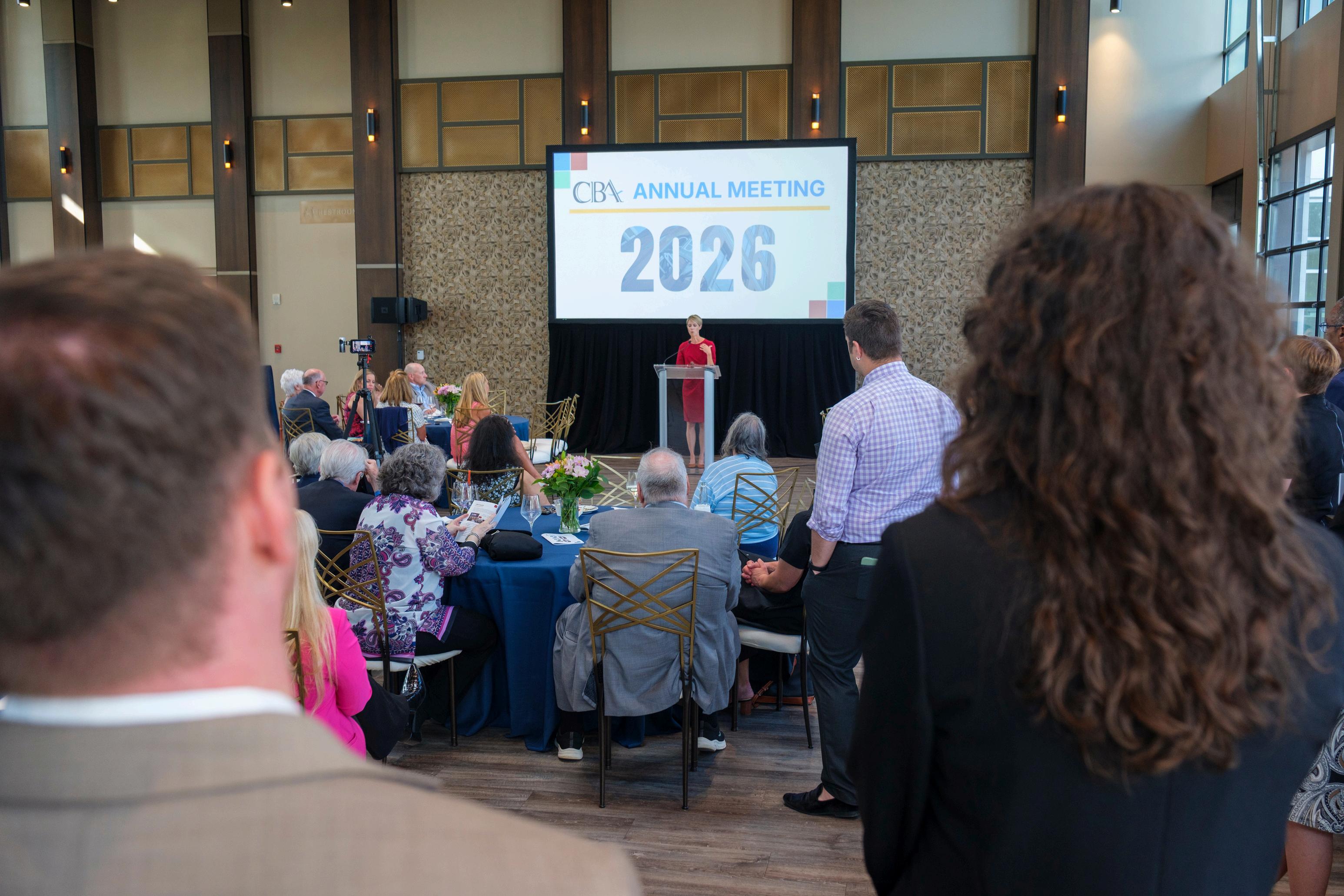
By Melanie Tobias-Hunter
Remember the days when we sent faxes? Many of us do, but a growing number of attorneys will never know the frustration of waiting for a fax confirmation sheet, especially under deadline.
From the way we conduct research and communicate with clients to how we manage our practices and deliver legal services, change is a constant. Today, that pace of change is accelerating. The legal profession is ever evolving with new technologies transforming the practice of law. Client expectations continue to rise. Attorneys are balancing increasing demands on their time while seeking new ways to remain connected, informed, and competitive.
Yet amid all this change, one truth remains unchanged: lawyers need community. They need trusted resources. They need opportunities to learn and grow. They need relationships that foster
collaboration, mentorship, and support. They need a professional home that helps them navigate both the challenges and opportunities of a rapidly changing profession.
For more than 150 years, the Columbus Bar Association has been that home for lawyers across Central Ohio.

As I begin my term as President, I am honored to help lead an organization that has played such an important role in the lives and
careers of so many attorneys, including my own. Like countless members, I have benefited from the education, relationships, leadership opportunities, and sense of belonging that the Columbus Bar provides. I am grateful for the opportunity to help shape its future.
And that future is guided by a simple vision:
The practice of law has become increasingly complex. Membership should not be.
That is why we are redefining what membership means.
Too often, attorneys are asked to navigate separate fees, separate subscriptions, and separate programs to access the tools they need to succeed. At a time when lawyers are being asked to do more with less time, the Columbus Bar is committed to making professional growth easier, more accessible, and more valuable.
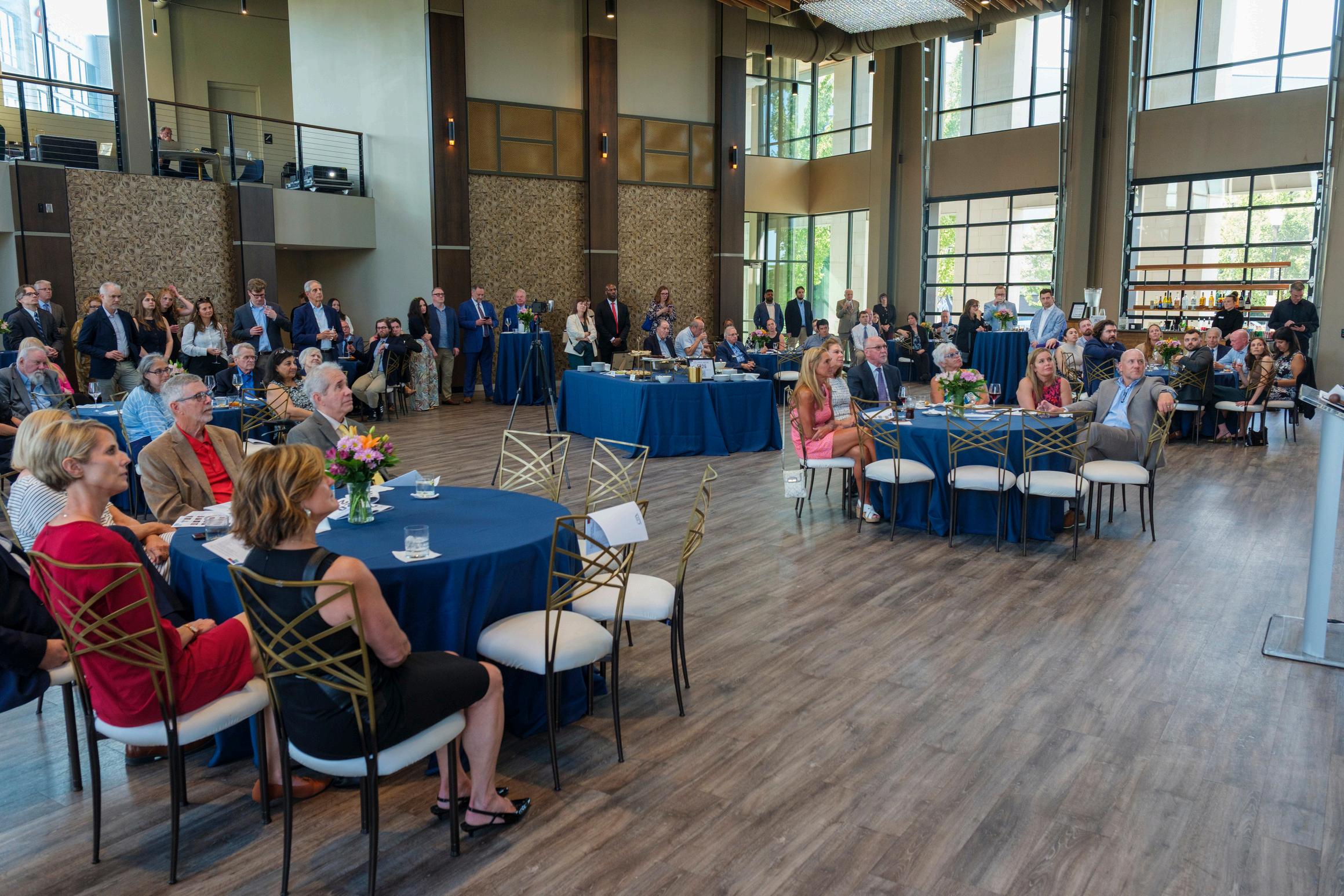
Rather than offering a collection of disconnected benefits, we are creating a unified membership experience that brings together education, networking, leadership development, business resources, practice-area engagement, and professional visibility under a single investment.
One membership. One community. One place to connect, learn, and grow.
The result is simple: members can focus less on tracking credits and registrations and more on developing the knowledge and skills that strengthen their practices.
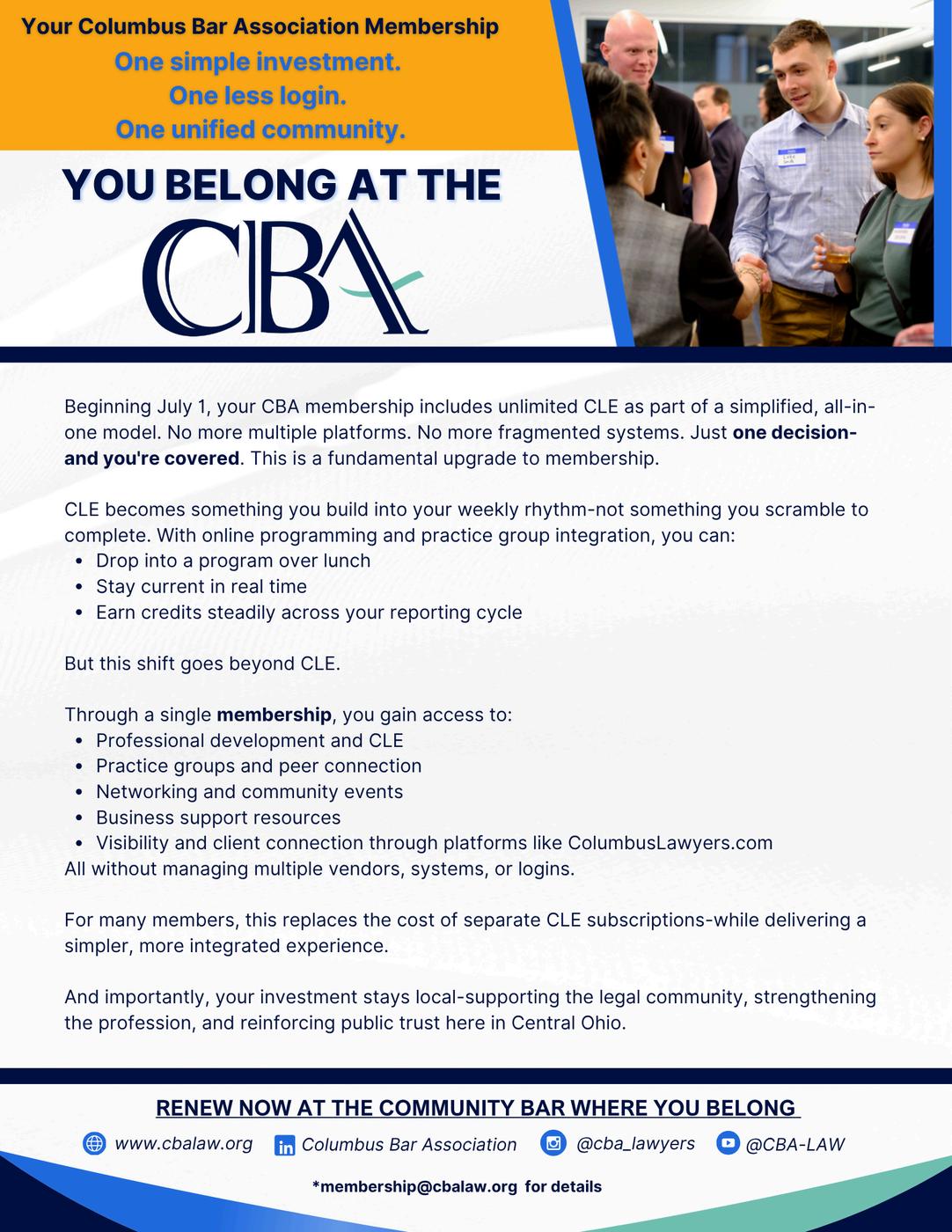
Perhaps the best example of this approach is our all-inclusive CLE model. For many attorneys, managing CLE obligations can become expensive, timeconsuming, and fragmented. Our all-inclusive CLE membership removes those barriers by
providing members with access to the education they need without worrying about paying for individual courses throughout the year.
But education is only part of the equation. The true value of the Columbus Bar comes from the connections that surround that learning experience. A CLE program can introduce a new idea. A conversation afterward can lead to a referral, a mentor, a business opportunity, or a lasting professional relationship.

That is the power of a unified community. It is found in our practice groups and networks. It is found at our SideBars and networking events. It is found in volunteer opportunities, leadership development initiatives, and conversations between colleagues who are willing to share their experiences and support one another. As our profession becomes increasingly digital, these connections become even more important.
Technology can make us more efficient. It can help us work faster and serve clients better. But technology alone cannot replace the value of belonging to a community of professionals who understand the unique demands of our work.
The strongest legal communities are built on relationships. They are built on mentorship and shared experiences. And they are built on a commitment to helping one another succeed.
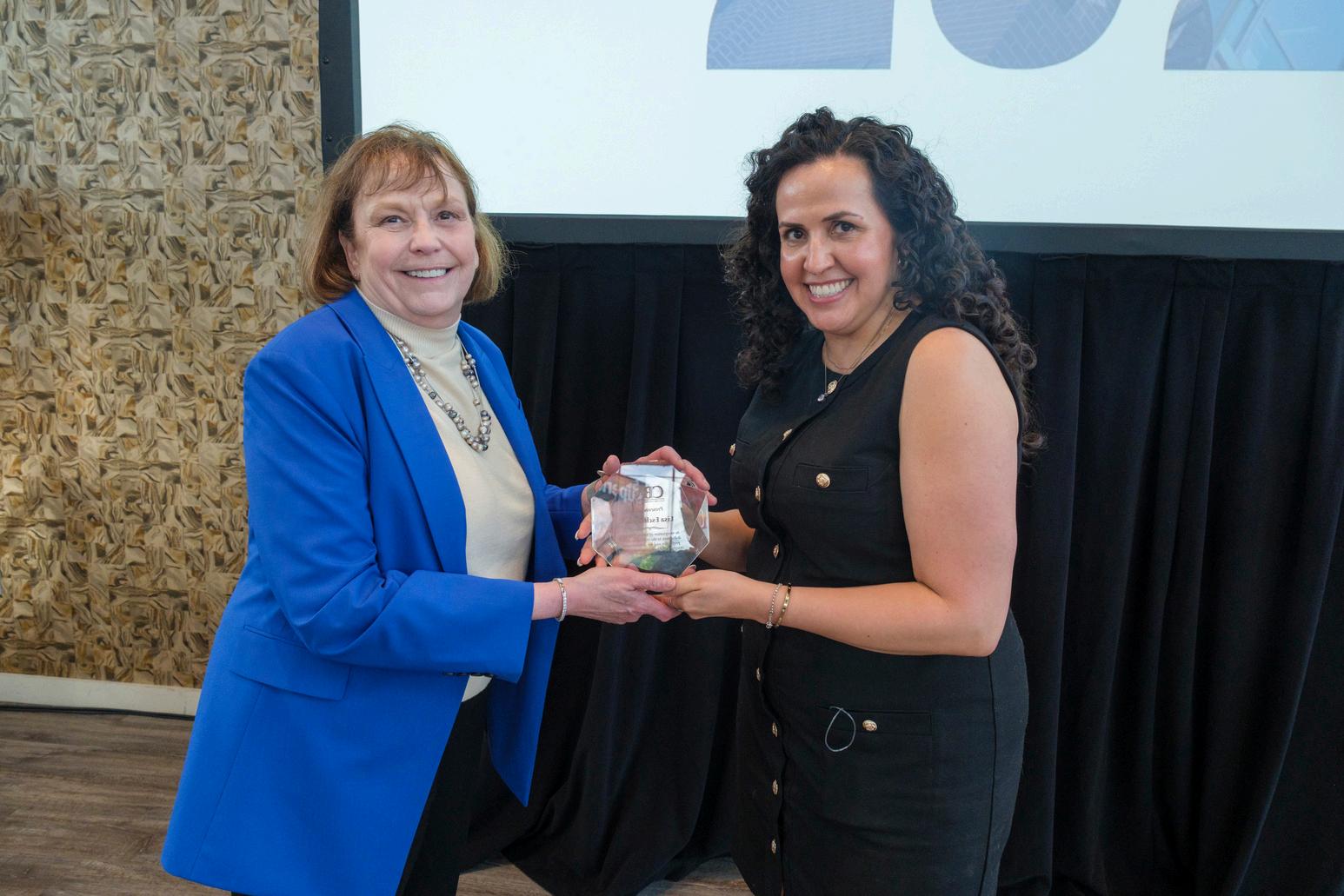


That commitment will continue to guide the Columbus Bar as we explore new ways to deliver value to our members. Whether through innovative educational opportunities, expanded networking experiences, or new resources designed to support modern legal practice, our focus remains the same: creating a membership experience that is simple, meaningful, and connected.
My hope for the coming year is that every member sees the Columbus Bar not simply as an
organization they belong to, but as a community they actively engage in a place where they can develop professionally, build lasting relationships, discover new opportunities, and contribute to something larger than themselves. Because ultimately, the future of the Columbus Bar Association will not be defined by any single program or service.
It will be defined by the strength of our community. One Simple Investment. One Unified Community. Together, we will continue building a Columbus Bar Association that meets the needs of today's lawyers while strengthening the connections that have sustained our profession for generations.
I am excited for what lies ahead and look forward to building that future together.

Melanie Tobias-Hunter
Columbus City Attorney Zach Klein’s Office-Criminal Division Chief mrtobias@columbus gov

Alston Quillin
Brodi Knodell
Caitlyn Looby
Catherine Robertson
Deborah Light
Ella Todd
Emily Hemlinger
Erich Guenther
Gina Fulton
Heather Lang
Kellen Whalum
Kelli Murphy
Laurel Barr
Lesley Vanessa Villarreal
Macayla Moore
Marc Falkoff
Maria McKeon
Mary Asomaning
Meghana Vallabhaneni
Michael Fallings
Nicholas Butler
Patrick Cummins
Russell Gertmenian
Ryan Gordon
Sean Rhodes
Shanna Harrell
Skylar McMillan-Gray
Sloane Collins
Thomas Wood
Victoria Falcon-Flansburgh
Wendy Celestin
KelliJoAmador
JaneStempelArata
GeorgeJ.Arnold
JoanneS.Beasy
DavidS.Bloomfield,Jr.
ThomasJ.Bonasera
SandraE.Booth
JamesH.Bownas
WilliamJ.Browning
WilliamL.ByersIV
SandraCarrillo
W.JeffreyCecil
MarkC.Collins
RonaldE.Davis
ShaneM.Dawson
RichardS.Donahey
RobertD.Erney
HenryL.Fein
JohnC.Fergus
StephenC.Fitch
RonaldA.Fresco
ScottN.Friedman
PeterJohnGeorgiton
JackG.Gibbs
PaulGiorgianni
DavidA.Goldstein
ShannaRaeHarrell
DimitriosG.Hatzifotinos
BarronK.Henley
DouglasE.Hoover
CynthiaEllisHvizdos
RichardB.Igo
FrederickM.Isaac
VickiL.Jenkins
JohnS.Jones
MichaelS.Jordan
RussellA.Kelm
RobertW.Kerpsack
RussellW.Kessler
AllenS.Kinzer
KennethR.Kline
RichardL.Levine
ScottT.Lindsey
ThomasK.Lindsey
AnnWhitlowLippman
DavidK.Lowe
MichaelD.Martz
WalterW.Messenger
DavidP.Meyer
RichardF.Meyer
JayE.Michael
ScottR.Mote
StephenA.Moyer
JohnC.Nemeth
ColleenK.Nissl
KimberlyD.Nocera
DavidC.Patterson
WilliamG.Porter
FrankA.Ray
MaryellenReash
SusanD.Rector
RonaldL.Rowland
PhilipP.Ryser
JamesA.Saad
CharlesA.Schneider
KeithW.Schneider
CarlD.Smallwood
RobinL.Strohm
IraB.Sully
ThomasM.Taggart
AracelyTagliaventi
MickelleaTennis
J.TroyTerakedis
DavidH.Thomas
H.LeeThompson
MelanieR.Tobias-Hunter
WilliamJohnWahoff
CharlesC.Warner
ScottN.Whitlock
BradleyB.Wrightsel
BenjaminL.Zox




ByDavidC.Tryon
“Where there is no vision, the people perish...”
Proverbs 29:18 (King James)

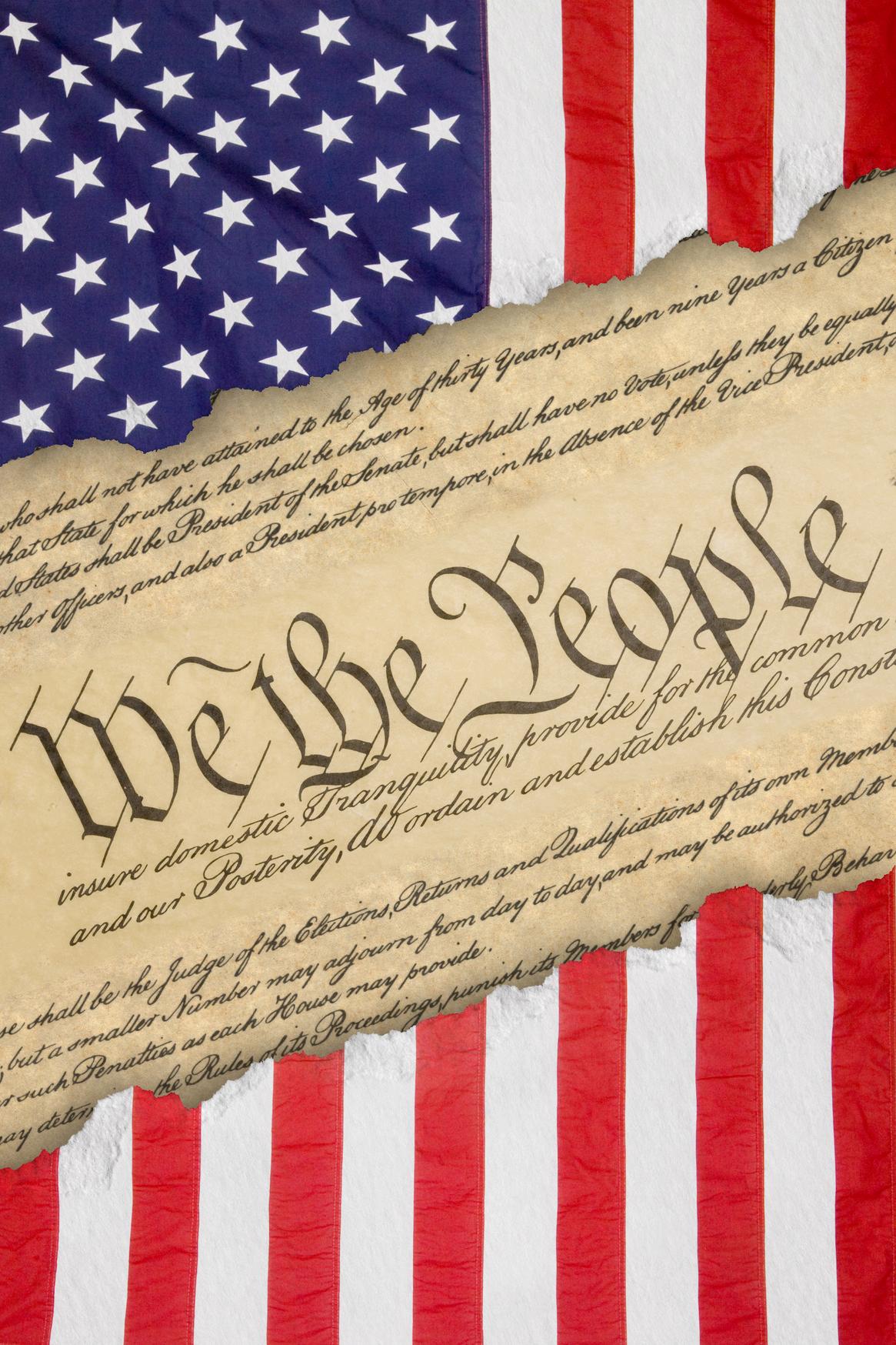
The Declaration of Independence: A Vision of Freedom and Equality
Margaret Thatcher once correctly said of the United States, “No other nation has been built upon an idea the idea of liberty.”[1]
Most nations primarily reflect their own history, language, and geography, but America was founded on a mission statement announced famously by “the greatest sentence ever crafted by human hand”[2]: “that all men are created equal, that they are endowed by their Creator with certain unalienable Rights, that among these are Life, Liberty, and the pursuit of Happiness.”[3]
That new vision of liberty makes the United States of America unique among the nations and has inspired generations of Americans and people around the world to live up to its great
promise by holding our institutions to that “promissory note to which every American was to fall heir.”[4] As President Calvin Coolidge recognized on our Declaration’s 150th anniversary, “[g]overnments do not make ideals, but ideals make governments.”[5]
Despite “read[ing] like a legal document,”[6] the Declaration of Independence is not law.[7] As Chief Justice Roberts has explained, “[t]he Declaration of Independence was then, and remains today, a statement of national aspirations, not a codification of enforceable legal obligations.”[8] Recognizing that a new national charter was necessary to sustain the Declaration’s principles,[9] the Framers drafted the Constitution as the binding fulfillment of the Declaration’s promise.[10] Thus, the Declaration has long been valuable for informing our jurisprudence because, although

its “principles may not have the force of organic law ... it is always safe to read the letter of the Constitution in the spirit of the Declaration of Independence.”[11]
Courts have looked to the Declaration as “one of many sources of the Constitution’s original meaning”[12] and have used it to illuminate “the understandings of the American people from the pertinent ratification era,” which provide “strong evidence” of the Constitution’s meaning.[13] The Declaration, for example, has informed the judiciary’s constitutional interpretation of the Bill of Rights by listing “America’s many [pre-ratification] objections to British laws and the system of oppressive British rule over the Colonies.”[14] The American revolution erupted in no small part due to Britain’s “long train of abuses” and its “history of repeated injuries and usurpations.”[15] And because the Constitution’s subsequent legal protections were meant to guard against those abusive injuries,
the Declaration’s explanation remains useful to our modern judicial understanding.
Many states, for their part, have adopted key language from the Declaration into their own state constitutions.[16] The Ohio Constitution, for instance, declares: “All men are, by nature, free and independent, and have certain inalienable rights, among which are those of enjoying and defending life and liberty, acquiring, possessing, and protecting property, and seeking and obtaining happiness and safety.”[17] Regrettably, Ohio courts have failed to give this constitutional provision more than aspirational weight, calling it “a statement of fundamental ideals” rather than accepting it as “an independent source of selfprotecting protections.”[18] That view may yet succumb to legal challenge, and the Declaration itself reminds us of our right and duty to use legal tools to resist overbearing and unjust laws in our courts and voting booths.[19]
As we celebrate the nation’s 250th birthday, we do well to remember that America’s founding was no mere accident. “It has a philosophical cause,”[20] and so despite our many trials and tribulations, “[a]mid all the clash of conflicting interests, [and] amid all the welter of partisan politics, every American can turn for solace and consolation to the Declaration of Independence and the Constitution ... with the assurance and confidence that those two great charters of freedom and justice remain firm and unshaken.”[21] And that is because, as President Coolidge reminded us 100 years ago, there is a reassuring finality to the Declaration’s truths: “If all men are created equal, that is final. If they are endowed with inalienable rights, that is final. If governments derive their just powers from the consent of the governed, that is final.”[22]
Though we may be “heirs” to “the magnificent words of the Constitution and the Declaration of Independence,”[23] we must always remember that “[t]he real heart of the American Government depends upon the heart of the people. It is from that source that we must look for all genuine reform. It is to that cause that we must ascribe all our results.”[24] So as we hope for an even greater fulfillment of the Declaration’s unique and laudable vision, Thomas Jefferson’s own reflections still ring true: “I like the dreams of the future better than the history of the past.”[25]

1. Margaret Thatcher, Speech at Hoover Institution Lunch (Mar. 8, 1991).
2. John G. Roberts, Jr., 2025 Year End Report on the Federal Judiciary 3 (Dec. 31, 2025), quoting Walter Isaacson, The Greatest Sentence Ever Written 2 (2025)
3 Declaration of Independence ¶ 2
4 Martin Luther King, Jr , I Have a Dream, Address on the Steps of the Lincoln Memorial (Aug 28, 1963)
5 Calvin Coolidge, Address at the Celebration of the 150th Anniversary of the Declaration of Independence in Philadelphia, Pennsylvania (July 5, 1926)
6 Roberts, supra note 2, at 4
7 See United States v Rahimi, 602 U S 680, 721 (2024); Troxel v Granville, 530 U S 57, 91 (2000) (Scalia, J , dissenting) (“The Declaration of Independence is not a legal prescription conferring powers upon the courts ”); Mark Graber, The Declaration of Independence and Contemporary Constitutional Pedagogy, 89 S Cal L Rev 509, 515 (Mar 2016)
8 Roberts, supra note 2, at 5
9 Alexander Tsesis, The Declaration of Independence and Constitutional Interpretation, 89 S Cal L Rev 369, 372 (2016)
10 Charles Alan Wright, In Memoriam: Warren Burger: A Young Friend Remembers, 74 Tex L Rev 213, 219 (1995) (quoting Chief Justice Warren Burger)
11 Gulf, Colo & Santa Fe Ry Co v Ellis, 165 U S 150, 160 (1897)
12 Lee J Strang, Originalism, the Declaration of Independence, and the Constitution: A Unique Role in Constitutional Interpretation?, 111 Penn St L Rev 413, 414 (2006)
13 United States v Rahimi, 602 U S 680, 719 (2024)
14 Id at 721
15 Declaration of Independence ¶ 2
16 See, e g , Fid & Cas Co of New York v Union Savs Bank Co , 29 Ohio App 154, 156 (1928); Perez v Sharp, 32 Cal 2d 711, 733–34 (1948), citing Inglis v Trustees of the Sailor’s Snug Harbor, 28 U S 99 (1830)
17 Ohio Const , art I, § 1
18. State v. Williams, 88 Ohio St.3d 513, 523 (2000).
19. See Abraham Lincoln, The Perpetuation of Our Political Institutions Address Before the Young Men’s Lyceum of Springfield, Illinois (Jan 27, 1838)
20 Abraham Lincoln, Fragment on the Constitution and Union (Jan 1861)
21 Coolidge, supra note 5
22 Id
23 King, supra note 4
24 Coolidge, supra note 5
25 Thomas Jefferson, Letter to John Adams (Aug 1, 1816)

By Judge Kristin Boggs

“We don’t want judges who will legislate from the bench,” said my doctor. It was 2012, and I was working as an Assistant Attorney General. I was surprised to see a campaign poster in her office endorsing a slate of candidates running for the Ohio Supreme Court. I assumed she personally knew one of them I did not expect her response when I asked about the poster.
My curiosity piqued, I pressed her further. “What do you mean?”
I asked.
“We don’t want judges who use their position to make policy. That’s the legislature’s job,” she answered.
I couldn’t disagree, but I still didn’t understand. “So, I’m working on this case.” I explained, “A city
passed a local ordinance to prohibit residences from having more than two ‘vicious’ dogs. Plaintiffs claim that the term ‘vicious’ is unconstitutional because it’s too vague and ambiguous to enforce. Would a judge be legislating from the bench if they uphold the statute, or would they be legislating from the bench if they strike it down?”
“I don’t know,” my doctor answered honestly. “You’re the only person to ever ask about the poster.” She was done with the conversation, but it left me still wondering: When did this phrase become so mainstream that it reached my doctor?
Questioning judicial overreach is not a new concept. The Constitution does not explicitly give judges the power to strike down laws passed by Congress for being unconstitutional. However, in 1803 Chief Justice John Marshall reasoned in Marbury v. Madison that the existence of such power can be inferred from the Constitution.[1]
The Supreme Court would not test this power again for another 54 years, until Dred Scott v. Sandford, which, in part, held that Congress lacked the constitutional authority to abolish slavery in federal territories.[2] President Abraham Lincoln urged Americans not to accept this decision while rallying for the adoption of the 13th and 14th amendments to the Constitution proving that judicial decisions could yield to the will of the people. But it wasn’t until the 1930s when President Franklin D. Roosevelt used his Fireside Chats (The first podcast influencer!) to accuse the Supreme Court of acting inappropriately as a policy-making body because it repeatedly thwarted his New Deal legislation. Since then, the notion of judges legislating from the bench has become increasingly common.
In 2016, I left the Attorney General’s Office and was elected to the Ohio House of Representatives. In 2022, I decided to run for the 10th District Court of Appeals. I knew I would
face scrutiny about whether I would be inclined to legislate from the bench after serving as a legislator. However, Ohio has many judges who first served in the legislative branch before being elected to the bench. I believe this experience fosters a better understanding of the difference between adjudicating and legislating. It also provides unique insight into the legislative process that helps shape how to interpret vague and unclear statutes.
Most judges accept the “plain meaning rule.” That is, if a statute can be interpreted and applied through its plain unambiguous text, then it must be applied as written. However, if the language is unclear, judges are urged to consider the intent of the legislature and strive to uphold the law in a way that fulfills the purpose for which the law was enacted.
After being a legislator, however, I recognize the difficulty in determining a legislative body’s
intentions. For starters, the Ohio House and Senate have a combined 132 members with covert agendas and unique motivations. The notion of 132 people having a unified intent is illusive. While disagreeing intensely, the most conservative and most progressive members have voted the same way: one because a bill goes too far and the other because it doesn’t go far enough. So how does one decipher intent when the vote casted is the same but for very different reasons?
Further, I know firsthand that vagueness is not always unintentional. Sometimes statutory language is deliberately vague because clarifying it would cost votes or because the legislature wants to yield the power to the executive branch to shape the policy through the executive rulemaking process. I also now understand that when a bill comes to the floor for a vote, only a few legislators have fully read it. Legislators rely heavily on policy aides and the Legislative
Service Commission to summarize and answer questions regarding each bill meaning those staff interpretations carry enormous weight. Republicans and Democrats employ different policy staff who can easily have different interpretations of a bill and advise their respective caucuses accordingly.
For these reasons, trying to ascertain legislative intent is exceedingly difficult. Yet the courts must still fulfill their duty to interpret and apply not rewrite — the laws enacted by the legislature. Even so, judges’ longstanding history of interpreting legislative intent in the face of ambiguous statutory text isn’t the appropriate framework through which people should rally against the notion of judges “legislating from the bench.”
So,
If my doctor’s answer is any indication, most people can’t say and that ambiguity, as vexing as any legislative vagueness, is
precisely the problem. After traversing all three branches of state government, I have come to believe that “legislating from the bench” is often an intentionally vague criticism used to arouse hostility toward the judiciary. Questioning the operation of government including the judicial branch — is undeniably a powerful and essential tool in our democracy.
Unfortunately, I expect that as our courts increasingly become the arenas in which deeply divisive issues are decided, the judicial branch will continue to be the target of the same disapproving frustration people express towards the executive and legislative branches.
1. Marbury v. Madison, 5 U.S. 137 (1803).
2. Scott v. Sandford, 60 U.S. 39 (1857).


ByChristopherR.GreenandMarissaR.Borschke
Employers operating in Columbus, Ohio, have less than six months left to prepare for a significant change in hiring practices.
Effective January 1, 2027, the City of Columbus will begin enforcing its pay transparency requirements under Ordinance 2898-2025, which will require covered employers to include a "reasonable salary range or scale" in employment postings.
While some employers may view this as a simple change to job advertisements, the reality is that pay transparency laws often expose broader compensation, equity, and compliance issues that organizations should address before salary ranges become public.
Columbus is not alone. Over the past several years, states and municipalities across the country have adopted pay transparency laws requiring employers to disclose compensation information during the hiring process. Jurisdictions such as Colorado, California, New York, Washington, and Illinois have enacted various forms of salary disclosure requirements, reflecting a broader policy movement aimed at promoting pay equity and reducing wage disparities.
As more states adopt these laws, employers with multi-state operations are increasingly finding that maintaining separate
recruiting practices for different jurisdictions is becoming administratively burdensome. Many organizations have instead elected to implement nationwide pay transparency practices, using consistent salary disclosure standards across their workforce.
For employers with operations in Columbus, the new ordinance may present an opportunity to evaluate whether a localized compliance strategy or a broader company-wide approach makes the most sense.
The ordinance applies to employers with 15 or more employees and requires a reasonable salary range or scale to be included in employment postings for positions covered by the ordinance. The ordinance identifies several factors that may be considered when determining whether a salary range is reasonable, including:
Budget flexibility
The anticipated experience level of applicants
Variations in job responsibilities
Growth opportunities within the position
Geographic cost-of-living considerations
Market data for comparable positions
Notably, the ordinance does not prescribe a specific percentage spread or formula for establishing salary ranges. Instead, employers must be prepared to demonstrate that their ranges are grounded in legitimate business considerations and are reasonably related to the position being advertised.
The ordinance also builds upon Columbus's existing restrictions regarding salary history inquiries. Covered employers generally may not inquire about an applicant's salary history, screen applicants based on prior compensation, or rely solely on salary history when making compensation decisions.
Although enforcement does not begin until January 1, 2027, employers should consider using the remainder of 2026 to evaluate their compensation practices and recruiting procedures.
One of the most significant questions raised by the ordinance is what constitutes a "reasonable" salary range. Employers should ensure that compensation ranges are supported by objective business factors, such as market surveys, internal compensation structures, experience requirements, geographic differentials, and budgetary considerations. Employers that cannot explain how a range was developed may face increased scrutiny if a complaint arises.
Public salary ranges often lead employees to compare their
compensation with posted ranges for similar positions. As a result, employers frequently discover pay compression issues, inconsistencies between departments, or legacy compensation decisions that become difficult to explain once ranges are publicly available.
Conducting an internal compensation review before implementation can help identify and address potential concerns before they become employee relations issues or litigation risks.
Employers should review job posting templates, recruiting platforms, applicant tracking systems, and hiring workflows to ensure salary ranges are consistently included where required. Human resources personnel, recruiters, and hiring managers should also be trained regarding the ordinance's continued restrictions on salary history inquiries and appropriate compensation discussions during the hiring process.
For employers operating in multiple jurisdictions, Columbus's ordinance may be another reason to reassess recruiting practices on a broader scale. Many employers are finding that uniform compensation disclosure practices are easier to administer than maintaining different requirements for different locations. However, because transparency laws vary significantly across jurisdictions, employers should carefully evaluate whether a nationwide approach creates unintended compliance issues elsewhere.
The trend toward pay transparency shows little sign of slowing. What began as a handful of state and local requirements has evolved into a nationwide movement that continues to reshape recruiting and compensation practices.
While including a salary range in a job posting may seem straightforward, the legal and practical implications often extend far beyond the posting itself. Compensation structures, internal equity, recruiting practices, and employee relations considerations should all be evaluated as part of a comprehensive compliance strategy.
Employers should consider taking proactive steps now to position themselves for compliance and minimize potential risk in 2027.


Amundsen Davis LLC cgreen@amundsendavislaw.com

Marissa R Borschke
Amundsen Davis LLC mborschke@amundsendavislaw.com


ByBradyR.Wilson

Watching my one-year-old son has changed my perspective on wellness. Wellness can be as simple as doing the things that make us happy and avoiding the things that don’t.
Babies tell you how they feel. For my son, that communication is straightforward: crying means something isn’t right, smiling means everything is right, and “da
da” means there is a dog nearby that he needs to get a better look at. I’ve learned a lot about him through this communication. For example, he likes going outside, riding the bike, chasing dogs’ tails, and reading the book about cows a few times a night. Conversely, he dislikes going inside, getting off the bike, seeing the dogs run away from him, and hearing that it is time for bed.
His reactions are transparent and immediate. His goal is simply to tell me what is working and what is not. As I have reflected during his life, it is easy to notice how often adults — especially lawyers ignore our own signals and put off the things that bring us happiness. We often put our needs behind work and accept temporary discomfort. We drink another cup of coffee to push through the fatigue and tell ourselves that everything will slow down next week. It’s easy to think that our needs can wait, that we’ll rest or recharge later, or that skipping out on hobbies is no big deal.
My solution after watching my son is simple: recognize what makes me happy and prioritize that. Our lives are more complicated than my toddler’s. Each of us has things that we don’t care for but must do, whether at work or otherwise. For me, I spend more time inside in front of my screen than I would like. I was drawn to litigation, in part, because of the opportunities
to get out of the office and into courtrooms and client sites. I regularly hear war stories of lawyers bouncing around the state or country to conduct a dozen depositions, discovering a new restaurant near the courthouse where they spent weeks at, or spending days with a client combing through physical filing cabinets for discovery. I have only practiced since COVID-19. However, because of the changes brought about by the pandemic, the majority of my work is online. Those same depositions are now on Zoom. The status conferences that drew attorneys to the courthouse are now over the phone. Discovery tools, thankfully, have largely eliminated onsite review. With these changes, many of the reasons for a young litigator to get out of the office are less common.
Without some of these built-in reasons to get away from the screen, I have had to make a conscious effort to find ways to step away from the screen and get outside. Whether it is walking around the corner to grab coffee with a friend, heading out early during the Ohio winter to squeeze in a run before sunset, or working from the porch on a Friday afternoon, I have found ways to integrate time outside into my practice.
These steps didn’t happen overnight. It took a few years for me to figure out the things that work. For example, my productivity normally dips in the late afternoon. A couple of years ago, I would have just pushed through. Now, I know that taking a 15-minute walk will give me the second wind I need to refocus and finish the day strong. Of course, more time in practice helps too. The same “emergencies” that would have kept me up as a first-year attorney are now just another box to check on the proverbial to-do list.
My suggestion to other attorneys is simple: take stock of the things that bring you happiness and make the effort to do those things. This perspective isn’t perfect. It doesn’t come with clear lines or boundaries. Although I find myself thinking about a case when we’re at the park, checking off my mental to-do list while out on a run, and leaving my parents’ house early to get back online, it is appealing to me because of its obviousness: the more things I do that make me happy, the happier I will be.
Unlike a toddler, I don’t have tantrums to tell me when something isn’t going right. But when I start to feel the scales tipping away from the things that I enjoy, it is time to reprioritize and incorporate the things that bring me happiness into my day. On a busy day, that might mean simply logging off for a bit to sit on the porch with my son and watch some big dogs pass by.

Brady R. Wilson

ByJanyceKatz
Freddy the Politician or, as it was named when it was first printed in 1939, Wiggins for President, is the sixth of the 26 books Walter Brook wrote about Freddy the Pig. It is a political satire that critiques elections, banks, legal manipulation, and dictators trying to use laws to ensure they control power.
Freddy and the other animals living on Mr. Bean’s farm speak English, and some of them can both read and write. Mr. and Mrs. Bean are humans and the owners of the farm. They want to head off to Europe but are concerned

about leaving their farm with no one to watch over and run it. To prove to Mr. and Mrs. Bean that that they could take care of the farm’s finances as well as the other farm responsibilities, the animals decide to set up a bank.
Freddy the pig and Jinx the black cat lead the establishment of a bank. Jinx just wants to put up a sign that says “bank” and start the bank. Freddy follows more practical advice, and the First Animal Bank opens. Mr. Bean, angry at the regular bank, puts all his assets into the First Animal Bank, and he and his wife go off to Europe.

John Quincy, a woodpecker from a distinguished family residing around the White House, accidentally flies off course and stumbles, rather bedraggled, into the Beans’ farm. The animals welcome Quincy, and he gradually regains his health. With his knowledge and experience, Quincy joins Freddy, Jinx, and a few others on the board of the bank.
After Jinx quits, Quincy brings in his father, Grover, as a replacement. The two refined woodpeckers play dirty. In one instance, they use real dirt to block the bank entrance through which Freddy and other larger animals could fit through.
The woodpeckers, in coalition with the rats, run Grover as their candidate.
The woodpecker-rat alliance may have entered Marcus into the race primarily to siphon votes from Mrs. Wiggins. Mrs. Wiggins is also derided because she has an unusual laugh, which some animals believe makes her insufficiently dignified for the presidency.
As only those living on the farm could vote, the woodpeckers make another rule-breaking move: they corral nearby birds to vote. The woodpeckers also extend their influence to animals on neighboring farms that cannot speak human language, as an attempt to expand their control into a wider empire.
Freddy attempts to break into the First Animal Bank to call other animals for a vote. The woodpeckers trap him.

After a woodpecker-led meeting excludes Freddy and other animals from voting because they cannot enter the bank, control of the bank soon turns into a broader struggle for political power, and Freddy and his allies decide the farm needs a president. Mrs. Wiggins, a cow known for her wit, common sense, and warmth, is Freddy and most of the other animals’ first choice. Freddy nominates Mrs. Wiggins for the top position in the First National Animal Republic on a farm deep in the state of New York. The race for president becomes complicated as Simon the rat pushes a questionable rabbit, Marcus, for the position.
And then . . . I won’t spoil the ending by saying what happens.
However, I will say that I found, read, and loved all the Freddy the Pig books that the nearby library had during the summer when I was nine years old. It wasn’t until after I got my law license and started working in Columbus that I found ten Freddy the Pig books, reread them, and discovered the satire and subtle critiques of the issues of the time when the books were written.


Allegedly, George Orwell was influenced by Brooks’ Freddy the Politician when he wrote Animal Farm. First published in 1945, Orwell used talking farm animals to tell his story about a quest for equality for all animals. The farm animals in Animal Farm
overthrow the cruel farm owner’s treatment and, in a parody of what happened in Russia, the pigs (Stalin) gradually take over while the loyal horse is sent to the glue factory. The pigs had by then altered the slogan “all animals are equal” by adding “but some animals are more equal than others.”

Janyce C. Katz
General Innovations and Goods, Inc
janyce.c.katz@gmail.com

By Joshua Cartee
“Violin was part of my life from the very beginning,” said Peter Georgiton as we settled into our coffee at The Roosevelt Coffeehouse on Long Street.
Peter’s father, John, is a longtime fiddler in bluegrass bands. Peter recalled picking up a spare violin
as a small child and trying to play it a hard task given it had no strings! He soon began playing the violin in first grade, at the prompting of his father. Peter stuck with lessons because playing “came naturally” and was enjoyable though practicing took a little getting used to. He
continued private lessons through high school. He also played with the Columbus Symphony Cadet and Youth Orchestras at venues including Capital University and Weigel Hall at The Ohio State University, performing some of the same repertoire as the professional orchestra. Being part of the orchestras allowed Peter to gain an even greater appreciation of musical compositions and the composers who synthesized different instrument parts into a cohesive whole. Peter recalled Symphony No. 2 in D major by Jean Sibelius and Appalachian Spring by Aaron Copland as having profound impacts on his musical development. Playing these classical masterpieces with a full orchestra, Peter says, “was a different way to experience music.”
Before law school, Peter graduated from Wittenberg University in Springfield, Ohio, with a degree in history in 1999. At Wittenberg, Peter continued to play the violin. He played in the Wittenberg University Chamber
Orchestra and in a folk-rock band named Glimmerbox. The band wrote all of its own music and included a singer-songwriterguitarist, a second singer, a bass player, a drummer, and Peter on the violin. The band did some recording at The RecW, a professional recording studio in Massieville, Ohio. Peter mostly played by ear and, on occasion, took audience requests during Glimmerbox gigs, something he viewed as a fun challenge. Peter said the fiddle tune “Orange Blossom Special,” popularized by Johnny Cash, was a crowd pleaser.
One lesson Peter took from playing in the band was that, in music as in life, you must be nimble. “Things don’t always line up neatly on stage,” he says. “You have to be prepared for whatever gets thrown at you.”
Today, Peter manages a busy commercial and tort litigation and insurance coverage practice at Dinsmore & Shohl, where he has practiced law since graduating
from The Ohio State University Moritz College of Law in 20 He began his legal car at Dinsmore’s Cincinn headquarters before moving Dublin in 2016 and joining firm’s Columbus office. There, serves on the firm’s Professio Development Committee, giv presentations for the Americ Bar Association’s Insurance Coverage Litigation Committee, and handles a wide array of insurance coverage matters for clients such as State Farm.
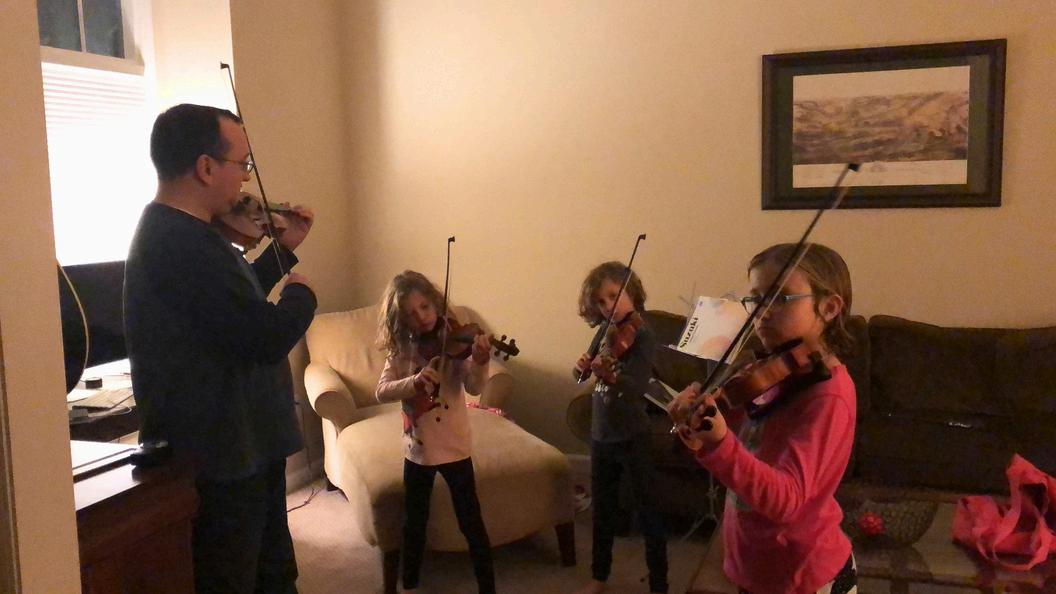
Although Peter has developed a thriving legal practice, he noted that the “challenge of being a lawyer is that there is often not enough time to practice music beyond personal enjoyment.” Still, after a few years’ hiatus from serious playing, Peter rekindled his love for violin (and practicing) following the births of his daughters, Katie (18) and twins Maggie (15) and Abby (15).
Peterteachinghisdaughterstheviolin has tried to impart to his children that he wants them to enjoy music and doesn’t expect them to become virtuoso concert performers. His youngest daughters, Maggie and Abby, play in their school orchestra and have taken up additional instruments: Abby plays the viola, and Maggie plays electric and acoustic guitar. His eldest daughter, Katie, has played in the Dublin Coffman Chamber Orchestra and intends to continue playing music when she attends the College of Wooster next year. One of Peter’s fondest memories is when he was pressed into service at the last minute to accompany his daughters on violin All three daughters began violin lessons when they were young, and all continued to play. Peter
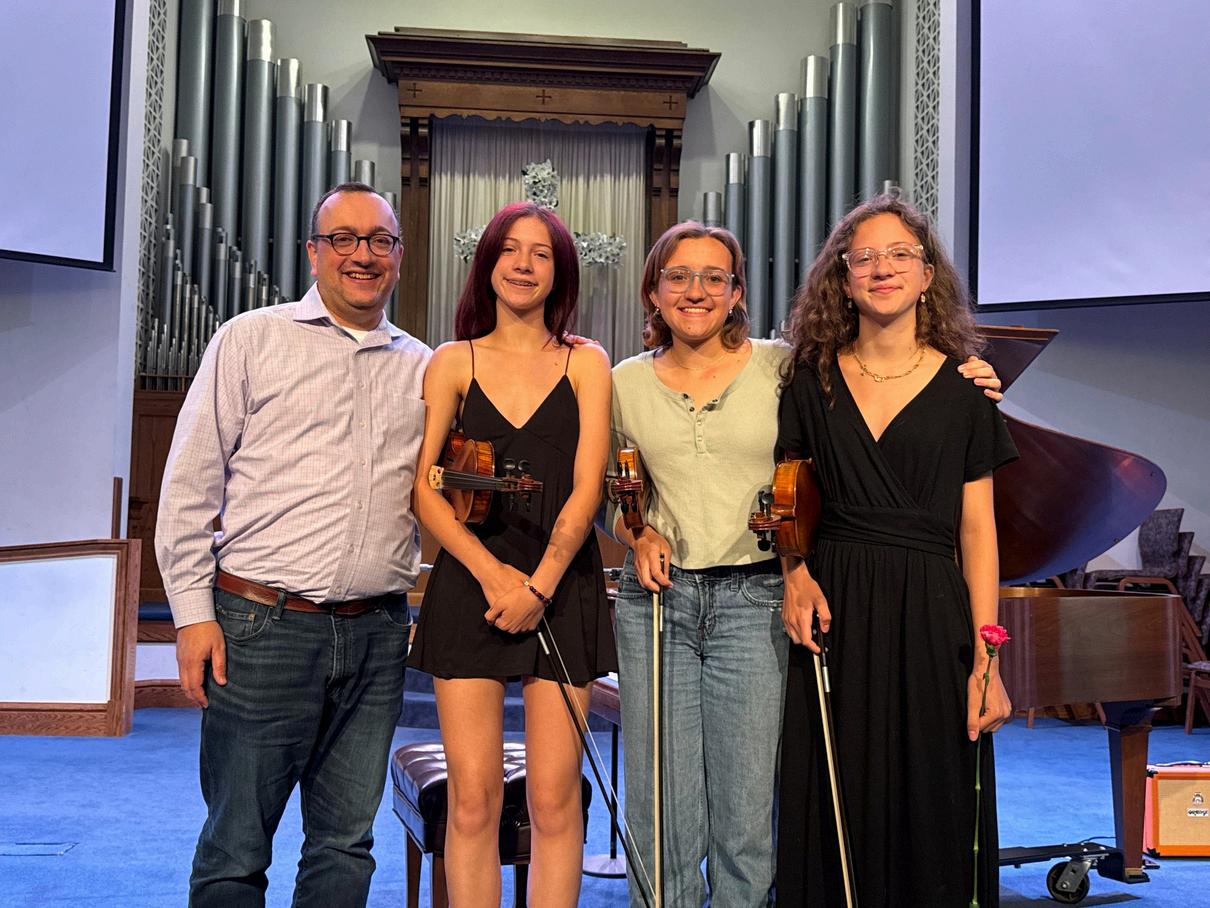
PeterwithMaggie,Katie,andAbbyattheirrecital
Recently, Peter has expanded his own musical repertoire. In the past few years, he has learned the mandolin, which has the same fingerings as the violin but the strings are doubled and plucked instead of played with a bow. He has also picked up the four-string Irish tenor banjo and the eightat their music recital. Being able to make music with his daughters “was a very special experience,” Peter said.
string octave mandolin, which is a mandolin on a guitar body that plays eight notes (an octave) lower than a regular mandolin. The latter instrument is a favorite of American singer-songwriter Sarah Jarosz, whose 2010 rendition of “Come On Up To The House” at Austin City Limits is the gold standard. (Both Peter and I agreed on this point; no disrespect intended to the Tom Waits original.)
Peter also enjoys playing violin with his father, who got him started on the instrument. Together, they played in jam sessions in Columbus and at a bluegrass workshop at Denison University.
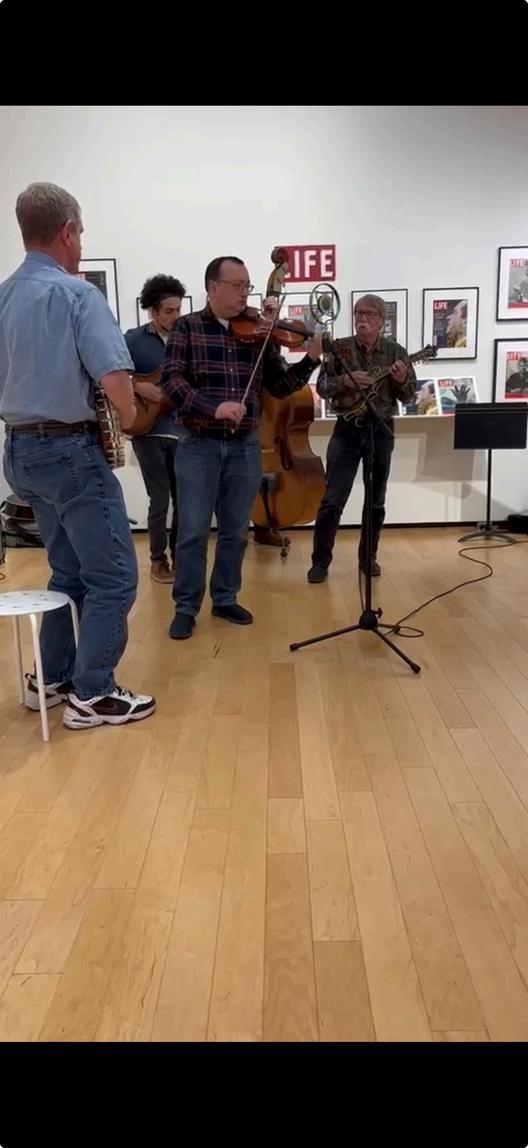
When Peter was a kid, his father would set out a boombox on the front porch of their house, turn it on, and serenade the neighborhood with his fiddle. At the time, Peter was a little embarrassed by the performances, afraid of the
reaction from his classmates riding their bikes by his house. After Peter moved back to the Columbus area as an adult, though, his father came over to Peter’s home to watch his granddaughters. As Peter was pulling up to the house after a day at work, what else did he see but his dad once again serenading the neighborhood to a boombox track on the front porch.
“It was a full-circle moment,” Peter says, smiling.
Music has provided Peter with a lifelong passion, connection to family members, and several valuable life experiences and lessons. Perhaps the most important lesson of all is that “you get out of something what you put into it,” he says.
As in music, so in life.

I’ve worked with lawyers in every corner of the profession: litigators, in-house counsel, solo practitioners, public defenders, government attorneys, etc. They come from different backgrounds, serve in different settings, and handle vastly different pressures. But there’s one thing I hear over and over, from lawyers at all levels of success: “I feel like I’m barely holding it together, but I can’t let anyone see that.”
That feeling is more common than you think. And the silence around it? That’s part of the problem.
In a profession built on high standards and long hours, many lawyers have internalized the belief that stress, burnout, and anxiety are weaknesses. But that mindset is outdated and dangerous.

By Scott R. Mote

Here are five ways lawyers can lead by example and send a clear message that prioritizing mental health isn’t just allowed — it’s essential. The truth is, mental well-being is a strength. It helps you think clearly, act ethically, communicate effectively, and sustain your performance over time. And the more we treat it that way, the better off our entire profession will be.
You don’t have to share your deepest personal experiences. But being honest about the demands of this work can go a long way. Try this:
“This case has taken a lot out of me. I’ve had to be intentional about staying grounded.”
“I’ve learned the hard way that if I don’t take care of my mental health, my work suffers.”
Even a simple comment like the above examples can change the culture in your office or firm. It tells colleagues, younger lawyers, and staff that it’s okay to feel stress and it’s okay to talk about it.
Lawyers in environments where mental health is acknowledged are more likely to seek support before problems escalate. That’s good for people and for practice.
I know this is difficult. The law often demands long hours, tight deadlines, and urgent client needs. But if you never step away, never protect your time, never say no, you will find yourself running on fumes.
Healthy lawyers do things like:
Take a real lunch break. Set office hours or client communication windows.
Say “no” to new matters when capacity is full.
Use vacation time to unplug.
Get exercise, sleep, and support — not just in theory, but in practice.
None of this makes you less committed. It makes you more effective. It shows others, especially junior lawyers or law students, that success doesn’t have to mean self-sacrifice.
Your well-being isn’t something to manage in the margins. It’s the foundation of clear judgment, client service, and professionalism.
You might not think of yourself as a leader, but if you’ve been practicing for a while, then you are one. People watch how you handle stress. They notice whether you’re approachable
when they’re struggling. They pay attention to what you normalize.
You can foster a healthier workplace by:
Checking in after long trials or tough weeks.
Encouraging people to take time off without guilt.
Respecting personal time. Don’t praise “always on” behavior as heroic.
Talking openly about contacting OLAP or other mental health support when someone seems off.
It’s not about being everyone’s therapist. It’s about being human and creating space for others to be human too.
A culture of empathy doesn’t happen by accident. It starts with how we treat each other in the everyday.
There’s still a persistent idea that great lawyers are emotionless, sleepless machines who never need help. But let me tell you: some of the best lawyers I’ve worked with are the ones who know when to pause, reflect, and recalibrate.
You can help dismantle that toxic “tough it out” myth by:
Admitting when you’re feeling stretched thin.
Saying you’ve contacted OLAP or have gone to therapy and it helped. Encouraging newer lawyers to build support systems early. Valuing collaboration, boundaries, and emotional intelligence as much as raw intellect.
Resilience isn’t about powering through at all costs. It’s about knowing when and how to recover.
Every time you speak up about wellness, whether at a bar association event, CLE seminar, law school talk, or even on LinkedIn, you help reshape what it means to be a lawyer.
Try this:
Mention mental health in CLE presentations. Write or share articles on burnout or work-life integration. Support wellness programs at your firm, bar association, or alma mater.
Speak during Mental Health Awareness Month about your own journey.
You don’t have to become an advocate. Just be honest. Be real. Be someone who shows that success and self-care can go hand in hand. Lawyers who lead with clarity, ethics, and empathy are the future of this profession, and mental health is part of that equation.
You Don’t Have to Be Invincible to Be Respected
The greatest lawyers I know aren’t the loudest, the flashiest, or the ones who pull all-nighters until collapse. They are the ones who stayed grounded. Who know their limits. Who make decisions with care and presence because they aren’t burned out and running on empty. They have people. They have practices. They have perspective. You deserve those things too.
If you’re feeling overwhelmed, disconnected, or unsure where to start, please reach out. OLAP is here for you. We’re 100% confidential, completely free, and judgment-free. We’ve helped hundreds of Ohio lawyers over the years, and we can help you too.
Because taking care of yourself is not a detour from being a great lawyer. It’s part of the job.
Call OLAP at (800) 348-4343 or visit www.ohiolap.org. All inquiries are confidential.
You’re not alone. And you don’t have to go it alone.


By Frank H. Foster and Jason H. Foster


When a new business or project might include a patentable invention or a new trademark, the following summarizes relevant legal principles. Knowledge of these principles will help avoid negatively affecting legal rights or increasing legal expenses.
Public Disclosure. Avoid disclosing an invention to the public and avoid offering an invented product for sale before a patent application is filed. If a business plan requires that a new product
be disclosed to someone, enter into a confidential disclosure agreement. The public disclosure of an invention or an offer (even if secret) to sell a product embodying the invention more than one year before a patent application is filed will likely destroy the right to obtain a patent. A disclosure or offer to sell less than one year before filing a patent application can be harmful in some circumstances.
Experiments. If laboratory experiments or field testing of prototypes are performed to improve or perfect an invention, maintain written records of the experiment or test. Include a description of each experiment or test, the test results and data, and conclusions reached as a result of the experiment or test.
early filing date. If a provisional patent application is filed, the most important information to include is what the invention is and how it works. The invention’s advantages over previously existing products can be included but are of minor importance. Most important is providing a detailed explanation of how to construct a physical invention and how to perform a method or process invention. The description of the invention must enable a skilled person to make and use the invention. Do not try to avoid being specific or to avoid disclosing details in the mistaken belief that doing so will give the invention a broader scope or keep some details secret.
The date a patent application is filed with the U.S. Patent and Trademark Office can determine whether the applicant is entitled to a patent. Filing a provisional patent application can provide an
Model or Prototype. For almost all inventions, it is not necessary to construct a model or prototype or to perform a method or process before filing a patent application. However, the U.S. Patent and Trademark Office may require one if the invention appears to violate accepted principles of science and technology.
Choose a Distinct and Memorable Trademark. The strength of your legal rights in a trademark depends on several things, including your choice of trademark, how you use that trademark, and whether you own and maintain a U.S. trademark registration. That legal strength is also highly dependent on the extent to which others use similar trademarks. You want a trademark that is different enough from trademarks used by others for your type of products to ensure that your trademark strongly distinguishes the origin of your products from the origin of the products of others. You also want to select a trademark that is easily remembered by prospective customers so they will look for your brand when shopping.
A trademark is a brand used by a company that sells goods and/or services or provides them as a free public service. A trademark can be a common word or a coined (made-up) word. It can be a graphical feature such as a symbol. It can be a combination of both words and symbols. It can even be a sound, a fragrance, or a package design, although those are more difficult to protect. A trademark indicates the origin or source of goods or services to prospective customers in the same way that a country’s flag indicates the relationship of a territory to a government. Trademarks help customers select products that come from a company they believe provides quality products. They also help a company that sells quality goods and services increase sales to customers who want quality. The following guidelines help avoid the most common problems that arise when creating a trademark.
or Images. The most common mistake is selecting a word or phrase for a trademark that describes an ingredient, quality, characteristic, function, feature, purpose, or use of the goods or services for which the trademark
is used. The law makes it difficult or impossible for merely descriptive words or images to receive trademark protection. The reason is that all competitors in a free market need to be able to use words or images that describe their goods and services to prospective customers. Consider a few examples: BED & BREAKFAST REGISTRY was considered merely descriptive of lodging reservations services; SUPERJAWS was considered merely descriptive of a variety of machine and hand tools that included jaws. Trademarks exist that appear to be an exception to the prohibition against descriptive trademarks but, upon analysis, they are not. They result from a change in customer perceptions.
A word, phrase, or image can be used in commerce for a long enough time and be promoted extensively enough that customers come to recognize it as a trademark. If there is sufficient evidence that the public associates the trademark with a specific source, a trademark is no longer considered merely
descriptive because it has acquired distinctiveness. That trademark is protectable and registrable. For example: American Airlines described an airline based in America; Holiday Inn described an inn to stay in during a holiday; Best Buy described the kind of purchase every buyer wants. If you select a descriptive word, phrase, or image as your trademark, there is a substantial risk that your trademark may begin with weak or no legal rights to stop infringers. Trying to protect or enforce your trademark can cause excessive legal costs. There is the risk that, despite substantial legal expense, you may never be able to prove that your trademark has acquired distinctiveness. In that case, other companies may have a right to use your trademark and you may not be able to register your trademark.
Avoid Surnames. A surname is a last name or family name. The law makes it more difficult or impossible for surnames to receive trademark protection. The
reason is that courts recognized long ago that all people should be able to use their surnames in their business. However, the same exception for acquired distinctiveness exists for surnames.
Avoid Trademarks Prohibited by Statute. The U.S trademark statute prohibits registration of a trademark that consists of or comprises:
Immoral, deceptive, or scandalous matter; or matter which may disparage or falsely suggest a connection with persons, living or dead, institutions, beliefs, or national symbols, or bring them into contempt, or disrepute; or some geographical indication for some particular goods.
A name, portrait, or signature identifying a particular living individual except by his written consent, or the name, signature, or portrait of a deceased President of the United States during the life of his widow, if any, except by the written consent of the widow.

Frank H. Foster Kremblas & Foster ffoster@ohiopatent.com
The flag or coat of arms or other insignia of the United States, or of any state or municipality, or of any foreign nation, or of any simulation thereof.

Jason H. Foster Kremblas & Foster jfoster@ohiopatent.com

ByToddA.Fichtenberg

When discussing artificial intelligence (AI), much of the focus is on how generative AI can be helpful tools or hallucinate fake cases. An overlooked aspect about AI is how it impacts ownership of intellectual property. Humans must take steps to maintain ownership of their creative and inventive works.
For a creative work to be protected under U.S. copyright law, it must be an “original work[]of authorship fixed in any

tangible medium of expression.”[1] “The U.S. Copyright Office will register an original work of authorship, provided that the work was created by a human being.”[2] Prior to the ubiquity of generative AI, animal rights groups argued Naruto, a crested macaque who took a selfie, could claim ownership of the selfie and sued on his behalf. The Ninth Circuit held that animals, as non-humans, lacked statutory standing to sue under the U.S. Copyright Act.[3]
This reasoning has been extended into the generative AI era. The U.S. Copyright Office has steadfastly refused to register works drafted by generative AI. In one case, Ankit Sahni combined an original photograph with Vincent Van Gogh’s The Starry Night using AI. The Copyright Office Review Board affirmed the refusal to register the work, reasoning that because Mr. Sahni only “provided three inputs” to a computer, the “app, not Mr. Sahni, was responsible for determining how to interpolate the base and style images in accordance with the style transfer value.”[4]
In another case, Steven Thaler created a work entitled “A Recent Entrance to Paradise” that “was autonomously created by a computer algorithm running on a machine,” and Mr. Thaler sought to register it as a workfor-hire.[5] The Review Board affirmed the refusal to register the work.[6] Mr. Thaler appealed the decision, and the U.S. District Court for the District Columbia affirmed the refusal to register,
stating, “Human authorship is a bedrock requirement of copyright.”[7] The U.S. Court of Appeals for the D.C. Circuit affirmed.[8] The U.S. Supreme Court declined to take the case, effectively leaving in place the Copyright Office’s interpretation that works created by generative AI are not registrable because they are not created by humans.[9]
The Copyright Office has left the door open to registration for works authored by both humans and generative AI as long as there is a disclaimer of the AI-generated material. Jason M. Allen created a work using Midjourney, a text-toimage generative AI platform, revising prompts at least 624 times before finding a satisfactory image.[10] Mr. Allen further used Adobe Photoshop to modify the image.[11] The Review Board refused registration because the work contained “more than a de minimis amount of AI-generated content,” and Mr. Allen refused to disclaim the AI-generated content.[12] For a copyright
registration to be supported by the Constitution, the work must have “independent creation plus a modicum of creativity.”[13] This is a low threshold, and the U.S. Supreme Court left unanswered for another day the question of how much human authorship is “a modicum of creativity” when using generative AI.
The concept of human as creator extends into the realm of patents. According to the U.S. Court of Appeals for the Federal Circuit, only natural persons can be inventors.[14] The U.S. Patent and Trademark Office (USPTO) acknowledged “AI systems, including generative AI and other computational models, are instruments used by human inventors. They are analogous to laboratory equipment, computer software, research databases, or any other tool that assists in the inventive process.”[15] Thus, when a human being is involved in inventing, the question is whether the human conceived the invention. Conception means “the formation in the mind of the
inventor, of a definite and permanent idea of the complete and operative invention, as it is hereafter to be applied in practice.”[16] In other words, if humans conceive of an invention, they can use generative AI as a tool and still protect their AIassisted inventions.
The USPTO also issued direction regarding examination of design patent applications related to computer-generated interfaces and icons.[17] Although historically, a picture was not patent eligible under 35 U.S.C. 171, the USPTO provided guidance for how a computergenerated interface or icon could be patent eligible in certain circumstances.[18] The USPTO has had to evolve to keep up with generative AI’s exponential growth.
Trademarks should not be left out of the conversation. Unlike patent and copyright, no law requires a trademark to be created by humans to entitle it to registration. However, to obtain
federal trademark protection, an owner must use the trademark in commerce. To demonstrate use in commerce, an owner must submit a specimen showing the mark as used in commerce to the USPTO. “Particular care should be taken to avoid submitting any AIgenerated specimens, which do not show actual use of the trademark in commerce.”[19] A photograph is a better way to show use in commerce.
In the context of authorship, inventorship, and proving use of branding in commerce, generative AI is neutral, neither good nor bad. Intellectual property is an area of law accustomed to keeping up with technological advances. However, uses and capabilities of generative AI are advancing at such a rate that intellectual property lawyers must be able to advise clients on how much, or how little, generative AI to use in protecting their works of art, inventions, and branding. Creativity and ingenuity remain uniquely human, and we must be
careful to advise our clients to not so easily and unwittingly give away rights to a machine.

Todd Fichtenberg
Emerson, Thomson & Bennett
taf@etblaw com
1. 17 U.S.C. 102(a).
2. U.S. Copyright Office, Compendium of U.S. Copyright Office Practices § 306 (3d Ed. 2021).
3. Naruto v. Slater, 888 F.3d 418, 420 (9th Cir. 2018).
4. U.S. Copyright Office Review Board, Second Request for Reconsideration for Refusal to Register SURYAST (SR # 1-11016599571; Correspondence ID: 1-5PR2XKJ) at 7 (Dec. 11, 2023) (refusal affirmed), available at https://www.copyright.gov/rulingsfilings/review-board/docs/SURYAST.pdf.
5. U.S. Copyright Office Review Board, Second Request for Reconsideration for Refusal to Register A Recent Entrance to Paradise (SR # 17100387071; Correspondence ID: 1-3ZPC6C3) at 1–2 (Feb. 14, 2022) (refusal affirmed), available at https://www.copyright.gov/rulingsfilings/review-board/docs/a-recent-entranceto-paradise.pdf.
6. Id. at 7.
7. Thaler v. Perlmutter, 687 F.Supp.3d 140, 146 (D.D.C. Aug. 18, 2023).
8. Thaler v. Perlmutter, 130 F.4th 1039, 1041 (D.C.Cir. Mar. 18, 2025), cert. denied, 146 S.Ct. 1777 (2026).
9. Thaler v. Perlmutter, 146 S.Ct. 1777 (2026).
10 U S Copyright Office Review Board, Second Request for Reconsideration for Refusal to Register Théâtre D’opéra Spatial (SR # 111743923581; Correspondence ID: 1-5T5320R) at 2 (Sept 5, 2023) (refusal affirmed), available at https://www copyright gov/rulingsfilings/review-board/docs/Theatre-DoperaSpatial pdf
11 Id
12 Id at 3
13 Feist Publications, Inc v Rural Tel Serv Co , 499 U S 340, 346 (1991)
14 Thaler v Vidal, 43 F 4th 1207, 1212 (Fed Cir 2022)
15 U S Patent and Trademark Office, Revised Inventorship Guidance for AI-Assisted Inventions, 90 Fed Reg 54636 (Nov 28, 2025) (Docket No PTO-P-2025-0014), available at https://www federalregister gov/documents/20 25/11/28/2025-21457/revised-inventorshipguidance-for-ai-assisted-inventions.
16. (Citation omitted). Id.
17. U.S. Patent and Trademark Office, Supplemental Guidance for Examination of Design Patent Applications Related to Computer-Generated Interfaces and Icons, 91 Fed.Reg. 12394 (Mar. 13, 2026) (Docket No. PTO-P-2026-0133), available at https://www.federalregister.gov/documents/20 26/03/13/2026-04987/supplemental-guidancefor-examination-of-design-patent-applicationsrelated-to-computer-generated. 18. Id.
19. U.S. Patent and Trademark Office, Guidance on the Use of Artificial Intelligence-Based Tools in Practice Before the United States Patent and Trademark Office, 89 Fed.Reg. 25609 (Apr. 11, 2024) (Docket No. PTO-P-2024-0013), available at https://www.federalregister.gov/documents/20 24/04/11/2024-07629/guidance-on-use-ofartificial-intelligence-based-tools-in-practicebefore-the-united-states-patent.


ByRexW.MillerIIandGrahamD.Christian
The impact of AI on the legal profession cannot be understated. Seemingly every day brings new advances creating both new opportunities and new challenges. While much attention is rightfully paid to the rapid technological advancement, two recent federal district court decisions demonstrate that old rules continue to apply to new technology. Or as Judge Rakoff succinctly stated in United States v. Heppner: “AI’s novelty does not mean that its use is not subject to longstanding legal principles….”[1]
In United States v. Heppner, the Southern District of New York held that a criminal defendant’s exchanges with Anthropic’s Claude were protected by neither

attorney-client privilege nor the work product doctrine because the communications were not with a lawyer, were not confidential in light of the platform’s privacy policy and training/disclosure terms, and were not created at counsel’s direction or reflective of counsel’s strategy. In Trinidad v. OpenAI Inc.,[2] the Northern District of California dismissed with prejudice a plaintiff’s claims that OpenAI misappropriated alleged AI-related trade secrets claimed to have been developed using ChatGPT, holding that the plaintiff voluntarily disclosed the alleged secrets to OpenAI, thereby failing to maintain the information as secret, and thus no trade secret existed.
These cases demonstrate how courts can and will apply long-standing legal principles to emergent technologies but leave a great number of questions unresolved. Terms of Service Matter. The fine print and legal terms
accompanying the publiclyavailable AI-platforms may not be literary masterpieces but are essential reading when confidentiality is at stake. In both cases, the providers’ terms of service factored heavily in the courts’ analyses. In Heppner, the court relied on Claude’s policy of open data collection, use, training, and potential disclosure of inputs and outputs, which undercut any reasonable expectation of privacy in the defendant’s communications with the platform. In Trinidad, the court analyzed the terms of use to conclude that the plaintiff consented to the disclosure of the alleged trade secret. As these holdings demonstrate, one must question how much confidentiality is surrendered when using publicly-available AI-platforms to develop or analyze information for which confidential treatment may be sought.

Another aspect of Trinidad is that the voluntary disclosure of the alleged trade secret was made to OpenAI, the same party the
plaintiff alleged to have misappropriated the trade secret. If the plaintiff had alleged misappropriation by a party other than OpenAI, would the voluntary disclosure to OpenAI still have undercut the claim based on the plaintiff’s failure to maintain information as secret? As is well established, a plaintiff must plausibly plead that a trade secret actually existed, which requires a showing that the information was subject to reasonable measures to keep the information confidential. Where information is disclosed to or developed with a public AI tool without adequate confidentiality protection, a user may inadvertently extinguish the very secrecy required to support a trade secret against a third party. When faced with a trade secret claim, discovery, including electronic discovery of the trade secret owner’s use of AI tools and the corresponding terms of service, may become commonplace. The casual use of public AI tools thus poses a serious potential
trap. Limiting use of publiclyavailable AI tools to only nonconfidential information may be one option to mitigate these risks. In addition, one would expect courts to recognize confidentiality protections of private, secure AI platforms, that include appropriate terms of service and privacy terms maintaining the confidentiality of user inputs and outputs. This outcome would respect longstanding legal principles respecting confidentiality obligations used with and applicable to many technologies. The fine print, however, will remain required reading.
Privilege and Work Product. The traditional requirements for determining whether the attorneyclient privilege or the work product doctrine protect information from disclosure apply consistently regardless of whether an AI tool was used. In Heppner, the court reiterated these requirements: For privilege, courts ask if a communication was made (and kept) between attorney and
client, if it was intended to be confidential and actually kept confidential, and if it was made for the purpose of obtaining or providing legal advice. For work product, courts focus on whether the materials were prepared by or at the direction of counsel and whether they reflected counsel’s strategy or mental impressions.
The requirements for privilege and/or work product protection for the defendant’s AI-generated materials were not met for several reasons. First, the AI tool in question, Claude, “is not an attorney” and expressly disclaims providing legal advice. Second, the communications with Claude were not confidential given that the terms of use allowed use and disclosure of the information. Finally, the defendant acted on his own, not at counsel’s direction, undermining his argument that the purpose was for obtaining legal advice. While the Heppner decision is consistent with traditional privilege analysis, it leaves open
important questions for future cases for advising clients in either criminal or civil matters. For example, would an AI tool functioning and having similar confidentiality protections as a secure litigation support platform preserve confidentiality and privacy protections for the materials generated? Would an attorney’s direction for a client to use such a tool indicate the generated material was for the purpose of obtaining legal advice? The specific facts of each case will vary, however, maintaining confidentiality and privacy protections, both technologically and through appropriate terms of use, will be essential to ensure that the use of AI tools does not undermine expected privilege and work product projections.
In Heppner, the defendant documented its communications with Claude, and these documents were seized from the defendant’s home. If Heppner had not synthesized and stored the communications and, instead, the
communications were stored, if at all, only on a Claude server, it is likely those communications could still have been obtained by the government. Assuming the government obtained the information from Claude, the arguments to assert privilege and/or work product protection would have been further weakened. Whether information is sought by the government in criminal proceedings or by an opposing party in civil matters, procedures for retaining and producing relevant AI communications will be needed, adding yet further complexity to electronic discovery.
Summary. AI has quickly become and will continue to be a powerful and increasingly accessible tool for both attorneys and clients. However, as Heppner and Trinidad demonstrate, public AI platforms are not safe environments for privileged, confidential, or trade secret material, especially where the provider’s terms permit training or disclosure. The more the facts of
a specific situation indicate counsel-directed use, private infrastructure, restrictions on provider access, and welldocumented confidentiality protections, the stronger the arguments a party will have for maintaining confidential information as confidential. Even as the technology evolves, courts are likely to continue applying these longstanding legal principles as parties continue to test the boundaries for use of the AI tools.
1. United States v. Heppner, 820 F.Supp.3d 292, 299 (S.D.N.Y. 2026).
2. Trinidad v. OpenAI Inc., No. 25-cv-06328, 2026 U.S. Dist. LEXIS 1129 (N.D.Cal. Jan. 5, 2026).




For creative clients, careful attention is required to any clause in a contract that grants a license for copyrighted works. For these types of clients, their intellectual property is often their most valuable asset. Creatives who sign contracts without fully understanding the terms risk giving away all rights to their works, with little recourse. Early contracts for musicians, writers, and other types of artists can be
By Miranda L. Rife
career defining, dictating how they can use or profit off their own works for years to come.
Many contracts that creatives are asked to sign seek broad rights and are drafted to capture any protectable intellectual property. When a work is specifically commissioned, this may be in line with the creative’s expectations. In other cases, creatives may be shocked to find that they are
Copyright ownership vests with the author of a creative work at the time it is created. This ensures that the artist generally holds the copyright immediately upon fixation, even if they do not register it. In contrast, two situations can alter this general rule of authorship, resulting in a work for hire. being asked to sign away all rights to their creations in perpetuity.
Creative works made by an employee within the scope of their employment generally become the legal property of the employer and are considered works made for hire. For creatives who work a traditional 9-5 job (for example, designing patterns to be printed on fabric for a design agency) never hold ownership in the works they create on the job with company tools. Those rights vest with the employer upon creation.
However, many creatives participate in the gig economy, rarely practicing their preferred creative pursuits through traditional full-time employment.
Work for hire agreements can also alter the default copyright ownership rule, resulting in copyright ownership vesting with someone other than the person who created the work. Such agreements can only be made for certain types of work and require an express, written contract signed by both parties.
Many creatives work under independent contract agreements, which put them outside of a traditional employeremployee relationship that would result in works made for hire. Even outside the types of work eligible for commission under a work for hire agreement, sweeping copyright clauses included in contracts may create licenses or assignments dictating that while they remain the author, any rights they have to the piece
have been signed away before the work is even created.
If the price is right for the work, your client may not be concerned that they are handing over all their rights. When an artist creates a copyrightable work at the direction of someone else, it may not fit their larger body of creative work or hold other value for them. In many cases, however, creatives are shocked to learn that contract language prohibits them from using their own works for any purpose, sometimes even in their own portfolio when seeking other work.
Any lawyer dealing with contract clauses related to intellectual property has a duty to fully inform their client about what they are giving away. Intellectual property clauses are often drafted to seek the broadest possible grant of rights, even where the legal language is brief.
A dangerous set of intellectual property clauses (for creatives), often follows the following structure:
First, a clause defines intellectual property under the contract to include all copyrightable material, trademarks, patents, trade secrets, or other intellectual property. This casts a board net, ensuring that a creative cannot claim ownership under a different intellectual property regime.
Next, the contract will define work product under the agreement as not just copyrightable material, but as anything created under the agreement, whether or not it meets the legal definition of a copyrightable work.
Next, a clause grants an exclusive, unrestricted license to use any work product in perpetuity. A legally
unsophisticated client may not recognize that language means they are signing away the rights to use the work in any manner, for any purpose, forever.
Finally, a clause states that all works eligible to be considered works for hire shall be treated as such, and for any works not considered works for hire, the artist or author grants, for no additional consideration, all their rights and ownership related to the work.
An assignment of all related rights effectively creates the same situation as a work for hire agreement, despite the statutory hesitancy to allow ownership to vest with someone other than the work’s creator, evidenced by the strict limits placed on contracted works for hire.
Any of these clauses alone can create a significant grant of rights that may leave an artist feeling robbed. Used together, this type of multilayered intellectual
property clause leaves the creator of a work with little to no recourse if they regret their decision to sign. As with all areas of the law, it is essential that clients understand what they are agreeing to when they sign a contract, as a court will not intervene to save them from an unfair deal.
Creative clients may be especially at risk of accepting a bad deal due to the systematic undervaluing of intangible intellectual property and creative works, paired with a lack of understanding of the nuances of intellectual property law. Lawyers must be vigilant when reviewing intellectual property clauses and ensure their clients are fully informed as to what rights they are giving away and what they are getting in return, so they can decide if it is worth it.




By Rachel Smoot
For more than 100 years, the first sale doctrine has limited the rights of trademark owners to police their marks following the sale of genuine, authorized products. Following an authorized sale, a buyer can resell genuine trademarked goods and even incorporate them into new products, provided the use of the mark does not create a likelihood of confusion. As gray markets and discount resellers became more common, courts refined the first sale doctrine to stress that it only protects the resale of “genuine goods bearing a true mark.” Essentially, as long as secondary markets like discount retailers, online marketplaces, and resellers deal in genuine, authorized

products and avoid misleading presentations such as false advertising, they may do so without a serious threat of trademark liability. But a pending case in the U.S. District Court for the Southern District of New York may fundamentally alter the first sale doctrine as well as how trademark owners may defend against secondary markets.
Background and Current Status based on Chanel’s purported efforts to restrict competition in the secondary market.[5] In particular, TRR alleged that it was unable to do business with Neiman Marcus, Saks, New York Magazine, The New York Times, and Vogue because of Chanel’s interference in 2015 and 2016.[6]
In November 2018, Chanel filed a lawsuit alleging trademark infringement and related claims, including allegations tied to purportedly counterfeit items, against The RealReal (TRR), a luxury resale business and platform.[1] TRR sources its inventory primarily through individual consignors, as well as estate sales and strategic partnerships, and claims to use a rigorous authentication process for each item before listing it on TRR’s website.[2] Chanel claimed that TRR’s authentication guarantees are misleading to customers and that only Chanel could definitively determine authenticity of its goods.[3] TRR responded with a motion to dismiss and an answer that, in part, relied heavily on the first sale doctrine, alleging that it deals in genuine, pre-owned goods and merely uses Chanel’s marks to identify those goods.[4] TRR also subsequently filed counterclaims accusing Chanel of violating federal and state antitrust laws

Although the presiding judge partially granted and partially denied TRR’s motion to dismiss, the court recognized that the resale of genuine goods is generally permissible and that nominative use of Chanel’s marks to identify Chanel products is allowed in principle.[7] As the case has continued, practitioners and legal scholars have treated Chanel v. TRR (as well as Chanel’s separate ongoing case against secondary-market platform What Goes Around Comes Around) as an ongoing bellwether case for luxury resale.
Until recently, the case was stayed pending a potential settlement agreement between the parties. However, in early
2026, following a breakdown in negotiations, the case resumed, and the court disposed of TRR’s counterclaims, finding, in part, that TRR’s counterclaims were time-barred or otherwise failed to state a claim upon which relief could be granted but permitting TRR to seek leave to amend its counterclaims.[8] TRR has now done so, alleging that Chanel is leveraging its relationships with publications such as Women’s Wear Daily to block or restrict TRR’s advertising and therefore limiting TRR’s access to ad space as well as channels that legitimize secondary resellers.[9] TRR has also alleged that Chanel has blacklisted some of its customers to prevent them from buying and reselling or consigning Chanel goods.[10] Essentially, TRR alleges that Chanel is influencing not only the circumstances of luxury resale but also the available inventory itself.
Although the court’s decision on TRR’s motion to dismiss indicated
that the first sale doctrine is still alive and well, the fact that the case continues reinforces that the doctrine itself is conditional, not absolute. The doctrine protects resellers when they handle genuine goods and avoid creating new confusion, but it offers no shelter for counterfeit sales or misleading claims about affiliation and authentication. At a time where luxury resale is on the rise, secondary markets may start to see more challenges as courts become increasingly willing to scrutinize “authenticity guarantees,” “expert authentication” claims, and prominent brand forward presentations as potential sources of confusion that erode first sale protection. As a result, to preserve a first-sale defense, secondarymarket participants should exercise additional caution to ensure that their anticounterfeiting measures are robust and any representations about authentication are carefully crafted.
But, practically speaking, this dispute highlights the strategic use of peripheral doctrines that shape the terrain on which first sale operates, including nominative fair use, false advertising, and antitrust. In other words, how far can brands go in shaping resale? Traditionally, luxury brands have created carefully curated collections, restricted access to certain channels (e.g., Hermes and its alleged sales quotas), and influenced how products are presented in person and online to build trust among the brand’s consumers. But if the court permits TRR’s amended counterclaims to proceed, the case could effectively force luxury brands to reevaluate how their enforcement efforts are evaluated.
Through its antitrust allegations, TRR is framing Chanel’s enforcement efforts as part of a broader attempt to monopolize the market for “investmentgrade” handbags as well as an effort to use anti-resale
strategies, including control over advertising space, to create anticompetitive restraints on the secondary market. While those antitrust theories are distinct from first sale doctrine, they reinforce the policy narrative that first sale doctrine exists to protect secondary markets from overreach by primary-market brand holders, especially when the brand holders combine trademark suits with distribution pressure and strategic investments to chill resale.
Although courts and practitioners are already drawing from the case regarding the limitations of the first sale doctrine, it remains to be seen if the case has an effect on limiting enforcement strategies as well.

Rachel Smoot Taft Stettinius & Hollister LLP rsmoot@taftlaw.com
1 Chanel, Inc , v The RealReal, Inc , No 1:18-cv10626 (S D N Y )
2 The RealReal, Inc , The RealReal’s 2025 Resale Report (Sept 4, 2025), https://investor therealreal com/node/11426/pdf
3 Chanel v The RealReal, supra note 1
4 Id
5 Id
6 Id
7 Id
8 Id
9 Id 10 Id

ByRachaelL.Rodman

Over the past decade, so-called “Schedule A” litigation has transformed how intellectual property owners combat online counterfeiting. By allowing a single plaintiff to sue dozens or even hundreds of anonymous online sellers in one federal action, these cases have become one of the most powerful, and controversial, tools in modern IP enforcement. As judicial scrutiny intensifies, practitioners must grapple with a fundamental tension: the need for efficient enforcement in a borderless digital marketplace versus the procedural safeguards that anchor the American judicial system.
Origin and History
Schedule A litigation emerged in the early 2010s as a response to the explosive growth of counterfeit goods on e-commerce platforms such as Amazon, eBay, and AliExpress. Counterfeiters exploited marketplace anonymity, setting up storefronts, selling infringing products, disappearing, and re-emerging under new identities. Filing individual lawsuits against each seller was impractical given the volume of infringers and the difficulty of identifying foreign operators. Traditional enforcement felt like a game of “whack-a-mole.”
The term “Schedule A” derives from the exhibit attached to the complaint listing all defendant sellers or storefronts accused of infringement. Because the individuals or entities behind these storefronts are often unknown, complaints typically name them as “Individuals, Corporations, Limited Liability Companies, Partnerships, and Unincorporated Associations
Identified on Schedule A.” The approach drew on the longstanding use of “John Doe” complaints, adapting them for the digital age through omnibus filings targeting large numbers of anonymous defendants.
The typical case follows a wellestablished playbook: the rights holder files a complaint under seal with an ex parte motion for a temporary restraining order (TRO). If granted, the TRO is served on e-commerce platforms and payment processors, who freeze accounts and remove infringing listings. Service of process on defendants is conducted electronically pursuant to Federal Rule of Civil Procedure 4(f)(3). Most defendants never respond, and default judgments follow. While initially concentrated in trademark counterfeiting cases under the Lanham Act, the model has expanded to copyright and patent infringement actions.
The Northern District of Illinois is the undisputed epicenter of Schedule A litigation. From January 2013 through May 2026, approximately 9,634 Schedule A cases were filed there, based on a Lex Machina search for “identified in Schedule A” for case types of copyright, trademark, and patent. As one judge observed, “[i]t has become the Northern District of Illinois vs. The Internet.”[1] Several factors explain this concentration. Judges in that district developed early familiarity with e-commerce infringement, and certain judges provided templates and streamlined procedures for TROs and default judgments. Ex parte TROs also were routinely granted. The Seventh Circuit’s decision in HANWJH further cemented the forum by affirming that a single sale of an infringing product to Illinois sufficed for personal jurisdiction.[2]
The Southern District of Florida has more recently attracted significant Schedule A filings, owing to the Eleventh Circuit’s favorable personal jurisdiction precedent and that district’s experience with international IP disputes.[3] Other districts, including the Southern District of New York, see these filings as well.[4]
Despite the model’s popularity, Schedule A litigation has come under increasing judicial scrutiny regarding procedural due process, ex parte relief, asset freezes, and joinder.
In December 2023, Judge Steven Seeger of the Northern District of Illinois denied a TRO motion against 310 Schedule A defendants, writing that the plaintiffs “want to sneak up on the defendants and strike a blow to their counterfeiting operations . . . under the cover of darkness.”[5] He found that boilerplate justifications for sealing and ex
parte proceedings were insufficient and inappropriate in cases where the plaintiffs ultimately sought statutory damages, not equitable monetary relief.[6]
Judge John F. Kness took the most dramatic step to date, staying more than 50 Schedule A cases to evaluate the propriety of ex parte proceedings, routine sealing, TRO grants, prejudgment asset restraints, and mass joinder.[7] He then ruled that boilerplate allegations and secret proceedings do not meet Rule 65(b)’s specificity requirements and due process standards, making it “all but impossible” to assess likelihood of success without adversarial input.[8]
Joinder has proven another flashpoint, even within the Northern District of Illinois. In one case, the court found joinder proper based on the “swarm” behavior of counterfeiters aided by internet anonymity.[9] Other courts, however, have held that defendants independently
selling similar products lack the common transaction required by Rule 20(a).[10]
Schedule A litigation as a broad enforcement strategy faces genuine headwinds. Judge Kness’s ruling signals that courts may begin to demand particularized fact-finding, narrower joinder, and remedies aligned with equitable principles. The growing divergence among district courts — and even among judges within the same courthouse — creates precisely the inconsistency that can draw appellate and U.S. Supreme Court attention.
Several issues could provide vehicles for higher court review. Personal jurisdiction based on a single investigator-initiated purchase remains contested; while the U.S. Supreme Court denied certiorari in HANWJH, the question will likely resurface as circuits develop
potentially conflicting precedent. Ex parte asset freezes to secure statutory damages a remedy at law — implicate foundational equitable principles the U.S. Supreme Court has addressed in related contexts.[11] Judges have begun scrutinizing the findings underpinning service by email. And permissible joinder under Rule 20 when defendants are unrelated beyond infringing the same IP rights is deeply contested.
For now, Schedule A litigation continues nationwide. But practitioners should expect more rigorous evidentiary requirements for ex parte relief, narrower joinder, greater jurisdictional variation, and a heightened risk that procedural shortcuts will invite judicial rebuke.
Conclusion
Schedule A litigation is a creative adaptation of existing procedural tools to meet the realities of global online counterfeiting, and it has delivered undeniable results
for brand owners. But as courts reexamine the model’s foundational assumptions from ex parte secrecy to mass joinder to prejudgment asset restraints the era of largely unchallenged Schedule A filings may be ending. Whether the practice survives in reformed form or faces a more fundamental reckoning may depend on how the federal appellate courts, and perhaps the U.S. Supreme Court, resolve the procedural and constitutional questions this litigation model has created.

1 Brabus GmbH v Individuals, No 20-cv03720, 2022 U S Dist LEXIS 187302, *2 (N D Ill Oct 13, 2022)
2 NBA Properties, Inc v HANWJH, 46 F 4th 614, 624 (7th Cir 2022) The U S Supreme Court denied certiorari in January 2023 See HANWJH v NBA Properties, Inc , 143 S Ct 577 (2023)
3 See, e g , Ross v Archer Publications Ltd , No 24-20991-CIV, 2025 U S Dist LEXIS 9817, *10-11 (S D Fla Jan 18, 2025) (noting that the 11th Circuit has not decided whether a single sale is sufficient minimum contacts for personal jurisdiction but finding HANWJH persuasive)
4 See Am Girl, LLC v Zembrka, 118 F 4th 271, 278 (2d Cir 2024) (holding that a single transaction supports personal jurisdiction even without a shipment)
5 Zorro Prods , Inc v Individuals, No 23-cv5761, 2023 U.S. Dist. LEXIS 226550, *2 (N.D. Ill. Dec. 20, 2023).
6. Id. at *11.
7. See, e.g., Eicher Motors Ltd. v. Partnerships, 794 F.Supp.3d 543, 546 (N.D. Ill. 2022).
8. Id. at 547.
9. Bose Corp. v. Partnerships, 334 F.R.D. 511, 517 (N.D. Ill. 2020).
10. See, e.g., Zaful Hong Kong Ltd. v. Individuals, No. 24-cv-11111, 2025 U.S. Dist. LEXIS 5156, (N.D. Ill. Jan. 10, 2025).
11. See Grupo Mexicano de Desarrollo S.A. v. Alliance Bond Fund, Inc., 527 U.S. 308, 333 (1999) (holding that district courts have “no authority to issue a preliminary injunction preventing [a defendant] from disposing of their assets pending adjudication of [plaintiff’s] contract claim for money damages”).


By Luke A. Fedlam and Marissa R. Borschke
On a Friday night, a high school athlete makes a play that travels farther than the stadium lights can reach. By the next morning, the video has been clipped, reposted, branded, and monetized in ways the athlete never authorized and may never even see. By the end of the week, someone has filed a trademark on the nickname attached to that moment.
The athlete created the value. The system distributed it. Others captured it. This is not a failure of effort. It is a failure of understanding.
We have entered an era where identity is currency, yet many of the individuals whose identities fuel the marketplace have little awareness of how that currency is created, commercialized, or protected. Name, Image, and Likeness (NIL) has opened the door to economic participation, but it has not yet built the framework necessary to ensure that participation translates into ownership and control.
That is the next frontier. And it is where the real stakes lie.
The phrase “identity is currency” is often used as a rhetorical device. In today’s NIL environment, it is better understood as an economic reality. An athlete’s identity functions as a revenuegenerating engine across multiple channels simultaneously. It drives engagement, influences purchasing behavior, anchors brand campaigns, and fuels content ecosystems that extend well beyond the athlete’s direct control. The market has already recognized this. The question is whether athletes and those around them fully have.
To understand the magnitude of this shift, it is necessary to reframe how we think about NIL. It is not simply a right to be compensated. It is a portfolio of intellectual property assets capable of generating long-term commercial value.
That asset class includes the athlete’s name and likeness, but it does not stop there. It encompasses nicknames, slogans, logos, digital content, social media presence, and increasingly, the data and digital representations associated with the athlete. Each component has independent and compounding value. Each can be licensed, replicated, and monetized in ways that extend far beyond a single deal.
In every other sector, assets of this nature are identified early, protected deliberately, and managed strategically. In sports, that mindset is only beginning to develop.
One of the most consistent patterns in the NIL ecosystem is the disconnect between how athletes evaluate opportunities and how markets extract value from them. Athletes are often conditioned to focus on the
immediate. What is the deal worth? How much is the payment? When will the check arrive?
Those are valid and important questions. But they are incomplete. Markets, by contrast, are structured to think in terms of scalability and longevity. A brand does not simply evaluate what a piece of content is worth today. It evaluates how that content can be reused, repurposed, and integrated into broader campaigns over time. It considers how the athlete’s identity can be leveraged across platforms, audiences, and products.
The result is a subtle but significant imbalance.
An athlete may receive a onetime payment for a campaign while granting rights that allow the brand to derive ongoing value from that same asset. The athlete’s compensation is finite. The brand’s opportunity is not.
This is not inherently inequitable. It becomes problematic when the athlete does not fully understand the scope, duration, or future value of the rights being exchanged.
If identity is currency, then every agreement is fundamentally a transaction involving that currency. And like any transaction involving valuable assets, the critical issue is not simply what is being paid but what is being surrendered in return. Without clarity on that exchange, it becomes difficult to determine whether the transaction is fair, strategic, or sustainable.
A critical challenge in this space is that most athletes are operating in an intellectual property economy without a working understanding of intellectual property itself.
This is not a reflection of ability. It is a reflection of exposure, education, and access.
Athletes are trained to perform, to compete, and increasingly, to engage with fans and brands. They are not systematically trained to understand the legal and economic frameworks that govern the value they create.
As a result, many athletes do not fully appreciate which aspects of their identity constitute protectable intellectual property, how those protections are secured, or what happens when they are not. They may not realize that a nickname can be trademarked, that content created during a campaign may not belong to them, or that their likeness can be used in ways that extend beyond the original context in which they were captured.
This knowledge gap has consequences. In any market, the party with the least information is often the party most likely to concede value. In the NIL market,
that value is frequently tied directly to the athlete’s identity.
The Legal Tools Are Established. The Strategic Application Is Not
The irony of the current moment is that the legal frameworks necessary to protect athlete intellectual property are not new. The problem is not the absence of legal protection available but the absence of strategic understanding.
The right of publicity provides a mechanism to challenge unauthorized commercial use of identity, as reflected in Restatement of the Law 3d, Unfair Competition, § 46 (1995).
Trademark law under the Lanham Act, 15 U.S.C. 1051 et seq. offers protection for names, logos, and brand identifiers. Copyright law, under 17 U.S.C. 102, governs ownership of original works, including the photos, videos, graphics, and digital media that drive much of the NIL economy.
These doctrines have existed for decades. What has changed is the speed and complexity of modern athlete commercialization.
A single NIL activation may involve multiple layers of intellectual property rights, each governed by a different body of law. A highlight clip may implicate copyright ownership. The athlete’s appearance triggers publicity rights. A slogan used in the campaign may raise trademark considerations. Yet many NIL agreements continue to treat these issues as secondary, if they address them at all.
This is where risk accumulates.
The NIL economy is moving faster than the strategic infrastructure surrounding it. Content is created instantly, distributed globally, repurposed continuously, and monetized repeatedly. Rights that appear insignificant in the moment can acquire substantial long-term value once an athlete’s profile expands.
As the regulatory environment continues to evolve in the wake of decisions like NCAA v. Alston,[1] the expectation of clarity and compliance will increase. Informal practices that once went unchallenged will face greater scrutiny. And the absence of strategic intellectual property planning will become not only more visible but more consequential.
Perhaps the most underappreciated risk in the NIL ecosystem is the quiet erosion of long-term value. When athletes prioritize immediate compensation without fully understanding the rights they are transferring, licensing, or relinquishing, they may inadvertently limit their ability to capitalize on their own identity in the future. Agreements that appear favorable in the short term can create restrictions that persist long after the initial deal has concluded.
This dynamic is particularly true in areas involving content usage and brand development. A broadly drafted license may allow a company to continue using an athlete’s likeness indefinitely, effectively extending the life of the deal without additional compensation. Similarly, the failure to secure trademark protection for key identifiers can result in third parties establishing rights that constrain the athlete’s future opportunities.
The long-term cost is often invisible at the time the agreement is signed. A short-term opportunity may seem economically beneficial while simultaneously diminishing future ownership control. By the time the consequences become apparent, the underlying rights may already be contractually restricted or legally claimed by others.
The issue is not that athletes should avoid monetization. It is that monetization should be approached with an
understanding of the underlying assets. They are foundational.
In markets built on intellectual property, value is not just created. It is preserved, structured, and leveraged over time.
If athlete intellectual property is an asset class, then it must be managed with the same level of discipline applied to other valuable assets. That process begins with identification and valuation. Athletes and their advisors must take inventory of what exists. This includes not only obvious elements such as name and likeness but also emerging components such as digital content, personal branding elements, and datadriven insights.
From there, protection becomes essential. Early trademark filings, clear ownership of content, and deliberate structuring of agreements are not optional in a mature market.
Equally important is the concept of selective monetization. Not every opportunity should be optimized for immediate revenue. Some opportunities should be structured to preserve flexibility, enhance brand equity, or open the door to future partnerships.
This is where the concept of identity as currency becomes most powerful. Currency can be spent, saved, or invested. The same is true of intellectual property. Athletes who treat their identity as something to be deployed strategically, rather than a series of isolated transactions, will build a more durable and valuable portfolio over time.
That gap will not just influence earnings. It will determine control.
At its core, the NIL movement was about creating opportunity. The next phase must be about protecting it. Athletes are not
simply beneficiaries of a new revenue stream. They are the creators and faces of a rapidly expanding asset class rooted in their identity. Ensuring that they understand, protect, and strategically manage those assets is essential to the long-term integrity of the system.
That responsibility becomes even more significant as the expansion of digital and AI-driven technologies creates new opportunities and new challenges. The ability to replicate and monetize athlete identity in virtual environments, gaming platforms, synthetic media, and AI-generated content will continue to test the boundaries of existing legal frameworks. In this environment, the gap between those who understand the asset nature of athlete IP and those who do not will become more pronounced. For lawyers, administrators executives, and policymakers this requires a shift in focus. It is no longer sufficient to facilitate
deals. The priority must be to structure those deals in a way that preserves ownership, aligns incentives, and supports sustainable value creation.
If identity is currency, then intellectual property is the infrastructure that gives that currency stability and meaning. Without that infrastructure, value can be extracted faster than it can be preserved.
The question facing the industry is not whether athletes will continue to generate value. They will. The real question is whether athletes will be positioned to keep it.
1. Natl. Collegiate Athletic Assn. v. Alston, 594 U.S. 69 (2021).

Luke A. Fedlam
Amundsen Davis LLC
lfedlam@amundsendavislaw.com
Amundsen Davis LLC
mborschke@amundsendavislaw.com