




In this edition, explore key topics in immigration law, including H-1B visa developments, L-1 strategies for multinational companies, and responding to ICE raids. Plus, find articles on litigation-proofing estate plans, mediation strategies, professional wellness, and the impact of sustained pressure on legal judgment.


Chair
Caitlyn
BoardMembers
Joshua Cartee
Lisa Critser
Claire Halffield
Matthew Jalandoni
Janyce Katz
Garth Robotham
Melanie Tobias



Kelli


1 H-1B Visas in Transition: Recent Federal Developments and Practical Implications
Kelli Hayes


Harold





Chris



The L-1 Visa: A Strategic Alternative for Multinational Companies
Kessia Cericola
5 Executive Wealth and Statutory Merit: A Critical Analysis of the Trump Gold Card Under the Immigration and Nationality Act
Gus M. Shihab
Strategic Litigation as a Check on Agency Power Angelyne Lisinski
Narrowing the Immigration Law Gap Through Legal Aid Morgen Morrissette
Responding to an ICE Raid
A. Kocak



By Kelli Amador
The Columbus Bar Association (CBA) is more than a place to get CLE and connect with colleagues — it’s an important organization to safeguard the profession and protect the public in legal matters. While the substantive law groups and social events are benefits of being a member, the Bar Association is important to the entire Columbus community because of the services it provides in admissions, ethics, attorney grievances, and judicial screenings. Membership in the CBA signifies support for safeguarding the profession and upholding high quality lawyers and

ittee of the CBA is a Board-appointed committee ng applicants for admission to the practice of law e is currently led by chair Eric Johnson and viceton. Members of the committee form interview icants’ character, fitness, and moral qualifications The full Committee meets regularly to review n recommendations made to the Supreme Court. tee reviewed and made recommendations on e bar. This year, they have already reviewed

The CBA has a direct role in safeguarding the protecting the community from lawyers in breac Professional Responsibility. The CBA has two ful assist in ethics-related matters in Franklin Cou served as Bar Counsel and General Counsel for th Wolf has also served as Bar Counsel since 2022. services to facilitate the filing of grievances an attorney misconduct. Last year, the CBA inves grievances and performed 40 investigations.
The Judicial Screening Committee is comprised of CBA members tasked with reviewing candidates for the judiciary in Franklin County. To independently evaluate judicial candidates, the Board-appointed committee performs interviews of judicial candidates, reviews questionnaire answers, and reviews past performance evaluations. The total committee preserves political balance as much as possible, consisting of 21 regular members and 9 alternates. Once the committee reaches its findings, the process is reviewed by the CBA Board to ensure the process was compliant with the committee bylaws.




Abril Martinez
Alberta Okuneva
Ally Gregerson
Amy Mildebrath
Ashley Martin
Ayahna Hu
Brian Cugliari
Caroline Moentmann
Casey Hayes
Charles Tetteh
Charles Tillett
Charlotte Calloway
Cheyenne Birchfield
Christopher Brubaker
Deon Ratliff
Emilia Rubin
Emily Soares
Emily Weber
Eric Beecher
Eric Fenstermaker

Erica Caron
Erin Haughey
Erin Nittinger
Gabriela Garlo
Heather Cockley
Irma Proctor
James Monast
Jennifer Cygan
Jeremy Adkins
Joseph Batchelor
Joshua Da Silva
Joshua North
Julie Bruns
Julie Eikenberry
Kaitlyn Bland
Kandy Kyle
Kay Dempsey
Kenneth Macke
Kristin Brown
Lauren Myers
Leah Fanello
Madeleine Kappel
Madeline Ballentine
Madison Weaver
Melody Charlton
Michael S. Holman
Michaela Banville
Michaella Radich
Nathaniel Ginsburg
Omar Ulvi
Patrick Cummins
Rachael Kisner
Rebecca Cambron
Robert Hudson
Ryan Skie
Shane Wiegerig
Souadou Kaba
Taylor Mawer
Tidiane Diarra
Zoe Cook
JaneStempelArata
GeorgeJ.Arnold
JoanneS.Beasy
DavidS.BloomfieldJr.
ThomasJ.Bonasera
SandraE.Booth
JamesH.Bownas
WilliamJ.Browning
WilliamL.ByersIV
SandraCarrillo
W.JeffreyCecil
MarkC.Collins
RonaldE.Davis
ShaneM.Dawson
RichardS.Donahey
RobertD.Erney
JohnC.Fergus
StephenC.Fitch
RonaldA.Fresco
ScottN.Friedman
PeterJohnGeorgiton
JackG.Gibbs
PaulGiorgianni
DavidA.Goldstein
DimitriosG.Hatzifotinos
BarronK.Henley
DouglasE.Hoover
CynthiaEllisHvizdos
RichardB.Igo
FrederickM.Isaac
VickiL.Jenkins
JohnS.Jones
MichaelS.Jordan
RussellA.Kelm
RobertW.Kerpsack
RussellW.Kessler
AllenS.Kinzer
KennethR.Kline
RichardL.Levine
ScottT.Lindsey
ThomasK.Lindsey
AnnWhitlowLippman
DavidK.Lowe
MichaelD.Martz
WalterW.Messenger
DavidP.Meyer
RichardF.Meyer
JayE.Michael
ScottR.Mote
StephenA.Moyer
JohnC.Nemeth
ColleenK.Nissl
KimberlyD.Nocera
DavidC.Patterson
WilliamG.Porter
FrankA.Ray
SusanD.Rector
RonaldL.Rowland
PhilipP.Ryser
JamesA.Saad
CharlesA.Schneider
KimberlyCalleryShumate
CarlD.Smallwood
RobinL.Strohm
IraB.Sully
ThomasM.Taggart
AracelyTagliaventi
J.TroyTerakedis
DavidH.Thomas
H.LeeThompson
MelanieR.Tobias-Hunter
WilliamJohnWahoff
CharlesC.Warner
ScottN.Whitlock
BradleyB.Wrightsel
BenjaminL.Zox






By Shana B. DeMooy

It is often said that an ounce of prevention is worth a pound of cure. This is certainly true when it comes to estate planning.
A solid estate plan is designed to accomplish two key goals: administer the testator’s assets in accordance with their intentions and protect against uncertainty. And when it comes to estate planning, one of the biggest uncertainties is whether any disgruntled family members or (would-be) beneficiaries may attempt to invalidate the plan later. If so, a significant portion of the client’s hard-earned assets could end up being consumed by attorneys’ fees. It is therefore worthwhile — even with the most optimistic clients to discuss strategies for litigation-proofing from the outset.
We generally think of will and trust contests coming after death. These cases are entirely circumstantial, and, unfortunately, by the time the testator/ grantor has died, the best evidence of their true intentions has died with them. Therefore, if a client anticipates that someone may try to contest their will and/ or trust after death, then the testator/grantor themselves can initiate a proceeding to validate such document(s) during their lifetime. These pre-death validation procedures are set forth in depth in Revised Code Chapter 5817.
First, a complaint must be filed in the probate court.[1] For will validation actions, the venue is the county in which the testator is domiciled or, if a non-resident, the county in which any of the testator’s real or personal property is located.[2] For trust validation actions, the venue is the county in which the settlor
resides or is domiciled or, if a non-resident, the county in which the trust’s principal place of administration is located.[3] Notably, the filing of such a complaint is personal only to the testator or grantor; neither an attorney-in-fact nor a guardian may file such a complaint on the creator’s behalf.[4]
Lifetime validation proceedings essentially operate as declaratory judgment actions, meaning there is no right to a jury.[5] This is a notable difference from postdeath will contests, for which a right to a jury trial is statutorily guaranteed.[6]
There are no hard and fast rules for the exact contents of a complaint to declare validity. However, R.C. 5817.05(C) (wills) and 5817.06(C) (trusts) provide various elements that may be included in the complaint, as applicable. For instance, the complaint should include a statement that the will/trust has been filed with the court, that it complies with the necessary
formalities, that the testator/ settlor had testamentary capacity, that the testator/settlor was free from undue influence, and that the will/trust has not been modified or revoked, among other elements.[7] In the case of a will that leaves any bequest to a trust, the validation action must cover both documents.[8] In conjunction with the complaint, the testator/ settlor must also file an express written waiver of their physicianpatient privilege.[9]
The following individuals are necessary defendants to a will/trust validation action: (1) spouse; (2) children; (3) heirs who would take under intestacy, had the testator/grantor died intestate at the time the complaint is filed; (4) trustee(s) of the trust; (5) beneficiaries under the will/trust; and (6) beneficiaries under the most recent prior will/trust (if any).[10] In addition to these necessary defendants, the testator/grantor may also name as a permissive defendant “any other person that the [testator/settlor] believes may
have a pecuniary interest in the determination of the validity.”[11]
Notably, the failure to name a necessary party is not jurisdictional, meaning any resulting declaration of validity shall still be binding upon all defendants who were named/represented and properly served.[12] However, any necessary defendant who was not properly named and/or served may contest the will/trust after the testator/grantor’s death.[13] There is no such allowance for permissive defendants to contest a will/trust after death, though, as they were not strictly required to be named in the first place.[14]
After the complaint is filed, an adversarial hearing is scheduled.[15] At the hearing, the testator/settlor bears the burden of establishing “prima facie proof of the execution of the will or trust, as applicable.”[16] Any person who opposes the determination of validity then bears the burden of establishing one or more of the following:
(1) lack of intent; (2) lack of capacity; (3) undue influence, restraint, or duress; (4) fraud or mistake in the execution; or (5) revocation.[17] The statute itself does not set forth the specific burden of proof that any lifetime contestant bears to establish one or more of these invalidating factors. However, case law throughout Ohio makes clear that the burden to invalidate a will or trust is clear or convincing evidence.[18]
After the evidentiary hearing, the court is required to declare the will/trust valid if it finds all of the following: (1) the will/trust complies with all of the applicable legal formalities; (2) the testator/settlor had the requisite capacity to create the will/trust; (3) the creation of the will/trust was free from undue influence, restraint, and duress; and (4) the execution of the will/trust was not the product of fraud or mistake.[19] Unless the will/trust is subsequently modified or revoked, the document(s) — once declared valid are generally not
subject to contest following the testator’s/grantor’s death.[20]
If a will that has been declared valid is later amended by codicil, then all provisions in the underlying will that are not affected by the codicil remain validated.[21] The same applies to all provisions in a trust that have been declared valid if certain portions are later modified by amendment.[22] However, neither a codicil to a validated will nor an amendment to a validated trust is considered validated itself without going through the procedures set forth in Chapter 5817.[23]
Finally, if a document purportedly revoking, reforming, or otherwise modifying a validated will/trust is itself declared to be invalid — whether due to lack of capacity, undue influence, or otherwise — the validation of the underlying will/trust remains in effect.[24] In other words, the later instrument ceases to exist and the administration reverts back to the prior (validated) will/trust.
Under R.C. 2105.15, a person may declare another to be their “heir at law” for purposes of intestate succession. First, the person must be “of sound mind and memory and free from restraint.”[25] The person must then file a written declaration designating their heir(s) at law by name and address, which must be attested by two disinterested persons and subscribed by the declarant as a free and voluntary act.[26] Finally, the declarant and two disinterested persons must appear before the probate court.[27]
If these requirements are satisfied, the person(s) so designated “will stand in the same relation, for all purposes, to the declarant as the person designated could if a child born in lawful wedlock.”[28] Thus, “[t]he rules of inheritance will be the same between the person designated and the relations by blood of the declarant, as if so born.”[29]
This procedure may be less expensive than a full estate plan and will certainly be less expensive than litigation to declare a will and/or trust valid during lifetime under Revised Code Chapter 5817. However, this procedure is likely more complicated than simply having an affirmative estate plan in place (especially one that may avoid probate altogether). Moreover, to the extent an individual wishes to designate a nonbiological child as their heir at law, this is not a replacement or shortcut for legal adoption. (And to the extent an individual wishes to designate someone else such as an unmarried partner — as their heir at law, the resulting treatment as the decedent’s child could be offputting to some.) Finally, it is important to note that, once made, a designation under R.C. 2105.15 cannot be vacated or changed for one year.[30]
No-contest clauses sometimes called forfeiture or in terrorem
clauses have been enforceable in Ohio since 1869.[31] And since then, courts throughout Ohio have made clear that such clauses are strictly enforced as written; unlike other states, Ohio does not recognize any exceptions for unsuccessful will or trust contests filed in good faith or with probable cause.[32]
These clauses are straightforward and simple to include in will and trust documents. It is important to understand, however, that no-contest clauses do not deter all types oflitigation. Rather, as the name suggests, they are meant to prevent only contests as to the document’s actual validity. By contrast, actions for breach of fiduciary duty, breach of trust, accounting, and/or removal do not trigger a no-contest clause.[33]
No-contest clauses are also only as good as the interest at stake. If a contestant has been completely disinherited under the instrument at issue, then they do not stand to lose anything even if
their contest fails. Therefore, if a testator/grantor anticipates that someone may attempt to contest the plan, they should consider leaving that person just enough of an inheritance to make them think twice about risking it.
Oftentimes clients have both a will and a revocable trust. The statutes of limitation applicable to will and trust contests, however, are vastly different.
For revocable trusts made irrevocable by the settlor’s death, the default statute of limitations to contest any of the following is two years from the settlor’s death: (1) the validity of the trust, (2) the validity of any amendment to the trust, (3) revocation of the trust, and/or (4) the validity of any transfer to the trust.[34] This deadline can be accelerated to six months “from the date on which the trustee sends the person bringing the action a copy of the trust instrument and a notice informing the person of the trust’s
existence, of the trustee’s name and address, and of the time allowed under this division for commencing an action.”[35]
For will contests, on the other hand, the statute of limitations is three months from the filing of the Certificate of Service of Notice of Probate of Will.[36] Full stop. Therefore, depending on how quickly the estate is opened and the Certificate of Service of Notice of Probate of Will is filed, will contest actions have the potential to become timebarred far quicker than trust contest actions.
To properly incorporate a trust into a will, several requirements must be met. First, the trust must already be in existence and must be referred to as being in existence at the time the will is executed.[37] Second, the referenced trust must be deposited in the probate court when the will is probated or within 30 days thereafter.[38] (Or, if in the event that the will incorporates the trust only in the
event that a bequest to the trust is ineffective, then the trust must be deposited within 30 days of such determination.[39]) Third, the will must clearly manifest the testator’s intent to incorporate the trust into the will “through use of the term ‘incorporate,’ ‘made a part of,’ or similar language.”[40]
The third element — explicit and unequivocal intent to incorporate — is the key. Simply identifying the trust in the will is not enough.
If these elements are satisfied and the trust is properly incorporated by reference into the will, then the three-month statute of limitations applicable to will contests applies to both documents. In other words, if a trust is properly incorporated by reference into a will, both the will and the trust must be contested within three months from the filing of the Certificate of Service of Notice of Probate of Will. The ordinary two-year or accelerated six-month deadlines otherwise applicable to non-incorporated trusts no longer apply.
The incorporation by reference doctrine has an interesting history in Ohio statutory and common law. In Linney v. Cleveland Trust Co., the Eighth District considered whether a provision in the decedent’s will effectively incorporated another document by reference.[41] Because Ohio did not have a statute covering incorporation by reference at the time, however, the court established the following elements for incorporation by reference based on treatises and other state law: (1) will must refer to the instrument which is to be incorporated as one already in existence, (2) reference is clear and explicit enough to identify the document, (3) language shows testator’s intention to incorporate the document into the will, (4) document was actually in existence at the time of the will, and (5) document aligns with the description in the will.[42]
In October 1953, Ohio’s first version of R.C. 2107.05 took effect. Notably, however, the language of the statute was not
nearly as stringent as the test set forth in Linney several decades prior. Specifically, the statute at that time permitted incorporation by reference of “[a]n existing document, book, record, or memorandum . . . if referred to as being in existence at the time the will is executed.” In other words, existence and simple identification of the trust were sufficient; there was no statutory requirement that the testator use explicit language clearly evidencing their intent to incorporate the trust into the will.
In 1976, the Ohio Supreme Court considered the case of Hageman v. Cleveland Trust Co.[43] In that case, the decedent’s brother filed two lawsuits: one to invalidate his brother’s will, and another to invalidate his brother’s trust. The will contest was dismissed. The trust contest was then dismissed, as well, based on the previouslydismissed will contest. The executor/trustee argued that the will incorporated the trust by reference under R.C. 2107.05, meaning that once the will
contest failed, a separate trust contest could no longer be maintained. The decedent’s brother, on the other hand, argued that R.C. 2107.63 (pourover bequests) controlled, rather than R.C. 2107.05 (incorporation by reference). Ultimately, the Ohio Supreme Court concluded that the elements of R.C. 2107.05 as in effect at the time were satisfied, the will validly incorporated the trust by reference, and the trust contest was thus barred and properly dismissed.[44]
The next major case to consider incorporation by reference was Gehrke v. Senkiw, in the Second District Court of Appeals.[45] In considering whether a particular provision in the decedent’s will complied with Ohio’s statutory requirements for incorporation by reference, the Second District stated as follows: “The statute [R.C. 2107.05] requires that (1) the will refer to the trust as one already in existence; (2) the will’s reference to the trust clearly identifies the trust; and (3) the
language in the will demonstrates an intent on the part of the testator to incorporate the trust into, and make it a part of, the will.”[46] In so stating, the Second District cited to the Eighth District’s 1928 opinion in Linney. Curiously, however, the version of R.C. 2107.05 in effect at the time of the Gehrke decision did not actually contain each of these recited elements (namely, the clear manifestation of intent element).
Because the will provision at issue in Gehrke was so similar to the will provision at issue in Hageman, the Second District concluded that incorporation by reference was satisfied, making dismissal of the plaintiff’s trust contest proper. The Second District did note, however, that it “might not otherwise conclude” that incorporation by reference was satisfied had it not been bound by the Ohio Supreme Court’s decision in Hageman.[47]
This prompted action from the General Assembly. In 2019, R.C. 2107.05 was overhauled to include new subsections (B), (C), and (D). The most notable of these additions is subsection (C), which makes clear that a trust is not incorporated by reference into a will unless the testator “manifest[s] that intent” through clear and explicit language something more than “only identif[ying] a trust” by name.[48] This amendment finally brings R.C. 2107.05 into alignment with the elements first set forth by the Eighth District in Linney in 1928. Indeed, the notes to the 2018 House Bill 595, which amended R.C. 2107.05, state that the amendment “is intended to abrogate the holdings of the Ohio Supreme Court in Hageman . . . and the Ohio Second District Court of Appeals in Gehrke.”[49]
Given the more stringent requirements now reflected in R.C. 2107.05, drafters must make sure that the language in a will is sufficient to effectively incorporate a testator’s trust by
reference. The benefits of doing so are substantial, however, as the statute of limitations for a trust contest will be greatly accelerated.
If a will, trust, or beneficiary designation is invalidated, it is as though the document never existed in the first place. The terms of administration then revert to the previous iteration of the instrument at issue, if any.
There are several potential benefits to executing successive iterations of estate planning documents. First, having a prior version of an invalidated document to fall back on helps ensure that the client’s intentions are preserved. For example, if there is only one version of a beneficiary designation on the client’s large brokerage account, invalidation of that document would result in the account falling into probate. Or, if there is only one version of the client’s will,
invalidation of that document would result in the client’s estate passing via intestacy. This is certainly not what any client wants if they are going through the process (and expense) of creating an estate plan in the first place.
Second, if a client executes multiple copies of the same document over a series of days, months, or even years, it will be significantly more challenging for a contestant to prove — by clear and convincing evidence that the client lacked the requisite capacity and/or was subject to undue influence on each of those dates. In short, the more layers exist, the harder it is to undo them all.
Third, having successive iterations helps insulate the client’s estate plan from attack by limiting who has standing to contest the plan in the first place. Under R.C. 2107.71, only “[a] person interested in a will or codicil admitted to probate that has not been declared valid by
judgment of a court pursuant to [R.C. 5817.10(A)(1)] may contest its validity by filing a complaint in the probate court.”[50] In turn, R.C. 2107.73 makes clear that the necessary parties to a will contest action include only those persons “designated in a will to receive a testamentary disposition of real or personal property,” heirs who would inherit by law under R.C. 2105.06 “had the testator died intestate,” the fiduciary of the estate, the attorney general (if applicable under R.C. 109.25), and “other interested parties.”[51] In other words, only those individuals with a direct, pecuniary interest in the decedent’s estate either by statute as determined at the time of the decedent’s death and/or as impacted by this particular will being admitted to probate — may file a will contest action.[52] This same requirement of a direct, pecuniary interest has been applied to trust contests as well.[53]
In practice, this means that a nonrelative contestant who would not be entitled to inherit via intestacy must challenge every version of the instrument that disinherits or otherwise impacts their pecuniary interest until they reach the version that included them (if any).[54] With respect to blood relative contestants, their potential standing to contest under the intestacy prong should be assessed as of the time the decedent died. As such, those blood relatives who would not actually be entitled to inherit via (theoretical) intestacy as determined at the time of the decedent’s death — and whose pecuniary interests were not changed or otherwise impacted by the most recent iteration of the document at issue still would not have standing to contest only the most recent version. Rather, such blood relatives must contest each version of the instrument at issue until they reach the version that included them (if any), like their non-blood relative counterparts.
Conclusion
Unfortunately, even the best laid plans may end up in court. To the extent such litigation can be avoided, however, it is certainly prudent to do so.
The list of potential litigationproofing strategies set forth herein is not exhaustive. Nor are these options mutually exclusive. Indeed, clients who are especially concerned about potential future litigation should consider employing several of these options (and potentially others), to further increase the chances of their goals, intentions, and hardearned assets being preserved for years to come.

[1] R C 5817 02; R C 5817 03 Although such actions must first be filed in the probate division, the probate court may transfer the proceedings to the general division.
R.C. 5817.04(B)-(C); R.C. 2101.24(B)(3).
[2] R.C. 5817.04(B).
[3] R.C. 5817.04(C).
[4] R.C. 5817.02(A); R.C. 5817.03(A).
[5] R.C. 5817.08(C), citing R.C. 2101.31 and R.C. 2721.10.
[6] R.C. 2107.72(B)(1).
[7] R.C. 5817.05(C); R.C. 5817.06(C).
[8] R C 5817 02(B); R C 5817 03(B); R C 5817 01(D)-(E)
[9] R C 5817 02(D); R C 5817 03(D)
[10] R C 5817 05(A); R C 5817 06(A)
[11] R C 5817 05(B); R C 5817 06(B)
[12] R C 5817 11(B)-(C)
[13] Id.
[14] R.C. 5817.11(A).
[15] R.C. 5817.08.
[16] R.C. 5817.09(A).
[17] Id.
[18] See, e.g., Sigler v. Burk, 2017-Ohio-5486 (3d Dist.); Wood v. Fernandez, 2023-Ohio-2435 (12th Dist.); Lah v. Rogers, 125 Ohio App.3d 164 (11th Dist. 1997).
[19] R.C. 5817.10(A)(1), (B)(1).
[20] R C 5817 11(A)
[21] R C 5817 12(C)
[22] R C 5817 13(C)
[23] R C 5817 12(C); R C 5817 13(C)
[24] R C 5817 12(B); R C 5817 13(B)
[25] R C 2105 15
[26] Id.
[27] Id.
[28] Id.
[29] Id.
[30] Id.
[31] Bradford v. Bradford, 19 Ohio St. 546 (1869).
[32] See, e.g., Bender v. Bateman, 33 Ohio App. 66 (5th Dist.); Modie v. Andrews, 2002-Ohio5765 (9th Dist.).
[33] See, e.g., Kirkbride v. Hickok, 155 Ohio St.,
293 (1951); Kasapis v High Point Furniture Co 2006-Ohio-255 (9th Dist ); Natl City Bank v de LaVille, 2009-Ohio-5725 (6th Dist.); Foelsch v. Farson, 2020-Ohio-1259 (5th Dist.).
[34] R.C. 5806.04(A).
[35] Id.
[36] R.C. 2107.76.
[37] R.C. 2107.05(A).
[38] Id.
[39] R.C. 2107.05(B).
[40] R.C. 2107.05(C).
[41] Linney v. Cleveland Trust Co., 30 Ohio App. 345 (8th Dist 1928)
[42] Id at 353
[43] Hageman v Cleveland Trust Co , 45 Ohio St 2d 178 (1976)
[44] Id at 182
[45] Gehrke v Senkiw, 2016-Ohio-2657 (2d Dist.).
[46] Id. at ¶ 14.
[47] Id. at ¶ 17.
[48] R.C. 2107.05(C).
[49]The text of 2018 Sub.H.B. No. 595 can be found at The Ohio Legislature, House Bill 595, https://www.legislature.ohio.gov/legislation/132/ hb595 (accessed Apr. 8, 2026).
[50] R.C. 2107.71(A).
[51] R.C. 2107.73.
[52] See State ex rel. Abraitis v. Gallagher, 143 Ohio St 3d 439, 443 (2015), quoting Bloor v Platt, 78 Ohio St 46, 49-50 (1908) (“A ‘person interested’ for purposes of a will contest is ‘[a]ny person who has such a direct, immediate, and legally ascertained pecuniary interest in the devolution of the testator’s estate as would be impaired or defeated by the probate of the will, or be benefitted by setting aside the will.’”).
[53] See In re Estate of Carte, 2023-Ohio-4286 (10th Dist.).
[54] See, e.g., Cook v. Everhart, 2019-Ohio3044 (8th Dist.); In re Estate of Carte, 2023Ohio-4286 (10th Dist.).

ByHaroldPaddock

I am frequently asked, “How do I get my case/dispute into mediation?” Here’s how I structure my answer.
A caller, especially a nonattorney, will often mix up mediation with advocacy. I begin any discussion with a definition of mediation: It’s a discussion process where a neutral third party helps the parties in a case or dispute resolve their problem through dialogue and diplomacy.
The neutral (called a mediator) makes no decision but instead helps keep the discussion on topic and free from antagonism or counterproductive interactions.
Once a caller better understands the concept of mediation, a frequent follow-up is “I want to mediate. How do I do that? Can I hire you?” This is the time when “How do I get there?” becomes significant. I point out that there are three pathways into mediation:
If the parties and/or their counsel freely agree to mediate their dispute, then they can mutually agree on a particular mediator — preferably one with both skills in the process of mediation and knowledge of the subject matter of the dispute. Assuming they agree on a mediator, it becomes a simple process of agreeing on a date, time, and place for the mediation conference. Callers sometimes think that if they want mediation, the other side can be compelled to participate, but it is not that simple.
If the dispute has turned into a litigated case filed in the proper court, and the court has a local rule regarding mediation, the judge can require the parties to go to mediation. The judge cannot require that they settle, but, at least, the process of mediation can be mandated. Some courts have employees who serve as
If the dispute arises out of a written contract, that contract may have an alternative dispute resolution (ADR) clause. ADR clauses vary widely in language and may require arbitration, but some clauses direct the parties to mediate before going to court. If the dispute has already matured into a filed case, the ADR clause might no longer apply, but it is worth looking for one in any presuit contract-based problem. When I served as a court mediator, I would frequently suggest that parties to a mediated settlement agreement include an ADR clause stating that any dispute over the performance of the agreement be mediated before filing an enforcement action.
Once the decision to mediate has been decided and a pathway determined, mediators frequently get asked two questions in mediators, and some maintain rosters of approved mediators that the parties can choose from.
advance of a mediation conference: “What style of mediation do you use?” and “We want to skip a joint session. Do you require one?” The answer to both questions is, “It depends.” Let me elaborate.
“What style of mediation will you use?” The short answer is whatever works best in that case. The two main styles of mediation are facilitative and evaluative. In facilitative mediation, the neutral takes a more passive role by letting the participants talk through their issues with little or no input from the mediator. The mediator just sets the framework and environment for the discussions and lets the parties and counsel hash things out. In evaluative mediation, the mediator takes a more active role and offers suggestions, recommendations, and/or personal opinions on the value of the case or the best outcome.
My opinion on the matter of mediation style is that a combination approach is best. I call this F.E.E.L. mediation: Facilitate Early, Evaluate Later. I will help the parties talk through their issues as far as they can go, and if they need a bigger boost later, then I will transition to a more evaluative approach. I will use methods like a Single Negotiation Text, Walk in the Woods, and Decision Tree analysis to assist the parties in being more analytical in their view of their cases. Socratic questions can play a big role in helping the participants develop a better understanding of their case. I have put miles on my step counter in shuttle diplomacy by walking back and forth between conference rooms. I will adapt the process to the participants and the problem at hand.
There are occasions when I use different styles in different rooms. I might be facilitative with an injured plaintiff by letting them vent about their injuries and the effects on their life. In a caucus room with a veteran insurance adjuster and defense counsel, I might be more evaluative early by mentioning what I think are weak spots in their case. And very late in the mediation process, when things look like they are approaching impasse, I will occasionally suggest a resolution to which the parties can say yes or no or throw out the time-honored split-thedifference proposal.
This leads to the second question: “Do you require a joint session?” As a general rule, I always hold some sort of joint session to (1) introduce myself, because the parties haven’t met me, (2) introduce the participants to each other, as the attorneys might have only met by email or phone (and, for example, an injured party probably has not met the adjuster), and (3) introduce the mediation process as I see it. Even if the attorneys have worked with me previously, there is likely to be a participant who has never been involved in mediation before. To the extent that a joint session is facilitative, I always start the process with a step in the facilitative direction.
Like people, every mediation is a little different. Adaptation to style, structure, and circumstances is the key to success.



By Claire Halffield

Having entered my fourth year of practicing law, I am increasingly aware of how important it is to intentionally reflect on the best ways to prioritize personal wellness alongside and among career obligations. This reflection has included not only looking at what wellness has meant in my own legal practice so far but also observing how wellness is practiced by my colleagues. Overwhelmingly, I have noticed that wellness is an evolving phrase and means something completely different to everyone. From my personal reflection and learning, I have implemented three aspects of wellness into my daily life and seen positive results from centering wellness within my life as an attorney.
While no two days look alike, I can reduce stress in my legal career by implementing systems that help me stay organized and allow me to focus on producing my best legal work.
One of my favorite tools that helps me reduce stress is my calendar. I put both big and small items into my calendar and share the calendar entries with others on my team. This helps me stay organized and communicate more effectively with my coworkers.
I also keep an ongoing to-do list that emphasizes intermediate deadlines, not just the final deadline (and I enter those various deadlines into my calendar). When I take the deadlines out of my head and put them on a page (or in my calendar), I stress less about when things might be due and focus my brain power more on lawyering.
Additionally, I create lists that reflect my habits and routines. For example, I created a comprehensive checklist of things to remember when finalizing a brief, and I use it with each brief that I draft. My checklist includes everything from “make sure the exhibits are properly formatted” to “make sure that the signature block is updated.” Tracking and checking off big and small items on a list help me ensure I am not forgetting anything when completing a routine task, like finalizing and filing a brief.
There is truth in the idea that you are your own best advocate. To advocate for myself, I prioritize scheduling time in my calendar for rest and relaxation, including vacation. Each of us knows when and how we can most effectively recharge, and it is important to take time off to de-stress and prevent burnout. Prioritizing my time off in my calendar ensures
that I recharge and ensure longevity as an attorney.
I also advocate for the support I need to be the best lawyer possible. We all have different strengths, and I have had to practice asking for help, especially as a new lawyer. My colleagues help me sort through legal arguments and review briefs. Professional staff help proofread and ensure proper formatting. My family helps pick up my dog from daycare. I know that I am a better attorney because I advocate for support and have a community behind me, and the knowledge that I am not in this alone improves my wellbeing in a multitude of ways.
3. Learn from the Best But Practice What Works Best for You
We have a lot to learn from others. I have grown immensely from the mentorship and guidance of senior attorneys, of which I am grateful. Simultaneously, I have learned
that every individual lawyer practices law differently. Sage advice is valuable to our individual self and our practice as an attorney, but tailoring that advice towards our best, unique selves is more valuable to our individual self and our clients. It is important to show up to this career as our full selves because attempting to conform causes unnecessary stress.
Ultimately, wellness can and should be integrated into how we practice law. That said, centering wellness includes more than attending a yoga class. (Although I attend weekly and it does help my well-being!) I hope my observations encourage you to take some time to reflect on what you are doing now to support your own well-being and allow you to better sustain your legal career for years to come.

Claire Halffield



Many attorneys operate for long stretches under sustained pressure without a single moment that feels decisive or dramatic. The work continues. The arguments remain sound. The obligations are met. Over time, however, the conditions under which judgment is exercised begin to shift. What once felt like a range of available options quietly compresses, not through error or neglect but through adaptation to a demanding professional environment. Because lawyers are trained to tolerate pressure, this constriction is often misinterpreted as “just the job.”
When pressure stops being episodic and becomes the background against which work is done, this gradual constraint on perspective is easy to miss because it remains functional. Nothing appears broken. But judgment does not operate in a vacuum. It depends on the conditions in which it is formed, the time horizons it can afford, and the range of alternatives that feel available. Long before any formal ethical question arises, those conditions shape how responsibility is carried and how choices are framed. I have seen these patterns not only in colleagues but also in myself,

particularly in how sustained urgency narrowed what I considered possible in a given moment.
Across different teams and roles, similar shifts tend to appear. Decisions begin to be made more quickly. Fewer alternatives are entertained, and certain questions gradually fall out of the conversation. In some cases, the hardest questions are not raised at all. Not because they no longer matter, but because they no longer feel available. The preference for short-term resolution over ambiguity is often framed as professionalism. What changed first was not the quality of the analysis, which often remains strong, but the field of consideration within which that analysis occurred.
Under sustained urgency, communication itself changes.
Exchanges become more transactional, and what once required explanation is replaced by shorthand. Over time, this alters what is discussed at all. As
urgency becomes ambient, what feels important shifts. Immediate demands take precedence, while considerations that require time or reflection are deferred, sometimes indefinitely. This reordering rarely feels like a conscious choice. It develops through adaptation to conditions that reward speed over deliberation.
For those in leadership or supervisory roles, these dynamics are particularly difficult to see from within. The distance that comes with seniority can insulate decision-makers from the day-today conditions under which judgment is exercised. Information about emerging problems, shifting conditions, or subtle changes in how work is being done does not always travel upward cleanly. Over time, this can create a quiet gap between how conditions are experienced on the ground and how they appear at points of review.
These adaptations are not personal failures. They are natural structural responses to
environments that reward decisiveness and throughput. Many legal and corporate contexts reward momentum. That logic doesn’t necessarily extend to discernment. Hesitation can be read as weakness. Looking more closely at a question can feel like a luxury that the moment simply does not permit. Over time, coping strategies that begin as temporary solutions can solidify into default modes of operating. Judgment remains competent, but the range of perspectives it can hold at once becomes narrower to meet the demands placed on it.
This narrowing is difficult to detect because it often masquerades as maturity or realism. The work continues to move forward. Outcomes remain defensible. Rules are followed. A more constrained sense of what is possible can feel like clarity when it is, in fact, a reduction in available frames. From the outside, everything appears to be working as it should. Yet the cost of sustained pressure is not only fatigue or dissatisfaction, but the
gradual shaping of how choices are perceived and ultimately made.
Ethical risk does not begin at the moment of a violation. It begins upstream, in how the field of choice is perceived and how judgment is paced. Judgment is not merely the application of rules. It involves framing, the tolerance of ambiguity, and the capacity to hold multiple considerations in view. These capacities are shaped by conditions long before any question of misconduct arises. Attending to those conditions is not a matter of compliance. It is a matter of professional judgment itself.
This dynamic is not a claim about burnout, disengagement, or diminished competence. Many professionals under sustained pressure continue to perform at a high level and take their responsibilities seriously. The narrowing described here does not reflect a failure of skill or commitment. It reflects the ordinary adaptation of judgment
to conditions that reward speed, decisiveness, and continuity over reflection.
None of this suggests that sustained pressure can or should be eliminated from legal practice. The demands of the work are real. The stakes are often high. But it does suggest that the conditions under which judgment is formed deserve attention. Not as a call for disengagement, but as an invitation to notice how environments shape what feels possible. For many professionals, simply having a place to examine those conditions outside the immediate pressures of the role can restore a degree of perspective that is otherwise difficult to access from within.
In many professional settings, there is little sanctioned space to reflect on how conditions are shaping judgment over time. Reflection is often reserved for outcomes rather than the environments that produce them. Making room for that upstream examination does not change the
demands of the work, but it can change how those demands are carried.
In complex professional roles, there is often little room to step outside the frame of immediate demands. Having a space to examine how that frame is shaping perception is not an indulgence. It is part of maintaining judgment over time. For some, that examination happens informally with trusted peers. For others, it requires a more deliberate separation from the pressures of role and institution. Either way, the capacity to notice conditions before they harden into defaults is itself a professional skill.

hris Beck
ark River Coaching
ris@darkrivercoaching.com

By Joshua Cartee

Bella Jagielski will forever think of herself as an “art kid,” but she always knew she wanted to be a lawyer, too.
We met over coffee at Starbucks in the Arena District, the default caffeine destination for corporate workers and attorneys within walking distance. Bella and I were introduced to each other by the featured attorney-artist of the Winter 2026 Lawyers with Artistic License column, Stefan Thomas. He thought our spirits would connect, and he was right. Bella and I immediately hit it off.
Bella grew up in northeastern Ohio in the small town of Sheffield, between Avon and Elyria in Lorain County. During high school at Brookside High School, she cultivated her passion for art with the help of an impactful Art History teacher, Mr. Barber. He saw Bella’s interest in painting and drawing and arranged to give Bella her own private studio space for her to work on her art during the school day. Knowing of Bella’s interest in a legal career, Mr. Barber mentioned the possibility that Bella could become an “art lawyer” (or intellectual property


Currently housed at the Cleveland Museum of Art
attorney). This idea resonated with Bella because she knew she did not want to give up on making art but also wanted a steady career. She had seen her father fulfill his lifelong dream of opening a restaurant, and witnessing the realities of running a small business during the Great Recession influenced Bella’s desire to have more certainty and stability than an art career might afford.
After graduating from high school, Bella continued her artistic studies while still preparing to go to law school. She first attended Baldwin-Wallace University in Berea for three semesters until the art history program there was discontinued. Then she transferred to Kent State University, where she obtained her degree in Art History in 2020.
As we settled into our coffee, I asked Bella about her favorite artistic era. Without hesitation, she told me the Baroque Era (ca. 1600-1750) is her favorite period
of artistic expression. A quick internet search reminded me that the Baroque Era was characterized by “drama, grandeur, and intense emotion,” utilizing a technique of strong light and dark contrasts known as chiaroscuro. Bella used this term chiaroscuro during our meeting, too. She said the Baroque Era’s tendency of using dramatic lighting sources, contrasted with dark images, has the effect of “inviting the viewer in,” which is what drew her to the period.
To this point, she told me her favorite work of art is The Crucifixion of Saint Andrew by Caravaggio, her favorite painter (and known mononymously, like Sting or Cher or Prince). The Crucifixion is currently housed at the Cleveland Museum of Art, basically Bella’s backyard, which is another reason for it being her favorite work. The painting, like most of Caravaggio’s work, depicts real people in godly images and, in Bella’s view, “humanizes greatness.”




She ties this sentiment to her general affinity for the classical artistic periods Renaissance and Baroque — because she delights in seeing the brushstrokes in a painting. For her, a brushstroke is evidence that someone was there at a moment in time, making decision after decision. Being able to see the brushstrokes in a work of art also humanizes the artist and signals to the viewer that anyone can achieve greatness or create great art.
Although Bella has a deep passion for art, she always knew she wanted to be a lawyer. For as long as she can remember — perhaps from as early as six years old — her plan was to go to law school and become a practicing attorney, probably, she says, “without really knowing what that meant.” Despite this selfassurance, Bella was faced with self-doubt when studying for the LSAT because her conception of herself had always been as an artist. Still, she found that the analytical reasoning she learned
in her Art History courses helped her in dissecting LSAT prompts and evaluating cases in law school.
After graduating from Kent State, Bella attended Capital University Law School. She immediately felt like she “wasn’t as polished” as other students, who seemed to have already internalized the version of a lawyer that popular culture demanded, and she felt pressured to fit that particular mold. She pushed those feelings aside, though, stayed on the path that was true to herself, and stopped worrying about making mistakes or being seen as something other than a made-fortelevision attorney.
“I felt I had something I wanted to say,” Bella told me.
So, she wrote on to Law Review. Then, she was elected by her peers as Editor-in-Chief (EIC). Finally, her student note on blockchain technology was published in the Law Review.




During her tenure as EIC, she encouraged her fellow law review staff members to chart their own paths, as well, and to “write about something that interests you.”
During law school, Bella interned at Aware (later acquired by Mimecast). At Aware, she worked closely with the company’s Senior Legal Counsel, Elizebeth Maag, who became a mentor to Bella during law school and from whom Bella learned everything she knows about being an effective corporate legal counsel and problem solver. Bella worked at Aware as legal counsel after graduating from law school and learned that the “chaos” of inhouse practice within a fastpaced, dynamic environment is where she thrives. Now, Bella serves as Legal Counsel at Orveon Global, which owns the bareMinerals, Laura Mercier, and BUXOM lines of cosmetics, crediting her law school internship with helping her land her current position. To Bella, her current role represents a bit of a nostalgic, full-circle journey.
“The first ever makeup I was allowed to wear was bareMinerals,” she said.
Bella connects her experience working as a visual artist to practicing as an attorney. Each portrait requires hundreds of micro-decisions to reach a finished work of art. So, too, with the practice of law. Countless decisions go into resolving a legal issue or closing a deal. In both art and law, you start with nothing or a simple framework and create something new. Brushstroke by brushstroke, decision by decision, you get to a final product. “But you have to make a decision,” Bella said, because, at the end of the day, “it’s all fixable.” She paused. “My mentor taught me everything is figure-out-able.”
Although “art kid” may no longer be Bella’s sole self-identity add lawyer, business person, and problem solver to the list of selves — her “first identity” of art kid will always be a large part of her. “Art,” she said, “is of your

a Cartee
bus City Attorney’s Office ee@columbus.gov
[1] Isabella A Jagielski, Note, A Comment on the Future: Considering Blockchain Technology Within the United States Legal System, 51 Cap U L Rev 546 (2023), available at https://www capitallawreview org/ article/89889-a-comment-on-the-futureconsidering-blockchain-technology-within-theunited-states-legal-system (last visited Dec 23, 2025) spirit,” and the point of art “is to express something you can’t do in any other way.”


Over the years, I’ve sat across from countless seasoned litigators, public defenders, corporate counsel and solo practitioners, and I’ve noticed something they all had in common, no matter their area of practice or career stage:
By Scott R. Mote

They were overwhelmed.
Some were exhausted. Some were quietly unraveling. Many were
functioning on the outside, but feeling lost, burned out, or unsure on how to slow down without dropping the ball.
If that sounds familiar, let me tell you this: you’re not alone, and it’s not a personal failure. It’s a systemic problem and one that we must confront as a profession.
One of the most powerful ways to prevent that slow unraveling is deceptively simple:
Boundaries are the intentional limits we create to protect our mental, emotional, and physical well-being so that we can continue practicing law with clarity, ethics, and strength.
And no, setting boundaries doesn’t make you selfish or weak. In fact, it’s one of the most courageous, responsible things a lawyer can do.
Here are six ways I encourage lawyers to set healthy boundaries because when you hold the line, you hold on to what matters most.
One of the most common struggles I hear at OLAP is “I’m working all the time, and I still feel behind.”
Consider some of these tips to create essential time boundaries:
Set office hours for yourself and stick to them, even if you work from home.
Communicate realistic response times to clients upfront.
Turn off email notifications when you’re off the clock.
Schedule protected blocks of time during the day when you don’t take calls or check your inbox.
1. Reclaim Your Time — Without Guilt
Lawyers are taught to be available, responsive, and always “on.” But, let’s be honest. Being on 24/7 isn’t sustainable. It’s a fast track to burnout.
Remember: You’re allowed to stop working at a reasonable hour. You’re allowed to have dinner without multitasking. You’re allowed to rest.
2. Separate Your Role from Your Identity
Many lawyers I’ve worked with describe feeling like they are their job. When things go wrong, they internalize it. When clients are in crisis, they feel personally responsible. The line between personal and professional disappears. But, you are not your caseload. You are not your clients’ trauma, or their decisions, or the outcome of any one matter.
Emotional boundaries are about learning to care without carrying everything on your shoulders:
Debrief tough cases with a trusted peer or counselor.
Journal or reflect after intense court days to process and release emotion.
Recognize when compassion is turning into codependence.
Give yourself permission to step back, even momentarily.
You can be fully committed and still protect your heart.
3. Redraw Relationship Boundaries — Even with Clients and Colleagues
It can feel awkward to set limits with clients, partners, or even friends who want “a quick legal opinion.” But the lack of boundaries is often what leads to resentment, burnout, or even ethical issues.
Here’s what healthy relationship boundaries look like:
Declining to take on work from friends or family.
Saying no to “off-the-clock” client calls at night or on weekends.
Having firm policies about communication when, how, and how much.
Being honest about your capacity, even if it disappoints someone.
You don’t have to take every case. You don’t have to answer every call. And you definitely don’t have to explain or apologize for protecting your well-being.
The law is not a passive profession. It demands attention, critical thinking, and precision, yet many lawyers spend their days ping-ponging between texts, emails, Teams chats, and courtroom prep and never fully sinking into one thing.
Boundaries around attention are game changers:
Turn off push notifications while drafting, writing, or reviewing.
Batch your emails instead of reacting to every new message.
Use an “away” message when you’re in deep work or out of office.
Let staff know when you’re unavailable, even if it’s only for 45 minutes.
When you control your attention, you control your energy. And when you protect your energy, everything else improves: productivity, professionalism, and client relationships.
The best lawyers I know are also fully themselves outside of work. They hike, sing, travel, read, coach soccer, garden, or just enjoy time with the people they love. But that only happens when they draw real, non-negotiable boundaries around their nonworking time.
I’ve spoken with lawyers who broke down in tears because they hadn’t taken a true weekend off in years. Or who hadn’t seen their kids’ games. Or who missed their anniversary dinner to rewrite a motion . . . for the third time.
We must do better. Not only for ourselves, but also for the people who love us.
Some tools I recommend:
Schedule personal time just like a hearing. Put it on the calendar.
Let your team know your “hard stops.”
Create rituals that signal the end of the workday (a walk, a shower, changing clothes).
Unplug intentionally — yes, even from social media.
Make mental well-being a regular part of your routine:
Go to therapy or coaching even when things are fine. Think of it as legal hygiene.
Join a confidential peer support group.
Take your vacation. And I mean really take it. Don’t just relocate your laptop.
Learn to notice signs of fatigue, irritability, cynicism, or brain fog. Those are your check-engine lights.
Mental health isn’t a crisis to avoid. It’s a foundation to build.
6. Put Your Mental Health on the Calendar
Strong Boundaries Make Strong Lawyers
I can’t tell you how many lawyers only call OLAP after something has gone wrong: a disciplinary complaint, a panic attack, a health scare. But the truth is, support works best when it’s proactive.
Boundaries aren’t a luxury. They’re not an escape hatch. They’re not just for people who “can afford to slow down.”
Boundaries are for the hardworking, high-achieving, heart-in-the-right-place lawyer who wants to keep doing this work without losing yourself along the way.
And if you are struggling, tired, overwhelmed, or just need to talk, OLAP is here for you confidential and judgment-free.
Because you deserve support, you deserve rest, and you deserve to practice law without breaking yourself in the process.
Let’s draw that boundary line together.

Scott R. Mote, Esq.
Ohio Lawyers Assistance Program smote@ohiolap.org



By Robert H. Cohen[1]
The Founding Fathers provided Congress with the power to “establish an uniform rule of naturalization.” However, the Constitution did not identify who was a citizen, but instead, it assumed that people were already citizens of individual states and that U.S. citizenship flowed from state citizenship. Legal scholars and historical sources note that the Constitution “assumes that there is citizenship of the United States, and of the States, but does not explicitly provide a rule” for determining it.
This excluded enslaved people and Native Americans. Disputes over the scope of both state and national citizenship engendered significant controversy, coming to a head in the 1857 decision of the U.S. Supreme Court in the Dread Scott case.[2] The Fourteenth Amendment was enacted following the Civil War and provided birthright citizenship, without differentiating among racial classifications. This provision will be discussed below following a novel interpretation by the Trump Administration that is currently pending before the U.S. Supreme Court.
The Naturalization Act of 1790 was the first law to establish a uniform process for becoming a naturalized citizen in the United States. It required two years of residence and limited naturalization to “free white persons” of “good character.” This act reflected Congress’ first attempt to define citizenship during a period of growing
national identity. The act was amended in 1795 to increase the residency requirement to five years, a requirement that remains in the law today. However, today mere residency is not sufficient but requires status as a lawful permanent resident, colloquially known as an immigrant and evidenced by a “green card.”
The Alien Enemies Act, passed by Congress in 1798, allowed for the detention or removal of foreign nationals from countries at war with the United States. This law, which can still be found at 50 U.S.C. 21–24, was recently relied upon by President Trump to summarily remove Venezuelan citizens by sending them to a prison in El Salvador. The statute provides:
Whenever there is a declared war between the United States and any foreign nation or government, or any invasion or predatory incursion is perpetrated, attempted or threatened
against the territory of the United States by any foreign nation or government, and the President makes public proclamation of the event, all natives, citizens, denizens, or subjects of the hostile nation or government, being of the age of fourteen years and upward, who shall be within the United States and not actually naturalized, shall be liable to be apprehended, restrained, secured, and removed as alien enemies.
50 U.S.C. 21.
There are currently several cases pending before circuit courts and several district courts in habeas petitions that are litigating various issues regarding the application of the Alien Enemies Act. Without deciding the issues on the merits, the U.S. Supreme Court lifted a nationwide TRO that had blocked deportations under President Trump’s March 15, 2025, proclamation invoking the Act against alleged members of the Venezuelan gang Tren de Aragua. Because litigation on the
application of this Act is still pending in several courts it is likely to return to the U.S. Supreme Court.
The period in the late 1800s and early 1900s saw the introduction of several immigration bills that began to provide the basic outline of immigration law. Primary concepts developed during this period include the criteria for inadmissibility and expulsion. The first of these acts, in 1875, provided that convicts and prostitutes were barred from admission. This was modified in 1882 to include the exclusion of “idiots, lunatics, convicts and persons likely to become public charges.” This act also included a head tax of fifty cents for each “non-citizen” to be collected by the collector of customs at each port of entry.
In 1891, the first agency with immigration responsibility was created within the U.S. Treasury Department. The Act provided for
the creation of the Office of the Superintendent of Immigration, a position to be appointed by the President and confirmed by the Senate. The Superintendent reported directly to the Secretary of the Treasurer, and his salary was set by statute at $4,000 per year. He was authorized to hire a chief clerk with a salary of $2,000 per year and two “first class clerks.” Congress also expanded the categories of individuals excluded from entering the United States. Among other categories were individuals convicted of a “felony or other infamous crime or misdemeanor involving moral turpitude,” concepts that can be found in the law today. The 1891 law created an exception, however, if the conviction was for a political offense.
The Chinese Exclusion Act was the first significant law restricting immigration based on nationality, banning Chinese laborers from entering the United States. It was
enacted in response to economic fears and racial prejudices exacerbated by the recession of the 1870s. Chinese immigration to the United States increased significantly beginning in the California Gold Rush (1848–1850s) and continued through railroad construction and agricultural expansion in the American West. As is the case today where immigrant labor is often concentrated in particular industries, Chinese labor was critical to the expansion of the cross-country railroads and was also included in the mining and agriculture industries. The popular demand for restrictions followed the perception that Chinese immigrants were making it harder for white Americans to find employment. Economic concerns merged with racialized beliefs that Chinese immigrants were unassimilable and fundamentally different from white Americans. Popular newspapers, political cartoons, and campaign rhetoric portrayed Chinese immigrants as morally corrupt, culturally alien, and a threat to American society.
Many of these same perceptions permeate the immigration debate today.
The act was repealed in 1943, acknowledging the contributions of Chinese Americans during World War II.
The Quota Act of 1921 introduced a national-origin quota system, limiting annual immigration to 3% of each nationality's presence in the 1910 census. This law, passed in response to growing xenophobic sentiment and prejudice against the Southern and Eastern European immigrants of the early 20th Century, was based in large part on the report of the U.S. Immigration Commission, known as the Dillingham Commission. This commission was created by Congress in 1907 to study the origins and consequences of immigration. Led by Senator William Dillingham, the commission struggled with many of the same arguments that
inform the current debate. The restrictionist arguments relied in part upon eugenics to argue for the exclusion of immigrants deemed undesirable. The Commission also considered the economic factors and issued a series of recommendations, many of which were incorporated into legislation beginning with the 1921 Act. This was the first time Congress imposed a limit on immigration, creating a quota of 3% of the foreign-born population living in the United States based upon the 1910 census. This limitation restricted the number of immigrants from Eastern and Southern Europe and favored Northern and Western Europeans.
Origin Quota Act (Immigration Act of 1924)[4]
The Immigration Act of 1924 enacted more severe restrictions, reducing the quota to 2% based on the 1890 census and establishing a ceiling of 150,000 admissions per year. Basing the quotas on the earlier census, 1890 instead of 1910 or 1920, the act
further restricted the Southern and Eastern European immigrants in favor of Northern and Western European immigrants to maintain racial homogeneity. Asian immigrants, and Japanese in particular, were excluded entirely.
The McCarran-Walter Act was enacted in 1952, during the early Cold War, when U.S. immigration policy was shaped less by labor economics than by national security concerns, especially fear of communist infiltration. This act was and is still known as the Immigration & Nationality Act (INA). Congressional sponsors, including Senator Pat McCarran and Representative Francis Walter, argued that immigration law should be a tool to protect the United States from ideological threats and subversion.
This security driven perspective conflicted with the views of reformers who believed that
racially discriminatory immigration laws undermined U.S. foreign policy and moral leadership, particularly in Asia and the decolonizing world. This conflict led to President Truman’s veto of the Act and the subsequent override vote by Congress.
The 1952 Act established the framework for modern immigration law, emphasizing skill-based immigration while maintaining national-origin quotas. There were also provisions for family reunification, providing for the current structure of immigration that is based upon either employment or family-based immigration. In addition to the criteria for immigrants, the 1952 act established developed criteria for both immigrants and nonimmigrants, grounds of admissibility and deportability, and citizenship and naturalization. Continuing the discriminatory quotas of prior laws, the number of permitted immigrants from each country was based upon the population as determined by the 1920 census.
Enacted during the period following President Kennedy’s assassination and the focus on civil rights legislation, the 1965 Act eliminated the national origins quotas and revised the employment and family-based categories. This opened opportunities for Asian and Latin American immigrants that had previously been closed based upon the restrictive quotas. The elimination of the national origin quotas resulted in significant increases of Asian, African and Latin American immigrants, and the decrease of European born immigrants. There was also greater diversity among the regional categories. Asian immigration was predominately Japanese and Chinese, but following the 1965 act there was a large increase of immigrants from India, the Philippines, Vietnam, and Korea. By 2013, Indians and Filipinos were among the largest immigrant groups, a sharp contrast to 1960 when Italians,
Germans, and Canadians were the predominate sending countries.
For the first time, the law included a labor market test for certain categories of skilled and unskilled employment-based immigrants. Employers seeking to sponsor an immigrant based upon skills was required to complete a labor market test to demonstrate that there were insufficient U.S. workers ready, willing, qualified, and available for the position and that the offered wages met the prevailing wage requirement. This labor certification requirement remains an important component of the employment-based immigrant provisions today.
The end of the Vietnam War and the pressure of the refugees fleeing from Vietnam, Cambodia, and Laos created the conditions that led Congress to pass the Refugee Act of 1980. This Act passed with strong bipartisan support. Although it received unanimous support in the Senate,
passage in the House was much closer and reflected concern with the costs of refugee admissions. The law reformed U.S. asylum procedures to align with the U.N. Convention Relating to the Status of Refugees and added humanitarian provisions to the Immigration and Nationality Act. Initially, the law limited refugee admissions to 50,000 annually but allowed for additional admissions during emergencies. Today, the law requires the President to determine the number of refugees to be admitted annually. In the last year of the Biden Administration, refugee admissions were set at 125,000, a number initially reduced to zero by President Trump. However, President Trump later amended this to permit 7,500 White Afrikaners from South Africa to be admitted during the current fiscal year.
address the problem of undocumented immigrants. Approximately three million immigrants applied for temporary status under the Act and were eventually granted permanent resident status under the legalization program. Applicants were required to prove they had continuously resided in the United States in an unlawful status since before January 1, 1982. Following an application and security and criminal checks, applicants were granted temporary status for 18 months, after which they were required to apply for a second stage that resulted in lawful permanent resident status.
IRCA, passed during the Reagan Administration, was drafted to
The theory behind IRCA was to provide a path to legalization for the undocumented population, and at the same time, limit further illegal immigration by imposing a requirement that employers verify the authorization of every employee within three days of beginning employment. Congress assumed that the driving force behind illegal immigration was the
employment opportunities, and by imposing an authorization requirement on every employer for every employee, the flow of undocumented immigrants could be stopped. The means of verification is the I-9 requirement, which must be completed within the first three days of employment. Employer sanctions can be levied against an employer for both technical and substantive violations of the I-9 requirement.
The Immigration Act of 1990 overhauled the preference categories for family and employment-based immigration and created several new concepts into the immigration laws.
Employment categories
IMMACT90 introduced the current five preference categories for employment-based immigration. These categories include the Employment Based, first preference (EB-1) for
extraordinary aliens in the arts and sciences, outstanding researchers and professors, and managers and executives for multinational companies. The EB-2 category includes professionals with advanced degrees (or the equivalent of an advanced degree based upon experience) and EB-3 includes separate subcategories for professionals with a bachelor’s degree and skilled and unskilled workers. Additional provisions for religious workers (EB-4) were included, and the EB-5 program was created for investors willing to invest large amounts of money in a new commercial enterprise that created at least ten jobs for U.S. workers. Extensive regulations further define each of these categories. There is an annual limit of 140,000 employment-based visas each year, divided among the five preference categories and subcategories.
Immediate relatives (spouse and minor children of U.S. citizens)
may immigrate without numerical limitations. However, the four preference categories for families of U.S. citizens and permanent residents are limited to 226,000 immigrants.
There are per-country limitations of 7% of the total for each of the employment and family-based categories. Because these numbers have not been updated since the 1990 Act, and the demand for immigrant visas has grown exponentially, the combination of limited visas and per-country limitations results in lengthy backlogs for immigrant visas. Some of the more extreme examples include a 12-14 year backlog for professionals from India with an advanced degree (EB-2)[5]. In the family categories, the estimated wait for siblings (FB-4) from Mexico is approximately 151 years.[6]
Diversity Visa Lottery
The 1990 Act created the Diversity Visa Lottery, and the current allocation is 50,000 visas
for countries with historically low rates of immigration. The intent of this provision was to broaden the diversity of immigrants. An annual lottery is conducted each year to identify applicants for the diversity visa.
Temporary Protected Status (TPS)
IMMACT90 created Temporary Protected Status (TPS) to provide the ability for the executive branch to grant temporary lawful status and work authorization to nationals of countries experiencing armed conflict, environmental disasters, or other extraordinary and temporary conditions. TPS was conceived as humanitarian protection distinct from asylum and generally provides for citizens and residents of designated countries who have been physically present in the United States for a period of time prior to the designation of TPS to apply for temporary protection and work authorization. It is not available to people outside the United States at the time the
country is designated eligible for TPS. The statute requires the U.S. Department of Homeland Security (DHS) (and, prior to March 1, 2003, the legacy to Immigration and Naturalization Service, INS) to follow guidelines and procedures to extend or terminate the TPS designation.
At the beginning of the current administration, 17 countries were designated as eligible for TPS status. Beginning the first week of the current administration, the DHS announced the termination of TPS for almost all of the designated countries. Each notice of the termination was challenged in federal court, leading to extensive litigation in several district and circuit courts. While the lower courts have often enjoined the termination notices, the U.S. Supreme Court issued a two-paragraph decision on May 19, 2025, to stay the preliminary decision in National TPS Alliance v. Noem, a challenge to the termination of TPS for Venezuela. Following this decision
on the “shadow docket” of the Supreme Court, which did not address the merits of the controversy, the district court and the Ninth Circuit confirmed that the termination of TPS status violated the statute and regulations. While the Government has not yet filed a petition for certiorari, it has until April 28, 2026, to file the petition and it is expected that the decision will be appealed. Similar decisions have been issued regarding other termination notices, most recently the decision of the District Court in Washington, D.C., in Miot v. Trump, a decision terminating TPS status for Haiti. This decision has been followed closely by the Haitian communities in Columbus and Springfield, following the national attention to these communities during the 2024 presidential election campaign. An appeal and further litigation are expected.
The Act created the nonimmigrant category for H-1B visas, available
for individuals in a specialty occupation. The H-1B visa has also been the subject of attention during the current administration. The statutory requirements for the H-1B visa include the definition of a specialty occupation, one that requires the achievement of a baccalaureate degree and application of the specific field of study applied to the duties of the occupation. There is also a prevailing wage requirement. The H-1B visa is employer driven, meaning that the employer must petition for the approval of the job offer and the hiring of the beneficiary. U.S. Citizenship and Immigration Services (USCIS) must review both the occupation (the job description) and the credentials of the individual to determine eligibility. The statute imposed a limit of 65,000 visas each fiscal year. While this was temporarily increased to 195,000 in the late 1990s, as the technology industry required significant resources to prepare for Y2K, the increased limit was not extended in the years following the September
11th attacks. However, as a compromise measure, in 2004 Congress authorized an additional 20,000 H-1B visas for advanced degree graduates of American universities. The limit today remains at 85,000 despite the very strong demand for the visa that has become known as the technology visa.
On September 19, 2025, President Trump issued a Presidential Proclamation imposing an additional fee of $100,000 for each H-1B visa issued by the State Department. While USCIS approves the H-1B petition filed by the employer and will also adjudicate a change or extension of status for beneficiaries in the United States, once an H-1B beneficiary travels or is outside the United States, they must have a visa issued by the State Department to enter or return to the United States. This additional fee has been challenged in at least two federal district courts. In Chamber of Commerce v. DHS, the District Court in Washington, D.C. upheld the President’s
authority to impose this additional fee. This decision has been appealed to the Circuit Court. A second challenge in Global Nurse Force v. Trump remains pending before the Northern District of California.
The Anti-Terrorism and Effective Death Penalty Act (AEDPA) changed the nomenclature and procedures for the expulsion of foreign nationals. Prior to 1996, individuals found to be inadmissible were subject to exclusion proceedings. Individuals in the United States and subject to expulsion were placed in deportation proceedings. AEDPA changed the language of both exclusion and deportation to removal. Additional grounds of inadmissibility and removal related to terrorist activity were added to the law and a statute providing relief from deportation based upon a balancing of equities was removed.
Additional provisions known as the three- and ten-year bars were added for individuals who were unlawfully present in the United States. While the definition of unlawful presence has a long and complicated history, the statute created a bar to return to United States following departure for three or ten years, depending on the length of time the individual was unlawfully present. These bars are complicated and, in many cases, block the efforts of many individuals to regularize their status.
The last major immigration related legislation was the Patriot Act passed in response to the September 11th attacks. The Act created the DHS and broke the INS into three separate components. The Bureau of Citizenship & Immigration Services, now known as USCIS, is responsible for the adjudication of immigration benefits. USCIS receives and adjudicates immigrant visa petitions in both
family and employment-based categories, as well as applications for the change of nonimmigrant status from one category to another. Applications for adjustment of status for nonimmigrants in the United States seeking immigrant (LPR) status are also filed with USCIS. The asylum office is also included within USCIS to adjudicate applications for asylum.
The U.S. Customs and Border Protection (USCBP) is responsible for inspections at ports of entry and the border. USCBP also has the authority to administer customs and tariff laws including the assessment and collection of customs duties and tariffs for goods entering the United States.
The third component of the INS was the enforcement agency, U.S. Immigration & Customs Enforcement, now known simply as ICE. The enforcement agency describes its mission to “Protect America through criminal investigations and enforcing immigration laws to preserve
national security and public safety.” Enforcement actions include the removal process. ICE attorneys represent the Government before the Executive Office of Immigration Review, which includes the Board of Immigration Appeals (BIA) and Immigration Judges (a Department of Justice Agency), in removal proceedings. ICE is responsible for the logistics of removal.
Current controversy surrounding ICE and its activities is beyond the scope of this article. It is noteworthy, however, that ICE is also responsible for criminal investigations of transnational crime (e.g., human trafficking, smuggling, financial crimes, export control violations) and civil investigations regarding employer sanctions and I-9 inspections.
The DREAM Act has been proposed in almost every Congress since it was first introduced in April 2001. At different times, this proposal has had bipartisan support, but for
myriad reasons, it has never received a majority support at any one time. The DREAM Act, if enacted, would provide a path to citizenship for children who have grown up in the United States after being brought to this country at a young age. In the absence of Congressional Action, President Obama implemented Deferred Action for Childhood Arrivals, popularly known as DACA, to provide temporary protection and work authorization for this population while Congress considers the DREAM Act. Implemented in June 2012, DACA has provided protection for more than 500,000 eligible individuals.
As noted in the opening section of this article, the Fourteenth Amendment provides for birthright citizenship. The last U.S. Supreme Court case to interpret this provision was United States v. Wong Kim Ark, 169 U.S. 649 (1898). Ark was born in the United States while his parents were legal residents of
the United States but were ineligible for citizenship based upon the Chinese Exclusion Laws. Following a departure and return to the United States, he was detained and denied permission to enter. He filed for a writ of habeas corpus, challenging the detention and claiming a right to enter the United States as a citizen. The Government argued that because his parents were citizens of China, he owned allegiance to the Emperor of China and was therefore not subject to the jurisdiction of the United States. Thus, the Government argued that he was not entitled to citizenship based on the birthright clause of the Fourteenth Amendment. The U.S. Supreme Court rejected this position and held that “subject to jurisdiction thereof” excluded only children of accredited foreign diplomats entitled to diplomatic immunity and children born to enemy forces occupying U.S. territory. In the prior case of Elk v. Wilkins, 112 U.S. 94 (1884), the Court held that a Native American was not a citizen based upon treaties that provided the tribe
was a sovereign entity and, therefore, a distinct political community placing its members beyond the jurisdiction of the United States. The Elk decision was overridden by the Indian Citizenship Act of 1924, which provided birthright citizenship for Native Americans born in the United States.
President Trump issued a Presidential Proclamation on the first day of his second term, generally asserting the same arguments and limitations on birthright citizenship rejected by the U.S. Supreme Court in the Wong Kim Ark decision. This proclamation was immediately challenged in several district courts, all of whom upheld birthright citizenship for all persons born in the United States, providing the recognized exceptions for diplomats and foreign enemy forces occupying the United States. (There are currently no enemy forces occupying the United States.) One district court decision in CASA v. Trump issued a
nationwide injunction to enjoin the Government from enforcing the presidential proclamation. The Government appealed to the U.S. Supreme Court on the sole issue of the Court’s authority to issue a nationwide injunction. The Court, in Trump v. CASA, 606 U.S. 831 (2025), held that the district courts did not have the authority to issue nationwide injunctions, limiting the injunction to the parties. Shortly after this decision, the plaintiffs filed a class action in Barbara v. Trump, in the District Court of New Hampshire. The class was certified, an injunction was issued to the benefit of all individuals born in the United States but excluded from citizenship by the presidential proclamation, and the merits have now been appealed to the U.S. Supreme Court. Oral arguments were held on April 1, 2026, and a decision is expected this summer.
The history of U.S. immigration laws reveals a complex interplay of economic needs, political
ideologies, and social attitudes. From the earliest naturalization requirements to contemporary security concerns, each legislative milestone reflects the nation's evolving identity and challenges. Understanding this history is crucial to understand the tension and controversies of immigration policy.
[1] The author notes significant assistance of Generative Artificial Intelligence (Co-Pilot) in the research and drafting of this article. The content and all citations have been verified. [2] For a more thorough discussion of the early controversy over citizenship, see The Citizenship Clause, by Akhil Reed Amar and John C Harrison, on the website of the National Constitution Center, https://constitution center org/the-constitution/articles/ amendment-xiv/clauses/700 (accessed Feb 22, 2026)
[3] Interesting articles on the Chinese Exclusion Act include Chinese Immigration and the Chinese Exclusion Acts, U S Department of State, Office of the Historian, https://history state gov/milestones/18661898/chinese-immigration, and Chinese Exclusion Act (1882), National Archives, https://www archives gov/milestonedocuments/chinese-exclusion-act (accessed Feb 22, 2026)
[4] For a more complete discussion of the 1924 act, see The Immigration Act of 1924 (The Johnson-Reed Act), U S Department of State, Office of the Historian, https://history state gov/ milestones/1921-1936/immigration-act (accessed Feb 22, 2026)
[5] There are 140,000 employment-based visas, and 28 6% are reserved for the EB-2 category The per-country limitation of 7% of 40,040 is 2,803 visas per year According to the most recent published report of the State Department entitled “Annual Report of Immigrant Visa Applicants” there were 28,921 applicants waiting for a visa on November 1, 2023 If 2,803 visas are issued each year, the wait is ten years The monthly Visa Bulletin published by the State Department states that applications with a “priority date” (date on which the applicant first applied) of September 15, 2013, and earlier will be processed in March 2026 The last report of the State Department was published on November 1, 2023, and presumably, the number of applicants in the last two years has increased
[6] The calculation for Mexican siblings is more severe. The total number of visas for siblings is 65,000 per year, with a 7% limitation for each country. Thus, 4,550 visas are available each year for siblings from Mexico and the reported number of applicants in the queue as of November 1, 2023, was 688,740. If 4,550 visas are issued each year, the wait is 151 years.

Robert H. Cohen Porter Wright Morris & Arthur LLP rcohen@porterwright.com




In September 2025, the Trump administration announced the imposition of a $100,000 fee for new H-1B visas, a common work visa for skilled foreign professionals, under Restriction of Entry of Certain Nonimmigrant Workers (Proclamation 10973).
Following the announcement, H1B visa holders outside the United States rushed to return to the U.S. to maintain their H-1B status, incurring significant travel costs, in a manner similar to travel disruptions seen during the COVID-era entry restrictions.
The H-1B visa originated in the Immigration and Nationality Act of 1952, which allowed work visas for foreign nationals "of distinguished merit and ability" coming to the United States to perform temporary services. The Immigration Act of 1990 later refined the H-1B category to cover specialty occupations and help address skilled labor shortages. In simplified terms, the H-1B applies to positions that require at least a bachelor's degree (or equivalent), where the foreign national employee possesses education related to the occupation.

g g
Nationality Act of 1952 affords the president broad authority to impose restrictions on entry. The U.S. Chamber of Commerce filed a notice of appeal with the U.S. Court of Appeals for the D.C. Circuit on December 29, 2025. Two additional lawsuits remain pending: Global Nurse Force, et al. v. Trump (Northern District of California), filed October 3, 2025, and State of California, et al. v. Trump (District of Massachusetts), filed December 12, 2025. Guidance issued since the Proclamation indicates that the fee applies only to individuals not physically present in the United States and are therefore not eligible to change status domestically to H-1B from another visa classification, such as F-1 student status.
p g y and travel restrictions affected H1B holders and other immigration matters, most of the substantial reforms attempted through interim final rules in October and December 2020 never took effect.
For nearly two decades, stakeholders have debated the need for H-1B reform. Proposed legislation has sought to narrow definitions of qualifying occupations, eliminate the random lottery in favor of wage-based selection, or prioritize advanced degrees in STEM (science, technology, engineering, and mathematics) fields.
As part of ongoing reform efforts, a weighted H-1B lottery selection rule is now in effect, increasing selection odds for higher-paid workers. Congress has capped the number of new H-1B visas at 85,000 per fiscal year a figure unchanged since 2004.
Labor's prevailing wage system, which establishes four wage levels (ranging from entry level to fully competent) for each occupation. Petitions at wage level 1 are entered into the lottery once, level 2 petitions twice, and so on, meaning that higher-wage positions have increased selection odds.
Whether employers actually raised wages to improve selection odds is not straightforward. Pay transparency laws increasingly require employers to maintain consistent salary ranges across departments and document job descriptions and wage histories. Hiring managers often cite budget constraints that limit flexibility in adjusting salaries solely for immigration purposes. Did any large employers opt to pay an entry-level H-1B worker more just to increase selection odds? It is
working under STEM OPT (a work authorization program allowing international students to work in the U.S. after graduation for up to 3 years total) or other visa categories who have spent several years with an employer and whose roles and salaries exceed entry-level thresholds seemingly benefit most from the weighted system.
Comments submitted in response to the wage-based lottery rule, and anecdotal feedback regarding the $100,000 fee, reflect a belief among some that these measures help protect the U.S. labor market. Immigration practitioners frequently note, however, that if a sufficient domestic workforce were available, employers would be unlikely to incur the filing and legal fees associated with visa sponsorship. Supporters of the
H-1B program view this as evidence that H-1B workers are not broadly displacing U.S. workers, while critics maintain that the program may still affect wage levels and hiring practices in certain industries.
A looming question remains: will these policies ultimately help or hurt the U.S. economy? To date, the $100,000 fee has not produced clear evidence of increased domestic hiring; instead, some employers are exploring offshore options for work previously performed in the United States. Economists have suggested that higher barriers to attracting talent, combined with the departure of international graduates, could affect productivity through a potential "brain drain." Separately, the anticipated end of Temporary Protected Status (TPS) will remove nearly one million individuals from the workforce.
Healthcare employers may be disproportionately affected by these developments. Hospitals nationwide face persistent
shortages of physicians, nurses, and other healthcare professionals, with more than 20 percent of U.S. physicians being foreign-born and requiring a visa or permanent residency sponsorship.[1] For many healthcare institutions, the $100,000 fee presents a substantial financial barrier to recruiting and retaining needed personnel.
Proclamation 10973 provides for national interest exceptions, though limited guidance has been issued regarding eligibility. In one example familiar to the author, a physician filed for an exception in early October and requested expedited processing through premium processing, yet approval was not granted until late January, when such a request previously would have been adjudicated in 15 calendar days or less. Such timelines have raised questions about how U.S. Citizenship and Immigration Services (USCIS) is interpreting the exception criteria and have affected routine recruiting and workforce planning.
introduced similar immigration legislation multiple times since 2007, most recently in September, with no advancement. As a result, anticipated reforms in 2026 and beyond are likely to focus on wage frameworks and post-graduation work authorization for international students transitioning to H-1B status.
workers is an open question.
[1] Stacey Weiner, Association of American Medical Colleges, 1 in 5 U.S. Physicians Was Born and Educated Abroad. Who Are They and What Do They Contribute? (Feb. 23, 2023), https://www.aamc.org/news/1-5-us-physicianswas-born-and-educated-abroad-who-are-theyand-what-do-they-contribute.
Globally, many countries are adjusting immigration policies to attract skilled workers. Canada, several European nations, and China have introduced or expanded visa programs aimed at foreign talent. In October 2025, for example, China launched a Kvisa targeting young STEM professionals, offering entry, residency, and employment opportunities. As evidenced by such worldwide visa program

Kelli Hayes Anthony Thompson Hine LLP kelli hayes@thompsonhine com


ByKessiaCericola
Numbers do not lie: Foreignowned businesses are pillars of the Ohio economy. Recent data from the 2025 Global Report by the Columbus Council on World Affairs reveals that over 39,000 individuals are employed by 644 foreign-owned businesses in Central Ohio alone. Additionally, the U.S. Global Leadership Coalition estimates that as of 2022, approximately 322,900 Ohioans were employed by companies with at least 50% foreign ownership. With top trade partners including Canada, China, Brazil, Mexico, Japan, Germany, India, and France, these global entities represent a diverse and indispensable business landscape.
Even amidst a turbulent political climate and an uneasy global economy, a multinational company’s ability to establish a U.S. presence or transfer highlevel talent remains an economic necessity. These organizations rely on the proven expertise of an international workforce to scale U.S. operations and, by extension, create more domestic jobs.
For attorneys advising these entities, particularly those navigating the complexities of the EB-5 and H-1B categories, the L-1 Intracompany Transferee visa offers a compelling path. Whether launching a “New Office” or transferring executive, managerial, or specialized
knowledge personnel, the L-1 provides a flexible solution.
However, while legal standards remain stable in 2026, USCIS scrutiny has reached a record high. Success requires a collaborative strategy between U.S. immigration and business counsel and the foreign company’s local legal team to ensure that claims and documentation are legally traceable and substantiated.
The L-1 visa is codified in the Immigration and Nationality Act (INA) §101(a)(15)(L). It holds several distinct advantages over the H-1B visa, which is also a temporary work visa:
No Lottery or Annual Cap: Unlike the H-1B lottery, L-1 visas are available yearround and are not restricted to an annual cap.
No DOL Certification: It bypasses the rigorous Department of Labor (DOL) certification process.
No Delayed Processing: Under Form I-907, USCIS must provide a response within 15 days.
When adjudicating these petitions, USCIS focuses on three pillars: the beneficiary’s position and qualifications, the “qualifying relationship” between entities, and the viability of the U.S. operation.
To qualify for transfer, the beneficiary must have been employed by the foreign entity for at least one continuous year within the three years preceding their U.S. admission. This employment must have occurred outside the U.S. in a managerial, executive, or specialized knowledge capacity.
Once approved, the beneficiary becomes an employee of the U.S. “petitioner.” Spouses and children may accompany them via the L-2 visa, and notably, L-2 spouses are eligible to apply for work authorization, which provides a significant benefit for relocating families.
Essential evidence for the beneficiary includes:
A translated resume, diploma, and professional certificate(s).
A detailed immigration history.
A formal statement from the foreign entity detailing the beneficiary’s specific role and achievements.
The U.S. entity’s offer letter.
A substantive proof of work, which may include emails, meeting minutes, call logs, and internal communications that prove the beneficiary actually performed the duties described.
For closely held companies, gathering this evidence is often the greatest hurdle. Business lawyers must advise clients to maintain formalities, such as recorded minutes or formal email meeting invites, even when local corporate laws do not strictly require them. These “unpractical” formalities often become the vital evidence needed to obtain approval.
Establishing the “Qualifying Relationship”
The petitioner must prove it is the branch, subsidiary, or affiliate of the foreign entity. In 2026, ownership “on paper” is rarely enough; USCIS frequently issues Requests for Evidence (RFEs) regarding “effective control.” Required evidence include the following from both the petitioner and the foreign entity:
Stock or membership interest ledgers and registries
Operating Agreements and Bylaws
Proof of Investment, including wire transfers or bank statements clearly showing the flow of capital from the foreign entity to the U.S. company
Detailed organizational charts that illustrate the chain of command across both entities
Tax filings
Contracts with vendors and/or clients, receipts, and/or invoices
Practitioner Tip: Modern RFEs often require foreign currency to be converted into U.S. dollars using specific, USCIS-approved official sources. Ensuring the translator notes these conversions correctly at the outset can prevent months of delay.
The L-1A is designed for those in high-level leadership and allows for a maximum stay of seven years. Executive Capacity focuses on broad decision-making authority with minimal oversight. Managerial Capacity includes “Personnel Managers” (supervising professional staff) and “Functional Managers” (managing an essential business function without direct reports).
For Personnel Managers, a “three-tier” organizational chart is mandatory. For Functional Managers, the burden of proof is higher; the petitioner must prove the individual has the authority to make autonomous, high-impact decisions for the business.
Statutory Foundation and Advantages
The L-1 classification is split into two critical subcategories:
The L-1B is for employees with “specialized knowledge” of the company’s product, service, research, or techniques and allows for a maximum stay of five years. To succeed, the petitioner
must prove that the knowledge is not commonly found in the U.S. labor market and is critical to the company's competitiveness.
For companies entering the U.S. market for the first time, the “New Office” L-1 can be a strategic entry point. Unlike established offices, these petitions are granted for an initial one-year probationary period.
To secure an extension after year one, the company must prove it is “doing business,” defined as the active, systematic provision of goods or services. It must also show that the U.S. entity has grown sufficiently to support the manager’s or executive’s salary. This differs significantly from the EB-5, which requires a much larger capital investment and the immediate creation of at least ten U.S. jobs.
Despite increased scrutiny, the L1 remains an attractive alternative to the H-1B due to the lack of a cap and DOL certification, and the EB-5 due to lower initial capital and job creation requirements. Furthermore, the L-1 is a “dual intent” visa: meaning that although the L-1 is a temporary work visa, the holder can legally seek permanent residency while on L-1 status.
For successful business owners, the L-1A offers a bridge to the EB-1C Green Card for multinational managers. This path is particularly advantageous because it is often shielded from the unpredictable visa bulletin backlogs that affect other permanent visa categories.
In 2026, the L-1 visa remains a robust tool for global growth and economic development. However, success is no longer a matter of filling out forms; it requires a narrative that weaves together corporate governance, precise
organizational documentation, and a clear demonstration of why the individual deserves approval. When approved, the L-1 visa offers a win-win situation for the company, the employee, and the United States.
Columbus Council on World Affairs, 2025: The Global Report, 1975–2075, https://ccwa.wp enginepowered.com/wp-content/ uploads/2025/05/2024-25_ccwa_ global report final.pdf (accessed Apr. 8, 2026).
U.S. Immigration and Customs Enforcement, Policy Manual, Volume 2 - Nonimmigrants, Part L - Intracompany Transferees (L), https://www.uscis.gov/ policymanual/volume-2-part-l (accessed Apr. 8, 2026).

ia Cericola
ola Legal Solutions LLC a@cericolalegalsolutions com
U.S. Globel Leadership Coalition, America and the World: How Ohio Wins, https://www.usglc.org/ media/states/Ohio.pdf (accessed Apr. 8, 2026).
I.N.A. § 101, 8 U.S.C. 1101.
8 C.F.R. 214.2.
U.S. Immigration and Customs Enforcement, I-907, Request for Premium Processing Service, https://www.uscis.gov/i-907 (accessed Apr. 8, 2026).



By Gus M. Shihab
The Trump Gold Card was officially established on September 19, 2025 by Executive Order 14351.[1] Under the order, the Gold Card program will combine a wealth-based entry route, in the form of a tax-exempt charitable contribution to the U.S. Treasury, with the existing regulatory structure and practices governing the granting of employment-based visas.[2] Trump administration officials called it a “gold card” or “career green card” for very wealthy immigrants. According to reports, before the program rules were formally published, tens of thousands of foreign nationals signed up for the program within

weeks of its formal start. It has also been reported that the Trump Gold Card might “likely replace” the EB-5 Immigrant Investor Program (which requires up to $1,050,000 in at-risk capital and the creation of ten new jobs). In the final published criteria, the Trump Gold Card is described as a donation program consisting of the requirement that an applicant pay a $15,000 nonrefundable processing fee to the U.S. Department of Homeland Security, followed by a gift of a $1,000,000 charitable contribution to the U.S. Treasury that the U.S. Citizenship and Immigration Services (USCIS) determines to be derived from legal means.[3] It is worth noting that each dependent family member counts against the cap and will also be required to make a $1 million gift for Treasury.[4]
Hence, a family of four will be required to make a $4 million gift. Alternatively, a corporation may sponsor $2 million per employee. For corporate sponsorship, the Trump Gold Card introduces a novel approach in which the
“green card” is attributed to the corporation, which can reallocate the donation to another employee after paying another filing fee, raising concerns about the birthcountry quotas built into the statutory scheme in section 203(b)(1)(C) of the Immigration and Nationality Act (INA) when said employees are born in different countries.

The Trump Gold Card program is based on electronic filing of Form I-140G, available on the USCIS website. The application process begins with a mandatory preregistration on the Trump Gold Card website, where applicants provide their personal data and pay the $15,000 processing fees to assess their eligibility for the program. Once USCIS confirms that the vetting process is complete, the petitioner (individual or company) must electronically file Form I-140G using the USCIS online system.[5] There is no option for paper filing.
The online form requests in great detail the applicants’ 20 years of employment history[6] as well as a description of the “source of funds” for the $1 million or $2 million donation.[7] The application also requires up to seven years of the applicants’ personal tax returns and five years of their bank statements to confirm that the donation was derived from legal sources and not from illicit activities.[8]
The adjudication of the Form I140G petition is supposed to be expedited, with USCIS promising processing times of weeks rather than months or years,[9] as is common for standard EB-1 petitions. However, even if an I140G petition is approved, this does not affect the applicant’s priority date. Applicants would still have to contend with the percountry caps and annual numerical caps set by Congress, which could mean a long wait of more than ten years for Indians and up to four years for Chinese applicants if the category were EB-2 NIW.[10]
The Trump Gold Card appears to be a very expensive way to gain entry to the United States. It does not represent an independent immigration classification. It is simply a means to an end that directs governmental agencies to make determinations under the existing immigrant classification schemes, either as aliens of “extraordinary ability” under the EB-1A category and/or as “national interest waiver” under the EB-2 immigrant visa category. [11] Any contribution to the United States may not, in fact, relate at all to the requirements in the INA. Rather, the donation can serve solely as one piece of “probative evidence” to satisfy the rigorous statutory schemes built into the EB-1A and EB-2 National Interest Waiver (NIW) immigrant visa categories. For instance, individuals eligible under the EB-2 category must satisfy the threeprong test set forth in Matter of Dhanasar.[12] According to the Dhanasar Court, an alien can
qualify under the EB-2 NIW immigrant visa category only if her proposed endeavor has “substantial merit and national importance,” that she is “well positioned to advance the proposed endeavor,” and that it would be beneficial to the United States to waive the requirements of a job offer and thus of a labor certification.”[13] While a multimillion-dollar donation may suggest a potential for greater impact on the U.S. economy, such impact is certainly not what was contemplated under the “national interest waiver” architecture built into the binding precedent of the Dhanasar decision. Hence, the Trump Gold Card program does not guarantee a “merit and national interest” pathway, nor does it comport with the arduous criteria of the EB-1 immigrant visa program which demands a showing of “sustained national or international acclaim” in the field.[14] The decision to treat a $1 million gift as “smoking gun” evidence of “sustained national or international acclaim” in the EB-1A extraordinary ability category is
thus perhaps less surprising than troubling in its potential to blur the lines between the two and undermine what is left of the traditional emphasis on “achievements.”
The Trump Gold Card’s endurance in the months ahead will likely spark significant constitutional controversy. On February 3, 2026, the American Association of University Professors (AAUP) filed a constitutional challenge to the Trump Gold Card in the D.C. District Court in a lawsuit that argues that immigration and naturalization agencies exceeded their statutory authority by effectively amending the merit-based “advanced degree/exceptional ability” and “extraordinary ability” categories of the INA to require successful aliens first to pay a “price” to qualify for permanent residence.[15] The AAUP, which represents more than 50,000 faculty members nationwide,
asserts in part that the Trump Gold Card and similar programs gut the merit-based immigration visa programs Congress established and that the program exceeds the authority delegated by Congress under the “major questions doctrine,” which requires the executive branch to obtain Congress’s express authorization before adopting administrative action with the major economic and political consequences involved here.[16] Under our Constitution’s separation of powers, Congress has primary responsibility over immigration policy,[17] and executive branch actions that transgress that statutory authority must therefore be enjoined. If the courts determine that the program effectuates a de facto amendment to the INA or violates the Administrative Procedure Act (APA), the Trump Gold Card may face a permanent injunction.[18]
[1] 90 Fed Reg 46031
[2] The Trump Gold Card, https://www trumpcard gov (accessed Feb 23, 2026)
[3] Id
[4] Id
[5] U.S. Citizenship and Immigration Services, Instructions for Immigrant Petition for the Gold Card Program, https://www.uscis.gov/sites/default/files/docume nt/forms/I-140Ginstr.pdf (accessed Feb. 23, 2026).
[6] Id.
[7] U.S. Citizenship and Immigration Services, Immigrant Petition for the Gold Card Program, https://www.uscis.gov/sites/default/files/docume nt/forms/i-140g.pdf (accessed Feb. 23, 2026).
[8] Id.
[9] See The Trump Gold Card, https://www trumpcard gov (accessed Feb 23, 2026)
[10] See U S Department of State, The Visa Bulletin, https://travel state gov/ content/travel/en/legal/visa-law0/visabulletin html (accessed Feb 23, 2026)
[11] See I N A §§ 201–203, 8 U S C 1151–1153
[12] Matter of Dhanasar, 26 I&N Dec 884 (AAO 2016)
[13] Id
[14] See 8 U S C 1153(b)(2); 8 C F R 204 5(k)
[15] See Am Assn of Univ Professors v Dept of Homeland Security, No 1:26-cv-300 (D D C )
(filed Feb 3, 2026)
[16] See West Virginia v Environmental Protection Agency, 597 U S 697 (2022) (discussing major questions doctrine)
[17] See Immigration & Naturalization Serv (INS) v Chadha, 462 U S 919 (1983)
[18] See Util Air Regulatory Group v Environmental Protection Agency, 573 U S 302 (2014) (holding that, while the president is not an “agency” under the APA, executive actions must comply with governing statutes and that lower executive officials remain fully bound by the APA)


By Angelyne Lisinski
Immigration law has become a highly scrutinized area shaped by shifting policies and evolving agency interpretations. In this present reality, immigration lawyers must consider not only immediate case outcomes, but also how litigation can clarify legal standards and constrain unlawful agency practices. For the Lisinski Law Firm (LLF), strategic litigation — bringing carefully selected, targeted lawsuits to achieve systemic change — is a deliberate practice choice. This commitment is reflected in LLF’s response to evolving governmental practices that depart from previously settled procedural standards.
One example is LLF’s strategic litigation efforts on behalf of individual clients. The United States Citizenship and Immigration Services (USCIS), a component agency of the U.S. Department of Homeland Security, for years required an original “wet ink” signature on all immigration forms filed by mail. In 2020, however, when COVID-19 disrupted daily life across the nation and the world at large, USCIS adopted a more flexible policy permitting applicants and attorneys to submit electronically reproduced signatures, such as scanned copies of signed forms. Under this policy, USCIS accepted, and subsequently approved, cases submitted by LLF and other immigration practitioners across the country for several years. Then, immigration advocates and practitioners identified a troubling trend: USCIS abruptly began issuing Requests for Evidence (RFEs), Notices of Intent to Deny (NOIDs), and denials alleging that certain signatures were “deficient” because they
appeared to be reproductions rather than original “wet ink” signatures. Even more troubling was that these challenges were primarily targeted at survivors of human trafficking seeking protections in the form of T-Visas, while other case types with the same signature formats continued to be approved.

What began as isolated adjudicatory decisions soon revealed a broader nationwide pattern of harmful agency conduct. LLF, among other immigration practitioners, began receiving similar RFEs, NOIDs, Notices of Intent to Revoke (NOIRs), and denials, particularly in cases involving survivors of severe human trafficking and abuse. In July 2025, after LLF attempted to negotiate with the federal government, LLF filed a suit against USCIS on behalf of 14 survivors of human trafficking who had their cases unlawfully denied or revoked based on a signature issue. LLF sought
injunctive and declaratory relief on the grounds that USCIS had retroactively altered its signature requirements without prior notice and opportunity for comment, in direct violation of 5 U.S.C. § 553(b), (c), and (e), and arbitrarily and capriciously rejected cases that were filed in compliance with the signature rule in effect at the time of filing. For survivors of trafficking and domestic violence, unlawful denials carry especially severe consequences, including loss of lawful presence, exposure to removal, and re-traumatization through prolonged legal uncertainty.
USCIS had adopted an unwritten policy requiring applicants to address alleged signature deficiencies only after USCIS reopened each unlawful denial. Both lawsuits remain ongoing. Interestingly, USCIS more recently appears to be applying this same abrupt change only to H-1B visa applicants. For LLF, these cases illustrate how individual representation can expose systemic issues that warrant escalation through strategic litigation.
In response, USCIS re-opened affected cases and provided mechanisms to cure the alleged signature deficiencies. In a second lawsuit recently filed in February 2026, LLF again sued USCIS, this time representing eight more survivors of human trafficking. In addition to reiterating the claims raised in the first action, LLF alleged that
In addition to strategic litigation efforts on behalf of individual clients, LLF actively contributes to litigation efforts that seek to remedy systemic issues affecting the populations it serves, such as ICWC v. Noem, a national class action pending before the U.S. District Court for the Central District of California. The case challenges a 2025 U.S. Immigration and Customs Enforcement (ICE) policy permitting the routine arrest,
detention, and removal of immigrant survivors of domestic violence, human trafficking, and other serious crimes. The ICE policy disregards deferred action protections that authorize eligible survivors to remain lawfully in the United States for a designated period. As implemented, the policy has enabled ICE to deport survivor-based applicants without conducting the statutorily-required inquiry into visa eligibility and to summarily deny requests for stays of removal.
viewed collectively. By identifying these inflection points, firms engaged in individual advocacy can meaningfully contribute to broader efforts that reinforce accountability and the rule of law.
The litigation remains in its early stages, with plaintiffs seeking preliminary injunctive relief and class certification. LLF contributed to this effort by submitting declarations from affected clients demonstrating how the policy harms noncitizens and interferes with effective legal representation. Across practice areas, attorneys frequently encounter agency actions that appear defensible in isolation but reveal structural flaws when
The potential outcomes of ICWC v. Noem illustrate the value of strategic litigation. A favorable ruling would require ICE to rescind or revise the policy and restore procedural protections enacted by Congress while also clarifying the limits of agency discretion. Even interim relief would safeguard individuals from arrest, detention, or removal during judicial review.

Strategic litigation plays a critical role in protecting vulnerable populations and reinforcing the integrity of administrative processes. LLF’s mission is to change as many lives as possible through direct representation and strategic litigation to ensure all applicants benefit from a fair and just immigration system. In just five years, LLF is proud to have
helped more than 55,000 immigrants pursue pathways to legal status. With more than 60 attorneys across 15 offices nationwide, LLF remains committed to advancing this work and continuing its leadership in the immigration law field.

The Lisinski Law Firm, LLC
alisinski@lisinskifirm.com

ByMorgenMorrissette

When Fabienne a Haitian teacher seeking asylum in the U.S after receiving death threats to her family and extreme violence at her school had questions about her work authorization application, she attended a Legal Aid of Southeast and Central Ohio (LASCO) pro se immigration clinic.
Fabienne expressed that the help was welcome on many levels. “I don’t even know how I could ever afford all you have done for me,”
she said through an interpreter. “But it’s not just about the money. It’s the way we were received. Everyone, regardless of their skin color, was treated with respect. The people who helped me, helped me with heart.”
On the same day, a Ukrainian man who was displaced by the war and a family from Afghanistan who assisted U.S. forces during the conflict also received assistance from clinic volunteers
eager to address a critical community need.
With a shortage of immigration attorneys in Columbus and a growing number of people impacted by violence and unrest in the world, the demand far outweighs the available help.
Fabienne and the other clinic clients are lawfully present in the U.S. and seeking asylum — a complicated process they must navigate pro se because they are unable to afford an attorney or unable to find one taking new cases.
LASCO’s clinics help narrow the gap in services by providing an opportunity for pro se asylum seekers to meet with an attorney and receive assistance so they have a better chance of winning their cases.
The clinics primarily serve refugees and asylees: those who left their home country due to a well-founded fear of persecution based on race, religion, nationality, political
“Often our clients fled unbearable conditions in their home countries and made a grueling journey to the U.S., facing everything from exploitation and severe weather to hunger and dangerous terrain,” said Stephanie Corcoran, managing attorney for the immigration team. “We help them navigate the steps toward residency and citizenship.”
Due to federal restrictions, LASCO and its volunteers can only serve U.S. citizens, lawful permanent residents, refugees, individuals who have been granted asylum, and victims of certain crimes.
LASCO can assist lawful permanent residents who need to renew or replace their green cards or apply for naturalization as well as U.S. citizens who need to obtain certificates of citizenship. LASCO can also help with completing applications for employment authorization documents. opinion, or membership in a “particular social group.”
“These are folks who the federal government has already vetted and admitted into our country due to the circumstances in their home country or who requested asylum at the border,” Corcoran says.
A growing area of LASCO’s work is assisting unaccompanied minors: children in this country without a parent and in the care of a family member or friend.
LASCO helps the caregivers formalize their guardianship status so that the children have someone to advocate for them. Many of my clients are schoolage children whose cases are stalled until a judge appoints a guardian for them.
LASCO helped Marian* when her six-year-old grandson, David,* was separated from his mother at the U.S.-Mexico border. Corcoran worked with Marian to gather and fill out paperwork requesting that Marian be named David’s legal guardian.
The request was granted, and Marian is raising David alongside
her other children who were born in the U.S. “Now he has all of these opportunities. He has the chance for an education. He has the chance for a career. I want him to have a good future.”
Thanks to funding from a grant, LASCO hired me in 2024 to work with lawyers who are interested in donating their time to help asylum seekers but are not yet ready to take a case on their own. I often hear from attorneys who want to do this type of work but are intimidated to do so because immigration law is so different from other practice areas, and the consequences can be dire. They feel more confident taking on this work with an experienced mentor second-chairing.
While I play a role in every case, volunteers are critical in expanding our capacity. They staff our in-person clinic, take on cases for full representation, and attend virtual clinics if they are not in Columbus or can’t attend in person.
Volunteer Christopher Trail is a retired attorney who had never practiced immigration law and now works on several LASCO volunteer projects. He enjoyed learning new things in retirement. He shared, “The training from LASCO is really good. I’m glad that I can use my legal expertise to help. All of the people I’ve assisted have been so thankful for the help.”
“The work can be mentally and emotionally challenging,” said Trail. “Filling out asylum paperwork can be time consuming and stressful because the process often involves an interpreter, meaning you are trying to document facts that you’re hearing second hand. Listening to people describe what they endured in their home country and enroute to the States is also difficult,” Trail explained. “It’s eye-opening. You realize how bad things must have been for them to go through the things they went through to get here. Before I started volunteering, I hadn’t given that much thought.
You quickly realize they can’t just fix things in their own country,” Trail expressed.
LASCO volunteers, like Trail, can make a real difference for clients like Marian and Fabienne by providing them with competent, meaningful legal advice they might not otherwise be able to access. Many of the clinic volunteers are new to immigration work, but they are trained, mentored, and supervised by experienced attorneys. Attorneys interested in volunteering to fill the immigration-law gap are needed and valued for the impact they make. Let’s connect so I can assist you in this rewarding work.
*Name changed to protect the client’s privacy.

rgen Morrissette SCO orrissette@lasco.org
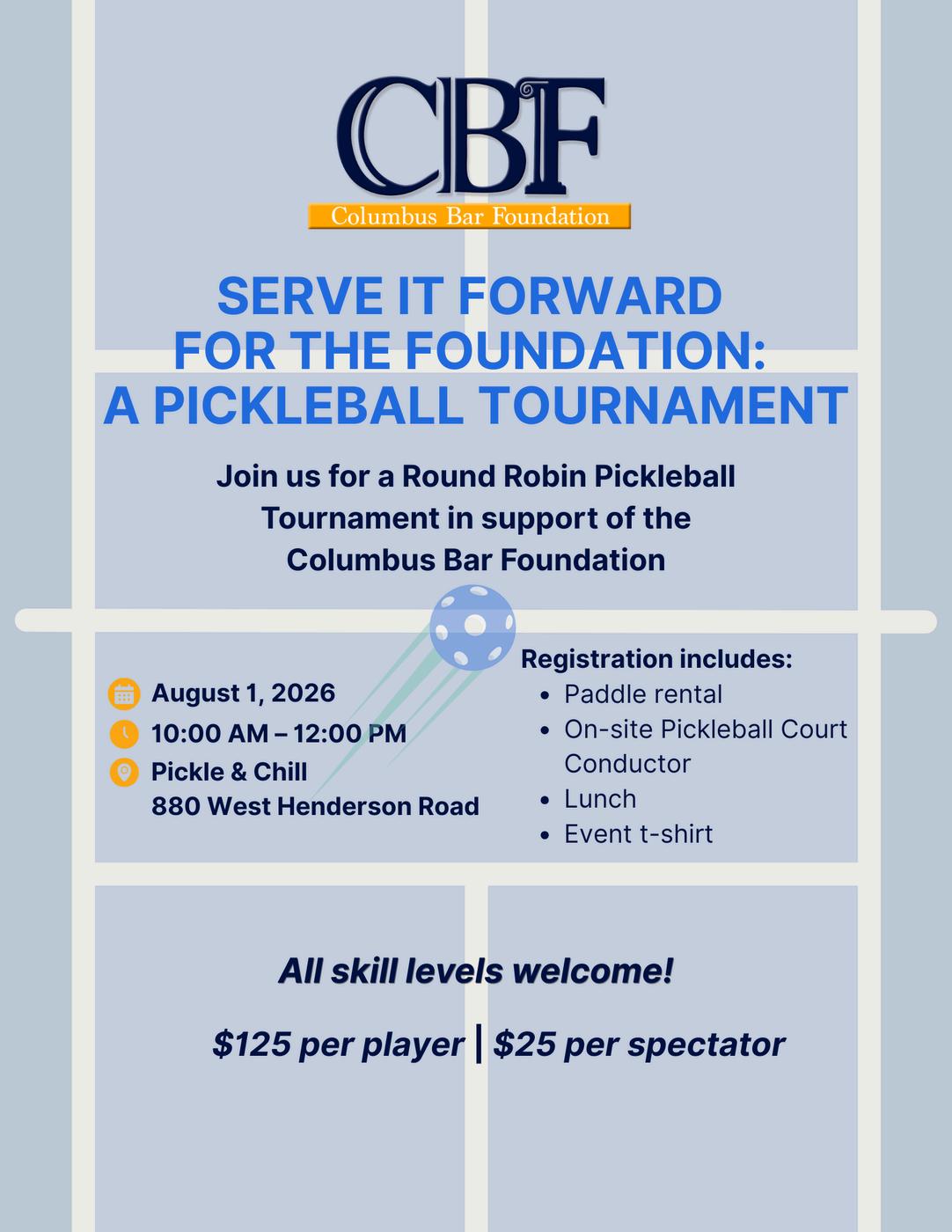

By Dominick A. Kocak

The United States Immigration and Custom Enforcement (ICE) received much attention in 2025. That attention is unlikely to go away in 2026 as recent enforcement efforts have aroused emotions for many. Having a clear understanding of ICE’s limitations and individual constitutional protections can provide at least some level of clarity to individuals. As it does for any law enforcement agency,
the U.S. Constitution protects people from ICE overreach. Individuals and businesses, who are considering the implications of ICE’s crackdowns, should have an understanding of their rights and obligations. That is also true for the attorneys representing them. This article serves as a basic overview of the do’s and don’ts of dealing with an ICE raid for both individuals and employers.[1]
The Fourth and Fifth Amendments of the U.S. Constitution provide fundamental protections for those dealing with government agents. These protections apply to encounters with ICE too.[2] The Fourth Amendment protects individuals and businesses from unreasonable searches and seizures. And the Fifth Amendment protects individuals from forced self-incrimination, among other things. These foundational protections apply in both private homes and private businesses and should guide every ICE interaction.
ICE raids are often conducted to arrest those who have violated immigration laws or to search for and seize evidence related to immigration crimes. ICE commonly conducts raids by entering the homes or workplaces of its targets. Like other law
There are important differences between a valid judicial warrant and an ICE or administrative warrant. Judicial warrants authorize ICE agents to search, seize, and detain evidence or people in private locations, while ICE warrants do not. Judicial warrants will be signed by a judge, and at the top of the caption will be the name of a enforcement agencies, ICE must work within confined limitations.
First, ICE has the right to question or arrest individuals in public spaces. Streets, sidewalks, business lobbies, and other common areas accessible to the public are fair game for ICE. But ICE must have a warrant to search for individuals or evidence within a private home or business that is, unless ICE has valid consent to enter and search. If ICE does not have consent and none of the limited exceptions of the warrant requirement apply, ICE must have a valid judicial warrant to search a private place.
court, such as “United States District Court.” ICE warrants, on the other hand, are issued from the Department of Homeland Security and are on forms I-200 or I-205.
Here is a visual comparison of the two types of warrants:
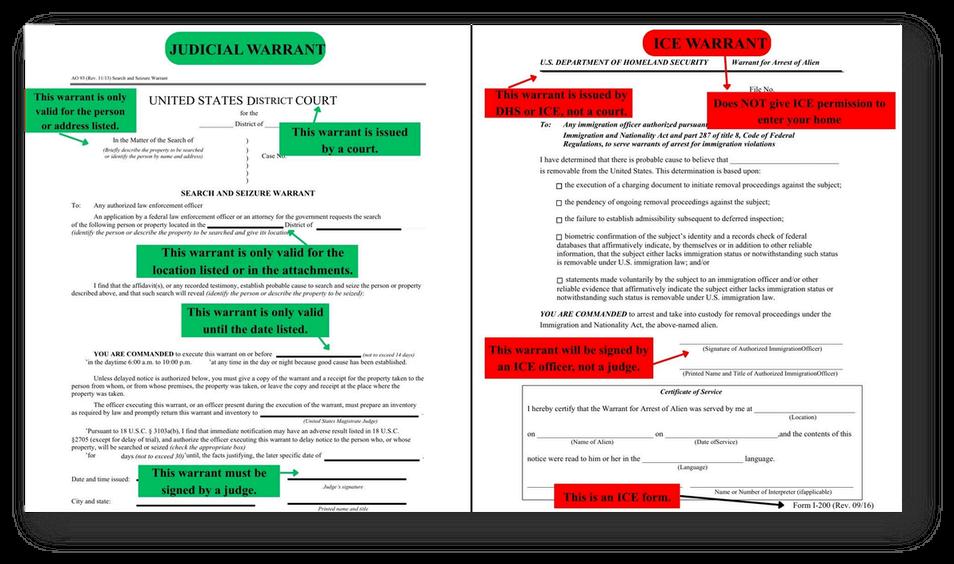
If ICE agents come to the door of a home or business, whoever greets them should first ask to see a valid judicial warrant. That individual should then verify that the warrant is signed by a judge.
The warrant will also have an execution date. They should ensure that the date has not passed. Finally, note the limitations of the warrant, which will provide guardrails for ICE’s authority. Agents may not search locations that are beyond the scope of the warrant or seize
people or evidence not listed on the warrant or its attachments.
If ICE agents present a valid judicial warrant, they are allowed to enter and proceed with the search. If the agents do not present a valid judicial warrant, employees or occupants of the premises may clearly say that the agents do not have consent to enter the private areas of the premises. If the agents nonetheless insist on entering the private location without a warrant (or without a valid warrant), employees or occupants should not physically obstruct the agents from entering. If ICE searches a private location without legal authorization, then that overreach should be later handled in court, not on the street.
After inspecting the warrant and allowing the agents to enter the premises, the employee or occupant of the premises should ask for the names and identification numbers of all agents present during the raid and document who is involved.
Moreover, those present at the premises being searched have the right to refuse to answer questions.[3] Employees or occupants may ask the ICE agents if they are being detained, and if the answer is “no,” they may leave the premises. If the answer is “yes,” employees or occupants should remain in the presence of the ICE agents.
During the search, employees or occupants should remain calm. They may also protest reasonably. At no point, however, should employees or occupants threaten, unreasonably berate, or physically obstruct ICE agents or their efforts. Ultimately, ICE agents are armed federal law enforcement agents, and they may take reasonable mitigation steps if they fear for their safety.
Employees or occupants may openly video record ICE agents during the search.[4] This may be especially important since, while body worn cameras are required by U.S. DHS policy, not all agents have yet received body
worn cameras.[5] Recording law enforcement encounters provides protection to both the agents and the public. And independent recording can offer alternative perspectives to an ICE interaction that might not be captured from body worn cameras. While recording, however, employees or occupants should remain at a reasonable distance away from the agents, refrain from intentionally intimidating the agents, and ensure they do not impede the enforcement action.
Someone with authority over the premises, such as a manager of the business or the owner of the home, should accompany the agents during the search. If agents request access to a locked location, such as a secured closet or file cabinet, the person should provide the requested access. If access to that locked location exceeds the scope of the warrant, the person may indicate that ICE does not have consent to search that area. But again, if the agents insist, the person should unlock the
location. ICE exceeding the scope of a warrant can be handled later in court.
In addition to recording, employees or occupants of the location being searched may take notes of all areas searched, people questioned, and items or documents seized. Likewise, employees or occupants should keep track of all other employees, visitors, and other witnesses who were present during the search. Moreover, employees of businesses should notify human resources or the legal department as soon as possible that ICE is present.
Finally, while ICE raids can stir up a lot of emotions, employees or occupants should never intentionally obstruct or physically impede the enforcement actions.[6] Additionally, they should not provide false information though they may choose to remain silent. Employees or occupants should also not destroy items, documents, or other potential
evidence. Finally, they should not hide or assist with the escape of potential targets. Doing so could result in criminal charges.
In a time of heightened attention to immigration enforcement
DO request to see a valid judicial warrant
DO accompany ICE agents in the search
DO provide access to any locked locations, if requested
DO take notes of all areas searched and items or documents seized during the search
DO inform HR or your attorney immediately
DO maintain a list of employees, occupants, or witnesses present during the search
efforts, individuals and businesses along with the attorneys representing them — should be prepared for handling encounters with ICE. Here is a summary of the behavioral checklist discussed in this article:
DO NOT refuse access to ICE agents who insist upon entering or searching a location
DO NOT impede or physically obstruct the search
DO NOT threaten ICE agents
DO NOT provide false information or destroy items or documents
DO NOT hide employees/occupants or assist in employee/occupant escape
DO NOT refuse access to ICE agents who insist upon entering or searching a location
DO understand the right of all individuals to remain silent at all times ominick A Kocak annery | Georgalis LLC kocak@flannerygeorgalis com
[1] This article covers ICE enforcement actions or “raids,” which should not be confused with I-9 audits.
[2] See United States v. Abdi, 463 F.3d 547, 557 (6th Cir. 2006).
[3] Lefkowitz v. Turley, 414 U.S. 70, 77–78 (1973).
[4] While neither the Sixth Circuit nor the U.S. Supreme Court have squarely addressed the question, the right to film likely applies in public spaces and one’s own private spaces. See Freeman v. Spoljaric, 667 F.Supp.3d 636, 662–63 (S.D. Ohio 2023). Recording in private spaces, however, is subject to the privacy policies of the owner.
[5] U.S. Immigration and Customs Enforcement, ICE Announces Updated Policy for Body-Worn Cameras (Jan. 12, 2024), https://www.ice.gov/ news/releases/ice-announces-updated-policybody-worn-cameras.
[6] 8 U.S.C 1324.