The ecology of the Chattahoochee Valley lies not only in its flora and fauna.
Our Green Issue evolved naturally into more than a focus on birds, bees and farming—it explores how we thrive as a community: the people, the places, where we gather and how nature serves as our common denominator. While the power of spending time in nature has been much lauded, it is nature that is the classroom that teaches us to give back to the next generation.
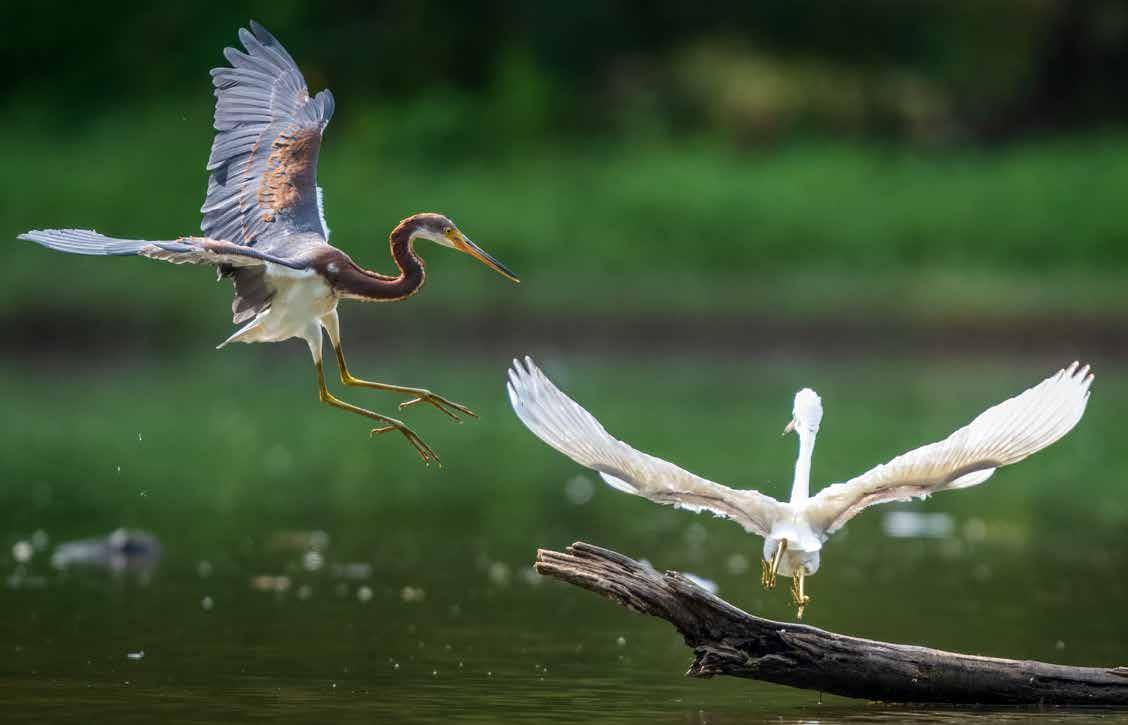
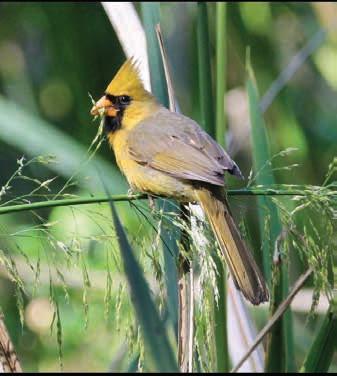
Delving deeper into the world of bird migration led us to the birdwatchers themselves—from the avid follower to the backyard observer. We discovered groups that gather at Oxbow Meadows, Heath Park and Cooper Creek Park. Local birds appear not only in the wild but in art as well, depicted through photography and murals—whether our familiar backyard favorites like the cardinal, great blue heron, blue jay and chickadee, or the rare yellow cardinal photographed in South Florida by Priscilla Marshall. And in a nod to the celebration of our nation’s 250th anniversary, you can find our national bird, a pair of bald eagles that have settled at Cooper Creek Park.
I enjoy learning about North American birds and compare them to their European counterparts. The British robin is a diminutive figure compared to his American counterpart—a metaphor for the size of the country perhaps? The tufted titmouse stands head and winged shoulders next it’s european cousins (the great tit, blue tit or coal tit), yet they are all one big family—the paridea family. I have “arrived” on my birding journey at the Bird Buddy stage. I can check in anytime on my feathered friends via a livestream. Amusingly, one of my daughters took ornithology in high school with disdained interest, yet it’s the Bird Buddy that has her reeling off the breeds of the birds. And the best part, my brother in England who’s an avid birder, gets to tap into the live feed also. Hummingbird season is one of my favorite times. However adorable hummingbirds may seem, once one claims a feeder, it becomes a Game of Thrones-style battle with other hummingbirds that dare to come near.
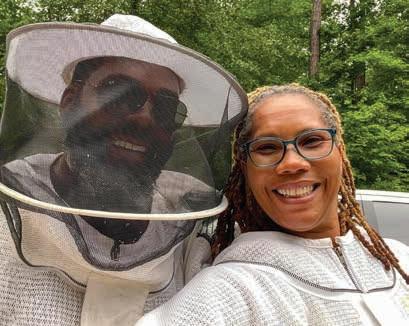
Oxbow Meadows is also a great source to discover all about bees and honey production. We have a thriving and active honey producing community here in the Chattahoochee Valley. With honeybees on the decline, man-made hives can be a sanctuary for breeding bees and honey production. Local honey can be found throughout the Valley for purchase at markets, restaurants and farmstands.
Farming is our focus for our continuing series on America’s 250 skills and industries. From the homesteader to the large-scale producer, we talk with the farmers cultivating not only the land but also a sense of community, which is by its very nature the root of why people choose to farm the land.
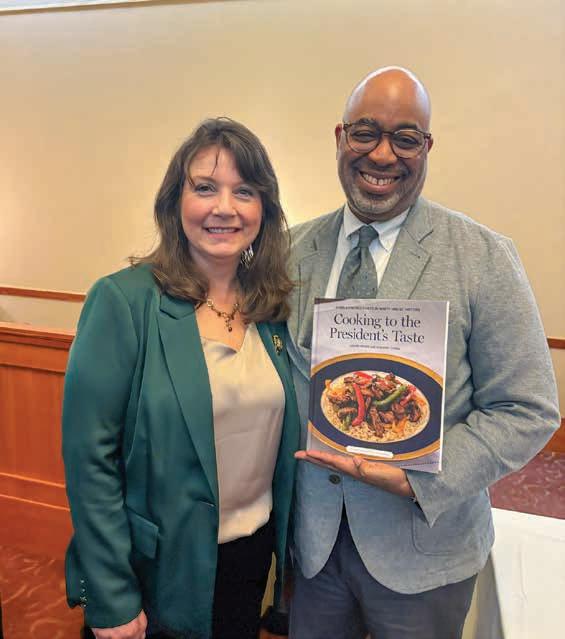
Finally, food for thought—the Chattahoochee Valley Libraries Food & Soul of America program series is for the foodies. What a delight it was to hear Adrian Miller, twotime James Beard Award Winner and certified barbecue judge. If you attended his lunchtime history of barbecue or the Muscogee County Library Foundation gala where he delved into the history of chefs who have served American presidents over the years, I am sure you had a takeaway of the culinary kind. The series will run through April in conjunction with exhibitions on cookbooks and the southern staple—pimento cheese.
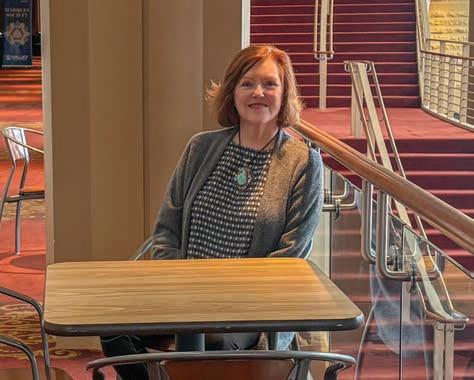
Jodi Saunders Publisher/Editor
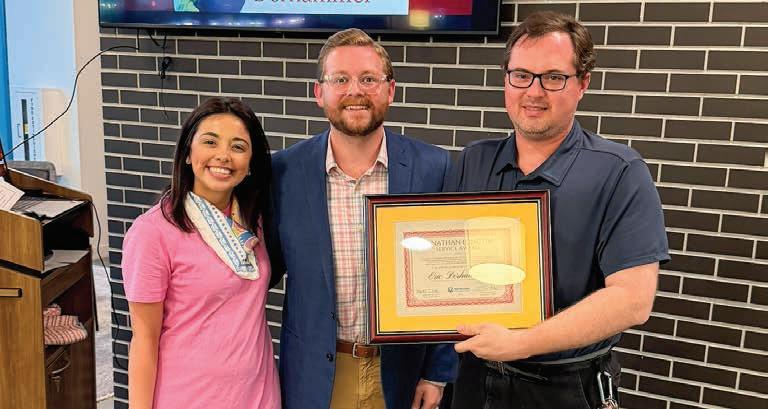
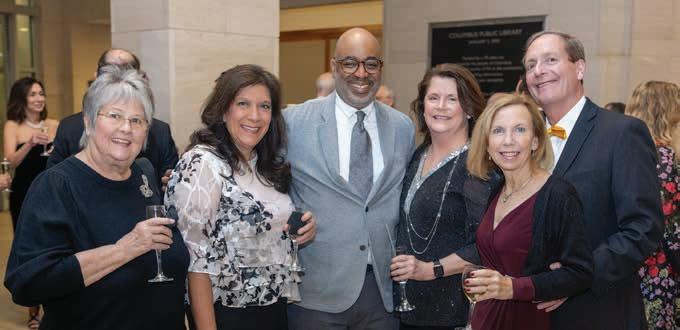
At Columbus Public Library with culinary author, Adrian Miller
A rare yellow cardinal seen in South Florida by local birder, Priscilla Marshall
We are happy to provide our publications for your events. Gift a great read showcasing the best of our region.
Digital options available by request. Request at contactus@columbusandthevalley.com. Please give 6 weeks advance notice
Proud to be a local, independent small business in the Valley area for 30+ years.
We want to hear from you! Share your stories and ideas with us. Our region is rich in its heritage, arts and culture scene, entrepreneurial endeavors and big business corporations. Everything is happening right here in the Chattahoochee Valley. Connect at contactus@columbusandthevalley.com.
WHAT’S HAPPENING?
Ongoing
Uptown Market Days
APRIL THROUGH AUGUST
Each Saturday, three blocks along Broadway host over 100 local and regional vendors. Visitors can expect to find fresh and organic produce, home goods, jewelry, unique crafts and delicious baked goods. Market Days is the perfect Saturday activity for family, friends and visitors. Don’t forget to bring your furry pals to get in on the fun.
AlwaysUptown.com
Celebrate SPRING! at Callaway Gardens
WEEKENDS IN MARCH & APRIL
Spring into new family memories when you discover the sights, sounds and flavors of the season. The garden's sprawling 2,500 acres will leap to life with live music, delicious food, beautiful blooms and more.. CallawayGardens.com
Highside Market Farmer’s Market
SUNDAYS
Spend your Sunday afternoons at Highside Market exploring their Farmers Market — a seasonal showcase of locally grown goods and handcrafted flavors in the heart of Columbus.
HighsideMarket.com
March
Toast of the Town
MARCH 6
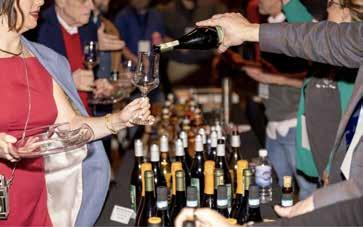
World-class wines, fine foods, hand-crafted beers and Southern spirits all await you at the Columbus Convention and Trade Center. Meet the chefs, vintners, distillers and brewmasters who will be on hand to share their toasts and tastes with you. Celebrate with wine walls and a silent auction filled with a variety of wines, trips and unique treasures all to benefit the Columbus Symphony Orchestra. ToastColumbus.com
Liberty Theatre Walk/5K
MARCH 7
This family-friendly 5K welcomes all ages and fitness levels—run, jog or walk at your own pace. The race begins at 9 a.m., making it the perfect way to start your Saturday morning with movement and purpose. All proceeds benefit the Liberty Theatre, helping sustain arts, cultural programming and community events in Columbus. ColumbusGa.gov/LibertyTheatre
Columbus Botanical Garden's Naturalist Symposium
MARCH 13-15
The Columbus Botanical Garden presents 2026’s Naturalists Symposium. This year's event will focus on using technology to deepen our connection to nature. ColumbusBotanicalGarden.org
Fields of Grace Tulip Festival
MARCH 13-15
Tulip Fest is a spring flower festival outside of Columbus featuring you-pick tulips, artisan vendors, delicious food trucks, an engaging kids’ STEAM zone and over 90,000 tulips.
FieldsOfGraceFlowerFarm.com/tulip-fest-26
Almost St. Patrick's Day Pub Crawl
MARCH 14
Get your shamrocks, green clothes and pots of gold ready for the Almost St. Patrick's Day Pub Crawl. This THEMED event is going to be more than just a wee bit o' fun. With green themed fun, contests, prizes and some malarkey.
DoTheCrawl.com/Columbus
CSO presents North vs. South: Battle of Baroque
MARCH 14
Step into the grandeur of the Baroque era in Legacy Hall with a thrilling musical showdown between Italy’s fiery virtuosity and England’s stately elegance. CSOGA.org
COMU Bridal Show
MARCH 15
Discover the best venue and vendors for your big day. Meet local vendors to help you plan every detail of your special event.
COMUGA.org
Friends of the Library Spring Book
Sale at Columbus Public Library
MARCH 20-22
All books are priced at $2 or less. Happening from 10 a.m. to 5 p.m. in the Synovus meeting room, the sales will accept cash, check, debit and credit cards. Cvl.libnet.info/event/14943826
Hairspray The Musical at the Springer
MARCH 20-29
It's 1962 in Baltimore, and the lovable plus-size teen, Tracy Turnblad, has only one desire – to dance on the popular "Corny Collins Show." When her dream comes true, Tracy is transformed from social outcast to sudden star. SpringerOperaHouse.org
Hope Harbor’s “Driving Out”
Domestic Violence Car Show
MARCH 21
This exciting event brings together car enthusiasts, motorcycle lovers and supporters of a great cause. Whether you're showcasing your ride or just enjoying
the event, 100 percent of the proceeds will go directly to support victims of domestic violence.
HopeHarbour.org
UNCF Columbus Mayor's Masked Ball at Columbus Trade Center
MARCH 21
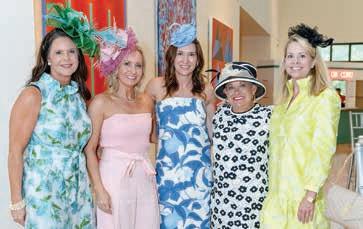
This event is full of fun, fashion, glitz and glamour, and supports UNCF’s mission of investing in Better Futures® for the young men and women we serve and by helping them move to and through college. UNCF.org
Forever Starts Here: A Wedding Experience at the National Infantry Museum
MARCH 22
NIM Events will be hosting the bridal event of the season. See the National Infantry Museum’s multiple event spaces highlighted, meet their preferred caterers and local event decorators.
NationalInfantryMuseum.org/events
Elizabeth Brim Reception at the Bo Bartlett Center
MARCH 26
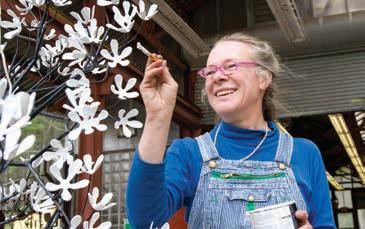
Born and raised in Columbus, Elizabeth Brim forced her way as a pioneer of contemporary blacksmithing. Celebrate Elizabeth Brim‘s exhibition at this public reception from 6-8 pm, with a screening of Iron Pearls, a retrospective film of Elizabeth, to begin at 7:30 pm. ColumbusState.edu/bartlett-center
Second Annual Spring Fest Car Show at the Civic Center
MARCH 28
Get ready for a full day of stunning cars, high-energy music and nonstop fun. FiveOnPumpSeven brings together classic rides and modern builds for an unforgettable in-person car show experience for all. CivicCenter.columbusga.gov
Uptown’s Spring Food Truck Festival
MARCH 28
Woodruff Park will transform into a food truck mecca with 35+ food vendors from the local and regional area. From turkey legs to seafood to street tacos, they’ve got it all with some of the yummiest vendors and an experience you won’t forget. AlwaysUptown.com
April
ARTSFEST
APRIL 1-30
ARTSFEST celebrates Columbus’s rich creative talent and many arts organizations striving to captivate and inspire diverse audiences of all ages every day. This month-long festival will encompass more than 60 events from 30+ organizations, include more than 100 local artists and feature a community-wide celebration on April 26 at Arts in the Park in Lakebottom Park. TheColumbusite.net/artsfest
Phenix City's Easter Egg-stravaganza Hunt
APRIL 2
Join the Easter Bunny to play some Easter themed games, bounce around on inflatables and participate in an Easter Egg Hunt. PhenixCityAl.gov/events/easter-egg-stravaganza-4
Columbus Clingstones Opening Day
APRIL 3
The Columbus Clingstones play their first home game of the season against the Chattanooga Lookouts. Clingstones.com
Uptown's Friday Night Concert Series
APRIL 3-24
Spring Friday Night Concerts Series is back in Uptown where you’ll hear jazz, rock, reggae, gospel and more. AlwaysUptown.com
Drumline Live! at RiverCenter
APRIL 4
A thrilling spectacle that pays homage to the showstyle marching popularized at historically black colleges and universities. With riveting rhythms, bold beats and ear-grabbing energy, Drumline Live! is a synchronized musical showcase of the legendary HBCU experience.
RiverCenter.org
Voices of Ascension Music Under the Dome Series
APRIL 7
This program weaves together rich, vocal-driven works—from an expressive treble-and-bass dialogue to jazz, choral and solo piano performances—celebrating the beauty and spirit of our state and the vocal repertoire. Highlights include the Schwob Jazz Combo’s Georgia on My Mind, the Schwob Singers in surround sound and Chopin’s Ballade No. 3. CCSSC.org
Mrs. Doubtfire The Musical at the Gogue Center
APRIL 9
Based on the beloved film, Mrs. Doubtfire tells the hysterical and heartfelt story of an out-of-work actor who will do anything for his kids. It’s “the lovable, bighearted musical comedy we need right now,” raves the Chicago Tribune—one that proves we’re better together. GogueCenter.auburn.edu
The Columbus Cup
APRIL 10-11
This is the premier U.S. freestyle kayaking event to be held on the Chattahoochee River in Columbus. Top paddlers throw down high-flying tricks on one of the Southeast’s most exciting standing waves. The event transforms the riverfront into a festival atmosphere, drawing athletes, outdoor enthusiasts and the local community together.
AlwaysUptown.com
Chicken & Biscuits at the Springer
APRIL 17-26
Chicken and Biscuits is a heartfelt comedy about family and forgiveness, that reminds us all that even in the messiest moments, laughter and love can bring us back together.
SpringerOperaHouse.org
Midland Commons & Street Food Saturdays Spring Fling
APRIL 18
Enjoy a fun-filled day of food and shopping from 11am–4pm at the 2nd Annual Spring Fling. MidlandCommons.com
CSO
presents Three by Beethoven
APRIL 18
Join the CSO for an electrifying season finale—an evening that celebrates the drama, passion and heroism at the heart of one of music’s most revolutionary figures. Step into the grandeur of the Baroque era in Legacy Hall with a thrilling musical showdown between Italy’s fiery virtuosity and England’s stately elegance. CSOGA.org
Piedmont Classic
APRIL 20-21
Piedmont Classic - Driven by Mercedes-Benz of Columbus is a celebration of health and wellness in our community. Tennis & Golf event proceeds will benefit the John B. Amos Cancer Center. Pickleball event proceeds benefit The Bill and Olivia Amos Children’s Hospital. PiedmontClassicCSG.com
Rebecca
Lang at Columbus Public Library
APRIL 23
This Southern cookbook icon, Food Network judge and pimento cheese expert will be presenting at 6pm as part of the Chattahoochee Valley Libraries’ Food & Soul of America Series celebrating America’s 250th birthday.
CVLGA.org
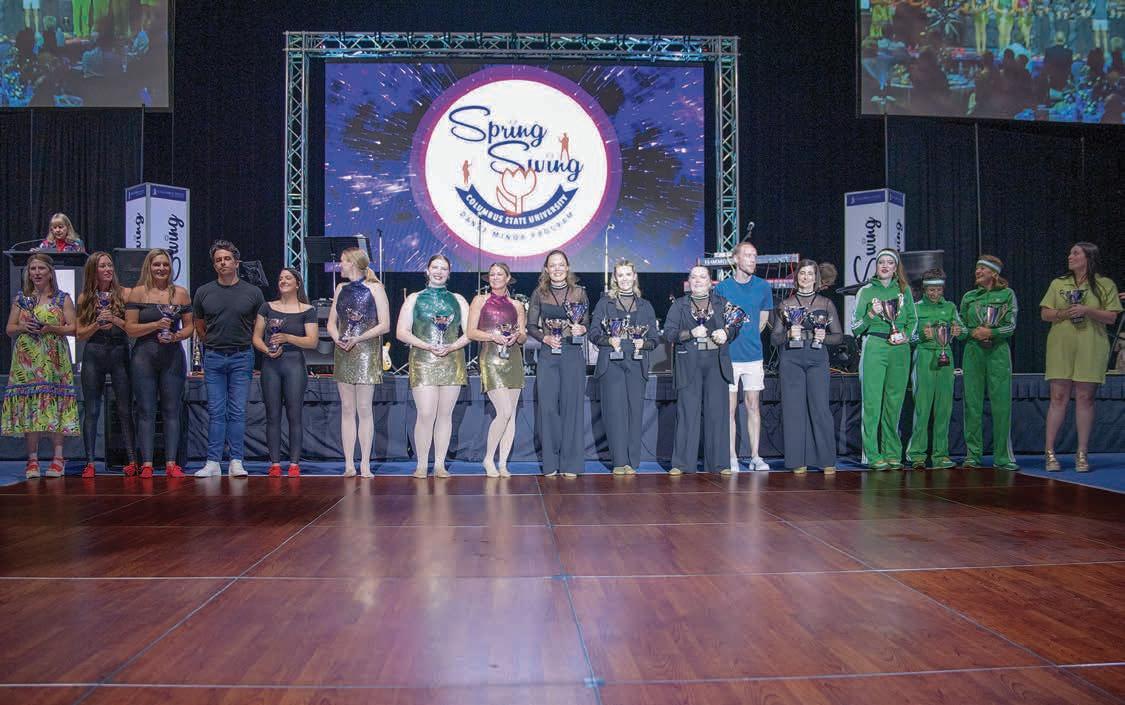
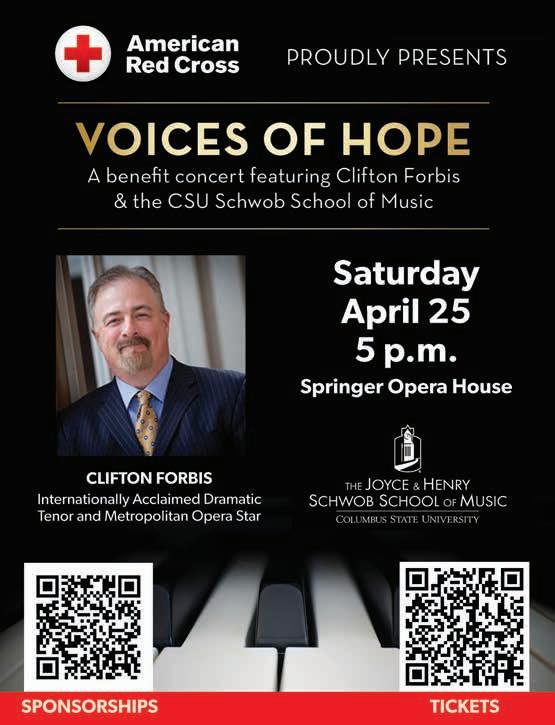
CSU’s Annual Spring Swing
APRIL 25
CSU presents their Spring Swing event benefiting their dance minor program. Enjoy a casual evening of dancing, food, drinks and live music.
Jeff Foxworthy is one of the most respected and successful comedians in the country. Widely known for his redneck jokes, his act goes well beyond that to explore the humor in everyday family interactions and human nature, a style that has been compared to Mark Twain’s.
RiverCenter.org
Columbus GA Chamber Golf Tournament
MAY 1
The Chamber will host their annual Partnership Golf Tournament at Maple Ridge Golf Course. Enjoy friendly competition, delicious food and great prizes. ColumbusGAChamber.org
Racing for COMU
MAY 2
Join COMU in watching the 152nd running of the Kentucky Derby while indulging in an evening of betting, bourbon, dining and live music—all in support of the Museum’s exhibitions, educational programs and free admission for the community. Fundraiser festivities will begin at 5:30 p.m. with pre-race activities, betting and special bourbons to set the mood for an exciting evening.
CSOGA.org
Columbus Porchfest 2026
MAY 2
Columbus will be transformed into a free, walkable music festival as talented local and regional musicians perform from the porches of historic homes. As music fills the air, local vendors will line the streets with handcrafted goods, original artwork, jewelry, food and more, creating a unique celebration of Southern creativity and charm.
ColumbusPorchfest.com
Midtown Getdown
MAY 3
Join Midtown for a free, family-friendly concert at The Band Shelter in Lakebottom Park. Bring your chair, blanket, favorite beverage and friends. MidtownColumbusGa.org/midtown-get-down/
Scan to submit your event, or see more events.
by Jenn Collins
in the AIR WORDS TO LIVE BY WHEN THE BIRDS FLY SPRING IS
Every spring, the Valley area serves as a rest stop for millions of birds as they travel northward from their winter retreats. Bird migration offers a profound connection to the natural world right in our local parks. Maybe the following list of birdrelated words and photographs will help you find your first ”spark-bird.”
migration noun /mī-grā-shən/
seasonal movement of birds and other animals from one place to another
Rachel Carson once wrote, “There is symbolic as well as actual beauty in the migration of the birds. ...There is something infinitely healing in the repeated refrains of nature—the assurance that dawn comes after night, and spring after the winter.”
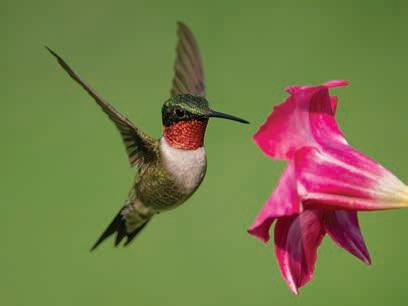
Close your eyes and imagine the beauty of seeing the first hummingbird of the year. Holding your breath as a delicate, jewel-toned creature with the strength to fly thousands of miles hovers nearby. Now multiply that feeling by 3.5 billion, and you begin to understand the wonder of North America’s spring avian migration.
Each year, many of those 3.5 billion birds pass through four migration corridors—the Atlantic, Mississippi, Central and Pacific Flyways. These invisible, ancient super skyways help guide birds as they move between their wintering and breeding grounds.
The Chattahoochee Valley lies in the Atlantic Flyway, which follows the eastern coastline from the Arctic to South America, roughly between the Appalachian Mountains and the Atlantic Ocean. This route allows birds to stay on track by following the coast, without risking long flights over open water.
Flyways are enormous, so birds tend to stop along the way to rest and refuel, often near lakes, marshes or grassy fields. Birders keep a watchful eye out for activity at these hotspots throughout spring migration season which, according to the Birds Georgia Lights Out Georgia program, lasts from about March 15 through May 31.
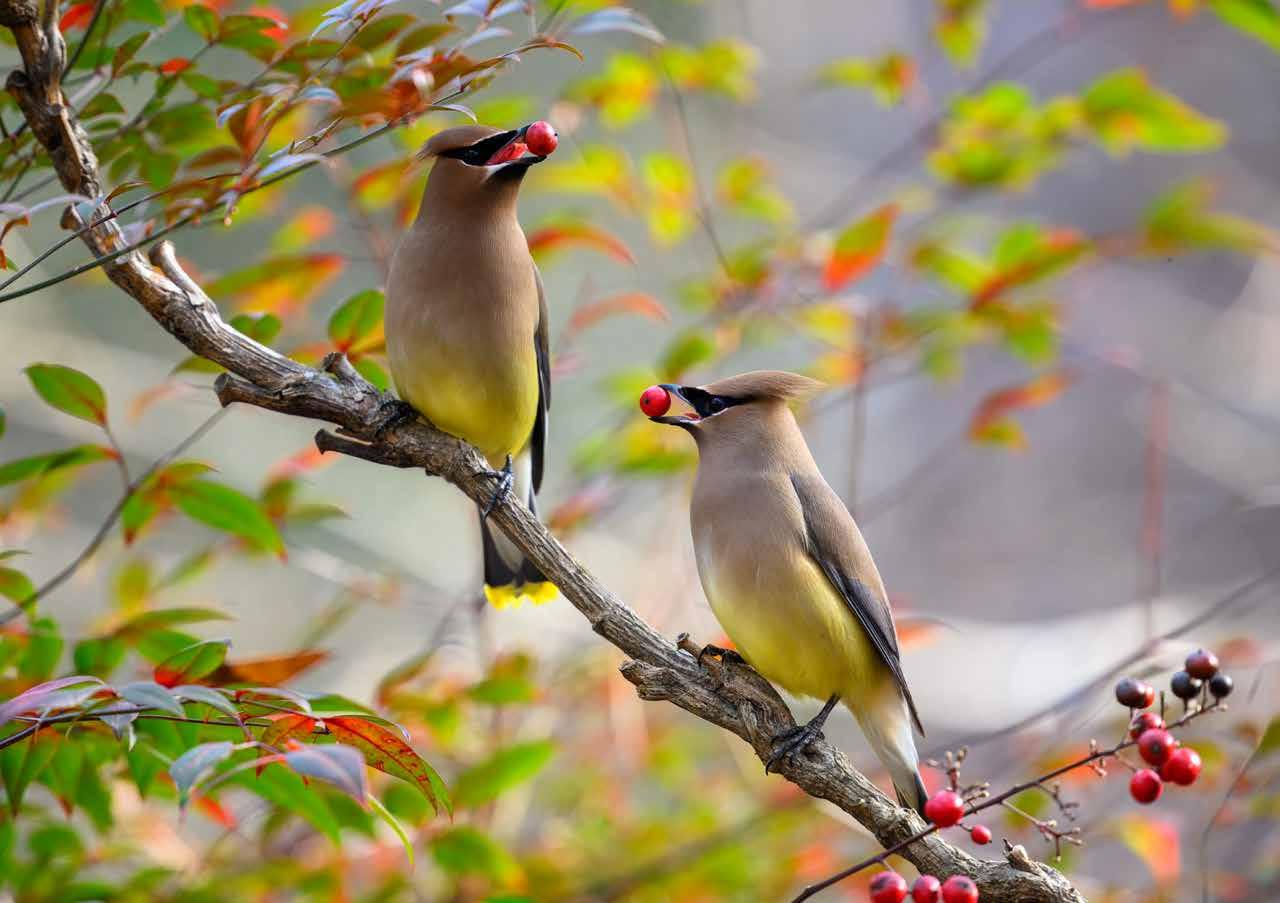
RIGHT: A couple of cedar waxwings share lunch at Heath Park. They migrate from their breeding home in southern Canada to as far south as northwest South America.
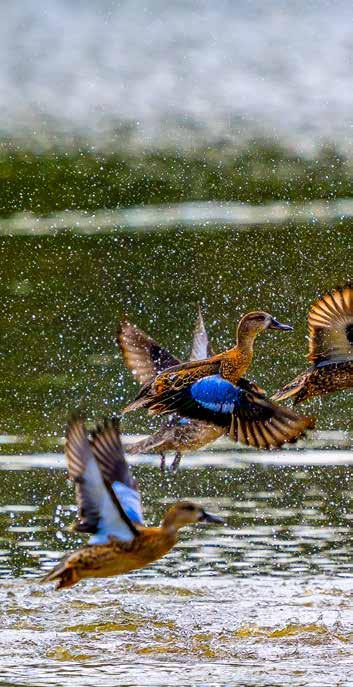
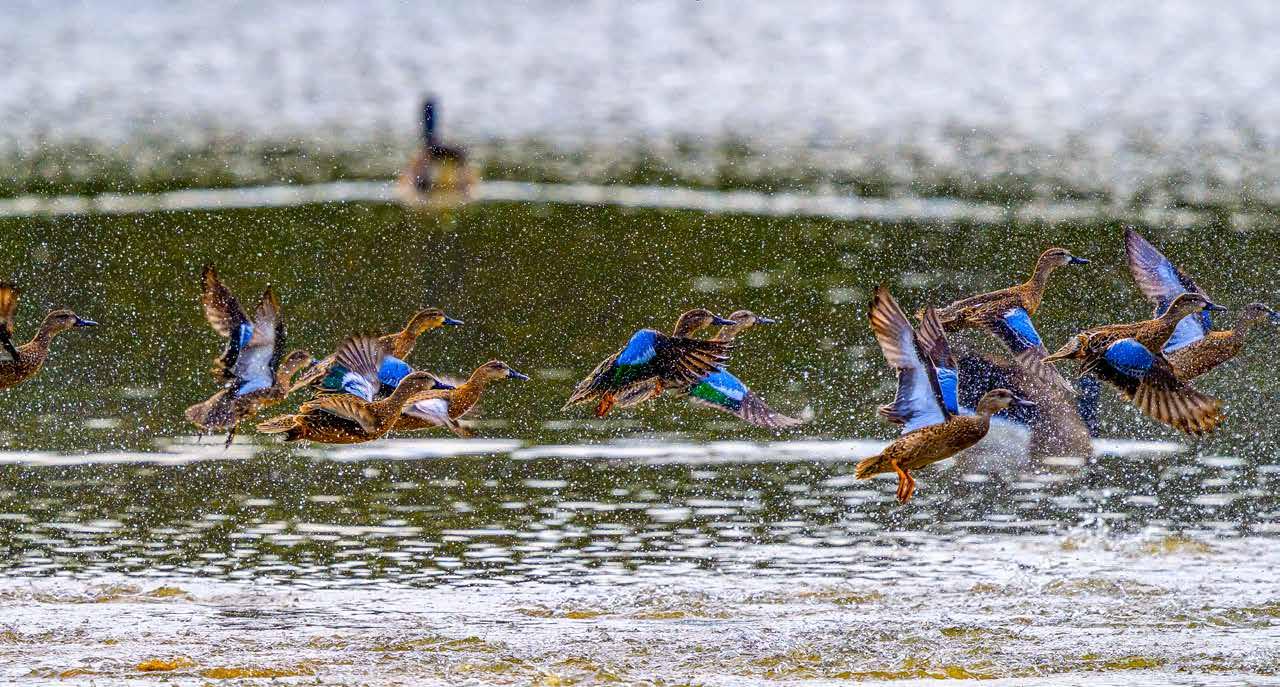
BELOW: A flock of bluewinged teal start the next leg of their journey northward from Cooper Creek Park to their breeding home.
hotspot noun /'hät-,spät/ a place where many species of birds congregate
Columbus is home to several hotspots including Cooper Creek Park, the north application field at the South Columbus Water Resources Facility and Oxbow Meadows Environmental Learning Center.
Oxbow Meadows, in particular, is a regional treasure with more than 250 bird species spotted throughout the year. The center has something for novice and experienced birdwatchers alike, and there are options for a quick lunch-hour picnic or an entire nature-filled day.
For shorter visits, the Audubon Bird Garden is located directly behind the center and features a small pavilion with observation benches along a running stream. It connects to the 0.8 mile Discovery Trail, a paved path that overlooks the wetland and passes by Historic Westville before ending at Wrens Pond.
But for longer forays into the natural world, the Walt & Frank Chambers Birding Trail is ideal. When it opened in October 2023, the trail system added 2.5 miles of new walking and biking trails. Birdidentification signs, developed and placed by the Columbus chapter of the Audubon Society, can be found along the paths.
This expansion at Oxbow Meadows came about through charitable donations from the Chambers family in memory of birding enthusiasts Walt and his grandfather Frank. Walt was a local pharmacist, who was a nationally renowned member of the southeast’s birding community. He died in 2021 at age 46.
Walt and his grandfather shared a love of the outdoors, and Walt’s birding interests frequently brought him to Oxbow Meadows, where he surveyed and recorded many first sightings of birds in the area.
Most of the new birding trails are named for native species—including Anhinga Alley and Meadowlark Lane—but a special trail, Bill Birkhead Loop, is dedicated to the emeritus Columbus State professor who died in 2021. Birkhead was a member of the department of biology faculty for 43 years, where he taught classes including ecology and ornithology. He also served as president of the local chapter of the Audubon Society from 1982 to 1984.
At the trail’s grand opening ceremony,
Bill’s son Roger told the crowd, “To see my dad and Walt working together was magical. I can’t think of any better tribute to them than a place like this that lets people get out in nature and enjoy it. I truly hope it inspires the next Walt Chambers or Bill Birkhead.”
Bird sightings at Oxbow Meadows range from year-round species like doublecrested cormorant and bald eagle to rarer, migratory species like western kingbird, indigo bunting and swallow-tailed kite. But be sure to stop inside the center to spot a few more native birds in paintings, photography and digital art, as part of the 14th Annual Dr. Flora M. Clark Audubon Art Exhibition—named for another beloved member of the birding community,
who taught biology for 30 years at Columbus State University. Winners of the annual art contest will be honored at a ceremony on March 14, which is free and open to the public, with the corresponding exhibit running from the first week of March through mid-April.
This K-12 contest receives more than 150 entries each year from Muscogee, Chattahoochee, Harris, Troup, Lee and Russell counties. The year’s theme is "Neat Feet," and submissions must include research about the bird, a description of their unique feet and how they use this adaptation.
With so many opportunities to appreciate our winged friends, one of them just might spark a lifelong love of birding for you.
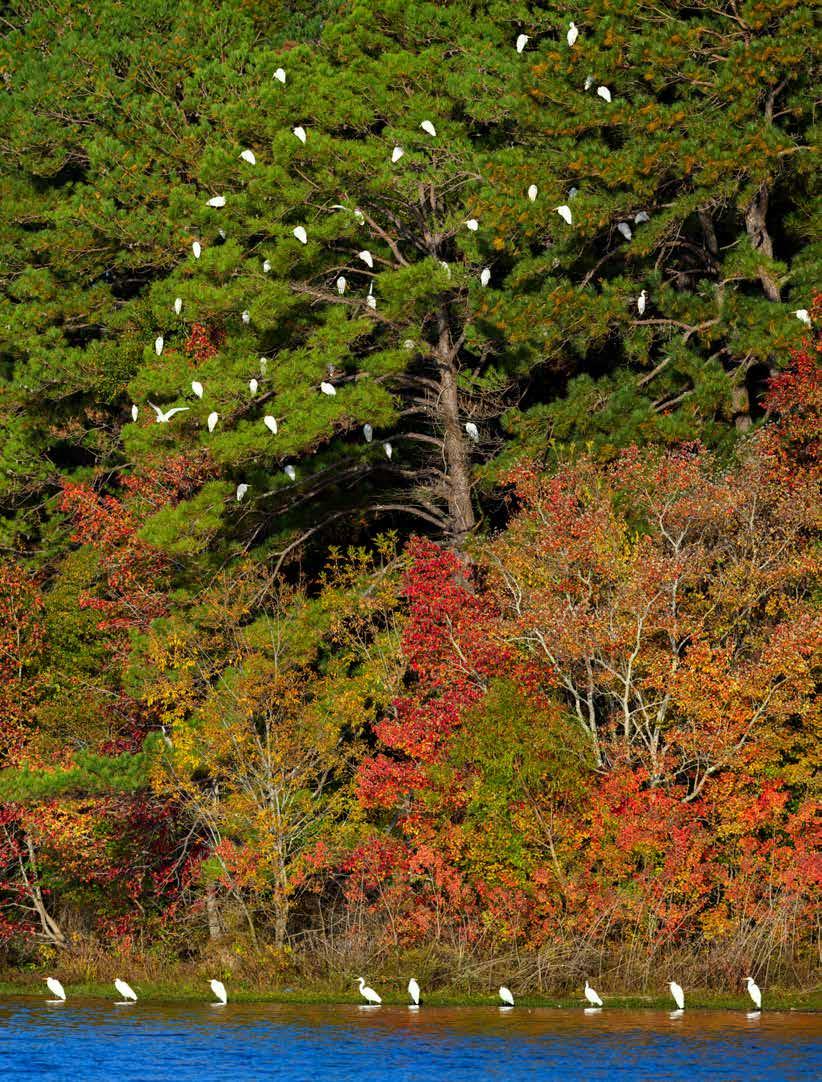
LEFT: Great egrets meet up at one of Columbus’ birding hotspots—Cooper Creek Park.
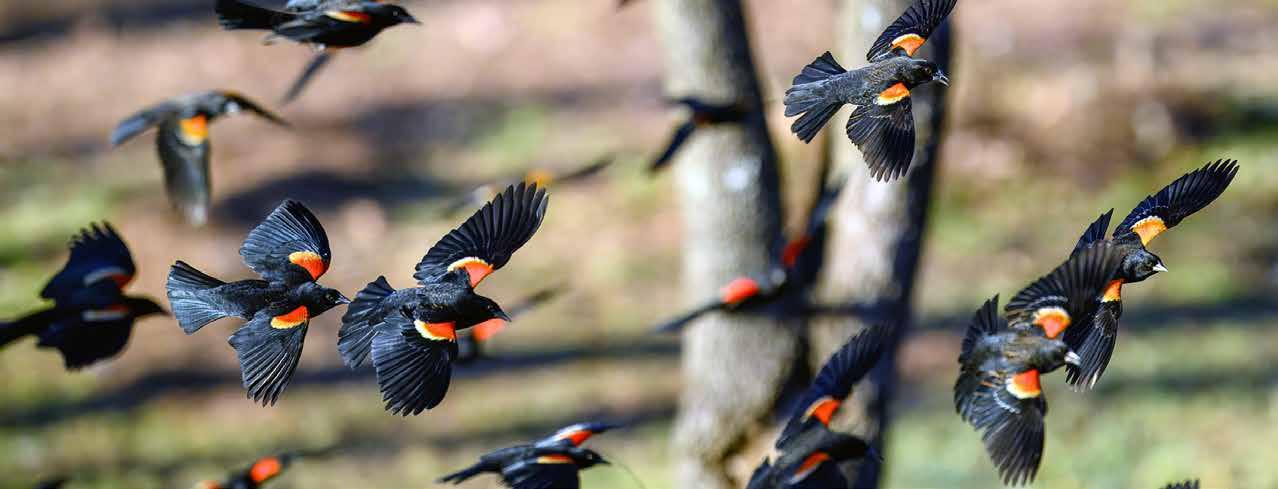
ABOVE: Red-winged black birds, like these seen at Heath Park, are one of the most abundant living land birds in North America.
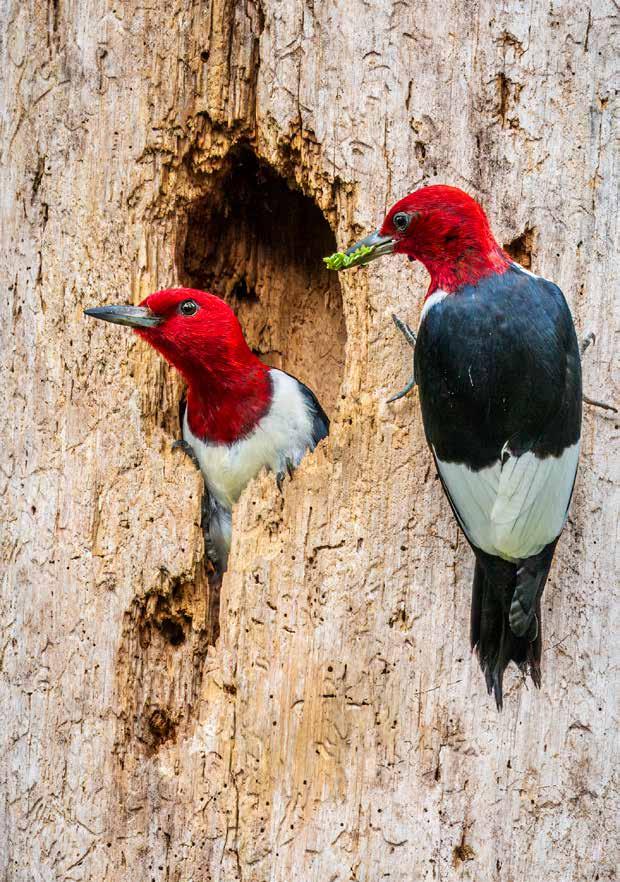
BELOW: Male redheaded woodpeckers find or create territories to attract a mate, like these at Heath Park.
spark bird noun /'spärk/ /'bərd/
a bird that inspires an individual's love of birding
For Priscilla Marshall, president of the Columbus chapter of the Audubon Society, her spark bird was the red-winged blackbird. “As a young child, my little brother and I stayed with our aunt at her lake house. I was eight, and noticed the flock of blackbirds on the cattails at the lake. Their call was unusual, and I always think back to those early memories of a cool bird at my aunt's house.”
It’s easy to get started with birding because, once you decide to pay attention, you’ll be amazed at the birds that are around you every day, in the park, on power lines, even in your own backyard.
A feeder at home is a good way to bring the birds to you, so you can observe them closely or take photographs. Marshall recommends using black oil sunflower seed as an all-around seed to attract many different species. Be sure to clean the feeder every couple of weeks with a solution of nine parts water to one part bleach to prevent the spread of disease between your visitors.
While there’s a ton of gear available for expert birders, the only thing you really need at the beginning is a pair of inexpensive binoculars. Numbers on binocular specifications, like 8x42 (standard for many birders), may look confusing at first, but they’re easy to decipher. That “8” is magnification, so objects will appear eight times closer. The “42” is the diameter in millimeters of the lens at the far end of the tube. Larger lenses let in more light, but they’re heavier; and higher magnification narrows the field of view, so fast moving birds won’t stay in your sight for long—which is great news because that means lightweight, lowpower binoculars are actually better for a beginner.
And don’t let mobility concerns stop you. There are plenty of places that are welcoming to strollers, wheelchairs and walkers.
“Cooper Creek Park is a wonderful local park, with good birding from a car as well as some accessible trails,” Marshall says. “Some areas for close-up feeder viewings would be Oxbow Meadows, observable from their lobby and breezeway and the Columbus Audubon Bird Park's feeders located behind Oxbow near the bird park's stream. Also, there are paved accessible Riverwalk trails behind Oxbow, leading to nice birding behind Westville, and good car-birding along the road beside Columbus Water Works' north application field.”
lifer noun
/'lī-fər/
the first time a new species of bird is spotted by a birder
Once you’ve spotted new birds, what’s the best way to identify them? Free apps like Merlin Bird ID, iBird Pro and Audubon Bird Guide are excellent resources, full of photos, descriptions and bird calls. Local maps can be downloaded for any state or country, so these apps are handy when traveling. Merlin’s Sound ID feature records the songs around you and offers real-time suggestions for which bird it might be. The suggestions aren’t 100 percent accurate yet, but they’re still quite helpful.
The bird-call libraries on these apps can quickly teach you how to recognize birdsong, but as a general rule, it’s best not to loudly play calls in the field to attract birds. Since songs can be used for territory marking, the birds may be stressed into thinking they have to defend against a competitor. Or they may stop foraging, caring for their young or resting—activities that are necessary for their survival. So use them to brush up before your outing, afterwards to review or at a low-volume in the field to help you check right then who’s doing the singing.
If you want to keep track of all those lovely birds you’ve spotted, the free app eBird lets you log checklists, whether you’re sitting still or moving along a trail. Marshall notes, “It’s a great tool for
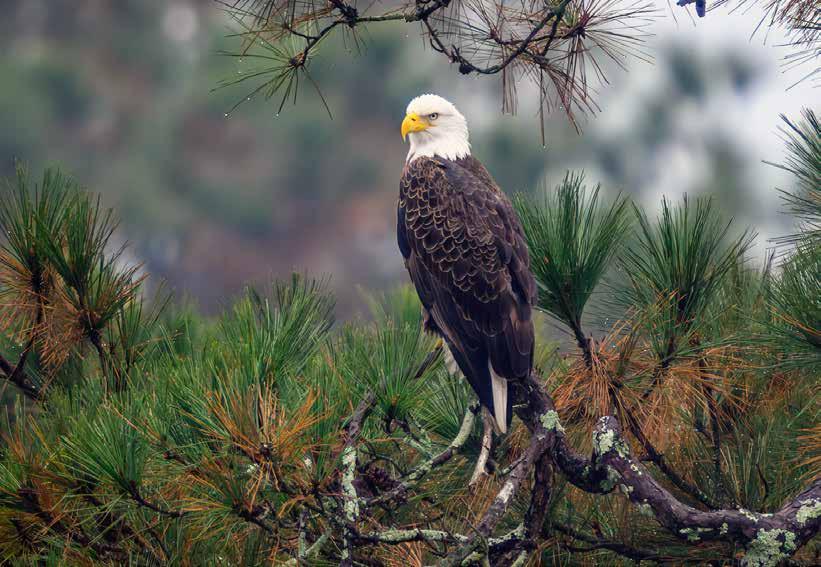
ABOVE: Once an endangered species, the bald eagle population has greatly recovered. The Valley area is now home to several—like this one at Cooper Creek Park.
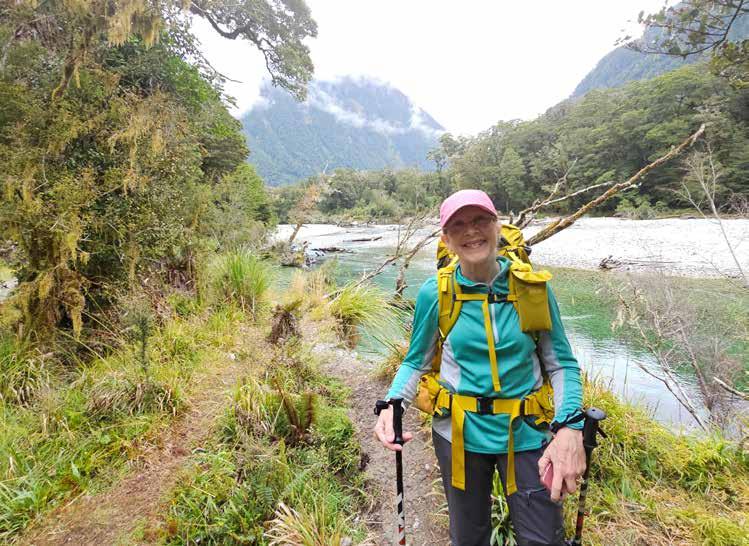
Priscilla Marshall on a birding expedition in New Zealand.
researching where different species are observed by location and date,” which makes it easy to decide where and when to go birding. The app, designed by the Cornell Lab of Ornithology, serves as a personal journal of special trips and sightings, but it also lets local birders contribute to the larger community of science and conservation.
citizen science noun /'si-tə-zən/ /'si-ən(t)s/
data collection, analysis and interpretation by nonprofessionals who contribute to scientific knowledge
Birding is not only great fun, it’s a way to help scientists study wildlife and make important conservation decisions. Whenever you make a checklist in eBird, that data becomes part of a huge biodiversity project, with more than 100 million bird sightings logged worldwide each year. The data is freely accessible to anyone, so students and researchers can follow trends in where the birds live, how many there are, how they use their habitats and when they migrate.
Those checklists can be logged anytime, but there are few special days each year when birders come together to take a virtual snapshot of the world’s bird population—the Christmas Bird Count in December, the Great Backyard Bird Count in February and World Migratory Bird Day in May.
Audubon and Oxbow Meadows often plan activities around these events, and this year is no exception. World Migratory Bird Day will be celebrated on May 9, so watch for details on Oxbow’s website at oxbow. columbusstate.edu. You just might find a new flock of friends to join you on the trails.
Follow @csuoxbowmeadows for birding information and other nature inspired programs.
BELOW:
Sow It Grows
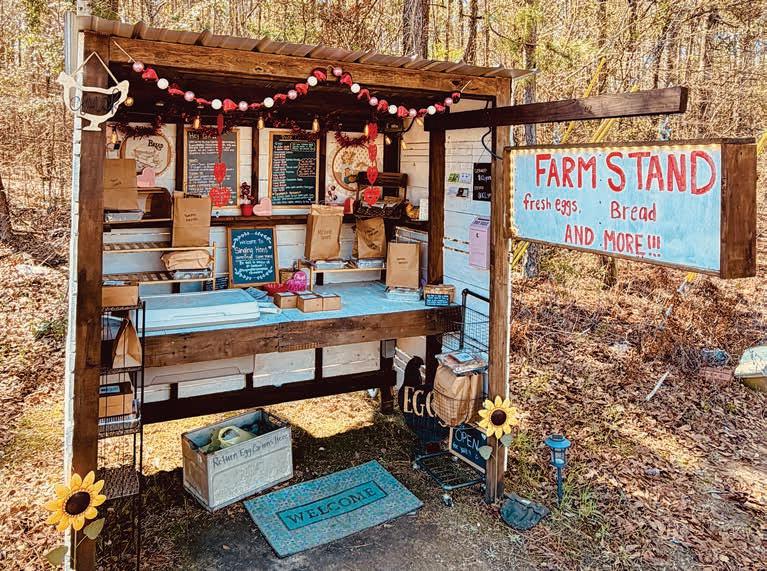
Stand & Deliver at Jenny Jack Farm
I,f you’re the off-the-beaten-path type, you’ve been on a small country road and seen a little homemade honey stand—a tiny kiosk with bottles of home-harvested honey—usually just off the street, a few yards in front of an old clapboard home. That little honey stand comes with two things: a drop box for cash, and a measure of trust that you’ll pay for what you take.
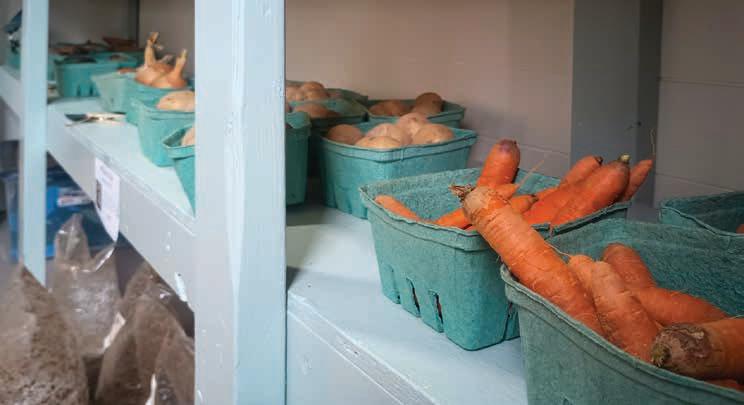
Now imagine that little station is, instead, a large climate-controlled room, filled with not just honey, but fresh lettuces, carrots, cabbages, mushrooms and, well, anything that’s in season.
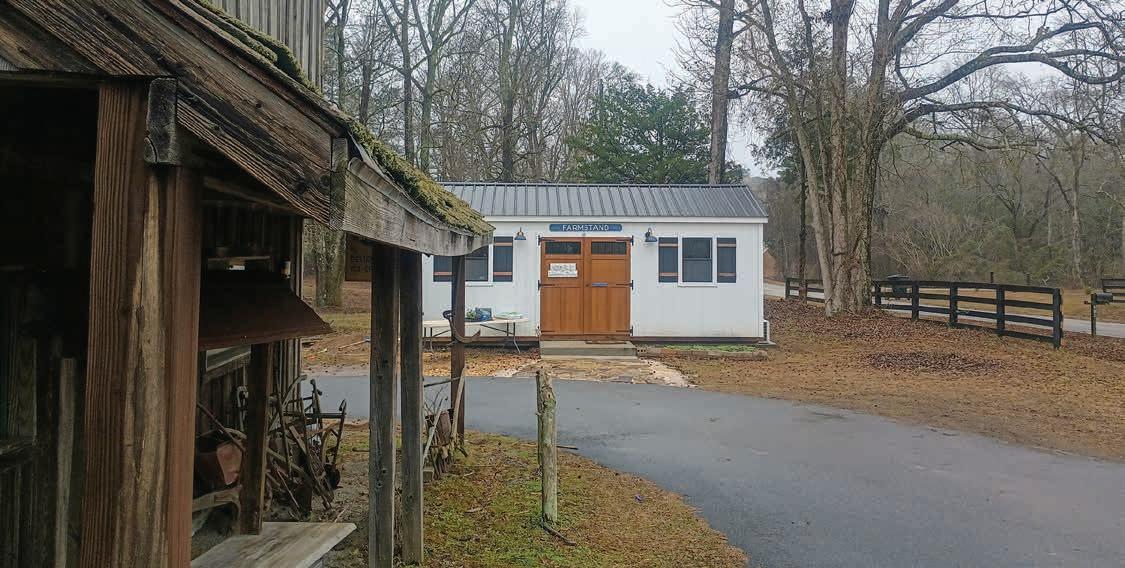
That’s what Harris County’s Jenny Jack Farm has launched just off the road at their farm.
But wait a second. Isn’t Jenny Jack a farm that’s best known for its subscription-based produce? What gives?
Well, small farms have had to get creative with how to maximize sales in a modern era. For many of them, they have to adopt strategies that are not so much get-rich
strategies so much as stay-in-business ones. This is why most such farms moved to subscription based “CommunitySupported Agriculture (CSA)" models in the first place. In a CSA, consumers will commit to paying a set amount to the farmer at the beginning of a season in exchange for a guaranteed amount of fresh produce weekly. For the farm, this gives the business up-front capitol when they need it the most, to buy costly seed and soil amendments. It also gives them peace of mind, knowing they have a foundation of customers. To put it in the digital parlance, you can think of CSA members as Kickstarter pledges who get their rewards every week.
Jenny Jack Farm’s bread and butter business comes from its CSA members. They offer pickups throughout the region, in Columbus, Auburn/Opelika, LaGrange and at their 6-acre farm, near Pine Mountain, just off Interstate 185. They’re a big enough operation that they can even offer their subscribers options to customize
by Brad Barnes
their weekly “shares," to get more of the vegetables they prefer and less of the ones they don’t like.
But a year-round market stand adds two things. First, it’s a way to offer customers fresh, organically grown produce in the gaps between CSA seasons and over winter. Second, it gives a la carte buyers a lot of flexibility in pickup dates, instead of just set time windows.
“For years people have been saying to us, ‘I wish I could get there on Wednesday morning,’" says Jenny Jackson, who runs the farm with her husband, Chris.
With the market stand, you can pop by the farm any Wednesday through Sunday between 9 a.m. and 6 p.m. and find the stall open and regularly restocked with whatever they’ve got. That honor-system cash box is still there, but next to it is a credit card scanner.
In addition to their fresh produce, you’ll find many of the extras from their traditional market days: milk and yogurt from Pecan Point Farm, organic eggs
from Smyly Farm in Buford, grits and cornmeal from Rome, Georgia, honey from Crossway Apiary, herbal goods and tinctures from Love + Land in LaGrange, mushroom tea and coffee from a Florida producer, locally baked bread and English muffins, and lots more.
The stall will be open all year. “We want it to be in people’s minds that we’re here and open," says Jackson, and not have to search the web to determine if the market is active or not. That means the farm will bring in produce from partner farms in other states when the crops here are dormant. Last winter, Red Door Family Farm in Athens, Wisconsin was able to provide carrots, potatoes, sweet potatoes, beets, onions and yellow squash when the local pickin’s were slim.
Jenny Jack’s CSA isn’t going anywhere. They accept subscriptions for the spring season as late as April (though available slots can fill up). For my money, I love CSAs. Pound for pound, they’re a great value. They ensure you’re getting the
freshest produce every week. They also have a knack for making you eat more vegetables, because it’s hard to justify a fast-food dinner out when you’ve got those fresh collard greens in the fridge, and you could sauté them up in just minutes with a little fresh onion, drizzle them with a little local honey. As Justin Wilson would say, “HOOO-eee!"
But if you’ve got a problem with commitment or are just a solo buyer who gets overwhelmed by a giant bag of veg, the roadside market might be the thing for you. It doesn’t get much more farm-to-table than picking up your produce from a place where the growing fields are in view, and a steer and a pig are penned nearby keeping an eye on the store.
Brad Barnes was a journalist for 17 years and a marketing expert for 9 years before he and his wife, Jenn, started Dew Point Farm in MidTown Columbus in 2019. You can email him at info@dewpoint.farm, and he’ll get back to you after he’s washed his hands.
A HIVE State of Mind
WHILE HONEY IS A SWEET BYPRODUCT, THE REAL VALUE OF BACKYARD BEEKEEPING IS COMMUNITY BUILDING
by Brett Buckner
Fear comes first, quickly replaced by respect and awe. Obsession is close behind. Hard work is constant. Sorrow and loss are inevitable as swarms leave the hive, and bees—as well as queens—die. There’s nothing easy about being a backyard beekeeper, and the rewards can’t be measured in honey alone.
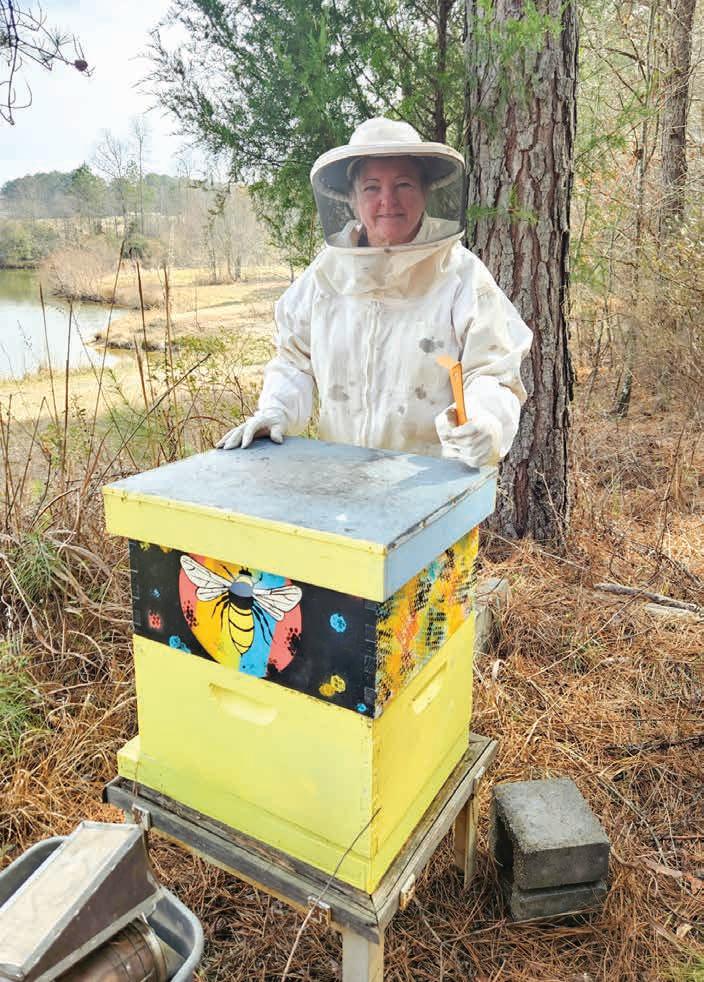
Jenny Eckman was surprised to find out she was going to be a beekeeper. About 20 years ago, Eckman’s husband, Mark, gave her two beehives for her birthday.
“No safety gear,” she said with a laugh. “He just had the hives delivered.”
Once Eckman got the necessary bee suit and mesh veil, she dove elbow deep into her new hobby.
“It was terrifying that first time,” she said. “When I put my hands in that hive after taking the lid off, the bees were everywhere, angry and buzzing. I had to tell myself to breathe. The bees weren’t going to kill me, but I was gonna give myself a heart attack.”
Jenny and Mark are electrical engineers by trade, they also own and operate KAE Farms in Harris County. Their six beehives are a natural extension of the cows, horses and chickens roam the sprawling family farm.
“Honeybees are the most fascinating insects alive,” Eckman said. “The whole hive is a community, and it's run by females. I like that…it’s very efficient.”
Not all bees are equal. Less than four percent of the roughly 20,000 known bee species produce honey, but honeybees are big business.
Honey production in Georgia reached over 2.5 million pounds in 2023, according
Jenny Eckman with one of her hives
to the Georgia Department of Agriculture with a honeybee farm gate value of over $78 million in 2022. Honeybee farm gate value refers to the total market value of honeybee-related products and services including honey, wax and pollination services, calculated directly at the point of production.
Beekeepers are critical to the honeybee population in Georgia, managing an estimated 75,000 to 95,000 colonies that are vital for both the state's $70 million pollination-dependent agriculture industry and for sustaining colony numbers against high losses. Beekeepers provide essential care, including mite control, disease management and supplemental feeding, which protects against environmental pressures and colony failure.
“If there weren't beekeepers, there probably would not be a whole lot of bees,” said Kevin Weis, president of the Chattahoochee Valley Beekeepers Association. “If you didn't have backyard beekeepers, I think that the companies that make the bees would not sell the bees, and you’d have a lot less bees. But as long as there's a profit to be made, we'll always have enough bees.”
Stroll through any locally owned convenience store, roadside stand or farmers market and find an endless supply of raw and naturally produced honey. On average a backyard hive can produce between 25 to 50 pounds of honey annually.
“The Chattahoochee Valley is a unique place to raise honeybees,” Weis said. “We have a relatively long growing season—typically March to June or possibly late August to September—which provides abundant flowering plants for bees to forage their nectar. This allows a healthy hive to produce a surplus of honey.
Northern beekeepers battle snow and freezing temperatures. Hives are not supposed to be opened unless it’s 55 degrees or higher because bees can’t safely regulate the temperature of their brood. At cooler temperatures, bees cluster tightly to keep the queen and developing larvae warm. Opening the hive breaks that cluster, letting heat escape and potentially chilling the brood, which can kill or weaken them.
“Cold bees are also less flexible and more stressed,” Weis said, “making them more defensive and slower to recover once the hive is closed again.”
Eckman generally starts pulling honey in the spring with the nectar flow starting sometime in March.
“It depends on the weather,” she said. “When the flowers start blooming, the bees are out gathering nectar or pollen. If it rains a lot, the bees aren't out working as much, so you don't have as much honey. If it's a drought, the flowers don't produce a lot of nectar, so you don't have as much honey.
“But if it's a good year, sometimes you can't keep up.”
Honey’s color and taste are influenced by a variety of factors, but it’s mainly determined by where the bees go to
ABOVE: Jenny
“If there weren’t beekeepers, there probably would not be a whole lot of bees.”
-Kevin Weis
TOP: A zoomed in look of the bee hive shows the queen (black in center). photo by Kevin Weis
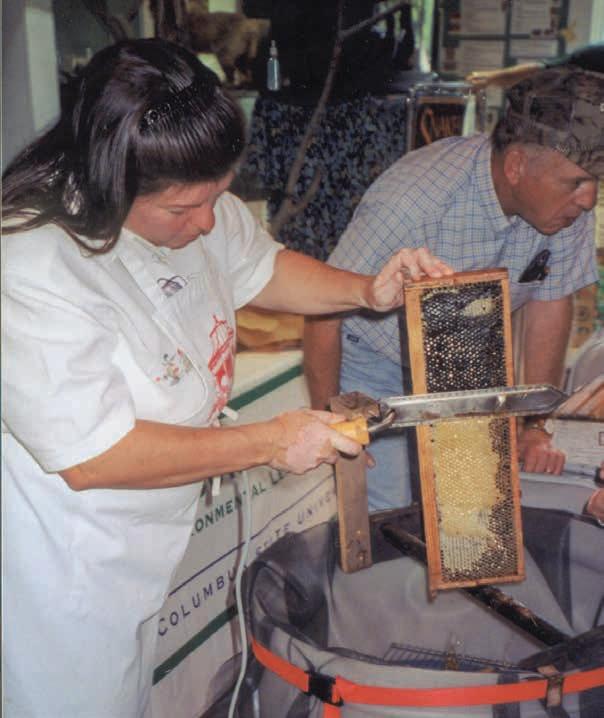
harvests the honey from her hive.
gather nectar and pollen. According to the University of Georgia Extension program, the native plants that are most attractive to honeybees include: maple trees, clover, soybean, tulip poplar, palmetto, sourwood, goldenrod and buckwheat.
Sellers can only promise honey’s specific flavor if their hives are set up in a field filled mainly with that type of tree or plant. That’s why most backyard beekeepers offer wildflower honey because it’s produced from the nectar of a variety of flowers.
“Most of what we sell is the wildflower,” Eckman said, “because we just don't know where those bees went. It’s something of a sweet mystery.”
Eckman sells her honey at KAE Farms, and her customers can become impatient.
“People are always calling me,” she said. “I've got a pretty good clientele list who just love our honey.”
There are educational programs and certifications available to backyard beekeeping enthusiasts. Oxbow Meadows offers beginner’s beekeeping and Junior Beekeeping workshops in the spring.
While a certificate isn’t needed to raise hives or sell honey, a license is required
for wild bee removal from homes or for selling bees, queens and nucleus colonies (aka “nucs”). Georgia, along with Texas and California are the top three states in producing honeybees and queen bees for sale. Though there’s certainly the potential for a profit from selling honey, it’s not the sole motivation for many backyard beekeepers.
Weis’ bees made 850 pounds of honey last year, which, at his son’s suggestion, he donated to the Harris County Humane Society to sell.
“I got into beekeeping,” Weis said, “because I wanted to do something bigger than myself.”
It’s About the Hive
Not the Honey
Radiah Mallard describes herself as “solution focused” and “methodical,” personality traits likely forged through her years of military service spent on the supply/administrative side. Radiah also enjoys being outside. It was during one of her nature walks that she noticed something was missing. The countryside
Barnes & Noble
Columbus Park Crossing 5555 Whittlesey Blvd. Columbus, GA 31909 The Cat’s Meow 137 Main St. Pine Mountain, GA 31822
Columbus Bound Bookshop 1328 13th St. Columbus, GA 31901
Columbus Collective Museums 3218 Hamilton Rd. Columbus, GA 31904
Columbus Museum Gift Shop 1251 Wynnton Rd. Columbus, GA 31906
Dinglewood Pharmacy 939 Wynnton Rd. Columbus, GA 31906
Durham’s Pharmacy 1420 17th St. Columbus, GA 31901
Galleria Riverside 1658 Rollins Way Columbus, GA 31901
Judy Bug Books 1033 Broadway Columbus, GA 31901
Piedmont Columbus Regional Midtown Gift shop 710 Center St. Columbus, GA 31901
Piggly Wiggly 5850 Moon Rd., Columbus 4916 River Rd., Columbus 1359 13th St., Columbus Stadium Plaza, Phenix City
St. Francis-Emory Healthcare
Nancy Saunders Gift Shop 2122 Manchester Expy. Columbus, GA 31904
Whitewater Express 1000 Bay Ave. Columbus, GA 31901
wasn’t like she remembered from childhood, when she could pick berries, plums and apples practically right from the side of the road.
The cause?
“There weren’t enough bees,” Radiah said. “People were killing them off and treating them like pests.”
Radiah decided to do something about it, first, by enrolling in the Hero to Hives program, a beekeeping course for veterans at Michigan State University, and then ordering a couple of hives from Woody O'Connell, a locally licensed beekeeper and owner of Honey, I’m Home, whose mission is for people to “have a partnership with bees.”
This all came as something of a surprise to Radiah’s husband, Robert, who is also a military veteran.
“I thought she was playing” Robert says, still sounding a bit shocked. “I should have known better.”
Fortunately, Robert “took to beekeeping right away,” he said. “If I was nervous, it was because of Radiah”
Radiah admits to being scared at first. “One of my challenges in the beginning,”
she said, “was actually realizing that these were wild animals that couldn’t be tamed just because I wanted them to be.”
And yes, beekeepers get stung.
“I get stung every year, multiple times, too many times to count,” Weis said. “I've been stung almost everywhere except in my eyeball. I've been stung on my eye lid, and I’ve even been stung in a place no man
should ever get stung.”
Beekeepers even get stung through their protective suits.
“It gets hot in Georgia,” Weis said. “You sweat, and the suit sticks to you. When they find the one spot where you sweat through your suit, you're done.”
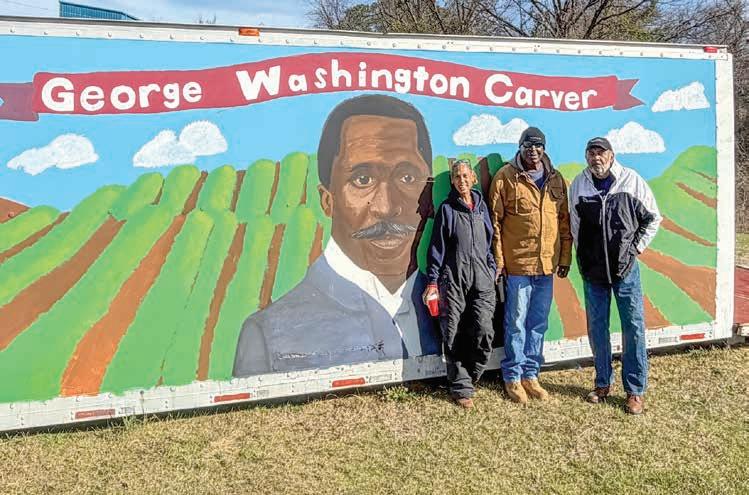
Robert and Radiah’s hives were installed at the George Washington Carver Victory
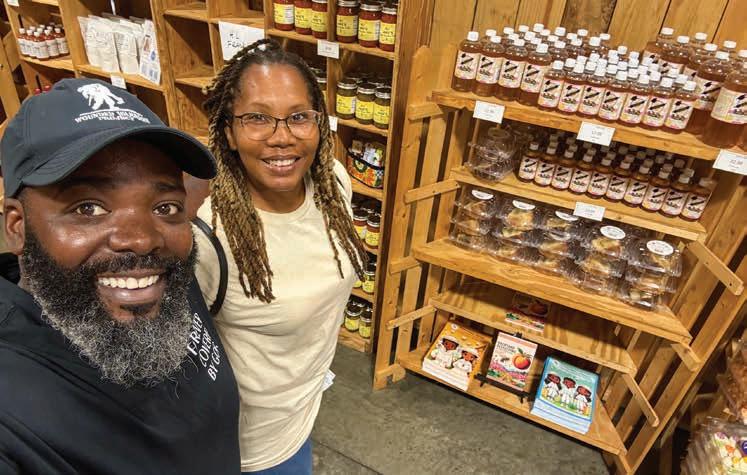
LEFT: Robert and Radiah Mallard selling their products at the Georgia National Fair.
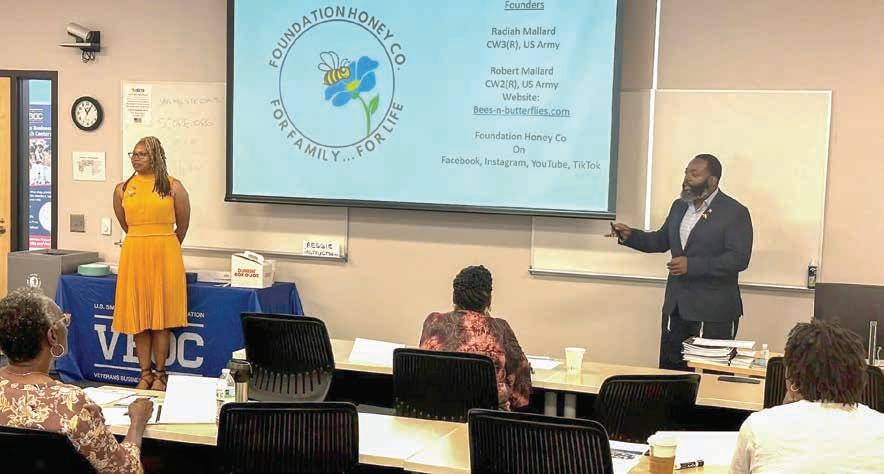
RIGHT: The Mallards teaching transitioning soldiers about entrepreneurship..
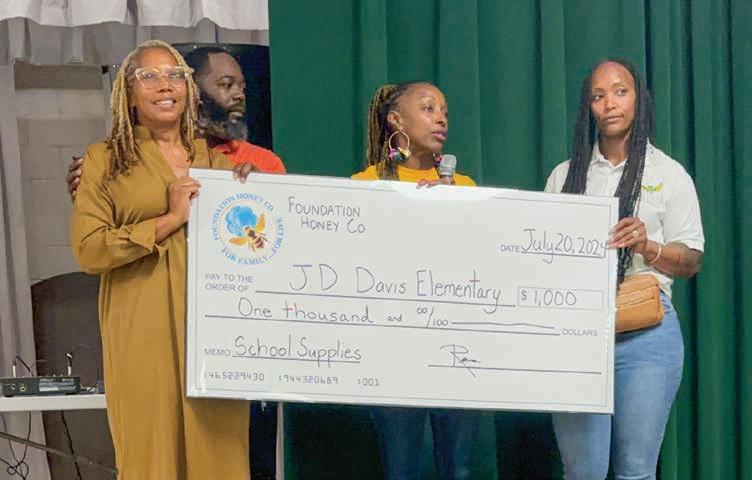
BELOW: The Mallards present $1,000 of their proceeds to JD Davis Elementary.
Local Beekeeping Resources
Foundation Honey Co. Education & Sustainability | Columbus foundationhoneyco.org
Turn Around Columbus Improvise, Adapt & Overcome | Columbus turnaroundcolumbus.org
Chattahoochee Valley Beekeepers Columbus GA Beekeeping Club cvbeeks.org
Master Beekeepers Program from the University of Georgia Master Beekeeper Program bees.caes.uga.edu
Garden and Farm, an initiative of Turn Around Columbus (TAC), which aims to empower youth with hope and opportunities.
Those two hives became eight. That soon led Radiah and Robert to start the Foundation Honey Co. with the mantra of “Educating others on how bees keep our world beautiful,” Foundation Honey Co. offers a variety of programs. These include hands-on beekeeping classes that teach entrepreneurial and community mindsets, resilience through beekeeping practices and specialized programs like Women in Leadership, Attributes of a Queen and Men in Leadership: The Drone Effect.
“Bees have a very tight community, and they work in harmony” Robert said.
“The byproduct of a well-managed hive is honey and survival. When we started looking at the community of Columbus, it looked like a hive out of order in many communities. So, we learned a lot about community through the stewardship of these hives.”
Their programs target everyone from school children to veterans, all with the goal of employing honeybee hives as a real-world analogy for what can be accomplished through unity and teamwork.
“Especially in an area that has a lot of problems where we can teach stewardship of nature and God's creation,” Radiah said, “but also teach the value of community through beekeeping ... because every bee in a hive has a different job.”
Foundation Honey Co. sells its honey with proceeds donated to JD Davis Elementary to help buy school supplies. Each of the past two years, Robert and Radiah have donated $1,000.
When Robert and Radiah go into the schools or bring kids to the hives, it’s the honey that gets their attention.
“The initial question is always, ‘Hey, y'all got some honey?’” Robert said. “So, we had to navigate that, explaining that honey’s great, but it’s seasonal.”
But it’s the hive, not the honey that inspires kids the most. “We’re here to help bring community together,” Robert said. “It opens their minds to other possibilities. It makes them aware that, ‘Hey, if these people are taking care of bees, I can do anything.”
Ninth Annual Spring Swing Provides CSU Dance Scholarships
Let theTimesGoodRoll!
That’s the theme for Columbus State’s Spring Swing, one of the main fundraisers for the university’s dance minor program. The ninth annual event will be held on Saturday, April 25 at the Frank G. Lumpkin, Jr. Center.
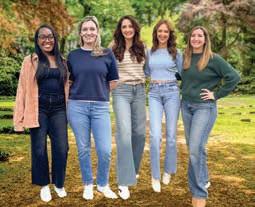
Four amateur teams from the community will compete for the Judges Choice Award, given to the team for the most entertaining performance of the evening, and the Community Award, given to the team that raises the most funds for the CSU Dance Minor Program. Each team performs a choreographed routine and is coached by a local dance professional. Beginning in February, votes for each team can be cast through the Spring Swing website—columbusstate.edu/ springswing2026—where $1 equals one vote.
All the funds raised by these votes will go towards tuition scholarships given to five dance minor students.
The Spring Swing will feature music
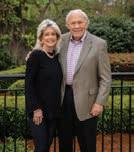
by “Georgia’s Premier Party Band,” The Grapevine Band. JoRhee and Jack Pezold, pillars of the Columbus community and veteran champions of the arts, will be given the 2026 Lifetime Achievement award.
“As always, the CSU Spring Swing is a delightful fun-filled event for all ages 18 and over,” said Patty Taylor, chairperson for the CSU’s Dance Minor Advisory Board. “When you add dining with superb food and beverages and dancing or listening to the music of The Grapevine Band, everyone in attendance will be captivated by a very enchanting evening.”
By the fall of 2015, the CSU Dance Minor Advisory Board was formed. The board created two fundraisers—The Broadway Ball, a black-tie event, and the Spring Swing.
The dance minor program was officially announced in February of 2016 in conjunction with the inaugural Spring Swing.
The CSU Dance Minor program consists
CSU Spring Swing
Saturday, April 25
Frank G. Lumpkin, Jr. Center, CSU Main Campus 6:30 to 11p.m.
Tickets: $60 through April 10 and $70 starting April 11
Tickets include meal and all beverages.
Ages 18 and up
For more Information, visit columbusstate.edu/springswing2026
of 15 credit hours of dance technique, dance history, dance composition, anatomy of dance and dance performance courses.
“The core mission of the dance program is to combine dual dedication to art and learning. Obtaining additional faculty specializing in diverse dance forms is a must,” Amy Mutarelli, director of dance/associate professor of dance at the university, said. “There are so many beautiful and unique dance forms, perspectives and voices. Representation and inclusiveness are core values for me as the director of this program. My personal hope is that CSU dance inspires the next generation of dancers, dance students, patrons and audience members.”
West Georgia Oral & Facial Surgery
On the Cutting Edge of Technology
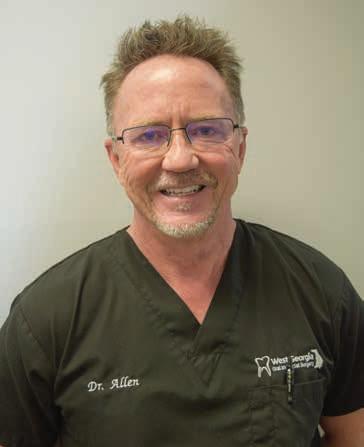
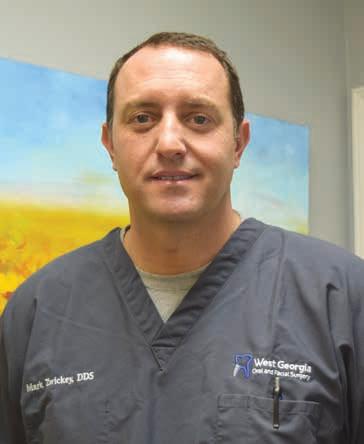
With more than 40 years of combined specialty surgical experience, Dr. Lee Allen and Dr. Mark Zwickey have made West Georgia Oral and Facial Surgery the maxillofacial surgery and rejuvenation onestop-shop. “Maxillofacial is a big word,” said Dr. Allen, “which means our dental training includes advanced oral and facial techniques that make us unique providers.”
To provide the best possible treatments for their patients means being constantly updated and informed about the technological changes within the industry and being willing to implement those changes within their practice.
“When it comes to technology and the dentistry profession, it is important for our practice to keep up with the latest trends and advances,” Dr. Zwickey said. “Advances in technology help to assist in proper patient care as well as more precise treatment methods, which in return can create a successful outcome and better recovery.”
West Georgia Oral and Facial Surgery is a licensed facility that can provide different types of anesthesia in its offices for every patient whether they want local or IV sedation.
“We cater to that, and can make their procedure seamless,” Dr. Allen said.
“As far as procedures themselves, we specialize in implants and have the 3-D treatment technology to perform single or multiple tooth replacement care for routine, or urgent cases in our office. We also specialize in cosmetic techniques like Botox and fillers,” Dr. Allen said.
Another aspect that sets them apart is a team approach. “We concentrate on surgery,” he said, “but work with a patient’s general dentist to do comprehensive planning using CONE Beam imagery software. Advances in bone grafting, plus implant placement innovations are exciting, too, and help improve the success rate long term.
“One of the things we pride ourselves on is that our staff excels at providing compassionate care and making a visit for an anxious patient as easy as possible,” Dr. Allen said. “We have highly trained long-term employees, who understand anxiety and emphasize that we are here to provide state-ofthe-art surgery in a compassionate environment.”
Dr. Allen completed training at Louisiana State Medical Center and moved to Columbus
after practicing for 20 years in West Virginia. “Dr. Zwickey has been here over 15 years,” he said, “and patients appreciate that we live locally with our families.”
He concluded, “We find that a lot of people put off dental surgery due to apprehension, and in those cases, seeing their amazement when they wake up from sedation and their surgery is already done is very rewarding.”
Dentistry is a profession that is as challenging as it is rewarding. But for both Dr. Allen and Dr. Zwickey, it’s the patients who make the effort worthwhile.
“Dentistry can be a challenging profession,” Dr. Allen said. “Each patient has their own concerns and challenges that they bring to our practice. There is also the constant change in techniques and procedures that are constantly keeping us on our toes. We are constantly learning to make sure we are offering the utmost care to our patients.”
“Despite the challenges that come along with the dentistry industry, it is extremely rewarding to see how our care can change a person’s life and confidence,” added Dr. Zwickey. “Whether we help a patient with pain, help to restore their smile, or provide cosmetic procedures they desire, seeing a happy and satisfied patient makes every day worth any challenge that comes our way.”
For more information about the services that West Georgia Oral and Facial Surgery offers, call 706.596.1757 or visit WestGaOralSurgery.com.” Adv.
Contact
706.596.1757
3640 Confetti Blush Dr. westgaoralsurgery.com
Gentle Dentistry of Columbus
Let us Transform Your Smile
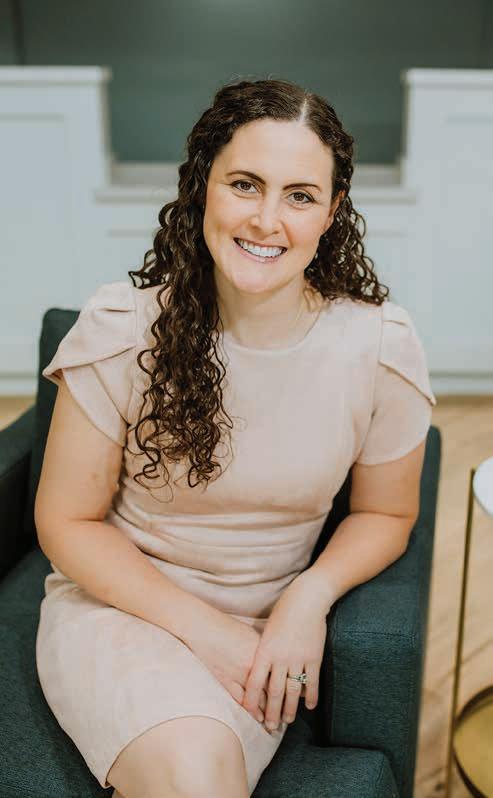
After purchasing Gentle Dentistry of Columbus in the Fall of 2018, Dr. Devon Paris has been driven by a singular purpose—to create a place where every patient feels at ease. The name of Dr. Paris’ practice is the very embodiment of that goal—Gentle Dentistry of Columbus. However, her vision doesn’t end with the name of her practice.
“I care so much about my patients that owning the practice outright was very important to me because I can ensure the customer service and family-like atmosphere stays—no one will feel like a number,” Dr. Paris said. As a result, she chose to invest in her patients and hometown. Since 2018, she has owned 100% of her practice—a rarity nowadays as private equity firms are increasingly buying up local dental offices. “We all truly want our patients to feel the same warmth and joy as visiting a cherished relative they see every so often but always look forward to. Also we hope for them to leave feeling heard, and with a smile on their face, having shared a laugh or two.”
“As we continue to cater to the community, grow and evolve,” she said, “we recognize the importance of broadening our perspectives, enhancing our expertise and ensuring that we are always available to see the needs of our patients.”
Gentle Dentistry of Columbus provides:
Crowns and Bridges: These preserve and restore the structure of your teeth to improve a tooth’s appearance and help prevent cracking.
Cleanings and Exams: Hygienists evaluate your dental health, provide the appropriate cleaning and educate patients on proper technique and gum disease, then the dentists come in to check teeth for cavities.
Restoring Implants: Placing crowns or bridges on top of implants in order to create an aesthetic and functioning smile after teeth were extracted.
Hybrids: Removing all teeth on an arch when those teeth are not fixable and replacing those
teeth with a brand new set— color of tooth, shape of tooth, size of tooth to your liking. These are fixed to implants under your gums and do not have to be removed at night. This type of appliance is the closest thing we have currently to natural teeth.
Fillings: Tooth colored fillings restore the tooth to a healthy state once a cavity is removed, and leave it looking like nothing ever happened.
Sealants: One of the most valuable preventative tools in dentistry. It keeps teeth healthy without removing any natural tooth structure. Sealants are just painted into the deep grooves on the chewing surfaces of teeth, so when you eat, nothing gets trapped down in there to create a cavity.
inside and outside of the tooth at the same time, it will bring that tooth back to the shade of your surrounding teeth.
Extractions: Tooth removal due to cavities, trauma, or crowding.
Teeth Whitening: The cosmetic procedure that lightens the color of teeth. This can be done on the outside of natural teeth and on the inside of teeth with root canals.
Options for teeth whitening:
• Take home trays: These custom whitening trays fit into your teeth's specific nooks and crannies to better whiten those stubborn areas.
• Opalescence GO! Kits: These kits are a step above what can be bought on the shelf. They will help whiten quicker.
• Internal bleaching: If you have a dark colored tooth that has had a root canal, you could be a candidate for this. Whitening gel is placed inside your tooth and you are given a single tooth-whitening tray to whiten the outside of the tooth as well. By lightening from the
Gentle Dentistry holds itself up to the highest standards, meaning every provider shares an unwavering commitment to patient well-being while having a gentle spirit. “From the moment patients step into our practice, they will be met with the same warmth, expertise and attentiveness that have defined our approach for over 30 years in the community.”
Dr. Paris, Dr. Yaseen, and the entire Gentle Dentistry team are deeply committed to their patients, ensuring they continue to receive the outstanding care they deserve, “with expanded perspectives, greater experience and a deeprooted dedication to service.” Adv.
Contact
New Patients: 706.321.4330
Existing Patients: 706.322.6551
500 Brookstone Centre Pkwy., Bldg. 300 gentledentistryofcolumbus.com
DR. PARIS
PROVIDING LOVING AND COMPASSIONATE CARE FOR SENIORS WHO NEED ASSISTANCE WHILE MAINTAINING THEIR DIGNITY IN A CHRIST-LIKE ENVIRONMENT.
• Exercise Classes
• Fun & Games
• Men’s Fellowship & Ladies’ Tea
• Local Outings
• Medication Management
• Chaplain on Staff
• Three Chef Inspired Meals a Day
• Housekeeping & Laundry Service
• Transportation to Appointments
• Tailored Care Plans
us to visit!
by Natalie Downey
Uplifting Art
Local
Muralist Chris Johnson Blends Nature with Community
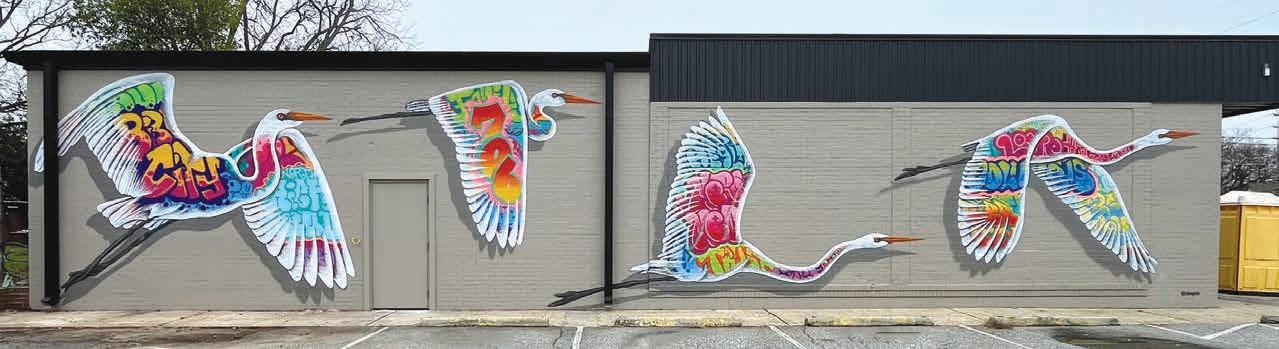
Birds don’t pay much regard to boundaries. They soar above man-made fences and walls, witnessing the bigger picture of the interconnectedness of all of nature. For local muralist Chris Johnson, birds offer inspiring insights into the interconnectedness of community and the sense of belonging that can be found when we all gather round a shared space we call home.
In 2022, real estate developer Christopher Woodruff was in the process of developing Highside Market. Located in what was once a quaint community called the Highside Neighborhood, Woodruff’s vision for the market included a lounge area with a shared space that could serve as a music venue, market spot, and entertainment hub.
Inspired by the space being a former
neighborhood and the theme of community, Woodruff approached Johnson about painting a mural in the lounge area of the market. The two worked together on the concept, with Woodruff giving Johnson some artistic liberty in the development of his mural. Themes of nature, connection, and shared spaces made Johnson’s mind turn to birds. “If you think about it, we all have our own bird houses and bird feeders in our yards and we share the same birds,” he says.
When Johnson pitched his bird theme idea, Woodruff liked the concept and added a few ideas to the concept. “I asked Chris to paint the birds all flying in the same direction,” Woodruff says. In the mural, the birds are all flying towards a painted bird house. For Woodruff, this was an important detail, symbolizing that
Highside Market is a space where all are welcome to gather. Woodruff also had Johnson paint dandelions and daisies into the mural for a few reasons—the park area at Highside is called “Daisy,” named after Woodruff’s late dog.
When deciding which birds to paint into his mural, Johnson knew he wanted to use birds native to the area. Woodruff had requested a cardinal, a symbol of renewal and life, and his father’s favorite bird, so Johnson started with that. He went on to add a hummingbird, finch, blue jay, oriole, and more, with a bird house painted off to the side. “They’re birds you would have seen at your feeder and at the neighbors’ feeders if you had lived in the Highside neighborhood,” Johnson explains.
Johnson remembers that the area where he was to paint the mural was
Highside Market’s Daisy Park
covered in graffiti when he took a first look at it. “It was beautiful,” he recalls. “It had attitude and I wanted to work around that.” Working with the concept of combining something man-made with natural beauty, and wanting to keep the space approachable, Johnson’s mural blends a graffiti background with superimposed birds across it, “I wanted it to have attitude but still be pretty and uplifting,” he explains. Understanding that graffiti can sometimes be seen as a negative thing, Johnson was inspired to elevate its colorful movement into beautiful art. “I like the contrast of what could be seen as negative combined with the beauty of birds,” he explains. “The elegance of the birds are amplified by the contrast of the graffiti.”
Woodruff liked the concept, and Johnson got to work on it. As his mural evolved, he began painting Columbus-inspired words into it. It eventually became a mural with a sort of word hunt painted into it, inviting people to spend more time with the art and take a closer look. “The more you look at it, the more [words] you see,” he says.
When deciding which birds to paint into his mural, Johnson knew he wanted to use birds native to the area. Woodruff had requested a cardinal, so he started with that. He went on to add a hummingbird, finch, blue jay, oriole and more, with a bird
house painted off to the side. “They’re birds you would have seen at your feeder and at the neighbors’ feeders if you had lived in the Highside neighborhood,” he explains. For Johnson, birds also represent the idea of memories. Birds collect bits and pieces of the world they encounter and take them home to build their nests—scraps of yarn, hair, bits of paper—all are incorporated into the bird’s own home, a mosaic testament of all of the places the bird has gone and the things he collected along the way. “Like birds, you collect memories when you go places,” he says, “All the pieces stick with you. I thought of that when I was making the mural.”
His bird-themed mural caught the eye of MercyMed developers. The communitycentered medical campus was developing an additional office and asked Johnson to create a bird mural for one of their buildings as well. “The building was covered in graffiti,” he recalls. “They wanted to retain that aesthetic, clean it up a bit and add in elements that related to the river.” He decided to create a mural similar to his Highside Market graffiti and birds mural. This time though, his mural would star white cranes. “You see them all over the river,” Johnson explains. And, he wanted to work with the symbolism of white cranes as healers and bringers of
transformation. “When I’m working with a vulnerable group or delicate situation, birds are a beautiful symbol,” he says. “I work with them a lot.”
For Johnson, his murals are more than just colorful art—though that in and of itself lends cheer and enjoyment to a community setting. He finds inspiration in the knowledge that his murals bring people together. For him, watching the responses of people as they experience his art makes it all worth it. “People have responded very positively,” he recalls. “Even people who wouldn’t normally like graffiti find it activating and engaging.”
Johnson recognizes that the power in art is in how people respond to it. And when he sees people taking photos with his murals, and kids enjoying it, he knows his mission in bringing a community together through art has been accomplished. “When I see people enjoying murals I painted, I think, ‘Wow - it’s not even my painting. It’s their painting.’”
And, just as a bird’s nest is comprised of fragments from all of the places they’ve been, our own community is also a living mosaic, a mural that each inhabitant lends color and texture to. We come, bearing fragments from all of the places we’ve been and, together, we create the space we call home.
CULTIVATING in the VALLEY
PART TWO: FARMING
Farming has been a part of the Chattahoochee Valley since settlers first made it their home. In this section we look at urban farming, the large scale producer and the homesteader. Overall the running theme with any scale of farming is that the focus is on community—feeding, teaching and unity.
by Frank S. Etheridge IV
Follow along with C&V in 2026 for this series on America 250 where we focus on the skills and industries that were formative in the development of the United States of America and are still present in the Chattahoochee Valley.
Sowing Tradition, Reaping Innovation
Rooted for more than a century in Stewart County’s fertile soil, WC Bradley Farms draws on the past to pay it forward.
Talking while on the 30-minute drive from WC Bradley Co.’s headquarters on Front Avenue south to its private farm in Stewart County, Ashley Turner draws a strong parallel for how the approximately 40,000-acre site serves as a microcosm of the prevailing forces that have shaped the full 250-year span of agriculture in the United States of America. Family-owned and operated since the early 1900s, WC Bradley Farms extends out from steep river bluffs to rolling hills of towering hardwoods and piney woods to big-sky spaces of lush river bottoms. The land’s life-giving qualities of fertile fields, abundant wildlife and vital waterways explain why this stretch of the Lower Chattahoochee River Valley served as the center of commerce and culture for Native Americans for centuries. Indigenous populations were removed, at first by fraud and then by force, with the State of Georgia’s encroachment southwest into Creek Territory in the 1820s and
‘30s. Next, government-sanctioned land lotteries then planted seeds of wildly profitable plantations, owned by those of European descent, worked by enslaved labor imported from Africa. Slavery, the cotton gin and the Chattahoochee’s direct connection to lucrative European markets combined to make current-day moribund counties of Randolph and Stewart a bustling place flush with newfound wealth in the antebellum era. The century after the Civil War ended slavery saw smallscale tenant farming on land often ruined from too much fertilizer and too much tilling, though high-demand for the native longleaf pine created a boom in timber production. Post-World War II mechanization meant human hands were no longer needed to cultivate land. That was changed forever by engineered lake, so nearly everyone left for greener pastures in cities while farms grew exponentially in scale to stay afloat and streamlined into harvesting just a few reliable cash crops
bound for distant markets.
“Cotton, corn and peanuts became South Georgia’s cash crops,” Turner says as she drives on dirt roads that count as Stewart County highways and past clapboard country churches that are vintage, yet vanishing, in Georgia. “And they’re still grown here.”
Turner certainly has an up-close view of operations of WC Bradley Farms that’s well-informed as to its position along the time-space continuum of American agriculture. The Columbus native followed up her undergraduate degree from the University of North Carolina with a masters of wildlife biology from the University of Georgia before an internship at Ichaway, land once owned by Coca-Cola executive (and Columbus native) Robert Woodruff on the Flint River in Baker County that is now primarily a quail-hunting destination, for the renowned Jones Ecological Research Center, where Turner learned to love the indigenous, yet endangered, longleaf pine. Directly connected to WC Bradley Farms by marriage, Turner’s work on the property, which has ranged from wildlife management to land conservation to blueberries, evolved when she had children and thus advocated for conversion to organic practices in order to cultivate healthier food options for families.
Mirroring a larger national trend toward increased awareness of how much nutrition matters in overall health—and just how bad processed food is for our mind and body— Turner linked WC Bradley Farms up with
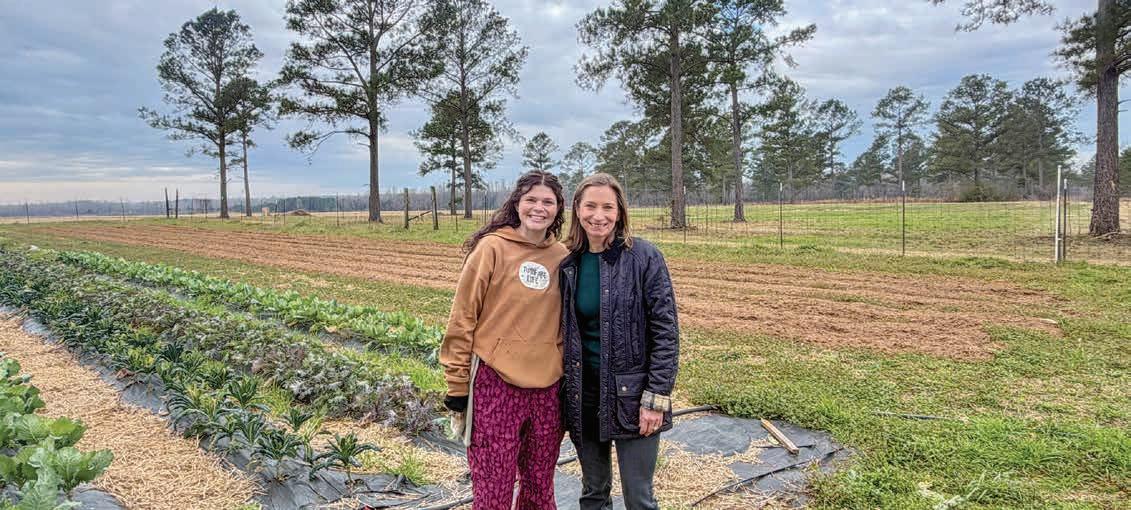
Charlotte Yancey with Ashley Turner
Georgia Organics, a member-supported nonprofit founded in the 1970s to “connect organic foods from Georgia farms to Georgia families,” as well as Georgia Grown, a marketing initiative of the state’s department of economic development, that promotes the ‘buy local’ principal for produce in markets and grocery stores. This was 10-15 years ago, when the farmto-table concept took hold. However, the impracticality of production under restrictive certified-organic standards for crops, combined with the strain of a small staff also responsible for WC Bradley Farms’ livestock and recreation (quail hunting, its primary activity, just like Ichaway and similar swaths of land in South Georgia), called for a new approach. In yet another parallel to the new way forward for American farms, the practice on Bradley property is now that of regenerative agriculture.
“In the larger sense, regenerative agriculture just means regenerating healthy soil,” Turner says. “Crop rotations, cover crops, cows stomping on the ground and pooping—that’s regenerative agriculture."
The hard-won fruit of this intentional labor has a positive ripple effect in kitchens across the Chattahoochee Valley.
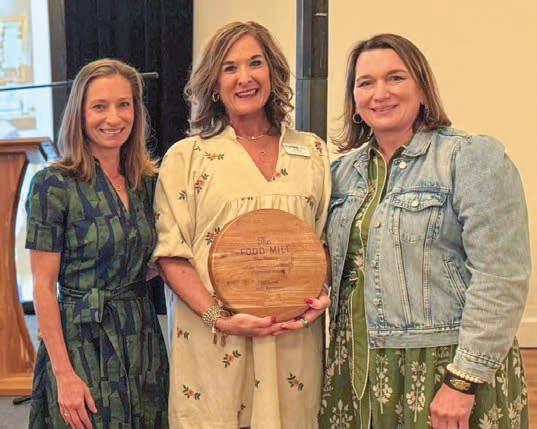
“Ashley’s passion for regenerative farming practices aligns with The Food Mill's mission to support small local farmers in an effort to strengthen our local food system,” says Olivia Amos, executive director of the community-minded nonprofit restaurant/ caterer/education resource. Amos calls The Food Mill “blessed” to have Turner serve as its board chair for the past five years and last year bestowed the first-ever Ashley Turner Community Cultivator Award to Jill Jones, a career-mentor educator at Jordan Vocational High School and owner of home-based bakery Dreams and Butterbeans, during its annual awards luncheon.
“When we are all collaborating and working together towards this same goal,” Amos adds, “our community benefits by greater access to fresh local food.”
Innovation & Stewardship
Today, WC Bradley Farms is widely recognized by leaders in agriculture across Georgia and Alabama as a model for its mix of innovation and stewardship. Acreage closest to the Chattahoochee River is held in the voluntary Wetlands
Reserve Program, which offers technical assistance from the federal Farm Service Agency as part of the effort to protect American wetlands’ delicate ecology. The farm benefits from a close relationship with the UGA Cooperative Extension office in Lumpkin and its vast offerings of agricultural research and resources.
Along with Dan Fletcher (farm boss) and Derek Lynch (property manager), Turner helped usher in this era with the new approaches mentioned above as well as collaboration with fellow forwardthinking farmers such as Will Harris. A fourth-generation cattleman in Bluffton, a bit further south down in Clay County, Harris is a living legend for revolutionary practices (cows grazing under solar panels) with profound impact (the return of bald eagles) while boosting the bottom line by creating widespread demand for their White Oak Pastures brand of beef, pork, turkey and chicken. Turner also represents a bridge to the past at WC Bradley Farms and the ancient wisdom of those who worked the land before her, namely her friend and mentor, the late James Carter.
“James always said to never touch greens after a freeze,” Turner says on a blustery January morning after several days of a hard freeze to farmstead manager Charlotte Yancey, who, along with colleague MaryMartin White, is responsible for WC Bradley Farms produce that ends up in the kitchens of Columbus restaurants and homes, grown in the same plots Carter once cultivated.
“It’s going to be fine in two days,” Yancey says, pointing to rows of kale the freeze forced to slump over (but also turned its leaves a brilliant purple).
“I brag about how good their kale is,” Turner says. “It fills you up faster. The look and taste of it is so much better than anything you can find at the grocery store.”
Two years into her WC Bradley Farms job, offered after she graduated from NC State with a degree in agroecology and sustainable food systems (followed by an agri-tourism internship on an olive farm and vineyard in Tuscany), Yancey explains that she and Martin, who is considered a genius in the Chattahoochee region farming circles and ran her own Little Bit Farm for years, together do four major plantings a year. “We just harvested most of our winter garden: Napa cabbage, carrots, spinach,” Yancey explains. “Next week, we’ll get started for the spring. In the summer, we grow Southern staples of squash, eggplant, okra—plus a mix of varieties we get excited about like yard-long beans, which is this huge, weird-looking bean— and pollinator-friendly flowers like zinnia and marigold.”
Finding her life’s passion and career while a student at Brookstone and volunteering at MercyMed Farm for the school’s AgriColGA Club, Yancey smiles as she recalls her first summer at WC Bradley Farms and the abundant, massive squash she harvested. “I’ve never seen squash produce like that!”
The giant squash yield was the result of the soil’s considerable calcium deposits, the results of James Carter’s fertilizer of choice, the old-school organic option of lime. “James worked this plot all by himself,” Turner recalls, “and did it just like his grandmother did it, putting lime on it every season.”
“A farmer is a special person,” says Turner.
The Food Mill’s inaugural Ashley Turner Community Cultivator Award was presented to Jill Jones of Jordan Vocational Career and College GTI Program. (L-R) Ashley Turner, Jill Jones and Olivia Amos
“All of us are skeptics when we’re introduced to a new idea about how to do things. Like when I started talking about organics and regenerative agriculture—the reaction I got,
you’d think it was the dumbest idea they’ve ever heard. But what I love about it here is it’s ‘go big or go home,’ and once they put a new idea into practice and see the results,
Strong Roots
Ronzell Buckner and his Turn Around Columbus crew cultivate joy and hope at George Washington Carver Victory Garden and Farm
Literally and figuratively, Ronzell Buckner casts a big shadow.
Figuratively, given his respected stature from decades as owner-operator of Skipper’s Seafood, a legendary restaurant/ market on Buena Vista Road. Even before he retired a few years ago, before the seemingly infinite construction chokehold on Buena Vista Road, with its maze of barricades and road closures, cut off customers and ushered the 79 year old into retirement sooner than he perhaps expected, back when he was working the relentless hours of a restaurant/smallbusiness owner, Buckner always found ways to contribute to the greater good of his community. Whether by creating opportunities for entrepreneurs, awarding scholarships to students or investing in a person, project or place that just needed a hand-up in order to thrive, Buckner has long embodied the humble strength of a servant leader.
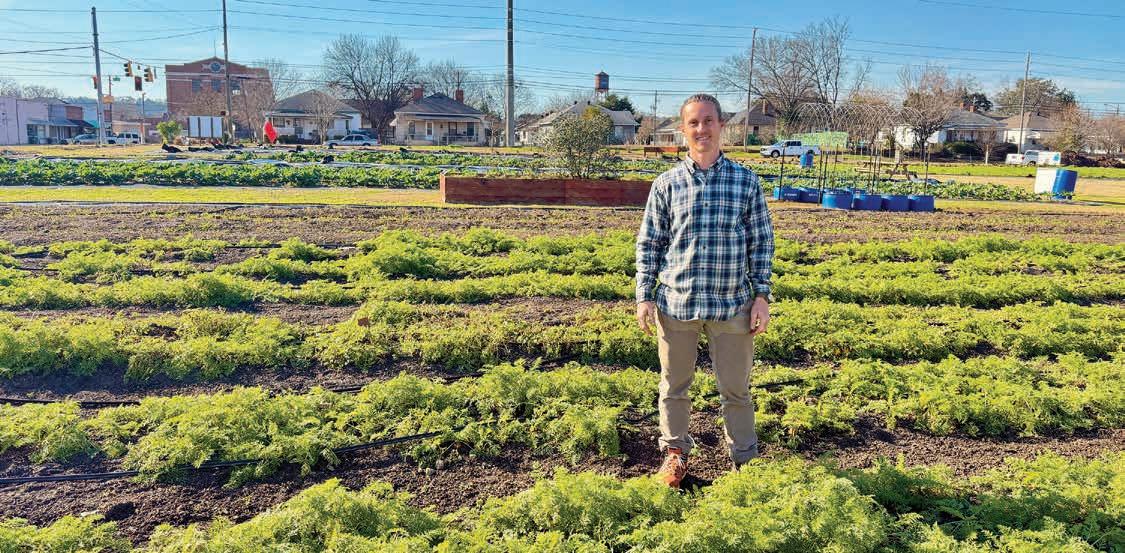
Literally, because when ‘Mr. B’ steps out of his Ford-tough, man’s-man vintage Bronco, his large frame looms large in a shadow cast by a bright winter sun that seems to stretch forever across the frozen ground of the Georgia Washington Carver Victory Garden and Farm. Through his nonprofit organization, Turn Around Columbus, Buckner constructed the Victory Garden on Muscogee County School District property on fields behind the adjacent campuses of Marshall Success Center and Davis Elementary. That was four years ago, not longer after Buckner led the charge to construct the Martin Luther King Outdoor Learning Trail. Running directly behind the schools along MLK
they’ll take your idea and push it past what you originally wanted to do and take it even further than you thought possible.”
Boulevard, the trail stretches 2.2 miles and features 18 sites with 11 historical markers on its way from Rigdon Road to the Chattahoochee River.
“Twenty years ago, I was sitting on the front porch with Mr. B and his wife, Miss Kitty, at their home when he told me, ‘We’re going to set up a farm somewhere in the community,’” recalls farm manager Mary Rogers. She sits in the warmth of a greenhouse filled with rows of cabbage, spinach, onions and kale alongside co-worker James Bell as Buckner arrives— still early enough for the nearby roosters to crow loud and proud. “So this isn’t something he pulled out of his pocket. A lot of thought, a lot of time and effort, went into this.”
“I saw how Mary cared for things around her,” Buckner says of his neighbor’s plants and property, “plus her personality and attitude, and I figured she’d be a good fit for the farm, so I brought her on to manage it.”
“I’ve been here since the very beginning, back when there were just a few beds up top,” Rogers says. “I was given the opportunity by Mr. B to help me on a healing journey and, trust me, digging in the dirt with your hands to grow good things is so, so healing.”
Today, the farm features two large planted fields, raised beds, a blueberry grove, chicken coops, boxes of beehives for
honey, a storage trailer, educational signage and more. The Victory Garden bustled over the recent MLK Day weekend, when Columbus State’s track team volunteered for the holiday’s day of service, which also featured a community trash clean-up Turn Around Columbus hosted on the trail and farm in partnership with Keep Columbus Beautiful Commission.
Producing fruit, vegetables and eggs is important at Victory Garden. However, the big-picture focus is on educating and empowering youth as well as inspiring the idea of food-as-medicine in the homes and kitchens of those who need it.
The biggest pool of volunteers come from Baker Middle School students. “We call them Hope Dealers,” Buckner explains of the group, “because of the fact that a lot of people look at these kids and dismiss them. We wanted to make an impression on the community that there is hope in our community.”
Two years ago, the Hope Dealers drew a visit from Sen. Joseph Jallah from the African nation of Liberia (which has deep ties to the Chattahoochee Valley as dozens of families of emancipated slaves settled there after the Civil War) toured the farm with Mayor Skip Henderson, State Sen. Teddy Reese and others.
For the friendly, free-spirited Rogers, the best part of working with the Hope
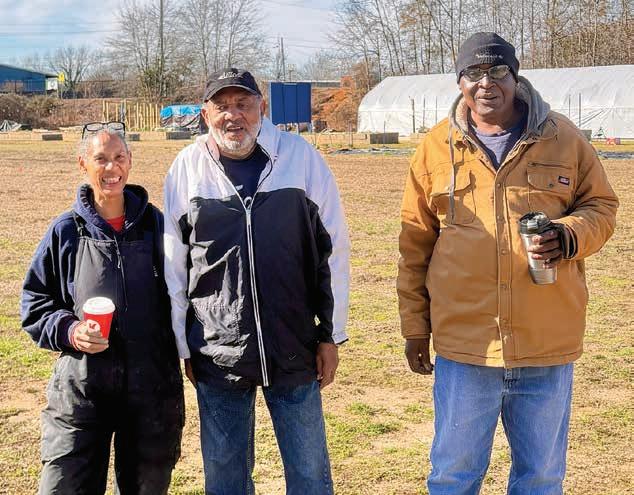
Farm manager Mary Rogers, Ronzell Buckner and James Bell
Dealers is their reaction to seeing the result of plants they grew from seed. “Some days, we’ll try to close the farm due to weather,” she explains, “but they’ll show up and shout, ‘Noooooo! Please let us plant and play!’ so we’ll stay open for them.”
Victory Garden volunteer groups also come from Hardaway High School’s Transition program for special-needs students who’ve already graduated (ages 18-22). They work on the farm as part of their job-skills training that also takes them to Fort Benning and Tractor Supply. Another key educational partner is Fort Valley State University, with students in its excellent agriculture department coming to Columbus to provide the knowledge and tools needed for various farm projects such as building tresses for the greenhouses.
Fort Valley State is now at work on the farm preparing the grounds—hard-packed to the point of almost hostile to planting seeds after decades of serving as Marshall’s baseball and football fields—for a vineyard of muscadines and persimmons.
“We want people to come out and take advantage of what we’re doing here,” Buckner explains. “We have educational
material about the plants, what nutrients they have, and some good recipes they can use to cook with it. Do you have heart disease? Well, beets are good for that. We want to help answer their questions; ‘Why should I eat this? How do I make it taste good?’”
A partnership with the Cancer Society of Southwest Georgia brings its Survivor
Thrivers (cancer survivors and their caretakers) to the farm to pick up fresh produce and recipes for healthy eating. Rogers says they give away all the produce they grow, mostly to families of volunteer Hope Dealers but also to cooking classes at the Food Mill. The two-dozen eggs the farm chickens lay in a given week are donated, too. She teaches
The Turnaround Columbus crew stand in front of a student-painted mural depicting it’s victory garden and farm’s namesake, George Washington Carver.
a small-container planting class to show people how they don’t need a big yard to grow their own cucumber or jalapeño plant. “And I do it using buckets,” she says, “because a lot of people will see a nice pretty container and think, ‘That’s gonna cost me $20,’ so they don’t do it. But they can connect earlier to a bucket, probably
Love Your Neighbor
Farmer Keith keeps it real at MercyMed Farm
Now seven years into harvesting remedies from the soil on a one-acre plot off Second Avenue in the hardscrabble North Highland neighborhood, Keith Sims grew his success in public-health advocacy from a seed of righteous anger over the American approach to healthcare.
“I was applying to medical school and had been waitlisted for physician assistant school when I became increasingly frustrated with how medicine was being practiced,” says Farmer Keith—as he’s
have one around the house, so it’s cost friendly and easy to use—just pop a hole in the bottom and you’re good.”
A friend to many in the local farm-fresh community, Rogers says she particularly enjoys visits from Happy Hearts, a group brought in on buses by the Housing Authority. “We’ll pick their produce but
it’s just as much about reaching individual people and sharing the good things we have to offer. I tell them, no matter what’s available to pick at the farm at the moment, I can guarantee they’ll at least leave with a couple barrels of laughter,” she says, “because they’re going to remember working with Mary.”
known to the steady stream of visitors to MercyMed Farm—during a recent tour of the site, which is operated by the namesake faith-based nonprofit founded on a mission to provide affordable, quality healthcare
“I think doctors are great, but I feel we’re doing patients—and really, doctors—a disservice by taking one step forward and three steps back when we don’t address the root cause,” he continues. “We’re putting on Band-Aids while people are hemorrhaging. We keep prescribing lisinopril (heart-disease prescription) to mask the underlying heart condition— mute it, mute it, mute it. But for every action, there’s a reaction, and eventually it’s going to explode. All of it could have been prevented. And then we wonder why healthcare in this country is falling apart?”
“Preventive medicine saves money, but it doesn’t make money,” Sims concludes. “In that paradox, lies the problem.”
A husband and father of two, Sims’ family switched between three different
health-insurance companies for 2026 coverage in January alone. “The way these plans churn over shows they’re not looking at your health long term; they’re just looking at how much money you’re costing them right now. If a health-insurance company had to cover you for life, they’d be knocking on your door to tell you to, ‘Eat your vegetables. Go for a run. See a counselor—we’ll pay for it.’”
Along with exercise and community— “Just knowing your neighbors, something we’ve gotten so far away from in our technological age,” he says, describing it as a remedy for what is now medically recognized as the epidemic of loneliness and its link to lower life expectancy— Sims cites diet as a key component of our overall health.“Dextra montres? Xanthan gum? That’s not food,” he says. “That’s a preservative that your body doesn’t know what to do with. And it comes out on your healthcare bill 30 to 40 years from now.”
Earlier that day, Farmer Keith worked
“Farmer Keith” Sims at MercyMed Farm on Second Avenue
with a volunteer—a regular from the neighborhood, a transient who rode his bicycle to his shift, which qualifies him for ‘able-bodied’ credit required for governmentassistance—who was suffering from a chest cold and looking for something that would help. “I said, ‘Please take some carrots and collards with you. Adding vegetables will help your body fight off the cold.’”
Sims says he enjoys working with the many volunteers who come to the farm to lend a hand. The often monotonous, tedious work such as weeding provides the chance for “great conversations” as it “keeps your hands busy and gives your brain a good flow.” Growing your own food “adds meaning to your life,” he says, noting he especially “loves getting my hands in the soil because it connects with something bigger than me.”
The Christian mission in MercyMed expanded into the food-as-medicine philosophy in 2016-17, when Founder and CEO Dr. Grant Scarborough and then-PA Meghan Brooks constructed raised beds on a small plot directly behind its Second Avenue clinic. When Sims joined the team, which he now admits with a chuckle, none of the three knew how to farm. Because of that, he went to Pine Mountain to apprentice at Jenny Jack Farm under owners Jenny and Chris Jackson—legends in the Chattahoochee Valley’s sustainable and organic agriculture circles—who helped show him the way, along with Sims’ former landlord and Bibb City homestead trailblazer (and our resident columnist), Brad Barnes.
Assisted by part-time team member Frank Steele, a former volunteer and Aflac retiree, Sims reports that in 2025 MercyMed harvested more than 20,000 pounds of produce. Revenue from selling it—primarily done at its 9 a.m.-noon farmstand every Friday, part of the national nonprofit Wholesome Wave’s Fresh for Less that doubles SNAP dollars spent on fruits and vegetables—accounts for about 40 percent of its annual operating budget. Outside of the occasional grant—such as the $10,000 USDA pollinator grant that paid for the tunnels covered in UV-treated plastic that heated its space up to 90 degrees on this past frigid day in January—Sims, who had already been fundraising for months before his official January 1, 2019 start date, says the remaining 60 percent comes for local family foundations, smaller individual
donations and fundraisers such as the annual collards cook-off.
The farm hosts cooking classes where MercyMed patients who are prescribed a better diet learn to love its white Russian kale. “I see the job of our farm as to not only provide patients with nutritious food, but also be a voice on the side of why food can be your best medicine,” says Sims, who also holds a master’s of public health degree.
Sims also tries his best to host students of all grade levels on the farm, but has recently been working a lot with high schoolers from Jordan and Shaw. “I’m not trying to get them to love farming,” Sims says of the teenagers, “I want them to see my love for farming and see that you can love something and make a living out of it. And for them to look inside and find what they’re passionate about and see what they can do with it.”
Southern & Sweet
How a Country-Singing Mama Hen Built Singing Hens Farmstand
Kirstine Pratt told her husband Nick, when she started her Singing Hens Homestead Farmstand last spring, she hoped to build a side business where she could make a few extra dollars. Her top priority was creating a life where she could stay home with her daughter, Paislynne, now two, while Nick, an electrician, went to work for Alexander Electric, with enough time and space left to focus on her career as a country-music singer. Kirstine started performing at age 15 and went on to appear before judges on The Voice and American Idol. Though she signed with Sony, the label dropped her after she couldn’t travel to Texas to open for Martina McBride during her pregnancy with Paislynne—their “sassy little diva” and “rainbow baby,” a tribute to the son
“I want these high schoolers to start asking the questions I was not taught to ask in high school. Like ‘What do I love?’ There’s a kid from Shaw that loves wrestling, and he makes custom wrestling belts. And they’re really good! So, go make a business out of it. Just trying to get kids to think outside the box. We’ve done it here at the farm, we filled a niche, but there’s a whole world out there that’s waiting for a passionate person to step into it and fill it up with whatever it is they love.”
Pointing out that the farm’s mission will never change but has to adapt (just like everything else in life) to change, Sims predicts the present-day size and location of MercyMed Farm will likely change drastically sometime soon. Whether it’s half or all the farm’s acreage, the property’s owner, Brad Turner, is looking to build affordable, high-quality townhouses for middle-class families on the site.
Considering it a much-needed development given the current housing crisis, Sims fully supports such development.
Urban farms, Sims argues, are in a unique position to get folks to think outside the box. The one-acre MercyMed Farm can get them outside their comfort zone. Its 10 green fields can pull commuters out of their routine if, while driving past and spotting it across four lanes of traffic, they pause and ask themselves, “What’s happening over there?”
“And from there,” Sims says of this new perspective, “if that person learns from seeing us and chooses to support Jenny Jack Farm or WC Bradley Farm—places with 100 to 1,000 acres dedicated to growing—and buys local from them, that’s a win for all of us. I mean, I appreciate the convenience of chicken nuggets from Walmart, too, but you’re not supporting your neighbor.”
they lost six years earlier. Determined to maintain her big TikTok following with the freedom to travel back and forth to Nashville to record, Kirstine figured opening a farmstand would fit easily into a work-life balance dominated by her daughter and a new contract, this one with the same management that’s repped Michael Jackson and Chris Stapleton, with two new singles set for release this year.
“Nope!” she said with a laugh when asked if she ever slows down. On a recent Thursday afternoon, she stood in her driveway just steps from her farmstand off Lee Road 197 in Phenix City, while her daughter watched cartoons on a tablet inside.“I work 24/7. I recently started closing on Mondays and Tuesdays to block off that time to spend with my daughter; I even promised myself I won’t go in the kitchen on Mondays and Tuesdays unless it’s to cook for us. But really, this all has been a true blessing from God. We’re doing amazing. We’ve gotten it down now to where we’re really turning and burning.”
Business is steady, with Kirstine calling $2,000 in sales a good week from 60-plus bakery orders and about 40 dozen eggs sold at $4 per dozen ($3.50 if you return the carton).
Kirstine uses turning and burning (service-industry slang for max-efficiency on repeat) to describe her kitchen’s output,
scaled-up after her husband bought her an industrial-grade oven for Valentine’s Day in 2025. She initially used the Hot Plate platform for sales but switched at the advice of fellow TikToker Bakesy. Now, customers order and then pay for her original-recipe baked goods—including Grandma’s Blueberry Muffins and the top-selling White Chocolate Snickerdoodle
The Pratt Family
Cookies, which were created by her husband. “He’s got a real sweet tooth,” she said. He also ran power to the cutely lit farmstand—which is under camera surveillance—and built the structure with help from his father-in-law, Phenix City Fire Department Capt. Brandon Corbett.
The name Singing Hens Homestead Farmstand reflects the business terminology Kirstine selected after researching the cottage food laws applicable in Russell County. These laws allow the sale of non-perishable foods, items that do not require time or temperature control for safety, made in private home kitchens and sold at farmstands. A “homestead” refers to a small, self-sustaining operational farm.
Cottage food laws vary by state. In Alabama, they govern details ranging from approved ingredients to specific labeling requirements, including font size.
The Singing Hens logo shows a mama hen singing and strumming guitar next to her baby chick (Paislynn loves to join her mama in the recording studio, just like she does in the kitchen). At the Pratts’ homestead, the 40–or-so chickens are on a first-name basis with country queens
muffins and cookies and loaves of bread.
Calling it a ‘full-on homestead,’ Singing Hens also sells non-toxic laundry detergent and medicinal remedies in addition to the
“We did this to bring fresh, all-natural and old-timey goodies to our community,” Kirstine says, “and the community has really responded and supported us. I don’t really get to sleep, but I am loving it.”
(Dolly, Reba, Miranda, etc.) while the three roosters are George Jones, Alan Jackson and Toby Keith.
Singing Hens Homestead Farmstand
Valley Scenes
Send us photos of your community event or achievement! We will publish as many photos as quality and space permit. Please identify all subjects with a brief description of the event and the date and the photographers name. Email them to: ContactUs@ColumbusAndTheValley.com,
Young Professionals of the Chattahoochee Valley Kick-off Event
The kick off event for The Columbus Chamber of Commerce and East Alabama Chamber of Commerce collaborative group for our region’s young professionals was held at the Aflac Club at Synovus Park. With over eighty attendees the event featured a welcome to former and current board members, an overview of events, award presentations and the opportunity to network.
2025 Debutantes
Presented at Cotillion photos by SE Photography
The 2025 Debutantes at Cotillion at Country Club of Columbus were (L-R, Front Row) Zoe Caitlyn Zwickey, Kaitlyn Elizabeth Shaw, Lillian Burns White, Caroline Flournoy Pease, Jessica Lucille Scarborough, and Vivian Cade Rayfield; (L-R, Second Row) Avery Louise Ellis, Susan Chapman Middlebrooks, Elizabeth Addison Knox, Rosemary Bailey Gross, Mary Harp McMillen, Kirkland Ann Mize, Riley Elaine Alexander, and Ashley Catherine Coppedge; (L-R, Third Row) Julia Caroline Alexander, Caroline Mitchell Calhoun, Ruth Ellington Haygood, Nancy Susan Laughbaum, Margaret Crockett Miller, Carolina McEachern Sheffield and Anna Caroline Foster
Sean Knox and daughter Addie
Courtney Ellis and daughter Avery
Eric Derhammer (right) receives the Jonathan Lontin Service Award. Pictured alongside Marci Norris, Board Chair (left) and Josh Edens, Vice Chair (middle)
photos courtesy Schwob School of Music
The premier annual fundraising gala for the Joyce & Henry Schwob School of Music at Columbus State University, Gusto! featured live performances by student musicians and faculty was held at The Bibb Mill Event Center.
The elegant, sold-out event directly funds scholarships for talented music students.
Jansen Tidmore, CEO of the Columbus GA Chamber of Commerce; Doug Jenkins, current Chair of the Board; Mayor Skip Henderson and Brian Sillitto, President of Strategy Engagement
Dr. Scott Harris, Director of the Schwob School of Music, addresses attendees.
2026 State of the City
Doug Jenkins, the new Columbus GA Chamber of Commerce 2026-27 Board Chair facilitated questions with Columbus Mayor Skip Henderson during the State of the City event on February 17th. Mayor Henderson addressed growth over the next ten years with the RPI, Columbus Ahead initiative, the construction of the judicial center, public safety and crime rates reduction, the search for a new city manager as well as reflecting on his time serving the city as he enters his final year of his term.
GUSTO!
TEDx Columbus State photos by
Joe Paull
A sell out crowd gathered at Columbus State University’s Riverside Theatre Complex on January 15th for an evening filled with inspiring talks, innovative ideas, and thought-provoking discussions. Nine diverse speakers shared their unique perspectives on the following topics:
• Adrian Locklear: Sonatas & Stoicism
• Dr. Susan Hrach: What If Your Mind Isn’t Just in Your Head?
• Pauline Flores: Becoming the Light
• Natalia Temesgen: The Joy in Not Getting What You Want
• Sally Baker: Our Brains on Art
• Tykeisha Williams: Make a Big Splash
• Addie White: Leading Through the 4th Quarter
• Chelsea Powell: Marked for Life
• Maria Hayes: Be the Drop
• Dr. Bryan Banks: Truth in Tunnels Beneath Columbus, GA
Columbus GA Chamber Chattee Awards
photos
by
Shannon B. Whittington Photography
The first ever Chattees were held February 10th at Green Island Country Club. It was an evening dedicated to recognizing excellence, leadership, and impact across our business community. Award recipients included:
COMMUNITY IMPACT AWARD
Columbus Correct Care, Columbus Fire & EMS and Columbus Consolidated Government
Recognized for their collaborative efforts and dedication to improving public health, safety, and community well-being.
J.R. ALLEN AWARD
Marci Norris, Columbus Georgia Young Professionals
Honored for exceptional leadership and dedication to cultivating the next generation of business and community leaders.
BUSINESS OF THE YEAR
Columbus Clingstones
Recognized for business excellence, innovation, and significant contributions to the region’s economic growth and community identity.
POLICY CHAMPION AWARD
Representative Calvin Smyre
Recognized for decades of advocacy and public service supporting economic development and community advancement. The Chamber also announced that this award will now be permanently renamed in honor of Rep. Smyre’s lasting impact and legacy.
JIM WOODRUFF, JR. MEMORIAL AWARD
Ken Henson
Honored for exemplary leadership, service, and commitment to strengthening the Columbus business community.
Award Recipients Calvin Smyre and Ken Henson
All of the nominees and award winners gathered at the end of the event
(L-R) Adrian Locklear, Dr. Susan Hrach, Pauline Flores, Natalia Temesgen, Sally Baker, Tykeisha Williams, Addie White, Chelsea Powell, Maria Hayes, Dr. Bryan Banks
MLK Jr. Elementary Becomes First Buntin School of Excellence
The Muscogee Educational Excellence Foundation (MEEF), in partnership with the Muscogee County School District (MCSD), announced the launch of the Buntin Schools of Excellence (BSOE) initiative at Martin Luther King Jr. Elementary School, the first participating school in the program. Named in honor of Dr. Jim Buntin, beloved former superintendent and one of MEEF’s founders, the Buntin Schools of Excellence initiative is a comprehensive professional learning program designed to strengthen teaching and leadership in schools serving students from high-poverty environments.
The Art of the Steal
There was a full house present at the Bo Bartlett Center to hear guest speaker Spalding Nix of Spalding Nix Fine Art talk about The Art of the Steal. The event was hosted by and Friends of Art at Columbus State University. Spalding dove into the fascinating and shadowy world of art theft.
Boys & Girls Club of the Chattahoochee Valley Youth of the Year Awards
The Youth of the Year award is the Boys & Girls Clubs of the Chattahoochee Valley’s highest honor. It recognizes the efforts of teen Club members in the Valley who are putting in hard work, investing in their personal growth and their community, and exhibiting leadership qualities in their schools and clubs. Congratulations to this year’s winners!
Breyana Anyaegbunam (overall winner)- senior at Carver High School, attends the CLUB Teen Center
Treasje’ Bell - junior at Carver High School, attends The CLUB Teen Center
Edwin Brown - junior at Northside High School and dual-enrolled at Columbus State, attends John F. Flournoy College & Career Center
Yariel
Jynesis Porter - J. Barnett
Girls Club
(Back row) Dr. David Lewis, MCSD Superintendent; Dr. Tammy Pawlowski, Director of the Center of Excellence for Teachers of Children of Poverty at Francis Marion University. (Front row) Ms. Felicia Thompson, MLK Jr. Elementary Principal; Dr. Jim Buntin
Sally Bradley and Spalding Nix
SENIOR WINNERS
photos by Patrick Albright
JUNIOR WINNERS
Mendez (overall junior winner)attends North Columbus Boys & Girls Club
Woodruff Boys &
Senior winners: (L-R) Edwin Booth, Breyana Anyaegbunam, Treasje’ Bell with Boys & Girls Clubs of the Chattahoochee Valley CEO, Fred Maglione.
Junior overall winner, Yariel Mendez, with emcees Barbara Gauthier and Jason Dennis
Muscogee
County
Library Foundation Gala photos by Joe Paull
The 2026 Muscogee County Library Foundation gala was held at the Columbus Public Library. Two-time James Beard Award-winning author and certified BBQ Judge, Adrian Miller regaled stories from his book Asian Heritage Chefs in White House History: Cooking to the President’s Taste. Dinner was a culinary delight by Jamie Keating of EPIC.
Board of
and
MCLF
Trustees
Staff with Adrian Miller: (L-R, Top Row) Nick Norwood, Jim Poole, Alan Harkness, Ryan Chitwood, Rob McKenna; (Middle Row) Kat Cannella, Eleanore Townsend, Tricia Llewellyn-Konan, Pam Page; (Bottom Row) Amy Brady, Laura Ann Mann, Hannah Vongsavang, Adrian Miller, Amy Spencer, Saba Gilani
Tricia Llewellyn Konan and March Konan
Susan Berry, Kathleen Mullins, Adrian Miller, Karen Kelly, Lisa and Carl Watry
Libations
Growing Grapes Isn't for the Weak
Spring is the time of year when we start to focus on new growth, spending time outside, earth’s season of renewal and perhaps planting a flower or vegetable garden. Most of us never give a second thought to how these changes we see every year affect the wine we consume. But, of course, all aspects of the changing seasons impact the growth of grapes in vineyards, and ultimately, the flavor of the wine we drink.
Growing grapes involves more than the romantic, hand-picked harvests of lovely summer days. This is a physically demanding, high stakes industry, facing modern challenges, such as climate change driven freezes in the spring, drought from lack of rain, early harvests in summers that are hotter than in previous years and the need to address changing issues of disease and pests. Here are some of the current issues and solutions winemakers are dealing with in our changing environment.
Roses and Seasonal Flowers
One of the earliest ways that winemakers have identified problems in their vineyards, is often overlooked by people who visit those vineyards. For centuries, winemakers have planted roses and other seasonal flowers at the ends of the rows of vines. If the flowers showed signs of disease or poor growth, this problem foretold the same issues with the vines, even if the vines were not yet showing signs of distress.
Protection from Freezing
As the vines are coming back to life in the spring, it is a vulnerable time for the future crop of grapes. The buds are delicate and breakable. The winemakers fear cold weather, especially frost, freezes and hailstorms during this time of year. In 2016, in the Burgundy region in France, some areas lost 100 percent of the buds on the vines due to a freeze, resulting in a complete loss of the entire crop of grapes. In 2021, a similar freeze in Sancerre in the Loire Valley
resulted in an overall loss of 50 percent of the entire crop.
Winemakers have several options to prevent crop loss from these weather conditions. Sprinklers! Strangely enough, spraying water releases heat as it freezes, protecting buds if applied consistently. Heaters and burners in the vineyard can directly warm the air around the vines. Helicopters and wind machines can also be used to mix warmer air from above with colder air near the ground. Some groups of winemakers form cooperatives to fund the cost of helicopters, which are obviously quite expensive.
Protection from Drought and Heat
In Europe, use of irrigation is heavily regulated to maintain terroir, quality and environmental standards. Irrigation has traditionally been banned or strictly limited for high quality appellation wines. This is now permitted in some cases due to climate change. Significant parts of France and Italy now allow limited, although regulated irrigation to save the vines during extreme periods of drought. When irrigation is allowed, it is often restricted to nonexcessive methods, such as drip irrigation. Italy, Spain and Greece have less stringent, more flexible rules due to the extreme heat these regions can experience, but irrigation is still strictly monitored.
Protection from Insects and Diseases
One of the other impacts of climate change, is the increase in threat to vineyards from insects and disease. In a world that is increasingly aware of the impact on the environment from the use of pesticides and fungicides, not to mention, fertilizer, there is increasing pressure to grow crops without the use of these chemicals. Since 1991, regulations in Europe have governed the use of these chemicals, establishing strict rules and a goal of reducing the use of these
by Pat Daniel
chemicals by 50 percent.
As the health and environmental impacts of these chemicals has become more well known, winemakers are searching for a solution. One of the newest, most forwardthinking solutions to this problem involves cultivating regional grape varietals.
Vitis Vinifera
Vitis Vinifera is the vine responsible for 90 percent of the world’s wine production. Cabernet sauvignon, merlot, pinot noir, sauvignon blanc, syrah, chardonnay, tempranillo and riesling, are among the thousands of grape varietals that come from this vine stock that originated 8,000 to 11,000 years ago.
Climate change has caused intense and variable weather, as well as new pests and expanded territory of old pests, revealing the shortcomings of wines based on Vitis Vinefera. The use of spraying these chemicals is still common and unquestioned in the majority of the wine producing world. A small percentage of winemakers are now focusing on regional grape varietals that flourish in “no-spray” environments. In addition, data shows that younger consumers care less about, and buy fewer, Vitis Vinifera wines!
As with so many things in our world today, climate change has affected the cultivation of grapes and winemaking. This ancient form of agriculture is now volatile and changing!
Pat Daniel is the owner of Uptown Wine & Spirits in Uptown Columbus.
FOOD & DRINK GUIDE
SPEAKEASY
A local favorite sering great, homemade food and drinks in a comfortable and relaxed atmosphere. Home of the Camel Rider.
Clean Eatz is heart-driven to change lives through clean, balanced food, thought-provoking education and motivational support that inspires results. We know personal wellness is not one-size-fits-all, so we craft nutritional products and fitness opportunities that meet the needs of every type of lifestyle.
CleanEatz.com
M-F 11AM-7PM, Sa. 11AM-3PM, Closed Sunday 3500 Massee Lane • 762.583.6170
FOUNTAIN CITY COFFEE
If you’re in the mood for anything from drip coffee to an iced Libbarace, come to Fountain City Coffee to support some locally roasted excellence. FountainCityCoffee.com
Our authentic, traditional Vietnamese dishes are both delicious and healthy and feature fresh ingredients and a variety of flavorful spices. Dine-in, carry-out and party trays available, and a 10% military discount.
The combination of a great menu, hand-tossed dough, fresh ingredients and friendly service makes Mellow Mushroom a must when you have a taste for pizza. Come for a family-friendly dinner or join your friends in our comfortable neighborhood bar.
Big Mama’s is proud to serve you fresh, homemade food made with local ingredients that you are sure to love. Our specialty involves healthy cuisine with plenty of fresh vegetables and a variety of flavorful spices. BigMamaVietnamKitchen.com
Traditional Japanese cuisine with hibachi grill tops and fresh sushi. Come and try our flavorful and fresh ingredients.
WasabiJapaneseColumbus.kwickmenu.com
Su-Th 11AM-9PM, F-Sa 11AM-10PM 1080 Manchester Expy. • 706.642.0888
RUTH ANN’S RESTAURANT
A Columbus tradition for families, friends and great food. Ruth Ann’s offers authentic Southern style lunches, and breakfast is served all day. RuthAnnsRestaurant.com
W-Su 6:30AM-2PM 940 Veterans Pkwy., 706.221.2154
COUNTRY’S BARBECUE
Real barbecue slow cooked over hickory and oak. Casual dress, takeout, catering, kids’ menu, three Columbus locations. CountrysBarbecue.com
EXECUTIVE DIRECTOR, RIVERCENTER FOR THE PERFORMING ARTS
Lee Foster joined RiverCenter in September 2025. She brings with her an extensive background in theater production and management and fundraising. We sat down with her in RiverCenter’s impressive lobby.
Lee, it’s so great to finally catch up with you. Let’s start with an overview of your background.
I was born in Honolulu and raised in California. Before moving into theater production, I worked in the cruise line industry—putting “bodies in beds.” Eventually, I decided to transition into theater where I like to say I focused on putting “butts in seats.” I love that shift.
I ran a producing theater in Northern California for about 16 years before deciding I was ready for a bigger challenge. My mother’s younger sister lived in Eatonton, Georgia, and my cousins live in Atlanta, so in 2014 we moved to Serenbe. From there, I commuted to Theatrical Outfit, where Tom Key was the brilliant visionary and artistic director. The theater is located at the corner of Luckie and Forsyth Street in downtown Atlanta. I was there for nearly four years, and we produced many wonderful shows. My husband is a musician—a conductor, arranger and drummer—so being in Atlanta was a great fit for us. Each year, we produced one show at the Rialto Center for the Arts, which is next door, because it seats 800 people, while Theatrical Outfit has just 200 seats.
After that, I went to the Georgia Institute of Technology to run the Ferst Center for the Arts for a year. I then moved to Georgia State University, where I led the Rialto Center for five years.
When the opportunity at RiverCenter came up, I was drawn to the idea of Columbus. I love a smaller town, and I had heard how gracious the community is.
I’ve also been deeply impressed by the vision behind the Columbus Challenge and by the founders (I like to call them that) of RiverCenter— starting with Bill Turner, Calvin Smyre, Steve Butler, Gardner Garrard, Frank Brown and Jimmy Yancey.
What were the deciding factors for you during the interview process?
When I came here to interview with the board, I immediately liked them. They were thoughtful, humble and genuinely likable. I have great board members, and that’s half the battle when you become a CEO. If you respect and enjoy working with your board—and they’re well connected— you’re in a strong position to raise money, grow your audience and move the organization forward. You need their buy-in for your vision, which of course should align with theirs. They want to expand the audience, increase revenue, attract more people and launch a capital campaign, so our goals are clearly aligned. It felt like the right fit, especially after being in this business for so long. They brought me in for three days last June. I met the staff and was impressed by their graciousness, transparency, energy and kindness.
I’m truly enjoying being here. Every day, I wake up excited to go to work.
I walk to the office from a charming place I found in the historic district. The trees are beautiful, and it’s such a pleasant start to the day. My husband comes to town on some weekends, or I’ll go home to see him, and he’s always excited to try the next new restaurant.
What do you see as your role at RiverCenter?
I think people need to remind themselves that RiverCenter and the Columbus Challenge are truly what revitalized downtown. Of course, Columbus State University moving downtown and bringing the Schwob School of Music was also transformational. Together, these efforts formed one of the first publicprivate partnerships of its kind here. It’s incredibly impressive. Recently, I brought the men I mentioned earlier—the founders and captains of industry—onto the stage.
These are the visionaries who helped shape this community. They were laughing and teasing one another, reminiscing about how they raised $100 million in private funding during the Columbus Challenge. Even they seemed amazed by what they had accomplished. That success shifted the community’s mindset to one of possibility—that Columbus can achieve anything.
I’ve only lived here for the past five months, yet I found myself getting emotional as I listened to them. There was something deeply nostalgic and heartfelt about it. It was true vision in action. My role now is to ensure that the RiverCenter thrives for another 25 years.
So now that you’ve got the lay of the land, so to speak, what are your challenges for RiverCenter?
One of our biggest challenges is that we’re approaching 25 years as an organization, and the building’s infrastructure is aging. The HVAC system, roof, bathrooms, lighting— even the stage technology inside the theater—are all in need of updates. Production technology has changed dramatically over the years, and we need to keep pace. That’s our first major challenge.
The second challenge is financial. Since COVID, the cost of booking artists has doubled or even tripled. Even with a 2,000-seat theater, there comes a point when ticket prices simply can’t cover those expenses. As a result, we need to raise funds at a higher level.
Our community has been incredibly generous, but many donors have been giving at the same levels for nearly 25 years. Currently, we spend about $1.40 on artists for every $1.00 we bring
in through ticket sales, concessions and related revenue. That missing 40 cents is what I call “the true cost of greatness.” The question is: how do we raise that additional 40 cents through fundraising?
For example, membership in the Marquee Society costs $1,000—a level that has remained unchanged for about 20 years. We deeply value and recognize our members’ support, but $1,000 no longer reflects today’s financial realities.
Another issue is that several longtime corporate supporters, such as Synovus, TSYS and Global Payments, have reduced their contributions as their corporate footprints have expanded beyond the region. I know many organizations are facing similar concerns.
Can you give our readers a sneak peek of the upcoming season?
Next year, we’re launching a fabulous new season as we return to Broadway shows with several well-known names coming to town. We’ll also feature symphonic pop shows, which are always popular, along with big bands, a Cirque-style performance and engaging children’s programming. It’s going to be an exciting year.
Jim Rutland, who has led our programming for the past 20 years, and I decided to make this season especially big. The 2026–2027 season marks our 25th anniversary. Our first season was 2002–2003, so we want this milestone to feel truly special. We’ll officially announce the season in April, and I couldn’t be more excited. We recently shared a preview with our board of directors, and after hearing the lineup, each member responded with the same enthusiasm: “Wow. Wonderful. Unbelievable.”