ƞƥƢƳƚƛƞƭơ ƨƮƭƤƚ
VIRAL MODERNISM ƭ ơ ƞ Ƣ Ƨ Ɵ ƥ Ʈ ƞ Ƨ Ƴ ƚ Ʃƚ Ƨ Ɲ ƞ Ʀ Ƣ Ɯ Ɯ ƚƧƝ ƢƧƭƞƫưƚƫ ƥƢƭƞƫƚƭƮƫƞ ƫƞ
Chapter One
INTRODUCING THE PANDEMIC
This book investigates a modernist mystery: why does the deadly 1918–1919 influenza pandemic seem to make so few appearances in British, Irish, and American literature of the period? Globally, the pandemic killed between 50 and 100 million people, and the United States suffered more deaths in the pandemic than in World War I, World War II, and the conflicts in Korea, Vietnam, Afghanistan, and Iraq—combined.1 In Britain, while more died in World War I, a third of the population, or ten million people, caught the flu, and at least 228,000 died, making it, as the historian Mark Honigsbaum observes, “the greatest disease holocaust that Britain . . . has ever witnessed.”2 Ireland alone lost 23,000 people, far outstripping the 5,000 deaths from the better-known civic political violence between 1916 and 1923.3 The pandemic also had profound effects on writers and artists: Guillaume Apollinaire and Gustav Klimt died; D. H. Lawrence, Katherine Anne Porter, the poet H.D., and Edvard Munch barely survived; W. B. Yeats nursed his pregnant wife through her almost fatal brush with the virus; and Nella Larsen “worked seven days a week” nursing patients through the outbreak.4 Thomas Wolfe lost his brother, T. S. Eliot feared his brain was damaged by his case of the flu, and Virginia Woolf’s initial scoffing at the pandemic’s danger turned into a profound reflection on illness. Given these effects and the period in which they occurred, it is equally astonishing that the flu is rarely considered in modernist scholarship.5
2 I N T R O D U C I N G T H E PA N D E M I C
Viral Modernism investigates this conspicuous literary and critical silence, analyzing how our assumptions about modernism, modernity, and the interwar period in Anglo-American culture change when we account for the pandemic’s devastation. The era’s viral catastrophe has been hidden since its arrival, drowned out by its overwhelming scope, by the broader ways outbreaks of disease are often muted, and by the way the humaninflicted violence of the time consumed cultural and literary attention. Reading for the pandemic offers a case study in how certain types of mass death become less “grievable” (in Judith Butler’s formulation) than others, with deaths in the pandemic consistently seen as less important or politically useful.6 The millions of flu deaths didn’t (and don’t) count as history in the ways the war casualties did, and Viral Modernism examines how and why such erasures happen. When we fail to read for illness in general and the 1918 pandemic in particular, we reify how military conflict has come to define history, we deemphasize illness and pandemics in ways that hide their threat, and we take part in long traditions that align illness with seemingly less valiant, more feminine forms of death. More specifically, this book reveals how the terrain of modernism—and modernist studies— changes when we start seeing the pandemic’s effects, altering assumptions about death and sacrifice; shifting enemies, threats, and targets; and changing the calculus of risk and blame between the home front and the front line. Despite the pandemic’s seeming disappearance, its traces are everywhere in the literature and the culture, and this instructive tension lies at the heart of the book. All the reasons for the erasure—from the war’s dominance to the invisible quality of this viral threat to the difficulties of representing illness—are intrinsic to the pandemic’s literary representations, paradoxically captured in gaps, silences, atmospheres, fragments, and hidden bodies. Recovering the pandemic in the literature requires recognizing these traces and seeing their spectral quality as inherent to a tragedy that fundamentally differed from the war’s more obvious manifestations. If we know what to look for, the literature of the era emerges as particularly adept at representing the pandemic’s particular qualities and its vast yet hidden presence. The pandemic’s very instantiation was often one of atmosphere, of bodily sensations, and of affective shifts, and its threat was literally microscopic. The war, by contrast, was easier to see, with demarcated roles for soldiers and civilians and events that unfolded in a realm accustomed to
3 I N T R O D U C I N G T H E PA N D E M I C
visibility: male contests of strength and power. Certainly the literature at the time made the war a central focus. Yet this literature (and, as I detail, especially modernist literature) also excelled at representing the pandemic’s spectral presence and the changes it produced on the streets, in domestic spaces, within families, and in the body. These realms of experience—the sensory, the atmospheric, and the affective—are often precisely the realms left out of written histories but infused into memories, poems, and novels. While the national governments at the time remained invested in structuring the moment around the war, literature became an outlet for alternative frames, offering places to “see” the private, endlessly repeated horror of a Grim Reaper that stalked silently and stealthily. As we reread texts as familiar as Mrs. Dalloway and The Waste Land through the lens of the pandemic, metaphors of modernism take on new meanings: fragmentation and disorder emerge as signs of delirium as well as shrapnel; invasions become ones of microbes and not only men; postwar ennui reveals a brooding fear of an invisible enemy. Establishing the pandemic’s importance alters not only the metaphors but also the contours of modernism and how we read it. The pandemic is a hidden force that has been there all along, exerting weight and influence. When we learn to see the effects of this force, a new interpretive landscape emerges. Illness and the body become more central, with iconic texts articulating the rippling and hard-to-capture effects that an invading virus produces within the physical body and in the body politic. The war shifts from the central source of horror and tragedy to a paired event of mass death, its memorialization bringing the war’s missing into view while obscuring bodies fallen in the pandemic. New forms of violence—an internal corruption, a miasmic enemy, an invisible weapon, a spreading contagion— become foils to the more visible violence of war. The very avoidance of the pandemic fundamentally shapes the period and thus changes how we read it: the virus becomes the ultimate form of Yeats’s “mere anarchy,” an invisible power without human agency and outside all control. When we recognize the terror and subsequent evasion that such a threat produced, modernism’s indirect qualities emerge as subterranean echoes of the pandemic’s horrors and the very ways these horrors go underground. I structure the book around three clusters of material. Part 1, “Pandemic Realism,” establishes a literary pandemic paradigm for the rest of the project. I analyze a group of interwar texts that both defied and represented the
4 I N T R O D U C I N G T H E PA N D E M I C
silence that surrounds so much of the outbreak: Willa Cather’s One of Ours, Katherine Anne Porter’s Pale Horse, Pale Rider, Thomas Wolfe’s Look Homeward, Angel, and William Maxwell’s They Came Like Swallows. These part-realist/part-modernist accounts treat the pandemic explicitly, but they also incorporate within their structures the stealthy encroachment of the virus and the reasons for the silence surrounding its emergence and spread. They make visible the miasmic atmosphere the pandemic produced, detailing the hidden suffering it inflicted, and illuminating how its imbrication with the war made it so hard to see. Most of these works are written in the late 1920s and 1930s, revealing how references to the pandemic became more explicit over time. As the pandemic became less of an immediate threat and fears of its return started to recede, authors seemed more willing to resurrect it: to represent its damage directly, to process its meaning, and to assess its lingering effects. Starting with the clearest, most obvious representations of the flu in the interwar era allows us to uncover, in the subsequent sections, the more coded references to the pandemic in works produced in the outbreak’s more immediate aftermath. Part 2, “Pandemic Modernism,” uses this new literary frame to reveal the subtle but significant presence of the viral tragedy within iconic modernist texts that are not typically seen in light of the outbreak: Mrs. Dalloway, The Waste Land, and “The Second Coming.” Virginia Woolf, T. S. Eliot, and W. B. Yeats all had intimate encounters with the pandemic, and their works capture the atmospheric dread, the violations of the body, and the radical perceptual shifts a pandemic leaves behind. These texts showcase how central elements of modernist style—from elongated sentences to plotless structures to amorphous characters—provided the ideal form to represent the pandemic’s presence and indeed helped shape that very form. The works also reveal how modernism helped fuel the pandemic’s erasure, instantiating the gaps and the silences even as it represented them. The authors were, at times, complicit in this erasure, their works revealing the ways that even a lethal mass illness may be present everywhere yet hard to see clearly, especially when bodies are caught in its grip. What emerge are the unprocessed fragments, the sensory and emotional residues left behind. This section argues for a change in our reading practices, becoming both an exercise in and a model for how to read for what is hidden. We are trained in modernism to see the trauma of war but not the trauma of the pandemic. With the history I offer in this introduction and the texts in part 1, we can
5 I N T R O D U C I N G T H E PA N D E M I C
piece together the fragments and see all the ways the lived experiences of bodies and illnesses infuse these works. Tracing how Woolf, Eliot, and Yeats represent but also obscure experiences that they manifestly had and that were omnipresent in the larger culture becomes in turn a reminder of and a corrective to how marginalized stories may be unseen despite their central presence. The bleak literary accounts of the pandemic in parts 1 and 2 capture the suffering and the burdens of the outbreak’s nihilistic threat. Part 3, “Pandemic Cultures,” shifts to responses within popular culture that pushed against the more invisible, miasmic quality of the pandemic by recasting the experience into structured resurrection stories with clear villains and heroes. I investigate how the revival of spiritualism in the 1920s and the creation of pandemic zombie figures placed (in very different ways) the anguish within more concrete and consoling frameworks. I uncover the surprising pandemic links within these prevalent tropes of resurrection, drawing on post-pandemic work by Sir Arthur Conan Doyle, the 1920s obsession with spiritualism, early zombie figures in Abel Gance’s film J’accuse, and the horror stories of H. P. Lovecraft. These popular manifestations offered audiences a powerful corrective to the burdens of a plotless tragedy caused by an amoral, invisible enemy, granting instead cause-and-effect narratives, a structure of meaning for death, an outlet for the guilt generated by both spreading and surviving contagion, and the image of a body once more alive and healthy—or safely and completely dead. Throughout these three clusters, I trace two tropes that infuse the works and provide new critical lenses for reading interwar literature and culture. The first trope centers on “miasma” as a central way to recognize and to describe the pandemic’s absent presence. The word has old associations with disease, referencing an outdated medical belief that illness came from tainted air. By 1918, germ theory had replaced the miasmic model, but the word still carries an evocative link to a spreading, airborne contagion. The definitions of miasma likewise capture vital features of the pandemic’s spectral realities: an unseen, corrupting, and depleting menace; a brooding sense of danger or foreboding; a delirium or hallucinatory reality; and a foglike, obscuring atmosphere. Such elements encompass biological elements of the virus—its airborne and invisible quality, its deliriums and dangers—as well as the way it silently infused itself into bodies and communities. These miasmic qualities were key vehicles for representing the sense of pervasive
6 I N T R O D U C I N G T H E PA N D E M I C
threat and lingering dread the pandemic left behind. The atmosphere of malaise and enervation that permeates The Waste Land and Mrs. Dalloway, the delirious and hallucinatory qualities of works from Pale Horse, Pale Rider to “The Second Coming,” and the emotional grief and contagion fears that saturate works by Thomas Wolfe and William Maxwell all encode a miasmic modernism at the heart of the era. The miasmic elements of the pandemic’s representation have their foil in a second representational strategy: repeated tropes of what I term “viral resurrection” that counter the amorphous characteristics of the outbreak. Images of resurrection in general infuse interwar literature and culture. The interest in the dead returning reflected the extensive grief surrounding the sudden losses of so many, whether in the war or from the flu. Such images drew on and reshaped both pagan and Christian traditions of resurrection, where a sacrificial body is subjected to intense violence that in turn brings redemption. This sacrificial model had been routinely deployed as a way to promote the war and came under vicious denunciation in much of the (anti) war literature. The pandemic, though, eroded the pretense of death as a meaningful sacrifice while at the same time magnifying the loss and thus the desire for some meaning or return. These conditions helped shape recurrent, pandemic-infused tropes of resurrection marked by their links to disease. The “viral” quality of these resurrections worked on multiple levels. Biologically, the virus caused delirium states and later mental-health issues that both in reality and in the literature produced illusions of the dead returning, from Porter’s depictions of delirium dreams to Woolf ’s and Eliot’s death-haunted cityscapes to Yeats’s visions of a second coming. The millions of disfigured bodies piling up in communities across the globe and insecurely buried filter into repeated literary representations of the returning dead, encompassing Eliot’s dug-up corpses and the emergence of zombies in the 1920s. The enervated, living-death state the virus produced in millions of survivors—incomplete resurrections, we might say—infuses the body of Clarissa Dalloway, the voices of The Waste Land, and all the pandemic mourners and victims in works like Look Homeward, Angel and Pale Horse, Pale Rider. The virus’s perverse, death-giving fecundity—its ability to replicate exponentially and seemingly forever—are captured in literary images of deathly vitality and in brooding fears of a mass return of the dead. The resurrection images also spoke to the pandemic’s position as a spectral trauma to the war, one that lurked at the edge of consciousness and
7 I N T R O D U C I N G T H E PA N D E M I C
always—quite literally—threatened to return. Despite their illusory and grim nature, though, these images of viral resurrection were at times carefully crafted aesthetic consolations, functioning as ways to make a threat visible, to represent bodies that were not being memorialized, and to make material a degree of loss that often defied representation. The pandemic fueled an interest in resurrections and living death in part by intensifying anxieties already set in place by the war. Both tragedies led to disrupted funeral rites, both required mass burials, both brought sudden and violent death, both damaged bodies in often grotesque and permanent ways, both caused a widespread sense of living death in survivors, and both left an almost unimaginable number of mourners in their wake. The way these traumas overlapped often makes it difficult to untangle the effects of one from the other.7 The pandemic, though, did more than simply intensify problems the war had started. The virus was both indiscriminant and delocalized, changing both targets and locations. In 1918, women as well as men were in extreme danger, and the domestic space became as deadly as the front lines.8 The enemy was no longer visible or from a particular nation, but a silent, nonhuman killer, loyal to no country or creed and able to corrupt the body from within. This adversary could move anywhere and attack anyone. Even those appalled by the war could still argue over the worthiness of the cause, but no such political arguments could structure the grief from the pandemic. It’s perhaps no wonder that the anguish went underground. PANDEMIC FLASHBACK
To uncover this anguish, and to recognize the pandemic, we must learn to read for the symptoms, to diagnose within the literature the pandemic’s ghostly presence. In the background section that follows, I offer a sensory and affective history of the pandemic—the forgotten sights, sounds, smells, tastes, sensations, and emotions it produced in victims and witnesses. This history will allow us to see the pandemic’s fragmented traces in the literature and the larger culture, traces that reflect flashbacks to the original experience. As trauma research suggests, elements of a traumatic event later become the triggers that lead to flashback; the smell of antiseptic, for example, might trigger in the present the fragmented memories of a past sickroom moment. Flashbacks are often bewildering, conjuring not the complete
8 I N T R O D U C I N G T H E PA N D E M I C
memory of the past event but pieces of sensory details, emotional states, or bodily sensations associated with it.9 Literary representations of flashback often reflect the disjointed and confusing elements of a memory’s intrusive return, the fragments now seemingly divorced from the initial event.10 The traumas inflicted by the influenza pandemic produced these gaps and fragmentations, which were further augmented by the delirium it caused, the cultural silencing it engendered, and the unseen quality of the threat. Knowing the original conditions of the pandemic allows us to see the traces and recognize the stories they tell. To reveal these details, both here and throughout the book, I draw on pandemic histories, newspaper accounts, medical reports, and two remarkable archives. The Collier Archive, held at the Imperial War Museum in London, offers a wealth of firsthand accounts of the pandemic. In the 1970s, the researcher Richard Collier took out advertisements in newspapers across Europe and the United States and received hundreds of detailed letters from people who remembered the pandemic and wrote about their experiences. A second archive, the Pandemic Influenza Storybook, is maintained by the Centers for Disease Control and Prevention (CDC) and is an online collection of firsthand pandemic accounts from the United States. Taken together, these materials reveal the experiential quality of the pandemic and its aftermath.11 A Sensory and Affective History
In 1918, much of the world was focused on war, and people everywhere were used to periodic pandemics. While mass outbreaks of disease often spread fear, and while many remembered the severe “Russian” influenza of the 1890s, the arrival of the flu was hardly cause for panic. So when the 1918 strain first emerged, it attracted little attention. The disease came in three waves in 1918 and 1919, with the first wave concentrated in the spring and summer of the first year.12 This wave was deadly but comparatively mild. Where the outbreak first emerged is unclear; at the time, many people believed it originated in Spain (hence its nickname, “Spanish influenza”), but this belief, perhaps subtly bolstered by an anxious nationalism, likely arose because Spain had less press censorship during the war and thus reported cases earlier.13 Historians used to believe that ground zero was an army base in Kansas, but some scientists now propose Asia as a possible
The influenza pandemic of 1918–1919 took the lives of 50 to 100 million people worldwide yet has faded from historical and cultural memory in the United States and throughout Europe. In Viral Modernism, Elizabeth Outka reveals the literary and cultural impact of one of the deadliest plagues in history, showing how and why the contours of modernism shift when we account for the pandemic’s hidden but widespread presence. “Adjusting our eyes so that we can see the shadowy presence of the pandemic, Outka gives us a new vision of modernism, vulnerable and embodied. Steeped in a rich and riveting archive, Viral Modernism offers transformative insights into the motivation and meaning of modernist texts, attuning us to the troubling ways illness can disappear from our cultural memory.” SARAH COLE, author of Inventing Tomorrow: H. G. Wells and the Twentieth Century “Viral Modernism resuscitates the buried stories of the 1918–1919 influenza pandemic in relation to modernist literary form. The voices that surface through the exquisite readings of this well-researched, well-argued study offer insight not only into the tragic experience of this devastating disease but also into how those affected use literary and cultural forms to make sense of that experience.” PRISCILLA WALD, author of Contagious: Cultures, Carriers, and the Outbreak Narrative “Viral Modernism is an elegantly written, penetrating study of how the influenza pandemic shaped modernist literature and society, most notably in Clarissa’s illnesses in Mrs. Dalloway; the burning thirst and drowning in The Waste Land; and the influence of Yeats’s stricken, pregnant wife as he wrote ‘The Second Coming.’ ” STEPHEN KERN, author of The Culture of Time and Space, 1880–1918 “Viral Modernism navigates deftly between history and literature and presents transformative readings of some of the most canonical high-modernist works. Along the way, Outka offers a moving and harrowing account of the challenges the influenza pandemic posed to those who lived through it. The field will never be able to ignore the pandemic again. An extraordinary achievement.” CELIA MARSHIK, author of At the Mercy of Their Clothes: Modernism, the Middlebrow, and British Garment Culture ELIZABETH OUTKA is associate professor of English at the University of Richmond. She is the author of Consuming Traditions: Modernity, Modernism, and the Commodified Authentic (2009).
02'(51,67 /$7,78'(6 PRINTED IN THE U.S.A.
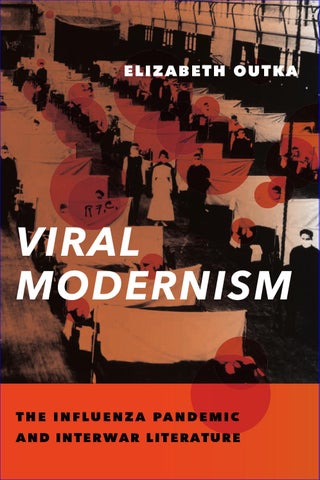
&2/80%,$ 81,9(56,7< 35(66 1(: <25. cup.columbia.edu COVER IMAGE: A warehouse converted to keep the infected people quarantined, from 1918; courtesy of Universal History Archive/UIG/Bridgeman Images. COVER DESIGN: Chang Jae Lee