“With his latest work, it becomes clear that Coviello has achieved something rare. Nearly alone among contemporary literary critics, he joins in the project of his objects, making of them something more wonderful than they would be without his attention. We should be so lucky to be read by him.” —JORDY ROSENBERG, AUTHOR OF CONFESSIONS OF THE FOX “[A] penetrating and nuanced work of literary criticism . . . Coviello’s astute and passionate analysis is a pleasure to read.” —PUBLISHERS WEEKLY
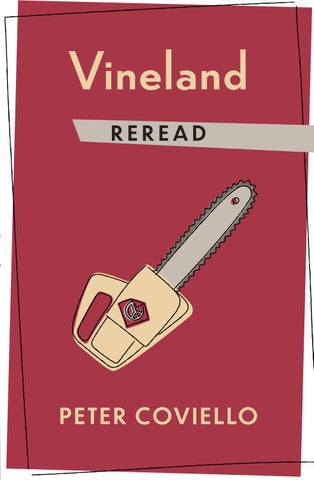
Vineland REREAD
V ineland REREAD
“I don’t even particularly like Pynchon! But I could read Coviello rereading Vineland for days. Vineland Reread traces Coviello’s readerly imagination of the past and future of the United States via Pynchon’s novel. The result is an account of literary experience that is as ethically and politically urgent as it is sparkling, vital, and fun to read.” —GLORIA FISK, AUTHOR OF ORHAN PAMUK AND THE GOOD OF WORLD LITERATURE
COVIELLO
“Here is a mash note, a fan’s riff, a sizzling study of Thomas Pynchon’s most misapprehended book, as well as a persuasive argument for its prescience and relevance. Peter Coviello writes with a generous spirit and vibrant clarity about the aesthetic and political stakes of Vineland and of the novel in general. But Vineland Reread is also a primer on how one can be both judicious and joyful in the act of criticism, rigorous but brave enough to double down on your affections, too. It shows us how to love a work of art honestly, communally. We need readers and thinkers like Coviello now more than ever.” —SAM LIPSYTE, AUTHOR OF HARK
PETER COVIELLO is professor of English at the University of Illinois at Chicago. His most recent books include Long Players: A Love Story in Eighteen Songs (2018) and Make Yourselves Gods: Mormons and the Unfinished Business of American Secularism (2019).
Cover design: Julia Kushnirsky Cover illustration: Jessica W. Schwartz
COLUMBIA UNIVERSITY PRESS | NEW YORK cup.columbia.edu
Printed in the U.S.A.
COLUMBIA
REREADINGS
P E T E R COV I E L LO
1 T H E G REAT SOUT H COA ST P L AZA EY ESH A D OW RA ID (’94)
V
ineland is Thomas Pynchon’s first post–Gravity’s Rainbow novel, released in 1990 and regarded, since then, as a fair-to-middling curiosity. (“That’s the one about . . . the communes?” a friend recently offered, after asking me what I was working on. And then, scanning the middle distance as if for a misplaced recollection, “With, like, a Godzilla appearance?”) The novel was to be further eclipsed, in 1997, by the appearance of the substantially more celebrated epic Mason & Dixon, although, at present, something of a small-bore reversal of critical fortune seems to be unfolding. The family at the center of Pynchon’s subsequent epic, Against the Day, from 2006, is the Traverses, who make their first sustained appearance in Vineland; then, too, his wonderful noirish Inherent Vice, from 2009, would take up not only some of the characters introduced in Vineland (Sledge Poteet, Scott Oof) but also the whole demimonde of Southern Californian counterculture as it turns the grim corner of 1970. All of this accumulating work has provided occasion to consider anew just what Pynchon had been up to back in 1990, when Vineland made its puzzling advent. Today, it is the kind of novel that scholars “revisit” and “reappraise.” Which, I think, tells you about as much as you need to know about its equivocal critical standing.1
16 = Part I
What, then, is Vineland? The plot of the novel is too baroque to be summarized, but let’s try. You might say, if you were trying to be quick about it, that Vineland tells the history of twentieth- century American political life through the story of late- twentieth-century California. The novel takes place in north California—the logging, pot-harvesting, fog-bound California, up near real places like Arcata and Eureka—in the ominous high Reaganite summer of 1984, journeying back for extended passages to the late sixties and early seventies and wending briefly as well through other scenes of political promise, fracture, turbulence: from the heyday of the organizing and subsequent violent suppression of the International Workers of the World in the teens, to mobilized San Francisco during World War II, and out into Hollywood in the era of the blacklist. Across these and other locales, the novel traces the intersecting lives of Zoyd Wheeler, a postcounterculture doper, knockabout, day laborer, part-time rock-’n’-roller, and single dad; the fourteen-year-old Prairie, Zoyd’s tough and venturesome daughter from his brief marriage to the cynosural figure of the novel, Frenesi Gates, a child of blacklisted parents, grandchild of Wobblies, and one-time member of a radical film collective centered in Berkeley in the late sixties who abandoned Zoyd and Prairie long ago for one Brock Vond, an archvillainous prosecutor in the Department of Justice whom Frenesi had been unable to prevent herself from falling for (and later snitching for), much to the heartsick dismay of her then-partner in revolutionary action, Darryl Louise (DL) Chastain, a Texas girl who grew up a military brat in Japan and there, in her reckless teenage years, found herself sucked into an underground dojo world where she apprenticed as a kind of black-ops martial-arts prodigy, coming later to order her life around the venerable principle of “enlightenment through asskicking” (198) and to take up with Takeshi Fumimota,
The Great South Coast Plaza Eyeshadow Raid (’94) = 17
a Yakuza-adjacent fixer with whom, after mistakenly attempting to assassinate him, she starts a private detective agency specializing in karmic adjustment. Got it? A cast of secondary characters (the automobile resurrectionists Vato and Blood, the mathematician and would-be campus revolutionary Weed Atman, Ortho Bob the Thanatoid, the DEA field agent Hector Zuñiga) round out the dramatis personae. The action of the book is set into motion when, after more than a decade during which Zoyd and Prairie have hidden away in north California and Frenesi has worked increasingly desultory and glamourless gigs as a government sting operative, the compact they had all tacitly agreed to shortly after Prairie’s birth seems, all of a sudden, to collapse. This is because Brock Vond, orbiting somewhere in the upper echelons of American administrative policing power, appears to have decided all bygone bets are off, what with Reagan in the White House, the long-time hippie despiser Ed Meese seated at his right hand, and the time therefore maximally propitious for the once-and- for-all rounding up of whatever subversive elements remain. Will the prosecutor for Justice, riding down the strong currents of antidrug fervor and flag-waving Reaganism, succeed at last in bringing each and every former radical to rough and escalatingly fascoid American justice? Will the unquiet dead rise again in vengeance or achieve some peace-granting karmic restitution? Will Prairie meet her mom? Who will play whom in the Movie-of-the-Week? Such are the novel’s basic coordinates, though lost in this recitation is among other things the singular tone or collections of tones in which it is performed. I’ve made it seem antic and maybe a shade cartoonish, and there is reason for that. But that’s not all the novel is, and to miss its sustained strains of mournfulness is to miss a lot. All at once wounded and rueful and shot through
18 = Part I
with stupefied gawping outrage—much of which leverages its manic comedy—Vineland is, you could say, a book about the hard afterlives of American revolutionary politics: about the ascent of Reaganite reaction, about the recurring and epochal shamelessness of law-and-order tyrants, and about the slender possibilities for safe haven, out in the interstices of sprawling American space, for renegades and castaways, the unmoneyed and unreconciled, whose visions of the Good Life square only very little, if at all, with the state-sanctioned American Real. Sweet and bumblingly parental Zoyd, with his Zappa aspect and his unhealed heartbreak, is only one face the novel gives to the ranks of those making their way through the Orwellian days. And the quasi-mythical place called “Vineland”—“Vineland the Good,” Zoyd allows himself to think late in the book, reminding us of the provenance of the phrase “Vinland the Good” in the Old Norse sagas of the discovery of America 2—is only one of those zones of partial refuge. But I’m getting way, way ahead of myself. Well might you wonder what any of this had to do with me, a young man in an airport, in that long-ago Clintonite summer of 1994, where our story begins. The truthful answer is: not that much.
= = = I was reading the book that day in O’Hare, as for many years I would continue to do, for no good professional or scholarly reason. I was then in my opening years of graduate school, and my interests were lurching, in confused spasms of attention, between twentieth-century poetry, queer theory, and some profoundly underthought fascination with visions of national belonging in the literature of antebellum America. But even graduate students sometimes manage intellectual lives that exceed the bounded precincts of the institution. And so I had spent the previous weeks
The Great South Coast Plaza Eyeshadow Raid (’94) = 19
sojourning in Chicago with friends from whom I’d too long been separated, and there we had improved the time in the postcollegiate fashion: staying out late in and around the 5200 block of Clark Street, chasing the more inexpensive varieties of insobriety, perturbing the summer night with vehement and intricate disputation. This was John, and Laura, and Paul, and Enrique—a lthough, my love for these precise people notwithstanding, you could I’m sure slot in any number of names and probably not lose much of significance with respect to the workings of this microcollectivity of young persons. I think a lot, in this vein, of a great passage from Zadie Smith’s first novel, White Teeth, about a character named Clara’s swoony first great love, for a scooter-loving wannabe Mod called Ryan: [Clara] imagined herself holding the bleeding Ryan in her arms, hearing him finally declare his undying love; she saw herself as Mod Widow, wearing black turtlenecks for a year and demanding “Waterloo Sunset” be played at his funeral. Clara’s inexplicable devotion to Ryan Topps knew no bounds. It transcended his bad looks, tedious personality, and unsightly personal habits. Essentially, it transcended Ryan, for . . . Clara was a teenage girl like any other; the object of her passion was only an accessory to the passion itself, a passion that through its long suppression was now asserting itself with volcanic necessity. Over the ensuing months, Clara’s mind changed, Clara’s clothes changed, Clara’s walk changed, Clara’s soul changed. All over the world girls were calling this change Donny Osmond or Michael Jackson or the Bay City Rollers. Clara chose to call it Ryan Topps.3
A “teenage girl like any other,” we are told of Clara, and I assure you those handfuls of us in Chicago were every bit as
20 = Part I
unexceptional: just an ultraordinary collection of young people, mixed by upbringing and geography and much else but steered into sodality—homogeneity, you might less generously say—by collegiate lives that had staged for each us how startling, indeed how life enlarging, you might find the encounter even with something as anodyne as, for example, an idea. As you perhaps recall, it is a discovery of considerably gravity. All at once, the world seems to shimmer with mystery and possibility. Vineland is the name we were just then giving to the impulse to be in that new-dawning world, ardently and together. I’d arrived that summer among these dear people and very quickly discovered that they had been passing the novel around between them like some newfound intoxicant everybody needed a hit off of. There was with respect to Vineland a fervor, a density of impassioned investment, the likes of which were in those days usually reserved for bands and records. But with Pynchon (as Henry James wonderfully puts it) contradiction grew young, and with it came all the intimate delights of that special subcategory of sociality. Paul and Laura, if I remember correctly, had come to the book through Rique, and so particularly loved the passages that discussed “the Vibrating Palm,” an esoterica martial arts move that, once applied to the unsuspecting victim, would cause him to drop inexplicably dead approximately one year later. (“In the Dim Mak method, the Needle Finger DL intended to use could be calibrated to cause a delay of up to a year in the actual moment of death, depending on the force and direction of its application. She could hit Brock Vond now, and months in the future be safely in the middle of a perfect alibi the moment he dropped dead” [151].) John expressed preference for both the politics and the execution of the scene in which Zoyd, finally framed beyond escape by Brock Vond and his DEA stooges, returns with baby Prairie to his Hermosa Beach bungalow to
The Great South Coast Plaza Eyeshadow Raid (’94) = 21
find “the biggest block of pressed marijuana Zoyd had ever seen in his life, too big to have fit through any door yet towering there, mysteriously, a shaggy monolithic slab reaching almost to the ceiling” (294). (Being hauled away in cuffs, Zoyd is “led out through an audience of neighbors mostly staring in wonder, or in forms of mental distress such as fear, at the tall prism, now miraculously outside again, secured on a flatbed trailer, ready to be hauled back to whatever spacious Museum of Drug Abuse it had been borrowed from” [297].) I was to be a partisan of all scenes involving the lawn-care operation founded by “a reader of forbidden books” and so called The Marquis de Sod (46). We were young. It was talk like that. Why did we sustain these hours-long colloquies, kicking around ever-finer and more and more seemingly pointless distinctions? Why the counterfactual vehemence, immoderate opining, delight ratifying itself in dispute? The only partial answer is that we loved the book with the special force young people bring to the objects, not all of them inanimate, of their affection; that we were captivated by it—most forcefully by its comedy—in ways that made it seem as alive and as immediate to us as any song on the radio or record on the turntable. Why this book particularly? The reasons, so far as I can now surmise, were predictably juvenile. We loved its affection for the hapless but ineradicable decency of miscreants like Zoyd. We loved its stoner absurdism. We were flattered, bright children that we were, by its inanely recondite lore. (As in: “Fortunately, Ralph Wayvone’s library happened to include a copy of the indispensable Italian Wedding Fakebook, by Deleuze & Guattari, which Gelsomina, the bride, to protect her wedding from such possible unlucky omens as blood on the wedding cake, had the presence of mind to slip indoors and bring back out to Billy Barf ’s attention” [97].) None of us could get enough of the sense of expansion and unconstraint,
22 = Part I
of an antic and ungovernable imaginative energy, that uncoiled page after page in sentences both riotously demotic and, in their syntactical unspooling, ornate, positively Jamesian, in ways we could never, in subsequent letters back and forth, manage to imitate quite successfully. We loved unto death the madcap, in-joking, word-by-word assembly of scenes like this, right down to its note-perfect punchline: This was [Prairie and Ché’s] star-and-sidekick routine, going back to when they were little, playing Bionic, Police, and Wonder Woman. A teacher had told Prairie’s class once to write a paragraph on what sports figure they wished they could be. Most girls said something like Chris Evert. Prairie said Brent Musberger. Each time they got together, it suited her to be the one to frame and comment on Ché’s roughhouse engagements with the world, though more than once she’d been called on for muscle, notably during the Great South Coast Plaza Eyeshadow Raid, still being talked about in tones of wounded bewilderment at security seminars nationwide, in which two dozen girls, in black T-shirts and jeans, carrying empty backpacks and riding on roller skates, perfectly acquainted with every inch of the terrain, had come precision whirring and ticking into the giant Plaza just before closing time and departed only moments later with the packs stuffed full of eyeshadows, mascaras, lipsticks, earrings, barrettes, bracelets, pantyhose, and fashion shades, all of which they had turned immediately for cash from an older person named Otis, with a panel truck headed for a swap meet far away. In the lucid high density of action, Prairie saw her friend about to be cornered, between a mall cop and a kid in a plastic smock, hardly older than they were, bought into it young, hollering as if it were his own stuff—with the cop, clear as a movie close-up, unsnapping
The Great South Coast Plaza Eyeshadow Raid (’94) = 23 his holster, oo-ooo, look out—“Ché!” Kicking up as much speed as she could, she went zooming in, screaming herself semidemented, paralyzing the pursuit long enough to sail alongside Ché, take her by the wrist, twirl her till they were aimed the right direction, and get rolling with her the hell out of there. It felt like being bionically speeded up, like Jamie Sommers, barreling through a field of slo-mo opposition, while all through this the background shopping music continued, perky and up-tempo, originally rock and roll but here reformatted into unthreatening wimped-out effluent, tranquilizing onlookers into thinking the juvenile snatch-and-grab mission couldn’t have been what it looked like, so it must be all right to return to closing time, what a relief. The tune coming out of the speakers as the girls all dispersed into the evening happened to be a sprightly oboe-a nd-string rendition of Chuck Berry’s “Maybellene.” (327–2 8)
Who could resist this? Here was a narrative voice entirely on the side of thieving and delinquency, of kids Robin Hood–ing through the cop-clogged spaces of the American marketplace, and announcing itself with an anarchic delightedness we then associated less with Serious Literature than with the spirit- shaking heresies of punk rock. (An older person named Otis? Jamie Sommers, the Bionic Woman? A sprightly oboe-and-string rendition of Chuck Berry? Come the fuck on.) Take that disposition and scale it up, so that it encompasses the fractious political life of twentieth-century America and its multiple seizures by reaction and counterrevolution, and you get some decent sense of the narrative atmosphere of Vineland. What was not to love? I would like to think something in us also responded to the writing itself, at levels more and less local. This surely is forgiving retrospect talking, but I would like to think we were live-minded
24 = Part I
enough even then to have noticed—beyond the wondrous antiestablishment flourishes, beyond the gleeful loathing of institutionalized authority, the polymath referentiality, the deadpan recitation of a history of American domestic atrocity—the novel’s positive reverence for the richness and splendid variety of ordinary American speech. (I hope we noticed too its attentiveness to what Pynchon, again in his in propria persona introduction to Slow Learner, calls “American nonverbal reality.”)4 Part of Pynchon’s signature as a stylist, I was just then beginning to discover, involves the conjoining of a fantastically baroque syntax with a giddy pleasure in the colloquial, in the possibilities of the vulgate, as unrestrained as most any you’ll find in American fiction after Twain and every bit as finely tuned. (See, again, the spectacularly hypotactic sentence beginning “Each time” and coming to rest in the perfectly demotic phrase “a panel truck headed for a swap meet.”) His style, in other words, performs the ongoing wedding of the elegant to the profane, James to Twain, high gentility to the vigorously antigenteel. I’d come upon a sentence later, in the infamous “Revenger’s Tragedy” section of The Crying of Lot 49, that never failed to reduce me to idiot hiccupping laughter, even after this special combinatory formula had become clear to me. “Honest Niccolo,” it goes, “who always has difficulty hiding his feelings, observes that if the two events turn out to be at all connected, and can be traced to Duke Angelo, boy, the Duke better watch out, is all.”5 Writing like this, dissolving as it did with such high delight the forms of order proper to what we understood to be Legitimate Novelistic Construction, felt to us I think like the seizing of a kind of freedom. I’m sorry to say that, with respect to the other things there were to notice about the novel—for instance, its attentiveness to experiences of genuine human grief, of losses impossible to
The Great South Coast Plaza Eyeshadow Raid (’94) = 25
compensate, dread encroaching and escalating, of smothered outrage and heartsick disbelief—we acquitted ourselves rather less well. This is not much of a surprise, though it is disheartening. Because what, then, had we to say about the iterations of sorrow that ballast the novel’s sometimes cartoonish humor and render its depiction of a lost moment of great promise and belief, of a “joyous certainty” now dissipated beyond hope of revivification, something substantially more wrought and harrowed than the standard-issue boomer nostalgia we had even back then had more than enough of? Prairie, our nearest peer in the novel, spends part of the summer of 1984 watching old film reels, shot by her vanished mother, depicting “a night wingding that was supposed to be a general policy meeting” in the midst of a campus uprising. Led Zeppelin music blasted from the PA, bottles and joints circulated, one or two couples—it was hard to see—had found some space and started fucking. Up on the platform several people were screaming politics all at the same time, with constant input from the floor. Some wanted to declare war on the Nixon Regime, others to approach it, like any other municipality, on the topic of revenue sharing. Even through the crude old color and distorted sound, Prairie could feel the liberation in the place that night, the faith that anything was possible, that nothing could stand in the way of such joyous certainty. She’d never seen anything like it before. (209–1 0)
I can’t say if any of us paused over that last phrase—Prairie, as I say, is born in 1970, near to most of us—but I do know this is true: neither had we. As I say, though, as accounts of why we loved this book all of these explanations are, at best, partial. As has been the case with
26 = Part I
virtually all of the books and songs and records I have come to cherish, whatever delight I took in Vineland would be hard to separate from the delights taken by that mini-grouping in one another’s company, or from the intimacies the book both entered into and, by its special grace, sustained. So much of the joy of reading Vineland that day in the airport, and in subsequent readings, came from the vivifying sense I had of collusion. I am thinking of the thrilling, conspiratorial sense of finding in the pleasures of works themselves a testament to the densely layered histories (of pleasure and affection and dispute) that had brought them, in the first place, into your hands. A critic named Karen Tongson, in a phrase I have long adored, invites us to think of pop radio as “a technology of remote intimacy,” and it’s startling to consider how novels, too, can fulfill this very office.6 Vineland, for us, just then, certainly did. And it taught me an astounding amount about just how happy you might be made, how transported by a particular calibration of joy, through the simple act of participating in the talk that condenses around the objects people love most. It seems obvious now, and maybe you didn’t need this kind of woozy and bar-lit ritualizing to come to it, but I swear nothing made clearer to me that this is what friends do, that this is how friends come to love one another and to nourish that love: by figuring out how to talk together about the things in the world that most beguile or intrigue or captivate them. I would remember, then, a line from Faulkner, in which he calls this “the best of all talking,” and that was it precisely. For here we were, a group of young people just beginning to glimpse the wider ballasting delights that, once removed from institutional settings like the classroom, insubstantial things like books might be discovered to possess. I grant you that there are probably easier ways to grasp the plain fact that falling in love with
The Great South Coast Plaza Eyeshadow Raid (’94) = 27
people is a process deeply involved in the making together of a language—an idiolect of veneration and disparagement, of criticism infused with joy—that you might then spend years refining and revising and speaking back to one another. This is how it happened for me, though. All of this is, as I say, standard issue, and if you are a reader of a book like this it seems to me unlikely in the extreme that nothing of the above will have an analogue, adjusted for era and for object, somewhere in your own experience. For you and yours it may not have been Vineland, the latest Helium EP, Clifford Brown. Maybe it was Middlemarch, or Another Country, or Joni Mitchell, or, I don’t know, The Mists of fucking Avalon. They all make a wonderful provision for ardor. They’re all effective if what you are doing is teaching yourselves how to convene what you might, with only a bit of aggrandizement, call a world: a collectivity of fellow travelers—a “peer group,” as the killjoy social scientists say—who out of the sheer abundance of their enthusiasm find themselves fabulating these semiprivate codes and idiolects, scored by distinctions and disputes and polemics and energized by the unbounded force of love that young people specialize in carrying to the scenes of their devotion. Nothing ever quite brought home to me the lit-up inner magic of such exchanges, or of the joys of this sort of small-bore worldmaking, as much as Vineland did. One result of which was that every subsequent rereading returned me, with a tranced and intoxicating completeness, to Paul, to Laura, to the whole scene of our being together. I don’t know that I ever got over it.
= = = It’d be easy to feel embarrassed by episodes like this, given their self-pleased insularity, their tediousness, their total demographic
28 = Part I
predictability. Listen: I know. If I’m less mortified by them than perhaps I should be, it is not because I suspect the scenes of sociability at their center to be hives of insurrectionary foment, or subversiveness, or really anything other than the finally commonplace. It is not a matter of nostalgic loyalty, or not only. But I do take them to be weirdly suggestive, weirdly instructive little ensembles. And they are so, I want to suggest, because they offer us one model of a kind of collectivity at the very heart of which is something very like criticism—by which I mean nothing more august than the making and honing of languages of appreciation, discrimination, and critique. We might go so far as to venture that they model, after their fashion, a kind of public, even if not in the Deweyian, or Arendtian, or Nancy-inflected senses.7 To do so we need only take “public” to signify, in a rather more basic construction, a network of relations, of attachments and affective ties, conjoining a set of persons and orienting them toward the world. By these lights, these scenes of sociability do indeed constitute a sort of public, insofar as they are collectivities drawn together by the impassioned responses of its members to an array of objects and given life by visceral and ongoing disagreements about not only the objects responded to but about the consequences of those passions, about the world those passions and the languages that emerge from them seem to imply. What goes on around creaky tables, in the corners of loud parties, at the backs of bars, and, when fortune smiles, in seminar rooms is “conversation,” yes. But it is conversation in a particular key. It is, I submit, a conversation in which one labors to translate one’s pleasures into worldviews, where the terminology is necessarily mutable, and where the larger ambition, if there is just one, is to fashion collaboratively an ever more refined vocabulary to describe one’s relation to the world and its vocabularies, its demands and injustices and exclusions and authorities.
“With his latest work, it becomes clear that Coviello has achieved something rare. Nearly alone among contemporary literary critics, he joins in the project of his objects, making of them something more wonderful than they would be without his attention. We should be so lucky to be read by him.” —JORDY ROSENBERG, AUTHOR OF CONFESSIONS OF THE FOX “[A] penetrating and nuanced work of literary criticism . . . Coviello’s astute and passionate analysis is a pleasure to read.” —PUBLISHERS WEEKLY
Vineland REREAD
V ineland REREAD
“I don’t even particularly like Pynchon! But I could read Coviello rereading Vineland for days. Vineland Reread traces Coviello’s readerly imagination of the past and future of the United States via Pynchon’s novel. The result is an account of literary experience that is as ethically and politically urgent as it is sparkling, vital, and fun to read.” —GLORIA FISK, AUTHOR OF ORHAN PAMUK AND THE GOOD OF WORLD LITERATURE
COVIELLO
“Here is a mash note, a fan’s riff, a sizzling study of Thomas Pynchon’s most misapprehended book, as well as a persuasive argument for its prescience and relevance. Peter Coviello writes with a generous spirit and vibrant clarity about the aesthetic and political stakes of Vineland and of the novel in general. But Vineland Reread is also a primer on how one can be both judicious and joyful in the act of criticism, rigorous but brave enough to double down on your affections, too. It shows us how to love a work of art honestly, communally. We need readers and thinkers like Coviello now more than ever.” —SAM LIPSYTE, AUTHOR OF HARK
PETER COVIELLO is professor of English at the University of Illinois at Chicago. His most recent books include Long Players: A Love Story in Eighteen Songs (2018) and Make Yourselves Gods: Mormons and the Unfinished Business of American Secularism (2019).
Cover design: Julia Kushnirsky Cover illustration: Jessica W. Schwartz
COLUMBIA UNIVERSITY PRESS | NEW YORK cup.columbia.edu
Printed in the U.S.A.
COLUMBIA
REREADINGS
P E T E R COV I E L LO