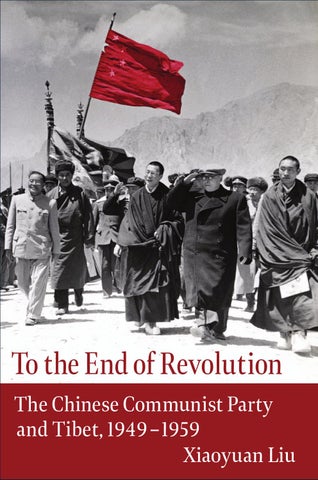
To the End of Revolution The Chinese Communist Party and Tibet, 1949 – 1959 Xiaoyuan Liu
PREFACE
F
or my generation, who grew up in Mao Zedong’s China, two pieces of our collective memory of childhood are connected to Tibet. One is a movie made in the early 1960s, Nongnu (The Serf), about how the Chinese Communist Party (CCP) liberated Tibetan serfs from the cruel, oppressive system of the old Tibet. The other is a female Tibetan singer named Caidan Zhuoma (Tseten Dolma), who gained national fame in the 1960s and 1970s by singing songs like “The Golden Mountain of Beijing” and “Song of Liberated Serfs.” Personally, my earliest memory about Tibet dates from when I was six or seven years old. It was a horrific story related by adults about a certain means used by “Tibetan feudal masters” to punish their serfs. Many years later, I realized that the story was just part of the official narrative at the time. Aside from this vivid memory and its reinforcement by Nongnu, I would not encounter anything Tibetan again until I went to Inner Mongolia in the late 1960s as a zhishi qingnian (literally, “intellectual youth,” but historically, “sentdown student”). In my “people’s commune” in East Uzhumuqin Banner, I saw a Tibetan Buddhist temple destroyed during the Cultural Revolution. In my “production brigade,” I came to know a few “secularized” lamas, one of whom was famous for having made an arduous pilgrimage to Lhasa. Today, Chinese youths’ knowledge and imagination about Tibet are neither as dark nor as sporadic as my generation’s. Today’s young people do not sense the kind of alienness or physical and mental distance between Tibet and neidi, or the Chinese heartland, that my generation did. Though still mysterious, Tibet is now one of their favorite tourist attractions inside China, easily reachable
viii
Preface
via airlines, the famed Qinghai-Tibetan Railway, and several highways. Among young Chinese nowadays, even a bicycle ride to Lhasa from Qinghai or Sichuan or any other Chinese province does not seem such an unusual adventure. Folksongs in the Tibetan and Mongolian styles are popular in China, though many of the songs currently in circulation are not necessarily Tibetan or Mongolian by origin. For instance, an enduring contest among China’s karaoke-goers and in talent shows on Chinese television is to see who can sing the well-nigh impossible high note of a song named “Qingzang Gaoyuan” (Qinghai-Tibetan Plateau). In Baidu, the Chinese alternative to Google, the song is listed as one of the best “Tibetan folksongs.” The song was written, however, by a People’s Liberation Army songwriter named Zhang Qianyi, an ethnic Korean, and it was first sung by the famed female singer Li Na, an ethnic Han. Nevertheless, from Tseten Dolma’s ode about Beijing as a “gold mountain” to Li Na’s pastorale about the Tibetan Plateau, Chinese society has gone through a mental reversal about Tibet as tremendous as that of Tibetan society itself through its physical integration with the People’s Republic of China (PRC). These easily observable and seemingly superficial changes are actually complicated and profound. The question of what happened to cause these changes does not have simple answers. Today, a visitor in Lhasa cannot help but carry away an eerie feeling. In Lhasa’s streets and around monasteries, the presence of the Chinese Communist authorities is highly visible in the black or camouflage uniforms of the Tejing (special police) and the Wujing (military police). It is not unusual for a local resident to be stopped by the police several times a day for an identification check. Meanwhile, residents of Lhasa and pilgrims from other places calmly carry out their daily activities, seemingly oblivious to this heavy presence of security forces. Local tour guides may talk about the fourteenth Dalai Lama as if he had never departed from the Norbulingka in the fateful month of March 1959. One does not have to witness a self-immolation or remember the riots of 2008 to sense the tensions of the place. “Globalization” has indeed reached Tibet since China’s “opening” to the world in the 1980s, but the CCP authorities’ on-again, off-again restrictions on foreign visitors have kept Tibet a “frontier region” that remains largely sealed, with international borders from the outside and provincial boundaries from the inside. Why has Tibet become so much closer to the rest of China but remained, like Xinjiang, a jarring problem in the eyes of the PRC authorities? This book is about how, sixty years ago, Chinese Communist leaders made a “Tibetan question” that they inherited from history into a “Tibetan problem” of their own.
✳✳✳ More than any previous occasion, the publication of this book affords me an opportunity to acknowledge, with heartfelt gratitude, the assistance and
Preface
ix
encouragement I have received during the many years spent researching and writing it. From the outset, I knew that a book project about Beijing’s Tibet policy of the Mao years would be an undertaking much more challenging than any of my previous projects. However, I did not expect a long interruption of my work by circumstances beyond my control. A special group of people must therefore be acknowledged for helping me overcome a tremendous hurdle in my personal as well as professional life. Their care, support, and counsel were physically healing, spiritually uplifting, and intellectually stimulating, and without them I would not have been able to present this book to its readers. These people include my mentors, friends, colleagues, and physicians who, each in her/his own way, enabled the completion of this study. I am blessed to have them in my life: Warren Cohen, Larry and Mariam Gelfand, Akira Iriye, William Kirby, Steven Levine, Rod MacFarquhar, Peter Perdue, Qi Shirong, and Ezra Vogel; Uradyn E. Bulag, Bi Aonan, Chen Jian, Hamilton Cravens, Dai Chaowu, Charles Dobbs, Fan Xin, He Yan, Gan Qi, Ge Hao, Guo Jianping, Han Gang, Hao Rui, Bob Hathaway, Carma Hinton, Huang Haoru and Zhu Rongjun, Jiang Huajie, Angela Kao, Sulmaan Khan, Li Danhui, Li Suwu, Li Xiaobing, Hsiao-ting Lin, Liu Yuan, Mao Sheng, James Millward, Aili Mu and Ren Yue, Niu Jun, Christian Ostermann, Qian Xiaohua, Sergey Radchenko, Pamela Rinay-Kehrberg, Patrick F. Shan, Shao Fangchen, Shen Zhihua, Richard J. Smith, Sun Baowen, Tian Xiansheng, Alan M. Wachman, Wang Haiguang, Wang Jinping, Wang Xi, Wang Zheng, George C. X. Wei, David Wilson, Xiao Xiaohong, Xie Jun, Xu Guoqi, Xu Lan, Yang Kuisong, Yang Zhiguo, Yao Baihui, Yao Ping, Yao Yu and Guo Youxin, Min-lei Ye, Ye Xiangdong and Li Shuxian, Yu Jiandong, Yu Kwok-leung, Yu Qun, Zhang Baijia, Ellen Zhang, Zhang Xiaojun, Zhang Yang, Zhang Yijun, and Zhou Na; and Dr. Peter Enzinger, Dr. Ahmad Fotovat, Dr. Larry Otteman, and Dr. Lansheng Wang. During the taxing period, my former classmates and fellow “sent-down students” in several WeChat groups were always there to cheer me up; their names are too many to list here. Finally, the most powerful support came from a very tight family circle: Hongxing, Ying Ying, Tanya, Xiaohong, John, Xiaoxi, Karen, Mutian, Xiaolin, and Lao Qiao. The unplanned interlude in my work was nevertheless a blessing, enabling me to amass information that became available to me only gradually. My archival research was accomplished with indispensable assistance from numerous people whom I had the privilege to know over a decade. As my drafting of the book dragged on, a number of institutions provided opportunities for me to present segments of my work, including the Fairbank Center for Chinese Studies at Harvard University, the Cold War International History Project of the Woodrow Wilson International Center for Scholars, the Hoover Institute of Stanford University, the Paul H. Nitze School of Advanced International
x
Preface
Studies (SAIS) of Johns Hopkins University, the Institute for Global History and the Mortara Center for International Studies of Georgetown University, the National Institute of Eastern Languages and Civilizations in Paris, the Center for Cultural Studies of the Chinese University in Hong Kong, the Center for Cold War International History Studies of the East China Normal University in Shanghai, the University of Wisconsin–River Falls, Göttingen University, Northeastern Normal University in Changchun, Central Minzu University in Beijing, Capital Normal University in Beijing, Inner Mongolia Normal University in Hohhot, South China Normal University in Guangzhou, and Shihezi University in Shihezi, Xinjiang. The research and publication of this study have received generous support from the Department of History at the State University of New York at Potsdam, the Department of History at Iowa State University, the Department of History at Harvard University, the Asia Program at the Woodrow Wilson International Center for Scholars, the Corcoran Department of History at the University of Virginia, the David Dean Endowment for East Asian Studies, the Buckner W. Clay Dean of Arts and Sciences and the Vice President for Research at the University of Virginia, and the East Asia Center at the University of Virginia. During the process of publishers’ manuscript review, several anonymous readers offered valuable critiques and suggestions for improving the manuscript. Zhao Yuchen helped me in diligently checking the Tibetan terms that appear in the book. Caelyn Cobb and Kathryn Jorge, my editors at Columbia University Press, patiently and adroitly guided the process of bringing the book to fruition, and their associates worked hard and efficiently in improving the manuscript. I am, of course, alone responsible for any remaining defects in the book.
Xiaoyuan Liu draws on unprecedented access to the archives of the Chinese Communist Party to offer a groundbreaking account of Beijing’s evolving Tibet policy during the critical first decade of the People’s Republic. Placing the PRC’s approach to Tibet in the contexts of the Communist Party’s treatment of ethnic minorities and China’s broader domestic and foreign policies in the early Cold War, To the End of Revolution is the most detailed history to date of Chinese thinking and acting on Tibet during the 1950s.
“Liu tells in exquisite detail, based on new archival sources, the dramatic story of how the PRC took over Tibet. Embracing multiple scales of time and space, he gives us a close-up view of how the PRC eliminated the autonomy of Tibet and a wide-ranging exploration of its implications for global geopolitics. A must-read for students of China’s rise to world power.” —Peter C. Perdue, author of China Marches West: The Qing Conquest of Central Eurasia
“An outstanding history of how the Chinese Communists turned Tibet into a problem of their own creation. Nobody will be able to understand current Chinese decision-making on Tibet without grasping how concepts of borders and territoriality were remade in the wake of the Chinese Revolution.” —Odd Arne Westad, author of Restless Empire: China and the World Since 1750
“Why did the ‘New China’ of the Communist Party move so quickly from accommodation to occupation in Tibet? How were its policies shaped by political tensions abroad and at home? What can this tragic history tell us about continuities in Chinese strategies toward religious and ethnic minorities over time and space? Liu is a gifted historian who has pursued masterly research in Chinese and international archives. This book will be required reading for scholars of Chinese politics and history and for any who seek to understand the origins of Tibet’s modern misfortune.” —William C. Kirby, T. M. Chang Professor of China Studies, Harvard University
Xiaoyuan Liu is David Dean 21st Century Professor of Asian Studies at the University of Virginia and Zijiang Professor at East China Normal University. His books include Frontier Passages: Ethnopolitics and the Rise of Chinese Communism, 1921–1945 (2004) and Reins of Liberation: An Entangled History of Mongolian Independence, Chinese Territoriality, and Great Power Hegemony, 1911–1950 (2006).
Cover design: Lisa Hamm Cover image: Nationaal Archief/Collectie Spaarnestad/Anefo/ Fotograaf onbekend/Bridgeman Images Printed in the U.S.A.
Columbia University Press / New York cup.columbia.edu
ISBN: 978-0-231-19526-3