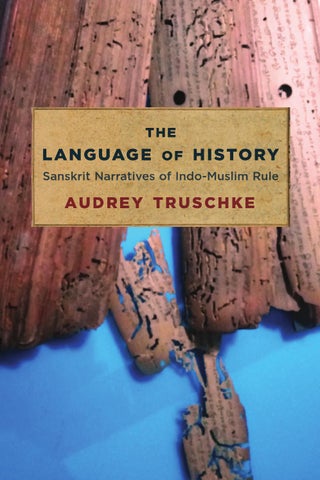
THE
L A N G UAG E O F H I S TO R Y Sanskrit Narratives of Indo-Muslim Rule
AUDREY TRUSCHKE
Introduction Controversial History
You must have the courage to break out of your own image. At each stage you go on breaking. That is the key. — M. F. HUSAI N, 2 010 I NTE RV IEW
I
n August 2018, Hindutva extremists prevented me from delivering an academic lecture on premodern Indian history in Hyderabad, in southern India. A few weeks before the scheduled event, self- described members of Hindu nationalist groups—including the Bajrang Dal, RSS, and BJP—wrote letters to the police threatening violence if I were to take the stage. The police refused to provide protection, which I sometimes need to speak in India and even in the West.1 And so the lecture, titled, in a nice bit of unintentional irony, “Unpopular Stories,” was canceled over my objections.2 The silencing of academic voices is an increasingly common outcome in India, where a political swerve to the hard right has been accompanied by a feverish devotion to a bastardized vision of India’s past.3 In short, Indian right-wingers are trying to cook the history books. This means that historians—who call out such shenanigans by insisting on evidence, solid arguments, and professional ethics—face mounting pressure to remain mute. Sometimes the bullying works, such as in Hyderabad, but other times it does not, such as in this book. I cannot promise that the narratives I share in what follows will be any more or less popular than those I was prevented from sharing in Hyderabad. But I can reasonably predict that the stories I resurrect here—many of them long tucked away in old, little-read Sanskrit texts—will surprise you, dear reader. For while the premodern Indian past is vibrantly alive and debated in modern times, premodern Sanskrit historical writings [1]
remain largely inaccessible and unknown to all but specialists. Even scholars partial to reading premodern Sanskrit texts may find that I analyze stories in unexpected ways and so bring out aspects of the Sanskrit tradition that are usually overlooked. The lack of visibility of Sanskrit histories of Muslim-led rule, to my colleagues and to a general audience, is part of why I decided to write about this subject. This robust body of narrative texts expands our historical and conceptual resources for understanding Sanskrit literature, early modern history, and premodern and modern Indian identities. In this book, I present and analyze a hitherto-overlooked group of histories on Indo-Persian political events, namely a few dozen Sanskrit texts that date from the 1190s until 1721. As soon as Muslim political figures established themselves in northern India in the 1190s—when the Ghurids overthrew the Chauhans and ruled part of northern India from Delhi—Indian intellectuals wrote about that political development in Sanskrit. Indian men (and at least one woman) produced dozens of Sanskrit texts on Indo-Persian political events. These works span Delhi Sultanate and Mughal rule, and some deal with the Deccan Sultanates and other Muslim-led polities in the subcontinent’s deep south. India’s premodern learned elite only ceased to write on Indo-Muslim powers in Sanskrit when the Mughal Empire began to fracture beyond repair, in the early eighteenth century. In other words, Sanskrit writers produced histories of Indo-Muslim rule—meaning political power wielded over parts of the Indian subcontinent by people who happened to be Muslim—throughout nearly the entire time span of that political experience. This book seeks, for the first time, to collect, analyze, and theorize Sanskrit histories of Muslim-led and—later, as Muslims became an integral part of the Indian cultural and political worlds—IndoMuslim rule as a body of historical materials. My main focus is historiography, or history writing, as opposed to political history (although there is more than a little of that, too, in these pages). This new archive has widereaching implications for specialist scholarship on premodern South Asia. The works therein lend insight into, among other things, formulations and expressions of premodern political, social, cultural, and religious identities. Given the current political climate, where nationalist claims are often grounded on fabricated visions of India’s premodernity, this book also contributes to ongoing debates in the Indian public sphere. In what follows I offer a substantial revision to Sanskrit intellectual history. I argue that Sanskrit authors marshaled the full resources of their [2]
I N T RO D U C T I O N : C O N T ROV E R S I A L H I S T O RY
layered literary heritage to comment on what we now identify as the single biggest set of cultural, political, and social changes of the second millennium in South Asia: Muslim-led rule. This means that some Sanskrit authors, far from being oblivious to their day-to- day realities, as many modern scholars have presumed, were keenly interested in writing about political events, on occasion in real time. The fact that premodern Sanskrit intellectuals wrote histories matters for how we understand the contours of the Sanskrit tradition and its relationship to political realities. Moreover, in the following pages, I explore how premodern thinkers recounted the political past in Sanskrit and what purposes these narratives served for their authors and readers. I also investigate what these Sanskrit histories can tell us about premodern identities. This is a tradition defined by writing about an Other, a time-honored way of also writing about the Self.4 I will tip my hand at the outset: if you are looking for the origins of “Hindu” and “Muslim” identities in premodern India or the roots of Hindu-Muslim conflict or, to be frank, Hindu- Muslim anything, then you might want to try a different book. Few, if any, of the dozens of authors I discuss here offer categories remotely approaching our modern dichotomy of broad-based religious identities. In fact, I use the general categories of “Hindu” and “Muslim” throughout this book, in part, because they do not offer strong interpretive frameworks for premodernity. Such categories are broad enough to enable us to recover the highly variegated identities expressed by premodern Sanskrit intellectuals. Sanskrit intellectuals who wrote about what we now call Indo-Muslim or Indo-Persian political history circa 1190–1721 defined peoples and communities by place of origin, place of residence, caste, class, style of rulership, and often not by the god(s) people worshipped so much as by the political power(s) they served. Sanskrit thinkers evinced a wide range of responses to political power wielded by Muslims, including formulations that I did not expect to find. In their works we meet outcaste Ghurids who can never be proper northern Indian rulers and Mughal kings who speak flawless Sanskrit. We encounter Vijayanagara rulers who, despite not being Muslim, declare themselves sultans superior to mere Hindu kings. We stumble across Maratha and Rajput yavanas (a Sanskrit word most commonly translated as “Muslim”) who fight proudly for a host of Indo-Persian dynasties. We have a whole lot of groups that I struggle to succinctly describe in modern English. While I wallow a little here in the glorious confusion of this rich I N T RO D U C T I O N : C O N T ROV E R S I A L H I S T O RY
[3]
tapestry, in the substantive chapters of this book I prioritize context and specificity. I parse the identities expressed in individual texts that generally feature an Other, who is often, although not always, an Indo-Muslim political figure or dynasty. I am interested in the definition of that Other and also in the Self, as formulated by each author, right up through the moments, in the sixteenth through eighteenth centuries, when the distinction ceased to exist for some Sanskrit intellectuals. In this book, I am interested precisely in the intersection between an elite learned tradition (Sanskrit thought) and a disruptive set of political changes (Indo-Muslim rule). Only a thin upper crust of premodern Indians participated in Sanskrit literary and intellectual culture. Accordingly, we should not conflate Sanskrit with India at large and certainly not with “Indian civilization” (if such things even existed in premodernity).5 Similarly, Indo-Persian rule was not an enterprise exclusive to Muslims, nor did it involve all Muslims. From the start, Muslim-led polities on the subcontinent were both elite and diverse, and included Hindus, among others. Accordingly, my questions here concern Sanskrit literary culture and its commentary on specific incarnations of Indo-Muslim rule. How did premodern Sanskrit intellectuals relate writing about new types of political power to their inherited literary tradition? Why did they write in Sanskrit? How did Sanskrit intellectuals think about rulers who happened to be Muslim? Did they always (or ever) conceptualize political actors as “Muslim” or “Other”? How did specific thinkers reformulate their own community identities through writing about Indo-Muslim political history in Sanskrit? It is difficult to cultivate within ourselves the capacity to imagine the premodern Indian past, which looks so radically different in many ways from our present. Part of the challenge lies in lacking a cluster of familiar concepts that might order our understanding of this long-lost world. A few short paragraphs in, and I have already thrown out “Hindu” and “Muslim” as analytical identities. I am talking about Sanskrit histories, a category that may confuse people who think that these do not exist. Below I suggest some ways to muddle through and develop new analytical concepts that enable us to unpack how premodern Sanskrit intellectuals narrate aspects of the Indo-Muslim past. Ultimately, this project may empower us to think more creatively and critically about writing history in our own present, an exciting possibility that I discuss later in this introduction and to which I return in the epilogue. But we ought not to put the cart before [4]
I N T RO D U C T I O N : C O N T ROV E R S I A L H I S T O RY
the horse. In order to begin, we must dismantle the bad ideas that have blocked most modern scholars from seeing the rich archive of premodern Sanskrit historical materials on Indo-Muslim polities.
Finding What We Are Not Looking For The Sanskrit historical works that I analyze in this book—“evidence” in the historian’s lingo and “texts” for the philologists among us— are neither singular nor hard to find. Sanskrit intellectuals penned dozens of such histories. And they are not squirreled away in manuscript archives that are off the beaten path, where they might be understandably, if regrettably, overlooked. Rather, the overwhelming majority of texts that I mention in the following chapters have been printed. In short, a plethora of works have been available to scholars for decades (for more than a century, in some cases).6 So, why has nobody written a book on Sanskrit historical accounts of Indo-Muslim rule until now? Scholars have worked on individual texts, and even on small collections of them, and a few thinkers have made notable attempts to catalog Sanskrit views of Muslims.7 But no one has collated these works together and analyzed them, as I do here, as histories. This neglect of texts lying in plain sight is explained by modern scholarly biases, which I identify and counter here because, despite our best efforts to date, they still exert varying degrees of sway over academic thinking. An earlier generation of Sanskritists thought that after they published Sanskrit literary histories, a cascade of Indological interest and awareness would follow. For instance, in 1877 Georg Bühler wrote to his colleague Theodor Nöldeke: “You are a little behind the age with your notion that the Indians have no historical literature. In the last 20 years, five fairly voluminous works have been discovered . . . I am on the track of more than a dozen more.”8 As C. H. Tawney noted, Bühler’s “lifelong aspiration” was removing the idea that, aside from Kalhana’s Rājataraṅgiṇī (River of kings), Sanskrit literature had “no work meriting the title of history.”9 I honor Bühler’s efforts here, but he did not change scholarship as he dreamed, not yet anyway. A handful of books have appeared over the decades that promise to analyze Sanskrit histories, defined in various ways.10 I draw upon some of them, but all these prior works overlook significant texts that I discuss here. Printing texts alone did not render them visible to most Sanskrit scholars, who remained—in Bühler’s time and, to a lesser degree, I N T RO D U C T I O N : C O N T ROV E R S I A L H I S T O RY
[5]
today— attached to unfounded assumptions. Specifically, two persistent wrongheaded ideas have prevented a book like this one from being written until now: the first myth is that there is no history in Sanskrit, and the second myth is that there is nothing on Islam in Sanskrit. By failing to overturn these two durable fictions, scholars have blinded themselves, and everyone else, from seeing, analyzing, and theorizing Sanskrit historical works on Indo-Muslim political events. The postulation that there is no history written in Sanskrit is an old trope, which most twenty-first- century scholars dare not utter but which constricts modern thinking all the same. This Orientalist slight is a subset of the earlier Orientalist dismissal that India had no history at all.11 Arthur MacDonell, a household name for Sanskritists even today, summed up the connection between the two ideas as follows: “Early India wrote no history because it never made any.”12 The India-has-no-history (real or written) thesis possesses a precolonial lineage as well, dating back to the tenth-century polymath al-Biruni, who was sometimes cited approvingly by colonialera scholars.13 In both premodern and colonial India, this blatantly bad idea was partly due to straight-up bigotry and partly followed from overreliance on Brahmin interpreters, a point that will come up again in this introduction.14 One scholar tried saying it in French, and even so it sounds every bit as prejudiced as it does in English: “L’Inde n’a pas d’histoire.”15 It has been decades since most respectable academics aired the “India has no history” line in print (although I dug up a number of exceptions, those of which from the 1980s onward I list in the note to this sentence).16 Still, our scholarship has yet to reflect our supposed change of heart. Inside the ivory tower, India’s alleged lack of history is a bias evidenced and entrenched in recent decades by omission, by what scholars do not research. Absence constitutes the most potent evidence that history continues to be sidelined in contemporary Sanskrit-based research. It is difficult to glimpse what is not there and definitionally impossible to cite a dearth; but consider a few indications. In July 2018, thousands of Sanskrit scholars descended on Vancouver, Canada, for the 17th World Sanskrit Conference. The conference hosted twenty-four separate sessions, but the word “history” appeared in the title of only one, where it was paired with art, architecture, and epigraphy.17 The 18th World Sanskrit Conference, originally scheduled for 2021 in Canberra, Australia, and now postponed until 2022 due to the COVID-19 pandemic, has announced a similar lineup of sessions that marginalize history.18 More generally, Sanskritists write and teach [6]
I N T RO D U C T I O N : C O N T ROV E R S I A L H I S T O RY
a lot about poetry, philosophy, mythology, and religion but only much more sporadically about historical works. A solid strand of Indological thought posits that premodern Sanskrit intellectuals expressed historical impulses in inscriptions, a claim that is true but often marshaled to wrongly allege a lack of narrative histories.19 While few contemporary scholars wish to go on record as saying that there is no history written in Sanskrit, plenty have proclaimed that there is no real history written in Sanskrit. The general idea behind this line of argumentation is that in order to count as “history,” a text must be sufficiently close to modern Western history. Usually this means that the text must use dates and express a historical causality palatable to modern Western sensibilities (i.e., without too much agency assigned to divine beings). This modern standard is rarely laid bare in this manner, but do not overlook its ever-lurking presence and catastrophic effects. The problem here is quite straightforward: if you look for modern Western history anywhere except in the modern West, you are doomed to find only deficiency. This is true regarding the premodern West as well, although this gap gets less airtime, because of a tendency “to idolize and fossilize the ‘norm’ (here, the Western model of historiography), while failing to note the diversity and historicity within itself.”20 Regarding premodern India, Romila Thapar has put the blunt reality of our own historical contingency thus: “We cannot find an Enlightenment view of history from early Indian writing.”21 The inevitability that no premodern society could have produced modern Western historiography is borne out in the great lengths to which some scholars have gone to declare certain Sanskrit texts, which narrate real events and contain clear facts, to be nonhistories. Others have described some of the texts I analyze in this book as bad histories, folklore, hagiography, hagiology, inauthentic historical literature, legend, historical memory, mythology, pseudohistory, stories, and so forth. Such characterizations are not de facto problematic or wrong, but they are red flags when prompted by a field-wide aversion to admitting that premodern Sanskrit intellectuals wrote historical narratives. As Ronald Inden put it when talking about the importance of admitting diversity in the production of history, “To strip a community of this capacity to textualize its past or deny that they possess it, as in the case of India, is to strip those people of the knowledge to articulate themselves as polities. We call this colonialism.”22 In its core structure, injudiciously applying modern Western standards to premodern India is a rigged game. Also, the results have proven to be I N T RO D U C T I O N : C O N T ROV E R S I A L H I S T O RY
[7]
analytically bankrupt. What possible insight might be gained by pointing out that premodern Indian texts are neither modern nor Western? But worse than being dull is that this line of thinking marginalizes Sanskrit narratives about Indo-Muslim political events as nonhistories or not-quitehistories or bad histories that therefore cannot be used, evaluated, and analyzed in the same way as historical works that are foundational to humanities research in many fields. In describing Sanskrit narratives as histories, I do not attempt to “scramble for coevality with the Western world and its disciplinary parameters” or gain an “exalted status” for these works, projects that other scholars have rightly criticized.23 In fact, I think that modern Western ways of defining history need reevaluation, and premodern Sanskrit literary histories might be just the ticket to jump-start that process (for more on this, see the epilogue). The first step is to level the playing field or, to return to my earlier metaphor, derig the game. We ought to acknowledge that premodern Sanskrit poets wrote histories, not as a way of saying that they are equal to modern Western historians but rather as a way of saying that they have as much right to define what it means to write about the political past as anybody else. A cautionary tale of what happens when scholars privilege Western ideas about historicity is the much-discussed book by Velcheru Narayana Rao, David Shulman, and Sanjay Subrahmanyam, Textures of Time: Writing History in South India, 1600–1800. First published in 2001, Textures of Time was a seminal work in many ways. For instance, it points out that written history survives in many genres in premodern India, an astute observation others have praised and upon which I build here.24 But the authors went astray in trying to find modern Western-style history writing in the wrong time and place. They sliced and diced Indian texts according to “subgeneric markers” of their own invention and then shoved raw textual fragments into categories for which they were never intended.25 These philological acrobatics convinced few readers, and they straitjacketed both the skillful scholars who authored the book and the rich premodern texts they analyzed, some of which had for decades prior been subjected to dismemberment into history and nonhistory.26 In my reading, at the heart of a book like Textures of Time lies a deep discomfort with subjectivity. That angst is decidedly a modern, not a premodern, problem. And I no longer want to write our contemporary anxieties onto the premodern past. Rather I wish to explore how premodern Indians wrote narratives about political events, and I want to do so without being chagrined about what I might [8]
I N T RO D U C T I O N : C O N T ROV E R S I A L H I S T O RY
find. Sheldon Pollock, in a discussion of Indian modernity that focused on questions of historiography, wrote: “There is no shame in premodernity.”27 I agree, and moreover I want to know what it is, exactly, of which we ought not be ashamed. What kinds of political history writing did premodern Sanskrit intellectuals develop in order to talk about and think through aspects of Indo-Muslim rule? Indologists have been ill-served by starting out with a heavy theory of what qualifies a work as written history and then seeing which premodern texts fit the bill. So, I try a different method here. I loosely define historical writing below and intentionally leave its contours flexible around the edges. Through careful textual analysis in this book, I attempt to describe the philosophies of and approaches to history writing cultivated by various Sanskrit intellectuals, along with their views of different political groups, formulations of their own community identities, and more. In declining to begin with my feet planted upon a strong definition of history writing, I aim to avoid the reductive pattern, succinctly described by Anjali Arondekar and Geeta Patel in a different context (queer theory) that “geopolitics provides the exemplars, but rarely the epistemologies.”28 I want to recover how premodern Sanskrit intellectuals defined history writing, as a methodological contribution to the broader field that can inform and challenge how we write history today.29 I never complete the historical-analysis circle by offering a final, clearcut delineation of what constitutes historical writing in premodern India. For readers who ache for all-encompassing definitions, I urge you to consider how poorly this impulse has served us in the past. As detailed in the prior paragraphs, ideas about historical writing that are rooted in the nineteenth-century West have resulted in earlier generations of scholars neglecting premodern Sanskrit histories, discarding them, or mutilating them. In contrast, my posture of openness and flexibility has the potential to allow us to conceptualize and analyze a body of written historical materials in one of the world’s most sophisticated premodern literary traditions in ways relevant for historians today. This is a worthy prize, in pursuit of which it is worth breaking out of the cage of our own theoretical scaffolding. Another powerful myth that has blocked scholars from investigating Sanskrit histories of Muslim political figures to the extent that I do so here is the assumption that Sanskrit intellectuals had nothing to say about Islam. This claim has been repeated ad nauseam, even in recent decades. For instance, in 1988, Wilhelm Halbfass wrote, “Even the Muslims, who were I N T RO D U C T I O N : C O N T ROV E R S I A L H I S T O RY
[9]
not only present in India for many centuries, but were its actual rulers, appear only in vague and marginal references [in Sanskrit literature].”30 In 1992, Carl Ernst declared, “The Sanskrit tradition has never taken official notice of the existence of Islam.”31 It is generally, although not universally, correct that Sanskrit thinkers had limited interest in Islamic theology.32 But do we not all agree by now that Islam consists of so much more than theology? Perhaps not. Much of our scholarship is still weighed down by the baggage of reifying Islam into religious aspects, above all high theology, while separating out Islamic cultures. Even our vocabulary meant to displace attention from religion does so by making theology the measuring stick of Islam. The best example is the term “Islamicate,” which denotes nonreligious aspects of Muslim societies by adding letters to and thus distancing itself from the term “Islamic.”33 Many of my colleagues are fond of “Islamicate,” because the term directs academic attention to nontheological features of Muslim societies. I agree with this emphasis, but I think we need to reassess the bad assumptions that require analyses of Islamic cultures to be labeled as distinct from the study of Islam. From where I stand, you cannot study Islam outside of Islamic cultures. I see neither sense nor purchase in distinguishing between two things that are one and the same. And so, I reject a theology-centric definition of Islam, along with all vocabulary distinctions—“Muslim” versus “Islamic” versus “Islamicate”—premised on that bias.34 Once we take this step of clarifying that studying Islam in history is the study of Islamic cultures, no separate vocabulary being required, and once we poke around a bit in Sanskrit texts, something emerges quite starkly. Sanskrit thinkers working in different times, places, and contexts wrote about Islam in some detail, specifically about Muslim political figures and events. While Sanskrit thinkers wrote a great deal about Muslims who wielded political power, they rarely wrote about those figures’ distinct religious beliefs. Seeking to capture the frequent nonemphasis on religious identities in premodern India, many scholars have attempted to replace the vocabulary of “Muslim” or “Indo-Muslim” with terms centered around ethnicity (e.g., “Indo-Turkic”) or, more commonly, literary and ruling culture (e.g., “Persianate”). It is tempting to think that new words alone could give us better ideas, but it is hardly that straightforward. Both “Indo-Turkic” and “Persianate” are clunky terms, bewildering to most nonacademics. Even more opaque, including to scholars who have rarely bothered to theorize such terms, are the various elaborations upon “Persianate” that have proliferated [ 10 ]
I N T RO D U C T I O N : C O N T ROV E R S I A L H I S T O RY
in recent academic writing, including the “Persianate world,” “Persianate ecumene,” “Persianate cultural zone,” “Persianate cosmopolis” (sometimes the “Persian cosmopolis,” sans -ate) and “Indo-Persianate.”35 Also, neither “Indo-Turkic” nor “Persianate” is broad enough to capture the longue durée of political and intellectual histories that I investigate here. I am interested in how Sanskrit thinkers imagined and wrote about various aspects of the wide-ranging set of historical processes that we now place under the umbrella phrase “Indo-Muslim rule,” which included Muslims who were not Turkish and, distinctly, Muslims who did not speak Persian. Even when Sanskrit thinkers used pseudoethnic terms, such as turuṣka (Turk), they generally used them to refer to groups of Muslims of various ethnic backgrounds rather than to Turks specifically (see chapter 1). I agree with the general impulse behind trying out alternative vocabulary that might displace “Muslim” as an organizing category, namely because we ought not to presume that religion always mattered most in premodern India. But our phraseological cacophony has often obscured more than it clarified on this front. Modern scholars should take heart that premodern Sanskrit intellectuals, too, had vocabulary problems when it came to describing Muslim or Indo-Persian or Persianate kings. They used a smorgasbord of terms over the centuries— some of which could mean Muslims generally, others of which referred only to circumscribed groups of Muslim political figures, and all of which had slightly different valences that shifted in each usage. Their terminology included cāṇḍāla, hammīra, janaṅgama, mausula, mleccha, mudgala, pulinda, saida, śāhi, śaka, śakendra, suratrāṇa, tājika, tāmra, “turushka,” “yavana,” and more. Alongside this specific vocabulary that they developed or repurposed, Sanskrit thinkers also identified mleccha or turushka or shahi rulers using more general Sanskrit terms for sovereigns (e.g., cakravārtin, mahārāja, rāja). Here I take a similar approach of varied vocabulary. I find, not without a hefty dose of irony, that a trifecta of terms—“Muslim,” “Muslim-led,” and “Indo-Muslim”—are capacious enough to capture a wide array of political groups perceived by Sanskrit intellectuals as somehow different and worthy of comment as such from 736 CE onward. Each term has unique advantages. “Muslim” is the broadest and most succinct. “Muslim-led” is the most inclusive of non-Muslims who also participated in establishing and shaping a ruling culture that differed from others on the subcontinent. “Indo-Muslim” foregrounds the long-standing integration of Muslim communities into Indian society. None of these terms is good enough, however, and so I I N T RO D U C T I O N : C O N T ROV E R S I A L H I S T O RY
[ 11 ]
use other words as appropriate, especially “Indo-Persian,” which indicates the cultural affiliations of many Indo-Muslim dynasties from the 1190s onward. In pursuit of accessibility beyond the ivory tower, I shy away from the scholarly favorite of “Persianate.” Premodern Sanskrit intellectuals never settled on a decisive vocabulary for Muslim rulers, and, even in the seventeenth century, authors were still inventing new terms and changing the meanings of old ones (see chapter 6). These twinned approaches—coining fresh vocabulary and redefining established terms— appear to be our fate in modern scholarship also. Here, I participate in the latter project of expanding and remaking the categories that we already have, especially “Muslim” and “Indo-Muslim,” to be elastic enough to cover a broad set of political changes and communities about which premodern Sanskrit intellectuals wrote in remarkable ways. It is an improbable argument that premodern Sanskrit authors wrote about everything under the sun except history and somehow failed to respond in any way to the seismic set of political, cultural, and social shifts brought on by Indo-Muslim rule. This book aims to overthrow both notions, long criticized but persistent nonetheless in the restrictions they place on our modern capacity to imagine the past. I lay the groundwork for this paradigm shift through the theoretical criticisms I have leveled here. But, going forward, I take a different tack. In the rest of this book, I endeavor to bury these scholarly prejudices under a mountain of textual evidence.
Historical Narrative Without Genre Relying on genre divisions has led many prior scholars to seek written history in Sanskrit in the wrong places, and so I forgo a genre-specific approach here. Most commonly, modern thinkers have scoured itihāsa and purāṇa texts for Sanskrit records of the past. Daud Ali, James Fitzgerald, Sheldon Pollock, Romila Thapar, and others have given serious attention to works situated within the itihasa-purana tradition as potential written histories.36 The term “itihasa” literally means something like “thus it was,” and “purana” refers to the ancient past, so perhaps both sound like history at first blush. But, as others have pointed out, the terms are probably better translated, at least much of the time, as “lore” and “myth,” respectively.37 Plenty of scholars may object to those translations (or any single-word translation of these terms) as oversimplified. But the core point stands that [ 12 ]
I N T RO D U C T I O N : C O N T ROV E R S I A L H I S T O RY
“Audrey Truschke demonstrates that the Sanskrit literary world was not simply an arena of elite male Brahmin scholars but also one in which non-Brahmins, women, Jains, and a wider lay community of scholars and patrons had a voice. The lasting contribution of this work will be not simply its methodological or analytical innovations but also firmly contesting and refuting the toxic Hindutva politics that has permeated debates about Sanskrit pasts, Hindu-Muslim interactions, and the nature of Hinduism and Islam in the last century.” PURNIMA DHAVAN, author of The Lords of the Pen: Literary Associations in Early Modern South Asia “Unpacking a rich archive that is scattered or largely ignored, Truschke skillfully probes how Jains and Brahmins assessed Muslims and their rule and how those assessments changed over a millennium. This book offers fresh insights into the contested issue of cultural encounter in India’s history.” RICHARD M. EATON, author of India in the Persianate Age: 1000–1765 “Few questions in premodern Indian studies are as fraught as the nature of historical consciousness—save for the nature of Indo-Muslim rule. Truschke takes on both, demonstrating not only the vitality of history writing in Sanskrit culture but also its intense political engagements. This is scholarship of the highest order.” SHELDON POLLOCK, Arvind Raghunathan Professor of Sanskrit and South Asian Studies, Columbia University “In this masterful survey of literary narratives referring to Muslim rulers, Truschke once again publicizes Sanskrit’s participation in the world of premodern politics. Sweeping in its scope, incisive in its analysis, and crisp in its prose, The Language of History demonstrates Sanskrit’s continuing vitality and creativity in a pluralistic age.” CYNTHIA TALBOT, author of The Last Hindu Emperor: Prithviraj Chauhan and the Indian Past, 1200–2000 “Sanskrit texts provide an archive for the study of the second millennium CE that historians have known of but have hardly explored. Truschke’s study demonstrates that Sanskrit histories of the period are partly a continuation from the past and partly a pointer to the new. Her analysis of these texts provides a necessary fresh perspective.” ROMILA THAPAR, author of Early India: From the Origins to AD 1300 AUDREY TRUSCHKE is associate professor of history at Rutgers University–Newark. She is the author of Culture of Encounters: Sanskrit at the Mughal Court (Columbia, 2016) and Aurangzeb: The Life and Legacy of India’s Most Controversial King (2017). P R I N T E D I N T H E U. S . A .
Cover image: Madhuravijaya of Gangadevi, Punjab University Library, Lahore, ms. no. 8579 Cover design: Chang Jae Lee
COLUMBIA UNIVERSITY PRESS
NEW YORK cup.columbia.edu