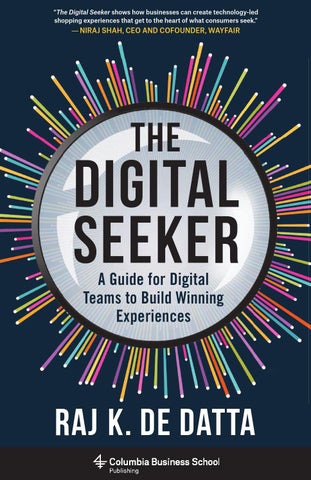
“The Digital Seeker shows how businesses can create technology-led shopping experiences that get to the heart of what consumers seek.”
— NIRAJ SHAH, CEO AND COFOUNDER, WAYFAIR
THE
DIGITAL SEEKER A Guide for Digital Teams to Build Winning Experiences
RAJ K. DE DATTA
INTRODUCTION Embrace the Winning Formula
It wasn’t always this complicated. Twenty years ago you hired a couple of web developers and designers, bought them some pizza, and asked them to stand up a website. Those days were simple—the website was like a digital brochure. Most of the business was in the “real world,” and the only expectation a customer had was for the website to represent whatever would have otherwise been in a physical brochure. We can call this the Brochure Age of the internet. Then came Google and Facebook. A whole industry of marketers started running campaigns against those websites, and more and more people started arriving there. Your chief financial officer would then ask questions like “How do we make money on our website?” That led to a plethora of technologies and marketing tactics designed to build a digital business and to increase the probability that when a consumer or business came to your websites, and later apps, they would buy or sign up or engage or undertake whatever other action you wanted them to. Now we were spending real money. We were hiring armies of people to manually edit and curate those websites. We were spending millions of dollars on digital marketing. We can call this the Digital Marketing Age of the internet. Pretty soon that digital marketing property became a core part of how we drove leads, customers, revenue, and service. It simply
INTRODUCTION
couldn’t go down. It was performing a wide range of functions— service, sales, finance, supply chain, marketing, and so many others. A parade of technology vendors arrived at your door, each promising a 20 percent revenue bump if you put their bit of tech on your website. Unfortunately, adding ten bits of technology didn’t seem to increase revenue by 200 percent, and technology management became more and more challenging. How exactly do you figure out why your website is loading so slowly when you are dependent on ten external vendors and a bunch of external systems? Meanwhile, customers weren’t just screaming about the problems—they were switching to native digital properties like Amazon, where billions of dollars of R&D assured a compelling digital experience. Their expectations had risen to where digital had become a utility, one that was expected to “always work.” In fact, it didn’t just need to work—it needed to delight them. We started to realize that the separation between the real world and the digital world no longer existed. They had become one and the same. We can call this the Digital Business Age of the internet. No longer are our digital properties just about marketing—they are the framework of the whole business. In the Digital Business Age, your customers are getting restless. Options have proliferated, but somehow customers have been tasked with doing the work of sorting them all out. Think about the last time you tried doing holiday shopping online. Chances are you started with optimism, hitting the search engines and looking for great gifts. But after a frustrating period of clicking around, you likely defaulted to the Amazon best-sellers list just to get out of there. My company, Bloomreach, powers search and digital experiences for thousands of the largest brands on the planet, including 25 percent of e-commerce in the United States and the UK. Looking at our data set of billions of consumer interactions going back ten years, I can see us searching for content, products, and services. I can see our hopes and dreams playing out in trend lines and keywords. And I can see unfulfilled customers and failing digital experiences in the form of stagnant conversion rates, high bounce rates, and uninspired customer journeys. And then I can see them go to Amazon or some Silicon Valley upstart. viii
INTRODUCTION
As this plays out, digital teams are wrestling with the challenges they see. Often they are the savants, charged with saving the company from looming disruption. They struggle with conflicting goals, a lack of resources, a talent gap, antiquated technology stacks, nimble competitors, and rising operational and financial targets. Something has got to give. The practices we learned when the internet was all about marketing are failing us in the Digital Business Age. And our customers are paying the price for it. Classic internet experiences are not giving customers what they’re seeking. Instead, they are turning our customers into screen-hogging automatons, sifting through the noise of the Web trying to find their way. They are turning our businesses into silos—the digital world versus the real world, with one struggling to compete with upstarts and the other continuing to fight yesterday’s battles. They are frustrating our digital teams, which often know what to do but struggle profoundly to make the substantial shifts needed to drive progress more quickly. All this frustration raises a very basic question about why we have the internet in our lives at all: Wasn’t this whole internet thing supposed to make our lives simple and easy and straightforward? It doesn’t seem to be working out quite that way. But amid the frustration and the struggles, I see companies winning big across the hundreds of digital businesses we at Bloomreach serve, across my personal investments as an angel investor in tens of start-ups, and across the broader ecosystem of digital contenders. The winners aren’t just the Silicon Valley success stories we all know—Google, Facebook, Apple, and Amazon. I see public-sector organizations like the National Health Service (NHS) in the UK innovating in health care delivery. I see fashion innovators like Stitch Fix and Rent the Runway remaking fashion. I see business-tobusiness (B2B) distributors like Watsco and MSC Direct reinventing their interactions with field technicians. I see local sports teams like Bayern Munich reimagining their relationships with fans worldwide. I see innovators like HotelTonight rethinking the travel industry by identifying a whole new need for spontaneous travel. And I see ix
INTRODUCTION
organizations like the United States Tennis Association leapfrogging other tennis powerhouses using the power of artificial intelligence (AI) and analytics. Each of these organizations falls into a distinct pattern that drives its winning. I see that the winners in the Digital Business Age have three things in common: • Winning digital experiences are built for the seeker, not the customer. They don’t just enable customers to buy or find something; instead, they enable customers to find the solutions they are seeking for deeper problems. • Winning digital experiences are built on a digital experience platform (DXP). They collect cutting-edge technology such as AI on a common platform that delivers agile, personalized, and scalable performance. • Winning digital experiences are built by product-centric digital teams with innovative new business models. Every aspect of organization, culture, and operation follows the business model of a Silicon Valley software company rather than that of a traditional organization.
How all that happens is the stuff of this book. We’ll profile a number of the winners, tracing their journeys and their conclusions. We’ll distill the three key attributes needed to win big in digital and provide a road map for all digital teams to adopt them. Our structure for doing all this is as follows: Chapter 1: Break Online/Offline Boundaries—The new age of digital is defined by the breaking of historical boundaries between the digital and the real worlds. To explain how we arrived in this new age, we’ll tell the Cedar Fair transformation story. Cedar Fair operates the famous Cedar Point as well as Kings Island, Canada’s Wonderland, Great America, and other amusement parks. It’s possible to break internet history into three distinct periods, and Cedar Point is a perfect case in point. In this chapter, we’ll explain why the new Digital Business Age is different from earlier ages in the evolution of the internet and what digital teams must embrace to create winning experiences today. x
INTRODUCTION
Chapter 2: Put the Seeker at the Center—Digital winners find the seekers behind their customers and build for them. We’ll share the stories of Stitch Fix, NHS Digital, HotelTonight, Flyhomes, Bayern Munich, and Uncommon Goods. Chapter 3: Swap Customers for Seekers—We’ll explain what the difference is between customer and seeker and why understanding the distinction is the difference between winning big and becoming obsolete. Customer-centric initiatives typically involve looking at customer-facing functions (sales, customer service, etc.) and improving them. But they do not ask a fundamental question: Why does a customer want my product? Understanding underlying motivations often results in the realization that a customer has “a job to do” or “a task to complete.” Seeker centricity involves really understanding these motivations and providing everything the customer needs to meet that goal. Winning digital means winning the seekers. Chapter 4: Harness the Three As—We’ll investigate the three As: AI, ambient technology, and application programming interfaces (APIs). These profoundly important technology trends have transformed digital experiences, enabling practitioners to build magical digital experiences that speak to the seeker. They provide the baseline technologies that form the core of a DXP, each one adding its own magic and together providing compounding benefits. We’ll share the stories of DeepMind, Google, Kespry, and the United States Tennis Association. Chapter 5: Build Your Digital Dreams; Don’t Buy Them—We’ll dive into the modern digital technology stack, which should form the basis of innovation for the future. The DXP is a new platform that harnesses the three As to transform digital experiences into engines for innovation, agility, and growth. We’ll outline the key components of a DXP, with a particular focus on the commerce experience—tracing the evolution of early e-commerce stacks to the powerful platforms that winning businesses use to drive competitive advantage. We’ll share the stories of commercetools and Blue Apron. xi
INTRODUCTION
Chapter 6: Design for Disaster—We’ll examine six of the core tenets of great digital experiences that scale: privacy, security, reliability, performance, explainability, and diversity. In the face of emerging regulatory restrictions, we’ll explore how to leverage large data sets and AI in a DXP but still ensure that diversity is maximized and privacy is honored. We’ll examine the core architectural principles that powerful technologies like APIs and ambient require from a modern DXP. We’ll share the stories of IKEA and Bloomreach. Chapter 7: Recast Your Team to Ship—Meet the new team. The digital team of the future will be product centric, not function centric. We’ll see the emergence of a whole host of new leaders with titles like chief digital officer and teams with skills that had never made it into enterprises in the past, including product manager, designer, developer, and others. We’ll see these teams operate within product-centric cultures, use agile development processes, and leverage lean methodologies to ship their products and iterate their way to digital success. Chapter 8: Create Your Money-Making Architecture—We’ll examine the business models of winning digital businesses, considering how they approach making money in very different ways. We’ll investigate how these businesses invest over long horizons, market creatively, play on a different competitive playing field, mitigate risk, build ecosystems, and scale with greater leverage. We’ll see that winning teams leave sunk costs behind, imagining their business plan the way a disruptor might. We’ll share stories of Atlassian, Hobbycraft, Next plc, and Olo. Chapter 9: The Winning B2B Experience—Winners are not remaking the internet as an exclusively consumer platform. While B2B experiences have a lot in common with consumerfacing experiences, they remain different in important ways. We’ll dive into what’s common and what’s unique about B2B digital experiences, including the teams that build them, the metrics they optimize for, the motivations of their customers, and the technology implications. We’ll share the stories of MSC Industrial Direct, Sandvik Coromant, Staples, and Watsco. xii
INTRODUCTION
Chapter 10: Max Out the R0—Even as we shift to this new Digital Business Age, the next shift is already brewing. We’ll explore the post-COVID-19 digital world, tracing the accelerations the pandemic has created and the implications for digital practitioners and consumers. What are the issues for the future that this current digital age will bring us? How has COVID-19 changed our digital experience? Will it last? In particular, we’ll discuss who will win in the long term and who will lose—challenging conventional wisdom that the digital behemoths of Facebook, Google, Amazon, Microsoft, and Apple are inevitable victors. At the end of this road map lie treasures that benefit all the stakeholders of digital business—teams, businesses, and consumers. For teams, treasure means high-velocity innovation around deep and transformative customer solutions that lead to leadership and career advancement. For businesses, it means a high degree of competitive advantage grounded in unique offerings that lead to outsized profits. For consumers, it means a world where the right collection of products, services, and experiences comes to you, so that you spend less time on your digital to-do list and more time on the things you love doing. Think of it like Iron Man’s armored suit that snaps on when he’s in motion—just in time to fight the enemy. Let’s get to the winning.
Figure Intro.1 The three core principles of a winning digital experience.
xiii
PRAISE FOR
THE DIGITAL SEEKER
“I’ve had the privilege of learning from the playbooks of strong Silicon Valley founders at companies like AirBnB, Pinterest, and Instacart. Raj K. De Datta puts his finger on the heart of digital disruptors—meeting deeply unmet consumer needs by delivering what they seek, rather than just what they say.”
— JEFF JORDAN, GENERAL PARTNER, ANDREESEN HOROWITZ “Just as we at Khan Academy designed an online student-led experience, De Datta explains how all digital organizations can design a seeker-led experience. The Digital Seeker illuminates the promise of an accessible, individualized internet age.”
— SAL KHAN, FOUNDER, KHAN ACADEMY “The Digital Seeker leads business to a new level in the experience economy. Customers today desire more than mere products or services—they want an experience. The Digital Seeker shows how business can create that experience online in a way that gets to the heart of what individual people seek.”
— B. JOSEPH PINE II, COAUTHOR OF THE EXPERIENCE ECONOMY: COMPETING FOR CUSTOMER TIME, ATTENTION, AND MONEY “When the digital team gathers, team members come from different worlds—technology, marketing, finance, and products. The Digital Seeker gives that team a common text to win together.”
— ANDY MAIN, CEO, OGILVY “In The Digital Seeker, De Datta has provided what companies need most: A playbook, with concrete advice, on how organizations can build essential digital habits. De Datta has lived this advice, has used it to build a massive company, and—most important—he draws on case studies from dozens of firms to show you where the future is going and what you need to succeed. This is essential reading for every CEO, entrepreneur, and digital thought leader—and a fantastic guide to building organizations that will thrive.”
— CHARLES DUHIGG, BEST-SELLING AUTHOR OF THE POWER OF HABIT AND SMARTER FASTER BETTER “The Digital Seeker is an exceptionally well-written and frank work about what it takes to succeed in a digital business. De Datta focuses not on the technical details of the digital world but on the human side of what it takes to pull together a team and a strategy for digital services. He is generous in sharing previously developed solutions to clients’ problems as examples of best-practice problem-solving.”
— J. ROBERT ROSSMAN, DEAN EMERITUS, ILLINOIS STATE UNIVERSITY, AND COAUTHOR OF DESIGNING EXPERIENCES $24.95
AN IMPRINT OF COLUMBIA UNIVERSITY PRESS
Printed in the U.S.A.