INTRODUCTION
Commitment to Style
Melancholy, nostalgia, and the relationship with solitude. These are the dominant themes that traverse all my films. —Paolo Sorrentino, interview with Alain Elkann
it would be easy to proclaim Italian director Paolo Sorrentino the answer to the decades-long dearth in Italian cinema of anything resembling a grande auteur—a cinematic authorial presence in the tradition of Fellini, Antonioni, Rossellini, De Sica, Visconti, Pasolini, Bertolucci, and others, all male. In certain ways Sorrentino is a throwback to the golden age of Italian auteurist cinema, writing (or cowriting, with Umberto Contarello) and directing all of his feature films. In he was hailed as “one of the most promising young directors of the new millennium,” and in the same year, after Il Divo () won the Jury Prize at Cannes the year before, Guido Bonsaver remarked that this “confirmed Paolo Sorrentino as the most promising Italian director of his generation.” Alex Marlow-Mann describes him as “one of the most interesting filmmakers to have emerged” in postmillennial Italy, producing work “distinct from anything in contemporary Italian or perhaps, world cinema,” and yet in a collection on popular Italian cinema Sorrentino gets no mention at all. While new books in Italian on Sorrentino’s oeuvre (or aspects thereof ) are appearing at an increasing rate, as of this writing there is no comprehensive overview of Sorrentino’s film and television work in English. The present book addresses this lack of attention—more pronounced in the critical literature than in the popular discourse, and in English rather than in Italian—considering Sorrentino as both a leading Italian director and as a representative twenty-first-century Eurotransnational filmmaker. The designation of transnational, it must be said, applies equally to the style and to the diegetic content of his cinema and television work. In this book therefore I focus as much on the meaning and value of Sorrentino’s allegedly mannered audio-visual style as on the content of his film’s diverse stories. As will be explored at length, these stories, and the distinctive manner of their telling, are linked in complex ways through the protagonist in each case, representing a series of variations on what I call the Sorrentinian subject.
By subject or subjectivities here I refer to human types, conventional social roles, performative identity categories, and so forth—as opposed to the subject of Freudian, Lacanian, or feminist psychoanalytic theory that until the s or so was privileged in much contemporary film analysis. The new millennium has brought new paradigms of film theory; for instance the variations on affect theory (and related approaches), which are certainly of relevance to this study. In what seems a necessary recursion to an earlier period in the history of film theory, others have analysed Sorrentino’s films from a feminist-psychoanalytic perspective. More broadly (and still in historical perspective), feminist theorists of melodrama in the s and s identified the “over-valuation of masculinity” as a fundamental problem in North American mainstream culture. Therefore I introduce the category of melodrama here for good reason: as will be seen below, and especially in chapter on The Young Pope (), the ubiquity of melodrama as a (generally gendered) cultural modality has to be seen in a transnational perspective, with Italian neorealism as a significant formative period—witness any of the major films, from Rome Open City () to The Bicycle Thieves () to Umberto D. () to later works, such as Visconti’s Rocco and His Brothers (), whose scenery-chewing boxing coach is a precursor to the verbally abusive soccer coach in One Man Up’s () second opening scene. Outside of Italian film, classical Hollywood provides the more famous model for melodrama, in the form of various genres, from weepies to the woman’s picture to what eventually becomes the television soap opera. But for our purposes here the most interesting aspect of melodrama as pervasive cultural mode is its adaptability across a variety of national cinemas to masculine narratives: stories of men structured around classic melodramatic tropes. My approach in this book therefore draws equally from this rich branch of feminist-infused poststructuralist theory and the kind of post-Marxist ideological critique typical of cultural studies. It goes beyond both, however, insofar as the former in its psychoanalytic guise is too prone to reducing every film narrative to an allegory of the Oedipal family romance, and every female body to a cipher for castration anxiety; the latter (cultural studies), for its part, tends to deprivilege film form in favor of story content as the basis of an insufficiently critical view of realism. In film, after all, any so-called unconscious dimension, like everything else, is right on the surface. Throughout film history, even the most intimate moments of subjective interiority, if they are manifested on screen, end up looking (and sounding) much the same as everything else. I use the term subject therefore in a philosophical or narratological sense, as ground for identity or self, as concatenation of attributes or traits. But by subject I also mean a visual-optical position in space, a mobile pointof-view upon the objective world, upon others, or the other. Historically, in the occidental tradition in which my argument is necessarily based, this subject is silently but inescapably gendered masculine. In a fundamental sense, then, my analysis of Sorrentino’s oeuvre is reducible to his contribution, for better or worse, to the ongoing legacy of this subject; to the representation, in short, of masculinity in the film, television, and literary work. The other aspect of this subject, of course, is the question of identification, which includes everything summed up in Laura Mulvey’s psychoanalytic theory of the xii
introduction
male gaze, but much more besides. Spectatorial identification with this or that film character may be productively considered in relation to theories of affect—both the affective experience of the viewer and the affects or intensities circulating onscreen and on the soundtrack—as well as with cognitive theory. Identification— what Murray Smith () refers to in terms of “levels of engagement”—is always reducible to some kind of visual-cognitive-emotional structure, which Smith helpfully addresses in the dyad of allegiance vs. alignment. Marlow-Mann makes effective use of Smith’s categories in his groundbreaking readings of Sorrentino’s first films, connecting their complex manipulation of the viewer’s cognitive and/or emotional engagement with this or that character to the director’s penchant for recurring character types, or what I refer to as the Sorrentinian subject: One of the most immediately obvious characteristics of [Sorrentino’s] work is a penchant for ambiguous or downright unsympathetic protagonists, and [his] decision to make a film on such an ambivalent and oft-despised figure as Giulio Andreotti instantiates a tendency that began with his portrayal of the arrogant, self-absorbed, middle-aged pop singer with a predilection for cocaine and casual sex, Tony Pisapia, in his debut, L’uomo in più. The extent to which the spectator is, or is not, encouraged to “identify” with such atypical protagonists constitutes one of the most unusual and distinctive elements of Sorrentino’s films.
Questions of spectatorial identification or engagement are tied up with the viewer’s identity, especially with respect to gender construed in conventional binaristic terms. Therefore, as unfashionable as it may sound, it is necessary to grapple with the question of realism in any critical appraisal of Sorrentino’s cinema.
Beyond Realism: Toward a Cinematic Ethics In Theory of Film () Siegfried Kracauer identifies what he calls the two main tendencies in film style from its origins in the late nineteenth century: the realist and the formative, or what we might call illusionism, each of which entails a distinct valuation of cinema’s function as audiovisual medium. Considering Sorrentino in relation to this highly artificial but heuristically useful binary illuminates his distance from a neorealist conception of film as a way of forging an ethical relation to a specific social reality, in contrast to his openness to the notion of art as a form of lying—a trick (un trucco), as Jep Gambardella would say, only one that discloses a more substantive truth about the fundamental nature of cinema. This binary is complicated by recent reassessments of Andre Bazin’s work on Italian neorealism and of cinematic realism generally as an ethical stance toward the world. This is a point Dudley Andrew makes in his foreword to Rosalind Galt and Karl Schoonover’s Global Art Cinema, where he cites “Bazin’s incomparably crucial distinction between realism as a set of conventions and neorealism as a moral attitude toward the alterity of what is nearby.” Andrew invokes Visconti’s La terra trema () as an example of this kind of film that bridges the gap between local vernacular—both the distinctive introduction
xiii
Sicilian dialect and the specifics of Italian neorealist style—and a more international approach to film language foundational to the new modernist art cinema: “Modernist cinema arose when new realities . . . in postwar Italy forced filmmakers into concocting ingenious narrative and stylistic strategies to bring them onto the plane of expression.” Analogously, every Italian filmmaker since has had to face this double challenge, at once negotiating and balancing the internal legacy of neorealism and the external demands of the global marketplace. Sorrentino is a recent, spectacular, and particularly successful example. Galt and Schoonover define the art cinema as congenitally “impure”: art cinema has from its beginnings forged a relationship between the aesthetic and the geopolitical or, in other words, between cinema and the world. Thus it is the critical category best placed to engage pressing contemporary questions of globalization, world culture, and how the economics of cinema’s transnational flows might intersect with trajectories of film form.
My invocation of the term art film or art cinema therefore is not indicative of a lack of historical understanding or an attempt to apply an anachronistic term to a contemporary body of work. What Dudley Andrew calls the “third optique”—after the first two: “national folk films” and “global entertainment movies”—art cinema remains a useful and, dare I say, necessary category, as long as it is qualified by an adjective such as global, international, or, as I favor here, transnational. This contemporary brand of art cinema, as exemplified in Sorrentino’s films, is not reducible, after all, to what Deleuze in the mid-s called the postwar cinema of the “timeimage,” any more than it corresponds to the logically—if not historically—and stylistically precedent movement-image. Sorrentino’s films do not qualify as postTarkovskian slow cinema any more than they do as slavish imitations of American commercial genre film. (Nor, needless to say, do they represent an Italian “national folk” cinema, in Andrew’s term.) As will be seen in what follows, Sorrentino’s films exemplify the contemporary art film’s tendency to stylistic hybridity and spectacularity, while adhering to an ethics focalized in the body and the face in medium and close-up shot (what Deleuze calls the affection-image) set over against another person or entity—whether object of desire, friend, or God—both conceptually, within the diegesis, and also visually-structurally, in the complexity of the montage and the sinuosity of the camera work. The ethical understanding of cinema adumbrated in Bazin mediates between the two extremes of realism and illusionism, which are therefore revealed to be complementary. This is not a question of an unwarranted privileging of the legacy of neorealism, however; the equivalent reading is there in Deleuze’s analysis of the emergence of the postwar time image, which for him begins with neorealism. Italian cinema retains a special place in this taxonomy; Deleuze quotes Barthélemy Amengual’s description of Fellini’s peculiarly hybrid contribution to the timeimage: “ ‘The everyday is identified with the spectacular . . . Fellini achieves the deliberate confusion of the real and the spectacle’ by denying the heterogeneity of the two worlds, by effacing not only distance, but the distinction between the spectator and the spectacle.” It is not hard to recognize here an anticipation of xiv
introduction
Sorrentino’s spectacular style. The two tendencies of realism and illusionism (really, two extremes on a continuum) are ever-present in Sorrentino, engaged in a stylistic dialectic described by Millicent Marcus as a distinctly Italian “post-realism” in which she sees: a self-conscious step beyond [neorealism’s] storied precedent, at once challenging its linguistic orthodoxy while reinforcing realism’s imperative to monitor the Italian national condition. The “afterness” of post-realism, then, inheres less in the impulse to supersede the earlier moment than to advance it through a process of linguistic remodeling that incorporates contemporary media codes while preserving the moral agenda of the realist tradition.
I invoke Marcus’s reading of Il Divo’s stylistic tendencies—and the ensuing debate in the pages of The Italianist—precisely because it leaves open the possibility for serious political critique where some see at best only postmodern playfulness or at worst selfindulgent masculinist display. One major difference, of course, is that the object of this critique is not necessarily “the Italian national condition.” Marcus’s reading allows Sorrentino to take his place first of all in a specific ethically charged line of postwar Italian cinema: “Sorrentino’s achievement harks back to the cinema politico of Francesco Rosi, Elio Petri, and Paolo and Vittorio Taviani in the s, s and early s whose penchant for spectacle and whose stylistic departure from the naturalism of Neorealist cinematography can be seen as important harbingers” of the postrealist aesthetic for which Sorrentino has been both lauded and criticized. (As will be seen in the ensuing chapters, however, it is every bit as relevant to compare Sorrentino’s style to that of Martin Scorsese, Joel and Ethan Coen, David Lynch, Brian De Palma, Quentin Tarantino, and other American fimmakers. This kind of transcultural stylistic appropriation and recontextualization is precisely what grounds Sorrentino’s unique contribution to both contemporary Italian and transnational filmmaking.) It must also be allowed, however, that Marcus’s description names a stylistic tendency that extends well beyond Sorrentino, contemporary Italian cinema, and any meaningful notion of cinematic realism. Also, Sorrentino’s affinities with many or most of the abovementioned Italian forebears is mainly on the thematic or diegetic and not the stylistic or formal level. (Il Divo and Rosi’s Salvatore Giuliano [], for instance, are—at first blush at least—radically different in form.) Sorrentino’s more recent exploits—most notably the television series The Young Pope—locate him in the vanguard of a transnational narrative style that transcends both Italian film and cinema per se. From this point of departure it is necessary to formulate a comprehensive reading of Sorrentino’s oeuvre, beyond such decidedly Italian films as Il Divo or Loro ()—a reading that, in accounting for his feature film and television work, would also (where relevant) take into consideration his literary output, most notably his first novel, Hanno tutti ragione (Everybody’s Right) and his short story collection, Tony Pagoda e i suoi amici (Tony Pagoda and His Friends), but also, potentially, the experimental novel Gli aspetti irrilevanti, as well as the published screenplays, the short films, and his film for television of the Eduardo De Filippo play Sabato, domenica e lunedì. Considerations of space compel me to privilege the films and introduction
xv
TV series, but the fact remains that Sorrentino is nothing if not a thoroughly interand intramedial cultural producer. This book considers Sorrentino’s unique contribution to postmillennial transnational filmmaking: not merely the capturing onscreen of some version of the real nor some extravagant innovation in film form or language but rather the exploration of the relation between these two supposed poles, realism and an often spectacular illusionism, through a recognition of narrative cinema’s unique ability to engage ethically with reality while conveying subjective interiority via cinema’s irreducible exteriority. Construing political in a very particular sense, Rosalind Galt asks: “Why can’t we understand Italian cinema as political (or valuable) in and through the image?” This book’s reading of Sorrentino is subtended by the equivalent question: Why can’t we understand Sorrentino’s cinema as ethical, and therefore valuable, in and through the image? For this study I extend this understanding of the ethical potential of cinema within a context determined in part by Italian film history but also by the more general history of the question of cinema’s capacity to effect positive social change in the world outside the theatre space. At certain key stages in cinema’s history the goal of social change has been bound up with questions of realism in all its permutations; in Italy this has been combined with an insufficiently reflective auteurist paradigm. Before the s, and the impact of cultural studies on film analysis, Italian film scholarship was held back by what Tiziana FerreroRegis calls “an equation in which the absence of recognizable grand auteurs indicated the absence of a national cinema altogether.” Alongside auteurism, moreover, the other major myth of postwar Italian film scholarship is that the very identity of this national cinema is inextricably bound up with the legacy of neorealism. The challenge presented by a contemporary auteur such as Sorrentino, then, is to clearly distinguish how realism and film’s ethical potential alike can be understood outside of the neorealist paradigm. The one category that links all of these discussions—around auteurism, (neo-) realism, the move beyond the national to a transnational identity, the emergence of a global art cinema modality—is intermediality. As will be touched on in the following chapters, closely related to the centrality of intermediality is the impact of digital technology, from the latest cameras to postproduction techniques, on Sorrentino’s filmmaking; to a very meaningful extent, any lingering debates about realism and related questions become moot when one recognizes that the realismformalism (illusionism) dichotomy dissolves in the face of digital’s pervasiveness. By this I mean that, where realism historically may be defined in terms of a film’s photographically conveyed diegetic content, and where the self-reflexivity encompassed by special effects and other techniques may be historically defined in terms of a film’s stylistic departure from realism’s immersive norms, digital production today means that a typical feature film release is determined by digital technology all down the line, from image capture/construction to visual effects, color grading, distribution, and so forth. This is also why Sorrentino is right in stating that, “his should be viewed as a relatively conservative approach” to digital visual effects. That said, films from Il Divo on display what has since the turn of the millennium become the new normal for international art cinema; as Brendan Hennessey explains, even a relatively visually unspectacular film such as Il Divo boasts several set-pieces created partly or xvi
introduction
entirely in the digital intermediate phase. In fact Youth () is his first feature shot exclusively in digital, in this case thanks to the Red Epic Dragon camera. Once one enters the digital cinematic universe, questions of mimetic indexicality or “referential reliability” become moot insofar as it is no longer possible to be certain of the provenance of any onscreen audio-visual signifier, no matter how banal or unspectacular. Realism therefore, if it retains any critical-analytical currency, becomes purely a question of ideology, of believability, not merely in verisimilitudinous but also in cinematic and intermedial terms. In other words, what is real is what reminds one of something seen or heard before in some other film. What this shift means for Sorrentino’s more recent films, not to speak of contemporary Italian cinema more broadly, is what Hennessy calls a “formalist retreat” from the narrative of “the afflicted state of the Italian nation.” For the present study, however, this global turn to the digital characteristic of contemporary commercial and arthouse cinema alike is part and parcel of the current instantiation of intensified style, whose crucial aspects for a filmmaker like Sorrentino include both intermediality and the digital interface (cinematography, postproduction, and so forth).
The Sorrentinian Subject With respect to Sorrentino’s films specifically, it is crucial to distinguish between their ethical engagement with social reality and the films’ politically problematic relation to gender and gendered identities—problematic because of the seemingly contradictory combination of socially critical ironic reflexivity with a degree of soto-speak middlebrow indifference toward the social transformations wrought by feminism in occidental society over the past fifty-odd years. The first problem that arises in any attempt to read Sorrentino’s films within a meaningfully ethical framework, in other words, is the thoroughly gender-specific identity of the subject privileged here; the abovementioned Sorrentinian subject, embodied in a series of protagonists, all of whom are white, male, heterosexual, mostly (but not always) European, and of a certain age or generation. I therefore examine Sorrentino’s films in terms of their evident preoccupation with specific character types and traits, ranging from “the ridiculous man” or “ambivalent anti-hero” of the first three feature films to the postsecular New Man of The Young Pope—all men whose identities are defined by their relationships with power. This subject constitutes the main through-line, linking the various chapters together, allowing the other themes and questions—(neo-) realism, national cinema, auteurism, commercial genre film vs. art cinema, and so on—to coalesce around this subjective focus. But I also examine the complement to this constellation: what I refer to for short as the enigmatic figure of “woman”—the “monolithic and transhistorical entity” identified by Molly Haskell in her canonical text, Reverence to Rape. Sorrentino’s films are also considered here in terms of their simultaneous critique and perpetuation of specific genderbased, sexist and, for some, misogynistic, stereotypes of femininity. This places Sorrentino into a long line of (mostly but not entirely male) filmmakers for whom the female body is at best a paradox or contradiction and at worst the ultimate introduction
xvii
reified object of heterosexual-consumerist desire. Sorrentino is hardly the first Italian director to engage in this kind of self-reflexive critique of the male gaze as it tends to manifest in Italian popular culture, a fact which only foregrounds the difficulty of exploiting such images in order to critique them without on some level appearing to participate in the perpetuation of a whole range of negative stereotypes. Sorrentino confronts these questions head-on in his novel, Hanno tutti ragione (Everybody’s Right), whose highly specific narrative voice—fictional s singer Tony Pagoda (based on Toni Servillo’s performance of Tony Pisapia in One Man Up) provides the author with a classic opportunity for eating one’s cake and having it, too. For instance: When the days press in upon us we take off our clothes. And [Beatrice] took off her clothes. Striking dumb my yearning for sex. So vast was my desire that it made me break out in a cold sweat. . . . Because what I was seeing was too much for just one man. And still it was too much even for all the men in the world. However fortunate and privileged I might be, I would have to get used to the idea that a body like that, without adequate adjectives, was giving itself up to me and no one else. But I got used to it.
Two things are worth noting: () “without adequate adjectives” leaves the reader in no doubt about the significance of medium specificity when it comes to a verbal description of a character’s body. Here it is less about Beatrice’s body in itself— where/what is that body?—and much more in the end about how the sight of her body makes the narrator feel; it is a description, in the end, of his experience of her body. And () “a body like that . . . was giving itself up to me . . .”: Beatrice is reduced discursively, rhetorically, to a body, and one moreover with its own agency even as the woman in question is denied any more complex subjectivity. In other words, Sorrentino’s parody of a certain kind of megalomaniacal male narcissist allows him as author to indulge, ironically, in the worst kind of sexist language. This narrative strategy succeeds, especially if one reads the book in the context of the long line of lecherous egocentric cads that populate the Western literary canon. When it comes to the representation of women in the films, however, it is a necessarily different, rather more complicated, story.
(The Persistence of ) The Auteurist Fallacy Ultimately, to invoke in any interpretive act the author’s gendered identity, coupled with the intentional fallacy underpinning any auteurial approach, risks opening up a critical minefield unless this is balanced with a consideration of as much as possible of the film’s surrounding context. That Sorrentino himself might not endorse this critique is a risk that I willingly run, which underscores my final point here: that, for all of its inevitable rhetorical dependency upon a certain long-standing tradition of thinking about film history as the narrative of a series of great directors, this book’s arguments are ultimately predicated upon the understanding that the filmmaker as auteur is only the first of many myths of film theory and criticism of the past xviii
introduction
sixty-odd years. Like many myths, the myth of the auteur must be met with critical skepticism even as it is recognized that an auteurist discourse can be very useful— and is to a certain extent unavoidable—in any such analytical discussion of a single filmmakers’ canon. To put it as simply as possible, my approach here locates itself necessarily on a continuum between two seemingly incommensurable extremes: on the one hand, it is my contention that the filmmaker and her/his/their intentions is/ are only present in and relevant to the final film in the form of the artistic choices she or he or they made and whose traces end up on the screen or soundtrack. On the other hand, it is virtually impossible in today’s critical climate to not take into account at some point the historically and culturally determined, embodied person of the filmmaker as a specific subject with an identity shaped (like anyone else’s) along the axes of gender, sexual orientation, ethnicity or race, language, nation, age/ generation, and so on. What sounds like a contradiction among incommensurable positions, therefore, is actually a continuum on which the filmmaker and her/his/ their story signifies as one intertexual node amongst many others, albeit an often privileged one. In order to mitigate this apparent contradiction as much as possible, then, and to avoid altogether the trap of essentialism lurking at the heart of any unreflective identity politics, alongside the transnational paradigm my approach foregrounds the films’ highly intermedial nature: their frequent and complex intertextual engagement with cinematic history, including but not limited to Italian cinema. It goes without saying that intermediality, as a key feature of Sorrentino’s formal approach, simultaneously militates against the unreflective privileging of the director as godlike authority presiding over a film’s meanings (a phenomenon for which Fellini’s slightly outsized reputation is the perfect example). Hence this book’s schizoid agenda: to interrogate the contradictions of entrenched habits of filmic interpretation by implicitly critiquing the cult of the director as auteur even while celebrating Sorrentino’s already significant contribution to Italian cinema and to world cinema more broadly. The best way to achieve this is to displace authorship and textual authority back onto the films themselves, paying close attention to the often complex relationship of image and soundtrack, to their characteristic intermediality, and to their unapologetic recourse to the beautiful or spectacular image. After all, the best riposte to an uncritically auteurist approach is the poststructuralist axiom that language—in this case cinema—belongs to no one and everyone alike. A film such as The Great Beauty, for instance, harkens back to the beautiful image of s European and Hollywood cinema, exemplified by the cinema du look in France, by films as diverse as Diva (Beineix, ) and Wings of Desire (Wenders, ). And, as will be seen below, in the transition from his feature films to the long-form television series, Sorrentino’s treatment of gender acquires a politically progressive appearance in which the sheer beauty of the image is tempered or even overpowered by its affective impact within the montage. The thematic shift is occasioned by a modal shift from a transnational art film style toward a hybrid species of postsecular male melodrama. As will be seen, I bring the postsecular and male melodrama together here because of the peculiar confluence in certain contemporary (post-s) films and television programs of a perceived crisis of masculinity with a renewed interest in the sacred, an intersection explored within the crucible of melodrama which, in introduction
xix
Linda Williams’s terms, provides a space in which masculine bodies may be temporarily feminized in attitudes of radical passivity—a position epitomized by the Passion narrative, the Gospel story of Christ’s ordeal on the cross. The etymological confluence of masculine passivity, melodramatic pathos, and Christian passion is at the crux of this investigation. Running through this book is a critical consideration of the representation of gender, beginning from the marginalization, sexualization, and, needless to say, objectification of the female subject in Sorrentino’s films and television work. The aim of this critique is to better understand the significance of woman for the cinematic and mnemic constitution of the Sorrentinian subject. In the process I situate Sorrentino’s work in the context of the contemporary transnational art cinema tradition set into dialogue with the current rise of prestige television programming. And, in a shift from the desiring and objectifying intradiegetic gaze to what Rosemarie Garland-Thomson in the context of disability studies calls “the stare,” in chapters and I also analyse Sorrentino’s fascination with non-normative identities whose onscreen function as locus of a radical alterity remains essentially ambiguous. From film to film to television series the treatment of gender grows increasingly comprehensive, even as it moves in what appears to be a more thematically and generically conservative direction with respect to the nexus of memory and whatever secular or postsecular redemption awaits the protagonist. Sorrentino’s ironically dialectical approach becomes most contentious in the representation of gender, especially images of women. In this respect, I am partaking of what feminist film theory calls “images of women” criticism in the most literal sense but without the attendant assumption (to which this approach was prone) of a direct correlation between such images and real-world women: Unfortunately mainstream Italian criticism has only flirted with the basics of this preliminary stage, and certainly never moved towards thinking about “images for women.” There is in fact an uncomfortable degree of overlap between the most basic “images of women” criticism and a kind of descriptive criticism that merely celebrates a bevy of female beauties, repeatedly fetishizing female stars without analyzing the complex gendered construction that constitutes a star.
As Danielle Hipkins clearly indicates, such images do not bring the actual experience of real women to the screen in any unmediated sense any more than they address the contradictions of stardom in relation to gender difference. Sorrentino’s case is not merely another instance of a male Italian director indulging in the medium’s potential for the exploitation of women’s bodies. As I argue in the following chapters, Sorrentino creatively exploits all the resources of narrative cinema to engage critically and self-reflexively with questions of identity, power, and representation in a contemporary transnational and—in The Young Pope—postsecular context. Hanging over this study, as it does over the director’s body of work to date, however, is the question of the cinematic representation of gender difference and what this difference might mean for the status of real women in the world today. xx
introduction
Transnational Intermediality This book presents a critical overview of Sorrentino’s feature films: One Man Up (), The Consequences of Love (), The Family Friend (), Il Divo (), This Must Be the Place (), The Great Beauty (), and Youth (), as well as the television series The Young Pope (). I also include a coda on the international version of Loro (). Where relevant, I also make reference to Sorrentino’s short film work and screenplays, as well as his literary output. The general aim of this book is to introduce Sorrentino to a wider audience of nonspecialist film lovers, while underscoring—most obviously by means of the book’s chosen language—the fact that Sorrentino has in a relatively short span evolved from a Neapolitan and Italian filmmaker into a cultural producer with transnational appeal. Three of his films to date, as well as The Young Pope, were international coproductions, featuring major American and British as well as European actors. Two films in particular—This Must Be the Place and Youth—tell eclectic transnational stories that unfold in decidedly non-Italian settings. At the same time, Sorrentino’s first four films already rank high in the pantheon of contemporary Italian art cinema, while The Great Beauty, itself a thoroughly Italian film, with its Best Foreign Language Film Oscar win, completed the work begun by Il Divo and The Consequences of Love of bringing contemporary Italian cinema back into the international spotlight. It is important therefore to recognize Sorrentino’s film practice within Italian cinema, including contemporary Neapolitan cinema in particular, if only to illuminate Sorrentino’s progressive departure from localized production in the direction of a more expansive and transnational approach to filmmaking. That said, it is equally important not to linger in the context of Italian national cinematic identity when the more recent film and TV work—This Must Be the Place, Youth, The Young Pope—is so clearly transnational in character. The transnational, therefore, alongside the films’ characteristic intermediality, constitutes my primary analytical frame. Sorrentino’s films are transnational, as opposed to merely European, in more than one sense. As Elizabeth Ezra and Terry Rowden make clear, transnational cinema’s inherent hybridity “problematizes the term ‘foreign film.’ In the United States and the United Kingdom, this term has functioned primarily as a signifier for non-English language films. Practically it has served to relegate those films, and the force of their images of cultural alterity, to the so-called ‘art-house circuit’ and to the select audiences that frequent them.” While some critics dismiss Sorrentino as the “medium talent” purveyor of a mannered, essentially empty style (e.g., Sicinski), many others hold him up as an emergent auteur for the twenty-first century. This book navigates the stormy waters between these extremes, in order to argue for the social-political value of the films and television series on the basis of their formal sophistication but also to critique the institutions of authorship and authority to which much contemporary film criticism is still beholden. In the s American and British critics, such as Andrew Sarris and Peter Wollen, appropriated the notion of the politique des auteurs from Francois Truffaut and André Bazin in their mid-century Cahiers du Cinéma articles, founding a kind of theology of the film director as ultimate source of meaning in a given film. Sarris is perhaps the most guilty on this score, having famously introduction
xxi
advanced a schematic of the auteur theory consisting of three concentric rings, with the technique and personal style of the technician and stylist, respectively, standing in for the interior meaning that only the true auteur is capable of conveying in his films. This metaphysical model of directorial intentionality is readily replaced by a pragmatic acknowledgment—such as that recently voiced by David Bordwell—that any commercially and/or critically successful filmmaker can become known by her/ his stylistic signature, whether it be a specific formal technique, motif, preferred actor, genre, and so on. Furthermore, while the notion of the auteur “as representative and bearer of national and/or ethnic identity” has been productively complicated by cinema’s increasing transnationalization, the myth of the director as god-like author persists today in much popular discourse around film (especially online), while continuing to determine the critical discourse in such respected venues as Cahiers du Cinéma. By the late twentieth and early twenty-first centuries both the Hollywood studio and international art film director of stature can function as a name-brand auteur linked to a specific national cinema. “In traditional film historiography,” according to Galt and Schoonover, “art cinema has been a way to organize national cinemas via canons of ‘great directors,’ so that the very international reception of art cinema becomes proof of its national importance.” I join these critics in suggesting, however, that “art cinema always carries a comparativist impulse and transnational tenor.” This situation is to a large degree the ironic result of capitalism’s fostering of a certain kind of global cine-literacy, as a markedly homogeneous popular culture expands exponentially thanks to a highly legible narrative film vernacular and quasi-universally available digital technologies. Transnational cinema, then, “arises in the interstices between the local and the global . . . [where it] is most ‘at home,’ ” reflecting “the hybridized and cosmopolitan identities of so many contemporary filmmakers.” Sorrentino is an exemplary twenty-first-century transnational filmmaker, not least in terms of his films’ typical production conditions. I invoke the term transnational therefore less in its original postcolonial-critical sense and more in terms of a cinema that represents but also critiques a different kind of diasporic experience: that of the global citizen adrift in the nonspaces of twenty-firstcentury consumer capitalism. Sorrentino’s is a decidedly cosmopolitan transnationalism, reflective of a set of values specific to a late modern subjectivity that knows itself to be on the brink of (metaphorical) extinction but does nothing because it is transfixed by the self-reflexive spectacle of watching its own demise as a strange kind of grande bellezza. The obverse of this position is what the actor Toni Servillo refers to in an interview as the realization of the “meaninglessness,” the “staggering insignificance,” of existence. Finally, one of the most important ways in which the films express their transnational identities is through Sorrentino’s eclectic approach to soundtrack music. In a interview the director admitted that music plays as important a role in his films as in his life, and he has never employed a composer to write the soundtrack music for an entire feature: “A film produces too varied a spectrum of emotions to be interpreted by just one composer.” No appraisal of the intermedial or interartistic dimension of his cinematic work would be complete, therefore, without some attention paid to Sorrentino’s melomania (from melos, melody or music, also the root of xxii
introduction
melodrama), which puts him into the same camp as such filmmakers as Pier Paolo Pasolini and Rainer Werner Fassbinder—both famous soundtrack mash-up artists avant la lettre. Sorrentino’s soundtracks employ musical choices from across the spectrum of genres and styles, ranging from The Family Friend’s Italian countrywestern subculture to David Byrne and a young Irish band called The Pieces of Shit (“exactly the right name for this moment in history”) in This Must Be the Place to The Great Beauty’s eclectic soundtrack, juxtaposing euro-trash EDM to twenty-firstcentury choral compositions, to the ultrahip resort hotel musicians in Youth. Where relevant, therefore, I also discuss specific musical/soundtrack choices and how they complement or contradict the image track in a particular film.
Impegno and the Political Art Film On the level of content—which is to say story, character, or theme, insofar as they can be artificially separated out from the material means of their expression in the film—from his first feature, One Man Up, Sorrentino’s films have shared a set of consistent preoccupations. In a interview with the director, Guido Bonsaver claims that his films before Il Divo show “no interest in politics.” Sorrentino responds that, “a common trait in all my films is the study of relationships of power among individuals.” Sorrentino speaks often of his fascination with political power— il potere—and the men who wield it, a phenomenon that cuts across cultural and geographical lines: “the psychological mechanisms derived from power are more or less the same in various cultures. In all nations, the dark and crooked paths that a powerful man might follow are very similar. . . . The mechanisms of power are analogous in France, in Italy, and in the U.S.” In an article in Il Foglio, Andrea Minuz brings together three works as la trilogia di potere (the trilogy of power): potere temporale (Il Divo), potere spirituale (The Young Pope), potere mediatico (Loro). While I am not sure that it is necessary to limit the trilogy to just these three works, Minuz’s emphasis on different manifestations or qualities of power is certainly instructive, and I will address the temporal, spiritual, and mediatic aspects of power in relation to specific films and their protagonists in the following chapters. My general approach to the relation between form and content in the films and television series nods to the ongoing relevance for Italian cinema of the notion of impegno, best translated as civic engagement or commitment. “Impegno . . . is normally associated with a specific historical period—from the late s to the s—in which cultural and political actors converged on a communal project based on strict ideological premises and tied to emancipatory and potentially revolutionary action.” Impegno found its initial cinematic expression in Italian neorealism, which is associated historically with “a strong ethic of civic commitment and a language of filmic signs whose referentiality is never called into question.” Impegno remains an important value in Italian film studies, even as the social and political reality with which film is confronted—not to speak of film technology itself—has radically transformed. Musing on the kind of precedent for twenty-first-century Italian cinema set by Matteo Garrone’s Gomorrah and by his own Il Divo, both of which appeared introduction
xxiii
in , Sorrentino states: “I suppose that these precedents can determine a shifting focus on the part of Italian cinema not only toward escapist comedy, but also toward a more serious and committed/engaged authorial cinema.” The deeply imbricated relation of political commitment and a hypostatized auteurism is evident in these lines; in other words, as Sorrentino implies: the idea that impegno can manifest in a film is unavoidably predicated on the more deeply entrenched and by now universal notion of the filmmaker as auteur. The latter—the myth of the auteur—is productively mediated through Marcus’s reading of Sorrentino’s “postmodern impegno,” in which “the contemporary vogue for stylistic virtuosity—including the use of pastiche, abundant citation, semiotic playfulness, imagistic saturation, decorative exuberance—can coexist with an ethics of political engagement in the arts.” Marcus invokes impegno in a contemporary context as indicative of not a single, overarching ideological agenda but of a “diversification” of a generally leftist critical perspective. I would extend this reading to all of Sorrentino’s film and television work to date, unyoking Marcus’s notion of irony from the realist paradigm that postrealism implies, and connecting it to a notion of impegno as style. In this respect I would go further than Alan O’Leary, who very helpfully argues for a reading of impegno in contemporary Italian cinema as a “discourse.” By conceiving of impegno in terms of the formal-material means of its expression, the more or less unconscious privileging of the director as author of and authority over a film’s meanings can be short-circuited. As others have noted, this disconnection of impegno from realism is necessary in order to appreciate an ongoing sense of ethical engagement in contemporary Italian film and television work that is not beholden to a tradition of cinematic realism understood as a set of photographically based correspondences with an external reality. It is also important to recall, however, the historical connection between the cinematic expression of postwar impegno and the Italian Communist Party founder Antonio Gramsci’s notion of the national-popular, implying that the popular in this Italian context is always located somewhere between a leftist conception of national identity (epitomized by neorealism) and cinema as commercial, mass-cultural phenomenon. According to Tim Bergfelder, “despite occasional claims on universality, in the study of transnational cinemas the concept of ‘nation’ remains the ultimate backbone of identity and cohesion.” What does this look like in the Italian context from which Sorrentino has emerged? Although not unrelated to Miriam Hansen’s concept of vernacular modernism, my use of the term vernacular refers quite literally to the level of language as dialect or local idiom that no single person either invents or completely controls. (I also owe a debt to Homi Bhabha’s paradoxical coinage “vernacular cosmopolitanism,” which combines the local and idiomatic with a worldly—and world-weary—open-mindedness.) Historically, the utopian notion of cinema’s political potential fed “into post-war neorealist hopes for cinema as a tool for popular emancipation.” Such hopes have found a strange kind of renewal in certain contemporary postcolonial theorizations of cinema in a postnational era, in which the universal is replaced by the diasporic and migratory, the national by the transnational. In Bergfelder’s view, the more sophisticated instances of contemporary transnational cinema exemplify this double logic, engaging in a critique of the forces of globalization within a text whose very existence depends upon said forces. xxiv
introduction
In embodying this double bind, Sorrentino’s films also engage in a critique, in a self-reflexive redoubling that, for many, does not go far enough to justify the marked perpetuation of sexist stereotypes in the onscreen representation of women. According to Bayman and Rigoletto, during the s in Italy “cultural industries such as cinema were powerful forces at play within the public arena, where they fostered an increasing awareness for Italian audiences of belonging to a national community.” At the same time an anti-Fascist film culture was emerging, which, after Mussolini’s downfall and the end of the war, in this period of radical commitment (impegno), became “the embryo of neorealism . . . from a belief that cinema has an ethical purpose granted by its ability to record popular reality”—even if this “popular” is based in a mythic notion of a unified people who were in fact only ever unified or united imaginatively, while at the cinema. “The intersection of class, nation and people in this post-war period of radical engagement (impegno) is highly influenced by Gramsci’s concept of the ‘national-popular’ ”—a concept at the foundation of the self-understanding of the field of Cultural Studies that emerged first in the U.K. in the s. “The national-popular . . . represents for Gramsci a political project for a kind of culture which the people might recognize as their own, which might make them feel part of one nation and which might lead them to their social and political emancipation.” In Bayman and Rigoletto’s estimation, “the ‘national’ part of Gramsci’s formulation has often obfuscated the ‘popular’ within Italian film scholarship.” In Italian, of course, the popular and the people share a common root in il popolo. In film scholar Vittorio Spinazzola made a “distinction between two categories of popular cinema: () films made about the people, and () films made for the people.” The first category, epitomized by neorealism, is politically “edifying, progressive” popular cinema; the second, epitomized by Fascist-era melodramas, comedies, and genre films, amounts to spectacular, “debasing, de-politicized products for popular consumption.” The latter, of course, is more escapist entertainment than realism properly speaking, while neorealism’s formal innovations consist mainly in long takes and composition in depth à la Bazin’s famous diagnosis of neorealist technique. In , explicitly addressing the possibility of a politically meaningful cinema outside the institutional structures of Hollywood, Jean-Luc Godard stated that, “the problem is not to make political films but to make films politically.” In Thomas Elsaesser’s gloss, “to make films politically” means “to challenge the strategies which contemporary popular culture, especially the cinema, had inherited from the bourgeois novel and theatre.” I suspect that there is something of this idea in Sorrentino’s stated desire to aspire to a “new approach” to making political cinema in Italy. Not even neorealism qualifies as this kind of political cinema, however, whose political engagement, or impegno, is activated on the formal level of audiovisual style—an understanding of political cinema whose radical nature has been helpfully complicated in recent scholarship on Sorrentino and other filmmakers of his generation. In Gary Crowdus’s estimation: In his call for a “new approach” to political cinema in Italy, Sorrentino seems to be essentially conceding that the days when there was a commercially viable audience for
introduction
xxv
a cinema of civic conscience, à la Francesco Rosi, are long gone, and that, in a new, highly competitive media and entertainment environment, today’s primarily younger moviegoers will have to be enticed to see films dealing with their own political history or contemporary affairs by packaging them in a more compelling, tricked-out visual style, complemented by a generous helping of popular music.
The other kind of popular cinema is only politically useful in the most cynical sense of being useful in the maintenance of hegemony under Fascism or, for that matter, a capitalist democracy. This is where it becomes possible to talk about Sorrentino’s films as having an ethico-political valence even when the content seems disengaged from everyday social reality (Italian or otherwise), or lacking in any obvious impegno as traditionally understood. If impegno is conceived in terms of audiovisual style, however, it becomes possible to view Il Divo, for instance as only the most obviously political of Sorrentino’s films to date. The films partake of a frequently flamboyant visual aesthetic whose self-reflexive tendencies represent a postmodern version of the typical Brechtianisms of a politically modernist postwar art cinema: impegno as film style.
Sorrentino’s Intensified Style This book’s argument extends and complicates Marcus’s notion of postrealism, as the formal packaging of Sorrentino’s stories moves from a new kind of transnational art film to a more conventionally melodramatic modality in The Young Pope. At the same time, I would make explicit Marlow-Mann’s implicit observation that Sorrentino’s films display a particularly stylish species of postclassical cinema, or what David Bordwell in labeled intensified continuity style: “a mobile camera heavily reliant on dollies and the Steadicam, alternating extremes of long takes and rapid montage, stylized slow motion, a surprising and unconventional choice of preexisting music, flamboyantly attention-seeking set-pieces, and so on”—what Sicinski reduces to “Sorrentino’s hyperactive zoom and crane style.” Briefly put, any example of Sorrentino’s style offers an illustration of what Bordwell identifies as a new international baseline vernacular, embracing a wide variety of cultural-aesthetic codes: art and avant garde cinema, commercial genre film, advertising, music video, and now, especially, television. “Where the Wenders of Paris, Texas . . . would adhere to the basic horizontality of the open road, Sorrentino likes to take a crane (or its digital equivalent) and go quite literally over the top of a scene, vertically swooping over the subject in the landscape, only to edit to another space and then swoop back the other way.” Arguably, Sicinski is merely describing Sorrentino’s version of what Bordwell captures in his intensified style. The justification for certain more orthodox critics’ hostility to Sorrentino-Bigazzi’s stylistic approach is often presented as if it were self-evident that a self-conscious style were inherently bad and that a more sober and understated style were somehow intrinsically superior—an old critical canard that is ultimately beholden to an unreflective adherence to what Sicinski
xxvi
introduction
unapologetically refers to as “stately master shot realism.” Sicinski’s critique reveals a reluctance to appreciate a filmic style that dares to combine the self-reflexive and the postrealist in the same shot. More fundamentally, his critique fails to recognize that, in cinema at least, there is no substance without style. Finally, I appropriate Bordwell’s model here because, as an understanding of the formal evolution of narrative fiction film, it provides an ideal basis for what I mean by the expression of impegno as style in Sorrentino’s works. This book considers Sorrentino’s films in their contribution to a new transnational cinema politico—a hybrid phrasing that refers to Sorrentino’s specifically Italian cinematic origins while looking ahead to his films’ more global, affectively charged ethical commitment, manifested through their innovative yet historically engaged form. I emphasize that my invocation of the term postrealist does not necessitate the complementary adoption of realism’s alleged stylistic opposite, which Pierpaolo Antonello labels the postmodern. It is necessary to clarify and complicate Sorrentino’s status as a postmodernist filmmaker in the most meaningful sense of one who comes after as the knowing heir to a rich cultural tradition—both in relation to cinema’s own modernist period and also modernity per se—as well as one who self-consciously attempts to forge something new and meaningful in the face of an ever-expanding mass of (often ephemeral) cultural material. The kind of postmodern stylistic approach to which Antonello refers is more accurately labeled as self-reflexive, metacinematic, and so forth, leaving the postmodern as the name for a cultural or epistemological moment or episteme that manifests diegetically in certain kinds of films. This is what is meant here by the term postmodern in reference to Sorrentino’s films or to his aesthetic approach more generally as an expression of a specific worldview. Realism vs. postmodernism is a false binary, and if I appropriate postrealism here it is to name precisely a postmodern form of realism, transcending for instance Marcus’s more restrictive (because focused on Il Divo) sense of a specifically Italian modality of neopolitical cinema. That said, the realism of Sorrentino’s postrealism in Il Divo embraces rather than excludes a variety of selfreflexive strategies that together render “obsolete all neorealist imperatives to stylistic transparency,” while insisting on a certain level of authentic “historical reference,” all the while recruiting the viewer “into an active process of interpretation and critical engagement in remembering and analyzing the workings of the Andreottian regime.” Postrealism, then—in an analogy with posthumanist and humanism, or postsecular and secularism—names an expressive modality that appreciates the value of even as it self-reflexively critiques the realist tradition in film. To identify Sorrentino and Bigazzi’s characteristic film style as an evolved species of Bordwellian intensified continuity begs at least two important questions, both of which need addressing at the outset. The first, which is a very common error, is to ask: What does intensified continuity have to do with an Italian or European filmmaker such as Sorrentino? This question is posed by those who labor under the impression that Bordwell identified intensified continuity as a specifically American style of film narration. Bordwell never intended to limit his identification of intensified style to American cinema; that was merely the focus of his original article
introduction
xxvii
and subsequent elaborations, given his own scholarly proclivities. As he states, the stylistic norms he identifies: aren’t restricted to North America, having originated in s and ʼs European cinema. Werner Herzog (Aguirre: The Wrath of God, ), Rainer Werner Fassbinder (Chinese Roulette, ), and cinéma du look directors like Jean-Jacques Beineix (Diva, ) and Léos Carax (Mauvais Sang, ) elaborated on the intensified continuity devices emerging in Hollywood. The techniques can be found in Luc Besson’s Nikita (), Jane Campion’s Portrait of a Lady (), Tom Tykwer’s Run Lola Run (), and several of Neil Jordan’s films. More broadly, intensified continuity has become a touchstone for the popular cinemas of other countries.
The second question is: Assuming that it is accurate to read Sorrentino’s films’ style in this way, what is their relation to the political impulse running through Italian cinema? How revolutionary are these films in terms of the potential for film form to work in a Brechtian manner to defamiliarize the viewer’s received sense of social reality, of the world, of her identity? In Vito Zagarrio’s discussion of the possibility of a meaningfully political cinematic form, the presence of anything like a postclassical style, which in the end means an extension—or, in this case, an intensification—of existing entrenched stylistic traits and narrational strategies, means that the film (or body of films) in question can only amount to further expressions of a society’s dominant ideological position; i.e., neoliberalist capitalism. “Who said that dolly, establishing shots, master shots, angle- and reverse-angles, and partial coverages are the only grammatical options available, just because such syntax has been historically dominant”? In siding here with form over content, Zagarrio grounds his discussion in Gramsci’s remarks about the inherently “revolutionary” quality of a “work of art” (), reading art as “cinema” and revolutionary as “political,” meaning “the power to influence society, imaginary [sic], cultures and consciousness, even in spite of its creators and systems of production.” In other words, this politically revolutionary type of cinema manifests “the will to express an authorial universe and the desire to transform society.” In nine chronologically ordered chapters, this book analyzes each of Sorrentino’s feature films, as well as The Young Pope television series, on its own terms, stylistically, narratively, and thematically, and also in relative terms, placing each into the broader context of Sorrentino’s still-evolving body of work, whether cinematic, televisual, or literary. This book is focused on Sorrentino as transnational filmmaker; on the films as exemplary instances of a contemporary art cinema laying the ground for the emergence in The Young Pope television series of a hybrid genre I call the postsecular male melodrama. The latter foregrounds this book’s engagement with the Sorrentinian subject as it evolves across the director’s body of work. More than any other feature, though, my readings of the films and other works herein are connected through the films’ pronounced intermedial dimension, including intratextual references in more than one media form. As will be seen, this approach reaches a kind of apogee in Sorrentino’s Berlusconi biopic, Loro, becoming the basis for the film’s stylistically based critique of the Italian televisual landscape in the early twenty-first century. xxviii
introduction
“With each new film, the need for a book capable of bridging the local and global and of accounting for the problematic aspects of Paolo Sorrentino’s aesthetic has become ever more pressing. That need has now been met. Film by film, Kilbourn maps and explains Sorrentino’s evolving aesthetic with great dexterity, clarity, and intellectual rigor, making a strong case for Sorrentino’s status as one of the most important cinematic artists of our age. This book is invaluable for newcomers and specialists alike and will undoubtedly become an essential touchstone for all future studies of the director.” alex marlow-mann, University of Kent “This elegantly written book is the first extensive study in English of Italy’s leading contemporary director. It places Sorrentino more firmly on the Anglophone film-critical map and offers an insightful reading of each of his films. Kilbourn is also incisive on the politics of the auteur that have elevated Sorrentino internationally and on his films’ sometimes problematic gender politics. As such, this book is a welcome and thorough examination of Sorrentino as an intermedial and transnational auteur and will be required reading for all those interested in contemporary Italian cinema.” catherine o ’ rawe, author of Stars and Masculinities in Contemporary Italian Cinema
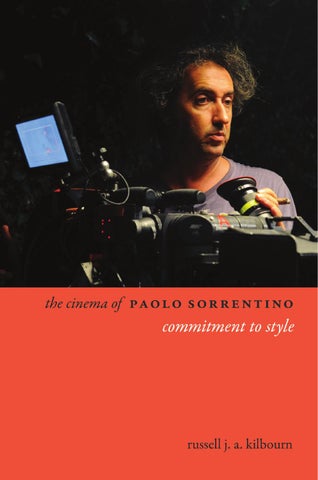
Paolo Sorrentino has emerged as one of the most compelling figures in twenty-first-century European film and a preeminent transnational auteur. Russell J. A. Kilbourn offers close readings of Sorrentino’s feature films and television output from One Man Up (2001) through Il Divo (2008) and The Great Beauty (2013) to The Young Pope (2016) and Loro (2018), featuring in-depth analyses of the director’s exuberant and intensified film style. The first English-language study of the acclaimed director’s oeuvre, this book demonstrates why Sorrentino is one of the most dynamic figures making films today.
DIRECTORS’
CUTS
di r ector s ’ cu ts focus on the work of the most significant contemporary international filmmakers, illuminating the creative dynamics of world cinema. russel l j. a . k i l b o ur n is professor of English and film studies at Wilfrid Laurier University. His books include Cinema, Memory, Modernity: The Representation of Memory from the Art Film to Transnational Cinema (2010) and W. G. Sebald’s Postsecular Redemption: Catastrophe with Spectator (2018).
ISBN: 978-0-231-18992-7
fi lm studi es
cover im age: Photo 12 / Alamy Stock Photo 9 780231 189927