Introduction Reclaiming the Great Unread
. . . a different conception of the history of literature: a history that takes for its potential subject the entire field of word-made objects; that refuses to assume a fixed, a priori distinction between one kind of writing and another; that concerns itself with the practical uses of such distinctions as emerge in any epoch; that looks skeptically upon the celebration of autonomous individuality; that understands that all literary creativity involves a complex global circulation of social energies. —Stephen Greenblatt, “What Is the History of Literature?”
T
he bookshop is a space that breathes dazzling plurality. Once you have stepped into this space—be it physical or digital—you cannot but be mesmerized by the cornucopia of materials that spark curiosity, awaken imagination, and activate the senses. Shaped as a condensed version of the world, the bookshop offers much more than a few fictional stories canonized as “literature” by centuries of Eurocentric critical pronouncements and curricular decisions.1 Each of us goes to the bookshop motivated by different interests. Some relish the aesthetic process of reading, savoring the visual and auditory nature of words. Others delight in the emotional and cognitive excitement generated by fiction and nonfiction. Still others revel in reading texts that quench their thirst for knowledge, humans’ innate libido
2
Introduction: Reclaiming the Great Unread
sciendi. After all, as Latin American writer Gabriel Zaid notes, “What matters is how we feel, how we see, what we do after reading . . . whether reading makes us, physically, more alive.”2 Transformative literature—this is what some crave. An etiquette manual can be a source of great enjoyment for those who want to master a more genteel deportment. Philosophical ruminations delivered in essay format can provide gratification to those trying to make sense of the world they inhabit. Travel writing can offer more than practical information or fantasies of distant places: as British writer Robert Macfarlane puts it, travel writing can be felt in one’s feet, it speaks to one’s soles, and invites us to march out into adventure.3 The pleasures of reading are as manifold as the books on the shelves of a bookshop. Publishers and booksellers are invested in a commercial enterprise that shapes what Umberto Eco viewed as the network of texts produced for “humanity’s own enjoyment—and which are read for pleasure, spiritual edification, broadening of knowledge, or maybe just to pass the time.”4 Eco held that it is precisely this network of texts that embodies our “literary tradition.”5 As such, literature expands beyond the rigid constraints of the canon in the eclectic space of the bookshop. Now step back in time, to seventeenth-century Japan. Imagine yourself on Teramachi Street, in the heart of Kyoto (fig. 0.1).6 This area was home to a number of publishers, which also operated as bookstores. The space they created was no different from the one limned in the preceding. The business established by Akitaya Heizaemon 䥳䓘⯳⸛ⶎ堃攨 (dates unknown), probably in 1644, was located in front of the temple known as Enpukuji (fig. 0.1, no. 1). In addition to
Figure 0.1 Detail from Shinpan Heianjˌ narabi ni rakugai no zu, 1680. Teramachi Street
in Kyoto. Courtesy of the National Diet Library, Tokyo
Introduction: Reclaiming the Great Unread
3
many works written in literary Chinese about medicine, Buddhism, and Confucianism, Akitaya issued texts in the vernacular starting with an abridged version of Genji monogatari (The Tale of Genji) in 1651 titled Genji ko-kagami (The little mirror to Genji). In his bookshop you could buy nonnarrative essays on Confucianism (e.g., Tagami no ue [The life of others; after 1657]), a guide to the annual festive days (Annaisha [The guide; 1662]), librettos of the Noh theater, and the chilling collection of ghost stories Otogi bˌko (Hand puppets; 1666) by the best-selling writer Asai Ryʪi 㳭ḽḮシ (d. 1691). Walking a few meters north, you would find the large compound of another temple, Seiganji (fig. 0.1, no. 2). Its architecture featured extensively in the lavish folding screens depicting Kyoto, and it was home to the famous storyteller Anrakuan Sakuden ⬱㤥⹝䫾 ễ (1554–1642), father of the form of comic performance known as rakugo. In front of this iconic and lively temple was the shop of Nishimura Matazaemon 大㛹⍰ⶎ堃攨 (dates unknown), whose oldest recorded publication dates to 1624. In addition to serious publications in Sinitic, which would probably have interested a chosen elite, Nishimura issued titles that would have appealed to a wider readership equipped with vernacular-only literacy. Much like his neighboring Akitaya, Nishimura wished to cater to the needs of those who had a couple of years of education in a terakoya school and were in the main trained to write and read the phonetic script. In 1634, for example, he released a conduct manual with letter templates (Shogaku bunshˌ narabi ni yorozu shitsukekata [Elementary letters and all forms of etiquette]; this work is discussed in chapters 4 and 5), which was an immediate hit and was reissued more than twelve times by him and other publishers, both in Kyoto and Edo, until the 1680s. You could have purchased it from his bookshop for the price of a bowl of steamed rice flavored with hot tea. Relatively low prices were one of the many pluses of the woodblock-printing technology. Nishimura’s huge stock of books included, among other things, collections of medical recipes, cookbooks, arithmetic manuals, school textbooks, classics like Ise monogatari (The Tales of Ise), Buddhist sermons, poetry anthologies, and didactic books for women. He was also the first to issue, in 1662, the earliest printed work dealing with the tenth-century diviner Abe no Seimei (Abe no Seimei monogatari [The story of Abe no Seimei]), a figure who continues to inspire anime and video games. Nishimura’s bookshop provided all sorts of readings to feed varied interests and deliver diverse pleasures. Nishimura was also one of the pioneers in publishing book-trade catalogues listing the titles available on the book market in Kyoto and possibly Edo. His catalogue dates to 1670 and gives us a clear idea of the magnitude of the contemporary commercial printing business, with a total of some thirty-eight hundred titles, out of which around eight hundred were in the vernacular (I return to this in chapter 2). Before the creation of publishers’ guilds, Nishimura’s ability to pull together information from the hundreds of publishers active in Kyoto speaks of his leading position in this world. If we
4
Introduction: Reclaiming the Great Unread
consider that more than a thousand publishers are recorded in the colophons of books commercially printed in Kyoto between 1673 and 1688, we can grasp the impressive size of seventeenth-century commercial printing and the literary tradition that it brought to life. At the beginning of the eighteenth century, in the 1703 poetry collection Fudanzakura (Never-ending blossoms), the business of publishing was aptly described as a lush forest: “With the cutting of characters / the forest of books / luxuriantly bursts forth” (Shokuji yori / fumihayashi wa / habikorite).7 These figures tell a compelling story. It is the story of a considerable number of readers ravenous for books that suited their multifarious interests and addressed different literacies; the story of a profusion of printed books created by savvy publishers in response to this hunger. The handful of titles touched upon in our imaginary wander around bygone bookshops in Kyoto speaks of a literature created to feed curiosity and to gratify customers with printed products that engaged them at multiple levels: aesthetically, cognitively, and emotionally. To instruct and to delight—this is what the publications in the vernacular issued by commercial publishers in seventeenth-century Japan were attempting to do. The pleasure of reading was by no means relegated to entertainment: it was also sparked by interacting with transformative literature. Sadly, we know very little of this story today. Of the numbers introduced here only a fraction have been included in literary histories. Over the past sixty years around twenty or twenty-five titles have been dealt with in some detail in English and only a handful have been deemed appropriate to be included in anthologies that have shaped the literary canon for undergraduate and graduate students. This is less than 1.5 percent of what seventeenth-century readers equipped with vernacular literacy could access, a tiny amount of what survives in the archives. We are not far from the “slaughterhouse of literature” lamented by Franco Moretti in his study of nineteenth-century English fiction.8 I wish in the present monograph to reconstruct the story of the Great Unread of seventeenth-century popular prose in Japan.9 My research reflects a desire to understand which texts were in phase with a large group of seventeenthcentury popular readers endowed with basic, vernacular literacy and how books shaped them as a community of fully-fledged human beings.10 This publication is the first step into the forest of books that awaits (re)discovery. It is also an intellectual journey that urges us to alter our expectations vis-à-vis the literary, breaking down the wall that is traditionally perceived between enjoyment (the aesthetic) and knowledge (the didactic or the cognitive).
A (Literary) History of Exclusion In 1957, and for the first time in English, the scholar and book collector Richard Lane introduced students of Japanese literature to the fiction produced
Introduction: Reclaiming the Great Unread
5
between 1600 and 1682.11 Lane’s pioneering and now classic account of this literary production fully conformed to the findings and the interpretative stance favored by Japanese academia since the seminal work of Mizutani Futʪ.12 In his examination of kanazˌshi—the conventional label for the prose written in the vernacular after 1600 and before the publication of Kˌshoku ichidai otoko (The Life of an Amorous Man; 1682)—Lane chose to focus mainly on fiction. For Lane literature is storytelling. Literature is narrative. While I concede that any distinction between narrative and nonnarrative is fraught with danger, I find Marie-Laure Ryan’s reflections on narrative and narrativity of assistance in unraveling these concepts.13 Basic conditions of narrative (intended as story) include the representation of at least two events (actions and happenings) that entail a change, possess an internal time sequence, and occur in a world populated by intelligent individuals and objects (existents).14 Nonnarrative elements are identified in “extended descriptions, metanarrative comments, digressions, narratorial and authorial interventions, general considerations, and philosophical meditations.”15 Narrativity is what allows us to grasp the complex, nonbinary relationship between narrative and nonnarrative, in that it “assesses the role of the story with respect to the whole of the text, taking both narrative and nonnarrative elements into consideration.”16 When viewed through the lens of narrativity, Lane’s work seems to evaluate positively those texts that push a story through and minimize any nonnarrative disruptions. There is more, though, to Lane’s intellectual position. Lane is in fact in search of the novel and identifies in realism the discriminating feature in his obsessive hunt for modernity and literary value. The nineteen works Lane selected for close reading are in one way or another narrating stories and are more or less successful in depicting the new age in realistic terms. References to Kabuki and pleasure quarters, kernels of psychological realism in the description of fictional characters, influences from classical literature such as Ise monogatari and Tsurezuregusa (Essays in Idleness), the presence of a coherent, wellstructured story, and a hedonistic mood are conveyed as the watchwords of quality creative writing in seventeenth-century Japan. Lane is zealous in trying to neatly organize his selected titles into three categories: entertainment, enlightenment, and practical education/guidance. These categories, too, appear somewhat slavish in their adherence to the views propounded by twentiethcentury Japanese scholarship. Once a title is associated with a particular category, Lane concentrates almost solely on the textual features that allow the text to fit that particular category. When he cannot silence the strident contradictions in some of the texts under discussion, Lane appears willing to blame seventeenth-century readers, who put up with such inconsistencies because they were “cut off from the mainstream of world literature.”17 In all this, the real winner seems to be taxonomy. As readers of Lane’s article, we are left with a slightly skewed view of a few titles of seventeenth-century vernacular fiction and the impression that these are the only titles that seventeenth-century
6
Introduction: Reclaiming the Great Unread
Japanese read. We are also reminded that we must wait for the genius of Ihara Saikaku ḽ⍇大浜 (1642–1693) to witness what Lane sees as the highly notable results in creative writing of and for the masses: “The kana-zˌshi are most important in the history of Japanese literature as a transitional form, bridging the gap between the medieval romance and the modern novel.”18 Lane’s study gave some impetus to a handful of English translations in subsequent years.19 As praiseworthy and meaningful as they are, these translations have paradoxically contributed to molding the image of seventeenth-century vernacular prose as a tiny canon of around ten titles, the vast majority of which are fictional narratives. This image is fundamentally at odds with the nature of the forest of books that was created by commercial publishers as sketched at the outset of this study. If one is keen to discover more beyond the set canon of a few works, the only resources to date that serve the purpose are in Japanese. Noda Hisao’s study of kanazˌshi, published as part of his multivolume Kinsei shˌsetsu shi, remains a standard source in the field.20 Organized chronologically with the division of works into categories that are reminiscent of Lane’s 1957 article, Noda discusses around two hundred primary sources. His erudite annotations for each title are tremendously informative, containing plots, snippets of texts in transcription, insights into the publication history of select books, the mention of key scholarly articles, and interpretative remarks that together make Noda’s work a solid starting point. Yet this learned companion to seventeenth-century prose falls into the same trap as Lane in its fixation with the novel (shˌsetsu). Noda is admittedly more inclusive, as the sheer number of titles he examines suggests. When he touches upon texts that somehow lack in what I have identified as narrativity, however, Noda justifies their inclusion with defensive apologies.21 As a result, he is reluctant to explore narrativity as a potentially generative framework that allows for a discussion about the degrees of the story’s visibility and in turn provides the opportunity to study a variety of modulations of narrative and nonnarrative. His desire to include as many titles as possible is at odds with the perceived need to mention only novel-like texts that offer a clearly detectable story (and possibly a story with “literary” qualities).22 The two required readings for anyone keen to explore seventeenth-century vernacular prose by Richard Lane and Noda Hisao are thus plagued by the same weaknesses. Both trumpet an elitist notion of what literature should be; both launch an anachronistic quest for the modern novel in an age and a culture that had no knowledge of or need for the European novel; and both belittle the nonnarrative (and the nonfictional) as something unworthy of the attention of a literary scholar. The result is a history of exclusion, barring any work that does not adopt a belletristic and elitist view of literature. And this has sealed the fate of seventeenth-century prose as an embarrassment of Japanese literature: the black sheep no one wants to talk about. The dearth of articles and the absence of any book-length study on the subject speak loudly to this lamentable state of
Introduction: Reclaiming the Great Unread
7
affairs. Indeed, Saikaku’s imagination and his linguistic genius have been spared such a fate for reasons that are no less fraught with problems of cultural assimilation. In seventeenth-century Japan, commercial publishers issued hundreds of titles that gained favor among what must have been a large constituency of readers. And these titles were as popular as Saikaku’s prose. Clearly there was something in this rich outpouring of texts that struck a chord with contemporary readers and satisfied their fundamental cultural needs. My journey in retrieving the Great Unread of popular seventeenth-century Japanese prose begins with the gaps in Lane’s account. Lane notes that a didactic strain is apparent to some degree in nearly all this corpus. Lane’s contrast of didacticism with fiction seems to imply his belief that didacticism occurs primarily in nonfictional texts, endowed with little narrativity. This then suggests, albeit indirectly, the presence of much seventeenth-century prose as not concerned with recounting a story but with something else. What is this something else? Lane notes the existence of contradictions within a few of the texts he examines, but, as already touched upon, he readily repudiates them. But what if we decide to enter into dialogue with these contradictions and listen to their message(s)? Lane mentions that select fiction makes use of the information and knowledge provided in the practical genre of “courtesan critiques.” This indicates that nonnarrative texts (or texts characterized by a lower degree of narrativity) had the power to influence full-blown narrative texts. Lane justifies this interaction as meaningful because it infuses fictional stories with realism. Is this all that such an interaction can offer? Lane, as a book collector, includes in his article a few images from seventeenth-century books but does not discuss their materiality, as if it were irrelevant to the understanding of their contents. What happens if we take the materiality of books into account? While today we might see flaws in Lane’s argument—after all, it was written in the nascent period of studies into popular seventeenth-century Japanese literature—it prompts us with thought-provoking questions that deserve examining in greater depth. My aim is to fully engage with what Lane (and Noda) have dismissed, silenced, trivialized, or discredited. As a result, I challenge the received view that most publications of the time were either poorly formed entertainment or dismal didactic things, waiting to be swept away by a brilliant development late in the century. Teleological considerations have no part to play in the story I wish to reconstruct.
Toward Inclusion The time is ripe to address the questions prompted by the lines of inquiry disparaged by Lane and to envisage novel ways to look at commercial seventeenthcentury popular prose. Three changes in literary studies by scholars working
8
Introduction: Reclaiming the Great Unread
inside and outside Japanese studies drive this new research trajectory: the growth of new historical scholarship; a mature interest in popular and didactic literature; and the provocative intellectual considerations advanced by Nakano Mitsutoshi, one of the leading scholars of Japanese early modern literature and book history. Before I delve into an exploration of these three threads, I wish to clarify the use I make of analytical frameworks drawn from Western literary criticism or from studies on early modern European texts. I am fully aware that some might deplore this as an exercise in cultural hegemony, subsuming knowledge under existing Western paradigms. Yet that is by no means my intention. For me, theoretical remarks produced in a variety of contexts (cultural, temporal, and spatial) prompt questions that we might otherwise not be able to formulate. They make us aware of critical angles that we might not otherwise envisage.23 I am not searching for any easy equivalence between early modern European and Japanese (popular) literatures. Texts are cultural products, firmly rooted in a specific time and space. Nevertheless, I am not ready to dispense altogether with the notion that the commercial desire to open up literature for a new kind of readership, one that possesses limited literacy and yet craves access to the written word, can undergo similar developments in different parts of the world and in different times. I seek to strike a balance between recognizing culturally specific choices and admitting universally applicable trends. Beginning in the 1980s, the study of literature—that is, English-language literature—witnessed an exciting moment in the field when scholars of literature turned from working on the literary to an exploration of the social and cultural aspects that were once relegated to the contexts in traditional literary histories. The assumption that only a small number of texts were worthy of study because of an inherent literary value and their place in the elite ranks of the literary canon was called into question. The implications of such a shift are significant since we are left with no masterpieces. All texts are equal and should rightfully be treated as the object of investigation by scholars of literature.24 While this approach does not come without its “burdens,” as discussed by Lawrence Lipking, or without controversy, as noted by Catherine Gallagher, it also comes with a wondrous sense of liberation: the literary space has become richer and truly democratic.25 In his study of what seventeenth-century readers in England enjoyed before the rise of the novel, Paul Hunter well sums up the excitement of this new approach: The past decade has brought new directions to literary study—interdisciplinarity, curiosity about generic issues, interest in theory for its typological potential and for its ability to sort among the strands of intention and outcome in texts, belief in history as a serious interpretive dimension for texts and in historiography as a means to analyze and recover cultures as wholes, pursuit of the
Introduction: Reclaiming the Great Unread
9
dimensions of desire in both readers and writers and concern with its communal and cultural forms as well as its individual and psychoanalytical ones, distrust of canonical categories and the disinterment of “minor” and “utilitarian” texts, replacement of strictly literary categories by cultural ones.26
Hunter adeptly describes the cultural turn in the study of literature and the positive results it generated. We are finally able to unearth those texts that traditional literary historians in the past eschewed. In this light, Eco’s identification of the literary tradition with texts produced “for humanity’s own enjoyment” makes perfect sense.27 The “enjoyment” of reading is not limited to the pleasure derived from the consumption of a beautifully crafted text or one that captivates because of its fictional nature. It is also the intellectual excitement derived from reading something that a reader finds interesting for all sorts of reasons. Eco’s inclusion of “spiritual edification” and a “broadening of knowledge” also allows literature to encompass what we would normally view as didactic, or even transformative, literature—literature that appeals for its epistemic function. In line with this, exciting new territories and methodologies have been explored by scholars like Franco Moretti and Stephen Greenblatt.28 Moretti views in what he terms distant reading a condition of knowledge that allows us “to focus on units that are much smaller or much larger than the text: devices, themes, tropes—or genres and systems.”29 We are invited to embrace skills like sampling and statistics as well as work with series and titles in order to make sense of the enormous number of texts released on the book market. Greenblatt and the New Historicism with which he is associated invite us to recover the marginal voices, those that have been suppressed or lost.30 This is admittedly just one aspect of a much wider intellectual project, and it may appear that I am selectively choosing from New Historicism’s rich basket, therefore risking oversimplification or misapprehension. I trust, however, that the idea of “culture as a text” and the resultant broadening of the literary field have great potential. In their introduction to Practicing New Historicism, Gallagher and Greenblatt explain, The notion of culture as text has a further major attraction: it vastly expands the range of objects available to be read and interpreted. Major works of art remain centrally important, but they are jostled now by an array of other texts and images. Some of these alternative objects of attention are literary works regarded as too minor to deserve sustained interest and hence marginalized or excluded entirely from the canon. Others are texts that have been regarded as altogether nonliterary, that is, as lacking the aesthetic polish, the selfconscious use of rhetorical figures, the aura of distance from the everyday world, the marked status as fiction that separately or together characterize belles lettres.31
10
Introduction: Reclaiming the Great Unread
It is in this democratic view of literature, one that expands beyond the boundaries of the canonical garden, that we are able to retrieve what literary histories have traditionally suppressed. Outcast texts, as Lipking calls them, can be reinstated as valuable objects of inquiry.32 In this book I want to retrieve what readers in seventeenth-century Japan enjoyed reading (and why) centuries before any hint of the novel breached the horizon. Taking into full account texts that the canon has outlawed is the key. While I am anxious not to raise the expectation that my research might fall into the theoretical realm of New Historicism, I wish to point out that my attempt to embrace the democratic view of literature that New Historicism underscores is a fresh endeavor when it comes to seventeenth-century Japanese literature. Research on popular literature and popular culture is seldom mentioned in the theoretical reflections around historical scholarship, and yet it seems to me that this research has, in its own way, set in motion a forceful challenge. In 1964, the historian Robert Mandrou published his work on the bibliothèque bleue, a corpus of blue-covered paperbacks that developed as early as the seventeenth century and were sold at a modest price by colporteurs.33 It was not the first time that these materials were unearthed for scholarly treatment. In 1864, for example, the philologist and literary historian Charles Nisard issued two substantial volumes on the history of popular books (livres populaires), with others to follow.34 Mandrou, however, remains the starting point for anyone curious about this literature.35 An interest in cheap literature similarly emerged in the study of literary traditions other than the French one. Margaret Spufford’s Small Books and Pleasant Histories is still regarded as a landmark publication for England and Scotland.36 Jeffrey Brooks has shed light on the Russian literature of the lubok, Candace Slater on the Brazilian literatura de cordel, Francesca Orsini on popular literature in colonial North India; Cathy and Michael Preston have opened the field to American, Pakistani, and Egyptian chapbooks; and the onitsha market literature of Nigeria has been similarly discussed.37 Research on commercial publishers in China across centuries has raised awareness of what kind of literature was produced to engage an ever-expanding readership.38 We are also conscious of vernacular fiction and the development of the book trade in seventeenth-century Korea.39 Whether conceived and marketed as book histories, literary histories, or cultural histories, these studies all pose the same questions, which Gary Kelly summarizes in the introduction to the Oxford Series of Popular Print Culture: “What did most people read? Where did they get it? Where did it come from? What were its uses in its readers’ lives? How was it produced and distributed? What were its relations to the wider world of print culture? How did it develop over time?”40 It is not within the remit of this introduction to provide a synopsis of the rich, manifold findings of the extensive work done over the years on popular literature around the globe. One point, however, does need to be singled out here as it resonates deeply with what historical scholarship and this monograph seek to achieve.
Introduction: Reclaiming the Great Unread
11
Each of these studies makes us aware that the contents of popular literature reflect the multifaceted interests of everyday life, urging us to include in our field of inquiry writings that are conceived for uses other than mere aesthetic appreciation. These studies thus showcase how important it is to work with titles that have traditionally been banned from literary histories. The French bibliothèque bleue, for instance, was much more than narrative fiction: cookbooks; manuals for health; divinatory books with prophecies, interpretations of dreams, and almanacs; religious books that included the lives of saints, select passages from the Bible, and manuals on the ars moriendi; fictional stories of love and war; conduct books for women on the pursuit of love and fostering a healthy conjugal life; and many others. English and Scottish chapbooks also display a parallel breadth in contents and scope. In her comparison of Samuel Pepys’s collection of chapbooks at Magdalene College (University of Cambridge) with the bibliothèque bleue, Margaret Spufford discovered something strikingly similar, with titles including cookbooks, almanacs, books of prophecies, medical handbooks, letter manuals, books of instruction, and religious writings. Jeffrey Brooks has identified chivalrous tales, morally instructive tracts, tales about merchants, war and travel stories, humorous tales, and saints’ lives as the preferred works commercially published as part of the literature of the lubok in Russia. In his investigation of Pakistani chapbooks, William L. Hanaway has uncovered traditional romances and adventure stories alongside religious stories, books of spells and charms, advice on marriage and family life, as well as humorous stories and jokes. In addition to these studies, mention should be made of the fascinating collection of books in the Fondazione Giorgio Cini on Venice’s Isola di San Giorgio, which demonstrates that fifteenth- and sixteenthcentury books printed in Italy were read not only by the period’s cultural elite but also by the middle and lower classes. The many dimensions of human life are once again mirrored in the variety of these Italian works: manuals for intellectual and moral education, with printed versions of Aesop’s fables occupying a prominent position; moral treatises about virtues; manuals of arithmetic; a range of religious booklets from missals to the lives of saints; verses, letters, and fictional tales teaching the art of love; books for entertainment, from manuals on gambling to tales of chivalry; and a vast selection of treatises on medicine, law, politics, and the art of war.41 In her work on the book trade that developed in the Chinese area known as Sibao from the late seventeenth century to the early twentieth century, Cynthia J. Brokaw has identified a similar variety of printed products, including educational works; guides to good manners, health, and fortune; and fiction.42 Yuming He has further expanded the textual typologies by looking at what she calls huckster or pulp scholarship, exploring Ming books of riddles, jokes, and drinking games, alongside nonfictional records of foreign countries.43 I could cite many more examples, but here I wish to reiterate the point suggested by these materials—that is, the probing of popular literature in print
12
Introduction: Reclaiming the Great Unread
forces us to move beyond aesthetically pleasing fiction and to recover other voices that have been silenced in previous literary histories. It asks us to acknowledge and engage with what Maria Nikolajeva refers to as the epistemic value of literature, or how literature conveys knowledge of extraliterary reality— including factual, social, interpersonal, and metacritical knowledge.44 Knowledge making, I argue, is a pivotal aspect of popular literature in print. The study of this field also prompts us to embrace a type of nonaesthetic reading, or what Louise M. Rosenblatt calls efferent reading, where the reader “concentrates on what the symbols designate . . . the information, the concepts, the guides to action.”45 When engrossed in aesthetic reading, our primary concern is “with what happens during the actual reading event.”46 But with efferent reading, we are interested in what comes after we have finished perusing a text. I disagree with Rosenblatt’s claim that an aesthetic stance is essential to all literary art, but I find her idea that the same text admits both aesthetic and efferent reading tantalizing. As such, familiar dichotomies between fiction and nonfiction, narrative and nonnarrative, useful/didactic and aesthetic, literary and nonliterary cease to be relevant. And we are asked to move beyond belles lettres according to what historical scholarship of the past three or so decades has taught us. As noted in the foregoing, a great proportion of popular literature around the world exhibits a strong penchant for the didactic, if not for the practical. In the introduction to Didactic Literature in England, 1500–1800, Natasha Glaisyer and Sara Pennell observe that the study of didactic texts still lacks “thorough and critically sophisticated treatment.”47 They suggest this is partly because of the academic judgments of what constitutes a valid text for study, which, in turn, takes us back to the problem inherent in traditional literary histories. Glaisyer and Pennell’s work, in tandem with a few other publications, reclaims the importance and the centrality of didactic texts, and the efferent reading they invite, at the heart of the study of literature.48 An interest in didactic writings produced in early modern Japan—especially cookbooks, manuals for the tea ceremony, and texts on natural history—has similarly begun to surface in recent years.49 This invaluable research has shed light on nonnarrative prose and allowed an appreciation of its historical, sociological, and cultural significance. At the same time, however, the fact that the great majority of these reflections position themselves outside the field of literary studies seems to be a missed opportunity for us to write a new literary history conceived from the perspective of what readers were actually interested in. What would happen if we integrated the study of didactic prose into the study of the literary? The most recent thought-provoking (at times even provocative) articles by Nakano Mitsutoshi are germane to this discussion. In 1997, Nakano proposed, quite controversially, to shift the temporal boundaries of gesaku (literally,
Introduction: Reclaiming the Great Unread
13
“playful writings”) to before the conventionally accepted date of the 1750s, beginning in the seventeenth century and including the prose of Ihara Saikaku.50 Some might object to Nakano’s suggestion as nothing more than a cosmetic change in that he simply substitutes the umbrella term bungaku (literature) with the term gesaku. Others might find Nakano’s writing overly dogmatic. Yet I would argue that Nakano’s stance is cogent and aligned with the aforementioned developments in the field of literary studies (although unbeknownst to Nakano himself). Nakano asks us to enter into dialogue with early modern texts once we have fully understood the intellectual world and beliefs of the Edo period. He speaks of fostering “two sets of eyes”: a set of “Edo people’s eyes” (Edojin no manako) complementing the second set of our modern eyes (gendai no manako).51 I would rephrase this and state that Nakano in fact urges us to study Edo-period literature from within, on its own terms. This stance is strikingly similar to that advocated by Margaret Cohen in her study of nineteenth-century France and its forgotten novelistic context. Cohen’s words seem to echo Nakano’s: The great challenge confronting any excavation is to denaturalize these expectations and take forgotten literature on its own terms. What are a work’s distinctive poetics; what are these poetics’ aesthetic logic and ideological force? Without understanding that forgotten works are shaped by a coherent, if now lost, aesthetic, one simply dismisses them as uninteresting or inferior in terms of the aesthetics that have won out.52
What Nakano views as a set of Edo-period eyes is the retrieval of a lost early modern aesthetic. Nakano explains convincingly the drawbacks that arise when employing words that are intrinsically modern—therefore extraneous to the Edo period—when discussing early modern writings and highlights the dangers inherent in applying concepts such as literature (bungaku), literariness (bungakusei), and the novel (shˌsetsu). He perceives unacceptable anachronism in the search for texts whose literary value resides in the resistance to and criticism of the dominant classes and their authority, arguing that early modern society had an unshakable faith in human beings and their intrinsic good nature. Nakano is also opposed to the view that Saikaku’s interest in eroticism and the pleasure quarters transcends the ethics and logic of the real world, as traditionally viewed in received Japanese scholarship on Saikaku. He argues instead that eroticism and the pleasure quarters lay at the very heart of the early modern world and thus well within the borders of what was considered ethical at the time. In short, we are asked to study early modern texts in their historical context and without superimposing modern notions of literature. Ultimately, Nakano’s decision to adopt the term gesaku accords with this point of view. Back in 1826, the gesaku writer Utei Enba II 䁷ṕ䂱楔 (1792–1862) wrote
14
Introduction: Reclaiming the Great Unread
that “gesaku in Osaka started with Ihara Saikaku.”53 Nakano is looking at the Edo period through the lens of someone from the Edo period. Having recalibrated his lens to the early modern era and espoused the historical concept of gesaku, Nakano continues by elucidating the key features of this prose, which (1) endorses the ideology of its epoch with no resistance, (2) shows a penchant for parodic playfulness and a keen interest in honing the language, and (3) combines humor with didacticism.54 The point I find particularly relevant for my own work is Nakano’s appreciation of the epistemic function of literature. For him, the literary-didactic split is alien to Edo-period prose (= gesaku), which results in the need for scholars of Edo-period prose texts to welcome didacticism as a pivotal quality. Nakano notes that “in pure literature a didactic stance [kyˌkun] is viewed as a secondary, tertiary aspect. In other words, it is considered as something that should not exist in proper literature.”55 He claims, however, that “didacticism [kyˌkunsei] is something intrinsically constitutive of Saikaku’s work,” therefore of gesaku and of early modern literature.56 I contend that this equally applies to the seventeenthcentury popular prose that I explore. While a modern view of literature rejects didacticism, the view aligned with the early modern Weltanschauung fully embraces it. As Pierre Bourdieu observed, “Any cultural producer is irremediably placed and dated in so far as he or she participates in the same problematic as the ensemble of his or her contemporaries.”57 Nakano sees didacticism at the core of this problematic, which, in turn, allows us to unlock the aesthetic and ideological stakes of early modern literature. In accordance with historical scholarship and work undertaken on popular literature, Nakano’s assessment asks us to move away from the canon and its dicta. It asks us to retrieve aspects of literature that have been relegated to the background or even negated by previous literary histories. It asks us to confront aspects of literature that have been buried in the modern process of canon making, aspects that are at the crux of the worldview of early modern literature. Nakano tries to make this point crystal clear by explaining what didactic implies and maintains that early modern didacticism investigates how one should live as a human being.58 He equates didacticism with beliefs or ideology (shisˌsei)—in other words, early modern prose is interested in conveying ethical, societal, and interpersonal knowledge to form fully-fledged human beings who fit into contemporary society.59 For Nakano, “in the early modern period it was universally accepted that prose had to profit morality.”60 Prose was expected to be of profit to its readers in the shaping of their morality; it was expected to instruct them. Humor could feature as well in order to make the teachings more palatable. The equilibrium between didacticism and humor, Nakano explains, could vary, at times leaning toward the former and at other times toward the latter. As noted, the expectation of early modern prose was to instruct and to delight.
Introduction: Reclaiming the Great Unread
15
It is not my aim to join in the debate about the origins of gesaku. Nakano asks if the beginnings of gesaku can be extended further back in time to the seventeenth-century prose before Saikaku. I do not wish to offer an answer, and I am not even convinced that this is the most meaningful part of the discussion. What interests me are the other issues ignited by Nakano’s research. How can we approach seventeenth-century prose from within? How can we retrieve the didactic side of seventeenth-century prose? Should we restrict ourselves to narrative fiction, or should we also take into account nonnarrative texts? How are books designed to instruct readers? How is ethical and societal knowledge conveyed? Does this knowledge cross-pollinate with fiction? Does fiction only mirror society and its ethics, or does it participate in their construction? Are “profit” and “entertainment” antithetical? Or can pleasure be derived from profit? Whether we call it gesaku or something else, seventeenth-century prose invites us to confront these questions.
Working with the Popular Galvanized by the sea changes in literary studies sketched in the previous section, my research aims at a reconstruction of the story of the Great Unread of seventeenth-century popular prose. A working definition of what I mean by “popular” is in order. Studies on popular culture and popular literature entreat us to ponder the meaning of “popular” as a complex entity.61 Usually the term “popular” implies something that is liked and consumed by many people. When considered within historical periods for which statistics (such as sales figures or number of copies printed) are lacking—the early modern period is a case in point—any quantitative assessment of the notion of popular could be seen as almost impossible. Yet consideration of other aspects of the publishing industry can offer clues such as how many times a title was printed (or reprinted), how many different publishers were involved at different stages of the production, to what extent a work was printed or circulated outside Kyoto, and whether and how it was mentioned or appropriated in later works.62 In this book I appraise the quantitative dimension of the popular in examining books that were in phase with a vast number of readers across society. Linked to quantification is the understanding that popular culture deals with commerce and commodity. Scholars of popular culture often speak of “mass culture,” a concept that is not devoid of traps.63 Despite any skepticism we might feel vis-à-vis the use of this term, the idea of books produced by means of a technology that ensures circulation in large numbers and at cheap prices has been acknowledged as something useful when considering early modern popular literature.64 Commercial printing and a commodified book trade can certainly be identified as key features in a discussion of the popular printed word in the Edo period.
I
N THE FIRST COMPREHENSIVE STUDY of the birth of Japanese commercial publishing, Laura Moretti investigates the vibrant world of vernacular popular literature. She marshals new data on the magnitude of the seventeenth-century publishing business and highlights the diversity and porosity of its publishing genres. Moretti explores how booksellers sparked interest among readers across the spectrum of literacies and demonstrates how they tantalized consumers with vital ethical, religious, societal, and interpersonal knowledge. Crucially, readers experienced entertainment within the didactic, finding pleasure in the profit gained from acquiring knowledge by interacting with transformative literature. Culling from a rich variety of archival materials, Pleasure in Profit questions traditional literary histories of this period and speaks to broader conversations about the category of the literary. “In this exemplary study, Moretti challenges the conventional wisdom in her choice of texts (outside the literary canon), in her treatment of genres (as ‘porous’), and in her approach (comparative). Her book should appeal to students of comparative literature as well as to specialists on Japan.”
—PETER BURKE, AUTHOR OF POPULAR CULTURE IN EARLY MODERN EUROPE
“The world of popular literature is often dismissed by scholarship, but it is precisely within the mundane that we are able to catch a glimpse of the authentic. Only by taking didactic prose seriously can we discover how the intellectual elite’s ideas percolate down and influence the everyman. Moretti has put the study of early modern Japanese literature on an entirely new footing.” —RICHARD BOWRING, AUTHOR OF IN SEARCH OF THE WAY: THOUGHT AND RELIGION IN EARLY MODERN JAPAN
“Moretti is an intensely learned guide through a forest of underappreciated popular prose books. She shows how didactic texts shaped the lives and fantasies of Japanese across class lines during the early decades of print, forever changing our view of publishers, audiences, and their multiple literacies.” – —LINDA CHANCE, AUTHOR OF OOKU: THE SECRET WORLD OF THE SHOGUN’S WOMEN
“Drawing on sources from etiquette manuals to literary works—and, tellingly, books that are both at once—Pleasure in Profit offers a nuanced portrait of popular publishing in seventeenth-century Japan, highlighting simultaneously its particularity and its echoes of European contexts. I can’t imagine a more lucid, approachable, and grounded treatment of the topic.” —MICHAEL EMMERICH, AUTHOR OF THE TALE OF GENJI: TRANSLATION, CANONIZATION, AND WORLD LITERATURE
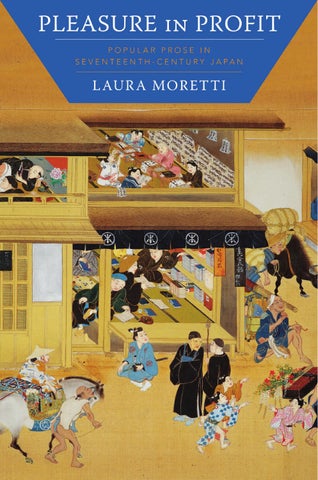
LAURA MOR E T T I is senior lecturer in premodern Japanese studies at the University of Cambridge and a fellow at Emmanuel College. She is the author of Recasting the Past: An Early Modern “Tales of Ise” for Children (2016). COVER IMAGE: Detail from Sumiyoshi Gukei, Tohi zukan (or Tohi emaki), ca. late seventeenth century. Bookshop and terakoya school. Courtesy of Konbuin, Nara. Licenced image provided by the Nara National Museum. COVER DESIGN: Milenda Nan Ok Lee PRINTED IN THE U.S.A.
COLUMBIA UNIVERSITY PRESS | NEW YORK cup.columbia.edu