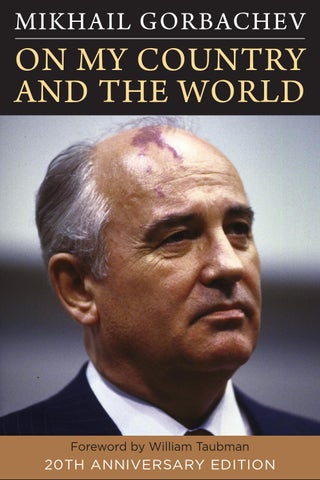
MIKHAIL GORBACHEV
ON MY COUNTRY AND THE WORLD
Foreword by William Taubman
20TH ANNIVERSARY EDITION
CHAPTER 2
Was Socialism Built in the Soviet Union?
The October revolution was termed a socialist revolution, and the Soviet Union was proclaimed a socialist state and even held up as a model. Later it was argued that what we had in our country was “developed socialism.” Was it really a socialist revolution that took place in October 1917, and was the system created by that revolution a socialist one? This is a valid and important question from the point of view of history and historical truth and from the standpoint of the future for all who continue to profess socialist ideas. Let me quote a statement by Lenin: “Our revolution up until the summer of 1918 and even until the autumn of 1918 was, to a significant degree, a bourgeois revolution” (Collected Works [Russian ed.] 38:143). What did Lenin mean here? Certainly he himself never renounced the socialist aims of the revolution. Lenin had in mind one very simple circumstance or fact of life. The revolution accomplished in October 1917 was obliged objectively, before all else, to carry out the tasks of a bourgeois revolution. In Russia in 1917 such tasks as reorganizing the structure and character of the government, making a fundamental transformation in the system of land ownership, and resolving the nationalities question were all problems that had not been solved despite the great progress in the last years before World War I. Without their being solved it was impossible to move forward. In October 1917 the victors in the revolutionary struggle confronted a society shaken to its foundations by the unprecedented slaughter and destruction of the world war. After the revolution many Social Democrats, both in the West and in Russia (Plekhanov, for example), said that in a society like Russia there could be no talk of socialism. The material basis for socialism had not yet 13
THE OCTOBER REVOLUTION
been created by capitalism. The Menshevik author Sukhanov wrote: “Russia has not reached that height of development of the productive forces under which socialism would be possible.” In Lenin’s last writings he answered his opponents—writings that are referred to as his political testament. What was his reply to Sukhanov in particular? Lenin agreed that Sukhanov’s was “an undeniable argument” that had to be considered (45:380). Lenin continued: If for the creation of socialism a certain level of culture is required (although no one can say exactly what that level of culture should be, for it is different in every Western European state), why could we not begin with the conquest by revolutionary means of the prerequisites for such a particular level of culture and then, on the basis of workers’ and peasants’ power, move toward catching up with other countries. (45:381)
Here the question is presented in a sober, well-reasoned way. But it was not until the years 1921–23 that policies based on such a reasonable approach made their appearance. In the first days and years of the revolution the Bolsheviks pursued a line of direct introduction of communist principles. The Kronstadt revolt and peasant uprisings, especially in Tambov province in 1921, signaled the defeat of this policy line. Lenin acknowledged this when he said, among other things: “You can’t leap over the people.” Nevertheless it must be said that the October revolution did carry out the first part of the tasks facing it—those Lenin characterized as the tasks of the bourgeois revolution. It destroyed the autocratic machinery of state and put an end to the legacy of feudalism in the countryside. It opened up a certain opportunity for national development in what was called the “borderlands,” the outlying colonial areas of the Russian empire. The cooperative movement also grew—not the kind that was later identified with all-out collectivization in the countryside but the civilized kind that had arisen earlier, before 1917. In addition, basic principles for industrial development were sketched out in the State Plan for the Electrification of Russia (GOELRO). Of course this was only a beginning, but one full of promise. What happened then? After Lenin’s death, and up to the end of the 1920s, a struggle went on in Russia between differing conceptions of how to move forward into the future. By the beginning of the 1930s Stalinism had triumphed in the Soviet 14
WAS SOCIALISM BUILT IN THE SOVIET UNION?
Union. The term Stalinism of course is a conditional one, although its usage has become customary. The one-sidedness of the term tends to flatten out the entire Soviet past, to paint it a single, uniformly dark color. In fact it was a multicolored, profoundly contradictory, and multilayered phenomenon. Today in Russia, and also outside our country, a debate is going on. What was the nature of the system built in the Soviet Union? The most varied of answers are given to this question. Here, some say: Yes, it was socialism, if not outright communism, and it was very nearly a model system. Others object: No, it wasn’t socialism; it was either state capitalism or even feudal capitalism or something of that kind. Still others disagree with both these views. They say: Yes, it was socialism but not a full-fledged kind of socialism; it was distorted, deformed, and incomplete. A similar variety of views may be found in the West. But one other point of view is held in the West to which I would like to call particular attention. Proponents of this view hold that indeed socialism was built in the USSR. They argue that thanks to the Soviet experience we now know what socialism is and therefore can reject and write off this kind of antihuman system once and for all and forget about it. This argument is false. My view is that in the Soviet Union a harsh and even cruel totalitarian system triumphed. It underwent an evolution to be sure; after Stalin’s death its harshness and cruelty were modified and blunted somewhat, but in essence it remained the same. Totalitarianism in the Soviet Union cannot of course serve as a model for anyone. That is indisputable. But it is also true that the kind of system that triumphed in the Soviet Union in the 1930s cannot be an argument against the socialist idea. I will return to this question below. For now there are other questions to consider. The first of them is this: How was it possible for Stalinism to triumph? A complete answer to this question would require quite an extensive discussion in the course of which it would be necessary to review almost the entire history of the past eight decades. That is beyond the scope of the present work, but it is necessary to touch on some aspects of the matter. We have already discussed one aspect—the particular features or characteristics that had developed in tsarist Russia, its social, economic, and political backwardness. Because of this backwardness the Russian people were not prepared to accept genuinely democratic ideals. Stereotyped ideas about “our good father, the tsar” had taken deep root in the mass consciousness, the idea of an omniscient, all-knowing leader who was always 15
THE OCTOBER REVOLUTION
right. In the Stalin era wide use was made of such stereotyped thinking, and this was the psychological soil in which Stalinism was able to grow. Alas, such stereotypes have not been overcome even today. It also cannot be forgotten that the Bolsheviks inherited a country in the depths of chaos. Harsh measures were required to overcome this— especially because, even after the end of the civil war, the resistance of the former ruling classes continued to make itself felt. Of course inexperience, even ignorance and fanaticism, among the revolutionaries themselves also played a role. Many of them considered the power they had won to be a carte blanche, that anything was permitted. The personal qualities of the leaders were also a very important factor that must be taken into account, especially those of Stalin, whom Lenin proposed to remove from the leadership. To me, Stalin was a cunning, crafty, cruel, and merciless individual, and a morbid suspiciousness was an innate part of his character. In Russia today one can hear people saying at times: “We need a new Stalin.” Such slogans tell us, first, that our population is still not living in genuinely democratic conditions, still has not lived in a genuinely human way: second, such slogans reflect the profound disillusionment and despair people feel regarding the existing order in Russia today. The majority of Russians, nevertheless, do not support such slogans. They favor freedom and liberty. One of the reasons for what happened (that is, the rise of Stalinism)— and the chief error the Bolsheviks made even before Stalin—was the “model” of socialism they chose, the conception of socialism that took shape in the minds of the Bolsheviks and in their writings even before the revolution. As is generally known, Marx and Engels did not work out a detailed blueprint of the future socialist society. And this was no accident. They were both opponents of “recipes.” They stressed the need to take specific conditions into account, the particular changes needed in one or another country, and the mutability of circumstances in which change was to be implemented. We must also recall that the views of Marx and Engels evolved. Thus, toward the end of his life, Engels came to the firm conviction that a democratic republic is the best form of government for the construction of socialism. On the eve of October, during his last period in the underground, Lenin wrote the booklet State and Revolution (which remained uncompleted). This 16
WAS SOCIALISM BUILT IN THE SOVIET UNION?
was in fact a systematic presentation, with commentary, of selected ideas about a socialist system drawn from his teachers, Marx and Engels. Lenin’s work, however, remained utopian and schematic, and the experience of the first few years of the revolution refuted that document. In the spring of 1918 Lenin published an article entitled “The Immediate Tasks of the Soviet Government.” This was a more or less realistic program of action adapted to the conditions that had developed at that time. In this work, incidentally, the first hints of ideas that later developed into the New Economic Policy may be detected. Later those ideas were set aside in favor of the policy of so-called war communism. After the civil war Lenin returned to those ideas and worked out the full program of the New Economic Policy. He admitted that major mistakes had been made during the previous four years. This was a serious matter. To me, it is obvious that Lenin, a man of tremendous intellect, analyzed the postrevolutionary experience with the maximum of candor and rigor. He rejected a great deal and called much into question. In his article of early 1923, “On Cooperation,” he uttered the celebrated phrase that it was now necessary to “acknowledge a fundamental change in our entire point of view toward socialism” (45:376). This indicates the direction in which he was searching. But many enigmas remain regarding his point of view. It is clear that Lenin wanted to promote pacification and reconciliation both in Russian society and in international relations, to bring people back together who had been divided by cruelty and hatred so they could jointly engage in constructive work and activity for the sake of the future. It is worth emphasizing that Lenin at that time paid attention not only to the economic side of things. In his “Letter to the Congress” he wrote about the problems of democracy. He began his thoughts on this question with these words: “I would strongly recommend that a number of changes in our political structure be undertaken at this congress” (45:343). His plans had not only a tactical aim but a strategic one as well. He did not have time to give full and final shape to his strategy. But knowing all of Lenin, not just bits and pieces quotable for one or another propagandistic purpose, I can state that his strategy excluded the revival of anything like war communism. Nevertheless Stalin imposed a new variation of war communism on our country. I do not think that the New Economic Policy was just a tactical retreat in Lenin’s view, as is often said. Serious and objective study is required on this point. What was involved evidently was a search for an approach to rethink17
THE OCTOBER REVOLUTION
ing the place of the October revolution and of the new Russia in relation to the destiny of world civilization as a whole. Several propositions in Lenin’s last writings speak along these lines, although various shadings and nuances can be found in these writings. Were these shadings not a reflection of the disputes within the Communist Party about the New Economic Policy? After all, many party members were accusing Lenin of revisionism at that time, of retreating, of betraying the cause of the revolution. What I see in Lenin’s last writings is a different person—a person who, after leading the country into and through the revolution, understood that mistakes had been made. This was a dramatic moment for the revolution. I understood this, and it influenced me greatly. These ideas of Lenin’s and his New Economic Policy, however, were completely cast aside by Stalin. What was it that was defective in the Bolshevik model of socialism? First, it was a crudely schematic model based on ideological principles and standards that could not withstand close examination. Stalin’s interpretation of these principles and standards deepened their harsh and dogmatic character. His version became a quasi-religious doctrine based on intolerance and ruthless suppression of all who in any way did not fit on this bed of Procrustes. Second, the most generalized principle of the Bolshevik “model” was the “dictatorship of the proletariat.” Borrowed from Marx, this idea was carried to the point of absurdity. Before the revolution Lenin wrote that the proletariat cannot conquer power in any way except through democracy, that it cannot construct a new society in any way except democratically. In fact the proletarian dictatorship in Russia almost from the beginning, and especially under Stalin, represented a complete break with democracy. The dictatorship of the proletariat was said to be nothing less than the highest form of democracy. Yet there was not a true dictatorship of the proletariat in the sense of a mass movement, based on a major stratum of society. It was a dictatorship by a small ruling group at the top and by the hierarchical apparatus (the nomenklatura) that served it. The banning of non-Communist parties after the revolution and the curtailment of freedom of speech were an obvious sign of a break with democracy. Such measures may be taken in conditions of extreme emergency but only as temporary measures. Also, the introduction of a oneparty system and “unanimity of opinion” as a principle inevitably led to the distortion of the natural course of events. It inevitably led to arbitrary rule and ended with very severe consequences. 18
D
RAWING ON his own experience, rich archival material, and a keen sense of history and politics, Mikhail Gorbachev speaks his mind on a range of subjects concerning Russia’s past, present, and future place in the world. He shares his views on the October Revolution, the Cold War, glasnost, perestroika, and the fall of the USSR, discussing key figures such as Lenin, Stalin, and Yeltsin as well as broader issues of Russian history and policy. On My Country and the World reveals the unique vision of a man who was a powerful actor on the world stage and remains a keen observer of Russia’s experience in the twentieth century. This twentieth anniversary edition features a new foreword by Gorbachev’s biographer, William Taubman. PRAISE FOR ON MY COUNTRY AND THE WORLD “Gorbachev’s authorship alone makes this book an important text. . . . [His] take on history and his analysis of global issues are unique and provocative no matter where one stands in the political spectrum.” —BOOKLIST (STARRED REVIEW)
“Perceptive analysis that we should not ignore.” —FOREIGN AFFAIRS
“A memoir that showcases both the former Soviet premier’s intelligence and his self-defeating idealism.” —PUBLISHERS WEEKLY
M
IKHAIL GORBACHEV was general secretary of the Communist Party of the Soviet Union, 1985–1991, and president of the Soviet Union, 1988–1991. He is the founder and president of the Gorbachev Foundation in Moscow.
W
ILLIAM TAUBMAN is the Bertrand Snell Professor of Political Science Emeritus at Amherst College. He is the author of Khrushchev: The Man and His Era (2003), winner of the Pulitzer Prize and the National Book Critics Circle Award for biography, and Gorbachev: His Life and Times (2017). Cover design: Milenda Nan Ok Lee Cover photo: Dirck Halstead/Time Life Pictures/© Getty Images
COLUMBIA UNIVERSITY PRESS • NEW YORK cup.columbia.edu
PRINTED IN THE U.S.A.