| D
INTRODUCTION
Unlocking the Prehistoric World
o you remember the first time you saw a dinosaur skeleton? With your head tilted back, eyes wide open, and experiencing that overwhelming, uncontrollable “wow” factor? For many of us, coming face to face with an intimidating colossus of bones and teeth, an animal unlike anything alive today, would have filled you with an incredible sense of wonder and excitement. But have you ever pondered what dinosaurs and other prehistoric animals did in their daily lives? Maybe what they ate or if they got sick? Perhaps how the animals cared for their babies and whether they laid eggs or gave birth to live young? Finding answers to these apparently simple questions is an almighty, complex challenge for paleontologists studying fossils. Some fossils, however, are so remarkable that they record direct evidence of such behaviors, capturing specific moments in the lives of long-extinct species. These are among the most fascinating, awe-inspiring, and exceptional of all fossils ever found. Rather than just preserving an impression or the remains of an organism, these rarest of all fossils do so much more. They give us a detailed glimpse into how prehistoric animals actually lived. Although somewhat cryptic, such discoveries provide paleontologists with all (or most) of the
2
|
Introduction
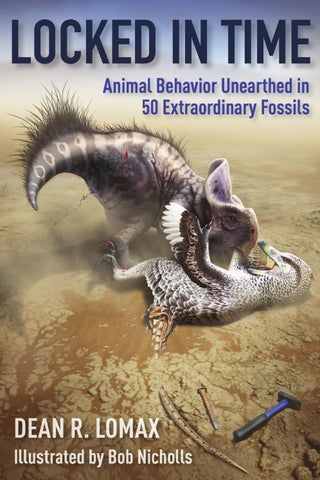
pieces of the puzzle to reliably interpret what happened to an animal during its life or at the time of its death. Take, for example, the fact that in practically every dinosaur film or TV show ever made, the climax will inevitably be a prehistoric battle. In reality, only one example of a pair of dinosaurs fighting to the death has ever been described in the scientific literature. (Another pair of apparently “dueling dinosaurs” has been found but has yet to be formally studied.) This does not mean that fighting was rare in dinosaurs or other prehistoric animals. Rather, it highlights the extreme improbability that such behaviors would be captured in fossils. Consider how slim the chances are that two dinosaurs, dying mid-fight, would be trapped and buried together so they would not just stay intact but then become preserved for eternity, capturing their fight for all time. That paleontologists would then come along millions of years later and discover them still locked in combat is extremely fortunate, especially considering that the fossil could easily have been eroded away and lost forever. Even though dinosaurs make up only a tiny fraction of what we know about prehistoric life, for many they are the gateway into paleontology and often science in general. In this book, I have included amazing dinosaur fossils that tell unique stories—such as dinosaur parents caring for young and dinosaurs dealing with disease. I have also taken advantage of exquisite fossils from other animal groups whose tales extend hundreds of millions of years into the past. You will be given a glimpse of the mating rituals of creatures preserved forever mid-sex, uncover a giant shark nursery, capture the magical moment of a seagoing reptile giving birth, and discover many more extraordinary fossils. The fifty stories I have curated in this book will take you on a global journey through the depths of time. Bringing these exciting real events— and the animals themselves—to life, Bob Nicholls has created some beautiful illustrations, one for each of the fifty fossils. All of the illustrations are based entirely on the story contained in each fossil. Most important, they are all scientifically accurate, derived from evidence and scientific research as opposed to simple assumptions. I want to show that fossils are not just inanimate objects. They are time capsules that provide us with an insight into a vanished world—a world that is unrecognizable and yet so familiar all at once. These fossils offer
Introduction |
3
much more than facts and figures; they showcase that behaviors typical of living animals in the present day have their evolutionary origins nestled far back in time. Through the following stories and illustrations, we can see snapshots of moments in time and learn to appreciate that these were once living, breathing animals that were as real as you and me. This is their story, of lives Locked in Time.
DITCHING THE “DUSTY OLD FOSSILS” Paleontology is going through a golden age of discovery right now. New finds are coming in thick and fast. Whether it is the latest feathered dinosaur with color from Asia, the DNA study of a 12,000-year-old mammal from South America, or the identification of an extinct species of early humans from Africa, the latest and greatest finds pique the interest of many. In today’s world, where access to knowledge is at our fingertips, paleontology has never been so openly available. It is through these types of discoveries and their reports in the media that I became so fascinated with fossils. I was one of those children who absolutely loved dinosaurs and all things prehistoric. You know the type— that annoying kid telling everybody dinosaur facts. Today, I get to do this as my job. My passion for this project stems from what became a career-defining trip to Wyoming in 2008. This was the first time for me traveling from the UK to the United States; it was also the first time I traveled abroad alone. I was eighteen years old and had sold my Star Wars collection (yes, really!) to fund my first professional excavation and research trip to the Wyoming Dinosaur Center, a wonderful museum in the mythical-sounding town of Thermopolis. On my very first day, I was given a tour of the museum displays, and one incredible fossil caught my eye: a large slab of limestone rock that had tiny footprints tiptoeing across its surface. I followed them and unknowingly found myself retracing the footsteps of a 150-million-year-old death scene. Lying at the end of this extensive track was the culprit, a juvenile Jurassic horseshoe crab. This little arthropod had been flung into a toxic
4
|
Introduction
lagoon, landed on its back, and then marched to its death, where it eventually suffocated due to a lack of oxygen. The very fact that this entire moment from millions of years ago was preserved here for all eternity astonished me. It had such a profound impact that it changed the way I thought about fossils. Fueling my excitement further, I learned that this fossil had not been studied, so I jumped at the opportunity to investigate it and teamed up with one of the then museum paleontologists, Chris Racay. Together we researched the specimen, and our findings were formally described in a peer-reviewed journal a few years later. I was young and eager to learn, and it really was a case of being in the right place at the right time, something that could not be said for the horseshoe crab. Ever since seeing the specimen, I became fascinated by fossils that had their own unique story of behaviors. It was this very fossil, however, that gave me the idea for Locked in Time, a book showcasing the astounding and exciting stories that prehistoric animals can tell.
UNDERSTANDING BEHAVIOR IN FOSSILS At times action packed and filled with drama, animal behavior can be the most exciting and sometimes rather peculiar aspect of nature. Whether it’s an eagle swooping down and snatching its fish prey, a horned lizard squirting blood from its eyes in self-defense, or lemurs using millipede secretions as possible medicine—a hugely diverse and often complex world of behaviors has evolved throughout the animal kingdom. One of the most frustrating things about studying fossils is knowing that you will never see a living member of that extinct species. It is a strange feeling and one I compare with astronomers and stargazers, who can see and study planets and stars but know they will never be able to visit them. Understanding and inferring behavior from fossils is one of the most daunting and challenging tasks that face paleontologists, although it is one that excites us the most. Having direct evidence, such as an animal with its last meal preserved or a tooth embedded in a bone, is the only way to know for certain that a
Introduction
|
5
prehistoric species engaged in a specific type of behavior. This can be interpreted further through careful, detailed comparisons with living relatives and/or analogues. In some cases, analogues are more pertinent even when there are living relatives of the extinct species. For example, a robin is a living dinosaur, but this does not mean that it would be the perfect analogue for a Diplodocus, because they have radically different body plans and modes of life, just as nobody would compare the behaviors of a squirrel with those of a blue whale simply because they are both mammals. In modern ecosystems, we can study animal behavior (ethology) directly in real time, which provides a necessary platform for paleontologists to interpret behavior in fossils (paleoethology) and can, in turn, reveal important information about ancient interactions between species and their environment (paleoecology). The identifications and interpretations of fossils and their behaviors in this book are based on detailed investigations by paleontologists; in some cases, I have also examined or studied the specimens. However, as is the wonderful nature of science, new evidence might arise from the discovery of additional fossils and further studies, which might offer alternative explanations and change our understanding of the behaviors inferred from these fossils. I had great fun combing through the extensive literature searching for exceptional fossils with evidence of behavior. There is a lot of research dedicated to fossil behavior, particularly in amber, a specialized mode of fossilization that is famous for capturing behavioral interactions. For these reasons, and to strike a fine balance in the fifty fossils and their stories, I was careful to select a diverse range of fossils illustrating various types of simple and more complex behaviors. Many of these specimens are one of a kind, whereas others are represented by multiple examples and highlight a behavior that was commonly preserved. As you read this book, I want you to experience the same thrill I did when I saw that 150-million-year-old horseshoe crab death track for the first time. From the outlandish to the surprisingly familiar, these stories are not fictitious like Jurassic Park; they are instead the real-life tales of long-extinct animals that are written in the rocks.
Praise for LOCKED IN TIME “A rousing romp through the fossil record. Dean R. Lomax’s storytelling and Bob Nicholls’s artwork reanimate the lifestyles and behaviors of long-extinct species. Revel along as old bones, teeth, and footprints tell the tale of dinosaur mating dances, fighting mammoths, and pterodactyl nurseries.”
—STEVE BRUSATTE, UNIVERSITY OF EDINBURGH PALEONTOLOGIST AND NEW YORK TIMES BESTSELLING AUTHOR OF THE RISE AND FALL OF THE DINOSAURS “Vividly told with stunning illustrations, Locked in Time is an essential book for any fossil fan. From the ancient steps of a horseshoe crab to courting dinosaurs, Lomax and Nicholls achieve the closest thing to time travel in bringing the prehistoric back to life.”
—RILEY BLACK, AUTHOR OF SKELETON KEYS: THE SECRET LIFE OF BONE “When we think about the animals of the past, we’re drawn to a small handful of movie dinosaurs, but in this fascinating and engaging book, Lomax brings to life incredible moments in the lives of animals from throughout prehistory, discovering the universal in the specific and offering us an insight into our sense of place on this planet. While being immersed in scientific literature, Lomax has a gift for extracting events from millions of years ago and giving them meaning for everyone today.”
—ELLIE HARRISON, PRESENTER OF DINOSAUR BRITAIN “A beetle within a lizard within a snake, a giant beaver that made huge corkscrew burrows three meters deep, a mammal that ate dinosaurs, insects caught in the act of mating, and dinosaurs with cancer . . . Lomax presents an extraordinary tour through recent fossil discoveries that shed light on all aspects of the life of the past. These extraordinary scenarios are brought to life in exquisite reconstructions by Nicholls. These are fossils that don’t make it into the textbooks; your appreciation of the history of life will never be the same again!”
—MICHAEL J. BENTON, PROFESSOR OF VERTEBRATE PALEONTOLOGY, UNIVERSITY OF BRISTOL
—DARREN NAISH, COAUTHOR OF DINOSAURS: HOW THEY LIVED AND EVOLVED $29.95
COLUMBIA UNIVERSITY PRESS NEW YORK CUP.COLUMBIA.EDU
PRINTED IN THE U.S.A.
“A number of exceptional, spectacular fossils show—via the most direct evidence imaginable—that the extinct animals of the past were once very much alive. They preserve animals giving birth, swallowing prey, and even having sex. Others reveal cases where animals died from poisoning, choking, or even when locked in combat. Join Lomax in this beautifully illustrated, thoroughly researched but accessibly written tour of animals forever locked in time.”