GIOVANNI’S EDEN
I address you as one of those creatures, one of God’s creatures, whom the Christian church has most betrayed.
—James Baldwin
Therefore, just as sin entered the world through one man, and death through sin, and in this way death came to all people, because all sinned.
— Saint Paul of Tarsus
In our exploration of how black writers in the twentieth century engaged with the afterlife of Original Sin and its Edenic interpretations, one literary figure most consistently grappled with Saint Paul’s theological interventions: James Baldwin. While all four of the primary writers of this project invoke Paradise, Edenic motifs, and several facets of Original Sin, he most consistently kept his finger on the theological implications of Paul’s unparalleled triumph. What’s more, we have yet to scratch the surface of his theological insight. When it comes to Baldwin and his well-known preoccupation with the “religious,” most scholars turn to his most popular writings, like Go Tell It
28 Giovanni’s Eden on the Mountain (1952), Notes of a Native Son (1955), and The Fire Next Time (1963), as well as his less popular but important play, Amen Corner (1954). Studying these works is understandable, considering that they most overtly express Baldwin’s religious tenor. And though I will engage with them as well, my singular focus is to uncover Baldwin’s theological contribution to Edenic discourse with unique attention on his second novel, Giovanni’s Room (1956).
My central argument is that Giovanni’s Room is an Edenic novel that explores the human condition, love, flesh, sexuality, and America. The tale follows David, the protagonist, who, to invoke Jack Halberstam’s The Queer Art of Failure (2011), is a failed “American Adam.” He enters Giovanni’s room, where the two lovers privately express their passion, until that Paradise is lost through David’s “innocent” self-deception (he believes he is a successful American Adam).1 David’s troubled self-perception requires a form of Pauline asceticism that tells him to “deny his flesh” in order to conform to the image of a successful American man who practices heterosexual norms. Overall, this novel is Baldwin’s apocalyptic warning. It is his theological reinterpretation of not just Eden, but particularly Saint Paul’s reading of Eden, which states that Adam’s defiance stems from his embracing the flesh and causing death to enter the world. Yet for Baldwin, it is refusing the flesh that is the origin of evil, the exact opposite argument. Said differently, for Baldwin, refusing to love with and through the flesh leads to various series of events that leave all of us in a world of ruin. That is what happens to Giovanni, as recounted through David’s narrative confession.
Thus, Baldwin—much like certain historical black religious intellectuals— adopted what Lisa M. Bowens calls a distinct African American Pauline hermeneutic. According to Bowens, there is a particular Pauline Wirkungsgeschichte in black American
Giovanni’s Eden 29
history.2 Some people of African descent from across the continent and diaspora have considered Saint Paul the singular source for slavery’s biblical justification because of the letters that scholars agree stem from his pen, like Romans and Philemon, or the pseudepigraphic writings like Timothy and Ephesians— each reveals the insight or at least the influence of this Jewish Roman intellectual who consecrated empire and was thus comfortable with any form of domination.3
Other black people have sought to instead rescue or reclaim Saint Paul from this interpretation by heeding his other words for the betterment of their spiritual lives. For this group, according to Bowens, Paul’s canonized words help them live, endure, and he is therefore held in high regard for his theological prose and candor. Baldwin is far from the latter group but not completely in the former. He finds some value in Saint Paul’s compositions, but overall, he sees Paul as a large culprit in ruining human relations. To be clear, Saint Paul’s eschatology requires an asceticism that Baldwin finds repulsive. And this conflict, this ascetism— which is tethered to every doctrine Saint Paul inspired—is what undoes the Eden in David and Giovanni’s tragic story.
THE CONFESSIONAL
The fact that this novel is communicated through confession is an important point for registering the theological theme that exists underneath the text. According to Foucault, not until Tertullian’s writing in the second century did “confession”—the confessio peccatorum —become a central rite for converts preparing for baptism. The idea was that one needed a deliberate “truth act,” a moment of intense self-revelation, to prepare for the
30 Giovanni’s Eden journey of purification. This form of penance not only assisted with the oncoming metanoia but also became necessary for the overall mind and heart of the catechumen. Foucault writes:
In a general way, from the end of the second century onward one sees the growing place occupied, in the economy of every soul’s salvation, by the manifestation of one’s own truth: in the form of an “investigation” where the individual is the respondent of a questionnaire or the object of testimony; in the form of a purificatory trial where he is the target of an exorcism; in the form, finally, of a “confession,” where he is both the subject who speaks and the object of which he speaks, but where it’s a matter of attesting that one knows oneself to be a sinner rather than drawing up an exact list of sins to be forgiven.4
The confession enabled the catechumen to comprehend their place within the faith’s salvific history. It not only highlighted the sinful actions they had committed and regretted but also emphasized that they themselves were especially flawed and helplessly prone to sin. It was the act of embracing the truth: they were subjects who desperately needed to attach themselves to the symbolic death and resurrection of the baptism. Giovanni’s Room is first and foremost an act of confession. David— one of Baldwin’s “stock names” for characters, according to Herb Boyd—is the voice of the story who tries to confess but fails. 5 What specifically he tries to confess we do not know; neither does he, yet he makes the attempt. And the reader is listening, sitting in his presence, as he struggles with his reflection in the mirror, trying to confess his own inhumanity to himself. In this fable, guilt drips from every page. Shame and remorse leak from between words. The story’s atmosphere assumes the presence of a listener who is listening to David but also watching
Giovanni’s Eden 31
Giovanni head to his execution. And though David was not around when Giovanni murdered Guillaume, we are compelled to believe that David holds himself responsible for all of it. Therefore, this novel not only is a confession but also beckons the image of the confessional. And the act of confession is what first ties Giovanni’s Room to theology. It is subtly as theological, or concerned with the religious, as Go Tell It on the Mountain (1952).
In Go Tell It, Gabriel Grimes’s suffering over what he cannot confess to himself is the source of his torture, and in Giovanni’s Room this motif is also present in David’s internal torment. Gabriel disowned his son, his flesh and blood, which he believes led to his unfortunate demise. David disowned his lover, disavowed his own flesh, which he believes also led to his lover’s execution. Ultimately, he bares his soul about all the consequences of his actions, desperately hoping to be seen and forgiven.
David is a run-of-the-mill, white American Protestant in Paris trying to “find himself” while his partner, Hella, travels across Spain doing the same. In an essay entitled, “A Question of Identity,” Baldwin writes: “For Paris is, according to its legend, the city where everyone loses his head, and his morals, lives through at least one histoire d’amour, ceases, quite, to arrive anywhere on time, and thumbs his nose at the Puritans—the city, in brief, where all become drunken on the fine old air of freedom.” 6 David loses his head when he meets an Italian bartender named Giovanni and involves him in a queer subculture where he manipulates the possibilities inherent in queer temporality for his own deceptive hidden appetite. What is temporal for him becomes the road to destruction for Giovanni. Yet in the beginning their eye contact alters the trajectory of both of their lives. What does David see in Giovanni’s eyes? It seems he is enraptured in his beauty, a beauty he remarks upon to Hella toward
the end of the story. And what does Giovanni see in David’s eyes? Perhaps the innocence that leads to his demise.
In their mutual eye contact I find a resonance with the subtle interactions between A and Moth in Ashon Crawley’s The Lonely Letters (2020). In A’s first letter to Moth, he writes:
It happened again and I don’t know what to make of it. Not staring but the sorta moment you feel someone looking at you from across the room and you look up from the convo you’d been engaging and, sure enough, there he is, looking. You make brief eye contact, he takes a deep breath and looks away. It’s almost as if his looking—the very fact of his doing it— stunned him, and that stunning took place in the space and pause between inhale and exhale, so he also was not immediately able to look away. You’re the trainwreck. You’re the fire to which the moth is attracted.7
The “stunning” reflects what I see as the mood between David and Giovanni. And the imagery of a train wreck is highlighted in the story, while the fire is noted explicitly by other characters.
Moreover, A writes to Moth that “Declarations of heterosexuality are cool but then the people long for something otherwise and see and really really sense me, and act as if whatever that otherwise might be is somewhere hidden in me, is something familiar.” 8 Perhaps David senses in Giovanni “something otherwise or inexplicably possible.” This is not something that he senses in Jacques, which causes in Jacques both suspicion and resentment. The question is what does David sense in Giovanni that makes him fail at his own self-deception? Perhaps some concealed familiarity? We do not know. What we do know is they fall madly in love.
Giovanni’s Eden 33
The two men, to David’s chagrin, are smitten.9 For a short period of time, David moves into Giovanni’s small room, where the heart of the story takes place. I consider the room to function as the Eden or the Paradise of the story. “The room itself,” says Marc Dudley, “is a squalid, smallish space on the outskirts of town, hidden away from prying, knowing eyes.” 10 It is their place of privacy, their space of romance, a designated area of sexual pleasure and self-discovery, until it transmogrifies into the singular site of contention between them.
Hella eventually returns to Paris to meet David and declare her love and wish to marry. Then David leaves the room, escaping the relationship— without telling Giovanni about Hella’s return—leaving Giovanni to wither in cold despondence. Desperate and humiliated, he discovers the truth about David’s departure, tries to find life despite the abandonment, but ultimately kills Guillaume, his corrupt employer, who wields his power whenever and however he sees fit after knowingly falsely accusing Giovanni of stealing. The Police Nationale capture Giovanni and incarcerate him, until the judge sentences him to death by the guillotine. The news sends David spiraling until Hella finds him at a queer bar in the south of France, discovering the secret he kept from not only her but also, in a way, himself.
My argument is that a deeper look into this novel, with Saint Paul’s reading of Eden and ascetism in mind, reveals an argument occurring between the text and Paul’s epistles. Though David does not reveal any Christian or evangelical fervor, for Baldwin, white Americans’ religious sentiments exist at a lower frequency than his Black Pentecostal upbringing. White Americans do not need religion as much as the poor black people, so the influence of Christian doctrine is more subtle in their lives. In other words, David’s lack of religious expression conveys more
Giovanni’s Eden
than conceals Saint Paul’s influence. To prove my argument, I will explore Paul’s interpretation of Eden and the Fall, then return to Giovanni’s room to make connections.
SAINT PAUL OF TARSUS
Saint Paul is a figure who emerged out of thin air in the first century.11 He was not a member of Jesus’s circle, and he had no prior relationship with any of the Jews from Galilee prior to Jesus’s execution. Yet he penned multiple letters Alain Badiou calls “speeches of rupture” to diverse assemblies in Corinth between 52 and 57 CE.12 His intention was to answer their complicated theological and ethical questions that arose from their varying ethnic, religious, and socioeconomic backgrounds.13 However, writings meant for small locales resulted in the alteration of a religion that then expanded across the globe. Letters sent to specific assemblies became ageless teachings to people across time and space. And although we may lack a substantial amount of the materials Saint Paul produced, we do possess some specific letters regarding Eden.
We have a letter known as “First Epistle to the Corinthians” and a possible compilation of letters, or simply one letter edited out of its order, to the Corinthians known as the “Second Epistle.” 14 Saint Paul expounds upon some of the central theological ideas he penned to the Corinthian assemblies in a letter to a church he did not establish in Rome entitled, “The Epistle to the Romans.” 15 All three early documents are significant regarding the creation theories because Saint Paul alludes to the Watchers story, but he mostly elaborates upon the ramifications of the Edenic myth and what occurred as a result of Adam partaking of the forbidden fruit.16
“Jamall A. Calloway’s book is a profound and powerful wrestling with the complexity of evil in the works of great Black literary artists and grand Christian theologians. In our grim moment, his brilliant probing of the Fall, original sin, and possible redemption yields some much-needed light and hope!”
—CORNEL WEST, Union Theological Seminary
“Putting works by Richard Wright, James Baldwin, Alice Walker, and Toni Morrison into conversation with theology, Imagining Eden demonstrates the power of Black literature to evoke a sophisticated liberative theology that honors Black people’s responses to loss through hard-won spiritual insight, grit, and ironic laughter as well as regret, blunder, and frustration.”
—M. SHAWN COPELAND, author of Enfleshing Freedom: Body, Race, and Being
“With the insight of a systematic theologian and the depth of a literary critic, Calloway’s rich and complex tracking of the theological threads woven into our finest Black secular writing is a compelling dialogue between tradition and innovation.”
—ANDRE C. WILLIS, Brown University
“This sensitive, deeply personal, historically responsible, and boldly original work challenges us to approach the sacred site of the Garden of Eden story with fresh eyes. By placing seminal Black thinkers in dialogue with classic theologians, Calloway gives us a rich liberatory framework to think about loss, expulsion, and ways of being in the world.”
—CANDIDA MOSS, author of God’s Ghostwriters: Enslaved Christians and the Making of the Bible
JAMALL A. CALLOWAY is an assistant professor in the Department of Theology and Religious Studies at Georgetown University and an honorary research lecturer in the School of Religion, Philosophy, and Classics at the University of KwaZulu-Natal, Pietermaritzburg Campus.
Cover design: Milenda Nan Ok Lee
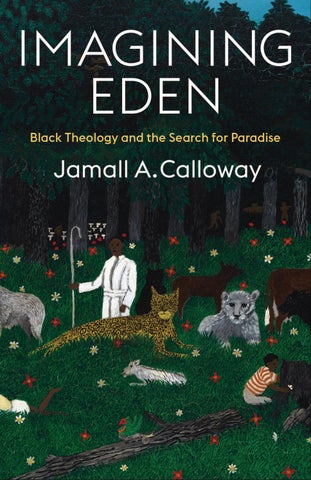
Cover art: Detail of Holy Mountain III, Horace Pippin, 1945. Oil on canvas; 25 1/4 × 30 1/4 in. (64.6 × 76.8 cm). Gift of Joseph H. Hirshhorn, 1966. Cathy Carver, Hirshhorn Museum and Sculpture Garden PRINTED IN THE U.S.A.