Costantino Pischedda
Conflict Among Rebels WHY INSURGENT GROUPS FIGHT EACH OTHER
1 Wars Within Wars
We must not fight two-sided; it is better to fight one-sided. — M AO Z E DO N G
I
1
n early January 2014 the news media were buzzing with reports of battles between Sunni rebel groups taking part in Syria’s civil war. Observers immediately pointed out that the government of President Bashar al-Assad would be the ultimate beneficiary, noting that “rebel infighting is a boon to regime forces and clearly detrimental to the overall strength of the Syrian opposition.”2 Subsequent developments confirmed this assessment, as the government made major gains in the following months of inter-rebel clashes. For example, in the span of a few weeks of fighting among rebels, the al-Tawhid Brigade, the largest rebel force in Aleppo, lost 500 men compared to 1,300 in the previous two years of antigovernment struggle, enabling the Assad regime to tighten its noose around the rebel stronghold.3 Analyses of the causes of the infighting, however, were not as insightful as the predictions of its consequences. The initial narrative of moderate rebels fighting against the extremist organization known as the Islamic State of Iraq and Syria (ISIS) became untenable as evidence emerged that the anti-ISIS coalition included several Salafi groups and
2
Wars Within Wars
even al-Qaeda’s Syrian affiliate, the al-Nusra Front.4 Why would rebel groups sharing ethnosectarian identities and religious ideology engage in “fratricide”? More generally, why do rebel groups divert resources from their common struggle against a powerful foe to fight one another? Why does inter-rebel war occur? Large-scale clashes between rebel groups are not peculiar to the Syrian civil war, which over the years has become infamous for the complex alignments of dozens of rebel formations, progovernment militias, and meddling third-party states. In fact, instances of inter-rebel war abound in contemporary history. During the Algerian war of national liberation against the French, the National Liberation Front (FLN) targeted its local competitor, the Algerian National Movement (MNA). More recently, the Tamil Tigers wiped out rival Tamil groups fighting against the Sri Lankan government, and Kashmir insurgent groups fought one another as they also battled India’s security forces. The fight between al-Qaeda in Iraq (AQI) and other rebels in Anbar province in the mid-2000s is perhaps the episode of inter-rebel violence that has attracted the most attention in the media and policy circles, given the involvement of U.S. forces in the war and the fact that the infighting may have contributed to the subsequent reduction of insurgent activity in the country by causing massive defections from the rebel ranks.5 Yet inter-rebel war is not a constant feature of civil wars. By my own count, inter-rebel war has taken place in about one out of four civil wars involving multiple rebel groups in the post–cold war era.6 Moreover, while some civil wars do not experience large-scale inter-rebel clashes at all (e.g., the civil wars in Argentina and El Salvador), in the cases characterized by rebel infighting mentioned above, phases of peaceful coexistence and even cooperation among insurgent groups preceded violent conflict.7 Existing studies do not provide entirely satisfactory explanations for the observed variation in inter-rebel war, despite the important stakes for international intervention in civil wars and counterinsurgency. This book aims to address this lacuna in our understanding of civil war processes by presenting a novel theory of the onset of inter-rebel war, weaving together insights from international relations theory and the study of ethnic politics, and testing it with a combination of case studies and statistical analysis.
Wars Within Wars
3
The Puzzle and Limits of Existing Explanations The occurrence of inter-rebel war is puzzling from several theoretical perspectives. Strategic logic (encapsulated by the adage “the enemy of my enemy is my friend”) should dissuade rebels from diverting scarce resources from the struggle against their common enemy. In particular, balance-of-power thinking should push rebel groups to ally against the government, which is usually the strongest warring party: inter-rebel squabbles should be set aside until the government’s threat recedes.8 These instrumental considerations should be reinforced by the enhanced social cohesion in the rebel camp caused by the shared experience of violence at the hands of government forces.9 When civil wars occur along ethnic lines, this effect should be especially strong, as ethnic violence “hardens” identities and deepens interethnic hostility and fear.10 Inter-rebel violence is also baffling because it often entails image costs for the insurgents before domestic and international audiences. Rebels’ domestic and foreign supporters may be disheartened by the incomprehensible internecine violence. The government, on its part, may be better able to resist international pressure to address the rebellion’s grievances by pointing out that the insurgents are themselves divided and claiming that the struggle between rebels and the government is not the main axis of violence. Although recent political science scholarship has shed much light on a broad range of civil war dynamics, existing answers to the puzzle of inter-rebel war tend to either lack a fully fleshed out theory of inter-rebel war or run into significant empirical difficulties.11 In the only published cross-national study on inter-rebel war, Hanne Fjelde and Desirée Nilsson find that insurgent groups are more likely to be involved in interrebel fighting when they are either strong or weak relative to other groups; they have exclusive control of some territory; they fight in areas with drug cultivation; and government authority is weak.12 While constituting an important contribution, these statistical findings are correlations in search of a theory, as they are not integrated in an overarching explanation of inter-rebel violence. Fotini Christia has advanced a parsimonious theory of civil war alliances, a phenomenon closely related to, though distinct from, inter-rebel
4
Wars Within Wars
war.13 (Alliances and inter-rebel war are not each other’s mirror images: two rebel groups may not cooperate and thus not form an alliance, while also abstaining from fighting each other. However, arguments that make predictions about rebel alliances typically imply predictions about inter-rebel fighting, as allies, by most definitions, do not wage war on each other.) Christia argues that alliances follow a minimum winning coalition (MWC) logic in which shared identity plays no role: warring parties strive to be part of the smallest possible alliance sufficient to win the war, both to maximize their shares of the spoils of victory and to reduce their vulnerability to strong allies. When the MWC threshold is passed, one or more belligerents will abandon the dominant coalition in search of an optimally sized one. The implication for inter-rebel war is that rebel groups should tend to fight one another only when at least one of them is stronger than the government. Many well-known instances of groups fighting one another while facing an unambiguously more powerful government, however, cast doubt on the ability of MWC theory to solve the puzzle of inter-rebel war.14 For example, in Algeria the FLN wiped out the MNA, despite the overwhelming power of the French army.15 Similarly, the National Front for the Liberation of Angola (FNLA) and the Popular Movement for the Liberation of Angola (MPLA) fought each other rather than cooperate against the vastly superior Portuguese forces.16 This pattern is not limited to anticolonial wars. For instance, in the 1990s Kashmir insurgent groups fought one another notwithstanding the clear military edge of the Indian government.17 Finally, Peter Krause theorizes about how the distribution of power within national liberation movements affects their prospects of success.18 Krause supports his argument with case studies of four movements, showing that they were most effective when hegemonic (i.e., with a single significant organization). One of the mechanisms in Krause’s theory— nonhegemonic rebel movements are more likely to experience internecine violence—suggests a prediction about inter-rebel fighting consistent with the argument presented in this book: inter-rebel war is unlikely once a rebel group has firmly established itself as the hegemon.19 In competitive movements (i.e., with more than one significant organization), Krause argues, relatively weak rebel groups should be particularly
Wars Within Wars
5
inclined to initiate infighting as a way to improve their power position, even if internecine violence is detrimental to the national liberation cause. There is remarkable variation in infighting, however, that Krause’s argument cannot explain: on the one hand, relatively strong groups like the FLN and the Tamil Tigers seem to initiate their fair share of episodes of inter-rebel war; on the other, weak groups engage in infighting in some moments but get along with their rivals in others. This book aims at advancing our understanding of the internal dynamics of rebel movements by presenting (and then testing) a theory of the logic driving inter-rebel war, which specifies more fully than existing arguments the conditions under which competition between rival organizations is likely to escalate to large-scale violence, even in the empirically common context of a government enjoying clear military superiority over the insurgents.
The Stakes for Policy Makers Unraveling the puzzle of inter-rebel war not only is important for theoretical reasons; it also has significant implications for external intervention in civil wars and their outcomes. When contemplating intervention in ongoing civil wars, policy makers will typically want to have a sense of the probability of inter-rebel fighting and of what policies could be adopted to induce cooperation or violent conflict among rebels, based on an intuition that infighting could make a decisive difference for developments on the ground. Going back to the case of ISIS with which this book opened, a key element of President Barack Obama’s strategy against the group in Syria was to induce other rebel organizations to fight it.20 By contrast, forging an alliance between Muslims and Croats was the lynchpin of the U.S. intervention strategy in Bosnia’s civil war, ultimately aiming to put pressure on the Serbs to negotiate a settlement.21 Inter-rebel fighting has indeed the potential of powerfully influencing the outcome of civil wars. In the course of infighting, insurgent groups redirect part of their resources from their struggle against the
6
Wars Within Wars
counterinsurgent toward other rebels. The government may then be able to take advantage of the internecine fight to regroup or to intensify operations and expand its territorial control, as the Syrian regime did in the wake of large-scale clashes between Sunni insurgents in 2014. Moreover, inter-rebel violence may lead to insurgent side-switching, as the group being defeated turns to the government for help.22 “Insurgent defection” not only entails a shift of manpower from the insurgent to the counterinsurgent side but also often provides the government with precious intelligence on the groups that continue to oppose it and thus can have a substantial impact on counterinsurgency outcomes. This point is well illustrated by the insurgencies in Iraq and Sri Lanka. In Iraq, the decision by Anbar province’s rebels to side with U.S. and Iraqi security forces against their erstwhile ally AQI marked a key turning point in the counterinsurgency campaign, paving the road to a substantial reduction in insurgent activity in the province and in the rest of the country.23 In Sri Lanka, the Tamil Tigers’ eastern commander’s “flip” in 2004 facilitated the subsequent government offensive, culminating in the Tigers’ complete defeat in 2009, after almost thirty years of intermittent fighting and negotiations.24 Inter-rebel war is not, however, an unalloyed good for the counterinsurgent. If a rebel group manages to quickly defeat its rivals, rather than being bogged down in a long war of attrition, it may come to represent a more formidable foe for the government by obtaining unhindered access to its constituency. For example, after wiping out their various coethnic competitors, the Tamil Tigers reached the apex of their political and military strength: by 1990 the group had unchallenged control of Sri Lanka’s Northeast (one-third of the country’s land area) and could hold its own in conventional battles against government forces, in addition to conducting a campaign of devastating suicide attacks deep inside enemy territory in Colombo.25 Understanding the causes of inter-rebel war thus holds the promise of providing policy-relevant insights about the conditions under which rebel-on-rebel violence is more likely and strategies that local counterinsurgent and external interveners could adopt to intensify or mitigate the risk of infighting as well as to shape its impact on the trajectory of the civil war.
hy do rebel groups frequently clash instead of cooperating against their shared enemy, the state? Examining the dynamics of civil wars in Iraq, Ethiopia, Lebanon, Sri Lanka, and Syria, Costantino Pischedda argues that infighting is a calculated response by rebel groups to perceived opportunities and vulnerabilities. He finds that rebels sharing an ethnic identity are especially prone to violent conflict, as they see each other as both potential existential threats and enticing opportunities for expansion. Conflict Among Rebels sheds new light on a key question of civil war dynamics: why the enemy of my enemy is not always my friend.
W
“Pischedda offers a compelling argument for when and why fighting occurs between rebels. He skillfully builds on existing scholarship while breaking significant new theoretical and empirical ground. Civil war and insurgency will continue to be the most common forms of conflict for the foreseeable future, ensuring that Conflict Among Rebels will generate strong interest from scholars, policy makers, and the general public alike.” —Peter Krause, author of Rebel Power: Why National Movements Compete, Fight, and Win
“Pischedda has written an important book that is required reading for anyone interested in the dynamics of civil war. He outlines a clear and compelling argument about the conditions under which insurgent groups, especially those sharing an ethnic identity, go to war with one another. He supports his claims with careful case evidence from a range of contexts, as well as statistical data. The book offers valuable and thought-provoking insights into the complex politics in alignment in internal conflict.” —Paul Staniland, author of Networks of Rebellion: Explaining Insurgent Cohesion and Collapse
“In this insightful and meticulously researched book, Pischedda argues that inter-rebel violence is a strategic choice. It begins when powerful rebel groups see windows of opportunity to consolidate their position as the prime challenger to the state, or when weaker groups attack their rivals in a bid to ‘gamble for resurrection.’ Conflict Among Rebels should be read by anyone seeking a deeper understanding of the dynamics and consequences of civil wars today.” —Benjamin Valentino, author of Final Solutions: Mass Killing and Genocide in the Twentieth Century
Costantino Pischedda is assistant professor of political science at the University of Miami. Cover design: Lisa Hamm
ISBN: 978-0-231-19866-0
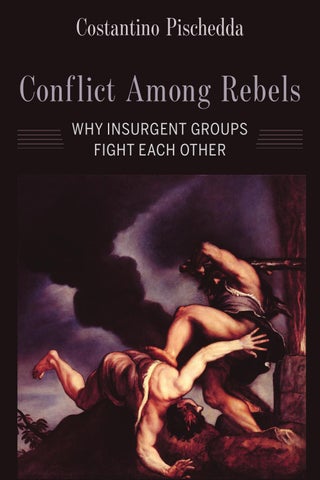
Cover image: Santa Maria della Salute, Venice, Italy. Cameraphoto Arte Venezia/Bridgeman Images
Columbia University Press / New York
cup.columbia.edu
PRINTED IN THE U.S.A.