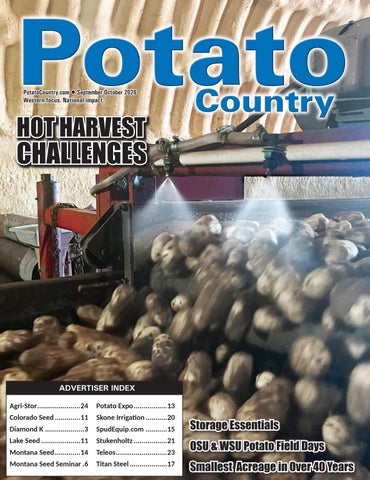
PotatoCountry.com • September-October 2026 Western focus. National impact.
HOT HARVEST
CHALLENGES
Advertiser Index Agri-Stor.......................24
Potato Expo..................13
Colorado Seed..............11
Skone Irrigation............20
Diamond K.....................3
SpudEquip.com............15
Lake Seed.....................11
Stukenholtz..................21
Montana Seed..............14
Teleos...........................23
Montana Seed Seminar..6
Titan Steel....................17
Storage Essentials OSU & WSU Potato Field Days Smallest Acreage in Over 40 Years
Table of Contents Vol. 42 No. 6 PO Box 333, Roberts, Idaho 83444 Telephone: (208) 520-6461 Circulation: (503) 724-3581
PotatoCountry.com
Country Western focus. National impact.
september/october 2026
Editor
Denise Keller editor@ColumbiaMediaGroup.com
Operations Manager, Advertising Brian Feist brian@ColumbiaMediaGroup.com
Publisher, Advertising
4 Beating the Heat
Dave Alexander dave@ColumbiaMediaGroup.com
8 Challenges of a Hot Harvest
Josephine Antwi josephine.antwi@oregonstate.edu
WSU Potato Field Day
insect Identification
Disease Identification
12 Storage Essentials
Jeff Miller jeff@millerresearch.com
16 Hermiston Highlights
Ben Eborn napmn@napmn.com
Buyers' Guide
Market Report
OSU Potato Field Day
Potato Growers of Washington
20 North American Potato Acreage the Smallest in Over 40 Years Market Report
22 Ag Labor Reform: A Long-Overdue Lifeline for the Potato Industry National Potato Council
Dale Lathim dale@pgw.net
EDITORIAL INFORMATION
Potato Country is interested in newsworthy material related to potato production and marketing. Contributions from all segments of the industry are welcome. Submit news releases, new product submissions, stories and photos via email to: editor@ColumbiaMediaGroup.com.
ADVERTISING SALES
For information about advertising rates, mechanics, deadlines, etc., call (208) 520-6461 or email dave@PotatoCountry.com.
SUBSCRIPTIONS
U.S. $50 per year / Foreign $120 per year Subscriptions can be entered online at: potatocountry.com/subscribe or call (503) 724-3581. Email address changes/corrections to: brian@ColumbiaMediaGroup.com or send to Potato Country, PO Box 333, Roberts, ID 83444. Potato Country magazine (ISSN 0886-4780), is published eight times per year and mailed under a standard rate mailing permit at Idaho Falls, Idaho and at additional mailing offices. It is produced by: Columbia Media Group, PO Box 333, Roberts, ID 83444 Copyright 2026. All rights reserved. No part of this publication may be reproduced or transmitted in any form or by any means, electronic or mechanical, for any purpose without the express written permission of Columbia Media Group.
Editorial Board New potato breeding selections were on display at the Oregon State University Potato Field Day. See more highlights from Hermiston on pages 16-18.
On The Cover Harvesting potatoes during warm weather can present unique challenges. Find a list of things to consider on pages 8-9. Photo courtesy Agri-Stor Companies
DEPARTMENTS 7 PGW Column 9 Calendar 10 Disease Quiz
Chris Voigt
Executive Director Oregon Potato Commission (503) 239-4763
11 New Products 19 In The News 22 Advertiser Index Aritra Choudhury
2 Potato Country • September/October 2026
Gary Roth
Executive Director Washington State Potato Commission (509) 765-8845
Director Montana Seed Potato Certification (406) 994-3150
Jamey Higham President/CEO Idaho Potato Commission (208) 334-2350
Tara Artho
Executive Director Colorado Potato Admin. Committee (719) 852-3322
Improve Water Efficiency, Unlock Nutrient Mobility —By Tom Tankersley, Sales Manager, Diamond K Gypsum
Diamond K Premium Prill Gypsum™ Gypsum Purity Comparison
NEW Diamond K Premium Prill Gypsum™ offers growers a strategic tool for soil amendments and enhances ROI. Unlocks Nutrient Mobility: 21% Ca improves soil structure and root growth to tap water-soluble N and K reserves. Increases Nitrogen Use Efficiency: 17% S alleviates deficiencies in Western soils. Maintains yield with lower N inputs. Reduces Sulfate Needs: High S content helps reduce AMS applications. Improves N efficiency when S and N are balanced. Mines Native Phosphorus: Unlocks P tied up as calcium phosphate compounds. Makes P more available to crops.
Saves Water: Increased water infiltration reduces irrigation sets, costs and runoff. Loosens Compacted Soils: Increases air and water movement. Displaces Na below the root zone for deeper roots. Naturally Occurring Trace Silica (less than .1%): Improves cell wall strength, stress tolerance and drought resistance. Lignosulfonate Binder: Stimulates beneficial microbial nutrient cycling, and improves nutrient chelation. 92% Purity: Means more active ingredient per ton, with less inert material.
Better Gypsum. Better Water.
Dihydrate, Not Anhydrite: Naturally mined and highly soluble, its two water molecules deliver faster dissolution. Fast Acting: Highest solubility rate of any mined gypsum product. Precise Nutrient Delivery: Blends evenly with other prilled nutrients as a top-dress or in-furrow, pre-, in-, or post-season. Call Tom Tankersley: (208) 570-1430 Email: tom@diamondkgypsum.com
Better Soil. Better Results.
Learn more— Contact your territory manager, or visit: www.diamondkgypsum.com/new-products/ Diamond K Gypsum • 435.896.8870 • 1720 South Red Hills Drive, Richfield, Utah 84701
WSU Potato Field Day
Beating the Heat Story and photos by Denise Keller, Editor
H
igh temperatures have not been letting up in recent summers, and neither are researchers studying the impact of heat stress on potatoes. An update on an ongoing study on heat stress was among the more than a dozen topics on the agenda at the Washington State University Potato Field Day, held June 25 in Othello, Washington, where attendees also viewed the annual commercial seed lot trial.
Heat Stress Study
Jacob Blauer, a post-harvest physiologist at WSU, is studying how environmental stress impacts the productivity and storability of potatoes. He says heat stress is the interaction of three variables: intensity, duration and timing – and you have to consider all three to understand what’s happening to potato plants from a heat stress standpoint. To illustrate, he likened
WSU researchers are using open-top heat boxes to study the effects of heat stress on potatoes.
4 Potato Country • September/October 2026
potato heat stress to traveling from the Pacific Northwest to a warm locale in the winter. “We adapt to heat over time. If we were to go to Arizona in July, yes, it’s going to be hot. It’s Arizona. But it’s going to hit us differently in February,” Blauer said. “Our potatoes are no different. They can adapt to a certain amount of heat over time as long as it’s gradual and it’s consistent. But what happens when intermittent heat pops up? It’s just like us getting off that airplane and landing in Arizona and all of a sudden, it’s 97 degrees and we left 45-degree weather.” To study heat stress in the field, Blauer’s team has been using open-top heat boxes. With the boxes positioned around small groups of potato plants, the researchers can keep the temperature inside the box 10.5 degrees Celsius higher than the ambient temperature to simulate heat stress. Meanwhile, the open-top design allows the plants to experience irrigation, natural solar radiation and pest pressure, creating as natural conditions in the field as possible. In 2025, the second year of the study, the researchers maintained the temperature differential for either nine days or 21 days and then removed the boxes and let the plants complete the season as usual. They found that plants exposed to heat stress produced a higher number of tubers and an increased number of misshapen tubers compared to the control. There was no change in total yield in the plants with nine days of heat stress, although the misshapen tubers reduced marketable yield. The 21day heat stress treatment reduced yield by 40%, which mirrored the 2024 study, Blauer said. In addition, heat stress at tuberization caused no impact on sugar quality during short-term storage studies, whereas heat stress later in the season results in decreased sugar quality. This year, Blauer used the heat boxes from July 31 through Aug. 20 to learn
The Washington State Potato Commission serves fries to field day guests.
Field day attendees visit prior to the research presentations.
how mid- to late-season heat stress affects internal brown spot and aftercooking darkening. Blauer’s work is designed to gain information that will help growers identify heat-tolerant varieties, adjust the timing of planting to avoid heat, and
utilize mitigating factors in irrigation or fertility management when heat is forecasted.
Seed Lot Trial
WSU hosted one of its largest field day turnouts yet, with nearly 300 attendees.
From left, Allie Rasmussen and Carrie Kondratuk with Montana Seed Potato Certification and Meret Beutler with the Alaska Division of Agriculture view the WSU commercial seed lot trial.
Participation in the commercial seed lot trial, however, was a different story. For the second consecutive year, the seed lot trial had fewer than 200 entries, all-time lows in its 63-year history. WSU’s Mark Pavek said this might reflect reduced
A research trial tests various sizes of seed.
PotatoCountry.com
5
WSU Potato Field Day production acreage, the loss of some seed cutting operations and lack of grower participation. “The seed lot trial is paid for by Washington growers, and they should utilize it by entering all of their seed lots each year,” Pavek said. “The seed lot trial provides a snapshot of the potatoes growing in Washington each year – the quality and varieties. This trial is a historical quality gauge of seed lots used to grow commercial Washington crops.” This year’s seed lot entries represented 33 varieties from six states – Colorado, Idaho, Montana, Oregon, Utah and Washington – and Alberta, Canada. The quality of the seed appeared to be average to above average, relative to the past 10 years, Pavek said. While the majority of the seed lots emerged well and had low or no disease, evaluators did identify four lots with relatively high levels of Potato virus Y (PVY). In those lots, 5% to 11% of the plants displayed PVY symptoms.
Vini Garnica, a new potato pathologist at WSU, introduces himself to field day attendees and asks for their input on his research priorities.
SEED POTATO SEMINAR
2026
MISSOULA, MONTANA • HOLIDAY INN DOWNTOWN • NOVEMBER 11–12
MONTANA GROWERS MEETING
SEMINAR DATES
HOTEL ROOM BLOCK
Tuesday, Nov 10
NOV 11–12
Reserve by Oct 11
For Montana Growers Only.
Wednesday and Thursday sessions are open to all who register.
Discounted rate available when booking through the website.
REGISTER AND BOOK YOUR ROOM TODAY!
MTSEEDPOTATOSEMINAR.COM 6 Potato Country • September/October 2026
In the News Potato Growers of Washington
Partnership Requires Shared Success By Dale Lathim, Potato Growers of Washington
O
ne of the defining characteristics of the potato industry has always been the partnership between growers and processors. Neither succeeds without the other. Processors need a dependable supply of high-quality potatoes, and growers need financially healthy processors that can compete and invest in the future. That partnership has served our industry well for decades. But partnerships only remain healthy when both sides share in the rewards – and the challenges. Following the difficult market conditions several years ago, we made meaningful progress restoring grower profitability through the 2021 and 2022 contract negotiations. Those agreements recognized that growers could not continue absorbing escalating production costs without corresponding improvements in contract pricing. Unfortunately, that progress has been reversed. For each of the past three crop years, growers have accepted reductions in contract prices while the cost of producing potatoes has continued to climb. Inputs such as labor, crop protection products, equipment, irrigation, financing, insurance, and regulatory compliance have not become less expensive. If anything, they continue to move in only one direction. At the same time, most processors – the J.R. Simplot Company being the notable exception – have reduced contract volumes. Producing fewer contracted acres doesn’t simply reduce revenue; it also reduces efficiency. The fixed costs of specialized potato equipment, storage facilities and skilled labor must now be spread across fewer acres and fewer hundredweight, increasing the cost of every potato produced.
These developments come as processor profitability has largely recovered. While most privately held companies do not disclose financial results, the one publicly traded processor that does report its earnings has returned to profit levels comparable to those enjoyed before the industry’s downturn. That is encouraging news. Strong processors are essential to a healthy potato industry. However, processor profitability alone cannot be the measure of success. If growers are forced to accept little or no return on the tremendous investment and risk required to produce a potato crop, many operations simply will not remain financially viable. Potato production is among the most capital-intensive and risk-laden crops in agriculture. Weather, disease pressure, pests, water availability and changing regulations all create uncertainty that growers willingly manage every season. That level of risk deserves the opportunity for a reasonable return. Another example illustrates the imbalance that has developed. Processors continue encouraging growers to evaluate new potato varieties that may produce higher yields, require fewer inputs or offer other production efficiencies. Growers willingly devote land, management time and financial resources to testing these varieties because innovation benefits the entire industry. Yet when those efforts succeed and a variety proves capable of lowering production costs or increasing yields, the conversation often shifts toward reducing contract prices so processors capture nearly all of the economic benefit. The grower assumes the risk of developing and proving the variety, but once success is achieved, the reward is too often transferred almost entirely to the buyer. That approach discourages innovation rather than encouraging it.
If growers are expected to invest in new technologies, management practices and varieties that improve efficiency, they should also participate in the value those improvements create. That is how partnerships work. Throughout my career, I have heard processors describe growers as partners. We are reminded that “we’re all in this together.” When processors face new customer demands, sustainability initiatives, food safety requirements or other challenges, growers are routinely asked to invest additional time, capital and effort to help meet those needs. More often than not, growers respond because they understand that the longterm health of the industry depends on cooperation. Partnership, however, is a two-way street. Today, growers are facing very real economic pressures. These concerns are not negotiating tactics or temporary complaints. They are the financial realities confronting farm businesses that continue to absorb increasing costs while revenues move in the opposite direction. The potato industry has been successful because growers and processors have historically found solutions together. That same spirit is needed today. Growers are not asking processors to be unsuccessful. Quite the opposite. We want processors to remain profitable, competitive and financially strong. But processors must also recognize that healthy processing companies cannot exist indefinitely without healthy growers. Long-term sustainability requires that both sides earn a fair return. It is time for processors to truly listen to the challenges growers are facing, understand that those concerns are genuine and recommit to the balanced partnership that has made our industry successful for generations. PotatoCountry.com
7
Challenges of a Hot Harvest By John Klimes, Product Quality Specialist, Agri-Stor Companies
T
his year has certainly been an interesting one – and rather challenging as it relates to weather. Some areas across the nation are hot and dry, while others are steamy and wet. The commonality has been the heat through mid-year, and while it is difficult to predict what will happen this harvest season, given the past few years, it is likely to be very warm until it is not. This places potato growers in a real predicament. They might ask themselves “do I wait for cool weather to harvest, or should I be concerned with my crop freezing in the ground?” To err on the safe side, most will tend to harvest while weather is still on the warmer side. Universities recommend harvesting between 45 and 65 degrees Fahrenheit, and many contracts require growers to stop harvesting when pulp temperatures
exceed 65 degrees. So what happens when it becomes necessary to harvest warm potatoes? If there is a water shortage or the normal freeze date is approaching, harvest must proceed. There are a few things to consider when this situation becomes the reality.
Cooling Availability
Does the facility have the ability to cool the potatoes once they reach the storage? When potatoes are harvested, respiration is relatively high, resulting in the production of heat and CO2. This respirational heat is combined with the heat from the field environment to create a significant heat load going into storage. This heat, along with CO2, needs to be managed. The recommended approach is to use outside air. It is common to bring potatoes into storage and set the
Freshly harvested potatoes make their way into storage.
ventilation system to between 50 and 55 degrees. While it is ideal, this scenario may not allow for cooling with outside air. If harvest conditions dictate a necessity for harvesting at 65 degrees or above, the potatoes need to be brought down to 60 degrees before worrying about getting them to 55 degrees. This is the time to consider a higher set point to maximize the use of outdoor air. Outdoor air cooling is a more economical method for removing field heat than using refrigeration. It also allows for CO2 management. When using outside air, heat is removed through the exhaust louvers or doors. Refrigeration can then be used to hold temperature during the heat of the day, as well as possibly pulling down temperatures after they are stable. To summarize, consider a higher set point if conditions require it, and remember not to blow warm air on cold potatoes.
Humidity and Shrink
Another consideration is providing adequate humidity to potatoes during the cooldown process. The higher the difference in temperature between the potatoes and the set point, the greater the moisture loss. If potatoes are harvested at 65 degrees and the set point is 55 degrees, the difference in temperature is 10 degrees. As the air temperature increases while moving through the pile, the Relative Humidity (RH) decreases. This reduction in RH will not appear on sensors, as the potatoes are releasing moisture into the environment to try and maintain their preferred RH of 98%. This process results in water loss from the potato, which is known as shrink. Shrink increases the risk of pressure flattening and pressure bruise. One highly recommended method for reducing shrink in the pile is to reduce the difference in temperature between the set point and the potato temperature. When harvesting in hot weather, increasing the set point to reduce this difference in temperature can help reduce shrinkage.
8 Potato Country • September/October 2026
Disease Control
If potatoes are held at warmer temperatures, the risk of disease increases. All potato pathogens thrive in warm, humid environments. This will be the case for most pathogens until temperatures are below 50 degrees. So, managing disease becomes critical at this point. Products are available for fungal and bacterial control that can be applied as potatoes are loaded into the storage facility. Field scouting for potential pathogens is important to help identify the appropriate control measures needed at harvest. After potatoes are fully into storage, there are additional products that can be used for pathogen control. It is important to apply these products as early as possible once the potatoes are in storage to reduce pathogen load before infection occurs. When harvest commences – and maybe for some growers, it already has – there are storage specialists who can be a great resource for storage concerns and challenges. Even during hot weather years, there are solutions for most storage issues. Being prepared and proactive can reduce risk and loss during the storage season.
John Klimes with Agri-Stor (left) checks an Idaho storage crop.
CALENDAR Oct. 26-30
Dec 2-4
World Potato Congress
Potatoes USA Winter Meeting
Naivasha, Kenya www.potatocongress.org
Denver Caitlin Roberts, caitlinr@potatoesusa.com
Nov. 11-12
Jan. 5-7
Montana Seed Potato Seminar
Potato Expo 2027
Holiday Inn Missoula, Mont. www.mtseedpotatoseminar.com
Gaylord Rockies Denver www.potato-expo.com
Nov. 17-18
Jan. 20-21
Fresh Pack Potato Symposium Canyon Crest Event Center Twin Falls, Idaho Gustavo Teixeira, (208) 423-6678 or gteixeira@uidaho.edu
Nov. 18-19
Pacific Northwest Vegetable Association Conference and Trade Show Three Rivers Convention Center Kennewick, Wash. Sheri Nolan, (509) 585-5460 or www.pnva.org
Idaho Potato Conference and Ag Expo Pond Student Union Building and Holt Arena Pocatello, Idaho Kristy Mayer, kristym@uidaho.edu
Jan. 25-28
Washington-Oregon Potato Conference Three Rivers Convention Center Kennewick, Wash. www.potatoconference.com
PotatoCountry.com
9
Disease Identification Quiz
Dr. Jeff Miller, a plant pathologist, is the president and CEO of Miller Research, Rupert, Idaho. He can be contacted by phone: (208) 531-5124; cell: (208) 431-4420; jeff@millerresearch.com
Do you know the difference between a disease and a pathogen? Below on the left are two photos of potatoes with disease symptoms, and on the right are two photos of pathogens (or at least, parts of the pathogen). Can you name the disease and match the pathogen which causes the disease?
A
1
Photo courtesy Phillip Wharton, University of Idaho
B
10 Potato Country • September/October 2026
2
Answers Page 15
new products
Diamond K Debuts Pair of Prilled Gypsum Products
Diamond K Gypsum’s new product lineup includes Diamond K Premium Prill Gypsum and Diamond K Premium Prill Gypsum HA with humic acid. The spreadable pelletized gypsum products are designed to improve soil structure, water infiltration, nutrient efficiency, and ease of application and blending. In addition, Premium Prill Gypsum is engineered to reduce sodium stress, soil crusting, compaction and runoff, allowing for more uniform wetting and deeper water penetration into the root zone. Premium Prill Gypsum HA is formulated to address high pH calcareous soils, salinity, drought and low organic matter. Both products can be applied preplant, in-season, post-harvest or as part of a long-term soil improvement program. Visit diamondkgypsum.com/new-products.
Colorado Certified Potato Growers Association “Quality as High as our Mountains” RUSSET VARIETIES: Russet Norkotah S3 Russet Norkotah S8 Rocky Mountain Russet Silverton Russet Rio Grande Russet Canela Russet Mesa Russet Mercury Russet Fortress Russet Crimson King COLORED VARIETIES: Columbine Gold Colorado Rose Rio Colorado Red Luna Purple Majesty Masquerade Mountain Rose Vista Gold
PVX GIII
SEED INC.
l RUSSET BURBANK l RANGER RUSSET
l On-farm tissue culture laboratory and greenhouse facility for nuclear seed production l 4 year rotation on clean fields l Strict sanitation program throughout l Modern storage and handling facilities l Rigorous Spray Program
We are dedicated to providing you with consistent high quality, high yielding seed that you can depend on year after year. You are always welcome to visit our farm. Let us show you what our program can do for you.
David
Dan Tim
Tim Dan
Pat
Dan, Dave, Pat and Tim Lake
(406) 253-3638 (office), (406) 676-2175 (fax) e-mail - spudman@ronan.net 35822 Spring Creek Road l Ronan, MT 59864
Seed Growers: Zapata Seed Company Worley Family Farms SLV Research Center San Acacio Seed Salazar Farms Rockey Farms, LLC Pro Seed Price Farms Certified Seed, LLC Palmgren Farms, LLC Martinez Farms La Rue Farms H&H Farms G&G Farms Bothell Seed Allied Potato Colorado Certified Potato Growers Association P. O. Box 267 Monte Vista, CO 81144 ColoradoCertifiedPotatoGrowers.com Lyla@ColoradoCertifiedPotatoGrowers.com (719) 274-5996
Lorem ipsum
PotatoCountry.com
11
Storage Essentials Buyers' Guide Agri-Stor Companies agri-stor.com
Climate Controls and Crop Protection
For 65 years, Agri-Stor Companies has innovated post-harvest storage solutions. The Agri-Star Control Panel can provide potato storages with historical data reporting, which can be crucial to long-term storage management. The panel can be customized to suit storages in any climate, and the intuitive app will save time and provide peace of mind for post-harvest storing challenges. In addition, Agri-Stor’s quality crop protection options, including a line of organic products, can help shield potatoes from bacteria and fungi and also provide quality sprout control and sprout elimination. Agri-Stor’s team of technicians utilizes years of experience in providing custom applications that will produce great results in holding quality.
Industrial Ventilation Inc. ivi-air.com
Ventilation/Climate Control and Treatment Protection
For over 50 years, Industrial Ventilation Inc. (IVI) has put the needs of growers at the forefront of its products and services. IVI pioneered the storage control panel and its newest panel, the Sentinel, providing reliable control within 0.01 degree Fahrenheit of target set point. The Sentinel’s streamlined features are compatible with IVI’s Centurion panel and software. The Sentinel includes eight sensors, making it an efficient, affordable option. IVI’s Imperium panel offers 12 or more sensors plus expanded capabilities. IVI panels are made in the U.S. and allow growers to easily and precisely manage storage climates by controlling fans, VFDs, evaporative coolers, humidification, heaters, refrigeration equipment and Thermadoors. Users can operate on-site with touchscreen, or remotely with an app or internet. IVI also offers an extensive line of treatments to protect and address the threat of disease. Service is backed by experience and expertise to best address the optimal outcome of stored potatoes.
12 Potato Country • September/October 2026
POTATO EXPO JANUARY 5-7, 2027
GAY LO R D R O C K I E S D EN VER , C O LO RA D O PotatoCountry.com
13
Storage Essentials Buyers' Guide Techmark
techmark-inc.com
Ventilation Systems
Techmark designs, installs and services automated ventilation systems for potato storages that integrate fans, humidity controls, CO₂ management and heating/cooling solutions. Techmark systems are engineered to deliver precise environmental control for post-harvest storage, ensuring quality storage and better profitability for growers. As an industry innovator, Techmark combines global experience with local expertise to deliver custom agricultural solutions tailored to growers’ needs. Techmark is committed to supporting growers, processors and the entire agricultural community with reliable technology, exceptional service and proven results.
Titan Steel
titansteelidaho.com
Storage Buildings
Titan Steel’s buildings are designed to provide maximum efficiency and convenience for produce preservation. Engineered with the latest industry standard technology, the company offers a perfect solution for producers. With third-party climate controlled systems, paired with ventilated floors or pipe, Titan Steel buildings ensure that potatoes stay fresh and in optimal condition prior to reaching consumers.
14 Potato Country • September/October 2026
Bret Mize
Coming in the next issue of
Planting Essentials Never miss an issue Subscribe at
PotatoCountry.com/ Subscribe
Pilers
2014 Double L 861 Piler all belt 480 V 3ph 42” x 49’ 2015 Double L 831 Piler 480 V 3ph 36” x 49’ 2000 Wemco 36” all belt 230 volt 3ph remote all hydraulic 1999 Double L 831 36” BC Elev/49’ boom 3ph HYD Drive & Remote 1996 Spudnik 550 30” BC Elev. 48’ Boom 3phase VFD’s 230 Volt Remote 1989 Spudnik 550 30” BC Elev. 230 volt 3ph VFD’s Remote 1985 Double L 813 30” x 49’ 230 volt 3phase, remote Reconditioned
Planters
KNOW YOUR DISEASE ANSWERS (from page 10)
Photo A shows symptoms of brown spot caused by Alternaria alternata, and Photo B shows symptoms of early blight caused by Alternaria solani. Spores (conidia) of A. solani are shown in Photo 1, and spores of A. alternata are shown in Photo 2. Species other than A. alternata can cause symptoms similar to those in Photo A, and many of these species have spores that appear similar. As a result, some people have referred to this collection of species as “small-spored Alternatas,” or SSAs. These spores are club-shaped and are formed in chains like beads on a necklace. Spores of A. solani (cause of early blight) are larger than those of A. alternata and are formed singly. These spores look more like a baseball bat than a club. Photos A and B show symptoms that are typical, but sometimes SSAs can cause symptoms that look like early blight. Also, when early blight lesions are young, they can appear like lesions caused by SSAs. With respect to fungicide control, fungicides are relatively similar in the way they target all Alternaria species. Whether lesions are caused by A. solani or SSAs probably doesn’t matter. Field research trials conducted at Miller Research where both species are present show that fungicides that work well on early blight also work well on brown spot.
Bulk BeDs/BoXes
2025 Trinity Stainless Steel 23ft, Combo, auto tarp 2025 New Double 901 20’ combo, Owner Priced to sell 2011 Double L 901 20’ Electric dual drive x(2) 1990 Spudnik 2100 20’ Electric, Reconditioned 1989 Logan 20ft, Electric
trucks
2019 KW T370 Auto w/2spd reduction, 1999 GMC C8500 Top Kick 3126 Turbo Cat Allison auto 2005 Spudnik 4200 bed Combo PTO/Elec. 1996 Ford L9000 Auto, Cummins 2012 Logan 22’ bed 1978 IH Tandem IH Diesel 10spd
2014 Spudnik 8080 Pull type, rear steer 2008 Spudnik 8080 Pull Hitch, rear steer 2015 Double L 9560 6 row 34” 2009 Spudnik 8060 6 row 36” semi mount 2008 Grimme GL36 Cup 6 row 36” Pull Hitch
scooPers
Planter filler Dirt Piler
Dammer Dikers
1995 Spudnik 1115 30” x 25’ Gas motor 1996 Spudnik 1110 30” x 25’ Electric & Gas Mayo 24” Telescopic Planter filler Piler Davis 20’’ x 20’ dirt piler Spudnik 1100 Tare piler 24” x 20’ 220 Volt 1ph
seeD cutters
2004 Better Built 60” model 460 230 3ph
treaters
2010 Milestone 36” Liquid Treater, 3ph 2013 Better Built CDT10’-10” Duster Chemical auger 2010 Better Built CDT10’-10” Duster 2000 Better Built CDT12-10 Duster 1996 Milestone 36 Barrel duster 1994 Milestone 36” Barrel Duster Reconditioned
2019 Logan Scoop Pro 30” 230 3phase 1997 Double L 30” 3ph Spudnik model 150 30’’ 3ph Refurbished Spudnik model 100 24” 1ph 2018 Logan Yield Pro 6 row Water Saver 2013 Ag Engineering 4 row Hyd. Reset 1996 AG Engineerng 6 row Tillage Master, Trip shanks 1991 Ag Engineering 4 row Hyd. Reset 36” 2020 Spudnik 9305 6 row Hyd. Reset
even flows/ surge HoPPers/ croP carts
1996 Spudnik 1800 48” Elev. 36” bin 480 Volt 3ph 1993 Spudnik 1800 48” Elev. 36” bin 480 Volt 3ph 2019 Logan Surge Hopper 330 60” 230 Volt 3ph 2010 Double L 968 Even Flow 1000 cwt 3ph 1 Stinger 36” 2015 Kringstad 3600 Crop Shuttle Tracks 1994 STI Model 1200 Even Flow 600cwt 1988 Spudnik 1800 600cwt 72” discharge 1983 Spudnik 1830 Even Flow 80cwt
Harvesters
Dirt eliminators
crossovers/winDrowers
conveyors - telescoPic
2019 Double L 953 4 row 2019 Lockwood 674 4 row 34” bed, 72” finger table 2018 Double L 7340 4 row 72” Reverse roll finger table 2016 Double L 973 4 row return flow, finger table 2012 Lockwood 474H 4 row 2005 Lockwood 474H 4 row 2006 Double L 883 “Air” 4 row Cummins Motor, galaxy table 2013 Spudnik 6160 6 row 34” 2017 Lockwood 554 LH 4 row 2009 Lockwood 554 LH 4 row 2005 Lockwood 5000 RH 4 row 2007 Spudnik 6140 LH 4 row 36” rows 1996 Double L 851 36” bed RH 4 row
rock/cloD/air eliminators
2023 Lockwood Vacs Mobile 2014 Lockwood Vacs 8 2014 Lockwood Vacs 5 2013 Harriston 4240 Clod Hopper, Ellis table, peg belt, blower, Full width elevators 2010 Harriston 3240 CH fingers peg belt blower sizing fingers 230 V 3ph 2002 Harriston 240 CH Ellis Table 480 Volt 3ph 2004 Harriston 200 CH Ellis Table 480 Volt 3ph
siZers
2024 Kerian Sizer 60” with 72”x 22’ & 72” x 12’ take away conveyors 2019 Spudnik 990 -96” Acorns, 240v 3ph 2000 Spudnik 925 -72” Acorns, 240v 3ph 1997 Spudnik 925 72” Acorns, 480V 3ph
not comPlete list call or cHeck:
2007 Milestone MSDS72 belt elev. 60” dirt rolls 72’’ sizing 72” clod drum 480 V 3ph 2014 Spudnik 990 Multi Sep Dirt Elim 72” 480 volt 3ph 2009 Spudnik 990 60”belt elev., 72” Rev/Roll Table BC picking 480 V 3ph 2006 Spudnik 995 72”Finger rollers, Rev/Roll table 2003 Milestone 36” hopper 60” fingers 48 belt picking table Hang-on 2015 Logan LTC4885 Tel. Conv. 480v 3ph 2004 Spudnik 1255 36”/42”/85’ 480v 3ph 1994 Double L 820 30” x 60’ 3ph 1989 Double L 810 30” x 50’ 3ph
conveyors - straigHt
2011 Mayo 36” x 40’ Str. Conv. 480V3PH x(2) 1994 Spudnik 1225 Scale Conv 30” x 16’ 1ph 1998 DL 809 30”/38’ 3ph x 3 Milestone 30” x 30’ 3ph x 2
sHreDDers
Newhouse 4 row 3-point w/tire rollers 36”
wareHouse & misc.
2011 Daumar PA 25D CB67 Wicketed bagger 2016 Tri Steel SS Grading/rolling table 3ph motor 24” wide rollers x 15ft long Tri Steel Bag Conveyor 36” x 19’H-Adjust Thermo Fisher Scientific Versa Flex Checkweigher System Model 40-060 Kwik Locs Neu Tech 9 lane weigher Ag Pak bagger Grain Treater USC LP2000 with seed wheel
sPuDeQuiP.com
Bruce: (208)390-5120 | Brucen@tristeelmfg.com • evan: (208)757-8481 | evann@tristeelmfg.com • maX: (701)740-7574 | maXw@tristeelmfg.com
PotatoCountry.com
15
OSU Potato Field Day
Hermiston Highlights Story and photos by Denise Keller, Editor
F
rom the field to the lab, researchers are working to find ways to grow better potatoes. At the Oregon State University Potato Field Day, held June 24 in Hermiston, Oregon, researchers spoke about their latest efforts to improve pest management in potatoes and develop varieties with increased resistance to pests and diseases.
Volunteer Potatoes
OSU plant pathologist Ken Frost and OSU entomologist Josephine Antwi are teaming up to study the role of volunteer potatoes in pest management.
Volunteer potatoes, which emerge from tubers left in the soil after harvest, act as weeds that compete with the current season crops for resources. While growers in the Columbia Basin have been dealing with volunteers for a long time, they’re becoming more problematic in the Midwest, Frost said. That’s because historically, cold winter temperatures have limited volunteer survival, but more recently, winters are becoming milder. Frost and Antwi are interested in the role volunteer potatoes play as a green bridge for insects and pathogens between potato crops and how that
Field day attendees listen to the final research presentations of the morning.
contributes to the persistence of pests in the landscape. Previous work has shown that one day of soil temperatures around 27 degrees Fahrenheit keeps Russet Burbank tubers from coming up as volunteers, but there’s not much known about other cultivars. Frost will evaluate chill exposure for different varieties and how that relates to tubers re-sprouting the next year. The researchers will also look at the prevalence of potential pests and diseases associated with volunteer potatoes including Colorado potato beetles, aphids, nematodes, Potato virus Y (PVY), late blight and powdery scab. Their work aims to gain information that will help growers better manage volunteers or at least know where potato volunteer and associated pest risks are higher.
Variety Development
Field day attendees also heard about some of the latest selections from the Tri-State Potato Research and Breeding Program. OSU plant breeder Sagar Sathuvalli started his presentation with a description of Canyon Creek Russet, a processing variety shown to produce large tubers and yields similar to Ranger Russet and Clearwater Russet. It is resistant to PVY and cold sweetening and tolerant to common scab, but susceptible to late blight and Fusarium dry rot. Vantage Russet is a high-yielding, latematuring selection with oblong to long, slightly flat tubers. It has good processing quality, good gravities, high vitamin C and very high antioxidant activity levels. It is moderately resistant to Verticillium wilt and susceptible to PVY, common scab and late blight. AOR13064-2 offers cold sweetening resistance, high processing merit and low acrylamide forming potential. It is resistant to early blight and common scab and tolerant to Fusarium dry rot. It yields similar to, but slightly lower than, Ranger Russet.
16 Potato Country • September/October 2026
OSU’s Ken Frost gives an overview of research from the plant pathology program.
HAREC director Carlos Bonilla discusses using soil aggregates to measure soil health.
Inga Zasada with NemaSolutions shares an update on applied nematode management research.
BUILDING RELATIONSHIPS, ONE PROJECT AT A TIME.
Every project reflects our dedication to quality, built to meet the specific needs of our clients. www.titansteelidaho.com
PotatoCountry.com
17
OSU Potato Field Day “From a post-harvest perspective, this is one of the best selections that we have in our program,” Sathuvalli said. “Its yield production is potentially slightly less than some of our major control varieties, but when you consider the pack-out and the processing percentage recovery, it’s on the very high side. So as a processor, you will not lose money. But for a grower, because of the tonnage, it might be less. But that is something that agronomists might be able to push to get more yield. That’s the only issue.”
Nematode Resistance
Marcella Teixeira, an OSU research associate, is part of a team working to develop potato varieties resistant to the three nematodes that are the biggest concern in the Columbia Basin: Columbia root-knot nematode, root lesion nematode and stubby root nematode. “We want to bring you guys some tools that you can use in the field, not just basic research that we perform to
Anisabel Guzman, an OSU biological science research technician, hands out French fries during field day presentations.
Ashley Wagenaar with Potato Growers of Alberta checks out the latest selections from the Tri-State Potato Research and Breeding Program.
Big Bud is a high-yielding, early-bulking chip selection with excellent fry chip color, high tuber set, and few external and internal defects.
understand something, but in a way that we can translate it to actual use,” Teixeira said. Specifically, Teixeira is working to speed up the variety development process by using high-throughput assays designed to screen multiple clones for nematode resistance more quickly. For example, in as little as 10 days, a paper pouch assay can determine if nematodes can enter plant roots and start feeding. Clones with promising results can be further tested in sand cones to evaluate nematode reproduction in a month. “Let’s just make mistakes faster so we can progress faster. That’s the idea,” Teixeira said. “Once we identify a gene from wild potatoes, we just want to confirm that’s indeed what’s conferring resistance to nematodes. We can do that faster without generating full transgenic plants, which would take a while. We can just make transgenic roots and screen them really fast.”
18 Potato Country • September/October 2026
IN THE NEWS
Potatoes USA Elects Leaders
Potatoes USA announced its new board leadership following the organization’s summer meeting. David Masser of Sacramento, Pennsylvania, will serve as chairman. The 2026-27 board also includes James Baker of Moses Lake, Washington; Thomas Baker of Bakersfield, California; Trever Belnap of Hamer, Idaho; Wendy Dykstra of Rio, Wisconsin; Hunter Gibbs of Washington, North Carolina; Leah Halverson of Grand Forks, North Dakota; Travis Meacham of Moses Lake, Washington; Cliff Shaw of Monte Vista, Colorado; Jordan Thomas of Glenns Ferry, Idaho; and Steve Elfering of Boise, Idaho.
Adam Weber is the new chair of the Washington State Potato Commission (WSPC). Weber is a third-generation farmer in Quincy, Washington. He will lead the commission’s executive committee, which includes Jordan Reed, first vice chair; Andrew Hyer, second vice chair; Marvin Wollman, secretary; Blaine Meek, treasurer; and Josh Bunger, past chair. The WSPC has also welcomed Ben Cox to fill the at-large position previously held by Scott Galbreath who retired after serving the commission for eight years.
Bagging EquipmEnt Chinook Equipment REntals Changes Ownership
Agri-Stor Adds Two to the Team
Jose “JJ” Moreno and Kelley Golay have joined Agri-Stor Companies to sell post-harvest storage solutions for potatoes, onions and other produce. Moreno has worked at the company’s Warden, Washington, location as a service technician since July 2025 and is now working as an account manager. He has experience working in potato storages and previously worked at Washington Potato Company, handling processed potato products and gaining mechanical and equipment experience. Golay is a new account manager at Agri-Stor’s Twin Falls, Idaho, location. His experience in agriculture comes from growing up on a family farm in southern Idaho. He also worked for 15 years as a field rep in the garden bean business and holds agri-business and master of business administration degrees.
WSPC Welcomes Weber as Commission Chair
nEwly OwnEd and OpERatEd
ExclusivE nORthwEstERn distRiButOR Ownership of packing ChinookEquipmEnt Equipment fOR all Edp
Jose “JJ” Moreno
has transitioned from Gary Loewe to Chinook Operations Group, owned and operated by Jordan Willis and Gordon Olsen. Chinook Equipment sold new and used bagging equipment since 1988. Loewe retired in mid-July and is confident he is leaving the business in capable hands. Willis and Olsen say they are prioritizing efforts to make the change in ownership as seamless as possible for customers and are eager to provide reliable and efficient service. ContaCt usGroup today! Chinook Operations is now the exclusive distributor for EDP machines, parts and factory support in admin@Chinookops.Com the Northwest. www.Chinookops.Com
208-331-1126
Kelley Golay
PotatoCountry.com
19
MARKET REPORT
North American Potato Acreage the U
SDA reports that growers in the 13 reporting states planted 873,000 acres of potatoes in 2026. That is 29,000 acres fewer than they planted in 2025. It is the smallest U.S. planted area since 1952. Eight states reported a downturn in this year’s planted area. The reductions came in Idaho (-15,000 acres), North Dakota (-3,000 acres), Colorado (-2,000 acres), Michigan (-2,000 acres), Minnesota (-2,000 acres), Nebraska (-2,000 acres), Wisconsin (-2,000 acres) and California (-1,000 acres). No states reported an increase. Reports from Canada show that growers planted 395,176 acres of potatoes this year. That is 1,946 acres fewer than they planted last year. It is Canada’s second largest planted area on record. Acreage in the Maritime Provinces dropped by 5,075 acres primarily due to contract reductions for frozen processing potatoes. In contrast, the planted area in the Prairie Provinces increased by 2,440 acres to meet the needs of the region’s growing processing sector. The combined North American potato area is 1.268 million acres, down 30,946 acres, or 2.4%, from the 2025 crop. It is the smallest planted area in at least 40 years. Over the past 10 years, Canadian potato acreage has expanded by 14.9%. On the other hand, U.S. potato acreage is down 10.9% relative to 2017 levels.
Abandonment
USDA projects this year’s harvested area at 867,600 acres. That is 29,200
20 Potato Country • September/October 2026
fewer acres than growers harvested in 2025, a 3.3% reduction. A year ago, U.S. growers abandoned 5,200 acres of potatoes, 0.6% of the planted acreage. During the previous five years, abandonment has averaged 0.6% of the U.S. potato area. Canadian growers abandoned 4,090 acres of potatoes during 2025. That was 1% of all potatoes planted. Abandonment averaged 1.7% during the previous five years. Because there have been only a few reports of abandonment so far this growing season, we have held our estimate of Canadian abandonment at 1.2%. Canada’s 2026 harvested area would be 390,275 acres. Based on these harvested acreage estimates, the combined North American 2026 harvested acreage would be 1.258 million acres, down 2.5% from 2025 levels.
Yields and Potential Production
The U.S. long-term trend yield is 465 cwt per acre. That is up from the current estimate for the 2025 yield, 460 cwt per acre. Using the trend yield and projected abandonment, the U.S. would be expected to produce 398.6 million cwt of potatoes during 2026. That is only 14.3 million cwt, or 3.5%, less than 2025 production, and it is 4.6% below the fiveyear average. Cananda’s average potato yield has increased by about 2.9 cwt per acre, per year for the past 10 years. The long-term trend yield for the 2026 crop is 332 cwt per acre. The current yield estimate for last year’s crop is 320 cwt per acre. With a trend yield and estimated abandonment, Canada would produce a 129.4 million cwt crop during 2026. That would exceed 2025 production by 3.5 million cwt or 2.8%. North American potato production is expected to decline in 2026. Estimated abandonment and trend yields suggest that North America’s 2026 potato crop could total 528.9 million cwt. That is 1.8% less than 2025 production. However, it would be 13.8 million cwt, or 2.5%,
below the five-year average production for the U.S. and Canada combined. Using trendline yields and average abandonment is a good place to start estimating total production. It only takes average growing conditions to produce a trendline yield. However, there are many other factors that can and will impact potato production between the time I write this article and the time you sit down to read it. And a lot can happen before harvest is complete. Potatoes were planted on time, or slightly ahead of schedule, in several of the major U.S. production regions. In general, summer growing conditions have been favorable across the country. However, the prolonged heatwave and smoke from wildfires could affect yields and quality in the Pacific Northwest. In Canada, planting was delayed by cool, wet weather in several of the eastern provinces. Summer growing conditions, so far, have been variable but mostly favorable across the country. Considering these factors, North American potato production could fall short of trend yield projections.
Processing and Table Potato Supply Situation
Though there were acreage shifts between processors, the Columbia Basin’s total planted area is expected to be stable compared to last year. Idaho growers reduced acreage for dehy processing potatoes, while the planted area for frozen processing potatoes increased. Growers also planted fewer open-market table potatoes than they did last year. Planted area reports suggest that growers in most of the other processing states and provinces reduced their planted area, except for Maine and Alberta. Overall, Pacific Northwest growers planted 15,000 fewer acres of potatoes than they did in 2025. All this year’s acreage reduction is in Idaho. That acreage, combined with trendline yields, would result in a 2.3% downturn in PNW potato production. Demand for early varieties is up, as fryers are eager to run new-crop potatoes due to
Smallest in Over 40 Years quality issues with the tail end of the 2025 crop. Reports suggest that yields and quality for early-harvested potatoes have been above average due to nearly ideal growing conditions, especially in the Pacific Northwest. Projected yields in the PNW and other processing regions will likely result in a 2026 raw-product supply that is more balanced with demand than it has been during the past three years. Russet table potato production will likely be down in 2026. If USDA’s planted area estimates are correct, growers in several states planted fewer russets. In addition, yields are expected to be down in Idaho. The acreage reduction was driven by extremely low, unprofitable table potato prices for the 2025 crop. New varieties, yield increases and storage improvements continue to reduce the number of acres needed to meet current demand levels. At 300,000 acres, Idaho’s planted area combined with a trend yield would lower the state’s total production to 133.7 million cwt, which is 4.7 million cwt, or 3.3%, smaller than the 2025 crop. Canadian growers also appear to have reduced russet table potato acreage in 2026. Marketers are determined to increase prices during August and September as the harvest gets underway.
By Ben Eborn, Publisher, North American Potato Market News
Key Points • North American growers planted 2.4% fewer acres of potatoes in 2026. Most of the reduction came in Idaho. • Trendline yields combined with this year’s acreage reduction would result in a 2026 North American potato crop 1.8% smaller than the 2025 crop. • Raw product supplies from the 2026 potato crop should be more balanced with demand than they have been during the past three years. • Fresh potato marketers will focus on increasing russet prices as the harvest gets underway. Editor’s note: To contact Ben Eborn, or to subscribe to North American Potato Market News (published 48 times per year), write or call: P.O. Box 176, Paris, ID 83261; (208) 525-8397; or email napmn@napmn.com.
Agricultural Consulting & Testing
Subscribe at
PotatoCountry.com/ subscribe or call 503-724-3581
• Soil Testing • Irrigation Scheduling • Feed Analysis • Contract Research • Tissue Testing • Pest Management
• Field Research • Grid Sampling • Variable Rate Fertilization • International Testing • Agronomic and CCA Seminars • Nematode Testing
Contact: Paul Stukenholtz, Consulting Agronomist
Crop Consultants: JP Kruckeberg • Bart Kunz • Cameron Brower Antone Christensen • Wess Gibson • Cody McCoy • Kevin Victor
www.stukenholtz.com 208-734-3050 • 800-759-3050
PO Box 353 • 2924 Addison Ave E. • Twin Falls, ID 83301 PotatoCountry.com
21
National Potato Council
Ag Labor Reform: A Long-Overdue Lifeline for the Potato Industry By Mike Wenkel, Chief Operating Officer, National Potato Council
F
ollowing President Trump’s successful actions to secure the U.S. border, agriculture champions in the House of Representatives are following through on a long-stated agreement with U.S. agriculture. Specifically, that deal held that once the security of our southern border was achieved, Republicans in Congress would be able to take on long-needed agriculture labor reforms. In that pursuit, just before the Fourth of July, House Agriculture Committee Chairman Glenn “GT” Thompson (R-Pa) introduced the Securing Agriculture’s Workforce Act of 2026, a bipartisan bill that would deliver comprehensive reform to a broken labor system. For the U.S. potato industry, this legislation arrives not a moment too soon. Our current agricultural guest worker framework dates back to 1986. In the 40 years since its inception, agriculture has transformed, yet federal regulations have remained frozen in time. This regulatory stagnation has created an unprecedented labor crisis. National H-2A program participation skyrocketed from 100,000 positions in 2013 to 400,000 in 2025. What’s telling about the need for outside labor is that, despite
mandatory local advertising, fewer than 400 domestic workers applied for those positions nationwide. Ongoing labor shortages hit close to home for U.S. potato growers. On a recent episode of the “Eye on Potatoes Podcast” (“How the Securing Agriculture’s Workforce Act Protects the Potato Supply Chain”), I joined Brett Jensen, a third-generation grower in Idaho Falls and National Potato Council Vice President of Trade Affairs, who has used the H-2A program for nearly 30 years. Guest workers have provided a stable, reliable labor force that has allowed his operation to grow. Jensen now employs a second generation of workers, with fathers bringing their sons to work on the farm. Despite living in an area of 100,000 people, Jensen told us that domestic applicants simply do not exist. In over three decades of posting job notices in local papers, only one domestic applicant ever inquired about a job posting – and then never showed up for the interview. Even for experienced producers, the current system creates intense friction. Last year, random border checks held up several of Jensen's 25-year veteran employees for 10 days during a critical production window. The Securing Agriculture’s Workforce Act was designed to fix these vulnerabilities by focusing on three pillars: expanding access, controlling
Advertiser Index Agri-Stor................................24
Potato Expo...........................13
Colorado Seed.......................11
Skone Irrigation.....................20
Diamond K..............................3
SpudEquip.com.....................15
Lake Seed..............................11
Stukenholtz...........................21
Montana Seed.......................14
Teleos....................................23
Montana Seed Seminar...........6
Titan Steel.............................17
22 Potato Country • September/October 2026
costs and streamlining processes. On the pillar of expanding access, the bill removes the outdated seasonality requirement. It redefines eligible labor as temporary work of 350 days or less, opening the program to year-round operations. Crucially for our industry, the bill also expands access to packing sheds that handle commodities in their natural state, regardless of the facility’s location or ownership. This change will immediately relieve operational pressure on the 30 to 35 packing sheds in Idaho and dozens more nationwide that constantly struggle to remain fully staffed. To help control costs, the bill provides predictability. Between 2018 and 2025, the national Adverse Effect Wage Rate surged 45% from $12.20 to $17.74 per hour, outstripping inflation by 70%. The new bill limits annual wage fluctuations to a maximum 3.5% increase or 1.5% decrease, codifying the predictable wage methodology introduced by the Trump Administration. Finally, the legislation helps streamline the process by, among other things, eliminating duplicative paperwork. Growers currently waste months mailing physical documents between state and federal agencies. The bill mandates a single, centralized online platform for all employer-agency interactions. It also transfers the authority to define agricultural labor from the Department of Labor to the Department of Agriculture, ensuring that agricultural experts interpret the rules. As we in the agriculture industry know, consumers are blessed with fully stocked grocery store shelves but are not entitled to them. If we fail to secure the hands that harvest our crops, Americans will face empty shelves and greater reliance on foreign food imports. With our borders finally secure and 50 original bipartisan co-sponsors backing this bill, NPC is urging Congress to act on the Securing Agriculture’s Workforce Act to protect our family farms and safeguard America’s food supply.
FOR PEACE OF MIND. TELONE™ II BY TELEOS SOIL FUMIGANT SUPPORTS:
IMPROVED QUALITY IMPROVED YIELDS IMPROVED ROI
TELONE™ has been trusted for 70 years and is still the world's best defense against nematodes.
REMEMBER, THERE'S NO COMING BACK FROM A POOR START! www.TeleosAg.com
PotatoCountry.com
23
TELONE™ and Teleos Ag Solutions™ are registered trademarks of Teleos Ag Solutions, Inc. TELONE™ by Teleos is a federally Restricted Use Pesticide. Always read and follow label directions.
HOT harvest... Let Agri-Stor help you... with the challenges of
harvesting in warmer temperatures!
From humidity solutions to disease control - our team has the answers your potatoes are looking for! The quality of your stored product is our #1 priority!
Talk to us now to be prepared for your hot harvest...
Call us today! SOUTHERN IDAHO 208.733.7000
WASHINGTON 509.349.7000
ALBERTA, CANADA 403.715.6960
EASTERN IDAHO 208.785.7000
COLORADO 719.850.3017
NOVA SCOTIA, CANADA 902.576.5888
We’re making a difference in the quality of your storage.
www.agri-stor.com