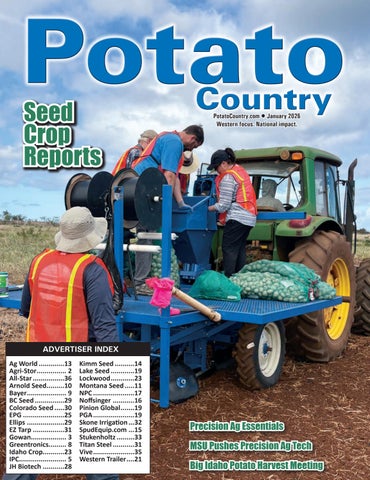
Seed Crop Reports
PotatoCountry.com • January 2026 Western focus. National impact.
Advertiser Index Ag World..............13 Agri-Stor................ 2 All-Star.................36 Arnold Seed..........10 Bayer..................... 9 BC Seed................29 Colorado Seed......30 EPG......................25 Ellips....................29 EZ Tarp.................31 Gowan................... 3 Greentronics......... 8 Idaho Crop...........23 IPC......................... 5 JH Biotech............28
Kimm Seed...........14 Lake Seed.............19 Lockwood.............23 Montana Seed......11 NPC......................17 Noffsinger............16 Pinion Global........19 PGA......................19 Skone Irrigation....32 SpudEquip.com....15 Stukenholtz..........33 Titan Steel............31 Vive......................35 Western Trailer.....21
Precision Ag Essentials MSU Pushes Precision Ag Tech Big Idaho Potato Harvest Meeting
oh
YEAH !
2026
DON’TWAIT SOUTHERN IDAHO 208.733.7000
WASHINGTON 509.349.7000
ALBERTA, CANADA 403.715.6960
EASTERN IDAHO 208.785.7000
COLORADO 719.850.3017
NOVA SCOTIA, CANADA 902.576.5888
AGRI-STOR.COM
FIELD-FOCUSED. GROWER-DRIVEN. SINCE 1962 Across America’s potato regions, growers rely on Gowan’s family of products to keep fields clean and yields strong. Our portfolio brings together trusted weed control like Treflan ® HFP, disease prevention from Zing! ®, Gavel ®, Badge ® SC, Badge ® X2, and Reason ®. As well as, Insect and Mite control from Onager ®, Trigard ® and Imidan ®. Real solutions for real growers. Grounded in agronomy, rooted in the field, and ready for whatever the season brings.
GOWANCO.COM Badge®, Eptam®, Imidan®, Reason®, Treflan®, Trigard®, Onager® and the donkey logo are registered trademarks of Gowan Company, L.L.C. Gavel® and Zing!® are registered trademarks used under license by Gowan Company, L.L.C. Always read and follow all label directions.
Table of Contents Vol. 42 No. 1 PO Box 333, Roberts, Idaho 83444 Telephone: (208) 520-6461 Circulation: (503) 724-3581
PotatoCountry.com
Country Western focus. National impact.
january 2026
6 Industry Updates: From Global to Local
Big Idaho Potato Harvest Meeting
Editor
Denise Keller editor@ColumbiaMediaGroup.com
Operations Manager, Advertising Brian Feist brian@ColumbiaMediaGroup.com
Publisher, Advertising
Dave Alexander dave@ColumbiaMediaGroup.com
insect Identification
Josephine Antwi josephine.antwi@oregonstate.edu
12 Seed Crop Reports
Disease Identification
18 MSU Pushes Precision Ag Tech
Jeff Miller jeff@millerresearch.com
21 Beyond the Shutdown
Ben Eborn napmn@napmn.com
Montana Seed Potato Seminar
Market Report
National Potato Council
Potato Growers of Washington Dale Lathim dale@pgw.net
24 Precision Ag Essentials
EDITORIAL INFORMATION
Buyers' Guide
30 Partnering to Change Perceptions
Idaho Potato Commission
Potato Country is interested in newsworthy material related to potato production and marketing. Contributions from all segments of the industry are welcome. Submit news releases, new product submissions, stories and photos via email to: editor@ColumbiaMediaGroup.com.
ADVERTISING SALES
32 2025 US Potato Production Down…But Not Enough
For information about advertising rates, mechanics, deadlines, etc., call (208) 520-6461 or email dave@PotatoCountry.com.
Market Report
SUBSCRIPTIONS
U.S. $24 per year / Canada $40 per year / Foreign $80 per year Subscriptions can be entered online at: potatocountry.com/subscribe or call (503) 724-3581. Email address changes/corrections to: brian@ColumbiaMediaGroup.com or send to Potato Country, PO Box 333, Roberts, ID 83444. Potato Country magazine (ISSN 0886-4780), is published eight times per year and mailed under a standard rate mailing permit at Idaho Falls, Idaho and at additional mailing offices. It is produced by: Columbia Media Group, PO Box 333, Roberts, ID 83444 Copyright 2026. All rights reserved. No part of this publication may be reproduced or transmitted in any form or by any means, electronic or mechanical, for any purpose without the express written permission of Columbia Media Group.
Editorial Board Aritra Roy Choudhury, director of the Montana Seed Potato Certification Program, and Carrie Kondratuk with the Montana State University potato lab pick a door prize for a lucky attendee. Read more about the Montana Seed Potato Seminar on page 18.
On The Cover
DEPARTMENTS
A crew plants Montana seed potatoes for post-harvest testing in Hawaii in midNovember 2025. Find out how the seed crop from the western states looks for this coming spring on pages 12-16. Photo by Aritra Roy Choudhury, Montana Seed Potato Certification
10 Calendar
4 Potato Country • January 2026
11 Insect Quiz
Chris Voigt
Gary Roth
Executive Director Washington State Potato Commission (509) 765-8845
Executive Director Oregon Potato Commission (503) 239-4763
22 Disease Quiz 31 In The News 34 PGW Column 34 Advertiser Index
Aritra Choudhury Director Montana Seed Potato Certification (406) 994-3150
Jamey Higham President/CEO Idaho Potato Commission (208) 334-2350
Tara Artho
Executive Director Colorado Potato Admin. Committee (719) 852-3322
The Idaho Potato Commission (IPC) and the American Diabetes Association® (ADA) have teamed up to tackle some of the most common misconceptions about one of America’s favorite foods: the potato. Idaho® Potatoes are proud to be recognized by the ADA’s Better Choices for Life program, highlighting how preparation and pairing play an important role in enjoying potatoes as part of a balanced, diabetes-friendly eating plan. The new Mashing the Myth campaign reframes how we think about potatoes by pairing science-backed facts with crave-worthy recipes that prove healthy can still taste amazing. To learn more, visit idahopotato.com/ada. PROUD SUPPORTER OF THE
Big Idaho Potato Harvest Meeting
Industry Updates:
From Global to Local Story and photos by Bill Schaefer
U
pdates on the state of the potato economy globally, nationally and in Idaho were on the agenda at the Idaho Potato Commission’s 2025 harvest meeting. With an estimated 200 people attending the half-day session on Nov. 12, discussion topics included access to foreign markets, a reduction in regulations by the Idaho State Department of Agriculture, global growth by Asian potato producers and efforts by the IPC to efficiently promote Idaho potatoes.
National Potato Council
Kam Quarles, CEO of the National
Potato Council, opened the meeting discussing the importance of protecting the development and growth of the market in Mexico and ongoing efforts to open Japan to the importation of fresh potatoes. “In order to keep Mexico open, because it’s so important, we actually have a team working in Mexico, legal and regulatory experts,” Quarles said. “One other market we’re working really hard on is Japan, and Secretary Rollins (USDA Sec. Brooke Rollins) made this statement to a group of producers a few months ago that she was going to
Kam Quarles with the National Potato Council discusses market access issues.
go into Japan guns-a-blazing to get fresh potato access. So, you can’t ask for more commitment than that,” he said. Quarles said that the Trump Administration has to keep the pressure on Japan to open the country to U.S. fresh potatoes. “We have been fighting this battle for 30 years and they (Trump Administration) have the ability to bring this to a close,” Quarles said. “The Japanese, their strategy is very clear. They want to negotiate with us, but they don’t want those negotiations to ever conclude. That protects the market. If you never get to the finish line, their market remains closed to us,” he said.
Idaho State Department of Agriculture
Chanel Tewalt, Idaho State Department of Agriculture director, followed Quarles’ presentation with an emphasis on what she called “hyper-local” issues concerning pesticide and chemigation use and application in Idaho. “If you, for some reason, have had anything but a great experience with that, come and tell me,” she said about chemigation reforms put in place this past year, “because it should be so much easier. If we come to your farm, we perform an inspection, you get a license. You don’t have to take a test; you don’t have to go through any of these processes anymore.” She then addressed efforts to expand pesticide licenses from the present twoyear licensing period to a five-year period in the 2026 legislative session. “That is in the rule that we are going to be moving forward with to the legislature this year for approval,” Tewalt said. “So you are going to deal with the agency 6 Potato Country • January 2026
half as much on your pesticide license than you have for the last 34 years.”
Potatoes USA
Blair Richardson, CEO of Potatoes USA, gave an update on the global challenges facing U.S. producers. “I have never in my career seen the type of change that is facing our industry today,” Richardson said. Richardson said that China will soon become the world’s largest potato grower and that India has made huge strides over the past 12 years in its potato production. Between 2019 and 2023, China’s potato exports grew from 33 million cwt to 376 million cwt while during the same timeframe, its imports dropped from 445 million cwt to 130 million cwt. Richardson said that while the U.S. continues to lead the world in market share of potatoes traded around the world, the percentage has remained the same over the past 20 years. “We’re 24 percent up over the last 20 years. It’s starting to level out over the past 10,” he said. “Really what you’re
seeing increase is Canada, China, India. Those are the big markets that are starting to increase more in terms of global trade, market share.” Previously, despite the added expense of importing U.S. potatoes to Asian countries, consumers preferred U.S. potatoes due to their culinary qualities compared to locally grown potatoes. Today, China and India have narrowed that quality gap, he said. “You can taste some minor differences, but by and large, the products they’re producing in China, the products they’re producing in India, the products they’re producing in the EU are not that different than the products we produce in the United States,” he said. There may be some consistency issues but when the product is 40 percent cheaper, it’s difficult to retain your customers, Richardson said. Richardson said that Potatoes USA is realigning how it’s investing its funds. “There’s no way we’re going to promote our way out of this in China. We’ve been pulling our money out of China because we think there are better
opportunities in other countries like Mexico and Japan and others that it’s a better return on investment.”
Idaho Potato Commission
Wrapping up the morning’s presentations, Jamey Higham, president and CEO of the Idaho Potato Commission, reviewed the IPC’s promotional successes for 2025 and previewed some promos for 2026. Higham said that one the highlights for the commission was the World Cup ski finals at Sun Valley, Idaho. Higham said that the venue was a one-time global event and they were able to negotiate donations-in-kind for some of their participation, thereby getting lots of worldwide publicity without a huge investment of funds. “By the time we were done with these in-kind donations, our money wasn’t that much that we were going to spend on it. And then we took it and ran with it. And we had a lot of our partners there: Simplot, Idaho, Lamb Weston, Teton Valley Brands, Roots Chips. A lot of the fresh potatoes were supplied. We
Chanel Tewalt with the Idaho State Department of Agriculture covers new chemigation regulations.
PotatoCountry.com
7
Big Idaho Potato Harvest Meeting
Jamey Higham, president and CEO of the Idaho Potato Commission, reviews highlights of the commission’s 2025 promotional efforts.
basically took over the World Cup in Sun Valley,” Higham said. He said that the finals generated over 18 billion impressions. “Our Idaho potatoes stuff was all over everything that was going on there. A great media value for a small spend,” he said. Another success story is the new Idaho potato license plates. Launched June 18, 2025, the design is a modern take on the 1948 plate design. “Each plate that’s sold, we get a little bit of money,” Higham said. “It’ll help us with our budget a little bit.” The Big Idaho Potato Truck continues to promote Idaho potatoes. In 2025, it traveled 31,000 miles, visiting 31 states and attending 57 events. With the current college football conferences in disarray, Higham said that the commission is constantly evaluating the Famous Idaho Potato Bowl, but is committed to the football game for the next two years. The commission is also making plans
Potatoes USA CEO Blair Richardson shares global challenges facing U.S. potato growers.
8 Potato Country • January 2026
A
Force in the
Field
The Bayer family of products is powerful, especially when used together. Combined, they create an agronomic force field around your crops, providing protection during the first 75 days when potatoes are most susceptible to pests and diseases. Safeguard your potatoes against nature's harmful pests and diseases with the Bayer 75-Day Integrated Pest Management program. Visit BayerPotato75DayIPM.com to learn more. ALWAYS READ AND FOLLOW PESTICIDE LABEL DIRECTIONS. Not all products are registered for use in all states and may be subject to use restrictions. Leverage ® 360 is a restricted use pesticide. The distribution, sale, or use of an unregistered pesticide is a violation of federal and/or state law and is strictly prohibited. Check with your local dealer or representative for the product registration status in your state. Admire,® Bayer, Bayer Cross, Emesto,® Luna Tranquility,® Minuet,™ Movento ® HL, Oberon,® Scala,® Serenade,® Sivanto ® and Velum ® are trademarks of Bayer Group. For additional product information call toll-free 1-866-99-BAYER (1-866-992-2937) or visit our website at www.BayerCropScience.us. Bayer CropScience LLC, 800 North Lindbergh Boulevard, St. Louis, MO 63167. ©2025 Bayer Group. All rights reserved.
Big Idaho Potato Harvest Meeting
Seed Without Compromise
Russett Burbank Ranger •Clearwater Teton Russet Norkotahs 278, 296 & Jorde Strain Northwest Norkotahs 111 & 218
www.ArnoldSeed.com Jeremy: 208-313-2875 • Eric: 208-313-5422
10308 North Highway 32 • Felt, Idaho 83424 •office@arnoldseed.com
to celebrate National Potato Day in New York City in 2026. “We’re going to have Idaho Potato Days in Central Park in August for National Potato Day,” Higham said. “We’ll have the truck there, we’ll have all sorts of news media there, potato dishes all made from Idaho potatoes.” Higham said that retirements at the University of Idaho’s College of Agricultural and Life Sciences has resulted in a number of vacant positions important to the industry. “We work a lot with the University of Idaho, and we’ve been challenged by our commissioners this year to hold them a little more accountable for the money that we’re spending with them and make sure it’s being spent wisely, well, and that we get results back from it,” Higham said. Higham said that the areas of research funded by the IPC include variety development, breeding and genetics, plant pathology, soil health, entomology, cropping systems and plant physiology. “This year, we put almost $1.3 million into this, and some of the money that we’re getting from the license plate is going to be put into that bucket as well.”
CALENDAR
•
Jan. 27-29 Washington-Oregon Potato Conference
Three Rivers Convention Center Kennewick, Wash. www.potatoconference.com
Mar. 9-12 Potatoes USA Spring Meeting
Denver Caitlin Roberts, caitlinr@potatoesusa.com
•
• •
Jan. 21-22 Idaho Potato Conference and Ag Expo
Pond Student Union Building and Holt Arena Pocatello, Idaho Kristy Mayer, kristym@uidaho.edu
10 Potato Country • January 2026
Feb. 3-5 Southern Rocky Mountain Ag Conference Outcalt Conference Center at SLV Ski Hi Complex Monte Vista, Colo. www.agconferencesrm.com
•
•
Feb. 23-26 NPC Washington Summit Hilton Washington DC National Mall the Wharf Washington D.C. www.nationalpotatocouncil.org
Jan. 6-8 Potato Expo 2026
Gaylord Texan Dallas www.potato-expo.com
INSECT BIOLOGY Quiz
This material is provided courtesy of Josephine Antwi, Ph.D., Assistant Professor of Irrigated Crop Entomology at the Oregon State University Hermiston Agricultural Research & Extension Center. She can be reached at josephine.antwi@oregonstate.edu.
During the growing season, potato fields come alive with multiple insects, some of which you probably have not much paid attention to. Pictured below are a few such insects.
Questions
1. True or false: The insects shown here feed on and cause damage to potatoes. 2. Both insects are larvae. Can you guess what kind of insects they are? 3. Can you also guess what the fangs on insect A are used for?
A
B
Answers Page 29
PotatoCountry.com
11
seed Crop reports
Colorado Seed Potato Crop By Andrew Houser, Colorado Potato Certification Service We had a mix of a cool spring, warm July, and a rainy first half of September and October. Fortunately, the rainfall turned into sunny days during the peak of harvest. Certified seed growers began killing vines in late July and continued through early to mid-August, limiting potential spread of virus by late-season aphid flights. Overall, crop yields have been above average. This year, we will continue to take a close look at using direct tuber testing to supplement our post-harvest test. Our post-harvest test is taking place on the North Shore of Oahu, Hawaii, again this year. Colorado certified seed potato acreage was up from 8,119 acres in 2024 to 9,425 acres in 2025. The 2025 accepted certified acreage after summer field inspections was 8,960 acres. Rejections
were primarily caused by Potato virus Y (PVY)/mosaic and blackleg. Total potato acreage in the San Luis Valley was 51,474 acres, up from 50,188 acres in 2024. The 2025 top six certified varieties in Colorado are Reveille Russet (2,611 acres), Russet Norkotah selections (2,444 acres), Canela Russet (457 acres), Soraya (429 acres), Teton Russet (339 acres) and Alegria (371 acres). An official 2025 certified seed directory is posted online at potatoes.colostate.edu/programs/ potato-certification-service/cropdirectory. All seed lots imported into Colorado are required to undergo a post-harvest test, a lab test for PVYN and a 21-day incubation test for late blight to comply with the Colorado late blight quarantine. A border crop of mustard green manure mix is planted next to early-generation seed potatoes in the San Luis Valley near Del Norte, Colo.
Idaho Seed Potato Crop By Alan Westra, Idaho Crop Improvement Association Seed potato acreage eligible for final certification in 2025 totaled 31,205 acres, a 2.9% decrease from the previous season. Excluding proprietary genetics, this acreage represents 129 varieties, selections and advanced clones. The top 10 varieties account for 77% of
Potato plants are irrigated on a farm in Idaho. 12 Potato Country • January 2026
total acres, with the leading types being Russet Burbank (25%), Russet Norkotah (22%), Ranger Russet (10%), Clearwater Russet (8%) and Dakota Russet (3%). Crop yield for 2025 is generally reported as good. Planting began on schedule mostly and slightly earlier than
usual in parts of eastern Idaho. Growth was excellent, with the crop running 7–10 days ahead of normal. Harvest conditions were warm and favorable, providing excellent digging conditions. Seed health in 2025 is comparable to last season. The percentage of seed lots with visually detectable PVY during field inspections declined to 5.6%. Blackleg incidence was very low, and once again there were no detections of potato leafroll or bacterial ring rot. Overall, seed quality going into storage was reported as excellent, with the crop showing an excellent shape and size profile. A complete listing of this year’s seed potato crop is available in the 2025 Idaho Certified Seed Potato Directory, posted at www.idahocrop.com. Hard copies may also be obtained by contacting the Idaho Crop Improvement Association’s Idaho Falls office.
seed Crop reports
Montana Seed Potato Crop By Aritra Roy Choudhury, Montana Seed Potato Certification The 2025 growing season carries particular significance for me, as it marks my first full year leading the Montana Seed Potato Certification Program. Montana’s certified seed industry spans three major production districts, each of which experienced a distinct start to the growing season. Gallatin County faced an unusually wet spring, and the persistent rainfall pushed planting a little behind schedule, with many growers unable to finish until mid-June. In contrast, growers in the other two districts completed planting by the middle of May. The remainder of the season was predominantly dry with moderate temperatures, offering favorable conditions for plant development. Harvest progressed smoothly, as well, with most fields harvested by early October. Growers have reported strong yields, excellent size profiles and overall,
high-quality seed. Montana certified 10,702 acres for the 2025 crop, reflecting a 2.4% decline from 2024. Russet varieties continued to dominate production. The largest acreage totals included Russet Burbank (2,981 acres), Clearwater Russet (1,942 acres), Umatilla Russet (1,244 acres), Ranger Russet (927 acres) and Alturas (702 acres). Most major russet varieties saw acreage reductions from the previous year. The standout exception was Alturas, which posted a 17% increase over 2024 and has grown 7% over the past five years. Russet Burbank, although still the leading variety statewide, has gradually declined to roughly 15% in that same five-year span. Clearwater Russet dropped 13%, Umatilla 9.8% and Ranger Russet 10.1% compared with last year. Russet Norkotah selections accounted for 1,184 acres, marking a 5.9% year-
over-year decline. However, one line bucked this trend: Texas 278, which expanded to 736 acres, a 22.7% increase from 2024. Montana’s specialty segment including reds, yellows, purples and fingerlings remained steady at 237 acres, continuing to represent a small but reliable share of certified seed acres. Chip-processing varieties also strengthened their presence. Atlantic, Lamoka and Snowden were planted on a combined 260 acres, continuing the gradual upward trajectory seen in recent seasons. As the program looks ahead, the 2025 crop year stands as both a personal milestone and a reflection of the state’s resilient seed industry. Montana’s growers once again delivered highperforming, high-quality seed to support the market.
K-line Russet Burbank G2 and G3 - early maturing, high yielding, bulky tuber type
Clearwater G2 and G3 Umatilla G2 and G3 K-line Norkotah G2 and G3
Rigid Sanitation Line Selection Program & MSU Tissue Culture Hawaii & Washington Seed Plot Trials 6140 Kimm Road, Manhattan, MT 59741 kimmseed@gmail.com 14 Potato Country • January 2026
406-282-7592 Office 406-580-7592 Bill 406-539-3620 Jason
Bill
Jason
Alan
Mark
Oregon Seed Potato Crop By Tami Brown, Oregon Seed Certification Service Oregon Seed Certification Service (OSCS) accepted 2,747 acres of seed potatoes for certification in 2025. This is the first decrease of acres in six years. Three lots applied but were not eligible for recertification. However, no lots were rejected in the season. For the first time in a long while, a chipper, Lamoka, had the most acres produced in Oregon. The other varieties in the top five include Clearwater Russet, Waneta, Frito Lay lines and Ciklamen. The bulk of Oregon seed was again from Nebraska, with the second most seed being Oregon seed planted back. Our grower directory has more
detailed information and can be found at seedcert.oregonstate.edu. Oregon has continued to conduct the post-harvest test in the greenhouses at Oregon State University. This process allows us to plant over a wider period and monitor the potatoes closer. Last year, direct tuber testing was offered as an additional test and several growers took advantage of it. All seed in Oregon must have a post-harvest test to be eligible for re-certification.
Hamlin Russets bloom on June 24, 2025, in Union County, Ore.
Planters
2012 Spudnik 8040 4 row 36” Cup 2015 Double L 9560 6 row 34” 2015 Lockwood 606 air cup 6 row 34” 2009 Spudnik 8060 6 row 36” semi mount 2008 Grimme GL36 Cup 6 row 36” Pull Hitch 2008 Spudnik 8080 Pull Hitch, Cup, 36” row spacing rear steer 2002 Kverneland 3200 4 row cup
Planter/filler/Dirt/tare
2017 Spudnik 1110 Rock roller “V” style 30” Tare 2015 Spudnik 1110 30” Dirt Tare 1998 Spudnik 1115 30” gas & elec. Planter Filler 1998 Double L 815 24”x25’ Planter Filler Gas Motor Mayo 24” Telescopic Planter Filler Piler Tri Steel 18” x 30’ Swing boom Tare Piler Shop Built 24” x 26’ Tare Piler
seeD cutters
1985 Milestone MSC48 48” Cutter 1988 Better Built 36” model 2300 2014 Better Built 72” model 400 3ph
treaters
2013 Better Built CDT 10’/10” Duster Chemical auger 2010 Better Built CDT10’/10” Duster 1996 Milestone 36 Barrel duster 1994 Milestone 36” Barrel Duster Reconditioned
Bulk BeDs/BoXes
2003 Spudnik 4200 20’ Electric 1996 Spudnik 2100 20’ Electric 1990 Spudnik 2100 20’ Electric 2001 Double L 801 20’ Combo Dual Drive 1988 Double L 801 20’ Elec. Single Drive 1985 Logan 20’ Electric
trucks
Pilers
2020 Spudnik 780 42” BC 230V 3ph remote 2000 Wemco 36” all belt 230 volt 3ph remote all hydraulic 1999 Double L 831 36” BC Elev/49’ boom 3ph HYD Drive & Remote 1998 Double L 831 36” BC Elev./49’ boom 3ph Elec. Drive & Remote 1989 Spudnik 550 36” BC Elev. 48’ Boom 3ph 480 Volt Remote Reconditioned 1989 Spudnik 550 30” BC Elev. 48’ Boom 3ph VFD’s 230 Volt Remote 1982 Spudnik 450 36” BC Elev. 45’ Boom 220 volt single phase 1985 Double L 813 30” x 49’ 230 volt 3ph, remote Reconditioned
scooPers
2019 Logan Scoop Pro 30” 230 3phase Spudnik model 150 30” Reconditioned 230 volt 3ph Spudnik 100 24” 3ph Spudnik 1000 Scoop trailer
Dammer Dikers
Ag Engineering 8 row Dammer Diker HYD Reset 2018 Logan Yield Pro 6 row Water Saver 2015 Logan Yield Pro 6 row Water Saver 2013 Ag Engineering 4 row Hyd. Reset 1996 AG Engineerng 6 row Tillage Master, Trip shanks
even flows/ surge HoPPers/ croP carts
2019 Spudnik 1860 600cwt- 60” elev. 3ph, two 36” stingers 2019 Logan Surge Hopper 330 60” 230 Volt 3ph 2013 Mayo 455 Surge Hopper 300cwt 3ph, 2 belt stingers 2010 Double L 968 Even Flow 1000 cwt 3ph 1 Stinger 36” 2010 Double L 960 Even Flow 600cwt 3ph 2 Stingers 36” 1992 Spudnik 1800 Even Flow 600cwt 3ph 1988 Spudnik 1800 525 cwt 30” conveyors 230 volt 3ph 2018 Spudnik 4835 Crop Cart 2 axle 2015 Kringstad 3600 Crop Shuttle Tracks
Harvesters
2019 Double L 953 4 row 2019 Lockwood 674 4 row 34” bed, 72” finger table 2018 Double L 7340 4 row 72” Reverse roll finger table 2017 Lockwood 674 2016 Double L 973 4 row return flow, finger table 2012 Lockwood 474H 4 row 2005 Lockwood 474H 4 row
crossovers/winDrowers 2023 Double L 6540 4 row 2019 Spudnik 6140 32” rows R&L discharge 2017 Lockwood 554 LH 4 row 2009 Lockwood 554 LH 4 row 2008 Spudnik 6140 RH 4 row 2005 Lockwood 5000 RH 4 row 2004 Spudnik 6140 LH 4 row 34” rows 1996 Double L 851 36” bed RH 4 row
rock/cloD/air eliminators
2023 Lockwood Vacs Mobile 2019 Spudnik 991 Air Sep 72” Multi sep. 480 volt 3ph 2014 Lockwood Vacs 8 2015 Harriston 4240 Clod Hopper 2012 Harriston 3240 CH fingers peg belt blower sizing fingers 230 V 3ph 2002 Harriston 240 CH Ellis Table 480 Volt 3ph 1995 Harriston 200 CH New13 finger roller table 480 volt 3ph
collectors & stingers/PuPs
2001 Mayo 250 Side shift Belt Table 36”w/ 2 Stingers 2014 Spudnik 2200 Belt Stinger 30”x10’ 3ph
Dirt eliminators
2014 Spudnik 990 Multi Sep Dirt Elim 72” 480 volt 3ph 2009 Spudnik 990 60”belt elev., 72” Rev/Roll Table BC picking 480 V 3ph 2004 Spudnik 995 DES 72” split picking 230 volt 3ph 2006 Spudnik 995 72”Finger rollers, Rev/Roll table 2003 Milestone 36” hopper 60” fingers 48 belt picking table Hang-on 1996 Milestone MSDS72 hopper 60” / 72” fingers 3ph 1998 Spudnik 900 hopper 48” Fingers 60” 230 volt 3ph
conveyors - telescoPic
2001 Spudnik 1255 30’’/36’’/85’ 3ph 1997 Spudnik 1255 30”/36”/85’ 1 ph 1994 Double L 820 30” x 70’ 3ph 1996 STI 30” x 70’ 480 volt 3ph 1989 Double L 810 30” x 50’ 3ph
conveyors - straigHt Spudnik 1205 42” x 40’ 3ph Spudnik 1205 36” x 40’ 3ph 1998 DL 809 30”/38’ 3ph Milestone 30” x 30’ 3ph
sHreDDers
2009 Newhouse 6 row 3-Point Model 1952 36” w/Tire Rollers 2014 Newhouse 8 row Pull type Model 2530 36” w/Tire Rollers
wareHouse & misc.
2011 Daumar PA 25D CB67 Wicketed bagger 2016 Tri Steel SS Grading/rolling table 3ph motor 24” wide rollers x 15ft long Tri Steel Bag Conveyor 36” x 19’H-Adjust EDP Electro Bagger 4 head 10lb-50lbs Thermo Fisher Scientific Versa Flex Checkweigher System Model 40-060 2017 Alliston 48” x 8’ rolling table Alliston Flume 48’’Wx13’L SS destoner Kwik Locs Neu Tech 9 lane weigher Ag Pak bagger 2 Kwik Locs Grain Treater USC LP2000 w/ seed wheel
2005 Pete Cummins Auto Trans siZers 2024 Logan LP22 bed PTO 2015 Spudnik 925 -84” Acorns,240V 3ph 2002 KW Cummins 9LL Trans 2000 Spudnik 925 -72” Acorns, 240V 3ph 2024 Logan LP22 bed PTO 1997 Spudnik 925 72” Acorns, 480V 3ph 2019 KW T370 Auto w/2spd reduction Kerian 60”W x 10’ L, 4 adjustable lanes 1996 Ford L9000 Auto, Cummins 1” to 4.5”, rib rolls 2012 Logan 22’ bed more at sPuDeQuiP.com 1986 Pete 349 Truck w/Logan 20’ bed Combo Bruce: (208)390-5120 | Brucen@tristeelmfg.com • evan: (208)757-8481 | evann@tristeelmfg.com • maX: (701)740-7574 | maXw@tristeelmfg.com
PotatoCountry.com
15
seed Crop reports
Washington Seed Potato Crop By Benita Matheson, Washington State Department of Agriculture A total of 2,989 acres of seed potatoes entered certification during the 2025 growing season. This is a 134-acre decrease from last year. Top varieties grown included Ciklamen (308 acres), Russet Burbank (240 acres) and Chieftain (190 acres). A complete report on seed lots is posted at agr.wa.gov/services/ licenses-permits-and-certificates/plantpermits-and-certification-programs/seedpotato. The total acres planted include 146 potato varieties ranging in size anywhere from partial-acre plots to 65-acre fields. Most seed lots are less than 20 acres and include numbered clones, table stock, processing and heirloom varieties. In Eastern Washington, growers had a nice spring planting season with reduced acreage, and the growing season was next to ideal with not too many extremes. Digging was finished around
the third week of October, and growers saw a good quality seed crop coming in with a nice profile. Western Washington growers had no issues other than always fighting to get tubers out of the ground before it starts raining for the season. Rain was weirdly intermittent, so harvesting was off and on. Due to labor expenses, growers have invested in extremely sophisticated harvesting and grading equipment. It has not only cut down on labor, but speeds up the harvest process dramatically. Quality has been very good. There was some common scab in old dairy ground, but that is always anticipated and managed appropriately. Yields have been, well, phenomenal. Growers are concerned about running out of storage space. Washington State Certified seed growers submitted seed lot samples for the post-harvest test that continues in Hawaii.
A field blooms in Skagit County, Wash., in late August.
Coming in the next issue of
Crop Protection Essentials Never miss an issue Subscribe at
PotatoCountry.com/ Subscribe 16 Potato Country • January 2026
2026 NPC WASHINGTON
SUMMIT FEBRUARY 23-26, 2026 HILTON WASHINGTON, D.C. AT NATIONAL MALL AND THE WHARF, WASHINGTON, D.C.
STANDING UP FOR POTATOES ON CAPITOL HILL NPC’s annual Washington Summit provides a forum for potato industry members to discuss, define, and advocate for the policy priorities impacting their businesses and protecting their ability to farm. • Hear from the nation’s top political and policy experts • Welcome NPC’s 2026 officers and grower leaders • Meet with members of Congress representing potato-growing states and districts • ...and unite as an industry in Standing Up for Potatoes on Capitol Hill!
NATIONALPOTATOCOUNCIL.ORG
Montana Seed Potato Seminar
MSU Pushes Precision Ag Tech Story and photos by Dave Alexander, Publisher
T
he Montana Seed Potato Seminar brings growers from Montana and Idaho to Missoula every November. This year, the seminar was held Nov. 12-13 and featured speakers, receptions and a trade show. Among the speakers was Paul Nugent with Montana State University (MSU) who gave a rundown of what the MSU Precision Ag Department has been working on. A primary focus for the department is irrigation decision support and how to apply water more precisely in the field. The team at MSU is using information gathered to figure out things like runoff and water stress prevention, where water is needed and where the best economic return is for water used. To make these irrigation decisions, MSU uses satellite and drone-supplied spectral sensing and commercial weather stations in the field that measure both crop stress and weather parameters. This setup allows real-time evapotranspiration Kate Vogel with North 40 Ag blends custom pasture grasses and perennial forages for customers’ areas and needs.
18 Potato Country • January 2026
Scott Short from Spraytec Fertilizers displays the company’s new Fulltec adjuvant. Chad Christopherson (right) with BioSafe Systems explains the benefits of new BioPhyter to a seminar attendee. BioPhyter is an endophytic Beauveria bassiana, which supports plant performance and vitality, minimizes abiotic and biotic stressors, and complements pest control solutions.
PVX GIII
SEED INC.
l RUSSET BURBANK l RANGER RUSSET
l On-farm tissue culture laboratory and greenhouse facility for nuclear seed production l 4 year rotation on clean fields l Strict sanitation program throughout l Modern storage and handling facilities l Rigorous Spray Program
We are dedicated to providing you with consistent high quality, high yielding seed that you can depend on year after year. You are always welcome to visit our farm. Let us show you what our program can do for you.
David
Dan Tim
Tim Dan
Pat
Dan, Dave, Pat and Tim Lake
(406) 253-3638 (office), (406) 676-2175 (fax) e-mail - spudman@ronan.net 35822 Spring Creek Road l Ronan, MT 59864
Is your business strategy half baked?
FULLY LOADED!
or...
In today’s challenging ag environment, knowledge is power. Pinion has the resources, passion (90+ years dedicated to food and agriculture), and expertise to turn your numbers into strategic business power.
CAUTION: Extra toppings can result in long-term business enhancements, opportunities, and success. CONTACT US AT 970.685.3425 OR VISIT PINIONGLOBAL.COM TO LEARN MORE PotatoCountry.com
19
Montana Seed Potato Seminar (ET) measurement and tracks how much water the crop is actually using. From there, decisions can be made on how much water to put down. MSU flew its drones approximately once a week, but sometimes weatherrelated flight gaps stretched to two weeks. Even without real-time data, the team has figured out how to use their previous measurements to predict how things were changing in the field and do it very accurately. They can put out two sensors, take measurements, then make irrigation recommendations based on those measurements and try and optimize irrigation across the field. “I find this very, very exciting because even a lot of commercial applications out there aren’t really doing something like this,” Nugent said. MSU is also working on identifying Potato virus Y-infected potatoes with hyperspectral imaging; a potato yield monitor that will identify, count and size objects on the conveyor leaving the harvester; autonomous robots; spray drones and virtual cattle fencing.
Phytophthora and Potato virus Y pocket test kits are available from Potadaho Seed Services and can be used in the field to verify pathogens in suspect plants.
20 Potato Country • January 2026
Paul Nugent, a Montana State University precision ag professor, addresses attendees in Missoula. His department at MSU is working to revive agricultural engineering at MSU, focusing on data science, robotics and automation.
Mike Wenkel, chief operations officer at the National Potato Council, outlines H-2A employer costs for growers at the Montana Seed Potato Seminar.
National Potato Council
Beyond the Shutdown
Implementing Proven Relief Programs for Family Farms By Kam Quarles, CEO, National Potato Council
W
riting this column less than a week after the longest government shutdown in history has ended, we are hopeful that Washington, D.C. will now turn itself toward important work and away from gridlock. One of the most important near-term issues for the Trump Administration and Congress to address is productively responding to a growing economic crisis for American agriculture. Nearly every commodity produced by our country’s talented farmers and ranchers is suffering from skyrocketing costs of production coupled with anticipated low market prices. Potatoes are no different. In just the russet category alone, estimates are that grower losses will exceed $480 million for the coming year. Extrapolate this across all the varieties that America’s family potato farms produce, and the scope of the crisis becomes clear. The good news is that the administration and Congress can help this situation. The better news is that they also know exactly how to deliver relief. Why? Because we tried a program in the past that failed spectacularly, learned from it, and created successor support programs that work. In 2020, during the height of the COVID crisis, the government demanded that major parts of our economy cease operating. Overnight, hotels, schools, restaurants and many other businesses were told to close their doors. All told, the potato industry lost over 60% of its customers during those COVID shutdowns. In response, the federal government created a relief program called the Coronavirus Food Assistance Program – or CFAP. This was a direct payment program intended to compensate growers for losses due to the shutdown. The trigger for receiving a payment was that each commodity (not each grower) had to prove to the government that prices had declined. There was a flaw in this model that caused the program to fail on a grand scale. It assumed that the federal government had pricing data from every commodity. For many of the “program crops,” this was easy because they have a futures market that provides price information on a second-by-second basis. However, the vast majority of the fruit and vegetable industry lacks those futures markets and has no such data. This caused the federal government to state that the loss of 60% of the potato industry’s customers caused no impact, and therefore, potato growers didn’t qualify for relief. After many months of front-page articles showing piles of potatoes going to waste, growers suffering tremendous economic peril, and senators and representatives meeting personally with the Secretary of Agriculture, a new program, “CFAP 2,” was rolled out. It discarded the pricing trigger of the failed program and let every grower petition the government
themselves. It provided immediate and significant relief to growers while offering the government the same audit power it has with annual tax filings to ensure that the relief was necessary. Fast forward to this year, and the federal government was again called upon to deliver relief to the specialty crop industry. The new mechanism was built upon the successful COVID program but was updated and called the Marketing Assistance for Specialty Crops (MASC) program. Though it was not easy to get this program released, once the administration finally made it available, it was again a huge success. Both CFAP 2 and MASC were released under the Trump Administration. Their delivery and execution were widely supported by family farms across the U.S. Given the scope of the current economic crisis, we are strongly urging the administration and Congress to double down on this prior success and execute on programs they know will work for growers. The great family farmers who make up this industry deserve a federal government that takes decisive action in times of crisis. That kind of effective leadership can restore faltering confidence and propel us forward past this crisis.
Building the best and making it better…your way! When you invest in a Western Spud Express® you can rest assured your new trailer has been built to stand up to the rigors the potato industry can dish out. The backbone of the Express is our high tensile steel main frame, treated with our level 4 paint system. Year after year the Spud Express delivers quickly and gently the biggest payloads, along with the highest resale value of any potato trailer on the market!
Learn more at: www.westerntrailer.com or call 888.344.2539 PotatoCountry.com
21
Disease Identification Quiz
Dr. Jeff Miller, a plant pathologist, is the president and CEO of Miller Research, Rupert, Idaho. He can be contacted by phone: (208) 531-5124; cell: (208) 431-4420; jeff@millerresearch.com
Part 1 What is wrong with the tuber in photo A? Multiple bumps are present all over the tuber. When the skin is sliced off, small brown dots are visible (photo B). These dots do not penetrate any deeper than the vascular ring in the tuber. Part 2 If you were to place a small piece of tuber tissue under the microscope, would you expect to see either of the organisms shown in photos C or D? If so, which one? What is visible in those photos?
A
B
C
D
Photos courtesy Phil Hamm, Oregon State University
22 Potato Country • January 2026
Answers Page 29
PotatoCountry.com
23
precision ag Essentials Buyers' Guide Agri-Stor Company agri-stor.com
Agri-Star Control Panel
The Agri-Star Control Panel is essential to having control over every aspect of the storage environment. Its adaptability to each application makes it a great fit for many post-harvest products in storage. The panel is perfect for potatoes, onions and even honeybees. The panel controls everything from humidity and refrigeration to heat, airflow, temperature and carbon dioxide levels. Users will have peace of mind with 24/7 access via an intuitive app. When paired with Gellert’s climate control equipment, the Agri-Star Control Panel is unmatched in its ability to extend the life and quality of products in storage.
Carbon Robotics carbonrobotics.com
LaserWeeder G2
Carbon Robotics LaserWeeder G2 delivers sub-millimeter precision weed control using AI and laser technology, removing weeds without disturbing the crop or the soil. Trusted by over 100 conventional and organic growers across 15 countries, LaserWeeders are helping farmers cut weed control costs by up to 80% by reducing herbicide use and hand labor. Laser weeding has also been proven to increase crop yield and quality. In 2024 onion trials, LaserWeeder delivered measurable gains: laser-weeded onions were 36% firmer and had 16% more single centers compared to herbicide-treated onions. The next-generation G2 line offers major performance gains, operating up to twice as fast as the previous model with upgraded NVIDIA GPUs and 240W diode lasers. The updated design is up to 25% lighter than the prior generation and is available in widths from 9 to 20 feet to fit a wide range of operations. As herbicide resistance increases and regulations tighten, LaserWeeder G2 provides growers with a scalable, chemical-free path to lower costs, higher yield and better quality.
Ecorobotix
ecorobotix.com
ARA Sprayer
Minimize phytotoxicity, increase yield, reduce manual labor and save up to 95 percent on inputs with the Ecorobotix AIpowered ultra-high precision sprayer. The ARA sprayer precisely applies plant protection products and fertilizers in a wide range of different crops. A 2023 study to review the effectiveness of weed control with ARA in onions showed a 78.9 percent savings on herbicides compared to broadcast treatments. The treatments with ARA also showed an overall effectiveness of weed elimination of 92 percent with fewer applications compared to broadcast while simultaneously preserving the integrity of the crops. Weed control with ARA also showed higher yields compared to conventional applications. While this study showed herbicide savings of around 80 percent, other studies have shown savings of up to 98 percent. The savings depend on a variety of factors like chosen treatment, weed density and other field conditions.
24 Potato Country • January 2026
Ellips
ellips.com
Elisam-Ellips AI Potato Grader
The Elisam-Ellips AI potato grader helps maintain consistent, high-quality results regardless of crop variability, while increasing capacity and reducing manual labor. With singulation, rotating cups and advanced cameras, the Ellips system captures a 360-degree view to accurately grade size, shape, color, weight and external quality, while internal quality technology reveals what lies beneath the surface. AI grading catches even the most challenging defects with pinpoint accuracy, ensuring consistent quality – batch after batch, season after season. The Elisam AI grader boosts throughput, allowing users to meet every deadline without manual sorting. And with the integrated carton filling solution, users can optimize their packing process, reducing labor and ensuring faster, more efficient order fulfillment. Users can spend less time managing a workforce and more time growing the business.
Fox Packaging foxbag.com
Bags
Fox Packaging delivers innovative and sustainable packaging solutions tailored to the precision agriculture needs of onion growers. Designed to enhance operational efficiency and resource optimization, these packaging options integrate seamlessly with advanced automation technology. The Fox Fresh Mesh Bag supports optimal respiration for extended shelf-life, while the Fox Leno Bag ensures durability for bulk packing. The Fox Fresh Mesh Wicketed Bag, also compatible with automated wicketed baggers, combines high breathability with precision-engineered materials, guaranteeing consistent performance and excellent merchandising potential. Fox Packaging’s solutions, paired with automation-ready designs, support the goals of precision agriculture by reducing waste, improving efficiency and maintaining product quality.
EXCEPTIONAL QUALITY
SEED POTATOES SINCE 1960
EXPERIENCE. DEDICATION. PERFORMANCE. WWW.EPG.AB.CA
Our isolated northern location along with our group of 10 experienced growers have been producing exceptional seed potatoes with increased energy and the lowest possible disease levels for over 60 years.
Our longevity and historical performance have made us a valued resource and seed potato supplier to growers across North America and the world. With over 100 varieties including main crop and specialty selections, we invite you to give us a call to discuss how we can help you make this growing season the best one yet.
Contact us to discuss how we can help make this year’s crop the best it can be.
Toll Free: 1 (800) 362–9791
(780) 447-1860 • darcyo@epg.ab.ca Edmonton Potato Growers 12220 – 170 Street, Edmonton, AB T5V 1L7 PotatoCountry.com
25
precision ag Essentials Buyers' Guide Fox Solutions
foxbag.com/equipment/newtec-celox-p-uhd
Newtec Celox-P UHD Optical Sorter
Make smarter use of every harvested ton with the Newtec Celox-P UHD optical sorter. High-resolution cameras and infrared sensors inspect each potato in a single pass, then precision ejectors grade by size, shape and quality according to the user’s programs. Users can create many grades and switch instantly, which removes pre-grading steps, reduces manual sorting and feeds packing with more consistent product. The Celox-P-UHD supports data reporting that helps fine tune upstream decisions over time.
Greentronics
greentronics.com
Yield Monitor
Greentronics yield monitors are designed for root crop and vegetable harvesters. The system is built around one or more load cells, which are installed in a conveyor to measure the weight of the crop as it passes on the belt. Once installed and calibrated, the harvester operator chooses the field name and sets the swath width. The operator does not need to interact with the yield monitor while harvesting. Growers use yield maps to study and manage variability in their fields and generate report cards on their progress. By applying breakeven points, yield maps can indicate areas with profit and loss and help make decisions about inputs, population density, crop rotation, cover crops, drainage, leveling and so on.
Industrial Ventilation Inc. (IVI) ivi-air.com
Imperium Storage Control Panel
IVI’s Imperium storage control panel directs optimal conditions for stored potatoes. Users can precisely control airflow, carbon dioxide, humidity and more and easily retrieve valuable historical data to aid in setting parameters. This powerful system for potato storage protection offers straightforward operation right at the user’s fingertips. The IVI app allows for off-site monitoring and control. The Imperium storage control panel is made in the U.S.A. under the supervision of the engineers behind the innovations. The company’s eye is always on improvement and technological advances, driven by growers’ needs in working with IVI’s service and sales team.
26 Potato Country • January 2026
KPM Analytics
kpmanalytics.com/products/vision/siftai-smarttable
SiftAI Smart Table
The SiftAI Smart Table is an all-in-one artificial intelligence (AI) inspection solution for potato processors to automatically sort, grade and size potatoes, while also detecting unwanted foreign materials with little human intervention. Each system is trained with AI models to analyze product attributes as they enter the potato shed, accurately routing and sorting products based on user-defined criteria. As potatoes pass on a rolling table, a row of SiftAI cameras captures images of all sides of the potato to precisely calculate the presence of defects (bruises, rot, percentage of green, damage, etc.). The AI system automatically triggers rejection fingers to move culled potatoes into a different process stream. When the system detects foreign materials (rocks, sticks and other field debris), a different set of rejection fingers moves those materials to a discard bin.
Lockwood Manufacturing lockwoodmfg.com
774 Harvester
Lockwood’s new 774 Harvester is designed with today’s higherlevel harvesting capacities in mind. The Lockwood 774 Harvester handles more volume by incorporating a wider rear cross and side elevator with numerous cleaning table options. Plus, the higher capacity full swing boom makes truck loading more efficient. The dual Lockwood high-efficiency fans increase airflow using less power. Lockwood’s 774 Harvester boasts excellent visibility for the operator along with a 10-inch touchscreen control system with joystick control. Optional wheel drive and vine choppers can be added to complete the system. Take harvesting to the next level and save time and money with the Lockwood 774 Harvester.
Symach
symach.nl/en
Palletizing Equipment
Symach has a long history of palletizing potatoes and innovating to provide customized modular designs to guarantee a high stacking rate with maximum flexibility. From 50-pound bulk and paper master bags to complex Octabins, Symach handles all customers’ palletizing needs. The company also offers options to stabilize the pallet at the end of the line, including wrapping and double stacking, and palletizing within the margins of the pallet to ensure ease of loading during the shipping process.
PotatoCountry.com
27
precision ag Essentials Buyers' Guide Tristeel Manufacturing tristeelmfg.com
Automatic Dual Tote Bag/Bin Filler
The Tristeel automatic dual tote bag or bin filler saves labor and increases plant efficiency by utilizing programmable logic controls (PLC) and filling with no or limited operator involvement via weight with floor scales or product height in the bag or box. Put two empty bags on the machine, turn it to automatic, and the machine will fill both stations. The machine can be run in manual mode, as well. Tristeel has been making these machines for 50 years and has enjoyed an excellent track record.
28 Potato Country • January 2026
KNOW YOUR Insects ANSWERS (from page 11)
KNOW YOUR DISEASE ANSWERS (from page 22)
Part 1
1. False 2. Insect A is a green lacewing larva. Larval green lacewings are predators of soft-bodied insects including aphids, lace bugs, leafhoppers, psyllids, scales, mealy bugs, thrips and caterpillars. Adults of some green lacewing species are predators (e.g., Chrysopa species) whereas others are not (e.g., Chrysoperla species). Insect B is a lady beetle larva. It has some resemblance to Colorado potato beetle larvae, but lady beetle larvae are more elongated and darker. Like lacewing larvae, lady beetle larvae are predators that feed on similar prey insects. Adult lady beetles are also predators.
The tubers in photos A and B are showing symptoms of Columbia root-knot nematode (Meloidogyne chitwoodi) damage. Other species of nematodes can also cause damage, such as M. hapla, M. incognita and M. arenaria. The small brown dots are actually female nematodes that have produced eggs. Root-knot nematodes rarely cause above-ground symptoms on plants. M. hapla and M. incognita have been known to cause root galls and lateral root proliferation on potato plants.
Part 2
Photo D is a picture of the Columbia root-knot nematode, which is the cause of the symptoms shown in photos A and B. Photo C is a picture of the root lesion nematode (Pratylenchus penetrans). The root lesion nematode is also pathogenic on potato, but does not cause lesions like those seen with root-knot nematodes. Root lesion nematodes cause plants to be less vigorous and can interact with Verticillium dahliae as a component of the potato early die complex.
BC CERTIFIED SEED POTATO GROWERS
3. Those sharp fangs are mandibles that have been modified to pierce and suck body contents of their prey. The next time you encounter any of these insects in the field, know that they are on your side controlling insect pests for you. Broad-spectrum and persistent insecticides and miticides that are not well timed can negatively impact these beneficial insects.
Quality British Columbia Seed Potatoes Grown in: Fraser Valley and Pemberton 2025-26 BRITISh COlumBIA SEED POTATO DIRECTORy
www.bcseedpotatoes.com Visit Our Website to see a list of our Growers & Varieties
EVERY POTATO COUNTS You want the best of both worlds. Speed to deliver maximum capacity and accurate defect detection to maintain consistent quality. Inspect the entire surface and look inside each potato to get the best out of every batch. More info? Please contact:
John Albert
john.albert@ellips.com
(206) 915-4962
Rowan Parmenter
r.parmenter@ellips.com
(425) 495-3378
www.ellips.com PotatoCountry.com
29
Idaho Potato Commission
Partnering to Change Perceptions By Jamey Higham, President & CEO, Idaho Potato Commission
T
he strength of the Idaho potato brand lies not only in our quality but in the truth behind it. For decades, our growers have worked tirelessly to produce the world’s best potatoes – nutritious, delicious and deeply rooted in Idaho soil. Yet, misconceptions about potatoes and health still persist. That’s why the Idaho Potato Commission’s partnership with the American Diabetes Association (ADA) has been such an important step forward for our industry, our growers and consumers. Since forming our multi-year collaboration in 2023, we’ve been proud
that Idaho potatoes are recognized by the American Diabetes Association’s Better Choices for Life program, which helps consumers identify products that meet its nutrition guidelines. This recognition reinforces our commitment to promoting wholesome, nutritious food choices and educating consumers about the role preparation and pairing play in maintaining a balanced, diabetes-friendly diet. The new “Mashing the Myth” campaign takes this mission a step further. It addresses several long-held misconceptions, including the belief that potatoes cause sugar spikes, lead to weight gain or lack nutrition. Backed by experts from the American Diabetes Association, the campaign shares science-based facts and simple
Colorado Certified Potato Growers Association “Quality as High as our Mountains” RUSSET VARIETIES: Russet Norkotah S3 Russet Norkotah S8 Rocky Mountain Russet Silverton Russet Rio Grande Russet Canela Russet Mesa Russet Mercury Russet Fortress Russet Crimson King COLORED VARIETIES: Columbine Gold Colorado Rose Rio Colorado Red Luna Purple Majesty Masquerade Mountain Rose Vista Gold
30 Potato Country • January 2026
preparation tips that show how potatoes can fit within the ADA’s Diabetes Plate Method. For Idaho’s growers, this partnership reinforces what we stand for: integrity, quality and continuous improvement. It brings credibility to the work happening in our fields every day and strengthens consumer confidence in choosing Idaho potatoes. When shoppers see the ADA’s Better Choices for Life mark alongside the Grown in Idaho seal, they can feel good knowing they’re choosing a food that’s both nutritious and trusted. As we continue this partnership, I’m proud of what it represents: a shared commitment to health, transparency and the enduring power of the Idaho potato.
Seed Growers: Zapata Seed Company Worley Family Farms SLV Research Center San Acacio Seed Salazar Farms Rockey Farms, LLC Pro Seed Price Farms Certified Seed, LLC Palmgren Farms, LLC Martinez Farms La Rue Farms H&H Farms G&G Farms Bothell Seed Allied Potato Colorado Certified Potato Growers Association P. O. Box 267 Monte Vista, CO 81144 ColoradoCertifiedPotatoGrowers.com Lyla@ColoradoCertifiedPotatoGrowers.com (719) 274-5996
Lorem ipsum
IN THE NEWS
WSPC Hires Director of Government Affairs
Geordy Bryant Greene is the new director of government affairs at the Washington State Potato Commission (WSPC). In this role, Greene will lead the Commission’s advocacy efforts on legislative, regulatory and environmental issues at both the state and federal levels, representing Washington’s potato growers before agencies, legislatures and trade partners. Before joining the WSPC, Greene spent three years working for U.S. Rep. Cathy McMorris Rodgers, where he focused on constituent services, communications and agricultural policy. Most recently, he worked in Washington State University’s Office of External Affairs and Government Relations.
The Automatic Truck Tarper Fully automated tarp installs easily and is completely operational from the cab of your truck. Visit our web site and view videos and photos. Learn how convenient we can make your hauling. Designed to make covering and uncovering truck loads safer, faster, and easier.
6 South, 1000 West • Blackfoot, ID 83221 Email: atsuk@live.com
PotatoCountry.com
31
MARKET REPORT
2025 US Potato Produc But Not Enough
U
SDA estimates that growers produced 412.06 million cwt of potatoes during 2025. That is 9.11 million cwt less than the 2024 crop, a 2.2% decline. It is 1.7% below the five-year average production. Nine of the 13 reporting states posted reduced production relative to the previous year. USDA puts the year’s national average potato yield for the 2025 crop at 461 cwt per acre. That exceeds the 2024 average yield by 7 cwt per acre. USDA made several changes to its June acreage estimates for the various states. The net result was an 11,000-acre reduction in this year’s planted area to 901,000 acres. That is 31,000 fewer acres than growers planted in 2024. At 894,800 acres, the official harvested area fell 11,100 acres below USDA’s June forecast. In this article, we review the USDA data and explore the implications for frozen processing and other industry sectors.
Columbia Basin
USDA estimates that growers in Washington and Oregon planted a total of 181,000 acres of potatoes in 2025. That is 22,000 fewer acres than they planted in 2024. USDA reports that Washington growers planted 140,000 acres of potatoes in 2025. That is 5,000 acres under its June estimate. It trimmed Oregon’s planted area estimate by 2,000 acres, to 41,000 acres.
32 Potato Country • January 2026
USDA put Washington’s average yield at 635 cwt per acre, 15 cwt per acre above the 2024-crop yield. It is the state’s largest yield since 2020. It is 21 cwt per acre above the five-year average. USDA also put Oregon’s average yield at 635 cwt per acre, up from 610 cwt for the 2024 crop. The combined changes result in a 114.62 million cwt potato crop in 2025. That is 10.44 million cwt less than the region produced in 2024, an 8.3% reduction.
Idaho
USDA reports that Idaho growers planted 315,000 acres of potatoes in 2025, which is unchanged from the June planted area estimate. It also matches the 2024 planted area. It estimates the average yield for the 2025 crop at 440 cwt per acre, up from 430 cwt for the 2024 crop. That is 11 cwt above the five-year average yield; however, it is 16 cwt below the long-term trendline yield. USDA put Idaho’s 2025 potato crop at 138.38 million cwt. That is 3.15 million cwt, or 2.3%, more than the 2024 crop. Idaho’s early-season shipping pace and current open-market prices suggest that USDA’s 2025 production estimate might be too low.
Upper Midwest
Combined production in the upper Midwest is estimated at 69.23 million cwt. That is only 372,000 cwt less than 2024 production, a 0.5% decline. USDA puts Wisconsin’s potato crop at 28.14 million cwt. That is 1.74 million cwt, or 6.6%, more than the 2024 crop. It reports that Wisconsin growers planted 68,000 acres of potatoes in 2025, 1,000 acres more than they planted in 2024. The state’s average yield is reported at 420 cwt per acre, up 20 cwt per acre from the 2024 yield. North Dakota growers planted 70,000 acres of potatoes in 2025. That is 3,000 fewer acres than they planted in 2024, and it is 2,000 fewer acres than the USDA reported in June. The agency puts the
state’s 2025 yield at 355 cwt per acre, 5 cwt per acre above the 2024 yield. USDA estimates North Dakota’s 2025 potato crop at 24.5 million cwt. That is 810,000 cwt, or 3.2%, less than 2024 production. USDA now reports that Minnesota growers planted 40,000 acres of potatoes in 2025. That is 3,000 fewer acres than growers planted in 2024, and it is 1,000 fewer acres than it reported in June. It puts the state’s average yield at 420 cwt per acre, which matches the 2024 yield. With those adjustments, Minnesota’s 2025 potato crop is estimated at 16.59 million cwt. That is 1.3 million cwt less than the state produced in 2024, a 7.3% reduction.
Maine
At 17.25 million cwt, USDA’s November crop estimate puts this year’s potato crop 1.07 million cwt below 2024 production, a 5.9% reduction. USDA estimates that growers harvested 51,500 acres of potatoes in 2025, 2,400 fewer acres than they harvested in 2024. USDA put the state’s yield at 335 cwt per acre. That is 5 cwt less than the 2024 average yield.
Other States
Production in the other six states totaled 72.59 million cwt, down 0.5% from 2024 production. USDA puts Colorado’s 2025 potato crop at 23.02 million cwt. That is 958,000 cwt more than the state produced in 2024, a 4.3% increase. Michigan’s potato crop is estimated at 20.21 million cwt, down 1.1% from the 2024 crop. USDA puts Nebraska’s 2025 potato crop at 9.95 million cwt. That is 187,000 cwt, or 1.8%, than 2024 production. California’s 2025 potato crop is estimated at 8.56 million cwt, down 387,000 cwt, or 4.3%, from the previous year. At 6.21 million cwt, USDA’s Texas potato crop estimate falls 584,000 cwt short of 2024 production, an 8.6% reduction. USDA puts Florida’s 2025 potato crop at 4.65 million cwt. That is 1% more than the state produced in 2024.
ction Down… Summary
Despite significant contract volume reductions for the 2025 crop, rawproduct supplies for frozen processing appear to be above budget again this year due to strong yields in most major processing regions of North America. Reports indicate that yields were exceptional for early varieties in the Columbia Basin and in Idaho. Though total production in the Pacific Northwest is down from 2024, it is more than sufficient for local processing needs. Fryers were purchasing contract overages during harvest, but those procurements have mostly ceased. The Midwest processing states should have an adequate supply of raw product to run plants at desired levels this year. In Canada, Prince Edward Island processors have already purchased production overages from Maine and other areas to cover their supply gap. Overall, the quality of this year’s processing potato crop is average or slightly above average, which should support favorable finished product recover rates. Dehydrators have large supplies of finished product in storage. As a result, there is currently very little demand for off-grade potatoes. A substantial volume of potatoes that would normally be used for dehy processing have been dumped or diverted to cattle feed. Chip potato supplies appear to be more than sufficient for industry needs. Reported U.S. chip potato shipments from the 2025 crop have been running well below the 2024 pace. Idaho growers increased russet table potato acreage this year. In addition, strong yields boosted production in Idaho, Wisconsin and Colorado’s San Luis Valley. Russet table potato production appears to be relatively stable in the Columbia Basin, Texas and Michigan. Strong earlyseason movement from Idaho has offset shipments from other areas. Marketers are struggling to compete with Idaho’s low prices. Table potato supplies are backing up in several regions.
By Ben Eborn, Publisher, North American Potato Market News
Key Points
• USDA estimates 2025 U.S. potato production at 412.06 million cwt, down 9.11 million cwt from the 2024 crop. • Reported production in the Pacific Northwest fell 7.3 million cwt short of the 2024 crop. • Despite a 22,000-acre, or 4.2%, reduction in the Pacific Northwest’s combined planted area, production was only down 2.8% due to strong yields in Idaho, Washington and Oregon. Editor’s note: To contact Ben Eborn, or to subscribe to North American Potato Market News (published 48 times per year), write or call: P.O. Box 176, Paris, ID 83261; (208) 525-8397; or email napmn@napmn.com.
Agricultural Consulting & Testing • Soil Testing • Irrigation Scheduling • Feed Analysis • Contract Research • Tissue Testing • Pest Management
• Field Research • Grid Sampling • Variable Rate Fertilization • International Testing • Agronomic and CCA Seminars • Nematode Testing
Contact: Paul Stukenholtz, Consulting Agronomist
Crop Consultants: JP Kruckeberg • Bart Kunz • Cameron Brower Antone Christensen • Wess Gibson • Cody McCoy • Kevin Victor
www.stukenholtz.com 208-734-3050 • 800-759-3050
PO Box 353 • 2924 Addison Ave E. • Twin Falls, ID 83301 PotatoCountry.com
33
In the News Potato Growers of Washington
Potato Profitability: The Real Story Behind French Fry Prices By Dale Lathim, Potato Growers of Washington “Affordability”
has become a buzzword in today’s economic climate, echoing through headlines and dinner-table conversations alike. Nowhere is this more evident than in the frozen potato processing sector, where the price of French fries at major quick-serve restaurants has skyrocketed, rising more than 100% between 2019 and 2024. In fact, recent data from the largest fast-food chain reveals a staggering 134% increase in fry prices over this period. What about sandwiches? Some have soared by over 300%.
The Paradox of Rising Prices and Growing Demand
One might expect such dramatic price hikes to drive customers away. Yet, quarterly earnings reports tell a different story: foot traffic at all but one of the top five publicly traded restaurant chains serving fries is up. Industry insiders report modest increases in both customer visits and “attachment rates” – the number of orders that include fries. The result? Fry volume is up more than 1%, consistent with previous quarters.
risen 35% from 2019 to 2024. But dig deeper, and a different picture emerges. The cost of production for growers has surged by more than 45% – and for some, over 50%. Reduced contract volumes and increased overhead per acre have compounded the challenge. For those forced to dispose of excess potatoes with no market, harvest and disposal costs turn a bountiful yield into a financial burden. Ultimately, growers’ profit margins over production costs have shrunk.
The Grower’s Dilemma
Who’s Absorbing Inflation?
So, what role do potatoes and potato growers play in this affordability debate? On the surface, it appears growers are benefiting. Contract prices for Columbia Basin potatoes used by processors have
Advertiser Index
Meanwhile, other players in the frozen potato supply chain – processors, packaging companies, oil suppliers and quick-serve restaurants – have largely maintained their profit margins. Publicly traded companies in these sectors disclose their financials, making it clear: the growing community is the only segment truly absorbing inflation.
Ag World...............................13
Kimm Seed............................14
Agri-Stor..................................2
Lake Seed..............................19
All-Star..................................36
Lockwood..............................23
Arnold Seed...........................10
Montana Seed.......................11
Bayer.......................................9
National Potato Council.........17
BC Seed.................................29
Noffsinger.............................16
Colorado Seed.......................30
Pinion Global.........................19
Growers are often urged to “tighten their belts” to keep French fries affordable. Yet, the economics tell a different story. Decades ago, potatoes accounted for about 33% of the cost of a finished fry. Today, that figure has dropped below 20% of the wholesale price and less than 2% of the price paid by consumers at restaurants.
Edmonton Potato Growers....25
Potato Growers of Alberta.....19
Setting the Record Straight
Ellips.....................................29
Skone Irrigation.....................32
EZ Tarp..................................31
SpudEquip.com.....................15
Gowan.....................................3
Stukenholtz...........................33
Greentronics...........................8
Titan Steel.............................31
Idaho Crop............................23
Vive.......................................35
Idaho Potato Commission........5
Western Trailer......................21
JH Biotech.............................28 34 Potato Country • January 2026
The Shrinking Slice of the Pie
A 100% increase in the cost of fries may sound alarming, but it’s not the result of grower greed. Instead, it reflects the leverage wielded by other supply chain participants to protect their margins. Growers have already contributed more than their fair share. The path forward will involve unity and advocacy. Growers must support their local bargaining associations and work collectively to halt the erosion of profitability.
Viloprid®4