Table of Contents
ONION WORLD Volume 42, Number 6
september/october 2026 4 Growing Onions Against the Odds
Desert Springs Produce
10 Storage Essentials
PO Box 333 Roberts, Idaho 83444 Telephone: (208) 520-6461 Circulation: (503) 724-3581
OnionWorld.net Onion World Contacts Editor Denise Keller editor@ColumbiaMediaGroup.com Publisher / Advertising Manager Dave Alexander dave@ColumbiaMediaGroup.com
Buyers' Guide
12 Researchers Study Cover Crop Strategies 16 Stemphylium Leaf Blight: An Ongoing Challenge
in Ontario
Director of Operations Brian Feist brian@ColumbiaMediaGroup.com
EDITORIAL INFORMATION Onion World is interested in newsworthy material related to onion production and marketing. Contributions from all segments of the industry are welcome. Submit news releases, new product submissions, stories and photos via email to: editor@ColumbiaMediaGroup.com.
22 A Memo From Michigan
Michigan Onion Committee
ADVERTISING SALES For information on rates, mechanics, deadlines, list rental, direct mail, inserts or other information, call (208) 520-6461 or email: dave@onionworld.net
SUBSCRIPTIONS U.S. $50 per year Foreign $120 per year
Subscribe online at: www.OnionWorld.net/subscribe or call (503) 724-3581.
Stemphylium leaf blight symptoms can include dark lesions on leaf blades. Find out how researchers are working to help growers better manage the disease in the face of limited fungicide options on page 16.
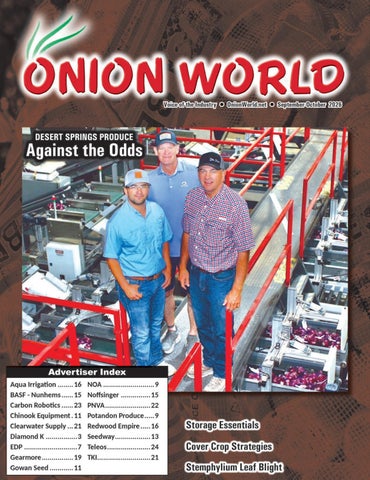
On The Cover Brandon Gills, Jeff Kennell and Dale Gillis with Gillis Farms and Desert Springs Produce grow, pack and ship onions in New Mexico. Read about the challenges they face on pages 4-7. Photo courtesy Gillis Farms 2
Onion World • September/October 2026
DEPARTMENTS 8...... Calendar 8...... In the News 14.... New Products 20.... From the NOA 22.... Advertiser Index
Email address changes/corrections to brian@ColumbiaMediaGroup.com or mail to: Onion World PO Box 333 Roberts, ID 83444 Onion World magazine (ISSN 0892-578X), is published eight times a year and mailed under a standard rate mailing permit at Idaho Falls, Idaho and at additional mailing offices. Produced by Columbia Media Group PO Box 333, Roberts, ID, 83444. Copyright 2026. All rights reserved. No part of this publication may be reproduced or transmitted in any form or by any means, electronic or mechanical, for any purpose without the express written permission of Columbia Media Group. For information on reprints call (208) 520-6461.
Improve Water Efficiency, Unlock Nutrient Mobility —By Tom Tankersley, Sales Manager, Diamond K Gypsum
Diamond K Premium Prill Gypsum™ Gypsum Purity Comparison
NEW Diamond K Premium Prill Gypsum™ and NEW Premium Prill Gypsum HA™ with Humic Acid offer growers a strategic tool for soil amendments and enhances ROI. Unlocks Nutrient Mobility: 21% Ca improves soil structure and root growth to tap water-soluble N and K reserves. Increases Nitrogen Use Efficiency: 17% S alleviates deficiencies in Western soils. Maintains yield with lower N inputs. Reduces Sulfate Needs: High S content helps reduce AMS applications. Improves N efficiency when S and N are balanced. Mines Native Phosphorus: Unlocks P tied up as calcium phosphate compounds. Makes P more available to crops.
Loosens Compacted Soils: Increases air and water movement. Displaces Na below root zone for deeper roots. Naturally Occurring Trace Silica (less than .1%): Improves cell wall strength, stress tolerance and drought resistance. Lignosulfonate Binder: Stimulates beneficial microbial nutrient cycling, and improves nutrient chelation.
Precise Nutrient Delivery: Blends evenly with other prilled nutrients as a top-dress or in-furrow, pre-, in-, or post-season.
92% Purity: Means more active ingredient per ton, with less inert material. Dihydrate, Not Anhydrite: Naturally mined and highly soluble, its two water molecules deliver faster dissolution. Fast Acting: Highest solubility rate of any mined gypsum product.
Saves Water: Increased water infiltration reduces irrigation sets, costs and runoff.
Better Gypsum. Better Water.
Premium Prill Gypsum HA combines Diamond K’s new humic acid, derived from fresh water and processed at low temperatures to preserve more humic compounds. This creates a powerful mix of Ca, S, and humic substances. Call Tom Tankersley: (208) 570-1430 Email: tom@diamondkgypsum.com
Better Soil. Better Results.
Learn more— Contact your territory manager, or visit: www.diamondkgypsum/new-products/ Diamond K Gypsum • 435.896.8870 • 1720 South Red Hills Drive, Richfield, Utah 84701
Desert Springs Produce
Growing Onions Against the Odds Story by Denise Keller, Editor Photos by Andi Gillis and Gillis Farms
W
hen it comes to growing onions in New Mexico, weather is a doubleedged sword. Dale Gillis knows this as well as anyone. He’s been a farmer all his life, and his family has been growing onions in the area since 1918. Today, Gillis Farms, which markets onions under the name Desert Springs Produce, farms 4,500 acres in a 60-mile radius around Arrey, New Mexico, at the north end of the Hatch Valley. Through the years, the family has grown a variety of crops including cabbage, lettuce, broccoli and squash. The current rotation consists of onions, chili, alfalfa, and silage corn. Onions, the farm’s main crop, account for 1,000 acres, with about 60% planted in yellow onions and the remainder equally split between reds and whites.
Weather Conditions
Gillis Farms has onions in the ground almost the entire year, with the only
Yellow onions, including the Crown variety seen here, make up about 60% of Gillis Farms’ onion acreage.
Dale Gillis, salesman Jeff Kennell and Brandon Gillis stand in the dryer barn at Desert Springs Produce.
4
Onion World • September/October 2026
Manuel Requejo, Dale Gillis and Brandon Gillis show off freshly harvested onions.
break in the growing season from midAugust to mid-September. Gillis plants spring-seeded varieties in late January and harvests those from early July through mid-August. In mid-September, the fall crop is planted, which comes out of the field beginning in midMay. Another 70 acres of onions are transplanted in early February to be harvested in early July. Hot days coupled with cool nights yearround allow for this extended growing season. But it also means the crop is at the mercy of Mother Nature 11 months of the year. “When it gets to 105 or 107 degrees, you can water these fields, and then in three or four days, they’re dry because you get that heat and the wind blows 30 or 40 miles per hour. It’s a challenge just keeping them wet and growing,” Gillis says. Early-season winds can sandblast emerging onions, summer hail and rainstorms can damage the crop, and hot days can cause sunscald. Temperatures commonly reach that 105 to 107 degree range, and if the plants don’t have a good top, the onions – especially the reds and whites – will scald. To protect the crop,
Gillis started planting onions in wider beds. This produces more of a canopy, creating more shade for bulbs. As an added benefit, the change also increased yield.
Water Supply
Dry weather has not been helping New Mexico farmers deal with ongoing drought conditions. Gillis says he has been short on water out of the Rio Grande River for the last five years. “Our normal is 2 acre feet, and we’re down to 4 inches because we’re going through a really bad drought. Our water situation is really, really getting pretty serious here,” Gillis says. “Water shortages are a top concern for just about everyone in the Western U.S. right now. The drought is the real deal.” Some farmers in the area are choosing to forgo growing cotton and other rotation crops in order to have enough water for their onion crops. Gillis is using mostly well water to make up for the lack of water from the Rio Grande. The well water contains more salt than the river water. With salinity at the soil surface, poorly timed rain can splash salt onto small onions and kill the plants. Gillis has
found acid products to be most beneficial in lowering pH levels in the water. “In reality, there’s only so much you can do about it,” the grower says. To improve water use efficiency, Gillis replaced flood irrigation with drip irrigation in 90-95% of his onions a few years ago, which has been a substantial help. And it doesn’t hurt to pray for snow in southern Colorado, he says. Runoff from snowpack in southern Colorado provides irrigation for growers in New Mexico, and there’s been little snow in the last four of five years, Gillis says. “If things don’t change, the water challenge is probably going to be the biggest challenge in the future. But that can all change pretty quick. The man above has a way of changing things. You never know,” he says. “If you don’t have faith, you probably shouldn’t be a farmer.”
Worker Shortage
In addition to a water shortage, New Mexico farmers – like those in most regions of the country – are experiencing a shortage of local labor, as well. At Gillis Farms, onions are transplanted, weeded and harvested by hand. This requires OnionWorld.net
5
Desert Springs Produce
Workers grade and pack onions at Desert Springs Produce.
Gillis Farms grows 1,000 acres of onions in New Mexico’s Hatch Valley.
6
Onion World • September/October 2026
40 to 50 full-time workers and 160 employees in the fields at harvest, with another 130 working in the onion shed. Gillis has been utilizing the H-2A guest worker program for the last five years. To reduce labor expenses, the grower purchased an Ecorobotix sprayer in April. Spraying herbicides three times this spring and summer helped him reduce hand weeding by 60% and also decrease herbicide damage to onions. He says further increasing efficiency with a mechanical harvester might be impractical for his farm given that Desert Springs Produce sells mostly to retail and has no storage sheds. “In the Pacific Northwest, growers just go to a different barn to fill an order. Our barns are the fields,” Gillis says, explaining that crews need to be able to harvest onions to fill orders, regardless of weather or field conditions. “Since we only have three days storage capability, we’re limited on what we can do.” That said, he hasn’t ruled out the possibility of mechanically harvesting a portion of his onion acreage someday. “I go to the Northwest, and I just drool when I see how they do it,” Gillis says. In the packing shed, Gillis has added palletizers and automatic fillers. He would like to further streamline operations with electronic sizers and graders.
Way of Life
Despite the challenges, Gillis, a fourthgeneration onion grower, loves his work. In fact, the challenge of farming is what he enjoys most. “It gets in your blood and you learn to love it, and that’s the only thing we know. That’s all we’ve done all our lives is work,” Gillis says. “About a week before I’m done with onions, I am beat down to nothing. But a month prior to starting, I’m ready to go. There’s just something about the harvest.” His family members’ involvement in the farm also motivates him to keep putting in the work. His son, Brandon, farms alongside him. Gillis’ wife, Priscilla, and their daughter, Savannah GillisTurner, handle food safety. His brother co-owns the farm and manages the chili crop, and their mom still checks in on things at age 90 – perhaps proving that farming does, in fact, get in your blood.
Desert Springs Produce sells mostly to retail, packing onions in bags from 2 to 50 pounds, as well as cartons.
edp Minibagger RPC Crate & Cardboard box/tray filler Low Cost | Simplistic Design Fully Automatic Complete System Weighing & Filling Storage Hopper for Batch Filling Small Footprint Transportable
S P E C I F I C AT I O N S Product: Potatoes • Onions
edp.com.au edp australia pty ltd
sales@edp.com.au
Pack Weight: 11-40 pounds crates or boxes Mode of Operation: Automatic • 6 to 8 cpm
OnionWorld.net
7
Bagging EquipmEnt REntals
IN THE NEWS
nEwly OwnEd and OpERatEd
Agri-Stor Adds Two to the Team
Jose “JJ” Moreno and Kelley Golay have joined Agri-Stor Companies to sell post-harvest storage solutions for onions, potatoes and other produce. Moreno has worked at the company’s Warden, Washington, Jose “JJ” Moreno location as a service technician since July 2025 and is now working as an account manager. He has experience in potato storages, as well as mechanical and equipment knowledge. Golay is a new account manager Kelley Golay at Agri-Stor’s Twin Falls, Idaho, location. His experience in agriculture comes from growing up on a family farm in southern Idaho. He also worked for 15 years as a field rep in the garden bean business and holds agri-business and master of business administration degrees.
ExclusivE nORthwEstERn distRiButOR fOR all Edp packing EquipmEnt
Chinook Equipment Changes Ownership
Ownership of Chinook Equipment has transitioned from Gary Loewe to Chinook Operations Group, owned and operated by Jordan Willis and Gordon Olsen. Chinook Equipment sold new and used bagging equipment since 1988. Loewe retired in mid-July and is confident he is leaving the business in capable hands. Willis and Olsen say they are prioritizing efforts to make the change in ownership as seamless as possible for customers and are eager to provide reliable and efficient service. ContaCt us today! Chinook Operations Group is now the exclusive distributor for EDP machines, parts and factory support in the Northwest.
208-331-1126 admin@Chinookops.Com www.Chinookops.Com
CALENDAR
•
Nov. 18-19 Pacific Northwest Vegetable Association Conference and Trade Show Three Rivers Convention Center Kennewick, Wash. Sheri Nolan, (509) 585-5460 or www.pnva.org
•
Dec. 1-4 NOA Annual Convention Omni Rancho Las Palmas Palm Springs, Calif. www.onions-usa.org
8
Onion World • September/October 2026
Nov. 26 UK Onion and Carrot Conference
•
Leicester Tigers Conference Centre Leicester, England www.onionandcarrotconference.co.uk
Dec. 8-10 Great Lakes Fruit, Vegetable and Farm Market Expo DeVos Place Conference Center Grand Rapids, Mich. www.glexpo.com
Editor’s note: To have your event listed, please email Denise Keller at editor@columbiamediagroup.com. Please send your information 90 days in advance
Mark your calendars! National Onion Association
Annual Convention & Raffle
www.onions-usa.org/members/conventions
Dec.1-4, 2026 *Tuesday-Friday
California OnionWorld.net
9
Storage Essentials Buyers' Guide Agri-Stor Companies • agri-stor.com Climate Controls and Crop Protection
For 65 years, Agri-Stor Companies has innovated post-harvest storage solutions. The Agri-Star Control Panel can provide onion storages with climate control for temperature, airflow and carbon dioxide levels. It can be customized to suit storages in any climate, including handling curing mode and burners. The intuitive app will save time and provide peace of mind for post-harvest storing challenges. Agri-Stor’s quality crop protection options, including a line of organic products, can help shield onions in storage from bacteria and fungi. Agri-Stor’s team of technicians utilizes years of experience in providing quality applications that will produce great results in holding quality.
Industrial Ventilation Inc. • ivi-air.com Ventilation/Climate Control and Treatment Protection
For over 50 years, Industrial Ventilation Inc. (IVI) has put the needs of growers at the forefront of its products and services. IVI pioneered the storage control panel, and IVI’s Imperium panel provides reliable control within 0.01 degree Fahrenheit of the target set point. Made in the U.S., the Imperium offers 12 or more sensors. Growers can easily and precisely manage storage climates by controlling fans, VFDs, evaporative coolers, humidification, heaters, refrigeration equipment and Thermadoors. Users can operate on-site with touchscreen, or remotely with an app or internet. IVI also offers an extensive line of treatments to protect, aid curing and address the threat of disease. Service is backed by the experience and expertise to best address the optimal outcome of stored onions.
Suberizer • suberizer.com Suberizer Storage Systems
Suberizer offers turnkey storage systems that are engineered for maximum efficiency. As a proven industry leader in raw product storage, Suberizer’s commitment to innovation has impacted the way raw products are stored. Suberizer Curve and Envelope storage systems use AirEverywhere floors that ensure optimum airflow through the pile. This system minimizes loss, maintains quality and maximizes return.
10
Onion World • September/October 2026
Symach • symach.nl/en Palletizing Solutions
Symach has a long history of palletizing onions and innovating to provide customized modular designs guaranteeing a high stacking rate with maximum flexibility. From 50-pound bulk and baled bags to complex Octabins, Symach has solutions to handle all customers’ palletizing needs. Symach also offers options to stabilize the pallet at the end of the line, including wrapping and double stacking, palletizing within the margins of the pallet to ensure ease of loading during the shipping process.
Titan Steel • titansteelidaho.com Storage Buildings
Titan Steel's buildings are designed to provide maximum efficiency and convenience for produce preservation. Engineered with the latest industry standard technology, the company offers a perfect solution for producers. With third-party climate controlled systems, paired with ventilated floors or pipe, Titan Steel buildings ensure that onions stay fresh and in optimal condition prior to reaching consumers.
Bagging EquipmEnt REntals nEwly OwnEd and OpERatEd ExclusivE nORthwEstERn distRiButOR fOR all Edp packing EquipmEnt
Paci�c Northwest
San Joaquin Valley
Brian Haddon Area Manager (971) 282-2884
Russ Brown Area Manager (559) 799-0799
Texas
Clegg Smith, Area Manager
ContaCt us today!
208-331-1126 admin@Chinookops.Com www.Chinookops.Com
(956) 340-0022
Northeast / Midwest
Josh Heller, Area Manager (717) 940-5440
Imperial Valley & Yuma, AZ
Scott Richards Area Manager (928) 580-2484
Florida, Georgia & the Carolinas
Derek Levy, Sales Rep. (912) 433-4752 New Mexico
Greg Patti, Sales Rep. (575) 202-2250
(831) 679-1900 • www.gowanseed.com P.O. Box 190 • Chualar, CA 93925 | 25445 Chualar River Road • Chualar, CA 93925
OnionWorld.net
11
Researchers Study Cover Crop Strategies By John O'Connell, University of Idaho
A
recent University of Idaho-led study conducted in collaboration with regional dryland wheat farmers provides guidance on when to terminate a springplanted cover crop. Cover crops, which are grown primarily to benefit soil health and fertility rather than for commercial sale, are becoming increasingly common on northern Idaho and eastern Washington farms. However, little research has explored how they perform in local growing conditions and cropping systems. Producers and researchers involved in U of I’s three-year study called the Pacific Northwest Cover Crop Decision Aid System (PaNDAS) evaluated how cover crops with varying species diversity affected soil moisture, as well as nitrogen and carbon levels, when killed at three different growth stages. The farmers and scientists agreed that terminating cover crops in early to midbloom stages – which generally occur from late June through the first week
of July depending on water availability – struck the right balance between maximizing soil health benefits and minimizing water consumption. The early-season termination date in low-precipitation areas, which occurred in early June, provided insufficient time for cover crops to make an impact. The late-season date, which occurred when seed pods started filling, around midJuly, used too much water to justify the additional cover crop growth in the study’s driest growing areas. In growing areas with heavier precipitation totals, the ideal termination date was closer to full bloom. By the late-season termination date, farmers in wetter growing areas were concerned that some cover crop seeds had reached maturity and posed a threat of emerging as volunteers in subsequent commercial crops. “It’s a tremendous amount of new information we obtained in partnership with eight producers, who
were co-principal investigators,” said Sanford Eigenbrode, a distinguished professor emeritus in the Department of Entomology, Plant Pathology and Nematology, who was part of the PaNDAS research team. “All of our producers want to keep going with this research. They want to learn more because they really enjoyed this experiment, they enjoyed the experience of collaborating with us, and they learned things.”
Trial Design
Farmers operating in three different rainfall zones in Genesee and Troy in Idaho, as well as Cloverland, St. John, Uniontown and Palouse in Washington – receiving annual precipitation of 10-12 inches, 14-18 inches or 18-22 inches – devoted 6 acres each toward replicated cover crop trials. Trials, which were conducted in 2023 and 2024, compared a low-diversity mix containing a brassica, a grass and a legume against a high-diversity mix with
University of Idaho staff, undergraduate and graduate researchers involved in a cover crop research project collect cover crop biomass samples from research trials on a commercial field in Genesee, Idaho.
three species from each genus. They also compared cover crop performance when terminating them in the early, mid and late season. “We measured how much biomass cover crops produced and how much nitrogen and carbon were stored in that plant material,” said Kendall Kahl, a PaNDAS team member who is an assistant professor in the Department of Soil and Water Systems. “We also measured soil nitrogen during the cover crop year and then again every six months for the next year and a half to see if we could measure some of that nitrogen from cover crops in the soil.” Cover crops replaced garbanzo beans in the crop rotation on farms in the wetter regions and were planted in place of summer fallow in the dry areas. Farmers planted winter wheat following cover crops.
The researchers saw no yield gains following cover crops in any of their management approaches, but they believe that winter wheat yields could increase with a longer study. “The cover crops use a little bit more water than what you are going to lose in fallow, but you get a significant amount of carbon and nitrogen and potentially other soil benefits from growing the cover crop,” Kahl said. “We hope to continue this study to look more closely at how our cover crop management
strategies impact soil health – in particular our soil arthropod and microbial populations, which the growers we’re partnering with are interested to learn more about.” Author’s note: PaNDAS was funded with a three-year, $350,000 grant from U.S. Department of Agriculture Western Sustainable Agriculture Research and Education, of which 100% was the federal share, under award number SW22-940.
SEEDWAY_Onion World_Oct2021_Layout 1 10/4/2021 2:52 PM Page 1
Your Acres. Your Livelihood. Our Priority.
Research Findings
The researchers found cover crops in all scenarios were effective at recapturing nitrogen that would have otherwise leached from fields, bringing it to the surface to slowly decompose over six months to two years, depending on conditions, and eventually become available for use by commercial crops. “In our high-rainfall areas, those cover crops are holding about 70 pounds of nitrogen per acre in plant material that will become available at some point,” Kahl said. “In our drier areas, we are seeing 45 to 50 pounds per acre of nitrogen in that cover crop biomass. The question is when will it break down and show up in the soil?” The second termination date also resulted in the ideal carbon-to-nitrogen balance in the cover crop biomass for soil microbes to convert organic nitrogen from cover crop foliage into inorganic forms accessible by commercial crops. Species diversity seemed to have no effect on nutrient cycling and soil water availability, though high-diversity mixes attracted a much greater diversity of insects. “If you’re concerned about the cost of doing cover crops, I think this research shows that choosing a simple, less expensive mix will still give you a similar benefit in terms of nitrogen,” Kahl said.
UNITED STATES UNITED STATES LancasterCalifornia & San Joaquin Valley (661) 978-5342 (661) 699-0055 DesertNew Southwest California, Mexico (661) 300-9109 (928) 446-7737 Southern California, Colorado & New Arizona Mexico (760) 791-0325 (970) 396-9728 Idaho, East Colorado Oregon, Utah & Nevada (208) 550-7733 (208) 941-1421 Idaho, Eastern Oregon, Skagit Valley, Washington Utah, Nevada, North Dakota (360) 941-7503 (208) 941-1421 Rio Grande & West Texas (208) Valley 550-7733 (956) 618-5574 Washington, Western Oregon (509) 820-9887
MEXICO MEXICO Irapuato Torreón, Coahuila +52(461) (462)117-3878 220-0453 TorreonCol. Colima, +52(461) (461)104-0134 117-3878 San Luis Potosi Chihuahua (461) 140-9452 +52 (648) 109-1597 SanChihuahua Luis Potosi (461) 171-9401 +52 (449) 196-1848 Tamaulipas Tamaulipas (461) 134-2421 +52 (461) 346-1531 Irapuato, Gto. Colima (461) 546-5792 +52 (461) 104-0134
Texas (956) 618-5574
(800) 952-7333 WWW.SEEDWAY.COM
new products
Vive Launches New Thrips Product
Vive Crop Protection is now offering Averland SM, a new in-season product designed to provide growers with a more flexible and effective approach to managing thrips in onions and other high-value crops. Enabling the active ingredient, abamectin, to move deeper into the soil profile, Averland SM builds a larger zone of protection where thrips are actively feeding. This approach helps deliver more consistent control compared to traditional surface-focused applications, according to Vive. Field trials have demonstrated that Averland SM provides strong and consistent thrips control, performing comparably to industry standards while offering a more cost-effective alternative, according to the company. Visit vivecrop.com.
Diamond K Debuts Pair of Prilled Gypsum Products
Diamond K Gypsum’s new product lineup includes Diamond K Premium Prill Gypsum and Diamond K Premium Prill Gypsum HA with humic acid. The spreadable pelletized gypsum products are designed to improve soil structure, water infiltration, nutrient efficiency, and ease of application and blending. In addition, Premium Prill Gypsum is engineered to reduce sodium stress, soil crusting, compaction and runoff, allowing for more uniform wetting and deeper water penetration into the root zone. Premium Prill Gypsum HA is formulated to address high pH calcareous soils, salinity, drought and low organic matter. Both products can be applied pre-plant, in-season, post-harvest or as part of a long-term soil improvement program. Visit diamondkgypsum.com/new-products.
Ecorobotix Introduces New Sprayer
Ecorobotix has rolled out a new model of its flagship ARA Ultra-High Precision Sprayer. This model, the ARA595, is designed for 80-inch beds with aboveground side sprinklers, commonly used in California and Arizona. The new model is slightly smaller than the ARA600 and ARA620 so that it fits between the sprinklers, and it has an arm that guides the sprinkler nozzles away from the machine as it passes. The ARA595 features a working width of 19.7 feet and driving speed of up to 4.5 mph, covering up to 10 acres per hour. Through the use of AI, the sprayer differentiates crops from weeds and applies crop protection products and fertilizers only where needed, reducing input costs by up to 95%, according to the company. Visit ecorobotix.com.
14
Onion World • September/October 2026
Coming in the next issue of
ONION WORLD 2027
Buyers' Guide Don’t miss this issue! Subscribe today at:
onionworld.net/ subscribe 8 issues per year including:
• Harvest Essentials • Crop Input Essentials • Storage Essentials • Buyers’ Guide • Short- and Intermediate-Day Varieties • Long-Day Varieties
Bred to Perform We combine market research and agrnomic expertise to develop onion varieties that people love. Visit nunhems.com for more information.
OnionWorld.net
15
Stemphylium Leaf Blight: An Ongoing Challenge in Ontario By Julia Scicluna, Michael Kooy, Bruce D. Gossen, Mary Ruth McDonald, University of Guelph
S
temphylium leaf blight (SLB) was first reported in the Holland Marsh, Ontario, Canada, in 2008. It causes lesions and leaf dieback progressing from the tip (Fig. 1). SLB can reduce quality and yield, but major losses are uncommon in Ontario. In most years, disease severity increases after the bulbs have already formed. However, severe leaf dieback can interfere with the uptake of sprout inhibitors such as Royal MH. Onion plants need five to eight green leaves for uptake of Royal MH. When leaves dieback early due to SLB, sprouting in storage can increase. The pathogen, Stemphylium vesicarium, starts producing spores in the spring. The spores initially infect young
onion plants at the third to fourth true leaf stage. New spores are produced on infected leaves and spread the disease to healthy plants, which causes many cycles of infection to occur during the growing season. The pathogen survives over winter on infected onion leaves left in the field and other overwintering plant material (Fig. 2). No yellow onion cultivars have strong resistance to SLB. Sanitation to remove infected crop residue from fields has a limited impact because spores can blow in from nearby fields. The pathogen can also infect other crops such as garlic, asparagus and pear, as well as many weeds found in and around onion fields. Fungicides are registered
for management of SLB, but their effectiveness has been inconsistent and fungicide resistance has developed rapidly.
Fungicide Efficacy
The effectiveness of many common fungicides has decreased over time, likely because of fungicide resistance. In the most recent trials in 2024 and 2025, suppression of SLB was limited. The most effective fungicides were Omega (or Allegro; fluazinam, Group 29) and Omega alternated with Miravis Duo (pydiflumetofen + difenoconazole, Group 7/3) (Fig. 3). Omega is at low risk for developing resistance and can be used in rotation with Group 7 products.
Fungicide Resistance
Fungicide resistance has become a major issue for managing SLB. Products that were once effective no longer reduce SLB severity. High levels of resistance to Quadris Top (azoxystrobin + difenoconazole, Group 11/3) and Luna Tranquility (fluopyram + pyrimethanil, Group 7/9) have been detected since 2018. These fungicides are no longer recommended for SLB in the Holland Marsh. Since 2021, moderate resistance has also been identified for Sercadis and Merivon (fluxapyroxad + pyraclostrobin, Group 7/11). To continue monitoring resistance, a new molecular method was developed to detect resistance to Group 7 and Group 11 fungicides. All samples recently collected in the Holland Marsh had high resistance to Group 11, and many were also resistant to Group 7 fungicides. Widespread fungicide resistance has also been reported in onion production regions of New York state. These results demonstrate how quickly resistance can develop, especially when onion fields are close together or onions are grown in short rotations. 16
Onion World • September/October 2026
A
B
Figure 1. Stemphylium leaf blight symptoms can include a) dark lesion on leaf blade and b) leaf dieback from tip.
Figure 2. Life cycle of Stemphylium vesicarium, the fungal pathogen that causes Stemphylium leaf blight on onion. Modified from Hay et al. 2021
OnionWorld.net
17
Stemphylium
Figure 3. Reduction in Stemphylium leaf blight (SLB) severity with various fungicides in an onion trial at the Holland Marsh in 2024. Fungicides with the same letter are not statistically different.
Figure 4. Reduction in Stemphylium leaf blight (SLB) severity using disease forecasting models in an onion trial at the Holland Marsh in 2024. Numbers on the bars are the number of sprays each model received. Models with the same letter are not statistically different. 18
Onion World • September/October 2026
Fungicide Timing Using Disease Forecasting Models
Disease forecasting models can help improve fungicide timing. Spraying fungicides only when disease risk is high can reduce unneeded sprays and help slow the development of resistance. When disease is low, fungicide applications may not be needed at all. Forecasting models for SLB have been tested in the Holland Marsh for the past 10 years. Developing an effective model has been challenging because most fungicides are not effective. The TOMcast model, originally developed for foliar diseases of tomato, has shown some success but often triggers more fungicide sprays than necessary. To solve this problem, a new model called STEMcast was developed based on weather that favors SLB. In 2024, weekly sprays and the TOMcast model reduced SLB severity, but TOMcast triggered even more sprays than the calendar schedule. The STEMcast model did not reduce disease and still needed improvement (Fig. 4).
Greenhouse experiments were conducted to get more information on the ideal conditions for SLB. Conditions for SLB development were identified as leaf wetness longer than 12 hours and temperatures between 64 and 73 degrees Fahrenheit (18–23 degrees Celsius). This information was used to update the model, now called STEMcast 3.0. In 2025, field conditions were hot and dry, and disease was low. Under these conditions, STEMcast 3.0 did not trigger any fungicide sprays, which was appropriate for the low disease risk that season. There were no differences in yield, which also indicated that no fungicides were needed that year. This is a step in the right direction, but the model still needs to be tested in years with higher disease pressure.
Conclusions
fungicide resistance. Omega provides some suppression of the disease and has a low risk of resistance development, but more fungicides with different modes of action are needed. The STEMcast 3.0 forecasting model shows promise for improving fungicide timing and reducing unnecessary sprays. Managing SLB is difficult and requires an integrated pest management approach. Ongoing research is focused on evaluating new fungicides for SLB management, improving forecasting models, identifying onion cultivars with lower susceptibility to SLB and monitoring fungicide resistance. Annual reports can be found online at bradford-crops.uoguelph.ca/publications/ cultivar-trial-and-research-reports.
Stemphylium leaf blight is a problem for growers in Ontario and other regions. The main challenges are limited fungicide options and the rapid development of
Authors’ note: This research was funded by the California Garlic and Onion Research Advisory Board, the Ontario Agri-Food Innovation Alliance, the Fresh Vegetable Growers of Ontario and the Bradford Cooperative Storage Ltd.
PRECISION VACUUM PLANTERS
Tਈਅ ਐਁਔਅ ਕਓਅ ਂਙ ਓਕਃਃਅਓਓਆਕ ਏਉਏ ਇਏਗਅਓ ਉ ਔਈਅ Wਅਓਔਅ Uਉਔਅ Sਔਁਔਅਓ ਁ Cਁਁਁ ਆਏ ਏਖਅ 25 ਙਅਁਓ 3 Modules - 24 Lines Model # AI-640-SNT Shown
Our proven accurate seed placement is why growers have continued to purchase our planters over these many years. Special inner and outer singulators removes doubles to insure placement of individual seeds.
ONION
WORLD E-News
All planters are assembled and tested at our plant in Chino, California, to insure accuracy.
Industry news to your inbox:
13477 Benson Ave. • Chino, CA 91710 Ph: 800.833.3023 • Fax: 909.548.4747 www.gearmore.com
onionworld.net/e-news-sign-up
OnionWorld.net
Onion World Ad
19
FROM THE NOA
Food Safety: An Ongoing Commitment to Excellence
By René Hardwick, National Onion Association Director of Public and Industry Relations
T
he strongest industries are those that never stop asking how they can improve. That mindset was evident throughout the National Onion Association’s Summer Convention in New York City, where growers, shippers, researchers, food safety professionals and industry partners gathered to begin the first comprehensive review of the NOA Food Safety Guidelines for the Dry Bulb Onion Supply Chain since 2022. The discussions were productive, thoughtful and, at times, challenging – but that is precisely what continuous improvement looks like. Food safety is not a static document or a onetime accomplishment. It is an ongoing commitment that evolves alongside new research, advances in production practices, emerging technologies and changing expectations throughout the food supply chain.
The conversations in New York were never intended to produce an overnight rewrite of the guidelines. Instead, they marked the beginning of a collaborative process designed to ensure the industry’s best practices remain practical, sciencebased and relevant to today’s production environment. Participants examined current recommendations, discussed opportunities for clarification, and carefully considered how guidance is interpreted by growers, handlers, retailers, auditors, regulators and customers. Throughout the meeting, a common theme emerged: effective food safety guidance should communicate sound scientific principles while recognizing that onion production varies across regions and operations. Flexibility, when supported by science, remains an important part of a risk-based approach. Just as important, the discussions reinforced that this work is still in its early stages.
Michael Hively of L.G. Herndon Jr. Farms in Georgia makes a point during the NOA’s food safety work group meeting. To his right are Shane Curry of the Vidalia Onion Committee, Tyler Wagstaff of Eagle Eye Produce -TVG of Oregon and Kurtis Nielson of Nielson Farms in Oregon.
20
Onion World • September/October 2026
Any draft language or working documents that have circulated among committee members should be viewed as discussion materials – not finalized policy. The review process is ongoing, and no revisions have been formally approved by the National Onion Association Executive Board. As additional feedback is gathered, recommendations will continue to be refined before an updated document is considered for adoption. That process will continue later this year when food safety once again takes center stage during the National Onion Association’s Annual Convention, Dec. 1-4, at the Rancho Las Palmas Resort & Spa in Palm Springs, California. Registration will be opening soon. Building on the momentum from New York, members will have another opportunity to contribute their expertise as discussions continue. Growers, shippers, researchers and food safety specialists all bring valuable perspectives to the table, and their participation is essential to developing guidance that serves the entire industry. The National Onion Association has long recognized that food safety leadership requires more than simply responding to change; it requires anticipating it. By regularly reviewing and updating industry guidance, the association helps ensure that retailers, consumers and supply chain partners can continue to have confidence in the safety and quality of U.S. onions. Perhaps the greatest strength of the process is the willingness of the industry itself to participate. The guidelines are shaped not only by scientific research but also by the practical knowledge of the people who grow, pack, ship and market onions every day. That combination of science and real-world experience has helped make the NOA Food Safety Guidelines a respected resource throughout the industry.
Stephen Parrott of Fort Boise Produce in Idaho and Cody Anderson of L&L Ag Production in Washington listen to the food safety discussions.
Food safety is never truly finished. It is a process of continual learning, evaluation and improvement. As the conversations continue in Palm Springs, the onion industry will once again demonstrate that maintaining consumer confidence begins with a commitment to working together and to always striving for better.
Sectagon for nutsedge suppression Sectagon for sodium-sensitive crops Sectagon for germinating weed seeds Sectagon for soil preparation Sectagon for metam potassium Sectagon for metam sodium Sectagon for Verticillium suppression Sectagon for Phytophthora suppression Sectagon for root-knot nematode suppression Sectagon for high pH soils Sectagon for calcium carbonate soils Sectagon for nematode suppression Sectagon for weeds Sectagon for onions Sectagon for carrots Sectagon for potatoes Sectagon for tomatoes Sectagon for strawberries For proven protection from the start, ask for Sectagon. Available in
To Advertise:
Dave@OnionWorld.net
Call: (800) 525-2803
tessenderlokerley.com
Always read and follow label instructions. Sectagon® and Tessenderlo Kerley® are registered trademarks of Tessenderlo Kerley, Inc. ©2025 Tessenderlo Kerley, Inc. All rights reserved.
OnionWorld.net
21
Michigan Onion Committee
A Memo From Michigan By Greg Bird, Executive Director, Michigan Onion Committee
S
omeone said my article in the September/ October 2025 issue of Onion World was funny! This put me on cloud nine (someone read it, and someone got my sense of humor). My friend Pat does not like my sense of humor. Pat was in the Navy. Perhaps those in the Navy do not like my sense of humor. I have the utmost respect for everyone who serves in our armed forces. I forgive you if you do not find me funny. “Forward ho” to the latest onion report from Michigan. Until the last year or two, there was a Michigan onion grower who grew on sandy soils. This farm was the outlier as most grow on muck soils. I believe this also to be the case for onions in other states in the Great Lakes region, for example in Wisconsin, Michigan and New York. With that being said, onion growers in the Great Lakes have similar needs. Onion growers in the West and South have different needs. I will say that the Stop the Rot project led by Lindsay du Toit with Washington State University was probably useful for anyone growing storage onions. du Toit was not able to join us for the Great Lakes Fruit, Vegetable and Farm Market Expo onion
session a few years ago. However, we were lucky enough to have Bhabesh Dutta from the University of Georgia give a presentation about Stop the Rot. The 2026 Great Lakes Expo, set for Dec. 8-10, is ramping up with the best onion session ever, followed by a lunch for speakers and onion growers. An early plan for the session includes Christy Hoepting and Brian Nault from Cornell University. There will be two speakers from Michigan State University and possibly someone from the Department of Horticulture. We also hope to have someone from Ontario, Canada, who is an expert in smart weeding. What is happening in Michigan’s Onion Committee? The committee was awarded another Specialty Crop Block Grant and will be working with Joshua Miranda at Michigan State University on a new project titled “Expanding Weed Management Options in Onions Using Directed-Energy Technologies.” There are fewer onion growers in Michigan than there were many years back. This makes filling the appointed positions on the Onion Committee difficult. Bruce Klamer of Byron Center, Michigan, and Michael Bosch of Hamilton, Michigan, have served for many, many years. In mid-August, they were replaced by Jeff Hawkins and Kyler Vandenberg.
Klamer and Bosch can remain part of the industry, but just not have to worry about attending board meetings. If I had to guess, Michigan’s onion harvest might be down some this year from last year. The acres planted were similar. But, Michigan had heavy floods in April and then heavy freezes following. Therefore, some replanted acres probably will not produce very well. This doesn’t necessarily mean a small crop, but just smaller than 2025.
Advertiser Index Aqua Irrigation....................16 BASF - Nunhems..................15 Carbon Robotics..................23 Chinook Equipment.............11 Clearwater Supply...............21 Diamond K............................3 EDP.......................................7 Gearmore............................19 Gowan Seed........................11 NOA......................................9 Noffsinger...........................15 PNVA...................................22 Potandon Produce.................9 Redwood Empire.................16 Seedway..............................13 Teleos..................................24 TKI.......................................21
22
Onion World • September/October 2026
FOR PEACE OF MIND. TELONE™ II BY TELEOS SOIL FUMIGANT SUPPORTS:
IMPROVED QUALITY IMPROVED YIELDS IMPROVED ROI
TELONE™ has been trusted for 70 years and is still the world's best defense against nematodes.
REMEMBER, THERE'S NO COMING BACK FROM A POOR START! www.TeleosAg.com
TELONE™ and Teleos Ag Solutions™ are registered trademarks of Teleos Ag Solutions, Inc. TELONE™ by Teleos is a federally Restricted Use Pesticide. Always read and follow label directions.