New Varieties • Cover crops • international carrot conf. CarrotCountry.com • Fall 2026
2026-27 Buyers’ Guide
Advertiser Index
BASF-Nunhems....... 15 Kerian..................... 13 Bejo........................ 10 Rijk Zwaan................7 Diamond K............. 11 Vogel........................3 Diamond K............. 16 Volm...................... 15
Table of Contents
PO Box 333 Roberts, Idaho 83444 Telephone: (208) 520-6461 Circulation: (503) 724-3581
Vol. 34, No. 3
Fall 2026
CarrotCountry.com
4 2026-27 Buyers’ Guide
CARROT COUNTRY Contacts
8 International Carrot Conference Highlights
Editor Denise Keller editor@ColumbiaMediaGroup.com
Innovation, Collaboration and the Future of the Crop
Publisher / Advertising Manager Dave Alexander dave@ColumbiaMediaGroup.com
10 New Breeding Lines Offer
Director of Operations Brian Feist brian@ColumbiaMediaGroup.com
Nematode Resistance
EDITORIAL INFORMATION
12 Researchers Study Cover Crop Strategies
Carrot Country is interested in newsworthy material related to carrot production and marketing. Contributions from all segments of the industry are welcome. Submit news releases, new product submissions, stories and photos via email to: editor@ColumbiaMediaGroup.com.
ADVERTISING SALES For information on rates, mechanics, deadlines, list rental, direct mail, inserts or other information, call (208) 520-6461 or email: dave@carrotcountry.net
SUBSCRIPTIONS U.S. $40 per year Foreign $60 per year
Subscribe online at: www.CarrotCountry.com/subscribe or call (503) 724-3581
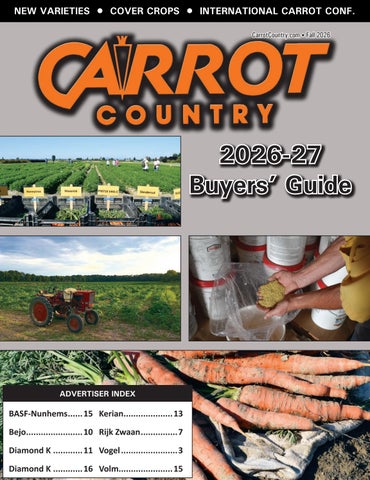
International Carrot Conference attendees check out a field trial featuring more than 100 carrot varieties. Find out what themes emerged during the conference on pages 8-9. Photo courtesy Jaspreet Sidhu, University of California Cooperative Extension
2
On the Cover
DEPARTMENTS
From seed to storage, Carrot Country’s 2026-27 Buyers’ Guide provides a list of vendors to help make the season a success. Check out this handy resource on pages 4-6.
7 New Products 14 In the News 14 Calendar 14 Advertiser Index
Carrot Country • Fall 2026
Email address changes/corrections to brian@ColumbiaMediaGroup.com or mail to: Carrot Country PO Box 333 Roberts, ID 83444
Carrot Country magazine (ISSN 1071-6653), is published four times a year and mailed under a standard rate mailing permit at Idaho Falls, Idaho and at additional mailing offices. Produced by Columbia Media Group PO Box 333, Roberts, ID, 83444 Copyright 2026. All rights reserved. No part of this publication may be reproduced or transmitted in any form or by any means, electronic or mechanical, for any purpose without the express written permission of Columbia Media Group.
New! Extreme Super Cleaning System 3 to 4 times better cleaning than any other system
Custom Built Harvesting Equipment Carrots — Pickles
We offer a computer (digital processor) individual row head height system 2, 3, 4, 6 & 8 Rows Conventional Roller Bar or High Speed Crowning. Precision Computer Controlled Planting Population Systems
LEADER IN CARROT HARVESTING TECHNOLOGY BUILT IN THE U.S.A. HE BESt t d l i u WE B rESt! E H t x i and f
For More Information Phone:
(231) 821-2125 Between 7 a.m. and 5:30 p.m. EST ask for Wayne fax (231) 821-0275
www.vogel-engineering.com
2026-27
Buyers’ Guide T
here are a lot of moving parts involved in growing and marketing a carrot crop - from needing the right products to protect your crop from pests and pathogens to having the right equipment to efficiently navigate the season. For most growers, packers and shippers, this translates into a constant to-do list, shopping list and wish list. Here are some resources to help you enjoy a successful season, from seed to storage.
CROP INPUTS Diamond K
diamondkgypsum.com/newproducts/
Now, introducing seven new watersaving products, including prilled gypsum, microalgae, soil wetting agents and humic acid.
Gowan Company gowanco.com (800) 883-1844
Reason 500 SC fungicide, Badge X2 fungicide/bactericide, EcoSwing botanical fungicide, M-Pede insecticide/miticide/ fungicide, Previsto fungicide/bactericide
4
Carrot Country • Fall 2026
redox
redoxgrows.com (208) 678-2610 Redox Bio-nutrients
VIVE
vivecrop.com (888) 760-0187
AZterknot and AZteroid FC fungicides, Viloprid FC insecticide
Harvest dewulf
dewulfgroup.com 32 51 20 58 71
Dewulf Zkivse Self-Propelled 4-Row Carrot Harvester
Univerco
univerco.com (450) 245-7152
Mini-Veg, G4-Pro, Mac II (carrot harvesters) Univerco has been building carrot harvesters since 1978 and is now offering a complete range of harvesters from the smaller 1-row machines that will fit on 60 HP tractors all the way up to multi-row self-propelled and everything in between. A solution for root crops production in any soil type, weather conditions or volume.
Vogel Engineering vogel-engineering.com (231) 821-2125
Computer individual row head height system, 2,3,4,6 & 8 rows conventional roller bar or high-speed crowing, precision computer controlled planting population systems
Packing & Processing Kerian Machines Inc. kerian.com 1709 Hwy 81 S, PO Box 311 Grafton, ND USA 58237 (701) 352-0480 sales@kerian.com Kerian Speed Sizer
Packing & Processing Volm Companies volmcompanies.com Antigo, WI (Corporate Headquarters) 1804 Edison St., Antigo, WI 54409 (800) 253-4737 Idaho Falls, ID 3721 W 65th South Idaho Falls, ID 83402 (208) 524-0600 Pasco, WA 5702 Industrial Way Suite 101 Pasco, WA 99301 (509) 547-3437 Fresno, CA 3440 S East Ave. Suite 104 Fresno, CA 93725 (800) 253-4737 Monte Vista, CO 1100 S Country Rd. 3 E Monte Vista, CO 81144 (800) 253-4737 Brantford, Canada 173 Garden Ave Brantford, Ontario N3S 0A7 (905) 648-7300
Planting Gearmore, Inc. gearmore.com 13477 Benson Ave. Chino, CA 91710 (800) 833-3023 sales@gearmore.com
Monosem Inc.
monosem-inc.com 1001 Blake St. Edwardsville, KS 66111 (913) 438-1700 Custom planters built-to-order
CarrotCountry.com
5
Seed Bejo Seeds bejoseeds.com (805) 473-2199 Carrot seed
Seed Stokes Seeds, Inc. stokeseeds.com 13031 Reflections Dr. Holland, MI 49424 (800) 962-4999 Carrot seed
Storage Germains Seed Technology germains.com (408) 848-8120 Jeff Fletcher (979) 481-0037 jfletcher@germains.com Seed treatments
Nunhems - BASF nunhems.com
For more than 50 years, BASF’s vegetable seed business has been breeding high-quality carrots that offer increased yield potential, disease resistance, great taste and high nutritional value.
Rijk Zwaan
rijkzwaanusa.com (831) 455-3000 (US Office)
Ymer RZ and Jerada RZ (carrot varieties)
6
Carrot Country • Fall 2026
Agri-Stor
agri-stor.com (208) 733-7000
Humidification, Refrigeration, Ventilation, Controls, Post-Harvest
Harvest More Jerada RZ Delivers Jerada RZ is an early Nantes hybrid for fresh cello, processing and bunching. Jerada RZ has an average of 90 growing days to reach full blunt shape and offers great uniformity, foliage health and taste. This early variety is high yielding and has long field standability. • Early high yielding variety • High uniformity in roots • Strong, mid-dark green and upright foliage • Smooth skin • Excellent for bunching and fresh markets www.rijkzwaanusa.com
New Products
Ecorobotix Introduces New Sprayer
Ecorobotix has rolled out a new model of its flagship ARA Ultra-High Precision Sprayer. This model, the ARA595, is designed for 80-inch beds with aboveground side sprinklers, commonly used in California and Arizona. The new model is slightly smaller than the ARA600 and ARA620 so that it fits between the sprinklers, and it has an arm that guides the sprinkler nozzles away from the machine as it passes. The ARA595 features a working width of 19.7 feet and driving speed of up to 4.5 mph, covering up to 10 acres per hour. Through the use of AI, the sprayer differentiates crops from weeds and applies crop protection products and fertilizers only where needed, reducing input costs by up to 95%, according to the company. Visit ecorobotix.com.
Diamond K Debuts Pair of Prilled Gypsum Products
Diamond K Gypsum’s new product lineup includes Diamond K Premium Prill Gypsum and Diamond K Premium Prill Gypsum HA with humic acid. The spreadable pelletized gypsum products are designed to improve soil structure, water infiltration, nutrient efficiency, and ease of application and blending. In addition, Premium Prill Gypsum is engineered to reduce sodium stress, soil crusting, compaction and runoff, allowing for more uniform wetting and deeper water penetration into the root zone. Premium Prill Gypsum HA is formulated to address high pH calcareous soils, salinity, drought and low organic matter. Both products can be applied pre-plant, in-season, post-harvest or as part of a longterm soil improvement program. Visit diamondkgypsum.com/new-products.
CarrotCountry.com
7
International Carrot Conference Highlights Innovation, Collaboration and the Future of the Crop Story and photos by Eric Woolson
T
he 42nd International Carrot Conference brought 131 carrot industry stakeholders from 10 countries to Bakersfield, California, June 2-3, underscoring both the global importance of the crop and the increasingly collaborative effort required to advance carrot production. The event featured two days of scientific presentations, field tours and industry discussions focused on the future of carrots. The program included oral presentations and 48 poster presentations highlighting advances in breeding, nutrition, genetics and crop management, while attendees also toured a carrot processing facility and evaluated field trials featuring hundreds of carrot varieties and breeding lines. One of the conference’s centerpieces was a conventional variety trial containing 153 entries spanning seven market classes, including cello, cut-and-peel, processing and specialty colored carrots. Participants also evaluated an Alternaria disease trial containing 117 entries from public and private breeding programs as well as the USDA germplasm repository. According to Jaspreet Sidhu, vegetable
crops advisor with the University of California Cooperative Extension in Kern County, who organized the conference, several themes emerged throughout the conference, including advances in nutritional quality, molecular breeding tools and improved strategies for managing diseases, insects, weeds and nematodes. Researchers also highlighted breeding strategies designed to improve tolerance to drought and environmental stress, challenges that are becoming increasingly important in carrot-growing regions around the world. Industry presentations introduced new crop protection technologies and a new nematode-resistant carrot variety, Percyst, released through BASF’s Nunhems vegetable seed business.
Practical Recommendations
Leonel Jimenez, director of the University of California Cooperative Extension in Kern County, said the conference reinforced both the global reach of the carrot industry and the importance of translating research into practical recommendations growers can use. Born and raised in California’s Central
During a break between presentations at the International Carrot Conference, Emily Florin, a graduate student at the University of Wisconsin-Madison, discusses details of a study that she conducted with professors Irwin Goldman and Patrick Krysan.
8
Carrot Country • Fall 2026
Valley, Jimenez said he was surprised by the number of countries represented at the conference and by the international attention focused on Kern County. “When you hear that California produces roughly 70 percent of the nation’s carrots, and then you meet people from Japan, Australia, Canada, Turkey and Poland who are all coming together around this crop, it really puts things into perspective,” he said. Jimenez said Kern County’s extreme growing conditions make it an ideal location for evaluating new varieties and production practices. “If a variety can perform under these conditions, it often performs even better in regions with milder environments,” he said. He said the conference also provided an opportunity to share the critical role that the cooperative extension system plays in turning highly technical research into useful information for growers. “Our job is to extend knowledge and remove the scientific jargon that farmers don’t need,” Jimenez said. “Growers want to know which varieties work, what management practices they should use and how they can improve yield and profitability.”
Genetics Research
For University of Wisconsin-Madison plant breeding and plant genetics doctoral student Avelina Gaston, one of the most exciting presentations involved research occurring just down the hall from her own laboratory. Gaston pointed to work by visiting scientist Gunay Yildiz, who validated a carrot gene-editing protocol and confirmed the role of a gene associated with reducing sugar content, an important component of carrot flavor. “The protocol for gene editing also shows promise for future genetics research in carrot and related crops,” Gaston said. Equally important, she said, were the conversations that occurred between
researchers and growers. As a researcher studying carrot texture genetics, Gaston said discussions about production challenges such as disease pressure and root cracking may directly influence future research projects. “The whole point of holding these conferences is to connect players across the carrot industry,” she said. “The most impactful research often begins with listening to the needs of growers.”
Plant Breeding
That connection between science and practical production was also evident to first-time attendee Zephyr Papin-Tillery, a field solutions specialist and regulatory affairs manager with Lallemand Plant Care, a company that provides microbial products meant to enhance plant health and productivity. Papin-Tillery, whose company collaborates with Sidhu on nematode and cavity spot research, said the conference provided valuable opportunities to connect with researchers, students and industry leaders while staying current on the newest developments affecting carrot production. One of the strongest messages she took away from the meeting was the importance of plant breeding to the industry’s future. Field tours showcasing hundreds of breeding lines allowed participants to evaluate varieties firsthand by examining root quality, harvestability and flavor. “Going out there and tasting the carrots in the field and seeing their pros and cons firsthand was really valuable,” said PapinTillery, whose favorite variety based on flavor was named Pink Punk. Papin-Tillery was particularly intrigued by research showing how consumer preferences have shaped carrot breeding over the past several decades. As breeders selected for deeper and more vibrant orange colors that consumers preferred, they unintentionally increased concentrations of pigments associated with health benefits. “Something the market wanted also ended up making the carrot healthier,” she said. Papin-Tillery also believes biological crop protection products will play a larger role in carrot production in the future, particularly as regulatory restrictions reduce the availability of traditional chemistries. Microbial products, she said, can
complement conventional crop protection programs while helping growers manage resistance and preserve the effectiveness of existing tools.
Bolthouse Tour
While every participant had an opportunity to visit the field trials and evaluate varieties firsthand, a smaller group was also treated to a tour of the Bolthouse Fresh Foods processing facility for a rare look at the scale and sophistication behind one of the nation’s most recognizable carrot brands. The Bakersfield-based company, which employs approximately 1,600 people in the region, is one of North America’s largest growers and distributors of fresh carrots and has played a major role in the development
and popularization of baby carrots and value-added carrot products. One recent innovation is the individual-serving size “Carrot Shakers” with dill pickle, spicy chili lime and zesty ranch. Inside the facility, visitors watched highly automated processing lines use cameras, scanners and computerized sorting systems to inspect carrots for size, shape and quality before directing them to their final destination as whole carrots, cut-and-peel products or baby carrots. The tour also offered a reminder that modern carrot production extends far beyond the field, relying on sophisticated engineering and logistics systems capable of processing thousands of cases of carrots every hour while maintaining the quality and consistency consumers expect.
Carrot industry professionals, representing 131 carrot industry stakeholders from 10 countries, survey varieties in field trials near Bakersfield, Calif., the site of the 42nd International Carrot Conference.
CarrotCountry.com
9
New Breeding Lines Offer Nematode Resistance By Philipp Simon, USDA-ARS
T
wo new nematode-resistant carrot breeding lines, Nb2159 and Nb3271, have been released by the USDA-ARS jointly with the California Agricultural Experiment Station and the Organic Seed Alliance. Nb2159 and Nb3271were among the carrot lines derived from a cross between BR 1252, a M. javanica-resistant population of Brasilia, and B6274, a smooth, mild-flavored Nantes style nematode-susceptible USDA inbred. These two inbreds were derived from two different F2 plants from this cross that were selected in University of CaliforniaRiverside fields infested with M. incognita at the Coachella Valley Agricultural Research Station, Kearney Agricultural Research and Extension Center, and South Coast Research and Extension Center for resistance over several years. They were also selected for horticultural quality including mild, sweet
flavor and high carotene content at the University of California Desert Research and Extension Center (UC-DREC). Hybrids between both of these inbreds and several unrelated nematode-susceptible and other nematode-resistant USDA seed parents had resistance scores from 0 to 2.5 on the 0-8 scale for root-galling when grown in the Coachella field site, suggesting partially dominant nematode resistance. These hybrids also performed well in field trials at UC-DREC based on horticultural quality, appearance and uniformity in comparison to leading commercial cultivars. Seed of Nb2159 and Nb3271 is available for research purposes, including development and commercial production of new cultivars, from the National Plant Germplasm System. Nb3271 (left) and Nb2159 (right) are two new nematode-resistant carrot breeding lines released by the USDA-ARS, along with the California Agricultural Experiment Station and the Organic Seed Alliance. Seed is available for research purposes.
BEJO CARROTS
STANDOUT VARIETIES � Imperator, Cello
� Berlicum
ISTANBUL F1
BELFAST F1 (BEJO 3497)
Very strong, healthy tops with good bolt tolerance. Long, slightly tapered root. High quality internals with dark orange color. Imperator type with strong tops. Well adapted with good performance on both muck and mineral soils. u
IR: Ad/Ar/Cc
u NEW
Refined Berlicum with excellent length and improved green shoulder. Can be used at high density for slicing or lower density for Jumbo. Good bolting tolerance! u
IR: Cc/Ps/Pv
� Continental Nantes
� Imperator, Cut & Peel
� Imperator, Cello
NAVEDO F1
PITTSBURG F1
JUNCTION F1
Excellent multi-use Nantes! Very long cylindrical shape with good early season bulk. Processing slicer or fresh market cello/ jumbo carrot. Provides extra length in marginal ground or growing conditions.
A good yield, well suited for the cut and peel industry. This variety is adaptable to different areas, with decent tops, and uniformity in shape. 12”-13” smooth roots, harvest friendly variety!
Widely accepted, Cello type with the strength and vigor of an imperator. Straight and slightly tapered roots with dark orange color and no green shoulder.
u
u
IR: Ar/Cc
u
IR: Ad/Ar/Cc/Ps/Pv
IR: Ar
Bejo USA & Canada | 1972 Silver Spur Place | Oceano, CA | 93445 | T (805)473 - 2199 | E info@bejoseeds.com This information has been compiled with care. The data is from our own trials and commercial practice and is to be used for guidance only; it must be interpreted at ones’ own discretion. No rights can be derived from the information given. For the most up-to-date resistaces of varieties, please see the assortment on our website bejoseeds.com.
10
Carrot Country • Fall 2026
Improve Water Efficiency, Unlock Nutrient Mobility —By Tom Tankersley, Sales Manager, Diamond K Gypsum
Diamond K Premium Prill Gypsum™ Gypsum Purity Comparison
NEW Diamond K Premium Prill Gypsum™ and NEW Premium Prill Gypsum HA™ with Humic Acid offer growers a strategic tool for soil amendments and enhances ROI. Unlocks Nutrient Mobility: 21% Ca improves soil structure and root growth to tap water-soluble N and K reserves. Increases Nitrogen Use Efficiency: 17% S alleviates deficiencies in Western soils. Maintains yield with lower N inputs. Reduces Sulfate Needs: High S content helps reduce AMS applications. Improves N efficiency when S and N are balanced. Mines Native Phosphorus: Unlocks P tied up as calcium phosphate compounds. Makes P more available to crops.
Loosens Compacted Soils: Increases air and water movement. Displaces Na below root zone for deeper roots. Naturally Occurring Trace Silica (less than .1%): Improves cell wall strength, stress tolerance and drought resistance. Lignosulfonate Binder: Stimulates beneficial microbial nutrient cycling, and improves nutrient chelation.
Precise Nutrient Delivery: Blends evenly with other prilled nutrients as a top-dress or in-furrow, pre-, in-, or post-season.
92% Purity: Means more active ingredient per ton, with less inert material. Dihydrate, Not Anhydrite: Naturally mined and highly soluble, its two water molecules deliver faster dissolution. Fast Acting: Highest solubility rate of any mined gypsum product.
Saves Water: Increased water infiltration reduces irrigation sets, costs and runoff.
Better Gypsum. Better Water.
Premium Prill Gypsum HA combines Diamond K’s new humic acid, derived from fresh water and processed at low temperatures to preserve more humic compounds. This creates a powerful mix of Ca, S, and humic substances. Call Tom Tankersley: (208) 570-1430 Email: tom@diamondkgypsum.com
Better Soil. Better Results.
Learn more— Contact your territory manager, or visit: www.diamondkgypsum/new-products/ Diamond K Gypsum • 435.896.8870 • 1720 South Red Hills Drive, Richfield, Utah 84701
Researchers Study Cover Crop Strategies By John O'Connell, University of Idaho
A
recent University of Idaho-led study conducted in collaboration with regional dryland wheat farmers provides guidance on when to terminate a springplanted cover crop. Cover crops, which are grown primarily to benefit soil health and fertility rather than for commercial sale, are becoming increasingly common on northern Idaho and eastern Washington farms. However, little research has explored how they perform in local growing conditions and cropping systems. Producers and researchers involved in U of I’s three-year study called the Pacific Northwest Cover Crop Decision Aid System (PaNDAS) evaluated how cover crops with varying species diversity affected soil moisture, as well as nitrogen and carbon levels, when killed at three different growth stages. The farmers and scientists agreed that terminating cover crops in early to midbloom stages – which generally occur from late June through the first week
of July depending on water availability – struck the right balance between maximizing soil health benefits and minimizing water consumption. The early-season termination date in low-precipitation areas, which occurred in early June, provided insufficient time for cover crops to make an impact. The late-season date, which occurred when seed pods started filling, around midJuly, used too much water to justify the additional cover crop growth in the study’s driest growing areas. In growing areas with heavier precipitation totals, the ideal termination date was closer to full bloom. By the late-season termination date, farmers in wetter growing areas were concerned that some cover crop seeds had reached maturity and posed a threat of emerging as volunteers in subsequent commercial crops. “It’s a tremendous amount of new information we obtained in partnership with eight producers, who were co-principal investigators,” said
Sanford Eigenbrode, a distinguished professor emeritus in the Department of Entomology, Plant Pathology and Nematology, who was part of the PaNDAS research team. “All of our producers want to keep going with this research. They want to learn more because they really enjoyed this experiment, they enjoyed the experience of collaborating with us, and they learned things.”
Trial Design
Farmers operating in three different rainfall zones in Genesee and Troy in Idaho, as well as Cloverland, St. John, Uniontown and Palouse in Washington – receiving annual precipitation of 10-12 inches, 14-18 inches or 18-22 inches – devoted 6 acres each toward replicated cover crop trials. Trials, which were conducted in 2023 and 2024, compared a low-diversity mix containing a brassica, a grass and a legume against a high-diversity mix with three species from each genus. They also compared cover crop performance when
University of Idaho staff, undergraduate and graduate researchers involved in a cover crop research project collect cover crop biomass samples from research trials on a commercial field in Genesee, Idaho.
12
Carrot Country • Fall 2026
terminating them in the early, mid and late season. “We measured how much biomass cover crops produced and how much nitrogen and carbon were stored in that plant material,” said Kendall Kahl, a PaNDAS team member who is an assistant professor in the Department of Soil and Water Systems. “We also measured soil nitrogen during the cover crop year and then again every six months for the next year and a half to see if we could measure some of that nitrogen from cover crops in the soil.” Cover crops replaced garbanzo beans in the crop rotation on farms in the wetter regions and were planted in place of summer fallow in the dry areas. Farmers planted winter wheat following cover crops.
Research Findings
The researchers found cover crops in all scenarios were effective at recapturing nitrogen that would have otherwise leached from fields, bringing it to the surface to slowly decompose over six
months to two years, depending on conditions, and eventually become available for use by commercial crops. “In our high-rainfall areas, those cover crops are holding about 70 pounds of nitrogen per acre in plant material that will become available at some point,” Kahl said. “In our drier areas, we are seeing 45 to 50 pounds per acre of nitrogen in that cover crop biomass. The question is when will it break down and show up in the soil?” The second termination date also resulted in the ideal carbon-to-nitrogen balance in the cover crop biomass for soil microbes to convert organic nitrogen from cover crop foliage into inorganic forms accessible by commercial crops. Species diversity seemed to have no effect on nutrient cycling and soil water availability, though high-diversity mixes attracted a much greater diversity of insects. “If you’re concerned about the cost of doing cover crops, I think this research shows that choosing a simple, less expensive mix will still give you a similar
benefit in terms of nitrogen,” Kahl said. The researchers saw no yield gains following cover crops in any of their management approaches, but they believe that winter wheat yields could increase with a longer study. “The cover crops use a little bit more water than what you are going to lose in fallow, but you get a significant amount of carbon and nitrogen and potentially other soil benefits from growing the cover crop,” Kahl said. “We hope to continue this study to look more closely at how our cover crop management strategies impact soil health – in particular our soil arthropod and microbial populations, which the growers we’re partnering with are interested to learn more about.” Author’s note: PaNDAS was funded with a three-year, $350,000 grant from U.S. Department of Agriculture Western Sustainable Agriculture Research and Education, of which 100% was the federal share, under award number SW22-940.
Sort Carrots by Size with No Labor Costs Fast Gentle Rugged Accurate Affordable Kerian Machines, Inc. PO Box 311 • Grafton, ND 58237 701-352-0480 sales@kerian.com | kerian.com CarrotCountry.com
13
CALENDAR
Advertiser Index
Nov. 18-19
BASF-Nunhems........................... 15
Three Rivers Convention Center Kennewick, Wash. Sheri Nolan, (509) 585-5460 or www.pnva.org
Bejo............................................ 10
Pacific Northwest Vegetable Association Conference and Trade Show
Nov. 26
Diamond K................................. 11
UK Onion and Carrot Conference Leicester Tigers Conference Centre Leicester, England www.onionandcarrotconference.co.uk
Diamond K................................. 16
Dec. 8-10
Kerian......................................... 13
Great Lakes Fruit, Vegetable and Farm Market Expo DeVos Place Conference Center Grand Rapids, Mich. www.glexpo.com
Editor’s note: To have your event listed, please email Denise Keller at editor@columbiamediagroup.com. Please send your information 90 days in advance.
Rijk Zwaan.................................... 7 Vogel............................................ 3 Volm.......................................... 15
in the news
Redox Expands Research Team
Redox Bio-Nutrients has welcomed formulation scientist Karthik Mani to the research team at the company’s Burley, Idaho, headquarters. His primary focus areas will be integrating bioactive components from diverse biostimulant sources and advancing their impact in modern cropping systems. Mani has a Ph.D. in chemistry and brings more than 13 years of experience in organic chemistry, biomaterials and nano-enabled formulation technologies. He joins Redox following a postdoctoral appointment at North Carolina State University.
14
Carrot Country • Fall 2026
Agri-Stor Adds Two to the Team
Jose “JJ” Moreno and Kelley Golay have joined Agri-Stor Companies to sell post-harvest storage solutions for potatoes, onions and other produce. Jose “JJ” Moreno Moreno has worked at the company’s Warden, Washington, location as a service technician since July 2025 and is now working as an account manager. He has experience in potato storages, as well as mechanical and equipment knowledge. Golay is a new account manager Kelley Golay at Agri-Stor’s Twin Falls, Idaho, location. His experience in agriculture comes from growing up on a family farm in southern Idaho. He also worked for 15 years as a field rep in the garden bean business and holds agri-business and master of business administration degrees.
0925 Carrot Country .5 Page.v1.pdf
1
2026-08-04
1:08 pm
Built to be Better
Our Carrots Are Bred to Perform Whether the focus is on disease resistance, difficult growing conditions, consumer preferences or something else altogether, our team is 100% focused on breeding the best seeds in the industry.
Visit nunhems.com for more information.
Individual results may vary. ©Nunhems USA, Inc. 2025. All Rights Reserved.
CarrotCountry.com
15
Get More. Save More. Build Better Ca and S Reserves for Your Carrots.
NEW PREMIUM PRILL GYPSUM™ 420 lbs Ca/340 lbs S per ton
New
NEW PREMIUM PRILL GYPSUM HA™ 400 lbs Ca/320 lbs S per ton
S AV E H U N D R E D S O F $ P E R TO N O N S CO M PA R E D TO OT H E R P R O D U C T S Introducing new Diamond K Premium Prill Gypsum and Diamond K Premium Prill Gypsum HA, Both products give you the highest level of purity and solubility for immediate crop availability of Ca and S. Premium Prill HA features a new humic acid derived from fresh water sources that is processed at low temperatures to preserve more humic compounds. Key Benefits Include: • Rapidly dissolves for crop availability
• Reclaims sodic soils by displacing Na ions
• Ca is the building block for healthy plant/soil
• Naturally occurring trace silica reduces crop stress
• S unlocks nutrients and improves growth
• Lignosulfonate binder rich in C and natural sugars
• Improves soil structure, saves water
• Engineered for precision field placement
Better Gypsum. Better Water.
Better Soil. Better Results.
Learn more— Contact your territory manager, or visit: www.diamondkgypsum/new-products/ Diamond K Gypsum • 435.896.8870 • 1720 South Red Hills Drive, Richfield, Utah 84701