THE COLUMBIA JOURNAL
OF LITERARY CRITICISM ISSUE
XXII SPRING 2025
Columbia Journal of Literary Criticism, 2025. All rights reserved.
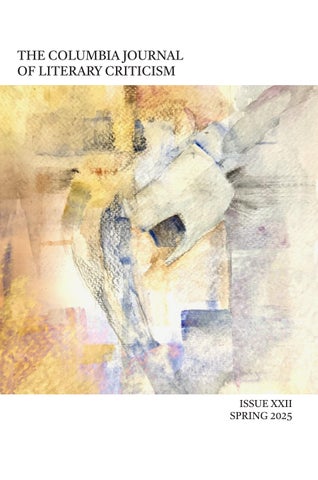
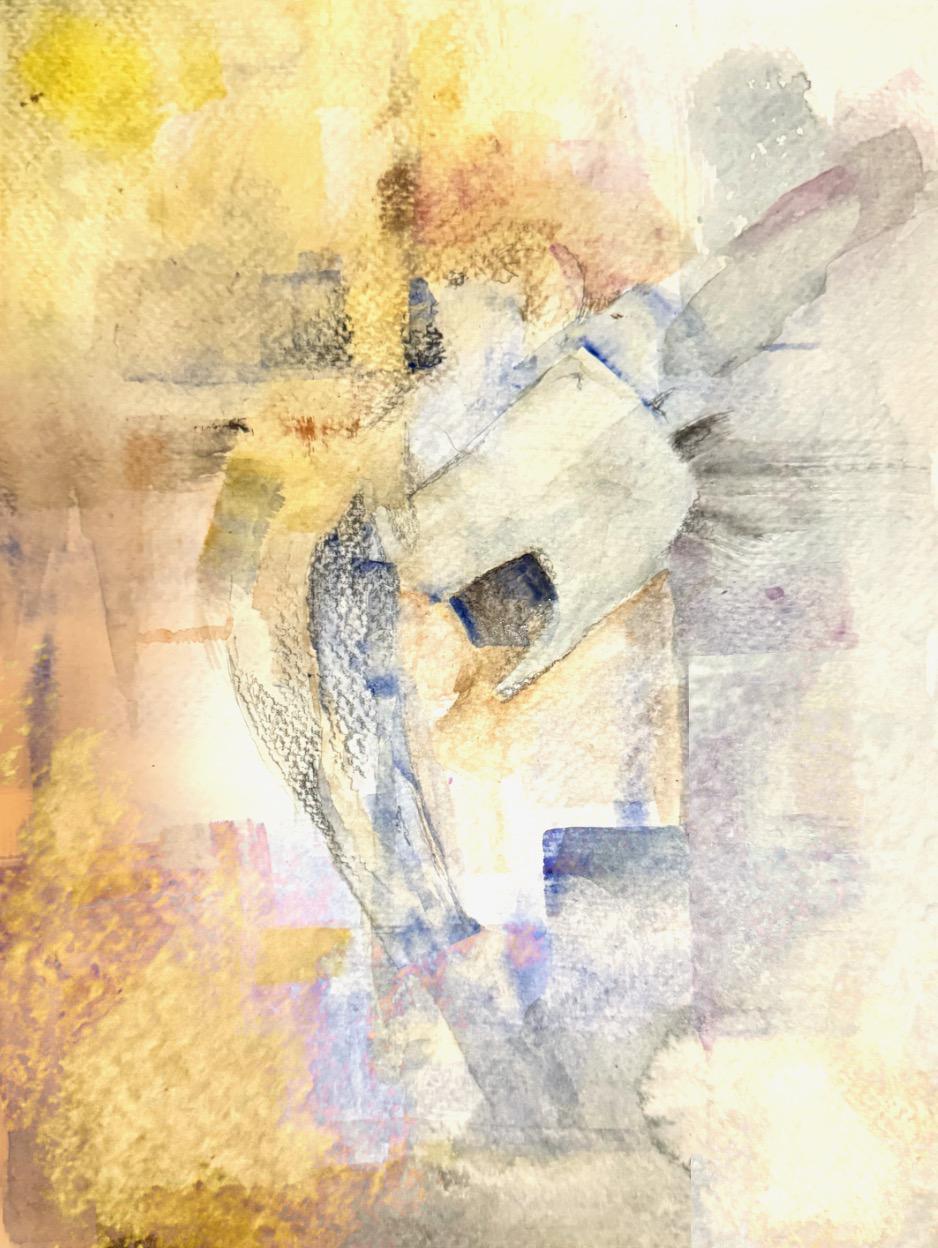
Cover Artwork:
JRob Goffstein, Morning Bird, Watercolor on Paper, 2025.
Layout by Oliver Rice.
Columbia Journal of Literary Criticism
c/o Columbia University Department of English 602 Philosophy Hall, MC4927 1150 Amsterdam Ave
New York, NY 10027
Trompe-l’œil
Masthead
Editors-in-Chief
Olivia Bulis
Anika Strite
Fenris Zimmer
Managing Editor
Reviews Editor
Interviews Editor
Events and Growth Coordinator
Art Editor
Web Developer and Editor
Director of Photography
Staff Editors
Josephine O'Brien
Zelia Lerch
Eve Rosenblum
Rosemary Ho
JRob Goffstein
Andrea De Bedout
Cole Gabriel Willis
Leyee Dai
Blaise Dalton
Lola Krivosic
Alanisse Pineda
Marco Rios
Noa Shmueli
Lucia Tian
Gabriel Tramontana
Editors-in-Chief Emeritae
Lulu Fleming-Benite
Lucia Cao
Sound and Vision: On the Fallibility of Images in John Lydgate’s The Temple of Glas
Representing the Real: Dante, Lacan, and the Pursuit of the Impossible
Veils of Representation: Illusion and Truth in Classical and Contemporary Journeys to the West Poetic Mysticisms: The Zohar and the Sestina Memory, Image, Simulacrum: A Letter from Sans Soleil (1983) to
Letter from the Editors
Dear Reader,
Welcome to the twenty-second annual edition of The Columbia Journal of Literary Criticism. This year’s issue is inspired by the idea of Trompe-l’œil—that of deceiving the eye. Originally a concept in painting, Trompe-l’œil describes the point at which a piece of art is able to mirror reality so effectively that it tricks the onlooker entirely. This theme was selected because it evokes a number of noteworthy topics in literary criticism—calling attention to the distinctions one instinctively makes between reality and appearance, fact and fiction, the original and the copy. Literature lies between and beyond these divisions; it thrives in the tension and ambiguity they produce.
We live in an age of deception, one that eludes containment and challenges the very structures upon which we rest. It would be remiss not to take note of the current historical moment—one of intense uncertainty and deceit, and one in which the foundations of academic liberty are under threat. Literature possesses a unique ability to cut through deception at the same time as it participates in its own varieties of trickery. Criticism coaxes the essential tendencies and relations out of a work of literature—it juices each piece of writing for everything it holds, and disseminates its most salient insights.
The Columbia Journal of Literary Criticism was established in 2002 by undergraduates in Columbia University’s Department of English and Comparative Literature. In the two decades since its inception, it has continued to operate as a peer-edited journal devoted to publishing rigorous works of undergraduate scholarship, and has provided an important forum for interdisciplinary critique. We are proud to present to you the culmination of a year of meticulous work, during which the Journal has devoted itself to producing a publication that reflects its legacy, and the time-honoured spirit of academic discourse. This issue contains five works of literary criticism written by undergraduate students at Columbia and beyond. These essays explore an array of different works, from John Lydgate’s Temple of Glas to Chris Marker’s Sans Soleil. They discuss the role of illusion in religious texts; the limits and indeterminacy of language; the power of
the image; the texture of love; and much more. This publication would not have been possible without the support of the Department of English and Comparative Literature and the valuable guidance of our journal’s faculty advisor, Professor Nicholas Dames. We would also like to extend our immense gratitude to the CJLC Editorial board for all of their hard work and dedication—they are, after all, the heart of our journal.
In preparing this issue we attended to thinking not only about the content, but the form, shape, and texture of what you now hold in your hands. We hope that cracks soon run down its spine in the places you continue to return to—that its corners become earmarked with pages that pierce your readerly experience. This issue is small enough to fit in your pocket and can be held with one hand while standing in a crowded subway car. Amid the raucous noise of life, we hope it keeps you company as you wrestle with love, or sit with pain, or relish in delight as you find yourself laying in bed, watching the morning light dance upon your wall.
Sincerely,
Olivia Bulis, Anika Strite, and Fenris Zimmer Editors-in-Chief, The Columbia Journal of Literary Criticism
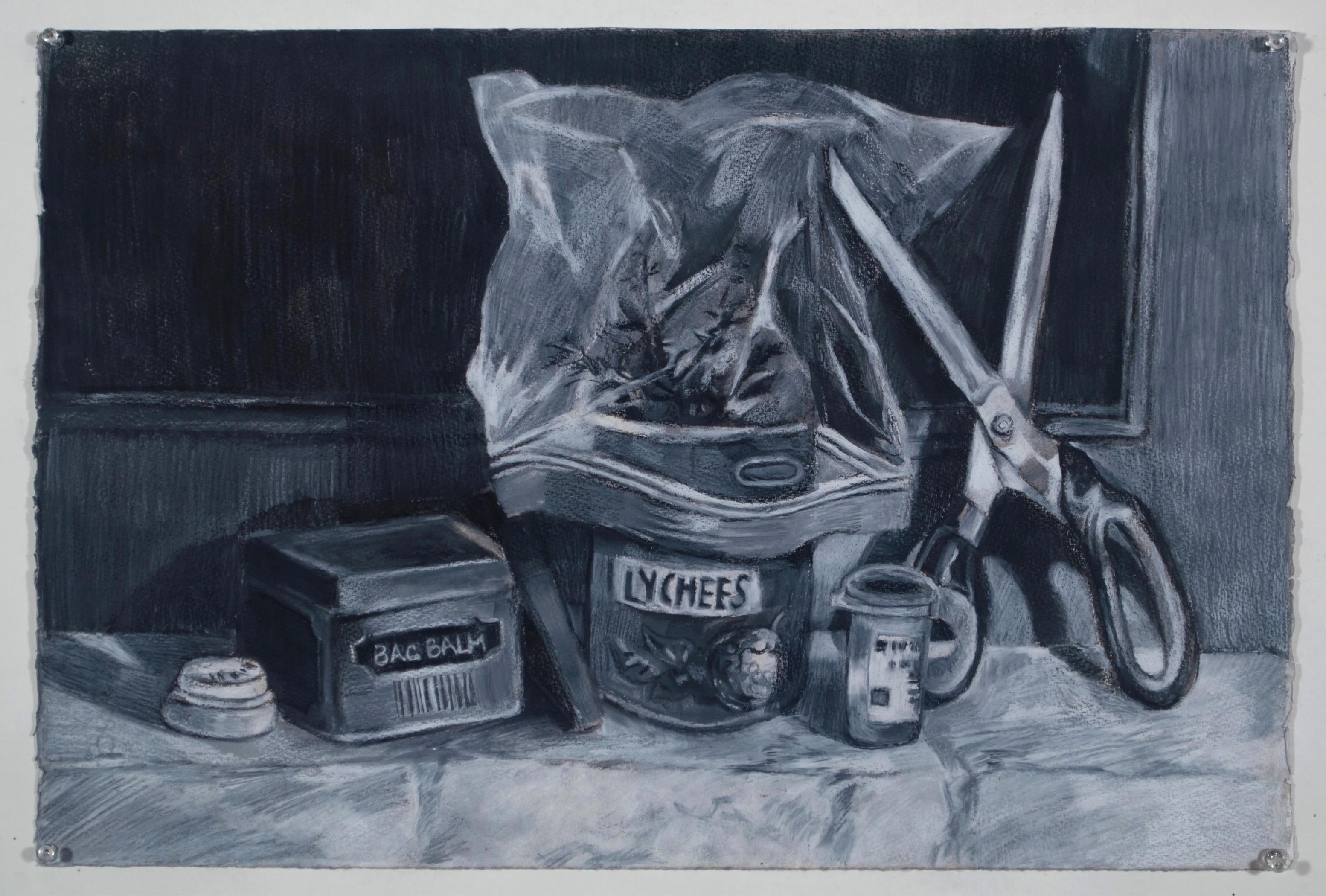
Lily Yanagimoto, Opening Up, 2025, crayon on paper.
Sound and Vision: On the Fallibility of Images in John Lydgate’s The Temple of Glas Jacob Sponga
In John Lydgate’s fifteenth-century dream poem, The Temple of Glas, the dreamer details his trip to a fantastical temple pitched on a bluff of ice and dedicated to Venus, goddess of erotic love. From the outset, the temple commands the dreamer’s visual attention, emitting a piercing light that initially blinds him to his surroundings; when the dreamer later finds a way inside, he begins a rich ekphrasis of the scores of painted figures who decorate the temple’s glass walls—a frieze of lovers culled from antiquity and Chaucerian myth. The placidity of these visuals, however, cannot distract Lydgate’s dreamer from the raucous noise made by the temple’s congregants—the space teems with lovers who are “[i]n sondri wise redi to complein”1 about their romantic misfortunes to Venus, so rowdy as “[t] o bronte and showe”2 one another as they proffer their petitions to the goddess.
At first glance, Lydgate’s poem seems to enact a tidy contrast— opportune for analysis—between the seen and the heard and their different textual mediums: the seen manifested through ekphrasis, the heard through bouts of near-onomatopoeia. To pursue this line of inquiry and thus reify the apparent contrast, however, is simply to default, as Andrew James Johnston et al. describe, to a view of the Middle Ages and medieval literature as abetting “the rise of Western modernity and the entrenchment of the verbal-visual binary,” a position troublingly “dependent on modernity’s self image.”3 Taking a cue from this recent work on medieval ekphrasis, this essay seeks not to conform Lydgate’s poem to narratives about modernity, but instead to approach its rich engagement of sound and vision on its own terms. Not relegating Lydgate’s text to a perfunctory reading about the
1 John Lydgate, The Temple of Glas, ed. J. Allan Mitchell. (Kalamazoo: Medieval Institute Publications, 2007), line 145.
2 Lydgate, The Temple of Glas, line 534
3 Andrew James Johnston, “Introduction: The Dynamics of Ekphrasis,” in The Art of Vision: Ekphrasis in Medieval Literature and Culture, ed. Andrew James Johnston, Ethan Knapp, and Margitta Rouse (Columbus: Ohio State University Press, 2015), 7.
enactment of the “verbal-visual binary,” I instead argue that Lydgate’s poem posits an inadequacy in what Boyda Johnstone calls the “affective engagement” of visual art, one that is only amended through a careful reintroduction of sound, demonstrated in the decorous criteria for amatory success performed by the lady within the temple. In recommending the reader supplement the superficiality of visual art through a conscious engagement of sound, Lydgate articulates a complex sensorial relationship between the two that problematizes dominant scholarly narratives about the seen and the heard in the Middle Ages.
While Venus’s temple, with its glass walls and brilliant light, seems to ally itself with sight, few of the painted figures whom the dreamer describes upon his entrance to the temple have romantic success; all the classical figures, in fact, are frozen in woe. Dido, legendary Queen of Carthage, laments “[h]ou she deceived was of Eneas”; Adonis complains about “hou the bore him slough”; and Alcestis grieves “for Admete hou she lost hir life.”4 Yet within this array of famous lovers (Johnstone counts twenty-two named), there are three outliers who make no petition to Venus upon the wall. Chaucer’s Canacee does not exhibit any suffering, content in her depiction which shows her use of the magic ring that lent her the ability to speak with animals.5 Likewise, Philology, a classical character from a prosimetrum by Martianus Capella, is peacefully honored :
Hou that she for hir sapience
Iweddit was to god of eloquence [Mercury], And hou the Musis lowli did obeie, High into heven this ladi to convei…6
This reward for sapience and eloquence recalls the third lover painted on the wall who is without complaint. Griselda, another character from Chaucer, is depicted as perfectly content, exhibiting only her “innocence, / And all hir mekenes and hir pacience.”7 Here, Griselda’s epithets emphasizing her etiquette and cultivation echo Chaucer’s description of her virtue, in “The Clerk’s Tale,” as “so discreet and fair of eloquence.”8 This, along with Venus’s celebration of Canacee and Philology for their gifts of speech, foreshadows
4 Lydgate, The Temple of Glas, lines 58, 65, 72.
5 Lydgate, The Temple of Glas, lines 138-139.
6 Lydgate, The Temple of Glas, lines 131-134.
7 Lydgate, The Temple of Glas, lines 78-79, 75-76.
8 Geoffrey Chaucer, “The Clerk’s Tale,” in The Norton Chaucer, ed. David Lawton (New York: W.W. Norton & Company, 2019), 410.
the poem’s later suggestion to supplement sight with sound. For about the first two hundred lines, however, Lydgate focuses on depicting how the figures within these beautiful images, charged despite their stillness with oneiric desires for amatory remedy, fail to solicit Venus’s intervention. Though painted in “lifli colours wondir fressh of hwe,”9 closer inspection of these images reveals that this splendor is superficial; while they easily command the dreamer’s eye, Venus is not nearly so engrossed, and none succeed in winning her attention. Johnstone claims that “the light shining through the glass [of the walls] gives a kind of mobility to figures frozen in acts of beseeching, pursuing, being struck by love,” compounded by “[t]he motion of the dreamer’s gaze.”10 Yet while these figures are indeed granted a kind of futile animacy through their translucence, they remain fundamentally immobile in the advancement of their complaint before the goddess of love.11 Theirs is the paralysis of lovesickness: the figures only pursue their love’s requital through the visual register of the longing, silent, and unactionable gaze. J. Allan Mitchell affords this visual signification some romantic efficacy when he writes that “[s]ight and seduction are intimately related on the diegetic level,” citing “the piercing look functioning throughout as a leitmotif describing the eyes of the beloved whose rays reach deep into the heart.”12 However, seduction is a mere preliminary to the proceedings within Venus’s court of love; this seduction, moreover, cannot be consummated from afar. This recalls what Roland Barthes identifies as the “hypnosis” of “[l]ove at first sight,” an instance of captivation by an [i] mage-repertoire.”13 Though Barthes locates the progression of love within this moment of hypnosis, the observation emphasizes the incapacitating effect of the image of the beloved. Even as Venus surely appreciates the visual splendour that instigates such an infatuation, she is aware that any romantic connection, any advancement beyond the inaugural obsession, is necessarily multisensorial. So long as the complaints remain paralyzed by their dependence on the visual, Venus’s auspices are useless. For this reason, the figures’ many “compleint[s]” remain unconsidered documents on which their amatory requests are written.14 In this way, the figures lack movement in
9 Lydgate, The Temple of Glas, line 48.
10 Boyda Johnstone, “Vitreous Visions: Stained Glass and Affective Engagement in John Lydgate’s The Temple of Glass,” New Medieval Literatures 17 (2017): 192.
11 Johnstone, “Vitreous Visions,” 57.
12 J. Allan Mitchell, introduction to The Temple of Glas, 8.
13 Roland Barthes, A Lover’s Discourse: Fragments, trans. Richard Howard (New York: Hill and Wang, 2001), 189-190.
14 Barthes, Lover’s Discourse, 51.
the only way that matters—the progression of their “caas[es].”15 Something is missing.
We encounter this something—this sound—in abundance, immediately following the dreamer’s description of the figures on the walls. Having so far focused exclusively on the temple’s visual significance the dreamer now transitions into an account of the temple’s soundscape. This description of sound within the temple is subtext to a description of the congregants within, whom the dreamer registers chiefly through the sound they make. After all, the congregants are the only sources of noise within the otherwise silent temple. Like the mythical figures on the wall, many members of the crowd approach Venus with petitions, yet their frustrations are chiefly vocalized. The dreamer describes, for instance, how young women married to old men “pleined sore with peping,” or “shrill crying,” over their husbands’ inability to “endure / Forto perfourme the lust of loves plai.”16 These “criden” complaints mix in the dreamer’s ear with “othir crie” which make a “ful pitous soune” throughout the temple.17 As the dreamer continues to chronicle the noise of the temple, it becomes clear that Venus remains indifferent to these oral complaints as well. These often melodramatic and cruelly exhaustive descriptions of the congregation’s amorous agony accord with what Adin E. Lears calls “a dismissive and restrictive impulse toward lay expression.”18 However, this unquestionably negative portrayal of the masses’ hubbub is more critical of the laity in its condemnation than of their expression itself. As Lydgate then shows, it is not sound per se, but rather its misuse that Venus finds contemptible.
Amid this cacophony, it seems a small miracle that two oblates to Venus, first a lady and then a man, make successful appeals. The goddess congratulates the lady on her “trouthe,” and likewise acknowledges that the man “menyst trouthe,” agreeing to betroth their beloveds to them.19 Notably, the poem homes in on the lady when she enters the dreamer’s “syght,” disengaging him from the poem’s soundscape.20 The manner in which the lady captures the dreamer’s attention is in many ways redolent of his absorption with the temple’s visual grandeur. The dreamer blazons her:
15 Barthes, Lover’s Discourse, 57.
16 Lydgate, The Temple of Glas, lines 180, 182-183.
17 Lydgate, The Temple of Glas, lines 196-167.
18 Adin E. Lears, World of Echo: Noise and Knowing in Late Medieval England (Ithaca, NY: Cornell University Press, 2021), 3.
19 Lydgate, The Temple of Glas, lines 377, 889.
20 Lydgate, The Temple of Glas, line 250.
… as the rubie bright
Of all stones in beauté and in sight (As it is know) hath the regalie: Right so this ladi with hir goodli eighe [eyes] And with the stremes of hir loke so bright Surmounteth al thurugh beauté in my sighte.21
In this blazon and elsewhere, the dreamer tirelessly emphasizes that the lady commands attention through the richness of “hir loke,” both through literally affluent “stones and perre,” or jewels, as well as her “chere,” or countenance.22 Consolidated, it is through these attributes that “[t]he tempil was enlumynd enviroun.”23 The intensity of the light that emanates from her is a welcome change from the volume of the congregation to both the dreamer and Venus. To make her complaint to Venus—requesting divine intervention in her loveless marriage—the lady does not speak aloud. Instead, she proffers a “litel bil” upon which her predicament is written “in wordys fewe.”24 In a moment of typic oneiric logic, the dreamer, upon reading to himself the message written upon this bill, activates Venus, who “did enclyne / … her head” toward the lad.”25 In the lady’s case, no word has yet been spoken; having won Venus’s attention over the rest of the congregation, it seems that this success arrives by virtue of her enduring patience, superior visual beauty, and fidelity to the written word. Indeed, the lady’s bill reveals that while she claims to “brenne [burn] with fervence,” she insists that she will repress her frustration until Venus advises her how to act.26 In saying so, the lady emphasizes that she does not talk about her fervor; she describes how she will never speak about her secret love “unto a wight; nor a woord unfold / [o] f all my peyne.”27 This quietness lends her something that “mani a thousand of lovers” wailing around her lack.28 In her patient style of complaint and visual splendor, the lady seems to personify the figures on the wall—Venus goes so far as to compare her comportment to “Grisilde [when] assaied.”29 Yet all of the figures, failing to resolve their complaints, are persistently still
21 Lydgate, The Temple of Glas, lines 259-264.
22 Lydgate, The Temple of Glas, lines 298, 301.
23 Lydgate, The Temple of Glas, line 283.
24 Lydgate, The Temple of Glas, lines 317, 320.
25 Lydgate, The Temple of Glas, line 370.
26 Lydgate, The Temple of Glas, line 356.
27 Lydgate, The Temple of Glas, lines 360-361.
28 Lydgate, The Temple of Glas, line 144.
29 Lydgate, The Temple of Glas, line 405.
and unflappably patient. What differentiates the lady?
The answer lies in a closer examination of the figures who are not in a state of woe: Cancee, Philology, and Griselda. Each embodies a tactful understanding of the necessity and limits of speech, despite their prevailing beauty. Barthes again illustrates this in his description of how speech is beset by the “fatigue of language itself.”30 In trying to reify the effect of the image of the beloved with words, the lover’s language invariably grows tautological—reduced to the simple affirmation “I love you because I love you.”31 Only in recognizing this tautological limit to speech, however, does the lover manage to reify the “preposterous state” of their love.32 The lady exemplifies her understanding of the limits of speech when she describes her hesitancy toward expressing her love. At the same time, however, she demonstrates an understanding of its necessity, soliciting and maintaining Venus’s attention with her words. Notably, Venus turns her attention to this lady only after the dreamer observes the phrase prominently written upon her clothing: “De Mieulx en Mieulx,” which Mitchell translates as “from better to better.”33 Importantly, as scholarship on the poem’s provenance demonstrates, in an early draft this phrase instead read “humblement magre,” or “humble regardless.”34 In this version, the dreamer introduces this phrase with:
Therfore hir woord wiþoute variaunce Was up and down as men myȝte se In frens enbrondyt humblement magre.35
Here, the dreamer’s emphasis on the size of the word recalls the din of the crowd; the phrase’s own emphasis on humility, however, gestures toward how this “woord” does not contribute to the temple’s noise. When Venus herself then turns to this lady, the dreamer captures how she mirrors the lady’s conduct by modifying the goddess’s speech with the adverb “softli.”36 Venus proceeds to congratulate the lady for making her complaint “[w]ithoute
30 Barthes, Lover’s Discourse, 20.
31 Barthes, Lover’s Discourse, 20-21.
32 Barthes, Lover’s Discourse, 21.
33 Lydgate, The Temple of Glas, line 310.
34 J. Norton Smith, “Lydgate’s Changes in the Temple of Glas,” Medium Ævum 27, no. 3 (1958): 167.
35 Henry Noble MacCracken, “Additional Light on the Temple of Glas,” PMLA 23, no. 1 (1908): 132.
36 Lydgate, The Temple of Glas, line 371.
grucching” and promises her what she desires.37 In doing so, Venus praises both the lady’s ability to further her amatory desires through language as well as the lady’s understanding of the necessity of curtailing that language. This praise implicitly articulates Venus’s attitude toward sound and speech more broadly; while limiting, they are nonetheless essential to the pursuit of love.
To scrutinize the figures on the walls is to discover that their beautiful expressions of love are a form of trompe-l’œil—the holistic effect of an arrangement of stained glass dissolved by observation of its constituent panes. On the contrary, to hear speech that acknowledges the ineffability of the love it seeks to convey is to preserve the profundity of that passion. This is not to say that this speech, occasioning “the end of language,” may compensate for an absence of resplendent visual beauty: both the lady and the man are sensually ravishing.38 This attitude toward sound in The Temple of Glas does suggest, however, that if a lover is silent even Adonis’s divine beauty will be an insufficient guarantee for the fulfillment of that love—it loses its luster up close just like the rest of the figures. Similarly, the crowd’s dependence on endlessly magnified volume to express the extent of their passion renders that passion diffuse and literally monotonous. The lady provides a third avenue, one in which the ineffability and self-abnegation of speech compensates for the loss of potency of amorous passion at close range inbuilt to the visually alluring.
This is a complex and artificial correspondence between the seen and the heard. In effect, the visual register allows the lover to manifest their passion to the others to excess, exhibiting superlative and unchecked beauty. The superficiality of this display, however, is revealed upon closer and sustained inspection of that beauty—notably, at the nearness required for amorous connections. Yet through a controlled and decorous use of sound, one that appropriates the futility of language, the lover may nonetheless safeguard the inexpressible effect of their passion. In The Temple of Glas Lydgate articulates a complex and procedural (if not outright circuitous) approach to sound and vision; one that problematizes the belief that medieval literature not only anticipates a rigidly modern opposition of sound and vision but also departs from a messy “period of intermedial innocence where the verbal and the visual could still freely mix.”39 Sound and vision come to one another’s aid, but they do so in a manner that accentuates the
37 Lydgate, The Temple of Glas, line 424.
38 Barthes, Lover’s Discourse, 21.
39 Johnston, “The Dynamics of Ekphrasis,” 7.
limitations exclusive to each sense. It seems no accident that Venus and her arbitration, personifying love’s unifying force, are central to this sensory interplay.

Bibliography
Barthes, Roland. A Lover’s Discourse: Fragments. Translated by Richard Howard. New York: Hill and Wang, 2001.
Chaucer, Geoffrey. “The Clerk’s Tale.” In The Norton Chaucer, edited by David Lawton, 256-83. New York: W. W. Norton & Company, 2019.x
Johnston, Andrew James. “Introduction: The Dynamics of Ekphrasis.” In The Art of Vision: Ekphrasis in Medieval Literature and Culture, edited by Andrew James Johnston, Ethan Knapp, and Margitta Rouse, 1-14. Columbus: Ohio State University Press, 2015.
Johnstone, Boyda. “Vitreous Visions: Stained Glass and Affective Engagement in John Lydgate’s The Temple of Glass.” In New Medieval Literatures, edited by David Lawton et al., Boydell & Brewer, 2017.
Lears, Adin E. World of Echo: Noise and Knowing in Late Medieval England. Ithaca, NY: Cornell University Press, 2021.
Lydgate, John. The Temple of Glas. Edited by J. Allan Mitchell. The Middle English Texts Series. Kalamazoo, MI: Medieval Institute Publications, 2007. https://metseditions.org/ editions/5NPG3PxqTzBpNumYAUm4LafWBe7Ler8x.
MacCracken, Henry Noble. “Additional Light on the Temple of Glas.” PMLA 23, no. 1 (1908): 128-40.
Mitchell, J. Allan. “Introduction.” In The Temple of Glas, edited by J. Allan Mitchell. Kalamazoo, MI: Medieval Institute Publications, 2007. Smith, J. Norton. “Lydgate’s Changes in the Temple of Glas.” Medium Ævum 27, no. 3 (1958): 166-72.
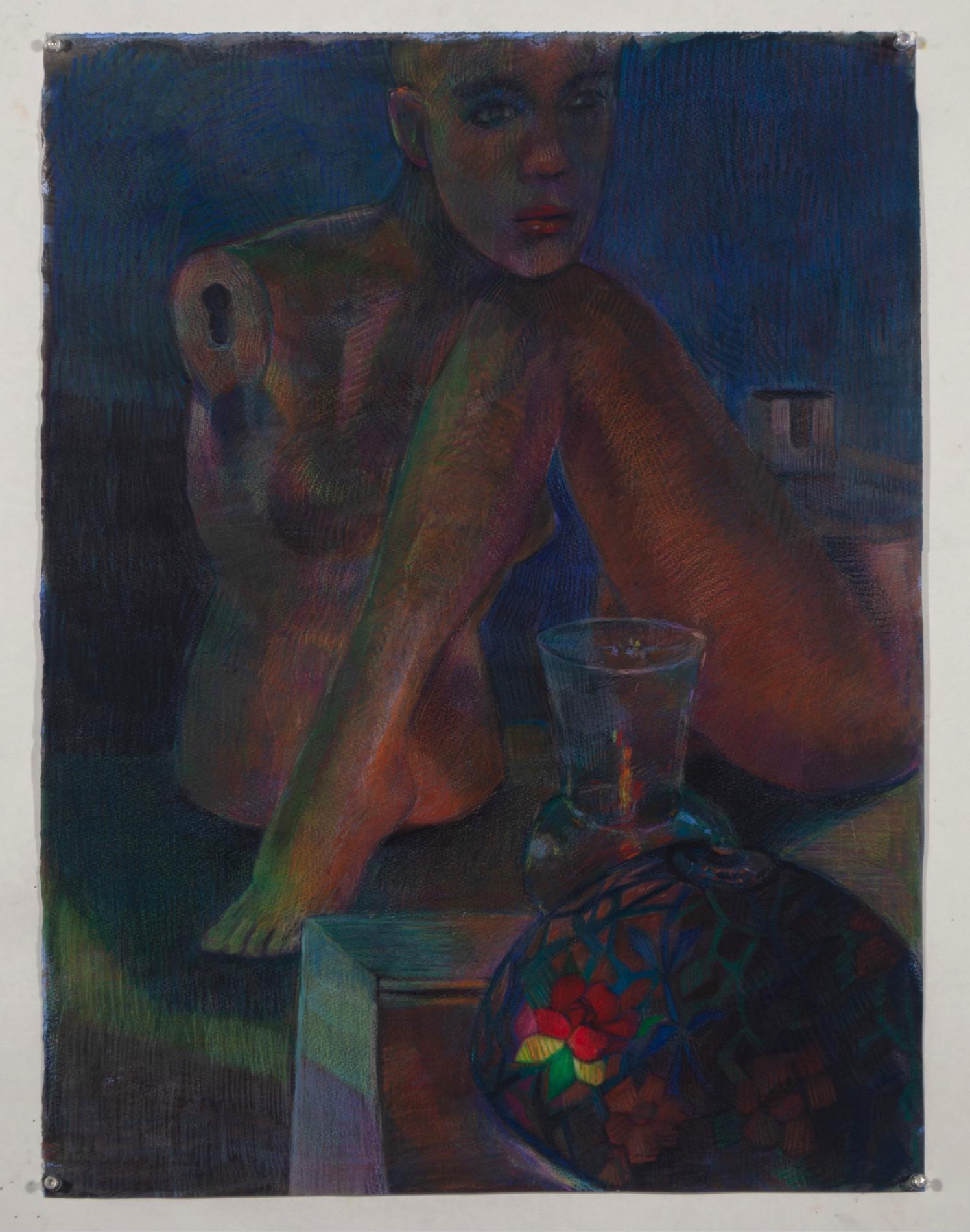
Lily Yanagimoto, Left At Home, 2025, crayon on paper.
Representing the Real: Dante, Lacan, and the Pursuit of the Impossible Stephen Dames
O you who in little barks, desirous of listening, have followed after my ship that sails onward singing turn back to see your shores again, do not put out on the deep sea, for perhaps, losing me, you would be lost.
—Dante
Alighieri, Paradiso
Found at the start of the second canto of Dante’s Paradiso, these six verses exist almost without precedent in Western literature. This forceful address is, in a sense, a plea for the reader to stop reading, to not do their job—to turn back. Here, speaking as the poet, Dante worries that those who are not prepared will be “lost” in their attempts to follow him through into Paradise, telling the reader to turn back before it’s too late.1 Though this may be a particularly forceful and notable example, Dante often demonstrates that he is thinking about how one might engage with his text. Therefore, while this intratextual reference to The Divine Comedy—to the existence of the text within the text—is unique in its purpose, it is not unique in and of itself. In fact, it is one of many examples of Dante struggling with metapoetic questions. In The Divine Comedy, Dante deals extensively with the history, meaning, and purpose of poetry, paying attention to how language is able (or unable) to capture his thinking. At points, he comes to places in the narrative where even he, the poet’s poet, cannot go any further; his thinking is unable to be captured in language. Like the reader in the opening lines, he too can be lost in the pursuit of a goal he will never reach. What these moments open up for the reader are questions of representation—of a struggle against the limits of language in articulating
1 Dante Alighieri, The Divine Comedy of Dante Alighieri. Vol. 3, Paradiso, trans. Ronald Martinez and Robert Durling, (New York: Oxford University Press, 2011), Canto 6.
affective experience. To conceive of how Dante deals with language’s fundamental inadequacy to capture our inner lives (our unconscious drives and wishes even), I turn to psychoanalysis. By examining how Dante deals with questions of representation alongside this body of work, I begin to probe out questions that will both force re-readings of Dante’s work and enable a new understanding of—and place new value in—certain concepts in Lacanian psychoanalysis. The way in which Dante deals with art will serve as our starting point in this exercise, ultimately leading to a reading wherein poetry and psychoanalysis are not unlikely bedfellows but instead close relations.
As an artist (and a self-referential one at that), Dante has some personal understanding of what constitutes a work of art. Unlike most poets, Dante provides his own particular definition of art in The Divine Comedy, giving us the opportunity to internalize his philosophy of art and apply it to his own work. Found in the Inferno—within a canto-long discussion of the divisions of lower-hell—the definition is given to us by Virgilio who, while speaking to the Pilgrim (Dante’s character) about the nature of art, specifies a definition, saying “that your art follows nature as much as it can, as / a disciple follows the master; so that your art is / almost God’s grandchild”2. Simply, the definition that Virgilio puts forward is a version of what is commonly referred to as the mimetic theory of art; wherein art is understood to be made in imitation of nature which in turn imitates God. This definition (memetic and hierarchical) has often been found in philosophical and theological discourses, and can also be found, as Virgilio notes in the preceding verses, “not many pages from the start” of Aristotle’s Physics. As renowned Dante scholar Teolinda Barolini notes in her commentary of Inferno 11, though Florentines of Dante’s time did not yet have access to Aristotle’s Poetics—the text which offers up the clearest of his definitions of art—Dante was able to develop the essence of its ideas through his engagement with the Physics and scholastic interpretations of Aristotle’s corpus. There is a slippage that manifests within the Inferno wherein Dante repeats Aristotle’s theory of art for his own purposes, making art to be both representative and imitative. It manifests as a human action based on nature which in turn is based on God.
While this theory of art is applied in all three cantiche of The Divine Comedy, the most explicit discussion of poetry and art as they relate to representation is found in Dante’s Purgatorio. As the Pilgrim and Virgilio (joined later by the 1st century Roman poet Statius) climb up the seven terraces of the mountain of Purgatory, they witness, as is said by Ronald
2 Dante, Inferno, 11.103–105.
Durling and Robert Martinez in their notes to their English translation of Purgatorio, “the process of purgation,” a process of destroying the love which the sinners once directed toward the wrong object (the sin) in an attempt to redirect that love towards the right object (the virtue which corresponds to the sin).3 However, purgation does not just take the form of labor, it also needs a supplement in the form of guidance from God. This, for Dante, takes the form of art. The inclusion of art in the Purgatorio is no accident. The tone of the cantica, if one had to sum it up, might be described as melancholic and mournful: though the Pilgrim is climbing up the mountain of Purgatory to reach Heaven, in order to do so he has to leave Earth and earthly pleasures behind. Unlike many other examples of art within The Divine Comedy, the art on the mountain of Purgatory is described by Dante in great detail. This action—the representation of the art of God in Dante’s verse—implies that “God’s” art is transforming into another artistic product. While there are discussions about poetry and representation at many points within the Purgatorio, by focusing on these examples of “Godly” art, we can find here most clearly, how Dante thinks about representation, thus opening up generative possibilities in thinking about both his work and psychoanalysis. The first example of this art is found on the terrace of pride, the first of seven terraces on the mountain of Purgatory. The terrace serves an illustrative purpose for the reader and is more clearly structured and spread out than later terraces. In structuring Purgatory this way, Dante gives the reader a greater ability to parse what he does later on, easing one into the repetitive (i.e. liturgical) structure of the second realm. This allows the reader to focus less on parsing the physical structure of Purgatory and more on the language and content of the first terrace. We find this content first around thirty lines into Canto 10, where the Pilgrim views a set of marble carvings, each depicting a different scene emphasizing the virtue of humility. In a pattern that will be generally maintained throughout Purgatorio, the first scene that the Pilgrim views is a snippet from the life of Mary, the second is from the bible, and the third is from classical antiquity. However, beyond the content of the carvings, what is most interesting is how Dante represents this art and what he tells us about his own attempts at representation. In the lines where he first describes seeing the engravings Dante writes that “not only Polyclitus but even Nature would be put to scorn” by them4—Polyclitus being a renowned 5th century BC sculptor. This representation means that, following the philosophy of art Dante gives in Inferno 11, the art that the
3 Dante, Purgatorio
4 Dante, Purgatorio, 10.32-33.
Pilgrim finds in the terrace of pride is somehow non-representative art: it is, through the power of God, art that not only surpasses human ability, but nature as well. This is because God is not a “representer”—imitating Nature, as Polyclitus does—but is, in fact, the Creator, the originator of all matter, artistic or otherwise. What Dante sees is not a picture of the life of Mary, or even an abstract depiction of it, but rather the life of Mary as it happened. God not only puts the viewer of the sculptures in a given scene, he has them understand the lesson from it; taking from it the essential truth of reality. To further emphasize the alien nature of the art’s “realness,” the sculptures on the terrace are not only visible, but, somehow, are audible too, being described by Dante as “visible speech” (“visibile parlare”) produced by “He in whose sight nothing is new” —they seem alive.5 Following his line of reasoning, Dante makes these sculptures—these examples of “Godly” art—into a type of art that is not representational. Instead, it is illuminating.
In his attempts to represent, in his own writing, this nonrepresentative art (to represent the non-representational) Dante employs a variety of techniques. Besides his apt description (and coining of terms like “visibile parlare”), Dante employs another technique, one embedded in the structure of his text itself. Unlike what he does in Purgatorio Canto 11, describing in simple verse the carvings exemplifying humility, in Canto 12, Dante approaches the description of God’s carvings exemplifying pride in a vastly different manner. In thirteen instances—one per terzina, each found on the floor instead of the wall—Dante represents God’s examples of pridefulness, including such notable examples as the biblical Nimrod and the classical Arachne.6 However, in order to capture these Godly carvings, Dante uses a notable technique: an acrostic. Beginning in line 25 of Canto 12, Dante starts the next first four terzine with the word “Vedea,” the next four with the word “O,” and the four after that with the word “Mostrava,” with the thirteenth example having all three words, each starting each line. These examples spell out “VOM” or “UOM,” which means man in Italian.7 In order to represent how God’s art manifestly presents pride as the original sin that most defines humanity, Dante changes the very structure of his text—adapting his art in order to bring it closer to that of God. He attempts, using his imperfect and all-too-human tools, to make his art meet God’s,
5 Dante, Purgatorio, 10.94.
6 Teolinda Barolini, The Undivine Comedy: Detheologizing Dante. (Princeton: Princeton University Press, 1993), Chapter 6, “Re-presenting What God Presented: The Arachnean Art of the Terrace of Pride.”
7 Barolini, The Undivine Comedy: Detheologizing Dante, 141.
needing to go outside of his regularly-used poetic techniques to demonstrate that this sin, in particular, is truly man’s exemplative one.
In her seminal 1992 work The Undivine Comedy: Detheologizing Dante, Teolinda Barolini devotes her sixth chapter to a reading of the terrace of pride, refuting previous interpretations that both paid less attention to the formal construction of the poem and followed a more theological approach to analyzing the poem. Her reading—to grossly oversimplify it— is an attempt to prove that in trying to represent God’s art on the terrace of pride, Dante knowingly invites readings that question his own humility (or lack thereof). By focusing so clearly on how he is attempting to represent art that is, by virtue of his own definition, non-representative, Dante creates a paradox for his readers. To show this tension, Barolini invokes the twined figures of Ulysses and Arachne, describing how the figures as evoked in Canti 10-12 are lightning rods “placed in the poem to attract and defuse the poet’s consciousness of his presumption in anointing himself “scriba Dei.”8
A return to this essay’s initial discussion of the opening lines of Paradiso 2 offers another example of the Ulyssean figure in the poem, one which, time and again, is associated with Dante’s pride. With the references to the “piccioletta barca” (or little barks/rafts) and the “pelago” (deep sea), Dante makes himself, the poet, into a Ulyssean hero, with these references directly evoking the encounter with Ulysses in Inferno 26. The idea of the Ulyssean hero as poet, or the poet as a hubristic Ulyssean hero, is common in the Divine Comedy, and it is present in moments where we are supposed to be questioning the metapoetic structure of the work.
It is through such an understanding of how Dante deals with representation and art on the terrace of pride that we are able to use Lacanian psychoanalysis to understand his notion of representation, and to support Barolini’s argument around pride. Lacan’s understanding of “the Real” provides us with this theoretical framework, enabling us to not only understand Dante’s understanding of Godly art better, but also to see that what Dante is doing in Canti 10-12 of Purgatorio is not just prideful but fundamentally impossible. To argue this, we must first come to understand what Lacan means when he uses the term “the Real.” Both in his Écrits, and in his Séminaire, Lacan writes extensively about this concept, using it in slightly different but still convergent ways throughout his career. However, it is possible to construct a usable definition of the term. Lacan’s idea of the Real can be understood as a reality that we (as socialized humans) have lost access to and that is, in a sense, a reality which is “outside language
8 Barolini, The Undivine Comedy: Detheologizing Dante, 130.
and unassimilable to symbolization.”9 When describing the Real, Lacan does not use it to describe any sort of psychological concept, but instead to showcase the limits of language: he uses it to demonstrate that there is a “Real,” a truth beyond what language can give us. Unlike language, the Real is utterly without differentiation—it has no signifiers. Instead, it is whole, with the symbolic language providing a “cut in the real,” not furthering it.10 The term is helpful in expressing the fissures in human life which come to be when language is just not enough to express some ineffable truth; something that one can never fully grasp. This is what makes the Real “impossible.” We therefore can approach the Real as something that is, as Lacan says, “impossible to imagine, impossible to integrate into the symbolic order, and impossible to attain in any way”.11 There is no way for us to even halfconceive this kind of unmediated reality, and we are instead forced to live in our differentiated and less real one.
Using this Lacanian understanding of the Real—as “that which resists symbolization absolutely,” we can start to see how this terminology might be useful in interpreting Dante’s idea of Godly art, and Barolini’s argument about the terrace of pride.12 To begin, we can take Dante’s idea of Godly art as itself an example of the Lacanian Real, enabling us to mutually understand Lacan and Dante. By using this Lacanian terminology to describe Dante’s idea of divine art, I clearly emphasize how what Dante is doing with Godly art is to understand it as an art that exists beyond language. To Dante, God’s art is art that makes it possible for “one / who saw the true event did not see better than I” and is one that enables the penitent to view the “true event”:13 an event that is, by virtue of the world that Dante constructs, undifferentiated and never lost in translation. Dante has to resort to extreme imitative lengths, such as the coining of terms or the usage of acrostics, to even begin to approach the Real, and, necessarily, even after all of that work, we are left without the benefits that the art (at least in Dante’s constructed reality) instills in the souls who view it. By viewing Dante’s attempt at representation through this psychoanalytic lens we can
9 Jacques Lacan, The Seminar of Jacques Lacan. Book 1, Freud’s Papers on Technique, 1953–1954, trans. John Forrester (Cambridge: Cambridge University Press, 1988), 66.
10 Jacques Lacan. Ecrits: The First Complete Edition in English, trans. Bruce Fink, (New York: W.W. Norton & Co, 2006), 65.
11 Lacan, The Seminar of Jacques Lacan, Seminar 11, 167.
12 Lacan, The Seminar of Jacques Lacan, Seminar 1, 66.
13 Dante, Purgatorio, 12.67-68.
find an example of how much language limits us: how even Dante, a master of language, fails to meet God’s commandment for him to represent. We see in Dante—when read through Lacan—a demonstration not only of the inadequacy of language but of the impossibility of escaping its representational frameworks. It teaches us to accept the reality we’re in. Furthermore, the idea of the Real being “impossible” can help us further buttress Barolini’s argument around Dante’s artistic hubris in the terrace of Pride. By arguing that God’s art is one which is impossible to represent in differentiated language, we can say that Dante’s ekphrasis serves both as a commentary on the impossibility of his representation—of the inaccessibility of an art beyond representation or even nature—and as a hubristic (and perhaps very human) belief that he may, even if it is exceedingly unlikely, be able to escape the paradox. We could say that while Dante perhaps knows—at least within the world he’s constructed—that the task he set himself is impossible—like the story of Ulysses in Inferno 26, his little ship will never actually reach his destination—he hubristically pursues it anyway. By introducing the concept of the Real we can understand just how far Dante’s own conception of his pride goes; by following this line of reasoning, we can say that he conceives of his own pride as being large enough that it extends beyond the impossible.
The Real, therefore, can serve as a useful term in understanding what exactly non-representative art is in Dante’s Purgatorio, helping us make the case that Dante is, in the terrace of pride, expressing his own sinful hubris through his attempts to represent what is fundamentally impossible to represent. His pride, as expressed by Barolini, is on full display. Furthermore, this single reading can invite and perhaps even enable further readings of Lacan through Dante, and vice-versa, two authors who, in time-separated yet similar ways, push the boundaries of language.
Bibliography
Alighieri, Dante. The Divine Comedy of Dante Alighieri. Vol 1, Inferno. Translated by Robert Durling and Ronald Martinez. New York Oxford University Press, 2011.
———. The Divine Comedy of Dante Alighieri. Vol 2, Purgatorio. Translated by Ronald Martinez and Robert Durling. New York: Oxford University Press, 2011.
———. The Divine Comedy of Dante Alighieri. Vol. 3, Paradiso. Translated by Robert Durling. New York: Oxford Univ. Press, 2011.
Bailly, Lionel. Lacan: A Beginner’s Guide. Oxford: Oneworld Publications, 2012.
Barolini, Teolinda. “Commento Baroliniano–Digital Dante.” digitaldante. columbia.edu, n.d. https://digitaldante.columbia.edu/commentobaroliniano/.
———. The Undivine Comedy: Detheologizing Dante. Princeton: Princeton University Press, 1993.
Freud, Sigmund. The Standard Edition of the Complete Psychological Works of Sigmund Freud. Vol. 13, (1913). The Moses of Michelangelo. Translated by James Strachey and Alix Strachey. London: Vintage, 2001.
Lacan, Jacques. Ecrits: The First Complete Edition in English. Translated by Bruce Fink. New York: W.W. Norton & Co, 2006.
———. The Seminar of Jacques Lacan. Book 1, Freud’s Papers on Technique, 1953-1954. Translated by John Forrester. Cambridge: Cambridge University Press, 1988.
———. The Seminar of Jacques Lacan. Book 11, Four Fundamental Concepts of Psychoanalysis. Translated by Alan Sheridan. New York: Norton, 1998.
———. The Seminar of Jacques Lacan. Book 20 : Encore 1972-1973, on Feminine Sexuality, the Limits of Love and Knowledge. Norton, 1999.
Žižek, Slavoj. How to Read Lacan. London: Granta, 2006.
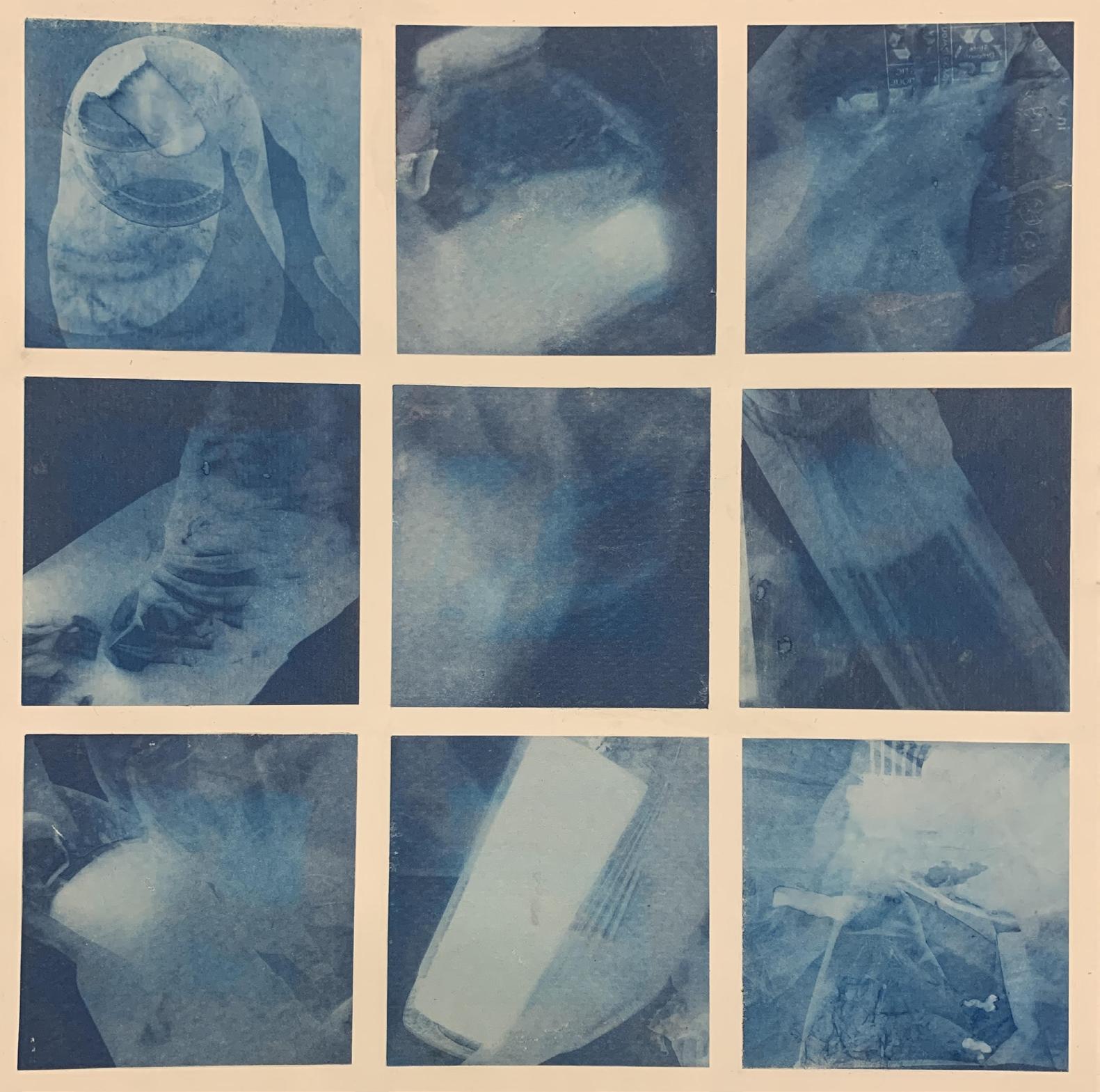
Julia Kirby, X-ray of Our Planet, 2021, cyanotype .
Veils of Representation: Illusion and Truth in Classical and Contemporary Journeys to the West
Xinke Huang
The classical novel Journey to the West, published in the sixteenth century during the Ming Dynasty, has inspired countless adaptations over centuries. Among the myriad reinterpretations and distortions of the story, Taiwanese director Tsai Ming-liang’s 2014 film Le Voyage en Occident stands out for its experimental approach that eschews all narrative elements. Presented in the style of documentary, the film follows an Eastern monk in a red robe as he walks at an unnaturally slow pace through the streets of Marseille. The only text offered for interpretation appears at the film’s conclusion: a quote from the Diamond Sutra, “一切有为法,如梦幻泡 影,如露亦如电,应作如是观,” suggesting that all worldly things are essentially illusory representations, as fleeting and insubstantial as a dream, a shadow, or a bubble.1 As a Mahayana Buddhist classic, the Diamond Sutra was especially revered by Chan Buddhism, which had flourished in China since the Tang dynasty. The film’s quotation of this canonical line echoes the core Buddhist principles of spiritual practice in Journey to the West. While Wu Cheng-en’s novel presents a syncretic religious worldview—blending Confucianism, Taoism, Mahayana Buddhism, and particularly the Chan concept of emptiness—Buddhist allegories and references to the Heart Sutra abound, and the protagonist is named “Wukong” (awakened to emptiness). This underscores the notion that the ultimate goal of the pilgrimage is the realization that all phenomena are merely illusions. Journey to the West and Le Voyage en Occident are both concerned with the idea of representation, using allegorical narration and formal construction to present and dismantle representations—shedding light on the deceptive nature of reality. The self-
1 “As stars, a fault of vision, as a lamp, a mock show, dewdrops, or a bubble, a dream, a lightning flash, or a cloud, so should one view what is conditioned.” Osho, The Diamond Sutra: The Buddha Also Said (London & New York: Watkins Publishing, 2010), 140.
reflexivity of these two works ultimately points to the limitations of art and language as mediums for conveying truth.
Before delving into the main discussion, it is necessary to explain why the term “representation,” is used to describe the illusory manifestation of reality, rather than other similar cultural or religious concepts that differ subtly in meaning. In Chinese Buddhism, there are two characters that refer to illusory external appearances: 色 and 相. The former is directly related to sensory and material phenomena, while the latter extends from the idea of deception of material appearances to an abstract ontological critique of meaning and the process of symbolic formation. Therefore, the character 相 has broader implications and is more suitable for discussing artistic construction. These two terms originate from the Sanskrit words rūpa and lakṣaṇa, which are often translated in English academic discourse as “form” and “characteristic.”2 However, “characteristic” in common usage tends to emphasize more specific and localized features, which distracts from the abstraction and generality in the Chinese character 相. Directly using 相 or its transliteration might risk oversimplifying the complicated nuances behind it. The two terms used in this paper, “representation” and “illusion,” are most appropriate given the subject matter at hand; in modern media theory they refer not only to the reproduction of reality but also imply the fictive nature of this reproduction—they bear an essential similarity to the Buddhist concept of 相. 3
Journey to the West reveals two primary levels of representation in its narrative, which follows Tripitaka’s journey across various lands and through his eighty-one ordeals. Tripitaka and his disciples frequently encounter demons capable of shapeshifting or creating illusions. One such demon appears in Chapter Twenty-Seven, in which the Bai Gu Jing (白骨 精) successively disguises herself as a young girl offering food, an old woman searching for her daughter, and an elderly man—all to elicit sympathy and deceive the travelers.4 While Sun Wukong can discern most disguises, Tripitaka repeatedly falls for them due to his rigid adherence to moral dogma, hesitance, and gullibility. This predicament echoes the scripture he
2 Monier Monier-Williams, A Sanskrit-English Dictionary: Etymologically and Philologically Arranged with Special Reference to Cognate Indo-European Languages (Oxford: Oxford University Press, 1992), 885.
3 Richard Allen, “Representation, Illusion, and the Cinema,” Cinema Journal 32, no. 2 (1993), 21.
4 Wu Cheng’en, Xi You Ji, 西游记 [Journey to the West] (Beijing: People’s Literature Publishing House, 2010), 323.
recited before his journey: “心生,种种魔生;心灭,种种魔灭.”5 The ordeals, seemingly external, serve as reflections of the greatest inner desires and attachments. The demons’ illusions thus symbolize the falsehood of reality; their role in the novel is to emphasize that spiritual practice requires transcending delusions and seeing beyond representations. This prophetic line of scripture serves not only as an instance of structural foreshadowing that establishes “emptiness” as the central theme of the spiritual practices, but also introduces another layer of narrative tension; although truth has already been spoken, Tripitaka continues to be deceived and to rediscover again and again, pointing to the novel’s deeper critique of the dislocation between language and truth.
The novel also suggests that power structures within the social framework are built upon illusions, and calls into question the legitimacy and necessity of central rulers. For example, the demon of the Wu Ji Guo (乌鸡国) needs only to mimic the appearance of the true king to completely take over his rule, with neither the citizens nor his wife and children suspecting the deception or doubting his ability to govern. Even the Bodhisattva Wenshu acknowledges that during the three years of the demon’s reign, the country experienced timely winds and rains, and national peace and prosperity.6 This episode reveals that power operates as a hollow institutional structure, with rulers serving as interchangeable placeholders.
In Journey to the West, the ruling class depends on an illusory system of symbols to maintain order. Take the heavenly court’s elaborate rituals and hierarchical system as an example: the Jade Emperor’s title is inflated into “the Great Benevolent Sage of Heaven, the Celestial Jade Emperor of the Most Venerable Deva (高天上圣大仁慈者玉皇大天尊玄穹高上帝)” to amplify his sanctity and unchallengeable nature through an accumulation of honorific terms. However, this authority lacks real administrative power— whether in response to Wukong’s single-handed rebellion or the demons causing chaos in the mortal realm, the heavenly court can only resort to hastily dispatching deities. Its mechanisms of resistance remain reactive and ineffective. Sun Wukong’s designations further highlight the hypocrisy of
5 Wu, Xi You Ji, 152. Anthony C. Yu translates this line as, “When the mind is active, all kinds of māra come into existence; when the mind is extinguished, all kinds of māra will be extinguished.” For other terms omitted in The Monkey and The Monk due to abridgment, I have kept their transliterations from Wu Cheng’en’s original text. See Anthony C. Yu, trans., The Monkey and the Monk: An Abridgment of The Journey to the West (Chicago: University of Chicago Press, 2006), 204.
6 Wu, Xi You Ji, 482.
this symbolic system. Upon realizing the demeaning nature of his previous title, “Bimawen (弼马温),” a nominal position in charge of the imperial stables that carries little real authority, Wukong proclaims himself “Great Sage Equal to Heaven (齐天大圣).” In an effort to pacify his rebellion, Taibai Jinxing persuades the Jade Emperor to officially recognize this selfbestowed title—a symbolic concession intended to restore order, yet one that ultimately backfires. When the title becomes an integral part of Wukong’s identity, the heavenly court faces an even greater challenge. The demons of the mortal world also imitate the symbolic system of Heaven. For instance, in Taoist mythology, the “Three Great Ones (三清)” refer to the three supreme Taoist deities: Yuqing (玉清), Shangqing (上清), and Taiqing (太清). Yet in Chapter forty-five, three demons in the Cart Slow Kingdom use illusory tricks to control the weather and thus secure their positions as national preceptors, adopting the title “Three Great Ones” to solidify their authority while abusing power and suppressing Buddhism.7 Through these episodes, the novel exposes the hollow nature of political power structures that rely on representations. Thus, the events encountered during the westward journey, along with the power frameworks behind them, can all be deconstructed as illusory. The novel’s allegorical narrative unveils the essential nature of all content and constructions as representation.
In the film Le Voyage en Occident, 8 the illusory nature of representation is revealed precisely through its realistic formal construction. Tsai Ming-liang employs three key methods to create an illusion of transparent and objective cinematography. The monk protagonist is often placed in a decentralized position, with unrelated objects or passersby frequently obstructing, or even dominating the frame. These individuals are engaged in their own everyday activities—not on that of objects or persons orchestrated for the screen. At one point in the film, the foreground is blocked by passing buses, and a moment later, a long shot centers on a merrygo-round, leaving viewers to struggle to spot the tiny figure of the monk, hidden in the crowd at the bottom right of the frame.9 Later, the monk is entirely absent, with only a faint glimpse of his red robe appearing in the top right corner.10 This randomized staging, which lacks any clear central focus, contradicts the presumed artificiality of the film and emphasizes the natural and uncontrived style of its imagery.
7 Wu, Xi You Ji, 546.
8 Le Voyage en Occident, directed by Tsai Ming-Liang (2014; Taipei: Homegreen Films).
9 Tsai, Le Voyage en Occident, 00:35:00.
10 Tsai, Le Voyage en Occident, 00:47:10.
The entire film is composed of static long takes, each longer than a minute, and the longest running for a full fourteen. The camera remains in a single fixed perspective, passively recording everything in its view without any in-camera movement, as though it had been placed and abandoned in one spot. This technique significantly reduces the perceptibility of the camera, creating a sense of unpolished reality. Most films compress events into a series of rapid cuts to contextualize the subject, while Ming-liang’s extended long takes reflect the real passage of time in the physical world, further reinforcing the film’s sense of authenticity. Traditional montage, in addition to using mostly rapid cuts, “suggests an idea by means of a metaphor or by an association of ideas,” with the arrangement of shots reflecting the director’s artistic intention.11 In Le Voyage en Occident, however, the transitions between shots appear random, with no discernible order or logical connection. This deliberate rejection of directorial intervention produces a realist transparency, denying the presence of an authorial hand and leaving the audience with a sense of unmediated reality. However, these seemingly realistic forms stand in stark contradiction to the deceptive nature of the medium of film. French film theorist Christian Metz posits that while film bears an iconic resemblance to reality, it functions as an imaginary signifier; it deceives the audience into believing they are witnessing reality, when in fact it is a symbolic representation in which the subject is absent. Here, the subject does not refer to the director who remains invisible behind the camera, but rather to the enunciator of the entire film operation mechanism. The director’s intentions are not directly manifested through enunciation and their “stylistic markers” merely resonate with the enunciation and “are captured within it.”12 Precisely because the location of enunciation cannot be located within the text, film becomes “a story from nowhere that nobody tells,” causing audiences to ignore its constructed nature and leading them to believe that they are not controlled by discourse but are, rather, “all-perceiving” subjects.13 14 Metz believes we can only perceive the absence of enunciation through a metadiscursive path because it does not exist in the same dialogic space as the audience and therefore can only make self-referential indications. The “reflection”
11 André Bazin, What Is Cinema? (Berkeley: University of California Press, 2005), 26.
12 Christian Metz, Impersonal Enunciation, or the Place of Film, edited by Dana Polan, translated by Cormac Deane (New York: Columbia University Press, 2016), 126.
13 Christian Metz, The Imaginary Signifier: Psychoanalysis and the Cinema (Bloomington: Indiana University Press, 1981), 97.
14 Metz, Imaginary Signifier, 48.
and “commentary” in Tsai’s film embody this metadiscursive register.15 On the one hand, reflection becomes a key mechanism through which Le Voyage en Occident imagines its performative essence, blurring the boundaries of artistic representation and lived experience, concerning how the film mimics itself—how it uses visual means to reveal its own constructedness. Multiple chains of performance reveal the illusory nature of cinema by metaphorically exposing film’s mimetic essence; the red-robed monk, who appears to blend into everyday urban life as he slowly walks through the streets, is in fact played by professional actor Lee Kang-sheng. His measured steps and meditative demeanor imitate the Buddhist figure Xuanzang, transforming the act into a piece of performance art.16 This is not a naturalistic representation. Rather, his highly stylized and symbolic gestures detach him from historical individuality, rendering him an abstract visual symbol of transcendental practice. Moreover, the elderly French man who appears repeatedly in close-up shots or a long take outside a café seems to spontaneously mimic the monk’s performance as though he were an ordinary passerby. But in fact, he is another performer in the film, French actor Denis Lavant. These layers of performance underscore the ambiguity between representation and reality, and ultimately point to the impossibility of approaching truth.
Commentary, on the other hand, provides an interpretive framework for its own imagery. The film’s recurring symbolic motifs and their correspondence with the quotation of the Diamond Sutra in its closing scene are a good example. Shimmering lights flicker over the surface of the ocean,17 the monk faintly appears in a broken mirror,18 and in another moment someone blows soap bubbles that swell, glisten, and eventually burst—all reflected in the mirrored ceiling that occupies the frame.19 Water, mirrors, shadows, light, and bubbles—these elements, rife with symbolic associations with impermanence, imitation, and ephemerality—directly echo the Diamond Sutra’s metaphors of illusion. This correspondence provides a Chan Buddhist interpretive framework,
15 Metz, Impersonal Enunciation, 120.
16 Xuanzang was a renowned Chinese Buddhist monk, scholar, and translator during the Tang dynasty. He undertook a 17-year pilgrimage to India to seek authentic scriptures. His journey inspired the novel Journey to the West, where he is fictionalized as the monk Tripitaka.
17 Tsai, Le Voyage en Occident, 00:15:20
18 Tsai, Le Voyage en Occident, 00:33:37
19 Tsai, Le Voyage en Occident, 00:47:10
guiding viewers towards an understanding of the film’s imagery. Yet at the same time, it exposes the constructed nature of cinema; the audiences are watching a deliberate operation of symbols, not an unmediated reality. The allegorical critique of representations in Journey to the West serves as a deconstruction of the material world. It carries a Buddhist message of enlightenment, guiding individuals to let go of sensory experiences, societal hierarchies, desires, and attachments as a way to attain the Chan concept of “emptiness.” This entails perceiving all phenomena including the self as interdependent and empty of inherent existence, which leads to liberation. By the end of the story, the no-longer-rebellious Sun Wukong and the no-longer-gluttonous Zhu Bajie betray this awakening through their transformed dispositions. In contrast, Le Voyage en Occident employs a self-reflexive methodology, making film examine its own symbolically constructed medium. This self-deconstruction is not a transcendence of representation, but an interrogation of the possibility of transcendence itself that reveals a new labyrinth of symbols inevitably constructed in the artistic pursuit of truth.
Journey to the West also includes self-referential metacommentary about its own medium. In Chapter 98, the Buddha’s attendants Ānanda and Kāśyapa deliver wordless scriptures to Tripitaka and his disciples. Upon seeing the blank pages, Tripitaka weeps, believing he has been mocked. However, the Buddha affirms the legitimacy of these wordless scriptures, suggesting that it is because “those creatures in your Land of the East are so foolish and unenlightened” that they cannot grasp their true meanings.
20This claim seems to imply that the absence of text can more effectively transmit profound ideas than the presence of text. Therefore, while this episode appears on the surface to be a test for the pilgrims, at a deeper level it questions the effectiveness of text and language as mediums for conveying truth. This reflection on the limitations of language likely originates from the inception of Chan Buddhism. From Bodhidharma, the First Patriarch, to Huineng, the Sixth Patriarch, Chan has upheld the teaching from the Lankavatara Sutra that “道由心证,不由言传.”21 Huineng, in particular, emphasized that “the principle of Buddha-nature has no connection to words,” asserting that “objectifying, abstracting, intellectualizing, or conceptualizing truth as topics of text or language serves only as a diversion from the essence of truth.”22 This perspective suggests that the ultimate
20 Wu, Xi You Ji, 1166.
21 Truth is realized through the mind, not conveyed through words.
22 Fang Litian, Chanzong Gaiyao 禅宗概要 [An Outline of Chan Buddhism] (Beijing:
truth might be accessed through inner realization, rather than through a continued reliance upon language as an inherently flawed medium. If the forms of art and language cannot approach or convey truth, then where do their function and significance lie? The works of Wu Chengen and Tsai Ming-liang offer audiences two directions for reflection. First, the limitations of these mediums align with the inherent incompleteness of reality itself; it is within this imperfection that art and language come closer to the essence of truth. In Chapter Ninety-Nine of Journey to the West, the old turtle, angered by Tripitaka’s failure to keep his promise, overturns the group into the water, leaving their scriptures soaked and partially damaged. While Tripitaka is deeply regretful, Wukong reassures him, saying, “After all, even Heaven and Earth are not perfect. This sutra may have been perfect, but a part of it has been torn off precisely because only in that condition will it correspond to the profound mystery of non-perfection.”23 This strikingly insightful remark reveals the inherently flawed nature of reality, legitimizing the incompleteness of the mediums that mirror it.
Experimenting with alternative forms of expression pushes beyond the limitations of language. Tsai Ming-liang employs pure bodily expression to reject the diluting effect of words. As early as a 1999 interview, he was questioning the reliability of language, describing it as something that always carries untrustworthy elements.24 In his 2011 experimental stage play Only You, he was profoundly moved when Lee Kang-sheng, who was playing the roles of himself, Ming-liang’s father, and Xuanzang, spontaneously began walking with a slow, deliberate pace. Ming-liang told Lee, “Xiao Kang, I’ve waited twenty years, just for this moment, [...]; It turns out this life was meant for me to see you make this movement.”25 Subsequently, Tsai Mingliang’s Walker series, to which Le Voyage en Occident belongs, represents a continuation of the slow walking from the stage play. This most primal and intuitive form of walking carries no symbolic or metaphorical meaning. instead, it establishes connections with time and urban physical space purely through its materiality, until the fluid continuity of space and time converge in each step of the walk. Through this most fundamental bodily resonance of walking, the audience forms a connection with the monk on screen that transcends the depth of language.
Zhonghua Shuju, 2011), 94.
23 Wu, Xi You Ji, 1186.
24 Jean-Pierre Rehm et al., Tsai Ming-Liang (Paris: Dis Voir, 2001), 110.
25 Chen Yijun, “Tsai Ming-liang Chaoxiang ‘Chunyingxiang’ de Manzou Changzheng” “ 蔡明亮朝向『純影像』的慢走長征” [Tsai Ming-liang’s Long March Toward ‘Pure Image’], Yishu Xuebao 藝術學報107 (2020), 104.
Although Journey to the West and Voyage en Occident exist in different historical and cultural contexts, both works employ self-reflexive strategies to explore the illusory nature of representation and the limitations of art and language as mediums. Journey to the West, through its allegorical narrative, reveals the illusion underlying sensory experiences and social structures, guiding readers toward the Chan Buddhist concept of emptiness and the transcendence of surface values. In contrast, Ming-liang’s film adopts a more radical form of media critique—not only questioning representation, but internalizing this interrogation within its very structure. By deliberately constructing a sense of authenticity and exposing the absence of enunciation through metadiscursive registers, it challenges the legitimacy of cinema itself as a tool for critique. The self-reflexivity present in both works engage in a dialogue that illuminates a fundamental paradox in the attempt to transcend representation. Wu Cheng-en and Tsai Ming-liang do not adopt a simplistic pessimism; they respond to this dilemma in profound and innovative ways. Wu legitimizes the incompleteness of the medium through revealing the inherent imperfection of reality; Ming-liang returns to raw bodily expression to establish a connection beyond symbols.
Bibliography
Allen, Richard. “Representation, Illusion, and the Cinema.” Cinema Journal 32, no. 2 (1993): 21-48.
Bazin, André. What Is Cinema? Berkeley: University of California Press, 2005.
Chen, Yijun. “Tsai Ming-liang Chaoxiang ‘Chunyingxiang’ de Manzou Changzheng” “蔡明亮朝向『純影像』的慢走長征” [Tsai Ming-liang’s Long March Toward ‘Pure Image’]. Yishu Xuebao 藝 術學報107 (2020): 103-127.
Fang, Litian. Chanzong Gaiyao 禅宗概要 [An Outline of Chan Buddhism]. Beijing: Zhonghua Shuju, 2011.
Hu, Shi. Hu Shi Lun Zhongguo Gudian Xiaoshuo胡适论中国古典小说 [Hu Shi on Chinese Classical Fiction]. Wuhan: Changjiang Wenyi Chubanshe, 1987.
Metz, Christian. The Imaginary Signifier: Psychoanalysis and the Cinema. Bloomington: Indiana University Press, 1981.
Monier-Williams, Monier. A Sanskrit-English Dictionary: Etymologically and Philologically Arranged with Special Reference to Cognate Indo-European Languages. Oxford: Oxford University Press, 1992.
Osho. The Diamond Sutra: The Buddha Also Said. London & New York: Watkins Publishing, 2010.
Rehm, Jean-Pierre, Olivier Joyard, Danièle Rivière. Tsai Ming-Liang. Paris: Dis Voir, 2001.
Tsai, Ming-liang, dir. Le Voyage en Occident. Taipei: Homegreen Films, 2014.
Wang, Yun. “Lun Fojiao ‘Xiang’ Wenhua dui Shenmei Yixiang Chuanggou de Sanchong Yingxiang” “论佛教‘相’文化对审美意象创构的 三重影响” [The Threefold Influence of Buddhist “Appearance” Culture on the Construction of Aesthetic Imagery]. Xueshu Yuekan 学术月刊 1 (2019): 1-7.
Wu, Cheng’en. Xi You Ji 西游记 [Journey to the West]. Beijing: Renmin Wenxue Chubanshe, 2010.
Yu, Anthony C., trans. The Monkey and the Monk: An Abridgment of The Journey to the West. Chicago: University of Chicago Press, 2006.
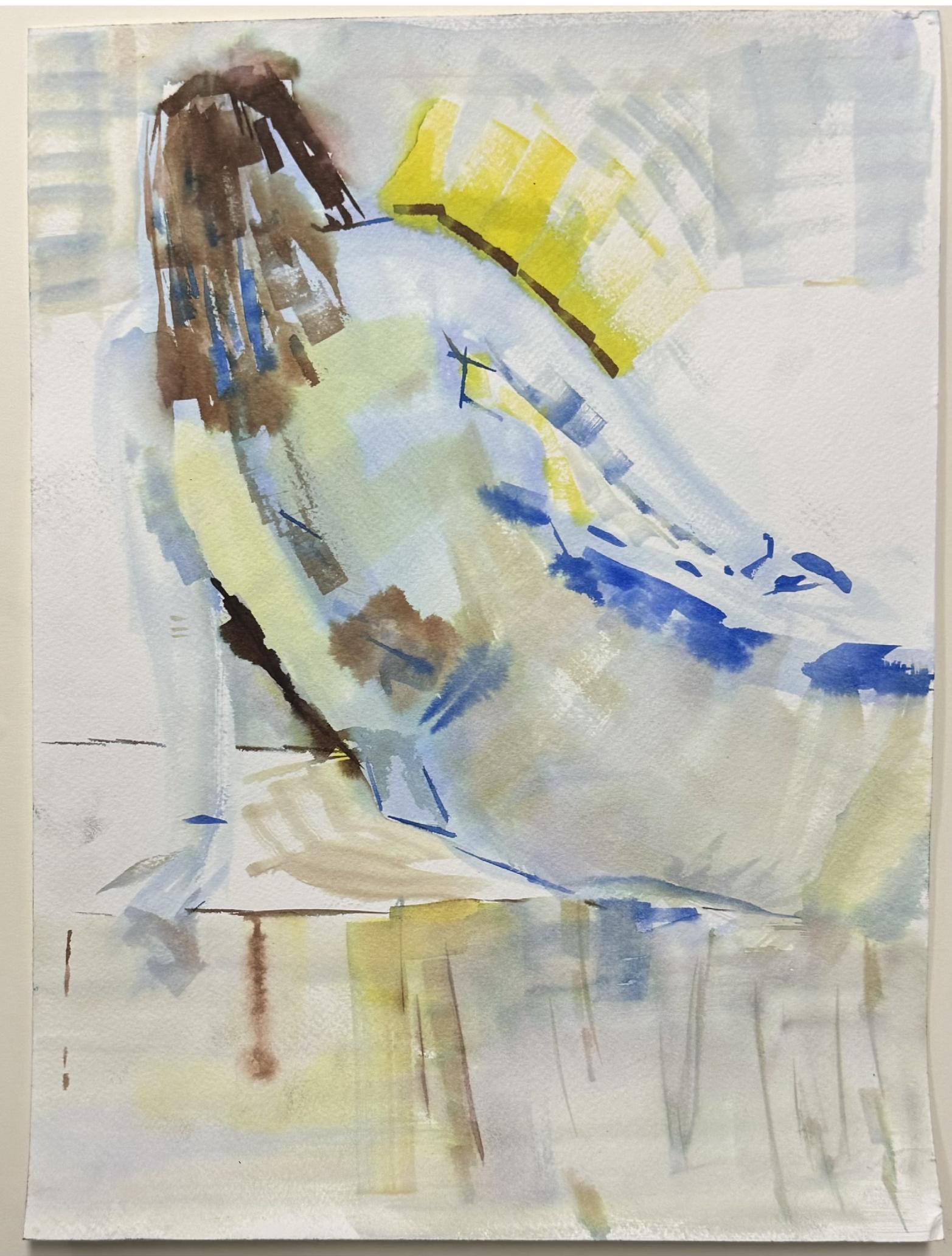
JRob Goffstein, Figure Drawing, 2024, watercolor on paper.
Poetic Mysticisms: the Zohar and the Sestina Rose Clubok
Who are the righteous? They are the wise ones who will see the things within that are not able to be said through speech.
—The Zohar
This proverb appears in the Zohar, an esoteric thirteenth-century Kabbalistic text of Jewish mysticism which is traditionally studied only by an especially learned few. The draw of the Zohar is, itself, something that is hard to explain through speech. Why is it so compelling? Maybe its allure is something that those who study Kabbalah traditionally, the wise ones, understand as better if left unexplained. Regardless, it seems that the secret to the allure of the Zohar arises from ordered language that creates a poetic mental atmosphere, wherein the reader is induced into a trance-like, meditative state—and one that is hard to put into words. Yet, this poetic state is not only a figurative one. More specifically, the Zohar shares elements with that of the sestina: a poetic form characterized by six stanzas of six lines each, a three-line envoi, and end words which repeat and change order. I argue that the Zohar and the sestina have parallel origins and share formal characteristics which function together to produce certain transcendent mystical states, suggesting that their analogous structures are themselves imbued with mystical qualities.
Reflective of one another from their very conception, both the Zohar and the sestina are products of linguistic borrowing and revival. The Zohar was “composed primarily by mid-to-late 13th century Spanish authors, largely in Aramaic.”1 The writers of the Zohar mostly spoke Spanish, but they took an ancient language and gave it new life in the form of the Zohar. Like the Zohar’s Aramaic, the sestina form also gained prominence through revival; it originated in the Middle Ages, but was not written in English until Sir Philip Sidney reintroduced the sestina in the sixteenth century.2
1 Nathaniel Berman, “Divine and Demonic in the Poetic Mythology of the Zohar,” IJS Studies in Judaica, vol. 18, (2019), 2.
2 Marilyn Krysl, “Sacred and Profane: The Sestina as Rite,” The American Poetry Review, vol. 33, no. 2, (2024), 9.
According to Stephan Burt, the sestina “[was of] little use [to authors] until the end of the nineteenth century” and experienced a greater “revival beginning in the 1930s.”3 Both forms are characterized by a fusion of different linguistic traditions and time periods—recalling these traditions while imbuing them with something new.
In addition to the parallels present from their conception, the poetic structures of The Zohar and the sestina are strikingly similar, as they both depend on the notion of the cyclical. In “The Sestina: An Exploration of the Dynamics of Poetic Structure,” Margaret Spanos describes the sestina’s formal orientation:
Formally, the sestina consists of six stanzas of six lines each and a three-line envoi or congedo. There is no rhyme within the stanza, but the same six rhyme words are repeated throughout in an order determined by their order in the first stanza. The first line of each succeeding stanza ends with the last rhyme word of the preceding stanza, and reorders the rest on a principle known in medieval rhetoric as retrogradatio cruciata.4
While The Zohar has no stanzas or line breaks, words are repeated over and over again in different orders. They are not formally reordered in a specific “retrogradatio cruciata,” but they can begin to have that effect—with the same few words appearing at the beginning of a sentence, then the middle of another, then at the end of a third.
In understanding the abstract notion of cyclicality found within the sestina, one can consider the poem “Vanishing Point” by Marilyn Krysl, who has also written a piece of critical literature on the subject titled “Sacred and Profane: The Sestina as Rite.” The words in Krysl’s sestina at the ends of each line, known as teleutons, rotate between “man,” “change,” “own,” “moonlight,” “point,” and “woman,” or slight variations, such as “owning” instead of “own.” The rotation cycles, with the word used to end the last line of one stanza ending the first line of the next stanza. The first two stanzas of “Vanishing Point” exemplify the circling characteristic of a sestina:
A city, alive with sleeping people. Awake, the man feels in his pockets. A roll of film, loose change, ticket stubs, a book of matches. All he owns
3 Stephen Burt, “Sestina! Or, The Fate of the Idea of Form,” Modern Philology, vol. 105, no. 1, (2007), 219.
4 Margaret Spanos, “The Sestina: An Exploration of the Dynamics of Poetic Structure,” Speculum, vol. 53, no. 3, (1978), 546.
can be quickly summarized. The drift of moonlight across the dark floor is more to the point here. Some things don’t pin down. The woman
he thought was his is now another woman in another city. Luminous, she leaves the man his own flesh, a roll of film. the vanishing point is that moment when the phone’s ringing changes to silence, and we are vibrant and alone, and moonlight seems like the only thing that’s left worth owning5
The repeating words along with their changing meanings and forms create a meditative state that resembles a vortex or a tunnel—the reader feels as if they are spinning and circling deeper and deeper into the state the poetry demands. Who is acting and who is acted upon shifts, and the connotation of the repeated words changes slightly as well. In the first stanza, “the man feels in his pockets”—then, in the second stanza, “she leaves the man his own flesh.” In the first case, the loose change is just one item of a list of things in the man’s pocket. But in the second stanza, “change” is a verb that actively propels the narrative of the poem forward. In his “Calliope Music: Notes on the Sestina,” John Cummins argues that the sestina is not stuck in a circular motion but rather shifts within the cycle itself. For Cummins, “The key here is progression, change. Each teleuton must change, grow, contain more or other than its previous incarnation, while it contains its own echo, another fascinating aspect of rhyming itself.”6 Like a later line in the poem, the same words “occur and reoccur”—continuously obtaining new meanings as they shift in relation to the rest of the verse. U. A. Canello, in “The Sestina: An Exploration of the Dynamics of Poetic Structure,” also notices how the sestina’s form seems to parallel its content, wherein “The conjunction of the squared and circular forms, both of which have traditional claims to emblematic significance, has created a composite form, the reader’s experience of which is in fact emblematic: the poetic tension (form) transmits an intuition of the emotional tension (content) it describes.”7 The form of the sestina facilitates the circling that often becomes apparent in its content as well as in its structure. In “Vanishing Point,” the parallel between form and content is all too apparent. Consider these two lines, one at the end of a stanza and the other at the beginning of the next:
5 Krysl, “Sestina: Vanishing Point,” Inward Bound Poetry, (1970), lines 1-12.
6 James Cummins, “Calliope Music: Notes on the Sestina,” The Antioch Review, vol. 55, no. 2, (1997), 156.
7 Spanos, “The Sestina: An Exploration of the Dynamics of Poetic Structure,” 549.
“we vanish and reappear, and there’s a point/ at which you are not who you were. At some point [...].”8 Here, the teleutons repeat, but they also shift. A singular, specific point becomes a general, unfocused point. In the sestina, the words change and reappear, just like the subjects of the poem.
Similarly, repetition is a core aspect of the structure of the Zohar. In the first page of the Zohar’s section on Bereishit (Genesis), there are ten shorashim (roots) that are repeated more than twice:
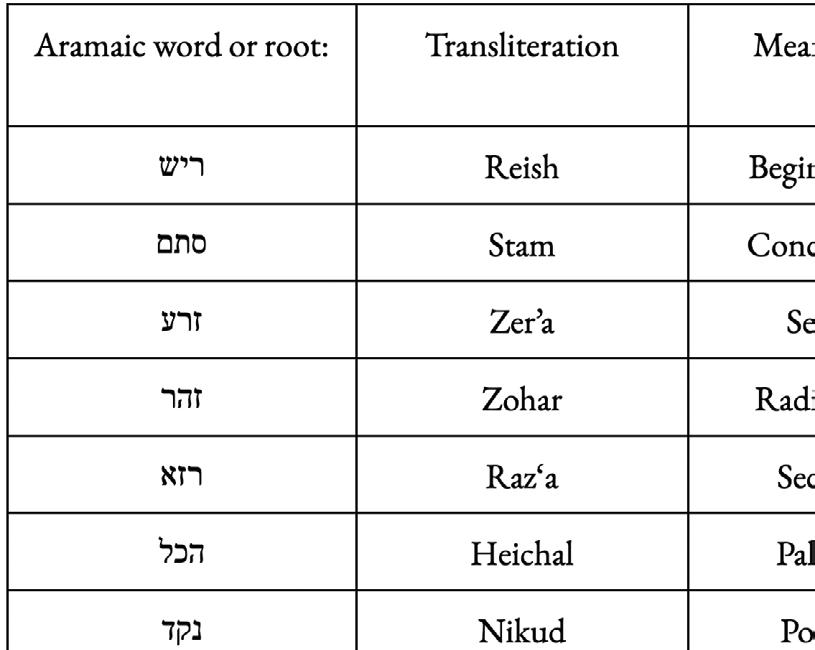
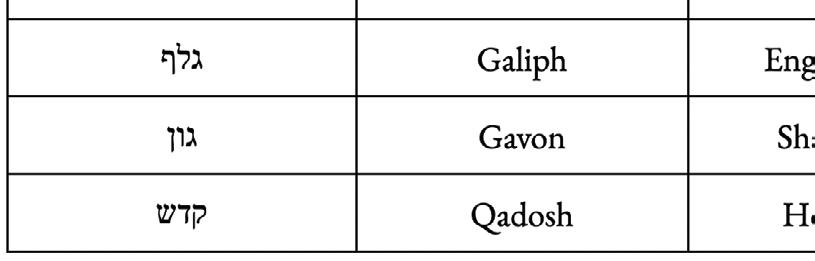
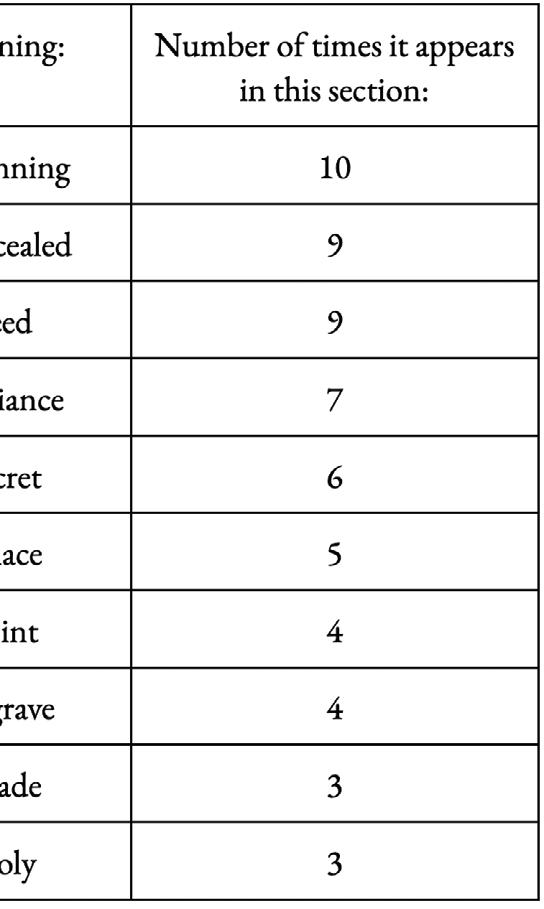
The words that appear in the table above have a similar function to the teleutons used in the sestina in that they contain connotations that change slightly with each line. The words are difficult to fully explain in the first place; the Zohar cannot say exactly what holiness is, or what the beginning is (these are entire categories of Kabbalistic thought on their own). With repetition, these amorphous concepts become even less defined. For example, in this section the Zohar says, “In the beginning, the will of the King engraved engravings in the supernal light with a strong spark.”9 This sentence’s repetition of words with the root of “engrave” pulls the reader in with its hypnosis. The meaning of the words changes slightly with each repetition. First, “engrave” is presented as a verb—a process in action—and is then transformed into a noun. In The Poetry of Kabbalah, Peter Cole
8 Krysl, “Sestina: Vanishing Point,” lines 18-19.
9 The Zohar, vocalized ed., trans. Rose Clubok (Israel, 2013), 1:15a.
observes that this repetition contains more significance than that of a mere stylistic choice; that “this tradition considers how first things are bound up with what comes last, and where the present stands in relation to both.”10 The repetition and circularity impact the reader’s perception of time itself and the progression of the world. According to Cole, this cycle of repetition has mystical significance, wherein “those who compose and utter the lines of mystical hymns take part in the continual reconfiguration of the cosmos.”11 Through repetition and circularity, the reader’s act of uttering the words of Kabbalah has ontological consequences for the universe. Although it contains significant repetition, contradiction is also a crucial element of the Zohar. Even as the meanings of the words from the section of the Zohar referenced above seem to refer to each other, they also contradict each other. Secrecy and radiance seem like they cannot both apply to the same object, just as a single point seems like it cannot also be an entire palace. The shifting words are trancelike and cyclical in their opposition. In the Zohar, it is written: “In the beginning He created this palace that is concealed and that isn’t understood.”12 The Zohar describes this palace as a representation of the newly-created material world—which would appear to be the most self-evident aspect of the universe. How can it be that material, physical, reality is concealed and misunderstood? The Zohar goes on to say: “There are colors that are seen and colors that are not seen.”13 Given that a color is by definition a visual element, what does it mean for a color to exist while simultaneously remaining unseen? Such contradictions are just as important as repetition in creating the Zohar’s altered atmosphere where opposition creates and sustains the act of meaning-making. Cole writes that Kabbalistic poetics draw “attention to aspects of language-in-action that slip readers into a ‘dawn-kaleidoscopic’ world of ramifying meaning where absence and presence evoke one another.”14 The world is intensified and warped through contradiction, as what is there calls to mind what is not. For example, the Zohar describes a flame that is “not white and not black and not red and not green and not any shade at all.”15 Each color is mentioned and brought to the reader’s mind, but the Zohar does this only to invoke
10 Peter Cole, “Introduction,” The Poetry of Kabbalah: Mystical Verse from the Jewish Tradition, (New Haven, CT: Yale University Press, 2014), xv.
11 Cole, “Introduction,” The Poetry of Kabbalah: Mystical Verse from the Jewish Tradition, ix.
12 1:15a (Vocalized Zohar).
13 2:23a-b (Vocalized Zohar).
14 Cole, “Introduction,” The Poetry of Kabbalah: Mystical Verse from the Jewish Tradition, x.
15 2:23a-b (Vocalized Zohar).
their opposite. What is not present is just as important as what remains. This juxtaposition is a feature of mysticism, as it emphasizes the fact that the material world is not capable of being understood by humanity. Perhaps the closest people can get to the answers are the contradictions themselves. Similarly, the structure of the sestina highlights juxtaposition, which is critical to the form: “end words that were furthest apart in any one stanza are placed as close as possible in the next,” creating ‘the greatest possible sequential displacement and juxtaposition.’”16 Like in the Zohar, the sestina’s contradictions are periodic and equally entrancing: “The sestina’s encoding of this pattern of polar moments linked by repeating teleutons fuels a peculiarly intoxicating tension.”17 This tension drives the orbit of the poem, building without resolution until the very end: “The tension is only resolved in the stability of the congedo, a point of equilibrium where the elements of the paradoxical counter-thrusts of the circular and squared forms balance without denying the jarring discords through which they have passed.”18 That is, this tension continues to build throughout the poem, and is only resolved in the end, by a break in the pattern. “Vanishing Point’s” last stanza and congedo portrays this dynamic:
the lay of the land? At some point she wakes, changes cities, names, cuts her hair. Like moonlight we occur and reoccur. He’s not wrong, but the woman in the photo is dead, the moon’s set. What’s the point of trying to buy time? What this man owns isn’t what he needs in the dark. This is the man
who wanted to remember the point at which he fell asleep. But he’s awake, without moonlight or a plan on his own, on the move, changing like a woman leaving a man.19
The poem ends with the word “man,” the same one that begins the poem. The revolution of the words finally finishes, with the end resolving the beginning (and the beginning playing a role in the end’s resolution). All of the words: “point,” “moonlight,” “woman,” “own,” “changing,” and “man” appear in these last few lines, but not in the pattern of the rest of the poem. This iteration joins these words together in a new way; in the rest of the poem, they are separated into each line, and none appear together. In this
16 Krysl, “Sacred and Profane: The Sestina as Rite,” 7.
17 Krysl, “Sacred and Profane: The Sestina as Rite,” 8.
18 Spanos, “The Sestina: An Exploration of the Dynamics of Poetic Structure,” 549.
19 Krysl, “Sestina: Vanishing Point,” lines 30-39.
way, the resolution of the tension requires a break in the previously established form of the sestina. That is, the poem can’t end until the form contradicts itself.
It is possible that these similarities in structure are not a coincidence; in fact, some scholars believe that the sestina’s structure of six stanzas of six lines has Kabbalistic significance. In her essay, “Sacred and Profane: The Sestina as Rite,” Marilyn Krysl describes the sestina’s connection to the sefirot—mystical emanations from God:
Six represented the highest state of union attainable in the profane world. Six, the lowest multiple of three and two, appears in geometry as the double triangle. This double triangle Seal of Solomon, star of David corresponded to the middle sephiroth of the Kabbalah tree, the sephiroth which joins heaven and earth top and bottom of the tree to its male and female left and right.20
It is possible that the sestina’s pattern—six stanzas of six lines and a seventh stanza that breaks the motif and resolves the tension—is connected to mystical ideas of Shabbat. Krysl goes on to say, “Eliade cites Philo Judaeus’ interpretation of the six days of creation after which, on the seventh day, God rested, opening profane, earthly existence into eternal, ‘timeless’ time. ‘In numerology [...]; seven is the number of eternity and mutability, of the temporal, sublunary world and the world of the eternal Sabbath.’”21 In the sestina, this seventh stanza is the congedo, which breaks the form and resolves the tension that has been built up by the six stanzas. Similarly, in the Zohar, Shabbat is a “break” from the rest of time and contains an extra element of spirituality. “When Shabbat arrives, she joins together and separates from the other side, and all the laws transition from it, and she stays in conjoinment with the holy light.”22 In the Zohar, the “other side,” the sitra achra, refers to evil forces. The Zohar’s discussion of Shabbat breaking from these evil forces and instituting a new law in conjoinment with holy light brings to mind the sestina’s congedo, which resolves the tension of the last six lines and uses its own culminating set of rules. Scholars of the sestina have recognized these mystical connotations. Krysl quotes Cummins, noting that “Cummins thinks we may have ‘lost the meaning of the number mysticism that the medieval mind associated with the sestina’
20 Krysl, “Sacred and Profane: The Sestina as Rite,” 9.
21 Krysl, “Sacred and Profane: The Sestina as Rite,” 10.
22 2:135b (Vocalized Zohar). .
and concludes that we must ‘somehow feel their meaning in the poem.’”23 Perhaps that intangible, inexplicable pull of the sestina arises—in its most basic sense—from its own mystical foundations.
Both the Zohar and the sestina raise the question of the place of language within the attempt to articulate the mystical experience. Krysl notes that the troubadours, who wrote and performed sestinas in the Middle Ages, “came to understand that writing and singing poems was a way of mediating desire within time’s flux. In this process one gained a sense of ‘selfknowledge and completion from the experience of loving, composing and singing viewed as an inseparable unity.’”24 Like the ontological significance of the language of the Zohar, the sestina’s language acts upon the world, “mediating desire” and impacting concepts of temporality. Moreover, the sestina’s origin story further positions it within this spiritual context. Like the Zohar, the sestina was originally connected to spirituality: “The sestina is a relic from an age of faith, and the meditative voice is never single.”25 This dual voice leads to the sestina being a mystical experience in and of itself. Cummins writes that “it posits itself and a Listener; and the idea of someone listening to you—let alone someone omniscient—makes for a whole dynamic, more than an utterance.”26
The Zohar’s language is likewise deeply intertwined with personal relationship to the Divine. In A River Flows from Eden, Melila HellnerEshed writes that, like the sestina, the Zohar’s language affects our mystical experience, because “The translation of that experience into words [enables one to] glimpse into that hidden domain.”27 Hellner-Eshed argues that language is our only recourse into the mystical realm, and that it allows us to see—if not articulate—the ineffable. She goes on to argue that “language, then, both reveals and conceals; in seeking to explore mystical experience in the Zohar, we have no recourse save these linguistic remnants.”28 As it is a last resort, language does not always do its job. Sometimes it reveals, but just as often it does the opposite and instead conceals. Yet, what if the construction of language in the Zohar doesn’t simply imitate divine experience, but rather guides individuals to it, in the same manner in which Cummins
23 Krysl, “Sacred and Profane: The Sestina as Rite,” 10.
24 Krysl, “Sacred and Profane: The Sestina as Rite,” 9.
25 Cummins, “Calliope Music: Notes on the Sestina,” 157.
26 Cummins, “Calliope Music: Notes on the Sestina,” 157.
27 Melila Hellner-Eshed, A River Flows from Eden: The Language of Mystical Experience in the Zohar, Stanford University Press, (2011), 255.
28 Melila Hellner-Eshed, A River Flows from Eden: The Language of Mystical Experience in the Zohar, 255.
argues the sestina does? Perhaps the poetic form of the Zohar is not just an approximation of some higher spiritual energy, but rather a powerful force in and of itself. Cole argues that the form of language present in the Zohar is essential for the mystical process: “In this Kabbalistic context, poems not only depict a mystical process, they produce it.”29 Cole writes that even Gershom Scholem acknowledged “the indissoluble link between the idea of a revealed truth and the notion of language.”30 Although language may have its faults, it is also the medium for attaining revealed truth. Perhaps the language is not the obstacle in the Zohar and the sestina, but rather, the path to meaning-making.
It is significant for the study of poetry and mysticism that the sestina, a mystical form of poetry, and the Zohar, a poetic text of mysticism, share key similarities. The Zohar and the sestina both contain the new and the old. They cycle between revival and oblivion and in each of these stages, resurrecting old traditions and inventing new ones. They depend upon cyclicality and contradiction, and more substantially, on maintaining and eluding form and structure. Both forms contain mystical significance and seek access to a transcendent experience of the Divine. These aspects of poetry attempt to elicit a mystical experience, and the fact that the same qualities are used across time and religion indicate that poetry is the driving force behind the affective experiences that religious texts like the Zohar produce. The Zohar is simultaneously a work of poetic form and a religious
text wherein the sharp distinction between poetry and mysticism—often maintained by separating the two genres—is blurred. At the same time, the meaning and draw of poetry itself is a direct result of this desire to indulge in mysticism, as it allows poetry to evoke the transcendent. The sestina has mystical connotations, even as it is primarily thought of as a poetic form today. The categories blur as poetry becomes mystical and mysticism becomes poetic. Spiritual significance is hard to quantify, and perhaps it is impossible to measure two deeply mystical poetic forms against one another in their entirety. Although poetry’s pull may be indescribable, it is connected to underlying mystical connotations that the reader can sense—even if they cannot explain it.
29 Peter Cole, “Introduction,” The Poetry of Kabbalah: Mystical Verse from the Jewish Tradition, ix.
30 Peter Cole, “Introduction,” The Poetry of Kabbalah: Mystical Verse from the Jewish Tradition, xi.
Bibliography
Berman, Nathaniel. “Divine and Demonic in the Poetic Mythology of the Zohar.” IJS Studies in Judaica, vol. 18, 2019, https://doi. org/10.1163/9789004386198.
Burt, Stephen. “Sestina! Or, The Fate of the Idea of Form.” Modern Philology, vol. 105, no. 1, 2007, pp. 218–41. JSTOR, https://doi. org/10.1086/587209. Accessed 18 Apr. 2023.
Cole, Peter. “Introduction.” The Poetry of Kabbalah: Mystical Verse from the Jewish Tradition, Yale University Press, New Haven, Connecticut, 2014, pp. ix-xxii.
Cummins, James. “Calliope Music: Notes on the Sestina.” The Antioch Review, vol. 55, no. 2, 1997, pp. 148–59. JSTOR, https://doi. org/10.2307/4613484. Accessed 18 Apr. 2023.
Hellner-Eshed, Melila. A River Flows from Eden: The Language of Mystical Experience in the Zohar. Stanford University Press, 2011.
Krysl, Marilyn. “Sacred and Profane: The Sestina as Rite.” The American Poetry Review, vol. 33, no. 2, 2004, pp. 7–12. JSTOR, http://www. jstor.org/stable/20682474. Accessed 18 Apr. 2023.
Krysl, Marilyn. “288. Sestina: Vanishing Point - Marilyn Krysl.” Inward Bound Poetry, Inward Bound Poetry, 1 Jan. 1970, http:// inwardboundpoetry.blogspot.com/2006/12/288-sestinavanishing-point-marilyn.html.
“Ask the Expert: Do I Have to be 40 to Study Kabbalah?” My Jewish Learning. 3/26/2025. https://www.myjewishlearning.com/article/ ask-the-expert-do-i-have-to-be-40-to-study-kabbalah/.
Spanos, Margaret. “The Sestina: An Exploration of the Dynamics of Poetic Structure.” Speculum, vol. 53, no. 3, 1978, pp. 545–57. JSTOR, https://doi.org/10.2307/2855144. Accessed 18 Apr. 2023.
Vocalized Zohar. Israel: 2013.
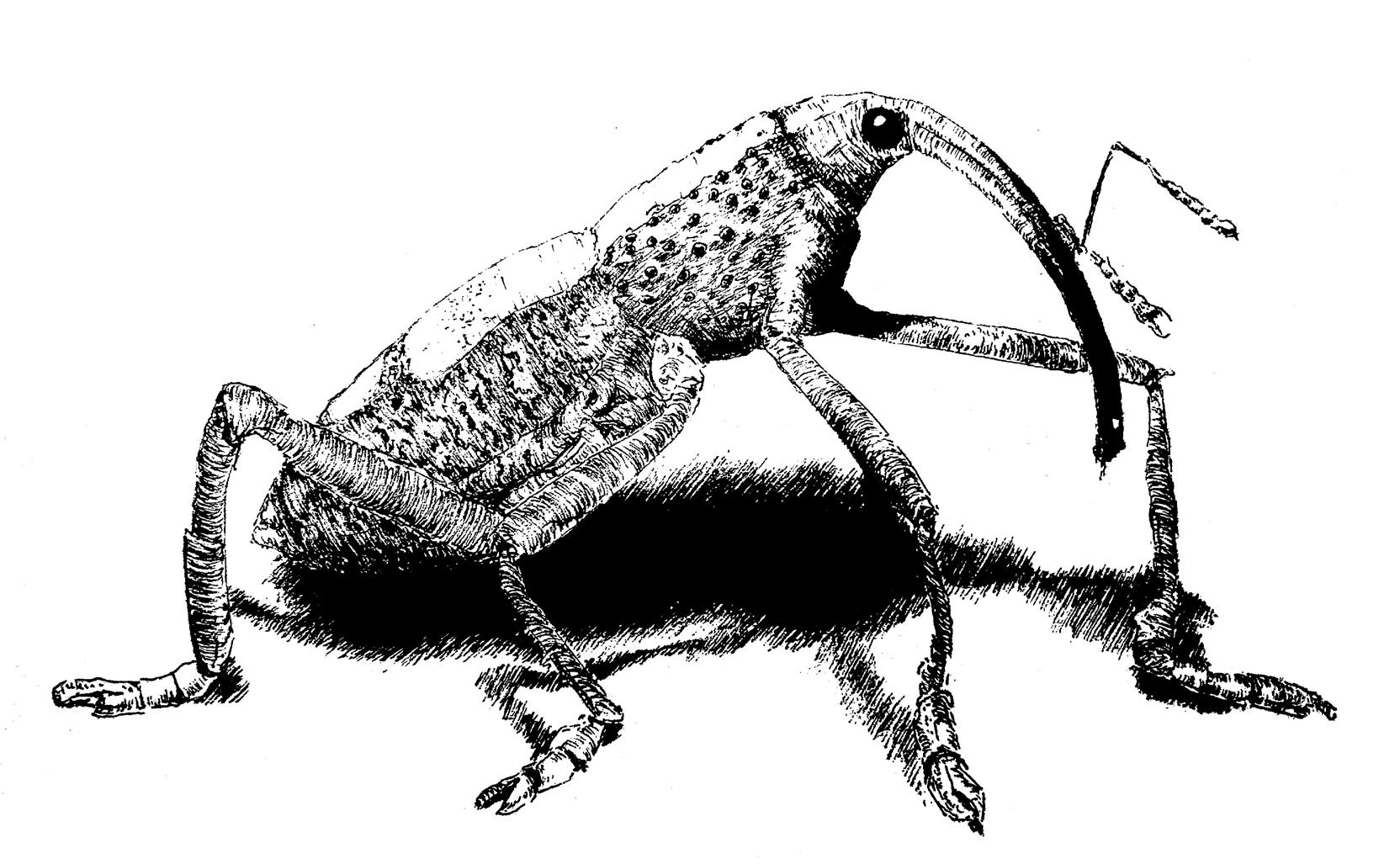
Julia Kirby, Weevil, 2024, ink on paper.
Memory, Image, Simulacrum: A Letter from Sans Soleil (1983) to New Media Art
Lucia Cao
I’m writing you all this from another world, a world of appearances. In a way the two worlds communicate with each other. Memory is to one what history is to the other: an impossibility.
—Chris Marker, Sans Soleil (1983)1
Chris Marker’s Sans Soleil (1983) is a film about images. Following the narrator’s voice reading letter fragments from a travelerfilmmaker named Sandor Krasna, we encounter on screen an electrifying myriad of images from all over the world: Japan to Iceland, Guinea-Bissau to San Francisco. Through montage, different types of images are indiscriminately woven together—televisual images, archival images, cinematic images, images processed by a synthesizer. It is a film that embraces disparities, mysteries, and incoherence; images only occasionally synchronize with the voiceover, and the transition from one sequence to another often goes unexpected and unexplained. One moment we’ll see what appears to be historical footage of a rocket launch—paired with unrelated musings about Sei Shonagon in the voiceover—and the next moment a long travelog-style image sequence of a Japanese ceremony will appear, which is then sporadically disrupted by a fleeting shot from Africa or Iceland, referred to in another part of the film. While it evokes documentary filmmaking with the use of handheld cameras, the film completely overturns the anticipation for a stable link between image and reality. On the contrary, Sans Soleil presents us with images we can only speculate about, whose origins are unknown and made unknowable by the discontinuity of editing and the asynchronicity of text, sound, and image. Thrown in front of us without a narrative framework or consistency, the images possess a radical “image-ness”: their temporality ambiguous, their authorship unknown, and their referentiality indeterminate, they are first and foremost “images,” and
1 Sans Soleil, 01:08:04.
are perceived as such. If these descriptors feel familiar, it’s because they foreshadow characteristics that would come to be associated with the digital image, considered in contrast to the indexical.2 A central device in the film further confirms this—an image synthesizer named the Zone (a reference to Tarkovsky’s 1979 film Stalker), created by Hayao Yamaneko, which collects, stores, manipulates, and distorts images from the past until they are no longer recognizable. Created in 1983, neither Sans Soleil nor the Zone was digital in the way we know it.3 At a time when analog media still dominated the cultural landscape, why would Sans Soleil distance itself from the indexical, analogical, auratic, authentic relationship between image and reality—a lost relationship that many contemporary artists now strive to restore? Using the Zone as an example for the critical aesthetic operation of new media art, I argue for a new media aesthetics that elevates the simulacral, virtual power of the image and its effects in affective, perceptual realms of experience, which constitutes a gesture of resistance in the time of pervasive media networks and technologically mediated histories.
A World of Appearances
There are many threads we can follow if we want to consider how, beginning in the twentieth century, both intellectual discourses and our everyday reality are concerned with images to an unprecedented degree. Throughout the twentieth century, new imaging technologies and media networks have constantly transformed mass communication and visual culture—photography, cinema, television, video, and finally the computer, which declared the arrival of the digital age. What sets Chris Marker apart
2 The characterization of the digital image as non-indexical was especially prominent in the late 90s and early 2000s, as a response to the dawn of the digital and the so-called post-cinema. See Lev Manovich, “What Is Digital Cinema?,” in Post-Cinema: Theorizing 21st Century Film, ed. Shane Denson and Julia Leyda (Falmer: REFRAME Books, 2016), 20–50. In the context of photography, indexicality refers to how photography results from “the physical imprint transferred by light reflections onto a sensitive surface” (Krauss, 75). See Rosalind Krauss, “Notes on the Index: Seventies Art in America,” October 3 (Spring 1977): 68-81; and Roland Barthes, Camera Lucida: Reflections on Photography, trans. Richard Howard (New York: Hill and Wang, 2010).
3 Sans Soleil was shot on 16mm film. As for the Zone, the synthesizer seen in the film is very likely a hybrid video synthesizer, with both analog and digital components. Later in the film, however, we are shown that Hayao also “invents video games with his machine” [00:58:32], although it is not clear how. I am tempted to believe that the Zone is a fictional machine that Chris Marker imagined to be—at the very least—conceptually “digital.”
as a filmmaker and artist is his exceptional sensitivity to the emergence of these new media forms and technologies, both in his choice of mediums and in the themes he addresses. Some of the examples include his “chatbot,” the computer program Dialector (1988), a television series called The Owl’s Legacy (1989), his CD-ROM Immemory (1997), a pseudo-documentary film Level 5 (1997) which interrogates the medium of video games, and his active presence on the virtual world of Second Life. I have mentioned previously how Sans Soleil evokes characteristics of the digital despite its analog nature. Even without further discussion of the digital, the documentary content of the film exhibits an extraordinary level of attentiveness to technologies and forms of mediation that define the visual experience of its time.
Throughout the film, as different types of images take up the screen, we see how everyday life is structured by the production, dissemination, and consumption of technical images—from the pixel interface of Pac-Man to television screens stacked on top of each other, live-streaming sumo fights. Towards the middle of the film,4 we follow Marker’s images to the train station; a blurred shot of several trains rapidly crossing each other transitions directly into a railway scene from the anime Galaxy Express 999, which, after the train changes direction within the scene, transforms seamlessly into another camera shot showing the railway as the train keeps on moving. Following this is a montage featuring individual close-ups of passengers asleep on the train, interspersed with zoomed-in televisual images from a variety of TV genres. This sequence ends as the eyes of a woman are replaced by the eyes on a giant anime poster in the next shot. In a couple more shots that follow, we see advertising images superimposed onto moving crowds. Sans Soleil documents a time when it is no longer possible to imagine a life away from the ubiquity and potency of infinitely reproducible images and images of images:
The entire city is a comic strip; it’s Planet Manga. How can one fail to recognize the statuary that goes from plasticized baroque to Stalin central? And the giant faces with eyes that weigh down on the comic book readers, pictures bigger than people, voyeurizing the voyeurs.5
In another fragment, Marker highlights the centrality of vision and visuality in the hypervisible and hypervisual (post)modern world:
4 Sans Soleil, directed by Chris Marker (Paris: Argos Films, 1983), 00:49:44.
5 Sans Soleil, 00:18:48.
But the more you watch Japanese television... the more you feel it’s watching you. Even television newscast bears witness to the fact that the magical function of the eye is at the center of all things. It’s election time: the winning candidates black out the empty eye of Daruma—the spirit of luck—while losing candidates—sad but dignified—carry off their one-eyed Daruma.6
This resonates with a whole lineage of discourses regarding the world and its image, reality and representation, or the original and the copy. Although these distinctions can be traced all the way back to Platonism, discourses have particularly intensified in the twentieth century due to the pervasiveness of new, technologically mediated visual regimes. Most notable is the tradition of Marxist cultural criticism and its critique of postmodernity in relation to the loss of referents in contemporary society, wherein images have taken over and have become reality itself. Guy Debord introduces the vocabulary of spectacle to describe the transformation of real life into images, which is “a worldview that has actually been materialized, that has become an objective reality.”7 Following in the footsteps of Debord, Jean Baudrillard contends that we live in a society of hyperreality and simulation and outlines four phases through which representation is subsumed by simulation—in the final phase, the image “has no relation to any reality whatsoever: it is its own pure simulacrum.”8
The twentieth century ushered in an intensified concern with image, vision, and visuality. Early in the 80s, W. J. T. Mitchell had observed the emergence of a “pictorial turn” within the humanities, which acknowledges “that pictures form a point of peculiar friction and discomfort across a broad range of intellectual inquiry.”9 Intellectual historian Martin Jay, likewise, has noted the “denigration of vision in twentieth century French thought” which denounces both the ocularcentric tradition of Western philosophy, as well as the contemporary visual practices of surveillance and spectacle which
6 Sans Soleil, 00:23:08.
7 Guy Debord, The Society of the Spectacle, trans. Ken Knabb and Fredy Perlman, (Critical Editions, 2014), 2.
8 Jean Baudrillard, Simulacra and Simulation, trans. Sheila Faria Glaser (Ann Arbor: The University of Michigan Press, 1994), 6.
9 W. J. T. Mitchell, “The Pictorial Turn,” Artforum 30, no. 7 (March 1992), https://www. artforum.com/features/the-pictorial-turn-203612/.
support networks of power.10
It is within the historical context of these intellectual discourses that we should understand Sans Soleil’s treatment of images, which—in a seemingly counterintuitive way—engages with the absence of a traceable link between images and reality; rather than mourning the loss, Sans Soleil affirms the image-ness of images as such.
Images, Not Presence
What results from the loss of indexicality is, partly, the crisis of historical representation and historicity—which has formed the ground of the tensions between postmodernism and Marxism. On the one hand, poststructuralists like Jean-François Lyotard characterize history as a process of mythmaking and question the notion of transcendent, universal truth.11 On the other hand, Marxist cultural theorists like Fredric Jameson criticize the loss of historical meaning and historical consciousness as history is replaced by depthless, empty stylizations of the past.12 Although these perspectives emerge from divergent critical traditions and express contrasting attitudes toward the fragmentation of historical narratives, their juxtaposition reveals a core paradox of postmodernity: the simultaneous collapse of historicity and desire for origins, alongside the simultaneous loss and overproduction of truths.
Discourses within cultural studies have been adept at diagnosing the loss of historical narratives in our time, but haven’t been able to alter the fact that our everyday life is overflowing with fabricated truth-claims more than ever before, amplified by global media networks and technologies. Within this context, the realism of the photographic image—once championed by Bazin for its capacity to “re-present” reality through direct transference rather than the illusionistic mimesis of other plastic arts13—becomes a site of contestation. In fact, from its inception, photography has served dominant visual regimes that embrace and elevate its supposed truth-value,
10 See Martin Jay, Downcast Eyes: The Denigration of Vision in Twentieth-Century French Thought (Berkeley: University of California Press, 1993).
11 See Jean-François Lyotard, The Postmodern Condition: A Report on Knowledge, trans. Geoff Bennington and Brian Massumi (Minneapolis: University of Minnesota Press, 1984).
12 See Fredric Jameson, Postmodernism, or, The Cultural Logic of Late Capitalism (Durham: Duke University Press, 1991).
13 André Bazin, What Is Cinema? Vol. 1, trans. Hugh Gray (Berkeley: University of California Press, 2005), 12.
facilitating the construction of coherent narratives and the claim to reality. To foreground the image-ness of images, then, is firstly to reject promises for historical truth made by technical images or any kind of so-called objective documentation. The problem is not, at least not yet, whether historical truth or reality exists—instead we need to remain alert to any claim of total access to it.
The entire project of Sans Soleil is based on unsettling the truthpromise located within the index. As discussed earlier, images in Sans Soleil are displaced and dislocated from a trackable link to a specific time and place in reality. More precisely, this attitude of assuming critical distance from indexicality is embodied in the Zone—the image synthesizer used by Krasna’s friend and video game artist Hayao Yamaneko, which makes its first appearance when Krasna ruminates upon political struggles of the sixties:
My pal Hayao Yamaneko has found a solution: if the images of the present don’t change, then change the images of the past. He showed me the clashes of the sixties treated by his synthesizer: pictures that are less deceptive he says—with the conviction of a fanatic—than those you see on television. At least they proclaim themselves to be what they are: images, not the portable and compact form of an already inaccessible reality. Hayao calls his machine’s world the Zone, an homage to Tarkovsky.14
Here, the Zone is used specifically to challenge the promises of the television. Compared to photographic truth, televisual truth has gained another dimension: the temporal immediacy and simultaneity of broadcasting, which Hayao aptly refers to as “images of the present.” Pitted against the deceptive images of television which claim to guarantee access to reality, the Zone functions as television’s other in every way, countering all of its principles. Images treated by the Zone are revealed to be absent rather than present, mediated rather than immediate, denaturalized rather than natural, fictional rather than truthful, distorted rather than coherent, and ultimately images rather than “reality.”
I read Sans Soleil’s refusal to indulge in illusions of presence as a gesture in the spirit of Derridean deconstruction. Perhaps the fact that Krasna always writes (in letters to the narrator) is already reminiscent of Derrida’s écriture which is always unfolding through différance. Derrida has called into question notions such as proximity, immediacy, and presence, introducing the concept of trace which “is not a presence but is rather the
14 Sans Soleil, 00:41:52.
simulacrum of a presence that dislocates, displaces, and refers beyond itself.”15 Postproduced by the Zone, televisual images that claim access to reality are stripped of their visual resemblance and undergo a manual treatment of deferral and differentiation, finally exposed as “images, not the portable and compact form of an already inaccessible reality” or as Derridean traces, not presence.
Rewriting Memory
Through the infinite agglomeration and superimposition of intentionally displaced images, Sans Soleil reveals “reality” to be something that is always deferred/differed and refuses to contribute to illusions of a universally present, coherent, and unmediated historical reality. The film’s focus on the politics of memory/remembering as subjective, personal, and trivial, is concerned with the destabilization of such official history. In the very beginning of the film, the letter reads, “I’ve been around the world several times and now only banality still interests me.”16 This is accompanied by a series of images on the ferry, each presenting a moment of fragility in everyday life: a foot resting on the desk, a manga book, a hand holding a cigarette, a businessman lying across the seats. In another instance, the narrator questions:
Do we ever know where history is really made? Rulers ruled and used complicated strategies to fight one another. Real power was in the hands of a family of hereditary regents; the emperor’s court had become nothing more than a place of intrigues and intellectual games. But by learning to draw a sort of melancholy comfort from the contemplation of the tiniest things this small group of idlers left a mark on Japanese sensibility much deeper than the mediocre thundering of the politicians.17
The film refers to how memory—with its roots in the banality and triviality of the everyday—eludes hegemonic history and possesses a subversive potential by revealing differences and discrepancies hidden beneath historical narratives. At first glance, this might be reminiscent of discourses in memory studies which theorize memory as arising from the collapse of
15 Jacques Derrida, Speech and Phenomena: And Other Essays on Husserl’s Theory of Signs, trans. David B. Allison (Evanston: Northwestern University Press, 1973), 156.
16 Sans Soleil, 00:02:31.
17 Sans Soleil, 00:09:51.
history “as a therapeutic alternative to historical discourse.”18 Scholars like Pierre Nora commend memory as the immediate and authentic force of remembering, as opposed to history’s rational manipulation of narratives. We can view this trend as having emerged in memory studies partly as “a response to the challenges posed by poststructuralism”—namely, the challenges of distance, mediacy, and a forever lost presence.19 According to Nora, “with the appearance of the trace, of mediation, of distance, we are not in the realm of true memory but of history.”20
However, in Sans Soleil, memory is not opposed to history as a “therapeutic alternative,” but is “an impossibility” as much as history itself is. While Sans Soleil pits personal memory against official history, it does not ascribe to memory the comforts and promises no longer found in historical narratives—the illusions of originary presence, of spontaneous engagement, or of unmediated access to reality. Instead, remembering itself is linked to the idea of writing in its first appearance in the film’s script:
He wrote me: I will have spent my life trying to understand the function of remembering, which is not the opposite of forgetting, but rather its lining. We do not remember, we rewrite memory much as history is rewritten. How can one remember thirst?21
The analogy to writing—“the structure always already inhabited by the trace”22—suggests that memory, just like the image, is imbued with delay and distance. Hayao’s “zone,” occupying a central position in the film, is exactly the site where memory—in the form of images—gets rewritten: “Hayao showed me my images already affected by the moss of time, freed of the lie that had prolonged the existence of those moments swallowed by the spiral.”23
These operations of sifting, sorting, and rewriting—a temporallybound process—entails an active acknowledgment of time, a refusal to
18 Kerwin Lee Klein, “On the Emergence of Memory in Historical Discourse,” Representations, no. 69 (Winter 2009): 127-150, 145.
19 Ibid, 144.
20 Pierre Nora, “Between Memory and History: Les Lieux de Mémoire,” Representations, no. 26 (Spring 1989): 7-24, 8.
21 Sans Soleil, 00:04:58.
22 Gayatri Chakravorty Spivak, “Translator’s Preface,” in Of Grammatology, by Jacques Derrida, trans. Gayatri Chakravorty Spivak (Baltimore: Johns Hopkins University Press, 1976), xxxix.
23 Sans Soleil, 01:38:03..
believe in an unmediated presence that can be preserved in totality. Memory can therefore never be present-minded, but is always a postproduction, which relates back to Derrida’s deconstructionist approach to history. Contrary to the presentist view that privileges the current moment present as the anchor point of approaching history, Derrida proposes the idea of an absolute past: “[the] impossibility of reanimating absolutely the manifest evidence of an originary presence refers us therefore to an absolute past. That is what authorized us to call trace that which does not let itself be summed up in the simplicity of a present.”24 In the same way that the signified is always-already a trace and a signifier, memory is also an image, rather than the prolonged presence of a past.
We should, therefore, understand the Zone not just as a critique of the false promises of the televisual apparatus, but also a resolute acknowledgment of the operations of time in general. It is time which determines the permanent “impermanence of things”25 and underscores the ineffable distance between so-called reality and any attempt to represent, preserve, or remember it in totality/objectivity. This places Sans Soleil in direct opposition to Bazin’s photographic realism. For Bazin, the photographic image is reality directly transferred. This distinguishes its aesthetic from other plastic arts such as painting: while art and reality differ in kind, “the photograph as such and the object in itself share a common being, after the fashion of a fingerprint.” In fact, the Zone overturns almost all of Bazin’s claims. While Bazin likens the image to “time [embalmed] and change mummified,”26 Sans Soleil emphasizes impermanence. While Bazin stresses the objective being of the image, Sans Soleil elevates the importance of subjective perception. While for Bazin, the image is nothing but faithful to its origins, Sans Soleil reveals the radical image-ness of images, which are as removed from physical reality as any other form of visual art—in distanciation, they are defined by a sphere of freedom related to affect, perception, and difference.
This explains why my understanding of Sans Soleil alludes to the impossibility of memory and suggests that history is precisely how and why remembering is meaningful. After seeing images of the sixties distorted by the Zone, Krasna makes the remark: “If to love is to love without illusions, I can say that I loved it.”27 This reveals an important aspect of the act of
24 Jacques Derrida, Of Grammatology, trans. Gayatri Chakravorty Spivak (Baltimore: Johns Hopkins University Press, 1976), 66.
25 Sans Soleil, 00:25:08.
26 Bazin, 14-15.
27 Sans Soleil, 00:43:21. This is not the original text from the English version but my
remembering in Sans Soleil—remembering as a subjective, meaningful, affective experience which is possible only when freed from the illusions of total recall or originary presence.
In the film, Krasna describes a science fiction movie that he wants to make, also called Sans Soleil. This film follows a man from a future where everything works to perfection—including memory. Free of amnesia, this future world is also free of any kind of affective activity: “to call forth a vision, to be moved by a portrait, to tremble at the sound of music, can only be signs of a long and painful pre-history.”28 It is only upon hearing a song cycle by Mussorgsky that he begins to understand the sentiment related to memory and unhappiness—something whose originary presence is lost, leaving behind only a trace.
For Marker, it seems, it is exactly the fragility of memory— its displacement and dislocation, its trace-nature, its eternally partial being—that animates the act of remembering: “total recall is memory anesthetized.”29 Sans Soleil allows us to see memory as image and image as memory—both defined by an unbridgeable temporal distance from an origin or presence. Yet the film’s insistence on such distance is not only about dismantling illusions—rather, it is this very distance that enlivens the process of remembering. It gives both memory and image a common power: the freedom from “total recall,” from the re-presentation of the same reality.
Power of the Simulacrum
By presenting the images of the Zone against those that lay claim to reality, Sans Soleil elevates the power of images as impermanent, transitory, impotent appearances—qualities considered inferior according to Plato’s derogatory classification of images in the Republic, a framework that has continued in various forms across Western intellectual thought.30 Yet it is precisely this degraded status—the image as an image and therefore as virtual—that opens up the space for engagement, imaginative freedom, and the potential for difference.
translation from the French. The original English version slightly distorts the French (“Si c’est aimer que d’aimer sans illusion…”) by translating it as “If to love without illusions is still to love…”
28 Sans Soleil, 01:15:02.
29 Sans Soleil, 01:14:37.
30 See Plato, Republic, trans. G. M. A. Grube (Indianapolis: Hackett Publishing Company, 1992).
Tracing a genealogy of the spectacle, Jonathan Crary points to Walter Benjamin’s early twentieth century critique of the effect of spectacle as the “standardization of perception.” Crary notes that Benjamin draws on Bergson’s re-conceptualization of perception as imbued with memory, which has “the capacity to rebuild the object of perception.”31 The spectacle, then, is not just defined by images per se, but by images that have lost their dimensions of perception related to the creative and productive force of memory.
For Bergson, images are the very foundation of perception. They constitute the basis for his philosophy of creation and freedom which seeks to find a way between and beyond the philosophical binary between idealism and realism. Bergson understands matter as “an aggregate of images,” and the image as “a certain existence which is more than that which the idealist calls a representation, but less than that which the realist calls a thing—an existence placed halfway between the ‘thing’ and the ‘representation.’” Matter is therefore conceptualized as “before the dissociation which idealism and realism brought about between its existence and its appearance.” It is within this context—image in between “representation” and “thing”—that we can understand how present perception can be constantly “created anew” by memory, the “intersection of mind and matter.”32
To further understand the Bergsonian concept of memory, let us turn to Deleuze’s explanation:
[As] Bergson shows, memory is not an actual image which forms after the object has been perceived, but a virtual image coexisting with the actual perception of the object. Memory is a virtual image contemporary with the actual object, its double, its ‘mirror image.’33
The “virtual,” which Deleuze relates to “the subjective, or duration,” is a key anchor to both Bergson and Deleuze’s philosophical projects. Rather than being opposed to the real, the virtual is opposed to the actual; while the possible needs to be realized, the virtual needs to be actualized, and the rules of such actualization “are not those of resemblance and limitation, but those
31 Jonathan Crary, “Spectacle, Attention, Counter-Memory,” October 50 (Autumn 1989): 96–107, 103.
32 Henri Bergson, Matter and Memory, trans. N. M. Paul and W. S. Palmer (Zone Books, 1988), 9-10, 13, 101.
33 Gilles Deleuze, “The Actual and the Virtual,” in Dialogues II, trans. Eliot Ross Albert (New York: Columbia University Press, 2007), 148–52, 150.
of difference or divergence and of creation.”34
In an earlier text “Plato and the Simulacrum,” Deleuze discusses the power of difference as “reversing Platonism,” defining the simulacrum not as a “copy of a copy” or a “degraded copy,” but as “an image without resemblance” that differs from the copy which is defined by an ethos of resemblance. The simulacrum—constructed on the basis of difference and dissimilitude—is seen by Deleuze as possessing a positive power that can
overturn the Platonic order of representation and its distinctions of essence/ appearance or model/copy; the simulacrum “negates both original and copy, both model and reproduction.”35
The power of the image as creative memory and imagination— which, as Benjamin and Baudrillard point out, vanishes in the regime of the spectacle—is the power of the virtual or simulacral image, which never prolongs, re-produces, or re-presents the Same. The kind of imageness affirmed by images in Sans Soleil is an image-ness as such—images that refuse to be immobile, and only always repeat with a difference. This approach to understanding images—which follows Deleuze’s emphasis on the virtual aspects of image related to temporality, perception, and the subjective—provides an alternative perspective that is no longer fixed upon the problematic of indexicality. Instead, it shows the limitation not only of the indexical claim, but also of representation in general—which is the reduction of difference to a mere re-iteration of the original. Rather than looking for the direct imprint of reality upon the image so as to approach reality in its presence, Sans Soleil attends to the virtuality of the image, that which, conversely, “[detaches] from the here and now.”36
In the last chapter of Gilles Deleuze’s Time Machine, Rodowick describes the minoritarian force of “the memory of resistance” and how art can disrupt the circuit of everyday life:
Like every art form, the original will to art of the time-image consists of extracting difference from repetition by reversing copies into simulacra. Art neither represents nor imitates, because it repeats… Everyday life is characterized by repetition as return of the same,
34 Gilles Deleuze, Bergsonism, trans. Hugh Tomlinson and Barbara Habberjam (New York: Zone Books, 1991), 42, 97.
35 Gilles Deleuze, “Plato and the Simulacrum,” trans. Rosalind Krauss, October 27 (Winter 1983): 45–56, 48, 53.
36 Pierre Lévy, Becoming Virtual: Reality in the Digital Age, trans. Robert Bononno (New York: Plenum Trade, 1998), 27.
primarily in the standardized production of commodities and the proliferation of information. Art is not opposed to this mechanical, stereotyped, and habitual repetition. Instead, it embraces it, or rather, incorporates it the better to expose its limits and to extract what is differential and virtual within it. The task of a work of art, then, is to open a line of flight that passes from the actual to the virtual by interrupting repetition with difference.37
The Zone—which repeats televisual images with a difference—therefore embodies an aesthetic operation. It is a strategy of using images against images, or more precisely, of virtualizing technical images that enter the everyday as part of the global media flow, detaching them from the here-and-now in order to elevate the differentiating power of the image-as-simulacrum.
Electronic Texture
I se e the Zone—and Sans Soleil as a whole—as presciently outlining a model for aesthetic resistance in new media art. It concerns an astute observation of the media landscape of the present and of the past, as well as a dedication to elevating the differential power within it. To recapitulate the argument, this resistance is rooted, firstly, in the acknowledgement of différance and the impossibility of originary presence, and, secondly, the virtual, simulacral power of the image in itself. It therefore has two functions; on a smaller scale, it exposes the trace-nature of all images and disrupts technological promises of presence and immediacy in media networks; on a larger scale, it re-activate the differential power in past images so as to “virtualize” the present, to embrace difference.
In my use of the term virtualize, I am referring to Pierre Lévy’s Becoming Virtual: Reality in the Digital Age (1998) wherein Lévy revisits the Deleuzian notion of virtuality in the digital age, when the virtual has become an equivalent for the digital. Lévy notes, however, that virtualization as “detachment from the here and now” had long been part of our existence before the computer age and “is one of the principal vectors in the creation of reality.” One could say that the virtual concerns the part of reality that is not its immediate physical being. For Lévy, virtualization is the process of transformation from the actual to the virtual, which would then mean “an exponentiation of the entity under consideration.” He writes, Virtualization is… a change of identity, a displacement of the center
37 D. N. Rodowick, Gilles Deleuze’s Time Machine (Durham: Duke University Press, 1997), 202-203.
of ontological gravity of the object considered. Rather than being defined principally through its actuality (a solution), the entity now finds its essential consistency within a problematic field. The virtualization of a given entity consists in determining the general question to which it responds, in mutating the entity in the direction of this question and redefining the initial actuality as the response to a specific question.38
Although virtualization is a general operation unrestricted to the technical medium, Sans Soleil illustrates how media images are especially fitting for this virtualizing process of “becoming other”39 due to their simulacral nature defined by spatio-temporal distance. This is something that the film itself seeks to acquire; despite its being analog, it pursues the qualities of detachment and distance through intentionally discontinuous and ambiguous editing.
Although my discussion has focused on more formal aspects of the film, Sans Soleil does have a political undertone. The process of virtualization epitomized by the Zone is particularly linked to the memory of the political struggles of the sixties. Images from the sixties treated by the Zone are freed from the here-and-now and undertake the task of rewriting memories, re-problematizing a past and its effect in the present. Marker was dealing with the aftermath of memories of political revolt, hardened into an unsatisfactory official history that shapes present reality. Virtualization is therefore a necessary operation to fluidize fixed boundaries, identity, and meaning—to counter reality not by answering a set of pre-constituted questions differently, but by turning to the virtual, the other, the not-yetthere or no-longer-there:
How can one claim to show a category of Japanese who do not exist? Yes they’re there; I saw them in Osaka hiring themselves out by the day, sleeping on the ground. Ever since the middle ages they’ve been doomed to grubby and back-breaking jobs. But since the Meiji era, officially nothing sets them apart, and their real name—eta—is a taboo word, not to be pronounced. They are non-persons. How can they be shown, except as non-images?40
38 Lévy, 26-27.
39 Lévy, 34.
40 Sans Soleil, 00:59:03.
This might be why Hayao—the fictional creator of the Zone—goes on to say that “electronic texture is the only one that can deal with sentiment, memory, and imagination.”41 For our time, it is indeed quite an unusual statement, since the advancements in image-making technology—reaching its peak with digitization—have generated above all a disquietude. Evidently, both theoretical humanities and contemporary art have observed in recent decades an “analog turn” towards the material, the continuous, the relational, the indexical, and away from the immaterial, the discrete, the digital, and the computational.42 Without fully partaking in an argument about the ontological—or even metaphysical—distinctiveness of the digital, I approach the question of the digital image through the perspective of perception, an approach shared by many scholars throughout the past two decades, who have turned to embodiment, materiality, hybridity, affect, and aesthetics.43 Marker’s use of the term “electronic texture” seems most appropriate here; the word “texture” (matière in the original French) evokes feeling, surface, appearance, touch, material; and the generic adjective “electronic,” without denoting a specific internal technological logic, simply describes the impression of such “texture”— an impression of difference rather than analogicity.
But Sans Soleil has also managed to create effects and impressions that are similar to the logic of the digital: manipulability, non-linear database, interactivity, and even global connectivity—was he dreaming the digital dream ahead of everyone else? According to scholars like Philip Rosen, digital media is defined by hybridities and traditions of old media,
41 Sans Soleil, 00:58:50.
42 See Alexander R. Galloway, “Golden Age of Analog,” Critical Inquiry 48, no. 2 (Winter 2022): 211–32; and Claire Bishop, “Digital Divide: Contemporary Art and New Media,” Artforum 51, no. 1 (September 2012), https://www.artforum.com/features/digital-divide-contemporary-art-and-new-media-200814/
43 For perspectives on analyzing the digital image in terms of embodiment, affect, and perception, see Laura U. Marks, Touch: Sensuous Theory And Multisensory Media (Minneapolis: University of Minnesota Press, 2002); Mark B. N. Hansen, New Philosophy for New Media (Cambridge: MIT Press, 2006); Kris Paulsen, Here/There: Telepresence, Touch, and Art at the Interface (Cambridge: MIT Press, 2017); and Homay King, Virtual Memory: Time- Based Art and the Dream of Digitality (Durham: Duke University press, 2015).
Galloway in “Golden Age of Analog” argues that these approaches are basically all “analog” in nature. Also see Brian Massumi, “On the Superiority of the Analog,” in Parables for the Virtual: Movement, Affect, Sensation (Durham: Duke University Press, 2002): “Digital technologies have a connection to the potential and the virtual only through the analog”
and the view that the digital signifies an absolutely radical break only feeds into the digital’s own utopian promises such as “pure unindexicality.”44 Indeed, the problem with the digital image—perhaps with all instrumentalized technologies—is never its qualities in themselves, but how they are used to produce illusions of what they are not: real-time connection, disembodied information, unmediated presence, flawless photorealism, permanent archives. After all, what is wrong with unindexicality in itself if it never tries to hide its electronic texture, and claims to be a faithful copy? Therefore, aside from its differential power, media art has a more local task: to break the illusions of technology and to make the inherent impurity of technology come to the surface. This is precisely what Sans Soleil achieves; it invokes the archive without permanence, images without resemblance, connectivity without immediacy, and interactivity without disembodiment.
It is on these grounds that I argue for a new media or digital aesthetics—the mapping of pre-existing images onto explicitly electronic textures to strategize the manipulability of technical image-making processes and their capacity to simultaneously evoke and distort. Against the pervasiveness of digital technologies and networks of control, it is understandable that many artists have increasingly leveraged mediums with characteristically analog qualities, such as that of film photography. However, if we understand contemporary visual culture as a site where the image circulates between the aesthetic realm and the global media flow, the responsibility falls upon images in art to react against its cultural counterpart, and to seize, rather than disavow, the power of the simulacrum.
44 Philip Rosen, Change Mummified: Cinema, Historicity, Theory (Minneapolis: University of Minnesota Press, 2001), 314-15.
Bibliography
Barthes, Roland. Camera Lucida: Reflections on Photography. Translated by Richard Howard. New York: Hill and Wang, 2010.
Bazin, André. What Is Cinema? Vol. 1. Translated by Hugh Gray. Berkeley: University of California Press, 2005.
Baudrillard, Jean. Simulacra and Simulation. Translated by Sheila Faria Glaser. Ann Arbor: The University of Michigan Press, 1994.
Bergson, Henri. Matter and Memory. Translated by N. M. Paul and W. S. Palmer. Zone Books, 1988.
Crary, Jonathan. “Spectacle, Attention, Counter-Memory.” October 50 (Autumn 1989): 96–107.
Debord, Guy. The Society of the Spectacle. Translated by Ken Knabb and Fredy Perlman. Critical Editions, 2014.
Deleuze, Gilles. Bergsonism. Translated by Hugh Tomlinson and Barbara Habberjam. New York: Zone Books, 1991.
———. “Plato and the Simulacrum.” Translated by Rosalind Krauss. October 27 (Winter 1983): 45–56.
———. “The Actual and the Virtual.” In Dialogues II, translated by Eliot Ross Albert, 148–52. New York: Columbia University Press, 2007.
Denson, Shane, and Julia Leyda, eds. Post-Cinema: Theorizing 21st Century Film. Falmer: REFRAME Books, 2016.
Derrida, Jacques. Of Grammatology. Translated by Gayatri Chakravorty Spivak. Baltimore: Johns Hopkins University Press, 1976.
———. Speech and Phenomena: And Other Essays on Husserl’s Theory of Signs. Translated by David B. Allison. Evanston: Northwestern University Press, 1973.
Galloway, Alexander R. “Golden Age of Analog.” Critical Inquiry 48, no. 2 (Winter 2022): 211–32.
Hansen, Mark B. N. New Philosophy for New Media. Cambridge: MIT Press, 2006.
Jameson, Fredric. Postmodernism, or, The Cultural Logic of Late Capitalism. Durham: Duke University Press, 1991.
Jay, Martin. Downcast Eyes: The Denigration of Vision in Twentieth-Century French Thought. Berkeley: University of California Press, 1993.
King, Homay. Virtual Memory: Time-Based Art and the Dream of Digitality. Durham: Duke University press, 2015.
Klein, Kerwin Lee. “On the Emergence of Memory in Historical Discourse.” Representations, no. 69 (Winter 2009): 127–50.
Krauss, Rosalind. “Notes on the Index: Seventies Art in America.” October 3 (Spring 1977): 68–81.
Lévy, Pierre. Becoming Virtual: Reality in the Digital Age. Translated by Robert Bononno. New York: Plenum Trade, 1998.
Lyotard, Jean-François. The Postmodern Condition: A Report on Knowledge. Translated by Geoff Bennington and Brian Massumi. Minneapolis: University of Minnesota Press, 1984.
Manovich, Lev. “What Is Digital Cinema?” In Post-Cinema: Theorizing 21st Century Film, edited by Shane Denson and Julia Leyda, 20–50. Falmer: REFRAME Books, 2016.
Marker, Chris, dir. Sans Soleil. Paris: Argos Films, 1983.
Marks, Laura U. Touch: Sensuous Theory And Multisensory Media. Minneapolis: University of Minnesota Press, 2002.
Massumi, Brian. Parables for the Virtual: Movement, Affect, Sensation. Durham: Duke University press, 2002.
Mitchell, W. J. T. “The Pictorial Turn.” Artforum 30, no. 7 (March 1992). https://www.artforum.com/features/the-pictorial-turn-203612/.
Nora, Pierre. “Between Memory and History: Les Lieux de Mémoire.” Representations, no. 26 (Spring 1989): 7–24.
Paulsen, Kris. Here/There: Telepresence, Touch, and Art at the Interface. Cambridge: MIT Press, 2017.
Plato. Republic. Translated by G. M. A. Grube. Indianapolis: Hackett Publishing Company, 1992.
Rodowick, D. N. Gilles Deleuze’s Time Machine. Durham: Duke University Press, 1997.
Rosen, Philip. Change Mummified: Cinema, Historicity, Theory. Minneapolis: University of Minnesota Press, 2001.
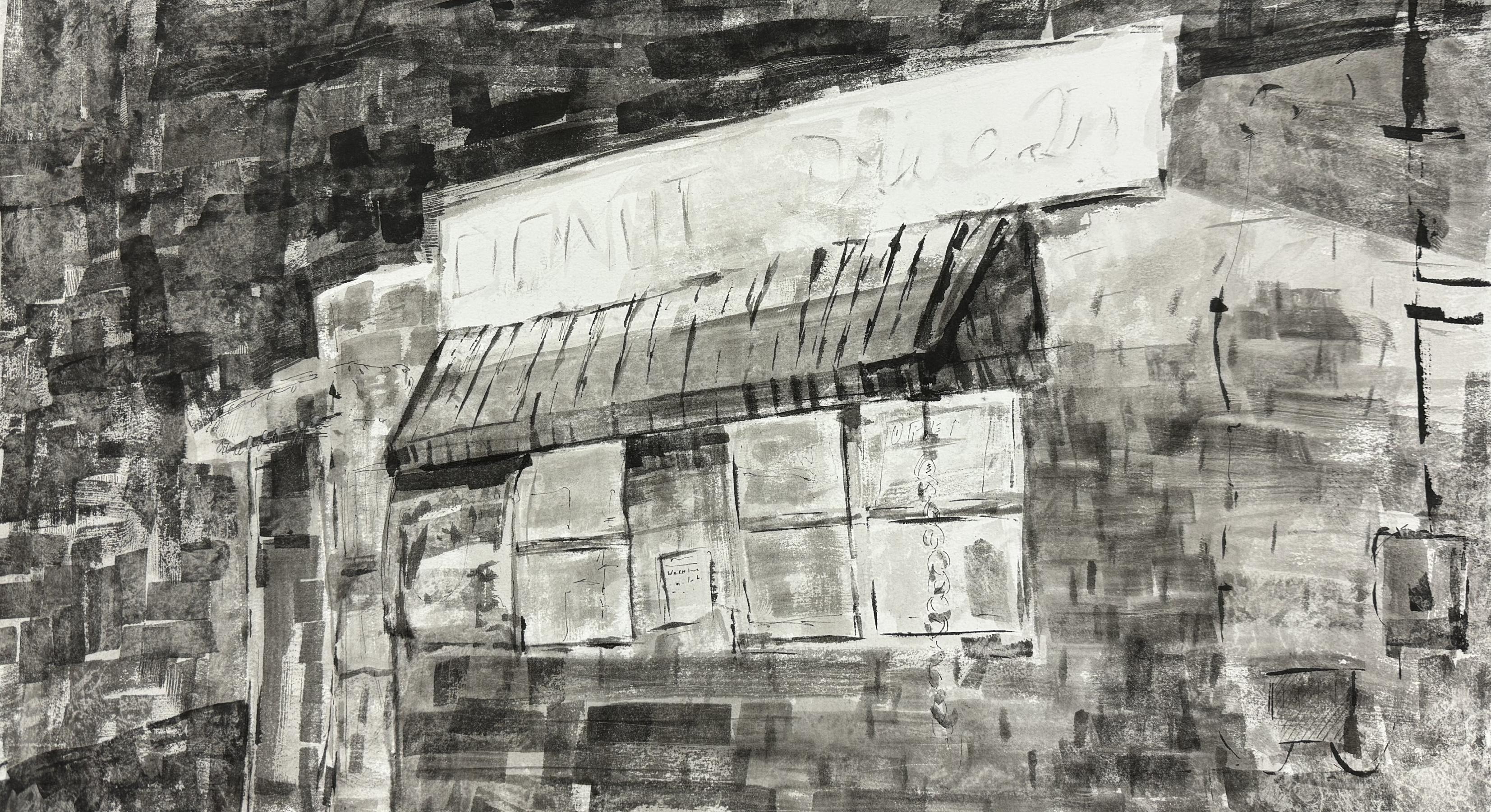
JRob Goffstein, Donut Drive-In, 2024, ink on paper.
Authors
Lucia Cao is a senior at Columbia University majoring in comparative literature and art history. She is interested in network cultures, images, and post-socialisms.
Rose Clubok is a junior studying Intellectual History and Education at Barnard College and Jewish Thought at the Jewish Theological Seminary. You can also find her work in The Gadfly, Iggrot Ha’Ari, and The Columbia Journal of Literary Criticism’s reviews page.
Stephen Rex Dames is a senior at Columbia University studying History, specializing in modern European intellectual and religious history. He is especially interested in the history of psychoanalysis, and has just completed his Senior Thesis on the development of non-medical psychoanalysis in Britain. He also serves as the Co-EIC of 4x4 Magazine, a Senior Editor at The Blue and White Magazine, and as the American Department Director of WKCR 89.9 FM.
Xinke Huang is an undergraduate in Comparative Literature at Brown University, Class of 2027. She is particularly drawn to East Asian studies, philosophy of language, and film theory, and hopes to explore them from a cross-cultural perspective.
Jacob Sponga is an undergraduate in Honors English at McGill University. His interests include Anglo-Irish modernism, classical reception, and Old Occitan poetry. Graduating in 2025, he will begin his MA in English at McGill in the fall, supported by a Canada Graduate Scholarship. In his free time, Jacob likes to garden.
Artists
JRob Goffstein is a sophomore studying philosophy and visual arts at Columbia College. He enjoys writing, painting, and drawing and tends to work in ink, watercolors, or oils. In addition to serving as the Arts and Design Editor for The Columbia Journal of Literary Criticism, he is involved with the New York Small Claims Advisory Service, and runs a radio show for WBAR.
Julia Kirby is a sophomore at Columbia College studying Physics and Archaeology. In her free time, she makes art and is involved in scientific research at the Plasma Lab and Synthetic Biological Systems Lab. Her artistic practice is centered around photography, painting, and sculptural work. She explores how our memories are formed and how to encode them using art.
Lily Yanagimoto is a sophomore studying comparative literature and visual art at Brown University. Her art appears in The College Hill Independent, where she’s a staff illustrator. Her poetry has been recognized by The Poetry Society and can be found at Dishsoap Quarterly and Eunoia Review, among other places. In her free time, Lily writes for and performs in Out of Bounds, Brown’s sketch comedy group. You can find her sitting under a big tree.
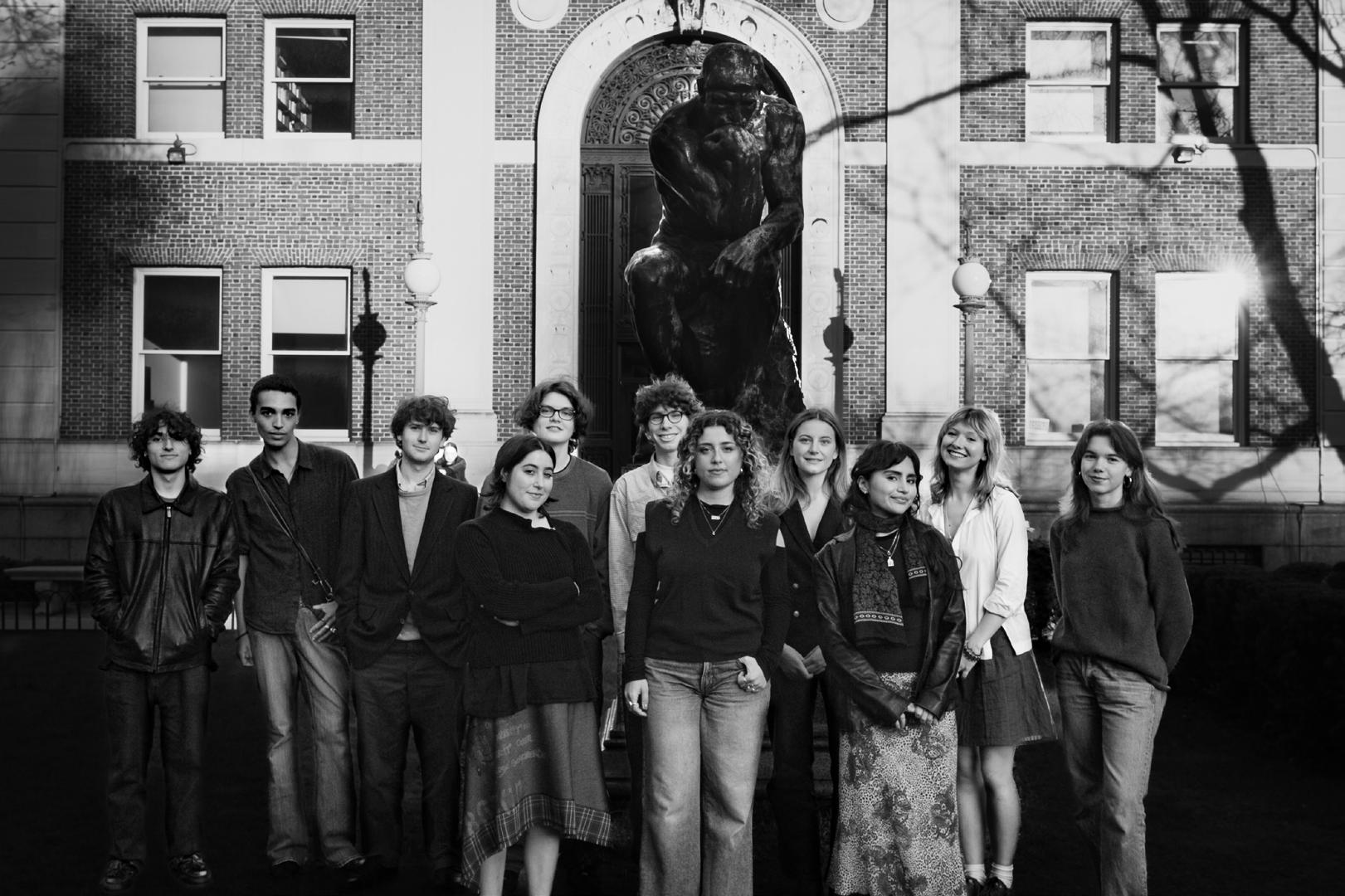
Spring 2025