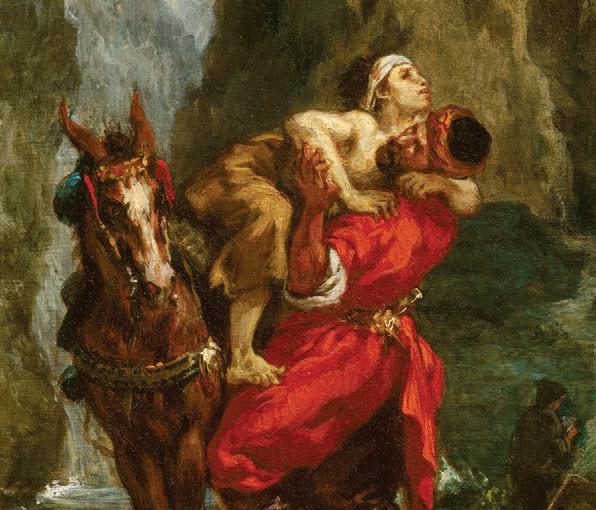
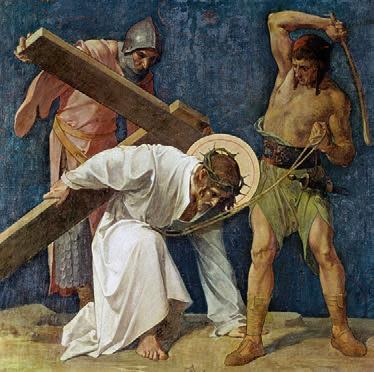
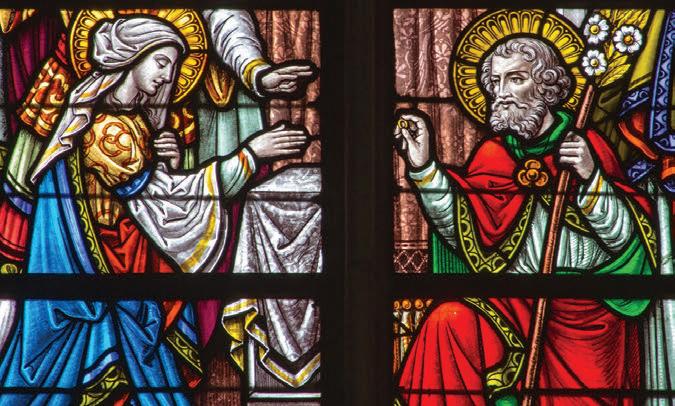
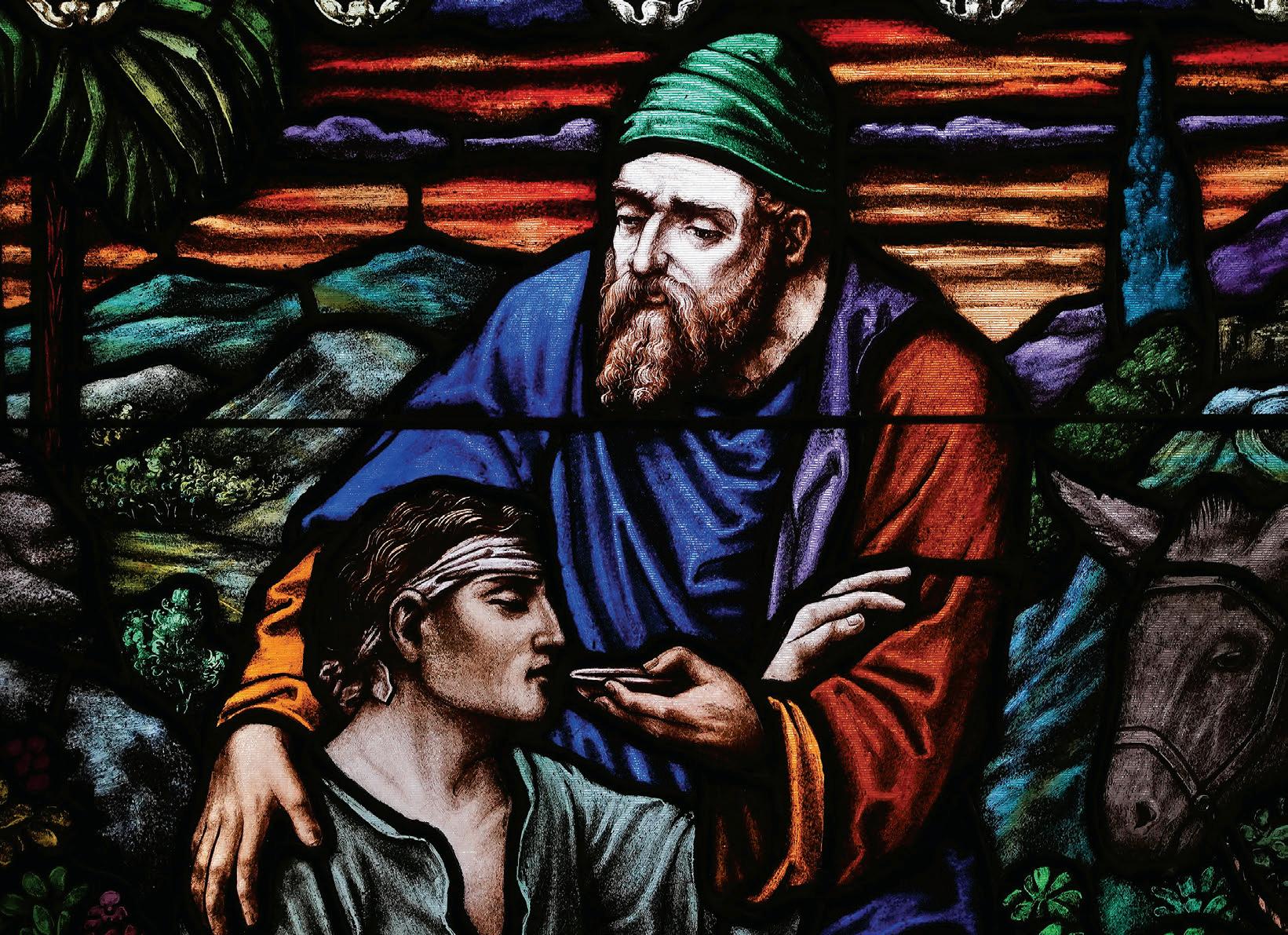
A 19th-century painting depicts a scene from Christ’s parable of the Good Samaritan (Lk 10:25-37). The Christian commandment to love one’s neighbors, especially those in most need of mercy, is the topic of an interview with Cardinal Konrad Krajewski, who has served as papal almoner since 2013 (see page 16).
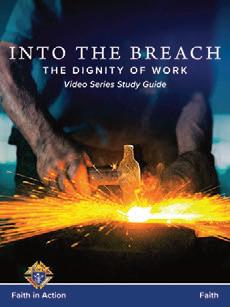
A new Into the Breach video series explores the dignity of work and its pivotal relationship to faith, family and leisure.
By
George Matysek Jr.
Champions of Love
Thousands of young people attend Life Fest in advance of the annual March for Life.
By Cecilia Engbert
PLUS: Because ‘Life Is a Gift’ – Knights of Columbus march in defense of human life alongside tens of thousands in Washington.
‘Only Mercy Can Bring Peace’
A conversation with Cardinal Konrad Krajewski, papal almoner, about the mission of charity at the heart of the Church.
Why Men Should Read Great Literature
Like the parables of Jesus, literary masterpieces hold up a telling mirror to reality — and to ourselves.
By Joseph Pearce
A Natural Born Director
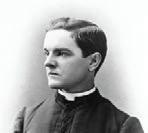
Father McGivney’s pastoral genius included directing popular plays to draw parish and social life together.
By Troy J. McMullen
3 For the greater glory of God
Through humble obedience and spiritual fatherhood, St. Joseph stands as a guardian against the forces of darkness.
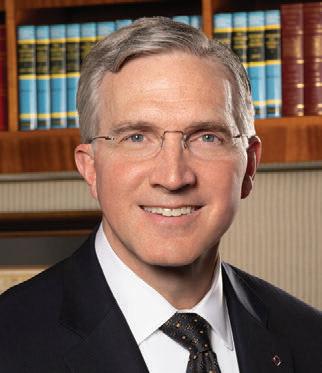
By Supreme Knight Patrick E. Kelly
4 Learning the faith, living the faith
Habitual complaint fosters discouragement and division, while a spirit of charity strengthens unity and peace. By Supreme Chaplain Archbishop William E. Lori
6 Building the Domestic Church
A series of columns on family life, leadership and financial stewardship
26 Knights in Action
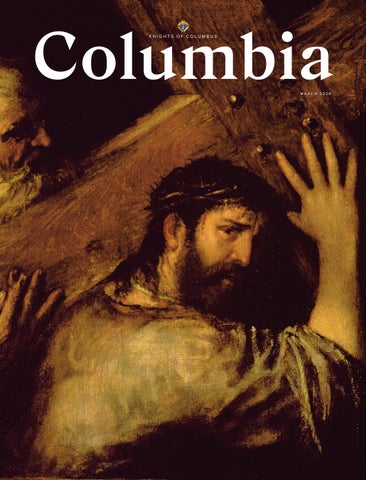
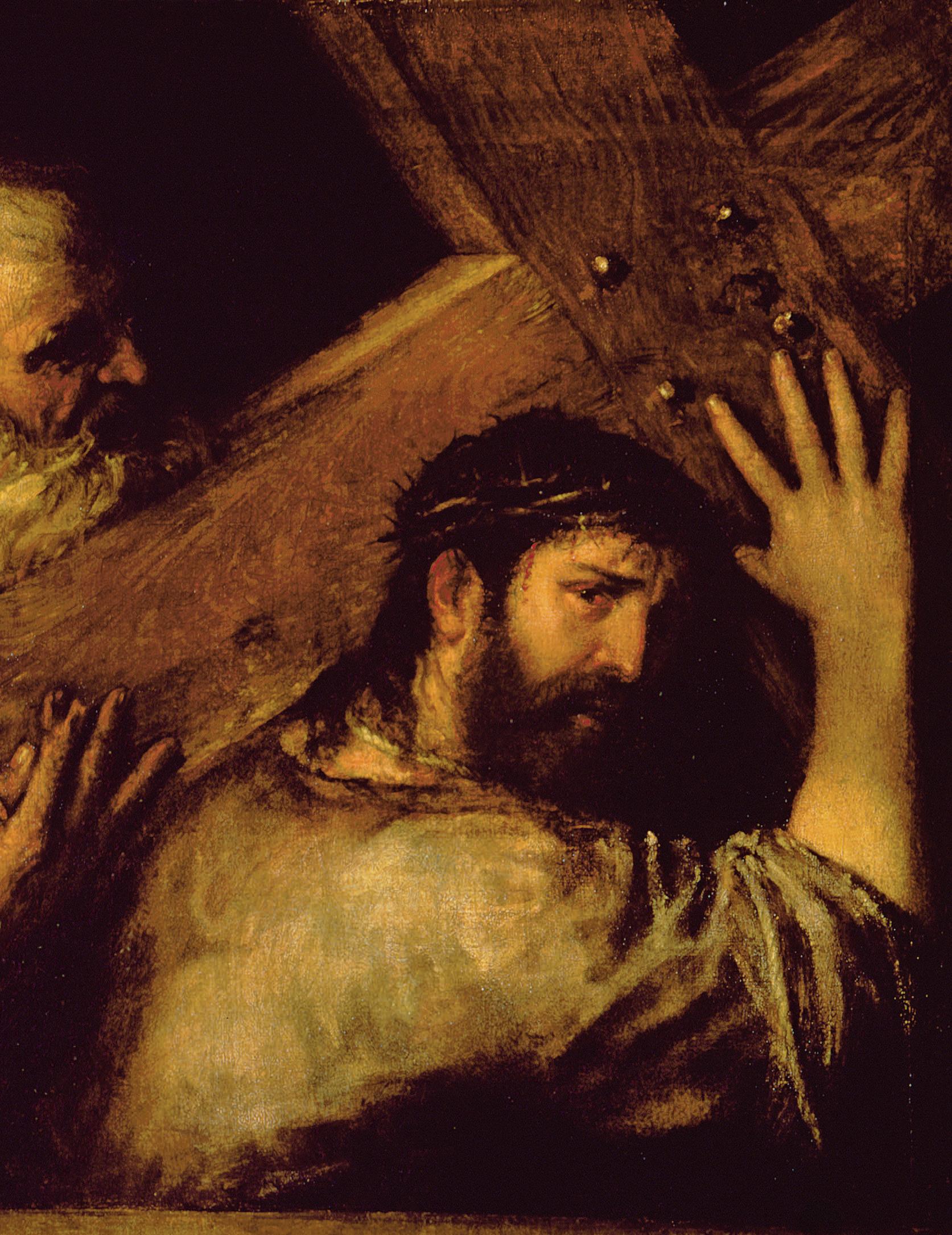
Reports from councils and assemblies, representing Faith in Action ON THE COVER Christ carries the cross with the aid of Simon of Cyrene in a 16th-century painting by Italian Renaissance artist Titian.
Membership in the Knights of Columbus is open to men 18 years of age or older who are practical (that is, practicing) Catholics in union with the Holy See. This means that an applicant or member accepts the teaching authority of the Catholic Church on matters of faith and morals, aspires to live in accord with the precepts of the Catholic Church, and is in good standing in the Catholic Church. kofc.org/join
IN THE SPRING of 1960, Catholic author Flannery O’Connor received a letter from Our Lady of Perpetual Help Free Cancer Home in Atlanta. The sister superior asked that she write a story about a patient whose ever-joyful character had made a deep impression on the community. Admitted at age 3 with a disfiguring tumor on the side of her face, the girl had spent nine years with the sisters before succumbing to cancer. O’Connor respectfully declined and urged the sisters instead to write a factual account.
The acclaimed author later reflected on this exchange in an essay titled “Introduction to A Memoir of Mary Ann.” She was particularly struck by a photo of the girl in her first Communion dress and veil, capturing her simplicity, innocence and imperfection. “One of the tendencies of our age is to use the suffering of children to discredit the goodness of God, and once you have discredited his goodness, you are done with him,” O’Connor wrote. “In this popular pity, we mark our gain in sensibility and our loss in vision. If other ages felt less, they saw more, even though they saw with the blind, prophetical, unsentimental eye of acceptance, which is to say, of faith.”
O’Connor also decried “a tenderness which, long since cut off from the person of Christ, is wrapped in theory.” She added, “When tenderness is detached from the source of tenderness, its logical outcome is terror. It ends in forced-labor camps and in the fumes of the gas chamber.” In another essay in the same posthumous collection (Mystery and Manners, 1969), she commended a contrary, Scriptural point of view characteristic of the American South: “a distrust of the abstract, a sense of human dependence on the grace of God, and a knowledge that evil is not simply a problem
to be solved, but a mystery to be endured.”
Echoing O’Connor’s insights, the late Msgr. Lorenzo Albacete (1941–2014) said: “Suffering is not a problem to be solved but a mystery to be lived.” Moreover, it is a mystery lived in communion with others and with God. For Albacete, the only adequate response to the suffering of another is to “co-suffer” in love — not to share another person’s pain per se, but to “share the question why, to be a companion, and to walk together towards transcendence” (Cry of the Heart: On the Meaning of Suffering, 2023).
Venerable Rose Hawthorne, the youngest child of novelist Nathaniel Hawthorne, understood the call to “suffer with” (in Latin, compassio). Born in 1851 — one year before Blessed Michael McGivney — she had lost both her parents and her only child by age 30. She entered the Catholic Church a decade later, on March 19, 1891, and increasingly dedicated herself to the service of God and neighbor. In 1896, she founded a home for patients with incurable cancer in New York and, four years later, founded the Dominican religious community that would contact O’Connor.
In The Life You Save May Be Your Own: An American Pilgrimage (2004), author Paul Elie recounts O’Connor’s correspondence and meeting with the sisters. He summarizes her conclusion — a call to charity at the foot of the Cross: “In human suffering, the believer sees the grounds of our common humanity, recognizing that it is through suffering, above all, that human beings are stirred to the love of one another, and to the love of God, who showed his love for humanity through his willingness to suffer as one of us.” B
Alton J. Pelowski, Editor
Featured Resource: The Dignity of Work Study Guide
A 45-page study guide companion to the new five-episode Knights of Columbus-produced video series titled Into the Breach: The Dignity of Work is available in print and digital formats through the Order’s Catholic Information Service. An ideal resource for Cor , it contains discussion questions for each episode, key quotes, Scripture verses for reflection, practical challenges and prayers. For more information, see the article on page 8 and visit kofc.org/intothebreach .
Columbia
PUBLISHER
Knights of Columbus
SUPREME OFFICERS
Patrick E. Kelly
Supreme Knight
Most Rev. William E. Lori, S.T.D.
Supreme Chaplain
Arthur L. Peters
Deputy Supreme Knight
John A. Marrella
Supreme Secretary
Ronald F. Schwarz
Supreme Treasurer
Anthony R. Picarello Jr. Supreme Advocate
EDITORIAL
Alton J. Pelowski
Editor
Matthew Kirby
Editorial Director
Andrew J. Matt
Managing Editor
Elisha Valladares-Cormier
Senior Editor
Megan Stibley
Associate Editor
Paul Haring Manager of Photography
Cecilia Engbert Content Producer
Blessed Michael McGivney (1852-90) – Apostle to the Young, Protector of Christian Family Life and Founder of the Knights of Columbus, Intercede for Us.
HOW TO REACH US
COLUMBIA
1 Columbus Plaza
New Haven, CT 06510-3326
columbia@kofc.org kofc.org/columbia
Address changes
203-752-4210, option #3 addresschange@kofc.org
Columbia inquiries
203-752-4398
K of C Customer Service
1-800-380-9995
Terror of Demons
Through humble obedience and spiritual fatherhood, St. Joseph stands as a guardian against the forces of darkness
By Supreme Knight Patrick E. Kelly
ON MARCH 19, we celebrate the solemnity of St. Joseph, husband of Mary, who for many centuries has been honored as one of the Church’s greatest saints and most powerful intercessors.
St. Joseph has been given many titles that describe his virtues and reflect the graces sought through his intercession. Various litanies attribute more than 30 different titles to him. One of the most striking is Terror of Demons .
This formidable title invites reflection on what makes St. Joseph such a strong protector in spiritual warfare — and why his help is so needed today.
The Gospels tell us little about St. Joseph. Scripture simply calls him “a just man” (Mt 1:19), and not a single word of his is recorded. His actions, however, speak volumes — and help us understand why demons would fear him.
Joseph was a man of deep humility. He never sought his own will but made every sacrifice to follow the will of God. When he learned that Mary was with child, he resolved to divorce her quietly rather than expose her to shame. But then an angel appeared to him in a dream and said, “Joseph, son of David, do not be afraid to take Mary your wife into your home. For it is through the holy Spirit that this child has been conceived in her” (Mt 1:19-20).
This humble carpenter set aside his fear and took a leap of faith. Not knowing what lay ahead, he trusted completely in God’s providence and accepted the call to be the earthly father of the Son of God.
St. Joseph’s “yes” had enormous consequences — he protected the Holy Family from all manner of evil and helped raise the Christ Child to manhood under his and Our Lady’s watchful care. In this hidden yet essential role, he made possible the unfolding of Christ’s saving mission.
St. Joseph was also a man of unwavering obedience. Each time he received a message from the Lord, he responded without hesitation. He didn’t argue or delay; he acted immediately to protect those entrusted to him. When warned that Herod sought to kill the child, “he rose and took the child and his mother by night, and departed to Egypt” (Mt 2:14).
Joseph’s humility and obedience stand in stark contrast to the pride and rebellion of Satan. This is what makes him such a powerful spiritual ally in the fight against evil.
A priest affiliated with the St. Michael Center for Spiritual Renewal — a Catholic ministry that serves people seeking deliverance from demonic influence — recently shared with me a compelling testimony. During the exorcism of a woman eventually delivered from possession, the Litany of St. Joseph was prayed aloud. At the invocation “St. Joseph, Terror of Demons,” the demons reacted violently. Afterward, the woman explained that it was clear the demons were shaken by the saint’s intercession and by the prayers offered in his name. She even described a vivid sense of St. Joseph’s spiritual presence in the room — a moment she said she would never forget.
St. Josemaría Escrivá once observed, “The greatest male saint in the history of the Church is not a pope, cardinal, bishop, priest or friar. The greatest male saint in the history of the Church is a layman, a husband, a father and a worker.”
As we strive to live our vocations faithfully and confront the forces of evil in our own time — in our homes, our parishes, and our society — let us look to St. Joseph as a model of authentic masculinity: humble, obedient, courageous. He is the Terror of Demons , and his quiet strength remains an enduring source of protection and inspiration for us today.
Vivat Jesus!
Joseph’s humility and obedience stand in stark contrast to the pride and rebellion of Satan. This is what makes him such a powerful spiritual ally in the fight against evil.
Photo by Michael Collopy
On the Whine List
Habitual complaint fosters discouragement and division, while a spirit of charity strengthens unity and peace
By Supreme Chaplain Archbishop William E. Lori
GOOD RESTAURANTS OFTEN present patrons with a wine list. The better the restaurant, the more extensive the list. Of course, patrons like me scarcely know what to do with such a list. I enjoy a good glass of wine but claim no expertise in choosing the perfect one to complement a meal.
There is another list. This one is not presented to us in a restaurant. It’s the one we carry around with us in our heads. It’s our whine list. It’s the things we dislike — both our vintage complaints and those that have fermented more recently.
Let’s delve further into the comparison between the wine we drink and the whining we inflict on others. As a rule, wine begins with grapes. When certain types of grapes are used to make wine, and the vintner stores and ages the wine properly, the resultant vintage is good. When the grapes are sour or otherwise defective, or when the wine is uncorked too soon, it is likely unfit to drink.
Whining is similar to bad wine. Like the hapless vintner who sets out to make fine wine, we might have a good goal in mind. We see a problem to be solved, or something or someone neglected, or a shortcoming to be corrected. The goal is good, but what if the “grapes” are bad? Our complaints, like bad grapes, can come from bad places in our hearts: peevishness, impatience, discontentment, grudges, a desire to dominate. And like the unskilled vintner, we store our complaints in hearts that bring out the worst “flavors” in every situation.
What’s more, sometimes we don’t take time to discern whether our complaint has merit. We don’t let our “whine” oxygenate by asking the opinions of others. And instead of constructively addressing a lack or a need, we let it ferment in us and then inflict “sour whine” on those around us.
Now, let’s face it: We live in an imperfect world. We struggle to improve our lot.
Many things irritate us. So we whine — and I can whine with the best of them! But chronic whining is destructive to ourselves, our loved ones, and our co-workers. And here’s why.
First, whining betokens a lack of gratitude to God and others. When every other word is a complaint, we’re saying to God that he put us in a pretty miserable spot — and we’re not happy about that at all. We may also be saying to others that they just don’t measure up.
Second, whining tears down the human spirit. When we’re subjected to continual whining, we can easily become discouraged. Nothing is right. Nothing is good enough. Every cloud has a dark lining. Human nature is hopeless. Whining uses up our spiritual oxygen and suffocates our joy and enthusiasm.
Third, whining undermines relationships. Whiners often don’t have anything good to say about other people. They foment discontent. They create suspicion. They prompt those around them to think ill of others. Constant whining — far from warming hearts and creating bonds of friendship and fraternity — creates anger, anxiety and isolation.
Finally, whining is not constructive. It doesn’t lead to solutions but to bad feelings.
So here are two thoughts for us in the midst of this Lenten season.
First, it’s fine to give up wine for Lent — but it’s better to give up whining. Lent is the perfect time to examine ourselves. Do we whine too much?
Second, let’s replace whining with mutual encouragement, bonds of charity, unity and fraternity.
Then, with united and grateful hearts, we can worthily drink the new wine of the kingdom — the blood of Christ shed for our redemption. B
Our complaints, like bad grapes, can come from bad places in our hearts. And like the unskilled vintner, we store our complaints in hearts that bring out the worst “flavors” in every situation.
Photo by Paul Haring
Supreme Chaplain’s Challenge
A monthly reflection and practical challenge from Supreme Chaplain Archbishop William E. Lori
“So Thomas, called Didymus, said to his fellow disciples, ‘Let us also go to die with him.’” (Gospel for March 22, Jn 11:16)
Look at the bravery of Thomas! Jesus had just announced his intention to travel to Judea, where he had narrowly escaped getting stoned to death. Given the potential danger ahead, Thomas seems prepared for martyrdom. Later, of course, he and the other disciples would flee as Jesus was arrested, and Thomas would doubt reports of Jesus’ resurrection. As fallible humans, our strength and resolve sometimes collapse into weakness. May we always seek the courage to follow Jesus faithfully, even when the going gets tough.
Challenge: This month, as we continue through Lent, I challenge you to pray the Stations of the Cross each week — in your parish community, with your family or individually — with the intention of receiving the courage to suffer for Christ. A good resource is the Catholic Information Service booklet The Way of the Cross: Traditional and Modern Meditations (kofc.org/shopcis).
Catholic Man of the Month
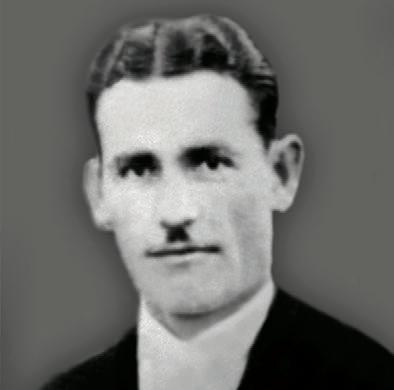
Blessed Qerim Sadiku (1919-1946)
AS HE AWAITED trial in a communist prison, Qerim Sadiku told his captors, “I am Albanian and Catholic — and I do not deny that fact.” The 27-year-old husband and father-to-be had been arrested for refusing to vote in a rigged election.
Born to devout Catholic parents in the ethnically Albanian village of Vuthaj, in Montenegro, Sadiku served as a gendarmerie lieutenant before opening a shop in Shkodër, Albania.
He married Marije Vatë in September 1944, and the couple was known for their deep faith. Sadiku attended Mass daily, and he and Marije made a traditional pilgrimage to the shrine of St. Anthony of Padua in Laç on 13 consecutive Tuesdays — even after communist partisans began persecuting Catholics in November of that year.
Following the execution of two priests in 1945, Sadiku joined the Albanian Union, an anti-communist group led by seminarian Blessed Mark Çuni.
The Dec. 2 election offered only communist candidates, and voting was enforced with threats. Sadiku was
Liturgical Calendar
March 3
March 4
March 7
March 9
March 17
March 18
March 19
March 23
St. Katharine Drexel, Virgin (USA)
St. Casimir
Sts. Perpetua and Felicity, Martyrs
St. Frances of Rome, Religious
St. Patrick, Bishop
St. Cyril of Jerusalem, Bishop and Doctor of the Church
St. Joseph, Spouse of the Blessed Virgin Mary
St. Turibius of Mogrovejo, Bishop
March 25 The Annunciation of the Lord
March 29 Palm Sunday of the Passion of the Lord
arrested the next day for refusing to vote and for ties to the Albanian Union.
Marije, who was pregnant, visited him in prison. Despite signs of torture, he told her, “I am strong.”
At trial, Sadiku admitted refusing to vote but denied false charges of violence. He was sentenced to death by firing squad. On March 4, 1946, Sadiku was executed alongside a fellow layman, a seminarian and three priests.
His last words were: “I forgive all those who have done me wrong … even those who will execute me. Long live Christ the King! Long live Albania!”
Two months later, Marije gave birth to their son, Gaspër.
Sadiku was among 38 Albanian martyrs beatified in 2016. B
Holy Father’s Monthly Prayer Intention
Let us pray that nations move toward effective disarmament, particularly nuclear disarmament, and that world leaders choose the path of dialogue and diplomacy instead of violence.
The Heart of Leadership
By Father James Mallon
I once heard someone say that if you keep telling people you are the leader, then maybe you’re not. This means there is a huge difference between holding a leadership position and having the character qualities of an authentic leader.
Author and motivational speaker Ken Blanchard has stressed that effective leadership is influence, not authority. What is influence? The term comes from the Latin verb influere , which means “to flow into.” This evokes a call to invest in and pour our efforts into another person. In short, it means to love others.
Leadership of this kind is not about having warm, fuzzy feelings for everyone, but about desiring and working for the good of others. It means resisting the temptation to use others to improve one’s own condition, status, reputation or even to fulfill a noble mission. It ultimately means working to help another person become who he or she is called to be by God.
This kind of influence — the heart of authentic leadership — is perfectly modeled by Christ, who said: “Love one another as I have loved you. No one has greater love than this, to lay down one’s life for one’s friends” (Jn 15:12-13). B — Father James Mallon is pastor of Our Lady of Guadalupe Parish in Dartmouth, Nova Scotia, where he is a member of St. Peter Council 3133. He is the author of Divine Renovation: Bringing Your Parish from Maintenance to Mission (2014) and founder of Divine Renovation Ministry.
MISSION OF THE FAMILY
Learning To Listen
As your children become adults, learn to let go of them — or they’ll let go of you
By Tom Hoopes
A DISCONCERTING THING happens when your children become adults: They take you aside and tell you what you did wrong. And, if you still have kids at home, as my wife and I do, they tell you what you are still doing wrong.
Hearing what they have to say has actually been salutary — like a root canal. It can also help us avoid becoming part of a new national trend: parents whose young adult children decide to go “no contact” with them. Here are three things I learned.
First, parents make a critical mistake when we consider our children “ours.” We have a crucial role in their life, but it is a temporary one. Ultimately, they are free individuals who belong to God.
A 2015 study found that the primary reason adult children became estranged is “their parents’ toxic behavior or feeling unsupported and unaccepted.” That describes me. Hearing how deeply my actions offended my adult children transformed my understanding of a parent’s role. It is not to solve our children’s problems so they won’t have to suffer; it is to let our children solve their own problems — even if that means we have to suffer.
Second, it’s hard to go from 90 miles per hour to zero in an instant, but we must. On their 18th birthday, our children go from our legal responsibility to legally independent — and they know it.
Here’s a tip: If they ask your opinion, give them everything you’ve got; they really want it. But your adult children don’t want unsolicited advice. The new rule is that you have to have a mutual,
respectful relationship with them — or none at all.
Third, listening is the most important trait for parents, all along. Failure to listen is the number one cause of fatality in the parent-child relationship. But before you decide you’re safe, realize this is an issue of quality, not quantity. According to recent studies, parents are spending more time with their children than ever, yet 1 in 5 young adults say they can’t always “be themselves” around their parents.
One of the toughest things about hearing criticism from our adult children has been realizing that they aren’t telling my wife and me anything new. They are repeating the same things they have been telling us for years — things we were too dismissive or defensive to hear.
Yet it’s never too late to listen with love. B
TOM HOOPES is vice president of college relations at Benedictine College in Atchison, Kan., where he is a member of Sacred Heart Council 723. He and his wife, April, have nine children.
FAMILY FINANCE
Why should I consider a 401(k) rollover when switching jobs?
By Joseph D. Novak
With stagnant wages and persistent inflation, nearly half of employees in the United States are expected to apply for a new job this year. Those who are successful, though, might make the mistake of forgetting about the retirement plans they had with a previous employer.
Many employers offer retirement plans — most often a 401(k) or 403(b), while government employees may have a Thrift Savings Plan. Participation in such plans allows employees to contribute a percentage of their income, while employers may offer a predefined
FOR YOUR MARRIAGE
Go to Joseph
matching contribution. Unfortunately, these accounts will not automatically follow you to your new job. You will need to decide whether to “roll over” your previous employer plan assets into your new employer’s plan, if they accept rollovers, or move them into a personal investment account.
Typically, this would be an Individual Retirement Account (IRA). The most common are Traditional and Roth IRAs. These accounts offer tax advantages: Traditional IRAs allow you to make pre-tax contributions — which may lower your taxable income — but distributions are taxed.
Roth IRAs are funded with after-tax dollars, allowing for tax-free distributions in retirement. In either case, you also have the option to work with providers that offer faith-based investments solutions that align with your Catholic values.
As husband and protector of Mary, St. Joseph is a model of strength, fidelity and reciprocal self-gift
By Julia and Francis Dezelski
ALL FOUR OF OUR DAUGHTERS could claim the title “daddy’s girl.” The 15-month-old, however, has distinguished herself by preferring Dad over every other person in her life. This makes us muse over what it is that makes him so different. In fact, what makes any little girl so fond of her daddy?
The role of protector and defender belonging to every husband and father may have something to do with it. St. Joseph demonstrates what it means to protect and defend. The humble carpenter of Nazareth, known as guardian of the Redeemer, was also guardian of Mary.
Before Joseph was entrusted with the Christ Child, he was entrusted with Christ’s mother. Yet he underwent the ultimate test upon discovering that his betrothed was expecting a child who was not his own. Even in his confusion, Joseph’s first inclination was to protect the honor of the woman he loved from public shame and disgrace (Mt 1:19).
Of all the attributes Joseph exemplifies, his quiet dignity as protector of Mary’s honor also demonstrates a quality in
At Knights of Columbus Asset Advisors, we assist with this process and can help facilitate rollovers into an appropriate IRA. Doing so helps preserve the tax-qualified status of your assets and avoid unnecessary penalties or fines. To better understand your options and make an informed decision, contact your advisor or visit kofc.org/familyfinance. B
— Joseph D. Novak is director of Investment Advisor Services and Sales Support and a member of St. Thérèse of Lisieux Council 8013 in Trumbull, Conn.
*Investment Advisory Services offered through KoCAA. Investing involves a risk of loss.
marriage that is often unspoken. St. John Paul II observed, “God, by giving Joseph to the Virgin, did not give him to her only as a companion for life, a witness of her virginity and protector of her honor: He also gave Joseph to Mary in order that he might share, through the marriage pact, in her own sublime greatness” ( Redemptoris Custos , 20).
In marriage, the reciprocity of gifts allows us to protect and to nourish, to provide and to receive. Through this mutual exchange, our children come to recognize all that mothers and fathers contribute to the family — even if the baby continues to exhibit a strong preference for Daddy. B
JULIA AND FRANCIS DEZELSKI write from Hyattsville, Md. Julia serves as associate director for marriage and family life at the U.S. Conference of Catholic Bishops. Francis, a mechanical engineer, has been a Knight of Columbus since 2014.
THE WORK of Our Hands
A new Into the Breach video series explores the dignity of work and its pivotal relationship to faith, family and leisure
By George Matysek Jr.
Aconstruction worker lays brick. A teacher grades papers. A CEO sets company goals. From cornfields to courthouses to corporate towers, millions of men devote much of their lives to labor.
At the dawn of creation, God set a rhythm of work and rest, marking both as sacred. Work orders the day, forms character, and invites man to participate in the Lord’s creative plan.
Yet many men today have lost sight of this deeper purpose. Too often, work has become either an idol or a burden — a standard of worth or something to escape. Artificial intelligence now threatens to automate human labor itself, putting the value and significance of work at risk. Meanwhile, more and more men are ill at ease, filling their free hours with endless scrolling, video games or other digital escapes.
To help men confront this crisis, the Knights of Columbus has produced Into the Breach: The Dignity of Work, a new five-episode video series that reclaims a distinctly Catholic vision of man’s mission in the world. Following the model
of the original Into the Breach series released in 2020 and Into the Breach: Mission of the Family, which followed in 2023, this new installment examines modern misconceptions about work — including the reduction of identity to productivity, the devaluation of physical labor and the lure of workaholism. It shows that true fulfillment emerges when work is integrated with faith, humility, rest and leisure.
Each video, approximately 12-14 minutes in length, focuses on a different aspect of the experience of work and features experts in evangelization and catechesis, many of whom are Knights of Columbus. At the heart of each episode, a Catholic man shares how his faith helped him ground his work in his relationship with God, family and friends, and the created world.
The series is accompanied by a study guide available through the Order’s Catholic Information Service, making it an ideal resource for Cor, the Knights’ discipleship initiative focused on prayer, formation and fraternity.
“This exciting new series,” said Supreme Knight Patrick Kelly, “will help Catholic men understand God’s mission for them on earth — how work brings men closer to God and builds virtue, and how work strengthens family life and improves society.”
The reflections presented below draw from both the video series and extended interviews with those featured.
EPISODE 1: GOD’S MISSION FOR MAN
Jesse Straight’s work begins before many people wake.
On Whiffletree Farm, operated by his family in Warrenton, Virginia, the father of eight guides chickens to fresh pasture, tends hens, checks pigs, and sets up animal fencing. Each year, Straight and his wife, Liz, raise about 16,000 meat birds, hundreds of pigs and several head of cattle. They also keep 3,000 egg-laying hens at a time.
“It involves hard work, but overall, it is beautiful,” said Straight, a Catholic convert and member of Herman J. Veger Council 5561 in Warrenton. “In my mind, work is collaborating with God’s creation to take care of each other and to steward the things of this world. I want everything we do to be done in charity — from how we care for the land and animals to how I approach employees, interns, customers or vendors.”
Farming is just one of many forms of work, yet manual labor represents a kind of paradigm, according to D.C. Schindler, professor of metaphysics and anthropology at the Pontifical John Paul II Institute for Studies on Marriage and Family in Washington, D.C.
“In manual labor, we come into direct contact with creation, and we transform it and augment its goodness through our manual intervention,” explained Schindler, a member of Potomac Council 433. “But that gets expressed in analogous ways
Photo by Slav Zatoka
Photo by Paul Haring
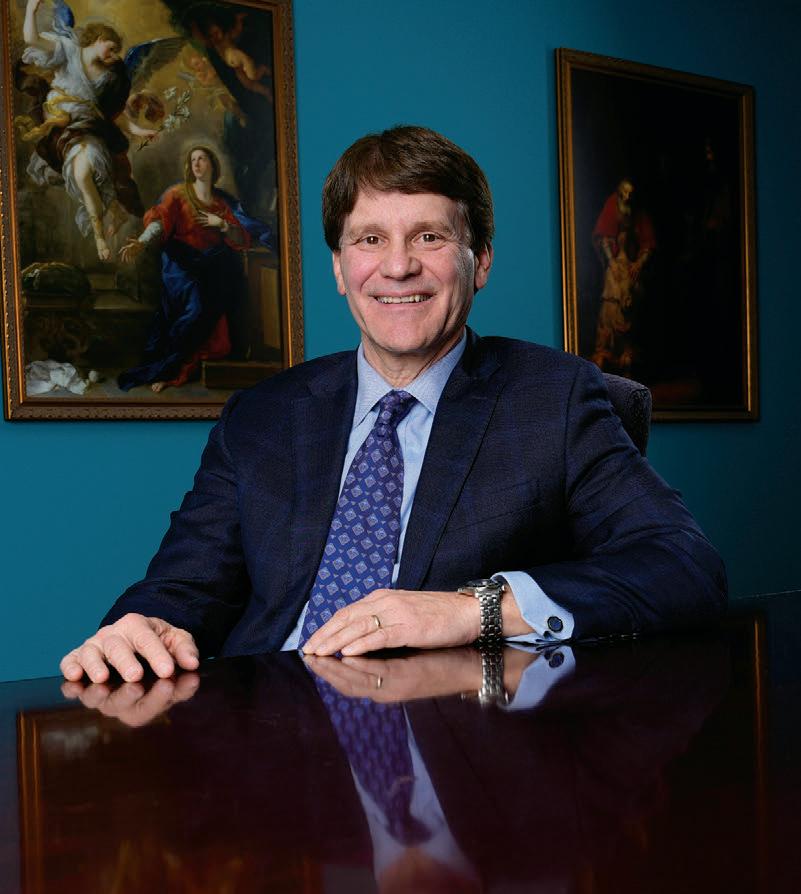
Right: Deacon Patrick Toole is pictured at the headquarters of the Diocese of Bridgeport, where he serves as chancellor. A member of St. Catherine of Siena Council 5806 in Trumbull, Conn., Toole previously worked as global chief information officer for IBM.
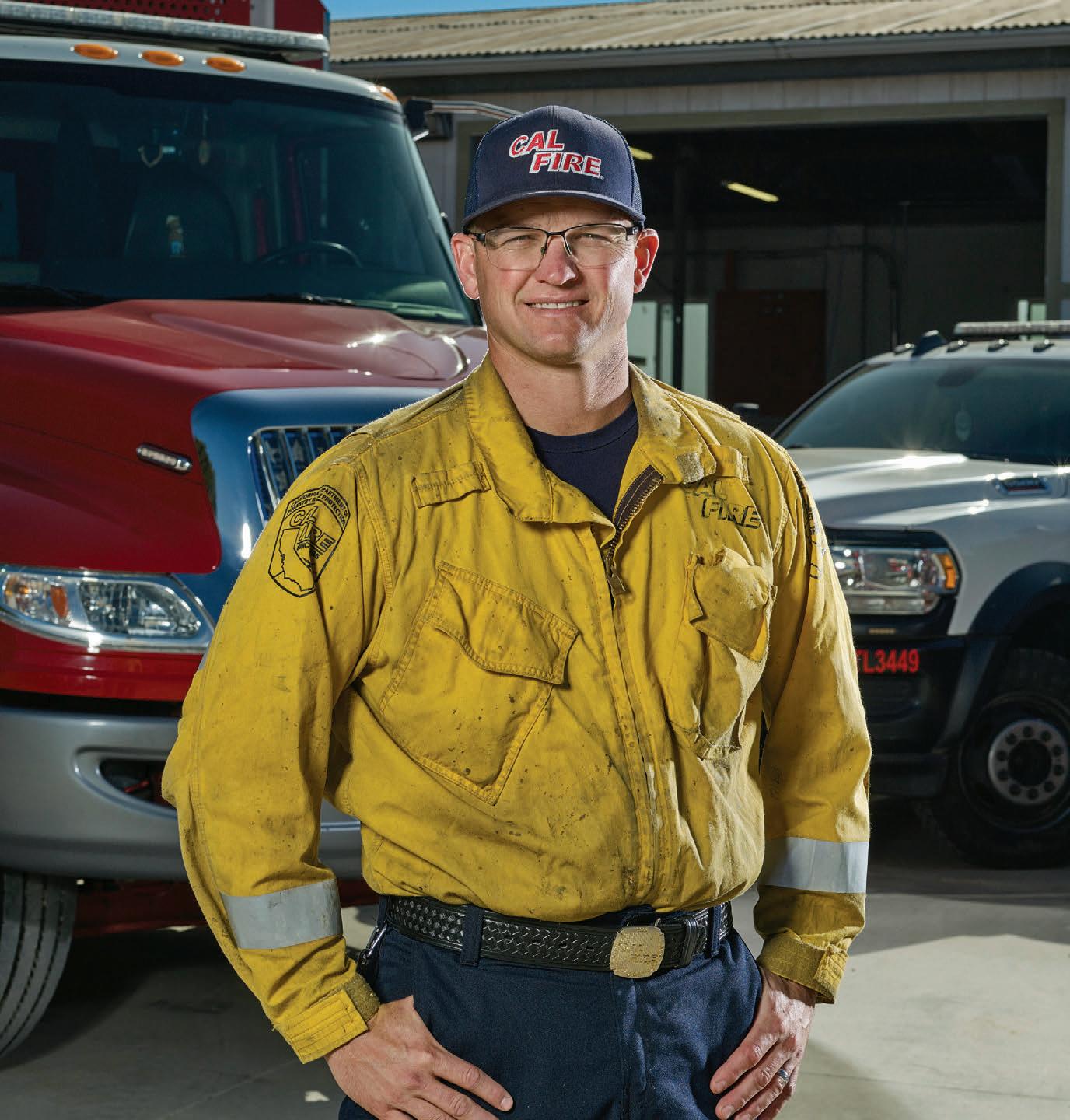
• Opposite page: Luke Bourgault, a battalion chief with CAL FIRE and a member of Santa Lucia Council 3648 in Atascadero, Calif., stands outside Los Robles Fire Station 98.
in many other fields. For example, when you write computer code, you’re transforming it and making it useful in new ways.”
Work has played a fundamental role in human fulfillment throughout history.
“God gave work to man before the fall (of Adam and Eve) because it’s essential for us to be happy,” said Kent Lasnoski, president of San Damiano College for the Trades in Springfield, Illinois, and a member of the Knights since 2017. “After the fall, it’s our vocation to try to reorder the world back to be in accord with God’s will.”
But Lasnoski cautioned against idolizing work and the trap of workaholism.
“There is a risk that man will find too much of his identity in labor, which is not the highest point of his vocation,” he said. “To find our identity exclusively in work is to misorder the goods God has given us.”
Jared Zimmerer, content marketing director and Great Books adjunct professor at Benedictine College in Atchison, Kansas, agrees.
“We live in this kind of major hustle culture right now, where I don’t sleep, I only work,” said Zimmerer, a member of St. Francis of Assisi Council 7099 in Grapevine, Texas. “I always think about memento mori (“remember death”). In the end, is it going to matter that you’re a billionaire? Probably not.”
Ultimately, work bears real fruit when performed in relationship to God.
“If one feels trapped in a cycle of stress and overwork, it’s important to stop and look at our lives in the big picture,” said Dr. Grazie Pozo Christie, a Catholic radiologist, writer and speaker based in Miami. “The measure of our success is not in our productivity, but in how well we allow God to transform us.”
EPISODE 2: WORK AND HOLINESS
David Michael Phelps, president of Harmel Academy of the Trades in Grand Rapids, Michigan, likes to ask his students what happens when a mason builds a “lousy” wall. Inevitably, the students respond that the mason has built a lousy wall.
“And I say, ‘No, you’re wrong,’” said Phelps, a member of Sacred Heart of Jesus Council 13641 in Grand Rapids. “‘He built a lousy mason.’”
The point is that our actions make us who we are. While work helps order the world, it also orders the worker.
“Work has the character of a habitual activity,” Kent Lasnoski explained. “We do the same thing over and over in our work, and so it forms habits. Well, what’s a virtue except a good habit?”
He added, “If our work is disordered, if our work is not in accord with the true good of humanity, it will form vices in us.”
Forming virtue in the workplace isn’t always easy, acknowledged Mark Matthews, a VFX (visual effects) expert who has worked for DreamWorks Animation. Noting that temptations and challenges abound — some men make work their identity, while others must deal with dishonest employers — he urged Catholic men to live their faith openly, even if workplaces discourage explicit discussions about faith.
“Don’t diminish who you are; don’t diminish your faith,” said Matthews, who joined the Knights in 2022. “If people ask, ‘What’d you do on the weekend?’ Would you say, ‘Oh, I went to an event’? Or would you say, ‘I went to church’? It’s OK to say, ‘Yeah, I went to church.’”
For Stephen Minnis, president of Benedictine College and a member of St. Benedict’s College Council 4708, living out the ancient Benedictine mottos — ora et labora (“pray and work”) and ut in omnibus glorificetur Deus (“that in all things God may be glorified”) — can have a profound impact.
“For example, before I give a talk or go into a meeting, or just about anything, I say, ‘Come, Holy Spirit,’ or, ‘Hail Mary, pray for me,’” Minnis said. “If you believe in ora et labora, then your prayer is your work, and your work is your prayer — everything you do is for the glorification of God.”
The ultimate model of this unity is Jesus himself, who showed that even his work as a carpenter was redemptive. In this way, Phelps noted, the working man par excellence is Christ.
“Human work is about the restoration and participation of the restoration of all things in Jesus Christ,” Phelps affirmed. “The hero is Jesus Christ. He’s the worker. We are his apprentices.”
EPISODE 3: WORK LIFE AND FAMILY LIFE
While many consider work a personal endeavor, Dr. Grazie Pozo Christie believes it also shapes and supports the family.
“This is sometimes hard to remember in our individualistic culture, which often places personal ambition, especially in the professional sphere, at the highest level,” she said. “Becoming selfishly attached to our own professional interests can have terrible consequences for our family.”
For Mike Sweeney, a former Major League Baseball AllStar and a member of the Knights of Columbus since 2014, decisions about work are guided by clear priorities: God first, then his wife and children, then his work.
“When rightly ordered, your work is not in a tug of war with your family,” Sweeney said. “Whenever your work is destroying your family, hit the pause button and figure out if that’s what you’re called to do.”
Katie Prejean McGrady, a Catholic radio host and author who is also a working mother, echoed these sentiments.
“Work — a job — is not just this thing happening over there. An integrated person recognizes that work affects my home, and my home affects my work,” McGrady explained. “So one needs to discern deeply: Is this making me happy? Is this bringing peace? Is this glorifying God? Those three things have to swim around in our heads as we discern the work that we’re doing.”
Children are clearly affected by the rhythms of work and the jobs of their parents and other family members. Naturally, they first develop the virtues of work at home, explained Tim Gray, president of the Augustine Institute in Florissant, Missouri, and a longtime member of the Knights.
“Through simple tasks such as taking out the garbage or mowing the lawn, they begin to understand responsibility and belonging,” Gray said. “Whatever they do, they’re learning that I have to contribute and that I get to contribute — I get to be part of that work.”
Family life, Christie added, cannot flourish through individual effort alone. “Everyone has to flourish together,” she said.
Scripture offers just such a model for integrated life. In the Gospel of Matthew, before St. Joseph is identified as a carpenter, he is described as a “just man” (1:19), noted Benjamin Akers, associate professor of theology at the Augustine Institute.
“God chose Joseph to teach Jesus what the model of a man would look like — how to love God, how to love Mary as mother, how to give a good day’s work, how to pray, how to live virtue,” he said. “And Joseph wants to teach us, as well, to be just men, so that we can bring the dignity of the human person to every and any activity we do.”
EPISODE 4: WORK AND THE WORLD
For 21 straight days last January, Luke Bourgault, a battalion chief with the California Department of Forestry and Fire Protection (CAL FIRE), fought fires in up to 100-mph winds as three major blazes destroyed tens of thousands of homes across Los Angeles County. The work was relentless
and emotionally draining — but sustained by teamwork at every level.
“I can’t do my job without the dozens of people who support what I do — who keep the lights on at the fire station, who keep our emergency vehicles running,” said Bourgault, a member of Santa Lucia Council 3648 in Atascadero, California. “Everyone is a piece of this puzzle, and the point of what we’re doing here in this world is to do what Jesus would do — impact our communities in a positive way, bring light to people’s day.”
That shared responsibility extends far beyond emergency response.
“There’s no job too small or insignificant, because all the small things add up to great things,” said Tim Gray. “If I don’t do my job well and I’m sloppy and it’s bad, it has an impact on others, and that impact can snowball.”
The moral weight behind such responsibility is rooted in Scripture, said Jared Zimmerer.
Christ’s parable of the talents shows that while people are entrusted with different levels of abilities, all are accountable for how they use them.
“It’s a loss to the world whenever someone doesn’t use his talents,” Zimmerer said. “All of us are called to go out and be the light of Christ in the world by providing our talents.”
That call also demands just structures for work itself. D.C. Schindler emphasized that workers deserve good labor conditions and fair wages.
“We need to recall that work is for man, not man for work, and that means that work needs to preserve a certain dignity,” he said. “The Church used to talk about a family wage — understood as enough to sustain a family. I think those considerations have largely been forgotten and need to be recalled.”
As artificial intelligence reshapes the workplace, safeguarding that dignity has become urgent — a major theme of Pope Leo XIV’s early pontificate.
“Pope Leo wants us to recognize that this is going to present brand-new challenges to the Church,” Schindler said. “It gives us hope that the Church will invite us to reflect anew on the nature of work and to rediscover its original meaning and vocation in a new way.”
“Human work is about the restoration and participation of the restoration of all things in Jesus Christ. The hero is Jesus Christ. He’s the worker. We are his apprentices.”
EPISODE 5: PUTTING WORK IN ITS PLACE
Deacon Patrick Toole, a member of St. Catherine of Siena Council 5806 in Trumbull, Connecticut, never believed in “banking” vacation days for some distant future. Even while serving as IBM’s global chief information officer and general manager of technical support services, he unplugged from work to spend time with his family. At 40, he also signed up for cello lessons — and though he admitted he’s not very good, playing calms his mind and brings him joy.
Deacon Toole, now chancellor and secretary of the curia for the Diocese of Bridgeport, notes that in rest, as in work, we are to imitate Jesus. “People were constantly coming to him, asking him to heal, to do this or that,” he said. “And what did he do? He would go off and pray. So, if our Savior needed time to rest, who am I to think I’ve got a better idea?”
A primary purpose of work is to provide time and resources for leisure — such as family time, worship, and cultural activities — yet many men struggle to find balance.
Andrew Abela, founding dean of the Busch School of Business at The Catholic University of America, said men often drift between two extremes: constant busyness or sloth, both forms of acedia.
“The reality is that now we don’t have our own time,” said Michael Hanby, professor of religion and philosophy of science at the Pontifical John Paul II Institute. “We are always connected. We are always available.”
A member of St. Jerome Council 5564 in Hyattsville, Maryland, Hanby challenges men to resist the “gravitational pull” of devices: “If you find yourself permanently distracted — craving distraction — put it away, do something else. Find ways, even for short bits of time, to be undistracted.”
Supreme Knight Patrick Kelly noted that it’s no coincidence that male friendship is declining as genuine leisure becomes scarce.
“Men are experiencing isolation and loneliness in record numbers,” he said. “It’s important to remember that strengthening your friendships and building up a sense of brotherhood require making time for leisure.”
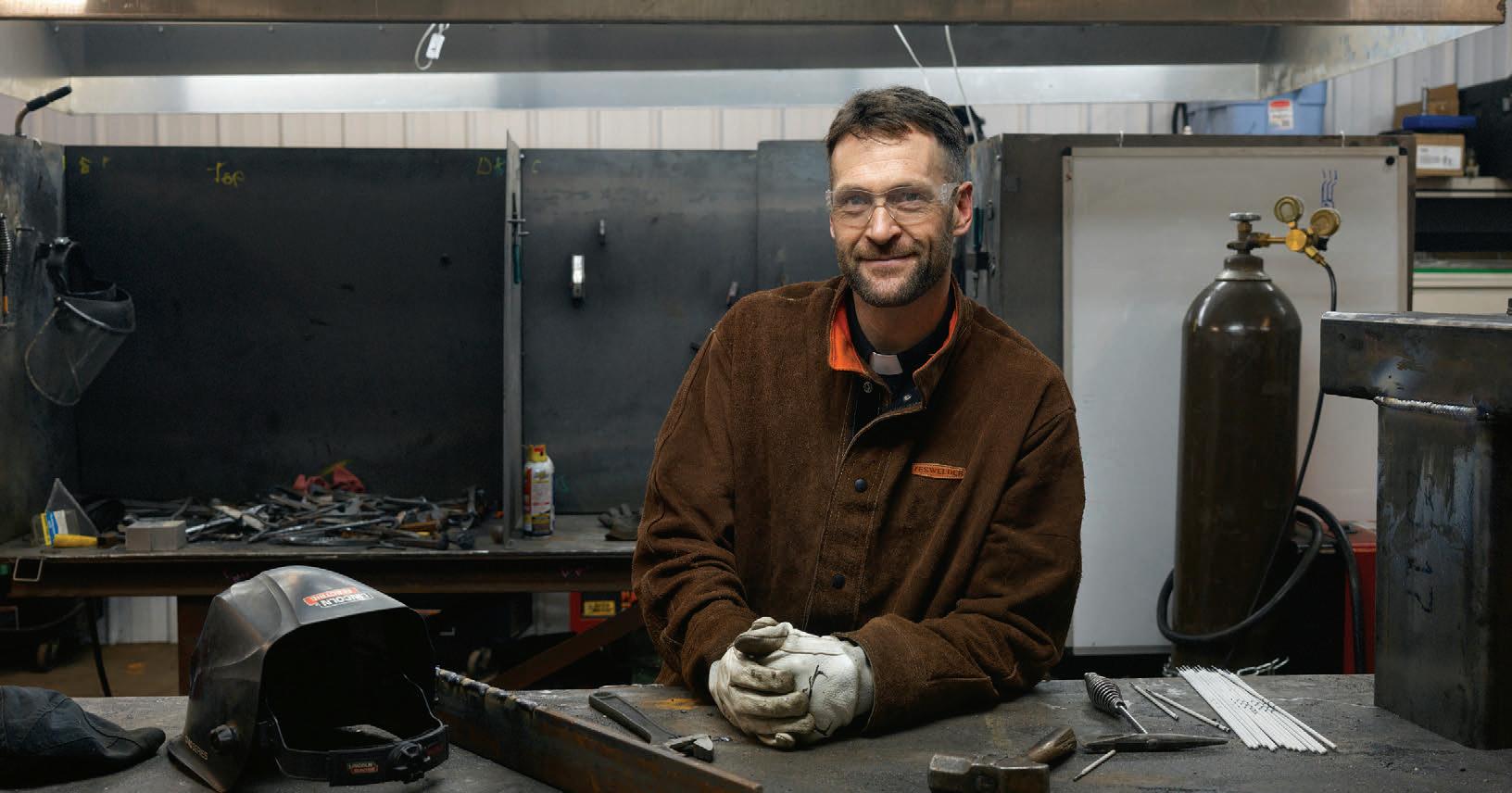
And for men unsure where to begin, Father Dominic Couturier, a welding instructor at Harmel Academy of the Trades in Grand Rapids, Michigan, pointed to Christ’s own need for fraternal support.
Photo by Kyle Monk
“According to St. Thomas Aquinas, acedia is a sin or a vice because it’s directly opposed to the virtue of charity,” explained Abela, a member of Padre Pio Council 10754 in Great Falls, Virginia. “It’s basically a reluctance or a denial to do the good that God is calling us to do; more generally, it’s an unwillingness to put in the effort to do the things we could or should be doing.”
Modern technology and constant connectivity can erode genuine rest while facilitating acedia.
“When Jesus Christ couldn’t carry the cross anymore, Simon of Cyrene came to help him,” said Father Couturier, chaplain of Bishop Richter Council 7761 in Rockford. “That’s why we men also need fraternity and brotherhood to help us on this journey. We can’t do this alone — we have to do it together.”
B
GEORGE MATYSEK JR. is managing editor of the Catholic Review , the official news outlet of the Archdiocese of Baltimore. A member of the Knights of Columbus since 2021, he lives in Baltimore with his wife and their six children.
Father Dominic Couturier is pictured at Harmel Academy of the Trades in Grand Rapids, Mich., where he teaches welding. He also serves as pastor of Our Lady of Consolation Catholic Parish and chaplain of Bishop Richter Council 7761 in Rockford.
CHAMPIONS OF LOVE
Thousands of young people attend Life Fest in advance of the annual March for Life
By Cecilia Engbert
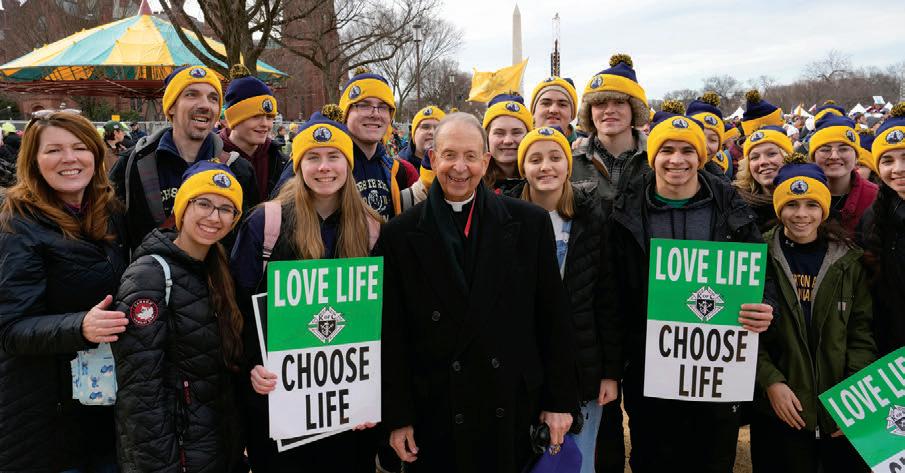
As the northeastern United States braced for a powerful winter storm, tens of thousands of pro-life demonstrators were not deterred from traveling to Washington, D.C., to participate in the 53rd annual March for Life on Jan. 23.
Before assembling on the National Mall in peaceful protest, more than 2,000 high school and college students gathered for Life Fest — a joyful pro-life rally and celebration held at the Gaylord National Resort & Convention Center in Oxon Hill, Maryland, just outside the U.S. capital.
The event, cosponsored by the Knights of Columbus and the Sisters of Life, featured live musical performances, dynamic speakers, Eucharistic adoration, and Mass celebrated by Supreme Chaplain Archbishop William Lori of Baltimore. Attendees represented areas across the United States, as well as four other countries.
“Being here at Life Fest, surrounded by thousands of young people who are here to celebrate life, gives me a tremendous amount of hope for the future of the pro-life movement and the future of our country,” said Supreme Knight Patrick Kelly. “Life Fest is a culture-shaping event that forms these young people in really important ways for the future — and really for the rest of their lives.”
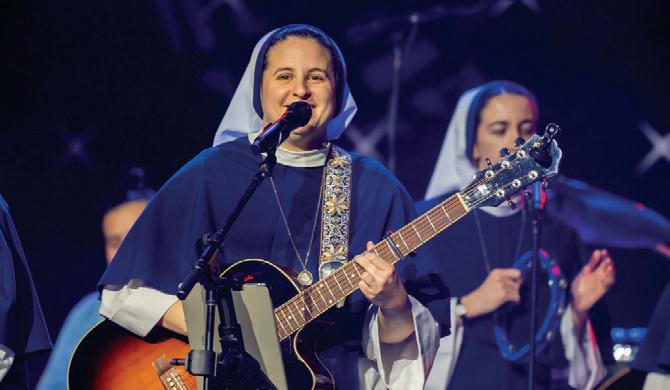
As the first participants began to arrive at 6 a.m. Friday, Franciscan Friar of the Renewal Father Isaiah Hofmann and the Sisters of Life band, All the Living, energized the crowd
with music. Sister Mary Hostia Josephine and Sister Cora Caeli of the Sisters of Life served as emcees, sharing testimonies of healing and hope drawn from their community’s experiences accompanying women in crisis.
“We are really gearing up to be incredible witnesses of life today, and being pro-life is about building a culture of life together,” said Sister Cora Caeli to those gathered. “To be pro-life is about seeing the world in a totally new way. It’s about seeing that every human life has value and meaning.”
Participants also heard from a lineup of speakers and performers that included Damascus Worship and Lila Rose, founder of Live Action.
“We can be champions of love,” Rose said. “When we go out and march today in Washington, D.C., when we stand strong, courageously, boldly, we are doing it as Catholics. … We are going out there to show people the model of how to advocate for life, how to advocate against evil — with love.”
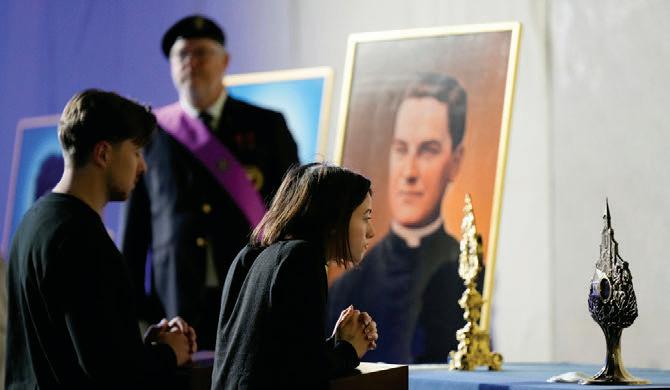
The event included opportunities for confession and the veneration of relics — those of St. John Paul II; St. Carlo Acutis; St. Teresa of Calcutta; Blessed Michael McGivney; and the martyred Ulma family of Poland. Throughout the event, Fourth Degree Knights provided an honor guard beside the relics.
Among those who offered a pro-life witness during Life Fest were Daniel and Michelle Schachle, whose son Michael McGivney Schachle (Mikey), now 10 years old, was miraculously healed of a life-threatening condition in utero. Mikey’s
FROM LEFT: Photo by Paul Haring — Photo by Matthew Barrick
From left: Life Fest participants venerate relics of Blessed Michael McGivney and the Ulma family. • Sister Zion Joy and the Sisters of Life band, All the Living, perform during the Life Fest rally.
Photo by Paul Haring
cure, attributed to the intercession of Blessed Michael McGivney, was declared a miracle and led to Father McGivney’s beatification in 2020.
To conclude Life Fest, Archbishop Lori celebrated Mass, assisted by more than 60 concelebrating priests.
Bishop Joseph Espaillat, auxiliary bishop of the Archdiocese of New York and a Knight since his seminary days, delivered the homily. He emphasized the need for a consistent
life ethic that upholds the dignity of every human person — including the unborn, the elderly and the marginalized.
“We cannot simply keep standing by idly,” Bishop Espaillat said. “We have been appointed to go and be the modern-day witnesses that the world needs.” B
CECILIA ENGBERT is a content producer for the Knights of Columbus Communications Department.
Because ‘Life Is a Gift’
Knights of Columbus march in defense of human life alongside tens of thousands in Washington
By Katie Yoder
ON JAN. 23, Knights and their families joined tens of thousands of pro-life advocates from across the United States for the 53rd annual March for Life in Washington, D.C. Among those participating were members of the board of directors, led by Supreme Knight Patrick Kelly and Supreme Chaplain Archbishop William Lori of Baltimore.
The annual march began in 1974, in response to the U.S. Supreme Court’s 1973 Roe v. Wade decision, which legalized abortion nationwide. The 2026 march — the fourth held since the court overturned Roe in 2022 — emphasized the inherent dignity of every human person beginning at conception, with the theme “Life is a Gift.”
Speakers at the pre-march rally on the National Mall included lawmakers, pro-life activists, and religious leaders, several of whom marked 2026 as the 250th anniversary of the signing of the Declaration of Independence, which recognizes a right to life.
Jennie Bradley Lichter, president of the March for Life Education and Defense Fund, read a message from a former marcher — Pope Leo XIV.
“I send warm greetings to those of you participating in the 2026 March for Life,” the Holy Father said in his message. “By advocating for [the unborn], please know that you are fulfilling the Lord’s command to serve him in the least of our brothers and sisters (cf. Mt 25:31-46).”
The Order is a platinum sponsor of the march and has supported it for more than five decades. Each year, Virginia Knights serve as marshals, guiding participants along the route.
The Knights of Columbus also supports the March for Life’s expanding state march program.
“The legacy of Blessed Michael McGivney continues to guide the Knights of Columbus’ pro-life mission,” Supreme Knight Kelly said in an interview. “We are being true to our founder’s original vision — and that vision was to help families in a particular way, to help vulnerable women and vulnerable children.”
Before this year’s march, the Order commissioned a new national survey of more than 1,400 U.S. adults on life issues — conducted by the Marist Poll Jan. 12-13.
While a majority of respondents identified as pro-choice, the poll found that 64% of Americans support placing limits on abortion. Sixty-three percent of respondents said health care professionals with religious objections should not be legally required to perform abortions, and 88% agreed that laws can protect both mothers and their unborn children. B
KATIE YODER is a freelance writer based in the Washington, D.C., area.
Supreme Chaplain Archbishop William Lori stands with a group of students from the Chesterton Academy of Annapolis on the National Mall before the annual March for Life.
‘Only Mercy Can Bring Peace’
A conversation with Cardinal Konrad Krajewski, papal almoner, about the mission of charity at the heart of the Church
“Almsgiving is the wing of prayer,” said St. John Chrysostom, the fourth-century bishop and doctor of the Church. “If you do not provide your prayer with wings, it will hardly fly.” More than 1,600 years later, in his inaugural apostolic exhortation Dilexi Te (I Have Loved You), Pope Leo XIV affirmed that “almsgiving remains … a necessary means of contact, encounter and empathy with those less fortunate.”
The ancient practice of giving alms — offering material aid to those in need — is rooted in the Gospels, and acts of charity have been carried out in the pope’s name since the earliest days of the Church. A dedicated role in the papal household — the almoner of His Holiness — was established for this purpose in the 13th century.
Cardinal Konrad Krajewski, a priest of the Diocese of Łódź, Poland, has served as papal almoner since 2013, after
previously acting as a papal master of ceremonies under Pope Benedict XVI and Pope John Paul II. He has also led the Vatican’s Dicastery for the Service of Charity since it was established in 2022, continuing to carry out works of mercy and raise funds for charitable aid on the pope’s behalf.
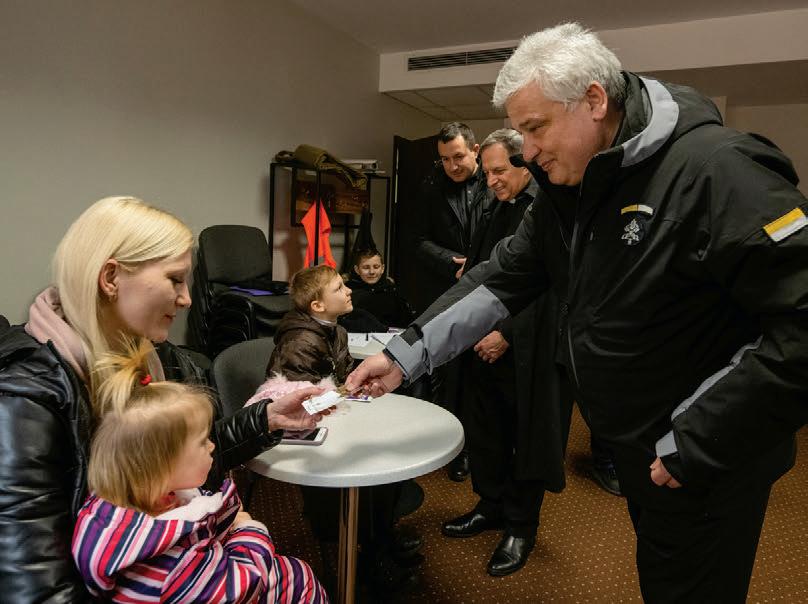
Following the full-scale Russian invasion of Ukraine in February 2022, Cardinal Krajewski made several trips to the war-ravaged country as a representative of Pope Francis. Accompanied by local clergy, Knights of Columbus and other partners, he personally delivered ambulances, generators, industrial-scale cooking equipment and other humanitarian aid to communities near the front lines.
He recently spoke with Columbia about the work of the dicastery in Rome and Ukraine, the role of charity in the Christian life, and the prospects for peace in Ukraine, the Holy Land and throughout the world. This interview, originally conducted in Polish, has been edited for length and clarity.
COLUMBIA: You have served under four popes — two of them as papal almoner. How has the office evolved in recent years?
CARDINAL KRAJEWSKI : The almoner is an institution that has been present in the Church from the very beginning. During our first meeting, Pope Francis reminded me that the first almoner was Judas, because he held the Apostles’ money bag. Everyone thought that Judas went to give money to the poor after he left the Last Supper. However, he went to sell the Lord Jesus. The Holy Father emphasized, “Remember that money can be used excellently, and help many, but it can also cause harm — just as it harmed Judas.”
Pope Francis said that I was to be his representative among the poor. Hence, his first instruction was that I was to sell my desk and go out of the Vatican. I was to be among the poor — to eat with them and, if necessary, sleep among them. Why? To know what they really need, so that solutions would not be created from behind a desk — which might be very good in theory, but would have nothing to do with reality. When one has lived with them, then one knows what they need and how to help them.
COLUMBIA: How can Catholics balance the evangelical witness you describe with the practical measures necessary to put faith into action?
CARDINAL KRAJEWSKI: I think one must use the logic of the Gospel. Jesus would go out in the morning — we don’t even know where he slept, where his home was — and he would walk the streets, meeting people.
He helped those he met, and he helped immediately. In the Gospel, he says: “Come down from the tree, today I am coming to you for a meal” (cf. Lk 19:5). When he met lepers, he healed them at once. He never delayed; he never said, “Please come back in two weeks, and we will talk.”
I think the last need in the Church is money, because if these are works of God, the money will be found. We do not go alone. As Catholics, we go with Jesus; we go to represent
Above: Cardinal Konrad Krajewski greets a Ukrainian woman and child during a humanitarian visit in March 2022. Accompanying him are Archbishop Mieczysław Mokrzycki of Lviv and Yuriy Maletskiy, then-state deputy of Ukraine. Opposite page: The parable of the good Samaritan is depicted in a stained-glass window at Good Samaritan Hospital Medical Center in West Islip, N.Y.
him. If we follow the logic of the Gospel, there will never be a lack of means to carry it out. One must trust God.
If we are bound to the Gospel and represent God through our way of thinking, through our way of acting, and in how we address the poor, then everything else simply falls into place.
Life consists of small gestures that seem trivial but restore dignity and hope. Mother Teresa used to say that every drop of water is important, because the sea is made of drops. We don’t have to look for great works right away — we should start with small ones. From these small ones, great works will be accomplished.
COLUMBIA: Your episcopal motto is Misericordia (“Mercy”). What, in essence, is this mercy in the daily practice of the Dicastery for the Service of Charity?
CARDINAL KRAJEWSKI: God’s second name is mercy — mercy that surpasses justice. This is our way of acting. The very word “mercy,” which is also linked to almsgiving, tells us that God does not tire of our sins — he always forgives us, helps us up, and says, “Be beautiful; start anew.”
Just as God loves me and acts toward me, so I am to act toward others — not forgiving once or twice, not seven times, but 77 times — without limit. This is mercy. And the same applies to helping others: not just once, not as a one-time gesture, but every time they are in need.
This is exactly what the Knights of Columbus does — in Ukraine, the Gaza Strip and other corners of the world. Imitating Christ, Knights rush to help with love, in ways that restore dignity to those they serve.
Our latest collaboration with the Knights was in Zaporizhzhia, Ukraine, where the Albertine Brothers reported that the oven they used to bake bread — about a thousand loaves a day for people in need — was breaking down.
As quickly as possible, we bought a new oven. And the Knights of Columbus immediately joined the effort, providing a flour mixer and other equipment needed to bake bread in large quantities.
This is a beautiful thing — that we complement each other in doing good. What the Knights of Columbus do, together with various foundations working on the ground, is deeply effective and restores hope to people.
COLUMBIA: What does the dicastery’s choice of where to provide assistance tell us about its strategy of charity? What should guide our discernment about where support is needed?
CARDINAL KRAJEWSKI: Jesus primarily sent out fishermen — people who had the courage to set sail in search of fish. We too, aware of the current needs, must go out and seek opportunities to help.
Pope Francis once told me, during a spell of cold weather, to load a car with a hundred sleeping bags and drive around Rome to find people who needed them. That wasn’t easy, because when it’s cold and raining, everyone takes shelter. Sometimes
you have to go into the metro, even into the sewers, to find people in order to help them. That’s exactly what Jesus did: From morning to evening, he went looking for people in need.
If we want to follow the logic of the Gospel, we have to go out and find others. For the past 13 years, my mission as almoner has been to stay close to the poor in order to know how to help them.
For example, our homeless will never escape homelessness if they don’t have documents — no one will hire them. They can’t return to their home countries, because they can’t board a plane without documents. They can’t even buy an international train ticket.
And if someone needs eyeglasses or is missing teeth, no one will hire him. It might seem like giving someone a loaf of bread is enough — but it’s not. You have to be very close to these people in order to help effectively.
COLUMBIA: In September, Knights of Columbus leaders joined representatives of the Catholic Near East Welfare Association – Pontifical Mission (CNEWA) in a visit of solidarity with Christians in the Holy Land. Are you hopeful about peace in the Holy Land and in Ukraine?
CARDINAL KRAJEWSKI: Peace is certainly possible — but mercy is essential. If we don’t forgive each other, there will never be peace. There is a lot of suffering and death on all
by Afolabi Sotunde
Photo
A man in Ogoja, Nigeria, receives a wheelchair during a February 2025 distribution sponsored by the Knights of Columbus in partnership with the Global Wheelchair Mission.
Life consists of small gestures that seem trivial but restore dignity and hope.
Mother Teresa used to say that every drop of water is important, because the sea is made of drops.
sides, and naturally, it gives rise to a desire for revenge. But the only path to healing is forgiveness. Without it, peace will never come.
It was the same after World War II. The 1965 “Letter of Reconciliation of the Polish Bishops to the German Bishops” declared, “We forgive and ask for forgiveness.” Without that step, we would never have been able to live normally — because we would constantly hold resentment.
According to justice, we would have to pay back in kind. But mercy — which is a kind of scandal — calls us to forgive, even when our children have been killed, when we have been left homeless, when everything we had has been destroyed. This kind of forgiveness is nearly impossible.
However, if we want to imitate God and live as his children, only mercy can bring peace. Otherwise, there will only be a temporary ceasefire, and the war will eventually continue. Without mercy, there is no peace.
COLUMBIA: In the context of extreme situations of religious persecution, such as is taking place in Nigeria, how can the Church survive and develop — and what role do mercy and forgiveness play in that?
CARDINAL KRAJEWSKI: We must always return to the Gospel — it alone can guide us. Evil must always be overcome with good.
Look at the example of Blessed Jerzy Popiełuszko. He shows us that even in the worst and most inhuman conditions, it’s possible to become a saint. The same is true of St. Maximilian Kolbe and the Ulma family. Thousands of saints — canonized and unknown — overcame evil with good.
There is no other way. We must always respond to evil with good — never in kind. This is a principle of the Gospel. It’s what Jesus did. When he was crucified, in the moment of his greatest suffering, he prayed, “Father, forgive them, for they know not what they do” (Lk 23:34).
This must be our attitude. It was the attitude of St. Stephen, the Church’s first martyr (Acts 7:54-60). This is what can save the world: overcoming evil with good.
COLUMBIA: With news of war and conflict constantly bombarding us, how can people who live in safety overcome their indifference?
CARDINAL KRAJEWSKI: We cannot become accustomed to war. Of course, in Ukraine, people have been living with war for four years, and they’re becoming desensitized to the sound of bombing sirens — because they have to carry on with life.
But those of us who live in peace, who have more than we need — we must guard against indifference. It’s the opposite of love — not hatred, but indifference.
Pope Francis once sent a photo to our office. It showed someone leaving the Church of St. Anne here in the Vatican. In front of the church sat a beggar. People coming out, dressed in beautiful fur coats, were turning their heads away from him as he asked for help. The pope said, “This is the worst thing that can happen to a Christian — to be indifferent.”
We also see this in the parable of the Good Samaritan. Many people passed by in a hurry; they didn’t have time. But one realized that by helping another human being, he was helping himself.
Dilexi Te — a document begun by Pope Francis and published by Pope Leo — speaks of almsgiving. It’s not a popular word today, because almsgiving means giving of yourself. And it has to hurt. If it doesn’t hurt, it’s not almsgiving. I give away not merely my surplus, but what is important to me.
COLUMBIA: What other spiritual and practical lessons can Knights draw from Dilexi Te and its call to love for the poor?
CARDINAL KRAJEWSKI: Dilexi Te emphasizes that almsgiving is the necessary compliment to prayer and fasting. Why? Prayer and fasting concern my interior life — they are meant to change me. But the real test of whether they have changed me is how I act toward others.
Scripture tells us that while prayer and fasting are good, almsgiving wipes away sins (cf. Tob 12:8-9). And Dilexi Te affirms that our closeness to God is reflected in how we treat other human beings — whether we are indifferent, or whether we share what we have received.
If there is food left over after dinner and I give it away so it doesn’t go to waste, that is simply justice. But if I cook something specifically for someone — knowing, for example, that they have a dietary restriction — and I prepare a dish just for them, that is almsgiving. It goes beyond justice, just as mercy does.
This brings to mind the poor widow in the Gospel, who gave everything she had (cf. Mk 12:41-44). In truth, she was as rich as a person can be, because she trusted Jesus — she gave everything she had.
Likewise, I know that whenever we turn to the Knights with a request, it will never go unanswered.
This is important. When we are united, we can move mountains. Our cooperation with the Knights of Columbus allows us to move mountains — to perform true miracles. These are not our miracles, but God’s — and thanks to his blessing, we are allowed to participate in them. For this, I thank every Knight. B
Why Men Should Read GREAT LITERATURE
Like the parables of Jesus, literary masterpieces hold up a telling mirror to reality — and to ourselves
By Joseph Pearce
Should real men read novels? Should they read poetry? Is reading good literature a good use of our time? These are questions that deserve good answers. Let’s begin, however, by asking a few more: Should we desire the facts and nothing but the facts? Or should we desire the truth and nothing but the truth? Is there a difference between facts and truth?
The great Catholic writer G.K. Chesterton thought so — and said so. “Not facts first,” he wrote. “Truth first.” What Chesterton meant was that some things are physical, whereas others are metaphysical. Things we can touch and see can be measured. They can be weighed on a scale and quantified. But what about things we can’t touch or see? What about goodness, truth and beauty? What about love? What about God?
If we want to see the truth, and not merely physical facts, we need to look beyond what we can see under a microscope or through a telescope. We need to join the Great Conversation that has gone on for thousands of years in the pages of the Great Books.
“The world is charged with the grandeur of God,” wrote 19th-century Jesuit priest and poet Gerard Manley Hopkins.
“We’re all in the gutter,” wrote profligate playwright and deathbed convert Oscar Wilde, “but some of us are looking at the stars.”
We need to learn to look up in wonder if we want to see the goodness, truth and beauty of God’s grandeur, and not merely the wickedness, lies and ugliness of the gutter. Great literature helps us do this.
Great literature also helps us look at ourselves and our neighbors more clearly. It is the most magical, mystical and miraculous of mirrors because it doesn’t just show us our physical surface, as an ordinary mirror does. It shows us what we are feeling and thinking — about ourselves and about our neighbors. It shows us who we are as human persons, not merely as physical bodies. And it shows us even more than who we are: It shows us who we should be and who we shouldn’t be.
Take, for instance, the fictional stories told by Jesus himself. The story of the prodigal son is a true story, even if the prodigal son is a fictional character, because it shows us ourselves as sinners who need to repent and seek the forgiveness of our Father. If Jesus sanctifies the telling of stories through the truths found in the parables, he sanctifies the telling of stories by us. We are made in his image and are called to be like him. He is a storyteller, and we are meant to tell stories — and to read them for the truths they show us.
It is in this light that we should approach the great works of literature that have conveyed the truth of the Gospel
Photo by Haywood Magee Getty Images
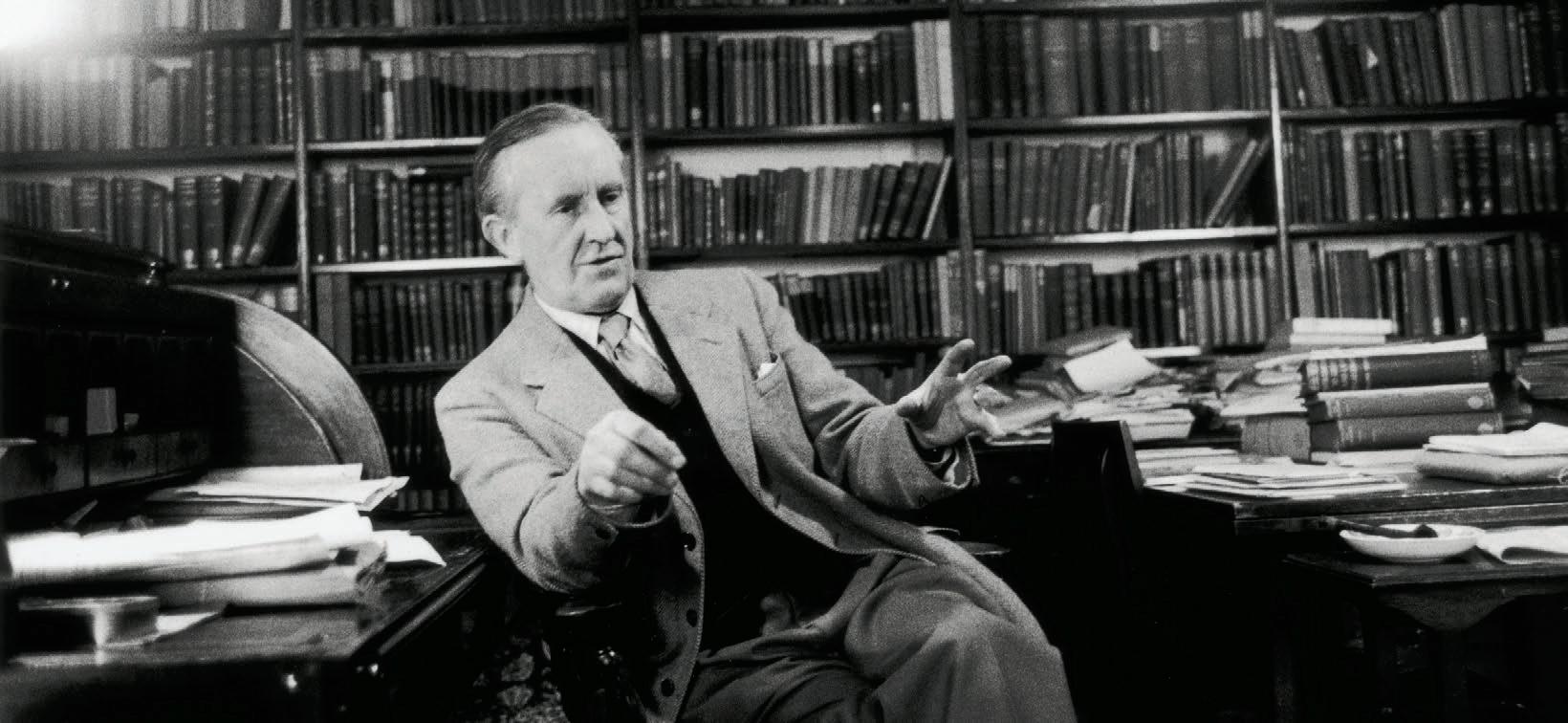
Opposite page: J.R.R. Tolkien (1892-1973), professor of English language and literature and author of The Lord of the Rings trilogy, is pictured in his study at Merton College, Oxford, in 1955.
throughout the centuries since the time of Christ. These range from the great works of the Middle Ages by Dante, Chaucer and others, to Shakespeare and Cervantes in the 16th and 17th centuries, right through to recent times with the great Catholic novels of the past century, such as Sigrid Undset’s Kristin Lavransdatter , Georges Bernanos’ Diary of a Country Priest and Evelyn Waugh’s Brideshead Revisited , and the fiction of American Catholics Flannery O’Connor and Walker Percy. The list could go on, but we will focus on three works in particular.
THE WEAKNESS OF THE WARRIOR
One of the greatest stories ever told is the Old English epic Beowulf, probably written by a Benedictine monk in the early eighth century. As with the parable of the prodigal son, Beowulf teaches a priceless lesson by showing us ourselves in the light of our relationship with God.
Beowulf is the mightiest warrior alive. No mere mortal is physically stronger. Yet in the epic he faces demonic monsters. The first, an evil creature named Grendel, he defeats by his own strength. The second is Grendel’s mother, even fiercer than her son. This time, Beowulf is armed not only with his strength but with the most powerful sword ever forged — one that had never failed in battle. Demonic evil is thus pitted against the strongest man alive, armed with the greatest technology man can make.
As Beowulf faces the monstrous demon, he discovers that his strength is insufficient and that the sword is powerless to harm his infernal foe. He learns — and we learn — that the combined power of man and technology is not enough to defeat demonic evil. It is then, as Beowulf is about to be slain, that a miraculous sword appears, with images from holy Scripture engraved on its hilt. With this God-given sword, signifying divine grace, Beowulf defeats demonic power. The meaning and moral are clear: No human person can defeat evil by his own strength and willpower — even aided by the most advanced technology. The supernatural assistance of God’s grace is essential.
LOOKING SIN IN THE EYE
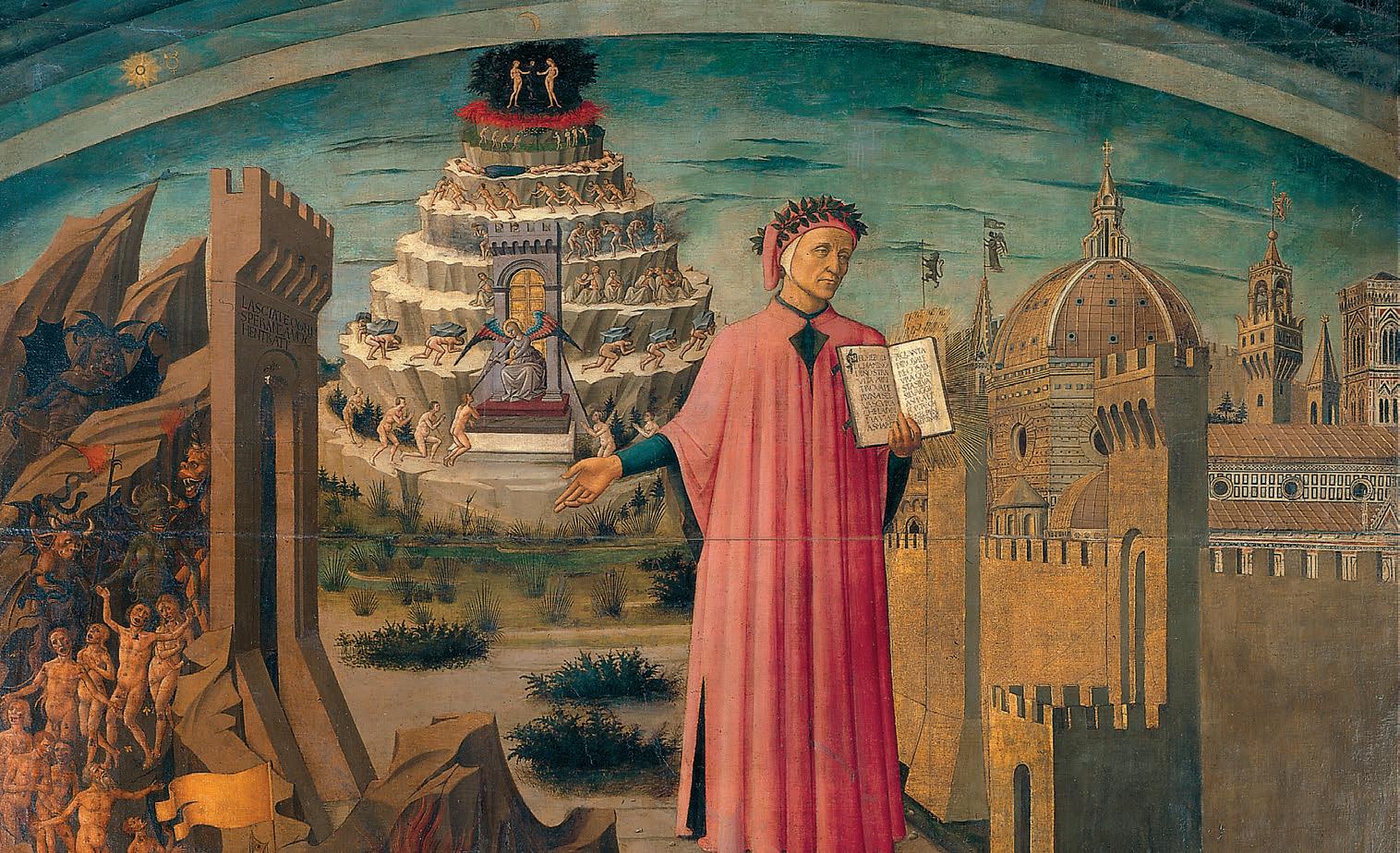
Perhaps the greatest work of literature ever written is Dante Alighieri’s Divine Comedy. Written in the early 14th century, it serves as a memento mori — a reminder of death — prompting the reader to contemplate the Four Last Things: death, judgment, heaven and hell.
Dante places himself within the story as its protagonist. This makes it a personal “confession,” but it is also a story of universal significance. It shows us ourselves. It holds up a mirror to humanity and, therefore, to each individual person. In this sense, Dante is an everyman figure. He is one of us — our representative.
The story begins, significantly, on Holy Thursday, the night Christ suffered his agony in the Garden of Gethsemane. Dante is trapped in the Dark Wood, unable to escape because of his slavery to sinful habits. Through the intercession of the Blessed Virgin, he begins the journey — or pilgrimage, led by guides — through hell and purgatory to paradise. On Good Friday morning, he is led into the depths of hell, where he sees the horrific consequences of unrepented sin. As he descends through the circles of hell, where each of the seven deadly sins is punished, Dante gains a deeper knowledge of the hatefulness of sin. At last, he reaches the very pit of hell, in the presence of Satan himself at the center of the earth — the furthest “down” anyone can fall. The image calls to mind Chesterton’s quip that angels can fly because they take themselves lightly, whereas the devil falls by the force of his own gravity.
Hitting rock bottom, after looking each deadly sin in the eye and seeing it with doom-laden clarity, Dante is ready to ascend Mount Purgatory. He climbs upward out of hell, emerging at the foot of the mountain on Easter Sunday morning. Like the Lord himself, and by his power, Dante rises from the dead into the land of the living.
Dante places St. Peter’s gate at the entrance to Mount Purgatory, reminding us that purgatory is the place of cleansing for those already saved. The gate is approached by ascending three steps, symbolizing the three stages of the sacrament of penance. The first step is white marble, polished to such a gloss that Dante sees his own reflection — signifying confession. The second is black and cracked lengthwise and across, the cracks forming the shape of a cross — signifying contrition. The third is red as blood — signifying the satisfaction for sins provided by Christ’s sacrifice.
Having ascended to the summit of Mount Purgatory, Dante enters Paradise, where he meets many saints before the climactic beatific vision of God.
Dante’s journey is a mystical reflection of the journey each of us is called to take, reminding us that the purpose of life is union with God in heaven. It shows that life is a pilgrimage in which we take up our cross to follow Christ. Dante’s journey is ours. His assent is the assent we must give. His ascent, aided by the intercession of the saints, is the way to heaven.
The story of the prodigal son is a true story, even if the prodigal son is a fictional character, because it shows us ourselves as sinners who need to repent and seek the forgiveness of our Father.
ONE SIN TO RULE THEM ALL
It might surprise us to discover that The Lord of the Rings, a story about elves, dwarfs, wizards and hobbits, is also a story about Christ. Yet its author, J.R.R. Tolkien, a lifelong, devout Catholic, insisted that “The Lord of the Rings is, of course, a fundamentally religious and Catholic work.”
How is this so? The key that unlocks the mystery is the date on which the One Ring is destroyed. Tolkien makes March 25 the date of the ring’s destruction — the feast of the Annunciation and, according to tradition, the historical date of the Crucifixion. He thus unites the climactic moment in his story with the climactic moment in history. The date of the Incarnation — when God becomes man — and the date when the God-Man dies on the cross is the date of our redemption from sin. The power of the ring is destroyed on the same date as the power of sin is destroyed. The ring is synonymous with sin itself. It is the “One Ring to rule them all and in the darkness bind them,” just as original sin is the “One Sin” that rules us and binds us in darkness. Both are destroyed on the same divinely significant date. It gets better. Frodo, the diminutive protagonist, leaves Rivendell on his mission to destroy the ring on Christmas Day and arrives at Mount Doom (Golgotha) on Good Friday. His journey parallels the life of Christ from birth to death.
Frodo is the Ring-Bearer — the one who carries the weight of sin without sinning. The Ring-Bearer is the Cross-Bearer. By contrast, the ring wearer chooses the “self-empowerment” the ring promises. Putting on the ring is an act of sin. When we put on the ring, we excommunicate ourselves from the good world God made, becoming invisible. At the same time, we become more visible to Sauron, the demonic Dark Lord, because the sinner has entered his kingdom of shadow. The power of the ring, like the power of sin, is addictive. The more we wear it, the more we come under its power. We become miserable wrecks, like Gollum, because sin “gollumizes” us.
It is no wonder that Tolkien insisted that stories — even fairy stories — hold up a mirror to man, showing us ourselves. In doing so, he and other great authors of Christian civilization were following the example of Jesus Christ — the greatest of storytellers — whose life, death and resurrection is the greatest story ever lived and, in the form of the Gospel, the greatest story ever told. B
JOSEPH PEARCE is the author of many books on Catholic literary topics, including Great Books for Good Men: Reflections on Literature and Manhood (Ignatius Press, 2025). A member of Msgr. Andrew K. Gwynn Council 1668 in Greenville, S.C., his website is jpearce.co.
La commedia
Firenze (1465), by Domenico di Michelino (1417-91) Santa Maria del Fiore, Duomo, Florence, Italy
Photo by Immagina / Bridgeman Images
A 15th-century painting depicts the Italian poet Dante Alighieri (1265-1321) holding the Divine Comedy while gesturing toward hell, purgatory and paradise — the setting for the journey of his epic poem.
A Natural Born DIRECTOR
Father McGivney’s pastoral genius included directing popular plays to draw parish and social life together
By Troy J. McMullen
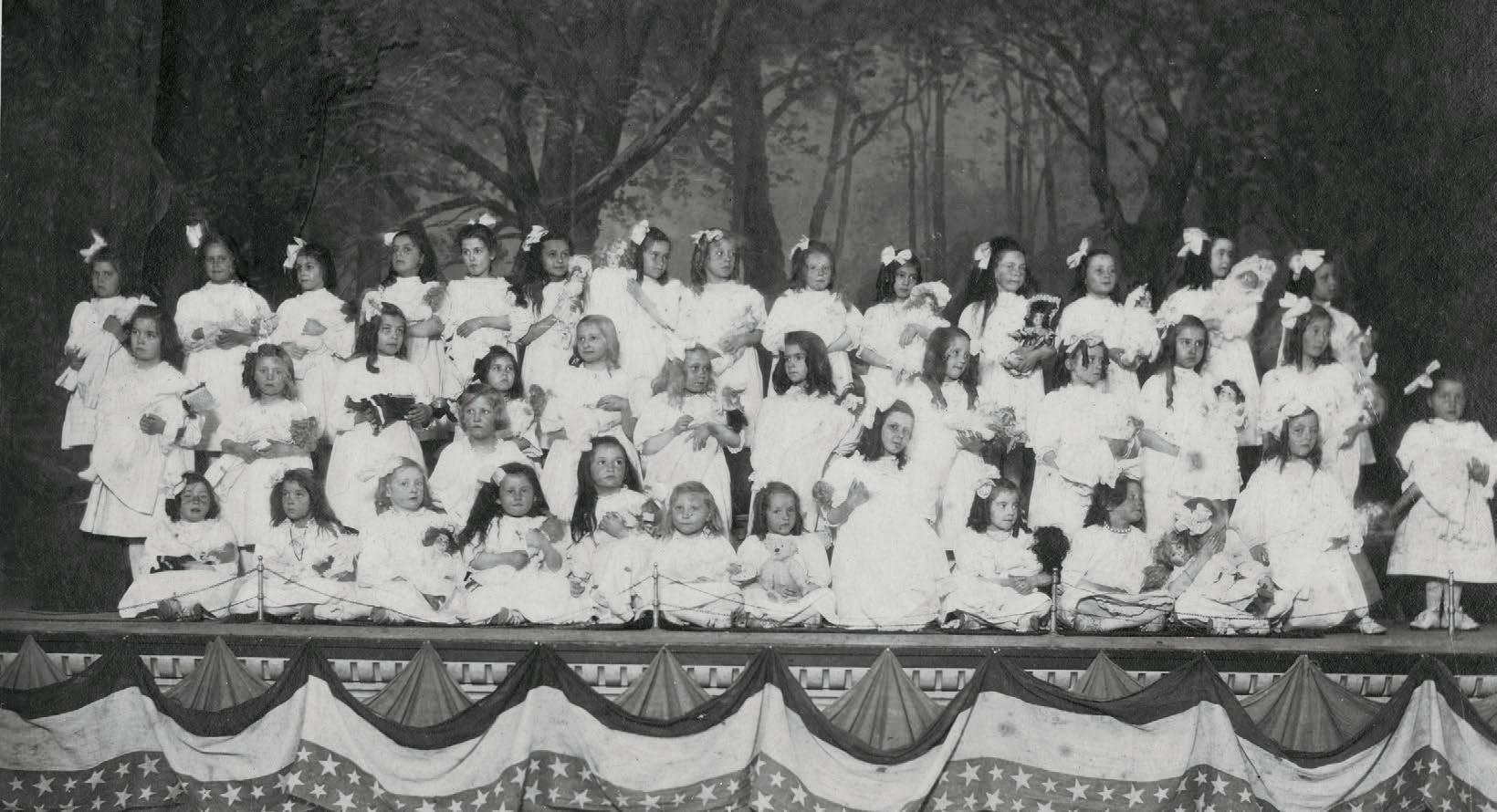
In March 1885, days before a stage production directed by Father Michael J. McGivney was set to open at the Opera House in Thomaston, Connecticut, the town’s new parish priest embarked on a 100-mile journey to New York City.
The Connecticut Catholic, the official publication of the Diocese of Hartford, reported: “Father McGivney is now in New York, where he will procure costumes and all that is necessary for the production of the drama ‘Eileen Oge,’ which will be performed by members of St. Thomas’ Christian Doctrine Society, on St. Patrick’s night, at the Opera House.”
This was not the first time the energetic priest — who had founded the Knights of Columbus three years earlier — navigated the chaotic and noisy streets of Manhattan on an artistic mission. By the time he was reassigned from St. Mary’s Church in New Haven to St. Thomas Church, some 30 miles north, Father McGivney had already produced or directed five plays and had made at least one other trip into the city to rent theatrical supplies.
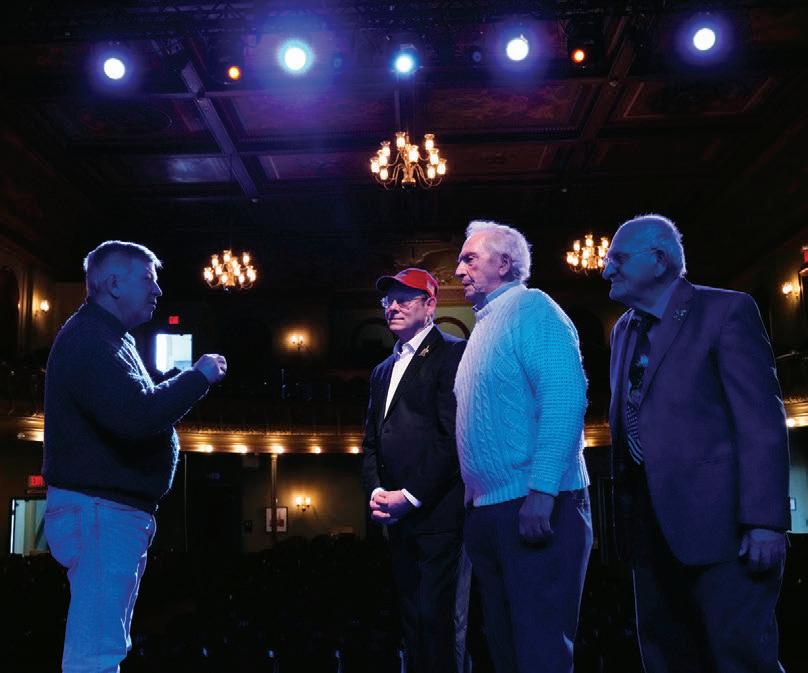
The ongoing restoration of the Thomaston Opera House, built in 1884, is reflected in this image of the ornately painted ceiling, completed in 2024.
While his roles as parish priest and founder of the Knights are widely known, Blessed Michael McGivney’s keen appreciation and use of the dramatic arts to foster friendship and charity further attest to his pastoral genius.
“He wanted to engage his parish by staging faith-based plays and community events that would connect people to the joy of the Gospel,” explained Father Joseph Crowley, pastor of St. Maximilian Kolbe Parish in Thomaston, which includes St. Thomas Church and Immaculate Conception Church in Terryville — both formerly under Father
McGivney’s pastoral care.
For a visionary like Father McGivney, the opera house became a bridge between the sacred space of the parish and the secular pulse of the street — a place where faith met the life of the town. “Through music and drama on the stage, he established a sense of fellowship with his parish and town community,” added Father Crowley, who serves as chaplain of Atlantic Council 18 in Thomaston.
That legacy continues into the 21st century as local Knights bear witness to Father McGivney’s vision both on and off the stage of the historic Thomaston Opera House, which is undergoing restoration.
STAGESTRUCK IN NEW HAVEN
Father McGivney’s interest in theater almost certainly predated his arrival as curate, or assistant priest, of St. Mary’s Church in January 1878.
Given what is known about his upbringing in Waterbury and what a seminary friend described as his “fund of good humor,” young Michael McGivney likely enjoyed — and participated in — school or parish stage productions prior to his ordination on Dec. 22, 1877.
The earliest documented evidence of his affinity for drama comes from Thomas Clark, one of his first Sunday school students at St. Mary’s.
“I never tired of him,” said Clark, as quoted in Parish Priest, the 2006 biography by Douglas Brinkley and Julie M. Fenster. “His course on Catechism was well planned, and he often used the children to personify characters of the Gospels.”
Beyond catechesis, Father McGivney was particularly concerned for teenagers and young working men of his largely Irish parish who were vulnerable to alcoholism. One of the
first parish organizations he joined was St. Joseph’s Young Men’s Total Abstinence and Literary Society (TAL), a temperance group whose principal activity was staging plays.
Though TAL lacked resources and momentum, Father McGivney quietly helped transform it. Elected treasurer in June 1878, he encouraged and advised the members as they organized fundraisers and rehearsed their lines, building confidence along the way.
TAL’s first theatrical production, Handy Andy, opened in a professional theater on St. Patrick’s Day in 1879. Though he did not direct the play, Father McGivney served as its de facto executive producer.
The production proved a “smash hit.” Reviews were glowing, and it netted $300 for St. Mary’s — nearly $10,000 in today’s currency. TAL membership soon topped 100.
In 1880, the group staged a more ambitious St. Patrick’s Day play: Pyke O’Callaghan, a patriotic Irish drama performed at the Grand Opera House in New Haven — later destroyed by fire in 1915. Directed by Father McGivney, it featured a large cast, including women — a bold move at a time when female roles were generally played by men. The production sold 1,800 tickets and raised a substantial sum for the debt-laden parish.
After staging shorter sketches and entertainments in 1881, TAL performed Eileen Oge, or Dark’s the Hour Before the Dawn under Father McGivney’s direction on March 17, 1882, before a full house.
Just 12 days later, on March 29, the Knights of Columbus was officially chartered by the state of Connecticut.
Father McGivney’s final theatrical production in New Haven was the newly written My Geraldine, staged on St. Patrick’s Day in 1883 with special permission from nationally acclaimed playwright Bartley Campbell.
During his nearly seven-year tenure at St. Mary’s, Father McGivney helped transform a struggling parish society into a successful theatrical and fundraising enterprise. Through full-scale productions, he provided young working men with a wholesome social outlet that strengthened fraternity and drew them more deeply into the life of the Church.
As Parish Priest summarized, “He was a natural-born director, with a steady stream of newspaper reviews noting that time and again the performers in his shows surpassed all limitations.”
CURTAIN CALL IN THOMASTON
When Father McGivney arrived in Thomaston in midNovember 1884 as pastor of St. Thomas Church, some 10 miles north of his hometown of Waterbury, he discovered that the parish’s Christian Doctrine Society, which numbered nearly 100 members, was already active in drama. Soon he was directing their cast in a production of Eileen Oge at the town’s majestic new opera house on Main Street.
The “fine, old Irish drama,” as the Waterbury Daily American described it in March 1885, included music performed by a symphony orchestra and drew a sold-out audience with “laughter-provoking” performances and “excellent acting.”
A year later, on St. Patrick’s Day 1886, Father McGivney reprised Handy Andy before another full house.
In the fall of 1887, after five weeks of rehearsals with the children of the Sunday school, he staged a Thanksgiving recital at the opera house. “It was no mere afternoon recital,” Parish Priest noted, “but a full-blown extravaganza.”
A large audience gathered, and the young thespians gave it their all. Act after act, the crowd responded with roaring laughter and applause.
“Michael McGivney, it seems, had the audience in the palm of his hand — but only because he had his players feeling so
Photo courtesy of the Thomaston Historical Society
Right: Mike Burr (left), chairman of the Opera House Commission and past grand knight of Atlantic Council 18, gives a tour of the opera house to brother Knights in February. • Opposite page: Sunday school children from St. Thomas Church assemble on stage at the Thomaston Opera House during an event organized by Father Michael McGivney, circa 1885.
good about themselves,” the biography recounts.
The success of these performances reflected Father McGivney’s understanding that music and theater could captivate parishioners and non-Catholics alike.
One St. Thomas parishioner declared, “He has been the best friend to youth since he came here.”
The Thomaston Opera House, erected in 1884 in the heart of the working-class town along the Naugatuck River, served as the community’s cultural center. Father McGivney viewed it as more than a place of secular amusement. He saw it as a stage for building community, strengthening Catholic identity, and funding works of charity.
Father McGivney established Atlantic Council 18 on April 8, 1885, and served as its chaplain, integrating the Knights into the fabric of Thomaston life. Over time, the council regularly hosted events at the theater, showcasing the principles of charity and unity to the wider community.
“In an era before radio or film, Father McGivney recognized that the local play was the primary source of storytelling,” said David Verdosci, an artist and member of Atlantic Council 18.
In 2018, Verdosci co-directed a performance of He Was Our Father, written by Dominican Father Peter John Cameron, portraying Father McGivney on the very stage he once used to serve his parish.
The play emphasized McGivney’s care for widows and orphans — a concern that ultimately inspired Verdosci to join the Order.
“I was touched in that performance by Father McGivney’s care for the everyday needs of people and his genuine concern for their spiritual well-being,” Verdosci said. “Then, seeing this in action through individual Knights was the spark that led me to become a Knight myself.”
“By putting on these high-quality productions, he virtually ensured that the Catholic social circle was the most vibrant one in town,” he added.
A LEGACY IN THE SPOTLIGHT
Father McGivney died in the St. Thomas rectory in 1890 at age 38, but his connection to the Thomaston Opera House did not end with his death. In the decades that followed, the local Knights of Columbus council remained a cornerstone of the theater’s support system.
During the Great Depression and the lean years of the mid-20th century, when many Victorian opera houses across New England were demolished or converted into warehouses, the Thomaston Opera House survived in part because of the community spirit Father McGivney had fostered.
The Knights, including Council 18, continued to use the space for exemplification ceremonies, concerts and balls, memorial services and charitable fundraisers, keeping the building’s heart beating. They also partnered with the opera house for special events, including screenings of documentaries about Father McGivney’s life and commemorative performances.
The theater stands as a living monument to Father McGivney’s belief that the Church must be present wherever the people are.
“He was ahead of his time in recognizing the significance of collaboration with the laity of his parish,” said Brian Caulfield, vice postulator of the cause for canonization of Blessed Michael McGivney. “And the opera house gave him an incredible opportunity to foster that vision.”
A yearslong restoration initiative, currently underway, has renewed the bond between the Knights of Columbus and the historic venue, noted Thomaston Selectman Mike Burr. A past grand knight of Council 18, Burr serves as chairman of the Opera House Commission, which includes several Knights.
“The teamwork and coordination from every member of this committee have been nothing short of amazing,” Burr said.
Jeff Dunn, executive director of Landmark Community Theatre — a nonprofit arts organization that operates the opera house today — said the venue is inextricably linked to the priest who used its stage to connect with the people of Thomaston.
As restoration continues, plans are underway to name part of the opera house in honor of Blessed Michael McGivney.
“The building is kind of a living monument to him,” Dunn said. “We want to demonstrate Father McGivney’s ties to the town, opera house and the spiritual benefits of the performing arts.” B
Editor’s Note : Maureen Walther, co-author of The Knights of Columbus: An Illustrated History (2020), contributed to this article.
TROY J. MCMULLEN is a former staff reporter for the Wall Street Journal and currently an executive producer for ABC News in New York City.
Members of SK John G. Timmermans Assembly 2632 in Airdrie, Alberta, gather behind a memorial display following the assembly’s Blue Mass at St. Paul Catholic Church. Representatives from three local first responder agencies attended the Mass. Fourth Degree Knights provided an honor guard and recognized Past Faithful Navigator Eric Howard, a longtime officer with the Royal Canadian Mounted Police who died in 2023.
SACRED HEART CELEBRATION
Winona (Minn.) Council 639 hosted a Sacred Heart Holy Hour — part of the Order’s Pilgrim Icon Program — at the Cathedral of the Sacred Heart in Winona. Father Mark McNea, former council chaplain, led the Holy Hour, attended by about 20 Knights and parishioners.
READY AT A MOMENT’S NOTICE
Members of St. Oscar Romero Council 16570 in Eastvale, Calif., cleaned the local parish chapel after a leak in the water heater line caused flooding. Six Knights responded immediately to a call for help from Father Tomás Guillen, pastor of St. Oscar Romero Parish and council chaplain, restoring the chapel in less than an hour.
INVESTING IN VOCATIONS
Holy Family Council 10388 in Tulsa, Okla., donated $3,000 to Peter Sartorius, a seminarian for the Diocese of Tulsa and a parishioner of Holy Family Cathedral, to support his first year of formation. The donation came primarily from a pancake breakfast hosted by the council.
REPURPOSING PEWS
Thirty members of Archbishop Fulton J. Sheen Council 7502 in Northglenn, Colo., removed and repurposed more than 320 pews and kneelers from Immaculate Heart of Mary Church, giving them to parishioners for use in their homes or personal projects. The 60-year-old pews were being replaced, and the council’s efforts saved the parish $10,000 in disposal costs.
ROSARY RIDE
Carrington (N.D.) Council 4951 organized a "rosary ride" pilgrimage in which participants traveled by motorcycle to five churches — praying and meditating on a decade of the rosary at each. They also made a stop at a local nursing home, where they visited with residents for about an hour.
PARISH REPAIRS
Tillamook (Ore.) Council 2171 donated $10,000 to Sacred Heart Church to help cover the cost of a new ceiling and windows for the parish hall. The funds came from the council’s annual sausage dinner, held for more than 60 years.
CHURCH DOORS RESTORED
Members of Father J. Fred Reidy, S.J. Council 1021 in Missoula, Mont., restored the solid oak doors of St. Francis Xavier Church after more than 130 years of exposure had left them badly deteriorated. With $300 of supplies, covered by a council member, 12 Knights completed the project of cleaning, sanding, and weatherproofing the doors over a period of four weeks.
Tony Suppa, an artist and member of Father John J. Walsh Council 7052 in Venice, Fla., paints a portrait of the Holy Family being guarded by St. Michael the Archangel. Commissioned by Council 7052, the painting serves as a visual reminder for Knights and their families of the Holy Family’s model of love, sacrifice and unity.
Family
Ed Thompson of St. Hubert Council 11357 in Langley, Wash., bags potatoes during a food packing event at St. Hubert Catholic Church. Knights and parishioners packaged more than 11,000 pounds of potatoes, distributing about 1,100 10-pound bags to charities on Whidbey Island — enough to feed approximately 22,000 people.
DISPLAY OF FAITH
St. Thomas Council 1347 in Hobart, Ind., collaborated with the city’s park district to display a Nativity scene at Festival Park. Two Knights installed the display, which remained up for just over a month as part of the council’s Keep Christ in Christmas campaign.
PRAYER WALKS
Pope St. Pius V Council 14041 in Bartlett, Tenn., led prayer walks at 11 local schools. Over six weeks, two groups of Knights visited two schools each Sunday, praying with 15 to 20 parents, teachers and students for safety and well-being.
TAKE AWAY HUNGER
About 60 Knights from Washington (Iowa) Council 2008 and Father Gaule Council 4092 in Fairfield volunteered at a food packing event organized by Council 2008. Working with Take Away Hunger, they prepared more than 15,000 meals for people in Haiti.
COLLEGE BOUND
St. Stanislaus Council 7875 in Pleasant Valley, N.Y., awarded $3,000 in scholarships to college-bound students. Since 2000, the council has provided more than $21,000 in scholarships.
HOLIDAY HOPE
Holy Infant Council 10794 in Ballwin, Mo., donated $2,000 to the Wenceslaus Food Bank and five hams
to families in need for Christmas. The council also raised over $1,200 for charity by selling hams, turkeys and other goods at Holy Infant Church.
SUPPLYING THE FUTURE
St. Gregory Council 15425 in Plantation, Fla., donated over $1,600 to support a school supply drive at St. Gregory the Great Parish. More than 230 backpacks were filled and distributed to families throughout the Fort Lauderdale area.
JOLLY PARISH MORNING
Bayou des Glaises Council 2972 in Moreauville, La., hosted a Breakfast with Santa at Sacred Heart Catholic School’s gym for about 150 parishioners. Guests enjoyed pancakes, sausage and a visit with Santa.
STEAKS ARE HIGH
St. Ambrose Council 11801 in Garrettsville, Ohio, raised approximately $1,700 through its annual steak dinner at St. Ambrose Church. Proceeds support scholarships, Coats for Kids, the Nelson Garrettsville Community Cupboard and other causes.
Members of St. John the
in
boxes of food to children in need. The council organized these distributions for three Sundays in December through the Food for Families program, which also included prayer, games and meals for 50 children and their parents.
Baptist Council 18537
Camalig, Luzon South, distribute
Members of Father Edward L. Richardson, S.M.A. Council 11984 in Chesapeake, Va., build a ramp at the home of a St. Stephen, Martyr Catholic Church parishioner whose granddaughter uses a wheelchair following a motorcycle accident. Six Knights worked with members of a Methodist church, who supplied the ramp, completing installation in five hours.
GIFTS FOR EVERY CHILD
Jubilee Council 3294 in Flemington, N.J., organized its annual Christmas toy drive at St. Magdalen Parish. More than 140 children from nearly 90 families received toys this year through Hope House. The council has sponsored the event for more than 25 years.
ROLLING HOPE TO UKRAINE
Victoria Council 1256 and St. Joseph the Worker Council 13356 in Victoria, British Columbia, raised over CA$35,000 to purchase more than 180 wheelchairs through the Canadian Wheelchair Foundation. The wheelchairs were delivered to people in need in Ukraine.
SPREADING CHRISTMAS CHEER
Knights from Father Harold M. Wren Council 3963 in Tewksbury, Mass., delivered socks to more than 35 patients and candy canes to staff at New England Pediatric Care Center. A Knight dressed as Santa posed for photos — a tradition since 1962.
CARING FOR GOD’S CREATION
Franciscan Martyrs of Georgia Council 10210 in Hinesville, Ga., organized a cleanup along East General Stewart Way. The council partners with the Keep Liberty Beautiful program to conduct quarterly cleanups, removing trash and large debris from roadways.
UNDER COVER SERVICE
Knights from Eugene A. Baker Sr. Council 11215 in Trussville, Ala., replaced a damaged carport at a parishioner’s home during a council service day. A local construction company donated over $1,000 in materials, and nearly 20 Knights volunteered to complete the project.
HONORING VIETNAM VETS
More than 30 Vietnam War veterans — including several Knights — and one widow were honored during a ceremony hosted by Msgr. Sliney Assembly 628 in Laconia, N.H. The event marked the 50th anniversary of the war’s end.
Community
Erick Cruz, a seminarian for the Archdiocese of San Antonio and past grand knight of St. John Paul II Council 13523, helps a child into a new jacket during a Knights of Columbus Coats for Kids distribution on Black Friday. One of two events in the archdiocese organized by the Texas State Council, the effort involved 20 councils and provided more than 2,000 coats.
HELPING OTHERS
Knights from St. Leonard Council 8986 in Madison, Neb., distributed nearly $6,000 — proceeds from weekly Lenten fish fries — to local and national causes. Beneficiaries included St. Leonard Catholic School, a food pantry, St. Jude Children’s Research Hospital, and a nonprofit serving children with disabilities.
Life
SUPPORTING LOCAL
Councils throughout West Virginia raised over $28,000 for maternity homes across the state, including $7,200 from four councils in the Martinsburg area to support Mary’s Refuge Maternity Home. Since the donation was made through the ASAP (Aid and Support After Pregnancy) program, the Supreme Council contributed an additional $1,800.
Members of Immaculate Conception Council 18200 in Jenkintown, Pa., gather around a banner of Our Lady of Guadalupe after a pro-life prayer service at Immaculate Conception Parish’s Marian garden. Deputy Grand Knight Jerry Frasca (left) holds a Knights of Columbus Silver Rose, which was displayed during the service.
ULTRASOUND UPGRADE
Father Lucien Galtier Council 4184 in West St. Paul, Minn., donated more than $12,000 to Guiding Star Wakota, a pregnancy resource center. The Supreme Council added $400 through ASAP. Father Jeremiah O’Callaghan Council 3659 in Inver Grove Heights raised a similar amount to help replace the center’s 12-year-old ultrasound machine.
FIRST LOOK AT LIFE
The Luzon South State Council organized 43 ultrasound events in the past year, helping more than 5,500 pregnant women see the child growing in their womb.
GOURDS OF GOODNESS
Victory Council 12900 in Columbus, Ohio, raised over $1,000 from its annual pumpkin sale at Our Lady of Victory Parish. Proceeds supported the Heinzerling Foundation and Misericordia Home, both serving people with developmental disabilities. Unsold pumpkins were donated to the Brian Muha Foundation.
SERVICE IN OUR VEINS
Rivière-du-Loup (Québec) Council 2402 partnered with Héma-Québec to organize four blood drives in 2024, collecting 900 units. Over the past 50 years, the council has collected approximately 20,000 units.
KANSANS FOR LIFE
Holy Spirit Council 16159 in Goddard, Kan., partnered with Kansans for Life to organize a baby bottle fundraiser at Church of the Holy Spirit. The five-week campaign raised more than $1,900.
FOR MOMS, BY MUMS
Father M. Joseph McDonnell Council 11044 in Carmel, Ind., raised $3,500 through its annual Mum Sale for Life at Our Lady of Mount Carmel Parish. Proceeds supported pro-life activities and local pregnancy resource centers.
See more at www.kofc.org/knightsinaction
Please submit your council activities to knightsinaction@kofc.org
Knights join thousands of pro-life demonstrators for the Michigan March for Life in Lansing. State Deputy Barry Borsenik led the Pledge of Allegiance at the rally, and Knights served as marshals during the march.
Local Knights, accompanied by state chaplain Father Elixander Torres Pérez, display a Knights of Columbus flag at San Benito Parish in Rafael Freyre, Cuba. The Knights delivered more than 700 pounds of food, medicine, and hygiene supplies to families affected by Hurricane Melissa.
Erwin Canciller (left) and Sean O’Malley of St. Benedict Council 15052 in Chicago prepare doughnuts for Donut Sunday at St. Benedict Parish. The council hosts the event several times a year, raising over $1,200 for charity at the most recent gathering.
United States
Knights from Nuestro Señor de Tabasco Council 13330 in Villahermosa, Mexico South, distribute about 120 toys to local children during a Three Kings’ Day celebration on the feast of the Epiphany.
by
MIDDLE:
Photo
Karen Callaway
Mexico
Members of St. Rémi Council 17671 in Colombes carry their council banner and a statue of Mary as they lead about 200 people in a procession on the feast of the Immaculate Conception. Knights organized several processions in France, drawing thousands of participants.
Knights from Blessed Józef Jankowski Council 15415 in Nakło nad Notecią and their wives assemble in the town square to sing Christmas carols following Nakło’s Three Kings Parade. The council worked with three local parishes to organize the event, which was attended by about 1,000 people.
Field Agent Vincent D’Souza (left) and Rolando Lagmay of St. Leonard’s Council 11752 in Ottawa, Ontario, sort more than 500 pairs of eyeglasses donated by St. Leonard Parish and local schools. The glasses will be sent to Cordon, Philippines, Lagmay’s home village, where a local K of C council and clinic will distribute them.
Members of Cebu Metropolitan Cathedral Council 3106 in Cebu City, Visayas, carry donations to San Isidro Labrador Parish following a Sept. 30 earthquake in northern Cebu. The quake affected nearly 750,000 people, killing more than 75 and displacing tens of thousands. Council 3106 helped distribute 1,200 packages of groceries, hygiene kits, water and other items to families in need.
OFFICIAL MARCH 1, 2026:
To owners of Knights of Columbus insurance policies and persons responsible for payment of premiums on such policies: Notice is hereby given that in accordance with the provisions of Section 84 of the Laws of the Order, payment of insurance premiums due on a monthly basis to the Knights of Columbus by check made payable to Knights of Columbus and mailed to same at PO Box 1492, NEW HAVEN, CT 06506-1492, before the expiration of the grace period set forth in the policy. In Canada: Knights of Columbus, Place d’Armes Station, P.O. Box 220, Montreal, QC H2Y 3G7 ALL MANUSCRIPTS, PHOTOS, ARTWORK, EDITORIAL MATTER, AND ADVERTISING INQUIRIES SHOULD BE MAILED TO: COLUMBIA, PO BOX 1670, NEW HAVEN, CT 06507-9982. REJECTED MATERIAL WILL BE RETURNED IF ACCOMPANIED BY A SELF-ADDRESSED ENVELOPE AND RETURN POSTAGE. PURCHASED MATERIAL WILL NOT BE RETURNED. OPINIONS BY WRITERS ARE THEIR OWN AND DO NOT NECESSARILY REPRESENT THE VIEWS OF THE KNIGHTS OF COLUMBUS.
SUBSCRIPTION RATES IN THE U.S.: 1 YEAR, $6; 2 YEARS, $11; 3 YEARS, $15. FOR OTHER COUNTRIES ADD $2 PER YEAR. EXCEPT FOR CANADIAN SUBSCRIPTIONS, PAYMENT IN U.S. CURRENCY ONLY. SEND ORDERS AND CHECKS TO: ACCOUNTING DEPARTMENT, PO BOX 1670, NEW HAVEN, CT 06507-9982.
COLUMBIA (ISSN 0010-1869/USPS #123-740) IS PUBLISHED 10
PERIODICALS POSTAGE PAID AT NEW HAVEN, CT AND ADDITIONAL MAILING OFFICES. POSTMASTER: SEND ADDRESS CHANGES TO COLUMBIA, MEMBERSHIP DEPARTMENT, P.O. BOX 554, ELMSFORD, NY 10523. CANADIAN POSTMASTER PUBLICATIONS MAIL AGREEMENT NO. 1473549. RETURN UNDELIVERABLE CANADIAN ADDRESSES TO: KNIGHTS OF COLUMBUS, 50 MACINTOSH BOULEVARD, CONCORD, ONTARIO L4K 4P3. PHILIPPINES FOR
Photo by Matthew Barrick
Knights of Charity
Every day, Knights all over the world are given opportunities to make a difference — whether through community service, raising money or prayer. We celebrate each and every Knight for his strength, his compassion and his dedication to building a better world.
Members of Joint Base Pearl HarborHickam Council 18025 in Hawaii carry tree trunks cut down during the council’s recent cleanup at Carmel of the Holy Trinity Monastery in Kaneohe. Knights have provided monthly maintenance and landscaping, among other projects, at the monastery since July 2022, and the council has donated more than $7,000 to support the Carmelite nuns who live there.
Photo by
‘I could not shake that gentle pull.’
In university, I increasingly found myself going through the motions of my Catholic faith. God seemed distant — but it was I who was distancing myself from him.
A decisive moment came during my engineering studies while traveling abroad. I felt drawn to go to Mass, and after receiving the Eucharist that day, my eyes were suddenly opened to how much the Lord loved me.
At the same time, God placed on my heart the call to the priesthood, and I wrestled with that in the years that followed. While I had everything I thought would make me happy, I could not shake that gentle pull on my heart.
My discernment was helped by the example of holy priests. I saw that Jesus’ call to “feed my sheep” (Jn 21:17) flourishes from his personal invitation: “Follow me!” (Jn 1:43).
My “yes” to Jesus grew in confidence once I set out to follow him wholeheartedly.
Now ordained a priest for four years, it brings me great joy to invite others to discipleship and to feed them through his word and sacraments.
Father Michel Quenneville Archdiocese of Kingston St. Paul the Apostle Council 9652 Kingston, Ontario