Why invest with Knights of Columbus Asset Advisors?
Alignment – Our investment strategies are consistent with Catholic moral screens in accordance with the U.S. bishops’ Socially Responsible Investment Guidelines.
Value – We o er high quality, competitively priced services designed to meet your needs.
Stewardship – Our profits help support the charitable works of our parent company, Knights of Columbus.
Accessibility – Our suite of faith-based investment solutions are available to both members and non-members.
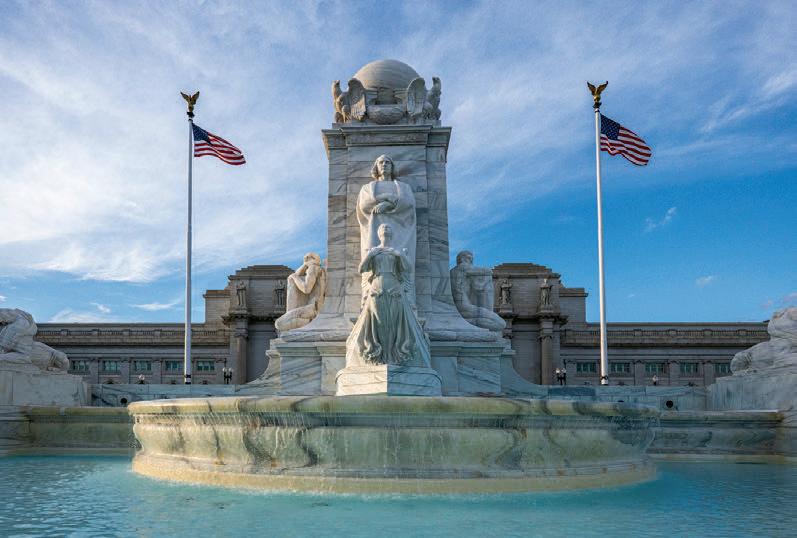
The Christopher Columbus Memorial by sculptor Lorado Taft stands outside Union Station in Washington, D.C. Recently restored in advance of the 250th anniversary of the United States, the memorial was dedicated in 1912 following a campaign by the Knights of Columbus, which successfully advocated for its construction.
20 10 24
America at 250: Christ at the Center
Knights nationwide celebrate the 250th anniversary as the U.S. bishops consecrate the country to the Sacred Heart of Jesus.
By Katie Yoder
United ‘Under God’ By Columbia staff
A Time for Witness By Supreme Chaplain Archbishop William E. Lori American Saints and Blesseds By Columbia staff
Journey of Healing
U.S. service members and veterans seek peace and spiritual transformation during the annual Warriors to Lourdes pilgrimage.
By Cecilia Engbert
A Magnificent Humanity
Pope Leo XIV’s first encyclical asks what we are building — and reminds us that our grandeur is a gift, not an achievement.
By Leonard DeLorenzo
Departments
3 For the greater glory of God
From defending religious freedom to serving local communities, the Order carries forward Father McGivney’s vision of faithful citizenship.
By Supreme Knight Patrick E. Kelly
4 Learning the faith, living the faith
The practice of gratitude strengthens our relationships, deepens our faith and prepares us for our eternal destiny.
By Supreme Chaplain Archbishop William E. Lori
6 Knights of Columbus News Organizational Meeting
Emphasizes Charity, Formation, Growth • Knights Honored for Pro-Life Leadership and Service • Catholic Leaders Promote Faith-Consistent Investing
8 Building the Domestic Church
A series of columns on family life, leadership and financial stewardship
26 State Deputies 2026-2027
28 Knights in Action
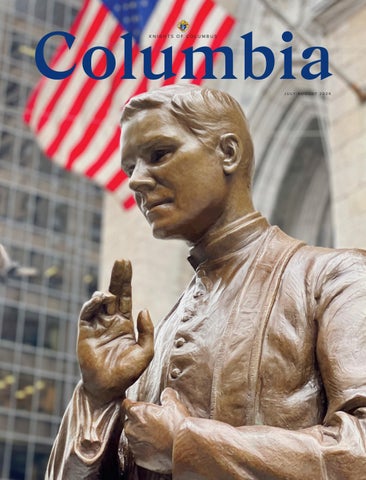
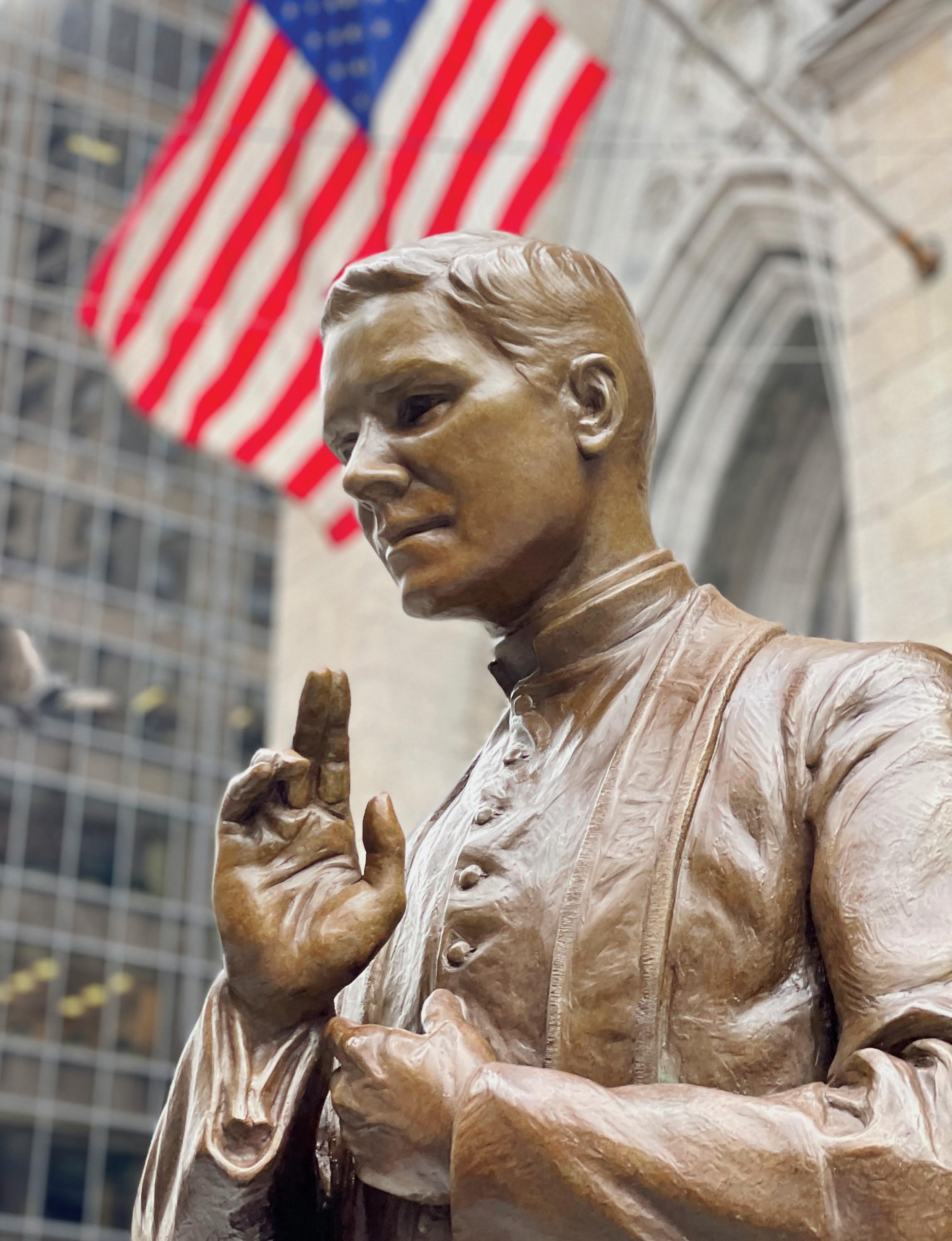
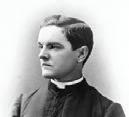
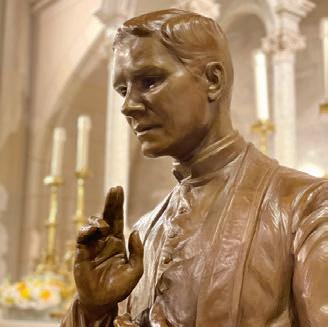
Reports from councils and assemblies, representing Faith in Action ON THE COVER A bronze statue of Blessed Michael McGivney stands in front of St. Patrick’s Cathedral in New York before its installation there in February 2025.
Membership in the Knights of Columbus is open to men 18 years of age or older who are practical (that is, practicing) Catholics in union with the Holy See. This means that an applicant or member accepts the teaching authority of the Catholic Church on matters of faith and morals, aspires to live in accord with the precepts of the Catholic Church, and is in good standing in the Catholic Church. kofc.org/join
THE CROSS ATOP Barcelona’s Basilica of the Sagrada Família’s central Tower of Jesus Christ, completed in February and blessed by Pope Leo XIV on June 10, rises 172.5 meters above the city below. After more than 140 years of construction, the basilica stands as the world’s tallest church, renowned for its architectural beauty and welcoming nearly 5 million visitors annually. Its chief architect, Venerable Antoni Gaudí (1852-1926), knew the project would require “the collaboration of several generations” and believed it would “not be fitting” for him to finish it. According to biographer Chiara Curti, he also believed “that creativity is born from encounters, from shared lives, from communion.” Perhaps most significantly, Gaudí intentionally limited the central tower’s height to remain slightly below Montjuïc, the hill overlooking Barcelona — reflecting his conviction that no creation of man should surpass the creation of God.
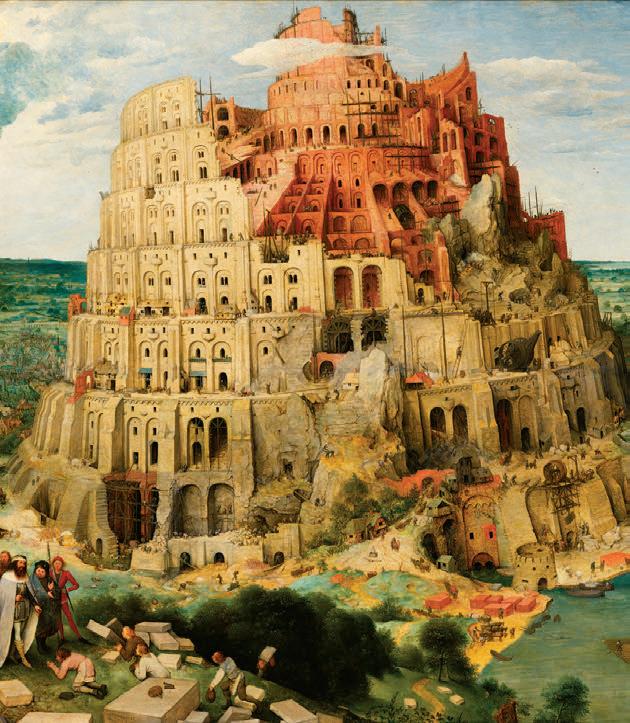
In this way, the Sagrada’s Tower of Jesus Christ stands in stark contrast to the Tower of Babel — mankind’s attempt to build a city and a tower “with its top in the heavens,” seeking to “make a name” for themselves and secure their future apart from God (Gn 11:1-9). It is precisely the image of Babel that Pope Leo uses to introduce Magnifica Humanitas, his first encyclical, published in May (see page 24). Reflecting on the human person in the age of artificial intelligence, he writes: “Humanity, created by God in all its grandeur, is today facing a pivotal choice: either to construct a new Tower of Babel or to build the city in which God and humanity dwell together.”
Pope Leo echoed this theme several weeks later when he celebrated Mass at the Sagrada Família to mark the centenary of Gaudí’s death
and bless the newly completed Tower of Jesus Christ. “Much more than a monument,” he said in his homily, “the Basilica of the Sagrada Família remains a work in progress today, reminding us that the Christian life is always a journey, because it is a project that God is carrying out.” The fact that the basilica remains unfinished, he added, “is not a flaw,” but rather “expresses a promise.”
The very next day, the U.S. bishops meeting in Orlando, Florida, consecrated the United States to the Sacred Heart of Jesus ahead of the nation’s 250th anniversary (see page 10). In his homily at the June 11 vigil Mass, Supreme Chaplain Archbishop William Lori said, “We give thanks for the blessings of these past 250 years, but we do so with a humble faith, recognizing that every nation stands in need of God’s mercy, wisdom and guidance.” He further noted, “We gather publicly to acknowledge that our deepest identity and our truest hope come not from ourselves but from the Lord.”
This understanding inspired the Order’s campaign 75 years ago to add the words “under God” to the U.S. Pledge of Allegiance (see page 15). Indeed, it has been an integral part of the identity of the Knights of Columbus since its founding by Blessed Michael McGivney in March 1882 — the same month construction began on the Sagrada Família. Today, as we celebrate our history and consider our future, Pope Leo’s challenge in Magnifica Humanitas remains before us: whether we will “construct a new Tower of Babel” or recognize that “the task of building in our time must place our relationship with God at its center” (236). B
Alton J. Pelowski, Editor
Cor Resource: In Charity & Truth
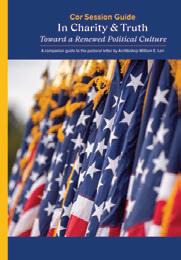
A new Cor Session Guide accompanies Supreme Chaplain Archbishop William E. Lori’s 2026 pastoral letter, In Charity & Truth , anticipating the 250th anniversary of the United States (see page 16). The 28-page guide offers 12 sessions on religious liberty, Catholic citizenship, the role of virtue in public life and related topics. Available in English and Spanish, it includes key points, discussion questions, Scripture passages, prayers and the full text of the pastoral letter. To purchase or download, visit kofc.org/shopcis .
PUBLISHER
Knights of Columbus
SUPREME OFFICERS
Patrick E. Kelly
Supreme Knight
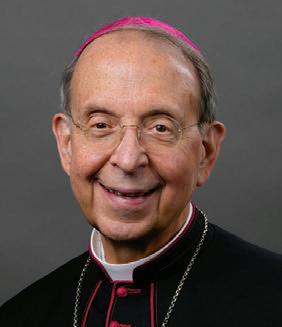
Most Rev. William E. Lori, S.T.D.
Supreme Chaplain
Arthur L. Peters
Deputy Supreme Knight
John A. Marrella
Supreme Secretary
Ronald F. Schwarz
Supreme Treasurer
Anthony R. Picarello Jr. Supreme Advocate
EDITORIAL
Alton J. Pelowski Editor
Matthew Kirby Editorial Director
Andrew J. Matt
Managing Editor
Elisha Valladares-Cormier Senior Editor
Megan Stibley Associate Editor
Paul Haring Manager of Photography
Cecilia Engbert Content Producer
Blessed Michael McGivney (1852-90) – Apostle to the Young, Protector of Christian Family Life and Founder of the Knights of Columbus, Intercede for Us.
HOW TO REACH US
COLUMBIA
1 Columbus Plaza
New Haven, CT 06510-3326
columbiamagazine.org columbia@kofc.org
Address changes
203-752-4210, option #3
addresschange@kofc.org
Columbia inquiries
203-752-4398
K of C Customer Service
1-800-380-9995
One Nation, Under God
From defending religious freedom to serving local communities, the Order carries forward Father McGivney’s vision of faithful citizenship
By Supreme Knight Patrick E. Kelly
IN MAY, I traveled to France to attend Warriors to Lourdes — our annual pilgrimage co-sponsored by the Knights of Columbus and the Archdiocese for the Military Services, USA. There, wounded, ill and injured veterans seek healing and peace from the physical and psychological effects of war. It was a moving experience to accompany these men and women who have sacrificed so much in service to this nation.
It was also an opportunity to reflect on the 250th anniversary of the United States and the contributions the Knights of Columbus has made to our nation over the years.
Blessed Michael McGivney founded the Knights to unite the men of St. Mary’s Parish in faith and service during a time of great division. The Civil War was still fresh in the minds of Father McGivney and the early Knights. The Industrial Revolution had brought dangerous working conditions and little support for workers injured or killed on the job. Catholics faced widespread discrimination and social barriers that limited opportunity and forced many into isolated communities. The dominant Protestant culture often viewed them with suspicion and questioned whether Catholics — most of them immigrants — could be loyal American citizens.
In the decades that followed, the Knights of Columbus proved its worth. We fought and died for our country in times of war and promoted its ideals in times of peace. We championed religious freedom and funded the U.S. Supreme Court case that struck down state laws aimed at banning Catholic education. We worked for racial equality when many others looked the other way.
Because of our history, religious freedom has always been a central concern. In 1954, the Knights played a key role in adding the words “under God” to the Pledge of Allegiance. To this day, the United States remains “one nation, under God.”
The Order has contributed greatly to the good of our nation. Yet perhaps our most important contributions are those that often go unheralded. I am speaking of the daily work of our local councils and assemblies — bringing men and families together in service to their parishes and communities. This work strengthens social bonds, assists those most in need and supports people living on the margins. It fosters solidarity and civic virtue, helping us become better citizens and contributing to the common good in ways that cannot be measured.
For this reason, it is not a stretch to say that patriotism is in the DNA of the Knights of Columbus — and that to be a Knight is to be a patriot. Some may hesitate to use that word, fearing it implies blind allegiance or political partisanship.
But that is not how the Church — or the Knights — understands patriotism. At its core, patriotism is a rightly ordered gratitude. It is the duty of allegiance we owe our nation in recognition of the blessings we have received — gratitude to God and gratitude for a country that has allowed so many good things to flourish: our families, our Church, our councils and our communities.
For the Order, patriotism is more than a sentiment. It means helping to build a just and flourishing society. Through our principles and service, we help shape the character of our members, which in turn shapes the character of our families — the fundamental cell of society. By strengthening families and serving our communities, we help shape the culture of our nation.
As we celebrate this nation’s 250th anniversary, let us do so with gratitude for the many gifts God has given us. And as an Order, let us renew our commitment to the work before us, helping ensure that our country will always remain one nation, under God.
Vivat Jesus!
For the Order, patriotism is more than a sentiment. It means helping to build a just and flourishing society. By strengthening families and serving our communities, we help shape the culture of our nation.
Photo by Michael Collopy
The Importance of Giving Thanks
The practice of gratitude strengthens our relationships, deepens our faith and prepares us for our eternal destiny
By Supreme Chaplain Archbishop William E. Lori
ONE OF THE MOST important lessons parents can teach their children is gratitude — learning to say thanks for kindnesses big and small, such as by sending a thank-you note to grandparents for a birthday gift, saying a prayer of thanksgiving before meals, or expressing thanks to a brother or sister for help with homework.
Gratitude is like oil in the gears of human relationships. It helps things run smoothly. A genuine word of thanks brings joy. But our gratitude has to be sincere. Otherwise, it does more harm than good. Real gratitude comes from the heart.
We are more readily grateful to those we love — for example, to friends who help us in time of illness or distress. But our gratitude should run deeper. We should cultivate gratitude for the gift of friendship, and we should be grateful to loved ones simply for being who they are. We should appreciate their presence, their gifts, even their foibles. Our gratitude is an expression of our love.
Gratitude can surprise us. Sometimes, out of the blue, a stranger will treat us with kindness, no strings attached. It might be something simple, like helping us lift luggage into an overhead bin. Or something dramatic, like saving us from danger. Gratitude can suddenly well up in our hearts for those who die in the line of duty, even if we’ve never met them. We can be astonished when someone with whom we don’t get along reaches out, seeking to mend fences. Whenever enmity is laid to rest, we should feel especially grateful. Gratitude is more than a good feeling; it is an intentional act of the will. Truly to thank another person is a decision that originates in our hearts. It is a way of life. A grateful person is a loving person. Gratitude curbs our tendency to be envious of others or hypercritical of them. It helps overcome the all-too-human tendency to gossip and thus sow division.
I hope you’ll agree that gratitude is a building block for a happier life, happier families and a more cohesive society.
But purely human gratitude is apt to fail. Sooner or later, our human nature, weakened by sin, will prompt us to ingratitude. Before we know it, our attitude toward life can turn negative. We start feeling as if nothing is good enough. When such feelings persist, they can distort the way we see both ourselves and the blessings God has given us.
Which brings us to the source of gratitude: our faith. At the heart of faith is praise and thanksgiving. The Persons of the Trinity are united in an eternal exchange of love. Jesus reflected this in his prayer; he continually gave thanks and praise to his heavenly Father, and he taught us to do the same. He chided the nine lepers who failed to thank him for curing them (see Lk 17:11-19).
The word “Eucharist” means thanksgiving, and we refer to Mass as “a sacrifice of praise.” As the Eucharistic Prayer begins, the priest says, “Let us give thanks to the Lord our God.” And we answer, “It is right and just.” But there’s more! It turns out that gratitude is not merely a passing act of piety. It is our destiny. We were made for gratitude. When, God willing, we are in heaven, we will spend all eternity giving God thanks and praise with unimaginable joy.
All this has special meaning for us, the family of the Knights of Columbus. After all, our first principle is charity. Only a grateful heart is receptive to God’s love. Only a heart that receives his love gratefully will share it with others. When we are grateful for the gift of life, we will strive to protect it. When we are grateful for our faith, we will try to deepen it and spread it. When we are grateful for God’s blessings, we will share them with others. Charity and gratitude travel together. Let us indeed give thanks to the Lord our God, for it is right and just! B
When we are grateful for the gift of life, we will strive to protect it. When we are grateful for our faith, we will try to deepen it and spread it.
When we are grateful for God’s blessings, we will share them with others.
by Paul Haring
Photo
Supreme Chaplain’s Challenge
A monthly reflection and practical challenge from Supreme Chaplain Archbishop William E. Lori
He turned and said to Peter, “Get behind me, Satan! You are an obstacle to me. You are thinking not as God does, but as human beings do.” (Gospel for Aug. 30, Mt 16:23)
Who knows the mind of God? God is beyond human understanding, yet he has revealed himself to us most perfectly in the person of Jesus Christ. Through prayer we can come to know God more fully, and we grow in understanding of his plan when we make a habit of conforming our will to his holy will. We follow Christ in discipleship when we pray daily to the Father as he did: “Not my will but yours be done” (Lk 22:42).
Challenge: This month, I challenge you to study the life and example of our founder, Blessed Michael McGivney, whose feast day is Aug. 13. Use the Blessed Michael McGivney Cor Session Guide (available for free at kofc.org/shopcis), noting in particular how Father McGivney always sought to align his will with that of God.
To view future challenges, visit kofc.org/monthlychallenge
Catholic Man of the Month
Servant of God
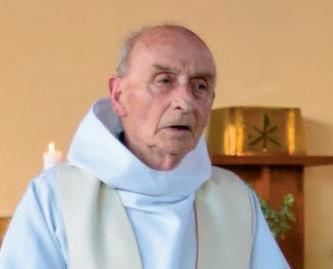
Jacques Hamel (1930-2016)
A DECADE AGO, when he arrived to celebrate morning Mass at St. Étienne Church in Saint-Étienne-du-Rouvray, France, Father Jacques Hamel had no idea his own life would be sacrificed at the altar.
Jacques Hamel was born in Darnétal, in northern France, the firstborn child of a railroad worker and a mother who was a weaver. Young Jacques was an altar server and would often play Mass. He entered seminary as a teenager, but his studies were paused in 1952, when he began four years of military service, including 18 months in Algeria. There, he was the lone survivor of an ambush that killed several fellow soldiers; he always wondered why he had been spared.
After returning to France and completing seminary studies, he was ordained a priest for the Archdiocese of Rouen in 1958. Father Hamel would faithfully serve its parishes for nearly 60 years.
Father Hamel gained a reputation as a gentle and compassionate priest, with a particular love for the Eucharist. “When
he celebrated Mass,” his sister Roseline said, “he seemed to be transformed by his faith.” In a 2002 homily, Father Hamel said, “Only through the Eucharist is it possible to truly live the Gospel.”
Instead of retiring at age 75, Father Hamel chose to remain in active ministry out of love for his vocation, frequently assisting at St. Étienne Church.
As he celebrated Mass on July 26, 2016, two Islamic State militants stormed the church and took the small congregation hostage. The priest attempted to resist while crying out, “Get away, Satan!” But they forced him to kneel before the altar and slit his throat.
His cause for canonization opened April 13, 2017, after Pope Francis waived the usual five-year waiting period. B
Let us pray that in large cities often marked by anonymity and loneliness we find new ways to proclaim the Gospel, discovering creative paths to build community.
KNIGHTS OF COLUMBUS leaders gathered in New Haven, Connecticut, for the annual Organizational Meeting of State Deputies June 4-7.
More than 70 state deputies representing jurisdictions across North America, Europe and Asia united in prayer and fraternity while preparing for the upcoming fraternal year through workshops, planning sessions and social events. Many also met with their state chaplains, whose annual meeting in New Haven was held June 3-6.
On June 5, 33 newly elected state deputies were installed at the conclusion of a Mass at St. Mary’s Church, the birthplace of the Order. Supreme Chaplain Archbishop William Lori of Baltimore was the principal celebrant, with more than 35 state chaplains and associate state chaplains concelebrating.
In his homily, the supreme chaplain pointed to the Sacred Heart of Jesus as a model of true humility — a necessary quality for leaders.
“It is because of this humility, both divine and human, that Jesus courageously led the way into the valley of darkness ... not with force but with a sacrificial love,” Archbishop Lori said. “If we would be great leaders in the Knights of Columbus, our hearts must be conformed to Jesus, who has a meek and humble heart.”
Following the Mass and conferral of medals of office, Supreme Knight Patrick Kelly commended the state deputies and chaplains for their accomplishments, noting that last year the Order welcomed more than 101,000 new Knights — the most since the end of World War I.
“People often ask me … how are you doing that?” Supreme Knight Kelly said. “The answer, really, is that we’re meeting the moment that we’re in right now, in our culture, in our society. … We’re giving young men a sense of meaning and a sense of coherence and a sense of purpose.”
The supreme knight underscored the Order’s record charitable activity during
the past year — including more than $200 million in charitable donations and more than 48 million volunteer service hours worldwide. He also pointed to Cor, active in more than 6,200 councils, as a key initiative helping men encounter Christ and deepen their faith.
“This is a powerful moment for the Knights of Columbus,” the supreme knight said. “We are uniquely positioned to help young men put their faith into action, together with their friends. I think the Lord is opening a door for us at this point in our culture’s history and in the history of the Knights of Columbus, and now it’s our job to seize the moment and move forward together.”
Business sessions and workshops provided state deputies with additional resources to grow faith formation programs, expand membership within their jurisdictions, and strengthen collaboration. The meeting’s theme, “Moving Forward Together,” reflected the Order’s commitment to advancing Father McGivney’s mission of charity,
evangelization, faith formation and fraternity, as well as his mission of protecting the financial security of Catholic families.
“Protection of our families through Knights of Columbus Insurance,” the supreme knight noted, “is the original sign of our commitment to charity, and it’s central to Father McGivney’s founding vision.”
As part of the concurrent State Chaplains Meeting, Archbishop Lori led more than 40 state chaplains on a pilgrimage to sites associated with the life and ministry of Blessed Michael McGivney.
During Mass at Immaculate Conception Church in Terryville, Connecticut, Archbishop Lori reflected on Father McGivney’s devotion to the Sacred Heart.
“What he left behind was a legacy of priestly love and self-sacrifice,” Archbishop Lori said. “The Knights of Columbus reflects the truth and love of the Sacred Heart that found a home in his priestly heart.” B
Photo by Paul Haring
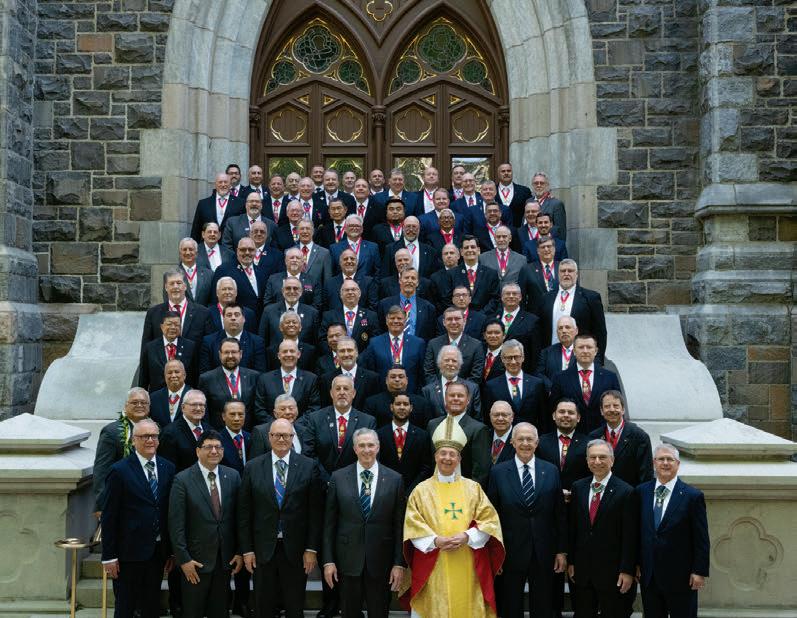
Supreme Officers and state deputies gather outside St. Mary’s Church in New Haven, Conn., during the Organizational Meeting of State Deputies on June 5.
Knights Honored for Pro-Life Leadership and Service
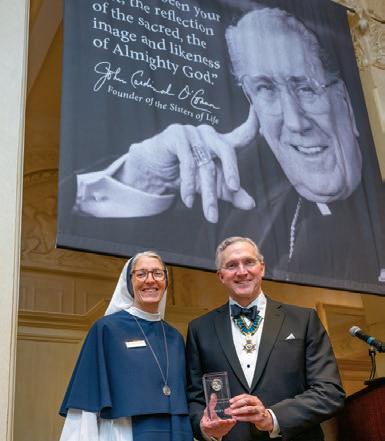
THE SISTERS OF LIFE honored Supreme
Knight Patrick Kelly with the John Cardinal O’Connor Award at the annual Sisters of Life Gala in Rye, New York, on June 5. The award recognizes individuals who embody the vision of Cardinal John O’Connor, who founded the Sisters of Life in 1991 while serving as archbishop of New York.
“We are proud to honor Supreme Knight Patrick E. Kelly with the John Cardinal O’Connor Award for his tireless commitment to building the culture of life,” Mother Mary Concepta, superior general of the Sisters of Life, said. “Under your leadership, the Knights of Columbus continue to be leaders in the pro-life movement in word and in action. Your unwavering commitment to the cause of human
life, marriage and the family is an inspiration to us.”
Upon receiving the award, the supreme knight praised Cardinal O’Connor as a leading figure in the pro-life movement whose influence continues to be felt decades after his death. He also highlighted several areas of collaboration between the Order and the Sisters of Life, including Villa Maria Guadalupe, a retreat center in Stamford, Connecticut, entrusted to the Sisters of Life by the Knights of Columbus in 2004.
“It is a great honor this evening to receive this award on behalf of the Knights of Columbus,” he said. “The Knights of Columbus works with all sorts of organizations. But there is no partnership that we cherish more than our close friendship with the Sisters of Life.” B
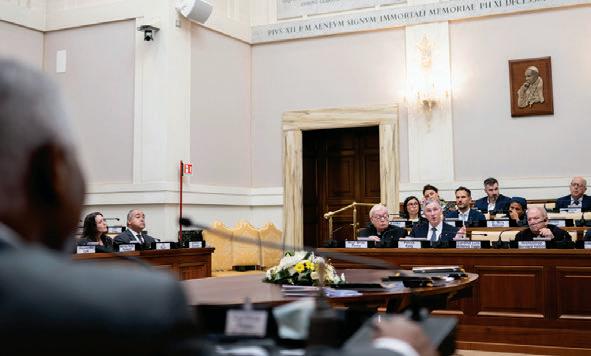
SUPREME KNIGHT Patrick Kelly delivered the keynote address at the Conference on Mensuram Bonam, hosted by Cardinal Peter Turkson, chancellor of the Pontifical Academy of Social Sciences (PASS), at the Vatican on May 20. The conference brought together 80 representatives of bishops’ conferences, religious institutions and experts from the faith-consistent investing community around the world to share research and reflections in light of Mensuram Bonam, PASS’s 2022 document on economics and finance from the perspective of the Gospel and Catholic social teaching.
“Mensuram Bonam is crucial because it summons the faithful to a deeper realization of who we are, and what we must do,” said Supreme Knight Kelly. He called faith-consistent investing “a process of continuous discernment,” noting the need for vigilance surrounding the growth of artificial intelligence.
“We must bring together our significant financial resources to help build an economy that serves the human person,” the supreme knight said.
During the conference, PASS distributed a white paper, Investing With Faith, written in collaboration with Knights of Columbus Asset Advisors (KoCAA), CAPTRUST Religious Services Investment Consulting and Catholic Investment Services. The white paper draws on the practical experience of financial organizations — including KoCAA — with expertise in faith-aligned investing to provide evidence that
Supreme Knight Patrick Kelly speaks about faith-consistent investing at the Conference on Mensuram Bonam at the Vatican on May 20. The conference, hosted by Cardinal Peter Turkson (foreground), brought together leaders in the faith-consistent investing community.
investing according to Catholic social teaching has not historically implied lower returns over time.
Deepak Devaraj, president and chief investment officer of KoCAA, participated in the conference. “Our experience shows that over a full market cycle, faith-consistent investing has been competitive with traditional strategies,” he said.
“With KoCAA’s leadership, institutional and individual investors can invest in ways that honor the Catholic faith and support their long-term needs.”
The white paper can be read at kocaa.com/investwithfaith. B
Supreme Knight Patrick Kelly accepts the John Cardinal O’Connor Award from Mother Mary Concepta, superior general of the Sisters of Life, on June 5.
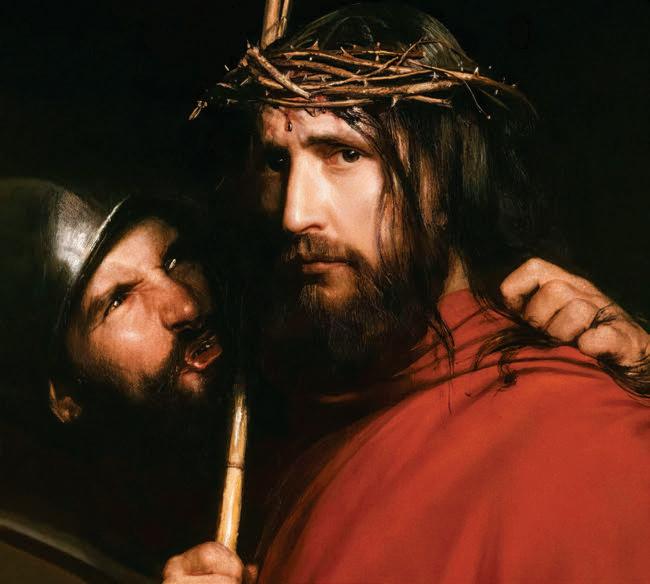
Risking Rejection
By Steve Dawson
Fear of rejection quietly limits leadership. It reduces one’s mission to what feels safe and manageable. Over time, it creates a pattern of hesitation that weakens clarity and action.
Christ was rejected and did not adjust his message to avoid it. He continued to testify to the truth, even when people walked away. His mission was not shaped by the response of others, but by obedience to the Father and love for those he came to save.
When leaders fear rejection, they begin to manage perception instead of lead. They avoid difficult conversations, delay necessary action and soften what needs to be said firmly. They second-guess clear decisions and hesitate at key moments. This weakens trust and slows the mission.
In evangelization, fear of rejection often means a conversation not started or a truth left unspoken. In business, it means a decision delayed or a problem left unaddressed.
Expect rejection and move forward anyway, with kindness, meekness and charity. Measure your leadership by faithfulness, not by response. That freedom allows you to act when it matters most and remain steady under pressure. B
— Steve Dawson is founder and president of St. Paul Street Evangelization and a member of Bishop Gallagher Council 2569 in Royal Oak, Mich.
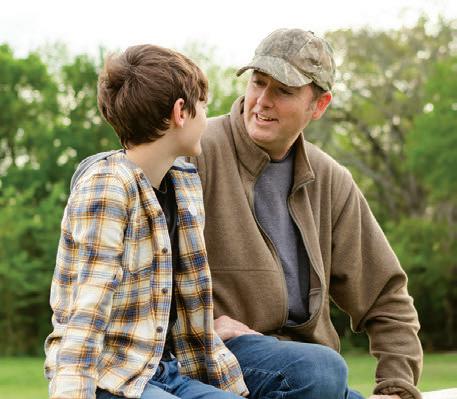
Taking Kids Seriously
When answering children’s questions about the faith, Catholic parents need to understand their point of view
By Steven R. Hemler MISSION OF THE FAMILY
IN TODAY’S INCREASINGLY secularized society, it is important for parents, grandparents, confirmation sponsors, catechists, teachers, godparents and other adult role models to answer questions young people have about the Catholic faith. Surveys show that 43% of Americans raised Catholic no longer identify as such, and nearly half of those who leave cite a loss of faith in Church teaching as the reason. Against this backdrop, helping young people understand and embrace Catholic teaching is critical.
Catholic parents often struggle to answer questions about the existence of God, the relationship between science and faith, evidence for Jesus’ resurrection, why God allows suffering, the obligation to attend Sunday Mass, as well as hot-button issues such as samesex marriage and gender ideology. Thankfully, many apologetics resources are available to help.
But more fundamentally, children need to feel loved and respected if they are to open up about their questions and struggles. They need to feel safe enough to raise concerns — even those that may seem taboo or embarrassing.
One of the most important tasks parents have is ensuring that their children feel unconditionally loved. It is not enough for parents to know they love their children; each child must feel it. This can be cultivated by taking children and their world seriously through focused attention and empathetic listening.
When children are ready to talk about faith, it is important for them to know that you are there to listen
and help, not to argue or judge. As such, it is vital to understand your child’s point of view, not simply prepare your next talking point. A great way to show attentive listening is to paraphrase what your child says and ask clarifying questions, including about the reasons behind his or her beliefs. Remember, you are taking small steps toward conversion; don’t rush the process. Sometimes the most effective thing parents can do, especially for adult children, is “plant a seed” and pray for the Holy Spirit to do the rest. Competently addressing our children’s faith questions, ensuring they feel heard and loved, and trusting in God’s guidance through prayer are all critical to helping them become — and remain — faithful Catholics. B
STEVEN R. HEMLER is president of the Catholic Apologetics Institute of North America (cainaweb.org) and author of The Busy Parent’s Guide to the Catholic Faith: Short Answers to the Big Questions (Scepter, 2026). He is a member of John J. Cempre Council 6328 in Culpeper, Va.
How can I make charitable giving a year-round habit?
By Dennis J. Gerber Jr. FAMILY FINANCE
Many nonprofits will tell you the same thing at this time of year: Charitable donations decline during the summer.
Summer often means interrupted routines, vacations and the unfortunate reality that, for some people, a need doesn’t exist if it isn’t right in front of them.
Here are three ways we can combat the summer slump in giving:
Set up recurring gifts. Parishes that rely on week-to-week offertory collections are greatly impacted when giving drops off during the summer. If
FOR YOUR MARRIAGE
Adventures in Ordinary Love
you aren’t enrolled in automatic giving at your parish or with other organizations you support, I strongly encourage you to do so. If you have an account with Knights of Columbus Charitable Fund, you can also schedule recurring grant disbursements.
Think ahead to your year-end charitable goals. If you’re aiming to reach a certain level of charitable giving by the end of the tax year, consider spreading those donations throughout the year. This can provide much-needed consistency, especially for smaller charities.
Be aware of heightened needs, especially in your community. Summer often brings increased needs. For example, food pantries may need to serve families whose children are no longer receiving meals at school. Keep your
eyes and ears open for opportunities to practice generosity with your time, talent and treasure.
Let’s continue to support the causes we care about. In doing so, we can more intentionally cultivate the virtue of generosity throughout the year.
For more tips and information, visit kofc.org/familyfinance B
— Dennis J. Gerber Jr. is president and CEO of Knights of Columbus Charitable Fund and a member of Father Patrick F. Pinder Council 3962 in Ramsey, N.J.
The daily responsibilities of married life can strengthen the bonds of friendship between spouses
By Jared Zimmerer
WITH SIX KIDS AT HOME , my wife and I rarely find time for quiet, uninterrupted conversation. Most of our talks happen while doing dishes, cooking supper, folding laundry or tending to our children. We discuss household needs, schedules, money and prayer — and sometimes simply enjoy each other’s company. But after almost 20 years together, we have learned something important: If we do not make time for those moments of love and communication, they will not happen on their own. We can become distant, not because love has disappeared, but because life has crowded it out. Love is often portrayed as spontaneous, and sometimes it is. But like many good things, love also thrives on discipline. The small, unnoticed habits — cleaning bathrooms, listening when tired, praying together, forgiving quickly, kissing your spouse before leaving the house — form extraordinary love through repeated acts of self-gift.
There is a myth in our culture that love should be effortless and constantly exciting. But the strongest marriages I know endure because husband and wife choose, day after day, to embrace the mundane.
G.K. Chesterton often saw adventure hidden within ordinary life, and I think he was right. In Orthodoxy, he writes, “Ordinary things are more valuable than extraordinary things; nay, they are more extraordinary.” In a world marked by betrayal, lies and sin, a holy marriage becomes a quiet rebellion. A faithful husband and wife exemplify extraordinary virtues: loyalty, forgiveness, sacrifice and friendship.
Marriage is a school of virtue, and its lessons are learned through faithful repetition. The chores, the conversations, the prayers, the kisses at the door — these are not water to the fire of love. They are where love is made real. B
JARED ZIMMERER is the content marketing director and Great Books adjunct professor for Benedictine College in Atchison, Kan., where he lives with his wife and six children. He is member of St. Francis of Assisi Council 7099 in Grapevine, Texas.
AMERICA AT 250: Christ at the Center
Knights nationwide celebrate the 250th anniversary as the U.S. bishops consecrate the country to the Sacred Heart of Jesus
By Katie Yoder
by Paul Haring
When a brother Knight encouraged Cyril Macaraeg to consecrate his family and their home to the Sacred Heart of Jesus, he jumped at the opportunity.
“It’s something I’ve always wanted to do,” said Macaraeg, a past grand knight of Msgr. Ailbe M. McGrath Council 8437 in Seattle. “I pray that it will help strengthen and deepen our relationship with God.”
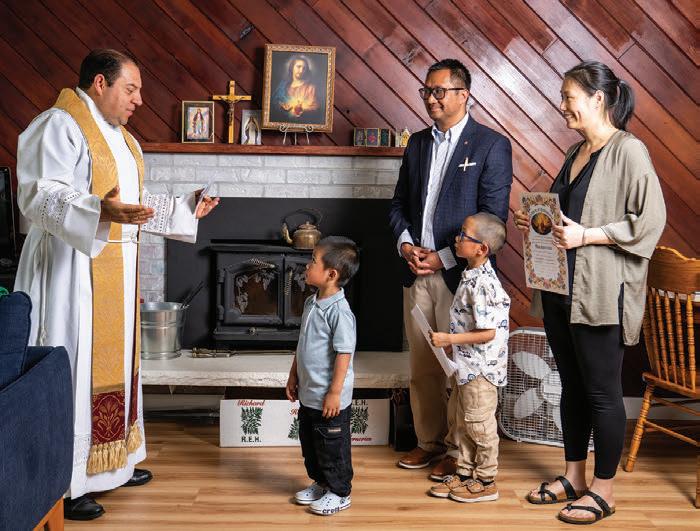
The home enthronement of the Sacred Heart of Jesus — a ceremony in which a family places an image of the Sacred Heart in their home, recognizing Christ’s rule over their lives and consecrating themselves to his service — is one of the ways Knights of Columbus throughout the United States marked the 250th anniversary of the Declaration of Independence.
In anticipation of the July 4 milestone, Knights at both the national and local levels celebrated the nation’s 250th anniversary by also celebrating God. In particular, they emphasized Christ’s real presence in the Eucharist and promoted devotion to his Sacred Heart.
At a special National Eucharistic Pilgrimage Mass held June 6, the vigil of the feast of the Most Holy Body and Blood of Christ, in the nation’s capital, Knights served in many roles, from the main celebrant and homilist to the ushers.
On June 11, when the U.S. bishops gathered in Orlando, Florida, to consecrate the nation on the vigil of the feast of the Most Sacred Heart of Jesus, Supreme Chaplain Archbishop William E. Lori of Baltimore served as homilist.
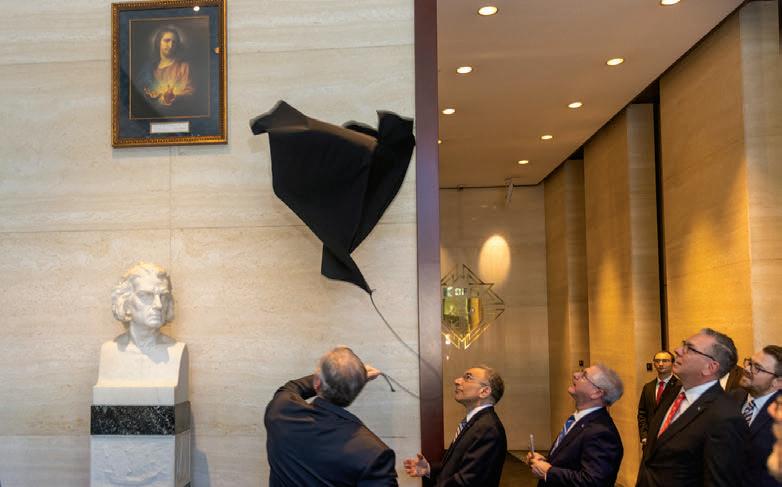
The next day, Supreme Officers and Supreme Council staff gathered to dedicate the Knights of Columbus headquarters to the Sacred Heart, while Knights at the state and local levels, like Macaraeg, did the same by dedicating their homes.
Supreme Knight Patrick E. Kelly also encouraged Knights to support the bishops’ campaign calling on parishes to offer 250 hours of Eucharistic adoration and perform 250 works of mercy for the anniversary.
“Seeing the Knights so involved — seeing husbands and fathers who are engaged in their faith — is so important because they’re the foundations of the faith life for
Photo
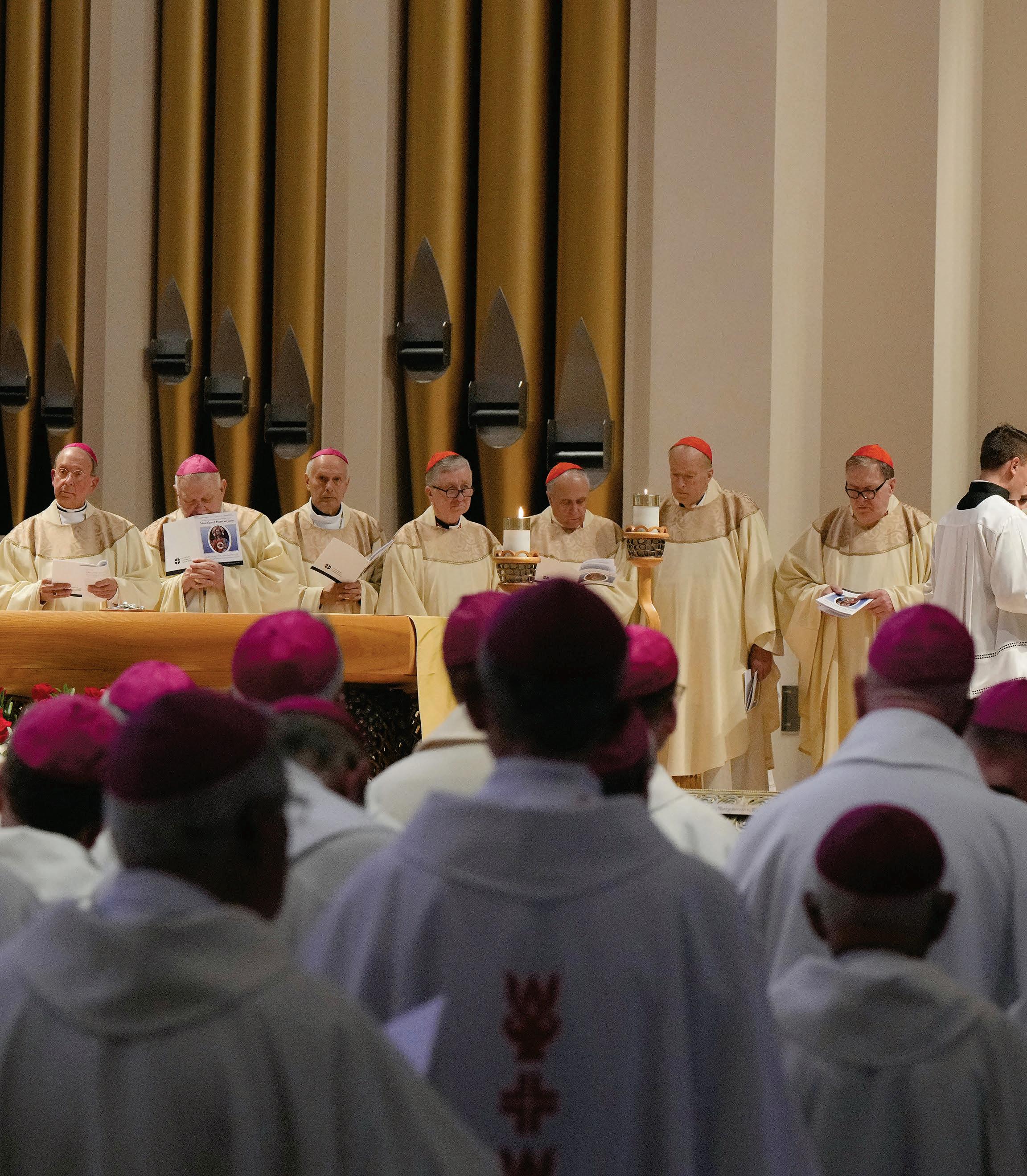
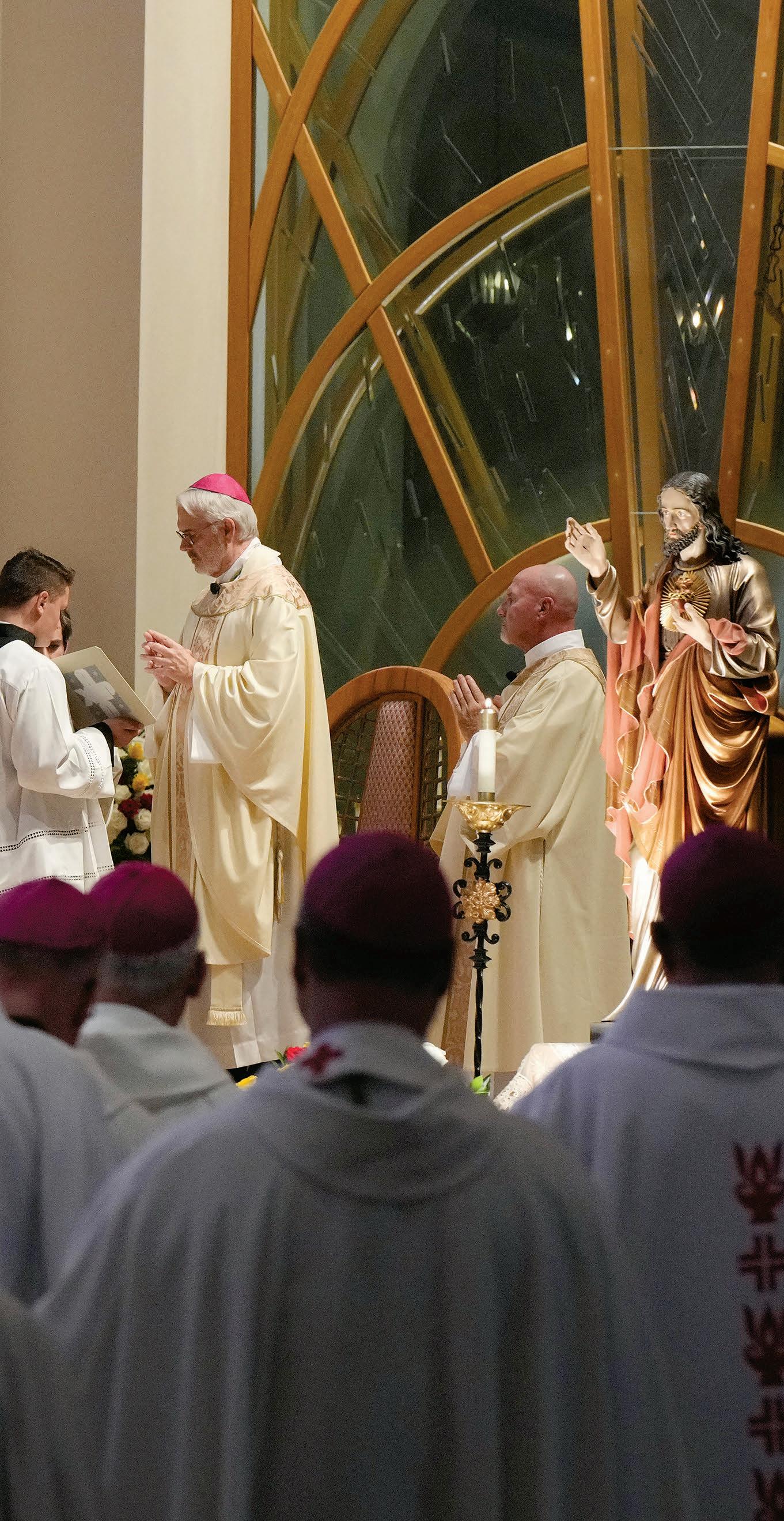
Archbishop Paul S. Coakley of Oklahoma City, president of the U.S. Conference of Catholic Bishops, leads bishops in consecrating the United States to the Sacred Heart of Jesus during Mass at the Basilica of the National Shrine of Mary, Queen of the Universe in Orlando, Fla., on June 11.
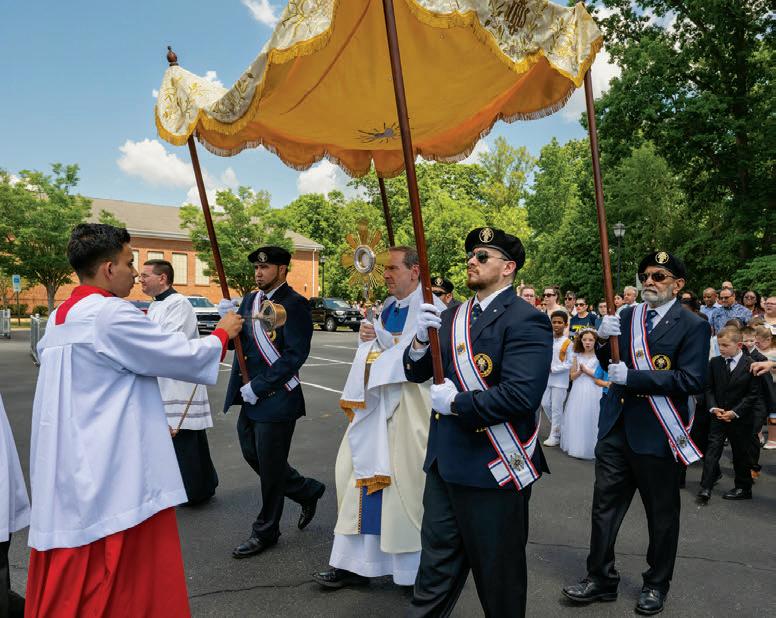
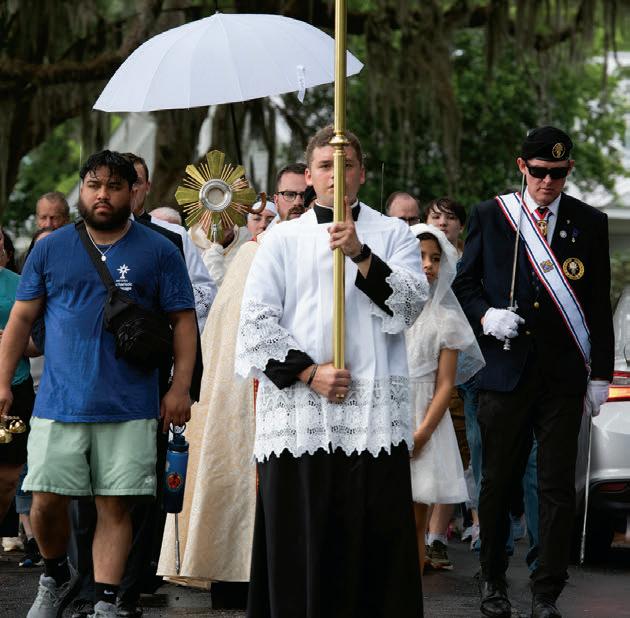
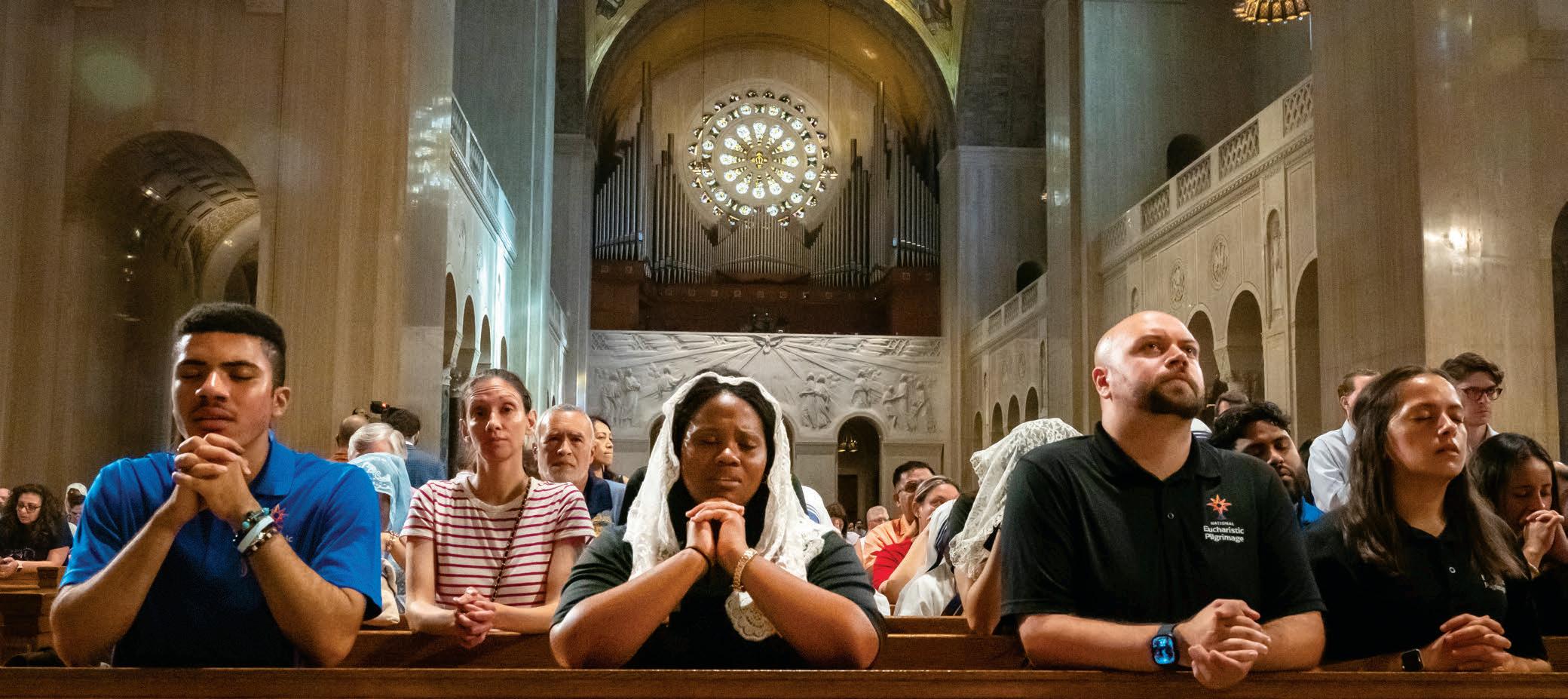
Clockwise from top left: Bishop Michael F. Burbidge of Arlington leads a Corpus Christi procession in Stafford, Va., on June 7. • Perpetual pilgrim Raymond Martinez II, a seminarian and member of Conception Seminary Council 13750 in Conception, Mo., carries a crucifix at the head of a Eucharistic procession in Savannah, Ga., on May 27. • Perpetual pilgrims (front row) pray with hundreds of Catholics during a Corpus Christi vigil Mass at the Basilica of the National Shrine of the Immaculate Conception in Washington, D.C., on June 6.
their family,” said Raymond Martinez II, a seminarian and Knight from the Diocese of San Angelo, Texas, who served as one of the nine “perpetual pilgrims” accompanying the Blessed Sacrament along the East Coast.
The Knights commemorated the country’s 250th anniversary by thanking God and renewing their commitment to prayer and acts of charity. Most of all, they sought to honor the anniversary by placing Christ at the center.
PILGRIMS OF THE REAL PRESENCE
The sound of sanctus bells filled the Basilica of the National Shrine of the Immaculate Conception in Washington, D.C., June 6, as then-Bishop-elect Gary R. Studniewski of Washington lifted the consecrated host. He gazed at the Eucharist together with the hundreds of pilgrims present for the vigil Mass celebrating the feast of the Most Holy Body and Blood of Christ (Corpus Christi).
Photos by Paul Haring
The Mass served as an important stop for the 2026 National Eucharistic Pilgrimage marking the country’s 250th anniversary. It involved Knights at every level, including Bishop-elect Studniewski, a Fourth Degree Knight.
Knights joined in its processions and helped welcome pilgrims at stops along the route, including hosting the pilgrimage at the Saint John Paul II National Shrine in Washington.
“Jesus wanted to leave us something,” said Bishop Studniewski, a past state chaplain of the District of Columbia, during his homily. “He wanted for us to know, to see, even to feel that he is still among us. Not just a symbol, not just half a locket with the promise that we’ll get the other half when we get to heaven, but his real Body and Blood right here.”
His words echoed through the largest Roman Catholic church in North America, a Romanesque-Byzantine-style basilica. The church, which houses more than 80 chapels and oratories honoring Our Lady under her title as patroness of the United States, enveloped the faithful with its glittering mosaics and marble columns.
The Knights have been part of the basilica’s history since before it was built: In 1920, 1,500 Knights from New York City were present for an outdoor Mass and blessing of the site of the future shrine. Now they stood as official ushers of the basilica, guiding visitors and distributing programs
before Mass began. Eleven members of the Fourth Degree honor guard led the processions at the beginning and conclusion of Mass. Vice Supreme Master Fritz Leach, wearing a light blue baldric, was one of them.
“The Body and Blood of our Lord and Savior is everything to us,” said Leach, who also noted that the day marked 82 years since D-Day, a turning point in World War II. “Together with Corpus Christi, together with the National Eucharistic Pilgrimage landing here in the nation’s capital on the 6th of June, there’s so much to celebrate, so much to be thankful for.”
As an event on the National Eucharistic Pilgrimage route, the Mass drew other Knights from across the country. Raymond Martinez II, a member of Conception Seminary College Council 13750 in Conception, Missouri, served at Mass. The 20-year-old seminarian called it a dream come true after visiting the basilica for the first time last year.
“As a Knight and as a Catholic, as a seminarian, it’s just so important to unify our nation under God,” Martinez said. “This pilgrimage is an opportunity to begin to promote that in a very real way.”
The pilgrimage commemorating the nation’s 250th anniversary wove through most of the original 13 colonies. Tens of thousands of people, including numerous Knights, joined the route named after St. Frances Xavier Cabrini, the first U.S.
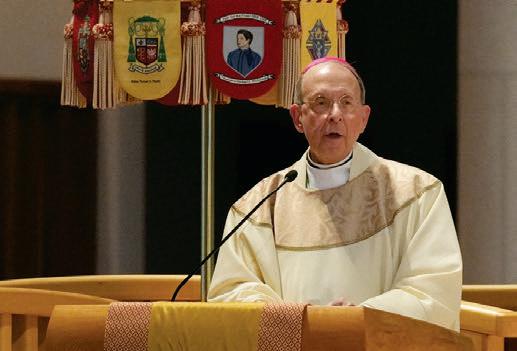
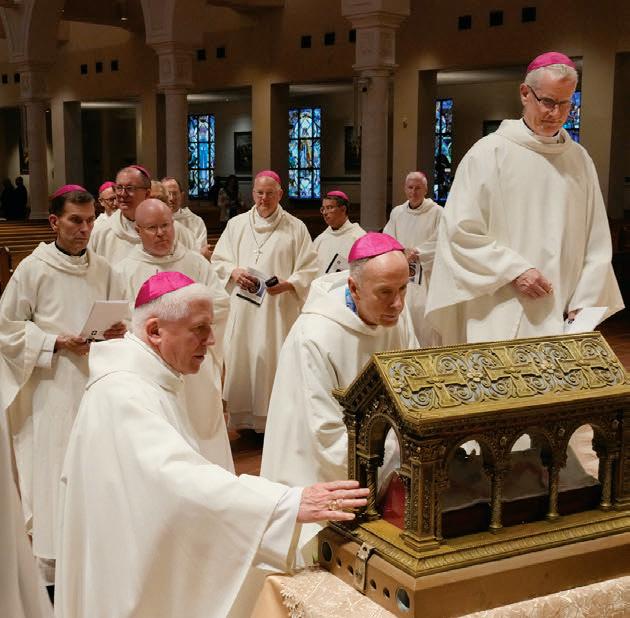
Above left: Supreme Chaplain Archbishop William Lori of Baltimore delivers the homily during Mass at the Basilica of the National Shrine of Mary, Queen of the Universe in Orlando, Fla., on June 11, before the U.S. bishops consecrated the United States to the Sacred Heart of Jesus. Behind him, the basilica’s umbraculum bears an image of Blessed Michael McGivney and the emblem of the Order. • Left: U.S. bishops venerate the major relics of St. Margaret Mary Alacoque following the Mass at the basilica. The relics of the French nun and mystic who promoted devotion to the Sacred Heart were brought from France by the Knights. • Above: Supreme Knight Patrick Kelly, accompanied by Supreme Officers and fraternal leaders, unveils an image of the Sacred Heart during the enthronement ceremony at Supreme Council headquarters in New Haven, Conn., on June 12.
citizen declared a saint. It began in St. Augustine, Florida, on May 24 and went as far north as Portland, Maine, before concluding July 4-5 in Philadelphia, where the Declaration of Independence was signed 250 years ago.
The pilgrimage’s theme, “One Nation Under God,” was a nod to the Knights, who 75 years ago launched a campaign to have “under God” added to the Pledge of Allegiance (see sidebar on page 15).
Bishop-elect Studniewski recognized the pilgrimage and the nation’s anniversary at the start of Mass. After Holy Communion, he closed with a special message to everyone present.
“The Christ we’ve received, we’re going to take it out into the world,” he said. “We’re going to show God’s love by the Christ that we share.”
CONSECRATED TO THE HEART OF GOD
Several days later, at another church dedicated to Our Lady — the Basilica of the National Shrine of Mary, Queen of the Universe in Orlando, Florida — the U.S. bishops consecrated the United States to the Sacred Heart of Jesus in anticipation of the country’s 250th anniversary.
During the June 11 consecration Mass, Supreme Chaplain Archbishop William E. Lori of Baltimore called the Sacred Heart a visible sign of God’s love. He spoke to his brother bishops, who dotted the sanctuary and front pews of the spacious church with their amaranth and scarlet zucchettos and white vestments.
“We consecrate our nation not because it is perfect but because it is beloved by God,” he said on the eve of the solemnity of the Most Sacred Heart of Jesus. “We entrust to the heart of Christ our achievements and our failures, our hopes and our anxieties, our present challenges and our future aspirations. We ask him to heal what is wounded, strengthen what is good, and guide us toward a future marked by justice, peace, freedom and respect for the dignity of every human person, especially the unborn, the immigrant, the poor and the vulnerable.”
Subtle signs of the Knights surrounded him. Behind the archbishop stood the basilica’s liturgical umbraculum (“little umbrella”), emblazoned with an image of Blessed Michael McGivney, the Order’s founder. To the side of the altar, a reliquary housed the relics of St. Margaret Mary Alacoque, the 17th-century French religious sister who experienced visions of Christ revealing his Sacred Heart. The relics had been entrusted to Arnaud Bouthéon, territorial deputy of France, who led a delegation of French Knights that escorted them to the United States.
With the consecration, the bishops sparked celebrations nationwide. Knights also marked the occasion locally by praying novenas to the Sacred Heart and leading Sacred Heart holy hours in their parishes. Churches across the country participated, from St. Patrick’s Cathedral in Manhattan to the Cathedral of Our Lady of the Angels in Los Angeles.
The events came in the wake of the 350th anniversary of St. Margaret Mary Alacoque’s visions and Pope Francis’ 2024
Cyril Macaraeg, past grand knight of Msgr. Ailbe M. McGrath Council 8437 in Seattle, and his family pray with Father José Alvarez, pastor of Holy Family Church and a brother Knight, during their Sacred Heart enthronement ceremony at their home June 15.
encyclical Dilexit Nos (“He Loved Us”) on the Sacred Heart.
The Knights joined in a special way from New Haven, Connecticut. On June 12, the day after the national consecration, Supreme Officers, fraternal leaders, Supreme Council staff members and their families participated in the enthronement of the Sacred Heart in the Supreme Council headquarters building.
After Supreme Knight Kelly unveiled a golden-framed image of the Sacred Heart, he delivered remarks at St. Mary’s Church, the birthplace of the Order.
“Our enthronement of an image of the Sacred Heart today at our headquarters building should also lead us, as an Order, back to the heart of Christ — despite our shortcomings, our limitations, and our weaknesses,” he said. “If you haven’t already, I’d encourage you to enthrone an image of the Sacred Heart in your home — and every day, let’s strive to make God’s love our own and to conform our hearts to his.”
A week later, Cyril Macaraeg did just that as he and his family — wife Michelle and their two young sons, 5-yearold Mateo and 3-year-old Miles — were joined by Father José Alvarez, pastor of Holy Family Church in Seattle, for the home enthronement ceremony at their home in Renton, Washington. During the ceremony, he formally placed an image of the Sacred Heart on their fireplace mantel.
“The enthronement has helped deepen our faith as a family,” Macaraeg said. “We hope it will encourage us to keep on growing.” B
KATIE YODER is a freelance writer based in the Washington, D.C., area.
by M. Scott Brauer
Photo
United ‘Under God’
A campaign launched by the Knights of Columbus 75 years ago led to a historic amendment to the Pledge of Allegiance
By Columbia staff
IN 1951, the Knights of Columbus began a campaign to add the words “under God” to the U.S. Pledge of Allegiance. Grounded in historical precedent and a growing grassroots movement, the effort reached Congress and culminated when President Dwight D. Eisenhower signed a bill amending the Pledge on Flag Day, June 14, 1954.
“It is a strange fact that the Pledge of Allegiance, which had its origin on Columbus Day in 1892, should have made no reference to the dependence of our nation upon Almighty God,” observed Supreme Knight Luke E. Hart the following year during the 73rd Supreme Convention in Philadelphia. “It remained for the Knights of Columbus to adopt and use and promote an amendment to that Pledge whereby the words ‘under God’ should be inserted after the words ‘one nation.’”
In April 1951, the Knights of Columbus Board of Directors voted to amend the recitation of the Pledge at all Fourth Degree assembly meetings in the United States by adding “under God” after “one nation.”
In the postwar era, the added emphasis also underscored the contrast between American ideals and those of the officially atheistic Soviet Union, where religion was suppressed and fundamental rights were seen as the gift of the state. As President John F. Kennedy, a brother Knight, later affirmed in his 1961 inaugural address, America’s forebears fought for “the belief that the rights of man come not from the generosity of the state but from the hand of God.”
The original Pledge was written in 1892 by Baptist minister Francis Bellamy and published nationwide with the approval of the National Education Association. Millions of schoolchildren first recited it on Columbus Day as part of the celebration marking the 400th anniversary of Columbus’ arrival in the Americas. It read:
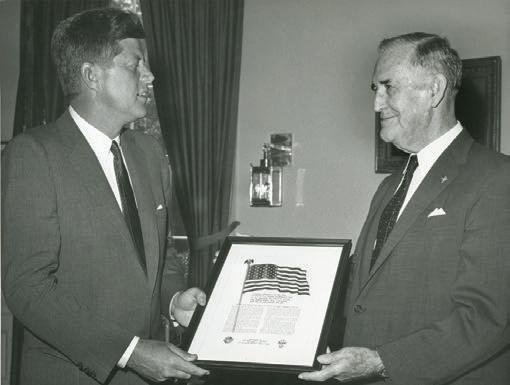
Then-Supreme Knight Luke E. Hart presents President John F. Kennedy, a fellow Knight of Columbus, with a framed copy of the Pledge of Allegiance during a meeting at the White House on Oct. 11, 1961.
I pledge allegiance to my flag and [to] the Republic for which it stands — one nation, indivisible, with liberty and justice for all.
The absence of any reference to God was notable in light of the nation’s political tradition and the Declaration of Independence’s foundational affirmation that all people “are endowed by their Creator with certain unalienable Rights.”
Nevertheless, millions of students recited the Pledge daily until 1923, when “my flag” was changed to “the flag of the United States of America” to avoid confusion among children of immigrants.
Then, in February 1948, Louis A. Bowman, an Illinois attorney and member of the Sons of the American Revolution, began including the words “under God” after “one nation” when leading his organization in reciting the Pledge. His inspiration was Abraham Lincoln’s Gettysburg Address, which expressed the hope that “this nation, under God, shall have a new birth of freedom.”
At the 1952 Supreme Convention in Los Angeles, the Supreme Council adopted a resolution urging Congress to make “under God” part of the nation’s official Pledge. Copies were sent to President Harry S. Truman, Vice President Alben W. Barkley and Speaker of the House Sam Rayburn.
The campaign soon gained broader support. Hart, who also served as president of the National Fraternal Congress of America, urged its more than 100 member societies to adopt a similar resolution.
The following year, the Supreme Council renewed its appeal, sending copies of its resolution to every member of the Senate and House of Representatives. Rep. Louis C. Rabaut of Michigan introduced one of several congressional measures supporting the amendment.
Congress approved the amendment in 1954, and Eisenhower signed it into law on Flag Day, June 14.
In a letter to the Knights of Columbus read at that year’s Supreme Convention in Louisville, Kentucky, Eisenhower wrote: “This year we are particularly thankful to you for your part in the movement to have the words ‘under God’ added to our Pledge of Allegiance. These words will remind Americans that despite our great physical strength we must remain humble. They will help us to keep constantly in our minds and hearts the spiritual and moral principles which alone give dignity to man, and upon which our way of life is founded.” B
A Time for Witness
This milestone anniversary year in the United States invites Catholics to renew their commitment to Christ, country and the common good
By Supreme Chaplain Archbishop William E. Lori
Editor’s Note: The following text is excerpted and adapted from In Charity & Truth: Toward a Renewed Political Culture, Archbishop Lori’s pastoral letter of Feb. 9, 2026. The full letter and related resources are available at archbalt.org/charity-and-truth
As our nation approaches the 250th anniversary of the signing of the Declaration of Independence, we find ourselves invited into a moment of profound reflection and renewal. Anniversaries are not merely occasions for nostalgia or celebration. Authentic remembrance always orients us toward renewal; it calls us to consider not only who we have been, and who we are becoming — but, by God’s grace, who we are called to be.
This anniversary can be a moment of grace if embraced also as a moment of responsibility. For while we rightly take pride in the achievements of our nation and the vibrancy of our Catholic faith, we cannot ignore the fractures, wounds and crises that mark both our national life and, sadly, even at times our ecclesial life. The task before us is not to romanticize the past but to offer a hopeful and credible witness today.
At the heart of this witness is a truth the Church never ceases to proclaim: The human person finds his or her full meaning and dignity only in Jesus Christ. As the Second Vatican Council teaches, “Christ … fully reveals man to man himself and makes his supreme calling clear” (Gaudium et Spes, 22). Our reflections on politics, culture, unity and civic responsibility must therefore begin — and end — with Christ, who reveals both the dignity of the human person and the path to authentic freedom.
BEING CATHOLIC IN AMERICA
Among the first words of Pope Leo XIV’s pontificate was a call for unity — unity in the Church, and unity among the peoples of the earth. Unity is not a strategy; it is grounded in Christ, who prayed that his disciples might be one. Unity is not uniformity. It is harmony in diversity. It is the recognition that we belong to one another, even when we see the world differently.
Unity requires responsibility. It calls us to be united first in faith and service, thereby strengthening the communion of the Church, while simultaneously working for the good of the communities and nation in which we live.
From the beginning, Catholics in this country have wrestled with how to live faithfully in a culture that does not always share or support the Gospel. The Catholic experience in the United States has always included both gratitude and tension — gratitude for the freedoms we enjoy, and tension when those freedoms are used in ways that wound human dignity. Yet our history also shows that these tensions can be navigated with integrity. Catholics do not need to abandon their faith to participate in public life, nor do they need to abandon public life to remain faithful. Instead, our faith offers the compass we need to walk this path with clarity and hope.
Being Catholic in America has never meant uncritical allegiance, nor has it required withdrawal. It means allowing the Gospel to form our conscience, guide our choices and inspire our commitment to the common good. When we do that, we contribute not only to the unity of the Church but also to the healing and strengthening of our nation, helping it grow into the best version of itself, even when the journey is difficult.
by Matthew Barrick
Photo
THE WITNESS OF BLESSED MICHAEL MCGIVNEY
At this pivotal moment in our nation’s life, we are blessed with a distinctly American witness in Blessed Michael McGivney, whose life embodies the virtues our time so desperately needs.
As a parish priest serving immigrant families, Father McGivney recognized the concrete wounds of his people — economic insecurity, social exclusion and cultural suspicion. His response was not ideological, but incarnational. He founded the Knights of Columbus, which fosters charity, unity, fraternity and a patriotic love that seeks the good of the nation without sacrificing fidelity to Christ.
Father McGivney understood that charity is not abstract sentiment, but love made visible through solidarity and sacrifice. He understood that fraternity flows from baptism, not from political alignment. He understood that authentic patriotism is not blind allegiance, but a commitment to help one’s country live up to its highest ideals.
In Father McGivney, we see a lived Christological anthropology: a man who knew that to follow Christ is to serve the whole person — body and soul — and to build communities where dignity is protected and hope is sustained. His witness reminds us that love of country and love of neighbor are not rivals, but companions, when rooted in the Gospel.
THE ROLE OF VIRTUE IN PUBLIC LIFE
A healthy republic does not rest solely on the strength of its institutions, its courts, or its electoral systems. It rests, above all, on the character of its people. The Founding Fathers themselves understood this well. John Adams famously wrote that the Constitution was made “only for a moral and religious people. It is wholly inadequate to the government of any other.” His insight resonates deeply with the Catholic tradition, which has long taught that political life — not unlike personal life — requires virtue. Law guides and establishes structure, but virtue is what animates.
In our times, many of the crises affecting our political culture — polarization, suspicion, hostility and the temptation to reduce opponents to caricatures — are ultimately crises of the human heart. They arise from habits of vice: pride, anger, rash judgment, fear and greed.
A renewed political culture will not emerge from policy changes alone. It will require the cultivation of virtue, which begins in individuals and takes root in families. From there, virtue radiates outward into society.
For this reason, the renewal of our political culture cannot begin in legislatures or courts; it must begin in the places where the human heart is first formed. The family is the primary school of virtue, where patience, honesty, responsibility, forgiveness and concern for others are learned through daily life. …
The classical and Christian traditions identify four cardinal virtues — prudence, justice, fortitude and temperance — which form the moral framework needed for healthy political engagement. These virtues do not belong only to one party or ideology. They are the shared moral grammar that enables people of goodwill to work together for the common good.
A BEACON OF HOPE
In the midst of political upheaval, the Church does not withdraw from public life, nor does she align herself with any partisan identity. She remains what she has always been: a sacrament of unity, a beacon of hope and a teacher of truth. Her mission is not to win elections, but to form saints. Not to secure power, but to proclaim the Gospel. Not to mirror the divisions of society, but to heal them.
Our nation needs Catholics who embody this mission — women and men whose lives witness to the dignity of every human person, whose love bridges divides, whose courage resists hatred and whose faith insists that despair does not have the final word. The civic landscape may look dark at times, but the Church has lived through darker times and emerged stronger, purified and more faithful. So, too, can our nation.
The saints and countless others throughout time did not wait until circumstances were perfect before offering their lives. They responded to God’s call amid turmoil, uncertainty and division. They remind us that hope is not optimism; it is fidelity. Hope is the quiet, steady conviction that God is at work even when we cannot see the path ahead.
As disciples of Christ and citizens of this great nation, we are called to that same hope. We are called to participate in the renewal of our political culture not out of fear, but out of love — love for God, love for neighbor and love for the country that has been entrusted to us. We are called to be saints for our time.
May God bless you and may God bless the United States of America. B
Photo by Marco Garcia
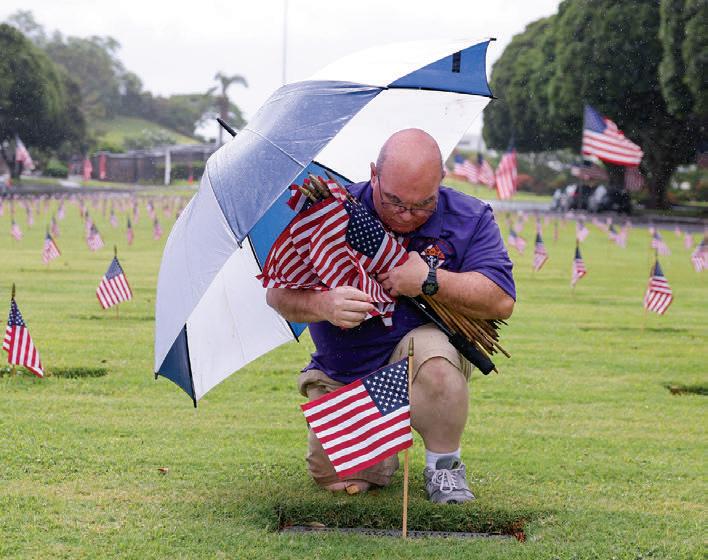
Kevin Clark, treasurer of Father Damien de Veuster Council 6906 in Aiea, Oahu, prays after placing a flag at the grave of a fallen service member in preparation for Memorial Day at the National Memorial Cemetery of the Pacific (Punchbowl) in Honolulu, Hawaii.
AMERICAN Saints and Blesseds
The Church in the United States has been shaped by missionaries and martyrs, educators and founders whose witness endures today
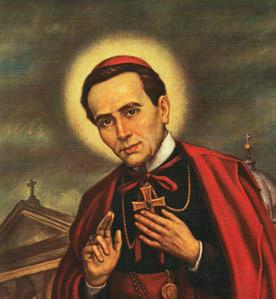
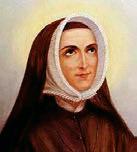
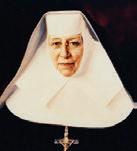
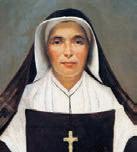
The history of Catholicism in the United States is reflected in the lives of saints and blesseds whose stories intersect the American experience in diverse ways. Adapted from the Blessed Michael McGivney Pilgrimage Center’s exhibition American Saints and Blesseds, on display in New Haven, Connecticut, through Sept. 6, 2026, the profiles below highlight 14 saints and nine blesseds connected to the United States and its territories, listed in order of canonization or beatification. Presented in conjunction with America’s 250th anniversary, the exhibit and these brief profiles offer a glimpse into inspiring lives of Christian virtue and holiness. Spanning more than four centuries, their stories reflect the growth of the Church across diverse regions, cultures and communities.
North American Martyrs
Sts. René Goupil, Isaac Jogues and Jean de Lalande
Three of the eight North American Martyrs, these French Jesuit missionaries evangelized among the Huron people in the 17th century. Captured during conflicts involving the Iroquois, they were killed in what is now New York state and are honored among the earliest martyrs of the Church in North America.
St. Frances Xavier Cabrini (1850-1917)
Born in Italy, Mother Cabrini founded the Missionary Sisters of the Sacred Heart and came to the United States in 1889 to serve immigrants. Her congregation established schools, orphanages and hospitals across the country. A naturalized U.S. citizen, she became the first U.S. citizen to be canonized a saint.
St. Elizabeth Ann Seton (1774-1821)
Raised in New York as an Episcopalian, Elizabeth Ann Seton converted to Catholicism after the death of her husband. She founded the Sisters of Charity and established schools
that helped lay the foundation for Catholic education in the United States. Canonized in 1975, she became the first U.S.born saint and remains one of the most influential figures in the history of the American Church.
St. John Neumann (1811-1860)
A native of Bohemia who came to America as a missionary priest, John Neumann joined the Redemptorists before becoming bishop of Philadelphia. He is remembered for establishing the nation’s first diocesan school system and expanding educational opportunities for Catholic children.
St. Rose Philippine Duchesne (1769-1852)
A member of the Society of the Sacred Heart, Rose Philippine Duchesne arrived from France in 1818 and established schools throughout the American frontier. Her missionary spirit and dedication to education helped spread the Catholic faith in a rapidly growing nation.
St. Katharine Drexel (1858-1955)
Born into a wealthy Philadelphia family, Katharine Drexel chose a life of religious service and founded the Sisters of the Blessed Sacrament. She dedicated her fortune to schools, missions and ministries serving Native Americans and African Americans, including Xavier University of Louisiana. Her life’s work transformed Catholic education and outreach across the nation.
St. Theodora Guérin (1798-1856)
A French missionary sister, Theodora Guérin established the Sisters of Providence of Saint Mary-of-the-Woods in Indiana. Despite hardship and poor health, she founded schools, orphanages and charitable institutions that strengthened Catholic life throughout the Midwest.
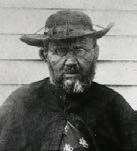
St. Damien de Veuster (1840-1889)
A Belgian missionary priest, Father Damien volunteered to serve people suffering from leprosy on Molokai, Hawaii. Remaining among them even after contracting the disease himself, he became a powerful witness to sacrificial service.
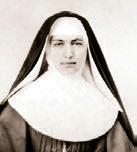
St. Marianne Cope (1838-1918)
Born in Germany and raised in upstate New York, Marianne Cope continued Father Damien’s work in Hawaii, caring for leprosy patients and helping establish homes for women and children. Her life exemplified compassion, perseverance and practical charity.
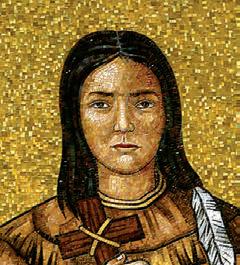
St. Kateri Tekakwitha (1656-1680)
The daughter of a Mohawk father and Algonquin mother, Kateri Tekakwitha embraced the Catholic faith despite strong opposition and personal hardship. Known as the “Lily of the Mohawks,” she became the first Indigenous woman of North America to be canonized a saint.
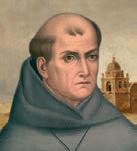
St. Junípero Serra (1713-1784)
A Spanish Franciscan missionary, Padre Junípero Serra founded nine missions in California and helped establish the Church throughout the region. Canonized by Pope Francis in Washington, D.C., in 2015, he became the first saint canonized on U.S. soil.
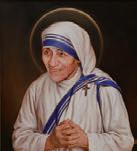
St. Teresa of Calcutta (1910-1997)
Founder of the Missionaries of Charity and recipient of the Nobel Peace Prize, Mother Teresa devoted her life to the poorest of the poor. Though not American, she received honorary U.S. citizenship in 1996, a distinction granted to only a handful of individuals.
Blessed Francis Xavier Seelos (1819-1867)
A Redemptorist missionary from Bavaria, Father Seelos served immigrant communities in Maryland, Pennsylvania, Kentucky and Louisiana. Renowned for his pastoral charity and dedication, he died while ministering to victims of a yellow fever epidemic in New Orleans.
Blessed Carlos Manuel Rodríguez (1918-1963) – Despite chronic illness, layman Carlos Manuel Rodríguez became a leading advocate for liturgical renewal in Puerto Rico through his writings and catechetical work. A member of the Knights of Columbus, he was the first Caribbean-born layperson to be beatified.
Blessed Miriam Teresa Demjanovich (1901-1927) – The daughter of Slovak immigrants, Miriam Teresa Demjanovich entered the Sisters of Charity of St. Elizabeth in New Jersey. She died at 26, before completing her religious formation, but her spiritual writings and holiness led to her beatification in 2014.
Blessed Stanley Rother (1935-1981)
An Oklahoma priest serving as a missionary in Guatemala, Father Rother remained with his people despite escalating violence during the country’s civil war. Murdered in his rectory in 1981, he was the first U.S.born priest to be beatified.
Blessed Solanus Casey (1870-1957)
A humble Capuchin friar known for spiritual counsel and compassion, Father Solanus Casey spent decades serving those who sought his prayers and guidance. He also helped found Detroit’s Capuchin Soup Kitchen, which continues its work today.
Blessed James Miller (1944-1982)
A De La Salle Christian Brother from Wisconsin, Brother James Miller devoted his life to Catholic education and missionary service in Central America. He was murdered while working in Guatemala and is honored as a martyr.
Blessed Michael McGivney (1852-1890)
A parish priest in Connecticut, Father Michael McGivney founded the Knights of Columbus in 1882 to strengthen Catholic family life and provide financial security for widows and children. Beatified in 2020, he remains a model of pastoral charity and evangelization.
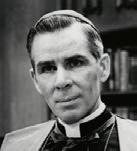
Archbishop Fulton J. Sheen (1895-1979)
Archbishop Sheen brought the faith to millions through radio and television. His TV program Life Is Worth Living made him a household name, and his evangelizing legacy continues to this day. A member of the Knights, he is scheduled to be beatified Sept. 24, 2026.
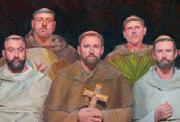
Georgia Martyrs (d. 1597)
These five Franciscan missionaries from Spain were killed while evangelizing the Guale people in what is now coastal Georgia. Recognized as martyrs by Pope Francis in 2025, they are scheduled to be beatified Oct. 31, 2026. B
JOURNEY OF HEALING
U.S. service members and veterans seek peace and spiritual transformation during the annual Warriors to Lourdes pilgrimage
By Cecilia Engbert
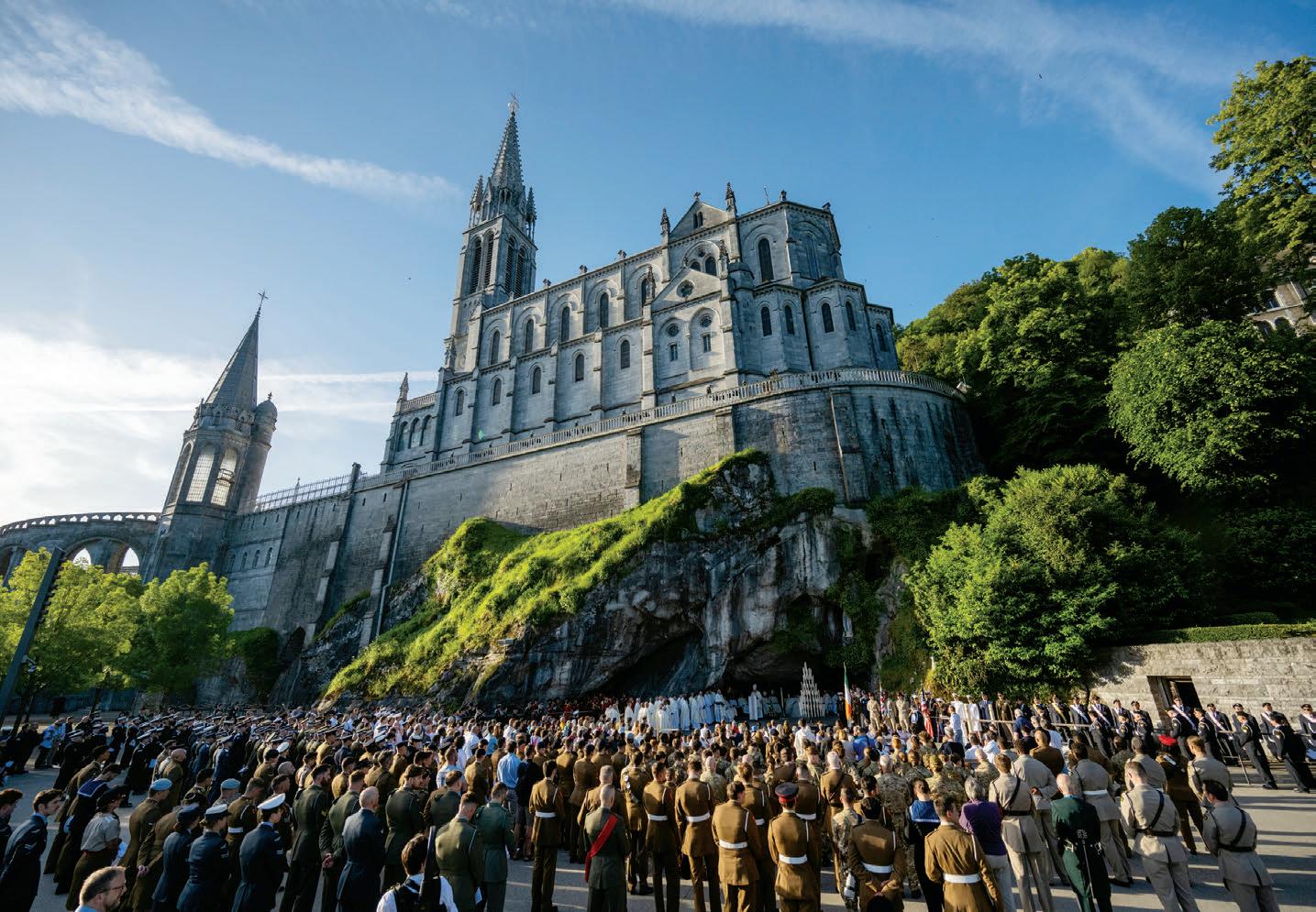
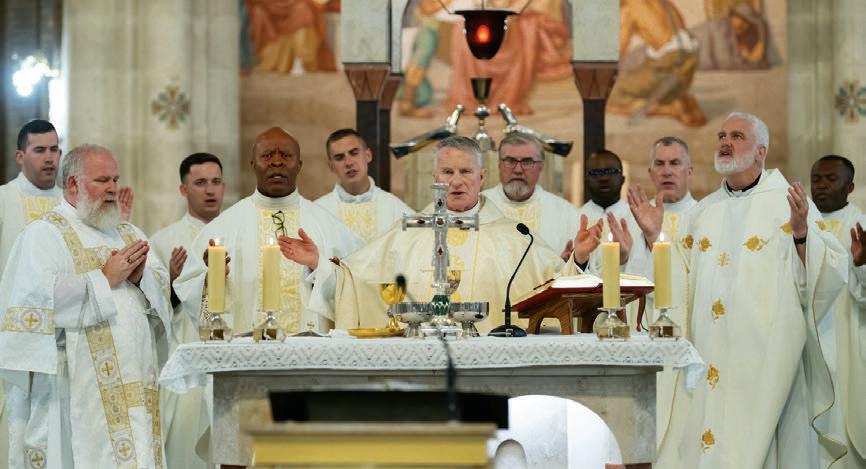
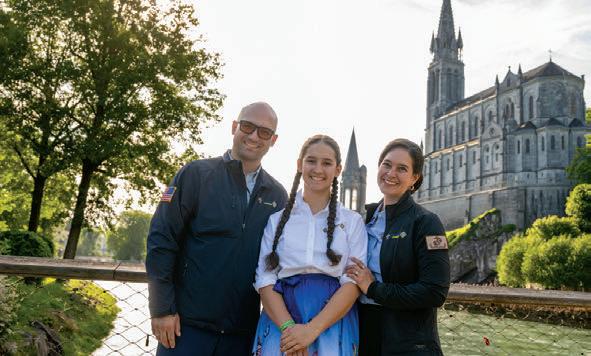
More than 180 wounded, ill or disabled United States service members and veterans participated in the annual Warriors to Lourdes pilgrimage to Lourdes, France, May 19-25, accompanied by family members, chaplains and a delegation of Knights of Columbus led by Supreme Knight Patrick Kelly.
The U.S. pilgrims joined more than 15,000 military personnel from approximately 40 countries who traveled to the Sanctuary of Our Lady of Lourdes for the 66th annual International Military Pilgrimage.
Supreme Knight Kelly, a retired U.S. Navy captain, was joined by Archbishop Timothy Broglio of the Archdiocese for the Military Services, USA — which co-sponsors Warriors to Lourdes with the Knights of Columbus — and Supreme Master Michael McCusker, a retired U.S. Army major.
“In a world that is marked by conflict and disunity and all sorts of dissensions, this pilgrimage offers hope,” said Supreme Knight Kelly, who was participating in Warriors to Lourdes for the first time. “Obviously, war is a reality in our world, but we are called to hope for peace. … Warriors to Lourdes gives us an opportunity to heal our hearts, to heal our bodies, to come to Lourdes, and really to have hope and to understand the resilience of the human person, which comes from God.”
This year’s pilgrimage theme — “Sentinels of Peace” — invited participants to reflect on their role in fostering peace in their communities and nations. Through prayer, counseling, fellowship and group activities, service members sought healing from the physical, psychological and moral wounds of war.
“This pilgrimage is a real attempt to try and offer healing for those wounds and also offer the opportunity to recognize
by Tamino Petelinšek
Photo
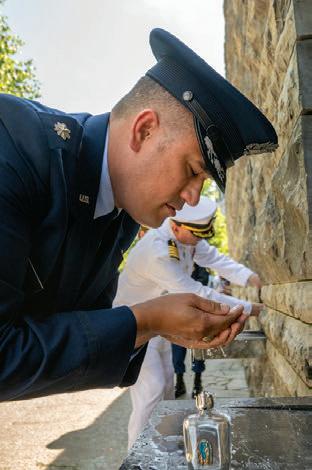
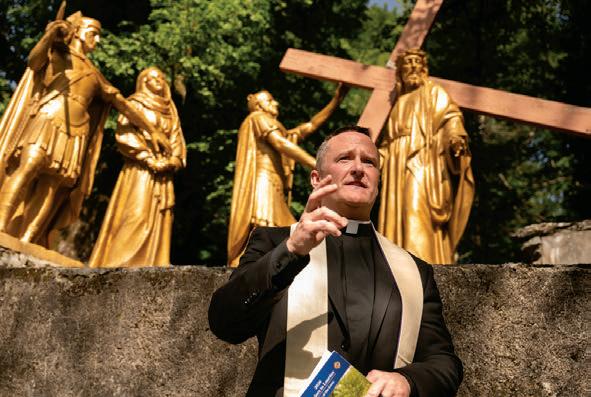
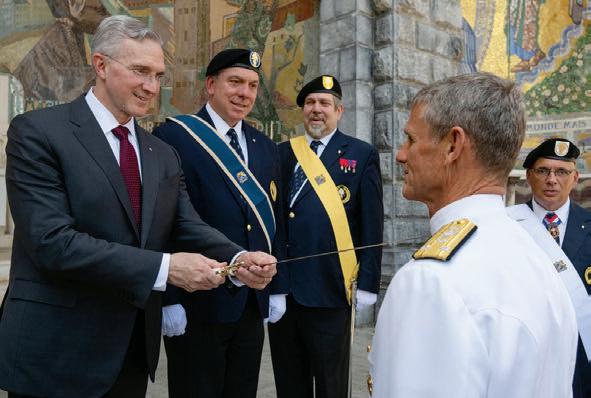
Clockwise, from top: Service members collect holy water from the spring discovered by St. Bernadette Soubirous. • Archbishop Timothy Broglio of the Archdiocese for the Military Services, USA, and concelebrating military chaplains pray during the Warriors to Lourdes opening Mass in the Basilica of Our Lady of the Rosary on May 21. • Supreme Knight Patrick Kelly knights retired Vice Adm. Andrew L. Lewis during an Exemplification of Patriotism outside the Basilica of Our Lady of the Rosary on May 24, formally welcoming him into the Fourth Degree. • Jesuit Father Brian Reedy, a U.S. Navy lieutenant commander and chaplain, leads the Stations of the Cross. • Opposite page: Warriors to Lourdes pilgrims and other military personnel gather for Mass at the Grotto beneath the Basilica of Our Lady of the Rosary on May 24.
that those wounds are present, and to try and begin a path of healing,” Archbishop Broglio said. “Because sometimes people may not even be aware of the suffering that is theirs.”
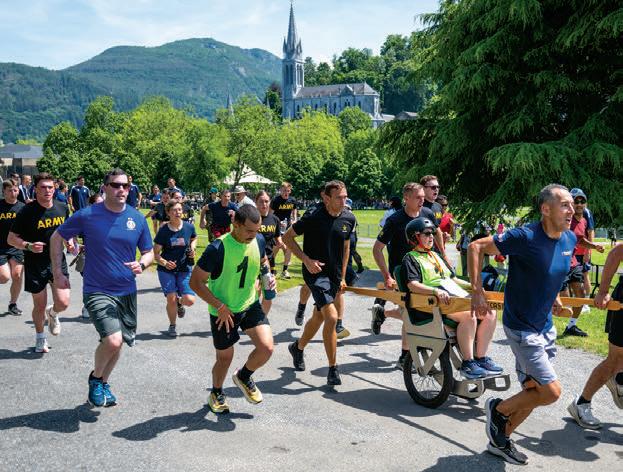
Throughout the week, pilgrims participated in daily Masses, the Stations of the Cross, Marian candlelight processions and immersion in the waters of Lourdes, where the Virgin Mary appeared to St. Bernadette Soubirous in 1858. Military ceremonies and athletic competitions also brought participants from many nations together in a spirit of fraternity.
“The remarkable thing about this pilgrimage is it brings military personnel from all over the world together, to share the camaraderie that we have known as soldiers in all branches of the military,” Supreme Master McCusker said.
“The important part of this experience in Lourdes,” he continued, “is that it has taught me that God needs us all to be patient in our healing, for reasons we may not always
understand. But if we remain calm, quiet and listen for his voice and his guidance, he will reveal to us in time the healing and the plans he has for our lives.”
Among those accompanying the pilgrims was Dr. Jo Sornborger, a clinical psychologist specializing in trauma and executive director of UCLA Health Operation Mend, which serves post-9/11 veterans and service members injured in the line of duty. Sornborger said the pilgrimage helps counter one of the most common effects of trauma.
“Isolation is one of the hallmarks of trauma,” she said. “Here they are surrounded by comrades and families with similar experiences. This pilgrimage offers a safe place for them to tell their story and try to gain that hope that’s been lost.”
The International Military Pilgrimage was established in 1946 to promote reconciliation and peace after World War II. Each year, Lourdes becomes a place of prayer,
healing and friendship for military personnel from around the world.
“Primarily, our military exists as a line of defense to ensure our liberties, to ensure our way of life,” Archbishop Broglio said. “The men and women that I’m privileged to serve fundamentally want peace, because they know what war costs. Some of them have paid with their own bodies and their own psyches for the wages of war, and so I think that makes them all the more sensitive to the importance of peace. And a part of this whole pilgrimage has been a gathering to pray for peace in the world.”
While in Lourdes, Supreme Knight Kelly presented a St. Michael Pilgrim Icon to Archbishop Broglio to mark the 25th anniversary of his episcopal ordination and in gratitude for his service to the Knights. The icon is one of 300 images blessed by Pope Francis that are being distributed to Knights of Columbus councils at military bases around the world.
“The Knights of Columbus has made supporting military veterans such an important part of our mission, precisely because we are an organization that is given to sacrificing for others,” said Supreme Knight Kelly. “That’s really the heart of the Knights — to sacrifice for those who need our help.” B
CECILIA ENGBERT is a content producer for the Knights of Columbus communications department.
‘A Counterpoint to Combat Deployment’
Retired U.S. Marine Corps Sgt. Buster Miscusi served in Afghanistan before being medically retired in 2018 following multiple unfavorable medical diagnoses. A member of Msgr. David M. Stotenbur Council 7237 in DeWitt, Michigan, Miscusi first participated in Warriors to Lourdes in 2017 and now serves as a moral injury awareness coordinator during the pilgrimage.
I first came to Lourdes in 2017 as a pilgrim. Later, I attended a moral injury presentation and told the coordinator that I wanted to help translate the theoretical language into something an infantry Marine who barely graduated high school could understand.
Moral injury is an event that violates a person’s deeply held beliefs. We reflect on that experience, and we can’t make sense out of it. We don’t know how to resolve it. At times, we can end up believing that either we, others or God are no longer good, and that shifts our ability to really feel goodness in the present moment.
It’s important to talk about moral injury because the stakes are high. Sometimes it looks like isolation or addiction. Ultimately, the highest risk is suicide.
What the Knights are doing here is really unique. The power of this pilgrimage is that it offers a complete counterpoint to a combat deployment. In a combat deployment, you’re going to a country with people you just met, to a place where you don’t speak the language, and your mission is violence. Here, we travel to a place we’ve never been with people we just met where we don’t speak the language, but the mission is peace, prayer, love and connection.
My hope for this year’s pilgrims is that they find hope in each other, in Our Lady and in the water; that they find the courage to become vulnerable with each other and ask for the help they need. B
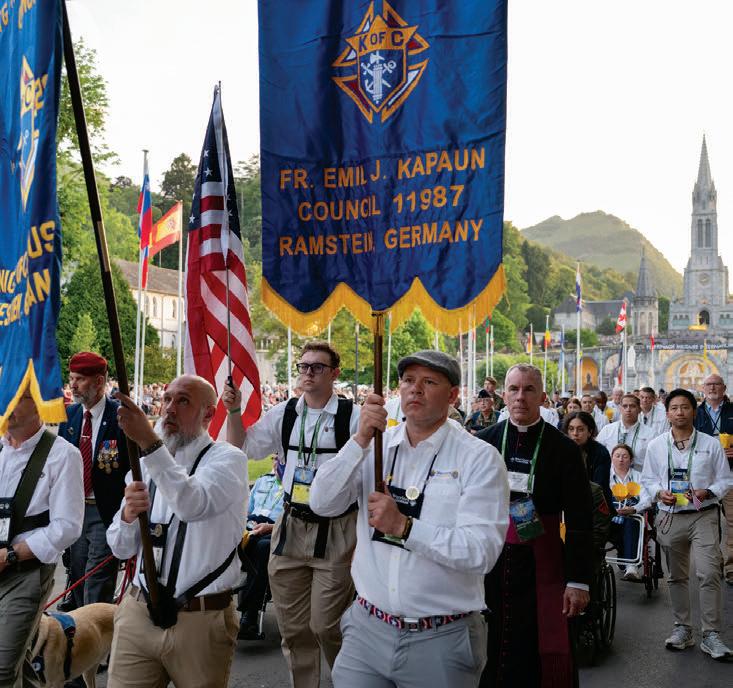
Members of Knights of Columbus military councils and assemblies in Germany carry banners during the Marian candlelight procession on May 24.
‘I
Felt This Peace Inside’
Retired U.S. Army Sgt. Eduardo Bonilla is a 9/11 survivor and served in the military for 22 years. A former deputy grand knight of Father John G. Siegfried Council 821 in King’s Park, N.Y., he is currently a member of Harry “Hap” J. Hansen Council 12281 in Hampstead, N.C.
For a few years, Msgr. Michael Butler encouraged me to apply, but I was reluctant. I felt that other wounded warriors or veterans were more appropriate than me. I don’t have any visual scars, but I do have internal scars, and I always felt this pilgrimage was for someone who had gone through a lot more than I had.
My wounds mainly come from 9/11. My office was destroyed, but I was able to get out; others perished or were injured, but I was OK. I’ve had PTSD ever since, and it carried over into anxiety and health issues. For years, I kept all those feelings and that pain inside.
But once I got here, the spiritual side just took over. The baths — my goodness — it’s hard to explain. My feet got in and it was a little cold, but then I felt this peace inside of me.
The Stations of the Cross were another powerful experience. For me, it wasn’t until we got to the 12th station that it really hit me. It was a very emotional moment.
What I would like to take home is the fact that I was able to express my feelings here. Someone told me, “If there’s anything special you’re carrying, get a rock and leave it here.” I grabbed a rock and threw it, and it hit another rock and came back. I picked it up and said, “Oh no, you’re staying here,” and threw it again.
Being able to share my story and hear the stories of others was humbling. I’m very grateful to the Knights of Columbus for having this program available because it’s so special and so rewarding. B
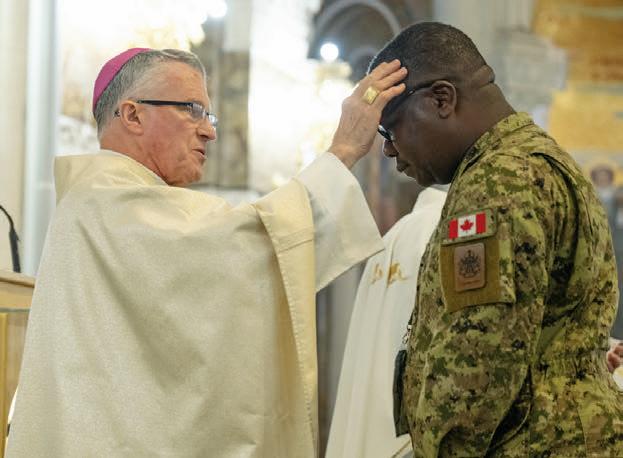
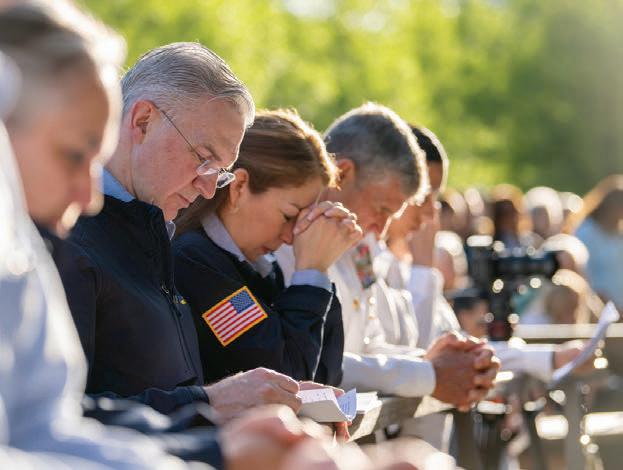
From top: Archbishop Broglio anoints a Canadian service member during the opening Mass. • U.S. Army service members compete during the Unified Sports Challenge of the 66th International Military Pilgrimage. • Supreme Knight Kelly and his wife, Vanessa, pray with other Warriors to Lourdes pilgrims during Mass at the Grotto.
A Magnificent HUMANITY
Pope Leo XIV’s first encyclical asks what we are building — and reminds us that our grandeur is a gift, not an achievement
By Leonard DeLorenzo
There is a question at the heart of Pope Leo XIV’s first encyclical that is so plain it might be mistaken for simple. Confronting the rise of artificial intelligence and related technologies, the Holy Father asks, “What are we building?” (90). He poses the question against two biblical images: the Tower of Babel, raised to “make a name” for its builders without reference to God, and the rebuilding of Jerusalem under Nehemiah, where a ruined city rose again not by one strong hand but through the shared labor of all — priests and artisans, families and young people, each assigned a portion of the wall (7-8). The choice, Pope Leo insists, “is not between a ‘yes’ or ‘no’ to technology, but rather between constructing Babel or rebuilding Jerusalem” (9).
Magnifica Humanitas takes its name from the Magnificat, the song Mary sings when she proclaims what God has done in her: “he has regarded the low estate of his handmaiden” (Lk 1:48). Here is the answer to the pope’s question hidden inside the title itself. The grandeur of the human person — the magnificent humanity the encyclical sets out to safeguard — is not something we construct, scale or seize, but something we receive, as Mary received it, and then magnify in praise.
This is why the Holy Father weighs artificial intelligence according to the Church’s social doctrine, whose measure is neither efficiency nor innovation but the integral flourishing of the whole person — “a theology of communion in history” (27). To read the encyclical is to keep his question open rather than settle it too quickly, for it bears, as he insists, on both our aims and our means.
THE STRANGE NECESSITY OF OUR LIMITS
One of the hardest sayings in the encyclical comes early, and it lands close to home: “Building for the common good means accepting the limits and weakness of humanity without considering them an error to be corrected” (12).
We feel the temptation he names every day. The body tires. The memory slips. The child will not be hurried, and the parent has begun to need us more than we are ready to be needed. And everywhere the technological imagination promises a way out: an upgrade for every weakness, a patch for every flaw.
Pope Leo names the deeper currents beneath that promise — transhumanism and posthumanism, which would climb out of the human condition or dream the person away entirely into the machine. He explains, “Everything that appears as a ‘limit’ — incapacity, illness, old age, suffering, vulnerability — tends to be seen primarily as a defect to be corrected, rather than as a reality through which our humanity matures and opens itself to relationship” (118).
Optimize the limit away, and you optimize away the better part of being a person — for it is precisely in our weakness that patience, mercy and love first find something to do.
The movement of God in history runs in exactly the opposite direction, for Christ takes our limitations and weakness as his own — “who, though he was in the form of God, did not regard equality with God something to be grasped” (Phil 2:6). The Christian tradition has always known we are made for self-transcendence — “not through an escape from reality or a contempt for [our] limitations, but through their fulfillment in love” (127).
Where an algorithm treats an error as a flaw to be deleted, a person can find in that same error the very door through which grace walks in. “A person’s future is not calculable,” Pope Leo writes; it hangs instead on a freedom lifted up by grace and on the relationships we cultivate (128).
The refusal of limits has a public face, too. Pope Leo observes that the technological order has grown not merely competitive but violent — in autonomous weapons, commercial domination and the privileging of the haves over the
Opposite page: A 16th-century painting depicts the Tower of Babel, humanity’s attempt to build a city reaching to heaven (Gn 11:1-9).
have-nots. The dream of the enhanced individual and the race for dominance are merely Babel by another name. And so the pope reminds developers that “every design choice reflects a vision of humanity” (111), and that technology must serve the common good.
Most of us are not technological developers, yet these temptations reach us in smaller ways: the question halfformed before the answer is summoned, the draft we no longer bother to write ourselves. Pope Leo turns from the towers to the ordinary person and the ordinary device, naming three things that deserve a vigilant eye: “the ease with which results are obtained, the impression of objectivity and the simulation of human communication” (100).
The ease that genuinely makes life simpler can also hollow out our creativity and judgment, training us to want the result without the labor that would have formed us.
But the third danger is the most quietly devastating, because simulation does just enough to dull our hunger for the real thing. “When words are simulated, they do not build genuine relationships, but only their appearance,” the pope writes, and the deepest risk is not that we mistake a machine for a person but that we “may gradually lose the very desire to form genuine human connections” (100).
This is the heart of the matter, for these tools are fundamentally different from human intelligence. “So-called artificial intelligences do not undergo experiences, do not possess a body, do not feel joy or pain, do not mature through relationships,” Pope Leo notes. “They may imitate language, behavior and analytical skills, or even simulate empathy and understanding, but they do not understand what they produce, for they lack the affective, relational and spiritual perspective through which human beings grow in wisdom” (99).
A simulated friend has no limits for us to bear with, and so it can never become a real friend.
Optimize the limit away, and you optimize away the better part of being a person — for it is precisely in our weakness that patience, mercy and love first find something to do.
CULTIVATING COMMUNION
Which brings us to the encyclical’s warmest imperative, given almost as a command: “Let us cultivate relationships!” (239).
Cultivation is patient work. It asks that we accept our own limits and resist the temptation to begrudge others theirs, wishing our spouse less forgetful or our neighbor less strange.
The concreteness of our humanity is found exactly here, in the peculiarities of our histories — none of it yet finished, all of it still on the way toward its completion in God. To cultivate a relationship is to receive another’s unfinishedness as patiently as we hope to have our own received.
The whole document rests on a conviction constant in Catholic teaching: that the human person is good — all of the person, the body included. Real places, real faces and real time cannot be swapped out for their images. Thus, Pope Leo asks us to cherish “places and times where physical presence remains crucial, such as shared meals, Christian community gatherings, time spent with the lonely and serving the poor,” for these are the signs of a people who still believe that every body is a dwelling place of God (239).
For Knights and their families, this is less an abstraction than a way of life already within reach. It begins in the home: the unhurried meal, the rosary prayed together, the discipline of being fully present to the people under your own roof — limits and all.
The second opportunity lies in the works of mercy done together — meeting the poor face to face and helping children encounter Christ in the hungry, the sick, the imprisoned and the lonely.
The third is in the parish in the fullness of its life: the Mass that gathers us bodily around one altar, the sacraments, the friendships forged across the pews. These are not smaller things than the great questions of artificial intelligence; they are where the answer is actually built, stone by stone, in the only city that finally matters.
What are we building? The encyclical refuses to let the question settle into either naive enthusiasm or unfounded fear, returning us instead to the choice between Babel and Jerusalem. Pope Leo gives that choice its deepest name in the mystery that “the Word became flesh,” the authentic alternative to every dream of transcending our humanity by our own contrivance: “the divine love that descends into the most fragile point of our history and renews it from within” (232). In Christ, God saved us not by escaping the limits of our nature but by taking them on.
The grandeur of humanity is received, not seized — the very thing Mary sang — and our part is to build accordingly: to accept our limits and bear with one another’s, choosing the real over its likeness, and so remaining, against every dehumanizing pressure, profoundly and gratefully human. B
LEONARD J. DELORENZO , a Knight since 2023, is professor of the practice in the McGrath Institute for Church Life and concurrent professor in the Department of Theology at the University of Notre Dame. His most recent book is The Rule of the Sacred Heart: Finding Rest in a Restless World (OSV).
Knights of Columbus State Deputies 2026-2027
The office of state deputy was established and defined at the 1893 Supreme Council meeting. As the chief executive officer of the Order in his jurisdiction, the state deputy provides leadership and inspiration to the Knights and their families, and promotes the mission and growth of the Order. State deputies are elected during the annual convention of each state council. Pictured here are the state and territorial deputies for the 2026-2027 fraternal year.
COLORADO MARC A. SOLOME
GEORGIA KEVIN J. YORK
KANSAS
KEVIN R. ROBERTS
MARYLAND JOHN F. WINFREY
Father Monte Hoyles, pastor of St. Mary’s Parish and a member of Sandusky (Ohio) Council 546, blesses a brother Knight and his daughters with a relic of Blessed Michael McGivney after a Mass marking the council’s 125th anniversary. During the Mass, Father Hoyles also blessed a statue of Father McGivney (foreground), commissioned by the council for the occasion.
HIS HEART IN OUR MIDST
Allegan (Mich.) Council 2515 hosted the Order’s pilgrim icon of the Sacred Heart of Jesus at Blessed Sacrament Catholic Church. More than 200 people prayed before the image during the week, including after Masses and during periods of Eucharistic adoration.
PARISH CLEANUP
Members of St. Ignatius Council 10738 in La Union, Luzon North, participated in a council-led service day at Our Lady of Lourdes Church. The Knights have organized the effort annually since 1992.
ANNIVERSARY CELEBRATIONS
Cargill Council 64 in Putnam, Conn., and its associated women’s group commissioned and funded a new exterior sign for St. Mary Church, as the previous one had blown away during a winter storm several years ago. The sign was unveiled as part of the council’s 133rd anniversary celebration, which also included a memorial service at the grave of charter Grand Knight Edward Mullan.
WELCOME BRUNCH
St. Basil’s Jubilee Council 18772 in Ottawa, Ontario, organized a brunch at St. Basil Parish to welcome Father Adolphus Chukwuka as the new pastor and council chaplain. This was the first event organized by the council at the parish since it was chartered a few weeks earlier.
MEMORIAL MASS
Marquette Assembly 1078 in Sioux Falls, S.D., organized a Mass at Sanford Hospital’s chapel honoring the assembly’s deceased members. Father Dan Smith, chaplain to the hospital and the South Dakota State Council, celebrated the Mass and used a chalice inscribed with the names of the deceased Knights.
WEATHERING THE STORM
St. John XXIII Assembly 4015 in Fort Myers, Fla., donated $1,000 to support St. John XXIII Catholic Church’s capital campaign for church repairs after a storm caused water damage. For the past year, Knights have helped set up for Mass in the parish life center while the church is being renovated.
Faith
JOURNEYING WITH THE SAINTS
Tabernacle (N.J.) Council 8733 organized a pilgrimage to the St. Carlo Acutis Shrine at Malvern Retreat House in Malvern, Pa., for parishioners of the Church of the Holy Eucharist. The pilgrimage included praying the rosary, Eucharistic adoration, confession and Mass celebrated by Father Michael McClane, pastor and council chaplain.
Past Faithful Navigator Steve Taylor of Father Michael J. Bader Assembly 2430 in Newport News, Va., presents a Mass kit to Cardinal Anthony Poola, archbishop of Hyderabad, India, on behalf of the assembly and Walter Pollard Council 5480. The gift was delivered during a visit to a Hyderabad orphanage supported by Council 5480.
TOP: Photo by Chloe Valladares
Family
A member of Cadiz (Visayas) Council 5205 gives food and drink to children during the council’s food distribution at Our Lady of the Miraculous Medal Chapel. Knights also sang in the choir at Mass following the distribution.
A MERRY GESTURE
Tomas Tenorio Council 10835 in Moriarty, N.M., donated more than $1,000 to the local Society of St. Vincent de Paul conference. The donation was used to provide $50 food vouchers to families in need.
SERVING UP SUPPORT
Bishop Timon Council 6405 in Jackson, Mo., donated $3,400 to Jackson Ministerial Alliance Food Pantry. The funds came from the council’s pancake breakfast, which has raised more than $50,000 in the past four decades.
KNIGHTLY FAREWELL
Thirteen Fourth Degree Knights from Bishop William M. Cosgrove Assembly 3151 in Freeburg, Ill., provided an honor guard for Father McGivney Catholic High School’s graduation Mass and commencement ceremony. The assembly has provided the service since the school opened in 2015.
ONGOING CARE
W.P. Morris Council 6645 in Cookeville, Tenn., donated more than $1,100 to Catholic Charities, Diocese of Nashville, and contributed more than 3,400 pounds of food from its 40 Cans for Lent drive to Catholic Charities and the Care Center’s food bank. Over the past nine years, the drive has collected more than 20,500 pounds of food.
BEYOND THE CLASSROOM
Msgr. Andrew K. Gwynn Council 1668 in Greenville, S.C., donated $1,200 to support Our Lady of the Rosary Catholic School’s senior class trip. Students visited various historical sites throughout the state and concluded the trip with Mass at the Cathedral of St. John the Baptist and a visit with Bishop Jacques Fabre-Jeune of Charleston.
AWARD NIGHT
Mother Seton Council 5427 in Washington Township, N.J., awarded three $1,000 scholarships from its James Picarella Memorial Trust Fund to graduating high school seniors. James, a member of the council and the son of Past Grand Knight John Picarella, died of cancer at age 27. The trust was established with funds raised by Council 5427 to support his treatment.
GLOBAL MEAL MISSION
Father Louis P. Gauthier Council 10170 in Burton, Mich., organized a food-packing event with Cross Catholic Outreach at Powers Catholic High School. About 70 people, including Knights from several councils in the area, helped pack 54,000 meals that will be sent to Guatemala.
BACKPACKS OF BLESSINGS
St. Peter Cathedral Council 15035 in Erie, Pa., organized its fourth annual backpack drive, collecting over $900 to purchase school supplies for more than 60 students in need at the Sarah Reed Children’s Center’s St. Ann campus. Several local assemblies and councils participated in the drive.
Members of Santa Maria Goretti Council 12836 in Edmonton, Alberta, spread soil and pull weeds from six garden plots in front of St. Anne Catholic Elementary School. The council donated three of the plots, which the school planted with flowers for the summer.
Father Fungai Welcome Chipiro, a priest of the Diocese of Mutare, Zimbabwe, and a member of North Pole (Alaska) Council 8308, joins Knights from other Alaska councils in repairing the pool at Regina Coeli Catholic Mission in the village of Madioma. Four Alaska councils raised nearly $9,000 for the project, and Knights traveled to Zimbabwe to help tile and paint the pool, among other improvements.
SWEET DELIVERIES
Six days a week, members of St. Francis of Assisi Assembly 3552 in Raleigh, N.C., collect donated doughnuts from a local shop and deliver them to nonprofits in the area, including Salvation Army of Wake County, Shepherd’s Table Soup Kitchen and The Women’s Center of Wake County, which provides housing for women experiencing homelessness.
PATRIOTIC HEROISM
Cullman (Ala.) Council 1484 hosted a talk by Gary Rose, a Vietnam War veteran awarded the Medal of Honor, at St. Bernard Preparatory School. Rose, a past grand knight of Good Shepherd Council 11672 in Huntsville, spoke to 130 students, faculty members and guests about his military service and the importance of courage.
BARGAINS THAT BLESS
St. Anne’s Bethlehem (Pa.) Council 15188 hosted a yard sale at St. Anne Parish’s community center, using items donated by parishioners and community members. The two-day event raised
more than $8,500, which the council distributed among several charities, including Cay Galgon Life House, which provides housing and services for pregnant women and mothers.
CANDLELIGHT TRIBUTE
St. Margaret of Scotland Council 17204 in San Angelo, Texas, held a candlelight ceremony to honor Knights who are veterans. Each veteran was recognized alongside family members and invited to light a candle.
COMFORT IN EVERY PAIR
St. Benedict Cathedral Council 7544 in Evansville, Ind., organized a clothing drive at St. Benedict Cathedral, collecting more than 700 pairs of underwear for Evansville Christian Life Center for distribution through its clothing bank.
HOSPITAL HELPERS
Pro Patria Council 751 in New York City raised more than $7,100 for Calvary Hospital. The council has supported the hospital for more than 40 years, with donations totaling over $62,000.
Community
Grand Knight Dino Quintero (center) and members of Bishop Ernest J. Primeau Council 10896 in Merrimack, N.H., stand on the field at Fenway Park during the 2025 Run to Home Base charity run and walk, which supports healthcare programs for veterans. The council has contributed more than $13,000 over the past three years.
THANKING HEROES
Escalante Council 1136 in Orem, Utah, organized its annual veterans and first responders appreciation event at St. Francis of Assisi Church. Knights served nearly 200 meals to veterans, first responders and their family members, and presented dog tags to guests in acknowledgment of their service. The event raised more than $1,400 for the council’s church mortgage fund and other programs.
Life
PRO-LIFE PRAYERS
Rev. James F. O’Reilly Assembly 2507 in Hoover, Ala., and Prince of Peace Council 11537 hosted the Knights of Columbus Silver Rose and organized a bilingual pro-life prayer service at Prince of Peace Church. About 100 parishioners, including Alabama State Deputy William Mores, attended.
Grand Knight Kent Siefkes (center) and Treasurer Bob Varro of Father Robert T. Lawson Council 11103 in Pinehurst, N.C., present more than $14,000 in baby-bottle campaign donations to Barbara Lamblin, executive director of Life Care Pregnancy Center. The center also received a $100 ASAP (Aid and Support After Pregnancy) grant from the Supreme Council. The donations helped purchase cribs for the center’s clients.
Members of Nuestra Señora de la Asunción Council 17966 in Cayey, Puerto Rico, and its ladies auxiliary carry their council banner during a pro-life demonstration in San Juan. About 500 people, including some 200 Knights from several councils, marched from El Escambrón Beach to the Puerto Rico Capitol, where Bishop Emeritus Daniel Fernández Torres of Arecibo led Eucharistic adoration. A Knights of Columbus Silver Rose was carried throughout the procession.
ROCK AND RAISE
Father Francis J. Fee Council 7750 in Lindstrom, Minn., organized a music tribute concert that raised $4,300 for Holy Family Catholic Adoption Agency.
CHAMPIONSHIP LUNCH
Knights from several San Diego councils cooked and distributed more than 850 bagged lunches for athletes, coaches and volunteers at the Regional Special Olympics Spring Games.
SUPPORT SINCE DAY ONE
Monticello (N.Y.) Council 550 donated $3,000 to 1st Way Life Center, a local pregnancy resource center, to help pay for diapers and formula. The center opened in 2010 with the support of local Knights.
BLOOD DRIVE CHAMPIONS
Corpus Christi Council 12960 in Lawrence, Kan., partnered with the Community Blood Center to organize a blood drive at Corpus Christi Catholic Church that collected more than 30 units of blood. The council
has organized two drives each year for more than a decade, collecting nearly 500 units of blood during that time.
LIFE IN FOCUS
Our Lady of La Salette Council 8376 in Marietta, Ga., raised more than $24,600 for a new ultrasound machine for Caring Solutions, a pregnancy resource center in Macon. The Supreme Council contributed more than $21,000 toward the machine through the Ultrasound Initiative.
ANNUAL SUPPORT
St. Francis Council 8110 in Belmond, Iowa, organized its annual fund drive for people with disabilities, raising $5,000 for Special Olympics Iowa and Access Inc., which provides services for people with disabilities, among other groups.
See more at
www.kofc.org/knightsinaction
Please submit your council activities to knightsinaction@kofc.org
OFFICIAL JULY 1, 2026:
To owners of Knights of Columbus insurance policies and persons responsible for payment of premiums on such policies: Notice is hereby given that in accordance with the provisions of Section 84 of the Laws of the Order, payment of insurance premiums due on a monthly basis to the Knights of Columbus by check made payable to Knights of Columbus and mailed to same at PO Box 1492, NEW HAVEN, CT 06506-1492, before the expiration of the grace period set forth in the policy. In Canada: Knights of Columbus, Place d’Armes Station, P.O. Box 220, Montreal, QC H2Y 3G7 ALL MANUSCRIPTS, PHOTOS, ARTWORK, EDITORIAL MATTER, AND ADVERTISING INQUIRIES SHOULD BE MAILED TO: COLUMBIA, PO BOX 1670, NEW HAVEN, CT 06507-9982. REJECTED MATERIAL WILL BE RETURNED IF ACCOMPANIED BY A SELF-ADDRESSED ENVELOPE AND RETURN POSTAGE. PURCHASED MATERIAL WILL NOT BE RETURNED. OPINIONS BY WRITERS ARE THEIR OWN AND DO NOT NECESSARILY REPRESENT THE VIEWS OF THE KNIGHTS OF COLUMBUS.
SUBSCRIPTION RATES IN THE U.S.: 1 YEAR, $6; 2 YEARS, $11; 3 YEARS, $15. FOR OTHER COUNTRIES ADD $2 PER YEAR. EXCEPT FOR CANADIAN SUBSCRIPTIONS, PAYMENT IN U.S. CURRENCY ONLY. SEND ORDERS AND CHECKS TO: ACCOUNTING DEPARTMENT, PO BOX 1670, NEW HAVEN, CT 06507-9982.
COLUMBIA (ISSN 0010-1869/USPS #123-740) IS PUBLISHED 10
Every day, Knights all over the world are given opportunities to make a difference — whether through community service, raising money or prayer. We celebrate each and every Knight for his strength, his compassion and his dedication to building a better world.
Fourth Degree Knights from Portland, Ore., provide an honor guard and hold a canopy over Archbishop Alexander Sample of Portland as he carries the monstrance through the city on the feast of Corpus Christi, June 7. The Order’s pilgrim icon of the Sacred Heart of Jesus immediately followed the Blessed Sacrament in the procession, which drew more than 5,000 people and concluded with Benediction outside St. Mary’s Cathedral of the Immaculate Conception.
Photo by Mack
‘I was ready to be formed in the school of love.’
As a young man growing up in Wisconsin, I found myself longing for eternal truth. But like so many others, I sought satisfaction in things that do not last. Eventually, I learned about religious communities online and began to discern what God was working on in my heart.
St. Augustine of Hippo was a companion who taught me that our task as Christians is to love rightly. When I first visited the Augustinians, I was struck by their joy, friendship and zeal. I wanted to share in that way of life, and they invited me to join them. With the Holy Spirit’s inspiration and a dose of humility, I was ready to be formed in the school of love.
Our charism is lived through interiority and friendship. Cultivating the interior life is a treasure, where we discover our restless heart and God’s grace guiding us in conversion. This gift is shared in community, where we grow in accountability, charity and joy. Together, we search for God, who alone can fulfill the deepest desires of the human heart.
Father
Jack Tierney Order of St. Augustine Province of Our Mother of Good Counsel Tulsa, Oklahoma