Knights of Columbus offers trusted insurance solutions that protect what matters most – so you can focus on building the future you’ve always envisioned for those you love.
Why Choose Knights of Columbus Life Insurance?
• Financial Security – Help protect your family’s income, mortgage and daily needs.
• Guaranteed Coverage – Permanent life insurance options that may never expire.
• Catholic Values – Ethical investments and a commitment to faith-driven service.
• Member Benefits – Exclusive fraternal benefits tailored for Knights and their families.
A 17th-century painting depicts the risen Christ walking with two downcast disciples on the road to Emmaus. Later, “he took bread, said the blessing, broke it, and gave it to them. With that their eyes were opened and they recognized him” (Lk 24:30-31).
14 8 18 22
Bringing Warmth to the Great North
Knights brave Manitoba’s ice roads to bring aid to a First Nations community in need.
By Campbell MacDiarmid
The Gift of Second Chances
A Maryland Knight’s mental health struggles led to a lifetime of service inspired by forgiveness and hope.
By Zoey Maraist
Faith, Hope and Mental Health
An interview with psychologist Dr. Greg Bottaro on a Catholic approach to mental health care.
Behind the Blocks
For more than 60 years, the K of C Saskatchewan Indoor Games have celebrated world-class and amateur athletes alike.
By Quinton Amundson
Departments
3 For the greater glory of God
The witness of Venerable Fulton Sheen reminds us that the most convincing testimony to the Gospel is a life transformed by Christ and lived for others.
By Supreme Knight Patrick E. Kelly
4 Learning the faith, living the faith
Amid a restless culture marked by isolation and distrust, Christ continues to draw people into the life of the Church.
By Supreme Chaplain Archbishop William E. Lori
6 Building the Domestic Church
A series of columns on family life, leadership and financial stewardship
17 Knights of Columbus News Rocket Strikes McGivney House in Erbil, Iraq
26 Knights in Action
Reports from councils and assemblies, representing Faith in Action
ON THE COVER
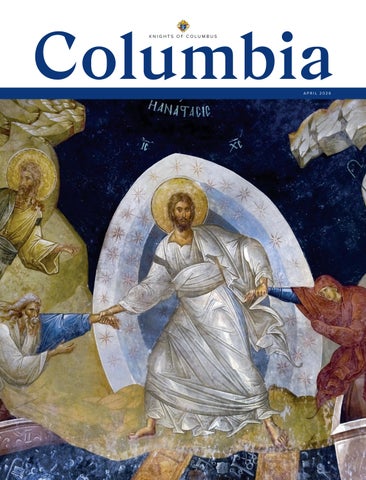
A detail of a 14th-century Byzantine fresco depicts Christ liberating Adam and Eve from Hades on Holy Saturday.
Membership in the Knights of Columbus is open to men 18 years of age or older who are practical (that is, practicing) Catholics in union with the Holy See. This means that an applicant or member accepts the teaching authority of the Catholic Church on matters of faith and morals, aspires to live in accord with the precepts of the Catholic Church, and is in good standing in the Catholic Church. kofc.org/join
THE GOSPEL OF LUKE recounts the journey of two disciples walking from Jerusalem to the village of Emmaus, as the newly risen Lord draws near and accompanies them along the way (Lk 24:13-35). They do not recognize him but instead express great discouragement and disillusionment following the events of the Passion. Reflecting on this encounter during a general audience last October, Pope Leo XIV observed, “The paradox is truly emblematic: this sad journey of defeat and return to ordinary life occurs on the same day as the victory of light.” He notes the disciples are filled with an “all-encompassing sadness,” even a “paralysis of the soul” — that is, until Christ interprets the Scriptures for them, sits with them at table, and ultimately makes himself known to them “in the breaking of the bread” (24:35).
In the same cycle of catechesis that concluded the Jubilee Year of Hope, Pope Leo meditated on the surprising humility with which Christ appears to his disciples following his resurrection. “The risen Lord does nothing spectacular to impose himself on the faith of his disciples,” the Holy Father said. “On the contrary, he approaches discreetly, like any other wayfarer, like a hungry man asking to share some bread.” Though the disciples’ vision is initially clouded by “the assumption that joy must be free from suffering,” Pope Leo points out that the Lord wishes to visit us with his mercy, hope and peace “precisely in the darkest places” — in our failures, doubts and brokenness. “The Risen One desires only to manifest his presence, to become our companion on the road and to kindle in us the certainty that his life is stronger than any death.”
This encounter on the road to Emmaus is not incidental, for it reveals the very logic of the Resurrection. In a world marked by global conflict and division, personal suffering and a growing crisis of isolation, it is tempting to see only the Cross, our vision clouded by discouragement, and to lose hope. Yet the risen Lord does not remain distant from these realities; he continues to draw near and accompany us, remaining with us, inviting us into communion with him. At every Mass, the same pattern unfolds: Christ opens the Scriptures and makes himself truly present in the Eucharist, re-presenting the Paschal Mystery. We are then sent forth to bear witness, just as the disciples at Emmaus “set out at once” upon recognizing the Lord (24:33).
Pope Leo affirms, “The Resurrection of Christ is not a simple event of human history, but the event that transformed it from within.” Christ’s victory over death does not eliminate the Cross but defeats it, opening even suffering to the light of Easter. In this light, the Paschal Mystery is not confined to the past but continues to shape our lives, restoring communion with God and with one another. Thus, as the Holy Father says, “The fraternity given by Christ, who died and rose again, frees us from the negative logic of selfishness, division and arrogance, and restores us to our original vocation” — a call that finds concrete expression in the mission of the Knights of Columbus. Like the disciples of Emmaus, we set out at once with certainty: that the Lord is truly risen, he walks with us still, and in him life has triumphed over death. B
Alton J. Pelowski, Editor
Featured Resource: The Life Everlasting
In The Life Everlasting (#110), professor and author Peter Kreeft outlines the Church’s teaching on the “four last things” — death, judgment, heaven and hell — in clear, engaging language. Part of the Luke E. Hart Series on major elements of the Catechism of the Catholic Church , this 22-page booklet explores the landscape of eternal life. To order this and other resources from the Knights of Columbus Catholic Information Service, visit kofc.org/shopcis .
Columbia
PUBLISHER
Knights of Columbus
SUPREME OFFICERS
Patrick E. Kelly
Supreme Knight
Most Rev. William E. Lori, S.T.D.
Supreme Chaplain
Arthur L. Peters
Deputy Supreme Knight
John A. Marrella
Supreme Secretary
Ronald F. Schwarz
Supreme Treasurer
Anthony R. Picarello Jr. Supreme Advocate
EDITORIAL
Alton J. Pelowski
Editor
Matthew Kirby
Editorial Director
Andrew J. Matt
Managing Editor
Elisha Valladares-Cormier
Senior Editor
Megan Stibley
Associate Editor
Paul Haring
Manager of Photography
Cecilia Engbert
Content Producer
Blessed Michael McGivney (1852-90) – Apostle to the Young, Protector of Christian Family Life and Founder of the Knights of Columbus, Intercede for Us.
HOW TO REACH US
COLUMBIA
1 Columbus Plaza
New Haven, CT 06510-3326 columbia@kofc.org kofc.org/columbia
Address changes
203-752-4210, option #3 addresschange@kofc.org
Columbia inquiries
203-752-4398
K of C Customer Service
1-800-380-9995
The Argument of Holiness
The witness of Venerable Fulton Sheen reminds us that the most convincing testimony to the Gospel is a life transformed by Christ and lived for others
By Supreme Knight Patrick E. Kelly
IN FEBRUARY, the Holy See informed the Diocese of Peoria, Illinois, that the beatification of Venerable Fulton J. Sheen could move forward. This followed the approval in 2019 of a miracle attributed to Sheen’s intercession.
Archbishop Sheen rose to national prominence in the 1930s through his radio program, The Catholic Hour, and in the 1950s through his television series, Life Is Worth Living. He was a man of tremendous talents: a television personality, author, teacher and one of the greatest evangelists of the 20th century. He was also a Fourth Degree Knight of Columbus and member of Council 178 in Rochester, New York.
Sheen spent his entire life bringing people to Christ. He was particularly eloquent when urging the laity — and especially the Knights of Columbus — to take bold action in defense of our faith. In an address to the 88th Supreme Convention in 1970, he called Knights to read the “signs of the times” amid the social upheaval of the day. He urged us to meet those challenges by embracing a “theology of the laity” — one grounded in action that keeps Christ at the center. Our focus, he continued, should not be on “Christ in the abstract, but in the concrete, [Christ] who is in this world needing and wanting our help.” We must see Christ in everyone, he said. “Christ is in agony in men until the end of the world.”
Archbishop Sheen knew that real change is not brought about through political programs or social revolutions. Rather, he said, “the only argument that is left to convince others is holiness. The world has heard every other argument and it is ready to reject them all except one: holiness.”
Whether speaking to millions on television or to a family in their living room, Archbishop Sheen was always calling people to an encounter with Christ. When I was a boy in the mid-1970s, he spent several days at my family’s parish, Holy Family, in Grand Blanc,
Michigan. Our pastor brought him to our home one evening for dinner, and we spent several hours captivated by the stories he told. I will never forget his gripping account of handing crucifixes to 500 lepers living in a colony in Uganda — a story he vividly recounts in his autobiography, Treasure in Clay Archbishop Sheen put enormous talents at the service of God — and he urged all of us, no matter our talents, to do the same. He wrote: “God has given different talents to different people. There is no basis for feeling inferior to another who has a different gift. Once it is realized that we shall be judged by the gift we have received, rather than by the gift we have not, one is completely delivered from a sense of false inferiority.”
The archbishop drew his energy and insights from a daily Holy Hour, which he called “the hour that makes my day.” It was his daily encounter with Christ. He wrote in his autobiography, “Neither theological knowledge nor social action is enough to keep us in love with Christ unless both are preceded by a personal encounter with Him.” A full hour was necessary, he added, because it is “not so brief as to prevent the soul from collecting itself and shaking off the multitudinous distractions of the world. Sitting before the Presence is like a body exposing itself to the sun to absorb its rays.”
For Archbishop Sheen, his daily Holy Hour was like “oxygen”: “Even when it seemed unprofitable and lacking in spiritual intimacy, I still had the sensation of being at least like a dog at the master’s door, ready in case he called me.”
Until his death in 1979, Sheen never stopped pursuing holiness — for himself and for others. His secret was a combination of using his God-given talents to their utmost while persevering in prayer every day. It worked for him, and it can work for us, too.
Vivat Jesus!
Archbishop Sheen spent his entire life bringing people to Christ. ... He put enormous talents at the service of God — and he urged all of us, no matter our talents, to do the same.
Photo by Michael Collopy
It’s for Real
Amid a restless culture marked by isolation and distrust, Christ continues to draw people into the life of the Church
By Supreme Chaplain Archbishop William E. Lori
THIS YEAR, unprecedented numbers will be received into the Church at Easter. In the Archdiocese of Baltimore, more than 2,000 are entering — and Baltimore is not alone. Dioceses throughout the United States and around the world are reporting similarly large numbers.
Many entering the Church are young adults. Some are involved in campus ministry programs; others are beginning their professional lives. Some are contemplating marriage, others priesthood or consecrated life. What is happening? What is drawing these young adults — and many others — to the faith?
Various explanations are offered. Some point to how isolated our culture has become. Many people interact more with their smartphones than with those around them, yet they still desire something better. They want to belong to something bigger than themselves and to Someone who loves them. They want to be seen, known, understood and loved — and don’t we all?
Others point to the emptiness of contemporary culture. News and entertainment are often superficial — tainted with ideology and devoid of beauty. Afraid of being politically incorrect, many resort to clichés and banalities. But the human spirit is made for more. It is made for truth and love — and one without the other is not enough.
Still others note that trust in institutions has declined dramatically, including government and news organizations. A recent poll found that only 22% of the U.S. population believes government most often acts in the public’s best interests. Social service agencies and religious institutions, including the Catholic Church, are distrusted. Yet some have taken a second look at the Church. They recognize her scandals and the faults of her members, but they also see that, despite everything, the Church has remained consistent in beliefs and practices. In a word, the Church is reliable in a world that often seems built on sand.
All these explanations have merit, but none fully explain the surge of new members entering the Church. Something more fundamental accounts for why the faith remains attractive and why the Church endures. The Church has seasons of growth and decline, yet just when it is widely thought to be vanishing, new life and growth appear.
The reason is that at the heart of the Church is something real — indeed, “really real.” It is the person of Christ, made present by the Holy Spirit: the Redeemer who promised to remain with his Church until the end of time, the Bridegroom who loves his Church in every season, whether times are peaceful or turbulent, marked by great holiness or by scandal and decline. The Lord does not countenance sin, but neither does he abandon his Church despite the infidelities of some leaders and members. The crucified and risen Savior continues to draw all people to himself.
During the Easter Vigil, thousands upon thousands are immersed in the mystery of the Lord’s death and resurrection. His victory begins to live in them through water and the Holy Spirit. In confirmation, the gifts of the Holy Spirit are poured into their hearts, and their relationship with Christ and the Church is sealed. They receive his body, blood, soul and divinity, experiencing communion with God and with the Church.
Knights of Columbus have a special role to play in all this. Through initiatives like Cor, our life of faith is strengthened. The living presence of Christ in the Church dawns on us anew, and our hearts open to him. We are thus equipped to bear witness to our faith and to walk with those seeking something better than the culture has to offer — something and Someone on whom they can stake their lives.
Our faith is for real. Of this Blessed Michael McGivney had not the shadow of a doubt. Let us rejoice and be glad, for the Lord is truly risen! B
Something more fundamental accounts for why the faith remains attractive and why the Church endures. ... It is the person of Christ, made present by the Holy Spirit.
by Paul Haring
Photo
Supreme Chaplain’s Challenge
A monthly reflection and practical challenge from Supreme Chaplain Archbishop William E. Lori
Then the two recounted what had taken place on the way and how he was made known to them in the breaking of the bread. (Gospel for April 19, Lk 24:35)
The disciples on the road to Emmaus did not recognize Jesus until the breaking of the bread. Jesus promised he would be with us always, and the Eucharist is his fulfillment of that promise. We encounter his presence most profoundly in the Eucharist, where he is truly present — body, blood, soul, and divinity — under the appearance of bread and wine. The disciples’ experience on the road to Emmaus was no ordinary meal, but an encounter with Christ, who invites us, too, to enter into communion with him through the Eucharist.
Challenge: This month, I challenge you to remain in prayer and adoration for several minutes after Mass to grow in awareness of Christ’s true presence in the Eucharist.
To view future challenges, visit kofc.org/monthlychallenge
Catholic Man of the Month
Venerable Adolphe Chatillon (1871-1929)
AS CANADA ENTERED World War I, a member of the Brothers of the Christian Schools waged another sort of battle. At the Lasallian house of formation in Montréal, novice director Brother Théophanius-Léo Chatillon fought against the half-heartedness of young men entering religious life. He told them, “A strong idea, filled with all the energy of your soul, should dominate you: ‘I wish to be the friend of Jesus, Mary’s child and the hero of souls.’”
Born to devout parents in Nicolet, Québec, Adolphe Chatillon was orphaned at age 9. A gifted student, he entered the Lasallian novitiate in Montréal in 1887, receiving the religious name Théophanius-Léo. He became director of Montréal’s St. Cunegonde School in 1907, adopting the motto, “Make happy in order to make better.”
Within three months, however, Brother Théophanius fell seriously ill and began a long convalescence, during which he taught liturgy and singing to novices. After partially recovering, he was appointed novice director in 1912.
Liturgical Calendar
April 2 Holy Thursday
April 3 Friday of the Passion of the Lord (Good Friday)
April 4 Holy Saturday
April 5 Easter Sunday of the Resurrection of the Lord
April 12 Sunday of Divine Mercy
April 17 St. Kateri Tekakwitha, Virgin (Canada)
April 25
April 29
April 30
His success as a formator led to his appointment as visitor general of North America in 1923, requiring extensive travel to Lasallian communities in Canada and the United States. Despite chronic illness, he carried out these journeys cheerfully.
In 1928, after chairing a commission at the Lasallian general chapter in Belgium, Brother Théophanius was diagnosed with intestinal cancer. Following an unsuccessful operation in Paris, he returned to Montréal, where visitors streamed to his bedside as if on pilgrimage.
Brother Théophanius-Léo died peacefully April 28, 1929. Pope Benedict XVI declared him venerable in 2011. B
Holy Father’s Monthly Prayer Intention
St. Mark, Evangelist
St. Catherine of Siena, Virgin and Doctor of the Church
St. Marie de l’Incarnation, Religious (Canada)
Let us pray for priests going through moments of crisis in their vocation, that they may find the accompaniment they need and that communities may support them with understanding and prayer.
‘Living the Truth in Love’
By Jose Pulido
As leaders, we are called to guide those in our sphere of influence to positive change — to conversion. But proposing change is never easy. Naturally, we want to maintain our relationships, and not push people away. At the same time, because we care about them, we want others to become the best versions of themselves — and, if they haven’t already, to come to know Jesus Christ and his Church. When sharing the faith, or even offering advice on everyday matters to those God has placed in our lives, it’s important for us to act intentionally and with great care.
St. Paul provides helpful guidance. The commitment to “living the truth in love” that he describes in his Letter to the Ephesians (4:15) can help us safeguard our relationships while sharing the faith or encouraging others in virtue.
To love others well means considering what we know about them and what they’re capable of hearing at the moment. Truth means recognizing the need for growth — in ourselves as much as, if not more than, in other people.
To lead effectively is to thread the needle between respecting where others are now and encouraging them to become the persons God is calling them to be. B
— Jose Pulido is a communication and leadership coach, the author of How to Evangelize Anyone (2025) and faith director of Camarillo (Calif.) Council 5272.
MISSION OF THE FAMILY
Domestic Missionaries
The Catholic home is mission territory, and spouses are called to bring the Gospel to their own families first
By Deacon Rolando Moreno
WHEN JESUS INSTRUCTED his disciples to spread the good news of his coming, he sent them out two by two (see Lk 10:1). Whether for reasons of accountability or companionship, ministry is best carried out alongside another person of faith. Have you ever considered married spouses as a pair of disciples whom Jesus sends forth on mission?
When we think of missionary work, we likely envision something happening far away. In marriage, however, the home is the mission field of spouses who participate in Christ’s call to go “and make disciples of all nations” (Mt 28:19).
Spouses are commissioned to be salt and light in their own home. Indeed, the home is the primary context in which married people are called to give witness to the Gospel. As St. John Paul II put it, “The family finds in the plan of God not only its identity, what it is, but also its mission, what it can and should do” (Familiaris Consortio, 17).
In order to fulfill this mission, it is critical that spouses intentionally live out their baptismal calling as disciples of Jesus. Knowing our identity as a beloved son or daughter of God is key to living the faith with our spouse and children.
God has called and placed spouses in a “micro vineyard” to cultivate the precious gift he has bestowed: children, the fruit of their conjugal love. The conscious decision to minister in your domestic church is not an insular one. Rather, the home is the most important mission field that exists, with repercussions for the whole of society.
What happens in one’s home affects the culture and contributes to the common good.
Such ministry in the domestic church is not for the fainthearted. Spouses are immersed in the messiness and daily grind of real life. It can often feel like you are perpetually in survival mode, just trying to keep up with life, work and family activities. When we feel exhausted, we would do well to remember the graces at our disposal. Jesus says, “Ask and it will be given to you” (Mt 7:7). Coming together daily in prayer is an act of humility that strengthens marriages and helps spouses minister to their children. So is attending Mass together as a family and regularly receiving the sacraments. Seeing Mom and Dad in the confession line or reverently receiving the Eucharist offers a powerful witness to children and helps root them in the life of the Church. B
DEACON ROLANDO MORENO is executive director of Mater Dei Radio in Portland, Ore., and a member of St. Joseph Council 1748 in Salem.
FAMILY FINANCE
How can charitable giving
be a part of my
legacy?
By Supreme Secretary John A. Marrella
When you consider creating an estate plan or will, your first thought might be how those plans will protect your assets or provide for your loved ones after you’re gone. But if charitable giving has been an important value in your life, you may also wish to create a legacy for the causes that matter to you.
A bequest is one of the most popular and flexible ways to support the Church or other charitable organizations.
With a bequest, you can leave a percentage of your estate or a designated amount of cash, stock or property to one or more
FOR YOUR MARRIAGE
beneficiaries. Because this gift takes effect only after your lifetime, you retain the freedom to update or amend it. Establishing a bequest today also does not jeopardize your ability to rely on retirement savings should your financial situation change.
You can also designate charitable organizations as beneficiaries of retirement accounts, IRAs, life insurance policies, donor-advised funds or commercial annuities, or allocate a portion of those assets to charitable causes.
Estate planning doesn’t have to be confusing or stressful. By focusing on the legacy you hope to leave — the goals, needs and dreams you have for your family and the causes you support — you can clarify your priorities and make the process easier.
In many cases, a charitable bequest can also reduce the tax burden on your
Approaching God Together
Married couples are called to share everything in common — including prayer
By David Dawson
MY WIFE AND I each came into our dating relationship with strong prayer habits, so we naturally assumed we would enjoy deep spiritual unity after the wedding. We figured the fruits of our prayers and the graces of the sacrament of matrimony would allow us to soar hand in hand above all the miscues and disappointments typical of the first few years of marriage. This was, of course, naive, and we soon fell prey to the usual tripwires and pitfalls.
Ironically, the deepest division and heartache came about because of our individual spiritual lives.
We were grateful that we did not have difficulty conceiving children, but this gratitude quickly gave way to a fear of being overwhelmed as God continued to bless us with more. As we became aware of the limits of our trust in him and in each other, we each responded in unhealthy ways. We yearned to be on the same page, but often felt as if we were in different books.
estate while helping ensure that the organizations you care about continue their mission. Whether supporting your local parish, Catholic education or other charitable works, a planned gift can extend the impact of your generosity for years to come.
For more resources, visit kofc.org/ familyfinance B
— John A. Marrella is the supreme secretary of the Knights of Columbus and a member of Trinity Council 5467 in Woodbridge, Conn.
*Knights of Columbus and its agents and affiliates are not authorized to provide estate planning, financial planning, legal or tax advice.
As I began to lean more deeply into prayer as a way through the difficulty, my wife became increasingly resentful, since it seemed my prayerful discernment always led to more challenges. In turn, I resented being hampered by her fears and limitations. I wanted God to “fix” her. But he made it clear that he had given her to me as a companion, and that we were meant to bear our shared cross and come to him together — not merely on our own.
We began praying together openly and spontaneously on a regular basis. As different as we are, and as vulnerable as it might make us feel, we learned that nothing brings greater intimacy. And now, when God responds, we rejoice in his faithfulness together B
DAVID DAWSON is an independent ministry consultant and speaker. He and his wife, Kate, live with their 10 children in Thibodaux, La., where he is a member of St. Genevieve of Paris Council 13397.
Bringing Warmth to THE GREAT NORTH
Knights brave Manitoba’s ice roads to bring aid to a First Nations community in need
By Campbell MacDiarmid
The sign at the turnoff from Manitoba Highway 10 offered a terse warning of the conditions ahead: “WINTER ROAD … Drive with extreme care!” A second sign listed the destination: “Pukatawagan — Status: CLOSED.”
While closed for commercial use, the ice road would be passable for the three vehicles idling on the shoulder north of The Pas, Manitoba, their exhaust rising into the freezing air. Inside, four Knights contemplated the journey ahead.
There would be no more asphalt. The group would travel nearly 160 kilometers (100 miles) along snow-covered dirt roads and over frozen lakes to reach one of the most isolated settlements in Canada. In the Mathias Colomb Cree Nation settlement of Pukatawagan — a community that has faced a series of severe challenges in recent years — the Knights would show residents how to assemble the 22 wooden bed frames they had crafted by hand and shipped by rail through a partnership with Sleep in Heavenly Peace.
They also brought seven wheelchairs for the local nursing station in partnership with the Canadian Wheelchair Foundation, along with 500 winter jackets through the Knights of Columbus Coats for Kids program. The latter delivery marked a record-breaking 300,000 coats donated across Canada and the United States during the 2025-26 winter season, exceeding last year’s record of 286,000.
“Anybody can do a donation locally,” said Manitoba State Deputy Mark Desjardins, principal organizer of the mission. “This project was about going past Winnipeg — going where people wouldn’t normally get that help.”
Photos by Colby Spence
The K of C caravan completes its ice road trek, arriving at Sacred Heart Church in Pukatawagan, Manitoba, a Mathias Colomb Cree Nation settlement.
Top Right: Sisters Tasha and Chnaelle show off their new winter jackets with help from Cleophas “Cleo” Castillo, a Knights of Columbus general agent based in Winnipeg.
A COMMUNITY IN ‘DIRE NEED’ Pukatawagan is situated more than 700 kilometers (435 miles) northwest of Winnipeg, the provincial capital, and part of the Mathias Colomb Cree Nation, an Indigenous community of approximately 4,000 members. Services are limited, with no year-round road connection to the outside world.
Instead, the Keewatin Railway runs trains twice a week to the town of The Pas — a one-way trip of 11 hours — though residents say the service is frequently disrupted. In summer, the only alternative is costly air travel, making winter — when seasonal ice roads open — the most reliable time for independent travel to the settlement.
This isolation has exacerbated serious challenges in recent years. Last summer, the entire community was under evacuation orders due to massive wildfires — the second such evacuation since 2022.
Residents were flown out on Canadian Air Force CC-130 airplanes and Chinook helicopters. Each was allowed to bring only a single carry-on bag of possessions. For months, they were scattered in hotels across Manitoba and as far away as Niagara Falls, Ontario, separated from their community and culture. Their prolonged displacement led to an increase in mental health challenges, according to Barbara Dumas, the local health director.
“We’re dealing with the physical, the mental, the spiritual
and the emotional part of the trauma,” she said.
Although the fires spared Pukatawagan, further distress awaited residents when they returned home to find their homes damaged by months of vacancy.
“They deteriorate because nobody’s using them,” explained Dumas, citing issues such as moisture damaging furniture — bedding in particular.
The deterioration, in turn, worsened an already severe overcrowding problem.
Meanwhile in Winnipeg, State Deputy Desjardins was looking for ways the Knights could take bold action in service of the province’s Indigenous communities, so he asked Archbishop Murray Chatlain of Winnipeg where their efforts could make the greatest impact. Shortly before Christmas, Archbishop Chatlain emailed priests across the province, inviting them to connect with the Knights of Columbus initiative.
Fransalian Father Dhana Raju Amarlapudi, pastor of Sacred Heart Church in Pukatawagan for nine years, responded the same day.
“I [described] the dire need and the overcrowded houses,” Father Amarlapudi said. “A lot of people sleep on the floor.”
The archbishop — who previously led two dioceses serving remote communities in the Northwest Territories and northern Saskatchewan — directed Desjardins to
by Mike Sudoma
Photo
Manitoba Knights and other volunteers sand wood for children’s beds during a Feb. 24 build with Sleep in Heavenly Peace in Winnipeg.
Photo by Colby Spence
Pukatawagan, where Father Amarlapudi said the community would be especially receptive to help from the Knights.
The idea of a mission to a remote northern community was enthusiastically received by the Supreme Council, Desjardins said, as it embodied the Order’s founding principles of charity and unity.
“Pope Francis told us to go out and serve,” Desjardins said, referring to the pontiff’s 2022 trip to Canada focused on healing and reconciliation. During his homily at Lac Ste. Anne in Alberta — a site of significance to First Nations peoples — the pope said, “We need to look more to the peripheries and listen to the cry of the least of our brothers and sisters.”
The mission began in Winnipeg, where the Knights joined forces with Sleep in Heavenly Peace to build 22 beds for the children of Pukatawagan.
A volunteer-run charity dedicated to ensuring no child sleeps on the floor, Sleep in Heavenly Peace’s Winnipeg chapter was founded in 2020 by local law enforcement officers. While the chapter has grown to provide about 800 beds annually — complete with mattress and bedding — partnering with the Knights of Columbus expanded the charity’s reach, according to Bonnie Emerson, superintendent of community engagement for the Winnipeg Police Service and a chapter co-founder.
“We don’t have the capacity to go into northern communities or organize volunteers across the province,” said Emerson, a member of Sandy Bay First Nation. “Partnerships
with organizations such as the Knights of Columbus make this possible, because they came to us and said they would organize the logistics.”
THE JOURNEY NORTH
After a day in which more than 20 Knights spent sanding, drilling and sealing wooden frames, the crated bedframes — alongside bedding, wheelchairs and winter coats — were sent by truck and rail to Pukatawagan. Four Knights followed by winter road — bringing additional coats and wheelchairs in their vehicles — to connect with residents during the distribution and demonstrate how to assemble the beds.
It was the morning of Feb. 27 when the foursome set off from The Pas, where they had stayed overnight after driving from Winnipeg the previous day.
The convoy traveled north through charred boreal forest, seeing few signs of civilization — save for the rusted hulk of an abandoned car. A lone coyote was a rare sign of life on the journey, Desjardins recalled.
The going was slow, as a recent storm followed by a warm spell had turned parts of the road into a morass of frozen mush. But when the route crossed lakes, the vehicles were able to speed across the smooth surface of the ice.
Driving over frozen bodies of water was anxiety-inducing for Cleophas “Cleo” Castillo, a Knights of Columbus general agent based in Winnipeg.
Manitoba State Deputy Mark Desjardins greets Fransalian Father Dhana Raju Amarlapudi, pastor, before the priest’s exemplification into the Knights of Columbus at Sacred Heart Church.
“I was clutching my rosary,” the Filipino native recalled with a chuckle. “A lot of prayers on the way!”
The final section of road was unplowed and particularly challenging, forcing the vehicles to drive in wheel ruts through a foot of snow, recalled District Deputy Vaughn Wadelius, a member of Charlebois Council 2704 in The Pas.
For Tony Kusiak, past grand knight of Fathers A & J Kulawy Council 9790 in Winnipeg, the tough going on the final stretch of road on his first trip to a northern reserve left a lasting impression.
“I think we all got stuck at least once on that part of the journey,” he recalled.
As the convoy arrived in Pukatawagan, the turquoise A-frame of Sacred Heart Church, with its galvanized steel bell tower, greeted them from atop a snow-covered hill like a beacon.
After being warmly welcomed by parishioners, the Knights were offered a quick buffet lunch featuring locally caught pickerel before heading back into the elements to distribute the donated goods. The weather was a relatively balmy
from top left: District Deputy Vaughn Wadelius helps a child into a new coat during the distribution in the parish hall of Sacred Heart Church. • Past Grand Knight Tony Kusiak of Fathers A & J Kulawy Council 9790 in Winnipeg places wooden slats into a new bed frame in a Pukatawagan home. • Connie Constant, a councillor for the Mathias Colomb Cree Nation, speaks with State Deputy Desjardins and other Knights at Nikawiy Health Nursing Station.
-15 degrees Celsius (5 F), allowing Desjardins — a hardy Winnipegger — to work bare-armed in his Knights of Columbus polo.
The Knights demonstrated how to assemble the beds in the home of Nancy Dumas, a mother of eight and grandmother of 20. Two of her grandsons, George and Adrian, ages 10 and 11, grinned broadly as they jumped into their new bunk beds.
“I’m grateful that they came, that they’re here setting up the beds for the boys,” Dumas said of the Knights’ visit. “It’ll give them comfort.”
‘A HUGE MILESTONE’
At the Nikawiy Health Nursing Station, director Barbara Dumas described how the delivery of wheelchairs had bypassed the usual bureaucratic ordeal of procuring medical equipment for the remote community.
“So much red tape,” said the 47-year veteran of community health, describing a monthslong process. “By the time it comes in, there’s no need for the wheelchair.”
After decades of service to her community, Dumas recognized in the Knights’ journey a reflection of her own values.
“My father always said, even if you [only] have a penny with you, give it away, because it’s going to come back to you in one form or another,” she said. “That’s how I live as a Catholic.”
As the Knights left the nursing station, she sent them on their way with a message of thanks.
“You’re welcome here anytime you want. Just don’t get lost if you’re traveling.”
Photos by Colby Spence
Clockwise,
“We don’t have the capacity to go into northern communities or organize volunteers across the province. Partnerships with organizations such as the Knights of Columbus make this possible.”
At the next stop in the whirlwind day, the four Knights distributed coats to children in the parish hall of Sacred Heart Church, where a noticeboard was adorned with a hand-painted sign reading “THANK YOU! KNIGHTS OF COLUMBUS.”
Father Amarlapudi had originally asked for 50 coats, but when Desjardins learned that 500 children lived in the community, the Knights sent 500. The increase meant the delivery included the 300,000th winter coat donated by the Knights of Columbus in Canada and the United States this season.
“Delivering 300,000 coats is a huge milestone, because that means there were 300,000 kids who didn’t have proper winter wear,” Desjardins said. “Providing coats to kids is providing a standard of living that everybody should have.”
A final highlight of the mission came when Desjardins formally brought Father Amarlapudi into the Knights of Columbus during an exemplification of charity, unity and fraternity.
Father Amarlapudi had followed the work of the Knights for years, but the visit to Pukatawagan confirmed his desire to join.
“I can be a spokesman,” he said. “They can use me as a channel to spread more about the Knights of Columbus.”
The Knights had been in Pukatawagan for only a matter of hours, but with their work complete and a worsening weather forecast, they hastened to return to The Pas before continuing to Winnipeg the following day.
During the long drive back, snow began to fall, and the Knights had time to reflect on the mission. Desjardins believed it had been a powerful example of what Knights of Columbus can accomplish. But he was just as impressed by the resilience of the Pukatawagan community.
“If we send more beds up there, I wouldn’t be concerned about putting them on the train,” he said. “It was about showing people what they can do [for themselves].”
For Castillo — who had overcome his hesitation about the winter roads — the needs he witnessed in Pukatawagan energized him to search for other underserved northern communities that could benefit from aid from the Knights of Columbus.
Turning to Desjardins, he recalled exclaiming: “Let’s do it again!” B
CAMPBELL
MACDIARMID is a journalist for the Canadian Broadcasting Corporation based in Ottawa, Ontario.
Children complete arts and crafts as they wait for winter jackets to be distributed by the Knights at Sacred Heart Church.
The Gift of SECOND CHANCES
A Maryland Knight’s mental health struggles led to a lifetime of service inspired by forgiveness and hope
By Zoey Maraist
“Insanity struck me like a lightning bolt,” Timothy McCarthy recalled of his first nervous breakdown at age 22. “I paced the floor, babbling impossibilities about my present and future. Before the day ended, I had gone stark raving mad.”
This crisis in 1964 marked the beginning of a 13-year odyssey of recurring psychosis, with multiple mental breakdowns and institutionalizations.
On one dark night in 1968, McCarthy found himself driving down a country road, his foot pressed to the gas pedal, hoping something might happen that would end his life. As the speedometer neared 100 miles per hour, telephone poles flew by like matchsticks and steam poured from the hood of his Mustang. Then, unexpectedly, the car gradually rolled to a stop — his radiator had run dry.
Though his life was spared, he continued to struggle with
Photo by Matthew Barrick
Opposite page: Timothy McCarthy is pictured outside Beaumont Hall, home of Patapsco Council 1960, where he has been an active member for nearly four decades.
Right: McCarthy offers counsel to a teen client in 1988.
mental health challenges for years before finding hope and healing. His suffering ultimately prepared him for a decades-long career helping people overcome addiction.
“Without my faith, I would certainly be dead; of that there can be no doubt,” McCarthy said. “With the help of my counselors, I learned that I could forgive God and forgive myself and that, ultimately, God could use what I’d been through for the good.”
Now 83, McCarthy, a longtime member of Patapsco Council 1960 in Catonsville, Maryland, remains committed to serving God and others — whether praying outside a nearby abortion facility or handing out hot dogs with his fellow Knights at the Catonsville Fourth of July parade.
“It’s in his DNA to serve,” said his wife, Mary Pat McCarthy. “And to help bring people to Christ.”
LOSING HIS MIND, FINDING HIS VOCATION
McCarthy’s desire to serve began in childhood. At age 9, after seeing the film The Bells of St. Mary’s , he decided he wanted to be a priest. Following high school, he entered St. Mary’s Seminary in Baltimore. But by the end of his time there, he could barely speak.
“I began to slip into what was diagnosed as an anxiety neurosis,” he explained. “I could say, ‘Hello’ and ‘Goodbye’ and ‘How are you?’ and then my mind would just go blank. It would just shut down. It was like Mother Nature was trying to tell me, ‘You just weren’t made for this.’”
Over the next 13 years, McCarthy experienced five nervous breakdowns and five institutionalizations. Among other factors contributing to his instability, he felt haunted by the success of his father and high-achieving uncles.
“I couldn’t match it — I just couldn’t, and I just cracked up,” he said.
Ultimately, a counselor helped McCarthy see the power of prayer and forgiveness. The right diagnosis and medication also led to long-term remission.
In the midst of his recovery, McCarthy’s heart turned to the drug-addicted patients who lived alongside him in the mental institutions.
“We shared stories, meals, dreams and tears. We were a brotherhood of sorts,” he recalled. “And I decided right then, when I was still not in very good shape myself, that if I could ever get well, I’d like to help them.”
So McCarthy became a parole agent committed to going above and beyond for the people he worked with.
“Tim was more compassionate with his clients than a lot of the other agents were,” said his friend and former supervisor Diana Harris, noting his willingness to look for housing for them or take them to programs.
Dr. Thomas Cargiulo, then director of the Maryland Bureau of Addiction Services, saw McCarthy’s dedication when he later worked as a detention center addiction counselor. Many inmates are used to being treated as subhuman, Cargiulo noted. But McCarthy didn’t view them that way.
“I was really able to see him at work, with his combination of passion and compassion,” Cargiulo said. “When you have somebody like Tim who treats an inmate like a human being, as an equal — that’s a powerful thing.”
McCarthy’s wife, Mary Pat, whom he married in 2013, also saw his impact firsthand. One morning they were out to breakfast when the waiter started talking to them.
As Mary Pat recalls, he said: “Mr. McCarthy, do you remember me? You helped me a few years ago when I was having trouble with drugs. I’m married; I have a son. I got this job because my life has really been turned around. I just want to say thank you.”
McCarthy’s dedication and faith also made an impression on his coworkers. Getting to know McCarthy inspired Cargiulo to take his own faith more seriously. He now frequently attends daily Mass, prays the rosary and volunteers.
When Harris was injured on the job, resulting in surgery and a yearlong leave from work, McCarthy stepped in.
“Tim gave me his leave so I could feed my family because I was a single mom. So needless to say, I have always and will always owe him a debt of gratitude,” Harris said. “He has always been a passionate, forgiving, loving, kind and just a very great human being.”
A TREATMENT-FIRST APPROACH
In addition to caring for individuals, McCarthy sought to influence the criminal justice system so that it would focus less on punishing offenders and more on ending the addiction that fueled their crimes. The idea was inspired by his own mental health journey.
“In the early going, I would stumble and be institutionalized, but sick leave protected me and I got back to work as an agent,” he explained. “However, when my clients exhibited the same out-of-control behaviors that I had, they went to prison. So it occurred to me: Why wouldn’t it be possible for them to go to hospitals and not to jails?”
The treatment-first approach is common today but was considered radical at the time, said Harris.
“The powers that be never really focused on the addiction,” she observed. “They basically focused on the criminal aspect of it because, you know, we were a public safety organization.”
Many thought that addicts in jail would go through detox and become cured, Cargiulo said.
“Now we realize it’s a chronic disease, so that’s not the case,” he explained. “And just locking somebody up can be a lot more traumatic, which then makes recovery that much more challenging.”
Though McCarthy believed his approach was effective, his supervisors wanted proof. So they launched the experimental Catonsville High-Risk Drug Project of 1985-86. In the end, the clients in the program had a 94% success rate after one year, McCarthy noted. He shared his findings with his peers in a document called “Unhooking the Hooked Generation,” published by the American Probation and Parole Association in 1987.
Since then, the treatment-first approach has become mainstream across the United States, due to McCarthy’s efforts and those of others like him.
“Just that piece, if he did nothing else in his life, has helped hundreds of thousands of people to be able to get into treatment and not wind up behind bars,” Cargiulo affirmed. “It’s a powerful thing.”
HEALING THE POOR IN SPIRIT
McCarthy sees his work as a continuation of the work of Blessed Michael McGivney, founder of the Knights of Columbus.
“Father McGivney worked with prisoners himself, with people who were dying. He ministered to the poor,” he said. “Essentially, I don’t so much minister to the poor as I minister to the poor in spirit — those who don’t have the spiritual resources.”
In 1988, the example of his own father inspired McCarthy to join the Knights of Columbus. For more than 30 years now, he has served as his council’s lecturer, providing succinct, inspiring talks for the men that weave together current events, the lives of the saints and spiritual messages. His brother Knights say he’s always at their events — collecting tickets, helping in the kitchen or serving up food. They speak
of his devotion to the rosary and his commitment to the prolife cause.
But the father of three and grandfather of five remains approachable, eager to talk about the faith or the score of the latest Baltimore Ravens game.
“He’s not a stuffy guy who, you know, kind of rams religious stuff down,” said Michael Doetzer, a member of Council 1960 for more than 50 years. “He’s very friendly and very personable.”
His brother Knights have also supported his longtime project — a prospective film about addiction and recovery. McCarthy was inspired to write the crime drama after learning about the heroic life of St. Maximilian Kolbe, the patron saint of drug addicts and a Holocaust victim who sacrificed his life for another prisoner.
“When I read his story, I couldn’t stop crying,” McCarthy recalled. “I said, ‘I am going to write a story to touch the heart of the nation, just as you have touched my heart this day.’”
The same tenacity, positivity and faith in God that carried McCarthy through his struggles and his career sustain his hope that the story may one day reach audiences. His dream is that the film’s message of forgiveness will help addicts find hope — and perhaps inspire someone to become the priest he wanted to be.
“What I’m about is second chances, because my whole life is a second chance,” McCarthy said. “Too often we give up on God, but God never gives up on us.” B
ZOEY MARAIST writes from northern Virginia.
Photo by Matthew Barrick
Timothy McCarthy speaks with Past Grand Knight Michael Duffy during an officers’ meeting in March. McCarthy has served as life director of Council 1960 since 2011.
Rocket Strikes McGivney House in Erbil, Iraq
MCGIVNEY HOUSE, a 140-unit apartment complex in Erbil, Iraq, was partially damaged during a rocket strike March 4. The strike came four days after the Feb. 28 U.S.-Israeli attack on Iran.
Built with help from the Knights of Columbus, the complex opened in February 2019 to house Christian families displaced from the Nineveh Plains after the Islamic State group overran the region in 2014.
Located in Ankawa, the Christianmajority district of Erbil, the apartment building was unoccupied at the time of the strike, having been evacuated several days earlier due to its proximity to Erbil International Airport. The chapel of McGivney House, which is affiliated with the Chaldean Archdiocese of Erbil, was significantly damaged.
“We thank God that no injuries were reported among the residents of the complex, nor among the security forces,” the archdiocese said in a March 4 statement. “Security personnel and civil defense teams promptly arrived at the scene to take the necessary measures and assess the extent of the damage. We pray that God protects everyone from harm and grants peace and safety throughout the country.”
McGivney House provides high quality, rent-free apartments to young families in need, for a period of five years each. Previously, it also had a floor dedicated to elderly residents, which included an on-site medical team. Missionaries who serve the archdiocese and local Catholic schools reside in a separate wing during their service in Erbil.
Prior to the Iraq War in 2003, close to 1.5 million Christians lived in Iraq, out of a population of 25 million. Years of instability and violence reduced that number dramatically. After Islamic State militants seized towns and persecuted Christian communities across northern Iraq in 2014, an estimated 300,000 Christians remained in the country. Projects such as McGivney House have helped to sustain Iraq’s diminishing Christian community, which currently
From top: The chapel of McGivney House in Erbil, Iraq, is shown after a March 4 rocket strike. The apartment building was constructed with help from the Knights of Columbus to house Christian families displaced by persecution and violence carried out by the Islamic State group. • Chaldean Catholic Archbishop Bashar Matti Warda of Erbil, Iraq, stands in front of McGivney House in 2018. • Then-Supreme Knight Carl Anderson and Archbishop Warda place an image of Father Michael McGivney in the McGivney House chapel in March 2019.
numbers some 150,000 people, or less than half of 1% of the population. Those who remain now face new fears amid the Iran war.
“We keep strong in faith and hope. We have to have that hope, and we are building from that hope,” said Archbishop Bashar Matti Warda of Erbil in an interview with OSV News. “But we cannot deny the fears, worries and concerns. You can feel it.”
Since the Supreme Council launched the Christian Refugee Relief Fund in 2014, it has contributed more than $20 million in support of Iraqi Christians.
“We will continue to stand with the families who called McGivney House their home,” said Supreme Knight Patrick Kelly in a March 4 statement. “We join with our Holy Father, Pope Leo XIV, who has encouraged us all to ‘pray for peace, work for peace.’” B
Faith, Hope and Mental Health
An interview with psychologist
Dr. Greg Bottaro on a Catholic approach to mental health care
The conversation around mental health and psychology has exploded worldwide in recent years, as professionals and average Joes alike grapple with the realities of mental illness.
More than 1 billion people currently live with mental health disorders worldwide, according to World Health Organization data released in 2025. In the United States, an estimated 61.5 million people — 23.4% of the population — experienced mental illness in 2024, according to the National Survey on Drug Use and Health. This includes more than 33% of young adults ages 18 to 25.
In recent years, the Catholic Church has underscored the need for mental health awareness and proper care. In 2021, Pope Francis revealed that speaking with a psychiatrist helped him deal with anxiety as a younger priest, and in 2023 the U.S. Conference of Catholic Bishops launched its National Catholic Mental Health Campaign to raise awareness and remove stigma attached to mental health. Despite growing openness to mental health care, a 2025 survey by The Harris Poll and the American Psychological Association indicates that stigma surrounding the term “mental illness” persists.
For more than a decade, integrating Catholic anthropology into psychology has been the driving force behind the work of Dr. Greg Bottaro and the CatholicPsych Institute, which he founded in 2012. A member of the Knights of Columbus since 2014, Dr. Bottaro spoke with Columbia about this clinical approach and how to combat some of the root causes of anxiety and depression.
The following interview has been edited for length and clarity. Learn more at catholicpsych.com.
Dr. Greg Bottaro, founder of the CatholicPsych Institute, is pictured in his home office in Greenwich, Conn.
COLUMBIA: How did your family background and early vocational discernment shape your understanding of the human person, and how did those experiences lead you to pursue psychology as your life’s work?
DR. GREG BOTTARO: I grew up in a nominally Catholic, churchgoing family but never understood how much my faith should or could matter to me. That really hit the wall when my parents got divorced during my senior year of high school. That was tremendously difficult.
Luckily, I went to Boston College, where I had Peter Kreeft as a professor of philosophy. He taught me how to think and introduced me to the philosophy and theology of
John Paul II. I read Love and Responsibility by Karol Wojtyła and discovered that the Catholic perspective on love and marriage was the antidote to all the ways in which the fractured experience of faith and family had left me.
As I experienced inner healing, I also realized nobody ever taught me this. Nobody ever helped me understand how important, practical and applicable the faith actually is. It’s not just about what you do on Sunday at church.
At that point, I knew I wanted to spend the rest of my life studying that and applying it for other people who might be struggling. This journey of vocational discernment led me to Franciscan University of Steubenville to finish my degree, and after graduation, I joined the Franciscan Friars of the Renewal in New York City. The friars were founded by a psychologist priest, Father Benedict Groeschel, who became a mentor.
In time, before making final vows, I realized I didn’t actually have a vocation to religious life but to marriage. I went to pursue my doctorate at the Institute for the Psychological Sciences in Washington, D.C., and met my wife the same year I graduated.
COLUMBIA: How does the Catholic vision of the human person differ from prevailing secular models of mental health?
DR. BOTTARO: The secular model is based on postmodern relativism, and it’s built on scientism — a kind of idol worship of science. This means the scientific method is treated as the be-all and end-all purveyor of truth, which ironically is not even what science would claim of itself. Science is simply a manner of observing and testing what is observed. What we have in our anthropology as Catholics is a belief in what’s revealed. It’s not just what’s observable. Science is important, but we can begin from a deeper place of revealed truth — the revelation of Jesus Christ. Everything Christ reveals about man, about being human, becomes our foundation and starting point.
So when it comes to things like abortion, we don’t need a research study to tell us that it’s wrong and harmful. When it comes to transgender issues, we didn’t need to wait for research to tell us that transition surgeries are not making
We’re made for order, not disorder, and every addiction is a disorder that points to a deeper positive desire. So we ask, “What’s the good that’s being sought in a distorted way?”
people happier. We already knew that, because we have the revealed truth about the human person. When we start there and then bring science into the conversation, it deepens our understanding of what it means to be human.
There are standards that we accept and take for granted when it comes to physical health. Here’s a mind-blowing fact: There are no standards of mental health in the secular world. If you have a 104 F temperature, you know you’re sick because you’re comparing that to 98.6 F. That’s a standard. That doesn’t exist in the entire world of mental health. There are subjective, relative definitions.
COLUMBIA: We live in an era of constant digital stimulation that fragments attention and often deepens isolation. What concrete disciplines can Catholics adopt to reclaim focus, interior silence and freedom in responsible use of technology?
DR. BOTTARO: I like to get really practical about this, because we’re talking about this as if it’s a new thing. In reality, we’re about 15 years late to the conversation about digital addiction.
Simply put, you have to have at least one technology-free day a week. Just cut it out entirely. No phone. Get it out of your pocket. Don’t even go on the computer. And if you can’t — because of some impossible restriction — then fix whatever in your life is making that not possible. If it’s your only means of supporting your family, maybe there’s some wiggle room, but maybe it’s just Sunday.
I believe kids should not have phones and tablets. They’re actually ruining kids’ brains. I think it won’t be long before studies show that this is actually a form of child abuse. At the end of the day, that is what the future will look back on us and see — but some people are choosing not to pay attention to it.
But we have to do it first for ourselves, because we can’t give what we don’t have. If we can’t create healthy separation from technology, we’re never going to raise our kids with that kind of freedom.
When we do carve out that time, we see anxiety and depression decrease, happiness and peace increase. There’s more attention in families, more connection, and healthier communication. Kids respect their parents and spouses respect each other more, not less.
COLUMBIA: From a psychological and spiritual perspective, how should we understand addiction — and the roots of addictive behavior?
DR. BOTTARO: We’re made for order, not disorder, and every addiction is a disorder that points to a deeper positive desire. So we ask, “What’s the good that’s being sought in a distorted way?” Whether it’s something pleasurable or the avoidance of pain or the resolution of some problem that can’t be solved through avoidance, there’s a certain sense of goodness and truth there.
When we look at digital addiction, I think there’s a really magnificent dimension of our human capacity for creativity,
where we want to go beyond the confines of this reality. Even gaming — it’s like we’re exploring or building new worlds, and transcending the limitations of this world. Well, we’re built for transcendence — because we’re built for divine union.
So once we understand why there’s a desire in the first place, we go back to that core and we ask how can we meet the need or feed the desire in a healthy way instead of a disordered way?
COLUMBIA: In your book The Mindful Catholic, you propose mindfulness as compatible with the Christian life. How would you distinguish a Catholic understanding of mindfulness from New Age spirituality?
DR. BOTTARO: When we talk about mindfulness, we’re talking essentially about paying attention to the present moment. What it means is taking your mind and what you’re focusing on and turning it toward what’s real right now. If you’re constantly letting your mind go to a place that’s not this moment, what we can measure with brain scans is that this increases your anxiety. It increases cortisol, heart rate, muscle tension. When we use our five senses to focus the mind back onto what’s here right now, all those anxiety signals decrease.
Peace expands our thought. You might be more creative, more connective, more able to make connections instead of worrying and only thinking about the future.
Now, it turns out that’s what the Buddhists have studied. The difference, which is critical, is their explanation of why it works. Essentially, the Buddhist unity of all being says that even the idea about the future is an illusion. That’s not what we believe. We believe that being in the present moment helps us be healthier and happier because we have a God who revealed himself to us in Jesus Christ, who told us, “Do not be anxious about the things of your life.” He told us that God will take care of us in each moment. He told us to look at the flowers, look at the birds. They’re not worried about their work, for the Father is clothing them and taking care of them.
Pope Leo has said that one of his favorite books is The Practice of the Presence of God. It’s all about finding God in the present moment. God, who is the eternal now, is there waiting for us if we focus on him in the present moment.
COLUMBIA: Marriage and family life today face enormous cultural pressures, and many couples struggle silently with stress, resentment or emotional disconnection. What habits can married couples cultivate to safeguard their relationship with one another and with God?
DR. BOTTARO: Men and women are so different from each other, yet God calls us to be united, and it can sometimes seem like a cruel joke. But if we listen a little more carefully and deeply, this is a path to sainthood. This is what St. John Paul II and the Second Vatican Council really made clear: the universal call to holiness. Most of us are called to holiness through marriage — and the challenges and the crosses are actually the path.
When I lived in religious life, I got to see this cadence for celibacy that was beautiful — the orarium, the daily schedule of common prayer. How do you spend your time every day in prayer? In as many ways as possible, I try to structure that time in our family life and with my wife. I can’t say we do a Holy Hour every day together, but we try to carve out a good amount of time to actually just be together every day, my wife and I. No technology, not in front of the TV, but just having a cup of tea, sitting and talking, being together.
Communication and emotional intimacy — or just quality time together — has to be a goal we are fighting for. The days we don’t want to see or be around each other — now that means there’s something to work through. It’s the working through that’s actually going to help us become saints.
So plant the stake, make the time and make it structured. If it’s an hour a week to start with, carve it out and put it on the schedule. Even if it’s 20 minutes a day, carve it out and put it on the schedule.
COLUMBIA: What are some foundational practices parents can adopt to foster resilience, emotional maturity and a stable sense of identity in their children?
DR. BOTTARO: The most basic, generalizable principle I can offer to parents is: If it’s humanly possible for your kid to be doing something, they should be doing it. If they can do the dishes, if they can cook their food, if they can take out the garbage.
We’ve moved away from this idea that children should be growing into their capabilities, and we need to encourage that. We need to bring that back.
Does it take more time from parents to instruct, to observe, to manage and watch over? Yes, definitely. The education of children is a primary responsibility for parents. As soon as a child is physically or mentally able to do something, they should be taught how to do it and then expected to do it. That’s where we grow them into their greatest capacity.
COLUMBIA: Many people — especially men — are hesitant to seek counseling or professional support. How can Catholic communities reduce stigma around mental health struggles?
Photo by Paul Haring
College Knights gather at the conclusion of the 60th annual Knights of Columbus College Councils Conference in New Haven, Conn. , held Sept. 26-28, 2025. The conference drew nearly 200 Knights representing 70 colleges and universities across North America under the theme “Ambassadors of Christ.”
DR. BOTTARO: On the one hand, there’s understandable hesitation about trusting the mental health field. At the same time, we all need help. There’s no “if.” It becomes a question of what kind of help we need.
This is the radical departure from the postmodern, relativistic culture we live in that is isolated and self-sufficient. We all need each other. God designed us to need each other.
Whether that means we need medical intervention, more connection and relationship, or more mentorship and guidance, if we rewrite the expectation across the board, then it becomes a lot easier.
You have everybody walking around like, “I’m so selfsufficient. I’m such a man. I don’t need any help.”
OK, well, where are your brothers, your father, the men in your family? Where’s the elder who’s teaching you how to become a better man?
“Well, I don’t need that.”
That’s totally false. It never works. It’s a bigger paradigm shift that we need to get to the place where community, relationship and mental health resources are not stigmatized.
COLUMBIA: Various studies point to rising loneliness, depression and a loss of purpose among men — especially young men. From your perspective, what are the deeper roots of this crisis?
DR. BOTTARO: I think that we are facing this incredibly challenging pressure to be good men, while culture has stripped what makes us good from us. If you look historically at what it is to be a man, we need each other. Men come together, men work together, and men validate each other.
The way that boys grow up into men is by being around men who show them, through example, what it is to work
hard, to have virtue, to be men of sacrifice — to be men for others, and to validate when the boys are starting to act with some of that virtue. We need each other.
There’s no way we can thrive in these isolated worlds of self-sufficiency, and yet that’s the world we live in. We are somehow expected to pull out of thin air these characteristics and virtues of being a man.
I think what we need to do is recognize where we’re isolated — perhaps the office cubicle or home office, and accept that some people can’t avoid those things — and we have to supplement our life with experiences that actually echo and reverberate with who we’re made to be.
So if you have to work in isolation or spend most of your time by yourself, you have to take the time and make the effort to go out and be together with other men, like with the Knights of Columbus, by working, serving and praying together.
COLUMBIA: What does authentic, healthy masculinity look like?
DR. BOTTARO: The healthiest masculinity follows the example of St. Joseph. St. Joseph first was on his knees as a son, and Joseph’s yes follows Mary’s yes. Mary is the example of the whole Church. So the first thing we can do as men is to follow the example of Our Lady, because her fiat is the prime example of the disposition every Christian should have before God.
It’s a little ironic, but the first mark of our masculinity is: Can you get on your knees in a position of humility and receptivity, in the example of Our Lady? From that posture we receive the charge that God has for us — as fathers, as husbands, as men in our communities. That humility and that vulnerability is the most important mark of true masculinity. B
BEHIND THE BLOCKS
For more than 60 years, the K of C Saskatchewan Indoor Games have celebrated world-class and amateur athletes alike
By Quinton Amundson
Thunderous rattling echoes across a wooden track as the pungent aroma of cooking grease and onions suffuses the air. Spectators, dazzled by their close proximity to Olympic and world champion athletes, recall how U.S. pole vaulter Bob Seagren seemed nearly in the rafters when he set a then-worldrecord vault of 17 feet, 1 inch.
Six decades later, the sounds, smells and sights of Saskatoon’s old downtown arena — venue of the Knights of Columbus Saskatchewan Indoor Games from 1965 to 1980 — remain vivid memories for athletes, volunteers and track and field enthusiasts.
“It was very special,” said Diane Jones-Konihowski, a pentathlete who represented Canada at the 1972 and 1976
Summer Olympics and competed in the first 16 indoor games. “You would come away with a headache because of the athletes pounding on the wooden track. We had world-class shot putters come and compete, and their shot puts traveled over half of the indoor field — it was pretty scary sometimes. It was also very noisy and exciting.”
The inaugural meet, which took place Dec. 3-4, 1965, was hosted by the local track community and the Saskatchewan Jubilee and Centennial Corporation to mark 60 years since the province joined Confederation.
The Knights of Columbus assumed full sponsorship in 1966 and gradually took on greater logistical oversight. The 2026 competition, held Jan. 22-24, marked the 59th meet; the only cancellations were in 2021 and 2022 due to COVID-19.
Photos by Owen Woytowich
A dedicated group of at least 100 Knights from around the province show up each year because of the character-building values the meet promotes for children and athletes with disabilities.
“It shows them what the Olympians have done in their life and what the children are capable of doing,” said Neil Mooney, a former district deputy and past grand knight of St. Anne’s Council 8638, who has volunteered at the Games for more than 44 years. “You want to instill the nature of an athlete within them because it can help them deal with challenges and accomplish great things in daily life.”
SHOWING UP — ON AND OFF THE TRACK
Ever since Bob Seagren’s pole vault world record, the Knights of Columbus Saskatchewan Indoor Games have attracted top international athletes such as John Thomas — the two-time U.S. Olympic medalist and world-record holder in the high jump who competed in the 1967 games.
The games have also launched athletic careers. Arnold Boldt, a leg amputee, competed in the 1976 meet and went on to win seven gold medals at the Paralympic Games. Saskatoon native Cyprian Enweani won the bantam long jump at the 1977 games before representing Canada at the 1988 Summer Olympics in Seoul. Another local athlete, Kelsie Hendry, won the invitational pole vault and later competed in the 2008 Summer Olympics in Beijing.
The K of C Indoor Games have also served as a springboard for athletic careers off the track. Lesa Mayes-Stringer placed second in the bantam long jump at the 1981 games before
Rick Dupuis, past grand knight of Mary, Mother of the Church Council 11888, volunteers on the sidelines during the elementary school relays at the Saskatoon Field House on the University of Saskatchewan campus Jan. 22. • Opposite page, from top: Returning 60-meter medalist Brandon Harris of the United States settles into the starting blocks for a practice run prior to a race at the K of C Indoor Games in Saskatoon on Jan. 23. • Track and field medals are displayed before the events.
representing Canada in the Bobsleigh World Cup and becoming one of the top 10 women’s bobsleigh pilots worldwide.
After the event relocated to the Saskatoon Field House at the University of Saskatchewan in 1980, the atmosphere remained electric, but the ambiance changed as spectators shifted from the field itself — where they had crowded around the athletes — to bleachers on the sidelines. The games increasingly became a family affair.
Over time, the K of C Indoor Games evolved to offer youth — and for several decades, Special Olympics athletes — the chance to participate not just as spectators but as competitors. Complementing the 600 amateur and international athletes competing at this year’s meet were 2,000 elementary students from 400 schools who took part in relay races.
In addition to these ever-popular races, kids compete in other running, jumping and throwing events the day before the adult competitions begin — and they feel like stars with nearly 4,000 people in the stands cheering on their efforts.
Martin Cey, honorary meet director of the 2026 games, was awed by the student event when he first started volunteering nearly 30 years ago.
“I just couldn’t believe the excitement of the children running, and the parents, grandparents, aunts and uncles in the stands,” said Cey, a member of St. Philip Neri Council 9539 in Saskatoon. “And then to see these world-class athletes perform was all new to me.”
Four of the enthusiastic youngsters during those early years of his involvement were Cey’s own daughters.
Left: An athlete competes in the pole vault during the Knights of Columbus Indoor Games. • Above:
from
Canadian
Jones-Konihowski, a two-time Olympian, attempts to clear the bar at the 1980 games. • Randolph
the Calgary Spartans reaches back for the baton during the senior men’s relay Dec. 29, 1971. • Athletes leap
hurdles during a race at the 1981 games. • Students participate in the 1985 elementary school relays. • American Al Feuerbach releases a shot put at the 1971 games. He won with a mark of 67 feet, 7 inches, and was voted top international athlete.
Photo by Glen Berger
Photo by John Kenney
Photo by Peter Blasshill
Clockwise,
top left:
Diane
Headley (281) of
over
This year, Cey served as a driver, chauffeuring athletes such as Sarah Mitton, the Canadian shot putter and two-time defending champion at the World Indoor Championships.
In addition to competing in the games, Mitton was the guest speaker at the closing awards banquet, where she urged young athletes to see sport as a communal venture: “Tonight, my challenge for you is to send a text or a phone call to someone in your village and let them know how much you appreciate them showing up for you every day — whether it be on or off the track.”
Helping aspiring athletes build character by putting them in touch with established pros has always been a goal of the Knights’ sponsorship of the games. For many years, athletes visited inner-city schools — a program replaced in 2023 by student assemblies with the athletes at the field house — and the visits often induced awe among students, Cey said.
“We brought outstanding athletes to various schools, and they gave a motivational talk to some of these young students,” Cey recalled. “And they were just wide-eyed.”
In a letter to Knights who organized the 44th games in 2009, then-Supreme Knight Carl Anderson wrote: “I am especially pleased to learn that top athletes are being given the opportunity to visit local schools and talk about the importance of staying in school and avoiding drugs and other negative behaviors. Athletics provide opportunities for participants to build the body, discipline the mind and give expression to the higher aspirations of the human spirit.”
PASSING THE BATON
Intergenerational volunteerism is a hallmark of the historic track and field competition. Among those continuing that tradition are father and son Don and Glen Hauser, dedicated Knights who served during this year’s games.
For a decade, Don, past grand knight of Council 9539, chauffeured international athletes, served in a Fourth Degree honor guard during the opening ceremonies, and ensured no one interfered with the competition timing lights. Glen, executive secretary for the Saskatchewan State Council and past grand knight of St. Augustine Council 10587, joined the effort around 25 years ago and has remained involved since.
In addition to serving the games in the same roles as his father, Glen has helped with parking, resetting pole vaults and singing in the K of C choir on opening night.
“My dad said to me, ‘Come on, we’ll drive some athletes around,’” Glen recalled of the day he became a volunteer at the games. “I didn’t know what would be involved, but it ended up being fun. I enjoyed myself.”
Don has fond memories of chatting with international athletes on the way from the airport to inner-city schools, where they would inspire students with their stories and answer questions. Their first reactions to the Canadian winter were a perennial source of amusement.
“I remember there were athletes that came either from New Zealand or Australia, young guys. They came out of the airport, they saw the snowbank — and they just dove into it,” said Don with a smile.
From right, Past State Deputy Larry Packet of Saskatchewan leads the Canadian national anthem, joined by Past Grand Knight Gil Wist of Denis Mahoney Council 8215, president of the Knights of Columbus Indoor Games planning committee; Richard Devon, a former district deputy; and others.
Wally Owchar, a Knight for nearly six decades, has volunteered at the meet for 54 years, serving separate terms of at least 15 years each as secretary, treasurer and invitational meet host. He is drawn back year after year out of a desire to give opportunities to younger generations.
“It’s all for the kids from my end of it,” said Owchar, a member of Sheptytsky Council 4938. “We need to cherish them, as they are our future. Let’s give them a chance to try.”
Larry Packet, who joined the planning board 21 years ago and served as Saskatchewan state deputy from 2022 to 2024, also returns each year because of his belief in the games’ mission.
“We are promoting a positive lifestyle through the participation of the international athletes, and the young adults and children can imagine that anything is possible if you are productive and look after yourself,” said Packet.
According to Cey, participating in the games is a unique opportunity for Knights from across the city and province to come together. And encouragingly, a younger generation of Knights is stepping up to volunteer.
“We really do form a bond of friendship,” said Cey. “By the time the Saturday night banquet rolls around, we’ve put in a lot of work, and we breathe a sigh of relief because we pulled it off and made it a success.”
Excitement for the 60th Knights of Columbus Indoor Games next year is mounting. Diane Jones-Konihowski, the two-time Olympian, looks forward to celebrating the meet’s pioneering uniqueness and staying power over six decades.
“I look back on the meet, and I talk to a lot of my colleagues from those days,” she said. “There was nothing like it.” B
QUINTON AMUNDSON is associate editor of The Catholic Register and a member of Alphonsus William Curran Council 5116 in Brooks, Alberta.
Members of Holy Family Council 9792 in Marietta, Ga., and wives participate in Transfiguration Council 10362’s fifth annual Carry the Cross Challenge — a 6-mile hike during which teams carried 40-pound crosses. The event raised more than $29,000 for seminarians in the Archdiocese of Atlanta.
JUBILEE OF PRIESTS
Several councils provided support for a gathering of more than 800 priests from the ecclesiastical province of Paris celebrating their jubilee. The priests visited eight sites of spiritual significance throughout the city and its suburbs before joining together for a final celebration at Notre-Dame de Paris Cathedral. Knights served meals to about 50 priests at the Basilica of Saint-Denis of Argenteuil, assisted with security and served as ushers during the closing Mass at Notre-Dame.
KITCHEN UPGRADE
Mankato (Minn.) Council 901 donated more than $12,600 to Sts. Peter and Paul Catholic Church to help purchase new kitchen appliances, including three ovens, for the church’s basement kitchen. The previous appliances were old and had become unsafe.
LOVE THAT ENDURES
Nuestra Señora del Rosario Council 15402 in Guiguinto, Luzon North, hosted the Order’s pilgrim icon of the Sacred Heart of Jesus at Nuestra Señora del Rosario Parish. The image was displayed for veneration over three days.
The council also organizes weekly Cor gatherings for men of the parish.
CENTENNIAL CAMPAIGN
Plaquemine (La.) Council 970 donated $100,000 — funds from various council fundraisers over the past four years — to St. John the Evangelist Church’s capital campaign, which will support the church’s renovation ahead of its 100th anniversary in October 2027.
THEOLOGY LECTURES
St. Gianna Beretta Molla Council 14749 in Brampton, Ontario, hosted a lecture by Michael W. Higgins, a Canadian Catholic academic and author, on Trappist Father Thomas Merton and Pope Francis. The talk was part of the council’s “Revitalization of Our Faith Speaker Series,” an annual lecture series the council has organized since 2018.
SERVICE WITH A SMILE
St. Elizabeth Ann Seton Council 8183 in Lake Ridge, Va., held its annual altar server picnic at St. Elizabeth Ann Seton Catholic Church. Nearly 20 altar servers and their families enjoyed grilled hamburgers and hot dogs, lawn games and fellowship.
Faith
SACRAMENTAL SUPPORT
About a year ago, Peter Kreckel of St. Francis de Sales Council 16837 in Morgantown, W.Va., organized a baptismal gift ministry at St. Francis de Sales Parish. For approximately 50 baptisms a year, the council provides a bottle for holy water from the baptism; rosaries for the child, parents, godparents and others; and instructions on how to pray the rosary.
Grand Knight Larry Navata of Nuestra Señora de los Remedios Council 16188 in San Pablo City, Luzon South, cleans rust from the stained-glass Stations of the Cross at the local parish church. The council restored the stations in preparation for the Lenten season.
Family
Paul Hopwood of Bishop O’Dowd Council 3474 in Campbell, Calif., speaks with college students from San José State University. Knights prepared and served more than 50 meals for students and FOCUS missionaries after Mass and spoke with the young men about their studies, future plans and joining the Knights of Columbus.
ROOM SERVICE
Over the past year, members of Jacksonville (Ark.)–St. Jude Council 11604 have helped deliver more than 63,000 meals to homebound residents of the Jacksonville Senior Wellness and Activity Center. By volunteering with the center’s Meals on Wheels program, the Knights helped save the center more than $16,000.
CHILLIN’ FOR CHARITY
Msgr. George V. Lentocha Council 3501 in Middletown, Pa., donated $300 to support the Middletown Interfaith Food Pantry’s community fundraiser. The campaign raised nearly $5,000, funding two new freezers and replenishing nonperishable food items.
COMMUNITY NOURISHMENT
Marion Council 4108 in Oskaloosa, Iowa, donated nearly $2,200 — proceeds from the council’s hog roast at St. Mary’s Catholic Church — to the Oskaloosa Ecumenical Cupboard, a local food bank.
A KNIGHTLY GATHERING
Knights from the Diocese of Talibon in Visayas organized the 7th annual K of C Diocesan Conference at St. Vincent Parish. About 300 Knights attended the event, themed “Pilgrims of Hope on Mission: Making History.” Bishop Patrick Daniel Parcon celebrated a pontifical Mass.
STUDENT INVESTMENT
St. Olaf Council 5502 in Bountiful, Utah, donated $10,000 to St. Olaf
Catholic School for the purchase of supplies, maintenance projects, new kitchen equipment and more. The funds were proceeds from the council’s annual golf tournament.
FRYING UP HOPE
When a storm left some Wahoo, Neb., residents without electricity for up to a week, members of Wahoo Council 1833 prepared and served free meals to help affected families. During the council’s regularly scheduled fish fry dinner at St. Wenceslaus Parish, Knights served more than 140 people at no cost.
NOT ALONE
For nearly 10 years, St. Patrick’s Council 3484 in Canby, Ore., has organized an annual Widows and Widowers Dinner at St. Patrick Parish Center to offer support and fellowship through an afternoon of dinner and dancing.
MEALS FOR MILES
St. Anne Council 10221 in Gorham, Maine, donated $8,100, split evenly, to four local food pantries. The funds came from the council’s 5K run, which had nearly 80 participants.
Troy Miller of St. Edward Council 9586 in Nashville, Tenn., serves guests during the council’s Lenten fish fry at St. Edward School’s cafeteria. The money raised will support the council’s scholarship fund for St.
School, which has awarded more than $14,000 to students since 2012.
Edward
Knights from St. Kevin Council 7786 in Goulds, Newfoundland and Labrador, gather with participants of the council’s Knights of Columbus Hockey Challenge at Goulds Arena. More than 15 children ages 11 and 12 competed, with winners from each age group receiving trophies.
DRIVING SUPPORT FOR HEROES
St. Francis of Assisi Council 16369 in Orland Park, Ill., hosted its annual car show at St. Francis Church, raising more than $25,800 for the Illinois State Police Heritage Foundation, which supports families of fallen officers.
FROM ASHES TO HOPE
The Bohol Knights of Columbus Fraternal Association Inc. donated 3,000 PHP (about $50) to Eduardo Valendez, a member of Sto. Niño Council 11047 in Getafe, Visayas, to help rebuild his home after a fire.
GRIDDLE GRATITUDE
More than 100 people from the Lincoln, R.I., area attended Lincoln Council 4005’s annual breakfast honoring veterans and first responders. This year’s breakfast was the 10th organized by the council.
CARING COATS
Sts. Joseph and Mary Council 8455 in Sequim, Wash., and James G. Caldwell Council 2260 in Port Angeles
raised $7,500 to purchase more than 800 coats through the Coats for Kids program. The councils have distributed more than 4,500 coats since 2012 to children in Clallam and Jefferson counties.
BLESSING BOWLS
St. Thomas Aquinas Council 15357 in St. Cloud, Fla., partnered with parish ministries and a Catholic Charities health clinic to host “Bowls of Blessings,” raising more than $18,000 for local charities.
PATRIOTISM ON DISPLAY
Holy Cross Assembly 1622 in Dearborn Heights, Mich., purchased new U.S., Polish and prisoner-of-war flags for the Polish League of American Veterans Post 16 to display outside its facility.
BAGGING HOPE FOR THE HOMELESS
Members of Holy Family Council 10797 in Regina, Saskatchewan, prepared about 60 bagged lunches for Carmichael Outreach, a local shelter for people experiencing homelessness.
Community
Deputy Grand Knight Mike Reynolds of Holy Cross Council 8509 in Kernersville, N.C., looks on during a flag retirement ceremony at Holy Cross Catholic Church. Fourth Degree Knights from Pope John Paul II Assembly 3017 stood at attention as 35 U.S. flags were retired in accordance with the U.S. Flag Code.
HARVESTING SUPPORT
Pope John Paul II Council 14017 in Middletown, Conn., raised $15,700 over four days from its cheeseburger booth at the Durham Fair, the state’s largest agricultural fair. The funds will support St. Mary of Czestochowa Parish, the Knights of Columbus Coats for Kids program, the Make-A-Wish Foundation and other charities.
RIGHT: Photo by Paul Doize
Life
O.C. WALK FOR LIFE
The Orange County K of C Chapter in California worked with the Diocese of Orange to organize the annual Orange Walk for Life. Members of several councils and their families participated, with Knights helping lead a Eucharistic procession around Christ Cathedral in Garden Grove and serving as ushers during Mass before the walk, which drew more than 1,000 participants.
Deputy Grand Knight Manuel Quiñones-Torres of Padre Antonio Uriarte Council 14281 in Ponce, Puerto Rico, donates blood during the council’s drive at San Miguel de los Santos Chapel. The council has hosted several blood drives with the Puerto Rico Medical Services Administration and Holy Trinity Parish, collecting nearly 100 pints.
Knights from Marienthal (Kan.) Council 2930 join staff and board members of Grace Place Pregnancy Care Center in Liberal beside a new ultrasound machine donated by the council. The council raised $35,000 to support the purchase of three machines; the Grace Place unit was purchased with $12,000 of the council’s funds and subsequent grants from 4US and the Supreme Council’s Ultrasound Initiative.
SAFE HAVEN BABY BOX
Father Jerry W. Glahn Council 11132 in Manitou, Ky., raised $5,000 to help fund the installation of a Safe Haven Baby Box at the Madisonville Fire Department. Father Steve Hohman, pastor of Christ the King Catholic Church in Madisonville and a brother Knight, blessed the box — the 46th installed in the state — during a dedication ceremony.
PENNIES THAT MOVE MOUNTAINS
St. Thomas the Apostle Council 9550 in Montevallo, Ala., donated nearly $4,800 and about 400 pounds of baby formula — funds and donations from the council’s baby bottle drive — to Positive Choices Pregnancy Center. The center will receive an additional $400 from the Supreme Council through the ASAP (Aid and Support After Pregnancy) program.
REMEMBERING THE UNBORN
Members of Winslow (Ariz.) Council 9801 built and installed a statue of Mary holding an unborn baby at Madre de Dios Church. The project was first proposed by Father Peter Short, a
former pastor and council chaplain. Grand Knight Daniel Tafoya constructed the statue from metal, and a local artist volunteered to paint it. The council paid about $700 to add lighting and a plaque to the statue’s display.
NEARLY 50 YEARS OF SWEET SUPPORT
Bedford (Ind.)–Father William P. Garrity Council 1166 distributed nearly $44,000 from its annual fund drive for people with disabilities to seven local organizations. The council has organized the fundraiser for 47 years.
PILLARS OF FAMILY SUPPORT
Fremont Council 2553 in Canon City, Colo., donated $1,500 to Starpoint, an organization that provides essential services to people with disabilities and their families. The drive has supported Starpoint for five years.
See more at www.kofc.org/knightsinaction
Please submit your council activities to knightsinaction@kofc.org
Father Jakub Ciołak, parish priest and brother Knight, incenses a casket containing the remains of eight infants at Our Lady of Mercy Chapel as a member of Our Lady of Ostrabrama Council 14577 in Skarżysko-Kamienna looks on during a funeral on Pregnancy and Infant Loss Remembrance Day. The Knights established a gravesite for children at a local cemetery and provided support for their parents at the chapel and cemetery.
Grand Knight Gustavo Buenrostro of Nuestra Señora del Perpetuo Socorro Council 15888 in Querétaro, Mexico Central, greets a man experiencing homelessness outside Escobedo Market. Every Thursday, Knights spend more than an hour visiting with those in need and distributing food, beverages and basic supplies.
French Knights carry a reliquary containing fragments of St. Margaret Mary Alacoque’s remains during a torchlight procession at the Basilica of the Sacred Heart of Paray-le-Monial during the jurisdiction’s annual retreat in late November 2025. The retreat, which marked the 350th anniversary of the apparitions of the Sacred Heart of Jesus to St. Margaret Mary, included prayer and talks by speakers such as Bishop Jean Laffitte, prelate of the Knights of Malta.
Members of St. Peter the Apostle Council 17487 in Ternopil gather with a team during the council’s third annual soccer tournament. Nearly 70 children from local Ukrainian Greek Catholic parishes participated. Participants received certificates and a meal, and a trophy was given to the winning team.
TOP LEFT:
Photo by Radosław Mizera
Poland
France
Mexico
Ukraine
Knights from Msgr. Montmorency de Laval Assembly 2015 gather with Cardinal Gérald Lacroix, archbishop of Québec, around a first-class relic of Blessed Michael McGivney at Le Centre Sheraton Montreal Hotel. The Knights provided an honor guard for veneration of and Mass with the relic at Mary, Queen of the World Cathedral as part of Catholic Christian Outreach’s Rise Up young adult conference, which drew 800 attendees.
Members of Manchester (N.H.) Council 92 load donations from their recent drive for people in Jamaica affected by Hurricane Melissa into a moving truck at Trinity High School. The council collected more than $15,000 worth of supplies — including furniture, clothing, hygiene products and building materials — which Knights drove to Maryland before the items were shipped to Jamaica and distributed through Mustard Seed Communities.
United States
Knights from Gomburza Assembly 2402 in Cabadbaran, Mindanao, and Antonio Pigafetta Assembly 2779 in Magallanes stand with Bishop Cosme Almedilla of Butuan at Virgen de la Candelaria Parish in Cabadbaran after Mass celebrating the parish’s patroness. The assemblies have provided an honor guard for this occasion for more than 20 years.
Canada Philippines
OFFICIAL APRIL 1, 2026:
To owners of Knights of Columbus insurance policies and persons responsible for payment of premiums on such policies: Notice is hereby given that in accordance with the provisions of Section 84 of the Laws of the Order, payment of insurance premiums due on a monthly basis to the Knights of Columbus by check made payable to Knights of Columbus and mailed to same at PO Box 1492, NEW HAVEN, CT 06506-1492, before the expiration of the grace period set forth in the policy. In Canada: Knights of Columbus, Place d’Armes Station, P.O. Box 220, Montreal, QC H2Y 3G7 ALL MANUSCRIPTS, PHOTOS, ARTWORK, EDITORIAL MATTER, AND ADVERTISING INQUIRIES SHOULD BE MAILED TO: COLUMBIA, PO BOX 1670, NEW HAVEN, CT 06507-9982. REJECTED MATERIAL WILL BE RETURNED IF ACCOMPANIED BY A SELF-ADDRESSED ENVELOPE AND RETURN POSTAGE. PURCHASED MATERIAL WILL NOT BE RETURNED. OPINIONS BY WRITERS ARE THEIR OWN AND DO NOT NECESSARILY REPRESENT THE VIEWS OF THE KNIGHTS OF COLUMBUS.
SUBSCRIPTION RATES IN THE U.S.: 1 YEAR, $6; 2 YEARS, $11; 3 YEARS, $15. FOR OTHER COUNTRIES ADD $2 PER YEAR. EXCEPT FOR CANADIAN SUBSCRIPTIONS, PAYMENT IN U.S. CURRENCY ONLY. SEND ORDERS AND CHECKS TO: ACCOUNTING DEPARTMENT, PO BOX 1670, NEW HAVEN, CT 06507-9982.
Every day, Knights all over the world are given opportunities to make a difference — whether through community service, raising money or prayer. We celebrate each and every Knight for his strength, his compassion and his dedication to building a better world.
Grand Knight Denys Zinchenk of St. Nicholas Council 18620 in Kryvyi Rih carries a care package for Iryna Novitska, a parishioner of St. Nicholas the Wonderworker Church. The council distributed more than 50 care packages filled with nonperishable food and beverages to people in need.
Photo by Andrii Gorb
‘God had made this community for me.’
After experiencing Eucharistic adoration for the first time at a summer conference before high school, I knew the Lord was inviting me to give my whole heart to him. When I finally dared to speak to a religious sister about it, she simply said, “You would like the Little Sisters of the Lamb. They’re very poor and very happy.”
Her words went straight to my heart. But I couldn’t believe that out of all the communities that exist, I would be directed straight to the community I was called to. At the time, I didn’t yet understand how God speaks through the people and events in our lives.
Eventually, I worked up the courage to visit the Little Sisters of the Lamb after visiting several other communities. I was far from disappointed; God had made this community for me! Nothing brings me happiness like our monastic life: contemplation of the Word of God, friendship with the poor, and going door to door to beg for our daily bread in the image of Jesus, who stands at the door and knocks.
Little Sister Candice Little Sisters of the Lamb Kansas City, Kansas