
INNOVATIVE TECHNOLOGY FOR BRIGHTENING A SMILE
PROF. GIANNA MARIA NARDI - Associate Professor, Sapienza University, Rome
MANUELA PIPICELLI - Dental hygienist FEBRUARY 2025
Health-sector operators devoted to healthcare often find themselves having to choose clinical operating protocols which have to combine health and a beautiful smile, which is an important factor in interpersonal relations. You absolutely must explain to the patient the importance of achieving effective levels of oral health management in order to proceed with cosmetic treatments that improve the radiance of the smile. Gradual yellowing of tooth surfaces is considered to be a physiological change that occurs with the passage of time. The need for the patient to maintain a pearly, radiant smile means that a motivational approach to proper oral hygiene routines and eating habits must be provided, together with detection of any dental enamel lesions. Therefore, the first step of a cosmetic treatment is for the patient to undergo a thorough dental examination in order to assess their state of health. Once the diagnosis and indication has been received, the dental hygienist can prepare a personalised preventive treatment plan based on clinical needs and select the most appropriate cosmetic treatment.
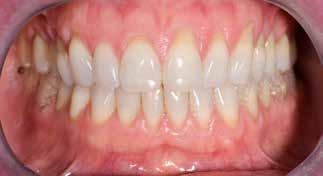
The patient we are considering is a 55-year-old woman who is a non-smoker in good health, with vestibular gingival recession in various locations and significant sensitivity. Her request was that she wanted to have a more radiant smile for her daughter's wedding photos. During the objective examination, slowly progressive stage II grade A periodontitis was diagnosed, without any loss of dental elements, and recession type 2, without any involvement of the interdental papillae and/or bone loss. Gingival recession is defined as the apical migration of the gingival margin, leaving the root of the tooth exposed and often causing sensitivity.
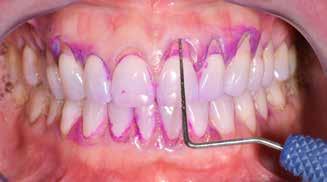
Its cause may be either physiological or traumatic, with this being determined through close analysis of the clinical case and based on the history-taking. Lifestyle, oral hygiene habits, previous illnesses, current illnesses and heredity are key factors determining correct diagnosis and selection of the most appropriate rehabilitation
treatment. The patient reported it having been proposed by the periodontist that she undergo mucogingival periodontal surgery, as per the diagnosis and the operating plan. Furthermore, home treatment was suggested, based on desensitising and remineralising products to be applied to the exposed surfaces.
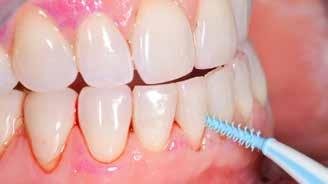
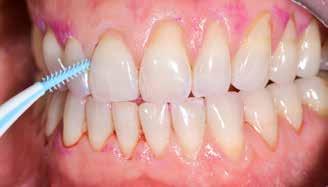
In addition, we explained the importance of following the maintenance protocols scheduled by the specialist staff and the importance of undergoing regular checkups.
The patient refused to undergo gum grafting and decided to opt for palliative support therapy, frequent check-ups and non-invasive local densensitising techniques.
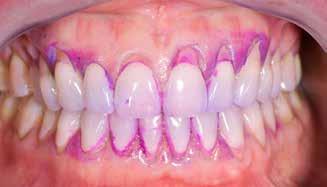
After performing the objective examination of the oral cavity and noting the clinical indices, we then moved on to the motivational approach. After applying the three-tone plaque disclosing gel, we showed the patient the topography of the bacterial biofilm and she agreed to pay close attention to the most retentive sites.
We assessed the degree of dental sensitivity by means of the air blast test and tactile stimulation, obtaining a score of 2 on the Schiff scale and 7 on the visual analogue scale.
We carried out decontamination of the oral cavity using an air polishing handpiece and subsequently removed the tartar in soft mode in order to avoid increasing the sensitivity of the exposed areas. This enabled both effective and careful movements to be performed, thereby reducing the extent of the ultrasound oscillations, notably reducing the perceived sensitivity. (mectron combi touch)
We applied a Colgate Duraphat fluoride varnish with a 5 % concentration of sodium fluoride (22,600 ppm), involving 2-3 applications of the product over a few days, until the symptoms cleared up. We arranged a follow-up appointment, giving the patient the responsibility of controlling the bacterial biofilm effectively and urging her to control her diet, avoiding acidic foods and beverages.
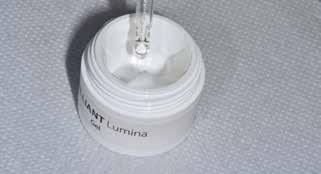
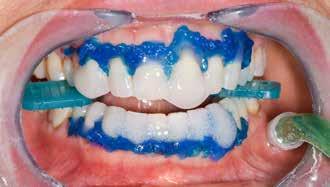
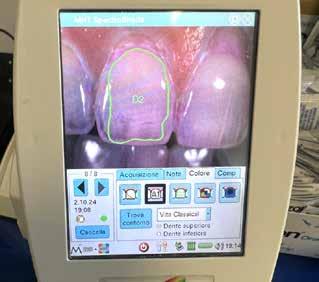
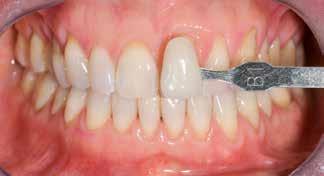
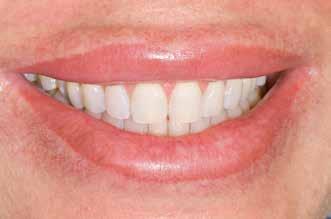
We carried out the whitening treatment, firstly determining the shade using a spectrophotometer and the VITA shade guide, documenting everything photographically. The shade identified was D2. The professional whitening technique chosen by the patient was BRILLIANT Lumina (Coltene), an innovative technology with the special feature of being free from hydrogen peroxide and/or hydrogen carbamide, as well as having a formula based on phthalimidoperoxycaproic acid (PAP). The active ingredient in PAP enables a naturally whiter smile to be achieved without causing dental sensitivity during and after treatment and without damaging the surface of the tooth, as happens with H2O2based treatments. Furthermore, the absence of peroxide provides greater comfort for the patient, making the treatment more effective and without giving rise to side effects such as post-treatment sensitivity.
In addition to greater comfort, it also provides an ideal consistency, enabling the operator to carry out better preparation and application of the gel.
Three drops of activator fluid were added to the 2 ml container of whitening gel and mixed with a spatula for 60 seconds until a uniform consistency was obtained.
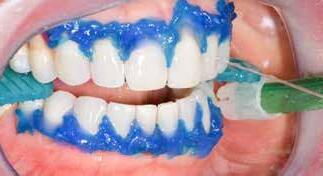
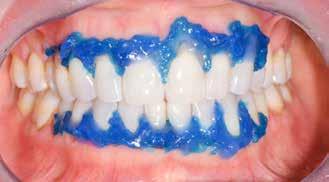
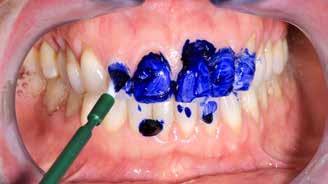
After having photopolymerised the liquid dam in order to protect the gums, we applied the product onto the tooth surfaces, carrying out 4 steps, each lasting 15 minutes, aspirating and removing the gel after each step was completed. Once the treatment was completed, we removed the residual gel and the liquid dam and, together with the patient, we viewed the end result achieved (B1). We documented the current clinical condition photographically, comparing the pre- and post-treatment photos. We recommended to the patient that she maintain proper oral hygiene routines and eating habits, limiting the consumption of teeth-staining foods in order to avoid acquired dyschromia. The patient's satisfaction with the result achieved in particular boosted her compliance, motivating her to adhere to the desensitisation protocols previously advised and the oral health and cosmetic maintenance protocols recommended at the end of the session.
We reassessed the patient 15 days after the cosmetic treatment. She reported she was satisfied with the radiance of her smile, as well as how it was perceived by her family members, and reported a clear improvement in the pain she felt when eating hot and cold foods. The Schiff scale score fell to 1, while the visual analogue scale score fell to 5.
We arranged for the patient to return for a 3-month follow-up appointment. Selecting the right technologies and personalising them based on the clinical situation is important for ensuring the success of therapies. This innovative opportunity to achieve a radiant smile using BRILLIANT Lumina (Coltene) makes it possible to meet the patient's needs which, notwith-
standing unfavourable clinical conditions, enables the appearance of their smile to be improved. Motivational techniques play a key role in achieving an effective treatment result and in ensuring consistent follow-up. Entering into a therapeutic alliance with the patient provides a means of encouraging them to change and increasing their sense of responsibility when it comes to constantly monitoring their own oral health which, as the scientific evidence suggests, also contributes to systemic health.
Bibliography:
1. Tadin A, Galić S, Gavić L. Assessment of Co- lor Change, Esthetic Perception, Treatment Sa- tisfaction, and Side Effects Following the Use of Over-theCounter Whitening Products. Acta Sto- matol Croat. 2023
2. Cantero-Gómez M, Vicente-Sanchez J, Ote- o-Calatayud MD, Piedra-Cascón W, Oteo-Mo- rilla C. Comparative Clinical Study of Two Tooth Whitening Protocols. A Randomized Clinical Trial. Part 2. Int J Periodontics Restorative Dent. 2024
3. Hernandez M. et al. Host-pathogen interactions in progressive chronic periodontitis. Journal of Dental Reserch, 2011
4. Sanz., Herrera D., Kebshull M., Chapple I., Jepsen S., Berlundh T., Sculean A., Tonetti M.S. Treatment of stage I-III periodontitis – The EFP S3 level clinical practice guideline. Journal of Cli- nical Periodontology, 2020
5. Wilson, T.G., Jr., Glover, M.E., Schoen, J., Baus, C. & Jacobs, T. Compliance with maintenance therapy in a private periodontal practice. Journal of Periodontology, 1984
6. Graziani F., Cei S., Orlandi M., Gennai S., Gabriele M, Filice N., Nisi M., D’Aiuto F. Acute-phase response following full-mouth versus quadrant non-surgical periodontal treatment: A randomized clinical trial. J Clin Periodontology 2015
7. Joiner A, Hopkinson I, Deng Y, Westland S. A review of tooth colour and whiteness. J Dent. 2008
8. Fiorillo L, Laino L, De Stefano R, et al. Dental Whitening Gels: Strengths and Weaknesses of an Increasingly Used Method. Gels. 2019